






Abstract
Background
Finger-prick sampling is an alternative strategy for monitoring immunosuppressive drug concentrations that could be useful in reducing outpatient visits. We investigated the correlation between venous and finger-prick samples in a group of adult thoracic transplant patients.
Methods
Blood samples (
Results
Between-batch assay imprecision (coefficient of variation [CV], %) for the last 12 months (
Conclusions
The liquid chromatography mass spectrometry methodology that we have developed has the potential to allow patients or their carers to collect finger-prick blood samples at home and send them to the laboratory using the routine mail service. We believe that finger-prick blood sampling has an important role to play in the care of transplant patients receiving immunosuppressive drugs, including tacrolimus.
Introduction
Regular monitoring of the immunosuppressive drug tacrolimus is necessary to tailor the therapeutic regimen in transplant recipients maintained on this drug. Blood sampling is usually performed at the time of routine clinical visits and the recommended sample type is whole blood anticoagulated with ethylenediaminetetraacetic acid (EDTA). Alternative strategies for blood sampling, such as finger-prick collection, have also been investigated for ciclosporin and tacrolimus with some success. Ciclosporin measured in a finger-prick blood sample has been shown to correlate well with venous whole blood and this approach offers the possibility of using the postal service to send samples from home to the central laboratory for analysis. 1–3 This can significantly reduce the number of clinical visits that patients and their families would normally have to make in order for drug concentrations to be monitored. In our transplant clinic, we have seen a fall in outpatient appointments of approximately 10–15% since we introduced finger-prick sampling for ciclosporin.
We have previously shown that tacrolimus in finger-prick blood correlates well with tacrolimus in venous blood taken at the same time in paediatric renal transplant patients, but we wanted to extend this work to test the correlation in adult heart and lung transplant recipients. 4
Methods
Blood samples (
For the liquid chromatography mass spectrometry (LC-MS/MS) assay, samples were prepared in a 96-deep well microtitre plate by adding 10 μL of blood to 40 μL of 0.1 mol/L zinc sulphate solution (VWR international, Lutterworth, UK).
5
Proteins were precipitated by adding 100
Results
The limit of quantitation, i.e. repeated measurement of the lowest control was 0.5 μg/L and the assay was linear up to 30 μg/L.
5
This method has been in routine use in our department for more than 5 y, and despite the perceived problems of handling such a small sample volume, it has proved to be very precise in our hands. Between-batch imprecision (CV, %) for the last 12 months (
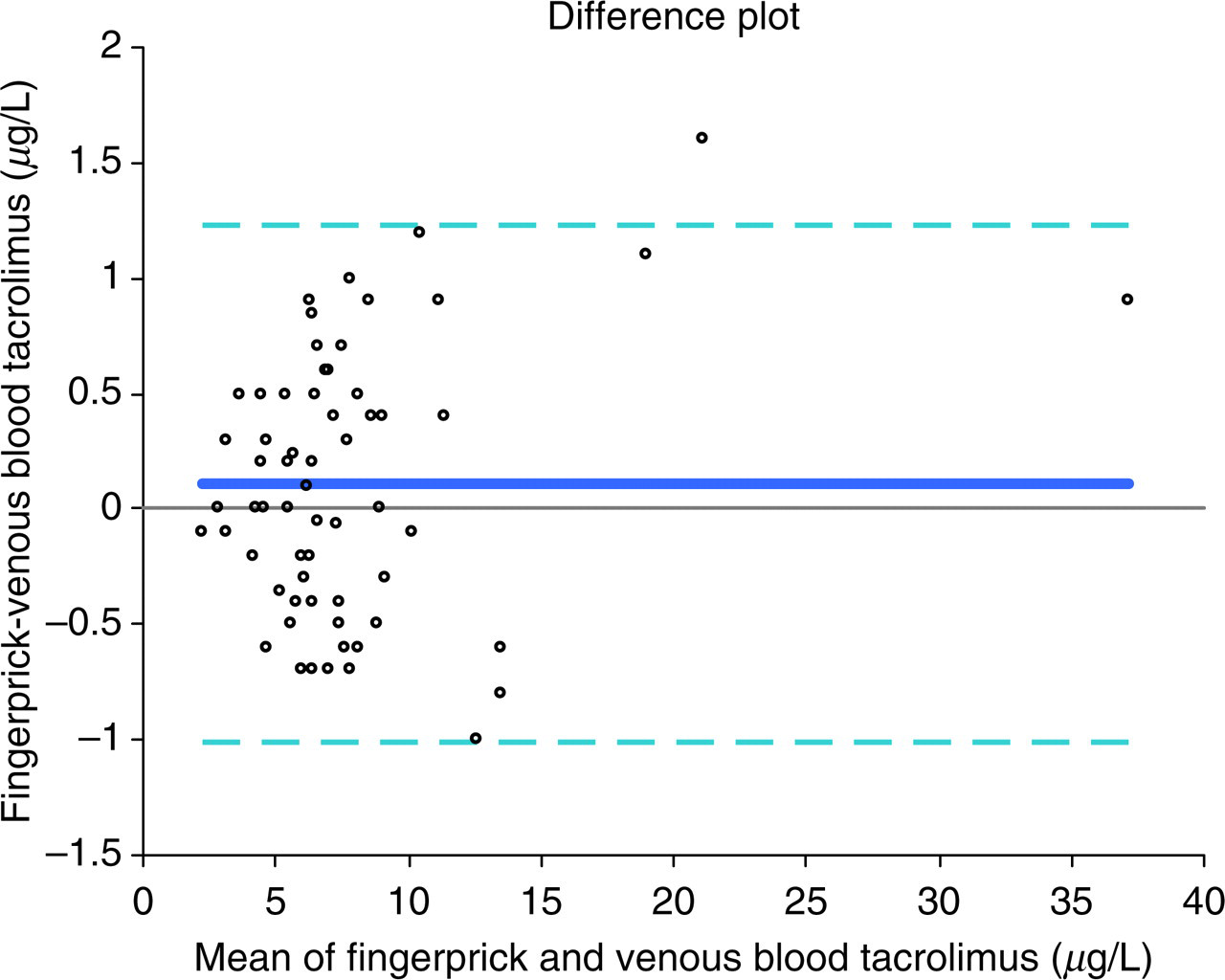
Bland–Altman plot of finger-prick tacrolimus – venous blood tacrolimus.
Discussion
Tacrolimus measurement using LC-MS/MS is becoming increasingly popular and it is now performed by approximately 22% of laboratories participating in the International Proficiency Testing Scheme (
The LC-MS/MS methodology, which we have developed, has the potential to allow patients or their carers to collect finger-prick blood samples at home and to send them to the laboratory using the routine mail service. We have tested this for ciclosporin but this still needs to be validated for tacrolimus. Home finger-prick blood sampling is already routinely performed by children and adults with diabetes mellitus. It is an easy technique to teach and uses inexpensive equipment that is widely available. We believe that finger-prick blood sampling has an important role to play in the care of transplant patients receiving immunosuppressive drugs, including tacrolimus.