




Abstract
Megaprojects involve market and nonmarket stakeholders with diverse perceptions regarding whether the project is wanted or not. This study explores how the diversity of stakeholder perceptions of megaprojects affects stakeholder engagement in a forestry megaproject. Through qualitative analysis, wanted and unwanted megaproject frames are identified. These frames create positive, negative, one-sided, and opportunistic firm–stakeholder and interstakeholder relationships, which in turn shape stakeholder engagement types: collaborative, antagonistic, passive, and compromising. The findings expose how the diversity of stakeholder perceptions shapes stakeholder engagement types and reveal darker and more stakeholder-centric approaches to engagement. Thus, understanding diversity improves stakeholder engagement in megaprojects.
Introduction
The scale and frequency of megaprojects are increasing at an accelerated pace globally. Megaprojects are “large-scale, complex ventures that typically cost US$1 billion or more, take many years to develop and build, involve multiple public and private stakeholders, are transformational, and impact millions of people” (Flyvbjerg, 2014, p. 6). They are surrounded by stakeholders who affect or are affected by megaprojects (Aaltonen et al., 2008; Eskerod et al., 2015; Freeman, 1984). These stakeholders have significant roles, and they can be valuable resources or fierce adversaries (Aaltonen et al., 2010; Morkan et al., 2023; Nguyen et al., 2019).
Megaproject stakeholders are diverse. This diversity has been generally understood as pertaining to stakeholder groups, interests, and relationships in megaprojects (Kujala et al., 2022; Mok et al., 2015; Wolfe & Putler, 2002). In this study, stakeholder diversity refers to the diversity of stakeholder perceptions of megaprojects. As stakeholders are diverse, consequently, they perceive a project through different lenses, taking even contradictory perspectives (Cuganesan & Floris, 2020; Cuppen et al., 2016; Witz et al., 2021). Project managers need to understand various stakeholder perceptions to comprehend the intricacy inherent in stakeholder diversity (Cuppen et al., 2016; Machiels et al., 2023).
Stakeholder diversity adds complexity to the megaproject stakeholder environment, also known as the project stakeholder landscape, where these groups coexist (Aaltonen & Kujala, 2016; O’Riordan & Fairbrass, 2014). Project managers navigate this diversity through stakeholder management. To manage diversity, project managers have favored stakeholder prioritization, focusing on market stakeholders such as business partners, investors, and suppliers and ignoring nonmarket stakeholders such as local communities (Corazza et al., 2023; Di Maddaloni & Sabini, 2022; Eskerod et al., 2016). Currently, project stakeholder management is experiencing a shift toward a more ethical and inclusive approach: project stakeholder engagement, which can be defined as continuous practices and relationships that shape and are shaped by the megaproject development (Aaltonen et al., 2024). Project stakeholder engagement advocates moving away from firm-centric management based on prioritization and supports greater stakeholder inclusiveness by incorporating all stakeholder voices (Aaltonen et al., 2024; Eskerod et al., 2016). However, stakeholder diversity complicates project stakeholder engagement, as project managers must deal with tensions and contradictions between the project and stakeholders, as well as among stakeholders, when engaging with all of them (Cuganesan & Floris, 2020).
A more inclusive and stakeholder-centric approach is needed to understand stakeholder diversity and how this diversity affects project stakeholder engagement. Stakeholders are diverse, and as such, there is no one-size-fits-all strategy available to engage with all (Freeman et al., 2025). Only by recognizing the differences among stakeholders, and considering all of them, can engagement be tailored to their variety for a more ethical approach (Freeman et al., 2025). Understanding the diversity inherent in the project stakeholder landscape is needed for successful stakeholder engagement, which is key to project success (Aaltonen & Kujala, 2016; Khalilzadeh et al., 2023). Project managers can thus address the complexities of engagement and ensure that it ethically reflects stakeholder diversity and promotes flexible, inclusive, and meaningful engagement processes (Buhmann et al., 2025).
Investigations into how stakeholder diversity affects project stakeholder engagement are required (Khalilzadeh et al., 2023; Machiels et al., 2023; Mok et al., 2015). The diversity of stakeholder perceptions of megaprojects and its implications for project stakeholder engagement remain particularly unexplored (Cuganesan & Floris, 2020; Cuppen et al., 2016; Machiels et al., 2023). This research is positioned at the intersection of stakeholder theory, concretely stakeholder engagement, and project management: taking project stakeholder engagement (Aaltonen et al., 2024) as a theoretical background to explore the diversity of stakeholder perceptions of megaprojects. The research question is as follows: How does the diversity of stakeholder perceptions of megaprojects affect project stakeholder engagement? To answer it, the objectives of the study are (1) to identify the frames that capture the diversity of market and nonmarket stakeholders’ perceptions of a megaproject, (2) to analyze how these frames create different firm–stakeholder and interstakeholder relationships, and (3) to explore how these relationships, in turn, affect stakeholder engagement. Empirically, this qualitative study focuses on the UPM Paso de los Toros megaproject, which involves the construction of a pulp mill in Uruguay by the Finnish forestry company UPM-Kymmene Oyj (UPM).
The contributions of this research to project stakeholder engagement are threefold. First, it highlights how the diversity of stakeholder perceptions of megaprojects works as an antecedent shaping project stakeholder engagement types. Second, it offers a more realistic view of project stakeholder engagement by identifying different engagement types, including both positive and darker approaches. Third, the study provides a more inclusive and stakeholder-centric approach to engagement by incorporating nonmarket stakeholders and interstakeholder perspectives.
The article is organized as follows: After setting the theoretical background, the article describes the UPM Paso de los Toros megaproject. Next, the empirical data are explained, together with the three-phase data analysis, and the findings are described and interpreted. Finally, the discussion covers the study’s contributions and limitations, followed by future research avenues.
Theoretical Background
Diversity in Stakeholder Theory
Stakeholder theory acknowledges a diversity of stakeholder groups and interests. Stakeholders are “any group or individual who can affect or is affected by the achievement of the organization’s objective” (Freeman, 1984, p. 46), and they include diverse groups such as shareholders, employees, customers, suppliers, investors, environmentalists, governments, media, and local communities (Freeman, 1984). Furthermore, Wolfe and Putler (2002) recognized within-group heterogeneity: Individuals within the same stakeholder group may have different priorities, and generic categorization of stakeholders is thus too vague.
As stakeholders are diverse, they show a diversity of interests in the organization too (Freeman, 1984). Organizations have the responsibility to address this variety and align the interests of different stakeholders with those of the firm (Bundy et al., 2018; Freeman et al., 2010). Managers must find a way to accommodate the diversity of stakeholder interests and find a jointness of interests over time (Freeman et al., 2010). Indeed, stakeholders are usually bound together by the jointness of their interests, and stakeholder interests are inherently connected to each other rather than opposed (Freeman, 2023). However, occasionally, companies deal with contradictory and even incompatible stakeholder interests simultaneously, and finding a joint interest becomes complex (Kujala et al., 2019; Kujala et al., 2022). These complex situations clash with the theoretical assumption of firms finding a jointness of interest among their stakeholders.
Stakeholder theory acknowledges diversity not only in stakeholder interests and within and across stakeholder groups (Freeman, 1984; Wolfe & Putler, 2002) but also in stakeholder relationships. Freeman et al. (2010) defines business as a set of stakeholder relationships, as companies have the responsibility to establish diverse long-term relationships with their stakeholders.
However, stakeholders do not exist in isolation. Interstakeholder relationships coexist with firm–stakeholder relationships, and stakeholders can collaborate or oppose each other in a complex network (Gonzalez-Porras et al., 2021a; Rowley, 1997). Companies must understand these interstakeholder interactions to comprehend stakeholder landscapes (Aaltonen & Kujala, 2016). For instance, Neville and Menguc (2006) conceptualized stakeholder multiplicity as competing, complementary, and/or cooperative stakeholder interactions based on the distinct levels of fit between their claims. Rowley and Moldoveanu (2003) identified interest overlap and common identity as drivers of stakeholder mobilization. Gray (2004) claimed that the success of stakeholder relationships depends on stakeholders having the same perceptions during a conflict; otherwise, they fail to cooperate. Thus, similarly to firm–stakeholder relationships, stakeholders collaborate when they find joint interests. However, while interstakeholder relationships have been acknowledged, research usually prioritizes dyadic firm–stakeholder perspectives.
Stakeholder Engagement
Stakeholder engagement has gained relevance in stakeholder theory as a suitable construct to explore stakeholder relationships (Kujala et al., 2022). It can be defined as organizational practices to involve stakeholders in a positive, collaborative manner in the firm (Greenwood, 2007). Research on stakeholder engagement has focused on either stakeholder relationships or engagement types (Kujala & Sachs, 2019; Lane & Devin, 2017).
First, stakeholder engagement entails diverse stakeholder relationships and interactions (Gonzalez-Porras et al., 2021b; Kujala & Sachs, 2019). Stakeholder engagement involves stakeholder identification, relationship-building among stakeholders, the alignment of stakeholder interests, internal and external communication, stakeholder dialogue, and learning with and from stakeholders (Kujala & Sachs, 2019; O’Riordan & Fairbrass, 2014).
Second, studies on stakeholder engagement have focused on engagement types based on common practices. Gable and Shireman (2005) identified the following types: track, inform, consult, support, collaborate, partner, and network. Lane and Devin (2017) identified interaction, involvement, and integration. More recently, researchers have categorized types of engagement based on intensity: Schneider and Buser (2018) and Fobbe (2023) identified low, medium, and high engagement.
To conclude, stakeholder engagement implies different stakeholder relationships and engagement types to involve stakeholders. Stakeholder engagement research calls for a stronger stakeholder orientation as well as better understanding of its darker side (Kujala et al., 2022), for instance, by exploring how stakeholder diversity challenges engagement.
Stakeholders in Megaprojects
Stakeholder theory has been widely applied in project management research, and thus, in megaprojects. Megaproject stakeholders can be defined as groups affected by the megaproject or in a position to influence it (Aaltonen et al., 2008; Eskerod et al., 2015). Their roles vary; they can positively impact the megaproject by being a source of resources and knowledge, legitimizing it, and contributing to project resilience (Aaltonen et al., 2010; Aaltonen, 2013; Buhmann et al., 2025; Eskerod et al., 2015; Morkan et al., 2023). However, stakeholders can negatively affect a megaproject by exerting opposition, leading to conflict and even project withdrawal (Aaltonen et al., 2010; Gonzalez-Porras et al., 2021a; Nguyen et al., 2019; Prno, 2013).
Project managers must establish relationships with and manage these stakeholders. However, they need to deal with a diversity of stakeholder groups, interests, and relations. To balance this diversity, prioritization has been important in managerial decisions (Eskerod et al., 2016). Organizations have focused on market stakeholders, defined as those considered essential in the project value chain, including project managers, contractors, employees, and investors (Corazza et al., 2023; Gil, 2023). This results in a narrow view of the megaproject stakeholder landscape that marginalizes other groups, and there is need for more inclusive consideration of stakeholders (Corazza et al., 2023; Eskerod et al., 2016; Freeman et al., 2025), including nonmarket stakeholders such as policymakers, unions, social movements, activists, media, and local communities (Di Maddaloni & Davis, 2017; Eskerod et al., 2016). These nonmarket stakeholders are defined as those outside the boundaries of the project value chain who can still affect the megaproject (Gil, 2023). Better inclusion of nonmarket stakeholders leads to higher chances of megaproject success (Corazza et al., 2023; Di Maddaloni & Davis, 2017; Eskerod et al., 2016).
Thus, project stakeholder management was traditionally characterized by an instrumental view lacking ethical considerations of stakeholders (Eskerod et al., 2016), but it is evolving from the “management of stakeholders” toward a “management for stakeholders” approach wherein all stakeholders deserve managerial attention (Eskerod et al., 2016). Project stakeholder management has also been firm-centric, exploring relationships from the perspective of the focal firm, and a stronger stakeholder orientation is needed (Aaltonen et al., 2024; Corazza et al., 2023; Di Maddaloni & Derakhshan, 2023; Gonzalez-Porras et al., 2021a).
Project Stakeholder Engagement
To overcome the limitations of stakeholder prioritization and firm-centricity, project stakeholder management is shifting toward project stakeholder engagement (Aaltonen et al., 2024) situated at the intersection of stakeholder theory (more precisely, stakeholder engagement) and project management.
Project stakeholder engagement can be defined as continuous practices and relationships that shape and are shaped by the megaproject development (Aaltonen et al., 2024). Project stakeholder engagement emphasizes both firm–stakeholder relationships and interstakeholder interactions as well as inclusive engagement practices (Aaltonen et al., 2024; Freeman et al., 2025; Kujala et al., 2022; Kujala & Sachs, 2019). Khalilzadeh et al. (2023) argued that megaproject success requires stakeholder engagement, and Erkul et al. (2020) examined stakeholder engagement and concluded that project success depends on maintaining relationships with stakeholders.
Thus, project managers must understand various stakeholders in the stakeholder landscape to successfully engage them and increase the chances of project success. Project stakeholder engagement takes a moral stance and calls for the inclusion of all stakeholders, especially marginalized stakeholders (Di Maddaloni & Derakhshan, 2023; Freeman et al., 2025), as well as deep recognition of interstakeholder interactions and the challenges in stakeholder engagement (Aaltonen et al., 2024; Freeman et al., 2025), such as those related to stakeholder diversity.
The problem of how project managers can engage with a diversity of stakeholders has remained unsolved, with stakeholder engagement facing difficulties when the interests of project managers and stakeholders collide (Jepsen & Eskerod, 2009). Additionally, project managers also need to reconcile diverse stakeholder interests and perceptions coexisting simultaneously, even dealing with contradictions among stakeholders (Buhmann et al., 2025; Cuganesan & Floris, 2020; Khalilzadeh et al., 2023, Mok et al., 2015). For instance, Li et al. (2012) demonstrated how stakeholders show different interests and concerns about megaprojects, and Davis (2017) explored diverse stakeholder perceptions of project success. Eskerod and Ang (2017) examined stakeholders’ different types of value constructs in megaprojects. Machiels et al. (2023) discussed stakeholder perceptions of uncertainty, and Witz et al. (2021) analyzed asymmetric legitimacy perceptions across megaproject stakeholders. Di Maddaloni and Derakhshan (2023) utilized attribution theory to explore the processes shaping stakeholders’ assessments of project fairness and their interpretations of organizational behavior. To ease conflicting situations, Ninan and Sergeeva (2022) noted that a common project narrative is essential when managing external stakeholders. Cuganesan and Floris (2020) recommended that project managers better consider the perspectives of local communities. Khalilzadeh et al. (2023) suggested that project managers must choose the engagement strategy that better adapts to stakeholders’ needs, and Di Maddaloni and Derakhshan (2023) emphasized communication as a key mediator shaping stakeholder perceptions. Ninan et al. (2024) highlighted the importance of trust-building for successful engagement with the project community. Finally, Freeman et al. (2025) suggested creative imagination and problem-based engagement to harmonize stakeholder interests.
While researchers have acknowledged stakeholder diversity and the existence of diverse stakeholder perceptions within megaprojects, there is a need for further examination of how this diversity, and especially the diversity of stakeholder perceptions of megaprojects, affects project stakeholder engagement.
Methodology
Research Context: UPM Paso de los Toros Megaproject
International forestry companies have started to relocate their activities to Latin America. UPM, a Finnish forestry company, has invested in megaprojects in Uruguay, attracted by the country’s political stability and the Bilateral Agreement on the Promotion and Protection of Investments between Finland and Uruguay (World Trade Institute, 2002). UPM has operated the Fray Bentos pulp mill, located by the Uruguay River, since 2009 (Gonzalez-Porras et al., 2021a). Recently, UPM completed the construction of its second pulp mill in Uruguay, UPM Paso de los Toros (UPM2), located in the center of the country by the Negro River.
The UPM2 megaproject consisted of the construction of the pulp mill and its required infrastructure. It was simultaneously wanted and unwanted. Based on studies conducted between 2016 and 2020 in Uruguay, public opinion was divided: Fifty-six percent of respondents supported the megaproject, 26% opposed it, and 18% were neutral or had no opinion (UPM Pulp, n.d.).
This megaproject is worth examining. First, it brings forth an intense interplay of radical support and opposition, with few neutral actors. Second, stakeholder involvement in the megaproject allows for an examination of numerous nonmarket stakeholders typically neglected (Di Maddaloni & Sabini, 2022; Eskerod et al., 2016). Third, UPM2 allows the exploration of a megaproject in a developing country. Megaproject research has concentrated on developed countries (Damayanti et al., 2021; Mok et al., 2015), and while developing countries attract numerous megaprojects, related research is lacking (Damayanti et al., 2021; Mok et al., 2015).
The UPM2 megaproject started in 2019, as soon as the final investment agreement was made official (UPM Uruguay, 2019). It is considered a megaproject due to its investment of US$3.47 billion (UPM Uruguay, 2023), its impact on a variety of stakeholders in diverse ways and intensities, and its complexity involving separate infrastructure projects: The government of Uruguay agreed to renovate the country’s Central Railway, and UPM committed to building a terminal port at Montevideo to export cellulose to global markets (UPM Uruguay, 2019). Construction of the mill was completed in 2023, and it started operations in April of that year (UPM Uruguay, 2023).
The UPM2 megaproject was supported for its economic and social impacts. For instance, it involved an investment of US$3.47 billion in Uruguay, resulting in the Uruguayan gross domestic product increasing by 2%; it created approximately 7,000 direct and indirect jobs within UPM’s forestry value chain; and the company pays approximately US$170 million in annual taxes and social security payments (CPA Ferrere, 2017; UPM Uruguay, 2019, 2023). Additionally, UPM2 has diversified Uruguay’s economic matrix, traditionally based on livestock, and includes community development side projects to support Uruguay’s less-developed central region through educational and social projects led by the UPM Foundation (CPA Ferrere, 2017; UPM Forestal Oriental, 2023; UPM Uruguay, 2018). Nonetheless, it raised concerns and opposition. First, the investment made by the government to cover the infrastructure requirements was considered too large, and stakeholders criticized how the government invested public funds to satisfy the needs of a private company, as UPM has priority use of the railway (Bacchetta et al., 2019). Second, opposition was based on environmental concerns. Opponents fear the Negro River will be polluted and, as the mill requires a water flow to operate, they claim that the water level will be controlled by the firm with natural resources in private foreign hands (Bacchetta et al., 2019). Stakeholders also have concerns about the expansion of eucalyptus plantations, owned by UPM, leading to land appropriation by a foreign company and a long-term impact on the soil (Recoba & Pena, 2020). Finally, opponents consider UPM’s influence on education and society too strong and as affecting Uruguay’s sovereignty (Bacchetta, 2021; Bolon, 2021).
Despite its uniqueness, the megaproject remains unexplored, with studies only exploring its social acceptability (Ehrnström-Fuentes & Kröger, 2017) and Finnish viewpoints on forestry in Uruguay (Jokinen, 2024; Kurki, 2018). Thus, it represents a remarkable context, as both wanted and unwanted, to explore the diversity of stakeholder perceptions of megaprojects.
Research Data
Qualitative data were collected about UPM2 in 37 interviews with key stakeholders, conducted by the author in 2020 and 2021 and covering the period of higher intensity in the construction of the mill and its required infrastructure. Data collection was conducted during a research visit to Uruguay, which allowed the author’s total immersion into the megaproject and its stakeholder landscape and the development of firsthand, on-site knowledge.
The stakeholders were identified through purposive snowball sampling to ensure the identification of information-rich participants (Emmel, 2013). They included UPM partners, university representatives and researchers, media representatives, government representatives, union representatives, environmental movement actors and nongovernmental organizations (NGOs), social movement actors and NGOs, and local communities. UPM managers were also included. These stakeholders were chosen due to their high involvement in the megaproject. While there is a minority of neutral stakeholders who deserve recognition (UPM Pulp, n.d.), they were not considered, as the purpose of the study was to explore the interplay of radical support and opposition so distinctive in the megaproject. Some participants belonged to several stakeholder groups simultaneously. For instance, one (P25) was a government representative who belonged to environmental and social movements. Table 1 shows the different stakeholders, categorized as market and nonmarket stakeholders.
Stakeholders Interviewed
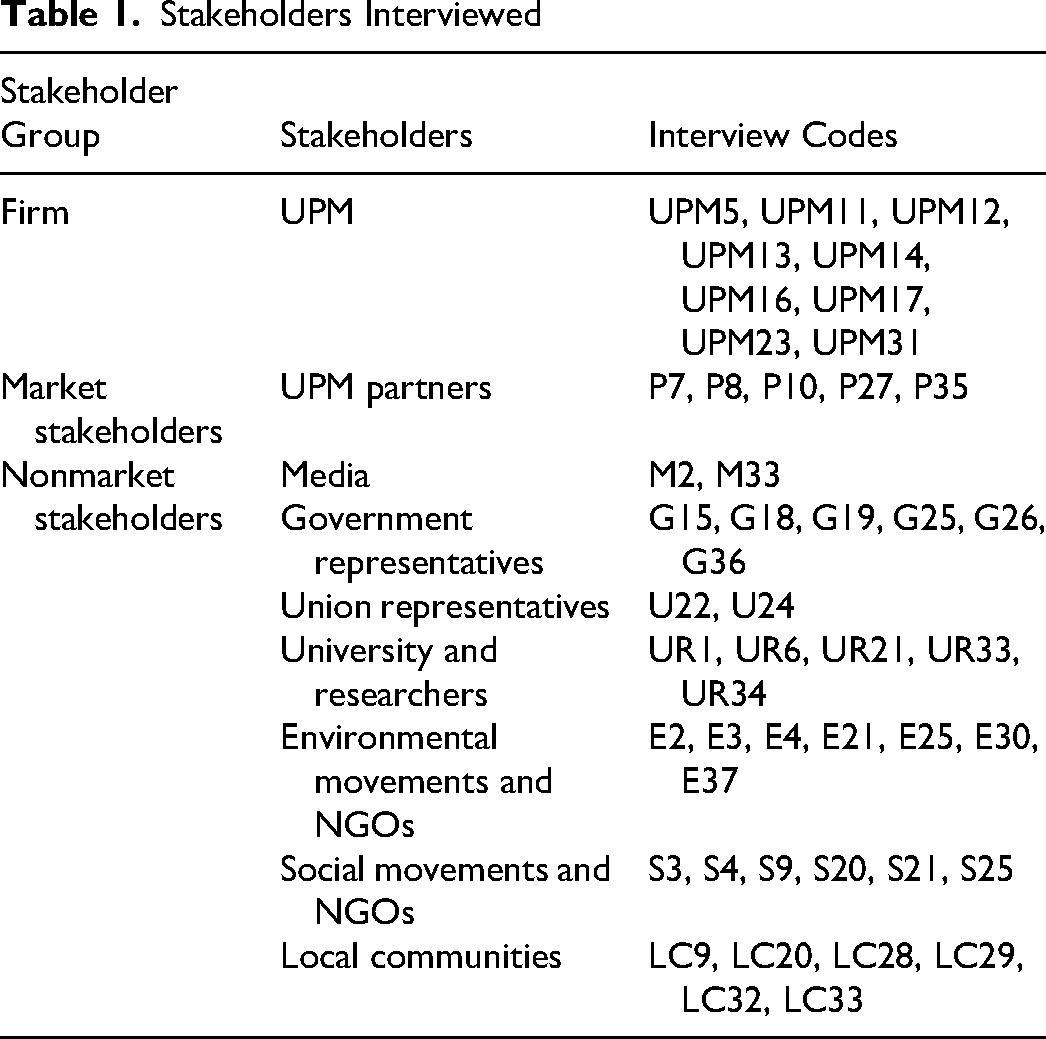
After obtaining a participant’s informed consent, the interview was conducted either online or face-to-face over approximately 2 hours. Most interviews were conducted in Spanish, with two conducted in English. The interviews were semistructured, including open questions based on the conversation to understand how the interviewee made sense of their perceptions, experiences, and relationships within the megaproject (Eriksson & Kovalainen, 2015). The interview guide included: (1) introductory questions; (2) questions about the stakeholder’s own description of the megaproject; (3) questions about the stakeholder’s relationships with the firm and other stakeholders; (4) questions about public opinion; (5) questions about the stakeholder’s involvement in the UPM Fray Bentos megaproject; and (6) final conclusions. All interviews were recorded and transcribed by the author, who also translated into English the quotes included below.
Data Analysis
Data were analyzed using qualitative methods. Laplume et al. (2008) suggested that qualitative studies, especially those using interviews and direct observation of stakeholders, provide a better understanding of the dynamics behind stakeholder relationships. Figure 1 shows the research structure, including three phases of data analysis.
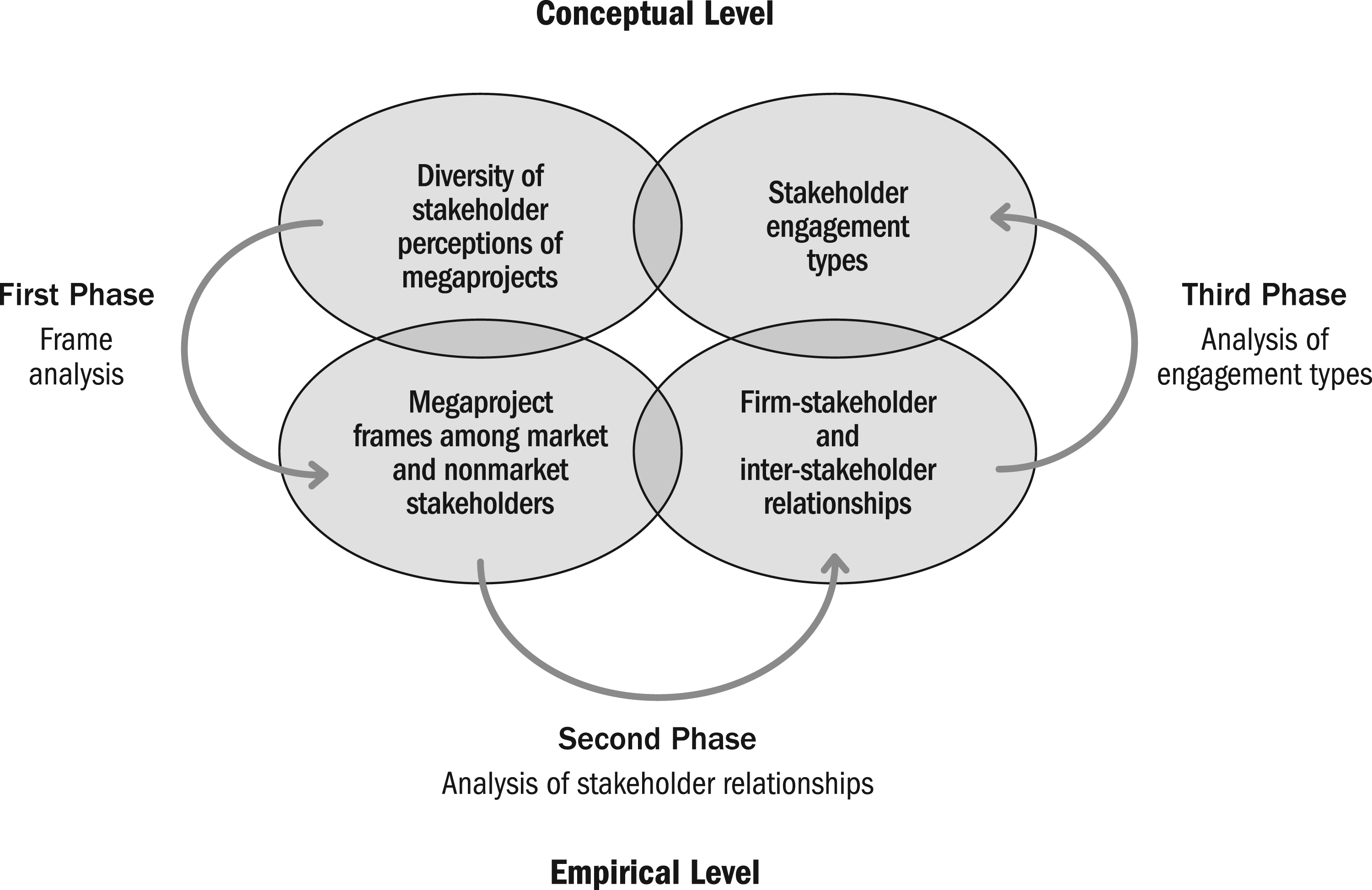
Research structure.
First Phase: Frame Analysis
This research analyzes the diversity of stakeholder perceptions of megaprojects through frames. Thus, in this first phase, frame analysis was performed on stakeholder perceptions. Frame analysis is an appropriate tool to explore diversity in the stakeholder landscape: Stakeholders utilize frames to interpret the context they are involved in (Creed et al., 2002), in this case, a megaproject. Additionally, recognizing the frames stakeholders utilize leads to better understanding of the dynamics of stakeholder relationships (Lehtimäki & Kujala, 2017).
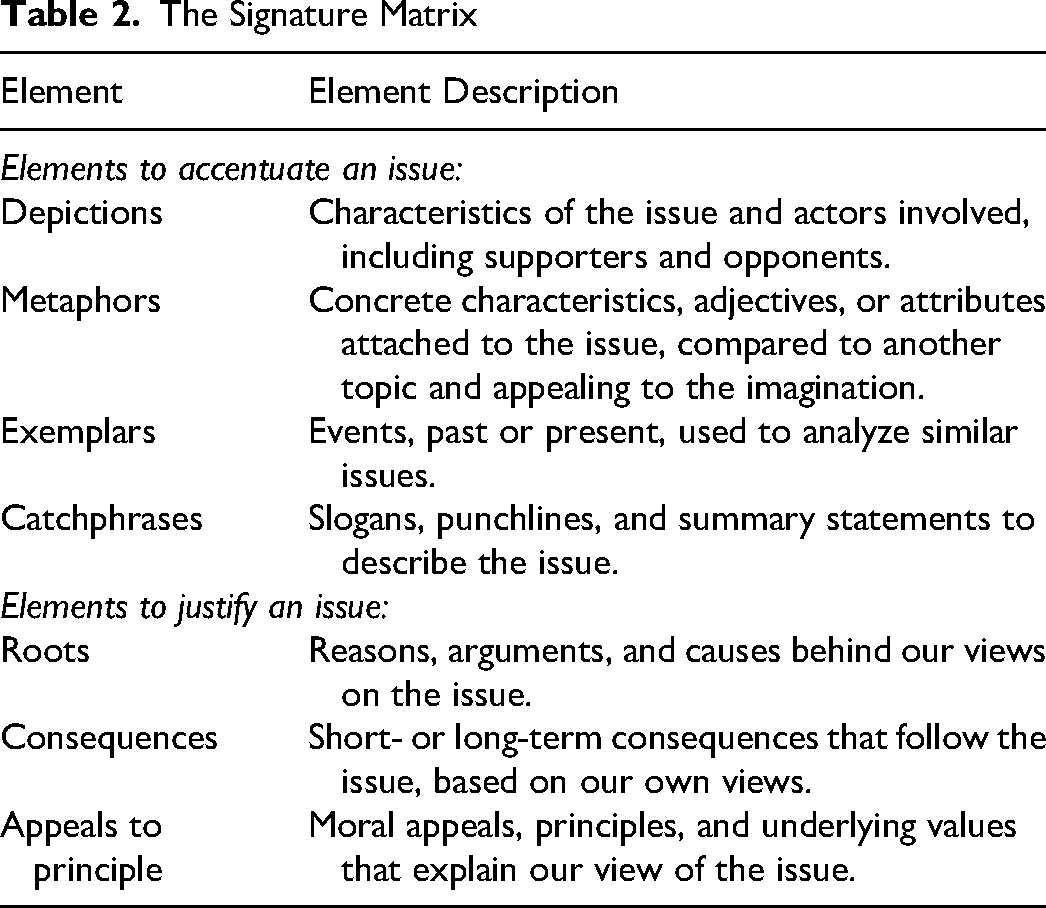
A framework developed by Gamson and Lasch (1983) was used: the signature matrix, which includes framing and reasoning elements. Framing elements provide a tool to interpret and accentuate an issue, including depictions, metaphors, exemplars, and catchphrases. Reasoning elements provide arguments that justify our position respecting an issue, including roots, consequences, and appeals to principle (Gamson & Lasch, 1983). The signature matrix can identify connections and patterns among these elements, leading to the identification of umbrella frames that hold them together (Creed et al., 2002). Thus, every frame is associated with a distinctive signature of elements connected to each other (Azad & Faraj, 2013).
The signature matrix has been used in social and political sciences. For instance, it has been utilized to identify different interpretations of American social welfare policy (Gamson & Lasch, 1983), to understand different meanings of socially responsible investing (Creed et al., 2002), to explore competing cultural meanings about the fat body (Kwan, 2009), to analyze stakeholder perspectives during the implementation of information systems (Azad & Faraj, 2013), to recognize different perspectives of materiality in sustainability reports (Puroila, 2015), to explore communication on health in the fast-food industry (Ban, 2016), to examine different media understandings of athlete philanthropy (Babiak & Sant, 2020), and to uncover firms’ procedural frames to cope with uncertainty in environmental policies (Reuter & Überbacher, 2025). However, it has not been used in stakeholder theory or project management, making its applicability interesting. The signature matrix is described in Table 2, adapted from Gamson and Lasch (1983), Kwan (2009), and Azad and Faraj (2013).
The Signature Matrix
The frame analysis of the interview transcriptions was conducted in five steps supported by ATLAS.ti software.
In the first step, the transcriptions were analyzed in the light of the different elements of the signature matrix. A file for each element of the matrix was created in ATLAS.ti, including representative quotes. Figure 2 shows how many representative quotes were included per element. For instance, the element “depictions” included 917 representative quotes.
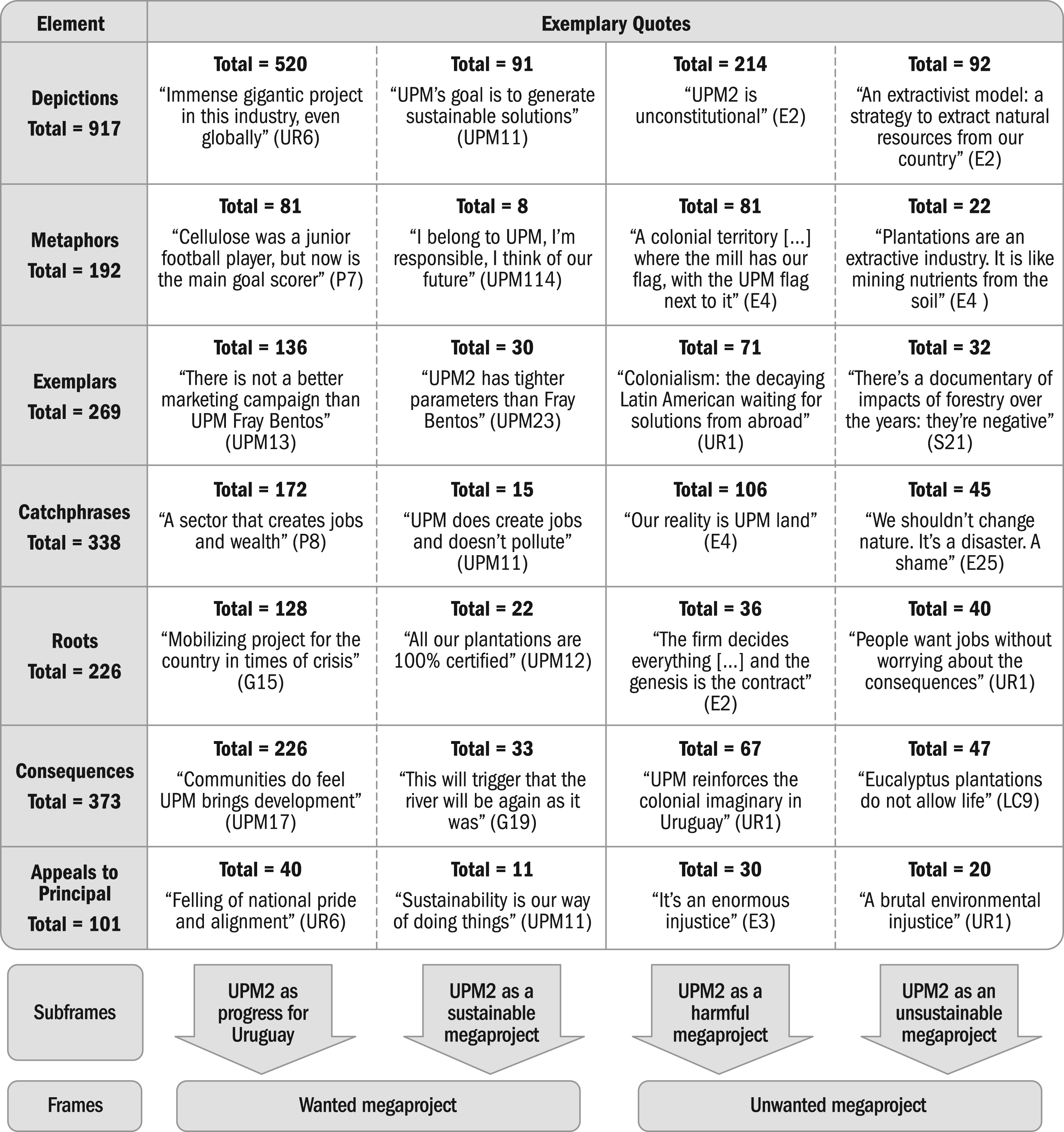
Excerpt from frame analysis.
In the second step, the analysis focused on the elements, and the representative quotes of each element were read. This resulted in the identification of two positions to perceive the megaproject coexisting within all the elements: stakeholder perceptions supporting the megaproject and stakeholder perceptions opposing it.
In the third step, the analysis examined the stakeholder perceptions supporting or opposing the megaproject separately, aiming to identify the reasons for this support and opposition. The representative quotes showing support for the megaproject within each element were read a second time to identify the reasons stakeholders supported it, which included (1) economic and social progress in Uruguay and (2) environmental protection. As a result, within the element “depictions,” 520 quotes were identified describing the project as economically positive and 91 were identified describing it as sustainable. Similarly, the representative quotes showing opposition to the megaproject within each element were read a second time to determine the reasons stakeholders opposed it, which included (1) negative social and economic impacts and (2) negative environmental impacts. As a result, within the element “depictions,” 214 quotes were identified describing the megaproject as harmful for Uruguay and 92 considered it unsustainable.
In the fourth step, the reasons that explicated either stakeholder support or opposition were considered subframes, as they contained a distinctive signature of connected elements (Azad & Faraj, 2013). These subframes were grouped based on supportive or opposing perceptions of the megaproject, revealing the final umbrella frames (Creed et al., 2002) of the megaproject: the “Wanted Megaproject” and “Unwanted Megaproject” frames.
In the fifth step, these frames and subframes were allocated between the UPM2 stakeholders. This final step allowed for further exploration of stakeholder relationships based on the frames in the second phase of analysis.
Figure 2 shows an excerpt from the frame analysis, providing a summary of exemplary quotes for each element of the signature matrix, and illustrating how those elements lead to the final subframes and frames.
Second Phase: Inductive Qualitative Content Analysis of Stakeholder Relationships
Next, the analysis focused on identifying stakeholder relationships, and an inductive qualitative content analysis (Vears & Gillam, 2022) was performed. Qualitative content analysis aims to reduce texts to specific categories based on codes to find patterns that describe the phenomenon (Bengtsson, 2016). Using ATLAS.ti, the analysis inductively identified stakeholder relationships depending on the frames the firm and the stakeholders employed. The analysis followed five steps to identify firm–stakeholder and interstakeholder relationships in the following situations: When the actors shared the same frame, when they partially shared a frame, and when they applied opposing frames.
In the first step, the stakeholders involved in each situation were identified. In the second step, in ATLAS.ti, data extracts of meaning units describing stakeholder relationships for each situation were recognized from the transcriptions. In the third step, for each situation, the meaning units were inductively labeled in ATLAS.ti through open coding, using codes in the shape of keywords or relevant descriptions of the relationships. In the fourth step, the meaning units and codes were reread, and codes with similar content were grouped together. In the fifth step, the groups of similar codes were classified into categories, which were named using content-characteristic words, revealing the final stakeholder relationships for each situation.
Figure 3 illustrates the inductive content analysis conducted to identify firm–stakeholder relationships. For instance, the firm and environmental organizations were identified as actors who applied opposing frames. From the transcriptions, 58 representative quotes were identified as meaning units describing relationships where the firm and stakeholders applied opposing frames. These included 42 codes, such as “opposition,” “distrust,” “silence,” “negotiation,” “intermediary,” and “independent.” Groups of similar codes were created and classified into categories. For instance, codes such as “opposition,” “silence,” and “distrust” were combined into the category “negative.” Codes such as “negotiation,” “intermediary,” and “independent” were combined into the category “opportunistic.” The process was repeated for situations where the firm and stakeholders shared or partially shared a frame.
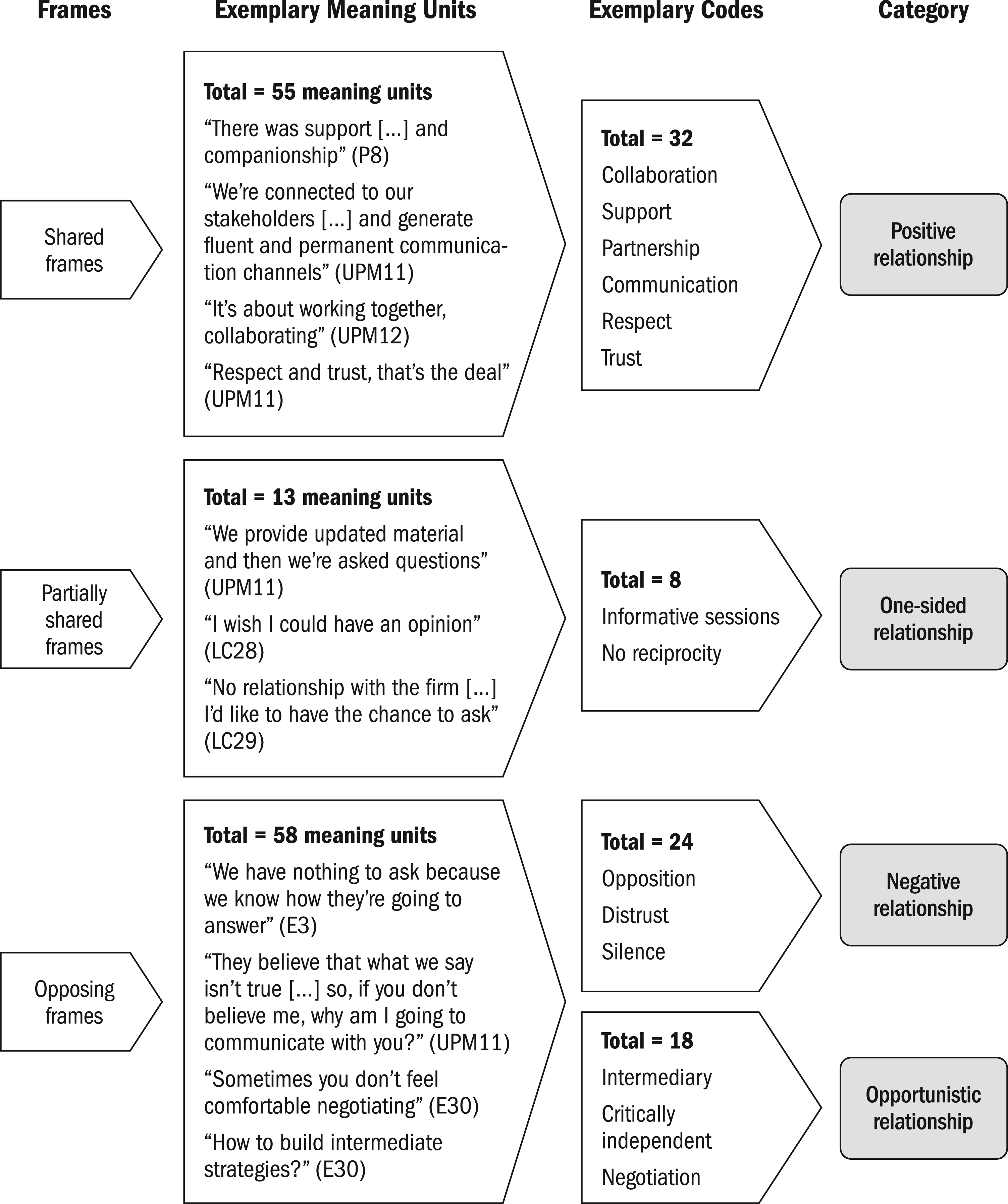
Excerpt from inductive content analysis of firm–stakeholder relationships.
The inductive content analysis was repeated, in the same manner, to identify interstakeholder relationships (Figure 4).
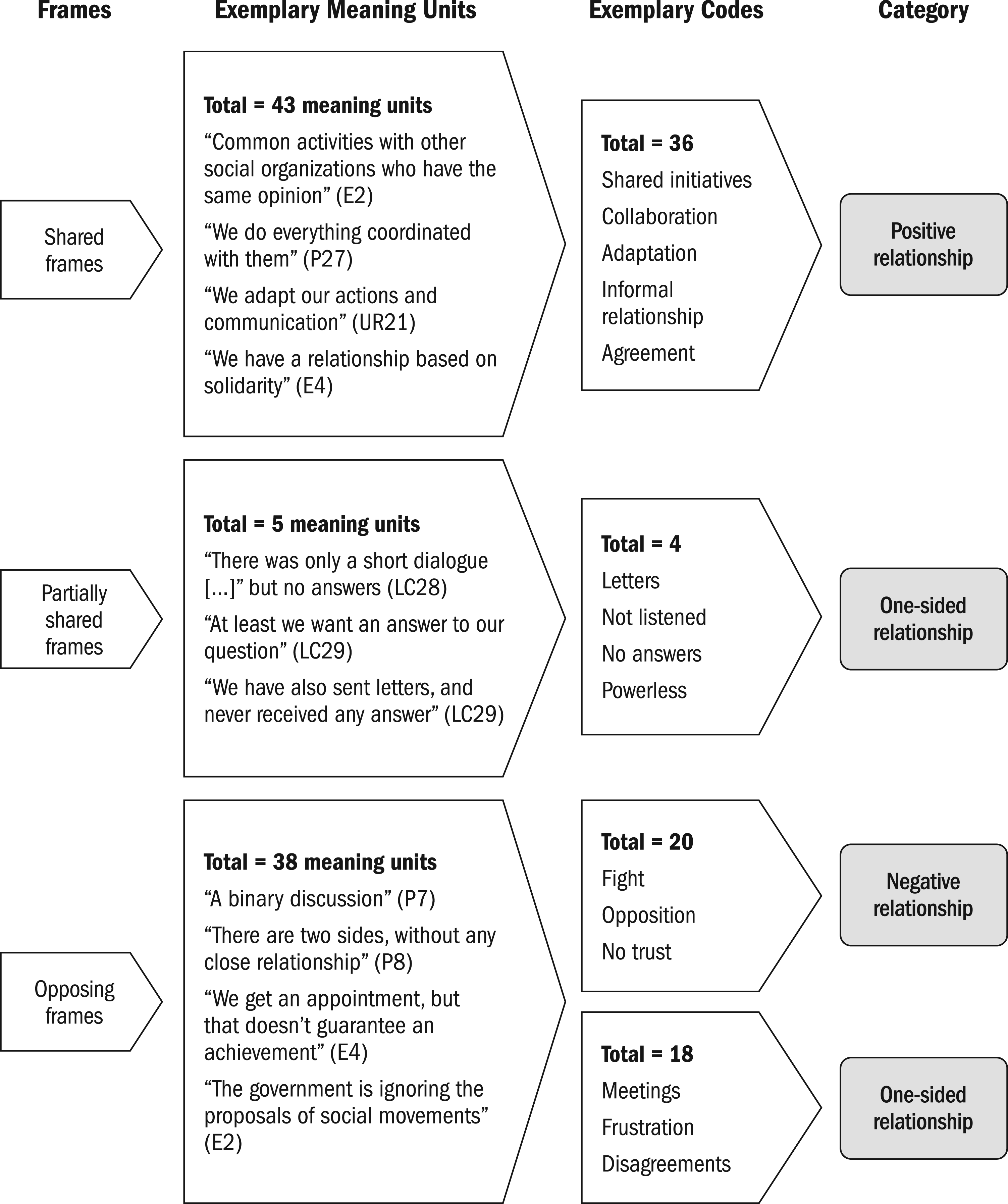
Excerpt from inductive content analysis of interstakeholder relationships.
Thus, and taking the frames firms and stakeholders employed as a starting point, firm–stakeholder and interstakeholder relationships were identified and classified as positive, negative, opportunistic, or one-sided.
Third Phase: Analysis of Stakeholder Engagement Types
Finally, the analysis focused on how the firm–stakeholder and interstakeholder relationships shaped different stakeholder engagement types. These were labeled building on work by Bundy et al. (2018), who examined organization–stakeholder (mis)fit and the resulting relational behaviors such as cooperation, compromise, and conflict. They recognized that low levels of (mis)fit lead to passive disengagement and apathy, resulting in null firm–stakeholder relationships, though the concept was not explored. Using this categorization as inspiration, the resulting engagement types were classified as collaborative, antagonistic, compromising, or passive.
Findings
The findings are presented in three subsections. First, the megaproject frames and subframes are described. Second, the stakeholder relationships are explained. Third, stakeholder engagement types are examined. The findings are illustrated using “power quotes” from the data (Pratt, 2008). Each subsection concludes with a synthesis where the findings are discussed in relation to the literature.
Megaproject Frames
After the signature matrix was applied, the “Wanted Megaproject” and “Unwanted Megaproject” frames were identified. Each included two explicative subframes. The “Wanted Megaproject” frame included “UPM2 as a Sustainable Megaproject” and “UPM2 as Progress for Uruguay.” The “Unwanted Megaproject” frame included “UPM2 as an Unsustainable Megaproject” and “UPM2 as a Harmful Megaproject.” Figure 5 shows the “Wanted Megaproject” and the “Unwanted Megaproject” frames, as well as their subframes.

Frame and subframes within the UPM2 megaproject.
The Wanted Megaproject Frame
The “Wanted Megaproject” frame was utilized to support the megaproject. The subframes “UPM2 as Progress for Uruguay” and “UPM2 as a Sustainable Megaproject” explain the reasons the megaproject was perceived as wanted.
The subframe “UPM2 as Progress for Uruguay” described the megaproject as “the most important private investment in the history of Uruguay” (UR6). UPM2 was perceived as a “transformative project in various aspects: improving infrastructure, developing people’s capabilities, strengthening the forestry value chain in the country, and supporting small Uruguayan companies” (UPM13) and as a “mobilizing project for the country […] with high impact on social, educational, economic, and environmental aspects, as well as infrastructure and communications” (G15). UPM was perceived as “an emblem for Uruguay: we’re a small country capable of attracting big investments” (UR6) and as an “economic miracle” (S20). This image was supported by the previous Fray Bentos mill, considered “the main cover letter to support this second project […] and the main factor generating trust” (UR6). The role of the megaproject in the development and growth of the center of Uruguay was highlighted too. Per UPM11, “when you visit the communities and go inland, of course [UPM2] changes lives.” The stakeholders emphasized how “forestry is a sector that […] provides quality jobs and generates wealth” (P8). The megaproject was perceived as a “generator of good synergies, […] a project that opens doors and stimulates positive outcomes” (P8) and “sheds prosperity” (UR6) through a “multiplying effect, generating jobs in the communities where UPM operates” (P7).
In the subframe “UPM2 as a Sustainable Megaproject,” UPM is described as “a company that acts in a sustainable responsible way and has a good reputation achieved through actions that go beyond words” (UPM11). Consequently, stakeholders were “confident about UPM being a responsible company in terms of environmental management” (UR6), as the firm applies the “best practices in environmental assessment […] being strongly controlled at environmental levels” (UPM23). UPM Fray Bentos worked as best evidence, as “after 30 years operating in Uruguay, public studies confirm the pulp mill is not polluting the environment” (UPM13). Forestry was perceived as a sector where production is pursued “in a sustainable, clean and organized way, respecting all existing regulations” (P8). Furthermore, UPM’s plantations are certified by the Forest Stewardship Council and the Programme for the Endorsement of Forest Certification, as P10 noted. The stakeholders were confident there would be “better water management on the river” (P27), as UPM had conducted “studies on the river water quality, on the soil surrounding the river, and air quality […] as the pulp mill needs these data before starting operations” (LC20).
The Unwanted Megaproject Frame
The “Unwanted Megaproject” frame was utilized to oppose the megaproject. The subframes “UPM2 as a Harmful Megaproject” and “UPM2 as an Unsustainable Megaproject” explain the reasons the megaproject was opposed and perceived as unwanted.
The subframe “UPM2 as a Harmful Megaproject” described UPM2 as a “colonial factory […] where [UPM] decide the law, they pay no taxes, and they don’t have the restrictions imposed on the Uruguayan population” (E4). The firm was considered an “authoritarian actor” (E2) “imposing itself with the overwhelming strength of its economic power” (E3). Consequently, the population was “living under the dictatorship of UPM” (E3). The investment agreement between UPM and the government was defined as an “abusive contract” (E3) that “leaves only breadcrumbs” (LC9), involving “commitments that negatively affect the institutional system of Uruguay” (E2). Consequently, the megaproject “reinforced the colonial imaginary [sic] of Uruguay” (UR1), “making us understand that we, Aboriginals, must accept the colony, as the colony is good and helps us” (E4). Additionally, the economic incentives provided by the government to forestry were criticized for creating a situation of “total privilege for this sector in comparison to traditional industries such as cattle-raising” (E2). The location of the pulp mill in a “free zone, thus not leaving any profits in the country” (E2) was considered problematic, as was UPM’s priority use of the railway.
In the subframe “UPM as an Unsustainable Megaproject,” UPM2 was perceived as an “extractivist megaproject” (E37) where the goal is “extracting our natural resources such as the fertility of our soil and our water […] to grow their own trees and, afterward, export those trees to a free zone” (E2). The megaproject was considered “neither ecological nor sustainable […] as in reality, all pulp mills are problematic in terms of environmental impact” (S21) and “an aggression on the environment and the climate” (LC9). For instance, E25 claimed that “they [the firm] steal your natural resources and people accept it just for a few jobs […]; Uruguay is giving away our water for free, and they give us back polluted effluents.” Forestry was criticized for creating “a change in the original landscape of Uruguay” (E4), and the UPM plantations were defined as “green deserts” (UR1). The expansion of forestation was considered a threat, replacing the Uruguayan ecosystem with eucalyptus plantations, and with the “countryside being completely empty and deserted” as a consequence (UR1). Thus, the UPM2 megaproject was expected to “have an environmental impact higher than acceptable” (E4). LC9 claimed that “the people who support this project do so because they don’t swim in the Negro River.”
Synthesis of the Megaproject Frames
The frames “Wanted Megaproject” and “Unwanted Megaproject” present a frame controversy, as they offered competing and opposing perceptions (Ascui & Lovell, 2011). The controversy can be explained by the megaproject’s uniqueness, with stakeholders presenting radical views of support and opposition. A UPM manager perfectly describes it: “UPM is the monster and God […] they see the company as both things, like an ambiguity” (UPM31).
The frames and subframes were allocated to every stakeholder. Table 3 shows the different frames and subframes assigned to each stakeholder. For instance, the “progress” and “sustainable” subframes represented UPM’s and market stakeholders’ perceptions appropriately, while “harmful” and “unsustainable” subframes represented environmental movements best.
Megaproject Frames and Subframes Assigned to Stakeholders
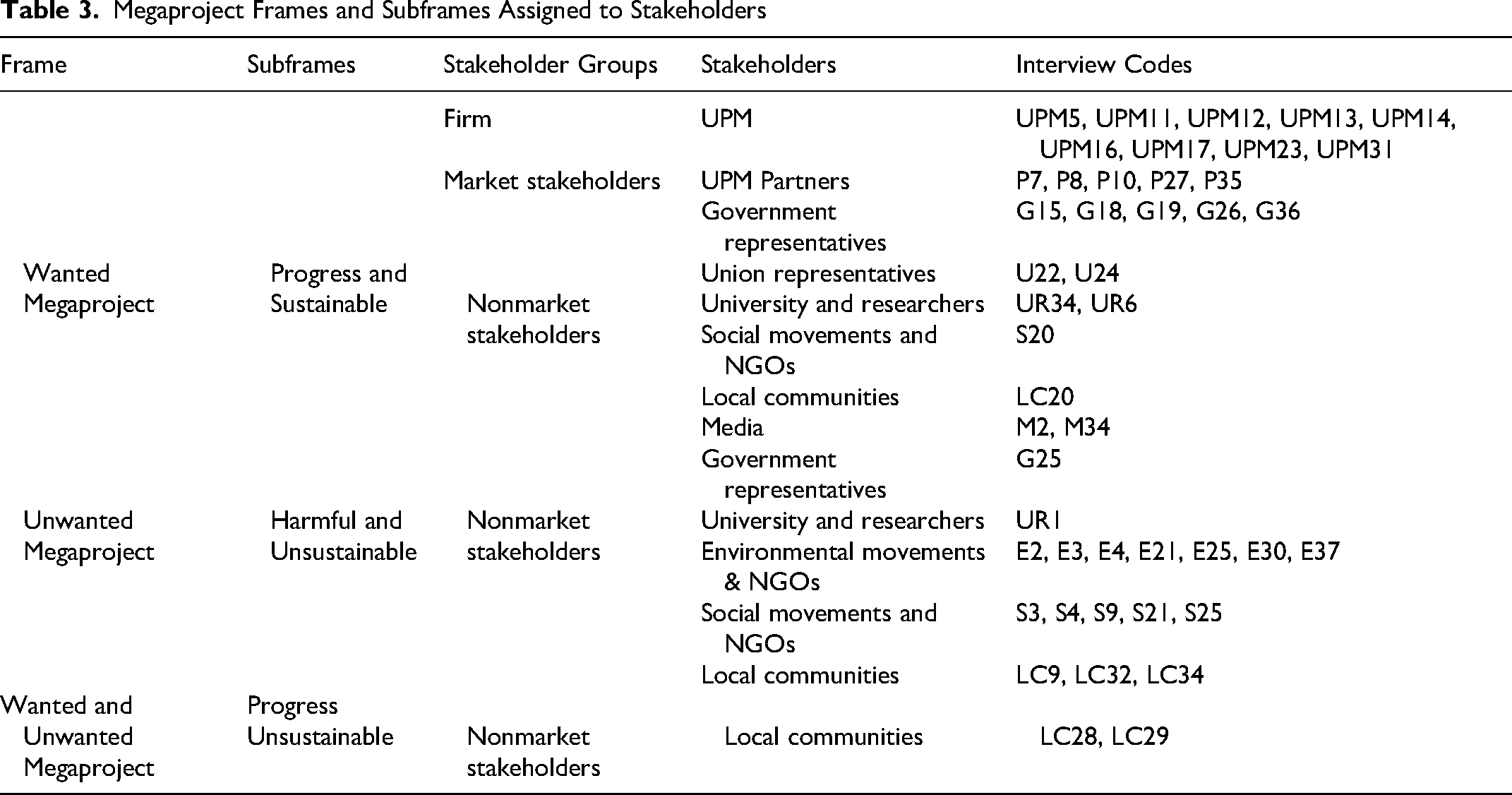
The results of the frame analysis show how the frames vary considerably among the stakeholders and indicate a complex stakeholder landscape. Its complexity is even greater when nonmarket stakeholders are included. For instance, while some local communities employed the “Wanted Megaproject” frame, others referred to the “Unwanted Megaproject” frame, with participants LC28 and LC29 even understanding the megaproject as both “wanted” based on its possibilities and as “unwanted” due to its unsustainability. Classifying stakeholders based only on the role they play and the group they belong to thus involves a risk of not properly recognizing their diverse nature (Wolfe & Putler, 2002). Identifying stakeholders based on the frames they employ permits a more precise understanding of stakeholders, better recognizing diversity among and within stakeholder groups.
Stakeholder Relationships
Based on the frames employed, various firm–stakeholder and interstakeholder relationships were identified. Firm–market, firm–nonmarket, and interstakeholder relationships were described when the actors shared or partially shared a frame or applied opposing frames.
Firm–Market Stakeholder Relationships
Firm–market stakeholder relationships resulted from the firm and market stakeholders sharing the frame “UPM2 as a Wanted Megaproject.” The emerging relationships were positive. The main example involved the relationships between the firm and its business partners. These were described as “fluid formal communication” (P34) where actors “get deeply involved […] and work side by side” (P7). P8 stated that “there is a common vision: everyone should win. […] There’s a spirit of collaboration without impositions, a consensus […] with solutions we bring about together.”
Firm–Nonmarket Stakeholder Relationships
Firm–nonmarket stakeholder relationships were identified when (1) the firm and nonmarket stakeholders shared the frame “UPM2 as a Wanted Megaproject”; (2) they partially shared the subframe “UPM as Progress”; and (3) they applied opposing frames, meaning UPM2 as a “Wanted Megaproject” and as an “Unwanted Megaproject.”
When a frame was shared, the emerging relationships were positive. One example is the relationships between the company and government representatives. These were described as “fluent, professional and transparent” (UPM11), “constant and permanent” (UPM13), where “communication is key” (UPM14) “to facilitate knowledge, facilitate information, and listen” (UPM11). The relationships were “respectful of everyone’s roles” (G36) and “based on plenty of dialogue […] and lots of negotiations” (U22). Occasionally, in the words of G15, “not all is sweet love […] but we found open doors and strong support from the company.”
When actors partially shared a frame, the resulting relationships were one-sided. The main example was the relationship between the firm and some local communities. UPM11 highlighted how the company offered “information sessions, […] a space to exchange information.” However, these opportunities were not received by some stakeholders who lacked the resources to engage. Some local communities felt they “were never called for a meeting to share our thoughts” (LC28). They claimed they were not recognized because “we’re not a formal organization” (LC29), so “maybe [UPM] doesn’t know […] that there are families living from the river” (LC29). These groups declared they “know nothing about technologies, […] how would I know which days they organize those information meetings?” (LC29).
When the firm and nonmarket stakeholders applied opposing frames, the resulting relationships were negative. The main example was the relationships between the firm and environmental movements. These were described as “a position against another position” (UPM11). E3 claimed that “every interaction we had with the company was based on confrontation.” The relationships were based on a “permanent dismissive attitude,” and “when there is a relationship based on opposition and not on building something together, then it gets complicated” (UPM11), and “then we simply agree to disagree” (UPM12). However, when the actors applied opposing frames, there was potential for an opportunistic relationship. The main example was the relationship between the company and one environmental organization (E30). It consisted of “agreements on biodiversity issues” (UPM13) that involved “consultation on the management of conservation areas” (UPM16). Within this relationship, the actors were self-interested: UPM had “interest in improving [its biodiversity management] but there was also an interest to publicly show cooperation with an environmental organization […] with stronger emphasis on image than content” (E30), whereas the environmental organization aimed to “define the standard for other industry companies to comply with” (E30). The relationship was described as a “philosophically controversial cooperation […] taking an awkward position as a mediator” even though they had “lost the illusion of having an influence in [UPM’s] decisions” (E30).
Interstakeholder Relationships
Interstakeholder relationships were identified when (1) stakeholders shared the same frame, either “UPM2 as a Wanted Megaproject” or “UPM as an Unwanted Megaproject”; (2) stakeholders shared only the subframe “UPM as Progress”; and (3) stakeholders applied opposing frames: “UPM2 as a Wanted Megaproject” and “UPM as an Unwanted Megaproject.”
When stakeholders shared the same frame, the resulting relationships were positive. One example was the relationships between environmental and social movements. These were described as “mature […] and based on respect and loyalty” (P8). The relations emerged “between compatible stakeholders” (E4), as “the same problem brings us together” (LC9), so they “prefer that [support] to creating divisions among the groups” (E3). Per LC9, “if we’re all fighting for the same, it’s more effective to join forces.”
When stakeholders partially shared one frame, the resulting relationships were one-sided. The main example was the relationships between some local communities and the government. In these situations, when one stakeholder initiated a relationship, the actor was ignored by the other. For instance, LC29 recalled “sending letters to the government” and claimed they were “never listened to” as they are “not powerful at all. We’re just fishermen who live on the water. I think that’s why they don’t answer. We’d like to be listened to.”
When stakeholders applied opposing frames, the resulting relationships were negative. The main example was the relationships between UPM partners and environmental movements. These were based on “trench discussions” (P10) where “you feel like hitting a wall every time you explain your arguments in a rational way” (P8). E2 claimed that “[UPM partners] have their discourse, we have another: you get nothing from this,” and P8 recognized that “we have little receptivity, […] and to have a dialogue, we need understanding and trust: that’s missing” (P8). However, when stakeholders applied opposing frames, there were one-sided relationships too. The main example was between environmental movements and the government. These were based on “clear discrepancies, […] but we can ask for a meeting and have a conversation” (E2) as “we’re in permanent direct communication” (E3). Nevertheless, “the government never answers back” (E2). The environmental movements described the situation as a forced relationship, claiming that “the government and the legislators can’t ignore us because that would be too much. […] That would be a clear dictatorship” (P2).
Synthesis of Stakeholder Relationships
While the relationships between the firm and market stakeholders were based on shared frames, and therefore positive, the nonmarket stakeholders entailed a wider, more complex relational approach. First, the relationships were either positive or negative. Positive relationships were based on collaboration (Kujala et al., 2022), and negative ones were based on opposition. While previous research has mainly explored stakeholder opposition against the firm (Aaltonen et al., 2008; Gonzalez-Porras et al., 2021a), results showed that firms and stakeholders may seek to harm each other (Harrison & Wicks, 2021). These negative relationships also clash with the assumption of firms and stakeholders finding a jointness of interests (Freeman, 2023; Freeman et al., 2010). In megaprojects, where diverse stakeholders coexist, interests can be irreconcilable. Second, opportunistic relationships emerged when the firm and stakeholders applied opposing frames but both actors benefited. In these opportunistic relationships, while the firm and stakeholders had contradictory perceptions, they still decided to compromise to pursue their own interests. Thus, these relationships clash with the assumption of stakeholder relations being facilitated when the company and stakeholders have similar interests and perceptions (Freeman et al., 2010; Gray, 2004), as firms and stakeholders can cooperate even when they perceive a megaproject in contradictory ways. However, these opportunistic relationships were led by the firm as the most powerful actor, and they were more strategic than collaborative (Bundy et al., 2018). Third, one-sided relationships emerged too, resulting in the stakeholder being ignored. These relationships remained unsuccessful, as the stakeholders did not have enough resources to engage due to their position as powerless nonmarket stakeholders, failing to be included in the company’s engagement efforts and thus marginalized (Aaltonen et al., 2024; Van Buren & Schrempf-Stirling, 2025). This represents a risk for organizations, as nonmarket stakeholders, when properly identified, can become partners (Corazza et al., 2023; Cuganesan & Floris, 2020) through positive or opportunistic relations. In sum, firm–stakeholder relationships varied and were characterized by the firm’s dominant role in managing them, with the inherent risk of failing to recognize potential stakeholders and relationships.
When exploring interstakeholder relationships, a wider stakeholder approach is provided, avoiding the traditional firm-centric understanding of relationships (Gonzalez-Porras et al., 2021a). This interstakeholder approach reinforces the status of powerless nonmarket stakeholders as marginalized actors. Thus, interstakeholder relationships are characterized by higher power imbalances, with no possibility for opportunistic relationships, especially in the case of powerless nonmarket stakeholders who remain marginalized (Aaltonen et al., 2024; Van Buren & Schrempf-Stirling, 2025) when no self-benefits are expected from the relationship. Consequently, stakeholders tend to relate with other stakeholders strategically to create coalitions, reinforce their status, and avoid marginalization (Gonzalez-Porras et al., 2021a; Gray, 2004).
Stakeholder Engagement Types
As a final phase, the analysis focused on how firm–stakeholder and interstakeholder relationships shaped different stakeholder engagement types. Table 4 presents the stakeholder relationships and the resulting engagement types.
Stakeholder Relationships and Engagement Types
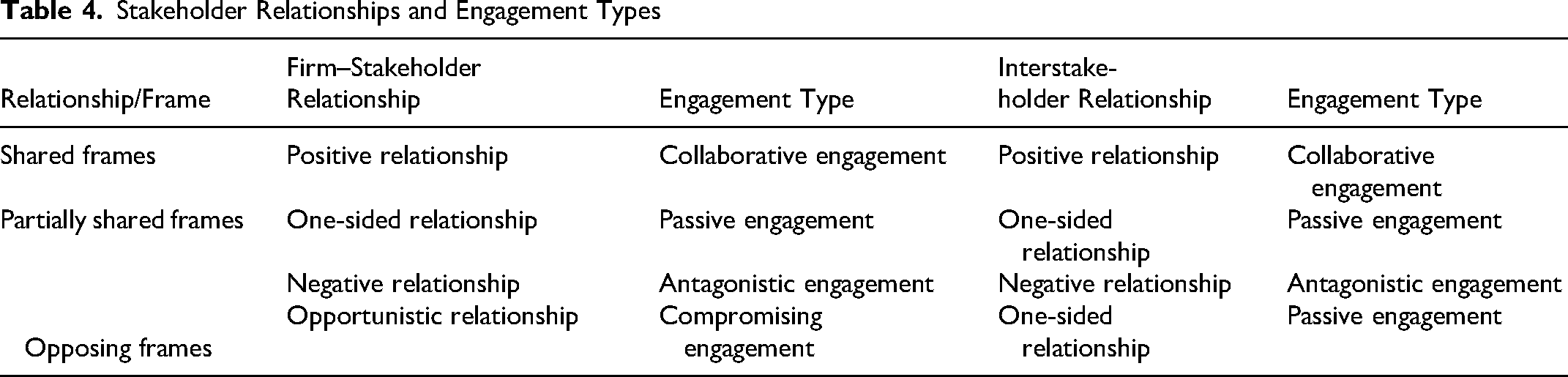
Collaborative engagement was a result of positive firm–stakeholder and interstakeholder relationships. This engagement consisted of two-sided communication, as well as cooperation based on trust and respect (Aaltonen et al., 2024; Kujala & Sachs, 2019). The objectives of this collaboration were twofold. First, firm–stakeholder collaboration established synergies and created joint value (Kujala & Sachs, 2019). Second, interstakeholder collaboration established support networks so stakeholders could reinforce their status (Gonzalez-Porras et al., 2021a). Thus, engagement was a collaborative process that had valuable, positive results for all involved (Erkul et al., 2020).
Passive engagement was a result of one-sided firm–stakeholder and interstakeholder relationships. Here, the engagement efforts of one actor did not reach the other. In firm–stakeholder passive engagement, there is one-sided communication where the company unilaterally provides information, but stakeholders do not have the resources to engage further. In interstakeholder passive engagement, the powerless stakeholder is ignored by the powerful one despite engagement attempts. Thus, engagement is desired and initiated but results in the powerless stakeholder being ignored and marginalized (Van Buren & Schrempf-Stirling, 2025), either purposely or otherwise.
Antagonistic engagement was a result of negative firm–stakeholder and interstakeholder relationships. It emerged due to irreconcilable perceptions and interests and high levels of distrust (Kujala et al., 2022). The actors were opposed, and engagement was a conflicting process where one actor sought to harm the others involved (Aaltonen, 2013; Harrison & Wicks, 2021).
However, there were exceptions when the firm and stakeholders applied opposing frames, but the emerging relationships are not negative, leading to different engagement types: compromising and one-sided engagement. First, compromising engagement was a result of opportunistic firm–stakeholder relationships: While the actors had contradictory perceptions and interests, they felt that cooperation was beneficial. This cooperation happened through agreements where self-interests were accommodated and pursued (Gable & Shireman, 2005). However, this engagement was shaped by power imbalances, with the firm leading the cooperation. Second, passive engagement was a result of interstakeholder one-sided relationships: The engagement efforts of one actor do not reach the other, and the powerless actor was marginalized (Van Buren & Schrempf-Stirling, 2025) by the most powerful one, either purposely or otherwise.
Synthesis of Stakeholder Engagement Types
The third phase of the analysis showed how the diversity of megaproject frames and stakeholder relationships leads to a wider understanding of engagement, shaping different engagement types. Engagement types vary from collaborative to antagonistic, in contrast to the traditional understanding of engagement as positive (Greenwood, 2007). Thus, companies and stakeholders can also engage with the objective of harming each other (Harrison & Wicks, 2021). Antagonistic engagement is a consequence of irreconcilable perceptions, based on opposition, and reveals a darker side of engagement (Kujala et al., 2022). Similarly, passive engagement is a result of stakeholder marginalization (Aaltonen et al., 2024; Van Buren & Schrempf-Stirling, 2025) and shows a darker side (Kujala et al., 2022). Additionally, while previous research assumes that firms and stakeholders interact when they have similar interests and perceptions (Freeman et al., 2010; Gray, 2004), compromising engagement indicates that engagement can also emerge from irreconcilable interests and perceptions. Both market and nonmarket stakeholders should therefore be considered (Cuganesan & Floris, 2020), as they can become partners.
Adding interstakeholder perspectives results in a wider stakeholder approach that removes the traditional managerial understanding of engagement (Aaltonen et al., 2024; Di Maddaloni & Derakhshan, 2023). Stakeholders also engage with other stakeholders, and additionally, bottom-up engagement is recognized: Engagement can be initiated by stakeholders and not only the firm.
Power imbalances remain the main challenge in stakeholder engagement (Aaltonen et al., 2024), especially in engagement initiated by powerless nonmarket stakeholders who remain ignored and marginalized (Van Buren & Schrempf-Stirling, 2025). This limitation is even stronger in interstakeholder engagement, with stakeholders establishing coalitions to address the situation and reinforce their status (Gonzalez-Porras et al., 2021a).
Discussion
This study explored how the diversity of stakeholder perceptions of megaprojects creates four types of firm–stakeholder and interstakeholder relationships: positive, negative, opportunistic, or one-sided. In turn, these stakeholder relationships shape four engagement types among megaproject stakeholders, namely collaborative, antagonistic, compromising, and passive engagement.
Implications for Project Stakeholder Engagement
The study advances recent literature on project stakeholder engagement (Aaltonen et al., 2024; Freeman et al., 2025) and makes three main theoretical contributions.
First, as its main contribution, the study recognizes how the diversity of stakeholder perceptions of megaprojects works as an antecedent shaping stakeholder engagement types. Thus, rather than it being a challenge to be solved or managed (Cuganesan & Floris, 2020; Khalilzadeh et al., 2023), this diversity guides and shapes project stakeholder engagement. Particularly, recognizing stakeholders by the diversity of their perceptions, instead of their traditional roles and groups, helps managers identify potential stakeholders and relationships more straightforwardly and, thus, be able to shape engagement to better reflect stakeholder diversity (Buhmann et al., 2025). Lozano (2005) proposed that organizations should not be merely managers but builders of stakeholder relations. Additionally, the study integrates two distinct engagement approaches, namely relationships and engagement types, previously explored separately in stakeholder engagement research (Kujala & Sachs, 2019; Lane & Devin, 2017), recognizing that the approaches are intrinsically and inevitably interrelated. As such, project stakeholder engagement can be understood as a continuous set of engagement types and relationships shaped by stakeholder diversity.
Second, the study provides a more realistic view of project stakeholder engagement. It recognizes both traditional, positive approaches and darker approaches to engagement, that is, collaborative and antagonistic engagement (Harrison & Wicks, 2021; Kujala et al., 2022). The study also explored situations of grayness (Blomberg et al., 2022), recognizing middle-ground situations (e.g., passive and compromising engagement) and identifying power imbalances as the main obstacle hindering project stakeholder engagement in both firm–stakeholder and interstakeholder relationships. Thereby, the study highlights how an instrumental perspective to project stakeholder engagement remains predominant in megaprojects, with firms and stakeholders interacting to pursue self-interests and reinforcing the marginalization of powerless nonmarket stakeholders (Di Maddaloni & Derakhshan, 2023; Van Buren & Schrempf-Stirling, 2025).
Third, the study provides a more inclusive and stakeholder-centric approach to project stakeholder engagement by including both market and nonmarket stakeholders, recognizing bottom-up engagement initiated by the stakeholders, and incorporating interstakeholder engagement. It abandons the firm-centricity traditionally inherent in the concept of stakeholder engagement and considers stakeholders’ voices, including nonmarket stakeholders who are usually marginalized (Aaltonen et al., 2024; Di Maddaloni & Sabini, 2022; Freeman et al., 2025). Better inclusion of nonmarket stakeholders leads to higher chances of megaproject success (Corazza et al., 2023; Di Maddaloni & Davis, 2017). As stakeholders are diverse, their perceptions of megaprojects too are diverse (Cuganesan & Floris, 2020; Cuppen et al., 2016), and all stakeholder voices should be considered to better understand this diversity (Cuppen et al., 2016; Machiels et al., 2023).
Managerial Implications
This study emphasizes the importance of preengagement (Buhmann et al., 2025) in megaprojects. First, it offers an alternative for stakeholder categorization, exposing the risks of stakeholder group categorization (Wolfe & Putler, 2002), and inviting project managers to identify stakeholders based on their perceptions and frames to better consider their diversity. Second, the study encourages project managers to stay receptive to stakeholder-initiated engagement and emphasizes the importance of project manager and stakeholder willingness to engage, as there are possibilities for engagement even when firms and stakeholders have opposing perceptions. Being open and alert in the preengagement phase can maximize the potential of stakeholder engagement, which is an essential part of value creation (Freeman et al., 2025; Kujala et al., 2019). Third, power imbalances are identified as the main obstacle when engaging with stakeholders, with nonmarket stakeholders collaborating to reinforce their status as a result (Di Maddaloni & Derakhshan, 2023; Gonzalez-Porras et al., 2021a). Finally, the study suggests that by better comprehending the diversity of stakeholder perceptions of megaprojects, project managers can predict interstakeholder relationships and anticipate different stakeholder behaviors (Gonzalez-Porras et al., 2021a). Understanding the diversity inherent in megaproject stakeholder landscapes ensures project success (Aaltonen & Kujala, 2016).
Limitations and Further Research
This study has two main limitations. First, the analysis is based on a single context. It provides context-specific insights into project stakeholder engagement, and thus, generalization of the results may be complicated. However, the megaproject occurred in a developing country, widely unexplored, making the context particularly interesting (Damayanti et al., 2021). Moreover, while this megaproject is unique due to the radical stakeholder perceptions of it, the interplay between support and opposition is a common megaproject characteristic, so the findings may be generalized (Pratt, 2008). Further research on megaprojects in different contexts and industries is recommended to test the results, especially on megaprojects in developing countries to identify their specific complexities (Crane et al., 2016; Damayanti et al., 2021).
Second, and due to the complexity inherent in the megaproject, not all involved stakeholders could be identified, and neutral stakeholders were not considered. However, the study involved nonmarket stakeholders, who tend to be marginalized (Di Maddaloni & Davis, 2017 ), thereby providing a significant contribution. Studies including neutral stances could provide valuable insights.
Future studies could further explore the gray and dark sides of project stakeholder engagement (Blomberg et al., 2022) by examining obstacles and tensions in the stakeholder engagement process. Additionally, as suggested by Corazza et al. (2023) and Freeman et al. (2025), research is recommended to study the dynamism inherent in stakeholder engagement, exploring the concept in distinct phases of a megaproject’s life cycle. Finally, frame analysis as a methodology to examine both stakeholders and megaprojects could be further explored.
Footnotes
Declaration of Conflicting Interests
The author(s) declared the following potential conflicts of interest with respect to the research, authorship, and/or publication of this article: The author declares close working relationships with one of the editors of this Special Issue, which have been acknowledged and addressed accordingly.
Funding
The author(s) disclosed receipt of the following financial support for the research, authorship, and/or publication of thie article: This work was supported by The Foundation for Economic Education (Liikesivistysrahasto) grants.
