




Abstract
City rebuilding precincts are embedded in, surrounded by, and sometimes resisted or celebrated by stakeholders they impact. These projects require long-lasting relationships and loyalty from the community they serve, making trust a crucial factor. This article employs a case study approach and draws from both social exchange and circuit of power theories to understand the complex relationship between trust and governance. Three strategies emerged from the analysis: employing resources, building legitimacy, and creating a brand. These strategies and their interactions highlight how trust can act as a governance mechanism for more effective engagement with the project community.
Introduction
Megaprojects are defined as temporary organizations characterized by large investments and complexity (Brooks & Locatelli, 2015). Megaprojects often involve various stakeholders of diverse occupational and cultural backgrounds who have different levels and types of interest in the project (Mok et al., 2015). In a study of more than 60 projects over a period of 20 years, Miller et al. (2017) highlight that megaprojects are rarely built with in-house resources. Megaprojects typically involve a variety of stakeholders, including collaborating organizations that are project partners, sponsors, experts, contractors, government agencies, and external players such as the project community. Rather than being led by a single organization, these projects require cooperation and coordination among multiple stakeholders.
The project community that embed, surround, resist, and sometimes celebrate the impact of a megaproject act in multiple roles. They may be potential end users of the project, funders of the project as taxpayers, and the ultimate source of democratic authority as voters; they may also be those most inconvenienced by being recipients of noise, pollution, and disruption. In megaprojects, the project–community interfaces are large, requiring many members of the community to be managed (Chinyio & Akintoye, 2008). Risks to the project that arise from the community may include protests and politically motivated public resistance (Ninan et al., 2022). Negative emotions toward the project can cause such stakeholders to oppose the delivery of the project and boycott services during its operation phase. The effects can be severe; loss of public support for projects can lead to their cancellation. Managing such stakeholders is important, as the success of any project depends on how its deliverables are viewed by the communities on whom its operations impinge (Cornelissen, 2004). Any putative project community has porous boundaries; is not regulated by governance instruments, such as contracts or standards; and will not be accountable to the particulars of the other project covenants such as detailed project reports (DPR) or equivalent (Ninan et al., 2020). Hence, there is a need to effectively manage the project community to deliver projects successfully.
Social concepts, such as trust, are of utmost importance in the governance of megaprojects, since the number of noncontractual relationships between stakeholders is larger in megaprojects compared to traditional projects (Ceric & Sertic, 2019). These projects require long-term relationships and loyalty from the project community it caters to; trust is, thus, of paramount importance (Casalo et al., 2007). Trust is also a key construct in handling uncertain situations with a lack of legal protection and conflicting interests (Luo, 2002). From a governance perspective, we argue that trust in a project can be considered as a form of organizational power as it helps secure consent. Hence, our research objective seeks to understand how trust-building strategies work together to govern project communities during the shaping phase, looking at governing as a phenomenon constituted by social exchange and organizational power relationships. The questions that guide this research are: (1) What are the trust-building strategies involved in the community engagement of megaprojects during the shaping phase from a social exchange theory perspective? and (2) How do these trust-building strategies work together in the governance of megaprojects during the shaping phase from a circuit of power perspective?
First, we conduct a detailed literature review on governance and trust in the context of megaprojects, and then gaps in the literature are highlighted. We choose a case study–based approach to answer our research questions. We discuss the research methodology and research setting that we applied in a case study of the shaping phase of a city rebuilding precinct in Australia. We highlight the findings and discuss the trust-building strategies from a social exchange and circuit of power theoretical perspective. Finally, we summarize the findings, theoretical and practical contributions, and limitations and future scope of work in the conclusion section.
Literature Review
Governance and Trust
Governance is defined as the sum of the many ways individuals and institutions, public and private, manage their common affairs (Carlsson et al., 1995). In projects, governance is a multilevel phenomenon that encompasses the governance of the project, parent organization, contractors, suppliers, and the relationships among them (Turner & Müller, 2017). Thus, governance in project settings aims to ensure consistent and predictable delivery of projects (Müller et al., 2013). Trust is important in governance processes and often exists as a tangled web in organizations (Puranam & Vanneste, 2009). Trust is defined by Rousseau et al. (1998, p. 395) as “a psychological state comprising the intention to accept vulnerability based upon positive expectation of the intentions or behaviors of another.” Less psychological, and more useful for project researchers, is Fox’s (1974) approach to trust. Fox’s key contribution lies in showing how intraorganizational trust is embedded in institutional systems and how internal and external trust dynamics were mutually constitutive. Maguire and Phillips (2008, p. 372) elaborate further, defining institutional trust as “an individual's expectation that some organized system will act with predictability and goodwill.”
Building trust is an essential ingredient in any recipe for manufacturing consent (Burowoy, 1979). Looked at from the other side, that of the project organization, Grey and Garsten (2001, p. 230) see intraorganizational trust as constructed for and by people in organizations to produce a degree of predictability as a “precarious social accomplishment enacted through the interplay of social or discursive structures, including those of work organizations, and individual subjects.” Trust can be considered as a focal element of social exchanges and is an integral component of governance (Gharib et al., 2017). Organizational theories, such as social exchange theory, can help explain the governance potential of trust because when one party trusts another, they often feel bound by the trust placed in them and to reciprocate it (Blau, 1964). The exchange of resources in the social interaction promotes the generation of trust and, hence, it has governance implications (Wang et al., 2020).
Trust in Social Exchange Theory
Social exchange theory considers social interaction as an exchange of tangible and intangible rewards and costs (Homans, 1961). The exchange of resources, such as money, social services, or relationships, can evolve over a period of time resulting in trusting and loyal commitments (Cortez & Johnston, 2020). Within organizations, the theory explains how employees perceive a climate of trust resulting from the social exchange and how they are willing to engage in more positive behaviors and work hard for their organization (Blau, 1964; Ekvall & Ryhammar, 1999). The resulting trust would promote organizational identification, which would result in more positive behaviors from all stakeholders associated with the organization (Aryee et al., 2002).
As part of social exchange theory, Zucker (1986) proposes three trust production mechanisms based on the study of historical data in the United States from 1840 to 1920. These trust production mechanisms are characteristic-based trust, process-based trust, and institutional-based trust. Characteristic-based trust focuses on defining commonalties, such as ethnicity, nationality, goals, or family background, which can act as a driving force in creating trust (Morgan & Hunt, 1994). The social similarity creates a sense of shared binding, which reduces the need for explicit rules and regulations in the social interaction (Doney & Cannon, 1997). Process-based trust refers to the type of trust that is dependent on past exchanges, reputation, and brand names (Morgan & Hunt, 1994). The objective of process-based trust is to convince stakeholders of one’s trustworthiness, which can result in consumers voluntarily providing personal data and repeatedly purchasing the organization’s goods or services (Luo, 2002). Institution-based trust is tied to formal societal structures and depends on attributes and associations such as certifications, third-party guarantors, and credible exchange partners (Luo, 2002). For example, certifications, such as medical licenses, guarantee professional practice standards and create trust in the bearer.
Similar to social exchange theory and its trust production mechanisms, Khalfan et al. (2007) state that the key to building trust is past experience, problem resolving, shared goals, reciprocity, and reasonable behavior. These trust-building mechanisms can be either planned, incidental, or both (Chow et al., 2012), and effective trust-building mechanisms can lead to reciprocating trusting behaviors by the trustees (Bigley & Pearce, 1998). Thus, trust-building mechanisms can have behavioral implications on the subjects and can be used strategically to alter practices. Even though these trust-building strategies are well established in the literature, the relationships among these strategies have not been conceptualized. We argue that the circuits of power theoretical framework can help realize the relationship among trust-building strategies. For this, the governing aspect of trust can be seen as a form of power for securing consent.
Power and Trust
Power is defined as “the probability that one actor within a social relationship would be in a position to carry out his own will despite resistance” (Weber, 1947, p. 152). The governing aspect of trust to secure consent can be argued as the highest form of power, in other words, the third dimension of power of hegemony/governmentality (Ninan et al., 2020). After all, governance can be defined as the process of implementing power and putting the program of those who govern into place (Di Gregorio et al., 2019). Within the broad range of organizational power theories, the circuits of power framework (Clegg, 1989) offer an explicit mechanism for tracing the exercise of power (Lapsley & Giordano, 2010).
The circuit of power framework considers power as flowing through three interdependent circuits—the episodic agency circuit, the social integration circuit, and the system integration circuit (Clegg, 1989). The episodic agency circuit considers the exercise of sovereign power, such that A makes B do something that B would otherwise not do. The social integration circuit is based on the power associated with the rules of meaning and relates to legitimation. In the system integration circuit, power is exercised through techniques of discipline that constrain and channel action. These three circuits are interconnected through the obligatory passage points (OPP) defined as conduits through which traffic must necessarily pass. These obligatory passage points are ‘yardsticks,’ used to measure the acceptability, appropriateness, and legitimacy of actions. The circuits institutionalize the obligatory passage points (Heikkurinen et al., 2021) and thereby direct future power relations. Overall, the circuits of power framework highlights how systemic circuits frame and direct episodic circuits through actor networks. Our consideration of power is based on Foucault’s perspective and is different from the traditional view on power; where power is seen as exercising sovereign control over another, or giving orders to make others obey, or imposing one’s will on others (Joullié et al., 2021). We now turn to megaprojects and explain the need for power and trust in managing the project community.
Governance and Trust in Megaprojects
Building trust is seen as a facilitator of positive relationships among project stakeholders (Pinto et al., 2009). It is also widely acknowledged that the main goal of stakeholder management of an organization is to form a trustful relationship with stakeholders (Bourne & Walker, 2005). Thus, trust is both the input and the outcome of stakeholder management practices (Eskerod & Vaagaasar, 2014). Pinto et al. (2009) showed the influence of trust on project performance by highlighting that trustful relationships between project stakeholders can prevent conflicts. Organization scholars emphasize that trust reduces transaction costs and leads to greater information sharing between stakeholders (Dyer & Chu, 2003), thus contributing to improved coordination and better project outcomes (Wang et al., 2020). Trust stimulates cooperation; decreases fear, greed, and risk perception; and creates a reservoir of goodwill, which helps preserve relationships (Kumar, 1996). Even in megaproject context, trust can lower costs, shorten duration, minimize monitoring and controlling efforts, reduce confrontations among project participants, form good relationships, cultivate better contract negotiation, and boost collaboration efficiency (Lu et al., 2014; Jiang et al., 2016; Chow et al., 2012). Due to these advantages, trust-based governance is a key component of relational governance (Roehrich & Lewis, 2010) and is highlighted as an alternative to formal governance mechanisms (Puranam & Vanneste, 2009).
Within megaprojects, trust building has to occur between two interfaces—one between the government and contractors and the other between the project and the project community (Hodge, 2004). Within these interfaces, a governance issue generally occurs when there is either a litigation-related or protest-related challenge (McAdam et al., 2010). These challenges have a greater frequency for the interface between the project and the community, as these stakeholders cannot be governed through contracts, rules, and regulations. These stakeholders, outside the contract, are external to these instruments (Ninan et al., 2020). Project communities are the set of project users, special interest groups, and actors that are not party to the contract but are socially or economically affected by the outcomes of the project.
Even though extant literature shows the importance of the project organization developing trust with internal stakeholders, such as contractors, owners, suppliers (Kadefors, 2004; Pinto et al., 2009), there are fewer studies that explore the development of trust in community engagement in the context of megaprojects. This is alarming considering that trust is of paramount importance in the context of the project community, as the interaction between the project and the project community extends for the full life cycle of the project, which includes planning, construction, and operation phases (Ninan et al., 2022). Porras et al. (2004) record that the longer the relationship, the greater the requirement for trust. Adding to this, since community relationships are not governed by contracts in megaprojects, as argued earlier, trust acts as a facilitator of stakeholder relationships (de Oliveira & Rabechini, 2019). Thus, the interplay between governance and trust needs to be explored further, especially on how trust acts as a governance mechanism (Ceric et al., 2021; Ceric & Sertic, 2019).
As we argued earlier, governance through trust can be considered as a form of organizational power as it helps secure consent. In the circuits of power framework, power is manifested in social relations and it can help explain how trust-building strategies govern the community in a circuitry fashion. Power and trust are generally considered as opposing; however, it could help us understand community engagement practices in megaprojects. We argue that a theoretical perspective, which looks at the relationship between trust-building strategies in community engagement can help us understand how trust that constitutes the systemic circuit can enable the overt governance that forms the episodic circuit.
Research Setting and Method
To understand the strategies employed by the project to build trust and govern the project community, we adopted the grounded theory method (Strauss & Corbin, 1990, p. 152) and used existing literature as starting points and for sensitization of the findings. We used single case studies as they provide excellent opportunities to enhance contextual understanding because of their depth in data collection and analysis (Lundin & Steinthorsson, 2003). Since the single case is investigated in detail with focus on multiple subunits, it comprises an embedded case study (Mui & Sankaran, 2004). A single case study can be considered an embedded case study when, within the single case, attention is paid to more than one subunit (Yin, 2009). Subunits refer to different salient elements of the larger case and analyzing these multiple subunits within the larger case gives sufficient insights for theorization (Scholz & Tietje, 2011). For example, subunits, such as bringing stakeholders together, hospital agenda, and social media engagement, are discussed to understand the different trust-building strategies within a single case.
We conducted a case study on a city rebuilding precinct in Australia to explore the trust-building strategies employed to govern the project community. City rebuilding precincts can be categorized as megaprojects as it requires coordinated land use and infrastructure planning and brings together multiple people with often conflicting interests (Ninan et al., 2021; Flyvbjerg, 1998). The project started in 2016 with an aim to expand the city and revitalize the city center with a health and education agenda. This would attract investments in health, education, and research. Health was important for the project as the city anticipated that health-related spending would grow from 4% to over 7% of the gross domestic product (GDP) by 2050. The city already has existing health assets in the forms of hospitals and research institutes. The project core sought to leverage these and establish a platform for additional investment from both the public and private sectors in associated health, education, and medical research activities, as well as investments in new housing and transport networks. The city in which the project is housed has land available for development, a strong identity with the people, good transportation infrastructure, and a lower cost of living and housing. The city, through this project, seeks to be an ‘innovation district’ by attracting new jobs and opportunities. It should be noted that the project is still in its shaping process and hence does not have a fixed cost or time line as of now. Even though there is no fixed cost, we found it relevant for the study of megaprojects as it satisfies the qualitative characteristics such as colossal, complex, controversial, captivating, and laden with control issues (Frick, 2008) with multiple numbers of stakeholders, requiring decisions to take into consideration all of these interests. Adding on to this, since the project is in its shaping phase, it provides a critical case (Flyvbjerg, 2006) to understand the trust-building strategies employed by the project team to govern the project community during the early stages of the project. We found this case important as our aim was to explore the different strategies employed during the early stages as the project develops its agenda. For example, this city rebuilding project anchors itself on the hospital agenda, in other words, rebuilding an existing hospital, so as to create a positive perception in the community.
The core project team was wide ranging and included government hospital constructions, local health bodies, research institutions, educational partners, and so forth. To facilitate the partnership between these diverse stakeholders and bring them into a project core group, a memorandum of understanding (MOU) was signed with each partner. The terms of the MOU involved a strategic partnership among the players and also an equal, fixed contribution yearly to facilitate the partnership. Each player in the partnership could nominate a member from their organization to the steering committee. Monthly meetings were convened among the project core, comprising of members of the standing committee, to make strategic decisions relating to the shaping of the project. All decisions of the steering committee were to be determined by simple majority. With the fixed contribution, the steering committee hired an independent chair, paid for administrative support, such as circulating invitations and minutes of meetings, and also hired a project management consultant who would organize committee meetings, plan media activities, and promote the project.
We collected diverse data from the city rebuilding project to understand the community engagement strategies and their effects. These included semistructured interviews, observation of committee meetings, project documents, news articles along with their comments, and observation of social media exchanges. The details of the data sources are given in Table 1.
Diverse Data Sources in This Research
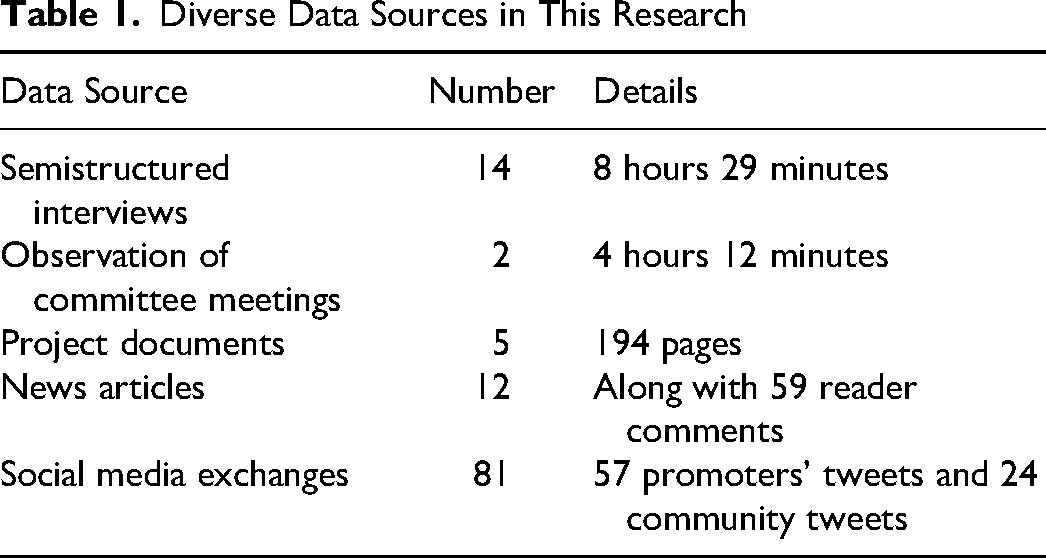
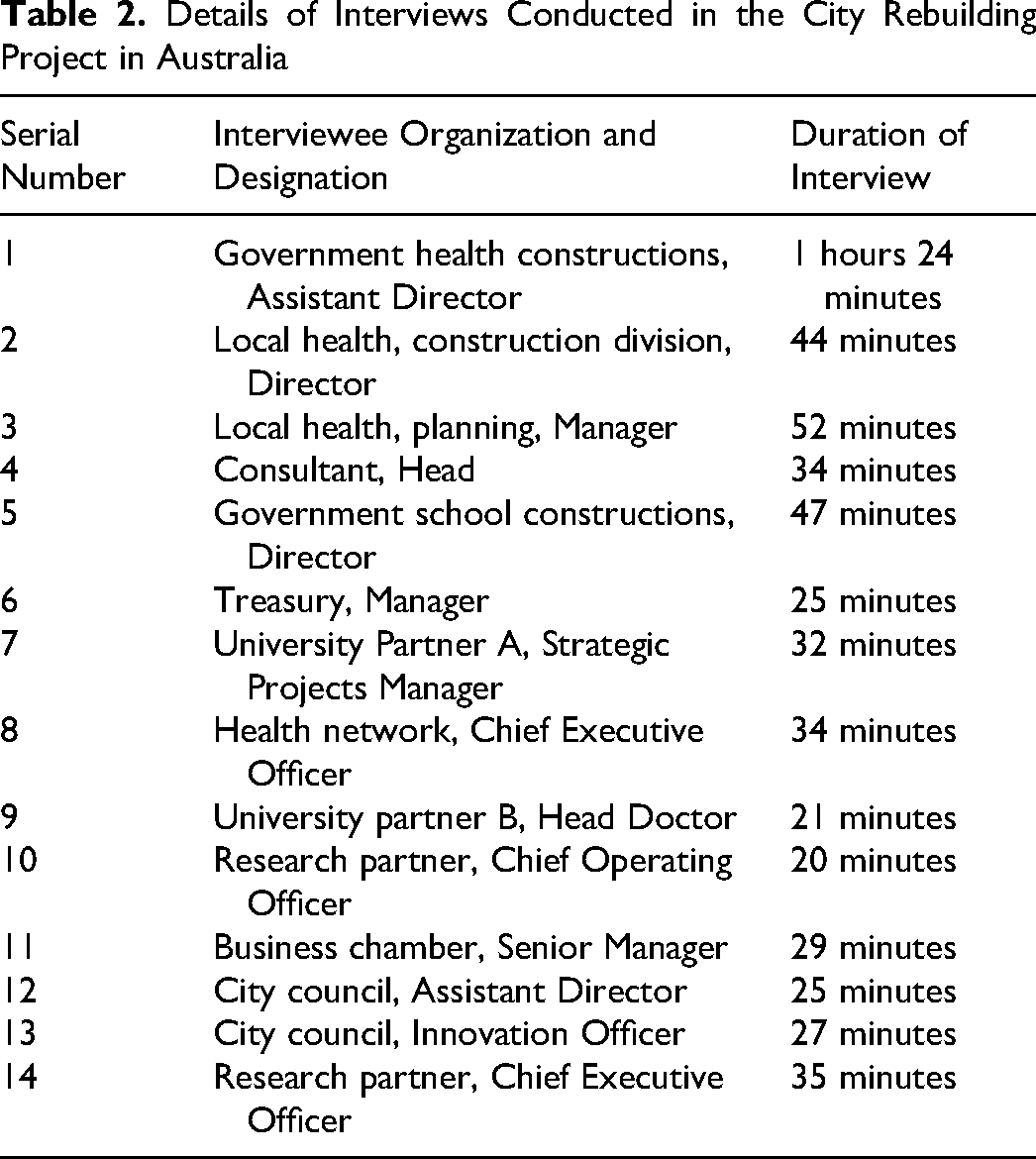
We conducted 14 semistructured interviews with the project core to understand the strategies employed. We tried to get interviews from different stakeholders involved in the project during the shaping phase. We asked the respondents open-ended questions such as the details of the interaction with the project community, the standard process used, and the major challenges during the community engagement project. Open-ended questions allowed the respondents to present their perception without constraints, while semistructured questions helped to keep the interviewee focused (Aberbach & Rockman, 2002). The interview duration ranged from 20 minutes to 1 hour and 24 minutes. We conducted interviews until thematic and theoretical saturation (Glaser & Strauss, 1967); in other words, we stopped conducting the interviews when additional data points did not develop the construct further. The details of the interviews conducted are summarized in Table 2.
Details of Interviews Conducted in the City Rebuilding Project in Australia
We also observed the discussions between members in two steering committee meetings to understand the community engagement strategy. Here, the researcher was a silent observer and made extensive notes of the meetings. Such observation provided direct experiential and observational access to the insider’s world of meaning (Ritchie & Lewis, 2003). We also collected documents on the project such as its vision document, community strategy plan, precinct strategy document, and position papers. Additionally, we surveyed the news coverage of the project to understand what was strategically communicated to the community, in the form of readers of the news media (Ninan et al., 2022). Twelve articles from newspapers in the region, such as The Sydney Morning Herald, The Daily Telegraph, Mirage News, were retrieved through a search of the project name in the Google news repository. We also collected 59 community comments on these news articles to understand the effect of the community engagement. The social media activities surrounding the project were also studied, as they can help us understand projects in the digital era such as their benefit realization (Mathur et al., 2021). We studied 57 tweets from the promoter organizations of the project who use the social media platform to create awareness. We used these tweets to understand community trust-building strategies. We also identified 24 tweets from members of the community, which helped us understand the perception of the city rebuilding initiative. Thus, in this research we use diverse data combining traditional interviews, observations, and document analysis with new-age datasets, such as social media and news article comments, to understand the community engagement strategies and their effects. Online naturalistic data can help understand projects in the 21st century as more and more communication regarding the project occurs in the digital environment (Ninan, 2020).
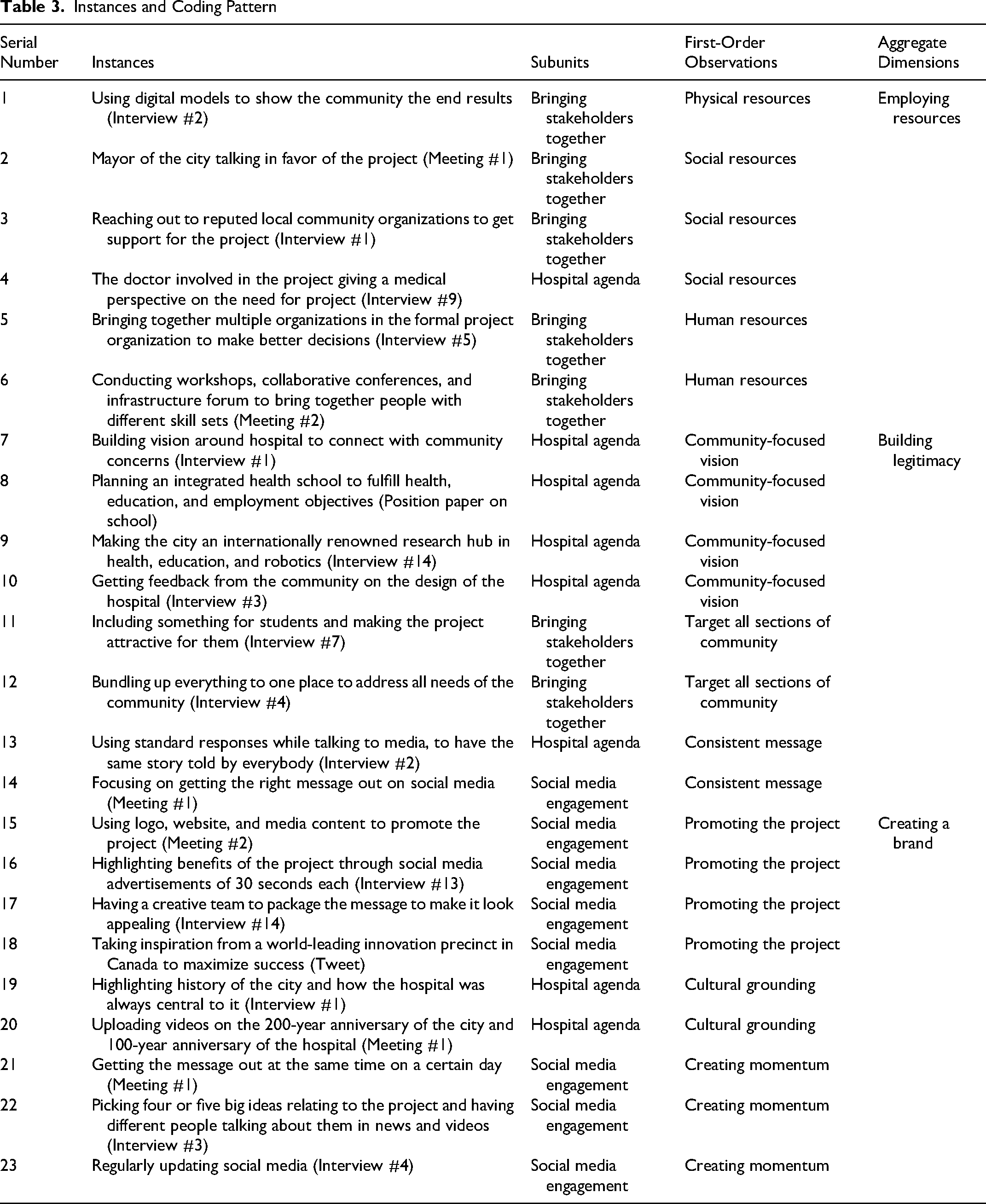
We then used open coding of the data to relate it with the social exchange theory (Zucker, 1986) and circuit of power theory (Clegg, 1989). We followed multiple cycles of coding, cross-checking, and theoretical review (Strauss & Corbin, 1990) to arrive at the different forms of trust-building strategies used for governing the project community, as shown in Table 3. For example, multiple instances in the subunit of hospital agenda were analyzed to create first-order observations, such as social resources, community focused vision, and consistent message, which were grouped into aggregate dimension, such as employing resources, building legitimacy, and creating a brand respectively, following a cross subunit analysis.
Instances and Coding Pattern
This research follows the guidelines suggested by Eisenhardt (1989) on ‘building theories from case study research’ by anchoring the new theory in the existing literature to increase the internal validity and generalizability. We use the existing social exchange theory (Zucker, 1986) and circuits of power framework (Clegg, 1989) as an initial guide, as part of an iterative process of data collection and analysis, and as a final product of the research (Walshham, 2002).
Findings
In this section, we present three subunits from the case study of the city rebuilding project in Australia. The first subunit presents how stakeholders are brought together for the project, the second presents the hospital agenda in the project, and the third presents the social media engagement in the project. From these subunits, the trust-building strategies employed to govern the project community are discussed in the next section.
Bringing Stakeholders Together
The city rebuilding project bought together diverse organizations as part of the formal project organization. The group of organizations involved in the project are the business chamber, the local health district of the city, the health network organization, the city council, the city hospital, the department of education, the education commission, an applied medical research institute, and three universities that have a ‘school of medicine’ operating in the area. The aim of bringing these organizations together was to create a synergistic pool of organizations, so as to make better decisions relating to the project as well as to exercise influence. The presence of multiple stakeholders in the project ensured the long-term survival of the project as the director of the government school construction remarked: We have multiple champions in this project .… If it’s a single-head snake and the head dies, the whole snake dies. (Interview #5)
Along with the hospital agenda, there were other objectives of the project tailored to the needs of the diverse groups of the project community. The presence of different stakeholders. such as health organizations, research institutes, and universities. was crucial for the holistic development that the city rebuilding project aimed to achieve. The project vision was to address several concerns of the community rather than focusing on a few. The manager of one of the partner universities highlighted that: There is a high chance of success when we are not just pursuing one individual idea but responding to several common concerns .… For example, what do students think are attractive to them in this project. (Interview #7)
Along with bringing all stakeholders together, there was a focus on bringing stakeholders who hold significant influence in the society. For example, the project team persuaded the mayor of the city in which the project was being carried out to communicate positively about the project. The endorsement was aimed at attracting more stakeholders to be involved in the city rebuilding project. The assistant director of the government health constructions remarked: We have to get the mayor to talk in favor of the project .… The vision is to get momentum for the project … and attract more people. (Meeting #1)
Along with prominent individuals in the area, local community groups that were influential in the area were also contacted to offer support for the project. The project team tapped into community groups who were in support of the project and this resulted in grassroots support for the project. One of the managers of the community engagement team overtly stated that: There are some local community groups out there, we are trying to tap into some of [them] to get support for the project. (Interview #1)
The support from influential people was well received by the community. A member of the community echoed the message of their favorite person: ‘We have to innovate… create the Valley of Life’ here in [name of precinct ] says [name of an influential person]—one of my all time favorite people!!! A tireless advocate for better health, medtech, and innovation to drive better outcomes! (Quoted from a community tweet dated 10 October 2019)
In another instance, the leadership conducted workshops, collaborative conferences, and infrastructure forums to bring together people with different skill sets. Events, such as workshopping and training sessions, are considered as part of engagement and collaboration in project settings (Lehtinen & Aaltonen, 2020). Thus, the project aimed to bring diverse stakeholders together in order to tap into their network and garner support for the project. As Di Maddaloni and Davis (2017) note, most projects lack the reservoir of support from the community and it is critical that projects reach out to local leaders and network during the initial stages.
Hospital Agenda
The city rebuilding megaproject stressed its objective of improving the health outcomes of citizens of the region. Through this, the project team justified the need for the city rebuilding project by anchoring it on the hospital infrastructure. A hospital narrative can be attractive to the project community as the project would benefit them. The assistant director of the health construction said: We build the case around hospitals .… Hospitals are great anchor points … it is easy marketing. (Interview #1)
Through this strategy, the full project was framed to be centered around the important hospital in the city. Similar examples from the megaproject arena include Gil and Lundrigan’s (2012) description of how the 2012 London Olympics bid team highlighted the Olympics megaproject as an urban regeneration project for one of the most deprived areas in London to gain community support. Effort was taken to make the message to the community clear and consistent. The public relations team of the project provided the spokesperson with standard responses to have consistent messaging. Such consistent messaging was important to build legitimacy in front of the project community. The director of the local health authority’s construction division, who was also responsible for talking to the media about the project, said that: I am given a sheet of paper with a prepared list of questions and their responses … thus, the same story is told by everybody …. If there is a question outside of the list prepared, we say we will get back to you. (Interview #2)
The project team also showed the community how the city and hospital would look like, through three-dimensional models and visuals. Feedback was also sought from the community as part of community engagement. The project team listened to the community’s concern and improved the design to make the hospital more integrated with the community. The manager of local health’s planning division was quoted as saying: We show them [community] how this [hospital infrastructure] is going to look like. We get feedback, document it, and work on them. (Interview #3)
Within the megaproject field, the use of software, such as building information modeling (BIM), provides an opportunity for the project team to engage with the project community and incorporate their feedback on simulacra of the anticipated structure in project decisions (Singh et al., 2018).
The members of the community resonated with the health agenda of the project and felt passionate about it. Generally, governments spent money on highways and stadiums, which does not necessarily benefit the community. In contrast, the hospital narrative was instrumental in getting the essential community support. In a comment to one of the news articles relating to the project, a community member shared: It's fantastic that they are spending money on upgrading hospitals to make it world class. (Quoted from the comments of a news article dated 21 June 2018)
Khurana et al. (2022) record that aligning the incentives of different stakeholders toward the project goal can help achieve good governance. Henisz (2016) highlights that demonstrating the material benefits arising from the project, such as the hospital agenda in this case, can enhance the legitimacy of projects with community.
Social Media Engagement
Even though the city rebuilding project was in its starting stage with undefined costs and time lines, it had allotted money for promoting the project to get support from the project community. The project used this budget to hire a team of public relations executives and communicate effectively with the project community. In the modern digital age such communication is often through social media and other media contents. During one of the meetings, the senior manager from the business chamber said: We have to promote the project to make it more appealing to the community … We have to promote and raise its profile… through logo, website, media content. (Meeting #2)
Messaging of the project in social media was strategically intended to create a favorable perception of the project. For instance, the project claimed on social media that it will take inspiration from one of the world’s leading innovation precincts to maximize success, as quoted here: [Name of city] will take inspiration from one of the world’s leading innovation precincts, the @MaRSDD in Canada, to maximize the success of the city’s upcoming health and academic hub. (Quoted from a tweet by a promoter organization on 15 November 2018)
The strategy for raising the profile of the project also included uploading short videos on social media, highlighting the uniqueness of the project, with frequent news reports also being published that promoted the project as offering the best available healthcare for the community. Another example of the content on social media being strategically managed was the innovation officer of the city council where the city rebuilding project is located, stating: We are aiming to create a series of social media advertisements of 30 seconds each … about how the private hospital is beneficial to this area .… Video contents are very engaging …. (Interview #13)
The community accepted the social media engagement of the project and echoed the health, research, and education agenda. There were multiple retweets of the social media posts of the project. In this tweet a community member shared: Great to hear about investment in the [name of place] health, research, and education precinct. This will create significant opportunities for medical innovation and job growth in [area]. (Quoted from a community tweet dated 19 June 2018)
In the case of the city rebuilding project, the project leadership pooled a creative team to package the message and make it more appealing to the community. They also planned to upload two videos on the upcoming 200-year anniversary of the city and the 100-year anniversary of the hospital to show the lineage of the project. These video contents were released at regular intervals in the social media. Social media can be successfully used in project settings for promoting the project organization, giving progress updates, appealing to the community, and targeting sections of the population (Ninan et al., 2020).
Discussion
The findings recorded in the previous section highlight the trust-building strategies evident in the city rebuilding project case in Australia. The strategies observed were employing resources, building legitimacy, and creating a brand. We discuss these strategies by anchoring them in the social exchange theory (Zucker, 1986). The relationships between the strategies are discussed by anchoring in the circuits of power framework (Clegg, 1989).
Trust-Building Strategies
Employing Resources
Physical project resources, requiring financial resources, were employed to address concerns raised by the community with the use of digital tools to show the community what the hospital is going to look like. Such instances of directly engaging with the project community, seeking feedback at frequent intervals in a transparent way, can help projects build trust among the project community (Kumar et al., 2016). In this case, financial resources were used to procure BIM tools, which were, in turn, used to develop simulations to enhance trust with the project community. As Freeman (1984) notes, investing an organization’s resources to address the concerns of the stakeholders is a justifiable managerial activity. In addition to physical project resources, social resources were also employed when the mayor of the area was asked to talk in favor of the project to attract more supporters. Lim et al. (2006) record that trust transference through associations with an existing reputed organization is instrumental in trust building. The project also bought together human resources from the business chamber, the local health district of the city, the health network organization, the city council, the city hospital, the department of education, the education commission, an applied medical research institute, and three universities. By bringing together these entities, the project aimed to create a synergistic pool of organizations with diverse human resources, so as to make better decisions relating to the project. The social and human resources can be considered gatekeepers as they help tap the formal and informal networks in the community (Renert et al., 2013). Word of mouth of community members can also be considered as a social or human resource and is enhanced by social media as a physical resource in this modern digital age. Burt (1992) highlights three widely accepted forms of resources—physical, social, and human. He notes that physical capital includes resources such as money and land that an organization has access to; social capital includes the network of contacts; and human capital includes the knowledge, abilities, and charisma of the group. While Aaltonen et al. (2008) record resource building as one of the strategies adopted by the project community to garner the attention of the project team, this study highlights the project team’s use of different resources to build trust with the project community. In the case of the city rebuilding megaproject, we see the physical, social, and human resources employed to build trust. As the project taps into their physical resources and social associations, they are building institution-based trust (Zucker, 1986). For example, the project calling upon the mayor of the city to support the project is similar to third-party guarantors or certification (Luo, 2002).
Building Legitimacy
Legitimacy for the project was built through anchoring the project in an agenda, which enabled the project to connect with community concerns such as with the hospital agenda. The main justification for rebuilding the city was strengthening the hospital infrastructure for the benefit of the community. Such larger agenda representations enable the diversion of attention to an issue, which seems more favorable to the project and helps the project build trust with the project community. However, it was not just the hospital objective that drove the project. Different objectives included catering to the student community and making the project attractive for them. Incorporating the views of various stakeholders weaves an ‘actor net’ of enhanced legitimacy (Czarniawska, 2004), which can help the project get a positive perception in the eyes of the project community. Building legitimacy also involved communicating a consistent message to the media such as when the same story is told by everybody. Carter et al. (2010) note that when organizations define what is real, they create conditions of legitimacy. Yousafzai et al. (2005) suggest that communication of meaningful and timely information has the potential to influence customers’ trusting intentions. We highlight that along with communicating meaningful and timely information, such information has to also be consistent for building trust with the project community. The finding is similar to Di Maddaloni and Sabini’s (2022) findings of consistent messaging throughout the project life cycle used to build trust with local community. We extend their research further by highlighting how consistent messaging with a community-focused vision targeting all sections helps build legitimacy. It should also be noted that legitimacy does not imply transparency, as the megaproject did not answer questions outside the list prepared and thereby was not fully transparent. While Shockley-Zalabak and Morreale (2011) highlight openness and honesty as key drivers of trust in the long run, we see projects as temporary endeavors sometimes using closed and less transparent methods to achieve momentum, which have ethical implications. Di Maddaloni and Davis (2017) record that there is a need for megaprojects to appear legitimate in the eyes of the project community. Van den Ende and Van-Marrewijk (2019) caution that insufficient legitimacy can create social unrest and community resistance. We extend this work by discussing how megaprojects build legitimacy and highlight that legitimacy is part of the trust-building strategies and thereby instrumental for governing the project community. As the project anchors itself in the hospital agenda and caters to the study community, it is building characteristic-based trust (Zucker, 1986). The focus with characteristic-based trust is on defining common goals (Morgan & Hunt, 1994) with the community, such as the hospital in the city rebuilding case, which was also the need of the community.
Creating a Brand
There was a focus on promoting the project to raise its profile such as with the social media engagement. The trust-enhancing facets of a brand, such as appealing to the community in this case, can be used to generate stronger commitment and help in governance by creating a sense of ownership (Rose et al., 2016). Hegemonizing and branding strategies in project settings, in the form of sustained communication, as explored in the work of Ninan et al. (2020), aim to create support for construction activities and tolerance to the inconveniences caused, due to diversions and other hassles. In the case of the city rebuilding megaproject, a brand was created around the project through short videos that were shared on social media. These videos highlighted the uniqueness of the project, as offering the best available healthcare for the community. They were released at regular intervals in the social media in an attempt to create repeated narratives of the benefits of the project. Dailey and Browning (2014) highlight that narrative repetition involves the story being recalled and retold from another narrative, portraying its rich conceptual depth. They record that these repetitions are instrumental in making the narrative stable. Fey (2019) highlights that stressing the positive effect in repeated interactions can create relationships of trust. Branding has governance implications as it extends a complex set of meanings, associations, and experiences that create emotional, relational, and strategic elements in the minds of those perceiving and enacting dispositions toward brands (Aaker, 1996). By building the project brand on social media, the leadership tapped into the process-based trust (Zuker, 1986). The process-based trust is dependent on the reputation and branding (Morgan & Hunt, 1994). To achieve this, the project organization promoted the 100 years’ heritage of the hospital within the city.
The trust-building strategies observed from the case of the city rebuilding case can be anchored on the trust-production mechanisms from the work of Zucker (1986) as shown in Figure 1.
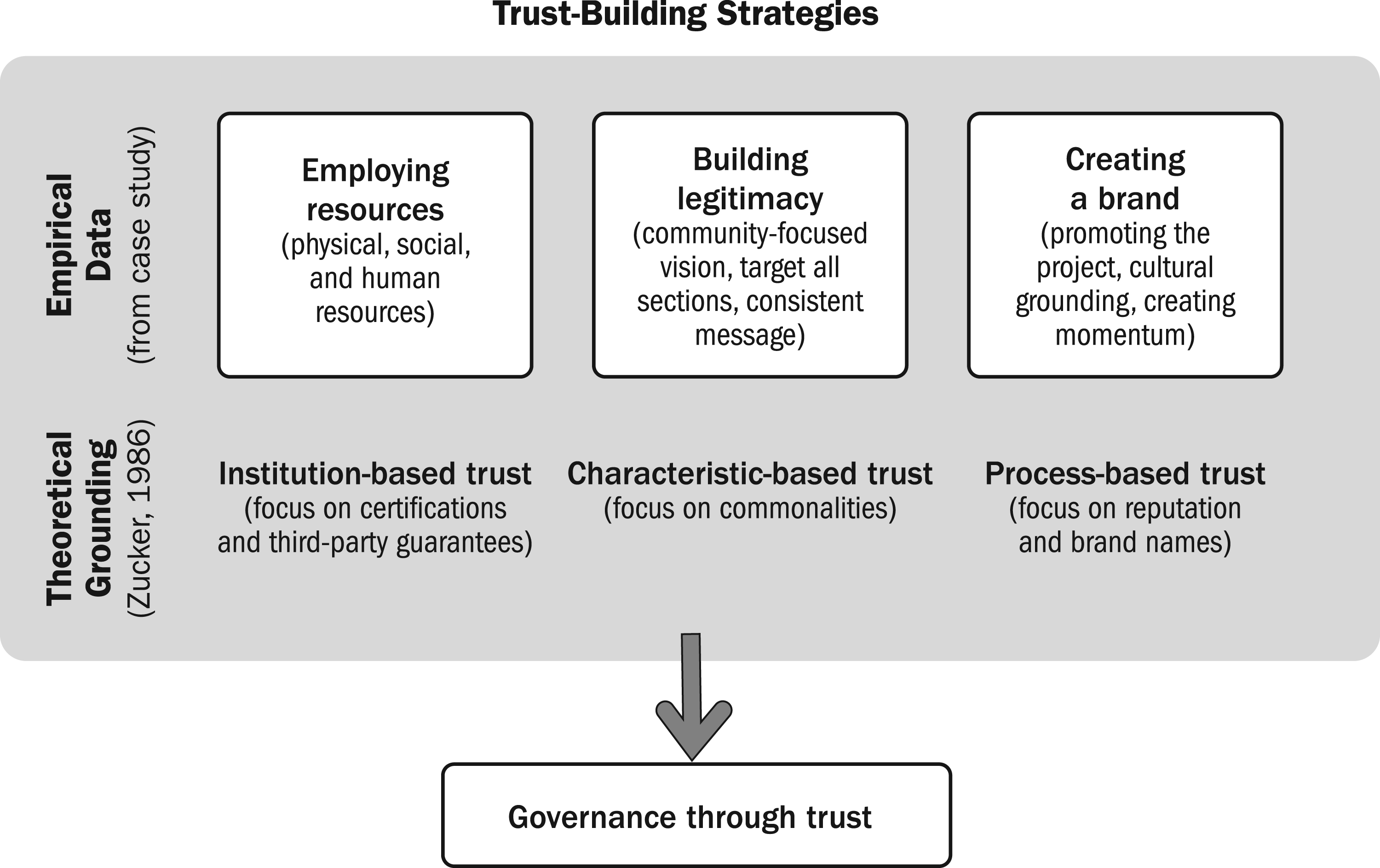
Governance through trust framework.
We discuss how the three trust-building strategies—employing resources, building legitimacy, and creating a brand—are integrated using the circuits of power framework (Clegg, 1989) in the next section.
Relationship Between Strategies
Strategies and the Three Circuits of Power
The three trust-building strategies described in the previous section can be anchored on the circuits of power framework (Clegg, 1989). The physical, social, and human resources employed to build trust govern stakeholders in the episodic agency circuit. The episodic agency circuit relies on the actor’s ability to directly mobilize resources to realize certain goals (Avelino, 2011)—project community support in this case. These resources give the project team the ability to make the project community do something they would not otherwise do (Dahl, 1957). Lukes (1974) calls the organizations shaping the agenda and deciding whether issues are enacted or not as ‘real power.’ Through the strategy of building legitimacy, the project was able to shape the rules of meaning as part of the social integration circuit within the circuits of power framework (Clegg, 1989). This shaping of rules of meaning was possible by promoting a community-focused vision, targeting all sections of the community, and employing a consistent message. The trust-building strategies of branding can be categorized as techniques of discipline as they work with the minds and channel action, and therefore can be considered as part of the system integration circuit in the circuit of power framework (Clegg, 1989). Through strategies, such as promoting the project, cultural grounding, and creating momentum, the city rebuilding project was able to work with the minds of the community.
Working Together for Social Exchange
As discussed, the three trust-building strategies shape the obligatory passage points of soft governance in terms of the circuits of power framework and these, in turn, shape the social reality that the community constructs, making them look favorably upon the project. Curchod et al. (2020) note that workplace designs shape capacity to influence through norms, roles, spatial layouts, procedures, and disciplinary mechanisms. For example, the employing resources trust-building strategy can help build legitimacy and create a brand. These employing resources can be considered as episodic interventions and provide groups with the ability to overcome established routines and instigate change (Schildt et al., 2020). The rules of meaning and the improved legitimacy of the project help the project gain political backing and resources that facilitated the episodic agency circuit through the obligatory passage points. For example, a community-focused message can get social resources, such as the mayor of the city talking in favor of the project, as seen empirically. As per the circuits of power framework, this system integration circuit also shapes the episodic agency circuit through the obligatory passage points, which implies creating a brand strategy can help improve the effectiveness of the physical resources. For example, a culturally grounded brand image of how the hospital was always part of the city will result in the community being involved in the digital models of the end results and offering constructive comments, rather than disrupting the project. The discourses on social media creating a brand can influence the legitimacy and resources of the city rebuilding precinct as discursive tools such as narratives can shape megaproject outcomes (Sergeeva & Ninan, 2023). Thus, as Clegg (1989) suggests, people possess power only in so far as they are relationally constituted as doing so, showing the working together of different circuits.
Reinforcing Trust With Each Exchange Cycle
These trust-building strategies work together and enable an exchange wherein the project and the community interact in a relationship that perpetuates an exchange cycle, which reinforces over time as more exchanges occur (Cortez & Johnston, 2020). Together, the trust-building strategies in repeated cycles can create a sense of ownership from the community. Our findings on the circuitry nature of trust building is supported by de Oliveira and Rabechini (2019) who stress the importance of sustaining trust after the start of the project. Similarly, Eikelenboom and Long (2022) call for continuous management strategies for successfully engaging local communities. We extend this literature further by showing the circuitry practice of building trust where the trust-building strategies of employing resources, building legitimacy, and creating a brand are repeated in cycles to continuously engage and sustain trust.
Conclusion
This study is unique for its coverage of the trust-building strategies during the shaping phase of a megaproject. In order to explain these strategies, we used theoretical frameworks such as the social exchange theory (Zucker, 1986) and the framework of circuits of power (Clegg, 1989). We argue that trust building can be strategic and is meant to enable construction of the project with least resistance. This strategic use can be considered as power in practice, since power is the ability to carry out one’s will despite resistance. So, a circuit of power framework can be useful to understand how different trust-building strategies work together to create a perception of the project. Thus, in this research we highlight how trust can be considered as a governance mechanism for effective engagement of the project community. We show how the trust-building strategies, such as employing resources, building legitimacy, and creating a brand, shape the obligatory passage points of soft governance in terms of the circuits of power framework.
The contributions of this study are, first, showing how trust-building strategies enable soft governance in a context in which more formal governance instruments such as contracts, rules, and regulations are absent. Thus, the research has implications for other fields outside the contexts of megaprojects. We extend research on project governance being important for building trust with stakeholders (Yang et al., 2022) and theorize the role of trust-building strategies in the governance of stakeholders. Thus, we highlight the complex relationship between trust and governance in megaprojects. Second, this study shows evidence of the physical, social, and human resources employed by the project team as part of the trust-building strategies used to govern the project community, thereby extending Aaltonen et al.’s (2008) work on resource building used by the project community. Third, we highlight the ethical concerns associated with projects as temporary organizations that sometimes use closed and less than transparent methods to achieve momentum. This was the case in using standard templates to maintain a consistent message while communicating to the media, in contrast to the recommendations of openness and honesty for building trust (Shockley-Zalabak & Morreale, 2011). This is a matter of concern, as trust can take a while to build while distrust rapidly spreads (Kramer, 2009). Fourth, using the circuits of power framework, we highlight how trust-building strategies interact with each other and evolve as a form of governance through trust. Finally, while the importance of sustaining trust after the start of the project is stressed in the literature (Eikelenboom & Long, 2022; de Oliveira & Rabechini, 2019), we record how trust-building strategies work in a circuitry process to continuously engage and sustain trust with the project community.
The study is limited, as the level of trust we studied is restricted to the planning phases of the project and trust can obviously vary during the construction and operation phases. Since the project was in its early stages, we were not able to ascertain the complete life cycle impacts of the trust-building strategies, as observed from the perspective of the project communities. Future studies can explore the life cycle implications of these trust-building strategies.
Footnotes
Declaration of Conflicting Interests
The author(s) declared no potential conflicts of interest with respect to the research, authorship, and/or publication of this article.
Funding
The author(s) received no financial support for the research, authorship, and/or publication of this article.
