




Abstract
Project steering committees are used for project governance, though their functioning has received little research attention. This study establishes roles and responsibilities of project steering committee members. Based on interviews with project steering committee members and project managers, backed by literature, we define five roles: representing funders, representing users, representing suppliers, representing the support organization of project deliverables, and quality assurance. Members’ roles help identify positions in the project steering committees and individual responsibilities, linking the temporary and permanent organizations. If trust and shared goals are present among project steering committee members, clear responsibilities sharpen decision-making, build commitment, and prevent relationship conflict, thereby improving the chance of project success.
Introduction
Project steering committees are used in practice as governance bodies for projects (Crawford, 2023). Governance provides “the value system, structures, processes, and policies that foster transparency, accountability, responsibility, and fairness to allow projects to achieve organizational objectives and foster implementation that is in the best interest of all stakeholders” (Müller et al., 2017, p. 14). A project governance body will provide direction and hold the project manager to account for performance and conduct (Müller et al., 2016a). Effective governance balances this control task with support for the project (Volden & Klakegg, 2024). A project steering committee is defined as “a group that acts at a strategic level and is responsible for achieving the business case as well as ensuring the progress of the project” (Zwikael & Meredith, 2018, p. 485). Project steering committees consist of senior managers representing stakeholder groups, forming a boundary-spanning team (Murphy et al., 2016). Project steering committees facilitate collaboration between stakeholders (Harvey et al., 2025). They should resolve conflicts between funders (Zwikael et al., 2019) and may play a role in fostering learning and creativity (Pemsel & Söderlund, 2024).
Note the difference between governance of projects and project governance (Müller et al., 2016b). The first is about creating value through groups of projects. The latter focuses on a single project, as is the case at a project steering committee (McGrath & Whitty, 2015; Müller et al., 2016a) and is the focus of this article. Project governance positively relates to decision-making, which can help project success (Turner, 2020). Also, governance aligns the project with the strategic objectives of the funding and owning organizations (Musawir et al., 2017). A recent editorial in Project Management Journal® (PMJ) summarizes research on project governance (Sankaran et al., 2025). It describes four contemporary strands of research. First, resilience, pointing toward project complexity arising from the uncertain and interconnected nature of projects. Governance mechanisms need to improve resilience to cope with uncertainty. Second, organization, focusing on interorganizational projects, where tensions arising from the various institutional logics have to be mitigated. Third, public project and institutional studies, involving government-funded projects and public–private partnerships. Fourth, innovation, where a flexible governance structure and a flexible governmentality stimulate creativity and innovation in projects and in project portfolios. Studies on project steering committees are relevant to the strand of resilience, as project steering committees can help deal with multiple stakeholders and gather and integrate diverse viewpoints (Stoppels et al., 2023). Also, the organizational strand is relevant in studies on project steering committees, because project steering committees provide unified direction in cases involving multiple stakeholders (Axelos, 2009).
A project steering committee is typically chaired by the project owner (Olsson, 2018; Zwikael & Meredith, 2018). The project owner is “the senior manager who is held accountable by the funder for realizing the business case” (Zwikael & Meredith, 2018, p. 485). The funder is “the senior manager from the funding entity who has the authority to approve the project and allocate its funds and/or resources” (Zwikael & Meredith, 2018, p. 483). Research on the project owner has stressed the impact of the project owner on project success (e.g., Breese et al., 2020). The project steering committee, however, typically has more members than the project owner. Managers of contributing stakeholders may not act on instructions from the project owner, as they often bring their own interests and capabilities (Musawir, 2024).
Since transaction cost economics theory suggests that the cost of governance activities should be worth the mitigated risks (Williamson, 1979), the composition of the project steering committee needs careful consideration. As will be detailed in the Theoretical Background section, there is limited research on the goal of a project steering committee as a group. There is even less research focusing on the roles and responsibilities of project steering committee members, although there are indications that they struggle with their responsibilities (Breese et al., 2020; Loch et al., 2017), while they rarely receive role-specific training (Reich, 2007).
We conclude that there is a mismatch between the acknowledged importance of project governance, the common use of project steering committees as a governance body, the time senior management invests in project steering committees, and the limited research on the functioning of project steering committees. This mismatch may jeopardize project success or result in inefficient use of managers’ time. Therefore, this article will study project steering committees in project management practice, with a focus on establishing the roles and responsibilities of project steering committee members. This study aims to answer the question: How are roles and responsibilities within project steering committees defined and applied, and what is their relation to project success? The level of analysis is the dynamics of individual project steering committee members and their perceptions, which have an impact on the project steering committee as a whole. In line with the remark by Wang et al. (2024) on projects, we view a project steering committee as a self-adjusting sovereign organization that adjusts to the characteristics of the project (Ahola et al., 2014).
The remainder of this article will first provide a theoretical background on project steering committees. Next, the inductive research method is described, and subsequently, the findings of the 18 interviews with project steering committee members and project members are discussed and confronted with literature. We conclude by answering the research question and providing theoretical and practical implications.
Theoretical Background
To understand existing research on project steering committees, we searched the EBSCO research database for articles on steering committee, steering group, and project board, combined with project or program. The search included literature on project owners, project sponsors, project oversight, and project governance from Project Management Journal®, International Journal of Project Management, and International Journal of Managing Projects in Business. The availability of literature on project steering committees proved limited; therefore, we added literature on top management teams and corporate boards because these “make decisions, solve problems, coordinate tasks, and keep members informed” (Bang & Midelfart, 2017, p. 335), which has an overlap with project steering committees in the decision-making activities. Organizational literature provided insights into functional diversity and team conflict. Surprisingly, little was found about the relationship between individual board members’ accountability and the group’s accountability. Studies on standardized roles of members also seem scarce. A reason can be that top management teams and corporate boards are permanent bodies, where the roles are aligned with the permanent function of members in the permanent organization (Menz, 2012).
Characteristics of a Project Steering Committee
The project steering committee should ensure that project success is achieved (Cooke-Davies, 2002; Zwikael & Meredith, 2018). For project success, this study uses a broad perspective, including the success for the owning organization (Kloppenborg et al., 2014) as measured at the end of the project (Joslin & Müller, 2016). Using a committee for governance instead of one person is a means to coordinate multiple stakeholder groups (Lechler & Cohen, 2009) and facilitate cooperation (Harvey et al., 2025). Stakeholder theory predicts that members will have social responsibilities (Freeman, 1984), as can be seen in the definition by Müller et al. (2017) of governance. The members form a boundary-spanning team (Murphy, 2016), which provides means for direct access to critical knowledge and other resources the project needs. This enhances the quality of information processing and, consequently, decision-making (Stoppels et al., 2023). Work on corporate boards provides similar insight: corporate boards offer a network with access to resources outside the governed organizations, providing information and legitimacy (Bainbridge, 2002; Boivie et al., 2021). While aware of their responsibility toward shareholders by monitoring top management, corporate board members mainly regard themselves as a sparring partner for top management (Boivie et al., 2021). So, both the holding to account and support functions are mentioned.
Unlike corporate boards, project steering committees can also be seen as the pin connecting the temporary project organization and the permanent organizations (Lechler & Cohen, 2009). They link the project and the funder (Hjelmbrekke et al., 2014). Müller (2009) also regards a project steering committee as a link to other stakeholders to engage them and foster trust, which is supported by findings by Joslin and Müller (2016) that an organization with a focus on multiple stakeholders has more successful projects than organizations with a sole shareholder focus. Project steering committees, therefore, consist of senior managers representing stakeholder groups (Murphy, 2016). Based on the work of McGrath and Whitty (2017), we define stakeholders as individuals or organizations who have an interest (positively or negatively, aware or non-aware) in the execution of the project or the project’s products. Note that not all stakeholders will have representatives in the project steering committee (Stoppels et al., 2023). There is a focus on those who can affect the outcome (Littau et al., 2010) and are thus needed to support the project. As the link to funders and other stakeholders, the project steering committee aligns the project deliverables with the goals of the permanent organizations (Too & Weaver, 2014) and provides the means for the project to deliver. Breese et al. (2020) add that a project owner who separates the responsibilities for the permanent organization from those for the temporary project helps to focus on the business case of the project, thus helping project success. There is a tension between the temporary organization and permanent governance in the stakeholder organizations, which needs further study (Wang et al., 2024).
The Relevance of Establishing Roles in Project Steering Committees
To know the functioning of a project steering committee, we must understand what members should do and what their roles and responsibilities are. A role is “an expected behavior pattern” (Merriam-Webster Inc., 2025; www.merriam-webster.com/dictionary/role) and a responsibility, the “obligation to perform a task” (McGrath & Whitty, 2018a, p. 687). Accountability is the stronger “liability for ensuring a task is satisfactorily done” (McGrath & Whitty, 2018a, p. 688). The interviews focused on responsibilities since, in practice, the distinction between these terms is often missed (McGrath & Whitty, 2018a).
We found five reasons to define roles in project steering committees. First, clarity on roles for those involved in project governance is essential for accountability (Turner, 2020; Wang et al., 2024). Meredith and Zwikael (2020) state that having one person accountable for business benefits positively correlates to project success. McGrath and Whitty (2018a) add that a role must have clear responsibilities to perform tasks satisfactorily. A lack of clear responsibilities in portfolio boards and project steering committees leads to poor portfolio results (Elonen & Artto, 2003). Second, enabling decision-making: Decision-making is an essential theme in project governance (e.g., Project Management Institute [PMI], 2016). In a project steering committee it has to be clear who can decide (McGrath & Whitty, 2020b). Arnesson and Albinsson (2013) describe an innovation project where the authority of the project steering committee members was lacking and responsibilities were unclear, leading to a lack of motivation, jeopardizing the oversight. Third, enabling coordination: A clear role structure is important as a mechanism for coordination (Bechky, 2006) to ensure that the actors know who performs which tasks and no tasks are forgotten. Fourth, the definition of roles can help select functionally heterogeneous members, which in top management teams supports high-quality decisions, given there is consensus about the organization's goals (Michie et al., 2006). Last, clear roles can help prevent tensions between the identity of a person in the temporary organization (like a project steering committee) and in the permanent organization (Turner, 2020), because members will know what to expect of one another and why others behave the way they do (Tidd et al., 2007). This is supported by role theory, stating that role ambiguity can cause conflict (Biddle, 1986).
The Roles and Responsibilities of Project Steering Committee Members
The literature describes the roles of the project owner and the project funder. Accountability for project benefits should be vested in one individual project owner (Breese et al., 2020; Meredith & Zwikael, 2020), who should know the strategy, culture, policy, managers, and project management approach. Meredith and Zwikael (2020, p. 66) advise forming a project steering committee with the “project owner acting as either a member or head of the committee.” McGrath and Whitty (2020b) are stricter by stating that the owner of the project outcome should be the chairperson. This owner is often a senior manager and acts as the link between the project and the funding organization. Zwikael et al. (2019) provide a list of 22 responsibilities of the owner, most of which cover achieving the business case or cooperating with the project manager. Olsson (2018, p. 831) adds the importance that the project owner “understands the responsibilities and has the experience to drive decision-making,” though Stoppels et al. (2023) found that in practice, individual responsibilities of members are not always clear. Both Zwikael and Meredith (2018) and Breese et al. (2020) apply role theory, which presumes that expectations of an actor having a role and other actors in the surroundings influence the shaping of an actor’s role (Bechky, 2006). Zwikael and Meredith (2018) mainly follow the structuralist approach in role theory (Bechky, 2006; Biddle, 1986), pointing out the importance of clear definitions upfront. Breese et al. (2020) follow the interactionalist approach, where the project owner shapes the role and should separate it from the daily responsibilities.
We found that literature is scarce on roles besides the project funder and project owner. Müller et al. (2019) mention that project steering committees consist of at least the project owner, and project steering committees “frequently include representatives of the main suppliers, end users of the project’s output, higher management, and others” while referring to project management methodology PRINCE2. This is peculiar, given that PRINCE2 has no others role (Axelos, 2009) and lacks foundation in literature (McGrath & Whitty, 2020a).
Murphy (2016) remarks that at ERP (standardized software) implementations, the project steering committee members are executives who represent stakeholder groups and together form a boundary-spanning team, so they should be able to bridge gaps between organizations, departments, or processes. This suggests they are managers of departments that will use or maintain the project products. McGrath and Whitty (2017) defined four types of stakeholders based on their interest in the project execution or products. First, Invested, financially or emotionally; has influence on the project, for example, the project sponsor. Second, Contributor, the participation is needed, such as a supplier. Third, Observer, uncommitted to the project but must accept or comply, such as a regulatory body. Last, End user, uses the project’s products, such as customers. They add that the Invested and Contributor direct the project and the Observer and End user can advise and must be managed to limit risks. The impact of having functional heterogeneous members is a leading theme in top management team literature. This is also relevant to project steering committees, since members tend to represent different funders, owners, functional departments (Karlsen, 2020), and even processes (Stoppels et al., 2023). Heterogeneity in functional background broadens information gathering and solution processing and provides a network of people who contribute. Functionally heterogeneous backgrounds of top management teams support information sharing between functional teams, thus improving performance (Walrave et al., 2024). A theme in organizational management literature is the impact of trust (Dirks & Ferrin, 2001, p. 456). Functional heterogeneity will lead to different viewpoints, resulting in task conflict. Trust is necessary for group members to consider benign reasons for this conflict (Simons & Peterson, 2000), so “they see the conflict as stemming from the needs of the work itself” (Tidd et al., 2007, p. 364), thus avoiding task conflict leading to relationship conflict. The latter harms team performance (Wit et al., 2012).
Decision-making is one of the most important activities in the project steering committee to execute governance (Loch et al., 2017). McGrath and Whitty (Mcgrath & Whitty, 2013) look at the committee level, stating that project steering committees typically cannot overrule authority in the permanent organizations. This indicates that the committee receives authority from the permanent organization, like the budget from the funder. It also implies at the member level that members need authority based on their function in the permanent organization (Stoppels et al., 2023). Consequently, the roles within the project steering committee should lead to members with access to critical resources (Karlsen, 2020) and managers with authority to decide on the project’s products (Murphy, 2016). According to the case study from Arnesson and Albinsson (2013), project steering committee members’ agreement on project goals is a prerequisite for effective decision-making. The field of organizational management encompasses extensive research on group decision-making, as well as some studies on the relationship between roles and responsibilities. Decision quality can be improved through the functional separation of responsibilities among members. This leads to diverse mental models, which may reduce groupthink (Jones & Roelofsma, 2000). Minichilli et al. (2009) add that having members with different perspectives leads to evaluating various scenarios and thus improved decisions. In the decision-making process, a moderate level of task conflict (disagreement about the task's content) positively correlates with team performance (Wit et al., 2012). Prerequisites are group cohesion, the members’ understanding of each other’s responsibilities, and members having shared goals (Jones & Roelofsma, 2000; Schippers & Rus, 2021). Therefore, members with distinct and clear roles and responsibilities can enhance decision quality, which in turn positively correlates with project success (Turner, 2020).
Conclusion From the Literature
The project steering committee links the permanent and temporary organizations, where the owner and other stakeholders collaborate to provide governance. Variations in responsibilities and functional heterogeneity of members can help decision-making quality. According to a structuralist approach in role theory, establishing roles helps shape and communicate these responsibilities. Doing so and ensuring all responsibilities are covered will lead to quality information gathering and processing. To avoid relationship conflict, goals must be agreed upon, trust should be established, and individual responsibilities and motives clarified.
As can be seen in literature, each project steering committee should have a member with the role to represent the funder, who has accountability for the overall benefits. Literature is less clear on the roles of other members, but several sources indicate that these roles should represent specific stakeholder groups. Thus, a second role represents the users of project deliverables. A third role represents the stakeholder group of resource providers (people, equipment, and information). A fourth quality assurance role provides information and skills unavailable within the owning organization. The primary responsibilities of these roles in the project steering committee and how role taking of project steering committee members relates to project success remain unclear from literature.
Research Method
The study will identify individual roles of project steering committee members. Since these are understudied, this calls for an explorative and inductive approach. We took the epistemological stance of a cautious realist (Blaikie, 2009), implying that the perspectives of respondents can shed light on reality. Characteristics of the project and its stakeholders are expected to influence the project steering committee. Therefore, we studied several project steering committees on various types of projects. Semistructured interviews are suited, since they help get close to the respondents’ interpretations of their activities and allow for follow-up questions (Creswell & Creswell, 2018). Asking multiple respondents for one project steering committee helps to compare views on roles, uncovering overlaps and differences in perceptions. So, for each project steering committee, we interviewed two members and the project manager. The project steering committee members would focus on their role and the expectations of the other members. The project managers could reflect on the impact of ‘role taking’ in the project steering committee on project success and compare it to previous projects. Discussing issues in a steering committee might be sensitive; therefore, we took time to build trust between the interviewer and the respondents.
Data Collection
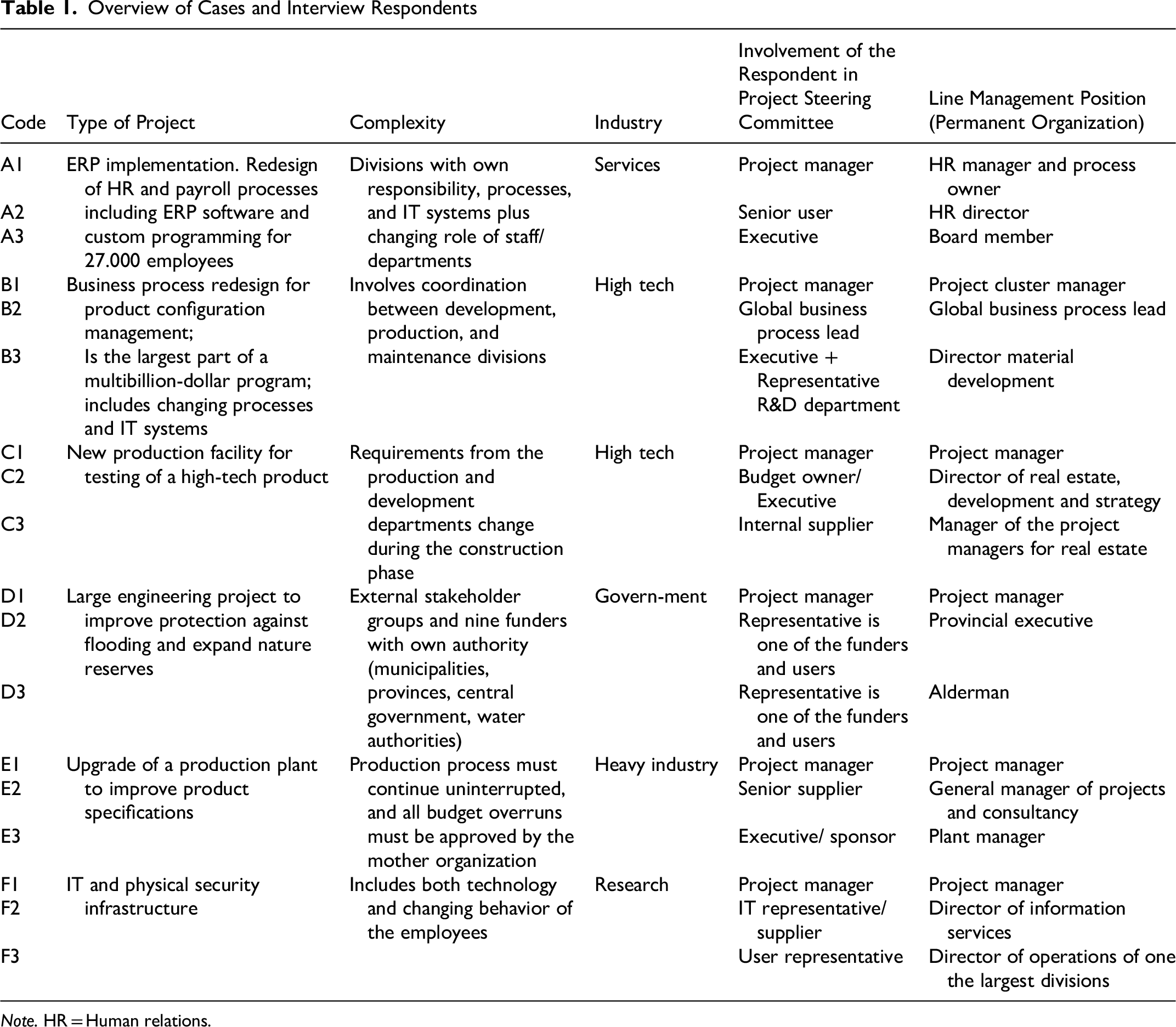
Via purposeful sampling, we selected projects with conflicts of interest between involved stakeholders and a high risk to the owning organization in case of failure, thus indicating the need for governance (Crawford et al., 2008). We made sure each project had a dedicated project steering committee with decision-making authority. Following the project categories used by Joslin (2014), the selection of projects included at least one engineering, one IT, and one organizational change project. This resulted in the selection of six project steering committees for data collection, responsible for projects with budgets between €8 million and €250 million (see Table 1). All project-owning organizations were based in the Netherlands, hence sharing a similar cultural context. For each project steering committee, we requested background documentation on the project from the project manager. The project manager was the first to be interviewed, with a minimum interview time of 90 minutes. This provided an opportunity to gather context on the project and its impact on stakeholders. Then, for each project, two project steering committee members were interviewed individually. This led to interviewing 18 people (12 project steering committee members, six project managers), each discussing one or more projects, which is generally sufficient for data saturation (Guest et al., 2006).
Overview of Cases and Interview Respondents
Note. HR = Human relations.
In the interviews, we focused on the actions, motivation, and effects at the individual project steering committee member level. For example, we asked, “What is the effect of your contribution and your role on project performance? Why?” To gain a deeper understanding of cooperation, we asked each participant to describe a recent difficult decision and how they shared facts, interpreted them, and projected likely future developments (Uitdewilligen & Waller, 2018). We also explored who made the final decision.
Data Analysis
The respondents validated a summary from their interviews. The interviews were transcribed to facilitate coding (Blaikie, 2009) via qualitative data analysis software, ATLAS (version 24). Data analysis started inductively by letting codes and concepts on roles in project steering committees emerge from the transcripts by reading attentively to understand the meaning given by the respondent and catching this in phrases. As a second step, we rechecked all transcripts, using the emerged codes and insights deducted from literature, leading to a finalized list of 166 codes. Analyzing the last three interviews led to only three new codes, indicating data saturation. Third, we combined these codes into code groups. Fourth, we checked the co-occurrence of codes, such as the combination of responsibilities of members of project steering committees and the role they fulfill, cross-case analysis, and within-case analysis. Last, for presentation purposes, we combined the code groups into four aggregated dimensions. The codes and categorization can be requested from the authors. Co-occurrence of codes showed no indication of consistently contrasting views between project managers and project steering committee members.
Results
The following sections present the findings, structured according to four aggregate dimensions: (1) the goal of a project steering committee; (2) initiating a project steering committee; (3) roles and responsibilities of members; and (4) execution of roles by members in the project steering committee. The coding in parentheses in the following sections refers to the first column of Table 1.
The Goal of a Project Steering Committee
Project managers and project steering committee members agree that the project steering committee serves as a collaborative device, where the main stakeholder groups are represented and collaborate to achieve alignment on decisions and actions. Additionally, it is a body that oversees the project team's work to mitigate risk for the funding organization and achieve the intended goals. As one project manager stated: “First, one tries to align all parties in the steering committee, and then all members must make sure the decisions are implemented at home” (C1).
The project managers need information sharing, commitment, and fast decision-making to move the project forward and achieve its deliverables. The project steering committee members mentioned they were involved to understand the impact on their stakeholder group, to influence decision-making, and to take action to implement decisions in their organization. The large engineering project for flood protection (D) was a special case, as nine of the 10 project steering committee members represented funders. They used the project steering committee to achieve consensus among themselves and formulate actions for their permanent organizations, enabling them to decide on budgets and design criteria. Summarizing, the project steering committee is “a place where stakeholders not just approve a proposal by the project team but are partners in the decision-making process” (C3).
Initiating a Project Steering Committee
A senior manager in the organization typically consults with the project manager about who should be in the project steering committee. This leading manager can be the project owner (A, B, C) or an expert on project management (E, F). Choosing to use a project steering committee for governance and the roles of members are based on “this is what we always do” (A, E, F) or explicit corporate rules (B, C). No roles were derived from literature or project management standards except PRINCE2 (E). At the large engineering project (D), representation is a direct consequence of which entities financially participate: If a province funds part of a large engineering project, the executive from this province with the corresponding portfolio is automatically in the project steering committee due to the investment involved.
Members are selected based on who represents the funder(s), the main stakeholder groups at the owning organization(s), the critical resources the project needs, and, to a lesser extent, knowledge or process ownership. Other characteristics (such as interest in the project and personal competences) are considered if several people can represent a stakeholder group. For example, in the ERP implementation (A), the project owner wanted one human resources (HR) director at the division level to represent HR for all divisions, and she chose an HR director with affinity to the project’s products and excellent reputation among colleagues. None of the respondents considered adding members external to the owning or supplying organizations.
Roles and Responsibilities of Members
Except for the large engineering project (D), roles and responsibilities for project steering committee members were not described. One organization formally used PRINCE2 (E), though the generic roles were not translated to members’ specific responsibilities. As the project owner stated, “When I became the new project owner, I just reread the PRINCE2 book I had kept from a training 20 years ago” (E3).
All respondents agreed on the role of representing the funder who decides on the budget and “has skin in the game” (A2). They have titles like “project owner,” “executive,” and “chairperson.” There can be several members with this role, which can be beneficial since all members will have to return to their constituency in case of a cost overrun, thus making them reluctant to request scope extension. Most members fulfilling this role had a second role in representing the users. At the business process redesign project (B), the project owner had limited formal budget and planning authority but represented a heavily impacted and powerful department. The chairperson was formally someone representing a funder, although at half of the project steering committees, a project manager technically chaired the meetings. In all project steering committees, the project manager prepared the agenda. Only one project steering committee (A) has a single, undisputed project owner. In the other project steering committees, a leading coalition decides if consensus cannot be reached. The absence of a single strong formal chairperson necessitated group decision-making and a stakeholder perspective, rather than solely the shareholder perspective.
All projects had several representatives of users of the project deliverables. This could be based on departments/organizations (B, C, D, E, F), processes (B, F), or members representing a combination (A). Important responsibilities involved providing information about the impact of options for decisions, providing user requirements, and acting in their organization to prepare using the project deliverables for “when the users become owners” (B2). Not all major stakeholders at the owning organization were covered, e.g., at the ERP implementation (A), it was unclear who represented the staff departments, leading to an underestimation and partial ignoring of their business impact. Most representatives of users also had the role of providing project resources by delivering project members.
Most project steering committees have members whose sole role is to represent a supplier. These project steering committee members work at the owning or funding organization, with an exception at the ERP implementation (A), where directors from two external suppliers were included. These externals used the project steering committee for escalation and sign-off, sometimes hijacking the meetings and preventing the business case from being discussed during the project steering committee meetings.
The “representatives of the support organization for the project deliverables” were also mainly employed by the owning or funding organization. However, at the ERP implementation (A), a director from the main external support organization was included. At the large engineering project (D), the organization for nature conservation had a seat. We found confusion about the PRINCE2 role of senior supplier: a respondent defined the PRINCE2 senior supplier as “people maintaining the competences you build up,” which in PRINCE2 is part of the “senior user” role. Another respondent was explicit on the separate support role for project deliverables: “The director of the IT company is responsible for maintenance, not for implementation” (A1).
At the ERP implementation (A), a top-level board consultant had the role of “quality advisor” toward the project steering committee, by clarifying the impact of decisions and probing the quality and progress of the project. This was necessary because the representatives had difficulty understanding the project's status and the impact of decisions. However, it jeopardized the position of other members and the project manager by making decisions in others’ domains. At the upgrade of the production plant (E), a procurement officer was a member to add knowledge about contracting.
A role of “steering committee support” can be added for preparing documents (A) or project controlling (C, F). People holding this role are at the meeting but are not members and do not have decision-making authority.
Members in practice often hold multiple roles. Such as an alderman providing part of the funding, representing their own municipality, and providing capacity from civil servants: “Participating is not just having your say, adding topics to the agenda, and cofinancing; but also, delivery of manpower” (D3). Users from outside the funding, owning, or supplying organizations were never represented in the project steering committee by someone from their organization.
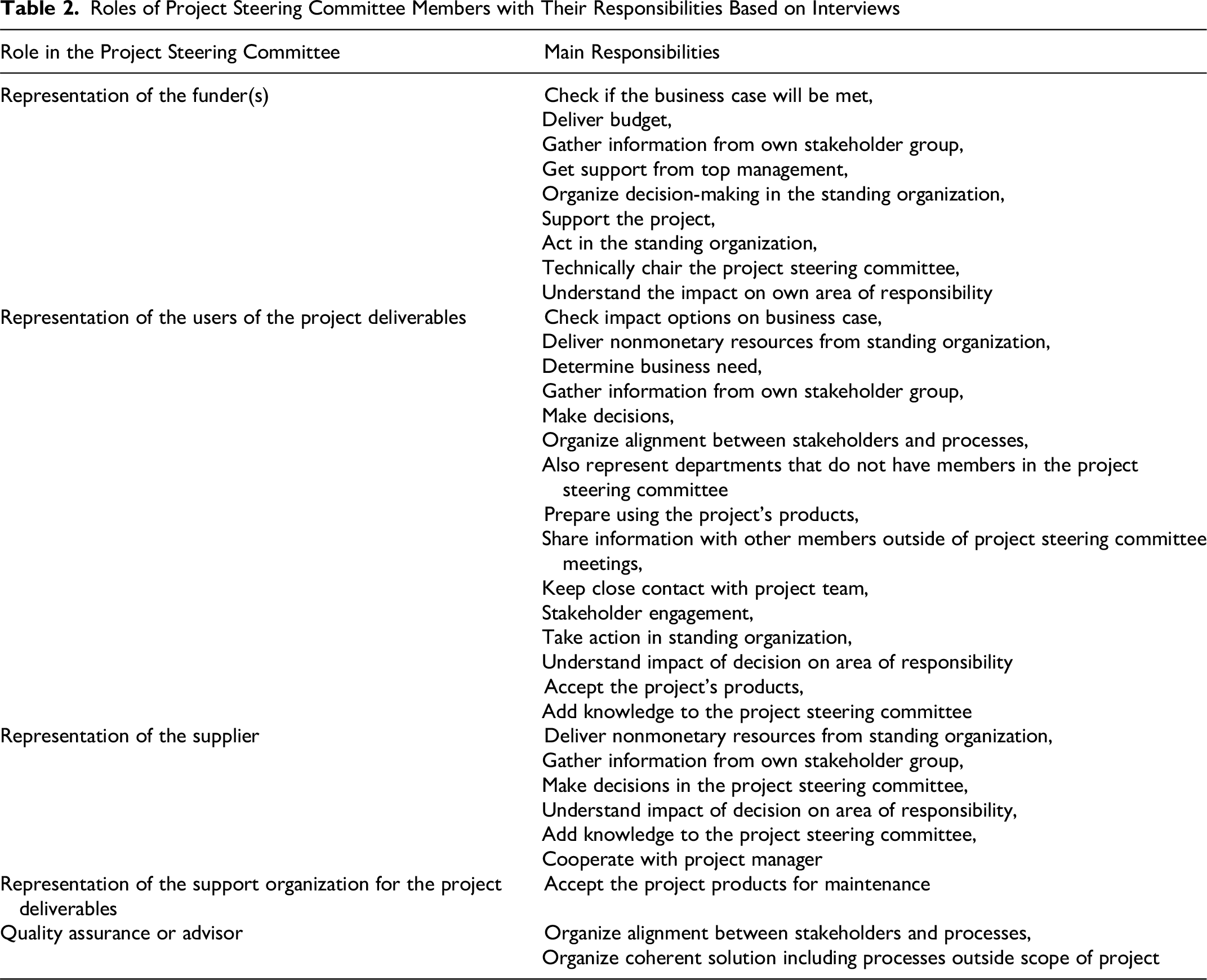
We asked the members about the primary responsibilities per role. Table 2 presents the co-occurrence of all roles and the responsibilities mentioned at least twice. Based on our data, the representative of the funder focuses on both investment and business benefits and is formally the chairperson. The representative of the user must accept the products, add knowledge about usage, add resources, and manage their own stakeholder group. The representative from the supplier adds resources and knowledge about the capabilities of the resources. The representative from the support organization must accept the products from a maintenance perspective. A quality assurance or advisory role can be added to align stakeholders or processes.
Roles of Project Steering Committee Members with Their Responsibilities Based on Interviews
Execution of Roles by Members
Respondents mentioned two reasons for establishing roles in project steering committees. The first is to select members of the project steering committee, based on what the project needed to succeed and how to limit the risk to the funding organization. At the large engineering project (D), the members were derived from the contract between the funders. At the other projects, representatives of invested and contributing stakeholders were invited. Some respondents spontaneously mentioned PRINCE2 roles as helpful for the selection of members. In none of the projects were the roles explicitly translated into the responsibilities of each member.
A second reason for establishing roles is to help identify which stakeholder group a member represents. However, one respondent said: “everybody works based on their personal experience and that’s not clear at all” (E2). This caused confusion during the lifetime of the project steering committee, leading to a lack of personal responsibility. The authority of the security manager versus the project owner was not apparent at the security infrastructure project (F). The project manager (F1) expected the representative of the largest user group to take care of communication, but this representative assumed this was an action of the project team, leading to delays. Unclear decision-making on internal resources (E) led to project steering committee members seeking consensus-based decision-making, which even helped project success due to exchanging knowledge and interests. This was possible due to mutual respect. At the ERP implementation (A), lack of clarity in roles negatively influenced project success, since members presented positive metrics according to their own interpretation of responsibilities, while nobody identified gaps.
Respondents had difficulty separating their role in the steering committee from their position in the permanent organization, “Everybody takes the perspective from the line function” (F3). In three project steering committees, the project steering committee has an overlap with the management teams in the permanent organization. The project steering committee members did not mind this lack of distinction between the role in the project steering committee and in the permanent organization if members share the overall project goals. However, project managers do indicate that the lack of distinction negatively affects results, since responsibilities for stakeholders outside their own departments are not covered, and priority for the project is lacking.
We explored how focusing on individual responsibilities and on shared goals impact each other. Respondents indicated that members sharing the overall goals of the project is a prerequisite before working from their own responsibilities. Some add that a second prerequisite is mutual trust; to share interests and doubts without “quarrels” (F2) and a willingness to understand the other’s viewpoints. If these two prerequisites are met, working from the role and “pushing the borders” (E2) is beneficial to project success. First, it adds perspectives and improves the quality of decisions. Second, it fosters commitment to decisions, which leads to compliance. Third, it provides project steering committee members with knowledge of why a decision was made, which facilitates implementation within their own stakeholder group. Fourth, it limits the chance that actions and issues are forgotten. Last, it helps members support one another in stakeholder engagement.
All respondents agree that decision-making is one of the most important activities of a project steering committee. Options should be prepared by experts from the project team. Some project steering committees discuss and make complex decisions in separate meetings to gain focus. Types of decisions are mainly on target processes and products. For example, shaping HR processes (A), aligning configuration management of machine parts between departments (B), ensuring access of ships to a harbor (D), and identifying the needed capabilities of the production line (C, E). Decisions on funding and planning were less frequent; the project steering committees for the upgrade of a production plant (E) and the business process redesign (B) even had no authority at all to approve scope changes and budget overruns. However, the members would jointly influence decision-making higher in the organizational hierarchy. For all roles, project steering committee members should understand the status and the impact of decisions on their area of responsibility and be critical toward each other; if not, the project steering committee will not steer, and “it just comes to us” (A3).
Respondents indicated that decision-making authority is derived from the member’s position in the permanent organization, rather than from their role in the project steering committee. For example, in the upgrade of the production plant (E), the director of operations was the project owner and decided on topics impacting operations. However, if this impacted budget or planning, he needed the consent of the director of the projects department, who had just a supplier representation role in the project steering committee. In the project to improve security (F), “the security officer could not be the project owner, since he has no authority over the IT and real estate departments” (F3). If consensus could not be reached, the most senior members in the permanent organization would decide. However, at five of the six projects discussed, the preferred method for decision-making was via consensus, to gather all perspectives and gain commitment. Gaining commitment is especially important if a decision impacts the responsibilities of several project steering committee members in their permanent organization. If consensus could not be reached, the decision was based on consent or made by a coalition of the most senior managers. In the public engineering project (D), members could not overrule one another. These project steering committee members indicated that consensus is only necessary between members who are impacted by a decision, and others should refrain from joining the discussion. In the words of a provincial executive: “I will not mingle in the discussions of the neighboring province,” and “members who do should be put back in their box” (D2).
Discussion
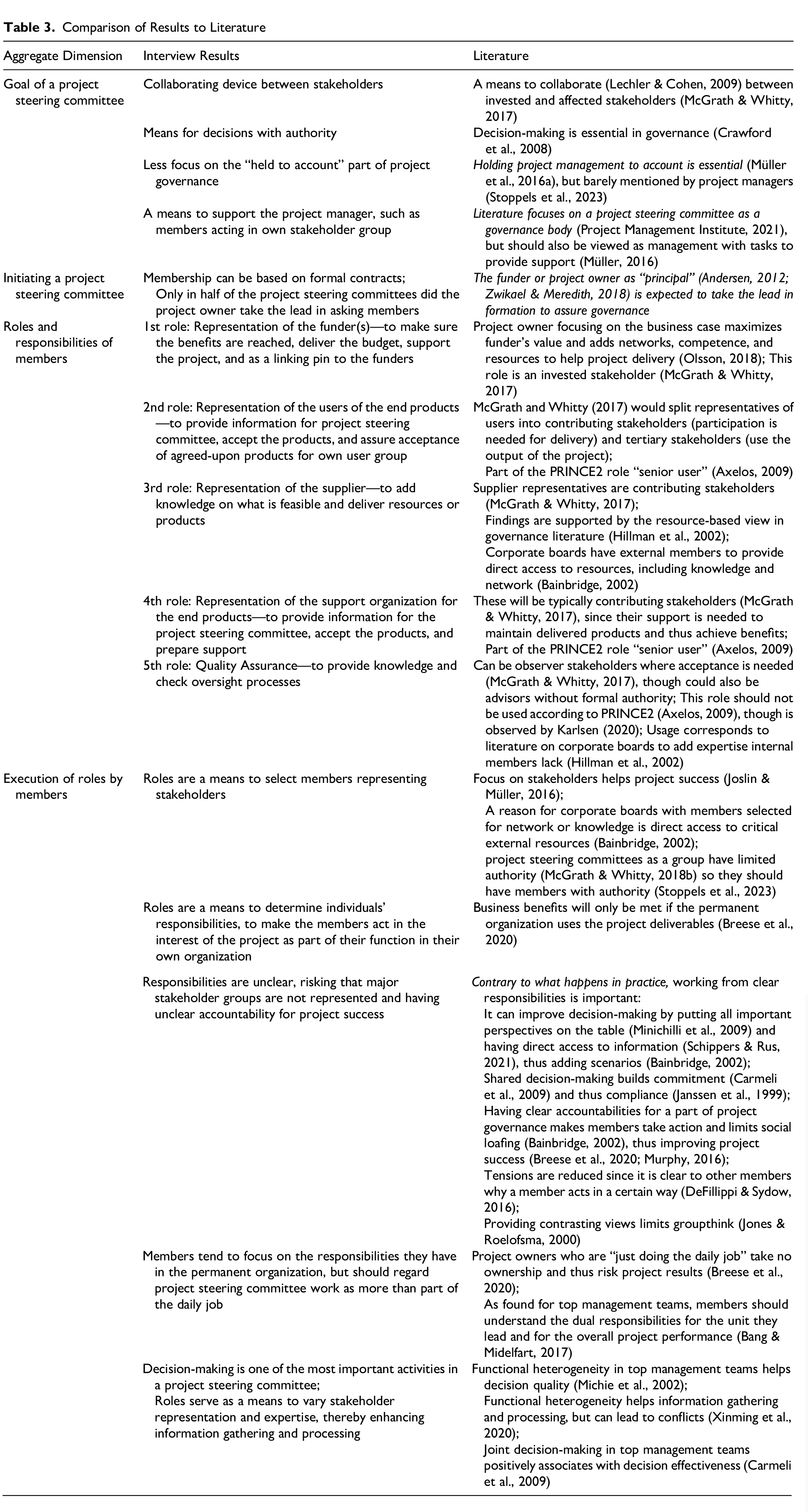
Table 3 compares our interview results and literature. Contrasting views (in italics) are discussed next, including the broader implications and limitations of our study.
Comparison of Results to Literature
Project Steering Committees as the Linking Pin Between the Temporary and Permanent Organization
The project steering committees we studied operated at the interface between permanent and temporary organizations, with funding organizations and other stakeholders collaborating to provide governance to the project, including support tasks. Whereas scholars earlier explicitly distinguished between project governance and project support (e.g., Crawford et al., 2008), these now appear to be integrated (Crawford, 2023; Sankaran et al., 2025). We, along with other scholars, define governance as providing direction and holding project management accountable (Müller et al., 2016a). A common meaning of “direction” is providing “guidance and supervision” (Merriam-Webster Inc., 2025; https://www.merriam-webster.com/dictionary/direction). Our data clearly show that project steering committee members should take ownership and act in the permanent organization to help the temporary project. Embedding the term “support” in “governance” carries the risk that research and practice may overlook this duty of project steering committee members to act.
We drew on literature on top management teams and corporate boards to expand beyond the realm of project governance literature, which provided insights into the types of conflicts and the importance of goal sharing. Project steering committees justify their own research, thus expanding organizational literature. However, there will be differences between project steering committees and top management teams/boards. Future research could focus on learning and knowledge transfer (e.g., Volden & Klakegg, 2024), as project steering committees and their members act at the intersection of permanent and temporary organizations. Such research would add to the research strand innovation (Sankaran et al., 2025).
Start a Project Steering Committee by Clarifying All Roles and Responsibilities of Members
Results show that five project steering committee roles can be distinguished in practice. The first three roles, the representation of the funder, users, and suppliers, are directly in line with PRINCE2. As per shareholder and stakeholder theory (Freeman, 1984; Friedman, 1962), the funder and main user groups will always require representation (Biesenthal & Wilden, 2014). There might be several funders, as we saw in our data, which is why we prefer not to use the term project owner. A project owner tends to be associated with a single person who should chair the project steering committee (Zwikael & Meredith, 2018). Our first three stakeholder groups are also recognized in earlier work of Murphy (2016) and McGrath and Whitty (2017).
Separating the fourth role of representing the support organization of project deliverables from the PRINCE2 senior user avoids confusion because “use” implies “put into service, especially to attain an end” (Merriam-Webster Inc., 2025; www.merriam-webster.com/dictionary/use), which suggests a one-time activity. The support organization will have fundamentally different interests from the users, such as achieving standardization and simplicity. The role of representing the support organization in a project steering committee can be considered when support is essential for realizing the benefits.
A fifth role of quality assurance, to add knowledge for decisions or hold the project manager to account, might be considered if other members lack expertise. This aligns with establishing nonexecutive corporate boards alongside top management teams to provide external viewpoints (Bainbridge, 2002). Interview results indicate caution when using this role, as the member added for knowledge in the ERP implementation (A) indeed improved information processing but jeopardized the roles of other members by heavily influencing decisions in their area of responsibility. Roles are needed to define the members’ individual responsibilities.
Our data shows that members tend to just start their project governance activities after joining the project steering committee, without making responsibilities explicit or sharing interpretations. For the members, this leads to shaping their responsibilities and authorities in the project steering committee as a subset of the function in their permanent organization. A resulting risk is that certain areas of responsibility are not covered in the project steering committee. Members representing various stakeholder groups lead to functional heterogeneity, improving decision quality (Michie et al., 2002) and utilizing diverse knowledge from the permanent organization (Walrave et al., 2024). One of the representatives of users indicated: “I want to be involved in analyzing and delivering the main deliverables in my area of expertise” (A3). The authority is mainly based on the function in the permanent organization (McGrath & Whitty, 2018b). Business benefits will only be met if the permanent organization uses the project deliverables (Breese et al., 2020), suggesting the need for convergence between responsibilities from the permanent and temporary organization.
Role theory presumes that an actor’s role is shaped by the expectations this actor has, and the expectations expressed by other actors. Structured role systems can help shape both expectations (Bechky, 2006). As our data shows, project steering committees have characteristics of temporary teams, and roles are barely defined at the start. According to the structuralist view in role theory, there is a need to clarify individual responsibilities to the members through structured roles. Most members will have a combination of roles for specific departments, organizations, and/or processes. Also, looking at the responsibilities in Table 2, on an aggregated level, these are not always distinct between roles. For example, the representative of the funder is responsible for the overall business case, the other representatives are responsible for those parts of the business case involving their stakeholder group. Therefore, in line with the interactionist view in role theory, members should also take time to tailor roles to the demands of the project and its governance. In their work on project owners, Breese et al. (2020) point to risks of them “just doing the daily job,” so being only a figurehead and not taking ownership. Our data indicates that for all project steering committee members, their role should be more than just business as usual (Olsson, 2018). As found for top management teams, the members should understand the dual responsibilities for the unit they lead and the overall project’s performance (Bang & Midelfart, 2017). They should act and “manage the business” (F1) during the project to deliver governance, and after the project to realize business benefits. Clarifying roles and responsibilities among the project steering committee members seems, therefore, an essential starting point.
Acting According to Individual Responsibilities to Influence Project Success
Project steering committee members acting from their personal responsibilities bring diverse perspectives to decision-making (Minichilli et al., 2009), while quality decision-making enhances project success (Turner, 2020). Besides, it helps members take action and limit social loafing (Bainbridge, 2002). Our data added the importance of members understanding the impact of decisions on their area of responsibility and taking ownership. If individual responsibilities are not discussed explicitly, members will make assumptions and cannot steer. We have seen that members who know and act according to individual responsibilities can help project success (B, C, D, E). Members who do not fail to discuss risks for the owning organization (A, F).
The members must balance and integrate responsibilities from both permanent and temporary organizations. They will need to learn to understand the project's goals and their impact on their own and others’ areas of responsibility. Only if group members share the overall goal and don’t feel they have to negotiate will they add interests and perspectives to the decision-making process and transform their views based on others’ input (Franco et al., 2016). If the overall goals among members differ, the variation in functional background of the members reduces decision quality (Michie et al., 2006; Walrave et al., 2024). As found in our data: “we often have to remind the members they must take into account the whole organization, not just their division,” but also “if another steering committee member has explained the reasoning behind a viewpoint, consensus will start to exist” (A1).
Literature indicates that having a single person accountable for the business case enhances project success (Zwikael et al., 2019). Still, our data shows that project steering committee members should combine individual accountability with at least a responsibility for the overall project success. Accountability implies authority and vice versa (McGrath & Whitty, 2018a; Zwikael & Meredith, 2018). Therefore, whether a group can decide is linked to whether a group can be held accountable. The apparent discrepancy between individual accountabilities and group decision-making can be explained by the concept of ‘group accountability’ (Kou & Stewart, 2017), a concept from the organizational management literature. As Stewart et al. (2023, p. 691) phrase: “the [group] accountability is collectively lived and breathed” and emerges from relationships and social exchanges. A sense of group accountability motivates members to dedicate time to shared goals. The emergence of group accountability is accelerated by shared decision-making, as our data shows. It will also shape the roles of individual members, such as by members filling gaps. A Guide to the Project Management Body of Knowledge (PMBOK® Guide)—Seventh Edition sums it up nicely, though intended for project teams: “Regardless of who is accountable or responsible for specific project work, a collaborative project team takes collective ownership of the project outcomes” (Project Management Institute, 2021, paragraph 3.2). Future research could build upon the work of Stewart et al. (2023) to further explore group accountability versus individual accountability, and on the work of Breese et al. (2020) about perspectives on roles. The notion of group accountability should be considered in future research applications of principal agency theories (Biesenthal & Wilden, 2014) by viewing both the principal and the agent as parts of groups that influence accountability and authority. This expands the call of Musawir (2024) to study principal–principal relationships by also including agent–agent relationships.
Respondents indicated that members should trust each other before focusing on their individual responsibilities as project steering committee members. Underlying this is the distinction between task conflict and relationship conflict (Simons & Peterson, 2000). Project steering committees are functionally heterogeneous because members represent stakeholder groups (Murphy, 2016). This functional heterogeneity can facilitate information gathering and processing (Benoliel & Somech, 2016), thereby enabling adaptive responses to environmental changes and supporting quality decision-making. However, functional heterogeneity can also lead to conflicts, as members work is based on different information and responsibilities stemming from their roles within the permanent organization (Deng et al., 2020). If this conflict is a task conflict, it can help decision quality (Wit et al., 2012). However, if this results in relationship conflict, it hinders working together (Parayitam et al., 2010). Therefore, relationship conflict should be avoided by clearly defining individual responsibilities and interests, and by fostering mutual trust and shared goals. As a result, other members understand behavior as resulting from the work itself and not coming from ulterior motives (Tidd et al., 2007).
Based on our case data, we expect there will be a degree of shared goals and mutual trust where the effect of acting from individual responsibilities to project success is positive, and a situation where this effect is negative. If common ground for project steering committee members is lacking, acting according to individual responsibilities only leads to haggling and pursuing their own interests (Parayitam & Papenhausen, 2016). Our qualitative study suggests that working from individual responsibilities based on roles affects project success. A future study could quantitatively test the moderating effects of shared goals and mutual trust.
Limitations
Our research involved both project steering committee members and project managers, allowing the comparison of their views, enriching our dataset. The current study, however, focused on respondents working for Dutch organizations. Future studies can expand to other countries.
Validity was enhanced via summaries checked by respondents, full transcripts, and a coding process in a publicly available tool. A limitation of interviews is that respondents might take certain responsibilities for granted and not mention them explicitly. A quantitative follow-up study can develop and test a conceptual model about members acting according to individual responsibilities, shared goals, mutual trust, and project success. Alternatively, a design thinking-based study can develop means to help funders and project steering committee members identify roles and translate them into individual responsibilities for the goals at hand. Stakeholder theory and role theory can be used as a lens. The governmentality (Müller et al., 2017) of the project steering committee members will also influence cooperation between project steering committee members and decision-making, including compliance with decisions by their own stakeholder group, thus providing another avenue for future studies.
Conclusion
Project governance is essential for project success (Musawir et al., 2017; Turner, 2020) and comprises a leading strand in project-organizing research (Sankaran et al., 2025). Project steering committees are used in practice as bodies for governance of the project (Stoppels et al., 2023). They are a collaborative group for invested and contributing stakeholders to ensure that project success is reached (Müller et al., 2015). Answering the question “How are roles and responsibilities within project steering committees defined and applied, and what is their relation to project success?” our study focused on the perception of members of the project steering committee on their own role, on the other members’ roles, and the dynamics in the project steering committee. Conclusions were drawn based on 18 interviews, documentation about the discussed projects, and literature from the fields of project management and organizational management.
Literature is not clear on roles beyond representing the funder, and this study added to literature by establishing five roles, according to the structuralist view of role theory (Bechky, 2006). The roles include representation of the funder(s), representation of the user group(s), representation of the supplier(s) of project resources, representation of the support organization(s) for project deliverables, and quality assurance. Across various types of projects, similar roles were found, and these roles provide clarity to the project steering committee members in practice. During the selection process for members, the categories of roles could be used to determine how stakeholders and resource providers will be engaged, based on the benefits and risks to the funding organization and the support needed for the project.
At the start of the project steering committee, the roles serve as a starting point to determine and share the individual responsibilities of each member, including the link of each member’s role to its function in the permanent organization. In practice, individual responsibilities are ambiguous since members fulfill several roles, and responsibilities related to the roles are hardly made explicit and shared among project steering committee members (Stoppels et al., 2023). As a consequence, during project execution project steering committee members often regard their project steering committee responsibilities only as a subset of the responsibilities in their permanent organization. This jeopardizes project success, since governance tasks may be ignored, and responsibilities for project success are unclear. Also, project steering committees hardly take time to deepen perceptions on goals and work on team building. Both limit engagement as a group, limiting project success (Murphy, 2016).
The members have functionally diverse backgrounds, which helps quality decision-making by considering stakeholder interests and knowledge (Benoliel & Somech, 2016). Diversity can lead to relationship conflicts, hindering collaboration and project success. This requires making individual responsibilities and interests explicit and building mutual trust and shared goals. When shared goals and mutual trust are present, and individual responsibilities are known, these responsibilities help achieve success: it sharpens the decision-making process, fosters commitment, prevents relationship conflict, and prevents gaps in governance activities. Project steering committee members must balance individual accountability, deriving from their permanent position, with group accountability for the project. This challenge requires additional research and support in practice by project managers and fellow project steering committee members.
Our study supports follow-up research on the relational interplay between individual members’ roles and the steering committee's overall duty in dealing with disruptions and alleviating tensions between stakeholders. This is in line with recent recommendations on the project governance research strands “resilience” and “organization” (Sankaran et al., 2025).
In summary, we recommend that project steering committee members balance providing direction, holding the project manager to account, and providing support. Practitioners should explicitly use our five standard roles as a starting point, where one member can have several roles. Project steering committee members should then work together (following interactionist role theory) to translate these roles into individual responsibilities in steering the project. This goes hand in hand with goal sharing and trust building. Failing to build a collective identity may lead to relationship conflict and merely “doing the day job” (Breese et al., 2020, p. 25). Taking the effort will help achieve a sense of group accountability combined with individual accountability, thereby improving the chances of project success.
