




Abstract
This article explores the concept of governance behaviors during project crises, which demand rapid responses. Grounded in the Cynefin model for decision-making and inspired by Iftikhar et al., (2021), we sought to explore in greater detail the challenge of a particular and common response to crisis: project manager replacement. We address governance as essentially a two-level function: sensemaking under crisis conditions and offering guidance within the critical early stages of project manager replacement, when the need for governance is crucial. Finally, this article offers some guidance for the employment of governance within different Cynefin complexity domains for maximizing effective replacement steps.
Introduction
Among the recent developments in project management theory and practice, one of the more profound has been the emergence of the concept of governance as a means by which to better understand organizational decision-making, planning, and control. The work of scholars such as Ralf Müller has been instrumental to our understanding of this key project process. It is particularly important in light of the dramatic upsurge in the adoption of project-based work by a wide variety of organizations and within disciplines as diverse as finance and insurance, IT and software development, sustainability, energy development, artificial intelligence (AI), and social infrastructure, to name but a few. Indeed, with the increasing interest and adoption of megaprojects to address societal needs, Project Management Institute (PMI) and other companion professional groups have plenty of evidence to clearly demonstrate that projects remain a principal means to change our world (Pinto, 2019).
In this article we seek to explore the evolving role of governance and its multiple manifestations, with a specific focus on responses to unexpected events, particularly in the realm of project crises. Drawing inspiration from the Cynefin complexity model developed by Snowden and Boone (2007), we delve into the interplay between governance and crisis management. Our central research question, guiding this exploration, is:
How does the decision to replace the project manager function as a potential governance response to project crises, and how can the Cynefin complexity model be adapted to provide guidance under varying levels of complexity within project environments?
As we navigate the landscape of project governance in the face of crises, our research contributes to the ongoing discourse on project management, providing valuable insights for scholars, project managers, and organizational leaders striving to navigate the challenges posed by unexpected events.
This article is structured to address the elements of governance as a model for understanding organizational responses in crisis settings. We categorize various forms of crisis, their signals, and common responses. Our contention is that governance responses to unexpected events, of which project crises are one example, are often hampered by an unstructured, reactive response pattern that forces project organizations to develop ad hoc or partial solutions. The Cynefin framework, discussed in this article, offers project teams the opportunity to apply a more structured sensemaking device to crisis detection that contains more proactive and measured responses to crises with the goal of minimizing project disruptions. Beyond a general context for addressing crises in projects, we focus specifically on one governance response to project crisis; namely, the decision to replace the project manager. The literature on crisis governance is in its infancy (see Iftikhar et al., 2021) and, as such, there are opportunities to extend our understanding of this phenomenon to specific, important settings and conditions through the use of adaptive models such as Cynefin, while offering a framework for project organizations to recognize and rapidly respond to developing crises with the goal of minimizing disruptions.
The Roots of Project Governance
As a key development in our pursuit of better understanding and management of projects, the exploration of governance systems for project-based organizations has witnessed remarkable growth in recent years, from earlier work by Müller (2009), Pryke (2005), Bekker and Steyn (2007), Clegg et al. (2002), and Turner and Keegan (2001), to more recent studies by a variety of scholars, including Ahola et al. (2014), Bourne et al. (2023), Biesenthal and Wilden, (2014), Müller (2016), Song et al. (2022), and Unterhitzenberger et al. (2023), among others. Indeed, the growth in the literature on project governance has demonstrated its resonance with a growing body of scholars seeking both to understand the functioning of this concept and its relationship to project success (Joslin & Müller, 2016).
Governance “… comprises the value system, responsibilities, processes and policies that allow projects to achieve organizational objectives and foster implementation that is in the best interest of all of the stakeholders, internal and external, and the corporation itself” (Müller, 2009, p. 4). Within the project setting, governance can be contrasted with simpler management practices and was seen, in Müller’s (2016, pp. 5–6) words, as: …The framework within which management tasks … are executed. Governance is established based on governance principles, which are the fundamental norms, rules, or values that are desirable and guide the establishment of governance practices. Governance principles are different from management principles, as the former typically underpin the ways in which management is steered, and thus provide norms, rules, and values for setting up a framework to steer management, whereas management principles refer to the organization of work and the people used to execute work.
Governance initiatives cannot be considered as one size fits all. They can be viewed as a shareholder/stakeholder as well as a behavior/outcome orientation (Müller, 2009; Müller & Lecoeuvre, 2014), complexifying the challenge for managers looking for the best way forward. The stakeholder satisfaction aspect is integral to ideas of success (e.g., Davis, 2018; Shao & Müller, 2011), and the complexity of managing stakeholder relationships is a significant factor in project resilience (Yang et al., 2022). We note here also the importance of “governmentality,” or “(the combination of the words governance and mentality) [which] sets the ‘tone’ … between governors and governed individuals” (Müller et al., 2017, p. 379). Governmentality thus addresses this vital people side (Müller et al., 2014). We note also that the multiplicity of stakeholders, including at different organizational levels, leads to a number of different priorities, adding further difficulties to the management task. Brunet (Brunet & Forgues, 2019; Brunet, 2021) employs a sensemaking perspective in analyzing this challenge in megaprojects, and we draw on this approach later. Subsequent work (Brunet et al., 2023) develops a framework for collaborative governance encompassing sensemaking, procedural, structural, and relational aspects.
So how might we best understand the nature of governance and its singular role in managing projects more effectively? Turner and Keegan (2001) describe project governance as a means for controlling the risk exposure of individual projects through regulating relationships between the organization and external clients while also normalizing and rationalizing conduct between the project team and the parent firm. Crawford and Cooke-Davies (2009) see project governance as a set of principles, structures, and processes that are intended to define and regulate roles, accountabilities, decision-making, and boundary management related to projects in order to centralize the project planning and control function. In his book, Müller (2009, p. 2) referred to project governance as “the conduct of conduct;” in other words, as a form of self-regulation “where the regulator is part of the system under regulation.” Writing further, he suggests, “governance provides a framework for ethical decision-making and managerial action within an organization that is based on transparency, accountability, and defined roles.” Another useful definition of governance was developed by Bekker and Steyn (2007, p. 4) who suggest governance to be: “[A] set of management systems, rules, protocols, relationships, and structures that provide the framework within which decisions are made for project development and implementation to achieve the intended business or strategic motivation.” The underlying features of these views of governance emphasize methods to provide control, not simply for the project at a microlevel, but within the project organization itself by prescribing supporting structures, policies/regulations, individual roles and duties, decision authority channels, and clear stakeholder management guidelines. All are intended to help firms regulate and control the behavior of their teams in developing projects.
Within project theory development, governance is a key ongoing area of research. Current important issues include the challenge of governing megaprojects (Bourne et al., 2023), and interorganizational project working (Fernandes et al., 2023; Roehrich et al., 2023; Unterhitzenberger et al., 2023; Wang et al., 2023), including at multiple levels (Martinsuo & Ahola, 2022). Other authors have addressed how governance relates to coopetition (Rouyre et al., 2023). The complexity of the challenge is recognized (e.g., Adami & Verschoore, 2018; Chakkol et al., 2018; Qui et al., 2019) and governance remains an important topic for both researchers and practitioners.
While the governance literature is growing apace, as scholars examine a variety of conditions or settings under which governance can enable more proactive and comprehensive project control, there still exist many opportunities for evaluating this construct. Opportunities exist particularly in the gray areas or special conditions under which governance models may either: (1) not work well, or (2) provide only broad guidance due to special circumstances or less-understood circumstances. For example, what happens when project developments do not go according to plan; that is, what happens within organizational systems guided by adequate governance processes when they encounter unexpected events triggering some crisis? As Müller and colleagues have noted, project governance approaches are seriously complicated and even compromised when a project faces a crisis (Iftikhar et al., 2021). We now look at the role of governance when the project encounters the unexpected.
Governance Response to the Unexpected
If we accept that governance offers the means by which project-based organizations can create and maintain the mechanisms and systems that allow for oversight and regulation of project activities, we are tacitly acknowledging that governance is often predicated on the maintenance of positive stasis. This continuance of behaviors is designed to control and promote rational oversight of projects within an organizational system. The question arises, however, as to how such mechanisms respond when projects experience unintended or critical events (e.g., Fang et al., 2023). That is, many of our previous governance definitions ascribe a means for creating a framework of deliberative behaviors—systems, rules, structures, and so forth, based on the intent of orderly control. But these best intentions can be thwarted in the case where projects and their larger organizations are confronted with crises demanding urgent sensemaking and corrective action. Are standard governance systems capable of pivoting quickly to accommodate the rapid “outturns” (Ika & Pinto, 2022) to which projects are often prone and that can render carefully developed governance systems incapable or even counterproductive, should the system be so rigid as to not adapt to emergent realities in a meaningful manner?
To understand more fully the nature of governance in atypical but significant circumstances, it is first necessary to identify project crises as a phenomenon. Having a better sense of what can signal or trigger such crises allows us to identify points of leverage where project governance can be meaningfully employed.
Project Crises and Their Signals
It has been observed that the environments within which organizations currently operate contain strong forces that increase the likelihood of the frequency of crises (Pearson & Clair, 1998; Pearson et al., 2023). Pearson argues that the key drivers include: (1) hypercompetition, (2) globalization, and (3) techno-acceleration. Hypercompetition suggests that firms are seeking to do more with less, while working in a continuous-loop cycle to make products faster, cheaper, and better. These challenges can lead to a natural desire to cut corners with a resulting increase in errors and operating misunderstandings, conditions that are ripe for creating crises. Globalization also can be a problem because, Pearson notes, most multinational firms still center their crisis management operations at their home office or some centralized location, despite operating in multiple countries, across ethnic and cultural boundaries. Lacking a decentralized crisis management capability frequently leads to a failure to anticipate and respond rapidly to emergent crises. Finally, techno-acceleration suggests that many technological advances produce higher uncertainty, an inability to account adequately for the implications of such shifts (the law of unintended consequences), and, ironically, compound crises by offering stakeholders and disgruntled employees multiple avenues for advertising or exaggerating situations that snowball into full-blown, publicly viewed crises. Thus, as problems are discovered, organizations may be put into reactive mode by having to fight a series of rumors or false information rather than focusing their efforts on averting a crisis.
Detecting evidence of likely or imminent problems in projects is a challenge that has motivated scholars and practitioners alike for decades. Academic research into crises may require serendipity in obtaining appropriate cases (Simard & Laberge, 2015). For practitioners, monitoring and control mechanisms, early warning signals (Green et al., 1993), and other sensing devices eventually gave way to data-driven metrics of the type employed by earned value and earned schedule to monitor cost performance and schedule performance indices. These are all designed to provide real-time evidence of the status of an ongoing project. The problem, of course, is the need to distinguish between simple under-performance, of the type that can be signaled by reviewing stage gates (Cooper, 1990) and other interim monitoring methods, and legitimate crises that can upend the development of an otherwise well-progressing project. Indeed, the language used can convey a certain muddiness in terms of what a real project crisis looks like. A crisis can be defined as “a low-probability and high-impact event” (Pearson & Clair, 1998, p. 60), which, should it occur, has the potential not simply to delay, but to affect a project beyond the point of recovery (Hermann, 1963). Iftikhar et al. (2021) noted that a common, albeit neutral, term used in project settings is “unexpected event,” which attempts to convey a sense of project risk, even though the authors caution against the intermingling of terms such as “risk” and “crisis.”
Project risk has been studied for many years now and some of its properties are suggested to include a sense of “unknown-knowns” (e.g., Fortis et al., 2018); that is, it is identifiable and known to occur, though the actual timing of these events, or their certainty, are unclear. In this sense, a risk represents an event for which a statistical probability may be determined due to the knowledge of the potential occurrence of such outcomes (Love et al., 2023). On the other hand, the roots of a crisis are often intertwined with uncertainties, for which it is impossible to determine probabilities. As Iftikhar et al. (2021, p. 395), suggest: “A crisis is commonly described as an unanticipated, surprising, and ambiguous event posing a significant threat, leaving only a brief time to make a decision.” Contingencies can be planned for risks, whereas a crisis is an event with a high level of uncertainty with typically no anticipation and contingency plan (Bell et al., 2018).
In their study on the nature of crises, Iftikhar and Müller (2019) conducted a systematic literature review and determined that while there exist a variety of definitions of a crisis, there are some key commonalities. First, they observed a crisis is an unplanned event that has the potential of dismantling the internal and external structures of an organization. A crisis may affect not only the employees and other members internal to the organization, but also key stakeholders external to the organization. Second, a crisis may occur in any organization. For example, nonprofit organizations, governmental agencies, multinational organizations, and so forth, all are susceptible to a crisis (Barton, 1994). Finally, a crisis may affect the legitimacy of an organization. In the event of a crisis, the ability to influence public or stakeholder perception may affect the survival of an organization.
Considering the challenging environmental factors, such as hypercompetition, globalization, and techno-acceleration (Pearson et al., 2023) that increase the frequency of crises in today’s organizations, there is a need to explore further how governance functions in crisis situations. Governance’s role in project crises is crucial yet complex. Iftikhar et al. (2021) examined governance in a megaproject crisis, using a single case study and found a number of important coping strategies when faced with unforeseen events. Another recent large-data study examined the impact of relational and contractual governance mechanisms on organizational resilience in infrastructure projects (Lv et al., 2023). Their findings suggest that when projects are faced with crises (unexpected events), governance can serve to enhance the project’s resilience when it focuses on relationship building and establishing contractual conditions that allow for rapid response and remediation in unplanned event settings. Moving beyond these specific cases to a broader context, examining a particular top management response (i.e., project manager replacement) offers the opportunity to expand our understanding of effective crisis response. Moreover, we face the challenge of fully understanding the nature of the crisis we face; that is, crises come in multiple forms and due to a wide variety of proximate causes. Offering alternative response options must be carefully understood in context.
Types of Crises and Common Responses
Following Shrivastava and Mitroff’s (1987) categorization of crises along two dimensions—internal/external and social/technical—we can formalize a system whereby it is possible to recognize the nature of a crisis, understand its root causes, and begin to formulate corrective strategies in applying project governance to these situations (Iftikhar & Müller, 2019). The first dimension, encompassing internal versus external crises, refers to the source of failures resulting in unexpected and serious events that have the capacity to derail a project. For example, internal events can include failures of organizational systems of control or culture; while external events are triggered by environmental upheavals, stakeholder interference, legal obstructions, and so forth. Second, Shrivastava and Mitroff (1987) note that root causes of crises can arise through social or technical causes, including everything from workplace bullying (social–internal) to changes in government forcing new regulatory guidelines (technical–external), as in the recent case of several previously approved gas and oil pipeline projects currently in regulatory limbo in the United States. Understanding the structural similarities of crises allows firms to develop corresponding sets of ameliorative methods rather than treating each crisis as a one-off crisis requiring a unique solution that prevents larger organizational learning or knowledge management (Shrivastava et al., 1988). Interestingly, a recent study by Iftikhar (2023) tested the Shrivastava and Mitroff (1987) typology and found differential effects of various types of crises (internal versus external; social versus technical). For example, external crises were not found to have the same negative effect on project outcomes that came from internal crises.
The challenge of addressing project crises is more marked by the observance that such crises often bring out the worst possible responses by key stakeholders. For example, Loosemore (1998), writing about crises within construction projects, observed three ironies: (1) when effective communication is most critical, it in fact becomes less likely, as organizational subunits “circle the wagons” and adopt defensive patterns that are self-preservatory; (2) when mutual sensitivity between project team members is important, it is less likely, with natural responses being self-protective rather than collaborative; and (3) when collective responsibility and teamwork are important there is a decreased likelihood. Mutual problem-solving responses are delegitimized in favor of departments or individuals “covering their tracks” or pointing fingers in other directions. A persistent challenge during crises is the difficulty key actors face in promptly shaping their interpretation of the event. This impedes their ability to select the most effective course of action for an early resolution.
While the Shrivastava and Mitroff’s (1987) categorization is a useful point of departure, it fails to adequately inform us of the trigger conditions under which various types of crises may be most likely to occur and how they might be best interpreted by key organizational actors (Iftikhar et al., 2023). To gain a deeper understanding of this challenge and how governance operates in crises, it is valuable to examine these distinctions between risks and crises through the lens of the Cynefin model.
Viewing Crises in Projects: Snowden’s Cynefin Framework
One of the challenges faced by management in project organizations is how governance is maintained in the face of project crises; that is, the process of recognizing and channeling resources and energy to addressing these unplanned, disruptive events, with the goal of returning the project to an earlier state of normalcy, or even successfully pivoting by reorienting project goals in the face of an uncorrectable challenge. This lack of systematic sensemaking recurs in all manner of organizational activities and is one of the principal reasons for the development of the Cynefin framework (Snowden & Boone, 2007; Snowden & Rancati, 2021; Shalbafan et al., 2018).
It is recognized that projects are complex, dynamic, and present managers with a range of challenges over their life cycle (e.g., Geraldi et al., 2011; Maylor et al., 2013), with corresponding difficulties in managing performance (Pavlov & Micheli, 2023). We also noted that projects can be prone to failure, either through a rapid crisis event, or through slower creeping failure (Kutsch et al., 2015). Partly, it has been argued, that the inherent nature of the environments in which many projects are initiated harbor numerous challenges that they are destined to encounter throughout their life cycle (Maylor & Turner, 2017).
The Cynefin framework (Snowden & Boone, 2007) was originally developed as a sensemaking device. The underlying notion is that decision makers operate more effectively when they understand the context within which they are working, as there may be competing alternatives of decision options, as well as connections of which they may not be aware. We utilize this framework as a way of showing that the nature of the challenge can be understood as one of the Cynefin categories, and we use this later to develop guidance for managers faced with a crisis. The model (Figure 1) depicts four main domains:
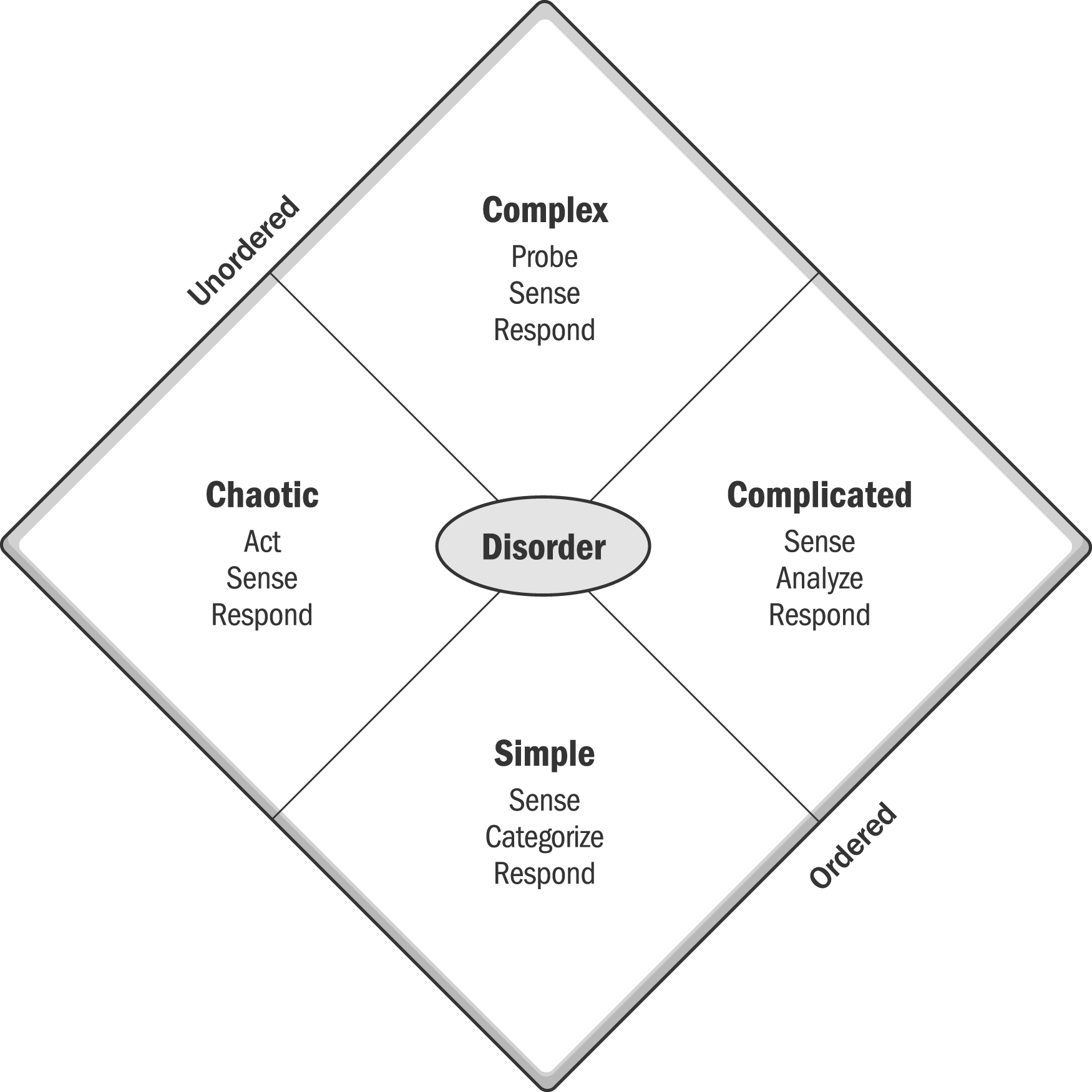
Cynefin Framework (adapted from Snowden & Boone, 2007, p. 72).
First, the “Simple” domain is stable and has clear cause-and-effect relationships with “known-knowns.” Managing while in this category is relatively straightforward. This domain permits us to use a “sense-categorize-respond” approach and can be understood as applying standard operating procedures or principles of established practice (including simple decision rules) in the project. For example, always employ a 10% contingency on a construction project or require a minimum of three estimates for site grading.
Second, the “Complicated” domain is one in which there may be many correct solutions, and expertise (e.g., project management and technical specialists) is required to resolve issues using “sense-analyze-respond” to address “known-unknowns.” Refined judgment and expertise are necessary to break down questions and generate a range of options that move toward optimal solutions. Artificial intelligence may be able to help with complicated problems, in this domain.
Third, the “Complex” domain suggests that there are no right answers and cause-and-effect can only be deduced in retrospect (looking back at the decisions we made and how they panned out), due to “unknown-unknowns” and embedded uncertainty. The appropriate response here is “probe-sense-respond,” to determine the right path through the fog. Examples may include the response to major market shifts, or the adoption of radical new technology. Dynamic complex project systems or organizational cultures are examples of complex challenges that confound simple, reductionist approaches to their understanding.
Fourth, “Chaotic” circumstances are rare and characterized by unknowables and may well be disaster situations. Events are too complicated to attempt to derive a rational response through analysis and, instead, the key is immediate action. There is no time to ask for input. Here, “act-sense-respond” is advised given the novelty of the situation where there is no template answer available. As Snowden and Boone (2007, p. 74) write: “In the chaotic domain, a leader’s immediate job is not to discover patterns but to staunch the bleeding. A leader must first act to establish order, then sense where stability is present and where it is absent, and then finally respond by working to transform the situation from chaos to complexity. Identifying emerging patterns can, both, help prevent future crises and discern new opportunities” [emphasis in original].
We note that the model could, for example, be used to explore and test specific governance actions in appropriate cases more fully (probe-sense-respond, sense-analyze-respond, etc.), but that is beyond the scope of this work. Rather, we use the quadrant terminology to examine response types, as discussed later.
As the Cynefin framework suggests, chaotic circumstances are often a characteristic of crisis situations. Whether the crisis is of a monumental, existential nature (e.g., the 2023 fires in Maui) or an industrial accident or spectacular product failure that represents a challenge to long-term corporate survival, the “appropriate” response is rarely immediately evident, the cost of “paralysis by analysis” prohibitive, and the efficacy of likely responses are impossible to determine a priori. Under such circumstances, project crises may require a bias for action rather than reflection, which, as Cynefin suggests, requires the reestablishment of order as quickly as possible.
The Cynefin framework has been employed effectively as a decision-making device in project settings. For example, Naim et al. (2022, p. 1377) use Cynefin with regard to understanding construction project supply chains and highlight that it “enlightens our thinking” and allows a narrative to be discussed around the challenges of disordered, interconnected issues beyond “the ‘risk register model’ norm” (see also Sawyerr & Harrison, 2020). Moreover, establishing the appropriate context within the framework allows us to reflect on the state of the project and provides a language to discuss the challenges. In particular, it can help facilitate a discussion over whether the current performance (especially one of deteriorating performance and/or crisis) warrants a change of governance. Alexander et al. (2018) apply the Cynefin framework to performance measurement and management systems and discuss the challenge of organizational culture. In “ordered” environments (the “simple” and “complicated” states), hierarchy and command and control is more effective, though they may not be sufficient to respond effectively under the “unordered” conditions of complexity. Although clear and unambiguous classifications of the Cynefin quadrants are difficult, if a project departs from a predominantly structured execution approach to a messier, complex one, then action should be taken with regard to sensemaking strategies (i.e., matching the challenges to appropriate sensemaking processes). Such processes are far from straightforward, however. Song et al. (2022, p. 342) examined the wider governance literature and recommend determining “how the interaction between the project and its embedded network, local community, and sociopolitical settings influence and are influenced by governance arrangements.”
The implications of the Cynefin framework on project governance are important as they are liberating in their call for flexible responses. As Song et al. (2022, p. 342) write: Project governance is no longer considered merely a one-off decision or a fixed arrangement, and temporality and contextual interaction can constantly reshape actors’ understanding and capacity. Therefore, we highlight that practitioners should recognize their opportunities for improvisations to confront unanticipated situations.
Governance and Crisis Management
We noted previously that project governance is not intended simply as a static or cybernetic form of project control, but that its strength lies in the willingness of organizations to afford their governance systems sufficient flexibility to identify, respond to, and learn from project processes. This capacity is particularly important when dealing with unforeseen events of the type that define a crisis. Writing on this topic, Iftikhar and Müller (2019) made several trenchant observations about the manner in which an effective governance system allows project organizations the best opportunity to monitor, respond, and learn from crisis events. They noted, however, that it can be nearly impossible to study these events in real time, due to their unpredictability. Thus, their key argument suggests: Crisis can be considered as an opportunity to change and opportunity to learn. It is an opportunity to change when warning signals are recognized before a crisis occurs. However, it is often only possible after the crisis, because warning signals are easier to detect after the crisis… There are two ways to deal with crises. The first is to prevent the crisis. Hence, a crisis is unimaginable, so it is impossible to prevent them. The second is to prepare for a crisis, which is more realistic. (p. 67)
The role that effective leadership can play during project crises cannot be underestimated. A variety of unexpected events (including but not limited to governance system failures) in projects can lead to the need for crisis responses where the project manager plays a critical role. This issue is considered especially key because of the central position that project managers occupy with their projects, serving as a visible focal point for all critical stakeholders, both internal and external to the organization. They are often the ones accountable for the outputs (Zwikael & Meredith, 2018; Zwikael et al., 2019), thus, when the crisis emerges, the project manager is expected to respond quickly and take action to minimize the impact on the project’s activities and overall direction. Because the project manager is the face of the project, expectations naturally exist regarding both their capabilities and willingness to step into the breach to begin corrective responses. As Pearson et al. (2023) observed, effective crisis leaders must not only lead their teams effectively, but they must be boundary spanners, able to influence beyond their team and designated “turf” even when they lack the position power to do so. Moreover, they need to make and reinforce connections and foster trust, while stepping up to take charge, all while making rapid decisions and acting promptly in the face of high volatility under which crisis situations often occur (Maylor & Turner, 2017).
Given the centrality and critical nature of leadership responses in times of crisis, the key question must be considered: under what circumstances might it be the case where the solution to a crisis involves the necessity of replacing the project manager? In other words, when has project leadership “failed” to the degree that replacing the project manager is justified as the best choice for fixing a challenging problem? The importance of effective leadership of projects is a topic that is widely covered in the project management literature, which points to the key role project managers play in successful projects (Müller & Turner, 2010; Turner & Müller, 2005). Consequently, this article endeavors to explore the relationship between crisis governance and the decision to replace a project manager. Our focus extends beyond delineating the primary reasons for a manager’s replacement. From a governance standpoint, we also delve into the actions that the incoming project manager, in collaboration with the project organization, can initiate to restore control and propel the project forward.
If governance is indeed a form of self-regulation, as Müller has noted, it is imperative to understand the way a project system can correct and begin to self-regulate itself in the aftermath of a replacement decision. This point is even more pressing when we consider our previous argument that a crisis necessitating project manager replacement can affect the perceived legitimacy of the organization, and the ability to influence stakeholder perception under crisis conditions is paramount.
The interplay among governance, project manager replacement, and crisis management is intricate and complex. By examining these dynamics through the lens of the Cynefin model, we can gain insights into how organizations can navigate crises, adapt their governance systems, and ensure their projects move toward recovery and stability.
Governance in a Crisis: Why is the Project Manager Replaced?
The Role of Agency Theory
We consider the role of governance here through the conceptual lens of agency theory (Martinsuo & Ahola, 2022; Turner & Müller, 2003). Agency theory assumes the separation of ownership and control, which is a fundamental problem in organizations (Pirhonen & Vartiainen, 2007). This separation is the result of absent or distant owners/shareholders (i.e., principals), entrusting decision-making to the agents (i.e., project managers) to act on their behalf (Hill & Jones, 1992; Jensen & Meckling, 1976). It is important that controls are in place to minimize a divergence of interests and, generally, alignment is achieved through appropriate incentives and contractual obligations. There are two key reasons for recognizing the centrality of the project manager in governance and in response to crises, particularly when contemplating their removal and replacement, and are discussed as follows.
Project managers, as agents, act as independent decision makers, balancing critical financial, technical, and behavioral variables all while seeking to maintain positive relationships with a variety of project stakeholders, both internal (e.g., top management) and external (e.g., contractors, regulatory bodies, etc.). These diverse stakeholders each has their own reasonable and compelling needs, which must be effectively balanced by the project manager. The added challenge is that their multiple needs and expectations may shift and compete over time, so acting in the principal’s best interests is a dynamic requirement (Maylor et al., 2023; Olander, 2007).
Project managers, as agents, occupy a unique position that affords them decision authority and a degree of autonomy, much as a CEO assumes a similar, high-visibility position as a symbol of the organization they are running (Anantatmula, 2010). Thus, in considering replacement, the nature of the relationship between the agent and the organization is often a critical determinant (Toivonen & Toivonen, 2014). Replacing the project manager in an ongoing project suggests that organizations tacitly accept the disruption that such a decision might engender. Retrenchment, reimagining, rescoping (and even rethinking) of the project are decisions that are often motivated by extreme circumstances. Moreover, the financial and project stakeholder impacts can be significant and destabilizing when these decisions are made. Past research suggests that project manager replacement often occurs in the post-planning phases of the project life cycle, precisely when the project is most vulnerable, given that activities are ramping up dramatically, expenditures are increasing, and the project and its parent organization are experiencing higher risk (Wideman, 2004). As a result, any decision to replace the project manager has huge financial and stakeholder management implications.
Governance and Replacement
A search for the keywords, “project manager replacement,” will reveal multiple examples—many of them familiar—of world-class firms making the decision to remove and replace the original project manager in the midst of a crisis. Indeed, it has been suggested that project manager replacement decisions are surprisingly common across industries and a wide variety of project types (Dubber, 2015).
In the context of project manager replacement, governance behaviors serve a dual role. First, they act as the driving force behind the initial decision to replace the project manager, a decision typically made by top management (see Zwikael & Meredith, 2018). This includes top-level governance actions such as evaluating project performance against strategic objectives, ensuring adherence to project management standards, and identifying any significant deviations from desired outcomes. When governance mechanisms reveal misalignment between the project and organizational goals, top management may opt for a project manager replacement.
Second, governance plays a pivotal role in the post-replacement phase, where the new project manager takes charge. Here, governance pertains to the actions taken by the project manager to establish effective governance mechanisms within the project. This involves defining clear roles and responsibilities, setting performance metrics, and ensuring robust stakeholder engagement. These governance behaviors are executed at the project manager level and are critical for stabilizing the project and addressing concerns raised by stakeholders. Interestingly, Zwikael and Meredith (2018) point out the role of governance enacted at the project management office, specifically manifested at the project manager tier, which is notably below that of senior management. Consequently, governance actions exist as distinct entities at these two separate hierarchical levels. The new project manager must adeptly navigate these governance structures to regain control, build trust with key stakeholders, and initiate corrective actions.
Reasons for Replacement
Although research and anecdotal evidence suggest that the act of replacing the project manager is commonly dictated by poor project performance and key stakeholders’ dissatisfaction (Dubber, 2015), it is also the case that this decision is associated with the strategic direction of the project-based organization. Both social and technical dynamics in projects can change quickly, and the need for balance among those dynamics in order to deliver the promised benefits is a recurrent task for project managers (Maylor et al., 2013). Projects are complex systems, and organization requirements and technical or business-case specifications might differ and/or change at each phase of the project life cycle or at various key decision gates. The emergence of new stakeholders, regulatory patterns, shifting political interests, and key actors in the supply chain can come into play at different points during project development (Davis, 2018; Maylor et al., 2013). Therefore, at later, specific points in time in order to reflect the needs of new social interactions, a new project manager may be judged to be better than their predecessor in managing, monitoring, and controlling the context in which these interactions are embedded.
To offer a typical example that we see regularly, as related by our post-graduate students and executive education participants, it is not uncommon for a technically adept engineer to lead a project during the initial, proof-of-concept phase, as major technological decisions are made, and then have leadership transition to someone with broader organizational experience or someone who is viewed as better able to liaise effectively with critical stakeholders. These anecdotes offer confirmation for Maylor et al. (2013, p. 50), who advocate: Understanding the dominant complexities within a piece of work allows the allocation of a manager with the appropriate experience and skills. For example, if the complexities are primarily structural, a more planning and control-oriented ‘managerial’ approach may be warranted; to address sociopolitical complexities, a skilled relationship builder who takes more of a ‘leadership’ approach may be preferable.
More recent research on the dynamics of project manager replacement has identified some of the primary reasons for replacing the project manager (Davis et al., 2023). Among the key findings were four primary dynamics relating to the use of replacement as a “preventative practice:”
Under Performance: The simplest and most basic reason for replacing a project manager is through clear evidence that the project is underperforming against expected standards or interim goals. Spiraling project indicators (e.g., time, cost, quality) will offer clear evidential markers heralding an inevitable replacement point. The evidence that best demonstrates these performance gaps include: (1) the project is not meeting standards of schedule, budget, or quality; (2) the project is failing to realize planned benefits and is in a recovery phase; (3) failure to engage with key stakeholders; and (4) the client perceives that the project is not performing according to plan. Thus, client/stakeholder disappointment is seen as the main trigger of the replacement process, where a perceived lack of competence from the current project manager is often flagged. Lack of Necessary Traits of the Project Manager: Replacing the project manager is often associated with the perception that they lack necessary skills or have demonstrated errors in judgment that endanger the project or key stakeholder relationships. Davis et al. (2023) found that when the replacement decision is taken, it is usually for one or more of the following reasons: (1) loss of client or stakeholder trust in the project manager; (2) the project manager lacks technical skills to understand and manage critical elements of the work; (3) the project manager lacks soft skills, creating relationship barriers and breakdowns; and (4) as the project moves to a different phase, there is the need for a dissimilar skill set to manage the upcoming challenges. Thus, a key reason is that the original manager may be inept in terms of maintaining high-quality stakeholder relations, resulting in alienation and critical disputes. Strategic Decision: It was noted that replacement need not necessarily be a reactive response to poor performance in that sometimes the decision is planned in advance and the project manager is fully aware that their replacement has been in the cards since the beginning. There are several common reasons for making the strategic decision to replace the project manager. For example, some project managers are perceived as better able to manage key stakeholder relationships at different points in the project; as in, when a defense project moves into verification and qualification stages, having a project manager who has built a positive working relationship with key clients may be crucial. Another reason might be the perception that some project managers are able to handle internal, technical challenges well but lack the skills to close out the project or are quickly needed to rotate to a new project, leaving the near-completed venture in the hands of a skilled termination administrator. Replacement is Context-Dependent: A final dynamic for project manager replacement from Davis et al. (2023) is the determination that the context within which the project is operating (i.e., the characteristics of the project itself) can have an impact on the likelihood of replacement. For example, they found that replacement is more common in larger projects with higher budgets and longer schedules than in shorter or less expensive ones. Moreover, some firms have a reputation for replacing their project managers to a greater degree than others in the same industry (e.g., construction).
In addition to the “preventative practice” reasons why a project manager may be replaced, Davis et al. (2023) also found evidence that replacement can be a purposeful choice by the project organization to signal a message for change. In this sense, the project manager is considered the visible (and therefore, expendable) symbol of the current state of the project or the larger organization in the eyes of key stakeholders. Hence, the project manager is the first imputable person, much like a professional sports team would signal their commitment to change by sacking their manager.
Davis et al.’s (2023) process model, as illustrated in Figure 2, provides a visual representation of these cause-and-effect relationships among key variables, with governance behaviors throughout. This model outlines how various antecedent factors lead to stakeholder disaffection, ultimately culminating in the decision to replace the project manager. It underscores the significant role of governance-related considerations throughout the replacement process.
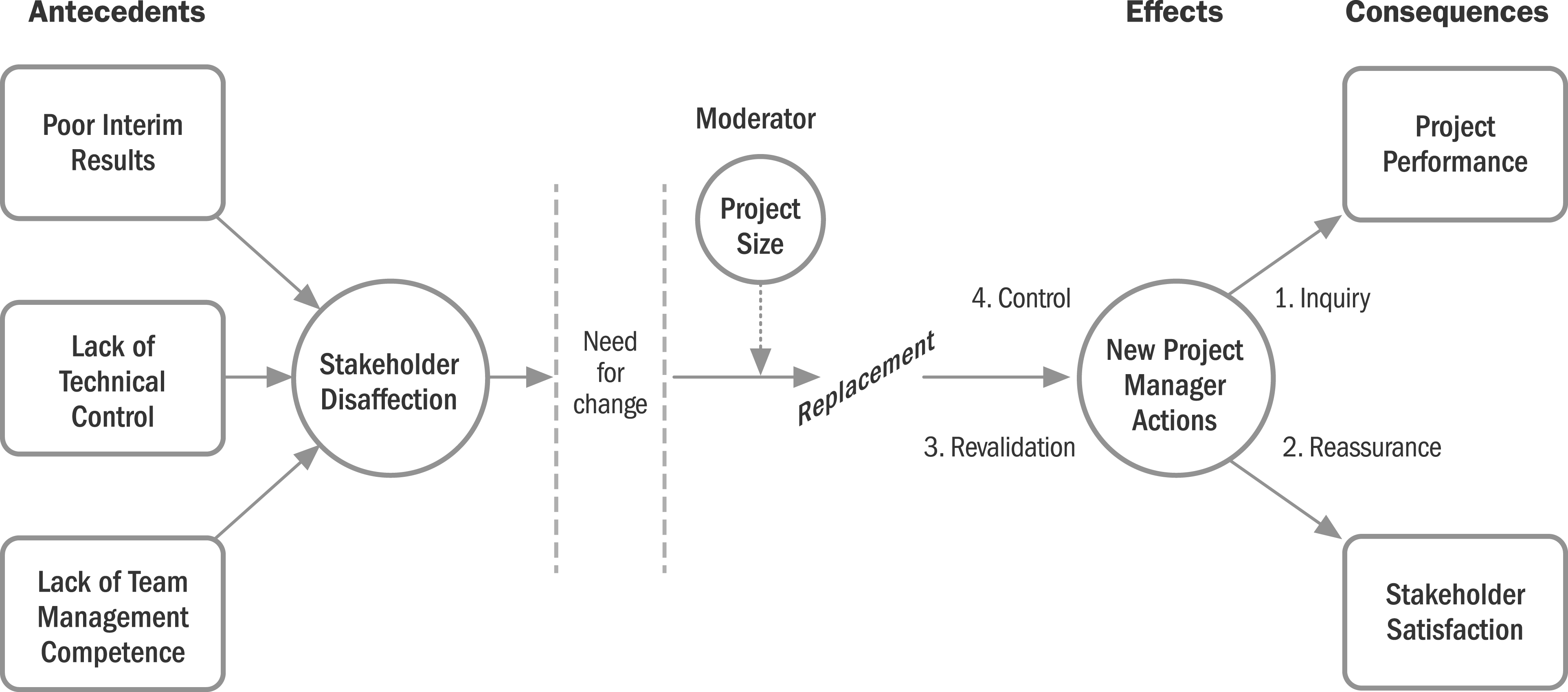
Project manager replacement process model (Davis et al., 2023, p. 1686).
Replacement: Internal Versus External
Selecting a replacement for the project manager is a pivotal decision in the aftermath of their removal and it holds significant implications, particularly concerning governance. The choice between sourcing this replacement internally or recruiting externally sends crucial signals about the organization’s approach. This issue is, of course, exacerbated in crisis situations where time is often of the essence, options may be limited because of the impossibility of conducting a full information search, and multiple stakeholders are impatiently waiting for demonstrated action being taken to alleviate the dangers. Thus, while the Davis et al. (2023) model offers an empirically derived process flow for replacement, it must be reconsidered in project crisis situations where these steps are often truncated or simply papered over initially, as the act of “doing something” is of immediate, paramount importance.
When top management’s objective is to minimize disruption and ensure a smooth transition focused on corrective action to get the project back on track, they often opt for an internal replacement (Davis et al., 2023). This decision is regarded as the most time- and cost-effective solution and is perceived as less risky. Most organizations have a pool of skilled project managers already familiar with the project’s environment. Consequently, an internal replacement accelerates the recovery process because the new project manager is well versed in the project management systems, processes, and the organization’s culture. Moreover, an internal project manager is typically seen as a cost-effective option and is more likely to overcome and mitigate any relationship barriers or breakdowns.
Conversely, when the project organization believes that a transformational change is essential, external sourcing for the replacement is more common. This action signals a commitment to taking any necessary measures to get the project back on track. In such cases, an external replacement is expected to bring an unbiased perspective and to disconnect from the prior management style. However, this choice involves disruptions and adjustments during the recruitment and settling-in period of the external replacement. This individual requires time to gain a comprehensive understanding, not only of the project itself, but also the operating environment, chain of command, and cultural nuances that will inevitably affect their transition. For instance, opting for an internal replacement is often seen as a “less traumatic” and safer option for other project team members, as new external project managers may be perceived as potential catalysts for more extensive and disruptive changes.
Governance in the Aftermath of Project Manager Replacement
The Cynefin model, discussed earlier, offers guidance for sensemaking in the face of a project crisis. Importantly, the process of replacing a project manager and ensuring a smooth hand-over period, with its profound implications for governance and its dynamics, can also be interpreted within the framework of the Cynefin model. Although we distinguish between the domains, we acknowledge that—in practice—the exact situation can be difficult to ascertain, and classification in real time can be challenging, with blurred boundaries.
The concept of a well-planned hand-over process following a structured approach aligns seamlessly with the Cynefin model’s Simple domain. In this domain, best practices and standard procedures are clearly defined. It becomes evident that a systematic hand-over plan is paramount to ensure a fast transition without disrupting ongoing project operations. Governance in this context revolves around establishing clear guidelines and ensuring their diligent adherence during the hand-over process.
In the Complicated domain, the need for senior and executive management to support the transition by facilitating a collaborative overlap between the outgoing and incoming project managers finds its natural home. The Complicated domain deals with situations where expertise and rigorous analysis are required to determine the optimal solution. Governance here demands meticulous coordination and management of the transition process, with a focus on aligning the project’s goals and objectives with the capabilities of the incoming project manager.
As the hand-over process unfolds, it may enter the Complex domain, influenced by multifaceted factors such as organizational culture, sponsor pressures, and project characteristics. In this domain, there is a recognition that a one-size-fits-all approach will not suffice, and outcomes emerge through adaptive responses. Governance in this context necessitates flexibility and a willingness to experiment with diverse approaches to the hand-over process, as highlighted by Davis et al. (2023). It involves fostering an environment conducive to learning and adaptation, acknowledging the intricate nature of the transition for the new project manager.
When the cases where the hand-over process is spinning out of control, it enters the Chaotic domain of the Cynefin model. Here, the emphasis shifts to rapidly restoring order and stability. Clear communication and effective collaboration become imperative, acting as linchpins to prevent further turmoil. Governance in the Chaotic domain revolves around swift actions to regain control and reestablish a semblance of order within the project.
What becomes the role of the outgoing project manager during transition? The answer is that it very much depends on the way the initial replacement took place, the willingness of top management and the former project manager to cooperate for the good of the project, and the ability of the new project manager to accept temporary assistance in recovering stability. Thus, the willingness of the outgoing project manager to cooperate and support the transition becomes a pivotal governance dynamic in this context. Its relevance can be correlated to the Cynefin model as follows, and we include illustrative interview quotes from our previous data set (Davis et al., 2023):
In ordered domains (Simple and Complicated), the willingness of the outgoing project manager to cooperate aligns harmoniously with established governance norms. It signifies a smooth hand-over process characterized by clearly defined roles and responsibilities. If you have enough resources internally then that can be the best solution because you can grab [the project manager] quickly and they probably know something about the organization. […] So yeah, generally you need internal knowledge as well as somebody you can rely on for program management. The role of the project manager is critical. Absolutely critical. The project manager sets a tone for the whole project. […] [Their] management style sets the culture whether it’s an open culture or whether it’s a bombastic culture. I think it’s very, very important. If you’re taking a person from outside it’s much more time consuming, let’s be very open to the fact that once a new person comes in, [they] need a little bit of a [lee]way to understand the process; you need to do a little bit of hand-holding, you need to give a little bit of room for mistakes and, mostly important, the tolerance level on a project which is intense with stringent timelines is less.
Moving into the Complicated domain, the focus shifts to rebuilding stakeholder confidence, emphasizing the importance of clear and effective governance practices. During this stage, the governance framework may require recalibration to enhance transparency and trust-building mechanisms. It is imperative to revisit and optimize existing governance practices to ensure alignment with the new project manager’s reassurance efforts and the evolving project dynamics.
In the Complex domain, where goals and expectations undergo clarification, the adaptability of the governance framework becomes paramount. Governance transforms into a dynamic process, flexing to accommodate the evolving needs of the project under new leadership. This adaptability enables the framework to remain agile in response to changes in project direction and objectives.
Furthermore, the Chaotic domain underscores the urgency of governance framework revisions. As the new project manager takes control to improve project performance and stability, rapid review and adjustment of governance policies and structures are often necessary. Governance actions may include streamlining communication channels and reinforcing project oversight mechanisms to support the new project manager’s actions effectively. We summarize these ideas in Figure 3, highlighting the key replacement responses within the Cynefin categories.
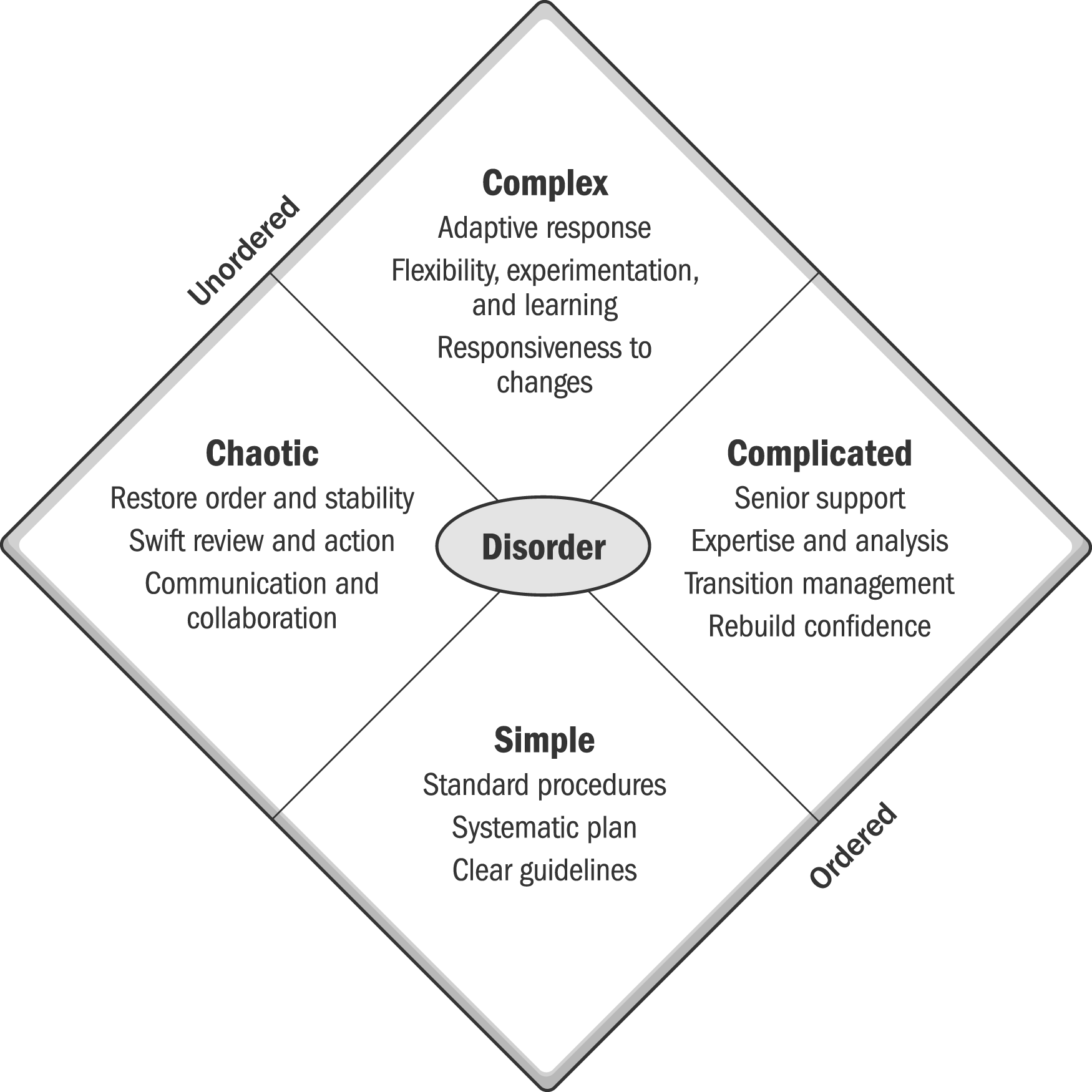
Project manager replacement responses in the Cynefin framework.
Beyond these domain-specific considerations, the consequences of project manager replacement, such as disruptions and impacts on time and budget constraints, reinforce the importance of governance framework adaptation. By recognizing the need for timely governance revisions in response to changing circumstances, organizations can better manage and mitigate these consequences. A responsive governance framework ensures alignment with the evolving project landscape, ultimately contributing to the project’s success and enhancing organizational resilience in the face of leadership transitions and project challenges.
The Intersection of Governance, Crisis Management, and Project Manager Replacement
While we have made progress in understanding the intricate dynamics of governance, particularly in the context of project manager replacements and crisis management, there remains room for further refinement. A crucial aspect to focus on in the future stages of our research is a deeper exploration of the process diagram (see Figure 2) outlined in Davis et al. (2023). This diagram serves as a valuable tool for visualizing the complex interactions among governance mechanisms, project managers, and crisis response. For example, the study found that a continuous cycle of behaviors—inquiry, reassurance, revalidation, and control—offer new project managers key “touch points” for connecting and developing a productive relationship with their project team, it is helpful to reflect further on how these activities must be addressed. That is, within the Cynefin framework, we know from previous research that organizations tend to relax central control and empower leaders and teams under crisis (Nachbagauer, 2021). Consequently, do various behaviors become more or less critical, depending on the domain in which the project (and the new project manager) find themselves? How might effective reassurance in the chaotic environment differ from reassurance in simple domains?
Moreover, it is essential to emphasize the pivotal role played by governance behaviors at different organizational levels. Here, we recognize that governance operates in a dual capacity within this framework. First, it serves as the driving force behind the initial decision to replace the project manager, typically initiated by top management in response to critical project issues. This top-down governance perspective reflects the motivations and strategies of upper-level decision makers. Second, governance functions as a crucial means for reorienting and steering the project back on course following the replacement, a decision often led by the new project manager. This perspective underscores the agency and decision-making authority vested in project managers, highlighting their role in project recovery and crisis resolution.
Finally, we would note the importance of stakeholders in Müller’s work (e.g., Müller, 2009; Müller et al., 2014; Müller et al., 2017; Müller & Lecoeuvre, 2014; Shao & Müller, 2011), and the centrality of this perspective is also reflected in this article. The model of Davis et al. (2023) in Figure 2 shows that the act of project manager replacement is often strongly driven by a need to improve stakeholder satisfaction. From our utilization of the Cynefin framework, we show in Figure 3 that as the responses move through the quadrants from “Simple” to “Chaotic,” the actions become less about systems and processes, and more reliant on relationships, communication, and enabling flexible solutions. With regard to our research question on the utilization of the Cynefin model, we posit that as complexity increases, managerial effort may best be focused on the relational issues to support project performance, rather than the technical issues.
Recommendations
In the context of the Cynefin framework, the relationship among governance failures, crisis management, and project manager replacement, we recommend the following:
In the Simple domain, where problems are clear, best practices are evident, and standard procedures apply, maintaining consistency in the governance structure during project manager replacement is essential. The replacement project manager should receive a clear introduction to the existing governance framework and have access to the necessary resources to ensure a smooth transition. This aligns with the principle of maintaining stability and clear guidelines when addressing straightforward issues.
In more complex workplace scenarios of the Complicated domain where causality may not be immediately evident, and analysis is required to understand and respond effectively, take a structured approach to governance. This involves conducting a detailed analysis of the situation, considering factors such as organizational culture, sponsor pressures, and the nature of the project. Integrated into the governance framework should be well-defined crisis management plans, outlining steps to be taken if a crisis occurs. This approach acknowledges the need for a systematic and analytical approach to crisis management within complicated work contexts.
In complex workplace situations of the Complex domain where multiple interacting factors create unpredictability and emergence, such as when dealing with both project manager replacement and crisis management, the approach should be adaptive. When a project manager is replaced during a crisis, ensure that the replacement manager is fully informed about any ongoing crisis plans and actions taken. However, also recognize that outcomes in complex situations are emergent and unpredictable. The governance framework in these cases should facilitate ongoing learning and adaptation, allowing the new manager to continue or adjust crisis response efforts as needed. Embrace the idea that in complex workplace scenarios, solutions evolve, and governance needs to be flexible to address evolving challenges.
Limitations
It is also appropriate to consider some limitations of the current work as they relate to the use of Cynefin for categorizing responses to crisis situations. We noted previously that disasters may not fit naturally into one of the four categories in the framework. Thus, caution must be taken in both sensemaking and subsequent response. That is, Cynefin is not intended to serve as a sort of “restaurant menu” of options to assumed causality of crises. Within each quadrant are suggested ways of orienting our thinking in order to best apply governance responses to assumed cause and effect, but they are not formulaic. There exists a need to continue to explore the utility of the Cynefin framework empirically to move beyond theoretical action/response to include outcomes (i.e., crisis remediation) in order to gain better understanding of how this framework can aid in crisis governance. Cynefin does offer a valuable way of addressing project governance in crisis, but we are still only at the front end of a potential movement in this direction. The more we can fill in the gaps through cause-and-effect analysis, the greater the potential for proposing concrete steps in establishing effective project crisis governance.
We have addressed these ideas with numerous project management professionals in postgraduate executive master’s classes as well as in executive education teaching, and managers report that they offer a beneficial way of conceptualizing and categorizing their business issues around governance and complexity. We believe that while work on the implications of project manager replacement needs to continue to expand as a contingency model for multiple circumstances (e.g., type of project, stage in the life cycle when replacement occurs, national and cultural diversity, etc.), this research, embedded in Müller’s conceptualizations of governance as a framework, is beneficial for both practitioners and researchers as we seek to govern complex projects effectively to enable valuable outcomes from the work.
Conclusions
By considering the Cynefin framework, organizations can tailor their governance practices to specific domains, allowing for more effective responses to governance failures, crises, and project manager replacements. This approach acknowledges the varying degrees of complexity and adaptability required in different situations, ultimately promoting better project management outcomes. Building on this framework, it is essential to recognize the dual nature of governance, operating both at the upper echelons of an organization, where strategic decisions are made, and at the project manager level, where day-to-day management and corrective actions are implemented. Recognizing these dual dimensions of governance is pivotal in our quest to guide projects back onto a productive path, ultimately ensuring their successful outcomes. A second duality that is underscored in this work is the distinction between the cybernetic control aspects of governance and the human behavior elements. Müller (2009) has long noted that governance has to be more than simply “control” writ large. Our exploration of the Cynefin framework within the specific joint contexts of project crisis management and project manager replacement underscores his point, as these conditions argue for a much broader, human orientation for governance. This comprehensive approach to governance underscores its multifaceted nature and its critical importance in navigating the complexities of project management, especially in times of crisis and transition.
Footnotes
Data Availability
Due to the nature of this research, participants of this study did not agree for their data to be shared publicly, so supporting data are not available.
Acknowledgments
The authors acknowledge the many helpful suggestions made by Shankar Sankaran and three anonymous reviewers on the abstract and original version of this article.
