




Abstract
Large-scale tourism development projects are popular for their impact on regional economic growth and global tourism attractiveness. Although it is widely recognized that they frequently get resistance from local residents due to their nature as unwanted projects, further hindering the already challenging process of value cocreation among project owners and tourists, there is still a gap in understanding how social media can be leveraged to turn the situation around. This study adopts a value cocreation perspective to examine how large-scale tourism development project stakeholders engage in collaborative processes through social media, using a case study to uncover the nuances of these interactions. Two popular large-scale tourism development projects in China were selected as cases because they have gone viral and attracted widespread regional and national attention on social media. An abductive approach is used for analyzing the empirical data collected by the web crawling technique, including videos and comments from TikTok. The results found that social media promotes value cocreation among heterogeneous stakeholders in large-scale tourism development projects in three ways: real-time project-centric improvement, multiperspective expectation management, and distinctive value generation. Theoretical and practical implications are discussed based on findings.
Keywords
Introduction
The rapid development of tourism globally has sparked a significant shift toward large-scale tourism development projects, especially as customized and mass tourism initiatives emerge to meet diverse traveler preferences. These projects, which involve considerable financial investment and spatial expansion, are vital to regional economic growth and global tourism appeal. Their large-scale nature brings forth a variety of complex considerations—from environmental impacts to social repercussions—requiring intricate planning and stakeholder involvement, among which local community resistance stands out and attracts a long-standing scholarly discussion. Research on large-scale tourism development projects offers multiple perspectives on resistance against tourism development, driven by structural response toward growth in the capitalist economy (Fletcher et al., 2019; Wegerer & Nadegger, 2023) and has typically been theorized as over-tourism or locals as victims (Seraphin et al., 2020; Valdivielso & Moranta, 2020). These large-scale tourism development projects are labeled as unwanted ones by local residents, also known as Not-In-My-Back-Yard (NIMBY) projects. Together, these insights highlight the complications and difficulties in reconciling a value cocreation process by balancing tourism business objectives and challenges brought by local community resistance. Yet, despite the growth in relevant research, gaps remain, especially in understanding how these projects can achieve both economic success and public approval—a dual necessity for the longevity and popularity of large-scale tourism development initiatives.
From a theoretical standpoint, the value creation process in tourism projects, particularly large-scale tourism development, is constrained by the inherent characteristics of these large-scale developments. Typically, the success of such projects, given their one-off nature and temporality (Lundin & Söderholm, 1995), relies heavily on the satisfaction of tourists, who form the primary customer base and, consequently, the main revenue source. However, a fundamental issue complicates this equation: There is a divide between the project developers who design and construct these projects and the tourists who only engage with the projects after construction is completed. This situation introduces an inherent paradox, where project owners cannot predict whether the tourists will appreciate the final product until it is fully realized. In other words, the space for value cocreation between the user and project owner is vague and distant, which has been worsened by resistance from local residents (Hassanli et al., 2022). Conversely, making post-completion changes based on tourist feedback is often economically unfeasible due to the high costs and logistical challenges of modifying established infrastructures (Arefazar et al., 2022). This divide reflects a notable theoretical complexity, rooted in the temporal and spatial gap between project creation and user engagement. As a result, project developers often face a high level of uncertainty about tourist preferences, which complicates efforts to ensure that the value proposed by large-scale tourism development projects is well-received upon launch.
With the advent of social media, new avenues for communication and interaction have emerged, providing large-scale tourism development project developers with potential solutions to the aforementioned issues (Ram & Titarenko, 2022; Williams et al., 2024). In light of the transforming role of social media, we argue that resistance against large-scale tourism development projects is not unresolvable, and social media can act as a platform for virtual interaction to bridge the communication gap among tourists, project developers, and even local citizens. This platform will eventually allow for value cocreation among those involved parties. Platforms such as TikTok, which is algorithm-driven and highly interactive, offer project owners an unprecedented opportunity to engage with potential tourists and even local residents before project completion. The novelty of using TikTok as a case study platform lies in its unique ability to foster real-time, dynamic interactions among diverse stakeholders. Unlike traditional social media platforms, TikTok's algorithm-driven content delivery system ensures that the most relevant and engaging content is surfaced to users, making it an ideal platform for studying how the interactions between different parties unfold in real time. This algorithm-driven system further paves the way for the removal of local resistance or resolving stakeholder exclusion issues toward large-scale tourism development projects (Di Maddaloni & Sabini, 2022; Wegerer & Nadegger, 2023). The interactive behaviors around large-scale tourism development projects on these platforms create possibilities for real-time feedback, enabling project developers to gather public opinion and gauge preferences early in the development process. The unique qualities of social media—especially its capacity for extensive reach and instant engagement—make it a transformative tool for bridging the gap between project developers and end users. However, little is known about exactly how social media functions in the process of value cocreation among parties. Therefore, we ask: RQ: How can social media platforms facilitate the value cocreation process for large tourist development projects?
This study adopts a value cocreation perspective to examine how large-scale tourism development project stakeholders engage in collaborative processes through social media platforms, using a case-based approach to uncover the nuances of these interactions. We take this process as a discursive phenomenon since we argue that the subjective nature of value perception can be constructed by verbal interactions among stakeholders (Alvesson & Karreman, 2000). Value cocreation theory, which emphasizes the role of all stakeholders in jointly shaping a product or service, provides a suitable framework for understanding how tourism projects might be better aligned with the desires of potential tourists and local residents. Our study focuses specifically on cases where social media played a pivotal role in facilitating stakeholder interactions. The cases chosen for study are the Dalian Donggang Tourism Project and the Zibo Barbecue Cultural Tourism Project, since both cases have attracted huge public attention on the TikTok social media platform. The selected cases follow theoretical sampling, with extensive data availability for in-depth exploration (Flyvbjerg, 2006) and cross validation.
In terms of contributions, this study aims to expand the understanding of value cocreation theory by demonstrating how involved heterogeneous stakeholders can interact virtually to bridge the communication gap (Toukola et al., 2023). While value cocreation has been studied across various fields and different partners, its application in the tourism sector—particularly in large-scale development projects—remains underexplored, especially when the projects are huge and the value creation process is costly. By focusing on the role of social media in these projects, this research extends current knowledge of how cocreation processes are achieved when leveraged by digital platforms. Furthermore, this study sheds light on the potential of social media as a tool for stakeholder engagement in large-scale tourism development projects (Yang et al., 2022). Through real-time feedback and interaction, social media can help project developers understand and respond to public preferences in a way that traditional project development frameworks do not allow. Our findings have both theoretical and practical implications, providing insights into how tourism projects can be planned and managed more effectively in an increasingly digitalized world.
This article is structured as follows. Following this introductory section, we review the literature on large-scale tourism development, highlighting the challenges and opportunities associated with these projects. We then delve into the theoretical background, focusing on value cocreation theory and its relevance to large-scale tourism development projects. The methodology section describes our case-based approach and outlines our data collection and analysis processes, with an emphasis on how we employ coding techniques to analyze social media data. The subsequent section presents the findings of our study, detailing the specific ways in which social media was used to facilitate cocreation among large-scale tourism development stakeholders. We conclude with a discussion of the theoretical and managerial implications of our research, along with suggestions for future studies.
Literature Review
Large-Scale Tourism Development Projects
A large-scale tourism development project is a comprehensive tourism system containing many destinations, usually bounded by cities in different geographic regions. There is a complex relationship among tourism services, tourists and local governments, and industries within the area delimited by this physical (and intangible) boundary (Kádár & Gede, 2021). The different scales and structures of travel destinations have been divided in existing literature, among which the largest comprehensive tourism system is the whole country (Balli et al., 2015; Pearce & Schänzel, 2015), and most studies only cover the regional scope (Asero et al., 2016). This means that large-scale tourism development projects need to consider various complex factors, ranging from environmental impacts to social impacts, requiring complex planning and stakeholder participation. Considering the large scale of Chinese cities, this article takes cities as boundaries and defines large-scale tourism development projects as a collaborative network consisting of organizational entities with different scales, locations, functions, organizational types, service scopes provided, and marketing and sales methods, with the destination city as the scope (Björk & Virtanen, 2005).
Large-scale tourism development projects are characterized by government promotion, community participation, and social benefits. Large-scale tourism development projects are generally regarded as opportunities for urban economic growth and redevelopment (Konstantaki & Wickens, 2010; Soutar & McLeod, 1993), such as stimulating consumption, increasing employment opportunities, developing service industries, and so forth (Bull & Lovell, 2007; Homafar et al., 2011) and therefore encouraged by the governments where the projects are located. In addition to these economic effects, large-scale tourism development projects have also received the attention and participation of residents for many noneconomic benefits such as shaping urban reputation, civic pride, community image, and promoting political integration (Delamere et al., 2001; Kim et al., 2015). The sense of civic pride helps build community acceptance and positive consensus on the project to reduce dissent. The participant network of large-scale tourism projects is composed of actors who control resources and execute activities (Håkansson & Snehota, 1989). Coordination and management of different levels and types of participants are necessary to promote tourism network cooperation such as individuals, groups, organizations, and companies.
These large-scale tourism development projects, however, may also lead to huge economic costs (i.e., taxation and real estate) and negative psychosocial effects (i.e., disturbance to the community, confusion, safety problems, and traffic congestion) (Cha & Jeong, 1998). To reduce the NIMBY problem caused by these potential negative impacts, the project sponsors and local governments will publicize the social benefits brought by the activities through various channels, including social media and the internet. Kim et al. (2015) considered the positive and negative impacts of sports tourism projects and developed a six-factor model of residents’ perceived social impact on sports tourism activities, including economic benefits, community pride, community development, economic cost, traffic issues, and security risks. Liu and Wilkinson (2014) believe that large-scale tourism development projects require a more comprehensive and powerful project funding system. Tourism companies and sponsors increasingly need to gather all stakeholders related to tourism in one destination (tourist area) to maintain competitiveness because they lack comprehensive resources.
Value Cocreation in Large-Scale Tourism Development Projects
As an overall concept describing cooperation among multiple stakeholders, the conceptualization of value cocreation covers the joint efforts of companies, employees, customers, shareholders, government agencies, and other entities. The service-dominant logic assumes that these participants represent dynamic, operable, and active resources and that the cocreation of value is not limited to dual relationships between suppliers and customers but involves a network of stakeholders in many to many relationships (Payne & Frow, 2014). From the stage in which consumers participate in the life cycle of a product or service, value cocreation is distinguished by two dimensions: coproduction and value in use (Ranjan & Read, 2016). Value coproduction refers to the direct participation of customers in the development of new products, joint work, service delivery, service recovery, and content creation of online communities (Auh et al., 2007; Chen et al., 2010; Dholakia et al., 2009; Dong et al., 2008; Droge et al., 2010; Heidenreich & Aurich-Beerheide, 2014). Value in use extends value to the process of use and experience beyond instant exchange, referring to the experience and evaluation of customers after using and maintaining products or services (Vargo & Lusch, 2006).
Existing studies on value cocreation in tourism emphasize multiple participants and personal experiences in the dynamic process of value cocreation. First, the concept of coproduction is not limited to the resources provided by service providers (such as hospitality) and service beneficiaries (such as customers) to achieve it. The roles of more and more specific stakeholders in the process of value cocreation in the tourism industry is being emphasized, including the roles of residents (Chen et al., 2020; Lin et al., 2017), IT companies (Baloglu & Pekcan, 2006; Pan & Li, 2011), academic researchers (Higuchi & Yamanaka, 2017), and travel websites (Applegate et al., 2008). Researchers have called for more attention to the role of information technology (IT) in the cocreation of value in the tourism industry, as IT makes the combination of resources, capabilities, and knowledge of heterogeneous stakeholders more rapid and convenient (Grover & Kohli, 2012; Gnyawali & Srivastava, 2013).
Second, the service-dominant logic of value cocreation makes the tourism experience more personalized and customized. Tourists are increasingly involved in actively defining products and creating services rather than simply choosing from prefabricated plans (Binkhorst & Den Dekker, 2013). Research considers that tourists’ complaints about airlines on Facebook create opportunities for value cocreation or codestruction (Dolan et al., 2019), and three unique approaches include seeking solutions, seeking support, and seeking social participation (Dolan et al., 2019). The logical architecture of the value creation, value delivery, and value capture mechanisms proposed by Teece (2010) serves as an important perspective for understanding the dynamic process of value cocreation in tourism. Tourists actively share their own personal experiences and travel strategies on social media and online platforms (Johnson & Neuhofer, 2017; Micera & Crispino, 2017), which not only attracts objectors, interpreters, and supporters to continuously participate in the process of information sharing (Brohman et al., 2009; Saraf et al., 2007) but also provide a comprehensive value proposition among more stakeholders (Brandenburger & Stuart Jr, 1996; Peppard & Rylander, 2006). The value proposition is the value promised to the customer, which is provided by a combination of values such as price, quality, performance, selection, and convenience (Cova & Salle, 2008; Gummesson, 2008; Payne & Frow, 2014). When potential tourists use this information to organize their travel, the value cocreated is delivered to the next tourism experience and captured by new stakeholders (Applegate et al., 2008).
The Role of Social Media in Projects
Social media is defined as the means, platforms, and applications for sharing information via virtual communities and the internet (Kaplan & Haenlein, 2010). Existing project management research primarily examines the role of social media from the perspectives of project value and stakeholder engagement, conceptualizing social media platforms applied in projects as spaces where value is created and distributed between project organizations and community stakeholders (Lehtinen & Aaltonen, 2022). The use of social media in public projects has been demonstrated as an effective project management strategy for initiating dialogues, building relationships, and promoting marketing (Fotis et al., 2012), such as the work of Lobo and Abid (2020) who examined the role of social media in mitigating NIMBY risks, highlighting how public stakeholders establish a strong sense of identity through social media. This internal group strategy significantly influences decision-making during the project consulting phase. Chung et al. (2023) proposed, through case studies, that social media has become a powerful tool for community stakeholders to engage in large-scale infrastructure projects due to its ease of access and high transparency. Furthermore, social media can actively and transparently involve external stakeholders in project operations to better create and distribute value in infrastructure projects (Lehtinen & Aaltonen, 2022).
As a novel way of communication, social media has fundamentally transformed the ways in which stakeholders interact and communicate during the value-creation process of a project. Four main research streams are distinguished: (1) broader communication reach, (2) enhanced real-time information agility, (3) greater participation depth, and (4) novel engagement strategies. From the perspective of communication reach, social media provides extensive influence and inclusive participation potential (Zhang & Chung, 2024). These platforms empower stakeholders with common interests to engage in public discourse, potentially attracting and influencing larger clusters of participants, whose impact can significantly shape the project (Dunbar, 2016; Williams et al., 2015). Through posting, liking, and sharing, stakeholders facilitate nonhierarchical interactions and viral information dissemination (Pfeffer et al., 2014). Social media allows geographically dispersed stakeholders (Ninan et al., 2019), including residents, customers, and suppliers, to engage in virtual teams and share their views (Bhatti & Ahsan, 2017; Ehsan et al., 2008), and facilitate collaboration among nonmarket stakeholders such as local communities, government, and nongovernment organizations (NGOs) (Lehtinen & Aaltonen, 2024; Zhang et al., 2018).
From the perspective of information timeliness, social media further provides a ubiquitous communication environment, allowing real-time updates and constant connectivity (Boyd & Ellison, 2007; Pfeffer et al., 2014). Applications like WhatsApp, WeChat (Ling & Lai, 2016; Zhang et al., 2018), and Facebook enable real-time communication, enhancing social coordination and stakeholder engagement in construction projects (Jere & Aaltonen, 2024). In terms of participation depth, social media enhances deep participation by improving information sharing, and knowledge accumulation (Daemi et al., 2020; Lehtinen & Aaltonen, 2022), and reducing coordination costs (Boyd & Ellison, 2007), thereby fostering better communication and engagement. Luyet et al. (2012) identify five participation levels, with the first three—informing, consulting, and collaborating—being most common in infrastructure projects, whereas co-decision-making and empowerment enable stakeholders to influence project value (Gil, 2023; Storvang & Clarke, 2014).
Social media also establishes various advanced social media strategies, such as manipulation, persuasion, promotion, progress updates, and online–offline interactions, to manage interactions among larger and smaller clusters (N. L. Williams et al., 2015), expectations (McDonnell, 2016), identification (Lobo & Abid, 2020), and building trust (Kakar & Khan, 2021) among community stakeholders (Ninan et al., 2019, 2020). At the same time, the emotional echo chamber effect of social media amplifies stakeholders’ positive and negative emotions through information interaction (Toubiana & Zietsma, 2017), potentially leading to sustained engagement or continued conflict. This necessitates balancing the breadth of communication with the depth of participation (Daft & Lengel, 1986).
Despite the growing recognition of social media's role in project management, there remains a limited understanding of how it facilitates value cocreation in projects. While existing research highlights social media's potential to enhance stakeholder engagement, communication, and collaboration, the mechanisms through which it enables value cocreation are underexplored. Current studies primarily focus on social media's ability to create and distribute value, particularly in public projects, by fostering dialogue, building relationships, and promoting marketing (Fotis et al., 2012; Lehtinen & Aaltonen, 2022). However, the deeper processes of how stakeholders collaboratively generate, negotiate, and integrate value through social media platforms are not well understood. This gap in understanding is particularly significant given the increasing reliance on social media for stakeholder engagement and the potential for hybrid online interactions to influence project outcomes.
Methodology
Research Design
The aim of this study is to enhance the understanding of the role of social media in the value cocreation of large-scale tourism development projects. To ensure the achievement of this research aim, this study undertook a theory-elaboration study (Fisher & Aguinis, 2017) to explain empirical observations (value cocreation) in a specific setting (large-scale tourism development projects). The openness of social media and the complex interactivity of value cocreation in large-scale tourism development projects, coupled with the dearth of prior theoretical exploration of research questions, renders a qualitative case study the most suitable research strategy (Chowdhury et al., 2016). The content about large-scale tourism development projects generated by users on social media platforms serves as the analysis unit (Yin et al., 2013) to allow us to gain an in-depth and comprehensive understanding of the value cocreation interaction that takes place among heterogeneous stakeholders of large-scale tourism development projects.
From a critical realist perspective, an abductive epistemological approach is used for theory building (Archer et al., 1998; Dubois & Gadde, 2002). An abductive qualitative research approach emphasizes the continuous interplay among a theoretical framework, empirical observation, and analytical discussion (Dubois & Gadde, 2002). Following the abductive approach, we systematically compared existing theory and empirical data with the themes and dimensions that emerged during the research process. According to Gioia’s approach (Gioia et al., 2013), our coding process focused on whether and how social media could create and refine value in large-scale tourism development project practices and how the extant project literature provided context for the emerging value cocreation theory (Eisenhardt, 1989). The adoption of abductive reasoning not only has the credibility of deductive reasoning rooted in existing concepts and publications but also combines the creativity of inductive reasoning from new empirical insights such as case interviews (Alvesson & Sköldberg, 2017).
Case Selection
After the COVID-19 pandemic China’s domestic tourism industry recovered rapidly and has even prospered more than before, and large-scale tourism projects in several cities have attracted nationwide attention in social media. Two popular large-scale tourism development projects in China were selected as cases owing to their typicality and popularity: the Dalian Donggang Tourism Project and the Zibo Barbecue Cultural Tourism Project. These two projects have attracted widespread attention and discussion on social media owing to their unique local characteristics. Videos related to these projects have become very popular on social media, drawing more and more people to them. Local residents and governments have also released relevant travel guides and organized official activities to sustain this online buzz. However, the difference between the projects is that Dalian, as a coastal tourist city, has abundant tourism resources and relatively mature tourism-supporting services. Zibo, on the other hand, is a traditional industrial city that has not attracted the attention of tourists before. Despite having limited tourism resources, Zibo has garnered considerable popularity on social media owing to its exceptional local services and rich food culture.
Specifically, the Dalian Donggang Tourism Project is located in a modern park, integrating sightseeing, leisure, sports and fitness, fishing, and swimming. The main attractions include the Oriental Water City with nearly 100 European-style buildings (similar to Venice, Italy), a musical fountain (Asia’s second largest), and an international yacht marina. Adjacent to these attractions, Donggang Fifth Street has become a new popular check-in spot in Dalian owing to its beautiful scenery of direct access to the sea. The end of the street leads directly to the azure sea, and police officers patrol the street every day. Standing on the elevated portion of Donggang Fifth Street, tourists can see merchant ships and passenger ships sailing through the sea, complemented by lively street scenes and blue skies. These scenic spots form a natural and beautiful picture, which has been widely posted on social media.
Unlike traditional tourism projects that feature scenery, the Zibo Barbecue Cultural Tourism Project is a unique travel experience that perfectly combines food and travel, allowing tourists to enjoy delicious barbecues while also experiencing the unique cultural charm of Zibo City. The reason why Zibo first attracted wide attention on the internet was because a top TikTok blogger promoted his vlog about Zibo’s food tour. The video not only showcases the unique taste and production process of Zibo barbecue but also highlights the hospitality and simplicity of local residents, which has greatly enhanced the positive image of the city and attracted a large number of consumers. With nationwide attention, more bloggers are joining the online promotion of the project, and residents are also contributing to the project through online and offline channels. The local government seized this opportunity in a timely manner and played an active role in promoting and developing projects, including establishing dedicated trains and travel lines for convenience, standardizing market supervision policies, and providing preferential services to attract young talent. The popularity of this project on social media has also driven tourist attention to its rich historical and cultural heritage and beautiful natural scenery. The development of cultural heritage, such as historical culture and the ceramic industry, has transformed Zibo into a tourist city.
Data Collection
This study employs crawler technology in Python programming language to obtain the required data on the social media platform of TikTok (Chinese version). The choice of TikTok as the primary social media platform for this study is justified by its unique characteristics that align with our research objectives. TikTok, known for its algorithm-driven content delivery and high user engagement, has become one of the most influential social media platforms worldwide, especially in China. Its short-form video format allows for rapid dissemination of information, and its popularity has been extensively validated by a record high user pool of over 800 million. Furthermore, TikTok's popular interactive features, such as comments, likes, and shares, enable stakeholders—including tourists, local residents, and government agencies—to engage in dynamic discussions, providing rich empirical data for analyzing how social media facilitates value cocreation. In order to avoid the influence of the TikTok platform recommendation algorithm on the experimental results, three newly registered TikTok accounts were enabled during the research. The first step involves ensuring the proper configuration of the Python environment and the installation of necessary libraries such as selenium, pandas, and openpyxl. The Selenium library is then used to initiate a browser session, log into a newly registered TikTok account, and conduct searches using specific keywords such as “Dalian Tourism,” “Dalian Seafood,” “Dalian Donggang,” and “Donggang Fifth Street” (notable local scenic spots). A similar process is followed with keywords such as “Zibo Tourism,” “Zibo Barbecue,” and “Zibo Culture and Tourism Bureau.”
The number of likes represents the relevance and richness of the video or comment content, as well as the public's recognition of the content information. A small number of likes suggests that the video content lacks substance and has no value to the public. To capture more meaningful content, the relevant information from the top 100 videos is extracted based on the number of likes, ranked from highest to lowest. This includes details such as the publisher’s nickname, video title, tags, number of comments, likes, reposts, release date, time, and video URL. This method is applied to gather data from 100 videos on two other newly registered TikTok accounts. After the data cleaning process, duplicates were removed, and the data was sorted in descending order by the number of likes. The final dataset contains 224 videos related to Zibo tourism and 222 videos related to Dalian tourism projects.
Subsequently, the TikTok platform was reaccessed using the provided video link to extract the top 50 comments for each video, ranked in descending order based on the number of likes. This collection included the commenters’ usernames, geographical locations, timestamps, and like counts. For each primary comment, secondary comments (i.e., replies to the initial comments) were collected, also ranked by the number of likes in descending order. In cases where fewer than 50 secondary comments were available, all comments were retrieved. The extracted comment data was then structured and organized using the Pandas library 1 and subsequently saved in Excel format. The data acquisition yielded a total of 35,640 primary and secondary comments related to the Zibo project and 36,800 comments regarding the Dalian project.
Data Analysis and Findings
The data analysis was completed by the coding team in three stages. First, given the vast amount of data, the top 60 videos and their corresponding comments were analyzed sequentially. By viewing the videos and repeatedly reading the highly liked comments and their replies, open coding was conducted while preserving the original meaning of the viewpoints. A coding memo was maintained to record theoretical sensitivity, and an initial concept library was developed. After consolidating the concept libraries from all three coders, the continuous comparison method was applied to identify redundant initial concepts and detect co-occurrence relationships between concepts, resulting in the formation of 16 first-order concepts. In the subsequent secondary coding phase, empirical concepts were transformed into academic themes. For instance, the concept “formalizing via government involvement, synthesizing opinions, and highlighting stakeholder engagement” was abstracted as “proactive stakeholder engagement.” Following the construction of a logical relationship matrix between the concepts, the top 80 videos were used to identify seven core second-order themes and develop preliminary theoretical propositions. Finally, the secondary coding was classified into three to five aggregate dimensions, and dynamic correlations between these dimensions were established. The exclusion and completeness of the dimensions were tested using videos from the top 80 to 100; the results indicated that no new concepts or relationships were emerging, suggesting that the model had reached theoretical saturation.
Through our case analysis, we have identified three constituting elements for social media–based value cocreation strategies. These three constituting elements are (1) real-time project-centric improvement, (2) multiperspective expectation management, and (3) distinctive value generation (Figure 1). The details and coding examples can be found in Appendix A at the end of the article.
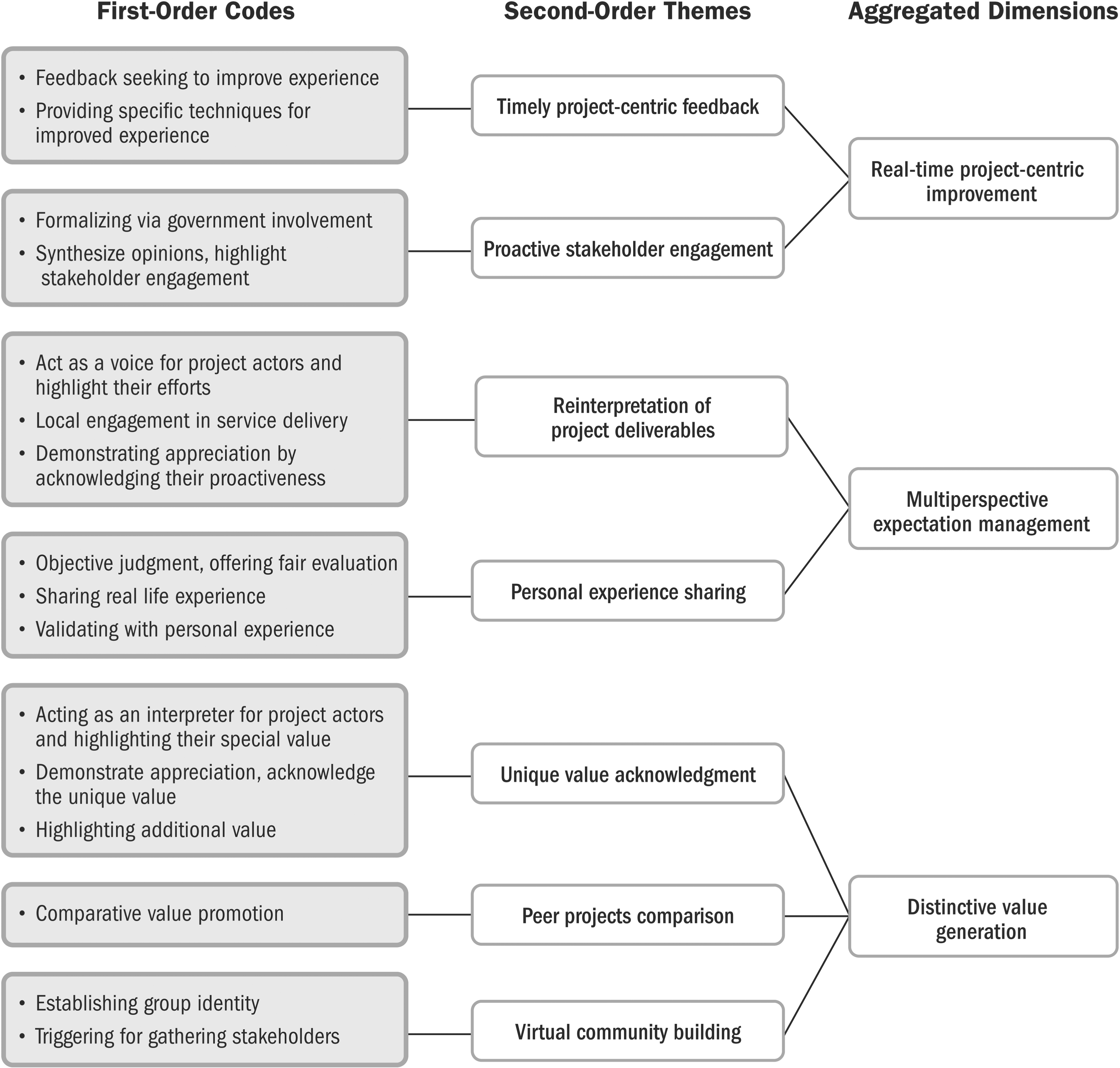
Coding structure for data analysis.
Real-Time Project-Centric Improvement
Real-time project-centric improvement refers to the ongoing process of enhancing project performance and outcomes by leveraging immediate data and feedback specifically focused on the project’s objectives and activities. Real-time project-centric improvement encompasses the following two subdimensions: timely project-centric feedback and proactive stakeholder engagement.
Timely project-centric feedback indicates that social media facilitates immediate communication with visitors, allowing projects to adapt quickly to feedback and changing preferences. This responsiveness can lead to the continuous refinement of offerings, ensuring they remain distinctive and aligned with visitors’ expectations. Timely project-centric feedback can take the form of feedback seeking to improve the experience. This means that social media allows for real-time engagement with different types of stakeholders and, in this case, any advancement of project implementation can be reviewed by potential visitors. These visitors can offer timely comments that develop into constructive feedback for project owners and managers, for example in this comment: “When I heard that this pot cake costs 20 yuan, as a person from Zibo, I instantly felt embarrassed. [sad emoji].” This local person shares their feelings toward the overpricing of the food after experiencing the tourism project. This reflects how local people are involved during the process of online feedback seeking, where the local people know the importance of pricing for tourists and they know the regular local prices. By posting openly on social media, local people—acting as project stakeholders—immediately participate in the project improvement process by providing authentic information.
Proactive stakeholder engagement involves utilizing social media platforms to actively communicate, involve, and collaborate with stakeholders in an effective manner. This approach leverages the unique capabilities of social media to foster relationships, gather feedback, and enhance participation throughout the project life cycle. Proactive stakeholder engagement can take the form of involving government agencies to act as third-party validation and regulators. In this case, a comment that uses comparative rhetoric is: “@Chengdu Market Supervision Bureau with 3 million followers, and @Zibo Market Supervision Bureau that works diligently.” This approach of tagging the agencies highlights both of them, leveraging the follower count to signify importance while praising their official participation and dedication. This is also very symbolic since this typically involves government agencies stepping in and getting involved so the quality of services and food can be guaranteed and supervised. This allows government agencies—who are project stakeholders—to be quickly involved without going through the traditional formal processes. The attention of local government is drawn, and symbolic effects, encouraging service providers to act legally, and actual effects, involving government regulation, are thus achieved.
Multiperspective Expectation Management
Multiperspective expectation management refers to the strategic approach of understanding, aligning, and addressing the diverse expectations of heterogeneous stakeholders involved in a project or organization. This concept recognizes that heterogeneous stakeholders—such as customers, employees, investors, suppliers, and community members—often have distinct perspectives and expectations regarding outcomes, processes, and performance. Multiperspective expectation management consists of two subdimensions: reinterpretation of project deliverables and personal experience sharing.
Reinterpretation of project deliverables refers to the process of reviewing, redefining, retelling, or refining the meaning and significance of a project to ensure it aligns with the project’s goals, stakeholder expectations, and changing circumstances. This concept involves critically assessing the different parts of the project and making adjustments or enhancements based on feedback, evolving project needs, or new insights. Reinterpretation of project deliverables can take the form of acting as a voice for project actors and highlighting their efforts. This can be identified via these comments: “Zibo Cultural and Tourism Bureau: Do you all want to see the sea? I’m digging right now [smile emoji].” This is a teasing comment by followers, who argue that the Zibo Cultural and Tourism Bureau is trying to do everything to improve the experience of city tourists. This exaggeration of digging a sea is a vivid example of the can-do attitude of local government. This interpretation by followers helps potential visitors understand the sincerity and determination of project stakeholders and actors. These comments help people realize how hard these local governments are fighting for the best tourist experience.
Personal experience sharing refers to the act of individuals recounting and discussing their own experiences, insights, or lessons learned in the project or a similar situation. This practice can serve the goal of providing vivid information for potential visitors. Personal experience can take the form of sharing the real-life experience of the individual. The technique can be mentioned in comments such as: “The ship named China Revival is highly recommended. A double-bed room costs ¥440/person—it's quiet, clean, and offers sea views. Note that the Dalian to Yantai leg is a night voyage, while the return trip timing is ideal.” These comments describe detailed suggestions for how to enjoy the trip from Yantai to Dalian, which is also part of the larger tourist project. The comments share a vivid experience of the tourist with useful information, which makes the overall project no longer out of reach and conveys the authenticity and visual appeal of the journey.
Distinctive Value Generation
Distinctive value generation refers to the process of creating unique and differentiated value propositions that set a project apart from its competitors, enhancing its appeal to target audiences. In the context of large-scale tourism development projects, social media plays a critical role in facilitating distinctive value generation through the following key mechanisms: unique value acknowledgment, peer project comparison, and virtual community building.
Unique value acknowledgment refers to recognizing and appreciating the distinct qualities, contributions, or benefits the project brings to the potential customer. This concept emphasizes the importance of identifying what sets this project apart from others, thereby highlighting its significance and relevance. Unique value acknowledgment can take the form of highlighting additional value. Highlighting additional value means that a specific value is distinctively identified and acknowledged; a relevant comment is: “My 2008 trip to Dalian remains unforgettable, in large part due to the exceptional warmth of its people. Whether it was asking for directions or inquiring about tourist attractions, everyone we met was so warm and kind. Thank you, Dalian.” The comments reveal that people in the city are rather friendly, which adds to the large-scale tourism development project as an additional value. This comment helps potential tourists realize that when they come to the city, they will also be welcomed by the warmth of the city residents. In this case, the friendliness of the city becomes another unique selling point for this large-scale tourism development project.
Peer project comparison refers to the analysis, evaluation, and demonstration of similar projects undertaken by different teams, organizations, or individuals within the tourism industry. This comparison helps identify best practices, strengths and even weaknesses, and areas for improvement by examining how different projects might appear or be implemented differently. Peer project comparison can take the form of comparative value promotion, which indicates that the benefits of projects are comparatively better than other projects. One comment from social media is: “With this weight and this price, people in Chengdu will be silent, and people in Chongqing will cry [facepalm].” The comments highlight the comparative price advantage of large-scale tourism development projects, which further allow potential tourists to make comparisons on which tourism project to choose. The comparative approach is not easily found without social media, since this will encourage potential customers to focus on the merits and not take the benefits for granted.
Virtual community building refers to the process of creating a virtual group of individuals who interact and engage with one another online, often centered on shared interests, goals, or experiences. In this case, the comment can function as a trigger to pull stakeholders together and identify and group potential visitors. One relevant comment can be: “If you like Dalian or are thinking about traveling to Dalian, drop an ‘1’ so I can see how many people there are!” This comment serves as a call to action, enabling potential visitors to connect virtually and coalesce around a shared interest as a special group. By promoting group identity and underscoring the comparative value of being part of a travel group as opposed to traveling by themselves, this process effectively encourages the conversion of online participants into real-world visitors.
Discussion
After identifying the social media–based value cocreation strategies, we further incorporated heterogeneous project stakeholders into the value cocreation process and formalized the following process model as a social media–based value cocreation process (Figure 2). Then the three strategies, in combination, allow for value-in-use to be achieved, as continuous value-oriented improvement, narrowing value proposition–perception gap, and spotting unique and consolidating community. These are further explained in the following sections.
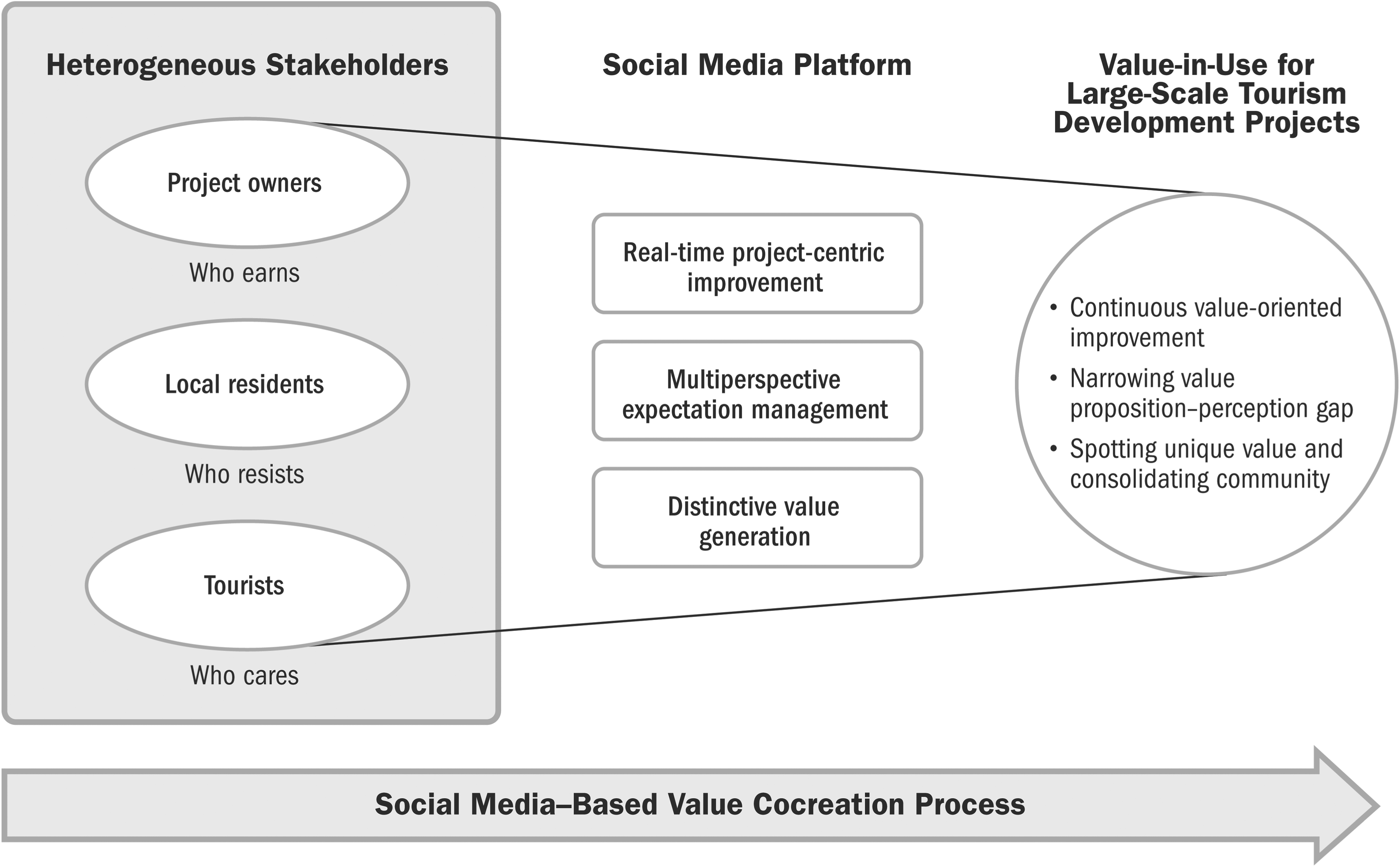
Model of social media–based value cocreation process.
Continuous Value-Oriented Improvement
Continuous improvement in large-scale tourism developments is difficult due to the inherent distance between potential visitors and the actual delivery of tourism products. Project owners intend to continuously improve their products in favor of user experience; however, continuous improvement becomes challenging due to the temporal and spatial distance between users and project owners. As shown in real-time project-centric improvement, social media ensures the value-in-use of tourism project services by increasing the frequency of value interaction. Consistent with Bhatti and Ahsan's research (2017), social media also enables geographically dispersed community residents, customers, suppliers, and other stakeholders to form virtual teams and express their opinions through social media platforms (Ehsan et al., 2008; Ninan et al., 2019). Social media provides a smoother channel for value interaction, where tourists’ real-time experiences are posted on online platforms in the forms of videos and comments, then pushed to more relevant stakeholders through back-end big data algorithms such as local residents and tourism regulatory authorities. As shown by Boyd and Ellison (2007) and Pfeffer et al. (2014), social media further provides a ubiquitous communication environment, enabling individuals to stay connected and receive real-time updates anytime and anywhere. The timelier and more accurate the communication among relevant parties is regarding tourism service content, the higher the frequency of value interactions becomes, which can effectively prevent potential value destruction and accumulation of value loss.
Narrowing Value Proposition–Perception Gap
The value proposed and value perceived always suffer from a gap between users and project owners. One essential reason the gap exists is that the design of large-scale tourism development was made to fit the needs of a variety of customers, whereas the tourists don’t necessarily understand from a more comprehensive perspective. However, as in multiperspective expectation management, the potential tourists experience the positive signals conveyed by these social media platforms, which later enhances the value perception. More specifically, social media openly gathers voices from different perspectives while coordinating consensus on various value propositions, which is consistent with the research results in the early stages of megaprojects (Williams et al., 2015). As an open public discourse platform, social media provides a value space for heterogeneous stakeholders to express their opinions about tourism projects, which is consistent with the open innovation culture within the service system supported by the service-dominant logic (Tussyadiah, 2014). On the other hand, the recognition, refutation, explanation, and irony of a certain viewpoint on social media form a community of opinions among heterogeneous stakeholders to share and develop the same value proposition. As the project information spreads and these clusters grow larger and more stable, they can exert significant influence on the project (Dunbar, 2016; Williams et al., 2015). For example, potential tourists become informal spokespeople for the government from a humorous perspective, and tourists and residents share experiences to optimize tourism services and experiences. As in the case of the Zibo project, the government has been personalized as so sincere and serious in serving tourists, that tourists joked that the government would kill for anything that benefits tourists. If tourists understand this level of government motivation and attitude, they will definitely perceive more value.
Spotting Unique Value and Consolidating Community
While large-scale tourism development projects often face local resistance, social media engagement has the potential to convert protesters into active supporters. The case demonstrates that as a city gains popularity online, residents’ distinctive viewpoints shared online foster local pride, effectively transforming them from opponents into the project's most authentic advocates. This approach is to turn unwanted projects into wanted projects by allowing local residents to foster a sense of belonging and embrace unwanted projects to become part of their larger community. This reflects the highest two levels of participation among the five levels proposed by Luyet et al. (2012), namely joint decision-making and empowerment. Tourists and residents are no longer passive roles, rather they are decision-making participants with the initiative to influence project value. By shifting their motivation, local resistants can engage in more constructive dialogue, which in turn helps to articulate and underscore the unique value of the large-scale tourism development project. The problem with NYMBY may also be resolved via this approach. More specifically, in distinctive value generation, social media amplifies the unique potential value of large-scale tourism projects by expanding the scope of value capture. Social media helps travel projects establish typical project characteristics by increasing the popularity and traffic of related videos and forming relevant feature labels for the tourism project to strengthen the value evaluation and perception of potential tourists (Prahalad & Ramaswamy, 2004).
Potential tourists distinguish tourism projects from peer practices through this unique value, which is captured when they participate in relevant supportive or advisory reviews. Potential tourists have redefined the significance of value in these tourism projects and actively participated in the value interactions of social media. These virtual groups—gathered because of their common interests, goals, or experiences—are constructing new values and expanding the scope of value capture. Similarly, Kakar and Khan (2017) proposed that social media can demonstrate the positive impact of infrastructure construction projects through managing relationships, expectations, and building trust. Furthermore, social media facilitates hybrid actions that connect online and offline spheres, utilizing public attention generated online to embed changes in offline contexts (Thorne et al., 2015). This virtual interaction supports diverse groups, tourists, project owners, and local residents to become a unified community, which turns enemies into friends, restrengthening the generation of unique value as a whole.
Conclusion
Theoretical Contributions
This study contributes to the value cocreation theory (Martinsuo et al., 2019; Chi et al., 2022; Toukola et al., 2023) by illustrating how heterogeneous stakeholders can interact virtually to bridge communication gaps, particularly in large-scale tourism development projects. Although value cocreation has been explored across various fields with different types of partners and industries, the understanding of the emerging role of social media platforms in facilitating the value cocreation processes has not been uncovered. In this research, we leverage complex interactions among heterogeneous stakeholders in large-scale tourism development projects to showcase the enabling mechanisms brought by social media platforms, which are not possible otherwise. By examining the role of social media in these projects, this research advances our understanding of how cocreation processes operate when enhanced by digital platforms, offering a new dimension to value cocreation theory in complex, resource-intensive contexts.
This study also contributes to resolution of the resistance of local residents (Fletcher et al., 2019; Wegerer & Nadegger, 2023) to large-scale tourism development projects by explaining how projects, unwanted by local residents, could be discursively transformed into wanted projects via the social media platform. Although existing literature has highlighted the resistance from local residents, especially due to their victimized role (Seraphin et al., 2020) and often easily ignored identity (Di Maddaloni & Sabini, 2022), there is a lack of solutions on how to turn hostility into friendship. Our findings help explain that this can be resolved by involving social media as a communication platform. Different parties can shift their role from protestors into proud contributors by joining the discourse of improvement. This further opens a theoretical understanding of why NYMBY may occur and how it can be resolved accordingly, since the local community should be discursively involved as contributors—even virtually and verbally. This doesn’t mean it will always work, and specific rules should be applied for this to function. The image of project owners should be positive and proactive, for example, by being willing to make changes and listen to the local residents.
Additionally, this study highlights social media’s potential as an innovative platform for project stakeholder engagement. Through real-time feedback and interactive capabilities, social media allows project owners to capture and address public preferences, moving beyond traditional project stakeholder engagement strategies and techniques. The findings offer theoretical insights for dynamically engaging with multiple heterogeneous stakeholders, with improved in-depth and broader scope via virtual communication channels. This further opens up more opportunities for understanding the dynamic engagement among project stakeholders, who are mainly considered to play a passive role (Yang et al., 2022). This enriches our understanding of how local residents can be actively engaged via online platforms.
Practical Contributions
We propose three practical contributions. First, build a better image for large-scale tourism development project and their project owners. The practical implications of this study highlight the benefits of social media in shaping a positive public image for project owners, especially in large-scale tourism development projects. By leveraging social media as a primary communication channel, project owners can build transparency and trust with stakeholders in large-scale tourism development, particularly local residents who may be directly affected by the development. Regularly sharing updates, project goals, and anticipated benefits to the community fosters a positive perception of the project, helping build goodwill and a strong foundation for community support. This image enhancement can be instrumental in avoiding misunderstandings and gaining the public’s trust from the early stages of the project.
Moreover, it is recommended that the management team of large-scale tourism development projects actively engage with local residents, since attitude matters the most. Proactive communication through social media enables project owners to engage with local residents more effectively. Involving the community by soliciting feedback, sharing project milestones, and addressing concerns demonstrates that local residents’ voices are valued, encouraging a sense of ownership and partnership in the project’s success. This also allows local residents—who have the best knowledge of the local community and may even play a role in large-scale tourism development in a broader sense—to contribute as part of the team. This proactive approach minimizes opposition by involving residents as collaborators rather than passive observers. Social media’s reach and accessibility make it easier to gather diverse perspectives and address them before they escalate into larger issues, ultimately contributing to smoother project execution and stronger community ties.
Finally, upright addresses the concerns by leveraging social media platforms. Social media allows project owners to address community needs and preferences in a timely manner, as feedback is often immediate and direct. Unlike traditional channels, where responses may be delayed, social media enables project teams to promptly react to public sentiment and adjust plans accordingly. This responsiveness helps ensure that the project aligns more closely with the community’s needs and expectations, improving project acceptance and reducing resistance. By using social media as a dynamic tool for stakeholder engagement, project owners can ensure that the project development process remains adaptable and responsive, resulting in a more successful and harmonious project outcome.
Limitations
Despite the valuable contributions, this study has several limitations that offer opportunities for further exploration and research. Although the article addresses the scenario where the public responds to negative comments via social media, there are still many negative comments that have not been properly addressed, which may be a design paradox of the tourism project itself. Social media serves as a double-edged sword in amplifying a city’s reputation and image, while also expanding the speed and scope of negative impacts such as the codestruction of values among various stakeholders. Future research can further explore whether social media can help projects move from value codestruction to value cocreation through negative cases. Additionally, the algorithmic nature of the TikTok platform might also share some limitations, since the algorithm tends to amplify popular content or prioritize recent content based on the different algorithms adopted. Future research could mitigate this through experiments on different types of social media platforms.
Furthermore, this article used Python programming language in the data collection to obtain a substantial volume of empirical data. Significant coding time and iterative procedures were invested in manually conducting a qualitative analysis of these data to uphold the reliability of the results. Although this article attempts to analyze the emotional tendencies of videos and comments through computer language 2 , which is only used as an auxiliary basis for data analysis by considering its academic reliability and validity. Therefore, the results of sentiment analysis are presented in Appendix B and Appendix C at the end of this article. Currently, the results obtained through web crawlers and sentiment analysis are not available for analyzing attitude change. Subsequent research should use data collection techniques and analysis methods for longitudinal sentiment change to explore the pre- and post-change of stakeholders’ emotional attitudes, which requires collecting emotional changes at different time points. Furthermore, with the maturity of future artificial intelligence (AI) models, future research may be able to extract themes from large-scale data through quantitative content analysis and emotion recognition.
Footnotes
Funding
The author has received funding from Shandong Provincial Natural Science Foundation, ZR2024QG179.

Notes
Author Biographies
Appendices
Example of Sentiment Analysis Results for Dalian
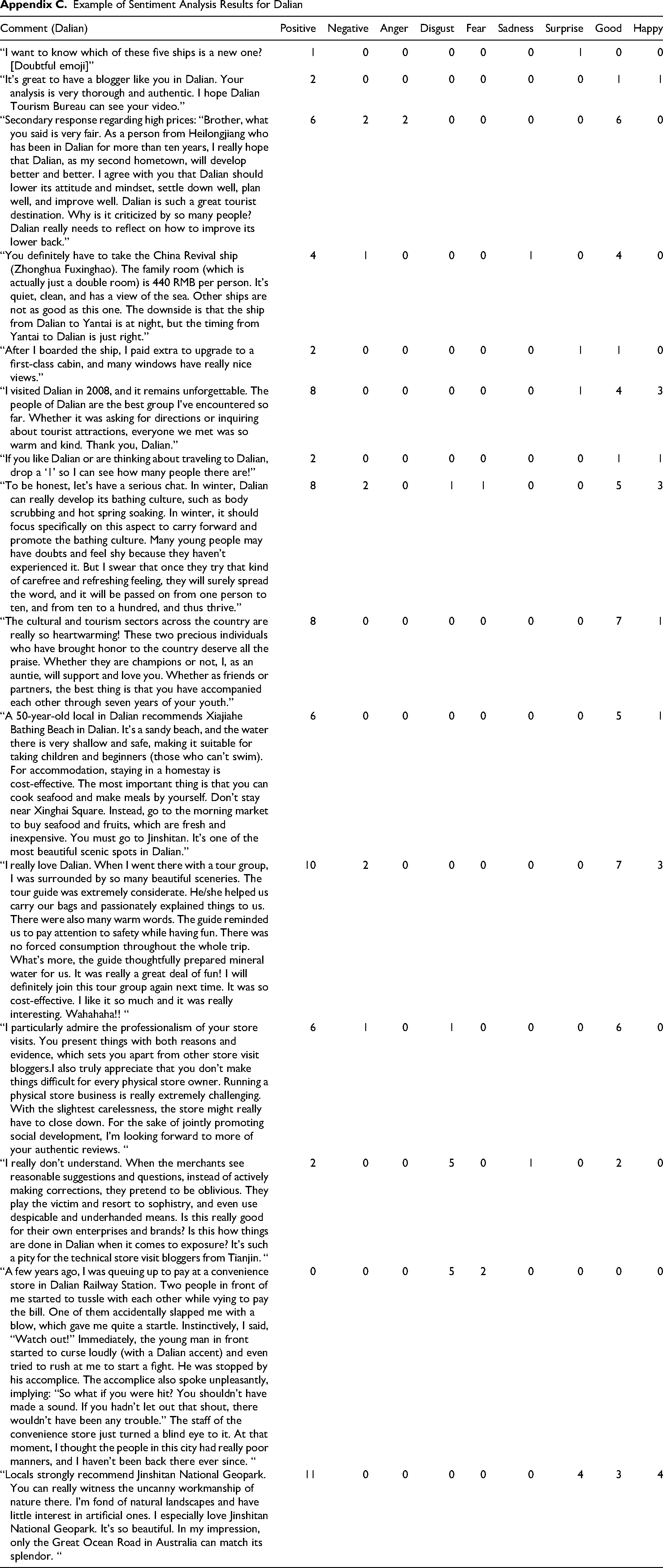
| Comment (Dalian) | Positive | Negative | Anger | Disgust | Fear | Sadness | Surprise | Good | Happy |
|---|---|---|---|---|---|---|---|---|---|
| “I want to know which of these five ships is a new one? [Doubtful emoji]” | 1 | 0 | 0 | 0 | 0 | 0 | 1 | 0 | 0 |
| “It's great to have a blogger like you in Dalian. Your analysis is very thorough and authentic. I hope Dalian Tourism Bureau can see your video.” | 2 | 0 | 0 | 0 | 0 | 0 | 0 | 1 | 1 |
| “Secondary response regarding high prices: “Brother, what you said is very fair. As a person from Heilongjiang who has been in Dalian for more than ten years, I really hope that Dalian, as my second hometown, will develop better and better. I agree with you that Dalian should lower its attitude and mindset, settle down well, plan well, and improve well. Dalian is such a great tourist destination. Why is it criticized by so many people? Dalian really needs to reflect on how to improve its lower back.” | 6 | 2 | 2 | 0 | 0 | 0 | 0 | 6 | 0 |
| “You definitely have to take the China Revival ship (Zhonghua Fuxinghao). The family room (which is actually just a double room) is 440 RMB per person. It's quiet, clean, and has a view of the sea. Other ships are not as good as this one. The downside is that the ship from Dalian to Yantai is at night, but the timing from Yantai to Dalian is just right.” | 4 | 1 | 0 | 0 | 0 | 1 | 0 | 4 | 0 |
| “After I boarded the ship, I paid extra to upgrade to a first-class cabin, and many windows have really nice views.” | 2 | 0 | 0 | 0 | 0 | 0 | 1 | 1 | 0 |
| “I visited Dalian in 2008, and it remains unforgettable. The people of Dalian are the best group I've encountered so far. Whether it was asking for directions or inquiring about tourist attractions, everyone we met was so warm and kind. Thank you, Dalian.” | 8 | 0 | 0 | 0 | 0 | 0 | 1 | 4 | 3 |
| “If you like Dalian or are thinking about traveling to Dalian, drop a ‘1’ so I can see how many people there are!” | 2 | 0 | 0 | 0 | 0 | 0 | 0 | 1 | 1 |
| “To be honest, let's have a serious chat. In winter, Dalian can really develop its bathing culture, such as body scrubbing and hot spring soaking. In winter, it should focus specifically on this aspect to carry forward and promote the bathing culture. Many young people may have doubts and feel shy because they haven't experienced it. But I swear that once they try that kind of carefree and refreshing feeling, they will surely spread the word, and it will be passed on from one person to ten, and from ten to a hundred, and thus thrive.” | 8 | 2 | 0 | 1 | 1 | 0 | 0 | 5 | 3 |
| “The cultural and tourism sectors across the country are really so heartwarming! These two precious individuals who have brought honor to the country deserve all the praise. Whether they are champions or not, I, as an auntie, will support and love you. Whether as friends or partners, the best thing is that you have accompanied each other through seven years of your youth.” | 8 | 0 | 0 | 0 | 0 | 0 | 0 | 7 | 1 |
| “A 50-year-old local in Dalian recommends Xiajiahe Bathing Beach in Dalian. It's a sandy beach, and the water there is very shallow and safe, making it suitable for taking children and beginners (those who can't swim). For accommodation, staying in a homestay is cost-effective. The most important thing is that you can cook seafood and make meals by yourself. Don't stay near Xinghai Square. Instead, go to the morning market to buy seafood and fruits, which are fresh and inexpensive. You must go to Jinshitan. It's one of the most beautiful scenic spots in Dalian.” | 6 | 0 | 0 | 0 | 0 | 0 | 0 | 5 | 1 |
| “I really love Dalian. When I went there with a tour group, I was surrounded by so many beautiful sceneries. The tour guide was extremely considerate. He/she helped us carry our bags and passionately explained things to us. There were also many warm words. The guide reminded us to pay attention to safety while having fun. There was no forced consumption throughout the whole trip. What's more, the guide thoughtfully prepared mineral water for us. It was really a great deal of fun! I will definitely join this tour group again next time. It was so cost-effective. I like it so much and it was really interesting. Wahahaha!! “ | 10 | 2 | 0 | 0 | 0 | 0 | 0 | 7 | 3 |
| “I particularly admire the professionalism of your store visits. You present things with both reasons and evidence, which sets you apart from other store visit bloggers.I also truly appreciate that you don't make things difficult for every physical store owner. Running a physical store business is really extremely challenging. With the slightest carelessness, the store might really have to close down. For the sake of jointly promoting social development, I'm looking forward to more of your authentic reviews. “ | 6 | 1 | 0 | 1 | 0 | 0 | 0 | 6 | 0 |
| “I really don't understand. When the merchants see reasonable suggestions and questions, instead of actively making corrections, they pretend to be oblivious. They play the victim and resort to sophistry, and even use despicable and underhanded means. Is this really good for their own enterprises and brands? Is this how things are done in Dalian when it comes to exposure? It's such a pity for the technical store visit bloggers from Tianjin. “ | 2 | 0 | 0 | 5 | 0 | 1 | 0 | 2 | 0 |
| “A few years ago, I was queuing up to pay at a convenience store in Dalian Railway Station. Two people in front of me started to tussle with each other while vying to pay the bill. One of them accidentally slapped me with a blow, which gave me quite a startle. Instinctively, I said, “Watch out!” Immediately, the young man in front started to curse loudly (with a Dalian accent) and even tried to rush at me to start a fight. He was stopped by his accomplice. The accomplice also spoke unpleasantly, implying: “So what if you were hit? You shouldn't have made a sound. If you hadn't let out that shout, there wouldn't have been any trouble.” The staff of the convenience store just turned a blind eye to it. At that moment, I thought the people in this city had really poor manners, and I haven't been back there ever since. “ | 0 | 0 | 0 | 5 | 2 | 0 | 0 | 0 | 0 |
| “Locals strongly recommend Jinshitan National Geopark. You can really witness the uncanny workmanship of nature there. I'm fond of natural landscapes and have little interest in artificial ones. I especially love Jinshitan National Geopark. It's so beautiful. In my impression, only the Great Ocean Road in Australia can match its splendor. “ | 11 | 0 | 0 | 0 | 0 | 0 | 4 | 3 | 4 |