




Abstract
Collaborative contracting models are increasingly being adopted for complex construction projects but achieving consistent improvement and broader alignment of such practices remains challenging. Based on a longitudinal study of collaborative contracting in Swedish infrastructure construction, this article argues that legitimacy concerns among major public sector clients contribute to this difficulty. Top management often responds to external criticism by quickly adopting new models, thus delegitimizing earlier practices and disrupting continuity at the operational level. Consequently, learning is cut short, and performance gains are unrealized—leading to repeated cycles of short-lived collaborative initiatives without sustained improvement.
Keywords
Introduction
Urbanization, advances in digital technology, and enhanced aspirations for social and environmental sustainability are significant trends that contribute to the increasing complexity of infrastructure projects (Banaszak et al., 2020; Glass et al., 2022). Executing projects in the context of existing residential buildings, local transportation systems, underground municipal infrastructure, commercial venues, and recreational areas implies high technical uncertainty and complexity, but also a more multifaceted and changing stakeholder landscape. In addition, most public clients face the challenge of decreasing financial resources. Traditional contracting models, characterized by a strictly linear logic and fixed-price contracts awarded based on the lowest bid, are less suitable for handling the unforeseen risks and scope changes typical of such unpredictable project environments (Davies et al., 2016; Eriksson, 2010). Consequently, clients more frequently adopt flexible contracting models that allow for closer collaboration between the contracting parties (Bertelli & Smith, 2010; Davies et al., 2019; Eriksson et al., 2017; Hartmann et al., 2014). This trend is further reinforced by risk-conscious contractors who avoid bidding on complex projects under conventional contracts (Hall & Scott, 2019).
In a broader sense, coordination and cooperation across organizations within the project-based construction sector rely on preexisting institutional trust. Such trust is not naïve but builds on a system of formal and informal structures at the institutional level that establishes mutual expectations regarding the parties’ competencies and conduct (Kadefors, 2004; Rousseau et al., 1998). While this institutional underpinning does not guarantee performance in each individual case, it improves predictability and reduces risks at an aggregate level. Hence, when new collaborative contracting models emerge, there is a need to update or complement existing institutional structures to align expectations with performance at higher levels of trust and collaboration.
Since the 1980s, policymakers in numerous countries have advocated for collaborative contracting practices as a means to cut costs and boost efficiency in the construction industry. However, achieving broad alignment and institutionalization of these practices has proven difficult (Bresnen & Lennie, 2024; Davies et al., 2019; Hartmann et al., 2010). Although there is general agreement, also internationally, around a set of practices defining collaborative interorganizational relationships—such as common goals, team-building efforts, risk sharing, joint risk management, and a system for conflict resolution (Bresnen & Marshall, 2010; Engebø et al., 2020; Eriksson, 2010)—attempts for further definition and codification have failed to gain wider acceptance (Bresnen et al., 2025).
Over the years, multiple concepts, including partnering, alliancing, integrated project delivery (IPD), and early contractor involvement (ECI), have emerged to define various collaborative approaches (Davies et al., 2019; Engebø et al., 2020; Hall & Scott, 2019; Lahdenperä, 2012). However, the meaning of these labels can differ significantly between local actors (Hall & Scott, 2019), across geographical contexts (Engebø et al., 2020; Lahdenperä, 2012), and even between projects led by the same client (Bresnen & Lennie, 2024). Additionally, research has shown that initiatives to implement collaborative contracting models and policies often become short lived as their legitimacy is challenged (Davies et al., 2018; Hartmann et al., 2014; Plantinga et al., 2020).
Still, while there are many studies describing how collaborative practices are implemented within a project (cf. Bygballe & Swärd, 2019; Matinheikki et al., 2019; Ruijter et al., 2021), the understanding of how collaborative practices develop and gain legitimacy at the organizational and industry levels over multiple projects and longer periods of time is still lacking (Bresnen & Lennie, 2024; Bresnen et al., 2025). This article seeks to address this research gap and investigate why it seems so difficult to achieve systematic learning and institutionalization around new collaborative contracting practices within infrastructure construction.
An important starting point is the key role that public infrastructure clients play in such institutionalization processes. These organizations are often dominant buyers in their respective markets and are generally expected to spearhead and champion the implementation of new contracting practices, affecting also the national level (Brady & Davies, 2004; Davies & Brady, 2016; Winch & Cha, 2020). However, such large and complex clients are also public sector organizations. This implies that they operate under the influence of bureaucratic logic (Hartmann et al., 2014; Matinheikki et al., 2019) and are required to report externally to show that public funds are spent responsibly (Mahura & Birollo, 2021). Further, public organizations are often instructed, or expected, to implement various political goals (Bonham, 2013; Plantinga et al., 2020) and public values (Kuitert et al., 2019), pertaining to, for example, innovation or sustainable transition of the construction industry at large (Glass et al., 2022). This complexity is further enhanced because goals can be contradictory and vary over time (Hetemi et al., 2021). Thus, to examine how large public clients can contribute to—or obstruct—long-term learning and institutionalization of collaborative contracting practices, it is important to consider their need to demonstrate legitimacy in relation to multiple goals and stakeholders.
In this study, we followed the introduction of a new collaborative contracting framework in the Swedish Transport Administration, a large public client organization that is responsible for a third of the total volume of Swedish infrastructure construction. Seven successive projects applying the framework were studied over seven years, and interactions between the projects, the permanent organizational level, and industry-level actors and processes were also mapped. Additionally, to expand the background and scope of the study, important developments in the decade preceding the study were included. The following research question was formulated:
How does legitimacy work in a public infrastructure client organization influence the wider institutionalization of collaborative contracting capabilities and practices over time?
The study showed that over the 20 years covered, new collaborative contracting models gained and lost legitimacy in multiple waves, as they were promoted, introduced, delegitimized, put on hold, and subsequently followed by new initiatives. Legitimacy work by higher management levels in the client organization was found to play an important role in these processes, since new contracting initiatives arose in response to calls by the government for increased productivity, or to requests for less risky contracts put forward by contractors. Failures to quickly meet high expectations for increases in performance, or lack of alignment with new political agendas, caused delegitimization and disruption of learning processes that could potentially have led to converging practices. The repeated cycles of initiatives also produced conceptual ambiguity, since new labels were introduced to avoid connection with previous, delegitimized, models.
The article discusses symbolic and substantive means to gain legitimacy and contributes to the current understanding of barriers to the institutionalization of collaborative contracting models by highlighting how short-term actions taken by large public clients to increase legitimacy may contradict the development of more stable legitimacy built on long-term efforts to increase learning and performance at the operational level.
Overview of the Field
This section starts by summarizing key points in the literature on institutionalization and change in the project-based construction sector. Next, research on such processes in the field of collaborative contracting models is reviewed.
Institutionalization and Project-Based Organizing
Considering that projects are usually seen as flexible organizational units formed to handle unique endeavors, project-based sectors have been found to be characterized by surprisingly strong isomorphism (Engwall, 2003). Projects, in general, are highly influenced by models and standards for project management developed and promoted by strong industry and professional bodies (Miterev et al., 2017). In the construction sector, with its unique, temporary, multiparty organizations, coordination needs are exceptionally high. Here, industry-level standardization of contracts, processes, and roles constitute important coordination mechanisms that reduce the need for information processing and mutual adjustment in individual projects (Bygballe et al., 2016; Kadefors, 1995).
Despite—or because of—the strong industry-level institutional order that aligns many project roles and routines, project managers have substantial authority to design other aspects to fit the unique and shifting needs of their specific projects (Bresnen & Lennie, 2024; Söderlund, 2023). Winch and Leiringer (2016) identified a wide range of capabilities (strategic, commercial, governance) that a client needs to possess. In practice, however, functions at the permanent level in client organizations are often weak and have difficulties in capturing experiences from a multitude of project-based initiatives and experiences (Dubois & Gadde, 2002; Eriksson et al., 2017; Swan et al., 2010).
When it comes to selecting the contracting model, this is often a decision made at the project level, since it is the project manager who is seen to understand the project needs and has the knowledge to design suitable contracts (Plantinga et al., 2020; Rosander, 2022). Thus, if a client organization wishes to implement a new contracting practice and refine it over time based on experiences gained in multiple projects, this implies that central units define standards to align practices between projects, and therefore that the freedom of individual project managers is circumscribed (Davies et al., 2018). Such initiatives will easily meet resistance at the project level, especially if there is already distrust between project-level functions and central organizational units (Bresnen et al., 2005; Qian, 2024).
Implementation and Institutionalization of Collaborative Procurement Strategies
There are a limited number of studies that describe and discuss initiatives to introduce new collaborative procurement models in large client organizations and more broadly in the construction sector. Plantinga et al. (2020) studied the implementation of new procurement strategies in a large public client in the Netherlands and identified so-called failure traps: When strategies failed to live up to the high expectations initially announced, they were quickly discarded and replaced with a new innovative procurement model. In a study of a public client implementing ideas from an industry initiative, Project 13, in the United Kingdom, Bresnen and Lennie (2024) found substantial confusion regarding how to translate such abstract ideas into practice, and that interpretations differed widely between projects.
Another initiative by a large client was documented by Davies et al. (2016), who followed the development of a new collaborative contracting model in British Airport Authority (BAA), initially developed in the Heathrow Terminal 5 (T5) project. This model was strongly championed by the CEO and was supported by codified knowledge in the form of a contract and supporting guidelines. Despite the difficulties in mobilizing some suppliers, the strategy was considered a key to success in the T5 project, and the intention was that the model would be used in subsequent major airport infrastructure projects. However, as a new owner took over the client company, the collaboration-oriented strategy was swiftly dismissed, and BAA reverted to traditional contracting models. Davies et al. (2016) discuss the fragility of new contracting models and how corresponding investments in organizational capabilities are easily lost.
However, also when practices are successful and relatively aligned within an organization, achieving further institutionalization in the sector is not evident. As such, Hall and Scott (2019) traced institutionalization processes as IPD was introduced by a strong hospital client in the United States. The study emphasized that for IPD to be validated as an acceptable and a “taken-for-granted way to organize complex projects” (Hall & Scott. 2019, p. 138) it was essential that the new model was perceived to meet general projects goals (e.g., time and cost) at a more pragmatic level. They further found that while the early (successful) initiative was based on a complex and demanding alliance model with multiparty contracts, it was followed by other clients who used labels such as IPD-lite or IPD-ish for a multitude of simpler collaborative approaches with less impact on formal contracts and roles.
A recent example of an institutionalization process in the field of collaborative contracting was described by Aaltonen and Turkulainen (2022) in their study of the complex and multilevel process of introducing alliancing practices broadly in the Finnish infrastructure sector. This initiative was supported by the director general of the Finnish Transport Infrastructure Agency and benefited from the long-term commitment of this major public client. The development process involved systematic capturing of knowledge from Australia and the United States, including a palette of study visits, translation to Finnish of guidelines and contracts, expert advice, successive refinement by pilot projects, and practitioner training. Therefore, the Finnish alliance process, similar to the original IPD model studied by Hall and Scott (2019), is well defined but quite demanding. Up to 2023, the model had been used for more than 100 large and complex projects without any important failures occurring (Kadefors et al., 2024). Although the Finnish case also shows that powerful and trusted individuals hold key positions as champions, at least in early stages, it supports the notion that sustainable change in project-based sectors must target institutionalized roles and practices at the sector level to become resilient (Kadefors, 1995; Windeler & Sydow, 2001).
Altogether, these examples highlight the difficulties involved in changing contracting practices at both organizational and institutional levels, as well as the significant resources, skills, and persistence that this requires.
Theoretical Foundation
In this section, we establish a foundation for our analysis by reviewing the literature that relates institutional change to the concept of legitimacy. Further, complications and contradictions in legitimacy work are outlined, focusing especially on public sector organizations.
Legitimacy and Institutional Change
Structures of legitimacy influence many aspects of organizational life, making the concept of legitimacy central to theories of organizational institutionalism (Deephouse et al., 2017). Within this field, legitimacy has been defined as a “generalized perception or assumption that the actions of an entity are desirable, proper, or appropriate within some socially constructed system of norms, values, beliefs, and definitions” (Suchman, 1995, p. 574). Thus, while Suchman (1995) and other legitimacy scholars acknowledge and discuss legitimacy structures at the societal level, they do so with a particular focus on how organizational entities gain legitimacy. However, the legitimacy of organizations is intertwined with the legitimacy of various organizational practices, which may also be constructed at a wider, societal level. Further, it is important to note that legitimacy structures influence the behavior of individuals, as such norms define what is viewed as the appropriate action in a specific situation and context (Giddens, 1984). Legitimacy evaluation comes from different sources (Deephouse et al., 2017) and can be based on individual values, as well as professional roles and standards (Grabher, 2004; Kadefors, 1995). Thus, legitimacy work also goes on within organizations, and what is seen as a legitimate action may differ between actors within the same organization.
The literature also discusses different forms of legitimacy and how they interact. Here, an early and influential categorization was offered by Suchman (1995), who identified three primary forms of legitimacy: pragmatic, normative (or moral), and cognitive. An organization may then gain pragmatic legitimacy by conforming to instrumental demands, normative legitimacy by conforming to altruistic ideals, and cognitive legitimacy by conforming to established models or standards (Suchman, 1995). Translating this typology to practices should imply that a new organizational practice is perceived as legitimate if it is seen as a useful way to solve a problem, is considered morally acceptable, and aligns with current understandings and practices. However, a layering approach, where new practices are introduced on top of or alongside existing ones, is seen to be more common than total replacement of old practices by new ones (Mahoney & Thelen, 2010).
Institutional change involves whole institutional fields comprising a wide range of organizations and professions (Barley & Tolbert, 1997; DiMaggio & Powell, 1983). Greenwood et al. (2002) developed a model relating institutional change to legitimacy work and proposed that institutional change often begins by a process of delegitimization, where proponents of a new institution first identify and articulate problems with the existing institutional order (theorization), and then explain why the new institution is more appropriate and how it will solve the problems (justification).
Especially in well-established fields, gaining support for change is often easier when the proposed modifications are incremental rather than radical, as the changes do not significantly alter the roles, skills, or resources of key stakeholders (David et al., 2013). In an influential article on managerial innovation, Ansari et al. (2010) suggest that practices that allow for multiple interpretations are more likely to be adopted, but with greater variation and less adherence to the original model. Consequently, managerial innovations tend to spread when they are flexible, require minimal investment, and are easy to comprehend. One important way to gain legitimacy in such processes is to imitate other actors or practices with high legitimacy (DiMaggio & Powell, 1983). This aligns with the findings of Hall and Scott (2019), where subsequent applications of a collaborative contracting model—integrated project delivery (IPD)—with strong legitimacy showed high variation, as other industry actors sought to imitate the source model and use the same label, but filled it with a variety of less demanding practices.
Vicious Circles of Reform in Organizational Legitimacy Work
Organizations need to show legitimacy in relation to multiple internal and external audiences, which may spur a range of parallel processes and initiatives that are related to different forms of legitimacy. Thus, organizations frequently adopt new practices and reforms mainly for reasons of normative and cognitive legitimacy (Meyer & Rowan, 1977; Brunsson & Olsen, 1993) rather than as genuine attempts to improve performance based on pragmatic legitimacy. As such, Ashforth and Gibbs (1990) differ between symbolic and substantive legitimacy management, where substantive management involves actual change in organizational goals, structures, and processes, while symbolic management focuses on appearing to conform to values and expectations, often in relation to external actors. Ashforth and Gibbs (1990) further note that managers generally prefer symbolic measures rather than substantive ones when aiming at building or restoring legitimacy, since symbolic measures usually require less resources and allow managers to preserve flexibility.
However, low-cost, episodic, and reactive efforts to quickly build legitimacy may yield the opposite result in the long run. One reason is that symbolic initiatives may contradict or crowd out organizational efforts to improve learning and performance at the operational level, which is often required to build more stable pragmatic legitimacy, especially toward well-informed professional audiences (Ashforth & Gibbs, 1990; Brunsson, 2002; Zuzul & Edmondson, 2017). Thus, superficial and symbolic efforts may trigger vicious circles of repeated initiatives, since they do not solve the basic problem and so tend to be followed by yet another symbolic initiative to produce legitimacy, again recreating the original situation (Masuch, 1985). Ashforth and Gibbs (1990) describe this phenomenon as the “double-edge” (p.177) of organizational legitimation and conclude that organizations with low legitimacy are more vulnerable to such vicious circles and risk being seen as nervous rather than succeed in their efforts to restore legitimacy.
Brunsson and Olsen (1993) note how especially public organizations can find themselves in such a state of constant reform, since they need to strive for legitimacy in relation to multiple, and often partly contradictory, goals and values. To handle this environment of inconsistent and fluctuating values, where legitimacy requirements might change as quickly as political goals shift, Brunsson (2002) suggests that organizations tend to respond by developing an internal differentiation, where some parts are oriented toward seeking legitimacy in relation to more normative, politically grounded goals, while others are concerned with operational activities.
Finally, projects are also arenas for different institutional fields and logics, which results in tensions that must be handled by organizations and project managers (Dille & Söderlund, 2011; Matinheikki et al., 2019). Kuitert et al. (2019) show how these effects play out in practice when public officers must prioritize between different values; for example, product values (quality, innovation) and procedural values (legal procurement processes). Public infrastructure projects are frequently contested by various stakeholder groups, and Hetemi et al. (2021) showed how legitimacy work in a large railroad project changed over the project life cycle and between actors and organizations.
In sum, the reviewed literature has several implications in relation to our research question, which addresses how legitimacy work in a public infrastructure client organization influences the wider institutionalization of collaborative contracting capabilities. First, legitimacy is clearly central to processes of change at both organizational and institutional levels, and such change involves both delegitimization and legitimization. Furthermore, legitimacy work within large client organizations may complicate the implementation and wider institutionalization of collaborative contracting models. Here, more symbolic initiatives to restore legitimacy may contradict efforts to produce more enduring changes in practice and risk to instead produce vicious circles of reform. Furthermore, project-based organizing is already a difficult context for driving change, and the public character of large public-infrastructure client organizations introduces a higher degree of complexity, since they need to establish, maintain, and restore legitimacy in a more multifaceted and variable policy context.
Methods
Research Approach and Methodology
The research project was initiated with the purpose of following up on the implementation of a new collaborative procurement strategy in the Swedish Transport Administration (STA), which gave us the opportunity to follow a development process in real time, in different parts of the organization, and in several projects, partly overlapping in time. The study can be described as a single qualitative exploratory case study. This research design offers a rich and in-depth understanding of a complex phenomenon (Martinsuo & Huemann, 2021) and is useful to elaborate on and extend existing knowledge and theory (Stake, 1995; Ketokivi & Choi, 2014). Here, the single case can add to the current understanding of how legitimacy issues influence institutionalization processes, especially related to the role of public project-based organizations. Furthermore, the longitudinal design naturally aligns with a processual perspective, focusing on “how and why things emerge, develop, grow, or terminate over time” (Langley et al., 2013, p. 1). This type of study, which encompasses activities in multiple projects and how they relate to the permanent organizational level, has been identified as essential to further develop project studies (Bakker et al., 2016, Brunet et al., 2021).
The core of the case study is the actions and experiences of individuals in different parts of the organization and the projects. As such, research methodologically takes a practice perspective, where organizational actors are regarded as knowledgeable agents, able to reflect on the structures within which they act (Giddens, 1984). In combination with the longitudinal design, the methodology emphasizes the processual aspect of stability and change in institutions and practices (Barley & Tolbert, 1997; Sydow & Braun, 2018).
The following sections will introduce the case and give an overview of the empirical material that built the case and how the analysis was conducted.
Empirical Material and Data Collection
The study follows the implementation of a new collaborative procurement strategy called the High Collaboration framework but also referred to as the early contractor involvement (ECI) model. The empirical material that built the case was collected over a period of seven years (2017–2023), at multiple levels, and in several parts of the organization (Figure 1).
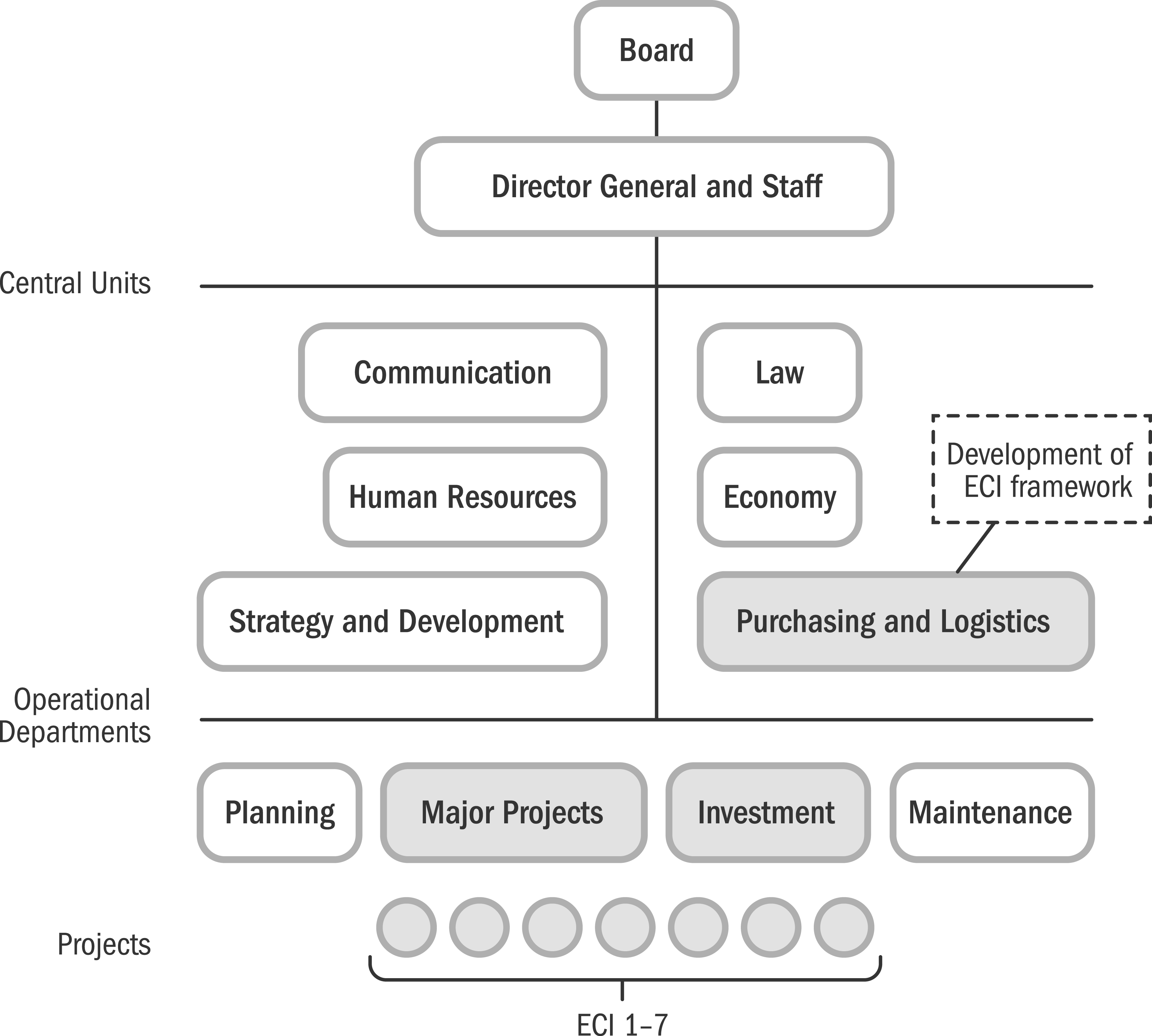
Organization of the Swedish Transport Administration, including the projects studied (ECI 1–ECI 7).
The main part of the material was collected in seven projects (five railroad and two road) applying the collaborative procurement strategy (ECI 1–ECI 7). These represent all projects in the Swedish Transport Administration that applied the ECI framework at the time of the study. Six of the projects were large and complex infrastructure projects, while one (ECI 3) was smaller and less complex. The projects were successively procured over the years 2014–2018 (Figure 2).
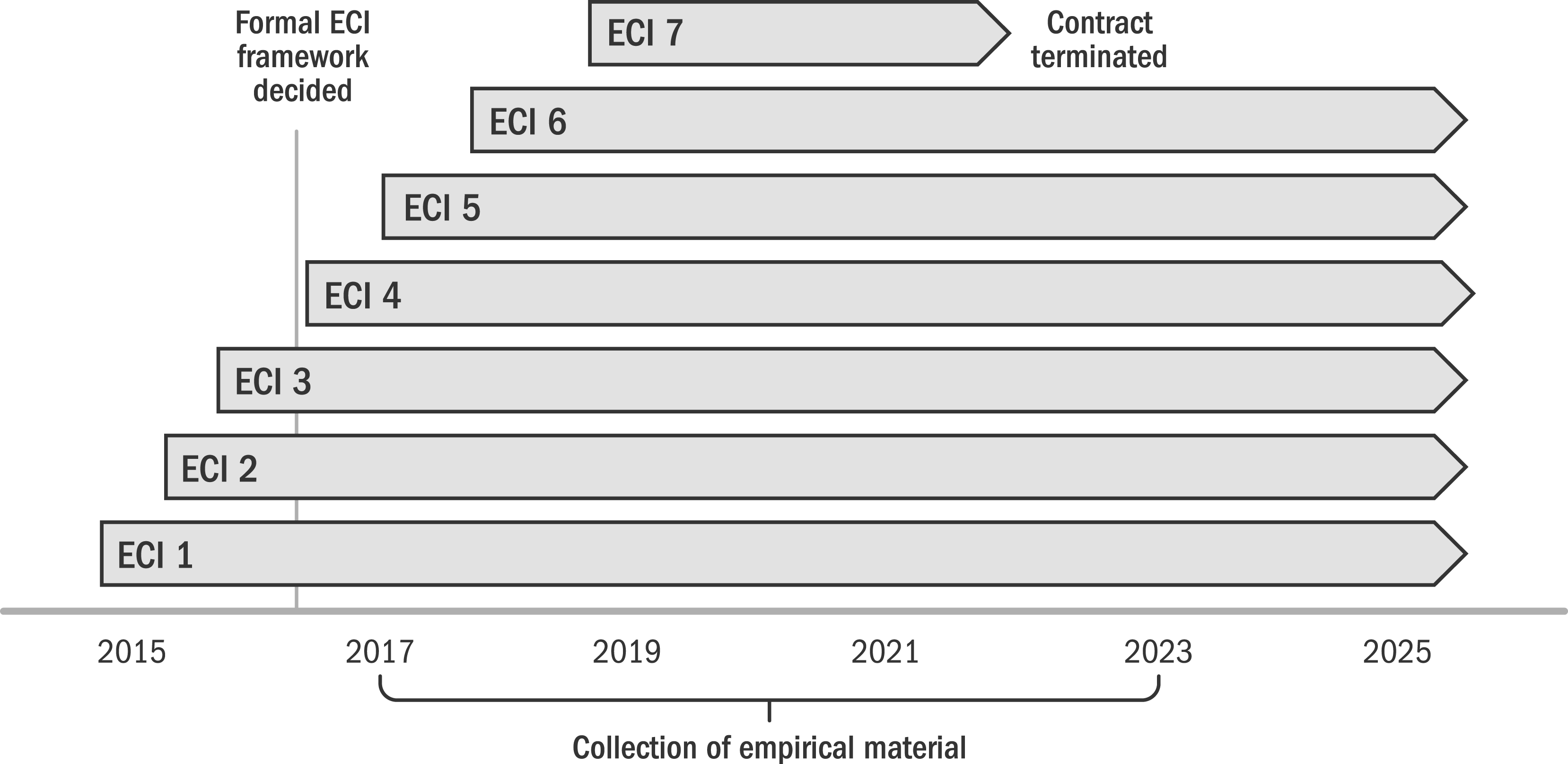
Overview of the duration of the projects, starting at the time of signing the contract for Stage One.
The empirical material consists mainly of semistructured interviews, which were performed in four rounds over a period of seven years (2017–2023). However, historical data was also captured (i.e., we asked about situations that had already occurred) as we wanted to understand how the currently initiated procurement strategy was influenced by previous policies and actions in the infrastructure sector and within the STA. It should be noted that earlier developments (especially before 2015) are covered in less depth than later years. In total, more than 70 semistructured interviews, with 51 unique respondents, were conducted (Table 1).
List of Interviewees and Interview Dates
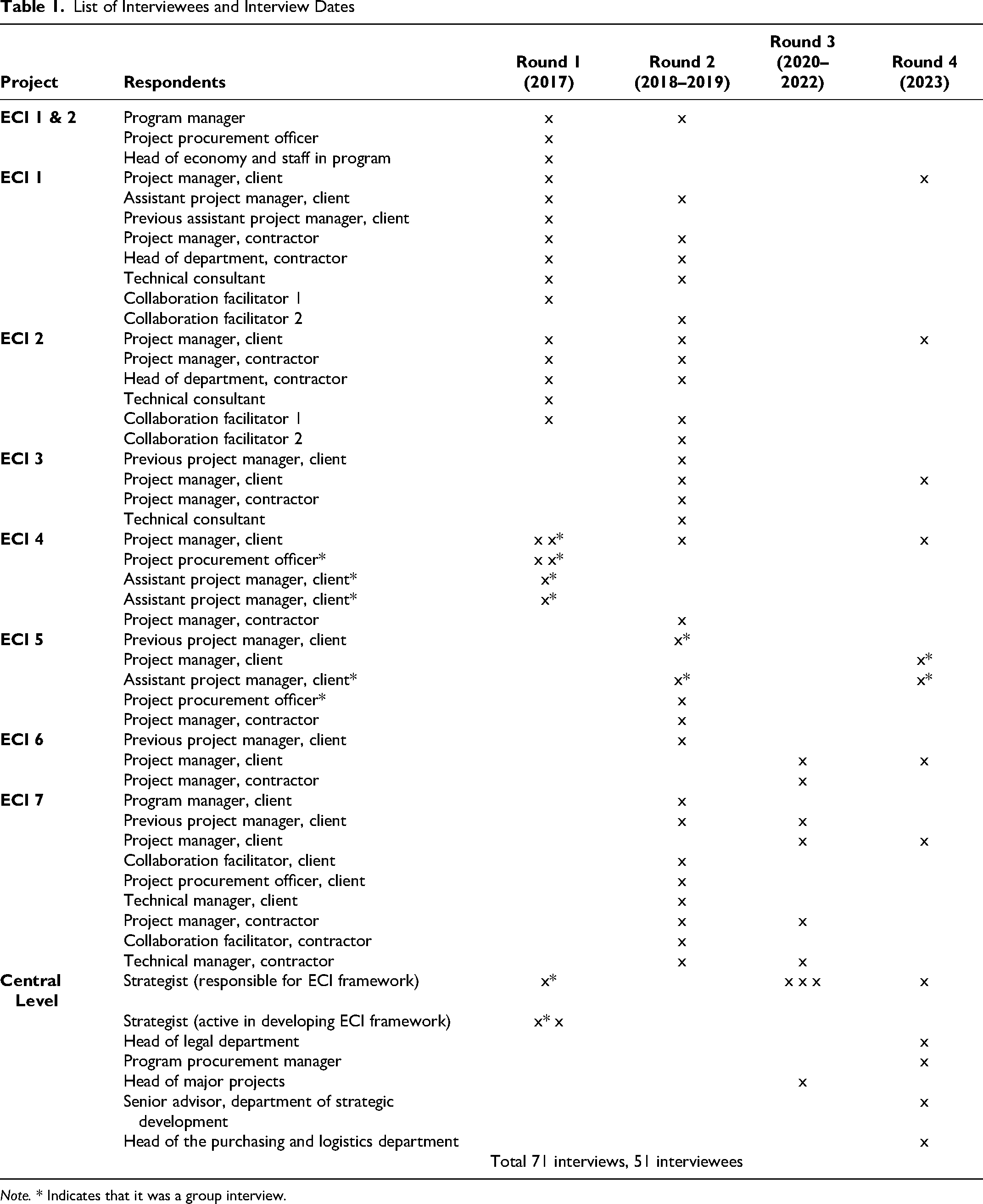
Note. * Indicates that it was a group interview.
In addition, organization- and project-specific documents have been essential to develop the complete case, especially to understand and triangulate the processes before 2017 (see Table 2 for an overview of all data sources). Direct observations of meetings were also carried out. Furthermore, relevant government policies and instructions, as well as organizational policies, were reviewed.
Overview of All Data
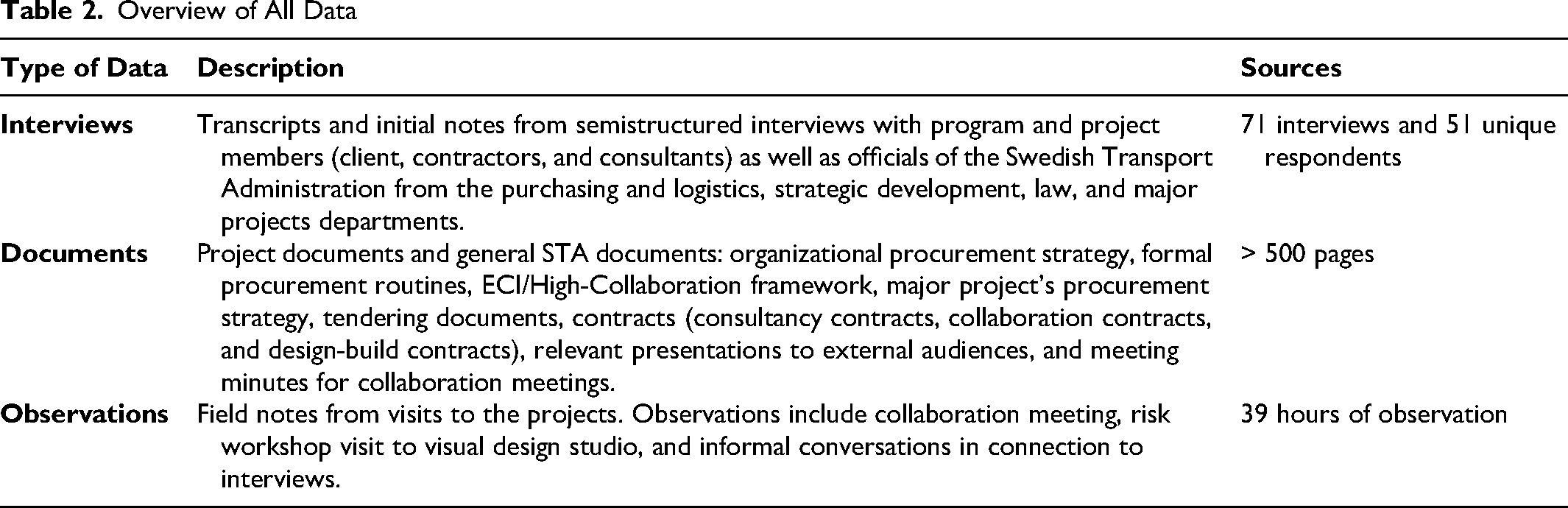
Respondents were chosen based on purposive sampling (Miles & Huberman, 1994) and included representatives for several organizational functions to include all relevant perspectives. First, members of project-level management functions from client, contractor, and consultant organizations were interviewed. When an ECI project was part of a program, material was also gathered at the program level. Furthermore, interviews were conducted with individuals at more central levels of the STA, such as the purchasing and logistics department, the legal department, and the management level of the operational departments (see Figure 1). Thus, most interviews have been conducted with client representatives.
Analyzing the Empirical Material
During the lengthy data collection, the material was continuously revisited to identify reoccurring themes and further refine and update our understanding of the case in light of new information. In earlier phases, this resulted in a database in NVivo qualitative data analysis software (version 14) where the interview material was structured and coded in three general themes based on the interview questions: (1) organizational processes and roles within the projects; (2) overarching structures and processes that acted across projects, such as policy-level developments, structures in the permanent organization to learn between projects, and informal contacts between projects; and (3) experiences of the new collaborative procurement strategy, in terms of innovation, sustainability, time savings, and quality.
The analytical process has been iterative (Ketokivi & Choi, 2014; Stake, 1995), where the theoretical framework, focusing strongly on legitimacy work in the context of public, project-based organizing, was developed to explain and theorize emerging empirical phenomena. In particular, this framework allowed us to account for the reoccurring shifts in the support for collaborative contracting, corresponding changes in practices and strategies, and differences in perceptions of the ECI model between the project level and the central management functions. The material was thus reread and analyzed with a focus on statements from different organizational departments and long-term developments, whereas project-specific collaborative practices (such as relationships and integrated routines) are not addressed in detail in this article.
To make sense of the material and understand when shifts in legitimacy occurred, temporal bracketing (i.e., organizing timelines into distinct phases) was applied (Langley, 1999). Key events and emerging views of the ECI model were plotted on a timeline, including organizational changes in the client organization (new directors-general, etc.). The result of the temporal bracketing was a narrative of the whole development process of the collaborative contracting framework divided into six periods/phases (Figure 3): (1) Early developments in collaborative contracting 2003–2010; (2) The new transport administration and collaboration backlash (2010–2014); (3) Resuming collaborative contracting (2014–2016); (4) the collaborative contracting framework diversifies (2016–2018); (5) Collaboration gets a bad reputation (2018–2021); and (6) The Phoenix rising of collaborative contracting (2021–2023). Each phase reflects a period where the policy context and views on collaborative contracting were relatively stable, whereas the transition to a new phase reflected a change in practices and the perceived legitimacy of such procurement strategies.
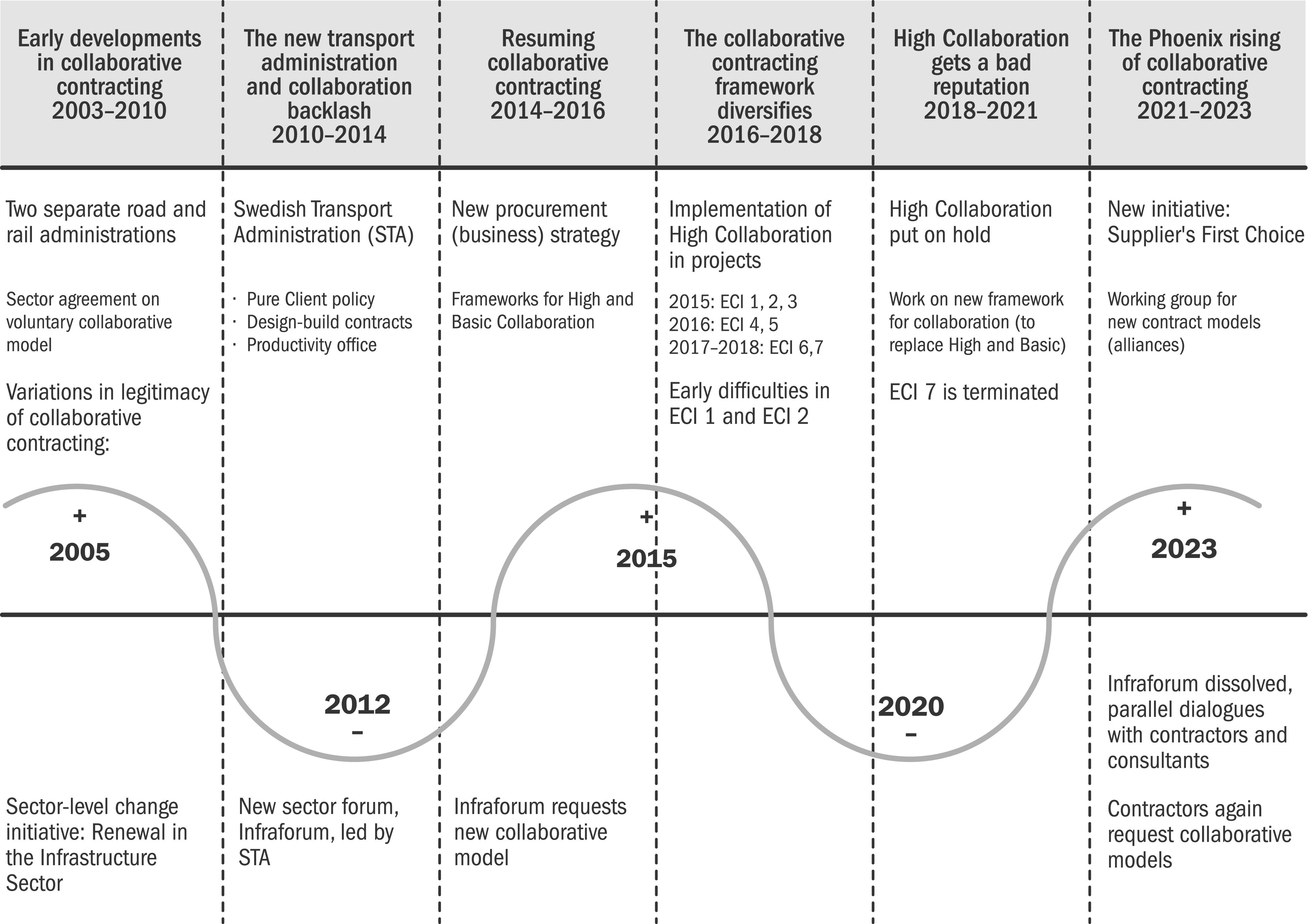
Process scheme summarizing the development in collaborative contracting, within the Swedish Transport Administration and at the sector level, including variations in legitimacy over time.
In the following section, the six phases that mark different stages in the development of collaborative contracting practices in the Swedish Transport Administration are described in more detail, outlining how processes at different levels—project, organization, and sector/market—unfold and interact over time. The developments in each phase are related to the legitimacy types described by Suchman (1995): pragmatic, moral/normative, and cognitive legitimacy; the process of institutional change outlined by Greenwood et al. (2002); and theories explaining vicious circles of legitimacy-seeking (Ashforth & Gibbs, 1990; Brunsson, 2002).
Findings
2003–2010: Early Developments in Collaborative Contracting
The early 2000s was a time of crisis in Swedish infrastructure construction. The works in the South Link tunnel megaproject in Stockholm had been procured in a deep recession using traditional fixed price contracts (Ottosson & Anderson-Skog, 2013; Siljevall, 2021). Additionally, sharper environmental regulations for water leakage increased geotechnical risks (Kadefors & Bröchner, 2015). This situation resulted in cost overruns, large lawsuits, and contractor losses. One contractor closed their tunneling division and others threatened to follow (Siljevall, 2021). In 2003, the directors-general of the former Swedish road and rail administrations initiated a sector-wide change organization called Renewal in the Infrastructure Sector, comprising also major technical consultants, contractors, and other large client organizations (SOU 2012:39).
A secretariat was established to administer the renewal initiative and organize learning activities. A basic model and guideline for collaboration was developed and the road and rail administrations issued a policy statement to run their projects according to this model. However, procurement requirements and contracts, for the most part, remained traditional, and collaboration was voluntary for contractors and negotiated after contract award. One of our interviewees participated in this initiative and described his experiences and views as follows: We all understood [in the early 2000s] that something was needed, so [Renewal in the Infrastructure Sector] was established, and we developed a model with inspiration from the United Kingdom and Denmark. Collaboration was defined at three levels, it was more a collaborative approach, and it was voluntary, but it worked. (Public officer, Swedish Transport Administration)
Several successful projects became forerunners in promoting collaboration, and the change organization collected experiences and issued reports and guidelines. However, another important objective of the initiative was to reduce costs, and in that sense, the new practices did not show a clear effect. Since the 1990s, several government reports had emphasized the low productivity in the construction sector at large (Swedish Agency for Public Management, 2009). In the late 1990s and 2000s, there had been a successive privatization of internal design and construction capacities of the Swedish road and rail administrations in line with general trends of new public management in Sweden and the rest of Europe (Jacobsson & Sundström, 2017). In 2010, the acting conservative government issued a large reorganization of the infrastructure sector, where the former road and railroad administrations (and some smaller agencies in the infrastructure sector) were merged into one new large organization, the Swedish Transport Administration.
To summarize the developments during this period, conflicts and lawsuits challenged the pragmatic legitimacy of traditional contracting practices. The imitation of other countries was important in formulating and legitimizing an alternative, more collaborative model. However, in parallel, another discourse emphasizing productivity issues and the influence of the private sector became increasingly pronounced.
2010–2014: The New Transport Administration and Collaboration Backlash
According to its governmental instruction, the new Swedish Transport Administration should, in its role as a client, especially aim to increase productivity, innovation, and efficiency in the markets for investment and maintenance (SOU 2012:39). The government also initiated the Productivity Delegation (2009–2012) to produce a review and policy suggestions in this field (SOU 2012:39). Based on this report, a policy was issued that focused on promoting innovation in the private sector. In line with this top-level policy and the instructions, the Swedish Transport Administration formulated a Pure Client policy, stipulating a new client role that would be less involved in the definition and execution of the projects. Traditionally, the road and railroad administration had mainly worked with design-bid-build contracts, and the new policy was operationalized in terms of quantitative goals to increase the future share of design-build (DB) contracts (50% in 2018), as well as lump sum contracts for consultancy services. This policy was supported by large contractors, who had since long argued for more DB contracts. The Swedish Transport Administration further established a productivity office to manage the change process, and the Pure Client policy was widely communicated in the organization (Trafikverket, 2015; Jacobsson & Sundström, 2017).
The previous initiative, which emphasized collaborative relationships with high client participation, did not align with this policy and lost legitimacy. One of the project managers (ECI 4) describes the shift: We finished a large project in 2011, about the time the Swedish Transport Administration was formed, and I remember that we got a prize for best collaborative project, and during the same time we had kick-off meetings in the Swedish Transport Administration on the pure client thing, and the newly appointed head of investment projects told us that this collaboration was only “fluffy things” that we were not supposed to do.
The Renewal in the Infrastructure Sector initiative was formally closed in 2012 and replaced by a new sector forum, Infraforum, which was led by the Swedish Transport Administration and focused on sector alignment with the Pure Client model as well as long-term strategic issues such as competence supply to the sector.
In sum, this period was characterized by the process to establish and build the new Swedish Transport Administration, where top management strove to legitimize the new agency in relation to its government instructions, which were grounded in high-level political trends to promote innovation by transferring risks and power to the private sector. The period marks a clear backlash in legitimacy for collaborative contracting methods, mainly due to low normative and cognitive legitimacy in relation to the general political discourse.
2014–2016: Resuming Collaborative Contracting
However, as the Pure Client policy gained more influence in practice, there was a growing awareness in the Swedish Transport Administration and among contractors that the DB contracts procured at the lowest price were not suitable for all projects. The contractors were concerned about the risks and conflicts that occurred in complex projects and once again called for more collaborative contracting models. A senior officer in the client’s strategic development department describes the background of the criticism:
We missed the goal with Pure Client and ended up with the contractor and the client distancing themselves from each other (…) we were not supposed to be poking around in their business, but I guess it created more uncertainties than necessary.
As a result, Infraforum decided to develop a new model for collaboration in infrastructure projects. A public officer at the purchasing and logistics department described the discussions and strategic choices: The Swedish Transport Administration, [the contractors’ industry association] and [the technical consultants’ industry association] sit together in that forum and discuss. They agreed that there was an increase in the number of contracts going to court in the sector. The discussion was then about how to deal with it and referred to the previous initiative Renewal in the Infrastructure Sector. However, the conclusion was that it was not possible to go back to the previous model and that there was a need for something new.
The task of developing a new collaborative contracting framework was assigned to two public officers of the Swedish Transport Administration’s purchasing and logistics department, who performed the work in collaboration with contractor representatives: Well, the [contractors’ industry association] was part of it all the way through the development of the framework. We had workshops together and there were a lot of suggestions from the contractor firms … As you know, they all have their own models. Then, I and [the other public officer] boiled all this down to what became the High Collaboration framework (Public officer responsible for the High Collaboration framework).
The framework that came out of this work included two levels of collaboration: Basic Collaboration (largely similar to the noncontractual Renewal in the Infrastructure Sector model), and High Collaboration, which was a two-stage contract with early involvement of the contractor, open books, and quality-based award criteria. In parallel, the Swedish Transport Administration initiated a new procurement policy (called business strategy) stating that project procurement strategies should be adapted to the complexity, uncertainty, and degrees of freedom in the specific project (Eriksson & Hane, 2014). A limited number of large and complex projects could now be procured based on the High Collaboration framework with early contractor involvement. In 2015 the Swedish Transport Administration was also appointed a new director-general and in the following years, with the new business strategy, the Pure Client policy became less influential, and the productivity office was closed.
One of the client-side project managers (ECI 4) with long experience within the Swedish Transport Administration reflected on the change between 2010 and 2015, from strict directives to use DB contracts with fixed price to a renewed support for collaborative models: There was definitely a new wind blowing in the Swedish Transport Administration. When I had completed [a collaborative project] in 2011 with great success, I joined a new project and tried to introduce a collaborative management style. But it was like swearing at church and the message was that we should not work in collaboration. Therefore, I was surprised to see that it was back, but I felt that we were on the right track again! I was afraid that we would not be able to work in a collaborative contract for this project, because I think it could not be completed in any other way.
However, already in 2014 three projects (ECI 1, 2, and 3) had applied a similar two-stage collaborative model with early contractor involvement. In ECI 1 and 2, which were parts of a large urban railroad program, the program manager expressed a personal motivation to “try something new” as he had experience with conflicts, cost overruns, and delays in more traditionally procured projects. Still, the most important factor leading up to this decision was program-level market dialogues with Swedish and international contractors: One of the contractors that we talked to had experience of working in a large Swedish project applying collaborative contracting, and also from the United Kingdom. Later, it turned out that many of the contractors had experience in collaborative contracting and collaborative delivery models of some sort. The collective voice of the contractors was that “This is complex and we don’t think you should procure this traditionally.” Instead, they argued to apply some kind of collaborative contracting model (Project procurement officer, ECI 1 and 2).
Top management at the Swedish Transport Administration approved the two pilot projects but this bottom-up, program-level initiative was not integrated with the ongoing process initiated by the Infraforum, where the purchasing and logistics department developed the High Collaboration framework jointly with high-level industry representatives.
Summing up the developments during this period, it became clear to many decision-makers that the Pure Client policy with DB contracts was not a panacea to reduce costs and stimulate innovation, and the industry discourse shifted back to collaborative contracting. This time as well, the change was spurred by a dissatisfaction among contractors with high risks in large contracts, and international experiences were used as inspiration and sources of legitimacy. However, in contrast to how the Pure Client policy was implemented, there was no high-level political support, no ambition to implement collaboration widely other than in the most complex projects, and very limited resources assigned to developing and implementing the model. Also, there were two parallel and largely uncoordinated initiatives, indicating differing goals and that central levels in the Swedish Transport Administration prioritized gaining legitimacy in relation to high-level contractor representatives. Thus, their input was more influential than actual experiences at the operational level.
2016–2018: The Collaborative Contracting Framework Diversifies
With the formal collaborative contracting framework in place in 2016, more projects followed the three initial projects. By the end of 2018, a total of seven projects had pursued to apply the High Collaboration framework with early contractor involvement (see Figure 2). For the contractor companies, bidding for these contracts was seen as a strategic decision: During the years 2016, 17, and 18 we really saw this initiative with collaborative contracting (at the Swedish Transport Administration) as a big thing to “get in on” and gain experience from (Contractor, project manager, ECI 5).
Within the Swedish Transport Administration, each project or program manager had the main responsibility of developing project-specific procurement documents. In the purchasing and logistics department, one public officer continued to work part-time with the High Collaboration framework. His role was to maintain a dialogue with the projects applying the framework and make sure that their procurement models aligned with the formal requirements. However, this framework did not define contractual or organizational aspects in detail, meaning that the individual project managers could still influence key aspects of their models. Many of them valued this freedom, and the attitude toward central Swedish Transport Administration functions was often ambivalent: It was nice to be able to use all your experience to create the delivery model. (…) The Swedish Transport Administration has a lot of good people, but it easily becomes too much paperwork and rigid routines, which makes it hard to be creative, which you need to be in these circumstances. But [the public officer responsible for the High Collaboration framework] was really understanding. Even if he did not like everything we did, we were still able to try some things (Project manager, ECI 5).
As the first two projects (ECI 1 and 2) progressed, several issues became apparent. There were discussions about the 50/50 gainshare/painshare ratio in the target cost model, which was eventually adjusted to assign less risk to contractors. Furthermore, it turned out that the estimated target costs exceeded the client’s budget in both projects, leading to adversarial negotiations and delays in Stage One. Another experience was that there was not enough time in this stage to establish effective routines to organize joint design processes, manage open books, and agree on a target cost. Additionally, the client resources within the two projects were scarce, which also hampered collaboration. Moreover, in ECI 2 both the contractor and the client had filled some key positions with project managers who did not have collaborative mindsets, which affected relationships. In ECI 1 individuals were more collaboration-oriented, and the issues encountered were mainly practical, such as lack of experience, resources, and a joint office large enough to accommodate the whole organization.
The negative experiences in ECI 1 and 2 (especially the conflicts regarding the target cost in ECI 2) influenced subsequent collaborative projects, as project managers tried to adjust their models to avoid these problems. However, such sharing of experiences was mainly based on initiatives by individuals and direct contacts between project managers. Thus, the seven projects all differed in award criteria, contract type, reward systems, what was included in the contractor’s fee, collaborative attitudes, collaborative activities, timeframes, and budget transparency. In effect, there were also significant differences between ECI 1 and ECI 2, which belonged to the same program and were based on very similar contracts.
No extra resources for training, implementation, or follow-up of experiences were allocated to the projects. The link between the two parallel development processes at the purchasing and logistics department and in the projects was described by those responsible as almost nonexistent, and many project members perceived that there was a lack of structured learning at the organizational level: Well, honestly, if I left now, all this knowledge would be gone. The next time they do this [use a collaborative procurement strategy], they would think: How did they do it? And that information would be all gone. And it could have been easily secured by developing some rudimentary guidelines, and people like myself could have given some feedback to the organization. Then they could have analyzed: Okay, what worked in this procurement process and what did not work so well? (Project procurement officer, ECI 7)
The public officer in the purchasing and logistics department responsible for collaborative contracting did not actively monitor the experiences in the projects to further develop guidelines. He was personally committed but had to prioritize tasks due to limited time. Instead, he hoped that the research project in which this study was conducted could provide such feedback: Well, learning… for me, frankly, I have just tried to connect the projects with each other, so that they could talk. (…) That’s a reason why I got engaged in your research project, so that you could collect the experiences.
In sum, this period illustrates the difficulties involved in driving systematic learning toward converging practices in a project-based organization lacking strong organizational capabilities at the permanent level. The limited resources allocated to implementing the policy did not allow for ambitious learning activities to improve performance at the operational level. However, the lack of structured learning also reflected traditional power relationships in the client organization, where project managers had considerable autonomy. Interestingly, however, project managers now began to see a need for alignment and called for more systematic organizational learning. In parallel, the pragmatic legitimacy of the collaborative model began to be questioned, as the first ECI projects failed to meet expectations for cost reductions in early stages.
2018–2021: High Collaboration Gets a Bad Reputation
Since central level structures for monitoring the projects were weak, experiences were shared mainly between individuals and at occasional seminars. Thus, the views of strong project managers with a high profile in the organization became very influential. In particular, the early problems in ECI 1 and 2 spread widely. Much was based on this negatively framed communication, and no more projects were procured with the High Collaboration framework after 2018. The responsible officer in the purchasing and logistics department commented on this change and its causes: Well, we have been a bit back and forth [regarding the future of ECI]. It started with ECI 1 and 2 having these large troubles… which were mostly due to the reward system. (…) And you know [the program manager of ECI 1 and 2] is a really strong profile and he has told people that there is something wrong with the model…which, of course, has raised questions in the organization. (…) This definitely creates mistrust. Now, it is a bit on hold.
In most of the other ECI projects, however, the experiences were positive, and their collaboration capabilities had developed over the years. For many of the project managers, this increasingly bad reputation of ECI was, therefore, a disappointment: “ECI has a bad ring to it in the Swedish Transport Administration now. (…) That’s a bit frustrating” (Project manager in ECI 5). Another project manager (ECI 4) further stated:
Personally, I believe in this way of delivering projects. Therefore, I get worried when I hear that it is not working out in other projects; of course, I refer to this rumor about ECI 1 and 2—that it is not working out, at all, there.
The critical incident that fundamentally delegitimized the ECI model was when a very large ECI project (ECI 7) was delayed in Stage One due to unresolved issues related to municipal planning processes. For the contractor, it became increasingly difficult to keep some of their most competent staff tied to a project that did not produce a large turnover. Thus, in 2020, the parties jointly decided to terminate the contract. The acting head of the operational department for major projects within the Swedish Transport Administration described the discussions at central levels as follows: We discuss ECI. The ones working at the purchasing and logistics department, their ideas are good, yet the execution or the way they are translated to practice is not good. They think that the contractor can come in when we don’t have legal decision for the project yet, because that’s how early they need to come in to make some real impact… It is possible to do that in a good way, but not here at Swedish Transport Administration, because we have different timeframes [compared to building construction].
To summarize, this period shows how the lack of top management support and formal structures for systematic learning within the client organization allowed individuals with critical views and strong informal networks to effectively delegitimize the ECI model. This caused the Swedish Transport Administration to quickly dismiss the model instead of investing in refining it to build more stable pragmatic legitimacy based on actual performance.
2021–2023: The Phoenix Rising of Collaborative Contracting
When follow-up interviews were conducted in the seven projects during Spring 2023, they had been ongoing for five to seven years. All of the project managers on the client side perceived that the projects had acceptable progress and that collaboration between the parties in general worked well. In effect, this also applied to the initially problematic projects ECI 1 and 2. ECI 1, especially, was now perceived to work better than other, more traditional, subprojects in the program, which by this time began to show significant cost and time increases as well as conflicts. According to the client project managers, the positive experiences were largely based on the joint processes, which over time had resulted in useful project routines: And all of these routines for how we work together—financial routines, how costs are reported and how we verify costs, how we call for inspections, and so on—we have gradually landed such things. Often, we have developed manuals for how this should be done; we summarize the procedures we have agreed upon and have gradually changed and improved them. There is not that much that doesn’t work now (Project manager, ECI 1).
Nevertheless, respondents generally described the process to achieve a shared understanding of the contract and develop joint processes in large project organizations as difficult. Therefore, many project managers called for more specific guidance and support from the central parts of the Swedish Transport Administration on how to establish and manage collaborative processes: “I believe that if you are going to have these types of contracts, then we also have to produce rules and materials that support it” (Project manager, ECI 2). Another project manager emphasized joint training: A big thing that I see that you need to do in order to continue working further in the collaborative mindset is that the Swedish Transport Administration trains its staff and employees, and also those you bring in as resource consultants, so that you get slightly better starting conditions: What is collaboration for the Swedish Transport Administration? A basic education.
In parallel to the discussions questioning the value of ECI in 2020, another program consisting of several large railroad projects developed a collaborative procurement strategy for their two largest contracts. This model shared many similarities with the ECI/High Collaboration model, but was not presented as a further development of, or formally related to, this initiative. It also used a different label: early supplier collaboration (ESC). Some respondents interpreted this as a way to distance the new initiative from the existing ECI contracts: You know, ECI has a bit of a bad reputation now within the Swedish Transport Administration, so then they invent something new called ESC instead: early supplier collaboration…the same thing with a different name. It is a little strange that instead of further developing something that exists and build on our experiences, you invent something new again.
In 2021, a new director-general was appointed. In 2022, in the annual supplier survey, it became clear that satisfaction with the Swedish Transport Administration as a client had dropped further. The background was again conflicts and high losses in large projects procured with fixed-price DB contracts. The contractors communicated that they intended to refrain from participating in the Swedish Transport Administration’s procurements if they did not improve collaboration and change the distribution of risk in the contracts. In addition, Infraforum was terminated, in part because suppliers were not satisfied with its focus on competence development and wanted to discuss more pressing issues related to contracts and profitability.
In response to this criticism, the new director-general initiated a program called The Supplier’s First Choice. Within this initiative a working group was formed for new contract forms, comprising six members from both central units and operational departments of the Swedish Transport Administration (strategic development, purchasing and logistics, legal affairs, major projects, investment and maintenance). The task of the group was to investigate how the Swedish Transport Administration could use new contract models to make the projects more attractive to bidders. This work did not explicitly build on the High Collaboration framework or the experiences in the seven ECI projects, although there were informal contacts. Instead, one of the leaders of the group described that they were on a “discovery journey,” exploring how other transport client organizations in the Nordics and Europe worked with new collaborative contracting strategies. Especially Finland and its successful experiences with alliance models was seen as a good example. Thus, in 2023 it was decided to test so-called alliance-inspired procurement strategies in a few pilot projects. Yet, there was no official communication about any details in these contracts and no plans for a broader industry-level platform to drive development such as in the Finnish Alliance initiative.
In parallel, a general effort to improve client–contractor relationships was initiated within the framework of the Supplier’s First Choice initiative and was led by the purchasing and logistics department in collaboration with high-level supplier representatives. Here, the ambitions were no longer to include contract forms with early contractor involvement or risk sharing. Instead, the initiative focused on codifying good practices for market dialogue, procurement processes, and project management that would support constructive contract relationships, regardless of contract type. The label used for this new model was Framework for Cooperation. According to the responsible public officer, the choice of the term cooperation was based on the “bad connotations” the term collaboration currently has in the sector.
In summary, this period is marked by efforts of higher management levels to regain legitimacy in response to criticism from external actors (the government and contractors). However, the organization did not build on the largely positive experiences in the still-ongoing ECI projects to improve performance in future projects. Instead, the low organizational legitimacy was addressed by further denouncing this model in favor of new approaches. This was achieved by using new labels for a similar model (early supplier involvement [ESI]), introducing a new model (alliancing) and replacing the word collaboration with cooperation.
Discussion
Our research question addresses how legitimacy work in a public infrastructure client organization influences the wider institutionalization of collaborative contracting capabilities. In the following, we first summarize and discuss the influence of the public context, characterized by the need to show legitimacy in relation to multiple goals and developments at the political level. Second, the relation between legitimacy work, resource allocation, and project-based context is discussed.
Cycles of Initiatives and Legitimacy Losses
In the case studied, we saw how initiatives to introduce collaborative contracting in the Swedish infrastructure construction sector gained and lost legitimacy in multiple waves over a period of 20 years. The findings show a messy and complex pendulum process in which practices did not converge and where parallel initiatives, taken at different levels within the client organization, competed for organizational resources.
Similar to the IPD initiatives described by Hall and Scott (2019), the collaboration waves were driven mainly by contractors, based on problems experienced in complex projects with fixed-price contracts. Thus, the pragmatic legitimacy (Suchman, 1995) of traditional contracts, placing high risk on the contractors, was repeatedly called into question, and collaborative contracting practices presented as a solution (cf. Greenwood et al., 2002). However, collaborative models were also quite quickly delegitimized. For the first collaborative initiative, initiated in the early 2000s and formally closed in 2012, this was primarily due to lack of normative and cognitive legitimacy (Suchman, 1995) in relation to a politically grounded Pure Client policy, aiming at shift responsibility and power to the private sector. However, the fact that collaborative projects had not met high expectations for cost reductions was a contributing factor. Regarding the second collaborative initiative (early contractor involvement [ECI]), between 2014 and 2018, the direct cause of delegitimization was disappointments in early stages of the first two ECI projects, which were largely related to pragmatic legitimacy. However, these implementation problems could, in effect, also be traced to a remaining influence of the previous Pure Client policy, which affected the client role and the level of resources allocated to the projects. As such, the Swedish Transport Administration did not take the lead in defining collaboration or developing guidelines and tools. Furthermore, limited staff resources were assigned to support and manage learning in relation to the new practices. This contrasts starkly with the more active role taken by British Airports Authority (Davies et al., 2016) and the Finnish Transport Infrastructure Agency (Aaltonen & Turkulainen, 2022). Moreover, when a new initiative emerged, collaboration was not simply resumed in the form that had lost legitimacy a few years earlier, despite that projects applying the previous model were still ongoing and could provide valuable input. Instead, the labels associated with earlier models were discredited and considered obsolete, and subsequent initiatives were presented as novel solutions using a new label.
Based on literature on legitimacy (Ashforth & Gibbs, 1990; Brunsson, 2002), this volatility can be explained by legitimacy work in different parts of a public organization. The client organization studied faced substantial criticism from external sources (media, government reports on low efficiency, and open criticism from suppliers in high-level industry dialogues). For an organization experiencing such legitimacy challenges, it is important to show initiative and the power of action. Especially if the organization’s general legitimacy is low, it will tend to respond quickly, but with efforts that address legitimacy primarily at a superficial symbolic level (Ashforth & Gibbs, 1990). Such measures will typically not solve the underlying problems and, therefore, tend to be followed by yet another new initiative (Ashforth & Gibbs, 1990; Brunsson, 2002). The pendulum movements observed in the case study indicates such a vicious circle, where higher management levels attempted to gain legitimacy by presenting new models and labels, often based on examples from other countries, while more substantive learning processes at the operational level were discontinued. See Figure 4 for an illustration of these processes.
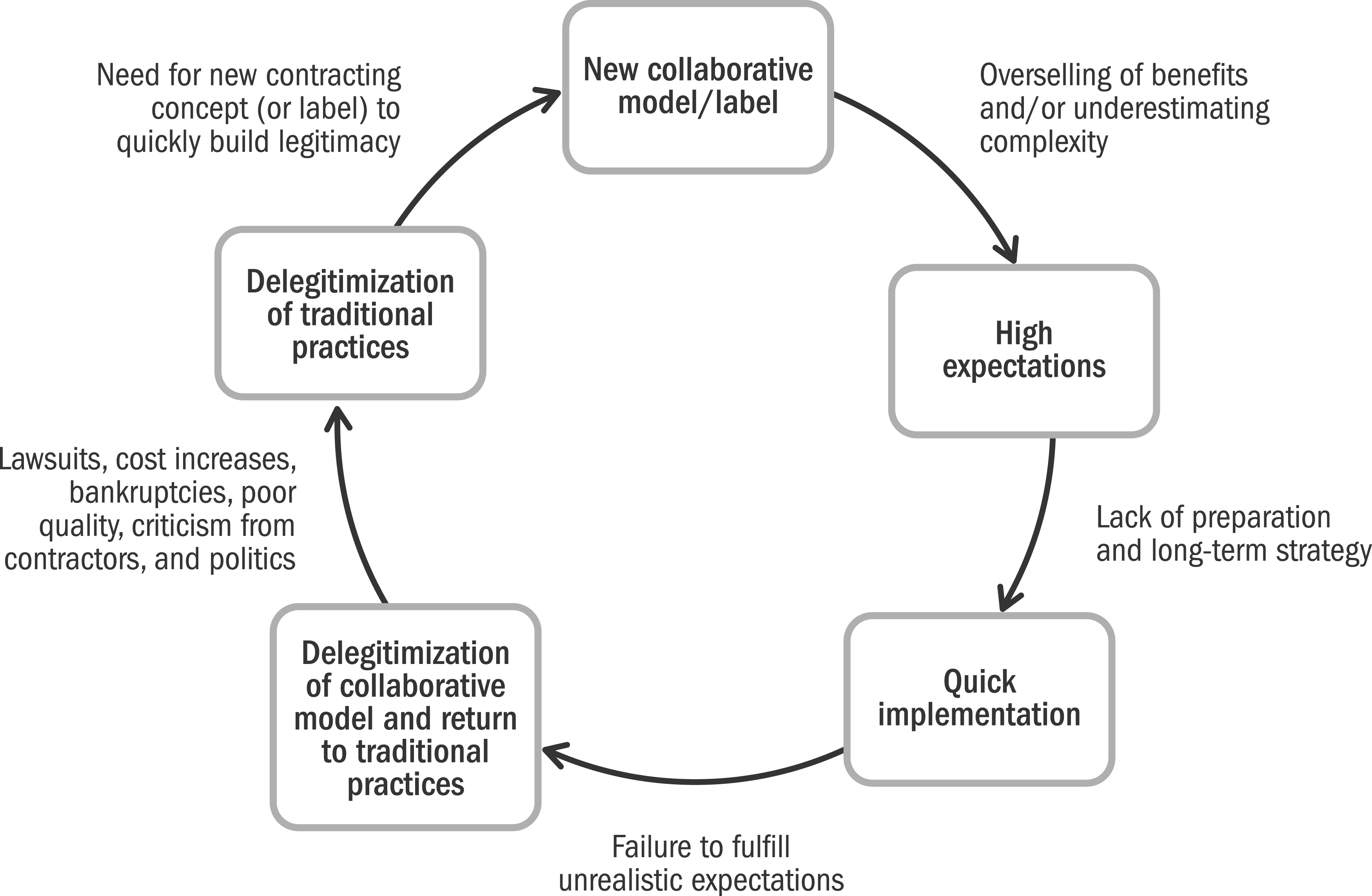
Schematic illustration of how measures to gain legitimacy produce repetitive cycles of collaborative contracting models.
This kind of trajectory is neither exceptional nor unavoidable. Similar situations were described by Qian (2024) and Zuzul and Edmondson (2017), who found that the focus of top management on external and normative legitimacy hampered internal and project-level development processes. Accordingly, the study of collaborative contracting practices in the Nordic countries by Kadefors et al. (2024) showed that the concept of partnering in Denmark reached a long-lasting taboo status when early projects failed to meet high expectations for cost savings, and in Norway developments in ECI resembled those in the Swedish Transport Administration. On the contrary, the ambitious and structured process to introduce alliancing in the Finnish infrastructure sector avoided backlashes and produced a higher level of institutionalization and stable performance (Aaltonen & Turkulainen, 2022).
Altogether, the findings indicate that legitimacy work resulting in repeated cycles of new collaborative contracting models in a large, influential client organization may contradict learning and wider institutionalization of such practices in several ways. First, superficial and symbolic initiatives are not assigned sufficient resources for implementation and systematic improvement over time, which hinders learning during the time the initiative is active. Additionally, learning cycles are interrupted when initiatives are stopped. Second, when a specific model is effectively discredited by a large client, this affects the normative legitimacy of the labels and practices associated with this model more widely in the industry, irrespective that the problems may be due to the implementation process rather than to the model as such. Third, the need to find new models and labels without recognizing similarities with previous, delegitimized ones increases conceptual ambiguity, thus further complicating the development of shared understandings and converging practices at the institutional level. However, such long-term consequences are not intentional on the part of the client organization but follow from legitimacy work undertaken to serve the organization in its purposes to survive and pursue societal goals.
Resources and Project-Based Organizing
The study also underlines the importance of understanding the impact of project-based organizing on institutional changes. Clearly, gaining more stable pragmatic legitimacy based on changes in operational-level practices is a lengthy and pain-staking endeavor (cf. Bresnen & Lennie, 2024; Davies et al., 2016; Plantinga et al., 2020). Developing client capabilities for collaborative contracting requires resources at the permanent organizational level for transferring knowledge, enabling iterative improvement and aligning practices between projects (Davies & Brady, 2016; Davies et al., 2018). However, a lack of such structures, combined with high project-level independence, is typical for project-based sectors such as construction (Bresnen & Lennie, 2024; Swan et al., 2010).
In the Swedish Transport Administration, project managers had the main influence on selecting and designing contract models, and the central purchasing and logistics department was not expected to interfere with these decisions (cf. Plantinga et al., 2020). Many project managers initially appreciated the freedom to design their own practices. However, over time, as they experienced the complexity of contracts with early contractor involvement, most project managers began to see a need for guidelines and standards to support their work. They also felt that they had experiences and routines that would be valuable for the organization to capture and saw the need to align client practices in relation to suppliers. However, resources at the permanent level were limited and the responsible officers in the purchasing and logistics unit were instructed to focus on the development work that took place at the industry level in collaboration with supplier representatives. Hence, experiences in the seven ECI projects did not influence the formal framework and guidelines. Moreover, the dearth of organizational capabilities to systematically drive long-term change processes meant that the legitimacy of the two-stage High Collaboration model became highly dependent on the opinions of strong individuals. Thus, general principles of project-based organizing emerge as an important contributing reason why new collaborative contracting models were seen to fail and, thereby, ended up reproducing the problem that they were intended to resolve (Masuch, 1985).
This being said, the lack of resources and structured learning can, to some extent, be explained by an underestimation of the complexity involved. As such, the collaborative model used in the first initiative, Renewal in the Infrastructure Sector, included only noncontractual aspects. The ECI High Collaboration model, in contrast, affected risk allocation, required new administrative processes to handle cost-based contracts, and demanded significant competence development. Still, it was assigned fewer resources for implementation than the previous one. Therefore, the study points to a general inability of industry actors to appreciate and predict the efforts required to successfully implement substantially novel contracting practices at the sector level.
Still, although the ECI High Collaboration model was sanctioned by top management, it was never as strongly embraced as the Pure Client policy, indicating a lack of normative legitimacy of collaborative approaches. Thus, in line with other studies of public sector reform (cf. Brunsson & Olsen, 1993), our findings illustrate the importance of political support to justify allocating sufficient implementation resources to a policy, while operational-level and supplier-led input has a weaker influence.
Conclusions
In this article, we have investigated the implementation of collaborative contracting in a large public infrastructure client over a period of 20 years, of which the last seven years have been followed in real time in a case study comprising seven projects and their organizational context. The study revealed how a collaborative framework with early contractor involvement, High Collaboration, was introduced, implemented, challenged, discontinued, and followed by new initiatives. Launching a new model, with a new label, was preferred before assigning resources to further improve the already tested model. Thus, practices did not converge over the course of the seven projects, and industry-level institutionalization remained at a general, unsophisticated, level.
The study shows that an important reason why it seems so difficult for large, repeat public clients to employ their buying power to implement and continuously develop new, innovative delivery models (cf. Plantinga et al., 2020) is that externally oriented legitimacy work initiated at higher management levels interferes with the building of internal capabilities at the operational level. In line with the theories of Ashforth and Gibbs (1990) and Brunsson and Olsen (1993) the findings suggest that public clients easily get stuck in vicious cycles of more superficial, symbolic legitimacy-seeking initiatives that contradict the building of long-term, substantive legitimacy. Such tendencies are reinforced by the principles of project-based organizing, characterized by high project autonomy and weak organization-level functions.
As such, this article adds to the discussion of why collaborative contracting models struggle to move from pilot to scale up and institutionalization (Banaszak et al., 2020; Plantinga et al., 2020). While previous research has pointed at interpretational flexibility and imitation as sources of variation in collaborative models and labels (Hall & Scott, 2019), this study highlights how large public clients in their pursuit of legitimacy may unwittingly act to hamper broader alignment, as they have the power to effectively delegitimize existing labels and practices and spread new ones to replace them.
Taken together, the findings emphasize the importance of considering the specific characteristics of large public clients when trying to understand how shared practices can become established in the project-based infrastructure construction sector and what role these clients can play in such processes. The article contributes to the growing field of literature on the embeddedness of projects in institutional settings (Hetemi et al., 2021; Matinheikki et al., 2019) and, more specifically, to the theoretical discussion of how legitimacy demands in project-based settings relate to project-level practices (Qian, 2024; Zuzul & Edmondson, 2017). Future research should investigate deeper the conditions that produce public clients that risk becoming caught in vicious circles of legitimacy work that can reinforce barriers to learning at the sector level.
For practice, our findings specifically point to the importance of strengthening the permanent project-overarching level in a public client organization. Such functions should be key knowledge resources on how to manage multilevel development in project-based organizations. Thereby, they may guide top management in its decisions, and act to limit policy volatility that risks producing repeated cycles of symbolic legitimacy-seeking activities that obstruct the long-term learning and consistency that is essential to build stable pragmatic legitimacy.
Furthermore, industry actors seeking inspiration between contexts and countries should focus not only on contract models as such but carefully study organizational and sector-level structures for implementing these new practices. It is important to acknowledge that institutional contexts vary between countries and over time and that such differences may affect which strategies are feasible and suitable. For example, this study is limited to Swedish infrastructure construction, which is a relatively small market dominated by one very large public client. Also, the study was conducted during a period when marketization and the influence of the private sector was in high esteem (Rosander & Kadefors, 2023). All international comparisons, whether research-based or policy-oriented, need to be attentive to such underlying and often taken-for-granted conditions.
Footnotes
Funding
The author(s) disclosed receipt of the following financial support for the research, authorship, and/or publication of this article: This work was supported by the Swedish Transport Administration under Grant TRV2016/102179; and FORMAS (government research council for sustainable development), under Grants 254-2013-1837 and 2016-20126.
Declaration of Conflicting Interests
The author(s) declared no potential conflicts of interest with respect to the research, authorship, and/or publication of this article.
Author Biographies
 )
)
)
)