




Abstract
When faced with major unexpected events, project teams must respond appropriately to return to a “normal” situation. This article argues that an effective capacity to improvise when major unexpected events occur contributes to project team resilience. Improvisation is a challenging concept to grasp, and some confusion exists as to what it is and what it entails. This concept is contextualized within the resilience discourse, and a model is proposed to explain how different actions, undertaken by project team when improvising, unfold over time in response to a major unexpected event. Next, the article identifies conditions that facilitate project management improvisation.
“Improvisation is making it up as you go along. […] We all go through life every day without a script, responding to our environment.” (Halpern et al., 1994, p. 14)
Introduction
While completely eliminating potential adverse consequences of project risk is utopian, and evaluating risk is no more than best guesses (Geraldi et al., 2010), the “art of managing the unexpected” is key to project management (Söderholm, 2008, p. 81). Central to this ability is project team resilience—the capacity of a team to collectively bounce back from adverse events occurring in projects (adapted from West et al., 2009), thereby increasing the likelihood of project success. However, the specific mechanisms by which teams respond to unexpected events—how they enact this resilience—are not yet fully understood (Naderpajouh et al., 2020).
This study focuses on major unexpected events that can significantly disrupt a project's progress, potentially jeopardizing its success or even its continuation. These events are low-probability events but are perceived to threaten project viability (Coulon et al., 2013). Various types of unexpected events can occur during a project, including for instance technological (e.g., a major crash of the technological infrastructure) and human issues (e.g., the reactions of future users of the project). Events of this kind may occur in the internal environment of a project (e.g., the technological solution supplier goes bankrupt during the project) or its external environment (e.g., the COVID-19 pandemic) (Coulon et al., 2013).
Major unexpected events are defined by their high level of urgency—requiring the project team to respond swiftly to prevent serious negative outcomes—and their high level of uncertainty, meaning the situation is complex, difficult to comprehend, and lacks preexisting solutions. This study addresses a gap in understanding how project teams prepare for and respond to major unexpected events, which disrupt structured plans and necessitate adaptive, real-time solutions. Such events often push projects into the complex or chaotic domains of the Cynefin framework (Snowden & Boone, 2007). In the complex domain, cause and effect are only clear in hindsight, requiring teams to experiment and adapt as they go. In the chaotic domain, immediate action is necessary to stabilize the situation before any meaningful analysis can occur. In these scenarios, traditional project management methods may be insufficient, forcing project teams to shift from formal management approaches, grounded in established practices and methodologies, to more informal, adaptive strategies often based on improvisation (Hällgren & Maaninen-Olsson, 2009; Hällgren & Wilson, 2007).
Therefore, the authors of this article argue that a project team’s capacity to improvise, when facing major unexpected events, will contribute to the fulfillment of project team resilience. Yet, developing improvisation theories in project management could be challenging, as the very concept of improvisation is difficult to grasp, and some confusion regarding both its descriptive and prescriptive dimensions—what it is and what it requires—still exist (Hadida et al., 2015; Vera & Crossan, 2004). Unlike general organizational contexts, the temporary and task-oriented nature of project teams might amplify the complexity of improvisation. Projects operate within finite timeframes, involve diverse team compositions, and are deeply embedded in organizational and stakeholder environments. It is also challenging to position improvisation as a lever of project team resilience due to its negative connotations. Improvisation is negatively perceived by some researchers and practitioners, as it may signal a lack of planning, expertise, or knowledge. Improvisation, by its nature, is in contradiction with the basic principles of project management, which emphasize rational processes, planning, and the use of control tools such as Gantt diagrams and risk matrices (Iivari, 2021; Klein et al., 2015; Vera & Crossan, 2005). Improvisation is considered to be subjective, interpretation related, and context dependent, which means that different individuals will develop different solutions to similar challenges or problems (Tukiainen et al., 2010). While formal tools—such as root cause analysis, fishbone diagrams, or constraint analysis—provide structured approaches to problem-solving (Engwall & Svensson, 2004; Pavlak, 2004), their effectiveness can diminish in situations characterized by unexpectedness, urgency, and uncertainty. In such cases, the adoption of formal and rational practices can be challenging, counterproductive, and potentially unreliable (Leybourne & Sadler-Smith, 2006).
With these arguments in mind, the purpose of this article is to integrate the concept of improvisation into the discourse on project resilience, clarify its meaning, and identify how it could be deployed. The underlying motivation of this research lies in understanding project team readiness, that is, how to establish the necessary conditions to favor effective responses to major unexpected events. To achieve this goal, this article proposes a conceptual framework that clarifies how major unexpected events trigger an emergent project phase—during which novel solutions are developed and implemented—and examines how these dynamics collectively enhance project team resilience. The study identifies specific improvisational actions that project managers and their teams can deploy, offering a detailed exploration of the descriptive dimension of improvisation—what it is and how it functions in practice. Additionally, this article introduces a model that maps out how these improvisational actions unfold over time when triggered by a major unexpected event. Furthermore, the article highlights the conditions that facilitate improvisation, addressing the prescriptive component of the concept—what is required to effectively improvise. In the final section, the article discusses the theoretical and practical contributions of these findings to the literature on project resilience and improvisation. Future research avenues are also suggested.
Background
The following sections provide a conceptual foundation by first reviewing the notion of team resilience in project contexts, followed by a discussion of improvisation as a central mechanism for enacting this resilience during major unexpected events.
Team Resilience
The variety and multitude of adverse events that a project team may face during a project’s life cycle requires it to develop mechanisms to ensure its resilience. The concept of resilience has been studied by both practitioners and scholars in different fields and at different levels of analysis, including individuals, teams, organizations, and even society (Bowers et al., 2017; Naderpajouh et al., 2020; Piperca & Floricel, 2023). This article focuses on team resilience, which is an understudied but essential level of analysis in project management (Chapman et al., 2020; Naderpajouh et al., 2020; Pavez et al., 2021). Indeed, teams are the primary organizational vehicle enabling projects to occur (Faraj & Sambamurthy, 2006). It is by focusing on project teams and the concrete actions their members deploy that researchers and practitioners can better understand what happens in projects and, more specifically, how project team resilience is enacted (Floricel et al., 2014). Kozlowski and Ilgen (2006) defined teams as two or more individuals who socially interact (face to face or, increasingly, virtually); possess one or more common goals; are brought together to perform organizationally relevant tasks; exhibit interdependencies with respect to workflow, goals, and outcomes; have different roles and responsibilities; and are embedded together in an encompassing organizational system, with boundaries and linkages to the broader system context and task environment.
Different aspects of resilience have been studied over time, and Duchek (2020) proposed a conceptual framework that breaks down the concept of resilience into three types of capabilities acknowledging that resilience is a “means to effectively respond to adverse events, not only after adverse events, but before, during, and after as well” (p. 223). The first type, “anticipation,” emphasizes the importance of proactively observing and identifying potential threats and preparing accordingly. The second, “coping,” focuses on the actions deployed by team members to develop and implement solutions to overcome adverse events, whereas the third one, “adaptation,” encompasses the need for reflection and learning. This conceptualization of resilience is consistent with other studies that highlight the dimensions of anticipation, monitoring ongoing situations, responding, and learning to foster resilience (Chapman et al., 2020; Glowinski et al., 2016; Hartwig et al., 2020; Rerup, 2001).
Project Management Improvisation as a Mechanism to Enact Project Team Resilience
When major unexpected events occur in a project, project management principles are usually replaced by more informal management approaches (Hällgren & Maaninen-Olsson, 2009). To cope with major unexpected events, researchers have highlighted different types of possible actions that can be deployed in projects such as setting up meetings, negotiating project conditions or reorganizing the project structure (Geraldi et al., 2010). More broadly, Gucciardi et al. (2018) suggest that behavioral, cognitive, and affective coordination emerges among team members facing an adverse event. As Hartwig et al. (2020) stated: “team resilience is demonstrated by a team’s trajectory following the exposure to an adverse event” (p. 185). Yet, there is a lack of an integrative framework that explains how project teams respond to major unexpected events by enacting project team resilience. This article postulates that such integration can be achieved through the concept of improvisation, which can help better understand project team resilience and identify the actions undertaken to overcome unexpected events. The study’s premise is that, when a project team faces a major unexpected—characterized by high urgency and uncertainty, where the situation is complex and existing plans are insufficient or irrelevant—an urgent and adaptive response is required. In such scenarios, project team resilience can be enacted through improvisation, allowing the team to develop and implement innovative solutions in real-time to navigate the challenge.
Past studies have suggested that the concepts of organizational resilience and improvisation are related (e.g., Rerup, 2001; Williams et al., 2017). Yet, despite the fact that project teams often improvise in real life (Leybourne & Sadler-Smith, 2006), the link between improvisation and resilience in project contexts is still understudied (Klein et al., 2015). The conceptual framework presented in Figure 1 synthesizes the arguments previously raised, illustrates the integration of project team resilience and improvisation, and situates the article’s scope and contributions within the broader scope of studies on organizational resilience.
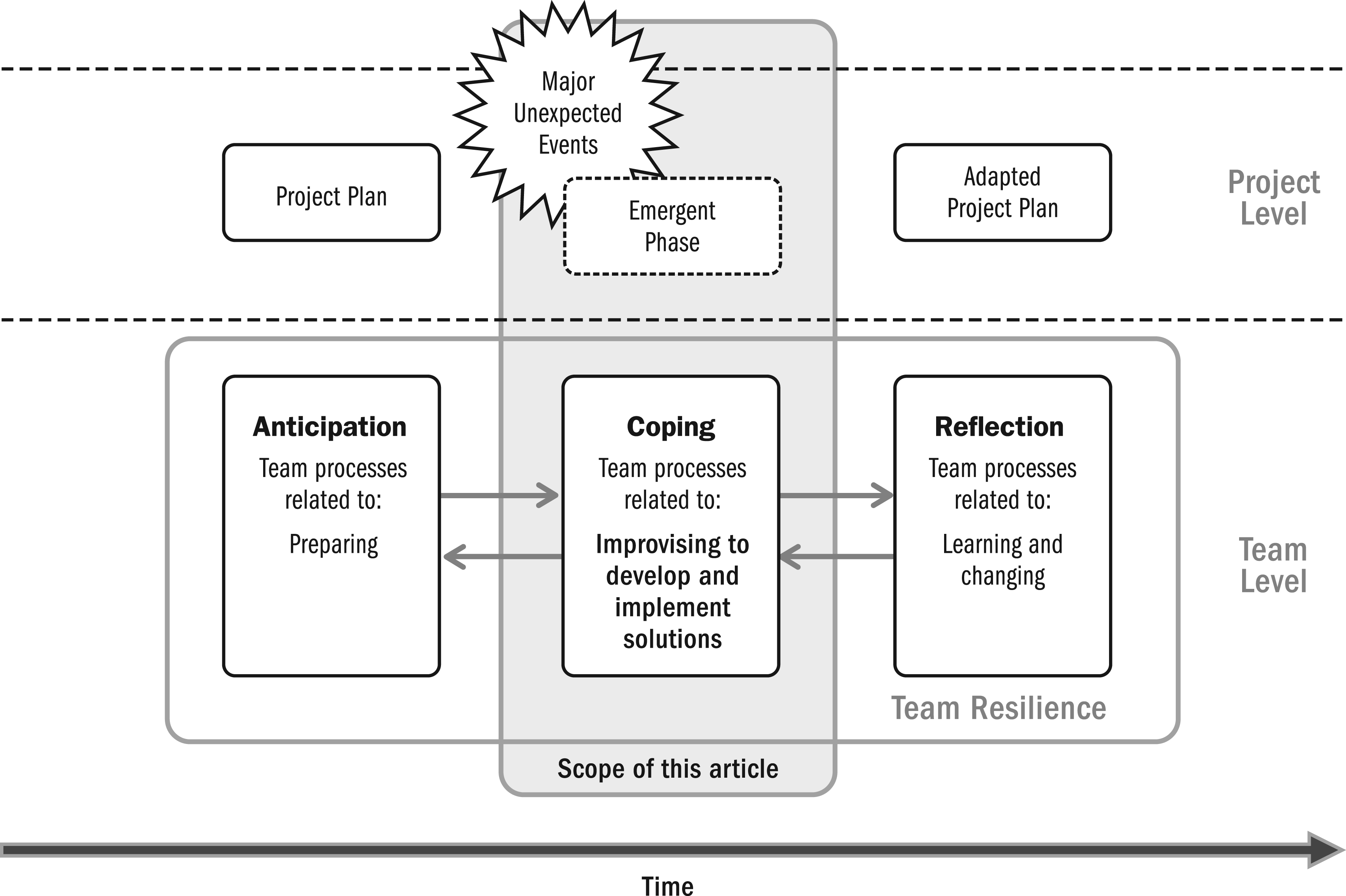
Project management improvisation as a mechanism to enact project team resilience (adapted from Duchek, 2020).
Project Management Improvisation: A Definition
The next sections present the conceptual roots of improvisation and offer a contextualized definition tailored to project management settings.
The Concept’s Root
The concept of organizational improvisation has been defined as “the conception of action as it unfolds, drawing on available material, cognitive, affective and social resources” (Pina e Cunha et al., 1999, p. 302). Improvisation is a deliberate and extemporaneous process deployed by individuals, teams, or an entire organization, which merges the design and execution of a novel and unplanned outcome (Ciuchta et al., 2021; Miner et al., 2001; Pina e Cunha et al., 1999). It is the process of trying to achieve something in a new way (Vera & Crossan, 2005) that is often based on intuition, namely “affectively-charged judgments that arise through rapid, nonconscious, and holistic associations” (Dane & Pratt, 2007, p. 33), and involves bricolage, or “making do by applying combinations of the resources at hand to new problems and opportunities” (Baker & Nelson, 2005, p. 331).
Yet only some studies have examined the concept of improvisation at the team level. Vera and Crossan (2005) stated that “team improvisation is more than the sum of individual improvisations because the joint activities of individuals create a collective system of improvisational action” (p. 204). Team improvisation is a process, as it is composed of a set of actions performed by a team (Fisher & Barrett, 2019; Pina e Cunha et al., 2016). This process is dependent on the context in which it is enacted (Weick, 1998), and our current understanding of the actions performed by a team during an episode of improvisation is limited. Recent research has mainly revealed important factors for promoting the team improvisation process such as collaboration, communication, transactive memory, team members’ skills and expertise, members’ experience working together, team cohesion, and behavioral integration (Crossan et al., 2005; Magni et al., 2009; Vera & Crossan 2005; Vera et al., 2016). Again, these studies focus on the prescriptive dimension of improvisation—what is needed to improvise—but fail to address the descriptive aspect, namely what it actually is; in other words, how improvisation is performed to enact resilience.
Broadening the literature review, it can be observed that the phenomenon of improvisation has been studied in various fields, including music (Barrett, 1998; Lewin, 1998), theater (Sawyer, 2000), education (Irby, 1992), psychotherapy (Keeney, 1990), and organizations (e.g., Crossan et al., 2005; Weick, 1998). However, there have been three important literature reviews on improvisation in the management and the organizational behaviors fields, summarizing this body of knowledge and attempting to capture this concept in the organizational context. They show that improvisation has been considered as a black box, focusing on its antecedents, facilitating conditions, and outcomes, without exploring how it is enacted (Ciuchta et al., 2021; Hadida et al., 2015; Pina e Cunha et al., 1999).
A Contextualized Definition of Project Management Improvisation
Concepts, which are the building blocks of theories, are essential to organize complex phenomena by using a common language and facilitate communication between researchers and/or practitioners (Podsakoff et al., 2016). One central element of conceptual clarity is having a good conceptual definition that captures (1) the type of property the concept represents, that is, the nature of the phenomenon, such as its intrinsic characteristics, attributes, perceptions, actions, and so forth; and (2) the entity to which the properties applies, namely the object or event to which the properties apply such as the task, process, individual, team, organization, and so forth (Podsakoff et al., 2016; Suddaby, 2010). Furthermore, Suddaby (2010) emphasizes the importance of “offering a contextually specific and clear definition” (p. 348) of the concept under consideration.
In the field of theater, the context of improvisation leads directly to the discovery and emergence of actions that unfold (Halpern et al., 1994). The same logic can be applied in project management, as the context in which the project teams act directly influences how a situation is managed and how the project team reacts and interacts (Bakker, 2010; Eskerod & Larsen, 2018). This context provides and influences the project’s resources and structure (e.g., expertise, time, money, roles and responsibilities, etc.) and affects the decisions made and actions taken by the project team (Grabher, 2004; Maloney et al., 2016). In organizations, the context represents the situational opportunities and constraints that influence the functional relationships between variables, as well as their significance and occurrence (Johns, 2006).
As temporary organizations, projects are characterized by four main elements that differentiate them from permanent organizations (Bakker, 2010; Lundin & Söderholm, 1995): time, which is limited or finite and perceived as linear, that is, a beginning, a middle, and an end; team, which is composed of individuals who have different backgrounds, experiences, and perspectives on the project objectives and who, given the short timeframe, focus on the interdependent tasks at hand; task, or the raison d’être for a project, which is often unique and more precise and complex than tasks in permanent organizations; and context, which refers to the fact that temporary organizations are embedded in permanent organizations. These distinctive elements have effects on, for instance, individual behaviors and attitudes, team processes, task performance, and so forth (Bakker, 2010). The authors of this article propose and rely on the following definition that takes these specificities into consideration: Project management improvisation is a creative process, enacted by a project team, in which the team steps out of the existing plan and acts spontaneously, intuitively, and resourcefully to overcome an unexpected, unknown, and urgent situation to adapt to it and bounce back as the situation unfolds.
This article argues that time, team, task, and context each plays a role in shaping the improvisation process. Time, for example, can complicate the improvisation process since the team may not have had enough time to develop trust. Diverse project team members may have varying attitudes, engagement levels, and expectations regarding the project, which can pose another challenge. Since tasks in a project are closely intertwined and multiple individuals are involved, the specific context of the project complicates the response process when an unexpected event occurs. An improvisation episode can temporarily distract a project team from its project plan, after which it must attempt to return to normal operation. Based on the characteristics of the projects described above, this study argues that focusing on projects provides a useful level of abstraction for conceptualizing improvisation and team resilience.
Methodology
This study adopts a theory elaboration approach to refine and contextualize the concept of improvisation in project management. Specifically, it seeks to explore both its descriptive (what it is) and prescriptive (what it requires) dimensions. The research applies a construct specification tactic to clarify the attributes and conditions that enable improvisation in project teams, alongside a focus on structuring specific relations to explore how improvisation serves as a mechanism through which project resilience is enacted when major unexpected events occur. By building on preexisting theoretical frameworks, the study investigates events characterized by suddenness, high levels of uncertainty, and the absence of preexisting solutions. Data were collected through interviews with 23 project managers (18 men and 5 women) with extensive project management experience, drawn from projects across North America.
Given the exploratory nature of this research, semistructured interviews were conducted to capture a wide range of business experiences. Although project managers are not the sole members of a project team, and the concept of project management improvisation is defined at the team level, this study posits that project managers are a relevant source of information for exploring unexpected events in projects and how project teams handle them. As central figures in projects, project managers not only observe team dynamics but also play a pivotal role in coordinating with various stakeholders, thereby gaining a comprehensive understanding of the actions taken and the emerging challenges within their teams.
Each interview lasted over an hour, with participants being recruited through researchers’ networks, professional associations, and subsequent snowball sampling. Selection criteria included a minimum of seven years of project management experience and having led at least seven to eight projects. To obtain a diverse range of backgrounds and experiences, there were no restrictions on the field or industry of respondents. The number of interviews to be conducted was determined by the criterion of theoretical saturation, which suggests that sufficient data has been collected to establish a robust understanding of the phenomenon under study (Glaser & Strauss, 1967). Theoretical saturation was assessed based on the emergence of novel codes during the coding process. After 23 interviews and 57 episodes of major unexpected events, no new categories or constructs related to improvisation or resilience were identified in subsequent interviews. On average, respondents had over 23 years of work experience and 19 years of project management experience. A description of the characteristics of the respondents is presented in Appendix A.
The interviews were structured in several stages. Initially, experts were asked to share episodes in which their project teams faced major unexpected events that significantly disrupted the project’s progress. These events were defined as having high levels of urgency and complexity, where no preexisting solutions were applicable, forcing the team to improvise. Specific questions focused on the context of these episodes, the activities undertaken by the team, and their results. On average, participants shared two to three examples of such unexpected events. Following this, a discussion was held to explore the nature of improvisation in projects, including the processes, dynamics, and challenges involved, as well as how improvisational conditions can be fostered in project settings. Finally, respondents were asked to define improvisation in the context of project management and discuss scenarios in which it is particularly useful and relevant.
While this approach does not include interviews with other team members—which limits the triangulation of information regarding the improvisation episodes studied—it offers a significant advantage in terms of the diversity of improvisation episodes reported. This diversity allowed for subsequent comparisons that are appropriate and relevant for this type of exploratory study. A summary of the 57 episodes shared by respondents, where major unexpected events occurred and required team improvisation, is presented in Appendix B.
All interviews were recorded with the respondents’ consent. The audio recordings were transcribed and then coded using NVivo qualitative analysis software. To shed light on the different aspects of project management improvisation, a content analysis was conducted. While improvisation has been studied across various domains and some conceptual definitions exist, there is no detailed model explaining how a team improvises and the enabling factors that support this process. Existing research has noted several practices, but a comprehensive framework is still lacking. To address this gap, the authors relied on their initial understanding of improvisation, based on existing conceptualizations, but used an inductive approach to analyze the data. This combination allowed for the refinement of descriptive and prescriptive dimensions of improvisation in the specific context of project management.
Throughout the analysis process, Miles and Huberman’s (1994) guidelines for analyzing qualitative data were followed; attention was also paid to Suddaby’s (2010) recommendations on clarifying constructs and Pratt’s guidelines (2009) on presenting qualitative data. Two of the authors conducted the initial data reduction step (Miles & Huberman, 1994) by coding the data according to two different themes, formulated as questions: (1) How do project teams improvise and enact project team resilience? And (2), what does it take for a project team to improvise effectively? With open coding, different codes emerged from the analysis of each of the two themes. This open coding approach is associated with grounded theorizing (Glaser & Strauss, 1967), whereby researchers analyze, in real settings, the actual generation of concepts and meanings used by social actors (Gephart, 2004).
To achieve a consensus on the first theme, namely how project teams improvise and enact project team resilience, multiple iterations were necessary. As a first step, each researcher identified an emergent set of codes through open coding. To organize the codes and derive categories representing different types of actions, two rounds of axial coding were conducted individually and in teams (three researchers). This new set of codes was then used again to code the interviews, and the results of this coding were compared among researchers to ensure the codes were complete and clear. Lastly, selective coding was used to group the categories of actions into larger clusters, which were then related to one another to understand the processes described by respondents. By comparing the similarities among the different cases reported by the respondents, this analysis enabled cross-case analysis to be conducted.
For the second theme, focusing on the factors enabling effective improvisation by project teams, a similar process was followed. Codes were grouped according to their level of analysis, that is, individual, team, or organizational factors; and by their nature, that is, competencies, mindset, and so forth. In the final validation phase, the results of the qualitative data analysis were compared with the body of knowledge identified in the literature review (Ciuchta et al., 2021; Hadida et al., 2015; Pina e Cunha et al., 1999). The following sections discuss the results of this analysis and how they relate to the existing literature on organizational improvisation.
Results
All respondents mentioned that improvisation has a negative connotation in project management and in organizations in general. There is a tendency for this concept to be misunderstood and reflect a lack of rigor or the isolated actions of an individual who does not have control over the situation. However, most respondents agree that improvising effectively when necessary is essential in project management.
As respondents pointed out, the project team as a whole improvises when a situation requires it, even though the project manager may play a more central decision-making role. Indeed, “during improvisation, the project manager is never alone” (PM01 1 ) and “improvisation is not just about one person, it’s about the whole team” (PM06). Several experts even cautioned against solo improvisation: “You shouldn’t improvise on your own!” (PM03). The reasons given are simple: “others see things that you don’t necessarily see” (PM09), “often members see reality through their own glasses” (PM03), and “several heads are better than one” (PM11). As one of the experts wisely pointed out, “for improvisation to work, it is necessary to capture and capitalize on the collective intelligence of the team” (PM19).
The results also emphasize the fact that the structure and composition of a project team can change over time. The team members who improvise when faced with major unexpected events are not necessarily the same individuals who formed the initial project team. Depending on the nature of the situation—that is, the degree of unexpectedness, uncertainty, urgency, and unfavorability—the entire team or a subset of team members will form the core improvisation team. Other experts within the organization or external stakeholders will support and supplement this improvisation task force. As one of the experts stated, the key is “to identify the right people to be there, maximizing the diversity of skills. The idea is to quickly get as many perspectives and new ideas as possible” (PM03). One expert even suggested looking outside the project context as “you can consult external project managers in other companies and use your network” (PM12). Bringing the right people together, however, also requires ensuring a certain degree of balance, since “too many people will create confusion and lengthen the process” (PM17). As shown in Figure 2, an improvisation task force will be established in relation to the core project team to enact project team resilience.
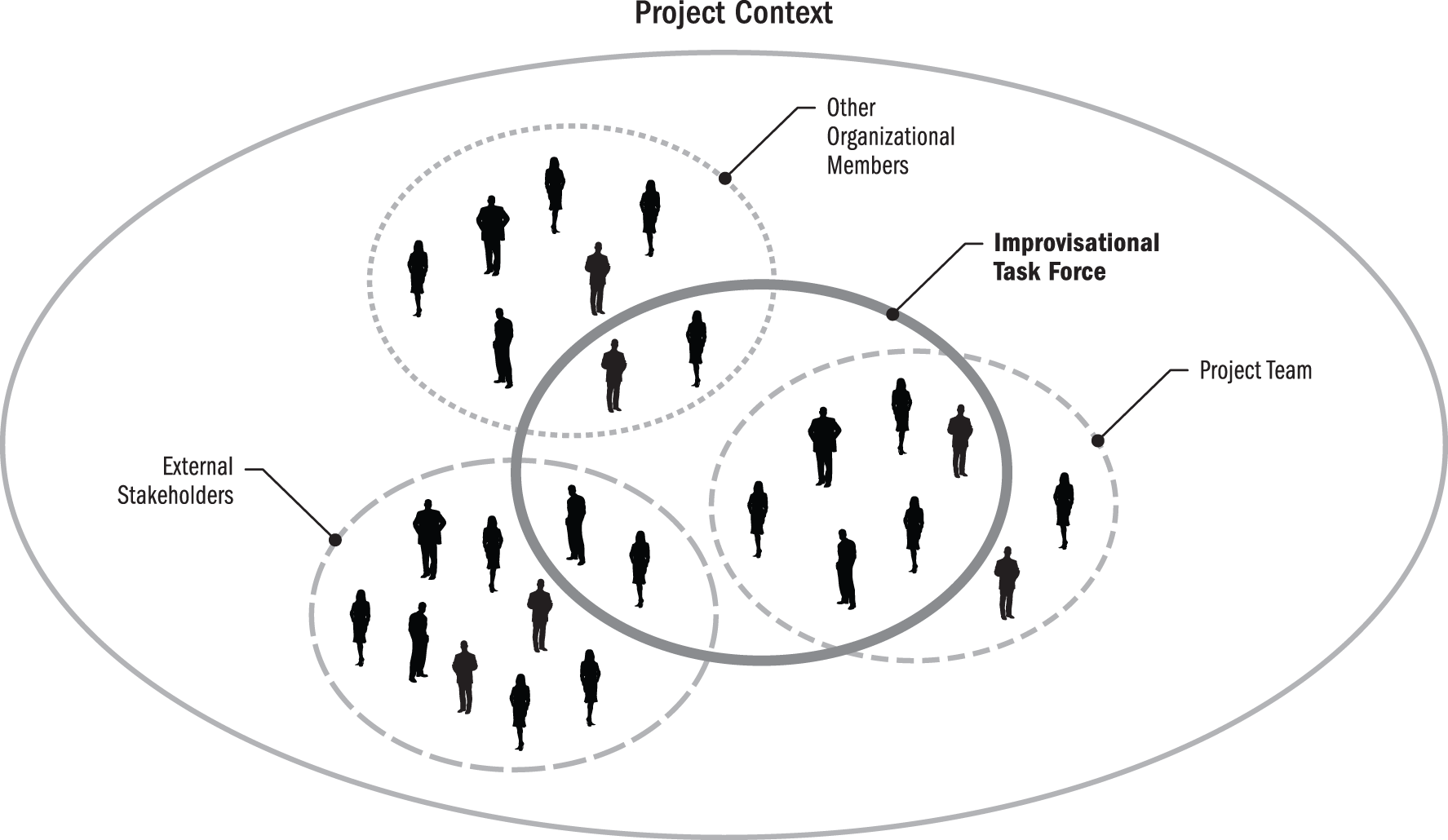
Composition of the improvisation task force during a major unexpected event episode.
Furthermore, our results highlight that, beyond the improvisation team, projects are embedded in a broader context involving multiple stakeholders whose involvement is critical. The relationship with stakeholders emerged as a key element in our findings. Respondents emphasized that stakeholders are essential not only for providing diverse perspectives and resources but also for helping the team understand the event and its context. Engaging with stakeholders enables teams to clarify the causes and implications of unexpected events, cocreate solutions, secure validation for decisions, maintain transparency, and build trust. These aspects, along with the detailed actions taken during improvisation, will be further elaborated in the following sections.
Project Management Improvisation: A Process Model
The project management improvisation process is a means of enacting the resilience of project teams: it involves a set of actions performed by the team during a project’s life cycle (Fisher & Barrett, 2019; Pina e Cunha et al., 2016). This process is not merely a rational, linear response to an unexpected event but rather a dynamic and iterative cycle of adaptation. These rapid iterations are represented in the model in Figure 3 by the time scale from T1 to Tn. For instance, PM21 described a situation where, during a construction project, unexpected issues with material suppliers in a conflict zone required the team to adapt quickly. The team had to continuously adjust their approach, as the original plan became unfeasible due to the volatile situation on the ground. PM21 emphasized that the team had to keep moving forward despite the uncertainty, continuously making decisions without having all the details.
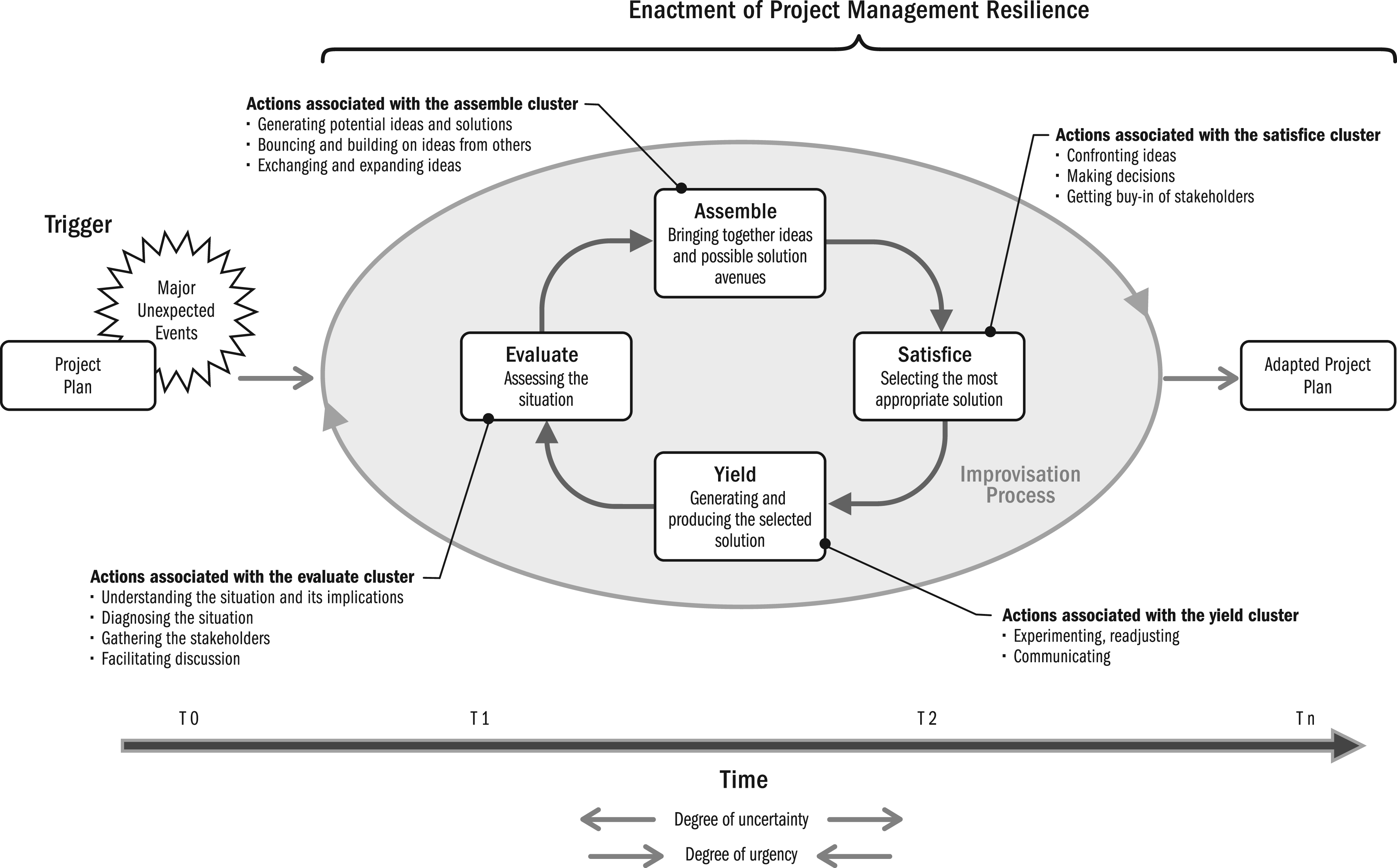
A process model of project management improvisation triggered by a major unexpected event to enact project team resilience.
It is important to note that the conceptualization of project management improvisation is bounded in time, beginning at a specific point when an unexpected major event occurs and ending when the team returns to a relatively stable and controlled situation. However, this new state of stability often differs from the original plan. After the improvisation episode, the project may settle into a new normal, which can vary in its degree of difference from the pre-event state. At a minimum, respondents mentioned that timelines or budgets were often adjusted to accommodate the changes. In other cases, the plans or objectives of the project could be significantly altered. For example, PM13 described a situation where, after a month of work, the team realized that the technology necessary for the project was not ready. This challenge required the team to improvise rapidly, making on-the-fly decisions to explore alternative technologies and approaches. Through continuous improvisation, the team managed to stabilize the project, albeit with a significantly altered structure and objectives compared to the original plan. This new state of stability is reflected as the “Adapted Project Plan” in the model illustrated in Figure 3.
The process of improvisation is characterized by a high level of urgency, as experts highlighted, with terms like “fast” and “quickly” frequently used to describe the actions taken by respondents. PM16 shared an unusual example from a critical project involving the relocation of a data center. An essential piece of telecommunications equipment needed to be moved, but when the mover arrived late at night, the truck was too small to transport the equipment upright as required. Several solutions were considered, but failure to move the equipment on time would have severely disrupted data center operations. With no time to rent another vehicle, the project manager finally made the decision to use a team member’s pickup truck to safely transport the equipment.
Additionally, the process of improvisation is also influenced by uncertainty—often likened to “navigating in the fog”—where the situation is not fully understood, and the team must improvise without clear guidance. As one expert summed up, improvisation occurs “when you face an unknown situation, [that is] unprecedented, urgent, and important for the project. It’s a unique situation, for the people who must deal with it—a first for everyone” (PM03).
When facing major unexpected events, project teams engage in a series of improvisational actions. According to the analysis of the interviews, four clusters of interrelated and complementary project management improvisation actions emerged. We have labeled these four clusters as the foundation of the EASY project management improvisational process (see Figure 3): (1) evaluate (E)—assess the situation; (2) assemble (A)—bring together team members to generate ideas and possible solutions; (3) satisfice (S)—detect the most appropriate solution(s) in view of the situation of the moment; and (4) yield (Y)—generate and implement the selected solution(s).
It is through these four clusters of actions that project team resilience is enacted. In other words, through this iterative process, the project team responds to the unexpected situation with the objective of bouncing back and increasing the likelihood of project success. These actions will be detailed in the following sections.
As depicted by the opposing arrows at the bottom of Figure 3, a situation’s uncertainty and urgency play antagonistic roles in the project management improvisational process. As a result of urgency, project teams are pushed to respond quickly, whereas uncertainty causes them to slow down by asking further questions and collecting additional information, which takes longer. Using the fog analogy again, the team finds itself in a fog that prevents them from seeing far (uncertainty) but they do not have the time to wait for the fog to disperse before acting (urgency).
While at first glance these four clusters of improvisational actions appear to reflect a linear process, the actions composing the four clusters and their sequence in time can differ in terms of duration and sequence. The process adopts an iterative and recursive perspective. The following sections describe these four clusters and explain how the underlying actions are carried out during a major unexpected event.
Cluster #1—EVALUATE
In this first cluster, 79 quotations from interviews were identified and categorized into four categories of actions. As developing a response to unexpected events requires a basic understanding of the situation, the project team tries to
A second category of actions involves
Lastly, the team evaluates its ability to act, that is, whether they can influence the situation, and whether the context enables them to do so. Regulatory or contractual requirements, often dictated by stakeholders, can significantly shape the team’s capacity to respond. Discussions and exchanges involving both internal participants and external stakeholders are essential at this stage. To accomplish this as quickly as possible, the experts interviewed all agree on the importance of
In this cluster, actions to
There was no evidence of linearity in the actions identified in this cluster based on the data analysis. This set of actions is emergent; as the situation unfolds, the involvement of stakeholders and team members may evolve, with new participants brought in to address emerging information needs or challenges.
Cluster #2—ASSEMBLE
As part of the second cluster, 47 extracts from interviews were identified and categorized into three different categories whose common objective is to bring together ideas and possible solutions.
The first category that emerges is labeled
Considering the urgency of the situation, some experts have also suggested finding short-term solutions whenever possible to allow for further elaboration later. The deployment of short-term solutions also provides an opportunity to quickly test ideas to receive feedback, reduce uncertainty, learn, and adjust ideas and subsequent solutions accordingly. To alleviate any fear of retribution among team members, project managers emphasized the importance of transparency, openness, and empathy, ensuring that challenges were communicated early to foster a supportive and open environment.
The project manager can then facilitate the discussion to allow the team to
Cluster #3—SATISFICE
In this third cluster, 34 quotations from interviews were identified and classified into three categories of actions whose common objective is to select the most appropriate solution in light of the situation at hand. The first category includes codes related to
Decision-making can be challenging when facing major unexpected events, as uncertainty is high and understanding of the situation is sometimes incomplete. As a means of accelerating decision-making in a context of urgency and uncertainty, project managers acknowledge that they often rely on intuition, as illustrated by PM19: “at a certain point, we’ve accumulated a lot of information. We know the context well. You must trust your intuition at that moment. You must take the least bad decision rather than the best one.”
Nevertheless, whether a consensus emerges from the interactions between the team members or the project manager must make the call. Many respondents emphasized the importance of
Cluster #4—YIELD
This cluster consisted of 32 quotations that were assigned to two categories of actions. In this cluster, actions are focused on implementing solutions. A project management improvisation episode is characterized by time pressure, which requires the project team to
Due to the urgency and lack of information, the decision made is not necessarily perfect and there is a likelihood that doubt will arise. As PM20 stated: “You’re always going to wonder ‘what if I had done this instead?’” Yet, respondents stress the importance of moving forward despite uncertainty and acting quickly. Nonetheless, the aim is not to share the feeling that “we don't know what we're doing,” but rather that the team can make small, quick adjustments as the situation evolves: “We know the general direction, but the path may evolve—we will clear the way little by little” (PM07). Teams seem to require the most courage for these actions because, without a net, you must jump in quickly (PM16), “you know you can make mistakes” (PM20), and “you have to jump into the water, get wet quickly” (PM19).
Several respondents also stressed the importance of
Figure 3 illustrates the iterative and recursive nature of the EASY project management improvisation process. Improvisation is a temporary process, bounded in time and triggered when the project plan can be difficult/impossible to follow. Improvisation involves listening, acting, and readjusting. The project team must be sensitive to changes in the situation, in the context and, if necessary, find new and more appropriate ideas and implement them. As the process is iterative, the composition of the project team may also change over time, depending on the situation evolution. New elements may require new expertise. By managing the situation, the goal is to regain control over the project’s development, to be able to achieve the project's objectives and to bounce back, that is, to enact project team resilience.
Figure 3 presents a simplified model of the process to make it as clear as possible. In reality, the process is messier, and the length of each step and the number of iterations vary according to the situation to be overcome. Responding to an urgent and uncertain situation is therefore a challenge that project teams can overcome by making quick decisions but being aware of their limitations and allowing themselves to reevaluate their decisions. In other words, improvising means doing several rapid iterations of the process presented in Figure 3, while remaining open-minded to continue to question and explore possible solutions.
Project Management Improvisation: What is Required?
Project management improvisation was addressed in the previous section from a process perspective, with an explicit description of how project team resilience can be enacted. This section is primarily concerned with focusing on the prescriptive side, namely what is required to improvise. As a result of the data collected, several facilitating conditions for project management improvisation have been identified that organizations must deploy and develop. The facilitating conditions identified were categorized into four clusters:
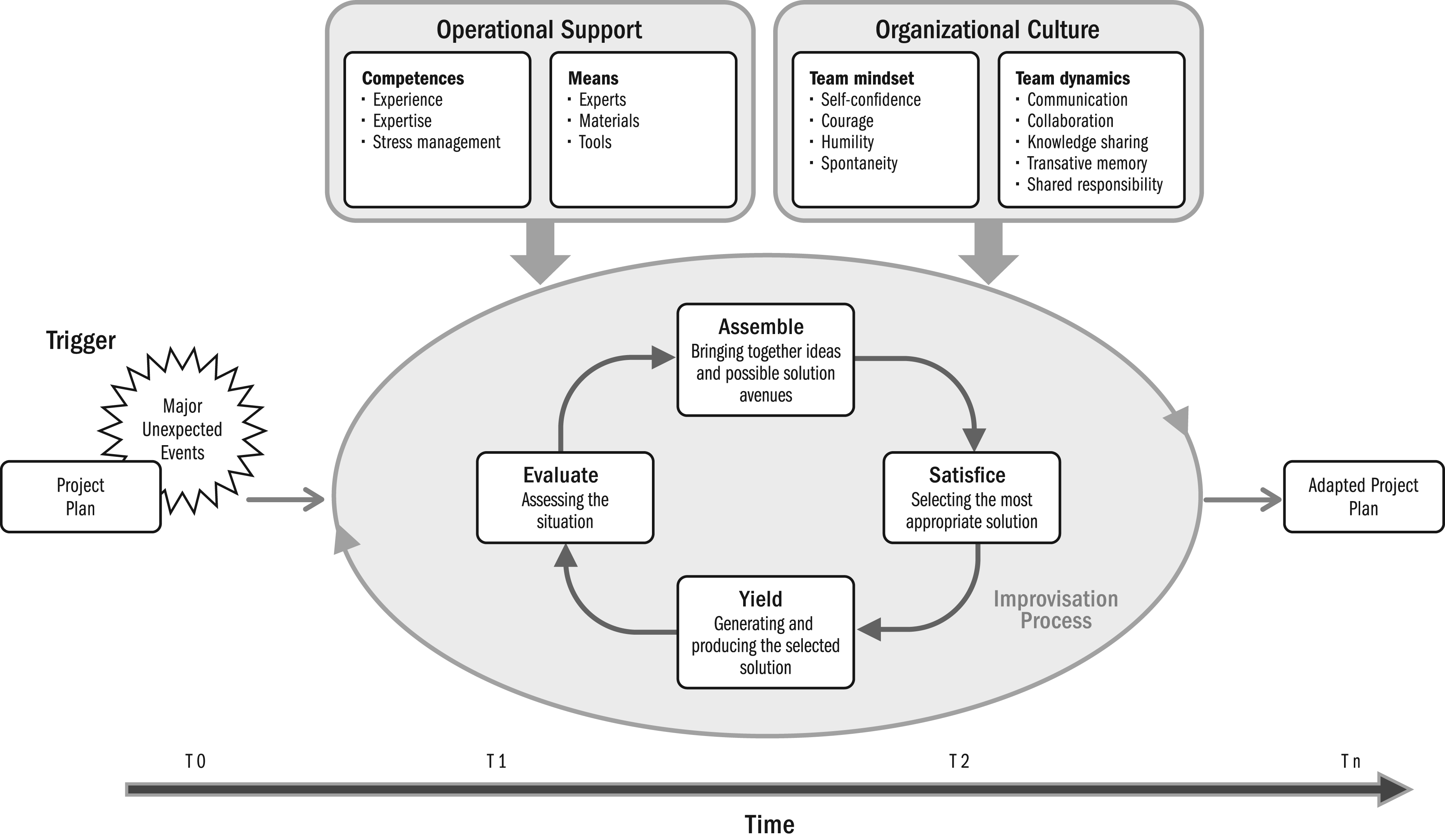
Facilitating conditions for project management improvisation.
Operational Support: Resources Needed to Improvise
Due to the fact that when faced with a major unexpected event, project teams must act quickly using available resources to improvise, most experts interviewed stressed the importance of organizational support, which is gained through trust and effective communication among members of the project team. This kind of support helps the team gather the necessary competences and means to improvise. For instance, PM13 highlighted the role of a dedicated expert in their organization, responsible for helping to manage major IT incidents and coordinating the right people to resolve crises swiftly.
Experience and expertise are often cited as crucial competencies for effective improvisation. In fact, the more experience members of the team have gained in previous projects, the more references they have available to analyze a situation and develop solutions. As one expert noted, when someone has less experience: “usually you are not willing to take chances. You are more by the book” (PM01). Experience gives people more confidence in their intuition when it comes to choosing a solution, as PM02 stated: “To be a good improviser on a project, a project manager must have gained confidence over the years and be at the top of their game. The more experience you have, the more confidence you have.” It is also essential to have expertise, and many respondents cautioned against improvising without domain knowledge. Expertise emerges from the entire team, which is why it is essential to carefully build the team.
As well as providing the ability to refer to past situations to find new solutions, experience also enhances the ability to manage stress and provides a greater sense of confidence. This is very important, because managing major unexpected events is stressful and can cause panic. The project team must also have the necessary means to improvise. The improvisation process may require the team to explore different possibilities that require additional knowledge and consult experts quickly. Additionally, respondents shared situations in which the availability of certain materials or tools facilitated the identification and implementation of a solution. For instance, as previously mentioned, in the project managed by PM16, the use of a colleague’s pickup truck during the data center relocation exemplifies how having access to unexpected resources can significantly ease the identification and implementation of solutions in critical moments.
Organizational Culture: Mediating Mechanisms That Promote Improvisation
As part of a larger organizational context, organizational culture was identified as an important factor in influencing the improvisation process through team dynamics and mindset. Stakeholders play a key role in influencing the project environment, as their expectations, preferences, and attitudes toward risk-taking often dictate what is possible or impossible within a project. A team’s ability to improvise depends on how improvisation is perceived, what is possible or impossible, the ability to take risks, the role of experimentation, the ability to discuss errors or doubts, and freedom of expression. One expert confided: “my ability to improvise is influenced by the risk-averse corporate culture. It imposes certain limits, certain restrictions on risk-taking” (PM04). Additionally, stakeholders provide critical contextual insights, helping the team understand their freedom of action and the constraints within which they operate.
Improvising requires a certain mindset within the team that represents its mental attitude and predisposition toward improvisation. Several key aspects were identified by the experts interviewed. First, the team must be comfortable operating in a highly uncertain context. Each interview includes elements such as experimentation, making mistakes, learning, doubting, asking questions, listening, and being curious. A project team must therefore have a certain attitude and predisposition toward spontaneity to be able to experiment and readjust in real time. Additionally, the members of the team must be humble and sincere since good improvisers are “humble, not stubborn, and able to admit that their idea is not the best in the world. Experimentation and learning are part of their DNA” (PM04). They “are people with great curiosity who are continually learning” (PM08). Project managers have a unique role to play, and their mindset influences the mindset of the entire team. In fact, the team must have the ability to explore, make decisions, and experiment, and therefore must be engaged, rather than merely participate. As one expert put it: “the team must know that we are not there to fail but to find a solution together” (PM02). Thus, team self-confidence and courage are important elements of the team mindset.
The study identified several factors supporting improvisation as a team-based process. Among the most important were good communication—openly sharing information as quickly as possible—and effective collaboration to enhance the team’s responsiveness and improve the improvisation process efficiency. A project manager plays a key role in facilitating this collaborative approach by acting as a facilitator and promoting shared responsibility for the success of the team’s response to the unexpected event. Collaboration, knowledge sharing, and negotiation are more likely to occur in a climate of trust, openness, and transparency. As a final point, several experts emphasized the importance of knowing one another’s strengths, weaknesses, and areas of expertise in case of an emergency so the team’s actions can be guided accordingly. Despite being factors underlying every team’s success, these elements become particularly important during an improvisation episode when a project team's resilience is tested.
Theoretical Contributions
The following sections further develop theoretical contributions by deepening the understanding of how improvisation contributes to project team resilience, outlining its specific characteristics in project contexts, and addressing the challenges and perceptions surrounding its use.
Connecting Improvisation and Project Team Resilience
This study positions improvisation and resilience as essential, yet distinct, components for managing major unexpected events in projects. Resilience, broadly defined as the capacity of a team to collectively bounce back from adverse events (adapted from West et al., 2009), is enacted through improvisation. By extending Duchek’s (2020) framework, this research demonstrates how improvisation functions as a dynamic mechanism that enables teams to adapt in real-time during high-urgency and high-uncertainty situations.
Improvisation contributes to resilience not only as a real-time response but also by influencing long-term adaptability. The findings reveal that improvisation enables teams to recover from disruptions while evolving to meet new project realities, reinforcing their capacity to cope with future challenges. This process aligns with Duchek’s (2020) concept of reflection, as teams not only react to immediate events but also learn and integrate these lessons into future actions. Such reflective adaptation strengthens both immediate coping capabilities and anticipatory preparedness.
Yet, not all unexpected events in projects necessitate improvisation (Coulon et al., 2023). Linear and structured approaches, such as root cause analysis or fishbone diagrams (Engwall & Svensson, 2004; Pavlak, 2004), remain suitable when preexisting plans or obvious solutions are available or when time constraints are less pressing. However, this study shows that improvisation is a critical response in situations where traditional tools fail due to the immediacy and unpredictability of major unexpected events. These situations, common in project environments, highlight the importance of equipping teams with improvisational capabilities to increase project success
Specificities of Project Management Improvisation
Improvisation, as prior research has emphasized, is a phenomenon observed across various domains, grounded in consistent core principles. However, its manifestation is deeply influenced by contextual factors. Building on this understanding, this study offers a distinct theoretical contribution by examining how the unique characteristics of temporary organizations—time, team, task, and context—interact to shape the way improvisation emerges and evolves within project environments, underscoring the important role of context in organizational behavior (Johns, 2006).
Time, and more specifically the finite nature of projects, introduces urgency that limits opportunities for detailed planning, creating a tension between acting swiftly and gathering sufficient information. As Bakker and Janowicz-Panjaitan (2009) emphasize, the temporariness of project-based organizations fosters a present-oriented mindset, requiring teams to prioritize immediate actions over long-term considerations. Building on this, the findings refine theoretical frameworks by highlighting how the iterative nature of improvisation enables teams to navigate this tension. Improvisation unfolds through continuous cycles of evaluation, adjustment, and action, allowing teams to dynamically recalibrate their strategies in response to shifting project demands. The duration and frequency of these cycles depend on situational demands: in urgent scenarios, teams must transition rapidly through the evaluate and assemble phases, prioritizing quick stabilization efforts. Conversely, in environments with higher uncertainty, these phases extend as teams gather additional information, iterate on potential solutions, and refine their approach before acting. These findings underscore the importance of teams balancing rapid response with deliberate sensemaking, enhancing their ability to manage the time pressures inherent in temporary organizations.
Team dynamics emerge as both an enabler and a constraint for improvisation. While predefined roles and structures may initially limit flexibility, the findings highlight the necessity of team recomposition during major unexpected events. This adaptive process, which aligns with the coping dimension of resilience, fosters creativity by incorporating diverse expertise but must be managed to avoid inefficiencies.
Task specificity in project management adds unique challenges to the improvisation process. Projects are defined by clear objectives and a structured plan, which acts as a roadmap for execution. This structure can complicate improvisation, as teams must simultaneously address immediate disruptions and ensure alignment with overall project goals. The interconnectedness of project tasks further intensifies these challenges, as actions taken to resolve issues in one area often trigger ripple effects elsewhere. These dynamics become especially pronounced when teams must quickly comprehend unexpected situations and make decisions that balance short-term urgency with long-term objectives.
Finally, context plays a pivotal role in shaping how improvisation unfolds, with project stakeholders emerging as a central element in the process. Projects are deeply embedded in organizational environments that influence the resources available, define constraints, and set expectations for success. Stakeholders act as both enablers and constraints, providing critical input and validation while exerting pressure to meet specific objectives. This study enriches the understanding of stakeholder dynamics by mapping their influence across the four clusters of improvisation (evaluate, assemble, satisfice, yield). These findings advance theory by demonstrating how stakeholder involvement can simultaneously expand the scope of potential solutions and anchor decisions within broader organizational goals.
Challenges and Perceptions of Improvisation
Improvising means acting with incomplete information, knowing that the chosen strategy may require adjustment. Respondents highlighted that improvisation carries a strong negative connotation in project management, as it can appear to lack rigor and control, clashing with expectations of confidence and assertiveness. This aligns with Fisher and Barrett’s (2019) observation that in many organizational contexts, improvisation is normatively discouraged, leading to its use as a last resort, often hidden and stigmatized. Given the complexity and interdependencies of projects, improvisation entails risks, as solving one issue can unintentionally create another. While inherently creative, it is constrained by available skills, resources, and what is deemed acceptable within a given context. Teams operate within a metaphorical sandbox, where constraints define acceptable actions, yet improvisation remains essential for resilience.
The findings emphasize the role of an improvisation-friendly culture in overcoming these challenges. By broadening the range of acceptable actions and fostering open-mindedness, such a culture increases the team’s ability to respond effectively. It also encourages learning and preparation, ultimately strengthening resilience.
Practical Contributions
The following sections discuss the practical contributions of the article by examining the relevance of the EASY model, the conditions that support improvisation readiness, and the role of the project manager in enabling improvisation.
Utilizing the EASY Model
The development of the EASY model—evaluate, assemble, satisfice, yield—represents a practical advancement in guiding project teams through the improvisational process during major unexpected events. This model offers a structured yet flexible approach for navigating crises, helping teams rapidly assess situations, assemble necessary resources, select feasible solutions, and implement them effectively under pressing conditions.
Beyond its application during crises, the EASY model serves as a valuable tool for post-event analysis. By structuring retrospective reflections, teams can systematically evaluate how each phase of the improvisation process was executed, identify areas for improvement, and capture lessons to enhance preparedness for future disruptions.
Readiness for Improvisation in Project Teams
This study highlights the importance of fostering readiness for improvisation in project teams to enhance resilience during major unexpected events. Organizations must ensure that project teams are equipped with relevant competences, derived from a combination of domain expertise and prior experience. These allow team members to rapidly assess situations and generate viable solutions under pressure. Access to necessary means, such as material resources, technological tools, and external expertise, is equally critical. Providing structured support mechanisms, such as access to a network of external specialists or a crisis task force, can greatly enhance a team’s capacity to act swiftly.
An improvisation-friendly organizational culture is essential. Teams should be encouraged to adopt a mindset that values experimentation, embraces uncertainty, and tolerates failure as a learning opportunity. Team dynamics, rooted in trust, open communication, and shared accountability, further strengthen improvisation. For instance, fostering psychological safety allows team members to express unconventional ideas without fear of judgment, which is crucial during major unexpected situations.
Stakeholders also play a pivotal role in facilitating improvisation. Their involvement provides diverse perspectives, resources, and validation of proposed solutions. Engaging stakeholders early helps clarify constraints, cocreate solutions, and secure their buy-in, which is critical for aligning rapid improvisational actions with broader organizational goals. Building strong relationships with stakeholders thus strengthens both improvisational readiness and project resilience.
The Role of the Project Manager
This study emphasizes the critical role of project managers as both facilitators and decision-makers during major unexpected events. Acting as facilitators, project managers foster the conditions necessary for improvisation by cultivating trust, encouraging open communication, and mobilizing diverse types of expertise. They play a pivotal role in forming and leading improvisational task forces, ensuring the right mix of skills and perspectives is brought together to address emerging challenges effectively. By empowering team members to share their views and act, project managers enable collaborative and adaptive responses.
However, their role extends beyond facilitation. In high-pressure situations, project managers must oscillate between facilitation and leadership, balancing collaborative decision-making with the need for swift, authoritative action when time constraints demand it. This dual role requires them to remain acutely aware of the project’s priorities and objectives, ensuring that rapid improvisational actions align with overarching goals.
Intuition, recognized as a critical enabler in improvisational settings (Elbanna, 2015; Leybourne & Sadler-Smith, 2006; Moeini & Rivard, 2019), further enhances the project manager’s capacity to navigate uncertainty. By relying on intuition alongside domain expertise, project managers can assess complex, evolving situations and make effective decisions under pressure. This study refines the theoretical understanding of intuition’s role, positioning it as a key element that supports both facilitation and decisive leadership during improvisation.
Limitations and Research Agenda
This final section outlines the study’s limitations and identifies key avenues for future research on project team resilience and improvisation.
Toward a Better Understanding of Project Team Resilience
While this study provides valuable insights into the coping dimension of resilience, it offers limited exploration of the anticipation and reflection dimensions. Future research could explore how project teams can enhance their ability to anticipate potential unexpected events and systematically integrate lessons learned during reflection into future project planning. Investigating the interplay among anticipation, coping, and reflection could provide a more holistic understanding of resilience and its contribution to project success.
While not all unexpected events necessitate improvisation as a response, further research is needed to deepen our understanding of how different resilience strategies can be selected and effectively deployed. For instance, identifying when and how to choose between structured, planned responses and improvisation could provide valuable insights into project team resilience. Additionally, understanding the implications of applying improvisation in situations where it may not be the most suitable approach would help in refining the concept of resilience, ensuring that teams are equipped to respond appropriately to a wide array of challenges.
The literature is also divided on whether resilience is defined as bouncing back or, as some suggest, bouncing forward (Grinberger & Felsenstein, 2014; Manyena et al., 2011; Wied et al., 2020). The former refers to the recovery to the pre-event condition, whereas the latter refers to the chance to change and improve following an unexpected event (Manyena et al., 2011). The objective of this study is not to take a position on this issue; instead, it has adopted the more common notion of bouncing back. However, an adaptation of the project plan is often what occurs, though the extent of this adaptation can vary. In some cases, the adjustments may be limited to the budget or timeline, whereas in others, the changes may be more significant, impacting the overall structure or objectives of the project. This adapted state of stability reflects the “new normal” that teams establish post-improvisation, which often diverges from the original plan. Nevertheless, the notion of bouncing forward could be a promising avenue for future research. It may be relevant to consider a perspective that views unexpected events as an opportunity to reassess the project’s objectives and scope in more uncertain projects such as technology projects. Understanding the factors that enable a project team to bounce forward more effectively, while considering the practical realities of the project, could provide valuable insights for enhancing project resilience.
Toward a Better Understanding of Project Management Improvisation
While the EASY model is a valuable tool for conceptualizing project management improvisation, its application has primarily been tested through retrospective accounts from project managers. Future research could benefit from a more detailed, longitudinal approach that observes improvisation in real-time across multiple projects. Additionally, incorporating perspectives from various team members and stakeholders could provide a more comprehensive understanding of how improvisation unfolds in practice. Exploring the evolution of improvisation task forces, and the factors that facilitate or hinder their emergence in response to major unexpected events, would also deepen the understanding of this process.
This study sheds light on the factors that facilitate project management improvisation, emphasizing the importance of operational support and organizational culture. However, further research is needed to explore how these factors influence the improvisation process and team resilience. Additionally, a relevant concept to explore further is the notion of team mindset, which refers to the collective mental framework that influences how team members perceive, interpret, and respond to events. Future research should aim to better define this concept in the context of unexpected events in projects and understand how this mindset could influence the team’s response.
Another notable aspect that emerged in this study, though not extensively explored, is the emotional response of project managers to unexpected events. Interviewees reported feelings of anxiety and frustration during such situations but emphasized the importance of maintaining a positive attitude and effectively managing emotions as team leaders. The emotional aspect of resilience seems to play an important role, not only for the well-being of the team but also for guiding the team through improvisational episodes. Although this study did not delve deeply into this area, future research should examine how emotional management by project managers, and potentially by all team members, can influence both the improvisation process and overall team resilience.
The results also highlight the crucial role of the project manager as an orchestrator and facilitator of improvisational episodes. However, the study’s methodological limitations constrain a deeper investigation into the nuances of leadership. While leadership is indeed key in facilitating improvisation—with leaders who balance direction and support fostering environments that encourage creativity and swift decision-making—more research is needed to determine how different leadership styles impact improvisation. It remains unclear whether strong leadership always aids or sometimes hinders creativity.
While the study indirectly highlights the role of stakeholders, their broader impact on improvisation remains underexplored. Strong stakeholder relationships are essential for enabling flexibility and sensemaking in urgent situations, but the relationship with stakeholders can take many forms. A better understanding of the roles and impact of stakeholders on the project management improvisation process may be relevant and worth studying in future research, as suggested by Yang et al. (2021).
One of the challenges identified in this study is the negative perception of improvisation in project management, which is consistent with past research (e.g., Fisher & Barrett, 2019). Further investigation is needed to understand the origins of these perceptions and their effect on teams’ readiness to adopt improvisation as a strategic tool. By understanding these factors, strategies can be developed to change organizational cultures and make them more supportive of improvisation. Additionally, exploring how training programs can shift perceptions and build improvisational skills among project practitioners could help normalize and legitimize improvisation as an essential project management practice. This could involve studying the impact of simulation-based training, role-playing exercises, and other experiential learning techniques on building improvisational skills. Additionally, investigating how training programs can be tailored to different levels of project management experience and the specific needs of various industries would provide practical insights for educators and practitioners alike.
Conclusion
In conclusion, this study underscores the pivotal role of project management improvisation in enacting project team resilience in the face of major unexpected events. By incorporating improvisation into the broader conversation on project resilience, the research offers valuable insights into how teams can better adapt and recover from adversity. The study also aims to shift the perception of improvisation, a concept often viewed negatively in organizational settings, by demonstrating its potential to increase team efficiency and resilience. Embracing improvisation as a legitimate and effective strategy can empower project teams to respond more dynamically to unexpected challenges. Further exploration is needed to fully integrate improvisation into project management practices, refine training programs, and ultimately strengthen the resilience of project teams.
Footnotes
Funding
The author(s) disclosed receipt of the following financial support for the research, authorship, and/or publication of this article: This research was supported by funding from the Fonds de recherche du Québec – Société et culture (FRQSC).

Notes
Author Biographies
Appendix A. Descriptions of Respondents
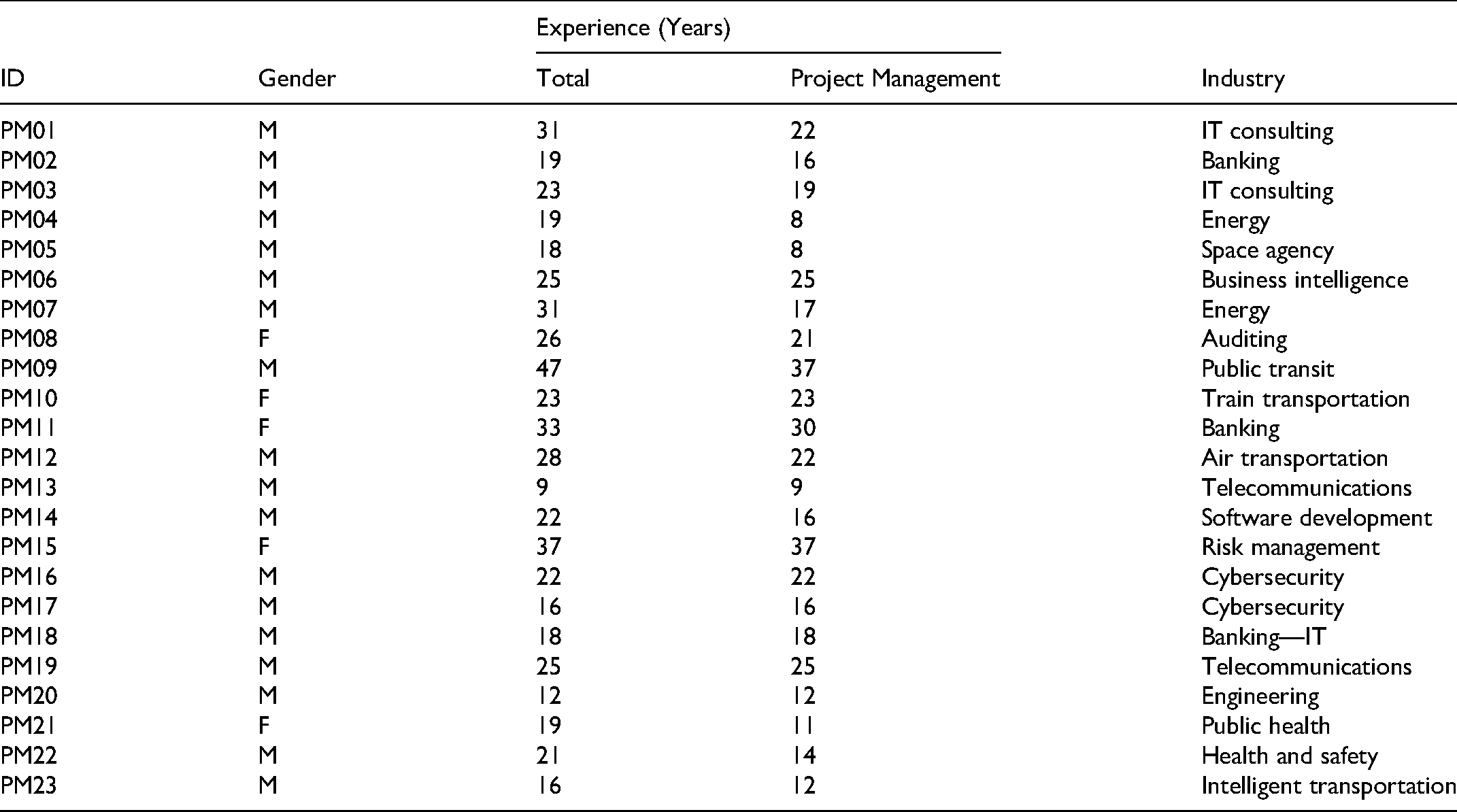
| ID | Gender | Experience (Years) | Industry | |
|---|---|---|---|---|
| Total | Project Management | |||
| PM01 | M | 31 | 22 | IT consulting |
| PM02 | M | 19 | 16 | Banking |
| PM03 | M | 23 | 19 | IT consulting |
| PM04 | M | 19 | 8 | Energy |
| PM05 | M | 18 | 8 | Space agency |
| PM06 | M | 25 | 25 | Business intelligence |
| PM07 | M | 31 | 17 | Energy |
| PM08 | F | 26 | 21 | Auditing |
| PM09 | M | 47 | 37 | Public transit |
| PM10 | F | 23 | 23 | Train transportation |
| PM11 | F | 33 | 30 | Banking |
| PM12 | M | 28 | 22 | Air transportation |
| PM13 | M | 9 | 9 | Telecommunications |
| PM14 | M | 22 | 16 | Software development |
| PM15 | F | 37 | 37 | Risk management |
| PM16 | M | 22 | 22 | Cybersecurity |
| PM17 | M | 16 | 16 | Cybersecurity |
| PM18 | M | 18 | 18 | Banking—IT |
| PM19 | M | 25 | 25 | Telecommunications |
| PM20 | M | 12 | 12 | Engineering |
| PM21 | F | 19 | 11 | Public health |
| PM22 | M | 21 | 14 | Health and safety |
| PM23 | M | 16 | 12 | Intelligent transportation |
Appendix B. Reported Unexpected Events
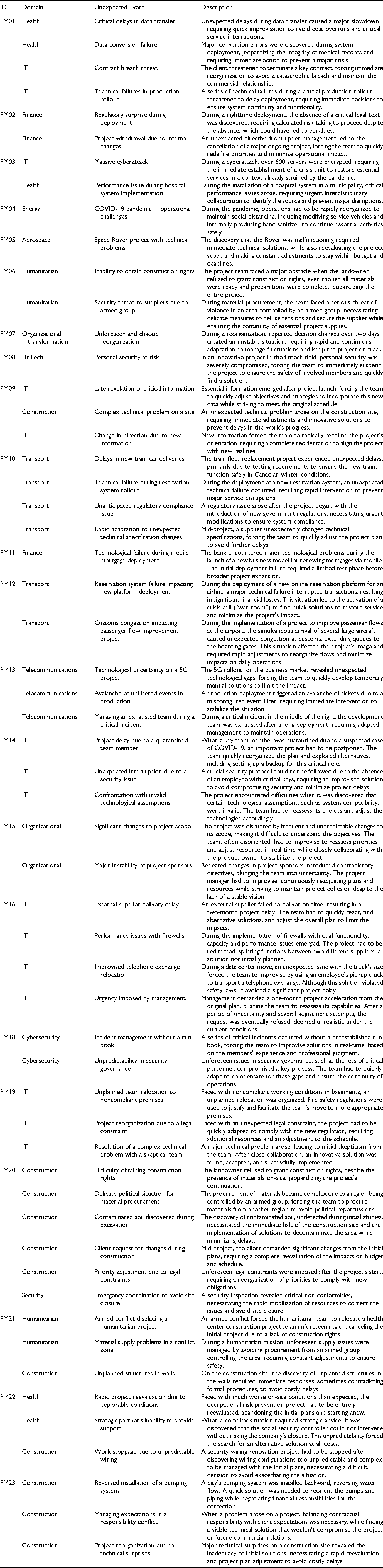
| ID | Domain | Unexpected Event | Description |
|---|---|---|---|
| PM01 | Health | Critical delays in data transfer | Unexpected delays during data transfer caused a major slowdown, requiring quick improvisation to avoid cost overruns and critical service interruptions. |
| Health | Data conversion failure | Major conversion errors were discovered during system deployment, jeopardizing the integrity of medical records and requiring immediate action to prevent a major crisis. | |
| IT | Contract breach threat | The client threatened to terminate a key contract, forcing immediate reorganization to avoid a catastrophic breach and maintain the commercial relationship. | |
| IT | Technical failures in production rollout | A series of technical failures during a crucial production rollout threatened to delay deployment, requiring immediate decisions to ensure system continuity and functionality. | |
| PM02 | Finance | Regulatory surprise during deployment | During a nighttime deployment, the absence of a critical legal text was discovered, requiring calculated risk-taking to proceed despite the absence, which could have led to penalties. |
| Finance | Project withdrawal due to internal changes | An unexpected directive from upper management led to the cancellation of a major ongoing project, forcing the team to quickly redefine priorities and minimize operational impact. | |
| PM03 | IT | Massive cyberattack | During a cyberattack, over 600 servers were encrypted, requiring the immediate establishment of a crisis unit to restore essential services in a context already strained by the pandemic. |
| Health | Performance issue during hospital system implementation | During the installation of a hospital system in a municipality, critical performance issues arose, requiring urgent interdisciplinary collaboration to identify the source and prevent major disruptions. | |
| PM04 | Energy | COVID-19 pandemic— operational challenges | During the pandemic, operations had to be rapidly reorganized to maintain social distancing, including modifying service vehicles and internally producing hand sanitizer to continue essential activities safely. |
| PM05 | Aerospace | Space Rover project with technical problems | The discovery that the Rover was malfunctioning required immediate technical solutions, while also reevaluating the project scope and making constant adjustments to stay within budget and deadlines. |
| PM06 | Humanitarian | Inability to obtain construction rights | The project team faced a major obstacle when the landowner refused to grant construction rights, even though all materials were ready and preparations were complete, jeopardizing the entire project. |
| Humanitarian | Security threat to suppliers due to armed group | During material procurement, the team faced a serious threat of violence in an area controlled by an armed group, necessitating delicate measures to defuse tensions and secure the supplier while ensuring the continuity of essential project supplies. | |
| PM07 | Organizational transformation | Unforeseen and chaotic reorganization | During a reorganization, repeated decision changes over two days created an unstable situation, requiring rapid and continuous adaptation to manage fluctuations and keep the project on track. |
| PM08 | FinTech | Personal security at risk | In an innovative project in the fintech field, personal security was severely compromised, forcing the team to immediately suspend the project to ensure the safety of involved members and quickly find a solution. |
| PM09 | IT | Late revelation of critical information | Essential information emerged after project launch, forcing the team to quickly adjust objectives and strategies to incorporate this new data while striving to meet the original schedule. |
| Construction | Complex technical problem on a site | An unexpected technical problem arose on the construction site, requiring immediate adjustments and innovative solutions to prevent delays in the work's progress. | |
| IT | Change in direction due to new information | New information forced the team to radically redefine the project's orientation, requiring a complete reorientation to align the project with new realities. | |
| PM10 | Transport | Delays in new train car deliveries | The train fleet replacement project experienced unexpected delays, primarily due to testing requirements to ensure the new trains function safely in Canadian winter conditions. |
| Transport | Technical failure during reservation system rollout | During the deployment of a new reservation system, an unexpected technical failure occurred, requiring rapid intervention to prevent major service disruptions. | |
| Transport | Unanticipated regulatory compliance issue | A regulatory issue arose after the project began, with the introduction of new government regulations, necessitating urgent modifications to ensure system compliance. | |
| Transport | Rapid adaptation to unexpected technical specification changes | Mid-project, a supplier unexpectedly changed technical specifications, forcing the team to quickly adjust the project plan to avoid further delays. | |
| PM11 | Finance | Technological failure during mobile mortgage deployment | The bank encountered major technological problems during the launch of a new business model for renewing mortgages via mobile. The initial deployment failure required a limited test phase before broader project expansion. |
| PM12 | Transport | Reservation system failure impacting new platform deployment | During the deployment of a new online reservation platform for an airline, a major technical failure interrupted transactions, resulting in significant financial losses. This situation led to the activation of a crisis cell (“war room”) to find quick solutions to restore service and minimize the project's impact. |
| Transport | Customs congestion impacting passenger flow improvement project | During the implementation of a project to improve passenger flows at the airport, the simultaneous arrival of several large aircraft caused unexpected congestion at customs, extending queues to the boarding gates. This situation affected the project's image and required rapid adjustments to reorganize flows and minimize impacts on daily operations. | |
| PM13 | Telecommunications | Technological uncertainty on a 5G project | The 5G rollout for the business market revealed unexpected technological gaps, forcing the team to quickly develop temporary manual solutions to limit the impact. |
| Telecommunications | Avalanche of unfiltered events in production | A production deployment triggered an avalanche of tickets due to a misconfigured event filter, requiring immediate intervention to stabilize the situation. | |
| Telecommunications | Managing an exhausted team during a critical incident | During a critical incident in the middle of the night, the development team was exhausted after a long deployment, requiring adapted management to maintain operations. | |
| PM14 | IT | Project delay due to a quarantined team member | When a key team member was quarantined due to a suspected case of COVID-19, an important project had to be postponed. The team quickly reorganized the plan and explored alternatives, including setting up a backup for this critical role. |
| IT | Unexpected interruption due to a security issue | A crucial security protocol could not be followed due to the absence of an employee with critical keys, requiring an improvised solution to avoid compromising security and minimize project delays. | |
| IT | Confrontation with invalid technological assumptions | The project encountered difficulties when it was discovered that certain technological assumptions, such as system compatibility, were invalid. The team had to reassess its choices and adjust the technologies accordingly. | |
| PM15 | Organizational | Significant changes to project scope | The project was disrupted by frequent and unpredictable changes to its scope, making it difficult to understand the objectives. The team, often disoriented, had to improvise to reassess priorities and adjust resources in real-time while closely collaborating with the product owner to stabilize the project. |
| Organizational | Major instability of project sponsors | Repeated changes in project sponsors introduced contradictory directives, plunging the team into uncertainty. The project manager had to improvise, continuously readjusting plans and resources while striving to maintain project cohesion despite the lack of a stable vision. | |
| PM16 | IT | External supplier delivery delay | An external supplier failed to deliver on time, resulting in a two-month project delay. The team had to quickly react, find alternative solutions, and adjust the overall plan to limit the impacts. |
| IT | Performance issues with firewalls | During the implementation of firewalls with dual functionality, capacity and performance issues emerged. The project had to be redirected, splitting functions between two different suppliers, a solution not initially planned. | |
| IT | Improvised telephone exchange relocation | During a data center move, an unexpected issue with the truck's size forced the team to improvise by using an employee's pickup truck to transport a telephone exchange. Although this solution violated safety laws, it avoided a significant project delay. | |
| IT | Urgency imposed by management | Management demanded a one-month project acceleration from the original plan, pushing the team to reassess its capabilities. After a period of uncertainty and several adjustment attempts, the request was eventually refused, deemed unrealistic under the current conditions. | |
| PM18 | Cybersecurity | Incident management without a run book | A series of critical incidents occurred without a preestablished run book, forcing the team to improvise solutions in real-time, based on the members’ experience and professional judgment. |
| Cybersecurity | Unpredictability in security governance | Unforeseen issues in security governance, such as the loss of critical personnel, compromised a key process. The team had to quickly adapt to compensate for these gaps and ensure the continuity of operations. | |
| PM19 | IT | Unplanned team relocation to noncompliant premises | Faced with noncompliant working conditions in basements, an unplanned relocation was organized. Fire safety regulations were used to justify and facilitate the team's move to more appropriate premises. |
| IT | Project reorganization due to a legal constraint | Faced with an unexpected legal constraint, the project had to be quickly adapted to comply with the new regulation, requiring additional resources and an adjustment to the schedule. | |
| IT | Resolution of a complex technical problem with a skeptical team | A major technical problem arose, leading to initial skepticism from the team. After close collaboration, an innovative solution was found, accepted, and successfully implemented. | |
| PM20 | Construction | Difficulty obtaining construction rights | The landowner refused to grant construction rights, despite the presence of materials on-site, jeopardizing the project's continuation. |
| Construction | Delicate political situation for material procurement | The procurement of materials became complex due to a region being controlled by an armed group, forcing the team to procure materials from another region to avoid political repercussions. | |
| Construction | Contaminated soil discovered during excavation | The discovery of contaminated soil, undetected during initial studies, necessitated the immediate halt of the construction site and the implementation of solutions to decontaminate the area while minimizing delays. | |
| Construction | Client request for changes during construction | Mid-project, the client demanded significant changes from the initial plans, requiring a complete reevaluation of the impacts on budget and schedule. | |
| Construction | Priority adjustment due to legal constraints | Unforeseen legal constraints were imposed after the project's start, requiring a reorganization of priorities to comply with new obligations. | |
| Security | Emergency coordination to avoid site closure | A security inspection revealed critical non-conformities, necessitating the rapid mobilization of resources to correct the issues and avoid site closure. | |
| PM21 | Humanitarian | Armed conflict displacing a humanitarian project | An armed conflict forced the humanitarian team to relocate a health center construction project to an unforeseen region, canceling the initial project due to a lack of construction rights. |
| Humanitarian | Material supply problems in a conflict zone | During a humanitarian mission, unforeseen supply issues were managed by avoiding procurement from an armed group controlling the area, requiring constant adjustments to ensure safety. | |
| Construction | Unplanned structures in walls | On the construction site, the discovery of unplanned structures in the walls required immediate responses, sometimes contradicting formal procedures, to avoid costly delays. | |
| PM22 | Health | Rapid project reevaluation due to deplorable conditions | Faced with much worse on-site conditions than expected, the occupational risk prevention project had to be entirely reevaluated, abandoning the initial plans and starting anew. |
| Health | Strategic partner's inability to provide support | When a complex situation required strategic advice, it was discovered that the social security controller could not intervene without risking the company's closure. This unpredictability forced the search for an alternative solution at all costs. | |
| Construction | Work stoppage due to unpredictable wiring | A security wiring renovation project had to be stopped after discovering wiring configurations too unpredictable and complex to be managed with the initial plans, necessitating a difficult decision to avoid exacerbating the situation. | |
| PM23 | Construction | Reversed installation of a pumping system | A city's pumping system was installed backward, reversing water flow. A quick solution was needed to reorient the pumps and piping while negotiating financial responsibilities for the correction. |
| Construction | Managing expectations in a responsibility conflict | When a problem arose on a project, balancing contractual responsibility with client expectations was necessary, while finding a viable technical solution that wouldn't compromise the project or future commercial relations. | |
| Construction | Project reorganization due to technical surprises | Major technical surprises on a construction site revealed the inadequacy of initial solutions, necessitating a rapid reevaluation and project plan adjustment to avoid costly delays. |