




Abstract
While public infrastructure projects face frequent challenges related to social acceptability, the relationship between these projects’ governance and social acceptability has been overlooked. Yet, governance plays a crucial role in generating practices and policies that facilitate the development of social acceptability. This article elaborates on a conceptual framework of the processual governance dynamics of public infrastructure projects, which bridges project governance and social acceptability literatures in the context of public infrastructure projects. An organizational learning framework is introduced, which portrays strategies that encourage stakeholder engagement and ensure alignment with sustainable development principles. Building on this, the article offers two contributions to the literature. First, it theoretically grounds the interrelations among governance, social acceptability, and organizational learning. Second, it develops a practical analytical tool that can serve as a roadmap for organizations that aim to improve their socially responsible project management practices.
Keywords
Introduction
Public infrastructure projects generate significant impacts and are increasingly scrutinized by various stakeholders with interests or apprehensions, and their social acceptability has never been more topical (Brunet & Baba, 2023). Construction is the biggest industry in the world, with its ecosystem representing 13% of the global domestic product (GDP) (McKinsey Global Institute, 2020). It is estimated that approximately one-third of work in advanced economies is organized in project mode (Schoper et al., 2018). Moreover, in the short and medium term, the sustainable transition to carbon neutrality will result in a 60% increase in investment compared to our current investment rate, primarily in complex projects. According to McKinsey (McKinsey Global Institute, 2022), the sustainable transition to carbon neutrality will lead to a 60% increase in investment in the short and medium term compared with our current investment rate, mainly in complex projects. In the face of such growth, the complexity of the governance put in place to manage these projects increases significantly (Drouin & Turner, 2022; Pitsis et al., 2018; Van Marrewijk et al., 2008). While many of those complex projects might be privately funded and managed, this article focuses more specifically on major public projects, as the important drivers around their governance include legitimacy, accountability, and efficiency (Brunet & Aubry, 2016). The link between a project’s governance and its social acceptability is still difficult to qualify and understand, yet current research suggests they are intimately linked. Recent work shows that the articulation of governance and stakeholder engagement has effects on project social acceptability, whether about environmental, socioeconomic, or indigenous issues (Aarseth et al., 2017; Sanderson, 2012; Sanderson & Winch, 2017).
In its most basic form, social acceptability refers to a population’s or community’s assessment that a project or industry is acceptable or desirable (Baba et al., 2021). Social acceptability issues are delicate and context dependent, as projects of a similar nature can generate very different debates in different settings. Indeed, several objectives can coexist and generate paradoxes and tensions, for example, when the main actors want efficiency in project delivery, and the impacted stakeholders want more consultation that favors social acceptability but requires time and energy to integrate it into the project (Boonstra et al., 2017; DeFillippi & Sydow, 2016; Hudon & Mazouz, 2014). Projects linked to the energy transition are particularly paradoxical in this sense (Enserink et al., 2022), as major contestations concerning the deployment of wind farms in Quebec have exposed that sustainable development does not necessarily equate to social acceptability (Batellier & Maillé, 2017). The success or failure of projects can be explained beyond their concrete objective. For example, many sustainable projects (Silvius & Huemann, 2024) anchored in the principles of sustainable development and contributing to the energy transition—from windfarms and public transit projects to hydroelectric facilities—do not achieve basic social acceptability (Yates et al., 2024). This case illustrates that, beyond the nature of the project itself, the processes, mechanisms, and actors involved in governance influence stakeholder perceptions of these major public projects.
With these considerations in mind, this conceptual article aims to deepen our understanding of the processes and responsibilities of governance, the role of institutional actors and project managers, and the means to be deployed to promote the social acceptability of major public infrastructure projects. This article aims to develop a comprehensive understanding of the processual governance dynamics of major public infrastructure projects to foster stakeholder engagement and greater social acceptability consistent with the requirements of sustainable development. Because these major public projects involve significant investments to improve the common good (Bozeman, 2007), asking how their governance is designed will shape community ownership (or lack thereof) and target social impacts, whether positive or negative. In this context, it is important to better understand the different forms of governance and the levers for promoting social acceptability. The research question that guides this article is:
How can the governance of a major public infrastructure project support a stakeholder engagement approach conducive to greater social acceptability?
The main contribution of this article lies in the theoretical development of the governance process and its impact on the social acceptability of major public infrastructure projects, presented through a conceptual framework that leverages organizational learning. As such, different learning stages are suggested: defensive, compliance, tactical, strategic, and institutionalized. From a practical point of view, a scale toward greater adoption of practices promoting social acceptability for major public infrastructure projects is proposed. The article is structured as follows. First, a literature review presents an overview of governance for major public infrastructure projects, social acceptability, and organizational learning. Then, the methodology is presented along with the conceptual framework. Following this, a practical tool assesses possible paths to social acceptability. A discussion presents the main theoretical and practical contributions, future research avenues, and limitations. Last, we summarize and conclude the study.
Theoretical Background
Major Projects and Governance
It is well recognized that major public infrastructure projects are complex undertakings that involve numerous stakeholders and that, despite their economic significance, their performance is still problematic and has not significantly improved in recent decades (Flyvbjerg, 2017). The consideration of multiple stakeholders, some of them more marginal, is being increasingly investigated and reveals evolving dynamics that have repercussions on projects (Aaltonen et al., 2024; Di Maddaloni & Davis, 2017; Di Maddaloni & Sabini, 2022). Institutional actors focus more on how projects are presented, structured, and governed throughout their life cycles to meet social imperatives (Derakhshan et al., 2019). Project governance is a broad topic that is sometimes criticized as a fuzzy and ill-defined concept (Ahola et al., 2014; Müller et al., 2017). Musawir et al. (2020, p. 1) define it broadly as “the management of project management […], a system that exists at a higher level than [the project management system] and provides oversight of it.” Project governance thus involves the structure, processes, decision-making, and actors that ensure that a project (or group of projects) runs smoothly, obtains adequate resources, helps reduce constraints, and optimizes performance.
The importance of governance in project management is well established. At the turn of the millennium, Miller and Lessard (2000) concluded that flexible institutional arrangements were one of the keys for project performance. Although the dynamic notions of governance and performance remain little studied in project management research, there is nevertheless growing interest in processual approaches (Sergi et al., 2020; Song et al., 2022). A recent review by Song et al. (2022) identifies the key themes explored in recent literature: contractual complexity, opportunistic behavior, public–private partnership projects, organizational design, project investment success, portfolio management, institutional complexity, relational governance, and partnership flexibility. They say most of these topics are studied statically rather than as processes. While a growing number of studies embrace the idea of project governing (project governance as a dynamic practice) (Pitsis et al., 2014; Unterhitzenberger et al., 2023), particularly adopting practice- and contingency-based theoretical perspectives, Song et al. (2022) suggest that further research is needed and that some areas remain under-researched.
Although the governance of major public projects is considered crucial to their success (Sanderson & Winch, 2017; Volden & Samset, 2017), this topic has received little consideration of social acceptability. This is all the more surprising considering the many environmental and social challenges that dominate the news, which major infrastructure projects must face (Huemann & Silvius, 2017). Yet, several studies conclude that project social acceptability should be a prerequisite for bringing a project to fruition, and that governance plays a crucial role in project social acceptability and its legitimization process (Batellier & Maillé, 2017; de Luca, 2014; Di Maddaloni & Derakhshan, 2019). Recent research shows that improved governance is possible through proactivity, learning, and reflexivity (Brunet & Baba, 2023). The social acceptability of major projects is built around three specific features: their territorial anchor, their temporal dimension, and their proximity to local communities, which play a key role in assessing the project’s legitimacy (Batellier & Maillé, 2017; Enserink et al., 2022). While projects might be labeled as “sustainable” (in intent, process, and outcomes), they are not by default socially accepted as they can disturb, deform, destroy habitats, and create displacements in (most often marginalized) populations or animal species (Whyte & Mottee, 2022). In a societal context of energy transition, it is important to fully understand the social acceptability of major infrastructure projects and the effects they will generate from environmental, social, and economic points of view (Ponce Oliva et al., 2024; Upham et al., 2015; Wüstenhagen et al., 2007).
Social Acceptability: Antecedents and Processes
Social acceptability is a multidimensional and multidisciplinary concept. Gendron (2014, p. 124) defines social acceptability as “the consent of the population in a project or decision resulting from collective judgment that the project or decision is superior to known alternatives, including the status quo.” It became popular at the turn of the century when politicians and businesspeople realized that making unilateral, top-down decisions could later result in important opposition that could threaten projects (Alcantara et al., 2023). Since then, social acceptability has evolved as a concept, being more largely understood as contributing to participative democracy and an imperative to realize major projects (Friser & Yates, 2021). Often simplistically described as “not in my backyard (NYMBY)” syndrome, social acceptability is much more multifaceted and complex. It is well rooted in a territorial perspective, which brings to the fore the importance of the larger socioeconomic context and the specific landscape design proposed for a particular project and community (Fournis & Fortin, 2017).
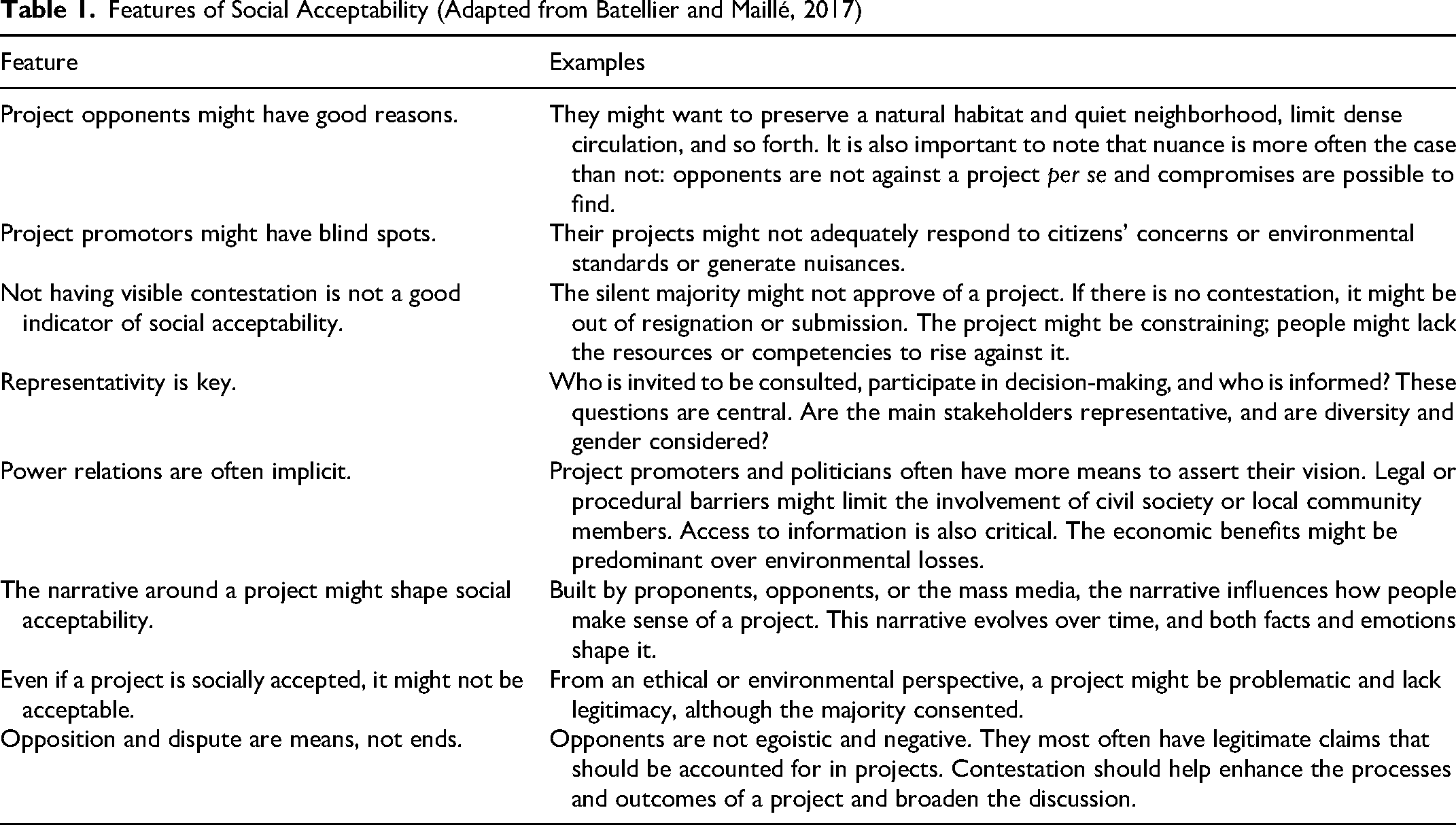
Many factors are involved in community acceptance. For example, the study of an important solar plant in the United Kingdom highlighted these determinants (listed from the most important one from the public to the least important ones): environmental considerations, project details, aesthetic, social, process, construction, economic, and temporal considerations (Roddis et al., 2020). The work by Klok et al. (2023) presents that community acceptance is shaped around three main dimensions: (1) the impacts (prevention, mitigation, compensation, and tolerance); (2) the process (where justice and trust are imperatives, see for example Mancini and Raggi, 2022); and (3) the context in which the local context is predominant. Summarizing the main postulates formulated in the book by Batellier and Maillé (2017), Table 1 presents some features of social acceptability.
Features of Social Acceptability (Adapted from Batellier and Maillé, 2017)
Although project governance and social acceptability are widely studied independently and genuinely contribute to project success, there has been sparse consideration of these topics and their relationships. Yet, a last theme, which relates to organizational learning, should be tackled as a theoretical lens before embarking on presentation of the framework.
Organizational Learning
The corpus about organizational learning is quite substantial in organization theory, so our focus here will be to highlight a few points relevant to our endeavors. Some seminal works that have shaped the field of organizational learning include those of Argyris (1999); Argyris and Schoën (1978); Lave and Wenger (1991); Nonaka (1994); Weick and Westley (1996), to name a few. Zollo and Winter (2002) developed an important framework that articulated the relations between organizational learning and dynamic capabilities (Teece et al., 1997), which can lead to the improvement and evolution of routines and organizational performance. In a well-known article, Zadek (2004) introduced a path to corporate responsibility by presenting five stages of organizational learning: defensive, compliance, managerial, strategic, and civil. Kashefi and Sanjaghi (2013) expanded on this framework and suggested the first stages are more related to superficial learning, and the last stages deepen into substantial learning.
In the realm of project studies, the topic of learning between projects has had considerable attention, given that it poses several challenges due to the temporal nature of projects and the involvement of team members (Grabher, 2004b; Hall & Holt, 2003; Wiewiora et al., 2020). Prencipe and Tell (2001) developed a framework that presents learning mechanisms for interprojects. This frame is built around learning phases (experience accumulation, knowledge articulation, and knowledge codification) and the level of analysis (individual, group/project, and organizational). Based on empirical case studies, they argue that there are different learning landscapes, depending on how the learning patterns unfold from the level of analysis through the processes. Their early contribution has been quite foundational for subsequent work related to project learning, capabilities, and knowledge transfer between projects; see, for example, Brady and Davies (2004), Eikelenboom and van Marrewijk (2024), Grabher (2004a), and Lindner and Wald (2011). The topic is still relevant today (Aerts et al., 2017; Pemsel & Söderlund, 2024).
Organizational learning is undoubtedly related to a multilevel perspective, grounded in the knowledge of individual team members (Fenwick, 2008), yet also simultaneously happening at a collective level (Knapp, 2010), which is also dynamic and situated (De Blust et al., 2019; Lervik et al., 2010). Although it is commonly acknowledged that managerial choices have an impact on organizational capabilities and team learning practices, it is equally important to acknowledge how team members’ knowledge informs and influences managerial decisions as well as organizational learning and outcomes (Harvey et al., 2022). Next, the methodology is presented, and a conceptual framework is proposed using learning stages to analyze the process of articulating the governance aspects of major public projects’ social acceptability.
Toward a Conceptual Framework
Methodology
The methodology adopted is based on conceptual reasoning and illustrative empirical evidence (Braun & Sydow, 2024). Based on the authors’ experience and the literature on project governance and social acceptability, the framework was developed iteratively as the main themes were identified and the different parts of the process connected to organizational learning. This form of theorizing is referred to as “process theorizing” (Cornelissen et al., 2021) and entails explaining a topic with the sequencing of events and outcomes. The authors argue that the main knowledge interest is to explain a phenomenon: “the elaborated trajectories conceptualize alternate causal paths and theorize underlying processes and structures as mechanisms” (Cornelissen et al., 2021, p. 7). Examples adopting this methodological positioning can be found in the works of Bitektine (2011) and Sergi (2012).
The Conceptual Framework
Major public projects are temporary initiatives that involve a complex ecosystem composed of numerous actors (public and private) that must collaborate to work together and coordinate their efforts (Kusuma, 2014). Geraldi and Söderlund (2018) consider projects to be fundamental economic and social action units comprising geographically anchored knowledge clusters. A conceptual framework is proposed to grasp the dynamics at play in articulating the governance of major public infrastructure projects (see Figure 1).
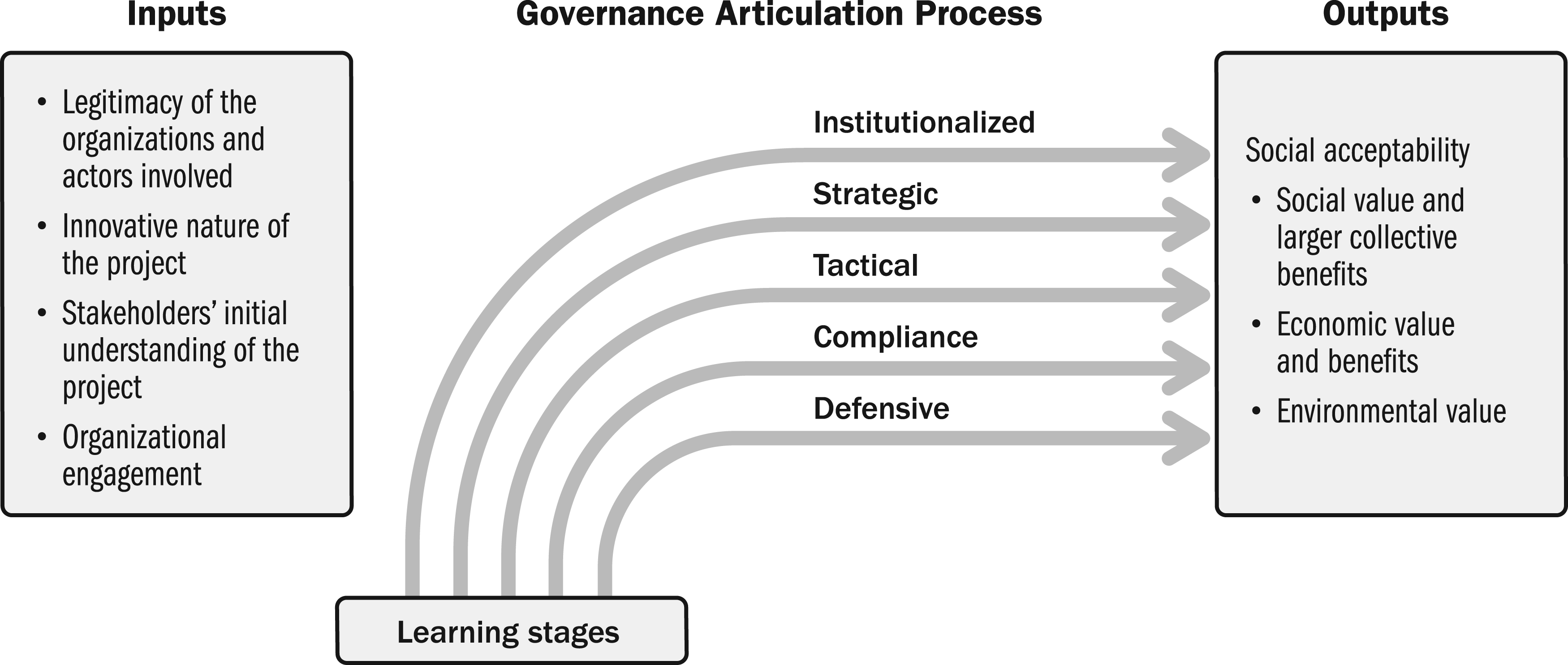
Conceptual framework for analyzing the process of articulating governance in relation to the social acceptability of major public projects.
In line with the processual studies advocated in project management (Cloutier & Langley, 2020; Sergi et al., 2020; Stephenson et al., 2020), our conceptual framework focuses on the process of articulating governance and its constituents. Various contextual elements are to be considered as inputs—first, the legitimacy of the organizations and actors involved (Bitektine & Haack, 2015). Even if a project might be socially acceptable, if its sponsoring organization lacks legitimacy, it might be detrimental to the project. Conversely, if a project is illegitimate for some reason, a legitimate owner organization might reinforce the project’s legitimacy (Baba & Brunet, 2024). Second, the project’s nature and innovative character must be considered (Gasparro et al., 2022). In this respect, projects seeking to achieve sustainability goals with rapid technology development, addressing climate change issues, and aligned with the sustainability transition fundamentally differ from a more traditional project such as building a large bridge or tunnel. Yet, a third element is fundamental to consider and relates to the initial understanding of local stakeholders and communities about the project (Derakhshan et al., 2019; Di Maddaloni & Sabini, 2022). Even if a project might be environmentally desirable, local communities might have other arguments against it regarding its nature, the processes around it, the organizations involved, or the impacts it could have at the local level. Fourth, essential inputs include organizational engagement and dedicated resources to address project governance and its overall social acceptability.
Once the inputs are identified, the governance articulation process will depend mainly on where organizations stand regarding their learning stages. Different and distinct stages might result in very different outputs regarding the social acceptability of their projects: defensive, compliance, tactical, strategic, and institutionalized. Those stages, explained in more detail in the subsequent section, hinge on key organizational elements: organizational culture, status, stakeholder engagement approach, scope, allocation of resources, policies and practices, and the utilization of monitoring tools. These different trajectories are depicted simplistically for the sake of clarity; however, the processual unfolding of the governance adopted for a project is quite dynamic. In theory, an organization could start at a learning stage at the beginning of a project and move up or down another stage as the project evolves. It is to be noted that those stages are neither rigid nor clear-cut, yet they provide several trajectories that organizations might follow. An organization might embrace practices from two (or more) trajectories—for different projects or even the same—and change over time, depending on the critical/turning points and triggers. As such, the evolution of governance could be investigated according to the temporal unfolding, critical events and turning points marking projects, and the need for decision-making involving a change in trajectory (Bröchner, 2022; Strauss, 1993).
Social acceptability as an output is to be analyzed according to the different facets of social and societal, economic, and environmental values (Aarseth et al., 2017; Kemp et al., 2006). Our premise, to be empirically investigated, is that an organization at a higher learning stage will articulate a governance process more supportive of a project’s social acceptability, resulting in higher overall acceptability. Yet, it will not automatically translate into higher social acceptability as, ultimately, the stakeholders have to make sense of and familiarize themselves with the project and understand its fundamental and multifaceted values (Caron et al., 2024). The value perspectives are numerous (see, for example, Table 9.1 in Ang et al., 2023, p. 107). Building on the work of Wüstenhagen et al. (2007) and Baba and Dahan (2023), we suggest three main configurational types of social acceptability: eco-traditional, symbolic, and technical. The first, eco-traditional, is related to community acceptability; it should consider traditions, the environment, and the public interest. The second value perspective, the symbolic, relates to the political acceptability, mainly to the (perceived) legitimacy of the organizations involved and the project’s innovative nature. Third, the technical value translates into market and future users’ acceptability regarding a project’s economic value and benefits and the need for regulatory compliance. This conceptual framework is a starting point to study these complex and interrelated themes. Next, the different conceptualized learning stages are explained.
A Path to Greater Social Acceptability
Social acceptability is related to the degree to which projects are deemed appropriate and beneficial within the social context in which they operate. As ample evidence shows, social acceptability is not static but dynamic, capable of enhancement and refinement through iterative development processes over time (Baba et al., 2021). In particular, empirical evidence and the existing literature suggest that organizations are at different stages in handling the social acceptability of their projects. Each learning stage refers to an organization’s advancement in terms of social acceptability integration into its operational and strategic ethos. Next, we expand on a framework for analyzing an organization’s learning stage in managing social acceptability. Building on the work of Zadek (2004) in corporate social responsibility, this framework identifies five stages: defensive, compliant, tactical, strategic, and institutionalized (see Table 2). We propose seven key organizational elements that form the foundation of these learning stages (see Baba et al., 2024; Bowen et al., 2010; Delannon et al., 2016): organizational culture, status, stakeholder engagement approach, scope, allocation of resources, policies and practices, and the utilization of monitoring tools.
Learning Stages in Terms of Social Acceptability and Key Organizational Elements
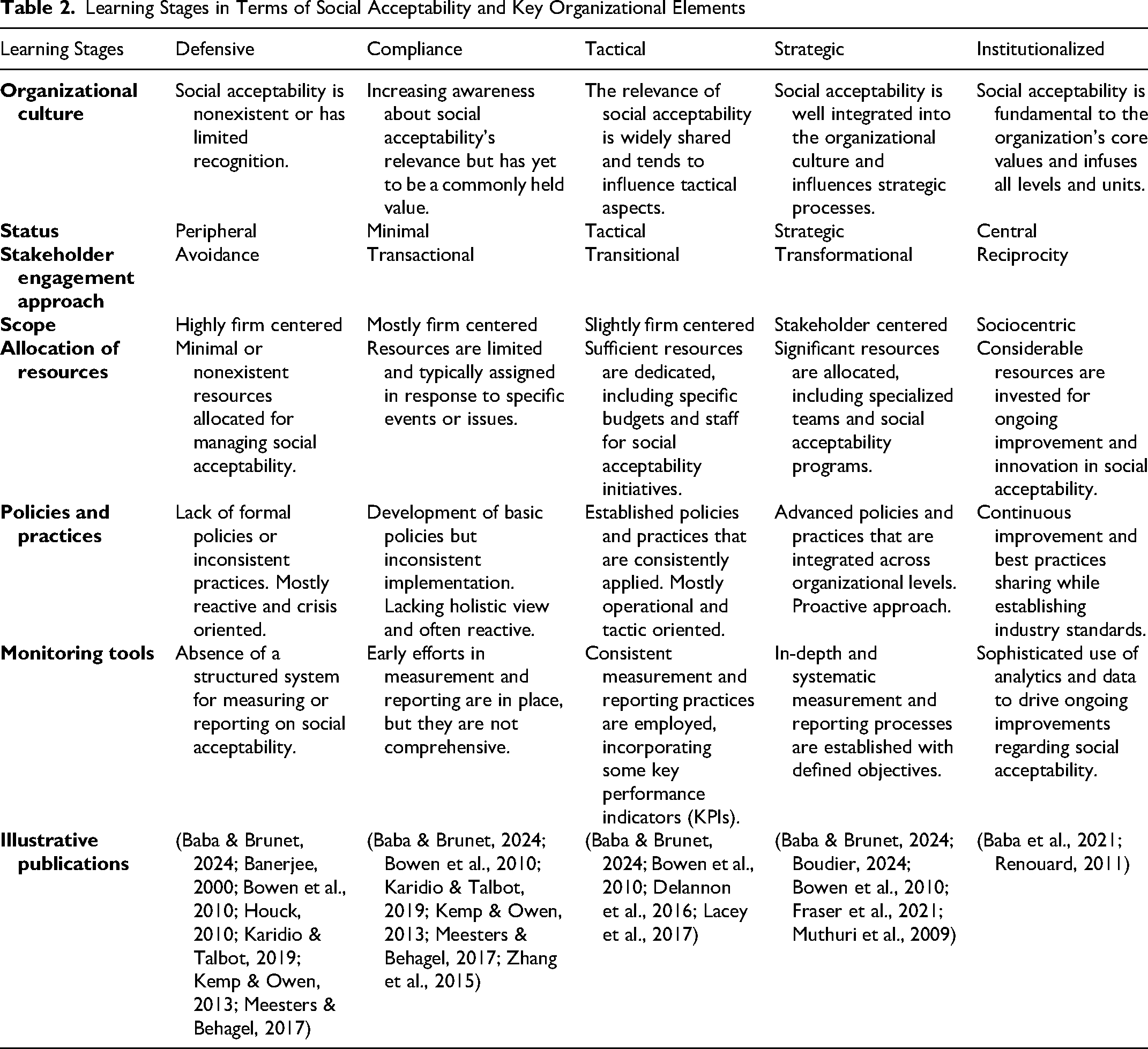
Although our framework is presented in a table that may appear rigid, we do not necessarily believe that organizations align systematically with a single specific learning stage. Across various organizational elements, they may exhibit characteristics spanning one, two, or even multiple learning stages. The key idea is that for an organization to truly operate at a specific learning stage, it must demonstrate coherence by being aligned across all organizational elements at that stage.
Defensive Stage of Learning in Social Acceptability
At the defensive stage of social acceptability learning, organizations exhibit minimal acknowledgment or awareness of its importance in the defensive stage of learning about social acceptability. This stage is marked by an organizational culture where social acceptability is either completely overlooked or given only marginal recognition, suggesting a lack of understanding or appreciation for the impact of social factors on the organization’s projects. The approach to stakeholder engagement is primarily avoidant at this stage. As a result, organizations will tend to minimize or ignore their perspectives instead of actively interacting with stakeholders to learn about their expectations or concerns. This firm-centered stance reflects a limited business operations perspective, where external social factors are viewed as irrelevant or secondary to the organization’s projects.
Resource allocation for managing social acceptability is virtually nonexistent at this stage. Organizations do not dedicate financial, human, or time resources to understanding or improving social acceptability and stakeholder engagement. Such resources are seen as a waste. The minimal resources that might be allocated are often reactionary, used only when a crisis arises or when the organization is obliged to respond to external pressures rather than as part of a proactive strategy to manage social factors effectively. Policies and practices related to social acceptability either lack or are used inconsistently and, where they do exist, they also typically mirror reactive responses to particular events or crises. Social acceptability–related policies and practices thus focus on damage control rather than prevention or the development of constructive relations with stakeholders.
Unsurprisingly, monitoring tools are absent for measuring or reporting on social acceptability at the defensive stage. 1 In this regard, the organization does not monitor its performance or hold itself accountable for improvements. In a broader sense, this lack of oversight indicates social acceptability’s peripheral status within the organization, which is not perceived as essential to its long-term success. An illustration of the defensive strategy can be found in the example of Matoush, a uranium mine project promoted by Strateco that was cancelled because of strong local opposition by indigenous communities. Throughout the controversy, Strateco attempted to minimize the importance of taking into account the local perceptions of communities, arguing that the legal license was sufficient (Karidio & Talbot, 2019; Yates et al., 2023).
Compliance Stage of Learning in Social Acceptability
Organizations begin to recognize the importance of social acceptability at this stage, although this understanding remains in its infancy. This awareness of social acceptability has not fully permeated the organizational culture and is not yet ingrained in the organization, as the approach to stakeholder engagement is still transactional. Immediate business needs drive unidirectional interactions with stakeholders rather than a dedication to creating long-term and mutually beneficial relationships. In this sense, the organization’s focus is firm and project centered, and stakeholder concerns are only addressed when they align with the organization’s immediate project objectives or when failing to address them could result in negative consequences.
The main goal of organizations that fit in this stage is to respect the law and obtain the required legal licenses. Obtaining social acceptability, or the social license, is perceived as less important. Resource allocation for social acceptability during the compliance stage is limited and reactive. Resources—financial, human, or logistical—are usually allocated in response to particular incidents or emerging issues. Although the organization understands the need to allocate resources for social acceptability at the compliance stage, it responds reactively to events instead of proactively incorporating it consistently into its project management approach.
Moving beyond the defensive stage, developing social acceptability–related policies marks a progress, yet they are often basic and their execution is erratic. The organization might start developing social acceptability–related policies or guidelines at the compliance level but is less likely to include them in its project management frameworks. This lack of a holistic view of social acceptability shows that the organization minimally addresses the demand for social acceptability management without embracing it strategically. Regarding measurement and reporting at the compliance level, first attempts to track and document social acceptability are seen; but these typically consist of simple attempts to measure fundamental metrics, such as the number of complaints, which reflects the limited status of social acceptability within the organization.
An interesting illustration of the compliance learning stage is the Réseau Express Métropolitain, a fully automated light rail system launched through a private–public partnership involving the Quebec government (Brunet et al., 2021). This project was controversial since it gave the speed of execution top priority over stakeholder engagement. The project progressed rapidly in terms of execution. On the other hand, it also drew criticism for inadequate involvement of stakeholders and weak public consultations. The lack of social acceptability caused by these flaws in transparency and governance resulted in the cancellation of the second phase.
Tactical Stage of Learning in Social Acceptability
During the tactical phase, social acceptability is established as a recognized priority within the organization and guides both discourses and decision-making processes. This highlights a transition from a project-centric stakeholder approach to one that reconciles internal priorities with external stakeholder interests. Organizations increasingly recognize stakeholder value and integrate their perspectives into project management practices, which demonstrates an increased awareness of their importance. An essential indicator of this transition is the improved allocation of resources for social acceptability initiatives. In fact, organizations allocate budgets and appoint personnel to oversee stakeholder relationships, indicating a shift from informal engagement to a more systematic and long-term approach.
This investment also reflects a willingness to go beyond compliance, as organizations understand that effective stakeholder engagement not only requires intent but also resources. Cooperation with stakeholders also progressively becomes proactive and deliberate, as organizations start including stakeholder involvement in their planning strategies, thus moving beyond a reactive approach to stakeholder engagement. This shift helps to build more collaborative relationships among stakeholders built on trust, communication, and transparency. Importantly, regarding human resources, social acceptability and community involvement projects assign committed staff members even though these staff members may still benefit from outside consultant support.
Policies and practices related to social acceptability also get more formal and are followed more consistently across the projects and organization. Mostly operational and tactical, these policies and practices focus on integrating social acceptability into the daily operations related to projects. Moreover, the tactical stage is characterized by implementing consistent measurement and reporting practices related to social acceptability and stakeholder engagement. These practices frequently involve using key performance indicators (KPIs), such as contributions to local development and satisfaction levels among community members, which show an effort to evaluate and monitor the organization’s progress (see the social value plan example in Babaei et al., 2023).
Strategic Stage of Learning in Social Acceptability
Social acceptability is an integral part of organizational culture, with a significant impact on decision-making processes. Social acceptability is thus regarded neither as an external factor to be addressed nor a risk to be dealt with, but rather a key component of the organization’s culture and project management approach. The transition from previous stages to the strategic learning stage is noteworthy for two reasons. First, it reflects a major shift in values and the move from an operational mindset to a strategic one. Social acceptability is not only a matter of operations but makes its way to strategic processes and dynamics within the organization. Second, this transition also marks a key step insofar as social acceptability becomes deeply embedded across all areas of the organization, establishing itself as a fundamental strategic pillar at the core of the value chain.
In this vein, stakeholder engagement transcends traditional approaches and involves a transformational relationship with local stakeholders based on trust, long-term relationships, and mutually beneficial cocreation initiatives. At this stage, the collaboration between the organization and its stakeholders takes front stage with an eye toward creating initiatives promoting local economic and social development. Recognized as important partners, stakeholders are included in the organization’s strategy to achieve common objectives. Social acceptability receives significant resources, including specialized teams in charge of involving stakeholders and committed financial help. With the stakeholder engagement and social acceptability team reporting directly to upper management, including the CEO, these teams reflect their vital contributions to project success and sustainability by implementing forward-looking programs coherent with expectations of stakeholders and embedding social acceptability policies and practices across all levels of the organization.
Finally, the strategic stage is defined by a systematic and advanced approach to measuring and reporting on social acceptability and stakeholder engagement initiatives. Measurable KPIs allow at least three main criteria—community acceptance, extent of stakeholder integration, and project efficacy as a catalyst for local empowerment and development—to be evaluated. With its approach, which gives equal importance to the social value generated for communities and traditional financial measures, Boralex illustrates this strategic learning stage well (Lemay & Longchamps, 2024).
Institutionalized Stage of Learning in Social Acceptability
At this stage, social acceptability becomes deeply embedded in an organization’s culture as it shapes its fundamental values. Importantly, social acceptability almost becomes the most significant element of project management. This stage marks a significant evolution, as social acceptability is no longer just a part of the organization’s strategy but lies at its core and guides every decision related to its projects. A sense of reciprocity defines how the organization engages with its stakeholders. Here, stakeholder engagement surpasses mere consultation as it becomes a genuine two-way interaction where stakeholders are listened to and become active participants in shaping projects. This is what can be called a reciprocity-based approach to managing stakeholder relations where the “conception of value from a project relies on an understanding of what is necessary for community members to be able to live flourishing lives.” (Baba et al., 2021, p. 894)
In this sense, the organization’s perspective broadens to a sociocentric view and places the well-being and interests of the broader community as key components of its project management. The allocation of resources for social acceptability (both financial and human) becomes deeply ingrained and undisputed as the organization consistently allocates considerable resources to develop and maintain its social acceptability performance. The pursuit of continuous improvement and the exchange of best practices at the industry level also characterize this stage. Furthermore, the organization actively seeks to improve its social acceptability processes and contribute to the broader industry dialogue on social acceptability. In doing so, the organization positions itself as a leader in social acceptability at the industry level.
Additionally, the institutionalized learning stage is distinguished by the organization’s advanced utilization of data and analytics to monitor and improve its stakeholder relations and social acceptability initiatives. This stage of learning is well illustrated by Hydro-Quebec, a Quebec government-owned company that runs the vast majority of the province’s electricity generation and distribution (Baba et al., 2021). Over the past 40 years and often through tough challenges, Hydro-Quebec has learned the critical importance of institutionalizing its community engagement function (Baba et al., 2021). With this learning curve, Hydro-Quebec promotes practices that are considered leading in the hydroelectric industry. Hydro-Quebec holds certifications that attest to its commitment to making social acceptability a strategic priority and actively shares its practices to allow other stakeholders to learn from its experience.
Discussion
Overall, there is an essential yet under-studied relationship between the governance of major public infrastructure projects and social acceptability. The literature at the intersection of large-scale public project governance and social acceptability is emerging (Brunet & Baba, 2023), relating mostly to public project governance frameworks and integrated impact assessments as sustainable development decision-making tools (Lehtonen, 2014; Oliver & Pearl, 2018). With this in mind, the research question asked at the outset was: “How can the governance of a major public infrastructure project support a stakeholder engagement approach conducive to greater social acceptability?” To answer this question, we developed a conceptual framework that better explains the governance articulation process and its effects on stakeholder engagement and the social acceptability of major public projects. This dynamic perspective enables the development of theoretical and practical knowledge about implementing practices in major projects that make it possible to apprehend the needs and expectations of stakeholders, engage and mobilize them, and foster their engagement while improving the project itself (Aaltonen et al., 2024).
This article theoretically improves our understanding of governance in major public infrastructure projects by focusing—via an organizational learning framework—on the antecedents of practices, mechanisms, and resources that support social acceptability. This point of view allows us to see the relationship between governance and social acceptability as a dynamic learning process in which governance develops over time as organizations react to stakeholder needs and sustainability challenges. From a practical point of view, this research proposes a comprehensive tool to measure one organization’s positioning along a path toward greater social acceptability of its projects. The learning scale developed in this article is an interesting managerial tool for practitioners, project owners, and promoters to reflexively analyze where they stand and what could be done to get to a higher stage, leading to enhanced governance that supports social acceptability. Although context dependent (Donaldson, 2001), it might not be possible to suggest a detailed step-by-step process or guideline to enable this framework for practitioners. Yet, this tool allows for reflexivity in action and for inspiration (Schon, 1983).
Future Research Avenues
The dynamic conceptualization we developed in this article enriches our understanding of the interrelations among governance, organizational learning, and social acceptability. In doing so, it also brings several theoretical premises that should be investigated more thoroughly in future studies, including:
How do the suggested inputs translate into an overall governance articulation process? Are there other factors that might influence an organization to adopt a trajectory or another and mirror its learning stage? How is it possible for a governance trajectory to change through time? Are organizations able to adjust and adapt (learn and move stages upward), and what effects could this have on a project’s social acceptability? On the contrary, would it be possible for an organization to drop from a higher learning stage to a lower one during a project (for example, by removing critical resources) and, if so, how would the social acceptability be impacted? How do the governance articulation processes translate into greater social acceptability for projects? What is the role of external stakeholders in coconstructing the meaning of the project with the promoters, framing values, and making a project socially acceptable? Can external stakeholders adjust and learn as a project goes through a similar learning stage?
The proposed framework has inherent limitations due to its conceptual nature, yet we invite scholars to use it empirically to enrich our understanding and deepen our knowledge on this important topic, as we will do ourselves. Although supported by empirical evidence, this conceptual framework was developed iteratively, based on the experience of the authors and the literature. It would be interesting to empirically test it in different settings and articulate more explicitly whether the governance trajectory adopted yields to greater social acceptability. The refinement of inputs, outputs, and measurements of social acceptability would also enrich the current state of knowledge in this area. Some of those organizational elements are more specifically tied to governance, for example, allocation of resources, policies, practices, and monitoring tools. For other organizational elements, such as roles, forums, expectations, delegations, escalations, and decision-making, more fine-grained analysis could be developed in subsequent research. For theoretical developments, it would be relevant to address the themes of organizational learning versus organizational maturity (Aubry, 2015) and compare different frameworks and how they have been mobilized (e.g., Zadek, 2004). Also, it would be interesting to understand in more detail how real-life organizations manage and balance conflicting interests of diverse stakeholders and resolve them, as it would be to delve into implications for leadership (Aaltonen et al., 2024). It would also be interesting to know more about the organizational dynamics around governance, for example regarding the fundamental constituents or events/triggers generally associated with shifts in governance (Brunet, 2025). Another interesting avenue, bringing the last point forward, would be to conduct longitudinal studies and comparative case analysis to cover in detail the project life cycle and differentiate possible levels of decision-making latitude on acceptability that exists at different points and regarding different projects.
Conclusion
This article argued for the importance of exploring the relationship between governance and social acceptability in major public infrastructure projects. Due to their size and impact, these projects typically face growing scrutiny from various stakeholders, making social acceptability an essential factor to consider for their success. In this vein, this article argues that governance can lead to making better decisions informed by acceptability realities, bringing forward a conceptual framework elucidating how effective governance can enhance social acceptability. The conceptual framework poses that several inputs (such as the legitimacy of actors involved, the nature of the project, the initial stakeholders’ understanding, and organizational engagement) are to be considered, along with the organization’s governance articulation process. Different learning stages are suggested: defensive, compliance, tactical, strategic, and institutionalized. The combination of inputs and governance approach leads to the outputs, which are considered as different facets of social acceptability: social value, economic value, and environmental value. Building on this framework, we also developed an organizational learning framework that outlines different stages through which organizations evolve in managing social acceptability—from a defensive stance, where social acceptability is overlooked, to an institutionalized approach, where social acceptability is deeply integrated into the organization’s core values. All in all, we suggested that major public infrastructure project teams that focus on organizational learning are more likely to achieve higher levels of social acceptability, leading to more sustainable and socially responsible outcomes. As a final point, we do encourage policymakers and practitioners to adopt the framework in real-world projects to understand where they stand and how they could improve their organizational skills on this important topic.
