




Abstract
The notion of temporary organization allows project studies to connect with the broader discipline of management and organization studies. However, temporariness is an important structural property of many social systems, rather than just organizations. Economic geography has studied trade fairs and other professional gatherings and conceptualized them as temporary markets, clusters, or communities. With its unique focus on physical space, economic geography can enhance our understanding of temporary organizing. This is illustrated with reference to trade fairs, but can be extended to other professional gatherings, such as conferences and conventions, and to some extent, even to field-configuring events or places.
Keywords
Introduction
Projects and project networks are an established field of research in the specialized discipline of project management and management and organization studies more broadly, where they have raised cross-disciplinary interest (Sydow, 2022; Wang et al., 2025). In these disciplines, as also in economic geography where the wider concept of project ecologies has gained most prominence (Grabher, 2001, 2002; Grabher & Ibert, 2012), projects have been discussed as an alternative form of value creation; one that combines, among others, elements of hierarchies, markets, and networks and allows for flexibility and adaptability—much needed in uncertain times. Interestingly, projects, project networks, and ecologies—or temporary forms of organizing more generally (Bakker et al., 2016; Burke & Morley, 2016)—have not been extensively discussed in the context of trade fairs and other place-based professional gatherings, 1 although they are all linked to such events in important ways. On the one hand, trade fairs, conferences, conventions, economic forums, and events like film festivals result from dedicated, often carefully planned and executed projects, which are linked to each other in the form of networks/ecologies. 2 On the other hand, these trade fairs and other professional gatherings provide important physical places and social spaces where new projects are being discussed, network relations are established, and investors seek to finance these projects (Cervenan, 2017; Schuldt & Bathelt, 2011). Without these place-based events, many projects would never materialize. The mutual understanding in project studies and economic geography research of temporariness as a critical phenomenon in the contemporary economy enables economic geography as a discipline to profit from both, an established understanding of temporary organizations as form and temporary organizing as practice. 3 Project studies, in turn, can benefit from economic geography’s serious concern for social space and physical place in knowledge generation.
To go beyond the concept of temporary organization without, obviously, downplaying its role, we chose to focus primarily on trade fairs. They are a particular type of gathering that plays a significant role, both in terms of stimulating sales and generating knowledge flows, thus adding to projects as a vehicle for knowledge transfer and generation as well as learning in and beyond regions (Asheim & Mariussen, 2003). 4 In surveys about critical information sources for innovation across different industries and countries, trade fairs (also business conferences) rank quite high—often just behind customer contacts and internal R&D resources, but higher than, for example, universities (Bathelt, 2017). Many trade fairs also have a substantial turnover with respect to sales agreements negotiated or signed at such events. For instance, the Canton Fair in Guangzhou alone (with two editions per year) accounted for over one-third of all Chinese exports in the mid-1970s and still represented about 3% of exports in 2015 in an economy as large as the Chinese (Jin & Weber, 2008; Li & Bathelt, 2017).
Trade fairs and similar professional gatherings can and should be viewed as temporary organizations (Lundin & Söderholm, 1995) defined not only by their ex-ante set termination but also their short duration, anchoring in a certain place, and the opportunity for copresent interaction in temporary proximity (Torre & Rallet, 2005). The projects implemented to realize such events, however, take months, if not years, of prior planning and organizing, often embedded in (at least latent) networks of relationships that stretch even longer over years, if not decades (Rüling & Pedersen, 2010; Wilson et al., 2017). While the social space these events create is usually considered in related research, the physical space—or place—is by and large, at least in project studies and management/organization research more generally, disregarded (for an exception, see Hedborg & Addyman, 2024).
By viewing trade fairs from perspectives intensively discussed in economic geography, we wish, in this thoughtlet, to highlight facets that are underemphasized when considering these events only as temporary organizations. The physical–spatial dimension of trade fairs, in particular, is a constitutive element of this form of temporary organization. While seemingly a remnant of past practices, this dimension remains highly relevant today despite ongoing digitalization. What is more, project studies conceiving such events as temporary organizations tend to overlook the importance of copresent interaction in physical place and its relevance for creating and maintaining markets, clusters, and communities—all important aspects in economic geography work.
What trade fairs are we looking at? We mainly focus on international business-to-business trade fairs, which—like projects—play an important role in learning and knowledge generation in the global knowledge economy. These events bring together members of an organizational field (DiMaggio & Powell, 1983) for a few days in a single place, typically a dedicated trade fair or convention center in a major city–region (sometimes located right in the city’s core). Trade fairs fulfill different functions such as sales, innovation, exchange, or market fairs. They typically occur once every two to three years and are linked to similar events in the organizational field. Through this, they generate a distinct trade fair cycle (Power & Jansson, 2008) where new developments in products and technologies are showcased; producers and users connect in established and new markets; and regulatory, technological, and market developments in the field are discussed. While our arguments revolve around these types of trade fairs, many of their features and consequences for knowledge generation can also be extended to other professional place-based gatherings, less so to mega-events, such as the Olympics, that do not focus on knowledge generation (Løwendahl, 1995; Thiel & Grabher, 2015).
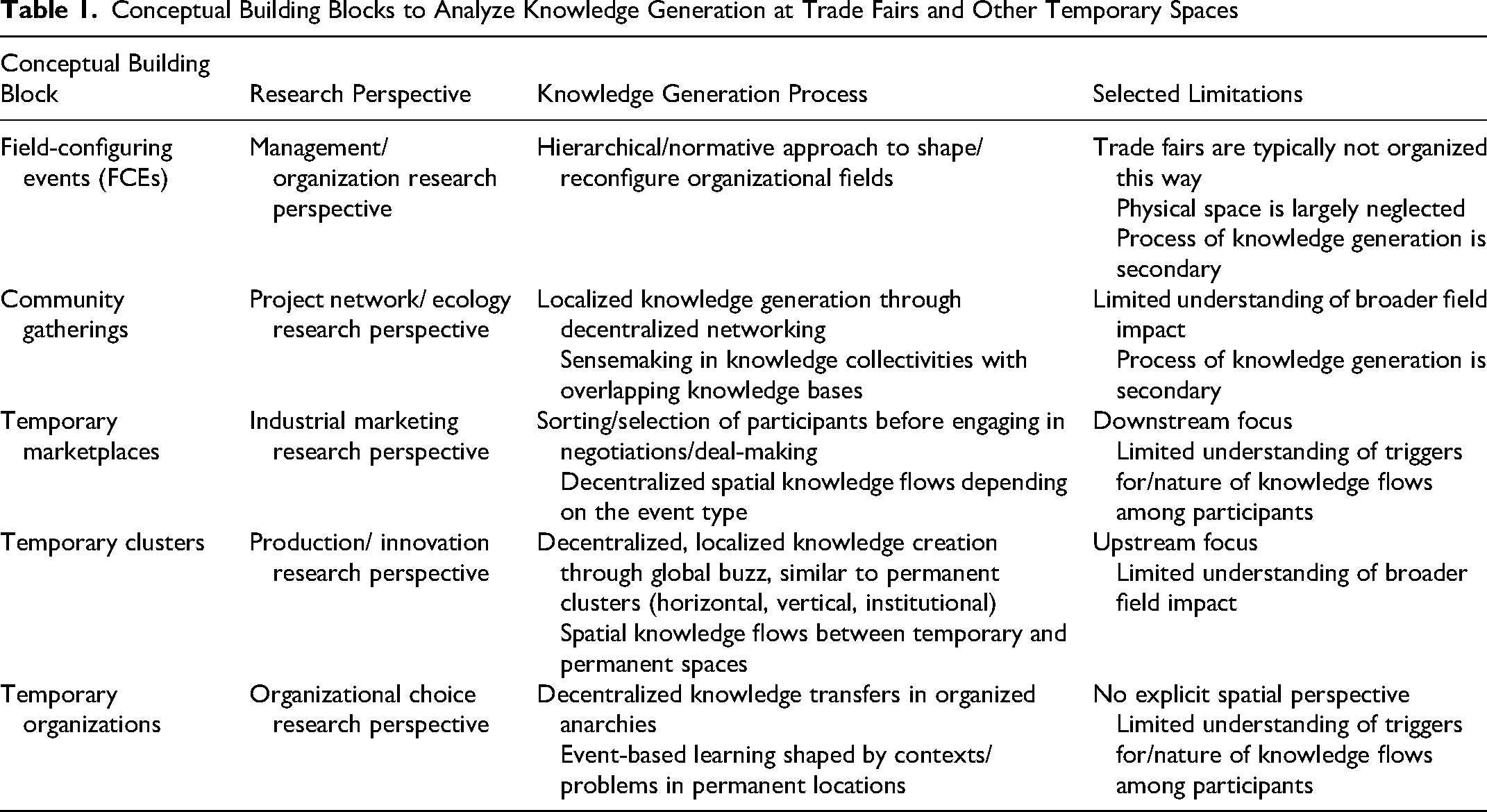
This thoughtlet is structured as follows: In going beyond the conventional perspective of viewing trade fairs as temporary organizations, we discuss them through various conceptual lenses that have developed in the context of economic geography in the past 20 years. Our analysis pays particular attention to how these perspectives conceptualize the interaction between participants and how this generates knowledge flows at these events (for an overview, see Table 1). We begin discussing trade fairs as field-configuring events that, as many projects, are in the preparation and execution phase hierarchically orchestrated to achieve a specific goal and (re)configure their underlying organizational field. This is followed by a discussion of trade fairs as both physical places and social spaces for community reproduction where professionals get together and connect with their peers in a decentralized fashion and collectively make sense of the changes and novelties in their field. Next, trade fairs are conceptualized as temporary markets that accommodate market transactions and trigger specific knowledge flows depending on the purpose of the events and the structure of exhibitors and visitors. This perspective connects this form of temporary organizing with market forces and processes. Viewing trade fairs as temporary clusters then sets up a perspective that emphasizes how participants engage in intense learning through interaction and observation during these events. These learning processes are enabled by a specific temporary knowledge ecology, 5 with regard to international fairs referred to as global buzz, and trigger adjustments in participants’ production and innovation programs. We conclude our thoughtlet by clarifying boundary conditions and pleading for an integrated perspective of trade fairs as temporary markets, temporary clusters, and community gatherings—a perspective that remains serious about the role of space and place and brings back the thereby enhanced perspective of the temporary organization. This allows us to generate a more comprehensive and deeper understanding of the learning dynamics at these events and how these shape the often project-based knowledge generation processes in organizational fields.
Conceptual Building Blocks to Analyze Knowledge Generation at Trade Fairs and Other Temporary Spaces
Trade Fairs as Field-Configuring Events and Places
From a management/organization research perspective, the concept of field-configuring events suggests that temporary forms of organizations can fundamentally impact organizational fields, their configuration, and their future development (Lampel & Meyer, 2008). While a narrow understanding of field-configuring events as “settings in which people from diverse social organizations assemble temporarily, with the conscious, collective intent to construct an organizational field” (Meyer et al., 2005, p. 467) only applies to a small number of events, Lampel and Meyer (2008) broaden the applicability of the concept by including events that substantially shape organizational fields or become turning points or critical junctures in their evolution. Such events include professional gatherings and conferences (Henn & Bathelt, 2025; Khoury et al., 2022; Schüssler et al., 2014) that are often hierarchically structured and have a strong normative character. Their goal is to bring together decisive actors from an organizational field to achieve consensus regarding the development of the field at a crucial point in time.
The concept of field-configuring events is also applicable to trade fairs, especially those leading or flagship events in an industry that are organized to bring together major parts of a global organizational field. Indeed, Rinallo and Golfetto (2006) have shown that fashion industries are driven by such events that are meticulously prepared in the form of projects, more specifically interorganizational projects, made up of representatives of leading firms and industry associations, sociologists, cool hunters, designers, and so on that are embedded in project networks (Bathelt et al., 2014). These projects culminate in concertation events, during which consensus is achieved about an orchestrated fashion trend, resulting in the establishment of code books, which are widely distributed within the industry long before the actual event takes place. The fashion products that then become visible at the fashion show are essentially variations on a predefined theme (Entwistle & Rocamora, 2006; Golfetto & Rinallo, 2017) and strongly impact consumer behavior. However, only a limited number of trade fairs have such characteristics and convey a strong normative agenda set by the organizers. And, even at fashion shows, firms are free to deviate from the concerted trends and may trigger new independent fashion developments through their unique collections (Gibson & Bathelt, 2014).
A study by Möllering (2010) of an engineering conference in the semiconductor industry indicates that there are limitations in applying the concept of field-configuring events to professional gatherings (see also Schüssler et al., 2014). While the conference investigated was organized with the goal to establish consensus regarding the development and commercialization of a new technology, interactions during the event showed that participants were not willing to follow this normative agenda, and no broad consensus was achieved. In the case of most trade fairs and conferences, organizers may structure events with the goal to support knowledge exchange, control access to the events, and try to accommodate participants’ expectations, but they hardly define normative agendas and push for hierarchical knowledge flows or standardization processes (Gibson & Bathelt, 2014). In fact, a key goal of organizers is to secure multiplicity in knowledge flows and generate a diverse knowledge ecology that offers many opportunities to recombine knowledge into new ideas for innovation.
While the work on field-configuring events does not pay much attention to physical places, the role of place and space has long been recognized in economic geography and innovation studies (even linked to the organizational literature). Innovation projects and their outcomes fundamentally depend on the spatial and social context within which economic interaction takes place and the influences and experiences that enter the various stages of innovation (Bathelt & Glückler, 2018). Studies about how large multinational firms initiate and organize innovation projects clearly illustrate that the various stages of the process—during which implicit and explicit knowledge components are socialized, explicated, combined, and internalized—are best carried out in different socio-spatial settings (Nonaka, 1994; Nonaka et al., 2000): from face-to-face brainstorming get-togethers in a relaxing offsite location to regular online meetings about project progression. Interestingly, the notion of field-configuring places has recently been mobilized in organization studies to emphasize the important role of physical places, in this case the Society for Arts and Technology building in Montreal, for the generation and maintenance of projection mapping in exchange fields (Capron & Delacour, 2024).
Trade Fairs as Places for Community (Re)Production
From a (project) network/ecology research perspective, trade fairs can be viewed as planned events that bring together representatives from an organizational field that are part of partially similar and partially different, overlapping professional communities (Bathelt et al., 2014; Nooteboom, 2000). These professional communities have epistemic and practice foundations (Knorr, 1999; Wenger, 1998) that constitute communities of knowing (Boland & Tenkasi, 1995). In their home regions, they form distinct local communities through self-identification and mutual recognition (Amin & Cohendet, 2004). These local communities are linked through social interaction, often with face-to-face contacts, and in tune with local institutional contexts and industry specializations (Glückler & Bathelt, 2017). Members of these communities are often part of international professional communities that form a global knowledge repository in their organizational field. These international communities have a strong epistemic base and are typically defined by membership in field-related or profession-based associations, industry consortia, or standard-setting organizations (Bathelt & Cantwell, 2025). They are often instrumental in organizing international trade fairs and similar professional events as platforms for members of different local communities to connect and interact.
Local community members benefit from attending these events and making contacts as they gain insights from feedback and advice from members of other local communities that operate in somewhat different contexts. At these events, the participating knowledge communities turn into knowledge collectivities (Lindkvist, 2005), where distributed knowledge is exchanged by constantly connecting with other participants with similar knowledge bases. This helps to look at specific technological problems, bottlenecks, and opportunities for solutions when these community members return home. Since members have a strong sense of belonging to these communities, they are generally open and committed to helping other community members (Gibson & Bathelt, 2014), thus turning these gatherings into events where identities of communities are shared and reproduced through ongoing intensive interaction about developments in the field. This is particularly important to refresh project networks and ecologies that are only loosely coupled.
This community perspective is important as it cuts across the organizers’ potential agenda-setting items and the participating firms’ specific goals. The normative items become reference points and triggers for discussions among community members about new developments in the field and, since participants are willing to give back to their community and share experiences with others, become the basis for collective sensemaking (Henn & Bathelt, 2025). As community members, however, operate in specific contexts that are related to, but distinct from others’ contexts, interaction among community members is highly decentralized. Whereas communication is centered on exhibits and/or presentations in physical or, sometimes, virtual spaces, the myriads of encounters among different community members reinsure the co-evolution of the field and its local and international professional communities.
Organizers of trade fairs recognize the need for decentralized interaction and problem-solving and design events to ensure that open and spontaneous interaction remains at the core of these gatherings. This is supported by a study of major lighting fairs in Europe and North America (Gibson & Bathelt, 2014), which finds strong evidence that flagship events are less of a tool to configure fields distinctly but one of continuous community reproduction: “This process of shaping and reshaping is highly decentralized, rather than proceeding through a centralized/planned agenda-setting process” (Gibson & Bathelt, 2014, p. 220). This is significant, as these gatherings generate a reference frame for participants’ day-to-day operations and reduce the need for permanent copresence with other community members.
International flagship events can also be of fundamental importance for project work and the evolution of project networks/ecologies, although—to the best of our knowledge—this has not yet been in the focus of empirical studies (exceptions include studies on festivals such as that by Rüling & Pedersen, 2010). Participants at such events can extend their pool of future project partners and diversify their knowledge pipelines by connecting with other local communities that have a complementary epistemic and practice base but operate with distinct knowledge ecologies at home. These events enable attendees to go beyond the pool of local (project) partners, thus helping them to avoid becoming narrowly locked into local search routines (Li & Rowley, 2002). Such local pools may be great in major agglomerations of an organizational field like the Hollywood movie industry (Scott, 2004), but most places have limitations in terms of access to local capabilities and partners.
The perspective of trade fairs as places for community (re)production goes beyond the understanding of field-configuring events and places. It recognizes the importance of decentralized communication and interaction processes at these events, which fits well with the expectations of participants and reinsures that they have incentives to return when a new edition of the event takes place in the future. However, there are limitations as this network/ecology perspective does not focus on the nature of spatial knowledge generation processes. It investigates neither the effects these events have on market relations and commercialization nor the systematic mechanisms that support production and trigger innovation processes in the field.
Trade Fairs as Temporary Marketplaces
From an industrial marketing research perspective, trade fairs are marketplaces where competitors get together as exhibitors to present their products to visitors, especially buyers and users, and utilize these events as a marketing platform to advertise goods, services, and technologies to interested buyers (Golfetto, 1991). Traditionally, many trade fairs had the characteristics of temporary marketplaces (Bathelt et al., 2014; Berndt et al., 2020) where contracts were negotiated and products sold. However, the nature of trade fairs has changed over time, and the sales focus of many events has shifted and become weaker. So-called atypical buyers who do not intend to buy the products or technologies showcased have become more dominant among visitors (Bathelt et al., 2014; Borghini et al., 2006; Sharland & Balogh, 1996).
While conventional market views of these events do not offer a distinct spatial focus, this has shifted by applying a knowledge perspective to the analysis of temporary marketplaces (Rinallo & Golfetto, 2006). This knowledge perspective distinguishes among different types of trade fairs according to their mix of local/national and international buyers and sellers. It suggests that events generate different spatial knowledge flows, thus introducing a distinct geographical lens (Rinallo & Golfetto, 2011). Export fairs, for instance, are characterized by a large proportion of international visitors who attend these events to inform themselves about local/national industries and buy their products, whereas import fairs have a large share of international exhibitors that direct their products to the local/national market. While the former trade fairs become a platform for developed regional/national producers to learn about diverse priorities and expectations of international customers, the latter types of events are an opportunity for less developed local/national industries to learn about the sophisticated production systems in developed contexts (Li, 2014; Rinallo et al., 2017). As such, these events stimulate knowledge flows between regions/countries and support regional/national development processes via trade.
This approach, like the work on field-configuring events and places, emphasizes the organizers who—often with the unacknowledged help of projects—configure these events to reach a specific goal. In the case of trade fairs, goals and functions of events are often related to the economic development stage of local/national industries—and thus consider a specific spatial dimension of knowledge needs (Bathelt et al., 2014). Export fairs are often set up in countries and regions with highly developed competitive industries, limiting access for foreign competitors, and import fairs vice versa dominate in developing contexts without strong local industries. From a temporary market perspective, trade fairs can be used as regional policy tools to stimulate economic development. This approach leads to systematic differences in trade fair industries across countries (Zeng & Bathelt, 2015). From this perspective, these events are also important for project-based industries, such as mechanical engineering or industrial services, as export fairs enable local/national firms to contact a different client base abroad, and import fairs offer opportunities to inquire about sophisticated project partners for future projects. Essentially, temporary markets open a research perspective to link fluid market relations at these events to trade flows between permanent industry contexts and project networks/ecologies.
Unlike field-configuring events and places, temporary marketplaces are not typically set up as critical junctures that shift the organizational field. The knowledge-generation processes at these events are not hierarchically orchestrated but take place in a highly decentralized form through interaction among the participants. The concept, however, also has limitations. Importantly, trade fairs are viewed with a downstream focus on markets and sales, neglecting upstream flows of knowledge that affect production and innovation (Callon, 2017). Additionally, the temporary market approach assumes that knowledge flows occur automatically, depending on the composition of exhibitors and visitors at such events, but it does not pursue an actor perspective by investigating the nature of these knowledge flows.
Trade Fairs as Temporary Clusters
From a production/innovation research perspective, trade fairs can be viewed as temporary clusters. They bring together many actors from an organizational field to present their latest products and innovations to a broad audience of peers. Such events are, in many cases, tied to specific places—i.e., city-regions (albeit some events switch places from event to event)—and their industry focus is sometimes linked to the economic specialization of the surrounding region (Rinallo et al., 2017). Examples are fashion fairs in Milan (Italy), chemical industry fairs in Frankfurt/Main (Germany), or government/public sector fairs in Washington, D.C. (USA). Attendees can learn about trends in markets and technologies and use these events as a benchmark to review their performance and strategic priorities (Bathelt et al., 2014). As these events are often focused on industries and are value-chain-based, the presented artifacts, attendee structure, and knowledge flows resemble those of a permanent regional industry cluster (Bathelt et al., 2014; Maskell et al., 2006).
In an upstream view, the temporary cluster perspective investigates how decentralized knowledge exchanges among participants in planned and unplanned encounters trigger learning processes in production and innovation. Communication and interaction during trade fairs are similar to permanent clusters, with distinct horizontal, vertical, and institutional dimensions. Exhibitors interact intensively with existing and potential future customers, and to a lesser degree with suppliers, to maintain or extend vertical value-chain relationships. At the horizontal level, competitors observe one another and compare their own progress with that of their peers (Schuldt & Bathelt, 2011; Zhong & Luo, 2018). Beyond keeping permanent regional clusters alive, interaction stabilizes the institutional context of collaboration and exchange relationships and supports the spread of so-called best practices within the field (Callon, 2017; Glückler & Bathelt, 2017). It creates a specific knowledge ecology, referred to as global buzz, that enables myriads of mutual knowledge flows among the trade fair participants (Maskell et al., 2006). Crucial elements underlying this knowledge ecology are the global copresence of actors, repeated intensive face-to-face interaction, dense observation practices, intersecting communities that form knowledge collectivities, and multiplex meetings and relationships (Bathelt & Schuldt, 2010). This is especially developed at leading global hub/flagship events organized around the latest products and technologies in the field with a dedicated innovation focus. Exhibitors at these events are expected to show their latest developments and, therefore, use them as deadlines in their innovation processes (Cohendet et al., 2013).
The global buzz at flagship fairs is well-suited for broad knowledge generation processes in an organizational field as it rests on temporary proximity (Torre & Rallet, 2005) and the physical copresence of important members in that field (Bathelt & Schuldt, 2010). Participants at these events observe and discuss the development of products, technologies, markets, and regulations outside of their normal day-to-day routines and engage in intensive face-to-face interaction and dense observation of the artifacts presented. They engage in collective sensemaking and learning processes as they originate from overlapping local and international professional communities (Bathelt & Cantwell, 2025) with similar cognitive bases (Nooteboom, 2000). The setup of the events enables rich, fast-timed sequences of communication in multiplex forms through planned and accidental encounters among participants linked in different ways as peers, colleagues, transaction partners, acquaintances, friends, competitors, and the like (Zhong & Luo, 2018). Through this global buzz, participants learn about novelties in the field and how they are perceived, even if they do not witness them firsthand. Such contexts can be a beneficial playground for firms and individuals who engage in project-based work to find inspiration for new project designs. They can contact potential future project partners and possibly overcome the limitations of existing project networks/ecologies (Grabher & Ibert, 2012; Sydow & Staber, 2002).
However, there are also gaps in the temporary cluster perspective when using it in isolation, especially related to its neglect of a downstream market focus. Additionally, community relations and longer-term impacts of trade-fair interaction are often implied but have rarely been the focus of comprehensive investigations, not to mention from a (project) network/ecology perspective. Overall, limited empirical evidence shows how knowledge exchanges during temporary get-togethers affect permanent sites of firms and industrial practices (Henn & Bathelt, 2025; Ramírez-Pasillas, 2008). The approach also has limitations for what it reveals about technological progress at large, whether flagship events foster the ubiquitous spread of new technologies within organizational fields (across places worldwide), or whether they support existing industrial specializations of participating firms, as well as their respective regional/national economies (Gibson, 2022).
Knowledge Generation in Temporary Places and Spaces
Trade fairs and other professional gatherings are relevant examples of temporary organizations with short duration and clear anchoring in place/space. They impact the creation and maintenance of markets, clusters, and communities as knowledge from the events is transferred to the permanent industrial spaces underlying their fields. Similarly, other types of temporary organizations, such as mega-events (e.g., World Expos, the Olympic Games) or larger festivals (e.g., European City of Culture), also have lasting positive impacts on the city-regions where they occur. However, in contrast to trade fairs and related professional gatherings, these mega-events are not focused on generating knowledge in an economic context. As such, analyses of these events may require additional conceptual tools compared to those discussed here.
We would like to conclude this thoughtlet about the role of trade fairs and similar place-based events in knowledge generation by synthesizing our agenda in four steps. First, the main argument we develop is that the literature on projects and project networks/ecologies (and the organizational literature more generally) could benefit from not only paying more attention to this form of temporary organizing, but from extending the analytical focus beyond temporary organizations (Lundin & Söderholm, 1995). This could be done by engaging more systematically with concepts such as field-configuring events/places, temporary community gatherings, temporary marketplaces, and temporary clusters—concepts that have been discussed intensively in economic geography (see Table 1). From a management/organization research perspective, the concept of field-configuring events (Lampel & Meyer, 2008) allows us to analyze how specific types of events can be organized to shape the development path of organizational fields and how specific places can impact this process. From a (project) network/ecology research perspective, major events bring together multiple local industry-related and project-based communities, as well as overlapping international communities, and encourage cross-community knowledge flows, community reproduction, and a broadening of potential project networks/ecologies (Bathelt & Cantwell, 2025). From an industrial marketing research perspective, the concept of temporary marketplaces extends this work by emphasizing that such events stimulate knowledge flows across space, depending on which participants and industries from which places the organizers target. And, from a production/innovation research perspective, the concept of trade fairs and other types of gatherings as temporary clusters (Maskell et al., 2006) enables us to investigate the nature and structure of knowledge flows among participants and how these knowledge flows impact permanent locations of participants and their future economic activity.
Second, we argue that it is essential to integrate the above concepts into a comprehensive perspective on (1) how knowledge bases of organizational fields and their underlying short-term knowledge collectivities and longer-term knowledge communities (Lindkvist, 2005) develop and are shaped; (2) how knowledge flows connect different places and stimulate economic development; and (3) what types of knowledge flows affect production and innovation when studying the potential impacts of these place-based events, not least on projects and the projectification of society (Lundin et al., 2015). However, in developing our argument, we also recognize that we should not leave the concept of projects as temporary organizations off the table as each of the above concepts implies, not least concerning preparation and execution, setting up projects and project networks, and possibly entire project ecologies. Additionally, these concepts have limitations in what they can tell us about the direction of changes stimulated by these events and whether convergence or divergence between places may be a consequence. In solving this puzzle, it may be helpful to consult the garbage-can model of organizational choice (Cohen et al., 1972) and apply it to the study of events. Despite the fact that trade fairs and similar professional gatherings are usually prepared and executed within a dedicated project governance framework (Sankaran et al., 2025), they resemble, to some extent, so-called organized anarchies with unclear preferences and technologies and fluid participation (Bathelt & Gibson, 2015). As such, trade fairs prioritize search processes of participants along preexisting pathways and reflect the specialization of their economic activities and home regions/sites (Gibson, 2022). Through this, these events support more or less path-dependent cumulative learning processes that support specialization—but they also foster radical change and fast diffusion of best, or at least promising, practices related to the specific knowledge ecologies or global buzz they generate.
Third, our discussion shows that events, such as international trade fairs, can become important playgrounds for participants to extend contact networks, update promising practices, deepen relationships with community members, and fine-tune or even reshuffle the organization of project work. Such events should be considered a relevant form of temporary organizing (Bakker et al., 2016) and be studied intensively concerning the projects and project networks/ecologies mobilized to plan and execute them, not only as social spaces but also as physical places. Even in the face of ongoing digitalization, such fairs, as places for knowledge exchange, will keep their critical global relevance, as will physical local spaces such as on-site labs or construction sites (Bathelt & Henn, 2025; Braun et al., 2024).
Fourth, and finally, when connecting the discussion of temporary organizations and temporary organizing with economic geography research, place and space should be considered important supplements to the present focus on time and temporalities in management and organization studies in general and studies of projects and project networks in particular. Like time, space and place are indispensable when studying economic practices, including knowledge generation practices, related to event and project ecologies. By applying a geographical lens (Bathelt & Glückler, 2018), we acknowledge that economic action and interaction fundamentally shape the spatial context of everyday life within which actors operate. Within a specific place and its regional context, actors are simultaneously linked to different economic and noneconomic networks and activities. Place-based interaction stimulates exchanges between these different economic and noneconomic domains, and overlapping networks connect people and organizations within specific spatial contexts. The local context systematically generates opportunities for more and less likely avenues of knowledge generation and influences the evolution of local communities, field components, and regional trajectories alike. It also places limitations on knowledge-generation processes and thus stimulates cross-local, interregional, and international exchange processes and interdependencies, and it produces a social–spatial reference frame for economic activities in not only temporary but also permanent, not only physical but also virtual and hybrid settings. Regarding the interplay between temporary and permanent settings in economic contexts, economic geography, of course, could also learn from project studies that have focused on this intricate relationship ever since Lundin and Söderholm (1995) presented their theory of temporary organization. Still, research that links (temporary) events and (permanent) places/spaces is limited and would benefit from (joint) efforts in economic geography and project management and organization studies to further investigate these connections conceptually and empirically, especially when focusing on knowledge generation.
Footnotes
Acknowledgments
We would like to thank Björn Asheim, Giorgio Locatelli, and Jonas Söderlund for several rounds of thoughtful comments and suggestions that helped shape our thoughtlet.
Notes
Author Biographies
 . He can be contacted at
. He can be contacted at joerg.sydow@fu-berlin.de.