




Abstract
Systemic innovations pursue renewal in a system and complementary systems and require the involvement of multiple organizations. In technology-based systemic innovations, disconnects between subsystems and stakeholders, haphazard innovation timing, and contextual dependency may hinder the progress of such innovations, demanding more coordinated management. This article proposes the concept of a systemic innovation program to be used for creating and implementing complex solutions through multiple parallel and sequential projects in interorganizational cooperation. The case of additive manufacturing reveals requirements to managing systemic innovation programs. Neutral orchestration, mission shaping, project roadmapping, and interorganizational multiproject coordination represent potential key mechanisms for managing systemic innovation programs.
Keywords
Introduction
Firms pursue radical changes by engaging in innovations that not only disrupt their own business but also activate broader institutional changes (von Pechmann et al., 2015) and require entirely new manufacturing methods and new types of services. Such changes may be referred to as systemic innovations that generate renewal in some aspects of a system and also require changes in other related, complementary systems (Chesbrough & Teece, 2002). This implies that creating a new material or technology, designing a new product or service, or revising a business model or supply chain separately are not considered as systemic; however, if many of these need to be accomplished to launch a specific complete solution in the market, the innovation is systemic. Systemic innovation tends to require that multiple organizations innovate the different subsystems in parallel and sequentially to jointly achieve benefits from the entire innovation (Chesbrough & Teece, 2002; Adner, 2006). Systemic innovation also requires an interfirm platform to enable the development of complementary innovations (Gawer & Cusumano, 2014). This article investigates the features of such systemic innovations and the requirements for their management.
Systemic innovations face significant barriers that need to be overcome during their creation and implementation, and many of the problems concern interfaces between the separate projects and organizations where the subsystems are innovated. One major challenge is that oftentimes the components of systemic innovation do not emerge at the right time to be combined into a complete solution (Adner, 2006). For example, mobile phones would not have been of much use unless the necessary network infrastructures, telecommunications services, and maintenance services were available at the right time, simultaneously. Sometimes, the system-level innovation may follow only over time, after a lineage of several projects has been implemented (Midler, 2013) and various explorative and exploitative innovations have been integrated skillfully into a comprehensive solution (Midler et al., 2019). This implies that it is not sufficient to just wait for the accidental emergence of innovation components from different firms’ projects; there is a need for some kind of coordination. Another challenge follows from the necessity for systemic innovation to also transform the context in which it operates (von Pechmann et al., 2015). For example, organizations may need to drive changes in various operating conditions, consumer behaviors, and even laws and regulations in the surrounding society to accomplish the changes required for the implementation of systemic innovation. Thereby, some authors emphasize that such innovations occur in broader ecosystems (Adner, 2006, 2017). It is not sufficient to consider systemic innovations from one organization’s viewpoint only, but recognize the involvement of stakeholders more broadly. In light of these challenges, this study is motivated by the need to understand the mechanisms required for managing the creation and implementation of systemic innovations holistically.
Programs and program management have been covered in project management research as possible ways to handle complex strategic changes in a coordinated way. Programs are goal-oriented, value-creating multiproject entities and even modes of organizing (Geraldi et al., 2022). Program management is seen as a way to create value for organizations by coordinating multiple projects that together pursue shared strategic objectives (Martinsuo & Hoverfält, 2018). It is understood that programs are not completely planned and known in their beginning, but their value proposition may emerge over time (Thiry, 2002) and new projects may be added (Vereecke et al., 2003). Various types of projects and different projects in different stages of the technology life cycle can be included in programs and sometimes they may involve external suppliers and other partners (Midler et al., 2019). In contrast to treating programs as portfolios of projects, I acknowledge that multiple projects can exist both in parallel and in a sequence, they are not necessarily coordinated as a portfolio, and they may require the involvement of multiple organizations (Martinsuo & Ahola, 2022; Midler et al., 2019). The consideration of projects embedded in the complex networks operating in society has been advocated as an important domain of project studies (Geraldi & Söderlund, 2018). However, the multilevel, interorganizational aspect of program management has been treated in very limited ways in previous research.
When materials, technologies, products, and services are developed in separate projects in separate organizations, systemic innovation would require the coordination of multiple projects in interorganizational settings for the innovation components to emerge at the right time and be integrated into a comprehensive solution. There is a need to understand whether and how programs and program management could be used to speed up creation and implementation of systemic innovation. The purpose of this article is to identify the program features of systemic innovations and explore key requirements for their management. My intent is to offer new knowledge on the interorganizational and multiproject features of systemic innovations, identify mechanisms for managing them, and, thereby, contribute to research on interorganizational program management. The focus is on two research questions:
What are the key program features of systemic innovations? How are these program features manifested in the management of systemic innovation programs?
Additive manufacturing is used as an example of a topical innovation with an inherent interorganizational and multiproject nature. Additive manufacturing was chosen for this study due to its revolutionary nature and the unanticipatedly slow pace in its implementation and diffusion (Rayna & West, 2023). It is a revelatory example concerning the challenges in creating a systemic innovation and, thereby, potentially also identifying hidden success factors in managing its projects as a program.
Additive manufacturing deals with various technological innovations renewing manufacturing industries around the globe. In contrast to subtractive manufacturing, additive manufacturing adds material layer by layer and thereby produces product shapes and properties that cannot be produced with traditional manufacturing methods (Holmström et al., 2010). At the same time, additive manufacturing may enable manufacturing solutions that could reduce material waste and energy consumption and achieve customer closeness and efficiency with small batch sizes (i.e., products tailored to customer expectations) (Holmström et al., 2010). Successful implementation of additive manufacturing requires developing multiple complementary technologies, integrating digital and physical systems (Rayna & West, 2023), and bringing together different firms in the value chain to drive the systemic innovation (Luomaranta & Martinsuo, 2020, 2022). Additive manufacturing has been considered as a possible systemic innovation (Martinsuo & Luomaranta, 2018; Roscoe et al., 2023) as it requires significant innovations in products, materials and manufacturing technologies, services (e.g., design, software, and customer services), and both material and product-related supply chains (Luomaranta & Martinsuo, 2020; Roscoe et al., 2023). The entire value chain should adopt such a novel manufacturing approach before its resulting products can be broadly offered on the market (Luomaranta & Martinsuo, 2022).
This study will explore the perspectives of possible focal organizations in a supply chain or network involved in the creation of a systemic innovation (mesolevel), whereas broader societal (industry, macrolevel) or behavioral and project considerations (microlevel) are excluded from the scope of the study. This means that the attention is on organizations’ view to systemic innovation and their process where multiple organizations are involved. Large firms well positioned in their industry and with sufficient resources are those that might lead systemic innovations (Midler & van Pechmann, 2019). This article will not report new empirical evidence, but some empirical research possibilities are suggested in the Limitations and Avenues for Further Research section at the end of the article.
Next, this article introduces the approach and method of the study. It continues by offering an overview of systemic innovations, generally, and their multiproject nature and requirement of interorganizational collaboration, along with a definition of a systemic innovation program. Then, the framework developed through the overview will be used to review examples of research on additive manufacturing, showing its inherent systemic character requiring the implementation of multiple parallel and sequential projects in interorganizational settings across the supply chain. The requirements for managing systemic innovation programs are discussed through revealing the capability-building nature of systemic innovation programs that proceed through interorganizational project sequences following different organizations’ disconnected strategies and multiorganizational project integration. A coordinated approach to systemic innovation program management is suggested through neutral orchestration, shared mission shaping, interorganizational project roadmapping, and boundary-crossing multiproject coordination. The article ends with some key conclusions, practical implications, and future research avenues.
Method
This article explores systemic innovation programs and their management through a conceptual study, with the intent to build upon various literatures and develop new arguments on the chosen phenomenon (in line with Elsbach & van Knippenberg, 2020). This study follows a theory synthesis approach through integrating multiple complementary literature streams (Jaakkola, 2020). The starting point is the phenomenon of systemic innovation that requires managing multiple projects in interorganizational settings (domain theories) and the idea is to use the example of additive manufacturing to structure and organize the phenomenon in a new way (application example). The study also resembles a problematizing review (Alvesson & Sandberg, 2020), whereby the intent is to open up new avenues to thinking about the focal phenomenon—here the systemic innovation.
Figure 1 introduces the phases and activities in the research. The literature used for this study was sought in two different ways. My initial starting point was previous knowledge of project portfolios and programs and their management as a subfield of project management and conceptual framing of systemic innovation, as indicated in the Introduction. With that baseline knowledge, I first did a search for empirical studies that concentrate on systemic innovation and cover multiple projects and/or interorganizational collaboration, starting from technology and innovation management journals and expanding to operations and construction management. I used the simple keyword of [systemic innovation] and [system & innovation] and selectively read the abstracts and full papers only if the papers fit my research task. For the most part, a keyword search was not helpful as most of the articles fell out of the scope of this study; forward and backward searches from some relevant articles proved to be more useful. The reviewed studies did not necessarily explicitly discuss projects at all but referred to such features that are relevant to (multiproject) programs and/or dealt with contexts that represent typical project-based industries.
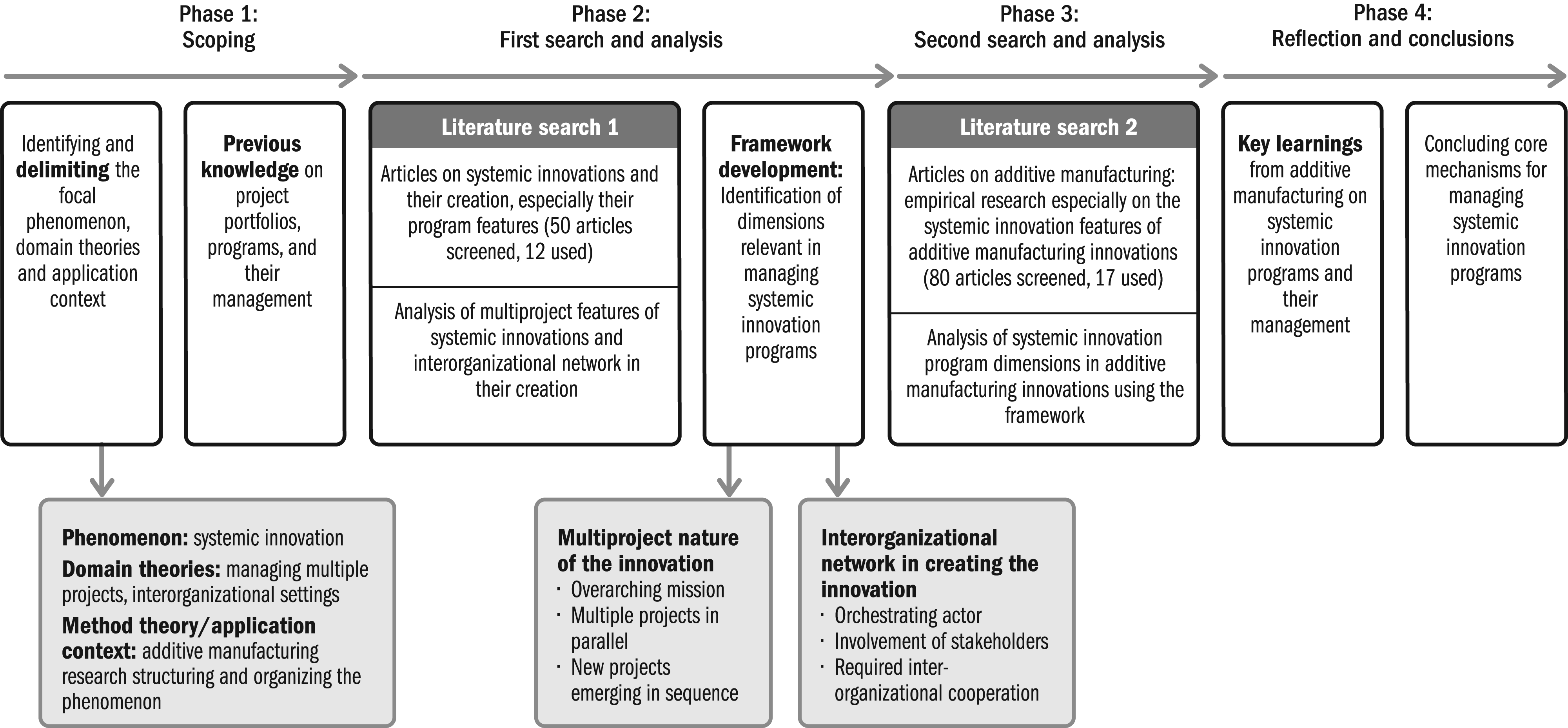
Main phases and tasks in the research.
Thereby, the search and analysis were purposively selective and creative, nonsystematic, and a dozen articles were explored in-depth. In this stream of literature, I sought the program features of systemic innovations and interorganizational cooperation in the explored articles. Consequently, I built a rough thematic framework divided into the multiproject features of the systemic innovation itself (including an overarching mission, multiple projects in parallel, new projects emerging in sequence) and the interorganizational network required to create it (orchestrating actor, involvement of stakeholders, and required interorganizational cooperation). This understanding is reported in the following section, “Systemic Innovation and Its Program Features,” supported with summary figures of the identified key themes.
The second search concentrated on additive manufacturing, specifically in such empirical studies where its program features are emphasized. While the expression “systemic innovation” appears only in a few studies, there are other studies that cover the complex system features of additive manufacturing innovations, explicate the necessity for multiple projects, and highlight the interorganizational involvement in the innovations. Again, I conducted a search—starting from operations, supply chain, and manufacturing technology journals and including innovation and technology management journals—exploring especially articles combining additive manufacturing with aspects of managing the innovation (and excluding purely technical articles). Here, some of the systemic, multiproject, and interorganizational features were identified. Of the screened articles, 17 were considered as central to the purposes of this article. In analyzing the readings, I followed the framework built based on the previous phase and then explored the studies to point out the prevalence of an overarching mission, multiple parallel and sequential projects and orchestrating actors, multiple participating stakeholders, and interorganizational cooperation. This approach structures the additive manufacturing–related findings in a separate section, “Additive Manufacturing and Requirements For its Management in a Systemic Innovation Program.”
After these steps, I explored the findings on additive manufacturing by contrasting and comparing them with program management research to reveal what they could offer as key insights on systemic innovation programs, and how systemic innovation programs could be managed based on those insights. Additionally, I explored what seems to be missing or particularly problematic in the case of additive manufacturing, considering the thematic framework on systemic innovation programs, to identify such factors that could be managed in a better way to promote the success of implementing additive manufacturing in society. For this discussion, I will highlight the key features of systemic innovation programs that were creatively chosen during and after the analysis.
While a problematizing, conceptual study enables a creative interpretation of the chosen literature streams for the purposes of the research task, it also has its weaknesses. In this study, an ordinary keyword search was not useful, since the vocabularies in systemic innovation research, multiproject management research, and additive manufacturing research do not coincide. This was mitigated through a forward and backward search from the most useful articles, purposive choice of readings, and a careful content screening. A systematic or integrative review might produce quite different results, but they would also require a more established research domain at the intersection of the literature streams, so that a search could be carried out using more established, robust keywords. Systemic innovation is viewed as a program and only two of its overarching features are covered (i.e., its multiproject and interorganizational features) due to the positioning in project management research, which also restricts the analytical findings. For example, it would have been equally interesting to explore the composition of component innovations (i.e., materials, technology, product, service, supply chain) or life cycle phases of the systemic innovation, each of which would represent additional perspectives to managing the systemic innovation program. These offer interesting possibilities for future research.
Systemic Innovation and Its Program Features
With product and service innovations, there is an assumption that the component parts of the innovation are developed in a single project. Firms use innovation projects to ideate, develop, and launch new products in the market and into full-scale operations. If external organizations are involved, they are involved as suppliers, partners, or customers whose contributions are integrated with the focal firm’s work. Here, the attention is on innovations concerning more complex systems.
Innovation in Systems Versus Systemic Innovations
It is possible and even likely that the component parts of a complex product–service system are innovated in different but potentially interconnected projects, in different parts of the organization, or even in multiple organizations representing different supply chain positions (Chesbrough & Teece, 2002). The nature of innovation for complex product–service systems is considered as different from mass-produced goods due to their complexity, extent of customization, dynamics, involvement of multiple organizations, and various other factors (Hobday, 1998). However, as Hobday’s (1998) examples show, oftentimes complex product–service systems are created in a specific project, with the focus on designing and delivering a complex and unique solution to a specific customer, implemented by a specific, contractually bound company network (i.e., project-based organization) (see also Gann & Salter, 2000).
For the purposes of this article, there is a need to distinguish between innovation in systems versus systemic innovations. Innovation in a specific system is being delivered in a single project to a customer in a contractually bound project-based organization. In turn, systemic innovation happens through multiple separate component innovations carried out in separate (even disconnected) projects, does not have a direct customer, is not necessarily contractually governed and, yet would require some interorganizational coordination. The focus of this article is on the latter; that is, systemic innovation. Midgley and Lindhult (2021) summarize five strands of systemic innovation research; this article is focused on the first strand: complementary innovations coming together in a comprehensive, technological novel system, requiring multiple stakeholders’ involvement. Table 1 offers an overview to some concepts relevant to system-related innovations with corresponding examples, with an intent to differentiate the focal concept systemic innovation from the alternatives.
Alternative Conceptualizations Concerning System-Related Innovations
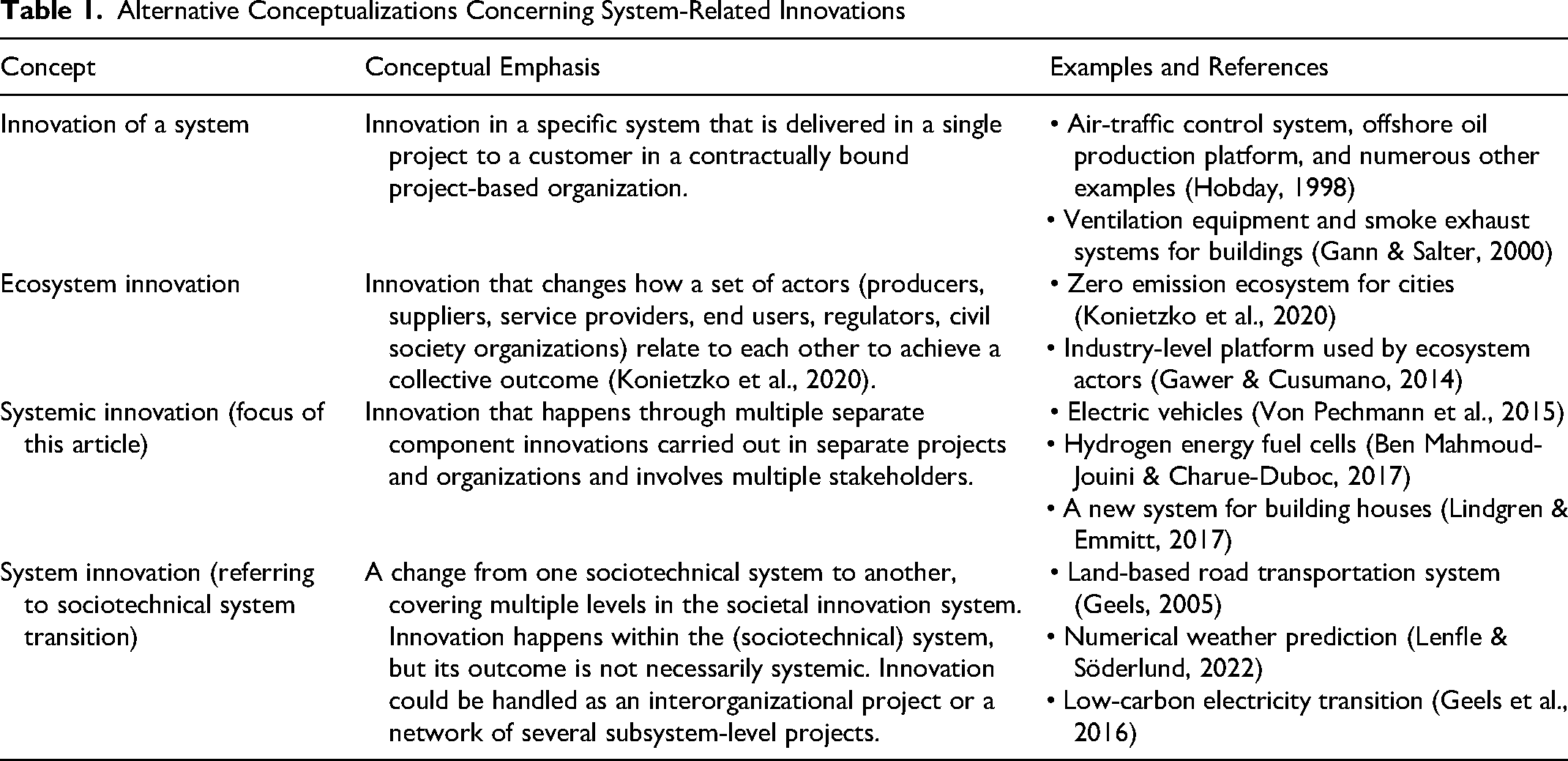
Research already offers versatile examples of systemic innovation that requires multiple innovation projects and involvement of various stakeholders and seeks broader institutional changes than merely serving a specific customer. For example, Von Pechmann et al. (2015) investigated the development of electric vehicles and pointed out the required systemic innovation: several complementary offerings are needed from different companies, and the dominant design concerning existing vehicles will need to be questioned and altered. Also, the entire sociotechnical system concerning private and public transportation requires changes, and the public sector needs to offer incentives for developing the complex system surrounding the use of electric vehicles (Von Pechmann et al., 2015). Ben Mahmoud-Jouini and Charue-Duboc (2017) report the emergence of hydrogen energy fuel cells as an example of a series of experimentation projects in an emerging ecosystem similarly reflecting the features of systemic innovations. This and other examples, particularly from the construction industry (Kang & Hwang, 2016; Lavikka et al., 2021; Lindgren & Emmitt, 2017; Mlecnik, 2013), draw attention to the need to coordinate multiple separate and even disconnected projects over time, potentially as a program, and manage the interorganizational cooperation necessary for the systemic innovation.
Some studies draw attention specifically to the information flows and systems connecting technologies and organizations, as potential key components of systemic innovations. Martinsuo (2021) reports an example of intelligent technologies and a related systemic innovation in manufacturing, where certain manufacturing-related materials would carry material-related information in themselves and enable efficiency in product information management throughout the entire life cycle of the material and products. This would require all suppliers and customers to commit to a shared material information platform and use of sensor and analytics technologies. The entire supply chains of related products would consequently require transformation, along with creating completely new supply chain positions for information technology suppliers. Furthermore, Alin et al. (2013) characterize the systemic innovation associated with building information modeling. Building information modeling tools themselves are not systemic innovations, but benefiting from their use throughout the architectural, engineering, construction, and post-project service processes optimally would require adjusting all involved firms’ internal processes. Firms would also need to engage in interorganizational cooperation and align their information flows, to ensure a thorough system and network level implementation over the lifetime of various projects and systems (i.e., buildings). Besides the multiproject and interorganizational coordination, these examples point toward the need for more formal commitments between organizations to the use of shared platforms when implementing the systemic innovation.
Multiproject Program Features of Systemic Innovation
The idea of multiple interrelated projects that share the same overarching mission is covered in the concept of programs. Programs are multiproject entities designed to achieve a goal in a specific context (Martinsuo & Hoverfält, 2018; Pellegrinelli, 1997). While earlier research has concentrated on programs that pursue change in one parent organization (Martinsuo & Hoverfält, 2018), programs may also reach outside of the boundaries of one organization, including complex systems and solutions designed and delivered to the market (Midler et al., 2019; Parolia et al., 2011), business expansion in the market (Turkulainen et al., 2015), mergers and acquisitions (Geraldi et al., 2022; Nogeste, 2010), and design and delivery of complex infrastructures used in the institutional field (Eweje et al., 2012). Figure 2 summarizes the program features of creating a systemic innovation through multiple projects and discussed as follows.
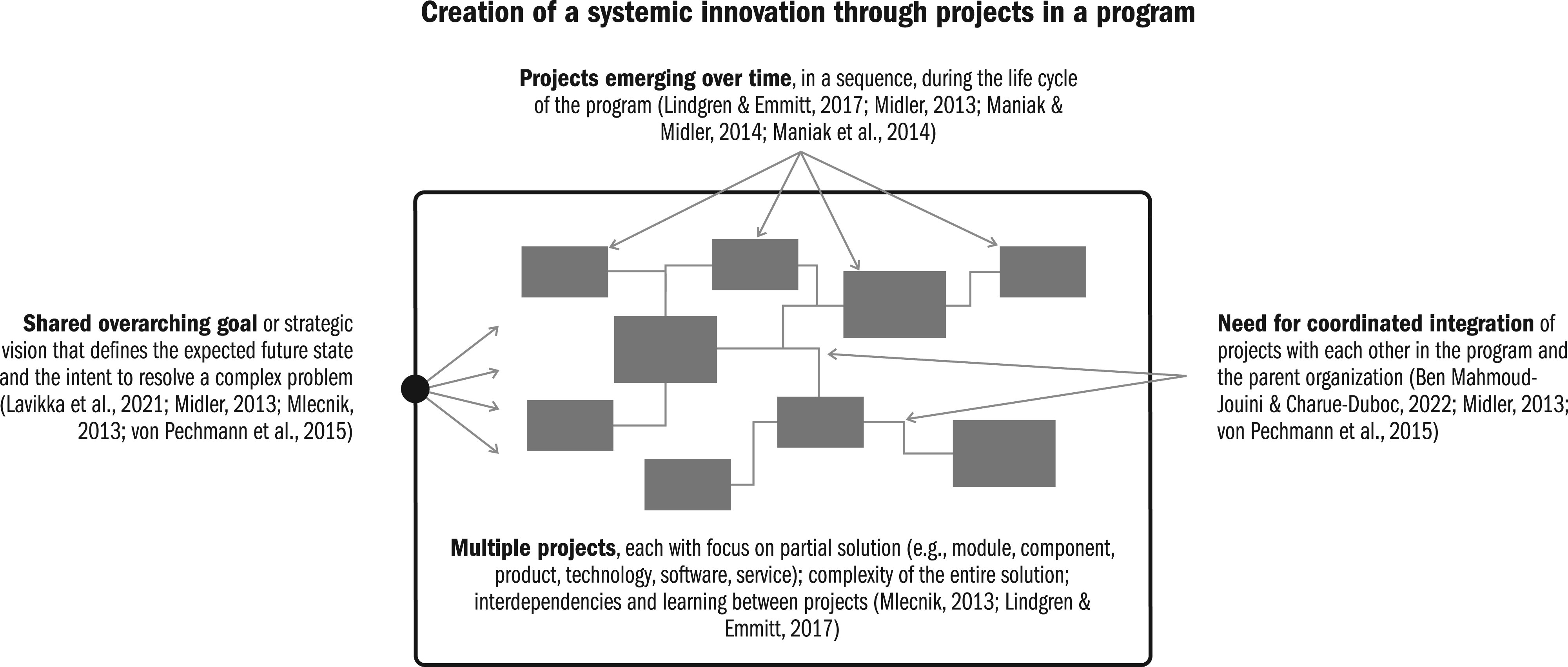
Overview of the program features of creating a systemic innovation through multiple projects.
With systemic innovations, the programs are new initiatives with an overarching mission or goal to achieve new systems and processes (in Vereecke et al., 2003; category D), but all projects are not known initially and the degree of change in the pursued outcomes is high. In systemic innovations, the pursuit of a shared, overarching goal communicates the expected, ambitious future state and some novel outcomes in a chosen domain. Earlier research has discussed various examples of overarching missions in systemic innovations, either implicitly or explicitly: development and mass diffusion of electric vehicles (von Pechmann et al., 2015); development of energy-efficient housing (Mlecnik, 2013); creating productivity improvements in the construction industry through implementing building information modeling in interfirm processes (Alin et al., 2013); diffusion of multistorey timber housebuilding systems in construction (Lindgren & Emmitt, 2017); implementation and diffusion of mechanical, electrical, and plumbing prefabrication (Lavikka et al., 2021); and development and implementation of smart homes (Ehrenhard et al., 2014). Such examples characterize the attempt not only to bring new solutions to the market, but also to transform the industry norm and practice significantly.
The above examples contain and illustrate the need for different components, products, technologies, software, and services to emerge at the same time (von Pechmann et al., 2015), or in the right order, for systemic innovation to be completed effectively and diffused in the market. The outcomes of systemic innovation programs can be considered as modular solutions (Mlecnik, 2013), where each component or module is developed in its own project. Very often, systemic innovations proceed through multiple projects that take place in parallel (von Pechmann et al., 2015) and in a sequence (Lindgren & Emmitt, 2017), sometimes referred to as a multiproject lineage (Midler, 2013; Maniak & Midler, 2014; Maniak et al., 2014). The projects may be more or less related to one another and there is a need to manage the task sequence carefully in the program (Alin et al., 2013; von Pechmann et al., 2015). When systemic innovation is emerging, the different experimental projects may represent different knowledge accumulation tasks for the emerging ecosystem (Ben Mahmoud-Jouini & Duboc, 2017). The multiproject sequence then formulates the life cycle of the program, not fully known in the beginning of the program. There is a need to carefully integrate the projects and intermediary results of the program with the parent organization, so that the outcomes from the program become useful and can be brought to market successfully (Midler, 2013; von Pechmann et al., 2015).
A key challenge concerning systemic innovation relates to the necessity of different innovation components to take place approximately at the same time, which calls for understanding the simultaneity and dependency between different innovations. In the beginning, systemic innovations may require exploration and tolerance of market and technology uncertainties to find a shared higher order goal and modes of managing that match the exploratory nature (BenMahmoud-Jouini & Charue-Duboc, 2022). According to Midler and van Pechmann (2019), systemic innovation requires ambidextrous program management that accounts for complexity in the innovation, allows for the management of multiple heterogenous projects and objectives with different time horizons, and enables handling exploratory and exploitative innovations simultaneously. In their view, traditional project portfolio management would not sufficiently cover the uncertainty and strategic flexibility necessary in systemic innovations, as all possible projects and steps cannot be defined in the beginning. There is a need for sufficient flexibility, collective learning, and interorganizational coordination, for the systemic innovation to proceed successfully (Midler & van Pechmann, 2019), and some ideas about agility have been included in project portfolio considerations (Bechtel et al., 2023; Stettina & Hörz, 2015). Program management could be used to allow some ambiguity, competition at the same time as cooperation, and coordination of heterogenous learning tracks as new projects emerge and new partners join the network over time (Midler et al., 2019).
Interorganizational Features of Systemic Innovation
It is well understood that concerning systemic innovation, all capabilities do not reside in the same organization; rather, there is an inherent need to collaborate in a network (Chesbrough & Teece, 2002). Figure 3 illustrates the network-related aspects of systemic innovation. The review of Takey and Carvalho (2016) argues that the early phases of systemic innovation differ from other types of innovations in the necessity to map the partner network very early, consider the mechanisms for coordination and cooperation, and potentially set up new business models or ventures for the innovation.
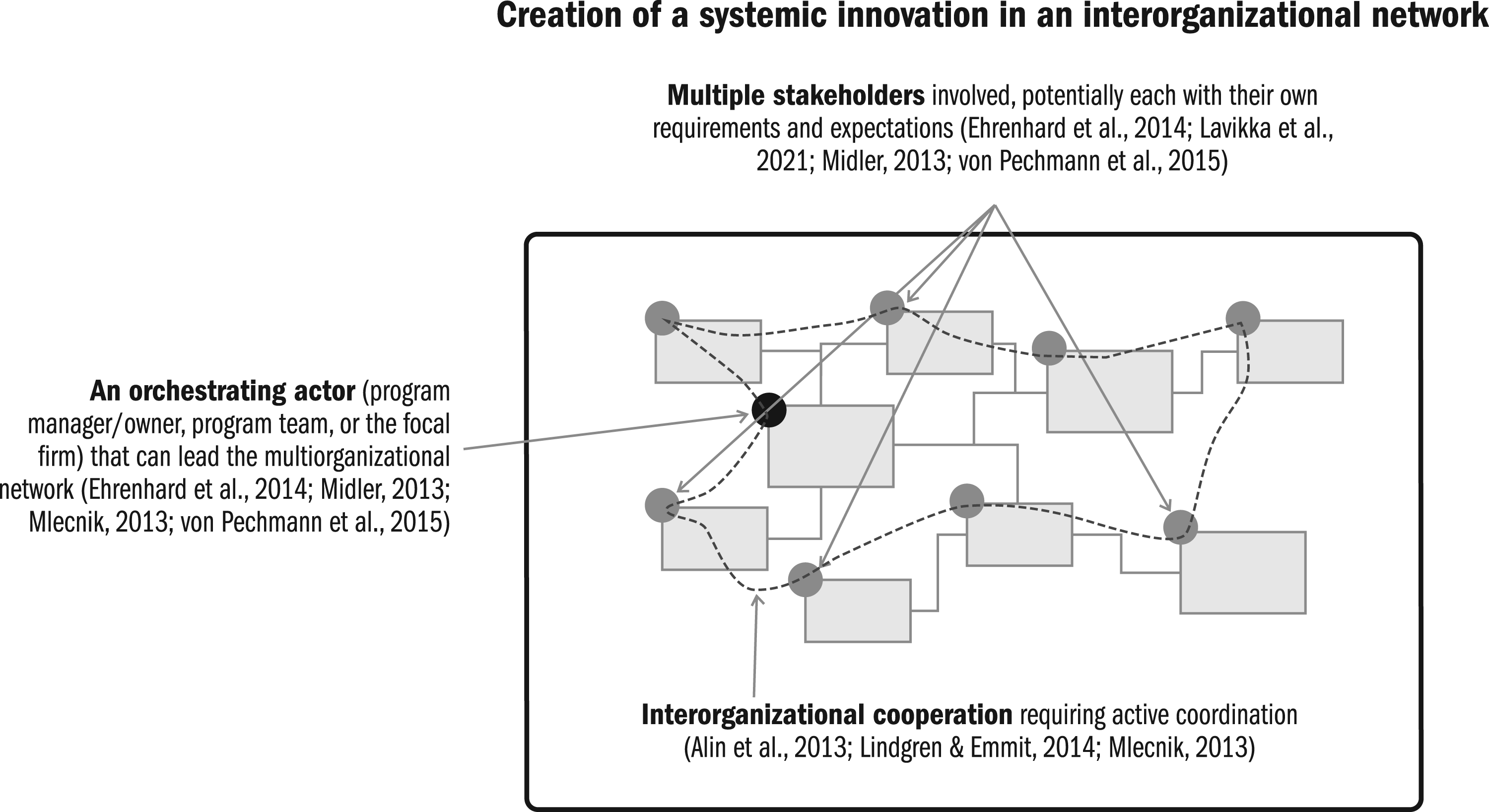
Overview of the program features of creating a systemic innovation in an interorganizational network.
Even with systemic innovation there is a need for an actor that leads (orchestrates) the interorganizational network involved in the systemic innovation. It may be a focal firm (Ehrenhard et al., 2014; Midler 2013; Mlecnik, 2013), a platform leader (Gawer & Cusumano, 2014), a program team (Midler & van Pechmann, 2019), a public actor (Ben Mahmoud-Jouini & Charue-Duboc, 2017), or a program hub (Midler et al., 2019). As systemic innovation requires years of development, it might even be that the leader or orchestrator changes or evolves over time. Midler et al. (2019) characterize this leadership as a process or community of practice, particularly due to the necessity to cover multiple time horizons and involvement of multiple organizations.
Previous research dominantly treats the systemic innovation program as one focal organization’s initiative involving its network partners. This involvement of multiple stakeholders is crucial for the creation of systemic innovation. The emergence of an interorganizational network requires the focal organization’s active effort to understand the customer and resource markets (Ehrenhard et al., 2014; Midler, 2013) and interact with possible customers and users (von Pechmann et al., 2015). The previous research on electric vehicle development shows the focal firm’s high activeness in developing the network infrastructure by identifying complementors and creating local, regional, and national partnerships already quite early in the development of the system (von Pechmann et al., 2015). The hydrogen fuel cell example suggests that the ecosystem remains in an emergent state as long as the overall complete solution is being specified, key stakeholders are being identified, and rules among the stakeholders are negotiated (Ben Mahmoud-Jouini & Charue-Duboc, 2017). A study on construction-related prefabrication showed that the different stakeholders in the focal firm’s network have different tasks and value expectations with regard to the systemic innovation and also experience different enablers and barriers to value capture (Lavikka et al., 2021). Ehrenhard et al. (2014) suggest mapping of the actors’ roles and activities in a value network to support the development and adoption of systemic innovation. Network structures for systemic innovations, however, do not stay stable and evolve over time (Kang & Hwang, 2016).
The interorganizational network for systemic innovation may require that the focal firm coordinates not only its own activities, but the activities of partners. Interorganizational cooperation in the network does not seem to occur spontaneously but tends to require the orchestrating actor’s active efforts. Mlecnik’s (2013) case study on energy-efficient housing shows how a supplier iteratively began cooperation with external actors, added new partners based on competence needs, engaged the network in various learning activities, and built continuity in the cooperation within the network (see also Ben Mahmoud-Jouini & Charue-Duboc, 2017). A study on implementing building information modeling in construction showed that the involvement of multiple organizations generally led to misalignment in systemic innovation, and project network actors had to readjust task sequences, align their knowledge bases, and reconsider work allocation to achieve desired performance (Alin et al., 2013). There are indications that the complexity of systemic innovation and the related interorganizational network may be related to diffusion of the innovation (Lindgren & Emmitt, 2017).
Interorganizational programs of systemic innovation have not been discussed explicitly, but there are indications of its potential (Andersen & Drejer, 2008). An interorganizational program would imply that the network of organizations clearly shares a higher-level objective, for example, concerning a societal change outside of their own boundaries (as in Lenfle & Söderlund, 2022). The study by Andersen and Drejer (2008) dealt with the Danish wind turbine industry, where a clearly coordinated approach to resolving energy issues emerged. Some studies characterize, for example, urban development through the concept of project ecology that includes multiple parallel and sequential projects (Hedborg & Karrbom Gustavsson, 2020; Hedborg et al., 2020) but they do not explicitly treat the multiproject entities as programs.
Systemic Innovation Programs
In response to the first research question “What are the key program features of systemic innovations?” the above analysis shows that studies portray systemic innovations through various multiproject and interorganizational features, as summarized in Figures 2 and 3. However, the multiproject entity required for systemic innovations is not usually treated explicitly as a program, and the requirements for managing systemic innovation programs are only partially covered. In the attempt to discover successful ways to manage the creation and implementation of systemic innovations, I propose the concept of systemic innovation program as follows: A systemic innovation program is an interorganizational multiproject entity that develops and implements a complex solution (consisting of multiple connected subsystems) and drives broader transformation when taken into use in an industry or society. To succeed, systemic innovation requires significant changes both within organizations, in the supply chains connecting organizations, and in the involved broader ecosystem.
The idea of a systemic innovation program purposely supplements the previously reported ideas of ambidextrous program management (Midler et al., 2019) and exploration programs (BenMahmoud-Jouini & Charue-Duboc, 2022). Where ambidexterity attempts to resolve the parallel need for exploratory and exploitative innovation in finding a suitable way of managing them (Midler et al., 2019), the idea of the systemic innovation program is to acknowledge the requirements of managing multiple parallel and sequential projects in an interorganizational setting. Exploration programs tend to concern the early phases of discovering a novel solution specifically with a certain parent organization (BenMahmoud-Jouini & Charue-Duboc, 2022), whereas systemic innovation programs would cover a broader interorganizational network and the implementation of the solution so it is used in industry or society. While systemic innovation programs may dominantly pursue increased efficiency, technological advancements, and economical gains, they may equally be used to achieve environmental and social goals. Next, I will use the themes in Figures 2 and 3 to explore an example of additive manufacturing.
Additive Manufacturing and Requirements For Its Management in a Systemic Innovation Program
What Type of Innovation is Additive Manufacturing?
Manufacturers originally used additive manufacturing (sometimes referred to as 3D printing) as a means to produce demonstrators and prototypes of new products as part of their product development process. Later, the use of additive manufacturing expanded to versatile applications of tooling and end-product manufacturing (Eyers & Potter, 2017) in various industries, ranging from the aerospace, automotive, and electronics sectors to the medical sector (Niaki & Nonino, 2017). While additive manufacturing is represented in various process types and technologies (Eyers & Potter, 2017; Luomaranta et al., 2024), the additive manufacturing–related innovation does not merely concern production technologies and processes. Additive manufacturing requires specialized materials suitable to the production technologies (Eyers & Potter, 2017); digitized three-dimensional product designs for additive manufacturing; related digital systems and services; and suitable production locations, post-processing operations, and supply chains (Luomaranta & Martinsuo, 2020; Martinsuo & Luomaranta, 2018), which differ from those used in traditional manufacturing. All these system components need to be available for additive manufacturing to become a complete innovation; thereby, researchers have started to consider a systems and systemic innovation perspective to additive manufacturing (Eyers & Potter, 2017; Luomaranta et al., 2024; Martinsuo & Luomaranta, 2018). Here, the perspective is that of large manufacturers using or considering the use of additive manufacturing and, thereby, needing the involvement of their supply chain and ecosystem in additive manufacturing implementation.
The innovation pertaining to additive manufacturing extends beyond firms and supply chains and is likely to require broader institutional change if implemented successfully. The commercial logic to additive manufacturing is expected to differ from traditional manufacturing, as it enables unique and complex product designs and smaller batch sizes and supports locating the manufacturing site near consumers (Holmström et al., 2010); this deviates from traditional manufacturing, which relies on high volumes and low-cost manufacturing locations. Additive manufacturing would not necessarily replace traditional manufacturing, for example, due to the challenge of scaling up volumes with additive manufacturing and overcoming various barriers concerning organizational arrangements in the additive manufacturing supply chain system (Roscoe et al., 2023). Instead of the high-volume, low-variety mass manufacturing of brand-label products offered by a specific large firm, additive manufacturing could enable redistributing the ownership of brands, manufacturing capacity, and distribution differently across different types of firms (designers, contract manufacturers, and service providers).
Additive manufacturing is one example of a possible radical or disruptive innovation that may change the logic with which firms operate (Chaoji & Martinsuo, 2019; Öberg & Shams, 2019). According to Steenhuis and Pretorius (2017), however, additive manufacturing cannot be simply categorized as incremental, radical, disruptive, or revolutionary innovation, because it may represent different types of innovations depending on the circumstances or whose viewpoint is taken. The additive manufacturing innovation may, therefore, include various incremental, radical, disruptive, and even revolutionary innovations as parts of the comprehensive additive manufacturing system transformation, spanning across firm boundaries. There is a need to further explore the multiproject and interorganizational nature of additive manufacturing innovation; this will be discussed in the following sections.
How Do the Multiproject Features of Systemic Innovation Programs Appear in Additive Manufacturing?
Sometimes additive manufacturing is discussed primarily because of its potential to enable complex, customized product designs, small-batch production, and manufacturing components more cheaply (Holmström et al., 2010; Knofius et al., 2019); however, its overarching mission can be understood also much more broadly—as both novel products and a completely new system of manufacturing and delivering these products. Roscoe et al. (2023) position additive manufacturing as a system technology, because it can be used to manufacture a range of subsystem components in a complex end product. Eyers and Potter (2017) emphasize the need to treat additive manufacturing comprehensively as a manufacturing system that ranges across the entire process of production, distribution, and consumption and requires system-level integration. The literature analysis by Rayna and West (2023) summarizes product innovations, mass customization, home fabrication, distributed manufacturing and global value chains, logistics, and new business models as the dimensions of societal impacts anticipated from additive manufacturing. Implementing additive manufacturing implies changes in the value propositions as well as creation of new value streams, which may complement the existing manufacturing system (Rylands et al., 2016).
Additive manufacturing literature acknowledges the necessity of strategic clarity and alignment during the decision-making on additive manufacturing investments, referring to the need to treat the overarching mission holistically. A key starting point for implementing additive manufacturing in a firm is acknowledgment of the requirements and pressures from the competitive, market, and institutional environments and decision to include additive manufacturing and related investments in the strategy of the firm (Mellor et al., 2014). Mellor et al. (2014) emphasize the necessity to align business, development, and manufacturing strategies, so they all acknowledge additive manufacturing in terms of technical, structural, and capability investments. Although firms could experiment with additive manufacturing before it becomes strategic, its necessary investments soon begin to require strategic decisions. Firms may consider additive manufacturing strategy deployment through in-house approaches or sourcing or partnering (Friedrich et al., 2022) and various internal process configurations (additive manufacturing as a stand-alone solution versus combined with traditional production technologies) and supply chain configurations (centralized versus distributed) (Bratziotis et al., 2019). Combining different strategies can be considered a way to mitigate market risks stemming from the new technology (Khajavi et al., 2015).
The strategic additive manufacturing decisions are reflected in the firms’ choices of additive manufacturing–related projects. Research indicates that firms need to be involved in multiple parallel projects in, first, building the additive manufacturing capabilities and capacity and portfolio-type screening of such projects. The systemic nature of additive manufacturing implies the necessity to identify and develop the components of the whole additive manufacturing system, including capacities for design, preprocessing, manufacturing, and post-processing (Eyers & Potter, 2017) or additive manufacturing technology, materials, and design software (Robinson et al., 2019). These components and capabilities may each require a development project of its own; the system becomes meaningful only if all components and capabilities are available at the right time. The multiple-case study by Eyers and Potter (2017) emphasized that different technologies, tools, and skills are needed for each of the system components. The innovation pathway study by Robinson et al. (2019) suggests that maturation in all the system components is needed, before new application branches can emerge in the additive manufacturing innovation pathways.
Second, besides their own capabilities, firms need to decide the application domains where they choose to use additive manufacturing as the manufacturing approach (Fontana et al., 2019; Luomaranta & Martinsuo, 2022); in other words, which products they design for additive manufacturing and manufacture through additive manufacturing, again implying choices of projects. While sometimes the application is a complex system requiring multiple additive manufacturing component designs (Roscoe et al., 2023), this is not always the case; additive manufacturing can also be used for simpler applications. The interview study by Fontana et al. (2019) revealed seven areas of value added by additive manufacturing, including prototyping, enhanced designs, incremental product launches, custom products, improved delivery, production tools, and process concentration. While all firms have their specific product mix and do not consider all these areas in their additive manufacturing implementations, this versatility implies a possibility for a portfolio of additive manufacturing implementation projects. Fontana et al. (2019) suggest screening the alternatives and evaluating the potential application domains systematically to reveal where the greatest potential exists and focus their resources effectively. Additive manufacturing as a manufacturing strategy for specific applications requires prioritizing and balancing among different evaluation criteria when choosing the additive manufacturing technology (Sobota et al., 2021) and assessing the feasibility of implementing additive manufacturing through its supply chain effects (Afshari et al., 2019).
As an emerging family of technologies, additive manufacturing may take different pathways in its emergence, which implies sequences of projects. Robinson et al. (2019) use the terms paths, pathways, and trajectories, to characterize technology emergence (see also Luomaranta et al., 2024). They differentiate between stable or stabilizing paths (leading to commercial products on the market) and emerging and branching paths (leading to societal embedding and potential beginnings of new stabilizing paths). While they do not explicitly refer to a lineage or sequence of projects, they identify a sequence of seven key steps on the innovation pathway, with each step potentially featuring some pilot or demonstration projects within the ecosystem. When, for example, certain materials and the right type of technology are available, investigating, demonstrating, and piloting with certain types of applications also become possible (Robinson et al., 2019). These phases then formulate a continuum of innovation projects, leading to commercial solutions or identification of new areas for expansion.
A potential indication of a past sequence of projects and additive manufacturing–related learning is the firm’s maturity in additive manufacturing. Haug et al. (2023) studied subject matter experts’ access to additive manufacturing knowledge through networks, additive manufacturing maturity, and their association with the perceived benefits (competitive advantages) from additive manufacturing, which showed a strong positive association between additive manufacturing maturity and competitive advantage. They identified that certain knowledge sources (consultants) are associated with competitive advantages but not additive manufacturing maturity, whereas some knowledge sources (additive manufacturing developers) promote additive manufacturing maturity and drive competitive advantages only indirectly (Haug et al., 2023). Corresponding with the idea of proactive project lineage (Kock & Gemünden, 2019), Despeisse et al. (2017) propose a sustainable value roadmapping framework for additive manufacturing, to help firms anticipate and prepare for implementing additive manufacturing into business in a sustainable way.
To conclude, previous additive manufacturing–related research does not explicitly treat additive manufacturing implementation as a systemic innovation program. However, the above examples show indications of an overarching mission, parallel projects, and sequences of projects typical in systemic innovations. Previous research emphasizes the strategic nature of a firm adopting and implementing additive manufacturing and choosing its application domains, reflected in project choices. Research also communicates the sequentiality of innovation projects in the additive manufacturing maturity, roadmapping, and pathway studies. The additive manufacturing example highlights three specific issues that challenge its implementation as a systemic innovation program: (1) the need for strategic alignment across organizational subsystems, when additive manufacturing is implemented parallel to a more traditional and enduring manufacturing system; (2) developing the firm’s own capabilities and capacities for additive manufacturing, while at the same time developing additive manufacturing–based applications and solutions to the market; and (3) the dependence of a firm on its supply chain and network when developing additive manufacturing capabilities and capacities.
How Do the Interorganizational Features of Systemic Innovation Programs Appear in Additive Manufacturing?
The manufacturing and commercial use of goods through additive manufacturing requires the right materials are available, the technologies are in place, the products have been designed for additive manufacturing, manufacturing value chain is configured for additive manufacturing, and the products are made available through the right sales and logistics channels. The supply chain process and company roles for additively manufactured goods may differ clearly from those of ordinary manufacturing (Luomaranta & Martinsuo, 2020). Whereas the additive manufacturing research dominantly concentrates on single projects (technologies, components, products, services), the systemic nature of additive manufacturing innovations and the business model shifts required for them are also acknowledged (Bogers et al., 2016; Eyers & Potter, 2017; Martinsuo & Luomaranta, 2018; Rayna & West, 2023). This is reflected in investigations that span throughout the additive manufacturing supply chain more broadly (Friedrich et al., 2022; Holmström et al., 2010; Jimo et al., 2022; Luomaranta & Martinsuo, 2022; Oettmeier & Hofmann, 2016). According to Luomaranta and Martinsuo (2022), the concept of additive manufacturing needs to be adopted in the value chain before its commercial applications can become successful on the market.
Attention in research is often directed at the goods (component, spare part, or end product) manufacturer (Bogers et al., 2016; Eyers & Potter, 2017; Oettmeier & Hofmann, 2016) as the focal, orchestrating actor coordinating its own specific supply chain. Additionally, additive manufacturing technology and material suppliers may serve an important role in the supply chain (Jimo et al., 2022; Naghshineh & Carvalho, 2022). Mellor et al. (2014) differentiate between the machine–technology supply chain (including materials) and product-related supply chain, whereas the material supply chain could also be treated separately from technology and product supply chains. Even if industrial design and engineering firms might possess crucial knowledge enabling successful additive manufacturing designs (Luomaranta & Martinsuo, 2022) and customers may become more actively involved in value creation (Bogers et al., 2016; Oettmeier & Hofmann, 2016), the manufacturing firms are typically bigger, better resourced, and more strategically positioned to orchestrate the network.
The manufacturing firm does not handle the development and deployment of all components of the additive manufacturing system itself, rather it sources from and cooperates with supply chain partners for such tasks (Friedrich et al., 2022; Luomaranta & Martinsuo, 2020). With additive manufacturing, manufacturers typically face the need to implement completely new supply chains (Bogers et al., 2016), as the stakeholders for traditional manufacturing are not necessarily involved with the materials, components, equipment, and services required for additive manufacturing. The goods manufacturer’s additive manufacturing supply chain includes such stakeholders as material suppliers (Jimo et al., 2022; Rylands et al., 2016), subcontractors, additive manufacturing service providers, additive manufacturing machine suppliers, engineering and industrial design firms, and customers (Luomaranta & Martinsuo, 2020; Martinsuo & Luomaranta, 2018). Furthermore, logistics service providers (Friedrich, 2022; Rylands et al., 2016) and external information system suppliers are needed in the supply chain if such tasks are not included in the manufacturer’s own profile. Some studies emphasize the involvement of external knowledge suppliers, such as universities and research institutes (Roscoe et al., 2023; Rylands et al., 2016), and the importance of governmental support (Roscoe et al., 2023) in the implementation and expansion of additive manufacturing implementations. The new supply chains may contain various vulnerabilities that can generate barriers to implementing additive manufacturing comprehensively (Naghshineh & Carvalho, 2022). Sourcing and distributed organizing of additive manufacturing development and deployment require specific governance due to complexities and dependencies (Friedrich et al., 2022; Jimo et al., 2022). With the simultaneity requirement and parallel projects for additive manufacturing as a systemic innovation, coordination of activities among different stakeholders is needed.
Reconfiguration of the supply chain of manufacturers in the implementation of additive manufacturing implies reconsiderations of the supply chain structure and process, as well as governance of the interorganizational relationships (Jimo et al., 2022; Luomaranta & Martinsuo, 2020, 2022; Rylands et al., 2016). It may mean the centralization versus decentralization of the supply chain structure (Bogers et al., 2016; Holmström et al., 2010), different firms’ involvement in the different value chain positions and sections of the supply chain process (Luomaranta & Martinsuo, 2022), new controls that regulate the activities in the process (Eyers & Potter, 2017), and use of external knowledge support in adopting and implementing additive manufacturing (Roscoe et al., 2023; Rylands et al., 2016). Bogers et al. (2016) emphasized the increase of customer-centricity in additive manufacturing production systems, which is both a starting point for production flexibility and a consequence of more decentralized value chains. Rylands et al. (2016) found in two case examples of additive manufacturing implementations that the additive manufacturing value stream does not necessarily replace the traditional value stream, but both value streams may coexist in parallel.
The complex multiorganizational setting has been considered a barrier to additive manufacturing adoption and diffusion (Martinsuo & Luomaranta, 2018), and inter-organizational cooperation appears as a necessity for firms to succeed in additive manufacturing. When a firm moves from traditional manufacturing to additive manufacturing, their supply chain partners will also need to change their offerings and operations, calling for their mutual rearrangement of competences (Friedrich et al., 2022; Holmström et al., 2010; Luomaranta & Martinsuo, 2020, 2022; Oettmeier & Hofmann, 2016). Kapetaniou et al. (2018) characterized the different landscapes of additive manufacturing production ecosystems in different industries and indicate that the competitive dynamics in additive manufacturing ecosystems are more relational than in traditional manufacturing ecosystems due to the increased user-centricity and necessity for cooperation between firms. Especially small and medium-sized firms will need to cooperate with other firms when implementing additive manufacturing to complement their own limited resources and knowledge with those of other firms (Haug et al., 2023; Martinsuo & Luomaranta, 2018; Luomaranta & Martinsuo, 2020).
In conclusion, this overview reveals that additive manufacturing research includes interorganizational program features of the orchestrating actor; involvement of stakeholders, particularly as parts of the goods manufacturer’s supply chain; and the increasing need to cooperate among firms in coordinated, customer-oriented value creation. In particular, additive manufacturing research highlights three main program features that generate requirements toward managing systemic innovation. First, additive manufacturing innovation takes place in networks that are governed through contracts or public sector support for capability development at the institutional level, not within a single parent organization, and this calls for interorganizational involvement in systemic innovation programs. Although there are indications of more relational competitive dynamics in additive manufacturing compared to traditional manufacturing, the contractual nature of supply chain relationships may challenge the possibilities to build successful project roadmaps and sequences between the organizations. Second, different organizations in the supply chain often lead the different phases of development concerning the systemic innovation of additive manufacturing; they are not necessarily well connected with one another, which is in contrast to ordinary project lineage research with an intraorganizational focus. Third, systemic innovation of additive manufacturing is created while at the same time some applications are being delivered to customers that have an increasingly central role in defining the product design. This implies that there is a need to integrate the projects and their outcomes into multiple parent organizations cooperating with one another.
Discussion
The second research question asked was: How are the key program features manifested in the management of systemic innovation programs? Following, I will first discuss the key insights on implementing additive manufacturing through its multiproject and interorganizational program features, then consider the requirements for managing systemic innovation programs by reflecting on the additive manufacturing–derived implications on systemic innovation and program management research.
Implementing Additive Manufacturing in a Systemic Innovation Program
Research on implementing additive manufacturing showed evidence of its management as a multiproject program (an overarching mission, parallel projects, and sequences of projects); for the most part, however, these features were examined in separate studies, not comprehensively. Similarly, the involvement of an interorganizational network (the orchestrating actor, involvement of stakeholders as part of the manufacturer’s supply chain and engaging in active interorganizational cooperation) was treated in a piecemeal manner in separate studies. This study revealed four key insights, characterizing the implementation of additive manufacturing in a multiproject, interorganizational systemic innovation program.
First, the strategic, interorganizational program features of additive manufacturing were revealed. Emergence of the systemic innovation initially started with building the necessary additive manufacturing capabilities and could eventually lead to capability complementing or destruction in some of the involved organizations. This adds to the solution-centric idea of systemic innovations (Midler et al., 2019; Parolia et al., 2011), the intent of knowledge accumulation through experiments (Ben Mahmoud-Jouini & Charue-Duboc, 2017), and early, exploratory program phases (BenMahmoud-Jouini & Charue-Duboc, 2022) by putting emphasis on developing the aspired capabilities to design and deliver various solutions in the future. In the case of additive manufacturing this implied new manufacturing systems and supply chains that together could be used to deliver new kinds of components and products to the market. The systemic nature of additive manufacturing crosses organizational boundaries and requires capability development, not just in the focal manufacturing firm but also with customers, suppliers, and other partners. The current research evidence suggests the importance of involving external knowledge suppliers and government support in capability building, besides the direct supply chain partners, for the systemic innovation program to overcome potential vulnerabilities in the supply chain and build more long-lasting effects.
Second, additive manufacturing examples demonstrated that the different phases of developing systemic innovation are led and implemented by different organizations, creating interorganizational project sequences. The idea of an interorganizational project sequence adds to previous intraorganizational project sequence and lineage research (BenMahmoud-Jouini & Charue-Duboc, 2022; Kock & Gemünden, 2019; Maniak & Midler, 2014; Midler, 2013), by acknowledging that projects required by specific systemic innovation and hosted in different organizations are dependent on and connected to one another. The need to consider interorganizational project sequences draws attention outside of a single firm’s boundaries, to the level of the supply chain and industry, which adds to the organization-centric view and opens up new research pathways for studying systemic innovations.
Third, additive manufacturing research revealed the tendency of organizations to select their additive manufacturing–related projects and applications following their own strategies, without paying attention to technology emergence and evolution pathways occurring in other organizations or between organizations. This implies disconnects in the timing of different projects and a need to pay attention to coordinating the multiproject programs interorganizationally. Previous conceptual research has acknowledged the importance of considering stakeholders as part of project portfolio management (Derakshan et al., 2019; Martinsuo & Ahola, 2022; Martinsuo & Geraldi, 2020). The additive manufacturing examples do not directly refer to project portfolios or programs, but the challenges with progressing in additive manufacturing implementation indicate the need to coordinate the simultaneity and correct timing of projects necessary for the systemic innovation (Luomaranta et al., 2024). Where program management research tends to adopt an intraorganizational view, the supply chains in additive manufacturing include and require contracts between the involved firms and the firms’ shared commitment to the overarching mission driving the innovation. The contractual aspects bring novel requirements to governing systemic innovations as interorganizational multiproject programs.
Fourth, the simultaneity and sequence of projects in interorganizational settings cause the need to integrate the projects and their outcomes into multiple parent organizations. Additive manufacturing research has covered the need for projects’ strategic alignment within single organizations, accumulation of additive manufacturing maturity over time, and the need for additive manufacturing adoption across organizations in the value chain. Program management research similarly suggests that the success of a change program depends on a successful integration of program outcomes to the organization. The necessity to integrate projects and outcomes into a parent organization has been discussed largely as a focal organization’s concern in previous research (BenMahmoud-Jouini & Charue-Duboc, 2022; Lehtonen & Martinsuo, 2009; Turkulainen et al., 2015), and systemic innovations now add the necessity to recognize the interorganizational integration context. The parallel paths of exploitative and explorative innovations have been acknowledged for systemic innovations in ambidextrous program management (Midler et al., 2019; Midler & van Pechmann, 2019. The organizational arrangements for integrating projects and outcomes in interorganizational settings clearly increase complexity, compared to ordinary program management research.
The Systemic Innovation Program and Its Management
This study portrays the systemic innovation program as a representative of interorganizational multiproject entities (cf. Martinsuo & Ahola, 2022) with the pursuit of broader acceptance and effects in the industry or society. While the right, simultaneous timing of system components and broader societal connections of systemic innovations challenge the implementation of these innovations (Adner, 2006), program management could offer tools for handling the parallel and sequential multiproject setting in a coordinated and collaborative way. As the technology trajectories (also for additive manufacturing) span over several years, there is a need to consider the long timeframes and find ways to integrate the interorganizational program toward a shared overarching mission. Based on the framework developed for this study (in the systemic innovation section), I reflected on the findings in the section “Additive Manufacturing and Requirements for Its Management in a Systemic Innovation Program” to discover issues that are either missing or somehow problematic and that might offer solutions to driving and speeding up the implementation of additive manufacturing through its consideration as a systemic innovation program. This reflection yielded requirements for some key mechanisms in managing systemic innovation programs, suggested as follows.
Identifying and Using a Neutral Orchestrating Actor
The example of additive manufacturing showed that innovation projects were typically initiated based on a focal manufacturing firm’s strategic mandate, and the simultaneity and sequence of other projects needed for the systemic innovation could be completely accidental. If the parts of systemic innovation are disconnected from each other both contractually and temporally, they will likely be carried out without proper interorganizational multiproject coordination. Lenfle and Söderlund (2022) point out the central role of project-oriented agency, that is, the collective action of actors involved in driving a system-level transition. A manufacturing firm may not be the right orchestrating actor, as it may hinder the inclusion of competitors, some suppliers, and potential customers in the program network and their involvement in creating and adopting the innovation. Previous research suggests that interorganizational program management may require setting up a multiorganizational program team or hub (Midler et al., 2019; Midler & van Pechmann, 2019), or using an institutional public-sector regulator, funding institution, or the like, as a temporary early-phase coordinator or support in the program (Ben Mahmoud-Jouini & Charue-Duboc, 2017; Midler & Alochet, 2023; von Pechmann et al., 2015). A neutral orchestrating actor could be formed by multiple stakeholders interested in systemic innovation. For example, publicly funded research and development programs represent such contexts where and how systemic innovations could be created, and they may feature a cross-organizational program management team or project management office (PMO). Public funding is often also a prerequisite for enabling the tolerance of uncertainties and ecosystem creation necessary in the early phases of systemic innovations (Takey & Carvalho, 2016).
Using the Innovation Front End to Craft a Shared Overarching Mission
Again, the additive manufacturing example revealed the innovation goal primarily from a focal firm’s perspective while also acknowledging its broader societal implications. The overarching mission was not treated as something shared among organizations involved in the supply chain. Interorganizational cooperation early in the systemic innovation program could be beneficial through the necessity to make sense of and negotiate a shared overarching mission during the front end of the program (Lenfle & Söderlund, 2022; Thiry, 2002). The mission represents an idea of the expected value and change achieved through the program (Martinsuo & Hoverfält, 2018). The literature analysis by Takey and Carvalho (2016) points out that all aspects of the pursued business model should be identified and defined already at the front end of the innovation, including the customer value proposition, supply chain, customer relationships, and earning logic. The actors may need to negotiate and prioritize their value expectations already quite early and take into account alternative project designs, competing and sequential projects, and projects benefiting from one another (Martinsuo et al., 2019). The shared higher-level objective and finding an interorganizationally coordinated approach would potentially promote a better innovation diffusion process across the firms (Andersen & Drejer, 2008).
Interorganizational Roadmapping of the Multiple Projects in Systemic Innovation Programs
The analysis in the context of additive manufacturing suggests there is a need to create understanding of the development tasks and phases for creating and implementing systemic innovation over time between firms, each with their own aspirations and roles in the supply chain. The firms could well collaborate throughout the value chain more comprehensively (Luomaranta & Martinsuo, 2022) and, thereby, also build a joint roadmap and schedule for the projects toward comprehensive systemic innovation. The proactive multiproject lineage is particularly important for strategic and longer-term oriented portfolio success (Kock & Gemünden, 2019). In the context of systemic innovation, there is a need to manage the task sequences carefully, especially in interorganizational settings (Alin et al., 2013; von Pechmann et al., 2015), which likely applies for additive manufacturing too.
Coordinating Multiproject Portfolios and Sequences Across Organizational Boundaries in the Systemic Innovation Program
The additive manufacturing–related analysis summarized that strategies and project selection are dominantly considered for a single focal firm, disconnected from the innovations of other firms. For systemic innovation to succeed, there needs to be some extent of coordination across projects in the interorganizational setting, crossing the organizational boundaries. To benefit from coordination, the network of relevant firms should be identified already quite early in the innovation process (Ben Mahmoud-Jouini & Charue-Duboc, 2017; von Pechmann et al., 2015; Takey & Carvalho, 2016). In the beginning of the program, there could be a chance to map the activities of each actor in the network systematically (following Ehrenhard et al., 2014; Takey & Carvalho, 2016). The multiproject coordination that crosses organizational boundaries could promote a faster development and diffusion of systemic innovations.
Conclusions
Contributions and Practical Implications
As a core contribution, this article proposes a new program type—a systemic innovation program—and recommends acknowledging both its multiproject and interorganizational features in its management. A systemic innovation program is defined as an interorganizational multiproject entity developing and implementing a complex solution that drives broader transformation, eventually used in an industry or society while also transforming organizations, supply chains, and the broader ecosystem. This study compiled the extant knowledge of the multiproject and interorganizational nature of systemic innovation into analytical frameworks and sought evidence on them via the example of additive manufacturing. The concept of systemic innovation program offers a practical way to treat projects that depend on other projects and require broader involvement in society, connect and coordinate them on multiple levels, and promote systemic innovation success. As a multilevel entity, this concept also reflects the desired expansion of project studies and creates a possibility to build bridges toward other scientific fields (as proposed by Geraldi & Söderlund, 2018).
For program management research, the findings encourage treating the systemic innovation program more comprehensively, not just as portfolios but also as project sequences (supporting the work by Martinsuo & Ahola, 2022; Midler, 2013; Maniak & Midler, 2014) and in interorganizational settings, to complement the dominantly intraorganizational view (Derakshan et al., 2019; Martinsuo & Geraldi, 2020; Martinsuo & Hoverfält, 2018). The findings suggest that systemic innovation programs build and supplement (not necessarily to replace and destroy) capabilities in multiple organizations. This adds the capability-building orientation to solution-centric systemic innovation research (von Pechmann et al., 2015) and the interorganizational dimension to multiproject lineage (Kock & Gemünden, 2019; Maniak & Midler, 2014; Midler, 2013) and program management research (BenMahmoud-Jouini & Charue-Duboc, 2022; Lehtonen & Martinsuo, 2009; Turkulainen et al., 2015).
For research on systemic innovation, the additive manufacturing example offers evidence on the reasons underlying the slowness in implementing systemic innovation and suggests program management as a potential resolution. The findings namely revealed governance challenges both in terms of the multiproject program design and the interorganizational network creating systemic innovation. The multiproject aspects of additive manufacturing implementations tend to be treated implicitly when organizations choose their projects and additive manufacturing application domains in isolation and involve creative and even accidental processes of supply chain collaboration. Also, the interorganizational sequences of related projects emerge accidentally over time, instead of in a coordinated manner.
As systemic innovations have been shown to benefit from ambidextrous program management (Midler et al., 2019; Midler & van Pechmann, 2019) and exploration in a series of projects (BenMahmoud-Jouini & Charue-Duboc, 2022), program management generally could be used in advancing systemic innovations in society, including those concerning additive manufacturing. In such an emerging and uncertain setting, managing systemic innovation programs would allow the tolerance of ambiguity in the early phases of innovation, emergence of new projects over time, and coordination across time horizons and organizations. The additive manufacturing examples yielded practical ideas on key mechanisms for managing the systemic innovation program in these ways: identifying a neutral orchestrating actor, using the innovation front end to craft a shared overarching mission, interorganizational roadmapping the multiple projects in the program, and coordinating interorganizational multiproject portfolios and sequences.
This study suggests practical implications, especially for organizations that develop and implement systemic innovations such as additive manufacturing. There is a need for such firms to consider the roadmaps of different innovation projects, map the network of organizations needed for the different projects, and collaborate to agree on the tasks of all supply chain partners in such projects. As this study has advocated interorganizational cooperation already in the early phases of the systemic innovation program, organizations would likely benefit from cooperating with various supply chain partners in joint research and development projects, likely supported by external funding and neutral orchestration. Such programs will require the development of new mechanisms for achieving fluent interorganizational program management, including a mutually agreed approach for program leadership and structures of governance. Furthermore, the insights from this study could be tested and also applied to other types of systemic innovations such as those dealing with sustainability transitions and other grand societal challenges.
Limitations and Avenues for Further Research
The validity of this research is restricted through the choice to frame the study into systemic innovations, multiproject lineage management, and program management. There are alternative theoretical lenses—ranging from systems engineering and technology and innovation management to various organizational and interorganizational theories—each of which could offer its unique grounding for considering additive manufacturing projects and programs. For example, a stronger focus on innovation types and contents would benefit from respective theories such as those concerning system architectures or radical innovations. In turn, the lens of technology adoption and diffusion would draw attention to the level of industry and highlight innovation adopter features and behaviors, whereas the lens of open innovation would bring depth to stakeholder involvement in innovation creation and its challenges. It is evident that these and many other theoretical options will offer fruitful future research pathways for studying systemic innovation programs.
The choice of additive manufacturing as an example of a systemic innovation restricts transferability of the results to technology-centric innovations with a commercial orientation. It is likely that other types of systemic innovations—such as service-centric or purely digital innovations, sustainability-oriented transformation, and innovations with a nonprofit or public sector focus—behave differently when organized into interorganizational programs. Further research could be designed to continue the exploration of different types of systemic innovation programs, especially those that pursue solutions to societal grand challenges (Ika & Munro, 2022).
This study has drawn attention to the concept of a systemic innovation program, inviting researchers and practitioners to view systemic innovation as a temporary endeavor that could be managed in a coordinated entity, irrespective of how many projects and organizations are included in it. Empirical research on the multiproject and interorganizational features of systemic innovation programs is encouraged, building on and expanding the frameworks reported in this article. Programs, however, are just one possible mode of organizing (Geraldi et al., 2022) understood thus far in limited ways in interorganizational settings (Martinsuo & Ahola, 2022), which also implies that systemic innovations may be organized in many other ways, and these alternatives, their justifications, and related routines will call for more research. This article focused on technology-centric systemic innovations, whereas Midgley and Lindhult (2021) pointed out four other types of systemic innovations, each potentially opening up rich avenues for further research concerning the approaches to organizing for systemic innovations in interorganizational settings.
Furthermore, it would be interesting to explore the composition of component innovations (i.e., materials, technology, product, service, supply chain), the life cycle phases (i.e., initiation, planning, implementation, diffusion, exploitation), actor network structures, and network dynamics of different systemic innovation programs. Various aspects of managing systemic innovation programs would also be of interest in terms of actors’ tasks in the stakeholder network, ways of overcoming progress barriers stemming both from multiproject and interorganizational settings, ways of handling complexity and uncertainty, and the public–private cooperation needed in the different innovation phases. In the interorganizational setting, more knowledge is also needed on such ambidextrous aspects of multiproject management to complement the formalization-oriented idea of project portfolio management.
Empirical studies are encouraged specifically at the conceptual intersection of systemic innovations, program management, and additive manufacturing research. Additive manufacturing could offer an excellent context to study the nature and interplay of project strategies of different firms that are involved in additive manufacturing innovations in the different phases of the supply chain. Additive manufacturing implementation could be compared with other manufacturing innovations—such as implementing lean manufacturing, just-in-time manufacturing, or various advanced manufacturing technologies that have diffused broadly—to differentiate among different types of systemic innovations and learn from past successes. There is also a need to investigate the emergence and evolution of additive manufacturing innovations and their coordination requirements and practices, when multiple organizations drive innovations in the different sections of additive manufacturing supply chains in parallel and in a sequence. Furthermore, additive manufacturing innovations might enable investigations into organizing and managing multiproject entities that are less clearly specified than ordinary within-firm project portfolios.
Footnotes
Acknowledgments
I express my gratitude to Christophe Midler for inspiring the connection between systemic innovations and program management. I thank the special issue editors for organizing the paper development workshop and the workshop participants for their helpful feedback. Also, I thank the handling editors and reviewers for the constructive and insightful feedback, and for Tampere University Center for Research on Project and Service Business (CROPS) for their support when writing an early version of this article.
Declaration of Conflicting Interests
The author(s) declared no potential conflicts of interest with respect to the research, authorship, and/or publication of this article.
Funding
The author(s) received no financial support for the research, authorship, and/or publication of this article.
