




Abstract
Digital transformation projects often fail due to tensions that emerge between temporary project teams set to design digital transformation and the permanent organization where digital transformation is to be executed. As a potential organizational response to such tensions, we introduce the notion of prototype work; in other words, the actions and interactions facilitated by making prototypes. Through a real-time longitudinal study of a digital transformation project in a Swedish manufacturing firm we specify prototype work, addressing strategic tensions, temporal tensions, and cross-functional tensions at different loci of temporary–permanent interfaces and, in turn, how both temporary and permanent organizations are transitioned.
Keywords
Introduction
Digital transformation is becoming ubiquitous across organizational landscapes. In manufacturing industries, the thoroughgoing strategic implications of digital transformation are captured in policy initiatives such as Industry 4.0 and concepts such as the fourth industrial revolution (Li et al., 2021; Schwab, 2017). One salient way of undertaking digital transformation is through temporary projects wherein digital technologies contain representations of projected future operations that allow them to serve as artifacts in organizational design and change projects that cut across functional boundaries (Ben Mahmoud-Jouini & Midler, 2020).
Digital transformation projects are designated temporary organizations (Lundin & Söderholm, 1995). They entail time-limited endeavors to develop and implement software in an iterative and incremental manner, using agile development approaches (Guinan et al., 2019). Digital transformation projects interact with organizational setups, aiming to change ways of working in permanent organizations undergoing digital transformation (Hanelt et al., 2021). Beyond changing products or services, digital transformation projects also have the broader goal of transforming permanent organizations, as digital information permeates and reshapes how they operate and compete (Whyte, 2019). Accordingly, digital transformation projects, as transitory units, perform transitions in both internal and external dimensions of temporary organizations (Jacobsson et al., 2013; Locatelli et al., 2020; Lundin & Söderholm, 1995; Sydow & Windeler, 2020).
These interactions in temporary–permanent dynamics are prone to enact tensions (Braun & Lampel, 2020; Geraldi et al., 2020; Stjerne & Svejanova, 2016). Following Smith and Lewis (2011, p. 382), tensions are here conceived as inherent and persistent in organizing, as they consist of “elements that seem logical individually but inconsistent and even absurd when juxtaposed.” Within a temporary organization, the diverse set of project team members (Guinan et al., 2019) may imply different understandings of time horizon, temporal perspective, and pace (Geraldi et al., 2020; Stjerne et al., 2019; Söderlund & Pemsel, 2022). This is particularly prevalent for digital transformation in manufacturing industries where prevailing stage-gate models contrast with the agile and iteratively coupled management of digital transformation projects (cf. Geraldi et al., 2020).
Understanding how to manage these tensions is important on both practical and theoretical levels. Smith and Lewis (2011) assert that the response to tensions is crucial to the fate of an organization. Despite strategic ambitions, a substantial portion of high-profile digital transformation projects fail (Davenport & Westerman, 2018). The failure rate is reported to be as high as 70% (see Huang et al., 2023; Jiang, 2023b; Wu et al., 2003). Jiang (2023b) observes this as a hard landing of digital transformation with numerous explanations, for example, a lack of digital mindsets, digital cultures, or digital capabilities. Following work by Geraldi et al. (2020), Stjerne et al. (2019), and Wimelius et al. (2021), these challenges can be attributed to responses to tensions. For example, Geraldi et al. (2020) investigate how temporal tensions are manifested in strategic initiatives and the role of temporal work in creating, reinforcing, and transforming such tensions. Similarly, Stjerne et al. (2019) exemplify how boundary-spanning practices, such as framing, synchronizing, and hyping, can resolve temporal tensions in interorganizational projects. Wimelius et al. (2021) focus on a specific type of strategic initiative—technology renewal initiatives—and discuss underlying tensions and how organizations respond to opposite poles of a tension through integrating, splitting, pretending, and avoiding. We build on this work and extend analyses of tensions to the context of digital transformation projects and the role of prototypes as organizations respond to emerging tensions in the intersection between temporary and permanent organizing.
Temporary organizing scholars have called for more research in validating and expanding the understanding of emergence and resolution of tensions in other project contexts (see Stjerne et al., 2019). Recent research indicates that digital transformation projects serve as important change agents (Correani et al., 2020; Guinan et al., 2019; Huang et al., 2023; Nylén & Holmström, 2015). Despite their role as temporary organizations founded to interact with and change permanent organizational processes, digital transformation projects have been largely overlooked in the research on project management. 1 To fill this void, we suggest digital transformation projects to be a suitable context for studying tensions emerging at the temporary–permanent interface and how to respond to tensions.
Prototypes are inherent in digital transformation projects (Huber et al., 2020) and product development projects (Ben Mahmoud-Jouini et al., 2016; Ben Mahmoud-Jouini & Midler, 2020; Liedtka, 2015; Thomke, 1998; Thomke, 2003). Interactions in digital transformation projects center on prototypes and their emerging representations of the software (Huber et al., 2020). Prototypes help understand how tensions are addressed and responded to at the temporary–permanent interfaces of digital transformation projects. Expanding upon Ben Mahmoud-Jouini and Midler’s (2020) inquiries of prototype archetypes in digital transformation projects, we focus beyond the essence of prototypes to what prototypes facilitate when responding to tensions. We suggest the notion of prototype work to describe actions and interactions enabled by making prototypes, in other words, the first, typical, and preliminary models of something. 2
Our aim is to explicate tensions experienced by organizational actors in digital transformation projects and explore whether and how prototype work aid in responding to tensions at the crossroads of the temporary and the permanent. We pose these research questions: (1) What tensions are enacted between temporary and permanent organizations in a digital transformation project and (2) how does prototype work address these tensions?
These questions are examined by means of a single real-time case study of a leading industrial firm, both in terms of market position and global coverage as well as in terms of volumes of digital transformation projects. We study how a temporary organization, with a duration of approximately three years, sought to create changes in activities carried out in the permanent functional organization. The focal temporary organization is composed of a project team endowed with a specific mission to introduce model-based definition (MBD) through a product life cycle management (PLM) system at one of the company’s main plants. The strategic vision of digital transformation at the case firm is to introduce 3D models to change how manufacturing and assembly work is conducted. We observe how team members interact with different stakeholders in the permanent organization to implement the strategic vision.
In our case analysis, we combine insights from theories on temporary organizing, digital transformation, and prototypes to identify how a temporary organization introduced a model-based way of working in a permanent organization. Our study provides additional insights into the project management literature on the inner workings of digital transformation projects. One contribution is the identification of three tensions: strategic, temporal, and cross-functional tensions and their primary loci of emergence at the temporary–permanent interface. In addition, we propose prototype work as an organizational response to tensions. Finally, we demonstrate how transition in both temporary and permanent organizations can be facilitated by prototype work.
This article is organized as follows: in the succeeding section, we discuss digital transformation projects as temporary organizing. We draw attention to two features of digital transformation: (1) how tensions arise when digital transformation projects are situated at the temporary–permanent interface and (2) how digital artifacts and their prototypical representations enable actions and interactions (i.e., prototype work) at the temporary–permanent interface. Next, we describe the methods used in the empirical study and how we analyzed the project processually through narratives. We then report our main empirical findings and our analysis with three narratives in relation to the emergence of tensions and how these tensions are responded to by prototype work. Our concluding discussion suggests contributions to literature by focusing on the role of prototype work serving as a link between temporary and permanent organizing.
Theoretical Framework
The omnipresence of digital technologies is undeniable, characterized by features such as virtual representation, modularity, scalability, and generativity (see Hanelt et al., 2021). Digital imperatives are underscored in concepts such as the second machine age, the fourth industrial revolution, and Industry 4.0 (Brynjolfsson & McAfee, 2014; Li et al., 2021; Schwab, 2017). Digital transformation has emerged as an umbrella term denoting the radical impact of digital technologies on organizations and has been defined “as a process where digital technologies create disruptions triggering strategic responses from organizations that seek to alter their value creation paths while managing the structural changes and organizational barriers that affect the positive and negative outcomes of this process” (Vial, 2019, p. 121).
The promises of digital transformation in renewing value propositions are manifold, entailing not only accelerating product and service development processes but also optimization of operations and the everyday functioning of firms; in other words: how work is done (Hanelt et al., 2021). In this vein, firms employ an onslaught of digital transformation projects (Correani et al., 2020; Guinan et al., 2019; Huang et al., 2023; Nylén & Holmström, 2015). Such digital transformation projects consist of a diverse set of team members, usually representing different functions in the organization, sometimes also incorporating externally hired consultants. A digital transformation project team is assigned to a specific task such as transformation of one or several organizational processes or operations. This task is to be completed for a specific time duration. Project transition takes place through the highly iterative process in which digital transformation projects are managed and interact with their surrounding context, often using agile approaches adopted from software development. Thus conceived, digital transformation projects are temporary organizations in the sense suggested by the 4 T framework of Lundin and Söderholm (1995), with “a set of diversely skilled people working together on a complex task over a limited period of time” (Goodman & Goodman, 1976, p. 494). As part of such an endeavor, digital transformation projects serve the critical role of enacting strategic changes with high longevity in a permanent organization by means of a temporary organization (Geraldi et al., 2020). One key feature of digital transformation projects is that they are situated at the intersection of temporary and permanent organizing. Another key feature in digital transformation projects is that they focus on infusing changes in the permanent organization by means of digital artifacts.
For decades, project management research has examined the relationship between temporary and permanent organizations (see e.g., Brookes et al., 2017; Sydow & Windeler, 2020). This relationship ties into a long-standing discussion in project management research regarding temporary–permanent dynamics (see e.g., Bakker et al., 2016; Geraldi et al., 2020; Lundin & Söderholm, 1995; Sahlin-Andersson & Söderholm, 2002; Stjerne & Svejanova, 2016; Sydow & Windeler, 2020; Söderlund & Tell, 2011). Some elements of these discussions are particularly relevant as they suggest how tensions are inherent to digital transformation projects. First, in defining projects as temporary organizations, researchers have often foregrounded the temporal element (Bakker et al., 2016; Sahlin-Andersson & Söderholm, 2002). That is, the duration of a project is limited even at its outset (and its completion can be assessed), which contrasts with going-concern presuppositions of permanent organizations (Stjerne et al., 2019). Second, research has recognized that projects do not take place in a vacuum; rather, projects operate in a context of more or less permanency with which there is a relationship (e.g., Bechky, 2006; Engwall, 2003; Sydow & Windeler, 2020). Third, while project contexts may differ, a particularly notable setting for temporary–permanent interaction is project-based organizations (e.g., Hobday, 2000; Sydow & Windeler, 2020; Söderlund & Tell, 2011). A salient feature of project-based organizations is that they are permanent organizations where development and delivery of products and services mainly take place through temporary projects. Last, but not least, temporary organizations are essentially agential in the sense that they are both instrumental and projective (Lindkvist & Söderlund, 2002). Actions and completion of temporary organizations induce transition of aspects of team, task, and time, not only in the temporary organization, but also in relation to organizational goals, expectations, and control of the permanent organization (Jacobsson et al., 2013; Locatelli et al., 2020).
Much of the literature acknowledges what can be termed tensions between these two faces of organizing by projects. While digital transformation projects have been identified as an integral feature of digital transformation (Correani et al., 2020; Guinan et al., 2019; Huang et al., 2023; Nylén & Holmström, 2015), their more specific relationship to tensions between temporary and permanent organizations as understood in the literature on project management have not yet been examined. Since digital transformation projects provide a setting where digital transformation is both a means for project delivery (Söderlund & Pemsel, 2022; Whyte, 2019) as well as an end in terms of enduring organizational change (Hanelt et al., 2021; Vial, 2019), tensions are an important property that needs to be understood and managed (Wimelius et al., 2021).
Tensions in the Context of Digital Transformation Projects
We draw attention to three types of tensions with contrasting poles in digital transformation projects, namely (1) strategic tensions between goal formulation and implementation, (2) temporal tensions between different temporalities entailed by stage-gate and agile development cycles, and (3) cross-functional tensions between specialization and collaboration.
Digital transformation, which aims at technology renewal, is inherently strategic (Geraldi et al., 2020; Hanelt et al., 2021; Wimelius et al., 2021). Correani et al. (2020) highlight the importance of consistency between strategy formulation (e.g., guiding policies of digital transformation) and strategy implementation (e.g., rollout plans and actions). A recent special issue of Project Management Journal® (PMJ), titled “Information Technology Project Management,” emphasizes the importance of digital transformation programs to manage the massive and complex nature of digital transformation, where a digital transformation program can be seen as “a temporary organization built between an enterprise’s strategic and operational layers to guide digital strategy implementation” (Jiang, 2023b, p. 329). However, the disconnect between strategy formulation and strategy implementation, or strategic landing, can render tensions and conflicts (Wu et al., 2023). Huang et al. (2023) underscore the role of transformational and adaptive leadership in achieving the goals of digital transformation (see also Vial, 2019). Especially when the strategic objectives of digital transformation are pursued as a change program entailing digital transformation projects, eventual outcomes can be attributed to how strategic goals are mediated between the program level and project activities at the operational level (Jiang, 2023b).
Digital transformation projects are carried out by a diverse set of team members, with differing skills and serving different functions (Guinan et al., 2019); some tensions pertain to diverging understandings of temporality within the project team (Braun & Lampel, 2020). For instance, team members may subscribe to different temporal perspectives and preferences (Geraldi et al., 2020). In a manufacturing context, agile digital transformation projects are iterative with changing requirements, whereas stage-gate project management models are linear with fixed objectives. Temporal tensions can thus arise from diverging temporalities and temporal norms (Stjerne et al., 2019) and mismatching temporal orders (Söderlund & Pemsel, 2022). Similar to interorganizational projects, which involve diverse sets of actors as described in Stjerne et al. (2019), we posit that digital transformation projects are likely to be characterized by diverging temporal understandings and temporal regularities, which prompt temporal shifts in temporal zones (Söderlund & Pemsel, 2022).
Digital transformation projects in a manufacturing context are often situated in project-based organizations where projects constitute the units of production (Söderlund & Tell, 2011). To achieve complex problem-solving through knowledge integration, one characteristic of project-based organization is the emphasis on cross-functional work, and teams are composed of members of different specializations selected from different functions in the permanent organization (Ratcheva, 2009). As highlighted by Vial (2019, p. 129), with digital transformation “changes to the structure as well as the culture of an organization lead employees to assume roles that were traditionally outside of their functions.” Changes in roles (Bechky, 2006), along with the expertise inherent in those roles, pose challenges to knowledge coordination and integration (Ratcheva, 2009; Söderlund & Tell, 2011; Tell, 2017). Bechky (2006) illustrates how roles and role expectations are negotiated and reproduced. Digital transformation may in this sense initiate unexpected negotiations of roles, prompting questions about how knowledge diversity is maintained and encompassing dimensions of knowledge specialization and integration of knowledge in professional communities (Ratcheva, 2009; Söderlund & Tell, 2011; Tell, 2017).
Prototype Work Beyond Prototype Archetypes
How organizations respond to tensions is a potential contributor to the outcomes of digital transformation projects. Following Smith and Lewis's (2011) conceptualization, on the one hand organizational actors can adopt a defensive stance or succumb to organizational inertia by not addressing the tensions; on the other hand, organizational actors can accept and resolve the poles of tension. For example, Wimelius et al. (2021) illustrate in a digital transformation technology renewal project how organizational actors proactively resolve tensions by accommodating the two poles and choosing one pole over the other. Simultaneously, they may choose to articulate a resolution without committing to it or opt to avoid the tension altogether.
The project management literature addresses some of the abovementioned tensions through boundary-spanning practices (Stjerne el al., 2019) and temporal work (Geraldi et al, 2020). We suggest that another avenue for potential responses lies in a key feature of digital transformation projects: the infusion of changes in the permanent organization through the design and use of digital artifacts. In the context of a digital transformation project, digital artifacts encompass various prototypes. Agile digital transformation project management involves short iterations, leading to the emergence and frequent modification of different prototypes embodying software requirements to a varying degree of completion, including “not only functional pieces of software but also intermediate work products such as paper prototypes, click dummies, or UML models” (Huber et al., 2020, p. 271).
Christophe Midler and Sihem Ben Mahmoud-Jouini, along with colleagues, bridge the research on prototypes to project management (e.g., Ben Mahmoud-Jouini et al., 2016; Ben Mahmoud-Jouini & Midler, 2020; Maniak & Midler, 2014). In the context of design thinking, Liedtka (2015) explains that prototypes as a tool can act as a playground for designers and customers to test assumptions and create vivid preexperience. Inspired by Liedtka (2015), Ben Mahmoud-Jouini et al. (2016, p. 149) suggest that in an innovation project management context, prototyping as a design thinking tool involves “techniques that facilitate making abstract ideas tangible (storyboarding, user scenarios, metaphors, experience journeys, business concept illustrations, and so on).”
Ben Mahmoud-Jouini and Midler (2020) extend their inquiry by examining the embodiment dimension of the prototype, with a varying degree of materiality and maturity: from a physical mock-up, storyboard, or performance to a functional version of a product or service. They propose a classification of archetypes of prototypes into three categories: stimulator, demonstrator, and validator archetypes with specific roles, functions, and expected outcomes in the design process. Stimulators appear in the early phase of innovation processes, such as inspiration stages and idea generation stages, to “stimulate the creativity of the design team members” (Ben Mahmoud-Jouini & Midler, 2020, p. 65). Demonstrators serve as initial proof of concepts and “enable evaluation of the first concepts generated before the development” (Ben Mahmoud-Jouini & Midler, 2020, p. 66). Like the role prototypes play in new product development process, demonstrators enable experimentation when design hypotheses or assumptions are tested and validated (Thomke, 1998; Thomke, 2003).
Based on the concept–knowledge design model (Le Masson et al., 2010), Ben Mahmoud-Jouini and Midler (2020) suggest the roles of stimulator in an innovation process to be primarily knowledge generation (from other extant knowledge) and concept generation (from knowledge), whereas the roles of demonstrator are knowledge generation (from concepts) and concept generation (from other existing concepts). They also complement stimulator and demonstrator with the validator archetypes identified in the literature, common at the detailed development stage, that “acquire knowledge about conformity to the specifications, manufacturability, and market acceptance of the solution” (Ben Mahmoud-Jouini & Midler, 2020, p. 67).
Prototypes play a ubiquitous role in digital transformation projects, with agile development revolving around the interactions associated with them (Huber et al., 2020). Responding to Ben Mahmoud-Jouini and Midler’s (2020) calls for research on “the collective work and the coordination required around the artifacts” (p. 69), we introduce the notion of prototype work as a concept encompassing the roles of prototype archetypes and the situated actions and interactions facilitated by them, including but not limited to ideation (Liedtka, 2015), experimentation (Thomke, 1998; Thomke, 2003), and knowledge and concept generation (Le Masson et al., 2010). We view the development of digital artifacts (such as software) as a highly iterative and dynamic process with different types of prototypes omnipresent throughout. For example, for each agile iteration, team members interact with one another to formulate software requirements in physical and/or digital form and test them with other stakeholders at the permanent organization; through this process a functionable piece of software emerges. Prototypes in this sense are also malleable as their properties are intentionally indeterminate (Huber et al., 2020).
When examining prototypes beyond their functions, one can observe the recurring interactions at the crossroads of the temporary and the permanent, where team members and stakeholders give meanings to the focal digital artifacts and the envisioned changes in the permanent organization. Less is known about how such interactions can respond to the tensions inherent in digital transformation projects. We therefore set out to answer these research questions: (1) What tensions are enacted between temporary and permanent organizations in a digital transformation project and (2) how does prototype work address these tensions?
Methodology
TurbineCo (a pseudonym), a Swedish gas turbine manufacturer, is an exemplary case for studying digital transformation. The case company is a CoPS (complex products and systems) provider where products characteristically are capital intensive, complex, low in volume and tailor-made, and typically involve a project-based organization (Hobday, 2000; Söderlund & Tell, 2011). The production of gas turbines is made-to-order, highly complex, and under constant scrutiny for high reliability (Bergek et al., 2008). An average gas turbine comprises more than 10,000 parts, many of which are made and customized to order; therefore, it becomes crucial to store hundreds of thousands of part drawings and 3D models and manage their ever-growing updates.
Against this backdrop, TurbineCo initiated several digital transformation programs to digitalize its entire product life cycle. We followed one particular digital transformation project involving model-based definition (MBD) in real time for three years between 2017 and 2020 (Sun, 2022). The project aimed to customize modules in a new product life cycle management (PLM) system to introduce model-based ways of working to manufacturing and assembly workers (i.e., digital information and models instead of documents) (Söderlund & Pemsel, 2022; Whyte, 2019). The focal digital transformation project, then, was both a digital infrastructure project to implement product life cycle management, and a manufacturing/assembly business process digitalization project to develop model-based definition. In the project, agile development principles were adopted, with incremental releases semiannually between Q4 2017 and Q3 2018 and quarterly between Q4 2018 and Q1 2020. Based on this longitudinal single-case study, we gathered qualitative data stemming from in-depth semistructured interviews, observations, and documents (see Table 1 for an overview). Our involvement in the model-based definition project commenced before the first release. We scheduled the research trips in connection to planned releases of the product life cycle management system, to study the model-based definition project processually while it was unfolding in real-time between 2017 and 2020.
Overview of Data Sources
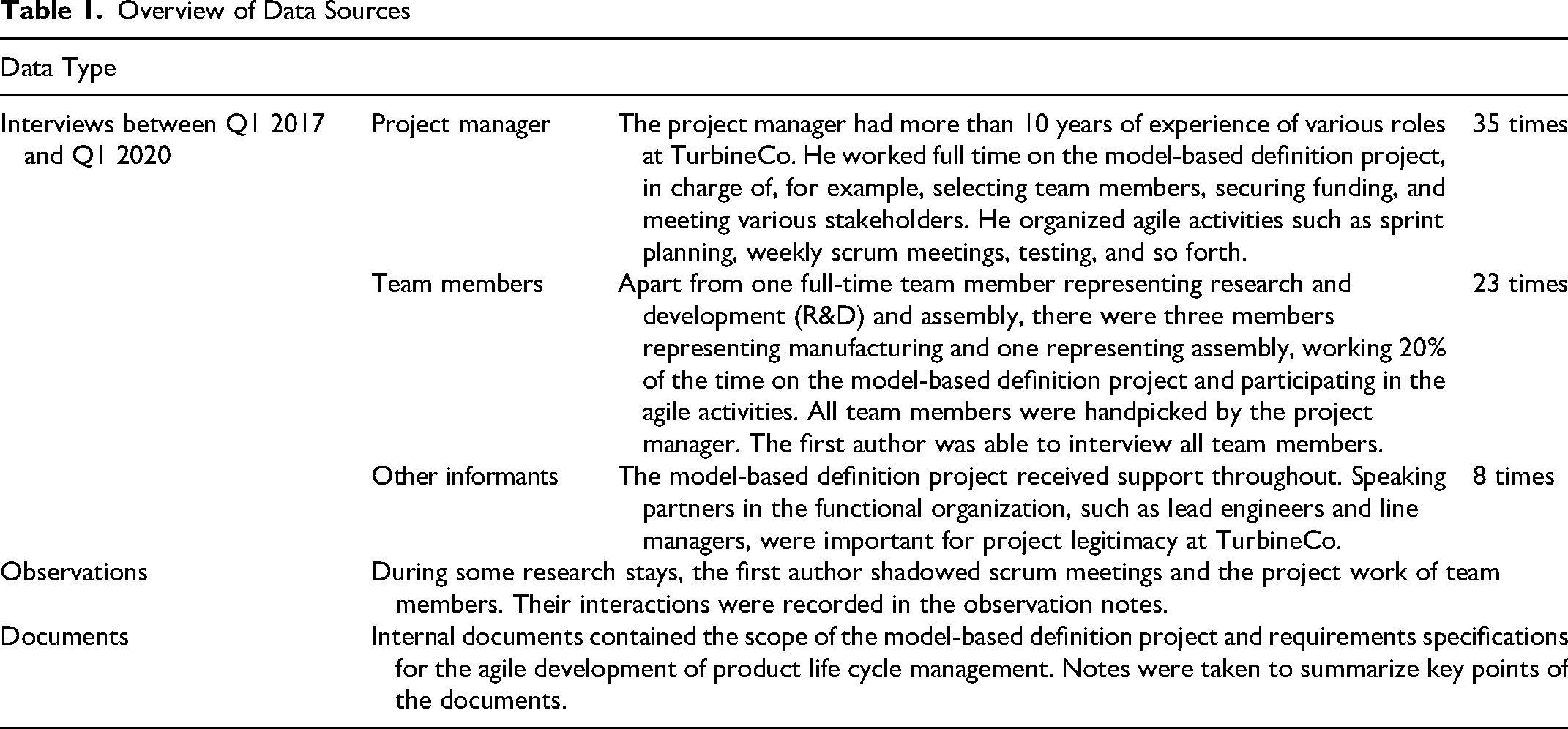
Temporary organizing is inherently processual. In this study we applied a process perspective, previously denoted process as narrative (Brunet et al., 2021). The project happenings were recounted by the participants through retrospective accounts, ongoing activities (in vivo) and prospective project plans, to connect the past, present, and future. Our empirical focus was not to reveal “the ‘truth’ of what happened, but rather reveal processes of sensemaking by different protagonists who make rather than reflect reality.” (Brunet et al., 2021, p. 838) We interviewed and observed team members’ project work. Interviewees were encouraged to share narratives regarding interactions with their colleagues in manufacturing and assembly, based on an interview guide with open-ended questions concerning the progress of project work, perceived challenges, and its (planned) responses. In total, 66 interviews were conducted with the project manager, all team members, and other important informants involved in the project. On average, each interview lasted approximately one hour. The first author made approximately 10 hours of nonparticipant observations of project work and project meetings to gain additional insights into some snippets of the events. We also had access to project documentations on-site, including scope outlines and user and software requirements specifications of the product life cycle management system.
The abductive data analysis process moved back and forth between empirics and concepts (Alvesson & Kärreman, 2007). We first constructed a project timeline (Langley, 1999) according to the eight releases and project work (see Figure 1). Close to the planned termination of the project (around Release 3.4), the team composition changed when the development and maintenance of the product life cycle management system was handed off from an external to an internal unit. To conduct in vivo data analysis when data collection was underway, we focused on the experience of the project team members in challenging situations. After each research visit, the first author transcribed interviews verbatim, and highlighted in the transcripts and observational notes the quotes and impressions describing the perceived challenges without applying any theoretical lenses. These notes were also useful as the project was ongoing in real time, and team members’ sensemaking of situations could change over time. The open-ended questions in the interview guide were updated based on the in vivo analyses.
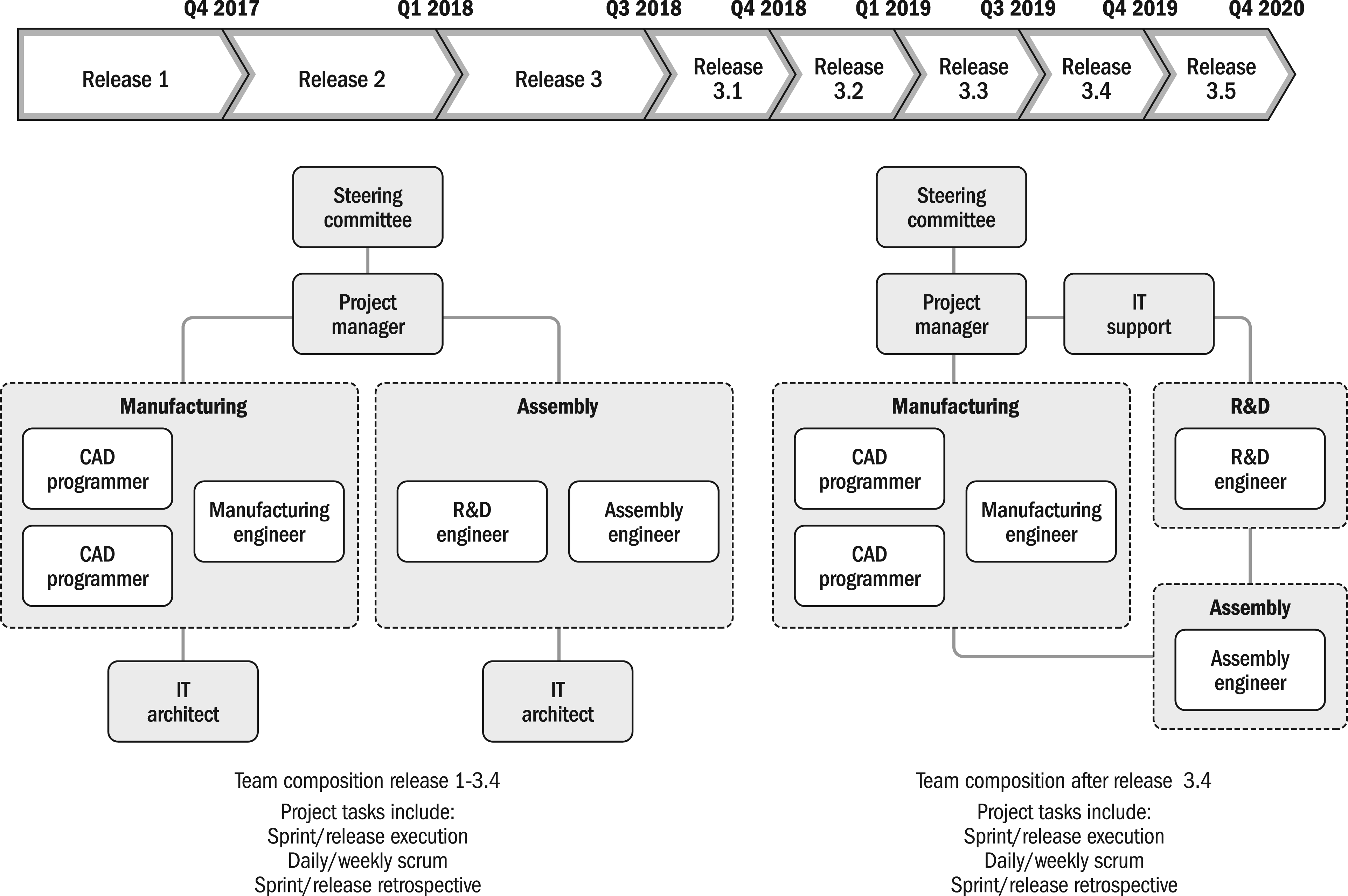
Project timeline and project team composition.
When the data collection was completed, we focused on how the temporary–permanent dynamics would inherently lead to tensions (Smith & Lewis, 2011). The challenges perceived by the model-based definition project team were framed as manifestations of tensions at the interfaces between the temporary organization (the model-based definition project) and the permanent organization (the functional organization) at TurbineCo in three distinct types. A first area of tension occurred when strategic discrepancies were experienced between digital transformation–related goals and their implementations (Correani et al., 2020; Geraldi et al., 2020; Jiang, 2023b). The differences in the temporal understanding of digital transformation revealed a second area of tension (Braun & Lampel, 2020; Geraldi et al., 2020; Stjerne et al., 2019; Söderlund & Pemsel, 2022). A third area of tension concerned the coordination of roles and knowledge (Beckky, 2006; Ratcheva, 2009; Söderlund & Tell, 2011; Tell, 2017). We coded the occurrences of tensions across interview transcripts and observation notes in NVivo (see Table 2 for the data structure).
Coding of Tensions
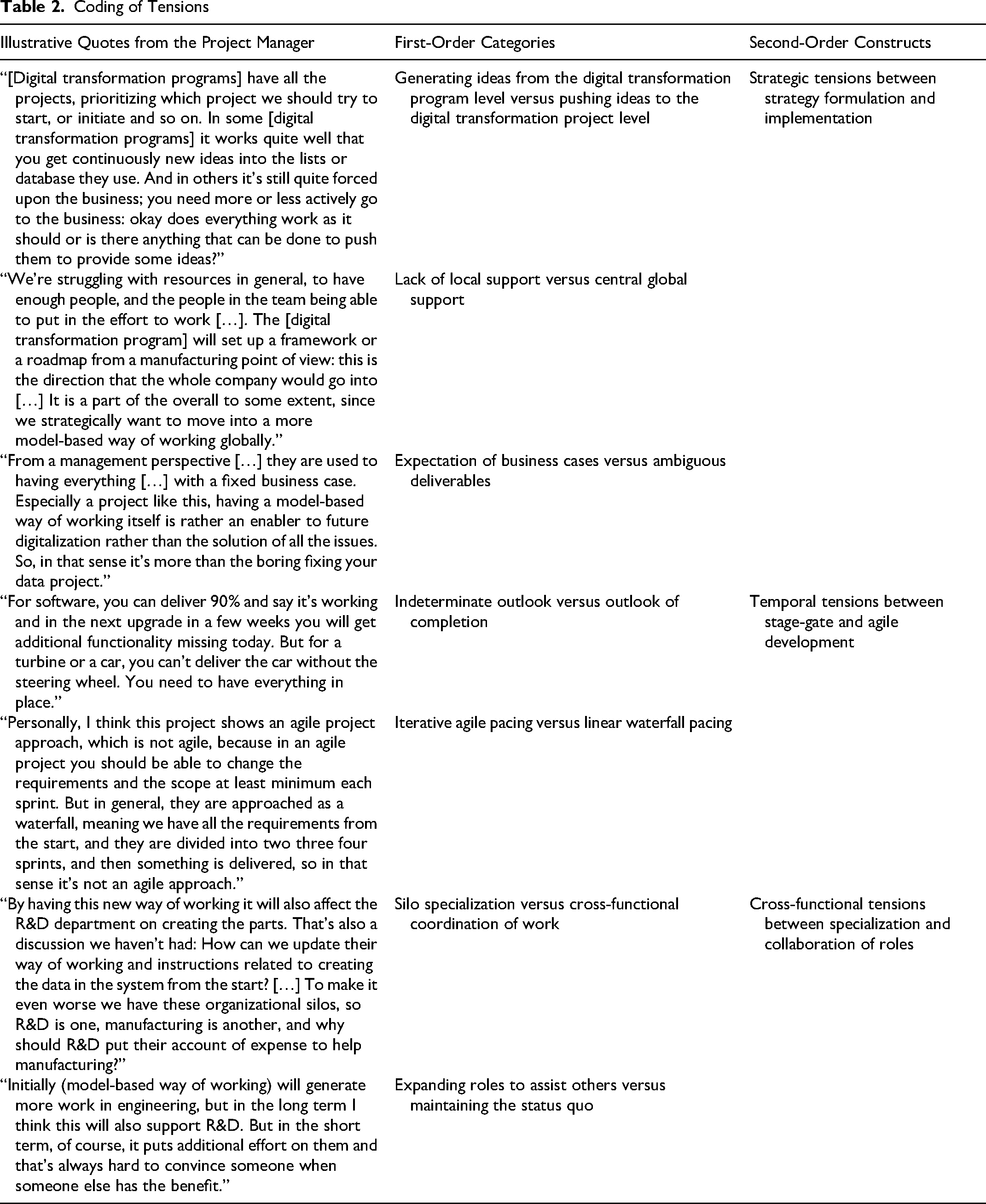
Next, we observed a novel type of organizational response to tensions, where the emerging physical and digital representations of the product life cycle management system were utilized beyond their initially intended roles in the development process (Huber et al., 2020). For instance, members of the model-based definition project team not only employed the use case diagram to formulate and validate user and software requirements with IT architects, but they also engaged with other stakeholders in brainstorming ideas for improvement. Our analysis of these actions and interactions around prototypes unveiled a new type of tension response: what we conceptualize as prototype work in the forms of stimulation, demonstration, and validation (Ben Mahmoud-Jouini & Midler, 2020). Prototype work gradually contributed to the resolution of identified tensions and facilitated transitions in both temporary and permanent organizational structures.
Instead of revealing the project in its entirety, we used the scope of this article as a guide to delineate tensions through three narrative accounts, with the central plot of responding to tensions (Brunet et al., 2021). Following, we introduce the background of the model-based definition project, the context and the permanent organization in which it was situated, and prototype work enabled by agile software development.
Temporary Model-Based Definition Organization and Permanent Functional Organization at TurbineCo
TurbineCo was no stranger to 3D models, however it was not until the early 2010s that 3D models were used to represent a full-scale gas turbine with all its components in a new turbine development project for the first time. After this accomplishment, a pet project was formed to investigate how physical drawings could be replaced with 3D models in manufacturing and assembly work. External consultants were invited to identify which digital technologies had the most potential. They found that the model-based definition approach and the product life cycle management system were key to change operations in manufacturing and assembly. Meanwhile, there were widening chasms among R&D, manufacturing, and assembly, respectively, due to the prevalent use of outdated paper drawings. Workers became increasingly frustrated by interruptions, and nonconformance costs in production multiplied.
As part of a large leading multinational conglomerate, TurbineCo and its sibling subsidiaries in the power generation segment followed directives from the parent company to set the agenda for digital transformation and also for customers and suppliers in the industry. The conglomerate decided to replace the incumbent product life cycle management system with a new product life cycle management system, developed and implemented by its own digital factory division. Shortly thereafter, a local digital transformation project, denoted the model-based definition project, started in 2017. The project team included experienced R&D engineers as well as operators from manufacturing and assembly, working together with IT architects.
Manufacturing and assembly work could unfold in multiple ways, depending on the degree of completeness of the information contained in the drawings and/or models. In a drawing-based way of working, manufacturing and assembly would prepare their work by receiving drawings from R&D to create numerical control codes and paper-based work instructions, respectively. Instead, in a model-based way of working, 3D models replaced physical instructions and representations entirely. Manufacturing and assembly workers were to retrieve numerical control codes and work instructions in one digital platform via customized modules in the new product life cycle management system.
The strategic goal of the focal digital transformation project was to improve operations in manufacturing and assembly, moving TurbineCo steps toward a smart factory. More specifically, the project visions were to, first, enable concurrent engineering practices where manufacturing and assembly work could start at an earlier phase, so that lead time and nonconformance costs would be reduced. Second, to facilitate collaboration, 3D models were promoted as the main representations of components across the product life cycle within the firm. Third, information islands between different functions caused by using paper drawings could be bridged.
Prototype Work in Software Development
The product life cycle management system was developed following agile approaches, with repetitive and incremental releases. The vision of model-based ways of working materialized into items on the scope document and in the project backlog. Before each release of the product life cycle management system, the team prioritized the items and created specific software and user specifications, with the assistance of IT architects. The first three semiannual releases of the product life cycle management system took place with the scheduling of Release 1 in Q4 of 2017, Release 2 in Q1 of 2018, and Release 3 in Q3 of 2018. The project team developed and customized features in the product life cycle management system such as user interfaces. The project was conducted in a test environment, with no connection to the incumbent CAD computer-aided design (CAD)/computer-aided manufacturing (CAM) programs and enterprise resource planning (ERP) systems. After the product life cycle management system went live, the project work continued throughout the next five quarterly releases: Release 3.1 in Q4 of 2018, Release 3.2 in Q1 of 2019, Release 3.3 in Q3 of 2019, Release 3.4 in Q4 of 2019, and Release 3.5 in Q1 of 2020. Eventually, some model-based ways of working were witnessed in assembly work, utilizing 3D models and digital work instructions via the new product life cycle management system. Due to the COVID-19 pandemic, model-based ways of working were put on hold in manufacturing.
We first observed that the team created various prototypes in software development (Huber et al., 2020). Digital prototypes, such as use cases, unified modeling language diagrams, and IT tests, embodied user and software requirements of model-based ways of working. Physical prototypes included mock production with no parts produced and proof of concept with parts produced, both involving actual manufacturing and assembly workers in the permanent functional organization. The collective situated actions and interactions around these prototypes are what we term prototype work. Expanding upon Ben Mahmoud-Jouini and Midler’s (2020) work on prototype archetypes, we categorize three main forms of prototype work in terms of stimulation, demonstration, and validation:
In summary, some prototypes emerged during the making of the product life cycle management system, facilitating actions and interactions beyond agile software development. In the subsequent section, we position these manifestations of prototype work as organizational responses to the identified tensions.
Empirical Findings
TurbineCo hoped that through a temporary organization, such as the model-based definition project, more ways of working in the permanent functional organizations would be digitalized. We observed that the undertaking was not friction-free. In this section, we detail how strategic, temporal, and cross-functional tensions emerged. We delineate in each narrative how different prototypes, intended for software development, were also important in responding to tensions through three manifestations of stimulation, demonstration, and validation.
Narrative 1: Strategic Tensions
To digitalize was a top management strategic decision. The global conglomerate that owned TurbineCo had the vision of becoming a truly digital company and supplied TurbineCo with a digital factory portfolio. TurbineCo, like its sibling plants, set up digital transformation groups in the functional organizations, to align ongoing digital transformation projects and coordinate digital transformation programs in company-wide roadmaps. These roadmaps served as guides, offering ideas and inspiration at the digital transformation program level, inspiring digital transformation projects, and delimiting scopes where necessary. At the same time, model-based definition and digital transformation at large remained buzzwords, misunderstood by workers and middle managers at the permanent functional organization of TurbineCo, which boiled down to the diverse experiences and expectations of digital transformation. The model-based definition project team, despite their familiarity with 3D models, was also new to model-based definition. The central question its members asked themselves at the outset was: “Do we believe in digitalization?”
To believe was to learn and experiment with what model-based definition would entail during the undertaking. The project team soon became experts and endorsers of model-based definition in manufacturing and assembly. As a majority of team members had only 20% involvement in the project, they practiced model-based ways of working in their daily work together with their peers. To have middle management onboard was critical as they sustained the project by providing project funding and allowing project members to reduce 20% from their daily work and devote this time on the project instead. Initially, the project funding would only remain until Release 3. The project manager had to pitch for more resources shortly after project commencement. However, the project manager was expected to build a business case that pinpointed a fixed value of model-based definition in terms of how it would affect nonconformance costs and lead time. This was problematic as the team could not quantify the benefits, yet numbers were crucial for the managerial buy-ins.
Prototype Work
Narrative 2: Temporal Tensions
TurbineCo had a traditional stage-gate workflow. Every gas turbine, upon commissioning, was customized to suit the needs of the customer. This product life cycle was by no means agile, though the vision was to achieve some level of flexibility. After working with the IT architects for a few releases, the team realized some differences between the business and IT in their views on agility. The project manager pointed out that agile approaches with partial delivery and a backlog in the software industry contrasted with the logic of full delivery in manufacturing industries. In industrial contexts, product life cycle management could be delivered with incompletion and defects fixed and enhancements added later on, whereas a gas turbine would be expected to work immaculately upon delivery.
To make matters worse, the agile software development, as experienced by the project team, was a predictive waterfall approach in disguise. For each release, the planning of the next sprint took place during the ongoing sprint, from a predefined pool of requirements. To change scope in the middle of a planned sprint, a formal change request must be submitted and approved by the IT architects. A tug of war started when a business requirement was deemed not fulfilled by the project team, which could be addressed by reformulating the business requirement for the next release or the release after next release. The project team could also submit a change request to have it addressed during the release, which would incur a higher expense and in turn lead to fewer business requirements eventually given the time and budget.
Prototype Work
Narrative 3: Cross-Functional Tensions
The project manager was aware of the implications of the project being located at the intersection of R&D, manufacturing, and assembly, which he described as different functions will be forced into more collaboration via the product life cycle management system. Model-based ways of working would create a new interface among these functions, in which 3D models would be the main information carrier—replacing drawings—to enable concurrent engineering. This would, in turn, put higher requirements on how the 3D models were designed in R&D.
Despite the prevalence of 3D models in R&D, not all models were quality assured for model-based definition, requiring some to undergo retouching. One reason for this stemmed from contractual obligations. In the gas turbine industry, the norm was to rely on drawings to define the deliverables, with 3D models as supplements. The quality of 3D models therefore differed. For example, some 3D models lacked nuts and bolts and had to be remedied before they could be reused in manufacturing and assembly. This, however, would come at a substantial cost. The R&D representative from the project team estimated a few thousand hours of work. The team was concerned how R&D would justify restricting their autonomy in creating 3D models and increasing the development cost, while benefiting the roles in other functions of the product life cycle.
Prototype Work
Discussion
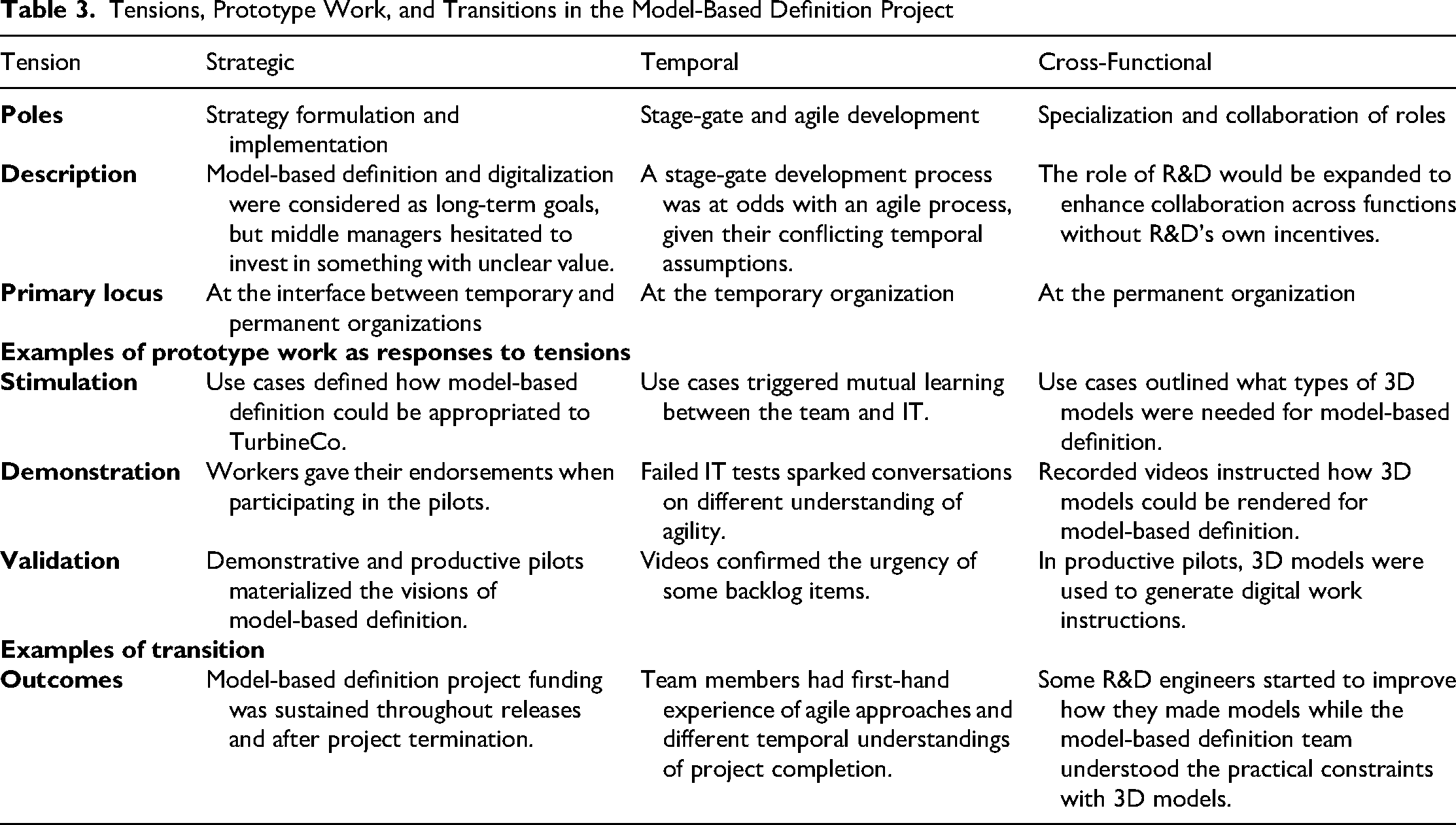
A digital transformation project is inherently situated in between temporary and permanent organizations. On the one hand, there is a time-boxed, iterative, and incremental development process in the temporary organization. On the other hand, there are also interactions with different stakeholders in the permanent organization, especially in conjunction with releases. The interactions between temporary and permanent organizations nevertheless created frictions in the model-based definition project. From the perspective of the project team, prototype work aided not only the software development process, but also helped respond to tensions that lead to transitions of both the project and functional organizations (see Table 3 for a summary).
Tensions, Prototype Work, and Transitions in the Model-Based Definition Project
Prototype Work as a Response to Tensions
Our theorization identified three tensions that take place at different temporary–permanent interfaces. Various actions and interactions around prototypes are manifested through different archetypical roles, namely stimulation, demonstration, and validation, as suggested by Ben Mahmoud-Jouini and Midler (2020). In a digital transformation context, prototype work at large can be seen as a direct resolution of tensions by reconciling the poles of tensions (Smith & Lewis, 2011). The model-based definition project illustrates how (1) the poles of strategic tensions occur between formulation and implementation (Correani et al., 2020; Huang et al., 2023; Jiang 2023b); (2) the temporal tension poles are temporal norms and assumptions between stage-gate and software development (Braun & Lampel, 2020; Geraldi et al., 2020; Stjerne et al., 2019); and (3) the poles of the cross-functional tensions take place between the role specialization and collaboration between organizational silos (Bechky, 2006; Ratcheva, 2009; Söderlund & Tell, 2011; Tell, 2017). As a result, transitions take place within both temporary organizations (e.g., the focal digital transformation project) and permanent organizations (e.g., the functional organization).
Between the model-based definition project and the permanent organization, strategic tensions emerged as the external dimension of temporary organizing (goals and expectations) interacted with the internal dimension (team and tasks) (Jacobsson et al., 2013; Locatelli et al., 2020). This empirical observation echoes the work of Jiang (2023b) that digital strategic goals are vague with room for interpretation. Ending in a hard or soft strategic landing, as illustrated by the model-based definition project, hinged on how the strategic formulation at the program level was understood and financially supported at the project level. Due to the ambiguity surrounding digital transformation, some middle managers at TurbineCo failed to see the economic and practical values in changing to the new ways of working. Prototype work then provided the missing link between buzzwords and everyday operations when the strategic formulation of digital transformation as a truly digital company was embodied.
Within the temporary organization, tensions emerged when team members and IT architects had different temporal horizons, perspectives, and paces (Geraldi et al, 2020). There were different views of pacing and temporalities (Stjerne et al., 2019), as a stage-gate production outlook confronted an agile view of development. For the project team, a desired future state was a functional product life cycle management system at the end of the project, whereas for the IT architects it was a product life cycle management system with a backlog at the end of the given release. The prototypes reconciled and synchronized these understandings of time values and rhythms (Stjerne et al., 2019) gradually and provided both team members and IT architects with a chance to learn from one another and shifted their shared temporal orders (Söderlund & Pemsel, 2022).
Cross-functional tensions concerned the changing coordination in the permanent organization (Söderlund & Tell, 2011), increasing collaboration between the roles in R&D and manufacturing/assembly. The foundation of model-based definition lies in the quality of 3D models created by R&D. The workload then would be shifted to R&D. This new division of labor and knowledge flow would be problematic from the R&D perspective, as there was no incentive to help manufacturing and assembly. By working on use cases and outlining user–system interactions, the team was able to generate 3D models and learn what standards were needed for model-based definition and R&D workload. These new role expectations (Bechky, 2006), however, also had to be demonstrated and validated by the workers in R&D while technically tested on the shop floor. In the end, new knowledge specializations of different roles emerged (Ratcheva, 2009; Söderlund & Tell, 2011; Tell, 2017).
During the model-based definition project undertaking, the tensions observed at different loci of the temporary–permanent interface also interacted with one another. For instance, temporal tensions were informed by the overarching goals of digitalization and underlying agile ways of working, which were fed back into the strategic formulation at the project and program levels. Similarly, cross-functional tensions were initiated by implementation at the operation level, and new goals (such as how R&D needed to change the creation of 3D models) emerged.
Digital Transformation and Prototype Work
Vial’s (2019) definition of digital transformation asserts that digital technologies trigger organizations’ strategic responses and the subsequent change process. Extending this view, our study demonstrates how digital transformation serves both as an end where strategic goals are situated and as a means to this end, with prototype work enabling assessment and management of outcomes (Huber et al., 2020). Inspired by the prototype archetypes suggested by Ben Mahmoud-Jouini and Midler (2020)—namely stimulator, demonstrator, and validator—we focus on the actions and interactions enabled by emergent prototypes as responses to gradually address the tensions (Smith & Lewis, 2011). Stimulation explicates the tensions and their poles, demonstration indicates potential resolutions, and validation confirms such resolutions, and these are discussed as follows.
Transition as an Outcome of Prototype Work
We also record the outcomes of responses as different forms of transition. To enable envisioned strategic changes and technology renewals (Geraldi et al., 2020; Söderlund, 2010; Wimelius et al., 2021), internal dimensions (team, task, time), and external dimensions (goal, expectation, control) of the temporary organization are transitioned (Jacobsson et al., 2013; Lundin & Söderholm, 1995). The value of digital transformation projects is shaped and reshaped iteratively during their project life cycle (Locatelli et al., 2020). The team composition in a digital transformation project (Guinan et al., 2019), for instance, may require increasing involvement from functions other than the planned ones. The role of team members may also change to a key user role upon returning to the permanent functional organization. The tasks in a digital transformation project, as illustrated by the model-based definition project, are ranked before each release. The temporal perspectives of the project can also change. Similar to Geraldi et al. (2020) and Stjerne et al., (2019), we find that digital transformation projects may have inherent temporal tensions where different modes of temporality coexist. These tensions were empirically manifested in the different temporal outlooks of stage-gate development processes and agile software development processes, which were then shifted with prototype work (Söderlund & Pemsel, 2022).
There are also long-term impacts on the permanent organizations when the strategic goals with digital transformation are revisited (Correani et al., 2020). At the focal case company TurbineCo, instead of a vague strategic formulation of digital transformation as a truly digital company, middle management was able to contextualize many digital transformation projects and programs at a local level (Jiang, 2023b). Consequently, the multiple expectations for such initiatives were also reconciled among different roles in the functions of the permanent organization. In addition, the control over digital transformation may be asymmetric. We find that digital transformation within the same permanent functional organization would benefit some (overlooked) functions more than others. With the progress of digital transformation, the power may shift between the roles.
Our findings also indicate how transitions may trigger new tensions eventually. For example, when dealing with cross-functional tensions, the model-based definition team realized the limitations of existing technical infrastructure to enable 3D models, which led to formulations of new goals for other digital transformation projects. In this respect, our empirical observations have indicated the cyclical nature of tensions (Smith & Lewis, 2011). Some examples are new strategic tensions between middle managers and team members when the scope of the project was changing; new temporal tensions between team members and internal IT support when they had different temporalities; and new cross-functional tensions between R&D and manufacturing/assembly when more roles were involved.
Conclusions and Implications
To respond to research questions regarding what tensions are enacted between temporary and permanent organizations in a digital transformation project and how prototype work addresses these tensions, this article presented an empirical study of a digital transformation project—the model-based definition project—at a Swedish gas turbine manufacturer. It was a partial success, acknowledging that model-based ways were designed and implemented in assembly, but only as proof of concept in manufacturing. The hardship encountered to implement digital transformation was due to tensions that emerged at temporary and permanent organizations, uncovered in three narratives. With the initiation and execution of digital transformation, organizations’ operational activities are undergoing strategic change. A digital transformation project as a time-limited endeavor aims to introduce transition in the permanent organization (Jacobsson et al., 2013; Locatelli et al., 2020; Lundin & Söderholm, 1995; Vial, 2019; Wimelius et al., 2021). In this study, we uncovered how digital transformation projects serve as change agents in manufacturing industries. We highlighted two features of digital transformation projects. First, digital transformation provides a fertile ground for interactions between temporary and permanent organizations (Bakker et al., 2016; Braun & Lampe, 2020; Geraldi et al., 2020; Sahlin-Anderssson & Söderholm, 2002; Stjerne & Svejanova, 2016; Stjerne et al., 2019), where tensions arise (Smith & Lewis, 2011). Second, as transitory units (Jacobsson et al., 2013), digital transformation projects induce changes in the permanent organization by the design and use of digital artifacts, including the various prototypes emerged during the project undertaking (Ben Mahmoud-Jouini & Midler, 2020; Huber et al., 2020).
We propose three main contributions to the extant research. First, the study contextualizes digital transformation projects (Jiang, 2023b) and their role in project-based organizations, where managing the temporary–permanent intersection is a salient feature and a recurring challenge (Hobday, 2000; Sydow & Wendeler, 2020; Söderlund & Tell, 2011; Söderlund, 2010). In particular, we recognize how a digital transformation temporary project team in a project-based organization faced three tensions emerging at the interface between temporary and permanent organization: (1) strategic tensions between strategy formulation and implementation (Correani et al., 2020; Jiang, 2023b); (2) temporal tensions between different temporal understandings due to different development life cycles within the temporary organization (Stjerne et al., 2019; Braun & Lampel, 2020; Geraldi et al., 2020; Söderlund & Pemsel, 2022); and (3) cross-functional tensions between the specialization and collaboration of roles within the permanent organization (Bechky, 2006; Ratcheva, 2009; Söderlund & Tell, 2011). We also indicate these tensions at different loci of the temporary–permanent interface may interact with one another in an ongoing and cyclical manner.
Second, we extend Ben Mahmoud-Jouini and Midler’s (2020) conceptualization of prototype archetypes by contextualizing the actions and interactions they facilitate to address tensions, which we coin as prototype work. Following Lundin and Söderholm (1995), Jacobsson et al. (2013), and Locatelli et al. (2020), the study also exhibits transitions enabled by prototype work. Project transitions include the dimensions of time, task, and team within the temporary organization in the short run when the team shifted their temporal orders (Söderlund & Pemsel, 2022). We also suggest the long-term impacts of digital transformation projects in terms of the dimensions of goals, control, and expectations of the permanent organization. We demonstrate how prototype work through stimulation, demonstration, and validation affects knowledge integration, when divisions of labor emerge over time (Ratcheva, 2009; Söderlund & Tell, 2011; Tell, 2017).
Third, while the literature on organizational change is vast, this study focuses on the application and development of concepts pertaining to dialectics and tensions in organizational change (Van de Ven & Poole, 1995; Smith & Lewis, 2011). Following Smith and Lewis (2011) and Wimelius et al. (2021), an organization may accept and address tensions by integrating opposite poles or splitting to choose one of the poles. While previous project management literature has examined boundary-spanning practices (Stjerne et al., 2019) and temporal work (Geraldi et al., 2020) as forms of organizational responses, a specific contribution of this study is showcasing prototype work inherent in digital transformation projects as responses that address tensions by integrating opposite poles. Accordingly, prototype work displays team members’ perceptions of tensions and validation of resolutions. Thereby, the study contributes to understanding tensions and dualities involved in organizational change (Smith & Lewis, 2011), demonstrating different responses that may resolve tensions over time.
Managerial Implications
The closeness to the project team granted some insights on practical learnings to manage tensions in digital transformation projects. First, we echo Westerman (2017) that digital transformation hinges on managerial practices in transformations. At the same time, digital technology itself is equally crucial to enable prototype work. Second, it is important to engage champions in the functional organization with the know-how, know-what, and know-why of their own operations. Business commitment can be enhanced by having project members from the functional organization, instead of relying solely on external partners. Third, tensions are not a monolith; they are multifaceted due to temporary–permanent dynamics. The model-based definition project is a case in point where tensions manifested through different interfaces and tensions may also interact with one another. Fourth, backlog management is an indication of how well tensions are responded to. When tensions arise, tackle them promptly to prevent them from accumulating at the bottom of the project backlog. Neglecting deprioritized tensions can lead to negative tension management. Fifth, prototyping is work. We have illustrated in this article how work surrounding a prototype is also important for finding the right problem to solve and solving the problem the right way. Prototype work is often time-consuming, requiring planning and coordination to enroll different stakeholders. Finally, the distinction between the success and failure of a digital transformation project is not obvious when business case performance and project completion sometimes cannot be quantified.
Limitations and Future Research
Our study has acknowledged how prototype work can address tensions in digital transformation projects, with responses in turn transitioning the temporary and permanent organizations. However, one limitation is that transition is not exclusive to prototype work; we have also observed instances where design thinking contributed to problem (tension) definition and solution generation (Liedtka, 2014). We therefore suggest that future research could explore how design thinking more broadly can link the temporary and permanent in the context of digital transformation, for example in stakeholder involvement and project strategy formulation (Ben Mahmoud-Jouini et al., 2016).
Moreover, digital transformation projects warrant more scholarly attention, and future studies could zoom in on its alignment with overall digital transformation program and portfolio levels and the capabilities of project or program managers (Jiang, 2023b). While we indicate some long-terms impacts of digital transformation at a micro level, the strategic dimensions of these initiatives and their expectations may have implications at a macro level (Hanelt et al., 2021) such as revamping a worldwide business model and global value chains (Vial, 2019). To further theorize prototype work, we encourage future research to situate it in other project settings, such as megaprojects (Brookes et al., 2017) and project networks (Sydow & Windeler, 2020), which are potential contexts for tensions at an interorganizational level. We also encourage exploration of prototype work in other digital transformation contexts like construction (Söderlund & Pemsel, 2022; Whyte, 2019), services (Geraldi et al., 2020), and volume manufacturing (Huang et al., 2023).
The incorporation of emerging digital technologies, such as generative AI (GenAI), may introduce tensions, stemming from its computational learning characteristics. It remains an open quest how temporary digital transformation teams can enable, or not, changes in permanent organizations in settings where both intellectual and manual work is being replaced by algorithms and machines. Perhaps partitioning digital transformation into time-limited projects is a false premise, as the project manager of the model-based definition project puts it: “When are you digitalized? Can you ever be?”
Footnotes
Acknowledgments
The authors express their gratitude to the editorial team of the PMJ special issue, “Project Management and Innovation: Essays in Honor of Christophe Midler,” in particular corresponding editor Jonas Söderlund, along with three anonymous reviewers, for their valuable and constructive feedback. We also thank our informants at TurbineCo and colleagues at the Department of Business Studies, Uppsala University, for engaging in many productive discussions on the topic. Earlier versions of this article were presented at the special issue’s paper development workshop in Paris in 2022 and at research seminars at Uppsala University, where comments and suggestions were greatly appreciated. Yunchen Sun extends their thanks to colleagues at the NICER group at Linköping University for their ongoing support.
Declaration of Conflicting Interests
The author(s) declared no potential conflicts of interest with respect to the research, authorship, and/or publication of this article.
Funding
The authors disclosed receipt of the following financial support for the research and authorship of this article: This work was kindly supported by grants from The Swedish Research School of Management and IT, Vinnova, and scholarships from Göteborgs nation in Uppsala.
