




Abstract
Why are certain organization design arrangements enacted in a project-based organization? Building on extant literature, this article addresses this fundamental question by explicating three distinct explanations of the raison d'etre of salient organization design arrangements: Functional, Legitimacy, and Agency. Conceiving these explanations as coexisting, interacting logics of organizing, the article argues to draw upon the powerful concept of logic multiplicity to pave the way for integrating diverse theoretical perspectives. Thus, the article contributes to the organization design stream of research in project studies by developing a typology of organization design logics and proposing a way forward for pursuing pluralistic theorizing.
Keywords
Introduction
Proliferation of projects as a key form for organizing collective action has led to the development of specific organizational means of coordination, manifested in an array of project-related structures, roles, processes, ways of thinking, and institutionalized practices (Lundin et al., 2015; Whitley, 2006). In the context of project-oriented organizations, scholars have uncovered and integrated a plethora of means, which organizations have at their disposal to orchestrate projects such as project management offices (PMOs), programs, portfolios, governance levers, and value systems (Gemünden et al., 2018; Müller et al., 2019). These studies have drawn attention to complex patterns of interaction among various organizational elements and their consequences for crucial organizational outcomes, including innovativeness (Gemünden et al., 2018) and viability (Lechler et al., 2022).
Lately, the organization design perspective has emerged as one of the ways to comprehend this complexity (Aubry & Lavoie-Tremblay, 2018; Miterev, Mancini, & Turner, 2017; Sydow & Söderlund, 2023), referring to the “structures of accountability and responsibility used to develop and implement strategies, and the human resource practices and information and business processes that activate those structures” (Greenwood & Miller, 2010, p. 78). This perspective proved to be fruitful for examining diverse project-related settings, such as project management offices (Aubry et al., 2022; Aubry & Brunet, 2016), multiactor programs (Miterev et al., 2020), interorganizational projects (Brunet et al., 2023; Eriksson & Kadefors, 2017; Fu et al., 2022; Zhang et al., 2024), and project-based organizations (Miterev, Turner, & Mancini, 2017; Söderlund, 2023; Turner & Miterev, 2019). Monique Aubry’s work has been instrumental in pioneering the explicit application of an organizational design lens in project studies (Aubry et al., 2022; Aubry & Lavoie-Tremblay, 2018; Simard et al., 2018). Two contributions appear particularly important in this vein. First, Aubry and Lavoie-Tremblay (2018) emphasized the process dimension of organization design, conceiving it as both a thing and a process. Second, a pluralistic, multiparadigmatic discourse on the topic has been strongly advocated for (Aubry et al., 2022; Aubry & Lavoie-Tremblay, 2018). Taken together, contributions within this research stream have highlighted untapped potential of an organization design lens for project studies (c.f., Söderlund, 2023).
However, given the daunting complexity of the emerging multilayered configurations (Müller et al., 2019), there is a growing need to understand what shapes the organization design arrangements in project-based organizations, both individually and collectively (Söderlund, 2023). To that end, intriguingly, there is no agreement in the literature regarding the underlying principles underpinning organization design arrangements’ antecedents and outcomes (c.f., Aubry et al., 2022; Denicol & Davies, 2022; Gemünden & Aubry, 2017; Miterev, Engwall, & Jerbrant, 2017). For example, while some studies posit that market opportunities and access to organizational and technological capabilities (or a lack thereof) represent key explanans of organizational architectures (Denicol & Davies, 2022; Söderlund & Tell, 2009), others emphasize institutional pressures and powerful incentives to attain legitimacy (Baba & Brunet, 2023), ensuing a degree of homogeneity in organizational structures and approaches (Loosemore et al., 2021; Miterev, Engwall, & Jerbrant, 2017). By contrast, Löwstedt et al. (2018) portray project actors in project-based organizations as pragmatic strategists and unveil a complex web of practice patterns underpinning organization design decisions.
Against this backdrop, two problems are discernable. First, although such contrasting rationales are visible in the literature, they have not been well articulated and juxtaposed in terms of the underlying assumptions, theoretical foundations, key results, and research implications, potentially hindering productive scholarly debates within this emerging stream of research in project studies. Second, making sense of such diverse theoretical underpinnings remains a key challenge in the literature, motivating scholars to debate integrative efforts (see Aubry et al., 2022). Of course, an interplay between competing explanations of organizational design is hardly a new discourse in the general organization theory (Poole & Van de Ven, 1989; Schoonhoven, 1981; Van de Ven et al., 2013). However, what shape such an interplay takes in project settings is not evident, warranting further inquiries. Hence, at a more fundamental level, the overarching question of why certain structures and approaches, such as PMOs or portfolio or program management, are enacted or not enacted in an organization deserves further attention. Thus, this article addresses the following research question:
RQ: Why are certain organization design arrangements enacted in project-based organizations?
Drawing upon ideas from the general organization theory and design literature, this conceptual article tackles this fundamental question by explicating three distinct explanations of the raison d'etre of salient organization design arrangements: Functional, Legitimacy, and Agency. A Functional explanation builds on the premise that various organization design arrangements are enacted due to their utility for, inter alia, compensating certain inherent weaknesses of projects as an organizational form and/or harnessing a firm’s strategic opportunities. For instance, while the knowledge management challenges in fluid, temporary projects are addressed by PMOs (Pemsel & Wiewiora, 2013), the short-term orientation is offset by strategic long-term programs and project portfolios (Martinsuo & Anttila, 2022; Morris & Jamieson, 2005). In turn, a Legitimacy explanation posits that organizations adopt certain organization design arrangements due to the powerful isomorphic mechanisms (Miterev, Engwall, & Jerbrant, 2017). The role of professional project management associations and the emerging institutions of project society (Lundin et al., 2015; Wagner et al., 2021) are thus central for understanding the dissemination and adoption of organization design arrangements and their configurations. Finally, an Agency explanation recognizes that enacting certain organization design elements or framing an initiative in a specific way (e.g., as a program rather than a project) can have implications for organizational politics and careers of managers, thus potentially shaping their preferences (Bresnen et al., 2004; Gemünden & Aubry, 2017; Löwstedt et al., 2018).
Drawing inspiration from research streams that have developed a conceptual apparatus for making sense of internal and external competing demands on organizations (Smith & Tracey, 2016), this article suggests conceiving the three rationales outlined above as distinct yet coexisting organization design logics. Furthermore, by drawing upon the notion of logic multiplicity (Besharov & Smith, 2014), it in turn paves the way for understanding how these logics can interact to shape organization design configurations in project-based organizations. Thus, the article’s contribution to the literature revolves around articulating the three organization design logics and proposing a novel way to integrate a diverse array of (multi-) theoretical foundations underpinning the notion of organization design in project studies. Consequently, it aims to enrich the debate on alternative strategies of pursuing theoretical pluralism, strongly advocated by leading project scholars (Aubry, 2016; Aubry et al., 2022; Geraldi & Söderlund, 2016; Söderlund, 2011).
The article is structured as follows. The next section elaborates on the article’s conceptual research design by justifying the choice and roles of key theories and concepts as well as by explicating the process of analysis. Afterwards, previous research on organization design in project studies is revisited, followed by explicating, scrutinizing, and juxtaposing the three alternative explanations of organization design arrangements. Consequently, the article presents arguments for building on the notion of logic multiplicity as a powerful means to make sense of these alternative explanations by viewing them as distinct organization design logics and paving the way for understanding how the logics can interact to produce a diversity of organizational outcomes. The article concludes with a discussion on its contribution, limitations, and implications for future research.
Conceptual Research Design
Conceptual papers represent a powerful means of theory building (Cropanzano, 2009; Gilson & Goldberg, 2015; Meredith, 1993), aiming at advancing knowledge by using existing theories and concepts as building blocks (Hirschheim, 2008). In that sense, such papers are not detached from the empirical world, since the building blocks are themselves anchored in empirically validated research (Jaakkola, 2020). Noteworthy, conceptual papers are characterized by a set of distinctive challenges (Fulmer, 2012; Hirschheim, 2008) and require a clear, transparent research design to deliver trustworthy answers to legitimate questions (Jaakkola, 2020).
In the case of conceptual papers, similarly to their empirical counterparts, research design refers to an explicit justification of the decisions regarding crucial elements of the study (Jaakkola, 2020), ultimately allowing to “bridge existing theories in interesting ways, link work across disciplines, provide multi-level insights, and broaden the scope of our thinking” (Gilson & Goldberg, 2015, p. 128). In particular, three methodological considerations warrant explicit attention in conceptual papers (Jaakkola, 2020): justifying the choice of theories and concepts, explicating the role of different theories and concepts, and making the chain of evidence easy to grasp. Thus, this section elaborates on the conceptual research design choices underpinning this article and explicates the process of analysis, drawing upon existing guidelines for designing a conceptual study (Barney, 2018; Cornelissen, 2017; Jaakkola, 2020).
A common way to justify the choice of a focal theory, concept, or research domain is by arguing that it is “internally incoherent or incomplete in some important respect” (Jaakkola, 2020, p. 19). The organization design stream of research in project studies, as discussed earlier, suits this reasoning as it currently exhibits seemingly conflicting empirical findings (Aubry et al., 2022; Gemünden & Aubry, 2017) and encompasses competing theoretical explanations (Gioia & Pitre, 1990; Okhuysen & Bonardi, 2011). Consequently, other theories can be mobilized to bridge the gap “based on their ability to address the observed shortcoming in the existing literature” (Jaakkola, 2020, p. 19), clearly justifying why a certain theory or theories is preferred to alternatives. Specifically, the article revisits and compares two theoretical lenses that are often employed to conceptualize competing demands on organizations—paradox theory and institutional complexity (Smith & Tracey, 2016)—and discusses how drawing upon the latter can help advance theorizing on organization design in project-based organizations.
Chain of evidence in a conceptual paper is made clear to the reader by explicating the key steps that reveal the logic of argumentation and by reflecting on the role of various theoretical lenses (Fulmer, 2012; Jaakkola, 2020). In particular, Jaakkola (2020) identifies four distinct types of research designs for conceptual papers: Theory Synthesis, Theory Adaptation, Typology, and Model. While these templates for conceptual research design can be used independently, combining two types, such as Theory Synthesis and Theory Adaptation, can be a more attractive option (Jaakkola, 2020). Thus, a two-step approach is followed.
The first step represents synthesizing the extant literature by articulating and explicating three alternative explanations on why certain organization design arrangements are instantiated in project-based organizations. The three explanations have been identified by drawing on rich, decades-long debates on the topic in the general organization theory and design literature (Van de Ven et al., 2013) and their reflection in project studies. Specifically, the classical issue of actor versus structure has pervaded the literature throughout the existence of management as a scientific discipline (Weber, 1978). When it comes to structure, the rivalry between effectiveness and legitimacy as key determinants of organizational arrangements is in turn a lasting, unending discourse (Schoonhoven, 1981; Scott, 1995; Van de Ven et al., 2013), which has tremendously enriched organization theory through the development and refinement of contingency theory and neoinstitutional theory as distinct explanations. In addition to the structural considerations, scholars argue for an actor-centered approach to organization design, drawing attention to who designs organizations and why (Jelinek et al., 2008; Pettigrew, 1987; Romme, 2003). Consequently, three broad explanations of organization design can be discerned: effectiveness-oriented, legitimacy-oriented, and actor-related explanations.
These developments have been reflected in project studies (c.f., Blomquist & Packendorff, 1998; Pettigrew, 1987), with content, context, and endogenous social processes being considered as key factors shaping organization design arrangements (Aubry et al., 2022; Eriksson & Kadefors, 2017; Miterev, 2017; Miterev et al., 2020). Indeed, project studies have demonstrated potency of various points of departure for developing explanations of organization design arrangements, most notably the effectiveness in achieving organizational outcomes (e.g., Denicol & Davies, 2022), overt and subtle influences from the environment (e.g., Miterev, Engwall, & Jerbrant, 2017), and actors’ agendas (e.g., Löwstedt et al., 2018).
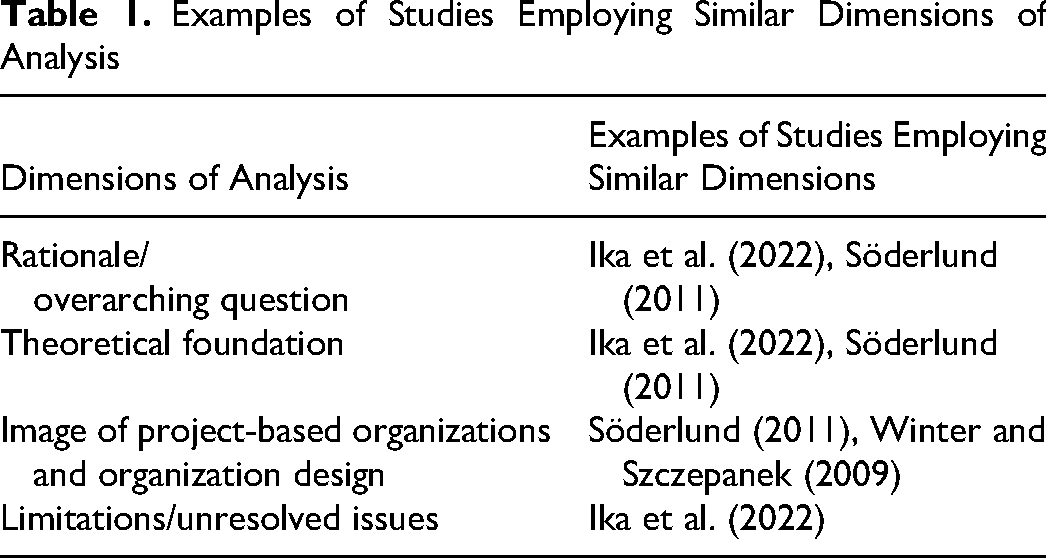
Consequently, three explanations (or logics) underpinning organization design arrangements have formed the basis for further analysis, here termed Functional, Legitimacy, and Agency. While any typology or categorization inevitably represents a simplification of reality by reducing the complexity of empirical phenomena (Doty & Glick, 1994), the three explanations appear to be a reasonable starting point for synthesizing the research stream given their historical roots and proven utility within the general organization theory and design literature. To articulate and juxtapose the differing logics, the article draws on the dimensions that have proven useful for capturing the essence of different perspectives in project studies (e.g., Ika et al., 2022; Söderlund, 2011; Winter & Szczepanek, 2009). Hence, the explanations are scrutinized and presented following the same structure of the rationale, theoretical foundation(s), ensuing images of project-based organizations and organization design arrangements, as well as limitations (Table 1).
Examples of Studies Employing Similar Dimensions of Analysis
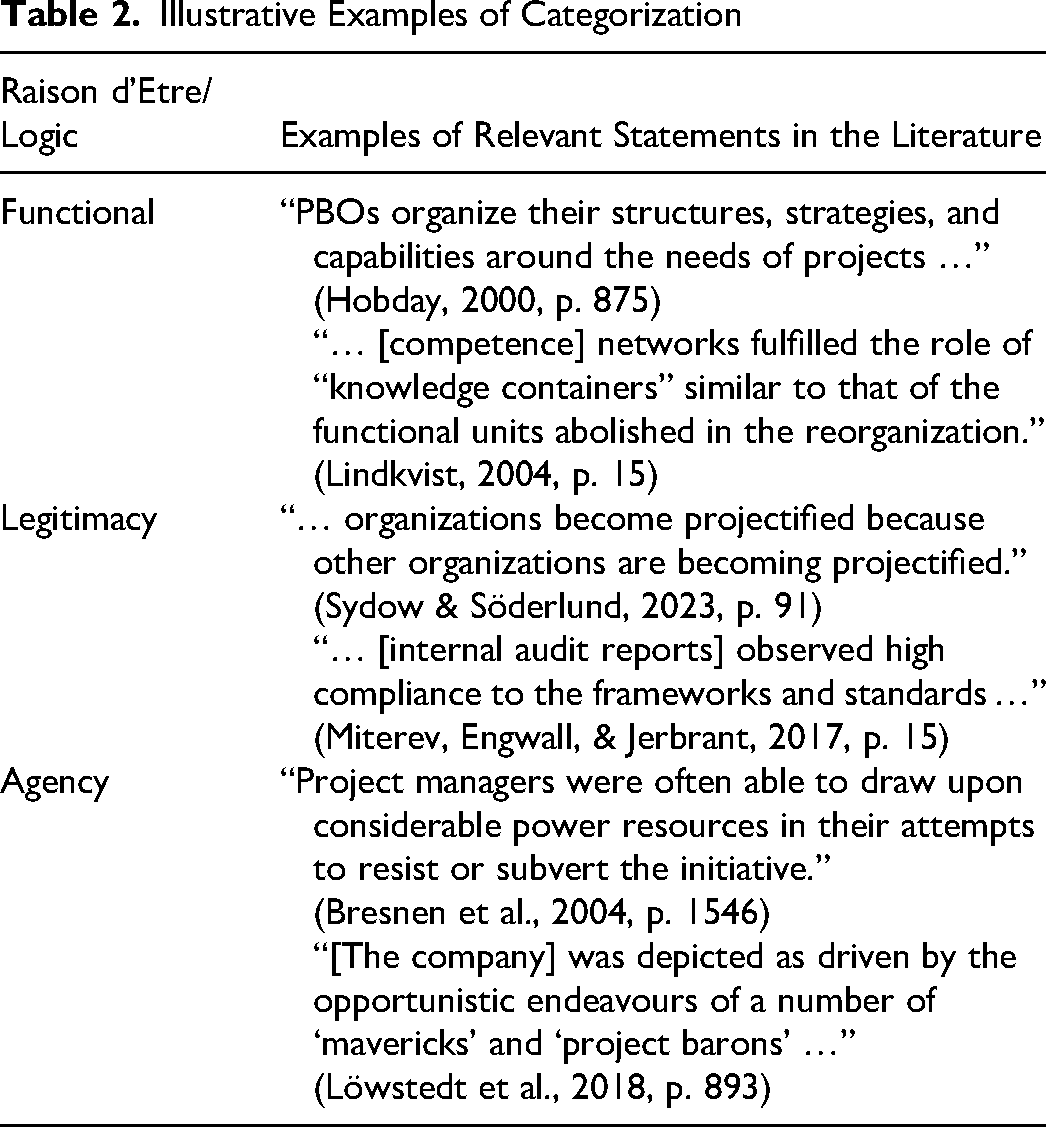
The process of analysis was highly iterative in nature, involving going back and forth between the literature and emerging depictions of the distinct explanations. While the author’s initial knowledge of the literature represented the point of departure for identifying relevant papers for analysis, it has been significantly augmented through a snowballing approach, selective search, as well as a number of excellent suggestions by the review panel. The process of analysis relied on a saturation principle, meaning that rather than aiming at grasping the entire literature, the focus was on uncovering the underlying rationales for organization design (see Table 2 for an illustration) and arriving at coherent, nontrivial depictions of the categories. Hence, the process was concluded when it was assessed that the key differences among the three categories were sufficiently explicated.
Illustrative Examples of Categorization
At the second step, following the Theory Adaptation template (Jaakkola, 2020), the extant research has been problematized, as it tends to portray the explanations as mutually exclusive or emphasize one perspective over the others. Consequently, the article discusses alternative ways to conceptualize and integrate competing demands on organization design arrangements (c.f., Gioia & Pitre, 1990; Okhuysen & Bonardi, 2011). The choice of building on logic multiplicity, as explained further, is justified by its efficacy in dealing with similar challenges of capturing competing stimuli for organizational actions and heterogeneous organizational responses. In addition, it gives access to a profound, vibrant stream of literature in organization studies (Sydow & Söderlund, 2023).
To conclude, by explicating and justifying conceptual research design elements, this section aims to facilitate an evaluation of the article’s challenges and merits.
Organization Design in Project Studies
Organization design refers to “the structures of accountability and responsibility used to develop and implement strategies, and the human resource practices and information and business processes that activate those structures” (Greenwood & Miller, 2010, p. 78), drawing attention to a broader array of organizational dimensions beyond mere organizational structure (Greenwood & Miller, 2010; Gulati et al., 2012; Van de Ven et al., 2013). Originating from the early models for organizational analysis (Galbraith, 1977; Lawrence & Lorsch, 1967; Mintzberg, 1979; Perrow, 1967) it has evolved to encompass interorganizational and community contexts (Gulati et al., 2012), institutional factors (Van de Ven et al., 2013), ecosystems (Baldwin, 2012), dynamics (Dunbar & Starbuck, 2006), and actor-centered approaches (Jelinek et al., 2008; Romme, 2003).
Within project studies, an organization design perspective has been mobilized to examine phenomena in a broad range of settings, including project management offices (Aubry et al., 2022; Aubry & Brunet, 2016), programs (Miterev et al., 2020), interorganizational projects (Brunet et al., 2023; Carroll & Burton, 2012; Edkins & Smith, 2012; Eriksson & Kadefors, 2017; Zhang et al., 2024), and project-based organizations (Gemünden & Aubry, 2017; Miterev, Mancini, & Turner, 2017; Miterev, Turner, & Mancini, 2017; Turner & Miterev, 2019). While these contributions mainly draw upon the same pool of organization theories, the relevant organization design dimensions and approaches differ depending on a particular setting (c.f., Aubry & Brunet, 2016; Eriksson & Kadefors, 2017).
One of the key challenges in this literature stream stems from a need to integrate diverse theoretical foundations (c.f., Okhuysen & Bonardi, 2011) and explain divergent empirical findings. In particular, it is still unclear to what extent isomorphic pressures can determine organization design arrangements (c.f., Aubry & Lavoie-Tremblay, 2018; Aubry et al., 2022; Gemünden & Aubry, 2017; Miterev, Engwall, & Jerbrant, 2017). While organization design in project studies requires a pluralistic, multiparadigmatic take (Aubry & Lavoie-Tremblay, 2018; Söderlund, 2011; Van de Ven et al., 2013), this represents a considerable challenge for theory building (Gioia & Pitre, 1990; Okhuysen & Bonardi, 2011). Nevertheless, Monique Aubry and colleagues have pioneered a thought-provoking approach to reconcile the tension between heterogeneity and homogeneity by developing a layered way to combine the lenses and highlighting the complementarity of equifinality and institutional isomorphism (Aubry et al., 2022).
This article aims to engage in this debate by scrutinizing the context of project-based organizations, where organization design has emerged as one of the key theoretical perspectives (Söderlund, 2023). While the main focus here is on the project-based organization, this work strives to integrate key insights and theoretical ideas that have been uncovered through organization design studies in other project-related settings such as interorganizational projects, programs, and PMOs (Aubry & Brunet, 2016; Eriksson & Kadefors, 2017; Miterev et al., 2020). Moreover, the article builds on cognate research streams in project studies such as organizational project management (OPM) (Müller et al., 2019; Müller & Wang, 2024) and organizational forms (Söderlund & Tell, 2009).
Three Organization Design Logics in Project-Based Organizations
Functional Logic
Rationale
Functional logic is driven by the following profound question:
What organizaton design arrangements are needed to coordinate projects effectively?
In Functional logic, various organizational arrangements and management levers in project-based organizations, such as portfolios or PMOs, aim to fulfill the coordination purposes of organizational units and management mechanisms of functional organizations (Hobday, 2000; Thiry & Deguire, 2007; Turner & Keegan, 2001). Specifically, the logic implicitly builds on the premise that projects generally display certain inherent limitations as an organizational form. These include short-term orientation or project myopia, precarious knowledge accumulation and transfer, fierce resource competition, and opportunism (Bakker, 2010; Engwall & Jerbrant, 2003; Müller, 2009; Sydow & Braun, 2018; Turner & Müller, 2003). As Lindkvist (2004, p. 19) put it: “the weaknesses of project-based firms as identified by Hobday (2000) need to be counteracted in processes at the level of the entire firm.” Thus, to offset these weaknesses, project-based organizations need to employ multiple potential remedies, including PMOs, portfolios, programs, and governance mechanisms (Müller et al., 2019; Pemsel et al., 2016).
This logic has been forcefully demonstrated by studies of decades-long projectification processes (Midler, 1995; Söderlund & Tell, 2009, 2011), which primarily explained evolving organizational structures, practices, and competences by persistent market, technological, and product challenges during different project epochs (Söderlund & Tell, 2009). The argument is also clearly visible in a seminal contribution by Hobday (2000), where he posits that “PBOs organize their structures, strategies, and capabilities around the needs of projects” (p. 875). In addition to responding to existing task requirements, the firm itself may pursue strategic opportunities requiring certain designs (Brady & Davies, 2004; Davies & Brady, 2016). In the same vein, a serial delivery of megaprojects requires building program management capabilities to avail of adaptability, flexibility, and collaborative setups aimed at delivering megaprojects together with clients (Denicol & Davies, 2022).
At a more fine-grained level, project management offices or competence networks often play a key role in facilitating interproject knowledge transfer and fostering competence development (Lindkvist, 2004; Pemsel & Wiewiora, 2013). As a characteristic example, in a case of transitioning from a functional organization to project-based organization “[competence] networks fulfilled the role of “knowledge containers” similar to that of the functional units abolished in the reorganization” (Lindkvist, 2004, p. 15). Similarly, the short-term orientation of projects can be supplemented by strategic goal setting in programs combining multiple interrelated projects (Martinsuo & Hoverfält, 2018) and utilizing clear strategic priorities for project selection and evaluation in project portfolios (Davies & Brady, 2016; Martinsuo, 2013; Müller et al., 2008). Likewise, opportunism can be partially reduced by employing multilevel governance levers (Müller, 2009; Müller et al., 2014), practices for setting target benefits (Zwikael & Meredith, 2019), and management control mechanisms (Canonico & Söderlund, 2010). Futhermore, Functional logic has proven useful for explaining the emergence of new actors and roles in project-based settings. The role of the project manager itself has been justified by the need to integrate diverse inputs and knowledge bases (Lawrence & Lorsch, 1967), whereas a range of other organizational roles, such as project owner, project funder, or PMO manager, have been linked to their utility for attaining project benefits (Zwikael & Meredith, 2018).
Nonetheless, within Functional logic, a specific configuration of organization design arrangements might not be fully determined by the organizational conditions. This is because the functions of various organization design arrangements in a project-based organization context overlap. Moreover, previous research has identified notable variations in the setup and functions of organization design arrangements. For example, PMOs can play serving, controlling, or partnering roles (Müller et al., 2013) and vary in terms of the scope and frequency of service provision across organizational landscapes (Müller & Wang, 2024), whereas different types of organizational programs can specifically fulfill coordination, direction, or political purposes (Miterev et al., 2016). Consequently, the same overarching functions can be fulfilled by various configurations of organizational levers.
Theoretical Foundation
Contributions within this stream often build on one of the following theoretical pillars: transaction cost economics (Turner & Keegan, 2001), contingency theory (Hanisch & Wald, 2012; Müller & Wang, 2024), and organizational capabilities (Davies & Brady, 2000, 2016; Leiringer & Zhang, 2021).
Image of Project-Based Organizations and Organization Design Arrangements
According to this logic, project-based organizations are portrayed as powerful mechanisms for turning goals into outcomes. Thus, projects represent strategic tools for achieving organizational benefits (Bjorvatn, 2022; Zwikael & Smyrk, 2012), or even “powerful strategic weapons, initiated to create economic value and competitive advantage” (Shenhar et al., 2001, p. 699), and the organization design arrangements facilitate decomposition of the strategic goals into manageable operational objectives for individual projects (Morris & Jamieson, 2005). Hence, organizational design choices are explained by their utility for attaining clear, undisputed organizational goals and benefits. There is a rich variety of organizational levers and mechanisms (Miterev, Mancini, & Turner, 2017; Miterev, Turner, & Mancini, 2017; Müller et al., 2019) that enable achieving innovativeness and viability at the organizational level (Gemünden et al., 2018; Lechler et al., 2022). This process is largely in the hands of powerful, rational top managers, while the choices they can make are largely unrestricted.
Limitations/Unresolved Issues
While this explanation rests on a solid empirical foundation (Davies & Brady, 2000; Midler, 1995; Söderlund & Tell, 2009), it does not appear sufficient for explaining why organizations hesitate to implement obvious improvements (Brady & Maylor, 2010), avoid making changes when a new project starts from scratch (Ekstedt et al., 1992), resist efficiency-oriented initiatives (Bresnen et al., 2004), run unenacted projects (Blichfeldt & Eskerod, 2008), or introduce certain project-based ways of working due to external pressure (Lenfle & Loch, 2010; Martinsuo et al., 2006). Therefore, the following two subsections delve into alternative takes on such unresolved issues pertinent to Functional logic.
Legitimacy Logic
Rationale
Legitimacy logic is driven by the following profound question:
What organization design arrangements are expected by the environment?
Legitimacy logic acknowledges that organizations are constantly experiencing external pressure and must effectively tackle multiple demands (Selznick, 1949; Smith & Tracey, 2016). As organizations strive to attain legitimacy in their respective organizational and institutional fields (Baba & Brunet, 2023; Suchman, 1995), they experience pressure to homogenize organizational structures and practices due to the presence of powerful coercive, mimetic, and normative mechanisms of isomorphism (DiMaggio & Powell, 1983). In the same vein, organization design arrangements are often shaped by rhetoric and myth surrounding various management fashion trends rather than particular task demands at hand (Kieser, 1997; Newell et al., 2001). Consequently, according to this logic, a recognized set of organization design arrangements let organizations enhance legitimacy with their stakeholders and thus facilitate acquisition of scarce external resources (Besharov & Smith, 2014; Smith & Tracey, 2016). A powerful example of such development is an institutionalization process of the control-oriented project delivery model and associated managerial toolkit as a result of the McNamara reforms in the U.S. Department of Defense (Lenfle & Loch, 2010). In this context, the sophisticated project management tools have been used to project an image of a trusted contractor, thus protecting the core technical work (Engwall, 2012). Furthermore, in the case of transnational interorganizational projects embedded in several institutional environments simultaneously, establishing a unified form of organizing is hindered (Fu et al., 2022), further corroborating the explanatory power of Legitimacy logic albeit in a different empirical setting than a project-based organization.
Accordingly, the prevalence of various types of project-based economic agents has been linked to characteristics of institutional frameworks they are embedded in (Whitley, 2006). For project-based organizations, professional project management associations often play a vital role (Hodgson, 2002; Sabini & Muzio, 2017; Wagner et al., 2021) informing our understanding of the dissemination and adoption of organization design arrangements and their configurations. Indeed, an adoption of a project-based way of working itself is partially explained by external pressure (Martinsuo et al., 2006) or, put differently, “organizations become projectified because other organizations are becoming projectified” (Sydow & Söderlund, 2023, p. 91). In addition, project-based organizations have been shown to adopt similar structures and practices due to isomorphism pressures such as in the cases of social procurement practices (Loosemore et al., 2021), project organization and production processes (Kadefors, 1995), and risk management approaches (Jepson et al., 2022). Besides, these mimetic effects are also observed at the intraorganizational level (Miterev, Engwall, & Jerbrant, 2017), further contributing to isomorphism. Consequently, Legitimacy logic suggests that project-based organizations primarily adopt certain organization design arrangements due to the powerful isomorphic mechanisms (Kadefors, 1995; Miterev, Engwall, & Jerbrant, 2017).
Theoretical Foundation
This line of argument often draws upon the earlier, structure-focused contributions within the neoinstitutional stream of organizational theory (DiMaggio & Powell, 1983; Scott, 1995), stakeholder theory (Parmar et al., 2010) and, albeit less frequently, diffusion of innovation literature (e.g., Martinsuo et al., 2006) and management fads and fashion (Gemünden & Aubry, 2017; Newell et al., 2001).
Image of Project-Based Organizations and Organization Design Arrangements
Under this logic, project-based organizations are characterized by fixed, constrained actions mirroring external structures, practices, and mindsets dominant in their organizational and institutional fields. This imitation tactic enables them to portray the organization as a predictable, legitimate actor in an organizational field (c.f., Baba & Brunet, 2023). Thus, the organizations are slow to change (Ekstedt et al., 1992), whereas the change itself typically originates from outside of the organization and permeates organizations’ porous boundaries. All in all, flexibility is limited as the managerial choices and their consequences are heavily constrained.
Limitations/Unresolved Issues
While Legitimacy logic adds important nuances to our understanding of how the external environment shapes organizational arrangements, it downplays a degree of agency actors enjoy in shaping organizations and enabling wider transformation efforts (Bohn & Braun, 2021; Engwall et al., 2021; Lenfle & Söderlund, 2022; Sydow & Söderlund, 2023). Furthermore, as noted by Gemünden and Aubry (2017, p. 3): “there is some evidence, that design choices are not only based on best fit of task demands and design characteristics but on other goals, such as achieving and sustaining powerful positions.” The third explanation as follows unpacks this insightful observation.
Agency Logic
Rationale
Agency logic is driven by the following profound question:
What organization design arrangements benefit managers personally?
Agency logic recognizes that enacting certain organization design elements can have implications for organizational politics and careers of individual managers, thus potentially shaping their preferences; therefore, it adds personal success, power, and career considerations, originating from societal expectations, as factors shaping organization design choices (Gemünden & Aubry, 2017). Consequently, organization design arrangements can be viewed as a means for harnessing resources and advancing one’s agenda or position in organizational hierarchies.
Prior research demonstrates abundant examples of the cases when vested interests and individual agendas affected organizational dynamics. For instance, project-based organization managers can successfully resist introduction of new management practices and tools when perceiving them as a threat to their control and influence within the organization (Bresnen et al., 2004; Löwstedt et al., 2018), with the common project-based organization’s characteristics of decentralization, short-term emphasis on performance, and distributed work practices playing important roles in this process (ibid). Thus, powerful project barons (Gann et al., 2012) can engage in opportunistic endeavors and openly resist, disregard, and mock organization design arrangements promoted by top management and consultants (Löwstedt et al., 2018). Similarly, organizational actors can decide not to introduce even obvious improvements for ameliorating performance, resulting in complicity behavior (Brady & Maylor, 2010).
However, the Agency logic does not have to be malevolent or result in negative consequences; instead, it simply reflects the importance of personal considerations and preferences in a real political environment. In multiproject environments, an actor-centered analysis facilitates explanation of organizational phenomena (Miterev et al., 2020; Vuorinen & Martinsuo, 2018). Moreover, when the distinction between projects and programs becomes blurred (Pollack & Anichenko, 2022), initiatives can be framed as programs instead of projects, resulting in a higher status and positive career implications. In addition, organizational actors can take active steps to portray themselves as role models, leading to a replication of their project management approaches as best practice within the organization (Miterev, 2017; Miterev, Engwall, & Jerbrant, 2017), and position themselves as legitimate strategists to determine a project-based organization’s strategic directions (Löwstedt et al., 2018). The resulting informal hierarchies of projects and managers, previously termed project landscape and social landscape, shape enacting of organization-level structures and approaches (Miterev, 2017). Furthermore, project actors engage in discretionary organizational citizenship behaviors promoting effective collaboration and enhancing effectiveness of temporary organizations (Braun et al., 2013), further corroborating the Agency logic, albeit in a different context than a project-based organization. In the same vein, managers actively change processes and routines to avoid the negative individual consequences of project overload (Karrbom Gustavsson, 2016). Consequently, rather than painting a dark picture of opportunism, egocentricity, and misconduct, the Agency logic simply aims to acknowledge an project-based organization’s actors’ perspective, manifesting in various defensive and offensive actions to pursue personal goals.
Theoretical Foundation
Theoretical underpinnings within this perspective include an array of theories and lens acknowledging the role of agency in shaping structure. These include but are not limited to institutional entrepreneurship (Battilana et al., 2009), social theories (Floricel et al., 2014), and power (Clegg & Courpasson, 2004). Other promising avenues for advancing this perspective include institutional work and practice-driven institutionalism (Sydow & Söderlund, 2023), as well as the microfoundations movement (Felin et al., 2015; Locatelli et al., 2021) and a practice perspective (Blomquist et al., 2010).
Image of Project-Based Organizations and Organization Design Arrangements
According to this logic, project-based organizations are depicted as arenas for power dynamics, competition for scarce resources (Engwall & Jerbrant, 2003), and intraorganizational politics among actors with vested interests. Managers enact organization arrangements and mobilize narratives around them (Sergeeva, 2016; Sergeeva & Kortantamer, 2021) as a means to advance their agenda or position in the social hierarchy, ultimately aiming to derive personal benefits.
Limitations/Unresolved Issues
While Agency logic complements the other two explanations by drawing attention to individual motives and actions, it is not sufficient on its own. Overfocusing on situational motives of project actors downplays the importance of more stable structures and environmental factors constraining individual actions. When applied in isolation, this may even lead to the fundamental attribution error, when the observed organization design arrangements are solely linked to dispositions of powerful actors, ignoring their effectiveness (Denicol & Davies, 2022; Söderlund & Tell, 2009), the role of external pressure (Fu et al., 2022), and path dependency (Hetemi et al., 2020).
Summary
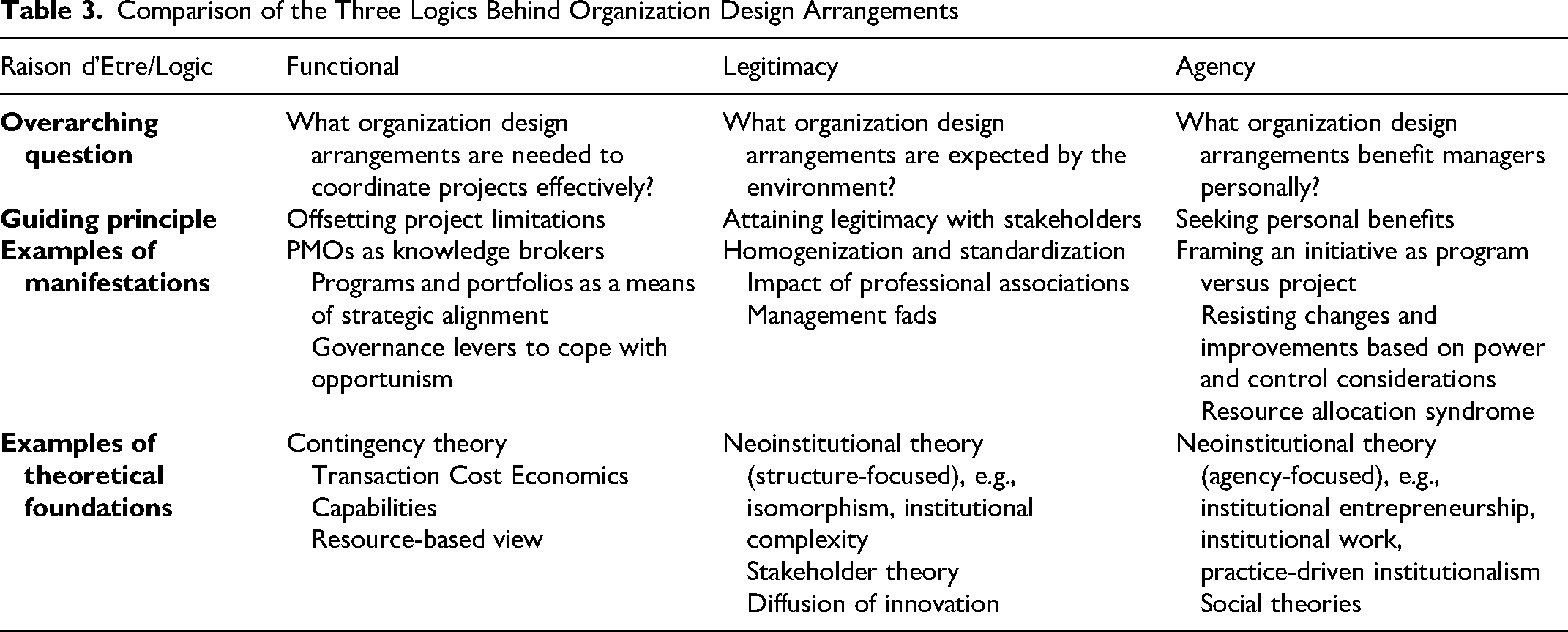
In the preceding subsections, three alternative explanations of the raison d'etre of organization design arrangements in project-based organizations have been examined. To summarize the key points, Table 3 presents the overarching question, guiding principle, examples of manifestations, and theoretical foundations for each of the three alternatives. Considering how distinct these logics are, it is important to discuss their interrelationship and role in advancing research in project studies.
Comparison of the Three Logics Behind Organization Design Arrangements
As it follows from the discussion above, each of the logics rests on a solid empirical foundation and has proved helpful for explaining the existence and utility of organization design arrangements in various studies. While many of the studies emphasize a single logic (perhaps reflecting the authors’ theoretical predisposition), they can also be seen as complementary. For example, Midler (1995) discussed both effectiveness (Functional logic) and power (Agency logic) considerations for explaining the transformation of organization design arrangements in Renault. In turn, Sankaran et al. (2023) combine the regulative, normative, and cultural–cognitive pillars of neoinstitutional theory (Legitimacy logic) with institutional entrepreneurship (Agency logic) to explain innovation in project-oriented organizations. Similarly, organization design arrangements of multiactor programs are shaped by the value-related needs (Functional logic), actions taken by the program protagonists (Agency logic), and interactions with the program context (Legitimacy logic) (Miterev et al., 2020).
To that end, there have been important integration efforts to make sense of the various forces shaping organization design in project settings. Gemünden and Aubry (2017) debated the explanatory power of isomorphism, taking stock of diverse theoretical underpinnings and empirical findings beloging to what has been termed here as Functional and Legitimacy logics. Aubry and Lavoie-Tremblay (2018) embraced a theoretical framework combining contingency theory, historical approach, and social theories to study organizing and organization design. In the same vein, an interplay of content, context, and endogenous social processes was found to shape organization design arrangements in project-based organizations (Miterev, 2017). Furthermore, Aubry et al. (2022) recently argued for a complementarity between equifinality and institutional isomorphism perspectives by inquiring their explanatory power at the organization and organizational field levels in a pluralistic, process-oriented analysis.
While these studies point toward a complementary character of various explanations, it is yet to be understood what can serve as a basis for theoretical integration. Thus, the following section discusses what the organization design stream of research in project studies can learn from a cognate research domain, which has successfully dealt with the issues of coexisting, overlapping demands on organizations.
A Quest for Integration: Toward a Logic Multiplicity Lens on Organization Design
This section outlines a potentially promising way of integrating the three rationales explicated above. It briefly revisits and juxtaposes two salient lenses from organization theory that are often invoked for reasoning around competing demands on organizational actions and presents arguments in favor of one of the lenses, namely, the notion of logic multiplicity. Subsequently, upon critically reflecting on the grounds for borrowing the lens (Whetten et al., 2009), it elaborates on how the notion of logic multiplicity can be mobilized to advance the debate on organization design in project-based settings.
The organization theory field has a long history of studying multidirectional demands on organizations and developing a conceptual apparatus for analyzing such phenomena. In particular, two lenses—paradox theory and institutional complexity—have specifically evolved for capturing competing demands on organizations (Smith & Tracey, 2016), and can thus be considered as plausible options to underpin and inspire theory development on organizaton design in project studies.
While both lenses tackle the challenge of addressing simultaneous competing demands on human and organizational actions and ensuing responses to such tensions (Besharov & Smith, 2014; Poole & Van de Ven, 1989), there are also important differences in terms of the sources, nature, and challenges of competing demands (Smith & Tracey, 2016). First, paradoxes are typically depicted as phenomena characterized by contradictory yet mutually constituting elements persisting in time (Besharov & Smith, 2014; Lewis, 2000; Smith & Lewis, 2011). Paradox studies are commonly limited to dual tensions and emphasize direct opposition of one element to another to an extent when one element is used to define another; for instance, light and dark or stability and change (Smith & Tracey, 2016). Conversely, institutional complexity perspective acknowledges the existence of multiple institutional logics that simultaneously exert pressure on organizations. Second, logics can be either complementary or contradictory, leading to distinct types of logic multiplicity (Besharov & Smith, 2014).
The organization design framework presented above (see Table 3) better lends itself to application of the logic multiplicity lens. Indeed, the three rationales can coexist at the same time, thus not representing dual tensions. In addition, they do not have to be in direct opposition to one another. Indeed, a more effective coordination of projects can be aligned with project-based organization managers’ interests, whereas an organization design arrangement introduced because of efficiency concerns can also enhance the project-based organization’s legitimacy. Consequently, the logic multiplicity lens appears preferable to the paradox theory and, as discussed in more detail below, can offer original insights to the debate on the organization design determinants in project-based organizations when the identified rationales are treated as distinct logics of organizing.
Drawing on the notion of logic multiplicity does not however imply that the three logics explicated above represent (or are equivalent to) societal institutions such as market, state or profession, or their organization-level instantiations (c.f., Frederiksen et al., 2021). Indeed, such an interpretation would be too far-fetched. Nevertheless, the identified three organizing logics correspond to socially constructed patterns of practices, assumptions, and values that set conditions on actions, akin to the dominant definitions of institutional logic (Barley & Tolbert, 1997; Besharov & Smith, 2014; Thornton & Ocasio, 1999), thus forming the basis for availing of the rich conceptual toolkit of neoinstitutional theory (Sydow & Söderlund, 2023). Consequently, while being wary about automatically and unreflectively transferring the assumptions and advancements of institutional theory to phenomena in project studies in general, applying the notion of logic multiplicity to illuminate the interplay among the three underlying logics of organization design appears reasonable. In turn, this lens can offer two important advancements for theorizing on why certain organization design arrangements are enacted in project-based organizations.
First, it draws attention to the point that various underlying logics can simultaneously coexist and interact within an organization. In the literature, it is well established that organizations can experience simultaneous, overlapping demands (Battilana & Dorado, 2010; Binder, 2007; Greenwood et al., 2010, 2011). While some of them might be aligned, others can be incompatible or conflicting, spurring a range of organizational responses to cope with the ensuing complexity (Besharov & Smith, 2014; Greenwood et al., 2010).
In the same vein, project-based organizations can embody several underlying rationales such as organizational effectiveness, external legitimacy, or individual self-regard. In addition, each of the three logics stresses certain factors and theoretical underpinnings at the expense of others, potentially neglecting important, empirically validated factors. Therefore, using them in isolation creates a risk of forming an incomplete, one-sided picture. Consequently, the logic multiplicity perspective facilitates perceiving the three underlying rationales as overlapping and coexisting explanations rather than mutually exclusive theoretical dogmas. Such reasoning means that a totality of logics can be required to make sense of the resulting organization design arrangements.
Second, the concept of logic multiplicity allows for theorizing about possible organizational consequences of logic interactions. When characterized by multiple organizing logics, organizational contexts might differ when it comes to the degree to which the logics imply consistent organizational responses (logic compatibility) and the extent to which all of them manifest in core organizational features (logic centrality) (Besharov & Smith, 2014). A combination of the dimensions leads to one of the four types of logic multiplicity—aligned, dominant, estranged, and contested—which are in turn associated with an organization’s propensity for organizational conflict (ibid).
In the context of the project-based organization, that implies that the observed (enacted) organization design arrangements can be seen as outcomes of a superposition of alternative coexisting logics. Thus, identifying salient underlying organization design logics in a specific context and assessing logic compatibility and logic centrality can facilitate analyzing organizational responses and predicting organizational conflicts (Besharov & Smith, 2014). To conclude, building on the notion of logic multiplicity can enable researchers to account for various motives behind organizational structures and practices.
Discussion and Conclusion
This article investigates the reasons why various organization design arrangements can be enacted in project-based organizations. By synthesizing relevant contributions in project studies, it explicates three underlying logics—Functional, Legitimacy, and Agency—which explain instantiations of various organization design arrangements, elaborating on their rationale, theoretical underpinnings, the image of a project-based organization, and the inherent limitations they entail. Furthermore, the article contemplates drawing on the logic multiplicity lens (Besharov & Smith, 2014) to elucidate how three identified logics can be integrated. Specifically, it suggests that they can be conceived as simultaneously coexisting logics of organizing that interact in complex ways to produce specific, observable manifestations of organization design configurations. Thus, the article responds to recent calls to draw upon the potential of a neoinstitutional lens in project studies (Söderlund & Sydow, 2019; Sydow & Söderlund, 2023).
Consequently, the article offers two contributions to the organization design stream of research in project studies. First, it articulates, exemplifies, and reflects on three distinct organization design logics shaping the enactment of organizaton design arrangements in project-based organizations. Second, it suggests an alternative way for theorizing about their complex interactions and effects.
Limitations
This study has some obvious limitations. While the three rationales examined in the article are based on rigorous, empirically validated findings, there could be alternative relevant explanations informing organizational dynamics. For instance, an historical perspective (Engwall, 2003), emphasizing the role of path dependency and lock-in effects (Hetemi et al., 2020), also represents a plausible candidate. In addition, management fads, albeit highly related to the Legitimacy logic, can be seen as a separate explanation (Gibson & Tesone, 2001; Kieser, 1997). Hence, the article does not claim that the set of three perspectives is exhaustive or ultimate; instead, it treats them as a reasonable starting point for discussing the multiplicity of organization design logics in project settings.
Accordingly, grasping the entire literature and analyzing it in a meticulous, systematic way was beyond the ambition of this article. Instead, the analysis process aimed at capturing the nature of different explanations as a whole, using a broad brush, as well as discussing a novel way to pursue integration efforts, thus potentially overlooking some details and nuances when it comes to extant empirical insights or theoretical underpinnings. Even though an effort was made to maintain the discussion at a nontrivial level, a follow-up systematic literature review would allow taking stock of the underlying theories and extant findings within each of the perspectives in a more fine-grained and comprehensive way.
Furthermore, integrating studies on organization design arrangements across empirical contexts, such as programs, interorganizational projects, and project-oriented organization, represents a challenge. For example, researchers have pointed out that large and complex projects have a greater ability to exercise agency and spur institutional changes instead of blindly adapting to institutional forces (Sydow & Söderlund, 2023). In the same vein, isomorphism pressure can be lower for interorganizational projects, giving them more space to maneuver due to their blurring organizational boundaries and embeddedness in complex organizational networks (Bohn & Braun, 2021; Miterev, Engwall, & Jerbrant, 2017; Sydow & Braun, 2018). Consequently, the article’s conclusions should be interpreted with caution, paying close attention to the nuances of a particular empirical setting at hand. Lastly, further empirical research is needed to validate the article’s theoretical arguments and conclusions.
Implications for Research
Nonetheless, acknowledging its limitations as a conceptual piece, the article offers several research implications. First, it adds to the discourse on the challenges and opportunities for enhancing the multitheoretical foundation of organization design in project studies (Aubry et al., 2022; Aubry & Lavoie-Tremblay, 2018). Specifically, while recent research drew on the notion of equifinality and highlighted the complementarity of equifinality and institutional pressure to combine differing theoretical foundations (Aubry et al., 2022), this article discusses an alternative approach to how diverse rationales can be understood and integrated by building on the concept of logic multiplicity. For example, prior studies reporting the prevalence of a certain underlying logic in an organization (e.g., Aubry et al., 2022; Miterev, Engwall, & Jebrant, 2017) might represent cases of a dominant or aligned logic multiplicity (Besharov & Smith, 2014). Although that would characterize the nature of logic interaction in a particular empirical setting, it does not necessarily clarify the explanatory power of the underlying theories per se.
Second, shifting the focus toward underlying logics of organizing helps obtain a more nuanced, situated understanding of organization design determinants. In particular, depending on a specific organizational context and history (Engwall, 2003), some of the explanations can play a more significant role in shaping a resulting organization design arrangement. For example, while setting up a PMO may be explained by an objective need to facilitate interproject knowledge transfer (Functional logic), introducing formal project portfolio prioritization procedures in the same organization might be promoted by an organizational actor to exert more control over projects (Agency logic). Therefore, the degree of influence of the competing logics can vary across various organization design arrangements within a project-based organization, offering a more nuanced picture. Furthermore, future studies involving tensions between different explanations and a dynamic process of changing from one dominant logic to another seem particularly promising.
Third, the logic multiplicity perspective potentially represents a valuable conceptual lens, which can inform studies of other types of tensions in project contexts and empirical settings in the realm of projects (e.g., Farid & Waldorff, 2022; Frederiksen et al., 2021). For example, the context of project-oriented organization naturally embodies tensions between permanent and temporary logics of organizing (Arvidsson, 2009; Söderlund et al., 2014), lending itself to an application of logic multiplicity and logic plurality frameworks (Besharov & Smith, 2014; Mair et al., 2015). Further, it can be extended into other project-related settings, including, for example, interorganizational collaborative settings (Brunet et al., 2023), ecosystems (Baldwin, 2012), or megaprojects (Denicol & Davies, 2022). Thus, future studies may investigate which underlying rationales and types of logic multiplicity dominate in various settings. Consequently, the concept of logic multiplicity paves the way for elucidating other types of tensions in project settings such as temporary/permanent, exploration/exploitation, and stability/change.
Fourth, project studies of organization design logic multiplicity can provide fertile ground for contributing back to the general organization theory (see also Söderlund & Sydow, 2019). As an example, Besharov and Smith (2014) assume that the properties of logics (i.e., logic compatibility and logic centrality) are uniform across an entire organization. However, organizational entities can respond differently to the same demands (Bresnen et al., 2004) and can also exhibit variation in logic multiplicity across organizational subunits (Binder, 2007). Consequently, studying instantiations of organization design logics at the project level within an organization allows capturing more fine-grained intraorganizational phenomena.
Fifth, the results call for a raised awareness of a multitude of potential explanations of organization design antecedents and effects. Notably, a number of studies reviewed in this article fit squarely within a single logic. However, it is unclear to what extent this was affected by the theoretical predispositions of researchers and/or their original research questions. For instance, if a research question is framed as a quest to identify organizational structures and processes for effective project delivery (Functional logic), the other two potential explanations will less likely be employed as rival explanations of the observed structures. Consequently, a scholar might naturally conclude that the structures were established to enable the desired outcome. Thus, to avoid confirmation bias, this article calls to maintain a reflective stance and offers a framework of the rival explanations that can facilitate such a reflection.
Footnotes
Acknowledgments
I would like to thank Monique Aubry for many inspiring and fruitful discussions on the topic over the past eight years, since we had discovered that we share research interest in organization design in project settings. I extend my thanks to the anonymous reviewers for their constructive and helpful suggestions. Previous versions of this article were presented at the special issue’s paper development workshop in 2022, and at a research seminar at KTH in 2023. I have greatly benefited from the comments of discussants and audiences on these occasions, most notably, Timo Braun, Mats Engwall, Hans Georg Gemünden, Maude Brunet, Ralf Müller, Emrah Karakaya, Charlotta Linse, and Matti Kaulio, to name a few.
Declaration of Conflicting Interests
The author declared no potential conflicts of interest with respect to the research, authorship, and/or publication of this article.
Funding
The author received no financial support for the research, authorship, and/or publication of this article.
