




Abstract
This article analyzes how firms can enable their innovation strategies through projects under various conditions. Previous research has identified an array of project-related means, such as explorative projects, project lineages, and ambidextrous programs, by which firms aim to realize their long-term innovation goals. These approaches, although powerful, are primarily focal firm-centered; address product-, platform-, and business-model levels; and tend to draw heavily on the firm’s resources and coordination efforts. However, systemic transitions are characterized by complex and unforeseen redefinitions of organizational and industrial boundaries, which require mobilization of resources by multiple actors, prompting firms to engage in time-limited experimental networks. This article introduces this concept to project studies and juxtaposes it with the key extant project-based concepts for enabling innovation by scrutinizing their definitions, intended scope of innovation, locus of attention, and coordination principles. Consequently, it draws attention to the importance of interorganizational aspects when facing a systemic transition and contributes to an emerging debate on the linkages among project studies, innovation management, and sociotechnical transitions.
Keywords
Introduction
How do various project-based initiatives enable innovation? While traditional project management techniques emphasize structure and control, stifling flexibility and innovation (Keegan & Turner, 2002; Lenfle & Loch, 2010), more open-ended, explorative projects and programs (BenMahmoud-Jouini & Charue-Duboc, 2022; Lenfle, 2008) can enable development of breakthrough results. However, such discrete advances are often insufficient on their own to accumulate the project outcomes and sustain long-term progress (Brady & Davies, 2004; Midler, 2019). Thus, a successful innovation strategy necessitates moving beyond single projects to include wider strategic and organizational considerations (Gemünden et al., 2018; Midler, 2013).
Previous research has introduced several concepts aiming to capture how project initiatives can achieve long-term organizational innovation. Specifically, explorative projects designate initiatives, which have the potential to set an organization on a novel, diverging technological trajectory (Lenfle, 2008). In turn, project lineages mobilize the notion of project interdependencies over a period of time to enable a systematic and organized exploration strategy (Midler, 2013) beyond mere interproject learning (Prencipe & Tell, 2001) and project portfolio management (Cooper et al., 1999). Similarly, the concept of ambidextrous programs “where the project components focus on both exploration and implementation” (Midler et al., 2019, p. 574) simultaneously, directs attention to various ways for firms to combine learning and innovation with efficient project execution. Taken together, the concepts provide insights into how organizations manage to respond to technological and business challenges in familiar environments and stable industrial setups.
These concepts are primarily focal firm-centered and draw attention to the firm’s internal innovative capabilities and to coordination efforts aimed at fostering innovation. However, in several industrial sectors, the combination of simultaneously ongoing sustainability challenges and technological developments are pushing for profound industrial and societal transformations. Such transformations challenge the businesses of incumbent firms, instigating redefinitions of industries, changes in network positions, and new or reconfigured business models (Chizaryfard & Karakaya, 2022; Midler et al., 2019). This is, for example, explicit in the automotive and transportation sectors, where the transition to electric, autonomous, and connected vehicles challenges well-entrenched, petroleum-based business models and triggers new cross-industrial collaborations among classical car manufacturers, electric energy providers, as well as companies like Apple, Google, and Microsoft (c.f., Blau, 2015). Such systemic transitions, typically revolving around technology shifts, are characterized by complex and unforeseen redefinitions of organizational and industrial boundaries, which requires mobilization of resources from multiple actors (Lenfle & Söderlund, 2022; Midler et al., 2019; von Pechmann et al., 2015) to address challenges on an industrial or societal level (Engwall et al., 2021). To that end, many incumbent firms face difficult dilemmas related to the ambiguity of their roles in alternative future value constellations (Tongur & Engwall, 2014) and are prompted to simultaneously pursue both technological and business model innovation (Kaulio et al., 2017). Hence, it is indeed a herculean task to navigate the transitions of technologies, business models, and business ecosystems, simultaneously (Midler et al., 2019).
As a response, a nascent stream of research has drawn attention to the link between project studies and the research discourse on sociotechnical transitions (Daniel, 2022; Gasparro et al., 2022; Lenfle & Söderlund, 2022). This literature highlights the central role projects can play in long-term transitions of technology and society and emphasizes the interorganizational dimension where firms need to combine resources and competences to weather these, sometimes stormy, processes (Koch-Ørvad et al., 2019; Lenfle & Söderlund, 2022). Notably, addressing wicked problems of relatively moderate transformation initiatives can still involve navigating intricate competing value systems and incongruent multilevel contexts (Bos-De Vos et al., 2022; Kuitert et al., 2023). Consequently, there have been calls for investigating alternative organizational forms, since the existing concepts of project management are insufficient for navigating fundamental, systemic transitions (Midler et al., 2019; Midler & von Pechmann, 2019; von Pechmann et al., 2015). Within these ongoing Schumpeterian waves, a novel phenomenon has emerged, characterized by established firms from different industries that collaborate in loosely coupled project constellations to test novel technologies, innovative business models, and new forms of cooperation over a limited period of time. While previous research has revealed the significance of interorganizational efforts in the form of, for instance, project ecologies (Grabher, 2002) or project networks (DeFillippi & Sydow, 2016; Kaulio, 2018; Steen et al., 2018) constituted by stable patterns of recurring collaborations to enable efficient project execution within the realm of an industry (Grabher, 2002; Manning, 2017; Oliveira & Lumineau, 2017), the rationale behind this novel phenomenon—here referred to as experimental network—is quite different. Unlike traditional projects, they do not have a clear organizational center of gravity with one actor functioning as a coordinator or project manager. Instead, they represent time-limited, loosely coupled heterarchies (compare Cumming, 2016; Girard & Stark, 2003; Hedlund, 1986), where each participant is pursuing its own project in coordination with the other actors. The primary intentions behind such a network are not to produce a finished product or service, but rather to gain experience of what works and what doesn’t when it comes to technology applications, collaborations, and business models. Instead of a well-specified common objective, an experimental network is typically driven by a set of visionary ideas that gather organizations from traditionally different industries to test and learn about how emerging disruptive technologies might enable new value constellations and future business models. Consequently, some of these constellations might fail and some might be terminated during their course of actions; however, experimental networks constitute time-limited experiments for their participants to probe the possible future(s) beyond systemic transitions like, for example, the electrification of heavy road transports or the introduction of autonomous vehicles in public bus services (Engwall et al., 2021).
To capture this empirical phenomenon, this article introduces the concept of experimental networks to project studies. The notion of an experimental network, defined as a “group of organizations collaborating in a time-limited, cross-industry network to explore potential business models for an anticipated, profound change in socio-technical systems” (Engwall et al., 2021, p. 2), was developed to capture a novel collaborative constellation that seems to emerge when entrenched technologies and business models are perceived to be at stake simultaneously. By comparing experimental networks with the established concepts of explorative projects (Lenfle, 2008), project lineages (Midler, 2013), and ambidextrous programs (Midler et al., 2019), the article takes stock of the repertoire of means by which firms can mobilize project initiatives to propel innovation and change. The authors argue that an understanding of how organizations try to navigate systemic transitions necessitates a shift of focus from internal innovation processes to nascent collaborations in possible future value constellations.
By introducing the experimental network to project studies, the article offers three contributions to the emerging debate on the linkages among project studies, innovation management, and sociotechnical transitions (Daniel, 2022; Davies et al., 2018; Lenfle & Söderlund, 2022; Midler & von Pechmann, 2019). First, it contributes to the research by highlighting the limits of extant project concepts in the face of systemic transitions and elucidating a potentially vital, emergent phenomenon of temporal, explorative, and heterarchic cross-industrial collaborations. It further adds to the discourse on networks in project studies by pinpointing the particular rationale of experimental networks, suggesting a need to revisit previous research’s core assumptions and proposing a distinction between delivery networks and experimental networks as prototypical ideal types. Finally, it enhances understanding of the efficacy of different project-related initiatives for enabling various types of innovation by linking it to two key dimensions, namely (1) ambiguity of a transition pathway and (2) lack or dispersion of key capabilities and resources.
The remainder of the article is structured as follows. In the next section, we address the intricate relationship between projects and innovation, highlighting the challenges of projects as vehicles for sustaining a creative innovation strategy. Then we scrutinize the concepts of exploratory projects, project lineages, and ambidextrous programs, focusing specifically on their definitions, intended scope of innovation, locus of attention, and coordination principles. Consequently, we draw attention to the important context of systemic transitions where none of the concepts is optimal due to their essential intraorganizational focus and scope. Thus, the article elaborates on the recently introduced concept of experimental networks to argue how temporary interorganizational structures can serve the purpose of facilitating systemic transitions. The article concludes by summarizing and juxtaposing the four concepts to draw overarching conclusions and present a research agenda.
Projects and Innovation
Projects and innovation have an intricate relationship. While project and innovation scholars essentially study the same empirical phenomena (Berggren, 2019), they simultaneously seem to fail to learn from each other (Davies et al., 2018; Midler et al., 2016). Nevertheless, the potential contribution of projects to enable innovation is widely recognized at different levels such as project portfolio (Kock & Gemünden, 2019; Martinsuo & Anttila, 2022), organization (Clark & Fujimoto, 1991; Gemünden et al., 2018), ecosystem (Koch-Ørvad et al., 2019; Malherbe, 2022), and sociotechnical systems (Daniel, 2022, Lenfle & Söderlund, 2022). Dominant ideas of project management and project organizing are often associated with control and reduction of uncertainty, and these emphasize efficiency and stifle innovation (Keegan & Turner, 2002). However, originally the concept of project management was associated with radical, much more open-ended, highly uncertain, and explorative initiatives (Lenfle & Loch, 2010; Gillier & Lenfle, 2019); whereas the sophisticated managerial control tools were enacted as protective devices to maintain managerial control, team autonomy, and to safeguard the projects’ technical core work (Engwall, 2012; Loch & Sommer, 2019; Sapolsky, 1972).
Notably, innovation is a broad concept encompassing a variety of empirical phenomena. Concepts, such as incremental innovation (Berggren, 2019), disruptive innovation (Christensen, 1997), fractal innovation (Midler, 2019), and systemic innovation (von Pechmann et al., 2015), are all associated with their unique sets of challenges. Specifically, the innovation efforts required for enabling profound, systemic transitions typically unfold progressively over a long period of time—from exploring emergent, potentially destabilizing technologies in protected niches and pilots to increasingly commercially viable configurations via gradual processes of learning and adaptation (Berggren et al., 2015; Geels, 2002). Accordingly, previous research has developed various project-based concepts to capture these organizational processes. Three primary examples are explorative projects (Lenfle, 2008), project lineages (Midler, 2013), and ambidextrous programs (Midler et al., 2019). While these concepts differ in terms of their characteristics and outcomes, taken together they address aspects of the challenges of systemic transitions. We examine each of these concepts in the following sections, discussing them in the order of increasing scope of intended innovation outcomes, before highlighting their common assumptions and limitations in the face of systemic transitions.
Explorative Projects
The traditional notion of control-oriented projects, emphasizing a strict adherence to a set of clearly predefined stable goals (Packendorff, 1995), neither adequately represents the variety of temporary organizational forms observed in practice (c.f., Engwall, 2002) nor does it provide a universally applicable set of management techniques (De Meyer et al., 2002; Lenfle, 2008; Pich et al., 2002; Shenhar, 2001). Thus, informed by the distinction between exploration and exploitation (March, 1991), a stream of research on exploratory projects has contributed to our understanding of prerequisites and effects of managing more uncertain breakthrough projects, as well as how project outcomes can be integrated by the parent organization. While some authors have questioned any empirical distinction between explorative and exploitative projects (Berggren, 2019; Davies & Brady, 2016; Tillement et al., 2019), when treated as ideal types (Weber, 1947), the dichotomy presents a useful analytical lens.
While exploitative projects constitute “the accomplishment of a clearly defined goal in a specified period of time, within budget and quality requirements” (Lenfle, 2008, p. 470), exploration projects are defined as projects for which “neither the goals nor the means for attaining them are clearly defined from the outset” (Lenfle, 2016, p. 47). Other concepts that aim to capture similar phenomena include vanguard projects (Brady & Davies, 2004), radical projects (McDermott & O'Connor, 2002), and skunkworks (Bommer et al., 2002; Rich & Janos, 1994). All of these project concepts are distinctly different from projects as usual and can have potentially significant, trendsetting implications for the parent organization such as developing the Sidewinder Air-to-Air missile (Lenfle, 2014) or constructing a hydrogen-based electricity generation plant (Frederiksen & Davies, 2008). Furthermore, exploration projects are closely linked to the notion of experimentation (Thomke, 2003, Gillier & Lenfle, 2019) and have been conceptualized as intentional experimental learning processes (Loch et al., 2006). However, exploration in projects can also result from serendipitous discoveries during project execution, blurring the distinction between explorative and exploitative projects (Tillement et al., 2019).
In line with contingency theory, research has shown that control-oriented project management is not an effective approach to explorative projects (Burns & Stalker, 1994; Lenfle, 2014). Such projects often require a clear structural separation from the parent organization to achieve autonomy (Bommer et al., 2002; Lundin & Söderholm, 1995; Rich & Janos, 1994). They typically gather interdisciplinary teams with diverse knowledge bases and encourage out-of-the-box thinking (Frederiksen & Davies, 2008; Salomo et al., 2007). In addition, exploratory projects often require organic systems of management (Burns & Stalker, 1994), informal decision-making processes, and flexible project management routines (Bommer et al., 2002; Lenfle, 2008, 2014). However, with some notable exceptions (Wied et al., 2020), there is still a lack of research on specific managerial practices in explorative projects (Lenfle, 2014).
Since exploratory projects are not islands, it is crucial to understand their temporal and context embeddedness (Engwall, 2003). Consequently, one of the key questions in research is how the results of explorative projects can be integrated and made use of by the parent organization (Brady & Davies, 2004). A variety of multiproject structures have been suggested to serve this purpose such as programs, project portfolios, and project lineages (Martinsuo & Ahola, 2022; Midler, 2013; Miterev et al., 2016). For example, firms can launch exploration programs comprising multiple interconnected exploratory projects to build up the organizational capability to manage exploration (BenMahmoud-Jouini & Charue-Duboc, 2022). Thus, although exploratory projects could overcome the limitations of control-oriented projects, they require different structures to afford outcomes (Brady & Davies, 2004).
Project Lineages
Individual projects, however innovative, do not usually suffice on their own for a firm to sustain a long-term innovation strategy. Consequently, there is a need for various coordination mechanisms to ensure continuity of projects as a temporary organizational form. One innovation strategy is to structure a sequence of projects, with an initial vanguard and explorative project followed by a set of related subsequent exploitation projects harnessing the outcomes of the initial explorations (Brady & Davies, 2004; Maniak & Midler, 2014; Midler, 2013). This line of thinking requires studies of the trajectory of consecutive projects (Engwall, 2002; Söderlund et al., 2014) to understand how systematic learning from project to project, and from project to organization, can unfold over time.
Studies on longitudinal project interdependencies are, however, scarce compared with studies on concurrent interdependencies in programs and project portfolios (Kock & Gemünden, 2019). One exception is the stream of research on project lineages (Kock & Gemünden, 2019; Midler, 2013). Originally coined in the start-up context (Midler & Silberzahn, 2008), the concept of lineage has also proven to be useful in project and innovation studies. Project lineage management refers to a systematic and coordinated management of project sequences, where subsequent projects build on and can retain some essential principles, practices, and outcomes of previous projects (Berggren, 2019; Midler, 2013). Examples in the literature often derive from the automotive industry such as the stepwise development and expansion of Renault Logan (Midler, 2013) or the sequence of CO2-reduction projects at Volvo Cars (Berggren, 2019). Kock and Gemünden (2019) differentiate between two types of approaches to project lineage management: (1) the proactive approach focusing on future-oriented road mapping of a project sequence; and (2) the reactive approach emphasizing utilization of valuable learning outcomes over an array of subsequent projects.
The concept of project lineage has some important characteristics differentiating it from other concepts in project studies. For instance, it differs from interproject learning (Prencipe & Tell, 2001) because it emphasizes a planned and systematic approach: The projects do not simply happen to learn from one another; instead, they deliberately build on experiences and outcomes of preceding projects and other activities (Engwall, 2002). Research on new product development, for instance, has shown how meta-rules, as well as design principles and guiding ideas, are often retained from an original pilot project to also focus the efforts in its succeeding, more incremental development projects (Midler, 2013; Wheelwright & Clark, 1992). Thus, a project lineage approach facilitates flexibility and exploration and helps overcome organizational resistance by accumulating stepwise accomplishments without much attention (Midler, 2013). Moreover, it is different from horizontal approaches to multiproject management in project portfolios or programs as it explicitly draws attention to the temporal interdependency among projects and the dynamics of project trajectories over time (Berggren, 2019). Thus, instead of starting with a breakthrough project followed by incremental successors, there can also be the reverse dynamics; in other words, that the successive outcomes of an array of incremental projects have such cumulate power that it triggers radical change (ibid.).
Although partially susceptible to a survivorship bias, prior research has documented spectacular cumulative results from project lineage management in terms of securing commercial success, as well as achieving sustainability goals despite considerable organizational resistance (Berggren, 2019; Midler, 2013). The findings suggest that firms that systematically manage project lineages are more successful than those that do not (Kock & Gemünden, 2019).
With some exceptions (c.f., Kock & Gemünden, 2019), this research line is dominated by qualitative, retrospective studies on product or platform innovation, empirically anchored in large industrial organizations of the automotive industry (Berggren, 2019; Midler, 2013). Consequently, there is a need for additional studies in other contexts. Furthermore, in previous research, the innovation achieved via project lineages is embedded in the existing paradigm of old and well-established industrial firms, whereas the locus of attention is on intraorganizational management efforts and mechanisms (for a rare exception, see Koch-Ørvad et al., 2019). What happens when the nature of innovation is more systemic, challenging the foundations of extant value constellations of the dominant sociotechnical system?
Ambidextrous Programs
When there are significant time pressures to respond to societal demands (Midler & von Pechmann, 2019), the temporal separation between radical and incremental innovation ingrained in project lineage management might be insufficient. Thus, a complementary structural approach is to utilize a combination of project management and program management, where project management techniques are mobilized to fulfill exploitation purposes, whereas program management assumes the explorative function (Pellegrinelli et al., 2015). Another approach is to design ambidextrous programs, which are deliberately structured to encompass exploration and exploitation projects simultaneously, in other words, “as programs where the project components focus on both exploration and implementation” (Midler et al., 2019, p. 574). Along the same lines, but at a project level, the notion of hybrid projects has embraced the possible coexistence of exploration and exploitation logics within a single project (Tillement et al., 2019). However, typical ambidextrous programs are characterized by a set of multiple, complex, and interdependent projects that require cross-project coordination, with an heterogenous mix of aims in terms of exploration and exploitation (Midler et al., 2019). Empirical examples in this domain often involve significant programs for technological and business model development within an incumbent firm such as automotive firms’ R&D programs for self-driving cars (ibid.) and the electrification of the urban bus service in Paris (Midler & von Pechmann, 2019). While ambidextrous programs have been discussed as a way of tackling technology, business model, and ecosystem transitions (Midler & von Pechmann, 2019; Midler et al., 2019), this approach assumes that a focal firm has the leading role. Although it acknowledges the value of external cooperation, it primarily focuses on internal coordination activities in navigating the transitions.
Summary
Implementing explorative projects, managing lineages among successive projects, and designing ambidextrous programs enabling both exploitative and explorative projects are three complementary strategies where projects are used to handle an organizational environment where the evolutionary trajectory is fuzzy and uncertain. While the scope of innovation of explorative projects revolves around radical products and technologies (Lenfle, 2014), the idea of project lineages builds on an initial breakthrough project to gradually develop a diversified, competitive family of innovative products (Midler, 2013). However, when lineages mainly comprise a sequence of explorative projects, the focus extends to improve organizational exploration capabilities (BenMahmoud-Jouini & Charue-Duboc, 2022). Furthermore, ambidextrous programs are launched to address more profound changes in the focal firm’s business model such as simultaneous alteration of operational processes, key production assets, as well as established revenue streams and cost models (Midler & von Pechmann, 2019).
Despite their differences, these concepts share some underlying assumptions. First, they do not question the overall industrial setup and the future role of the focal firm in the value-creating constellation. Similarly, they emphasize the central role of the focal firm in shaping the transition to the future constellation. Even in the case of ambidextrous programs, where inter-organizational cooperation is assumed to overcome internal limitations in resources and capabilities, the focal firm is assumed to play a central, decisive role in orchestrating the inter-organizational effort.
Systemic Transitions and Experimental Networks
By systematically orchestrating various multiproject initiatives in time and space, previous research has demonstrated various strategies for firms to achieve their innovation objectives. However, there are contexts in which these means might fall short of achieving the intended long-term effects.
Challenges of Systemic Transitions
Systemic transitions, for example those caused by technology shifts, can profoundly change established industry structures of roles, relationships, and value propositions. So did, for example, the changeover from sailing ships to steam ships in the 19th century (Geels, 2002) and the shift from analog to digital printing (Tripsas, 1997), both of which had a fundamental impact on the industry structures and actors involved. Similarly, the contemporary endeavor to move from petroleum-based to battery-powered electric cars will be a challenge for entrenched industry structures, established behavioral patterns, and incumbent business models (Jacobides et al., 2023). These systemic transitions have been described to constitute “major, long-term technological changes in the way societal functions are fulfilled” (Geels, 2002, p. 1257). They are often results of continuous and gradual processes of sociotechnical change, but they can also be rapid and of high intensity (Suarez & Oliva, 2005). Independently of duration, for the involved actors who often find themselves to be in media res, transition processes typically have a high degree of strategic ambiguity and opaque relations between possible actions on one side, and desirable future positions beyond the transition on the other (Tongur & Engwall, 2014). In addition, most systemic transitions include mutual adjustments of multiple business models of several incumbent firms; interindustry and cross-sectoral collaborations for novel, breakthrough solutions; and a lack of clarity regarding their roles in the emerging, new network-level ecosystem (Engwall et al., 2021). In such situations, an involved incumbent firm “has to adapt the whole ecosystem” (Midler & von Pechmann, 2019, p. 46), thus implicitly assuming that there is a decisive role of one single firm in resolving the challenge. However, wider industrial transformations often require idiosyncratic setups of a large number of stakeholders (Miterev et al., 2020).
Due to their systemic nature, such transition processes often challenge existing roles and network configurations (Geels & Schot, 2007) and require market shaping through interactions among various actors, both inside and outside existing industrial networks (e.g., Bankvall et al., 2017). The transitions are primarily not about exploiting existing technologies in innovative ways (e.g., Palo & Tähtinen, 2013), but are driven by profound innovations that have long-term and disruptive effects on existing sociotechnical systems. For example, a future shift to electric airplanes would represent a systemic transition in aviation (Christley et al., 2024). Such a transition would require significant technological advancements in batteries and propulsion systems (ibid.) but also different airplane designs, where smaller, electric airplanes could substitute traditional kerosene-fueled airplanes over time, which would constitute a disruption to the incumbent airplane manufacturers. Moreover, shorter travel distances would change the role of regional airports, require development of power generation, extensions of charging infrastructure and energy storage facilities, as well as either a massive ramp-up in pilot training facilities, or a further shift to autonomous airplanes (see Christley et al., 2024; Lai et al., 2022). Finally, shifting to a larger number of smaller airplanes operating over shorter distances would affect both the business models of airlines as well as entrenched industry regulations such as air traffic control protocols.
Consequently, effecting such systemic transitions includes execution of a set of innovation efforts to achieve changes beyond the control of one single organization (c.f., Colvin et al., 2014; Rohrbeck & Schwarz, 2013). Even though ambidextrous programs have been suggested as a remedy to these situations (Midler & von Pechmann, 2019; Midler et al., 2019), their focus on a powerful focal firm orchestrating the process is typically insufficient for systemic transitions where the future roles, relationships, and business models are unknown.
Experimental Networks
By acknowledging the degree and character of challenges of systemic transitions—where the rules of the game in entire industries are changing—the concept of experimental networks can complement the existing concepts linking projects and innovation. In previous research, the notion of project networks has proved to be significant for understanding the organizational logics behind projectified production in industries such as construction (Ahola, 2018; Eccles, 1981; Kadefors, 1995), offshore (Stinchcombe & Heimer, 1985), advertising (Grabher, 2002), and media production (Manning & Sydow, 2011). Such networks have been depicted as the underlying long-lasting structures that temporary projects harness when executed (DeFillippi & Sydow, 2016; Steen et al., 2018; Sydow, 2022).
However, in the face of systemic transitions another type of project-related network has been observed. In such situations, several established firms have to innovate new (or reconfigure existing) business models without knowing what effects these initiatives might have on their roles and industrial positions, ex post the transition (Tongur & Engwall, 2014). Against this backdrop, a phenomenon has been identified, where groups of private and/or public organizations from different industries participate in time-limited networks with no clear, leading actor. The firms come together to simultaneously test visionary technologies and innovative business models, which might have profound industrial effects in the future (Engwall et al., 2021). Instead of stability and efficient resource utilization, the purpose behind these networks is to temporarily pool complementary capabilities across industries to create and test new value propositions that none of the involved organizations would be able to produce on its own.
In this way firms from traditionally different industries, such as automotive, telecommunications, and real estate along with public agencies, have been observed to cooperate in pilot projects on autonomous buses (see vignette below), whereas automotive, energy, and haulage firms along with regional administration cooperate on introducing electric road systems. Another example is firms from the energy and mining industries that cooperate in future-oriented endeavors to produce carbon-free steel (Engwall et al., 2021). Hence, a highly diverse set of actors, such as established construction and real estate companies, leading tech and energy management firms, wearable smart ring manufacturers, and public agencies, join forces to create full-scale testbeds to integrate insights from user behavior to inform sustainability-oriented efforts as well as explore associated business models (KTH Live-In Lab, 2023). Moreover, similar albeit less technologically uncertain processes are also observed in the context of urban experimentation when, for instance, a transition to low-carbon district heating involves novel interorganizational constellations (Speich & Ulli-Beer, 2023). Vignette. The Autonomous Bus Initiative: An Example of an Experimental Network In 2018, two small self-driving buses were observed operating on a fixed 1.5-kilometer route in an industrial science park north of Stockholm, Sweden, representing the first time globally when 5G technology was utilized to enable autonomous driving. The public discourse around the initiative was sustainability-driven, emphasizing a potential shift from private cars to public transportation by providing an effective last-mile solution. The group of organizations behind the initiative represented a rather unexpected collaboration among firms, such as a bus operator, a global telecommunications company, and a real estate company, among other private and public actors. Coming from distant industries, the firms had not collaborated prior to engaging in this network. Notably, potential long-term implications of shifting to self-driving buses could be profound, including a radically different cost structure and a potential on-demand public transportation solution blurring industrial boundaries. However, what shape the future value network might take, which firms would survive the potential transition, and how they would be able to capture value in a future industrial constellation were unclear. As an illustration, a public session in connection with the initiative, co-arranged by the telecommunications company at the leading political forum in Sweden, “The Almedalen Week,” in 2018, was titled “The Future Vehicle: Who is Actually Driving?” conveying that even such a core operational function as driving could be potentially assumed by a telecommunications company (based on Engwall et al., 2021).
Thus, an experimental network can serve several functions for the participating firms. First, by reaching across established industrial boundaries, the firms can gain access to required competences outside their traditional realms. Thus, the learning benefits of participating can allow the actors to obtain insights into necessary technologies and business models from other actors outside their fields of competence. Second, an experimental network can serve as a test bed for learning new technologies and new ways of doing business. It allows the actors to test the new technologies and business processes on a small scale, without committing large amounts of capital and prestige. In addition, an experimental network can enable the participants to pool resources (e.g., financial assets and personnel) to maximize the likelihood of achieving business model innovation, while simultaneously buffering their established businesses from disturbances. By doing so, the participating firm can maximize their scopes, as well as share the risks, in their attempts to innovate. Furthermore, an experimental network can create a unified voice among the actors, which increases the likelihood of attracting public attention, external support, and—in the long run—the ability to tap into public funding from calls on national and international levels (Engwall et al., 2020, 2021). Thus, by participating in an experimental network, the firms not only reactively respond to perceived pressures for change, but also proactively attempt to claim space in their respective value networks long before a new future regime, beyond the projected systemic transition, has been established.
Discussion
This article introduces the concept of experimental networks to project studies and analyzes how firms can enable their innovation strategies through projects. By scrutinizing the established concepts of explorative projects, project lineages, and ambidextrous programs, the article takes stock of the repertoire of means by which firms can mobilize project initiatives to propel innovation and change. Although powerful, these concepts are primarily focal firm-centered and address product-, platform-, and business-model innovation and tend to rely on intraorganizational resources and coordination mechanisms. The aim has been to introduce the concept of experimental networks to shed light on an interorganizational project phenomenon, which emerges from the dynamics of firms attempting to navigate the early, fluent phases of an overarching systemic change (Engwall et al., 2021).
A comparison of experimental networks with the three concepts can be summarized as follows (Table 1). The intended scope of changes in the case of experimental networks encompasses the whole sociotechnical system that is facing a profound, uncertain transition. This is in contrast to the concepts of explorative projects, project lineages, and ambidextrous programs that primarily address innovation and change at the firm level of analysis. Specifically, explorative projects and project lineages typically capture new technology and/or product development efforts (for a rare exception, see Koch-Ørvad et al., 2019), within an entrenched business logic. While experimental networks explicitly address business-model innovation (Engwall et al., 2021), explorative projects can be highly complex and innovative, but seldom imply any deeper business model changes (e.g., Lenfle, 2014; Midler, 2013). Furthermore, while ambidextrous programs explicitly tackle the business-model innovation of a focal firm (Midler et al., 2019), they do not imply more fundamental transformations to new industrial logics and boundaries.
Comparison of Project-Based Concepts Aimed at Enabling Innovation
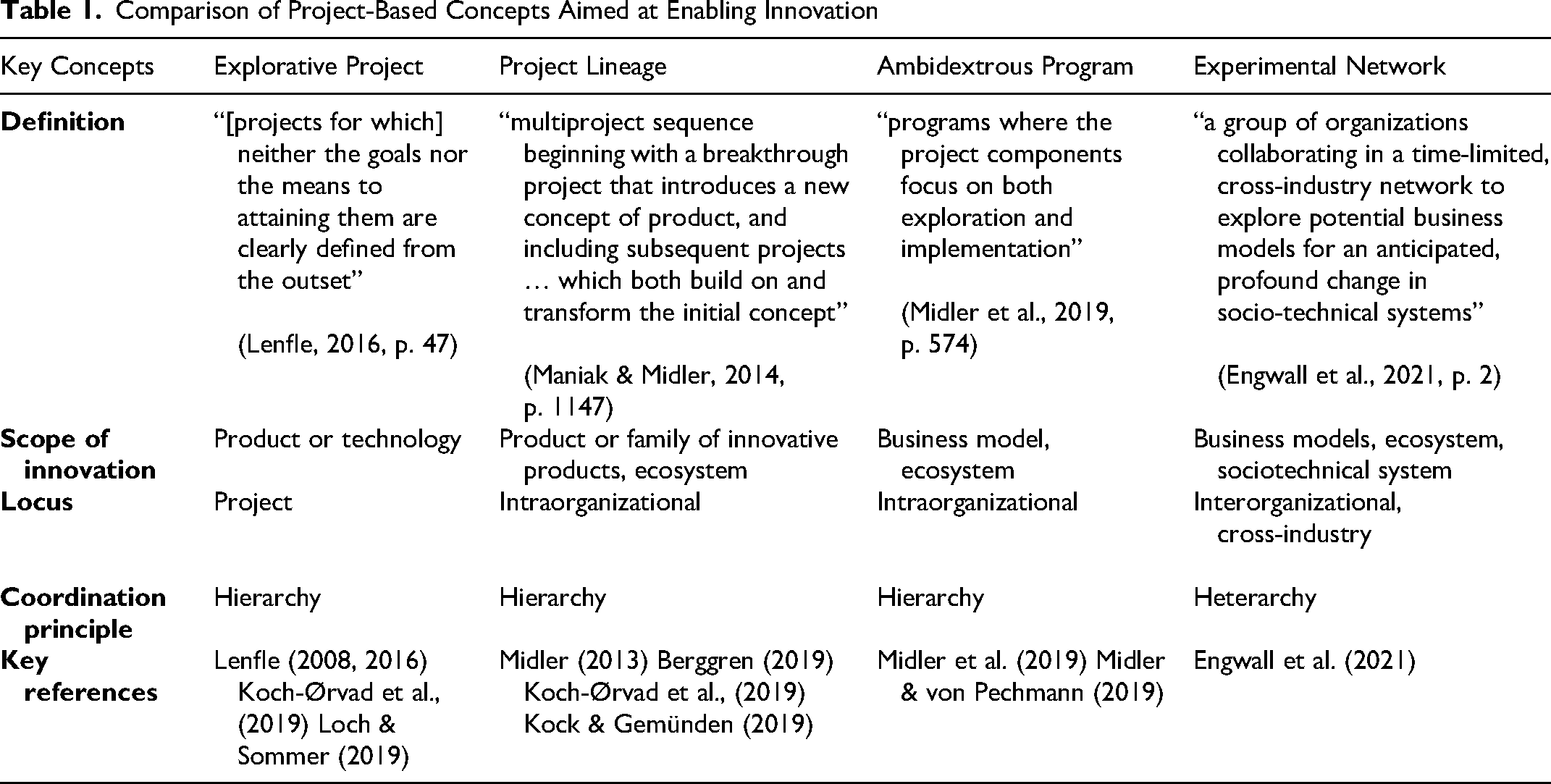
The locus of attention is also different. While experimental networks explicitly emphasize interorganizational and even cross-industry, novel constellations of several incumbent firms, the other concepts are primarily emphasizing intraorganizational strategies and configurations. For instance, explorative projects are often carried out by autonomous teams (Lenfle, 2014), tiger teams (Wheelwright & Clark, 1992), or skunkworks (Jenkins, 2001) within larger organizations, and project lineages address sequence-specific coordination mechanisms (Midler, 2013; Berggren, 2019), predominantly implying an intraorganizational locus of attention. Furthermore, even if the research on project lineages of explorative projects (Koch-Ørvad et al., 2019) and ambidextrous programs (Midler et al., 2019) has addressed the inter-organizational dimension, the emphasis has been on a focal firm’s measures to coordinate the other actors within an existing ecosystem where the overall value constellation and key roles have remained unchallenged.
In addition, there is a fundamental difference in coordination principles implied by the concepts. While experimental networks notably lack centrality and employ heterarchical coordination principles (c.f., Hedlund, 1986), the idea of hierarchical control, both within a project as well as imposed on a project by its parent organization, is a fundamental element in project-based concepts (Hodgson, 2004; Miterev et al., 2017).
However, the concept of experimental networks raises some issues that need to be discussed further. In the following section, two research implications are discussed. First, how the notion in question stands out compared with other resembling concepts, emphasizing how experimental networks can play a crucial role in addressing the fuzzy front end of systemic innovation (Takey & Carvalho, 2016). Second, how the four project-based organizational forms discussed can be utilized in a concerted way to tackle the challenges of innovation and change under different contextual conditions such as ambiguity of a transition pathway and lack, or dispersion, of key resources and capabilities.
Experimental Networks in Relation to Cognate Interorganizational Concepts
The observed empirical phenomenon, experimental network, shares several features with other, more established interorganizational concepts in project studies such as megaprojects (Denicol et al., 2021; Söderlund et al., 2017), large-scale innovative projects (Lenfle & Söderlund, 2019), project ecologies (Brunet & Cohendet, 2022; Grabher, 2002; Hedborg & Karrbom Gustavsson, 2020), and project networks (DeFillippi & Sydow, 2016).
Megaprojects typically involve complex nets of interorganizational collaborations and can even function as niches of sociotechnical transitions (Geels et al., 2023; Papadonikolaki et al., 2023). However, in contrast to experimental networks, their objectives tend to be well-defined and confined to a single industrial sector such as transportation, energy, or healthcare infrastructure. Furthermore, they usually represent hierarchical contract organizations (Morris & Hough, 1987) where their coordination mechanisms and required capabilities are well-characterized (Denicol & Davies, 2022). Ultimately, although megaprojects can involve significant innovation efforts (Aaltonen et al., 2020; Davies et al., 2014; Sergeeva & Zanello, 2018), they neither imply business model innovation of participating actors nor redefinitions of extant industrial boundaries.
Large-scale innovative projects, like experimental networks, can represent interdisciplinary, multi-institutional, and cross-boundary efforts characterized by a relatively low degree of familiarity among the involved actors (Lenfle & Söderlund, 2019). However, their primary purpose is to drive scientific and technology advances without emphasizing either the business model or the transition implications. Moreover, in the case of large-scale innovative projects, there is an, albeit unique and singular, “allocated task” (ibid., p. 1714) that the projects are set to accomplish, contrasting with the much more ambiguous, ill-defined explorations of organizations engaged in experimental networks (Engwall et al., 2021).
Project ecologies (Grabher, 2002), and lately, megaproject ecologies (Brunet & Cohendet, 2022), have been linked to disruptive learning and innovation but also to efficient production of creative outcomes. Akin to experimental networks, project ecologies characterized by a disruptive learning regime benefit from preserving cognitive distance among project participants (Grabher, 2004). However, while ecologies can exhibit heterarchical forms of coordination (Grabher, 2002) and stress multilevel interdependencies across organizational forms and personal communities, they are typically restricted to a single industry such as advertising (Grabher, 2002), software development (Grabher, 2004), or construction (Brunet & Cohendet, 2022; Hedborg & Karrbom Gustavsson, 2020). Consequently, in contrast to experimental networks, project ecologies rely on entrenched understandings among their participants with respect to roles, resources, and coordination mechanisms, without challenging the underlying business logics, industrial boundaries, and rules of the game.
Lastly, it is crucial to unambiguously position experimental networks in relation to project networks (DeFillippi & Sydow, 2016; Kuitert et al., 2023), especially since the noun “network” features in both labels. Most importantly, while previous research implicitly assumes that the purpose of a project network is to deliver certain products, assets, or services to the customers by leveraging internal and external resources (Ahola, 2018; Auschra & Sydow, 2023; Hellgren & Stjernberg, 1995), the prefix “experimental” for the new phenomenon emphasizes its learning dimension. 1 It is neither an assumption nor a demand from its stakeholders that this kind of time-limited networks will succeed or be commercially viable. Instead, experimental networks can rather be understood as goal-seeking endeavors (compare Karrbom Gustavsson & Hallin, 2015) for exploring new and unknown terrains. In the same vein, the long-lasting character of project networks within the realm of an industry (Manning, 2017) implies that the end goals of the participating actors, rules of coordination, as well as their roles in value creation and capture within the network, are known in advance (Bechky, 2006).
An experimental network, however, is rather a network of projects where the end goals emerge during its life span as a result of uncertainty reduction through learning and interactions between the projects and involved actors. Due to the novel, cross-industry character of such a network, the roles of the actors are constantly negotiated rather than given; a feature that is enhanced by the ambiguity regarding what business models will prevail in the ambiguous future (Tongur & Engwall, 2014). Thus, an experimental network provides a means for actors to try to reposition themselves in their wider economic environments.
These considerations point toward a new way of differentiating between networks in project studies based on their overarching purpose, in other words, efficient delivery versus radical experimentation. Consequently, we suggest an analytical distinction between the long-lasting delivery networks and the time-limited experimental networks (see earlier discussions in Engwall et al., 2020, 2021) as two ideal types, while acknowledging that many empirical manifestations of project networks often embody a mix of explorative and exploitative components (e.g., Brunet & Cohendet, 2022; Tillement et al., 2019). Thus, while the previous research has emphasized how delivery-oriented project networks benefit from low coordination costs and efficiency, the benefits of experimental networks are derived from identifying disruptive value constellations and potential future business opportunities (c.f., Engwall et al., 2020). The idiosyncratic characteristics of such networks can be instrumental in enabling systemic transitions.
Tackling the Challenges of Systemic Transitions Through Projects
Situated at the intersection of project, innovation, and transition studies (Koch-Ørvad et al., 2019; Lenfle & Söderlund, 2022; Midler & von Pechmann, 2019), this article offers several research implications to the discourse on facilitating systemic transitions.
There is a growing research stream in project studies addressing the role of projects in enabling wider changes to sociotechnical systems (Gasparro et al., 2022; Daniel, 2022; Lenfle & Söderlund, 2022). This research has primarily positioned large, innovative projects within the multilevel perspective framework (Geels, 2002; Geels et al., 2023) and emphasized the achievement of sustainability goals as the desired outcome of the interventions (Gasparro et al., 2022; Winch, 2022). Previous research has emphasized the agency of projects in enabling such sociotechnical transitions (Lenfle & Söderlund, 2022; Papadonikolaki et al., 2023) and conceptualized vanguard projects as propelling technological innovations to fulfill policy goals within a broader context (Gasparro et al., 2022), hereby drawing attention to the projects’ capacity to serve as temporary trading zones between a diverse set of actors (Lenfle & Söderlund, 2019). In addition, research demonstrated how project lineages and ambidextrous programs can enable both firm and ecosystem outcomes to tackle systemic challenges (Koch-Ørvad et al., 2019; Midler et al., 2019). Notably, however, the interorganizational networks addressed in this research, tend thus far to be relatively mature and fit into existing industrial paradigms (c.f. the solar power plant project in Gasparro et al., 2022).
However, our conceptual article acknowledges how the idiosyncratic challenges of systemic transitions might set a limit on the potential outcomes of firms’ innovation efforts. In other words, firms can successfully innovate their products and services portfolios but still find themselves obsolete when the business ecosystem of the new technology matures. Systemic transitions implying significant reconfigurations of established value constellations also challenge the project lineage approach since various organizational actors, coming from different industries and having a limited history of collaboration to rely on, can face difficult challenges when aligning their internal innovation processes. When several different actors simultaneously try to navigate an ambiguous transition, established project lineages could easily grow out of alignment with one another, leading to a missed opportunity to develop a joint, future value constellation. Thus, in addition to the classical question of how to cross the valley of death? (Midler, 2019), this article draws attention to the more strategic question of which is the right valley of death to cross?
Moreover, although previous research has emphasized the perspective of the focal firm, our article indicates that it is equally important for a firm to consider the rationales of the other actors in an experimental network (Engwall et al., 2021). Since firms often have limited insights into technological trends of unknown industries (and might be ignorant of parallel experimentations by other network actors), there might be a need to retain exploration activities for mutual adjustments within the network. Consequently, the article both highlights the importance of interorganizational collaborations and calls for further studies on how firms strategically can make use of explorative projects, project lineages, ambidextrous programs, and experimental networks in a concerted way and what tensions can they cause.
Taken together, these points offer some cues regarding the contextual conditions favoring usage of the various project-related means to enable innovation. First, they refer to a degree of clarity, or a lack thereof, regarding the firms’ actions that would allow surviving an ongoing industrial transformation. Specifically, in the presence of multiple competing technologies and potential business models, firms face fundamental ambiguity dilemmas (Tongur & Engwall, 2014), favoring concurrent, exploratory initiatives. Second, they address the extent to which a firm in an industrial network is capable of mustering resources and capabilities to harness a post-transition value offering on its own, thus avoiding the cumbersome challenges of safeguarding its know-how in an interorganizational collaborative effort.
Therefore, a simplified way to map the concepts discussed above is by applying the two dimensions captured in Figure 1: (1) lack or dispersion of the required resources and capabilities and (2) degree of ambiguity regarding the transition pathway. While exploitation projects and delivery networks represent different degrees of capability dispersion within a relatively stable business environment (x-axis), project lineages and exploratory projects represent different organizational measures to mitigate an increasing degree of pathway ambiguity (y-axis). Launching ambidextrous programs is, in addition, a middle way, whereas experimental networks, as suggested in Figure 1, prevail in situations combining a high ambiguity concerning the transition pathway with the dispersed capabilities required to unlock future value constellation.
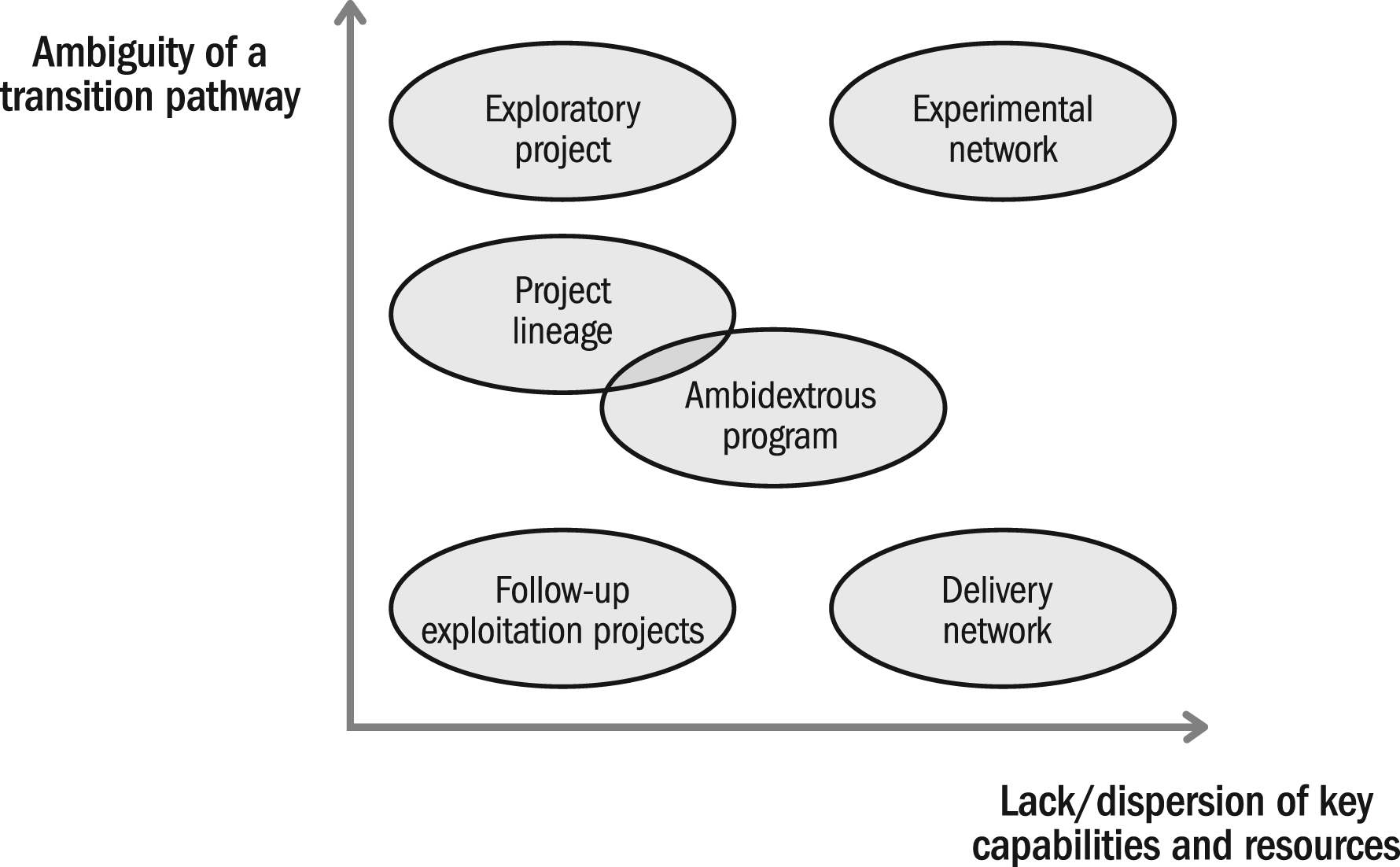
Examples of project-related initiatives for enabling innovation.
To conclude, firms can employ a range of project-based organizational forms to navigate systemic transitions that challenge established roles and industry structures. Engaging in experimental networks can be an effective strategy for firms to probe future technologies and value constellations in nascent phases of a systemic transition, when the ambiguity is high and the capabilities required are unclear. In later, more mature phases, however, several of the other project-based strategies seem to be both more effective as well as cost efficient.
Conclusion
This article introduces the concept of experimental networks (Engwall et al., 2021) to project studies. Theoretically, the article offers three key contributions. First, it contributes to the discourse on how firms utilize project-related initiatives to enable innovation by highlighting the limits of extant project concepts in the face of systemic transitions and by expounding the new, potentially powerful concept of experimental networks. Furthermore, it calls to revisit the notion of networks in project studies and suggests a distinction between delivery networks and experimental networks, thus paving the way for a more refined typology. Third, it suggests a model of two key dimensions (ambiguity of transition pathway and lack or dispersion of key capabilities and resources) for understanding the efficacy of different project-related initiatives for enabling various types of innovation.
The article offers implications for management as well. First, it highlights the importance of not getting cognitively stuck in present business models and existing industry paradigms when pursuing technology and business-model innovation. When facing potentially profound transitions, it is important to continuously reflect on potential roles in the future value constellations and search beyond the immediate networks of existing suppliers and customers. The crucial question to raise is: Given ongoing technological trends and social challenges, are there actors in other industrial sectors that, in the long run, are better positioned to carry out parts of the current value-creating activities? Consequently, firms need to develop specific search capabilities for identifying potential partners beyond their established industrial ties.
Second, it is important to keep in mind that the overarching purpose of engaging in experimental networks is linked to learning and to not expect the experimental networks to always be successful. Instead, the emphasis should be on exploring new opportunities and subsequent activities to benefit from the outcomes of the explorations. Likewise, if the level of ambiguity associated with a certain transition is high, one strategy is to engage in several, parallel and sequential experimental networks to probe the future.
Furthermore, the main policy implication is to avoid relying solely on entrepreneurial start-ups to promote profound industrial transformations. A complementary strategy is to support the emergence of experimental networks, engaging both established industrial firms and other types of private and public organizations. To do that, policymakers need to facilitate inter-organizational interactions, for example by creating cross-industry and cross-sectoral arenas, innovative procurement instruments, and cofunding opportunities, incentivizing participation in experimental networks.
Finally, being a conceptual piece, this article has some obvious limitations. Before any general conclusions can be drawn, the analysis needs to be validated by further research in various empirical settings. First, there is a need to gain a deeper understanding of the phenomenon of experimental networks, under which conditions these networks emerge, and how their goals originate, take shape, and unfold over time. Thus, are these networks more frequent in certain types of industries, technologies, or certain types of contextual pressures for change? How do spatial proximity and embeddedness in certain regulatory, cultural, or political contexts affect the networks’ emergence and evolution? Furthermore, are there specific prerequisites or antecedents that trigger the formation of these networks and, if so, how are these formative processes orchestrated?
Moreover, the internal dynamics of experimental networks need to be better understood. These questions need to be addressed: What are their coordination mechanisms and governance levers? How do the network actors resolve tensions among one another? How do they come to agree on joint directions for development? Another question that warrants asking is whether a focal firm or orchestrator would typically emerge during the duration of an experimental network or would power remain distributed among the participants over its life cycle? Yet another question worthy of investigation is whether it would be possible to identify a specific point of phase transition, or peripety (c.f., Engwall & Westling, 2004), when a loosely coupled experimental network evolves into a more exploitative mode. Consequently, the experimental network could also be transformed into another organizational form such as a new corporation, a formalized joint venture, or a goal directed interorganizational project.
Answering these and other relevant questions poses several methodological challenges. First, there is a challenge of studying a future-oriented, nascent phenomenon, which at the time of investigation might still be lacking stability and substance, exacerbated by the fact that a firm can ponder and experiment with several different transition pathways. Also, an in-depth understanding of experimental networks characterized by heterarchical coordination mechanisms requires access to several diverse organizations simultaneously, further complicating the task of a researcher. Consequently, the question of the entry point to observe such a phenomenon is a central methodological issue here. Without pretending that we can provide an ultimate answer to these challenges, we think that combining forces of researchers with complementary industrial expertise—as well as participating in government-funded cross-industry initiatives aimed at responding to grand societal challenges—could facilitate such empirical work. We deem that the concept of experimental networks opens several new avenues for inquiry within project studies. Moreover, it could help scholars of sociotechnical transitions (c.f., Köhler et al., 2019) gain more in-depth insights into the organizing dynamics of early, fuzzy front-end phases, where various actors explore how to collaborate, compete, and position themselves to gain advantageous roles on the other side of an emerging transition.
Footnotes
Acknowledgments
We would like to thank the editorial team of the Project Management Journal® special issue, “Project Management and Innovation: Essays in Honor of Christophe Midler”—Jonas Söderlund, Sylvain Lenfle, and Sihem Ben Mahmoud-Jouini, as well as three anonymous reviewers for their constructive and helpful suggestions. We would also like to extend our thanks to our colleagues and coauthors Matti Kaulio, Emrah Karakaya, and Daniel Berlin for many fruitful discussions on the topic. Previous versions of this article were presented at the special issue’s paper development workshop in 2022 in Paris, the EURAM Conference in 2023, and at research seminars at KTH. We have greatly benefitted from the comments of reviewers, discussants, and audiences on these occasions. Additionally, Vesa Räisänen helped us improve our English.
Declaration of Conflicting Interests
The author(s) declared no potential conflicts of interest with respect to the research, authorship, and/or publication of this article.
Funding
The author(s) received no financial support for the research, authorship, and/or publication of this article.
