




Abstract
This article demonstrates how early contractor involvement (ECI) facilitates the exploration and exploitation of innovations in megaprojects. Contractors possess knowledge of innovations that project owners often lack. By involving them in the front end, owners can explore this knowledge when there is more flexibility to change design. Additionally, this article contributes to understanding project ambidexterity by illustrating how collaboration between contractors and project owners represents a form of structural ambidexterity. Last, the findings suggest the development of a model of ECI that enables project owners to simultaneously evaluate multiple alternatives with several contractors in an organized convergence process.
Introduction
This article analyzes how early contractor involvement (ECI) facilitates exploration and exploitation of innovations in megaprojects. Innovation in megaprojects can be incremental or radical (Cantarelli & Genovese, 2021). The management of both types of innovation is an ambidextrous task. Exploration is analyzed in this article as the search and introduction of radical innovations in a megaproject; whereas exploitation is the replication of innovations introduced in previous megaprojects, which are then rearranged, modified, and refined on subsequent megaprojects (Davies et al., 2009). Early contractor involvement is a process by which project owners engage with contractors in the early planning phases, more commonly known as the front-end phases (Mosey, 2009; Wondimu et al., 2020). Since the front-end phase is where innovative ideas can be most effectively integrated into the design, early contractor involvement is linked to project innovation as it allows companies to search for new solutions at a stage of the project where they can be thoroughly evaluated and selected for implementation (Davies et al., 2009; Mosey, 2009; Valkenburg et al., 2008).
The effort to balance exploration and exploitation in projects has been discussed previously (Liu & Leitner, 2012; Sailer, 2019; Sergeeva & Ali, 2020; Sun et al., 2020; Turkulainen & Ruuska, 2022; Turner et al., 2014) as well as the relationship between early contractor involvement and ambidexterity (Eriksson, 2013; Eriksson & Szentes, 2017). However, there is a gap in understanding how collaboration with contractors in the early stages of megaprojects can help project owners in their efforts to explore and exploit innovations. The lack of research in this area indicates that, although the importance of ambidexterity in projects is acknowledged, the role of contractors in this process is often disregarded, particularly in how project owners explore their knowledge of innovations. This limitation also hinders the development of insights into how models of ECI can be designed and managed to foster innovation.
This article seeks to examine these issues by posing the question: How does early contractor involvement facilitate exploration and exploitation of innovations in megaprojects? By framing this research question, the article emphasizes the strategic application of ambidextrous principles that allows project organizations to evaluate and integrate various innovative solutions, which contractors have replicated and recombined from previous projects.
The relationship between early contractor involvement and ambidexterity is explored empirically through a multiple-case study of large and mega offshore oil and gas projects on the Norwegian Continental Shelf, involving 67 semistructured interviews with 72 participants. The inherent challenges of offshore extraction have made this industry historically dominated by megaprojects. Over the past 20 years, high-profile projects, such as Goliat, Martin Linge, Edvard Grieg, Ivar Aasen, Gina Krog, Aasta Hansteen, Johan Sverdrup, and Johan Castberg, have been carried out. These are all field development projects involving the construction of large offshore infrastructure, generally involving production platforms and subsea equipment.
This article illustrates how oil companies use the exploratory phase in the front end to learn about their contractors’ strengths, competitive advantages, alternative concepts, new technologies, as well as their knowledge of solutions and costs, among other information. For contractors, collaborating in the front-end phase allows them to leverage their capabilities, working with concepts they are experts in, while also suggesting improvements and adaptations to the megaproject. There is a simultaneous exploration and exploitation of innovations during this phase; oil companies evaluate new solutions against familiar ones while adapting and refining concepts. Simultaneously, contractors aim to replicate innovations they have created in recent projects.
These findings offer three contributions to megaproject research, highlighting the role of ECI in facilitating exploration and exploitation activities. The first contribution underscores that ECI fosters exploration and exploitation of innovations because contractors often possess greater knowledge of innovations than project owners, because they develop these innovations and can replicate them across various megaprojects. Project owners seek information about technologies, costs, strengths, risks, schedule, and so forth that only contractors can elucidate.
The second contribution is to illustrate how project owners engage in exploratory search, even when innovations from other megaprojects are being replicated by contractors. Project owners must familiarize themselves with innovations that are new to them and assess their suitability in different scenarios. This dual process of contractors replicating innovations and project owners exploring them represents a form of structural ambidexterity.
The third contribution of this article is to present a model of ECI used in the offshore industry. This model helps project owners in their pursuit of innovations to engage with multiple contractors simultaneously, analyzing several alternatives. The model employs an organized convergence process to eliminate less attractive alternatives, thereby retaining the most promising ones to subsequent front-end phases. By adopting this ECI model, project owners can broaden the scope of their exploration while also streamlining the temporal separation of tasks. This streamlined process enables a quicker transition from the exploratory front end to the exploitation phase, where designs are refined for execution.
Literature Review
Project Ambidexterity
In both long-term organizational strategies and shorter-term projects, two key learning approaches often coexist: exploratory learning, which is oriented toward innovation and the discovery of novel solutions; and exploitative learning, which focuses on the incremental improvement and optimization of established processes and technologies. The balance of these two types of learning is a central point that connects innovation and project management research (Davies et al., 2018).
Projects can be categorized based on their emphasis on exploratory or exploitative learning. At one end of the spectrum lie projects with uncertain goals, which focus on exploratory learning. These projects are characterized by flexibility, with the primary objective being the pursuit of new knowledge and innovation (Lenfle, 2016). At the opposite end of the spectrum are projects that have well-defined goals and operate in contexts that are well-understood or familiar. These projects prioritize exploitative learning, aimed at using existing knowledge to optimize established capabilities. In these settings, the main objective is to maximize efficiency while minimizing errors.
However, most projects, especially megaprojects, do not strictly conform to these extremes. Instead, they exist within a range that incorporates both exploratory and exploitative approaches (Tillement et al., 2019). The hybrid nature of projects confronts the complex issue of ambidexterity, which is the ability to alternate between exploration and exploitation in the context of a single megaproject rather than having a portfolio of exploratory and exploitative projects.
The balance between exploration and exploitation has gained increasing importance and attention in the project management field. Liu and Leitner (2012) argue that as projects progress, the emphasis shifts gradually from exploration to exploitation, resulting in reduced uncertainty. Eriksson et al. (2017) explore the concept of ambidexterity in conjunction with cocreation of value, highlighting the benefits of collaboration between customers and suppliers in different project stages. Turner et al. (2014) provide insights into the role of ambidexterity in project delivery and propose a framework to comprehend the intricate interaction of social, organizational, and human capital during project execution. Turkulainen and Ruuska (2022) discuss practices and processes to facilitate alignment and adaptability in various program phases, emphasizing the role of specific organizational units as ambidexterity facilitators. Sergeeva and Ali (2020) demonstrate that project management offices (PMOs) play a significant role in balancing exploration and exploitation across the phases of the project life cycle. PMOs achieve this by fostering innovation during the project's front end, where opportunities for exploration are greatest, and continue the innovation process to the operational back end of projects, where there are more opportunities for exploitation.
Sailer (2019) emphasizes the significance of project management methods that combine mechanistic and organic approaches to achieve ambidexterity effectively. Sun et al. (2020) focus on ambidexterity in project-based organizations, highlighting the spatial separation between functional and project units to balance efficiency and flexibility. On a project level, they emphasize the importance of temporal separation between different project life cycle stages to achieve ambidexterity. Zerjav et al. (2018) suggest that routine-based capabilities can be developed not only to ensure stability but also to provide a space for exploration when conditions change. Eriksson and Szentes (2017) stress the significance of sequential ambidexterity and innovation in early project stages, gradually shifting focus to efficient production based on prior experience and knowledge in later stages. Liu et al. (2012) utilize a four-phase life cycle model to illustrate how ambidextrous management is enabled by the temporal segregation of exploration and exploitation, as well as their integration during each project stage.
Together, these studies highlight projects as an ideal context for investigating ambidexterity due to the inherent tensions between the pursuit of efficiency and the need for flexibility to address uncertainties (Pellegrini et al., 2015; Turner et al., 2015; Petro et al., 2019). This tension is also prevalent in engineering endeavors (Liu et al., 2012; Du et al., 2013), which are central in megaprojects. A key focus area is the progressive balancing of exploration and exploitation across different phases of projects (Eriksson & Szentes, 2017; Liu & Leitner, 2012; Sergeeva & Ali, 2020), alongside the importance of context and adaptability to enable the transition between exploration and exploitation throughout projects (Turkulainen & Ruuska, 2022; Liu et al., 2012).
However, one area with still incipient interest within the existing discourse on project ambidexterity is contractor collaboration. Eriksson (2013) argues that contractual aspects, such as partner selection based on multiple criteria, incentive-based payment, and collaborative tools, positively influence ambidexterity in projects. The author proposes adopting contracting as a framework to facilitate both exploration and exploitation at the project level effectively. Similarly, Eriksson and Szentes (2017) suggest that early contractor involvement enhances ambidexterity, whereas contracting strategies that separate explorative design from exploitative production may impede innovation. Davies et al. (2016) demonstrate that dynamic capabilities supporting ambidexterity can be integrated into the contracting strategy of megaprojects. They discuss a multiparty contract that employs partnering principles—a form of ECI—to foster flexibility and innovation.
A closer examination of how contractors and project organizations collaborate presents an opportunity to enhance knowledge of two critical aspects that often determine the success of ambidextrous capabilities in projects: the temporal and structural separation of tasks. The temporal dimension of ambidexterity involves focusing on exploitation and exploration one task at a time (Tushman & O’Reilly, 1996; Uotila, 2018). According to Liu and Leitner (2012), temporal separation between exploration and exploitation is a natural occurrence in projects, because of the focus on life cycle management. Another path to ambidexterity is to structurally separate the tasks of exploration and exploitation. Some organizational units become responsible for exploiting and others for exploring (Benner & Tushman, 2003).
In projects, temporal separation of tasks is often operationalized by reserving the earliest phases of the front end for exploring new ideas and technologies, whereas later stages concentrate more on exploitation. As the front-end planning advances, exploration opportunities decrease, and the focus increasingly shifts toward exploitation. This approach allows project organizations to leverage the project's life cycle to enhance ambidexterity (Liu & Leitner, 2012).
For Sergeeva and Ali (2020), the front end provides the greatest opportunity for exploring innovations. However, this period also experiences constraints due to the impending need to prepare for the project's execution phase, which is more focused on exploitation. These constraints often manifest as key milestones, which are used to monitor the progress of engineering work during the front end (Jergeas, 2008). The dual pressure to both innovate and prepare for execution creates what Gil et al. (2012) describe as a race against time to incorporate new technologies before freezing design at the front end.
Previous research has not adequately examined the potential role of contractors in extending exploration capabilities during the front-end phase. Since the 1990s, efforts have been made to involve contractors early in the front end to assist project owners with design, an approach commonly known as ECI (Mosey, 2009; Rahman & Alhassan, 2012; Song et al., 2009). The participation of contractors in the front-end phase can serve as a key driver to accelerate the exploration process, thereby winning the race against time described by Gil et al. (2012). Contractors bring with them a repository of innovations and efficiencies accrued from previous projects, allowing them to engage in both exploration and exploitation simultaneously (Eriksson & Szentes, 2017). This dual focus can not only enhance the innovation potential but also set the stage for an effective transition into the project's exploitative learning stages.
In addition to improving the efficiency of the initial exploration phase, early contractor involvement also brings into focus a neglected aspect in project ambidexterity discourse: the potential for achieving a structural separation among tasks related to exploitation and exploration. Existing literature suggests that the need for horizontal coordination in projects may undermine the benefits of structural ambidexterity, due to the difficulty for separate organizational units to effectively work simultaneously on both tasks (Liu & Leitner, 2012). Yet, project studies largely overlook the untapped potential for achieving ambidexterity through collaborative efforts.
Research on project capabilities reveals that megaprojects are composed of project-based firms that offer repeatable solutions by applying past learning to new contexts (Davies & Hobday, 2005, 2006; Davies et al., 2011). Such firms leverage their established competencies by replicating and refining learned practices, thereby enhancing the efficiency of project-related tasks (Davies & Hobday, 2005, 2006; Davies et al., 2011). Therefore, when collaboration is initiated during the front-end stages, the project owner's organizational units can focus on exploring various options, while contractor units can exploit their knowledge to offer tailored solutions. This collaborative dynamic potentially enables a structural separation of exploration and exploitation tasks, thereby offering a new perspective on achieving project ambidexterity.
Early Contractor Involvement
In conventional contracting approaches, contractors are typically excluded from the appraisal, project definition, and design phases. Although these phases constitute only a small portion of the overall project expenditure, they exert a disproportionate impact on total building costs (Masterman, 1992). Under such conditions, the value contribution of contractors is confined to commercial rates and adherence to specified project requirements. ECI emerged as a shift in contracting strategies, aiming for a more comprehensive understanding of the value creation that contractors can offer from the project's inception through to its completion (Mosey, 2009).
ECI is typically realized through alliances and partnerships, where clients and contractors collaborate from the design stage to project delivery under a cost-reimbursable contract (Mosey, 2009; Naoum, 2003; Scott, 2001). Initially stemming from the North Sea oil experience in the early 1990s (Barlow, 2000), these collaborative principles have since been adapted for various projects, including megaprojects in the United Kingdom, healthcare facility construction in the United States, and infrastructure development in Australia (Davies et al., 2019; Lahdenperä, 2012).
Over time, various approaches to early contractor involvement have emerged, allowing contractors to develop design proposals through either design competitions or two-stage processes. Contracts for execution would then be awarded based on the proposals’ competitiveness and their ability to offer innovative solutions. These approaches have led to the development of new delivery models such as price-competitive alliances (Mosey, 2019; Josey & Burton, 2014; Love et al., 2010) and competitive dialogue (Haugbølle et al., 2015; Hoezen et al., 2010; Hoezen et al., 2012; Valkenburg et al., 2008), as well as two-stage tendering (Lahdenperä, 2010; Liu et al., 2014).
Methods
A qualitative multiple case study of the Norwegian offshore oil and gas industry was used to investigate how early contractor involvement facilitates exploration and exploitation during the front-end phases of megaprojects. The research on the offshore industry was based predominantly on the analysis of primary data, but it also benefited from access to informative secondary sources obtained from reports and media documentation. Data collection and analysis included 67 semistructured interviews with 72 participants from the largest oil companies and contractor in Norway. The respondents were mainly identified online, by searching for specific roles and names of firms. Most of the respondents had LinkedIn pages, with detailed descriptions of their responsibilities; they were approached by email. In other cases, respondents were suggested by others, in a snowball approach.
Data Collection
This research was undertaken as part of a research group created by the University of Oslo (TIK Department) to study transformations in the Norwegian offshore oil and gas sector (Globoil, 2017). It went through iterative phases of data collection and analysis that extended over a three-year period, from December 2018 through November 2021. In the first six months, open-ended interviews were made to explore a number of topics such as product and process innovations, relationships with suppliers, and contracting strategies for two offshore projects. An inductive approach was chosen due to the exploratory nature of the research. The purpose was to identify frequent and significant themes from raw data.
One of the themes was how oil companies and contractors were collaborating closely in the early phases of projects. This salient theme was selected for further development based on a research question and theoretical framework influenced by the megaproject literature, in other words, collaboration in the front end to appraise alternatives. The orientation of data analysis changed to understand better how the stage-gated front end was managed by oil companies and if the initial statements about contractor involvement in the front end were valid.
To gain a deeper understanding of the oil and gas industry, its projects, and how collaboration with contractors during the front-end phase was organized by oil companies in Norway, the data collection strategy combined extensive use of both secondary and primary sources.
The first source was a database with offshore fields developed in Norway, which was created by merging publicly available information from the Norwegian government. Every year, the Ministry of Petroleum and Energy (MPE) presents a document for the Storting (parliament), reporting the status of all ongoing energy projects, with the updated costs. These documents, called Prop 1 S, date back to 2000.
Once data from Prop 1 S documents was consolidated, document research was conducted to investigate all major projects undertaken in Norway, with a focus on their front-end governance and the firms involved. Three main sources were used. The first source was a virtual library of technical literature on offshore oil and gas projects, including peer-reviewed papers presented at the most prestigious conference in the industry, the Offshore Technology Conference. The second source was a specialized media outlet that covers offshore projects worldwide, called Upstream Online. The third source was a database on global offshore projects provided by Rystad, a consultancy firm in the energy business.
After the document research, more rounds of open-ended interviews were conducted, which could provide first-hand insights into the front end and how firms collaborated with one another. These interviews took place between June 2019 and August 2021, with 45 respondents (respondents #20 to #64). Like in the first round, both contractors and oil companies were taken into consideration in the data collection. Participants had the freedom to talk about a specific project they were involved in at the moment or general impressions drawn from their experiences with recent projects, or both. Due to the additional insights gained from secondary data sources, the interviews became more focused and informed (see Table 1).
Interviews Ordered by Dates and Phases
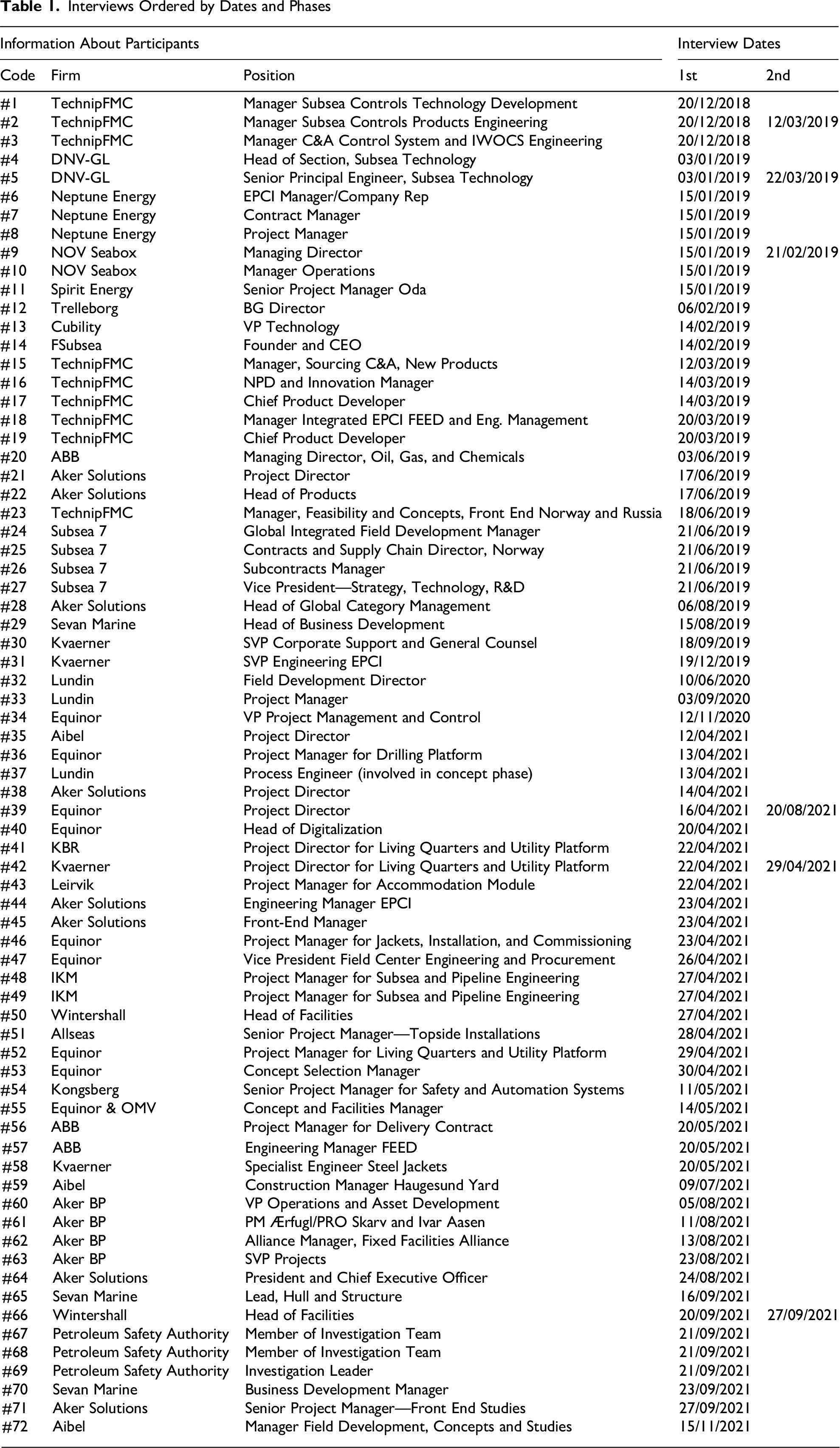
Following Eisenhardt (1989), the multiple methods for data collection provided a stronger substantiation of the constructs through triangulation. The vast information about Norway’s oil and gas projects available in specialized media and conference proceedings guided the interview topics and contextualized the information provided by informants. Moreover, the interviews provided meaning and details that were not found in document sources. Another round of five interviews from August through November 2021 and secondary data collection were conducted to cross-check and confirm the interpretation of the data.
Research Validity
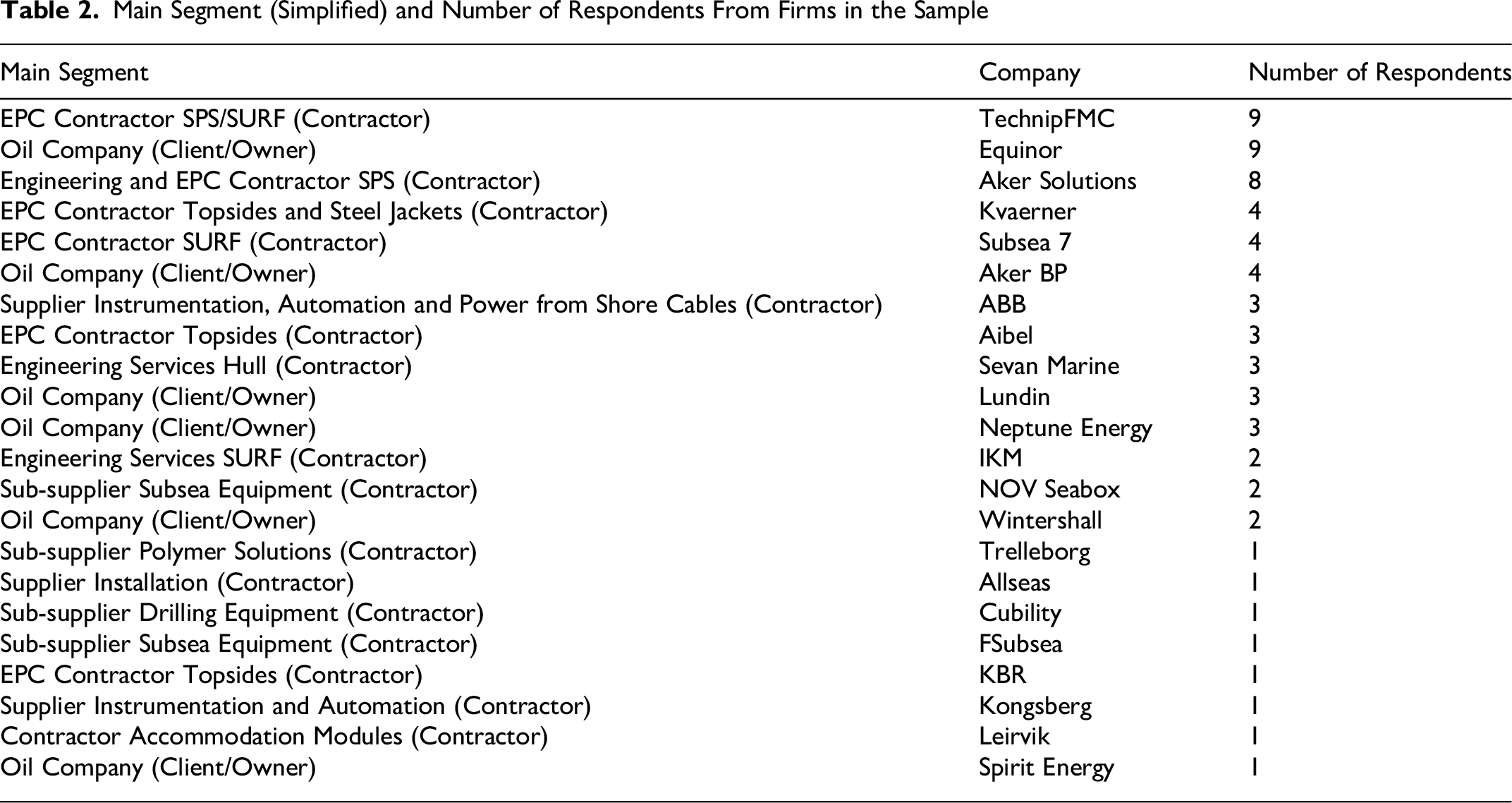
Contractors or oil companies often have different interests, which can affect the research validity if a disproportionate number of interviews is made with one type of organization in detriment of the other. Therefore, sampling needed to be wide (many firms) and diversified (many segments). As shown in Table 2, a representative sample was created consisting of contractors and oil companies with different organization sizes and areas of specialization. The sample includes the four largest EPC contractors for offshore projects, in terms of revenues in Norway: TechnipFMC, Aibel, Subsea 7, and Aker Solutions. All oil companies in the sample have been involved in important projects recently in the Norwegian continental shelf, including Equinor, the largest oil company in the country.
Main Segment (Simplified) and Number of Respondents From Firms in the Sample
Other measures to increase validity were confirmation interviews on phases III and IV of data collection, peer debriefing, and member checking. Two and a half years later, speaking with 34 respondents and building a solid knowledge of contracting strategies and adoption of front-end studies, the author conducted many interviews to confirm what had been described before. The research was presented and discussed with others from the research project who could provide helpful criticism. Lastly, the findings and reports were shared with respondents with requests for comments or corrections. This proved very useful, as the rate of reply was significant, with some respondents even providing validation interviews.
Data Analysis
Addressing the research question imposed several important considerations for data analysis. First, it required identifying examples of innovations being explored within the offshore industry, thereby providing insight into current technological advancements and trends. Second, the task involved identifying the methods by which joint exploration was organized by oil companies. An additional challenge lies in comprehending the impact of early contractor involvement for ambidexterity. Here, impact refers to what was made possible to explore in collaboration with contractors, as well as the anticipated benefits.
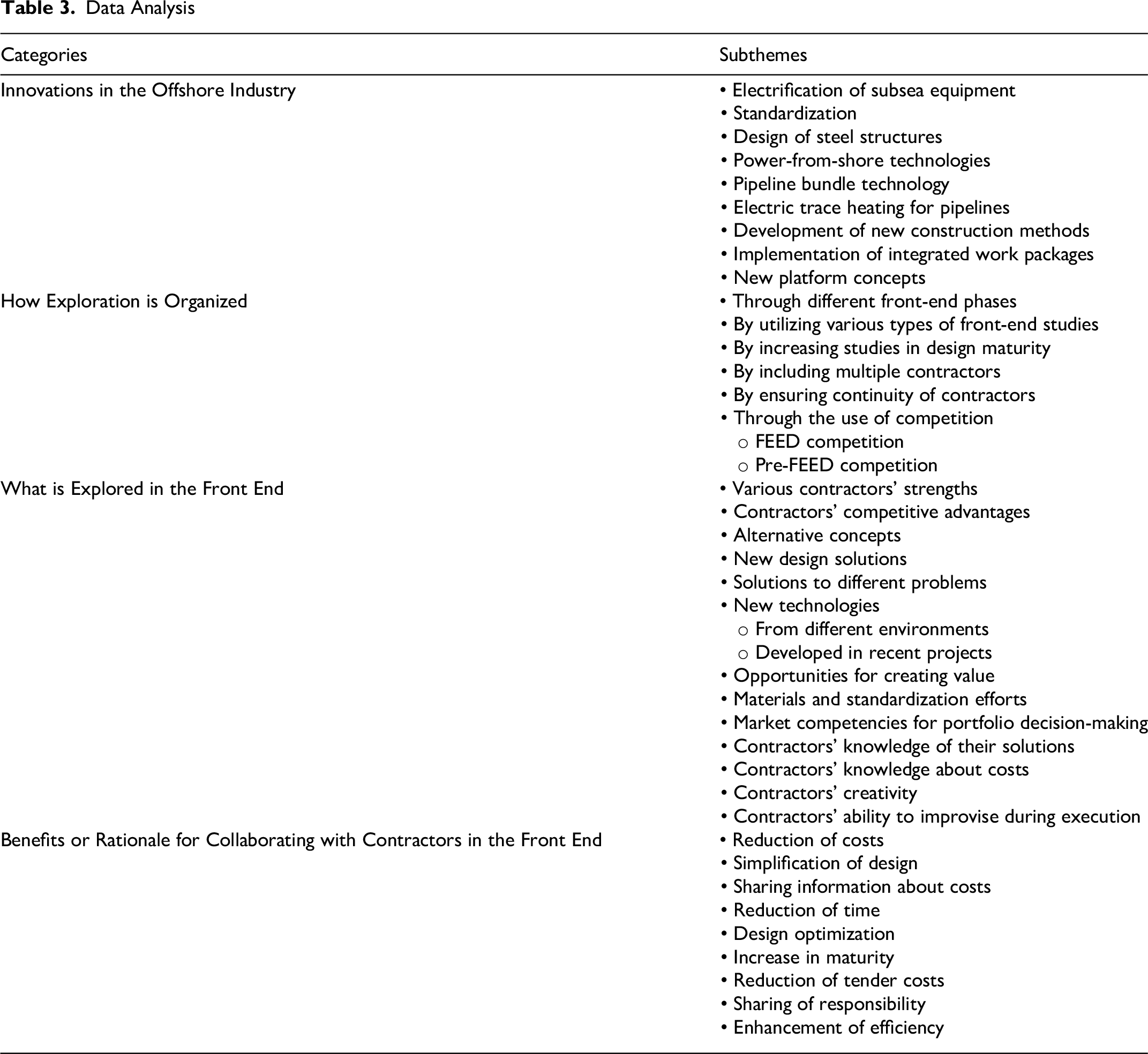
The interview material was divided into smaller segments, with specific sentences or paragraphs assigned corresponding codes. This coding process developed organically during data collection and analysis, following an inductive approach. Then, similar codes were grouped into four broader categories that aligned with existing concepts in the literature such as innovation, exploration, collaboration, and front end. These categories were structured to provide a comprehensive understanding of the research question, covering innovations pursued in the offshore industry, how exploration is organized, what was being explored in the front end, and the rationale behind collaboration efforts. These four categories encompassed 39 descriptive codes derived from participants’ responses, reflecting their views, experiences, and insights about specific projects they have participated in.
Category A: Innovations in the Offshore Industry
The data delineate a series of innovative developments that are shaping the offshore industry. The emergence of electrification and power-from-shore technologies signals an industry-wide shift toward sustainable energy practices. The implementation of pipeline bundle technology and electric trace heat adds momentum to the transformations happening in the subsea segment. Standardization, along with developments in the design of steel structures and new construction methods, underscores efforts to create more efficient practices across the industry. Furthermore, integrated work packages are indicative of a trend toward vertical strategies, combining technologies that were previously provided by different companies under separate contracts. Lastly, the adoption of new floating platform concepts in the Norwegian Continental Shelf over the last decade represents a major development, as it provides oil companies with more alternatives for field development through alternative technologies.
Category B: How Exploration is Organized
Exploration within the offshore industry is characterized by a convergence process, organized in different front-end phases and study types, alluding to a process of increasing design maturity. The participation of multiple suppliers reveals a collaborative model, enabling diverse expertise and perspectives to be integrated into the front-end phase. Contractor continuity suggests a system that harmonizes the need for broad exploration with the imperative for competitive development. The data highlight that competition, whether through FEED or Pre-FEED studies, plays an integral role in fostering innovation.
Category C: What is Explored in the Front End
Collaboration with contractors in the front end serves as a critical mechanism in the exploration process—from the perspectives of the project owners—which can explore various contractors’ strengths, competitive advantages, alternative concepts, and novel design solutions that are new to the oil companies. From the perspectives of contractors, the codes reveal exploitation efforts, given that they are mostly about contractors’ existing knowledge and capabilities. Front-end studies are instrumental in investigating different problems and their relationships to infrastructure, thus providing comprehensive insights into a project's feasibility and challenges. The emphasis on exploring new technologies, whether adapted from other environments or recently developed, signifies an industry that must balance its risk aversion while simultaneously remaining receptive to technological advancements in other contexts. The focus on standardization and market competencies reflects alignment with broader global trends.
Category D: Benefits or Rationale for Collaborating with Contractors in the Front End
The data affirms that joint exploration in the offshore industry is underpinned by several mutually reinforcing objectives. Reduction of costs through various means, time optimization, design simplification, and shared responsibility are evident, reflecting a concerted effort to align the objectives of different stakeholders. The themes articulated through these insights provide a nuanced understanding of the current landscape in the offshore industry, showcasing the pivotal role of innovations in shaping future trajectories and operational excellence (Table 3).
Data Analysis
Findings
Exploring and Exploiting Innovations in Offshore Megaprojects
Offshore oil and gas fields require an infrastructure for extracting, processing, and transporting oil and gas kilometers away from shore, which must be tailored to site-specific conditions and stakeholder requirements. The most important assets in an offshore infrastructure are the large-scale production platforms that host the processing plant and the living quarters, which can also store oil. Platforms can be fixed to the seabed or float on different types of hulls. An offshore infrastructure will typically have an additional system of subsea equipment that controls what goes in and out from the wells, which can be used to extend the operations site farther away from the platform. Also, it involves a large network of pipelines, spread across kilometers in the field, connecting the subsea equipment to the platforms.
The offshore industry has a constant flow of innovations in several technological areas. This research has identified several innovations, such as new platform concepts, like Spar platforms or circular ship-shaped FPSO (floating production, storage, and offloading) platforms; new subsea production concepts and equipment; new technologies to electrify platforms; new technologies for pipelines; and new construction methods. All these innovations discussed in this research were developed by contractors seeking to gain competitive advantages and differentiate themselves from their competitors. Oil companies typically serve as users of these innovations.
One important aspect to note is that the innovations discussed during the research have all been introduced before in other megaprojects, albeit in quite different contexts such as the Gulf of Mexico, Brazil, the United Kingdom, and other offshore markets. In the projects discussed for this research, these innovations were already being replicated by contractors, highlighting a process of learning and innovation described by Davies et al. (2009), where innovations are recombined and replicated across megaprojects to improve efficiency. These contractors have a global footprint and therefore are able to disseminate innovations from one market to another.
Despite innovations being in the process of replication, for oil companies this couldn't solely be seen as exploiting innovations. Many of the oil companies involved in the discussed projects were embracing these innovations for the first time. This novelty led to an exploratory phase, during which oil companies had to understand the risks and value of adopting new technologies or concepts and compare them with well-established alternatives. This required oil companies to develop new knowledge. Therefore, the experience of oil companies suggests that exploration also entails searching for innovations that are new to project owners, even if they have been used in other contexts before. The replication process was also exploratory for oil companies for another reason: in the forms of radical customizations, either to adapt technologies to larger scales or to challenging site conditions such as harsh weather.
These characteristics highlight that the exploration phase in offshore oil and gas megaprojects involves replicating technologies and processes proven in different contexts but not previously adopted by project owners. This, in turn, requires oil companies to (1) conduct a comparative analysis between innovations and more established technologies and practices, and (2) make customizations and improvements to replicated innovations to suit specific site conditions.
To illustrate the comparative analysis, an excerpt from an interview with the Head of Facilities of a smaller oil company was selected (respondent #50). This company, which began operating on the Norwegian Continental Shelf within the last 15 years, focuses on projects involving subsea equipment connected to existing platforms in the region. Due to its size and limited experience in Norway, the company relies heavily on the expertise of its contractors: “We would typically ask a contractor for what type of technology they would suggest for this type of project, what are the technology readiness levels as you indicate, and what is the potential likelihood for success and schedule implemented? And then you would of course consider that. Do you go with the technology qualification here or do you wish to go for conservative existing technology? This is a strategy that you would consider but it's also decision-making through the project.”
The Senior Project Manager from a contractor (respondent #71) emphasized the importance of customization to site-specific conditions. His company has been involved with a large oil company in Norway to develop a challenging project in arctic conditions in the Barents Sea: “When we started the study work for the [name of project], we didn't have a reference from all these North Sea developments. So, we started looking at all the design issues that were not known in the industry. We tried to gather information, and we developed the technical solution in combination with our clients and we tried to learn how we could adapt to these more extreme design requirements. That differs from what is seen in the North Sea and the harsh environment with large waves and so on, which are well known. But the additional impact as the low temperature, the cooldown exposure to personnel, exposure to facilities, is definitely a challenge to the teams that shall develop facilities for the Arctic region.”
How Exploration is Organized
In the Norwegian oil and gas industry, collaboration with EPC contractors has become predominant in the early phases of the front end. Most of these EPC contractors have their own front-end units, with engineers and commercial managers that interface with oil companies early on, proposing their own ideas or elaborating on the ideas the oil companies provide. Oil companies organize the collaboration with contractors using front-end studies, with varying levels of definitions and categories. The studies progress according to the phases of the front end (see Figure 1). They also ensure that multiple contractors participate and there is continuity for some of them.
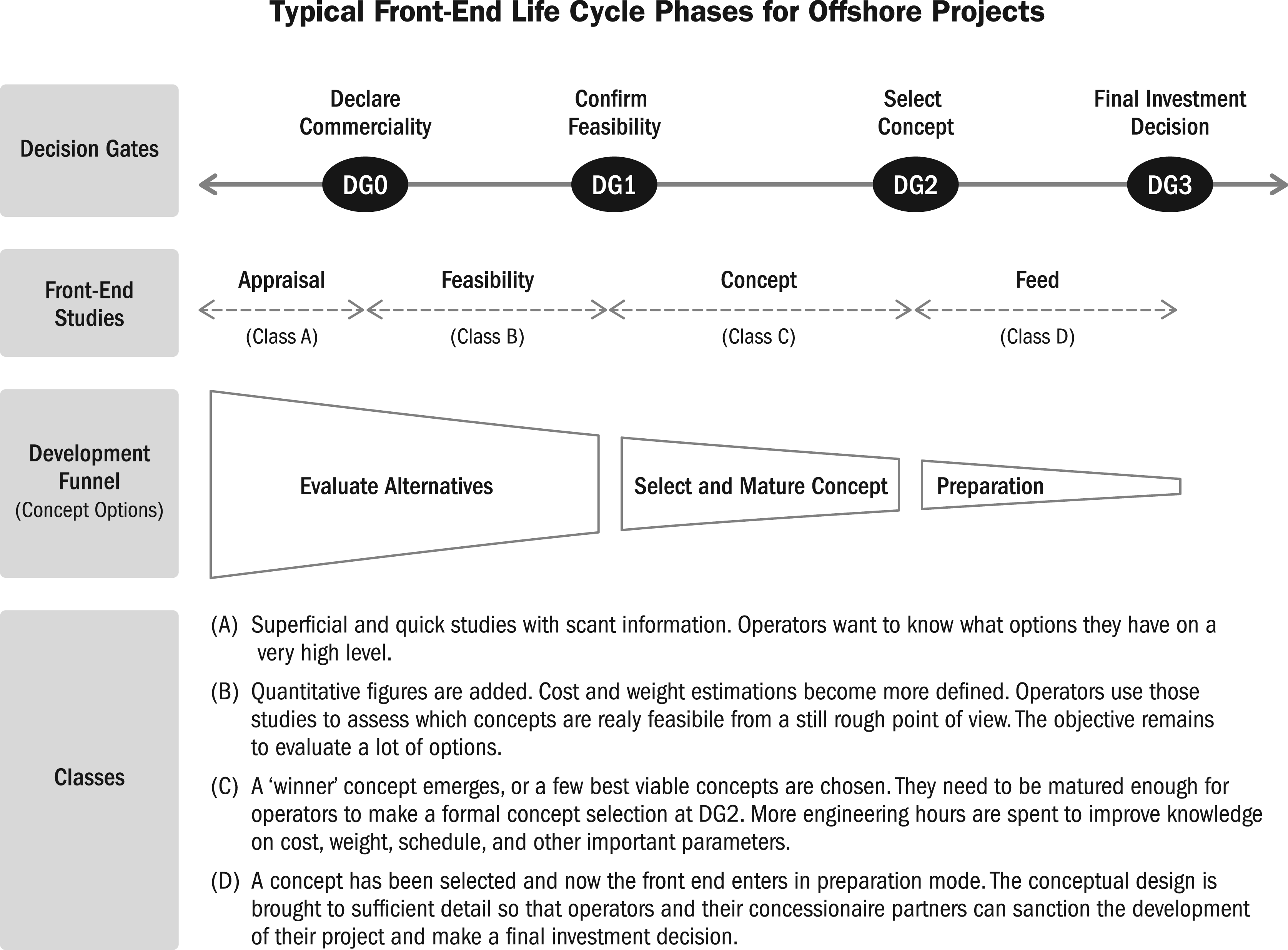
Collaboration with contractors across different front-end phases.
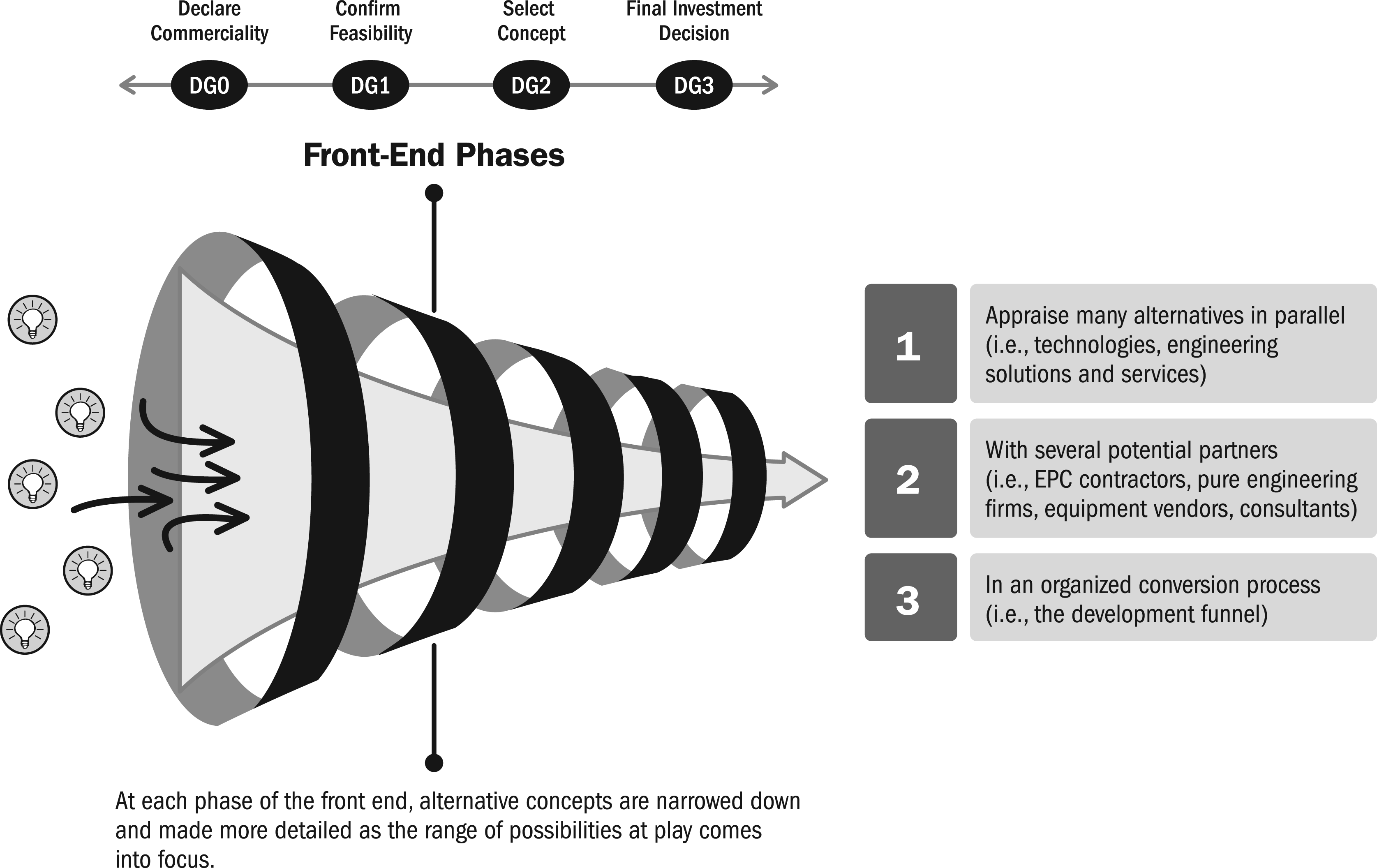
Model of early contractor involvement to optimize the exploration and exploitation of innovations in megaprojects.
The first study is called appraisal, a very superficial type of study used to prospect several development options. Cost uncertainty in appraisal studies is still in orders of magnitude. During the appraisal phase, oil companies reach out to many contractors, show them the preliminary information they have about the field, and ask them to advise on how to develop it, using their own technologies and concepts. This creates an opportunity for the contractors to discuss the business case and get the oil companies interested in the advantages of their products, the savings potential, and the technical hurdles that need to be solved.
If the proposal is interesting for the oil companies, there is an opportunity for a second and more detailed study, called feasibility study, to prepare the oil companies for DG1 (see Figure 1). While appraisal studies are more on a qualitative level, feasibility studies require more high-level engineering work. Key disciplines get involved, and there is constant communication with the oil companies as the contractors work throughout the study. The end decision gate for feasibility studies is DG1. The oil companies will then provide a new invitation to tender for the next level of study, which is a concept study.
The objective with concept studies is to take the design basis up to the required maturity level for a formal concept selection at DG2. Cost uncertainty needs to be reduced. All the disciplines used in the feasibility study are now taken to higher levels of detail. Communication with the oil companies also increases. Expert teams on both sides have regular meetings together just to talk through the development and alternatives, and how the design should be performed on the individual topics. In the end, there should be a recommended development solution for the oil companies in the license partnership to decide at DG2, with an estimated development cost, project size, and preliminary schedule for first production.
Given that front-end studies up to concept selection (especially appraisal and feasibility studies) contemplate high-level issues, numerous contractors can participate. Many respondents from oil companies confirmed that they seek the inputs from multiple contractors before selecting a concept. This collaboration with multiple contractors may include design competition in the front end. In other cases, it only ensures the continuity of contractors who have participated in previous front-end phases into the next ones. That way, a contractor who has provided a feasibility study with a proposal that pleased the oil company is likely to be invited for a concept study.
According to respondent #32, a project manager from a midsized oil company: “Most of the technical work being performed for the investment decision on [name of the field] was [made by] externally companies hired. So, we had extensive dialogue with a number of service providers, like [name of contractor] and other possible vendors. We issued a number of competing studies to clarify the potential for the various development concepts. That was definitely the basis for the concept selection. […] We looked at floating vessels, ship-shaped and circular, we looked at jacket [substructure for fixed platforms], I can’t recall all the different solutions. We had different studies ongoing with different vendors to provide us with input on different solutions.”
Another quote from the project manager and control of a large oil company (respondent #24): “During [early] studies, we go broad with several contractors, to have a competition. Typically, we are playing with several of them up to concept select—ideally.”
After a concept is selected, the project enters the last stage of the front end, the FEED phase. The purpose of FEED studies is to mature the concept for a final investment decision, reduce uncertainties around issues that can impact execution the most, and specify requirements for the package vendors. FEED stands for front-end engineering design. In these studies, the concept must be estimated as precisely as possible. The license partnership and authorities expect uncertainty about costs to be around +/-20% for a FEED study. If the project exceeds this uncertainty range at delivery it is considered a cost overrun.
Although the deliverables for FEED are crucial for ensuring predictability in execution, opportunities for innovating are drastically reduced from previous studies and are mainly about optimization through construction input. However, there are still important opportunities for exploring innovations that can lead to more efficient execution strategies. Furthermore, oil companies have increasingly adopted a model of contracting that involves awarding a FEED contract, followed by an EPC contract, closely resembling a two-stage tendering. To avoid being overdependent on contractors’ points of view, oil companies use competition on all stages to force them to optimize their cost estimates.
This process reveals a way of organizing collaboration with contractors to assess innovations and assess how they can be replicated in a particular context. This allows for greater input sources to explore more widely, instead of relying on a single contractor.
What is Being Explored in the Front End of Offshore Megaprojects
Most innovations in the offshore industry are developed and disseminated by contractors. These contractors collaborate with oil companies in the front-end phase of megaprojects (from appraisal to FEED). This collaboration is mainly focused on replication of innovations developed for other megaprojects, allowing contractors to exploit their learning to enhance efficiency and refine their innovations. However, for oil companies, there is often an exploratory aspect, particularly when they have not yet adopted the innovations proposed by contractors. This creates a need to explore new knowledge that primarily resides within contractor organizations.
This research identified nine forms of innovation developed by contractors. These innovations are also adopted and differentiated by competitors, who may also develop their own alternative concepts to compete in the same technological domain. Consequently, oil companies need to explore various aspects of the knowledge held by contractors regarding these innovations. The research identified 12 key aspects: (1) their own strengths; (2) their competitive advantages; (3) alternative concepts; (4) new design solutions; (5) solutions to different problems from a systems perspective; (6) new technologies from different environments or developed in recent projects; (7) opportunities for creating value; (8) materials and standardization efforts; (9) market competencies for portfolio decision-making; (10) contractors’ knowledge of their solutions; (11) contractors’ knowledge about costs; and (12) their creativity.
An excerpt was chosen to demonstrate interviewees’ awareness that contractors possess a significant portion of the knowledge regarding the solutions being developed. Respondent #24, the manager from a contractor, articulated: “We do this every day. We know exactly what things cost, we know how long things take, we know where the risks are, we know the supply chain very well. So, we feel that we are able to not only price work a lot more accurately, but understand what the best solution is, what's going to be simplest way to install and commission, what's going to be simplest to operate, what can be done within the schedule that's set where the risks are is very important. A lot of this is about risk management, but we feel that we're best placed to understand what those risks are, both technical and commercial risks.”
Three examples of innovations in the offshore industry were selected to illustrate how the capabilities of contractors are explored by oil companies in the front end and are described in the following subsections.
Implementation of Integrated Work Packages
By the time of the research, one major innovation in the offshore industry was the consolidation of the subsea sector, either by mergers or strategic alliances, in such a way that contractors were able to design and deliver all equipment from the subsea production system (SPS) and the subsea umbilicals, flowlines, and risers (SURF). The integration of SPS and SURF segments was a business model innovation developed by contractors and was being adopted in several projects in Norway, including Trestakk, Fenja, Skogul, Ærfugl, Nova, Solveig, Visund Nord, and Duva.
For megaprojects requiring subsea technology, there is intense competition among a select few contractors vying for the SPS and SURF contracts. It has become customary for oil companies to involve these contractors in the front-end phase to discuss how the integration of SPS and SURF can optimize the subsea field layout, using their proprietary technologies and customizing design to fit their installation capabilities. However, such involvement is only meaningful when contractors are engaged early in the front-end phase; otherwise, crucial decisions may already be made before their introduction to the project.
Respondent #18, the manager of the front-end unit of one of the contractors using this integrated model, stated: “We worked on the model of integrating SURF and SPS, and we told the market that to provide the most value you need to bring us in early. Then we can optimize the field for you, come with new technology ideas, work smarter, reduce the risk, and sort out all the interfaces that you used to deal with […] Everything inside one company is smarter than two separate companies and you need to make a contract to each of them that is without any holes, if you understand that.”
Many subsea projects involved smaller oil companies that had never previously collaborated with an integrated SPS/SURF supplier. For these companies, it was crucial to understand the advantages and consider the disadvantages of a “one-stop shop” for all subsea equipment. They needed to explore this business model innovation, which was new to them. In contrast, for contractors who had already developed and commercialized this solution, the focus was on exploiting their existing knowledge and making incremental improvements to persuade the oil companies of the benefits.
New Platform Concepts
New floating platform concepts have emerged as a significant innovation in the offshore industry since the 1990s, when oil companies began operating in deeper waters. In Norway, fixed platforms have been the prevalent concept due to shallower waters. Nevertheless, the discovery of oil and gas in deeper waters necessitates the use of floating platforms, requiring the introduction of new platform concepts in the Norwegian context. These new concepts must also be adapted to larger scales and withstand the challenging weather conditions of the Norwegian Continental Shelf. For example, a Spar Platform installed in the Aasta Hansteen field in 2018 was the first ever Spar platform in Norway and also the world’s largest of its kind. At the time of the research, other megaprojects were in the process of selecting or had recently selected floating platforms. These megaprojects, located in the Barents Sea, were Johan Castberg, Goliat, and Wisting.
The Barents Sea is a distant and challenging area north of the Norwegian coast in the arctic region, which presents many location-related challenges, such as darkness during wintertime, polar lows, and constant low temperatures, as well as large distances from the shore or any other offshore facility. Therefore, these three megaprojects represent a departure from most projects in Norway, not only because they required floating platforms, but also because there were other important requirements, like how to electrify these platforms, if they should be turned into hubs for future discoveries, and how to prepare them for the challenging arctic conditions where they would operate.
These unique challenges indicated the need for an exploratory phase to determine the most appropriate production infrastructure and refine it according to each megaproject's specific requirements. During the front-end phase, oil companies collaborated with contractors that specialized in different platform concepts to evaluate which one would be best. This assessment included both unfamiliar and familiar platform concepts, among them Spar platforms, semisubmersibles, TLPs, circular FPSOs, and ship-shaped FPSOs. The contractors, being experts in platform design, could support the oil companies in their exploration efforts. So, the front end was a period for exploring the contractors’ experience and undergoing a screening process. In one megaproject, a circular FPSO was chosen; in another, a ship-shaped FPSO was the concept of choice. All these concepts had to undergo extensive studies to prepare them for the cold weather of the Barents Sea.
Respondent #55 was involved in concept studies for two of these megaprojects, from the oil company side, and said: “For some projects, it's pretty obvious that you will use a floater solution, even from the beginning. But then you would also have to look into different subconcepts for the floater, where you would need different contractors. We have previously in the project looked at totally different floater solutions. We had to use different contractors. Also, for one floater solution which was very specific, [we needed] expert knowledge by a particular company. Those sorts of capabilities that we would not have in house to evaluate such concepts.”
There are few but significant megaprojects in Norway that necessitated the construction of floating platforms. In some instances, oil companies had prior experience with this concept but needed to develop new versions of the platforms to withstand challenging site conditions. In other cases, oil companies were unfamiliar with a specific floating platform and had to explore the pros and cons of each design. For contractors, this represented an opportunity to exploit their expertise in platform concepts, allowing them to adapt and apply their knowledge to the Norwegian context.
Electric Trace Heating for Pipelines
The last example comes from an offshore oil and gas project in the Norwegian Sea. Given the small size of the reservoir, the project was planned to have a subsea production system on-site and transport the production via underwater pipelines to an existing platform nearby for processing. Due to the very long distance from the field to the existing platform, many types of pipelines were assessed in the feasibility stage. The oil company realized a wide and heated pipeline for transporting production was needed to avoid problems with wax and hydrates in case of maintenance shutdowns, because of the high wax content of the oil. They also decided to use a new technology called electrically trace-heated pipe-in-pipe (ETH-PiP). Having this technology would allow the oil company to restart production much faster than using thawing chemicals for hydrate control on traditional pipelines.
The ETH-PiP would be the world’s longest subsea development. A number of tests had to be made and so the project team decided to bring in two contractors that had developed this technology to start qualification of their own heating systems early and outline in studies their use in different scenarios. Once the concept was chosen, the oil company awarded these contractors two separate FEEDs for the network of pipelines and installation, so the contractors would be in in direct design competition. The competitors developed their design based on high-level functional requirements established beforehand, taking full responsibility for the specifications. Technical clarifications and qualification work between the oil company and the contractors were made during the study. Thus, most of the documents going into the contract were already written and negotiated by the time of the tender. Respondent #7 stated: “We knew we needed heated pipe. There were several options available for how to heat the pipe. So, ETH was one of the options. There were several technologies that we looked into and ended up with the ETH as the most practical for our project. We also looked into several other technologies in other areas and did the screening of what could be relevant for us and sort of closed them out as went along. We ran a parallel design competition in SURF with [name of two contractors]. We had to choose them because they were the only players capable of the ETH piping and they only had one vessel available for each company.”
This subsea project involved a smaller oil company that had never implemented the ETH-PiP technology. Only one project in Norway had previously utilized this technology, which was operated by a different oil company. Consequently, there was a need to explore this unfamiliar innovation. In contrast, the two contractors had developed and applied this technology in other projects abroad. One of the contractors had also worked on the ETH-PiP project in Norway, the other oil company. This presented them with an opportunity to exploit their knowledge of the technology and demonstrate to the oil company that they had the superior technical proposal and execution capabilities to secure the contract.
Discussion
Early Contractor Involvement Facilitates the Exploration and Exploitation of Innovations in Megaprojects
Early contractor involvement entails engaging contractors in the front end of projects, before the phases typically associated with execution such as detailed engineering, procurement, and construction. The front end is when all important decisions impacting the project are made, including conceptualizing the project and selecting the most appropriate technologies. Previous studies have indicated that the project life cycle is a spectrum, with the value of incorporating new ideas gradually decreasing from the front end to execution (Williams et al., 2009; Williams & Samset, 2010). The advantages of exploration are higher in the earliest stages of the front end, whereas some innovations may not be viable due to late-stage implementation (Worsnop et al., 2016).
This article contributes to project studies by illustrating the front end's potential to explore innovations and align with earlier research (Davies et al., 2014; Davies et al., 2016; Edkins et al., 2013; Williams et al., 2019; Williams et al., 2009; Williams & Samset, 2010). However, the existing literature lacks detailed discussion on the sources of these innovative outputs, whether they originate from the owner organization or from third parties such as governments, consultants, and suppliers.
The rationale for involving contractors in the front-end phase is grounded in their role in developing and disseminating innovations across various megaprojects (Davies et al., 2009). Consequently, contractors possess a deeper understanding of innovations compared to project owners, which stems from their accumulated experience with previous megaprojects and their active engagement in developing new technologies and processes. However, this assumption has not been thoroughly examined until now. This research demonstrates that, given the reservoir of knowledge residing within contractors’ organizations, an effective approach for project owners to explore innovations is through collaboration with contractors during the front-end phase.
Engaging contractors at the front end allows for the timely incorporation of suggestions and minimizes disruption in decision-making processes. Such collaboration enables project owners to leverage contractors’ strengths, competitive advantages, alternative concepts, new design solutions, strategies for addressing various challenges, emerging technologies, opportunities for value creation, materials, and standardization efforts. Additionally, it provides insights into contractors’ solutions, cost considerations, creativity, and adaptability. These dimensions of exploration are overlooked in research concerning the role of early contractor involvement in fostering innovation within projects (Mosey, 2009; Valkenburg et al., 2008).
In essence, contractors craft advantages over their competitors rather than discovering these advantages solely during the tender process, when it is often too late to consider new options. Collaborating with contractors during the front end allows project owners to explore relevant knowledge about innovations when there is greater flexibility to implement changes. Thus, the findings demonstrate that early contractor involvement facilitates the exploration and exploitation of innovations in megaprojects by enabling project owners to leverage the knowledge acquired by contractors through the development and replication of innovations, in a phase of the megaproject that is more conducive to exploration.
Three examples from innovations in the offshore industry were provided to illustrate how project owners explore the knowledge that contractors gain by replicating innovations from previous megaprojects. The first example is the implementation of integrated work packages, a business model innovation that allows one contractor to design interrelated systems that used to be designed by two separate contractors. In the offshore industry, this refers to the integration of subsea production systems (SPS) and subsea umbilicals, risers, and flowlines (SURF). By integrating these work packages, contractors can create many synergies in design. This knowledge is then explored by project owners, who collaborate with various contractors to assess the advantages of adopting this model over the more traditional separation of work packages. Additionally, they evaluate which contractor is better suited to adapt to this new business model.
The second example refers to the range of platform concepts used in deeper waters. Some contractors specialize in specific types of platforms, whereas others focus on different ones depending on the markets they originate. Many contractors have proprietary design and construction processes that distinguish them. Drawing from prior experience in megaprojects worldwide, these contractors assist oil companies in exploring various platform concepts, some of which may be unfamiliar. This collaboration in the front end enables oil companies to assess strengths and weaknesses directly from specialists and select a concept that best suits their field development objectives. Additionally, oil companies can collaborate with contractors to customize and enhance concepts, fostering ongoing innovation in the replication process.
The third and last example involves the adoption of a new technology for heating pipelines. The oil company had not previously employed this technology; however, the characteristics of the field development concept justified its use for the first time. Consequently, the oil company engaged two contractors specializing in this technology to provide clarification and conduct qualification tests to ensure its reliability, particularly considering this would mark the longest pipeline in the world utilizing that technology. During the front-end phase, these contractors participated in a design competition tailored to optimize their delivery capabilities, enabling the oil company to compare their offerings and select the most promising proposal encompassing design, product delivery, and installation. It is essential to note that this decision couldn't be solely based on the tender process, as the contractors were not competing on a standardized design but rather on highly customized solutions.
Structural Ambidexterity
The collaboration between project owners and contractors underscores the concept of structural ambidexterity within projects, wherein exploration and exploitation are done simultaneously by different organizational units. Structural ambidexterity is a concept often overlooked in project studies. It is assumed that the advantages of structural ambidexterity are limited in a project context, given the challenge of coordinating separate organizational units to engage in exploration and exploitation simultaneously (Liu & Leitner, 2012). However, the findings highlight that integrating resources from contractors’ organizations facilitates structural ambidexterity, because contractors can embody the exploitation aspect of ambidexterity whereas project owners drive exploration efforts.
On one hand, contractors engage in a replication process, exploiting innovations they've utilized in previous projects (Davies et al., 2009). In this process, technologies and processes are replicated with incremental improvements in new contexts and with new project owners. Conversely, for the project owners, this collaboration is exploratory as they must acquire knowledge about technologies they haven't utilized before—innovations that are new to the firm (Cantarelli & Genovese, 2021). Project owners also undergo an evaluation process, comparing these new technologies being replicated by contractors with more familiar ones. Additionally, there's a necessity for radical customizations and improvements, often more exploratory than exploitative, to adapt technologies to larger scales or more challenging site conditions.
The evolution of project-based industries has facilitated collaboration between project owners and contractors, fostering structural ambidexterity. Prior studies highlight how contractors have established specialized front-end units to engage with project owners during the front-end phase of projects. These front-end units present a diverse array of products tailored to the owners’ specifications (Davies et al., 2007; Davies, 2004; Davies & Hobday, 2006). Similarly, the strategies discussed in this research emphasize the importance of dedicated front-end teams within contractors’ organizations, comprised of experienced engineers trained to understand projects from the owner's perspective and translate their needs into customized commercial propositions.
New Contracting Strategies Can be Formulated to Enhance ECI and Ambidextrous Management of Innovations
The findings discussed in this article demonstrate that project owners develop elaborate contracting strategies to optimize this collaborative exploration and exploitation of innovations. The findings describe a model of early contractor involvement that encompasses three pivotal aspects: project owners (1) appraise numerous alternatives in parallel; (2) with several contractors; and (3) in an organized convergence process. In this organized convergence process, the number of collaborations is reduced as the project progresses through decision gates and life cycle phases. The simultaneous evaluation of different solutions bears similarities to the parallelism observed in exploratory projects (Lenfle & Loch, 2010).
This form of ECI has elements that differ from other forms of ECI analyzed in previous project studies such as alliances and partnerships (Barlow, 2000; Mosey, 2009; Naoum, 2003), price-competitive alliances (Mosey, 2019; Josey & Burton, 2014; Love et al., 2010), competitive dialogue (Haugbølle et al., 2015; Hoezen et al., 2010; Hoezen et al., 2012; Valkenburg et al., 2008), and two-stage tendering (Lahdenperä, 2010; Liu et al., 2014).
In this modeI, during the initial exploration phase, project owners explore as many alternatives as possible with many contractors. As the front end progresses, less attractive alternatives are eliminated, while more promising ones are retained and advanced to the subsequent phase of the front end, consequently reducing the number of collaborating contractors. This iterative process continues until only one project concept remains, which is then detailed sufficiently for accurate pricing and scheduling of execution. Each phase of the front end corresponds to a level of definition, accompanied by distinct studies, participant engagement levels, and scopes of work. The studies get more detailed and larger as the range of potential options comes into focus.
This model of ECI—involving the evaluation of numerous alternatives concurrently from multiple contractors—offers two advantages for facilitating exploration and utilization of innovations. First, project owners can access information beyond the accumulated experience of a single contractor or themselves. While contractors may attempt to replicate innovations from previous projects in a new context, project owners can explore replication efforts from multiple contractors, ensuring greater knowledge dissemination within the project organization. Project owners can place small bets on different ideas, thereby reducing dependency on a single contractor's vision for the project.
Second, the organized convergence process optimizes the stages of the front end that are predominantly dedicated to exploration. Rather than following a linear approach of sequential collaboration with each contractor, project owners can engage in parallel collaborations to explore alternative solutions more comprehensively or swiftly. Furthermore, this model of early contractor involvement enables project organizations to prospect new ideas widely without having to investigate all alternatives in depth. Given that not all ideas are worth the same time, money, and attention spent, the convergence process directs resources progressively toward the most promising concepts, enhancing the efficiency of the exploration phase.
This efficiency is crucial in schedule-driven megaprojects, where an optimized exploration phase translates into time savings or a broader scope of exploration. Project stakeholders often display reluctance during prolonged exploration phases, pressing for definitive design choices at the project front end (Gil et al., 2012). Given the typically tight project timelines, enhancing exploration efficiency during the front end is imperative to ensure a wider scope of exploration within the same timeframe or achieving similar results in a shorter period.
Conclusion
This article concludes that early contractor involvement (ECI) has an important role in facilitating the exploration and exploitation of innovations in megaprojects. Contractors possess knowledge about innovations that project owners often lack, as they are regularly involved in developing innovations and replicating them across multiple megaprojects. Involving contractors in the front end allows project owners to explore this knowledge when there's more flexibility in incorporating new ideas into the design. During the front end of megaprojects, owners collaborate with contractors to explore their strengths, competitive advantages, new design solutions, alternative concepts, emerging technologies, and many other market developments identified during data analysis.
This article also contributes to studies on project ambidexterity by demonstrating how collaboration between contractors and project owners constitutes a form of structural ambidexterity. Contractors engage in an exploitative process by replicating innovations developed in previous megaprojects, whereas project owners undertake exploratory efforts to learn about these innovations and compare them with other alternatives in the market. They also require extreme customizations such as adapting to larger scales or challenging site conditions. Therefore, when considering the pursuit of innovation in megaprojects, it is essential to integrate it with ambidexterity for its exploratory and exploitative aspects. This involves recognizing that exploration and exploitation are done simultaneously in the front end, by project owners and contractors, respectively.
Last, since exploring and exploiting innovations is associated with contractor collaboration, contracting plays an important role in driving and organizing such collaboration. The findings in this article indicate that contracting strategies are being developed to enhance ECI, employing a front-end collaboration model. This ECI model enables project owners to (1) appraise many alternatives in parallel, (2) with several contractors, and (3) in an organized conversion process. Thus, not only does this research demonstrate that ECI, in general, facilitates the exploration and exploitation of innovations, it also highlights a specific model of ECI that further promotes innovation in megaprojects in two ways.
First, by evaluating multiple alternatives with several contractors simultaneously, project owners can explore innovations more extensively than with a single contractor. Innovation knowledge is dispersed across a whole array of contractors, each with its own competitive advantages, so involving multiple contractors in the front end broadens the scope of innovations to be explored. Second, the organized conversion process enables a more efficient exploration phase, as project owners can evaluate alternatives widely while gradually allocating resources to the most promising concepts. This ECI model suggests that definition phases and stage-gate controls can be employed during the exploration phase to sift out less viable ideas, focusing only on the more promising ones for further elaboration. In schedule-driven megaprojects, this is crucial for conducting a more efficient exploration phase in the front end, allowing exploitation activities to begin more promptly.
For practitioners, this article offers a contribution by providing a detailed description of how managers can effectively utilize stand-alone engineering contracts to facilitate collaboration with multiple contractors in the front end. By gradually analyzing alternatives, managers can prevent unnecessary delays in the exploration phase of their projects. These contracts encompass feasibility studies, conceptual studies, and FEED, depending on the required level of definition. This form of early contractor involvement can be seamlessly integrated into the front-end structure of any megaproject, particularly those employing a common stage-gate methodology.
The findings of this article have certain limitations. The study focuses on a sector that is particularly diverse. This diversity, characterized by numerous capable suppliers and competitors across different segments, may limit the generalizability of the findings to other industries with less competitive or less innovative ecosystems. Moreover, the oil and gas industry has been a leader in contracting innovations, which has enabled companies to experiment with various forms of competitive contracting. This model of joint exploration may not apply to sectors that do not have the same quantity of complex projects as oil and gas, and therefore cannot really experiment with structural ambidexterity using contracting strategies. Additionally, although this article emphasizes that contractors typically exploit knowledge from project to project, there are instances where project owners also capitalize on technologies previously implemented. More research is required to understand how project owners and contractors can collaboratively exploit these technologies through incremental innovations for new projects, rather than through full-scale exploration with multiple contractors.