




Abstract
The aim of this article is to understand the dynamic evolution of a governance framework for major public projects. Drawing on Ralf Müller’s contributions in the field of project studies regarding governance, combined with a theoretical anchoring in neo-institutionalism, we seek to shed light on the evolutive aspects of a governance framework, also framed as a public policy. Based on the case of Canada, relying on secondary sources and ethnographic sensitivity, we trace the trajectory of the policy (the governance framework) and highlight the main evolutions and turning points. Five iterations are documented, resulting in increasing complexity over time and institutional layering. The theoretical contribution is to uncover the dynamic and evolving nature of governance frameworks, whereas the practical benefit is to enable decision makers to understand the implications of layering and find the right balance between novelty and overlap for optimal project governance.
Introduction
Governance frameworks for the management of major infrastructure projects are now largely implemented in many countries with varying levels of income (Volden & Samset, 2017). In Canada, the first initiative to implement a policy to frame the governance of major public projects dates back to 1978 (Treasury Board of Canada, 1978). Since then, there has been a constant evolution of the framework, each version addressing specific issues regarding regulation, decision-making processes, or scope of the framework, leading to increasingly normative and cultural–cognitive policy instruments. This particular situation in Canada reveals a dynamic process by which the governance framework evolved in a political administrative context and, in so doing, draws an itinerary where different project actors are being involved and might take part in its evolution (Brunet, 2021; Volden & Samset, 2017). The interest in engaging in more research on the dynamic nature of governance frameworks—instead of taking them for granted—is found in the capacity of such frameworks to operate in a changing world (Shiferaw & Klakegg, 2012).
Researchers have recently argued for a stronger mobilization of public policy theory to better understand public projects and megaprojects (Esposito & Terlizzi, 2023; Hudon & Floricel, 2023; Sanderson & Winch, 2017). We agree with this point and aim to contribute to this theoretical enrichment. The field of project studies abounds with rich understandings of project governance, for which we highlight the specific contributions of Ralf Müller and colleagues (Müller et al., 2014, 2015). Thus, we attempt to build bridges among neo-institutional theory, policy implementation and evolution, and institutional governance frameworks for major public projects. Investigating governance frameworks as public policies, having distinct trajectories (Pollitt & Bouckaert, 2011) and contextual embeddedness, is highly needed both from a theoretical and practical perspective (Flyvbjerg, 2007; Sanderson & Winch, 2017). Mobilizing rich, longitudinal data, this article seeks to answer this research question:
How has the Canadian governance framework for major public projects evolved over the years?
A deep dive into this specific case study sheds light on undertheorized topics in project governing such as process tracing, path dependency, and institutional layering (Howlett et al., 2020; Song et al., 2022). As other researchers have investigated other governance frameworks (most notably in the United Kingdom and Norway), broader reflections and comparisons will also be discussed along with theoretical and practical contributions related to governing long-term policy interventions (Klakegg et al., 2016). Notably, there are connections, inspirations, and learning not only within a specific public administration (country, state, or province) but also among them. The main theoretical contribution is to uncover the dynamic and evolving nature of governance frameworks as public policies, presenting an overall long-term trajectory (Strauss, 1993) and embedded in an institutional context (Müller et al., 2019). The main practical contribution is to help politicians and civil servants to adopt public policies that are adapted to govern major public projects optimally.
The next section presents a literature review with subsections on neo-institutionalism and policy processes, multilevel project governance, and organizational enablers. Then the methodology is presented, with the case study selected, data collected, and the analysis procedure based on process tracing. The section on findings provides detailed evidence of the trajectory of the governance framework, with the main characteristics, actors, and turning points highlighted. The discussion section points those results back to a theoretical argument about governance frameworks as evolutive and contextually embedded. Organizational enablers and inhibitors are presented and discussed more broadly as a specific contribution of Müller’s work (Müller et al., 2015) that help advance this topic further. Lastly, the main contributions and limitations are highlighted in the conclusion, along with future research avenues.
Literature Review
A thorough review of the literature has revealed that, to the best of our knowledge, the subject of the evolution of the Canadian federal governance framework for projects has not yet been directly addressed by the scientific community. This article therefore represents a first attempt to analyze and interpret the specific question of the evolution of these frameworks using some of the theoretical approaches employed by Müller, namely neo-institutionalism and layering, multilevel project governance, and enablers.
From a Policy Perspective: Layering in a Neo-Institutional World
The neo-institutional approach focuses on the analysis of different contexts in order to understand and interpret the construction of rules, practices and, more generally, political and administrative systems that influence and delimit the interplay of actors (Lecours, 2005; Pierson, 2000). According to Hall and Taylor (1996), new institutionalism is a term that has been used in many different contexts, bearing different meanings. These authors identify three schools of new institutionalism: historical institutionalism, rational-choice institutionalism, and social institutionalism. According to the historical institutionalism, an institution is defined as “the formal and informal procedures, routines, norms and conventions embedded in the organizational structure of the polity or political economy” (ibid., p. 938). In this view, actors are constrained in their actions by the weight of previous decisions, according to a logic of path dependency (Campbell, 2004) that may be broadly defined as “what has happened at an earlier point in time will affect the possible outcomes of a sequence of events occurring at a later point in time” (Sewell, 1996, cited in Thelen, 2003, p. 218). The focus of analysis relies mostly at the macrolevel, where emphasis is put on national institutions rather than a specific organization. The other two variants of neo-institutionalism focus either on the restrictions imposed on the members of an institution by its culture, thus favoring an analysis at the mesolevel (sociological approach), or on the influence of structures on the individual preferences of actors at the microlevel (rational choice approach) (Hall & Taylor, 1996). It is important to note that the present analytical framework is based primarily on the historical form of neo-institutionalism, without excluding other variants.
The work of Scott (1995, p. 33) has been very influencing in shaping neo-institutionalism. At its core, he defines an institution as “consist[ing] of cognitive, normative, and regulative structures and activities that provide stability and meaning to social behavior. Institutions are transported by various carriers, cultures, structures, and routines and they operate at multiple levels of jurisdiction.” Those three pillars are independent, but interdependent (Scott, 2012). First, regulative elements include rule-setting and sanctioning activities. They are often externally imposed and include formal regulations, laws, and property rights (Müller, 2017). Some examples of regulative elements regarding project governance have been cited by Müller (2017) and Müller et al. (2015): regulations, policies, relational contracts, public–private partnerships, complying with environmental laws, media, and infrastructure. Second, the normative pillar is composed of prescriptive, evaluative, and obligatory activities (Scott, 2012). There is an important tangible and formal side to norms (described in Müller et al., 2015, as process facilitators) but they are also informal, value-laden, and performative. Ostensible normative elements relating to project governance are, for example, standards issued by professional associations, companies’ internal project management methodologies, certifications, training, meetings, process documents, and central agencies (Müller et al., 2015). Thirdly, cultural–cognitive elements are shared conceptions of social reality (Scott, 2012). Although cultural–cognitive elements are more intangible and subject to different interpretations, they mostly refer to shared beliefs, symbols, identities, and logics of action (Müller, 2017). This can be inferred, for example, by assessing the importance of the role of a project manager throughout the formal description and status.
These three institutional pillars work together to provide stability to an institution. Yet, an important stream of research has emerged over the past decades to uncover the dynamics of institutional change (Campbell, 2004). Reviewing this important body of literature is out of scope for this article. However, an important conceptual subset of institutional change is institutional layering, defined as “tense layering of new arrangements on top of pre-existing structures” (Schickler 1999, cited in Thelen, 2003, p. 226). Institutional layering involves “the partial renegotiation of some elements of a given set of institutions while leaving others in place” (Thelen, 2003, p. 225). Thelen (2003) has been very influential in developing this concept. A literature review suggests that some layering involves a thickening by adding actors, whereas others’ regulatory ratchet involved mostly adding instruments (van der Heijden, 2011). A more recent review classifies layering according to expected policy outcomes, whether the results are achieved, failed, or contradictory (Capano, 2019). Examples of recent studies mobilizing neo-institutional theory and institutional change can be found in public administration (Van De Bovenkamp et al., 2014) and in project studies (Hetemi et al., 2021; van den Ende & van Marrewijk, 2019).
Thus, an institution is very broad and encompasses many things. Our object of study relates more directly to the politics and policies for major public infrastructure projects. According to (Heclo, 1974, p. 4), a policy is: “a course of action or inaction pursued under the authority of government. It is employed as a concept at the middle-range level of analysis, larger than a decision and smaller than a social movement. […] Policy acquires meaning because an observer perceives and interprets a course of action amid the confusions of a complex world. Policy exists by interrogating rather than by intuiting political phenomena.”
From a Governance Perspective: Institutional, Organizational, and Project Enablers
Project governance has been studied from a multilevel lens looking at the macro (institutional) level, the meso (organizational) level, and the micro (project) level (Brunet, 2021; Brunet & Aubry, 2016; Daniel, 2022). Whereas Müller et al. (2019) have focalized on the organizational level using a contingency approach, their onion model is quite interesting and could be expanded upon into the institutional level. This is the approach taken by Turner (2023), who proposed a model of governance including four levels: (1) from the broadest policy decisions (governmentality), (2) strategic decisions (board level), (3) tactical decisions (governance of projects), and (4) operational decisions (project governance). Similarly, Jooste and Scott (2012) mobilized an institutional approach to analyze the broader organizational enabling field for public–private partnerships. In recent papers, Müller and his team have embraced a broader view of governance such as network governance, governance of networks, and metagovernance (Müller et al., 2022; Unterhitzenberger et al., 2023). As such, Müller and his colleagues still adopt a contingency lens but focalize on larger interorganizational project networks. Yet, as we will develop next, Müller’s work also relied on institutional theories to develop research on enablers, using these three institutional pillars: regulative, normative, and cultural–cognitive elements (Müller et al., 2015; Scott, 2012). Recent calls have been made to delve deeper into institutional implications of projects, megaprojects, and project-based organizing (Esposito et al., 2021; Söderlund & Sydow, 2019). Whereas classic neo-institutionalism tends to view institutions mostly as stable structures with limited actor’s purposive actions, other approaches view actors as shaping how institutions (and policy) are shaped over time (Esposito & Terlizzi, 2023). For example, Tukiainen and Granqvist (2016) have used institutional work to understand how institutional change is enabled by temporary organizing. Close to this approach, researchers have used the practice perspective to study how actors influenced policy implementation or evolution through various enablers (Brunet, 2019; Hampton, 2018).
Project Management Institute (PMI) defines an organizational enabler as “a structural, cultural, technological, or human-resource practice that the performing organization can use to achieve strategic objectives” (PMI, 2018, p. 85). Müller et al. (2014) first investigated this concept as they reviewed the existent literature on the topic, applying it to the project context and different levels of governance. Thus, they conceptualized organizational enablers as comprising process facilitators and discursive abilities, each with intrinsic factors and mechanisms (Müller et al., 2014). In a subsequent paper, Müller et al. (2015) connected those enablers to the three pillars of institutions, namely the regulative, the normative, and the cultural cognitive. They also suggested that their main characteristics referred to stability, flexibility, and alignment as they studied six cases of project-based organizations, offering numerous examples of the practices used as organizational enablers. In his book written in 2017, Ralf Müller expands these notions, even dedicating a part of his book to the topic, separated into tactical and strategic organizational enablers. This body of work has inspired us for this article, as we will build on this in the discussion. Next, we turn to the methodology adopted.
Methodology
The objective of this article is to better understand the evolution of the Canadian governance framework for major public projects since its inception. We have chosen the case of this specific government since, as this article demonstrates, this institution has a rich history of governance frameworks for major public projects. In fact, the current trajectory began in 1978; this case therefore allows us to probe more than 40 years of evolution. In addition, the Canadian case complements a study published by Volden and Samset (2017) that offers a comparative analysis of governance frameworks in six jurisdictions (Denmark, Norway, the Netherlands, Québec [a Canadian province], the United Kingdom, and Sweden), as we propose a similar unit of analysis (i.e., a country) to the European counterparts.
The research design is based on a case study approach focusing on the several variations of this framework, from 1978 to the present day (Yin, 2009). This strategy provides a global view of the case studied, enabling the main iterations of the framework to be described, compared, and interpreted. We chose the case study, because we believe this research strategy is the most suitable for proposing a holistic interpretation of the dynamics specific to a theme, namely the project governance framework. The combined studies of several iterations from different political–administrative periods enable a holistic interpretation of the evolution of this framework. This historical perspective allows for more in-depth interpretations and avoids the singularity of an explanation based on a single period (Gerring, 2004; Stoecker, 1991).
This process of historical evolution, which spans more than four decades, required in-depth documentary research during which valuable information was extracted from official Government of Canada sources, including rare archives consulted in person at the Library and Archives Canada (LAC) headquarters in Ottawa. To this end, we focused our research on documents presenting the 10 key policy instruments (Table 1) as well as several official publications dealing with governance and project management within the federal government. Thus, the secondary data collected is essentially qualitative, in line with the selected methodological approach. In view of the long historical background that makes recruiting participants difficult, we did not conduct interviews for the first stage of this multiphase study. However, this research has been enriched by insights from the field, as one of the coauthors of this article is a former Government of Canada executive who held various positions, including Director of the Departmental project management office (DPMO) in a major federal organization (2019–2020). In addition, two experienced civil servants contributed to this article by reviewing its content as well as providing additional understandings drawn from professional experience. These sources provide an insider’s perspective in line with the concept of political ethnography developed by Schatz (2009), who proposes a study of a phenomenon through immersion in the field (in this case, the workplace), using various qualitative research methods such as participant observation and direct interaction with institutions and their representatives. The ultimate purpose of this approach is to gain a contextual and holistic understanding of the research problem.
Main Iterations and Frameworks Through Time and Change of Governments
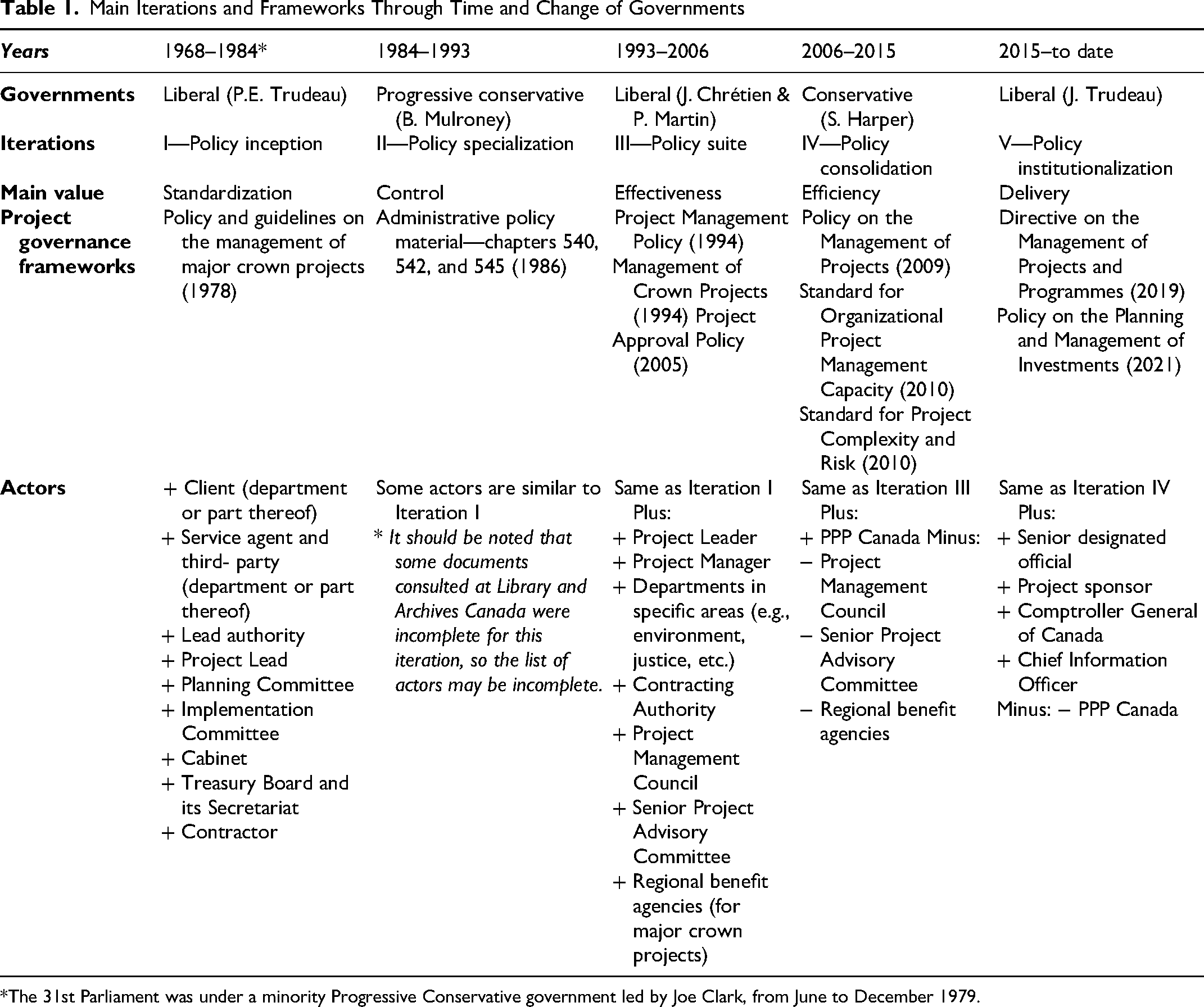
*The 31st Parliament was under a minority Progressive Conservative government led by Joe Clark, from June to December 1979.
In sum, the data collected enable us to analyze the regulative and normative pillars; however, analyzing the cultural–cognitive pillar is out of scope of this article, given the lack of primary data, yet would be an interesting research avenue.
To accurately interpret the historical evolution of the project management governance framework, it is essential to understand the very nature of federal government policy instruments. These are classified according to a taxonomy based on objectives, targeted actors, and whether measures are mandatory or voluntary. The policy constitutes the highest level of internal governance and management instruments. The policy outlines the expected achievements of deputy heads and their officials by specifying expected results, requirements, roles, and responsibilities, as well as the consequences of noncompliance. At the next level is the directive, which sets out the how in the form of formal instructions to the deputy head’s subordinates. Subsequently, standards offer more detail on the how, with mandatory procedures and practices. Finally, guidelines and tools are more voluntary in nature (but nonetheless amplify the phenomenon of isomorphism within public administration), offering guidance, advice, and templates for managers and functional experts (Government of Canada, 2008).
Data analysis was carried through process tracing, defined as “the examination of diagnostic pieces of evidence, commonly evaluated in a specific temporal sequence, with the goal of supporting or overturning alternative explanatory hypotheses” (Brady & Collier, 2010, p. 201). We mostly used the regulative and normative pillars, and identified the main actors and practices that were codified in the documents.
Findings
This section presents 10 project governance frameworks (in the forms of policies, directives, and standards) introduced in five iterations by various liberal and conservative governments in Canada (Table 1). As pointed out by Klakegg et al. (2008, p. s30) and Miller and Hobbs (2005), these instruments provide rules, processes, procedures, and artifacts to establish sound project management practices within the government, but also with a view to institutionalizing them to establish rituals specific to this federal institution.
Iteration I—Policy Inception
The first iteration, policy inception, covers one main document, described below.
Policy and Guidelines on the Management of Major Crown Projects (1978)
To the best of our knowledge, the first time such a project management policy was published was in 1978. At the time, the government, led by the federal Liberal party, was confronted with structural deficits reaching historic post-war levels after years of increased public spending, specifically used to fund major infrastructure projects (Bélanger & Brunelle, 1988).
The Policy and Guidelines on the Management of Major Crown Projects (Treasury Board of Canada, 1978) was developed following an interdepartmental review conducted the previous year, which revealed that a number of departments were managing Major Crown Projects (i.e., projects with a capital investment of over CAD$100 million or where the overall risks were considered too high) in a non-coordinated manner, with costs sometimes exceeding their annual operating budget. By way of illustration, this governance framework identified several examples, including Mirabel Airport and the CF-5 fighter jets. As a result, the government was committed to ensuring that the various stakeholders involved in a major project worked together on planning and implementation, with a single lead authority designated based on ministerial accountability.
The Policy provided a comprehensive, standardized life cycle for the conduct of major projects. In essence, once a requirement has been translated into a project and subsequently approved by the Treasury Board (the committee responsible for the management of the government and comprised of five ministers, including the President), the lead authority was required to set up two committees: the first responsible for planning and the second for implementation; however, the same person had to chair both committees. At the completion of the planning phase, a Project Brief had to be attached to a Memorandum to Cabinet for final approval prior to the implementation stage. Once approved, this document became the memorandum of understanding among the various stakeholders. The lead authority was expected to review the project twice a year and after completion of each major phase and inform the Treasury Board of the main findings. Finally, a final report needed to be submitted to this central agency once the project had been completed.
Iteration II—Policy Specialization
The second iteration also covers a single document, presented below.
Administrative Policy Material—Chapters on Project Management (1986)
From 1984 onward, the Mulroney conservative administration implemented a number of reforms to slow the burgeoning debt by reducing the size of government and privatizing high-value public services (Pollitt & Bouckaert, 2011).
In terms of the internal management of public administration, the key reference for this period was undoubtedly the Administrative Policy Material (Treasury Board of Canada, 1987), an evergreen document (from 1978 to 1987) divided into six volumes containing over 500 chapters (it should be mentioned that some sections of this manual have been declared lost by Library and Archives Canada). The final volume, entitled “General,” includes three chapters specific to project management incorporated in 1986, namely Management and Control of Project (Ch. 540), Project Management and Training (Ch. 542), and Major Crown Project (Ch. 545).
Chapter 540 was intended to enhance (not to replace) departmental management procedures by providing overall principles and guidance, as well as descriptions of the four main functions within a project: planning, organization, conduct, and control. The chapter also placed a strong emphasis on public finance management requirements through the three types of approval given by Treasury Board: preliminary, effective, and overrun. Effective approvals, which were at the core of project execution controls, were valid for a 12-month period and needed to be renewed if the project was pluriannual or exceeded the time constraint.
Interestingly, this chapter introduced a monetary penalty in the event of mismanagement of a project “in an amount up to twice the total overrun,” (Treasury Board of Canada, 1987, p. 2) a feature not found in any other project governance framework discussed in this article.
Unfortunately, the other two chapters dealing with project management were not available for consultation during our on-site visit to Library and Archives Canada.
Iteration III—Policy Suite
The following period was one of the darkest in the history of federal public finance (Champagne & Choinière, 2014). The decisions made by the Liberal government of the day were largely influenced by this fight against the deficit, and public management policies were no exception.
In this regard, the Chrétien administration introduced two new policies during its first year in office—Project Management Policy and Management of Crown Projects—replacing Chapters 540, Management & Control of Project, and 542 Project Management & Training from the 1985 Administrative Policy Material. A third policy followed a decade later, this time focusing on project approval.
Project Management Policy
This Policy (Government of Canada, 1994a) was the first federal instrument to be entirely devoted to project management. Its main objective aimed to “achieve effective and economical management of projects 2 with visible and clearly established project leadership.”
Beyond this objective, the policy stresses the importance of accountability, as evidenced by the requirement for departments to develop an accountability framework to oversee the project life cycle. One of the key requirements of this framework centers on the designation of project leaders who are accountable to the deputy head 3 (via the established hierarchy). Additionally, departments are expected to develop their own project management frameworks (including policies, guidelines, and methods) in accordance with the Policy Requirements as well as industry best practices. Departments must also allocate sufficient resources to enable project leaders to deliver the expected results (an essential condition for maintaining the integrity of the accountability framework). Departments are also encouraged to develop a project database.
In addition to accountability, risk and complexity are also key concepts that frame this Policy and will become fundamental in subsequent iterations. The identification, assessment, and mitigation of risks throughout the project life cycle, integrated in the project management framework, are at the heart of this requirement. To this end, the Policy proposes a new tool, the Project Profile and Risk Assessment (PPRA). In line with TBS’ Risk Management Policy, this document provides a guide for analyzing the main risks and their potential impact on the various project components, highlighting the political, international, or strategic context as well as the reporting relationships. The PPRA should be competed at the inception of the project as it subsequently serves as the basis for the project management framework.
Additionally, the Policy stated that an evaluation must be carried out for all projects (within three months of project closure). This activity constitutes a “valuable resource of lessons learned to support improvements to policy & procedures” (Government of Canada, 1994a, p. 17). Furthermore, certain evaluations may be required by TBS. Evaluations should cover the achievement of objectives, compliance with relevant policies and guidelines, adequacy of principles and practices, effectiveness of the project plan, as well as an analysis of issues encountered (delays, outstanding items, unforeseen events, etc.).
To ensure this area of expertise continues to evolve in line with industry best practices and trends, the Policy outlines the creation of the Project Management Council (PMC) with a dual mandate: provide advice and guidance to TBS (by supporting it in the evolution of this policy) and foster a project management community of practice within government.
Finally, it should be mentioned that this policy also applies to projects financed jointly with other levels of government.
Management of Crown Projects
Since 1978, the Government of Canada has placed particular emphasis on major projects. This Policy (Government of Canada, 1994b) followed this trajectory, as it incorporated core elements of previous iterations, notably the key principles approved by TB in 1990–1991 (under the Mulroney administration).
The Management of Crown Projects pursued the same objective as the Project Management Policy, with the difference that it focused on major projects (commonly known as megaprojects) with estimated costs equal to or greater than CAD$100 million, where risks were deemed very high by TB (at its discretion), or where the financial limit exceeded the sponsoring minister's approval authority. Moreover, both policies shared the same requirements with the exception of the following additional conditions centered on a key actor: the project leader (hereinafter referred to as leader). First, the leader must be an executive directly accountable to the deputy head and must be “personally and visibly accountable” (Government of Canada, 1994b, p. 2). A Senior Project Advisory Committee (SPAC) comprised of executives must be established to advise the leader (who is the chair) and provide oversight of the procurement process. The leader is ultimately responsible for defining the scope and specific objectives of the megaproject, appointing a project manager, implementing a project management framework—including the PPRA and the performance measurement framework—and producing progress reports at key stages, including mandatory reports to Parliament. Second, the leader must take into account the needs of the project and the “wider interests of the government” (Government of Canada, 1994b, p. 3). To achieve this, departments must provide the level of authority and resources necessary to ensure the leader is fully accountable. Third, the leader must involve various organizations as early as possible in the project life cycle such as central agencies, contracting authorities, regional benefit agencies, as well as departments whose mandates are central to the success of the project.
Finally, each department involved in a megaproject must assess the effects of the project on its operations and reach an agreement with the department in charge of the project, appointing a representative at the executive level for this purpose.
Project Approval Policy (2005)
At the start of the new millennium, after a substantial effort to reduce deficits, the government found itself in better financial health but still determined to keep a tight rein on spending (Champagne & Choinière, 2014). It was in this context that TBS launched a second specific policy, this time focused on approval controls and mechanisms with the aim of ensuring that “projects proposed for approval, by the sponsoring Minister or, where required, by the Treasury Board can receive informed and effective consideration” (Government of Canada, 2005, p. 1). This instrument solely applies to capital, lease, and information technology projects requiring approval, as the cost exceeds Minister expenditure authority, or the limits previously approved by TB or when there is a substantial change from the baseline.
This latest project policy is based on 14 project requirements, including the following new or updated features:
A Project Brief; A clear demonstration of cost-effectiveness; Project segmented in phases according to key decision points; A single request for approval (omnibus submission) for a set of similar projects (a harbinger of program-based management); Three mandatory approval submissions, according to project phase or type of project (in continuity with the instruments developed in the 1978 policy), in other words: Preliminary Project Approval (PPA), Effective Project Approval (EPA), Lease Project Approval (LPA); Specific requirements for IT-specific projects; and Financial information and justification of costs overrun for greater control over project cost estimates.
The policy also identifies project approval authority limits by department. For example, in 2005, Industry Canada had a limit of CAD$2 million for IT projects and CAD$1 million for other types of projects; in comparison, this limit was CAD$5 million for the Canadian Space Agency.
Iteration IV—Policy Consolidation
Elected for the first time in 2006, Stephen Harper's Conservative administration sought to review the way departments were managed to increase the effectiveness and efficiency of public programs by simplifying administrative processes and procedures (Champagne & Choinière, 2014). The government therefore embarked on a review of its management policies, including those focusing on projects. However, as we shall see, this review was mainly carried out by consolidating existing instruments, with notable additions in terms of organizational maturity in project management and mandatory assessment of project risks and complexity.
Policy on the Management of Projects (2009)
This policy replaces the previous liberal policies implemented in 1994 and 2005 and aims to introduce a “significant change in how government manages projects” (Government of Canada, 2009, p. 1). To this end, a five-year transition period is allowed to implement this new policy (from April 2007 to 2012). Interestingly, the policy officially came into force during this transitional phase in December 2009, after some amendments had been incorporated based on lessons learned from the first two years of implementation.
The Policy objective was “to ensure that the appropriate systems, processes and controls for managing projects are in place, at a departmental, horizontal or government-wide level, and support the achievement of project and program outcomes while limiting the risk to stakeholders and taxpayers” (Government of Canada, 2009, p. 4) notably to prevent unnecessary expenditure and duplication of effort. In addition, the Policy states four expected results, focusing on resource optimization and answerability:
Projects achieve value for money; Sound stewardship of project funds is demonstrated; Accountability for project outcomes is transparent; and Outcomes are achieved within time and cost constraints.
The most significant new measures are undoubtedly the two standards requiring departments to assess their project management capacity using a standardized questionnaire and to assess the level of complexity and risk for each project (thus replacing the PPRA introduced in 1994). This assessment seeks to develop an approach aligned with the nature of their projects and adjusted to their capabilities. These standards stipulated that, by 2012, each organization subject to the Policy must undertake an assessment of its capacity. These measures are discussed in more detail as follows.
This Policy features new or modified requirements, including a department-wide governance and oversight mechanism, the objective of grouping projects with similar objectives (program inception), the new standards, and a requirement for documenting project outcomes.
Finally, this Policy adopts the Project Brief instrument as presented in the 2005 Project Approval Policy, but with additional documentation requirements for departments such as a governance approach, a performance measurement framework, and the addition of an option for public–private partnerships (in collaboration with PPP Canada for its guidance), and so forth.
Standard for Organizational Project Management Capacity (2010)
One of the major components of the 2009 Policy is the assessment of organizational project management capacity. The Standard (Government of Canada, 2010a), which officially took effect on December 2010 was implemented in four phases: first, with four voluntary departments in 2007, followed by three groups of departments.
The purpose of this new requirement is twofold. First, to “determine [the department’s] class of project management capacity for the purposes of project approval and expenditure authority, [and second to] assist in identifying areas of capacity that should be improved or maintained, in light of the department's business activity” (Government of Canada, 2010a).
On a three-year cycle, each organization must submit the results of its analysis to TBS who then classifies them into five capacity classes (1-limited, 2-sustaining, 3-tactical, 4-evolutionary, and 5-transformational). It is noted that departments should not necessarily aim for the highest level of maturity but rather the one that is most appropriate for them given their mandate and key activities. As already mentioned, each project must also be assessed in terms of complexity and risk, the sum of these two exercises being used to establish the spending authority for each project (from CAD$1 million to CAD$25 million).
The assessment is essentially based on a self-administered questionnaire comprising 92 questions covering three fundamental capacities 4 and 13 areas of project management knowledge. 5 Supporting documentation must be provided to substantiate the score attributed to each question.
Standard for Project Complexity and Risk (2010)
This Standard (Government of Canada, 2010b) focuses on measuring the complexity (based on the number of administrative rules, technology used, and size of the project) and risks (the effect of uncertainty on the achievement of results) of each project. The results of the assessment must be combined with that of organizational project management maturity to determine project approval and expenditure authority limits “prior to the expenditure of project funds.” This Standard replaces the PPRA.
The Standard is supported by a tool comprised of 64 questions divided into seven categories. 6 The higher the score, the more complex and riskier the project. This assessment should be carried out as early as possible in the project cycle and can be updated subsequently in light of the project’s evolution and refinement of available information.
The results of this exercise ultimately enable the project to be classified into one of the four established levels of risk and complexity (1-sustaining, 2-tactical, 3-evolutionary, and 4-transformational). Thus, if a department wishes to implement a project whose complexity and risk exceed its organizational capacity, it must obtain prior approval from TB.
Iteration V—Policy Institutionalization
The latest iteration in the evolution of the federal governance frameworks was initiated with the election of the Liberal Government led by Justin Trudeau in October 2015. This new government quickly announced the funding of major infrastructure projects in most provinces and large cities (Mwesigwa & Siemiatycki, forthcoming). This change of approach is also exemplified by a government-wide initiative, led by TBS, to review the key rules of management, known as the Policy Suite Reset, which aims to “streamline and clarify TB policy instruments while shifting public service culture towards a focus on better service and results” (Canada School of Public Service, 2020). Project governance is a central element of this reset. A new policy (Planning and Management of Investments) integrates the content of eight previous policies, including the 2009 Policy on the Management of Projects. As a result, the project governance framework is now scaled down to the level of a directive (Management of Projects and Programmes) and focuses on the how, rather than the what (the main objective of a policy) (Government of Canada, 2008). Interestingly, the directive was published two years before the new policy (2019 vs. 2021); traditionally, the latter takes precedence over the former. However, the constraints imposed by the institutions and the result of path dependency act as a disincentive to change: the modifications resulting from this review have mainly to do with the hierarchy of policy instruments rather than their content. The key elements of the previous policies are still in place, with the effect of policy layering amplified by the addition of new actors, approval processes, and the introduction of clauses specific to programme management.
Directive on the Management of Projects and Programs (2019)
This directive (Government of Canada, 2019), which took effect on April 2019, supersedes the Iteration IV policy instruments; however, this new instrument continues the trend toward increasingly detailed project management responsibilities and requirements. In contrast to the previous iteration, which was implemented over a relatively long period (five years), the transition period for this directive is much shorter: only six months to one year (for projects with a total cost of CAD$25 million or more).
Results and benefits are key concepts brought to the fore by the Trudeau administration. As such, the directive’s objective is a reflection of this orientation: “government projects and programmes are effectively planned, implemented, monitored and controlled, and closed to enable the realization of the expected benefits and results for Canadians.” Furthermore, the four expected results highlight the emphasis on benefits, results, and performance measurement: (1) governance and controls over projects and programs are effective; (2) decisions are made throughout the life of the project and program with a view to maximizing efficiency and ensuring the realization of benefits; (3) performance measurement data are used in support of regular monitoring of project and program health and evidence-based decision-making; and (4) capacity for project and program management, commensurate with organizational need, is developed and maintained. Another key aspect of this directive is the fact that portfolio and program management are now an integral part of the directive: guidelines are prescribed specifically for programs such as the portfolio management requirements, program brief template, and the program tranche.
In terms of roles and responsibilities, this directive goes beyond previous instruments. Specifically, the senior designated official (SDO) is required to develop a program and project framework, support the departmental transparency and expenditure decision-making processes, coordinate with the Comptroller General (for projects with a projected cost of CAD$25 million or more), and establish a learning environment based on best practices and lessons learned. The SDO is also responsible for the completion of the Organizational Project Management Capacity Assessment (which changed from being a standard to an Appendix of the Directive). As for the program/project sponsor, their responsibilities cover various areas such as leadership and alignment, governance, benefits management, and transition to operations as well as ensuring the completion of the Project Complexity and Risk Assessment (which changed from a standard in 2010 to an Appendix in this Directive). Additionally, the Directive introduces two new actors with formal roles: the Comptroller General of Canada (government-wide functional leadership) and the Chief Information Officer (oversight of digital investments). To illustrate the roles of this iteration (summarized in Table 1), Figure 1 presents the main actors for this project governance framework.
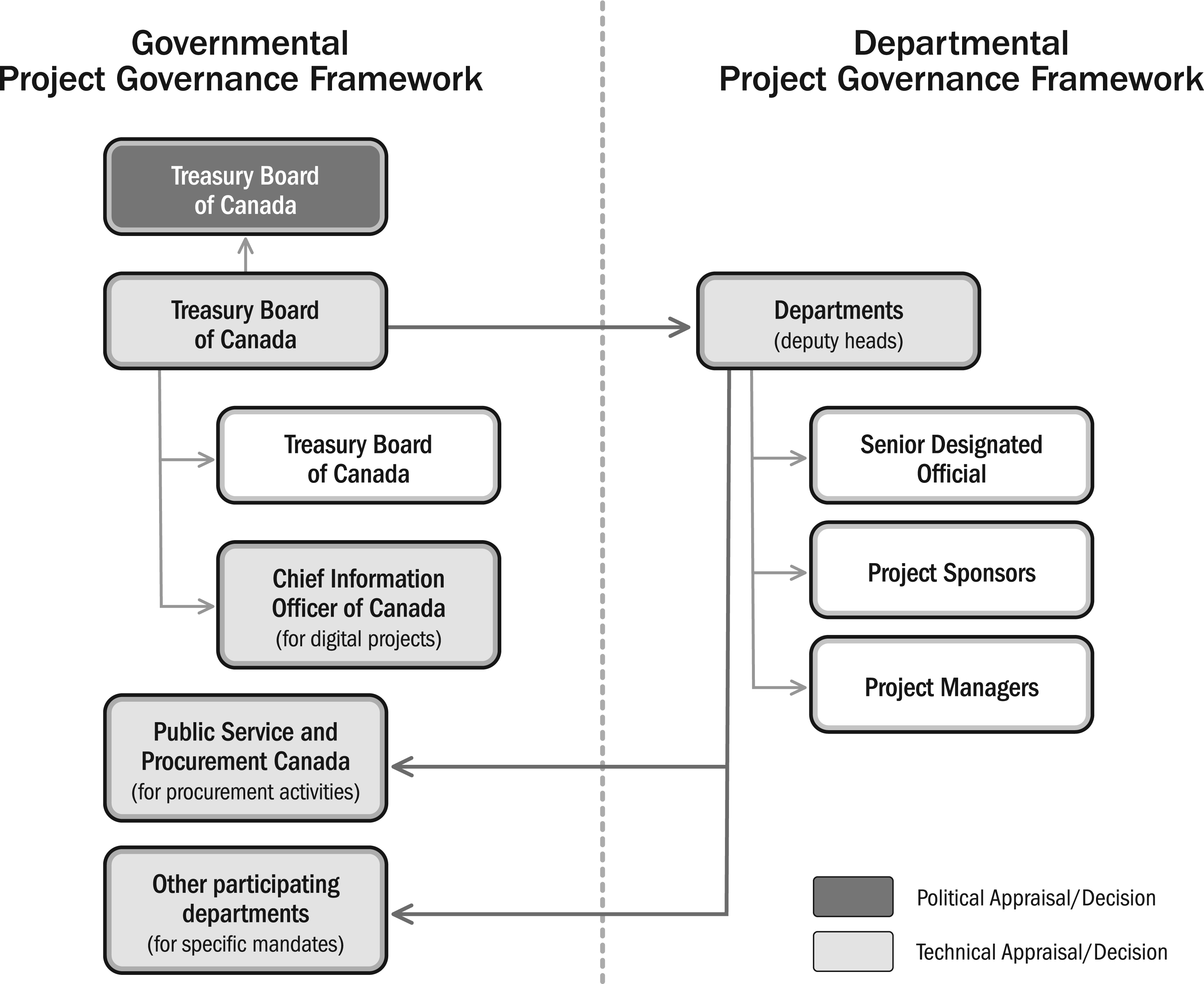
Main roles for Iteration V—Institutionalization.
This instrument includes eight appendices (in lieu of standards and guides) that provide the SDO, sponsors, and project managers with the information needed to comply with the Directive, notably:
The mandatory procedures for organizational project management capacity assessments and for project complexity and risk assessments, replacing the former standards of the same name; An increase in the minimum spending authority (from CAD$1 million to CAD$2.5 million), but not the upper limit (which remains at CAD$25 million for departments with the highest maturity level); Two major additions in the Project Brief: the benefits realization plan and the risk management plan; and Three specific program management appendices as well as the introduction of the “tranche” concept (i.e., different phases of the program’s life cycle (Government of Canada, 2019).
Policy on the Planning and Management of Investments (2021)
This new Policy (Government of Canada, 2021) governs the 2019 Directive even though it was published two years later (in May 2021); it replaces 10 policies, including the Policy on the Management of Projects (2009). This Policy is designed to ensure the Government has the assets and capabilities it needs to support the delivery of programs to Canadians. The main management functions covered by this instrument are: program and project, real property, information technology, material, finance, human resources, security, and legal services. This integration approach reverses the trajectory begun in 1994, during which project management was the subject of a specific policy.
Unlike the introduction of previous instruments, there is no transition period for the implementation of this Policy: “projects approved under the previous policies will be automatically transitioned to this Policy” (Government of Canada, 2021). This fact reinforces the trend initiated earlier, which significantly reduced the time required to transition from one instrument to another.
Most of the requirements of this Policy are at the highest level of departmental governance. Thus, the deputy head is responsible for appointing SDOs and establishing a sound and proportionate governance structure with a sponsor as a single point of responsibility for each program and project. SDOs ensure that project risks and complexity are aligned appropriately with the investment, while also providing a five-year investment plan. This plan includes a prioritized list of programs and projects with an estimated cost of CAD$2.5 million or more, alongside a summary of the department’s expertise capacity in this domain.
Among the new elements introduced by this Policy are specific measures required by the Office of the Chief Information Officer for digitally enabled projects exceeding the department’s spending authority. The stated aims of these measures are to improve the outcomes of these types of projects and maintain the overall alignment of IT-related projects across the government.
Having reviewed the main policy documents regarding projects over time, it is worthy to mention that other official and internal documents also complement those instruments. For example, there are guides (e.g., Guide to Project Gating [Government of Canada, 2021]); departmental audits of project management, and special reports for specific projects from the Auditor General of Canada (e.g., Gordie Howe Bridge [Office of the Auditor General, 2022]; and Champlain Bridge [Office of the Auditor General, 2018]). Next, we discuss the results in light of the evolution of the project governance frameworks over time and iterations.
Discussion
Process-Tracing and Path Dependency
Historical neo-institutionalism contends that institutions can shape and constrain political and administrative strategies in important ways but are also themselves the outcomes of political strategies and choices (Steinmo et al., 1992). As we review the main trajectory of policies related to the governance of projects for the Canadian government, it is central to consider the historical evolution, based on process tracing (Pierson, 2000) and path dependency, which might restrict possibilities for change (Müller, 2009). Thus, from a historical tracing of policies, previous choices, experiences, and events influence—even constrain—actors and institutions in their subsequent decision-making. Path dependency includes two antithetical conceptions of change: one customary, in continuity with the past; and the other rare, abrupt, and discontinuous, such as critical junctures or turning points (Bröchner, 2022; Streeck & Thelen, 2005).
Whereas the first two iterations focused on specific subjects (i.e., major crown projects as well as project management functions and training) as part of a more or less structured collection of policy instruments—with standardization and control being their main values—Iteration III marks the launch of policies specific to project management. In this sense, it is possible to identify the politico-administrative values of this phase, in other words, effectiveness, economy, personal leadership, and accountability. It is also the last iteration with a specific policy for major crown projects, although this very notion no longer appears in subsequent policy instruments, as only the CAD$100 million limit is not mentioned after the 2009 Policy on the Management of Projects. Departing from previous policies there is a critical juncture in terms of public finance ideology, as the emphasis is on deficit reduction and its repercussions on project governance and management. Furthermore, the policies present a more structured approval process, project approval authority limits by department a focus on IT-related projects and request mandatory project briefs.
In Iteration IV, these notions are put in the forefront: value for money and sound stewardship, due diligence, ethical behavior, sound management practices, long-term sustainability, and value for Canadian taxpayers. While project risks and complexity remained as important as in previous versions, they are now a stand-alone standard and made more visible. For the first time, new concepts are introduced including organizational project management maturity models, which must be assessed following a required standard. Other concepts are introduced such as optimal contributions to programs, governance, accountability for outcomes, and organizational, horizontal, and government outcomes. Management of projects (structure/framework within which projects are managed) is now distinctive from project management (management of a specific project). The concept of program is introduced 7 (group of projects, resources, and activities pursuing a set of related objectives). There is a strong focus on assessments and a commitment to limiting project duplication and overlap. Thus, this iteration embodies a proliferation of new instruments and requirements (Lascoumes & Le Galès, 2004). These additional conditions might enforce the impression of sound project management, but in fact are the result of an institutional layering effect (Thelen, 2003), contradicting the government’s desire to reduce red tape (Brewer & Walker, 2010).
Iteration V embodies ideas and values of new public service (Denhardt & Denhardt, 2000) as well as deliverology: “a systematic process for driving progress and delivering results in government” (Barber et al., 2011, p. vii), as there is a focus on results and benefits as part of the delivery approach. While previous instruments are reconducted, such as the project brief, organizational project management capacity assessments, or project complexity and risk assessments, new actors are being introduced for greater focus on governance and the institutionalization of portfolio and program management. While the policy instruments clearly show the expectations from TBS, there is also additional guidance for departments to show how to manage projects properly.
This contextual process tracing of the evolution of a project governance framework offers two interesting and contrasting perspectives (Thelen, 2003). From an historical institutionalism perspective, the evolution of the policies is path-dependent, in the sense that operative forces are mediated by contextual features of a given situation often inherited from the past (Hall & Taylor, 1996). According to Kay (2005, p. 554), “the concept of path dependency does have potential utility in the field of policy studies in terms of explaining not only why policies might be difficult to reform but also why they may become more complex over time.” The other perspective is that of institutional change, mostly embodied in this case as institutional layering (van der Heijden, 2011). We could argue that following the changes in the government parties, there have been mild critical junctures, particularly from Iteration III onward, mostly changes in vision and values explicitly endorsed. However, the relative weight of previous iterations is more important, showing a consistent overall path-dependent trajectory.
Institutional Instruments and Actors of a Contextualized Project Governance Framework
Following the descriptive account of the evolution of the project governance frameworks, here we undertake an analysis of each iteration. Building on the conceptualization of Müller et al. (2014) on organizational enablers, we discuss the concept of institutional layering to address process facilitators, but also potential pitfalls created by this increasing complexity as they are empirically revealed with the case of the Canadian federal project governance framework. Here, we address exclusively the level of governance of projects; however, it should be noted that a further analysis of the project governance and governmentality levels could be further investigated. We discuss the regulative and normative pillars along with the main actors of these framework iterations (Müller et al., 2015). Table 2 summarizes the main institutional instruments and actors for each of the five iterations.
Institutional Instruments and Actors for the Governance of Projects
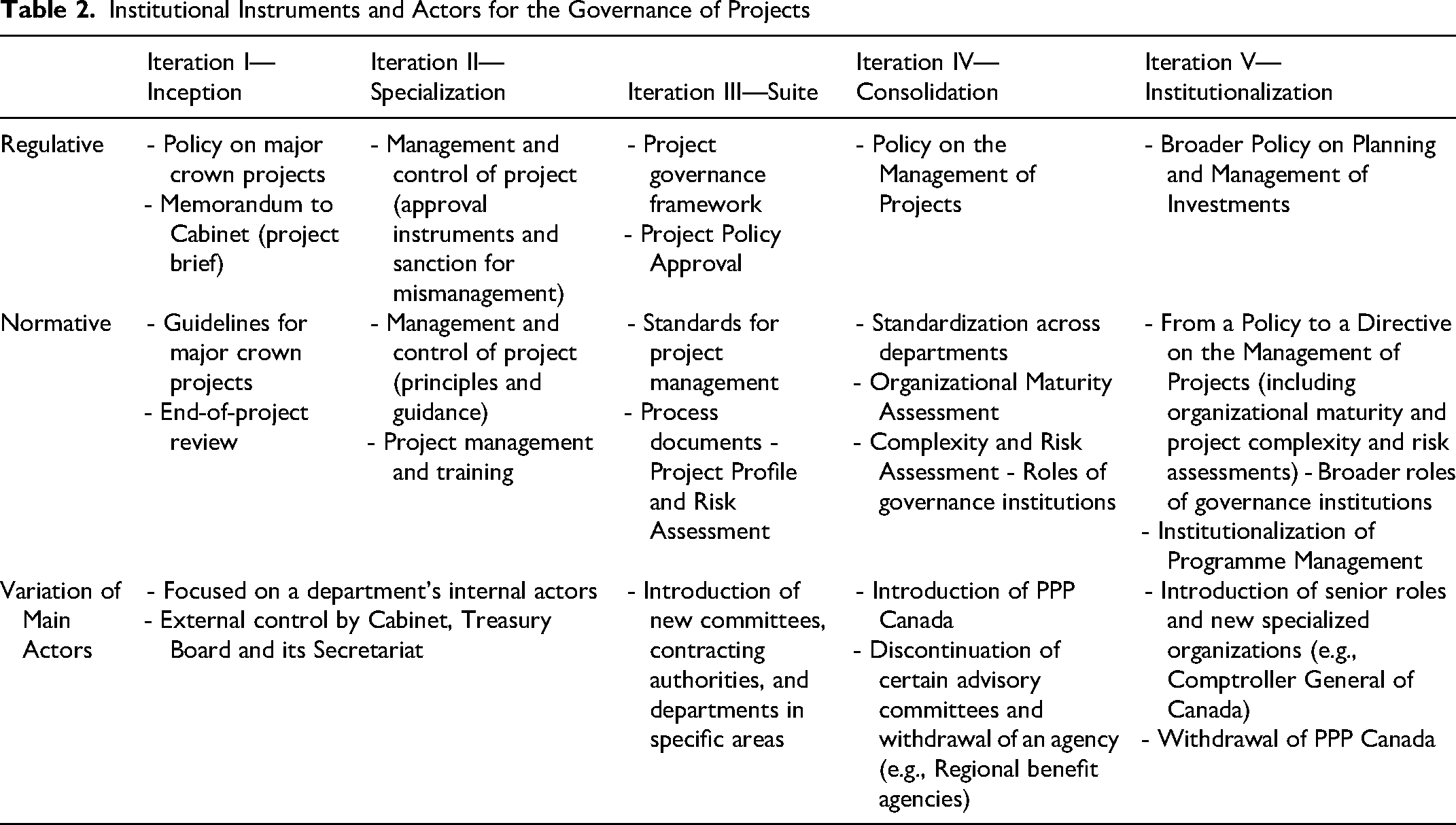
The initial iteration was centered on major crown projects and proposed various elements of both regulative and normative in nature. The rationale behind the need for this new framework was the suboptimal management of key public megaprojects in the past. The next iteration (Iteration II) extended the previous framework by adding new enablers for projects other than major crown projects, including new approval mechanisms (regulative) and project management training (prescriptive). In Iteration III, the previous instruments were replaced by a suite of three policies, one more general (Project Management Policy) and two more specific (Major Crown Projects for megaprojects and Project Approval Policy for capital, lease, and information technology projects). The previous regulative policies were maintained and expanded upon. This iteration also equates with the addition of normative enablers such as process documents and standards. Iteration IV consolidated the established regulatory instruments (policies and standardized behaviors) and normative ones (standards and roles of governance institutions). In Iteration V, regulatory instruments and institutionalized broadly, normative instruments are consolidated (certification/training, standards, and collective awareness).
Thus, expanding upon the previous point on path dependency and institutional layering, Figure 2 illustrates the progression of the project governance framework as a trajectory becoming over time more complex (largely due to the layering effect), involving more actors, and building on previous iterations. The regulative and normative pillars become over time more substantial, building upon previous iterations for increased control, creating regulatory ratchet (van der Heijden, 2011). With regards to the actors (individual and collective), each iteration proposed additions and, in some cases, removals; in overall terms, however, this dimension is also influenced by the institutional layering effect, more precisely by the thickening process (van der Heijden, 2011).
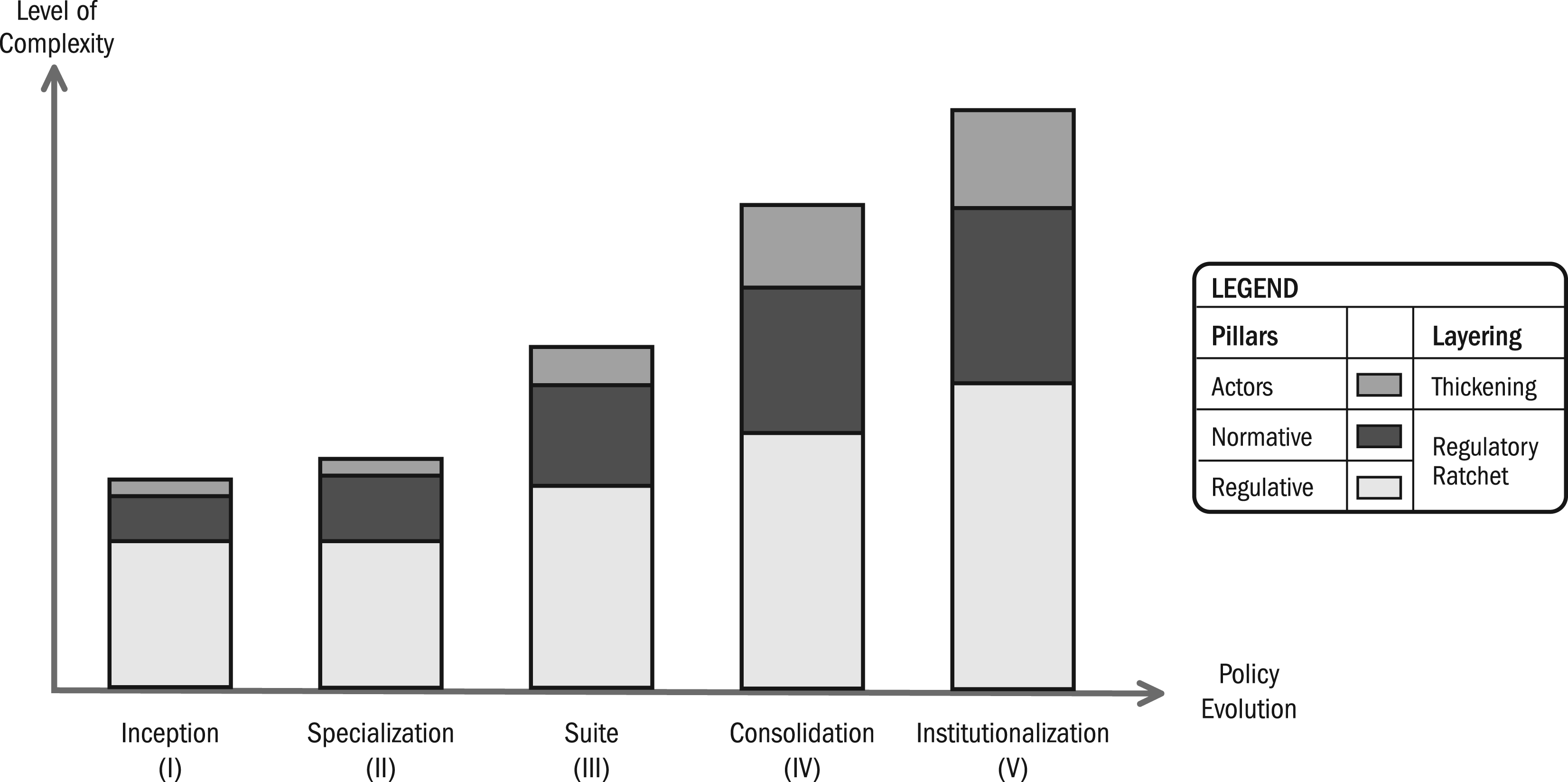
Policy iterations and institutional layering.
This policy evolution offers several positive results. Building on previous experience in a path-dependent process, the governance frameworks become more thorough and robust over time addressing, for example, organizational risks and maturity, which we have not encountered in other documented cases (Volden & Samset, 2017). As such, the governance frameworks include many instruments that are referred to as organizational enablers (Müller et al., 2014) to manage projects at the government level, which should be beneficial, at least in theory. However, there are also potentially negative consequences linked to the layering effect, leading to a proliferation of policy instruments and more cumbersome procedures. One might wonder whether all this bureaucracy, these assessments, and the resources involved really lead to better projects and better value for the money. Questions regarding access to information, transparency, and ethics are also worth raising, as recent cases of mismanagement have been uncovered (Migone et al., 2023).
Policy Interventions for Policymakers
In terms of practical contributions, this article is an interesting point of departure to understand where a specific policy comes from, how it has evolved over the years and why, within the specific context of Canada. Following its trajectory, the Canadian public policies for major projects became more robust and complex and they also more broadly encompass broader benefits for the public good. Canadian public policies for major projects follow the same pattern suggested in an international comparative study of six countries aforementioned of which Quebec, one of the Canadian provinces, was documented (Volden & Samset, 2017). Thus, understanding the current version of a policy, but also past versions, is of interest for the Canadian government; the historical approach might also be usefully replicated in other jurisdictions (supranational, national, or regional governments).
Conclusion
This article aimed to shed light on the evolution of the Canadian governance framework for major public projects. Using Canadian governmental documents as secondary sources as well as auto ethnographic insights, we have traced the key iterations, underlying the main features, turning points, and continuities. We have suggested five iterations that have been conducted over the past decades, each one adding up to and generating institutional layering, based on the regulative and normative pillars, and the number of actors involved. An important limitation here is with the underuse of the cultural–cognitive pillar; it would be interesting to conduct interviews with the people working with those governance frameworks to understand how they make sense of and use them. Framing our theoretical contribution within the neo-institutional theory, building upon previous work by Ralf Müller and colleagues, we suggest that institutional layering of various organizational enablers and actors creates added complexity regarding public policies for project governance (Müller, 2017; Müller et al., 2015). We also uncover the dynamic and evolutive process of a governance framework for public projects. More specifically, we anchor the evolution of governance frameworks in public policy, thus connecting project studies with public administration research (Esposito & Terlizzi, 2023; Hudon & Floricel, 2023; Sanderson & Winch, 2017). The main practical contribution of this article is to provide insightful comprehension of the current state of a policy and perhaps reflect upon the next steps ahead.
As with this time of exploratory and qualitative inquiry, there are several limitations to be acknowledged. First, there is a methodological limitation. As we based our analysis on official documentation, it would be interesting to investigate more the cultural–cognitive pillar and the discursive abilities (Müller et al., 2015) and talk to project actors to better understand agency in shaping (more specifically for the last two iterations, given the long period of time separating us from the previous iterations). At a microlevel, it would be interesting to delve more into the political parties in place and their effects on institutional practices. Asymmetries of power among actors could also be taken into account. Second, as we study a specific case, the replicability of such a method might be difficult and, as such, it is important to be very sensitive about the context. Future research avenues include the investigation of organizational enablers for other levels (project governance and governmentality) as well as inhibitors and practices. Finally, it would be very valuable to pursue comparative studies with other countries and jurisdictions.
As a final word, we have drawn inspiration from the work of Ralf Müller, which is anchored in institutional theory. We recognize, however, that his legacy in the field of project studies and project governance is broader and far-reaching, as reflected in the other articles in this special issue. We will continue the work he began, as the topic of project governance is more than ever relevant, both in theory and practice.
Footnotes
Declaration of Conflicting Interests
The author(s) declared no potential conflicts of interest with respect to the research, authorship, and/or publication of this article
Funding
The author(s) received no financial support for the research, authorship, and/or publication of this article.
