




Abstract
This reflective paper examines the critical thinking levels of final-year, final-semester public administration students at a South African university, using a case study approach. By engaging students in a structured case study, this paper also reveals the value of case-based methods in fostering critical thinking skills within the academic context. The case study challenged students to critically evaluate the dynamics of policy implementation in the context of public service delivery within South Africa. The lecture was designed to emphasize the importance of understanding the motivation behind specific policy formulation and highlight this as the guiding principle for their application in real life contexts. This paper presents reflections of this educational exercise, by exploring the depth of critical thinking and reasoning exhibited by the students as they considered the complexities of public service delivery in South Africa, emphasizing the significance of policy context and its influence on decision-making. Blooms Taxonomy (1956) is used to support the reflections in this regard. The findings of this activity reveal not only the effectiveness of the teaching methodology but also the extent to which students internalised the ethos behind policy creation and its role in shaping policy implementation. The paper underscores the importance of promoting critical thinking, problem-solving skills, as it relates to policy analysis. It also highlights the practical implications of this teaching method in preparing students for future roles in public service and policy development. Additionally, this paper contributes to the ongoing dialogue on enhancing teaching and learning effectiveness in South African universities, emphasizing the importance of engaging students in critical reflection.
Keywords
Introduction
The significance of quality education and its influence on critical thinking, policy analysis, and problem-solving skills has steadily gained popularity in an increasingly interconnected world. Ramírez-Montoya et al. (2021) suggest that in the context of Education 4.0, teaching demands skilled professionals possessing expertise in innovation, intricate problem-solving, entrepreneurship, collaborative practices, a global perspective, leadership qualities, and a profound connection with the evolving needs of society. One of these needs is critical thinkers. The Critical Thinking Foundation (2019) defines critical thinking as referring to the cognitive approach applied to any subject, content, or problem. It involves the thinker enhancing the quality of their thinking by adeptly assuming control over the inherent structures of thought and imposing intellectual standards upon them. By underscoring that critical thinking can be applied to any subject, content, or problem, the definition highlights the universality of critical thinking, highlighting its broad applicability across various domains. The idea of thinkers enhancing the quality of their thinking by assuming control over intrinsic structures and imposing intellectual standards suggests a sense of empowerment, meaning that individuals can actively improve their thinking skills. The definition additionally implies that critical thinking is a skill that can be developed and refined. For educational practices, the implications are limitless, suggesting at the fore, that fostering critical thinking should be a deliberate part of educational curricula. This idea is further buttressed by proponents of neuroplasticity literature which refers to the brain’s ability to continuously reorganise itself by forming new neural connections throughout life (Goldberg, 2022; Piradov et al., 2018; Tovar-Moll and Lent, 2016). Critical thinking is not a static trait, rather, it is a dynamic process that can be continuously refined. In addition, the reference to the imposition of intellectual standards implies the responsibility of educators to guide students in formulating context specific, setting and adhering to high intellectual standards. What will ensue is a paradigm shift from passive learning to active engagement with intellectual processes.
Authors have suggested that problem-based learning has efficacy to enhance critical thinking skills (Rahman et al., 2016). Recent world events, in particular, the coronavirus (COVID-19) pandemic exponentially exacerbated the need for innovation and flexibility. It demonstrated that individuals and communities equipped with these skills are better equipped and prepared to address complex, interconnected global challenges. Presented with an unprecedented global challenge, individuals and governments were required to develop and implement complex solutions, such as, vaccine distribution, public health measures, and economic support; forcing people to think critically and come up with innovative solutions to mitigate the impact of the virus. Governments had to swiftly craft policies and make decisions in response to the evolving crisis. This required/s informed public policy analysis and the ability to adapt such policy in real-time. The majority of these individuals/'thinkers’ who would have acquired a tertiary qualification at a university, for instance, operate within the public sector, addressing dynamic matters pertaining to social, economic, religious, and political issues that have significant impacts on large populations.
Critical thinking gaps exist in higher education institutions worldwide. Fitriani et al. (2019) explored the critical thinking and critical analysis skills of prospective teachers and found them to be underdeveloped, with differences in interpretation, explanation, and self-regulation. This suggests that these deficiencies have been and will continue to be ‘inherited’ by students, as the learning is predetermined by the teaching. The extent of this gap varies by institution, department, and individual educators. Alsaleh (2020) contends that it is essential to employ inventive approaches and incorporate new technologies to address the deficiencies. This adjustment is crucial because conventional methods typically emphasize the delivery of subject content rather than actively nurturing the development of vital thinking skills. In a global village, these skills are essential for addressing complex challenges, such as climate change, healthcare access, and economic inequality. Policy decisions largely impact communities, economies, and public service delivery locally and globally. Understanding the motivations behind policy formulation is a universal concern as it influences the understanding of what actually happens at the level of the policy recipient, responsible for the dynamics of implementation (Barrett, 2004). By promoting critical thinking and effective educational methodologies, this study contributes to Sustainable Development Goal (SDG) 4, aiming to ensure inclusive and equitable quality education for all. Though not the focus of this paper, it has further implications for SDGs 10 and 11 as well. SDG 10 highlights that an understanding of policy and its implications helps to reduce inequalities. Students equipped with such skills can contribute to fairer policy decisions and outcomes later in their careers. The importance of policy context in public service delivery, aligns with Goal 11’s objective to make cities and human settlements inclusive, safe, resilient, and sustainable; all of which require critical thinking to execute.
The emphasis placed on critical thinking varies across programs and universities. Some institutions may prioritise critical thinking skills in their curriculum and teaching methods, while others may not (Paul et al., 1997). It is within this context that this reflective paper explores the assessment of critical thinking teaching effectiveness, in a South African university. The reflection assumes that teaching effectiveness equates to fostering critical thinking in students, by assisting them to move across the levels on Blooms Taxonomy. The paper presents a unique case study, extracted from a class with third-year, final semester students at a South African university, offering a distinctive and enlightening perspective on the global importance of educational practices: critical thinking as it relates to policy analysis. With the high rates of migration from the global south to the global north and vice versa, this paper addresses a critical issue which traverses borders, such as policy dynamics, critical thinking, and problem-solving skills.
The critical thinking gap
There is a global awareness of the importance of critical thinking in education, and many educators and institutions are working to enhance the critical thinking skills of students. Prameswari et al. (2018) contend that critical thinking is a thinking process that needs to be inculcated from elementary/primary school. This training should ideally extend through a student’s life; Such that, Grussendorf and Rogol (2018) additionally posit the overall need to strengthen critical thinking in higher education, supported by their study findings which suggest a developmental approach of acquiring the skill. Their work advocates the idea of starting the students on a path to become critical thinkers, and where this has been done, progress can be observed within one semester of implementation. In a controlled experimental study of first- year students at a Dutch university, it was concluded that critical thinking is an important competence for students in higher education (Peppen et al., 2018). This worldview assumes that instructors/teachers are aware of their influence and their role in crafting an environment that promotes critical thinking (Bataineh and Zghoul 2006).
More studies have shown a correlation between student engagement and critical thinking (Williams and Lahman, 2011) characterised by active participation, interaction with course materials, and meaningful involvement in learning activities (Nguyen, 2019). When students are actively engaged in the learning process, they are more likely to seek deeper understanding; critically analyse the information presented; apply existing knowledge; be more discerning when evaluating the credibility and relevance of information; reflect on learned material and synthesise information from various sources to craft well-reasoned conclusions. Edwards (2015) suggest that encouraging active learning within middle grades classrooms enhances intellectual engagement, critical thinking, and relevance. Which is achieved by compelling students to apply, analyse, evaluate, and create, thereby fostering a more dynamic and participatory educational experience. Similar outcomes can be expected in higher grades and institutions of higher learning.
The specific context and the pedagogical strategies employed by educators will determine the nature and strength of the correlation between student engagement and critical thinking. Sha et al. (2021) noted significant differences in the critical thinking level of students with varying levels of academic engagement. This suggests that effective teaching practices that encourage engagement can significantly enhance critical thinking skills among students. This is particularly important in light of the blended teaching and learning approach adopted by a number of universities following the COVID-19 pandemic. Ensuring that online courses are effectively designed to promote critical thinking is essential, while taking into consideration various factors that influence students’ perception of course material, such as individual styles of learning (Varenina et al., 2021). Their study highlighted a correlation between preferred learning styles and levels of critical thinking, which requires consideration when developing an online learning curriculum.
Critical thinking in South African higher education
South African higher education grapples with various obstacles in fostering and nurturing critical thinking skills among students (Van der Merwe, 2021). These hurdles encompass challenges like oversized class enrolments, financial constraints, time limitations, and external pressures prioritizing exam success over critical thinking (Chetty et al., 2015). These challenges are further compounded by the COVID-19 pandemic, which has created uncertainty and financial strain on the National Student Financial Aid Scheme (NSFAS) (du Plessis et al. (2022). In response to these issues, scholars and educators advocate for innovative teaching approaches, including group projects, role plays, and simulations, as a means to enhance critical thinking skills in students.
Moreover, the Department of Basic Education and the Department of Education in South Africa have acknowledged the significance of improving critical thinking skills since 1997. Teachers in South African higher education institutions play a pivotal role in this process of cultivating critical thinking skills among students. Dunpath et al. (2021) concluded from a collaborative higher education project, conceptualised, and implemented by academics from seven South African universities, that educators prioritse critical thinking, active learning, responsive curriculum design, and engaged professional attributes. However, Hurd (2018) had argued that research in higher education reveals three troubling yet not entirely surprising realities. A significant number of university faculty across various levels lack a robust understanding of critical thinking. Moreover, many faculty members are unaware of this deficiency, mistakenly believing they possess a sufficient grasp of critical thinking and assuming they are effectively imparting it to students. Hurd (2018) suggested that at that time, traditional instructional methods such as lectures, rote memorisation, and predominantly ineffective short-term study habits continue to prevail in college education. Additionally, Ontong and Bruwer (2020) determined that students employ past assessments as a deductive tool to anticipate future subject areas and exam difficulty levels; A practice with the potential to impede the development of critical thinking skills. It is prudent to assume that a lack of understanding of critical thinking could account for the differing research findings.
The effectiveness of critical thinking instruction is influenced by cultural norms (Giacomazzi et al., 2022). In numerous sub-Saharan African countries, governments have officially recognised critical thinking skills as a key educational priority to enhance global economic competitiveness (Grosser and Lombard, 2008; Ijaiya et al., 2010). Despite these declarations, many schools and education systems have not implemented tangible measures to align with government policies, such as revising curricula, adopting new pedagogies, and adjusting assessment frameworks. Furthermore, educational approaches continue to prioritise memorisation and rote-learning, emphasizing an examination-oriented style of education (Giacomazzi et al., 2022; Paul, 2005). They further suggest that the pedagogical approach in the classroom prioritizes the recollection of facts over higher-order cognitive skills such as synthesis and evaluation, as a result, impacting the thinking processes and patterns of African students.
Critical thinking in policy education
Teaching public policy to public administration students at university level, serves several important purposes. Ideally, students should learn about the entire policy process, which includes policy formulation, implementation and evaluation. This knowledge equips them with the necessary skills to participate in and contribute to the development and execution of public policies in their future work. It also prepares them for public service at a local, regional and national level, as municipal managers, policy analysts, or program administrators. As such, they will be required to make decisions that align with the public interest, while adhering to legal and ethical standards. A deep understanding of public policy equips them with the knowledge to make informed rational decisions, that consider the broader implications of their choices. The interdisciplinary nature of policy education allows students to draw from a broad knowledge base when addressing complex community-based challenges, and understanding the interconnectedness of various policy issues. The teaching of the subject should preferably incorporate problem-solving skills, where students learn how to identify, analyse, and propose solutions to public issues. Lectures focusing on policy evaluation, guide students in their estimation of the effectiveness of resource allocation and their efficient use. A solid grounding in public policy, ensures that students are equipped to develop and implement new policies or improve existing ones. One of the key responsibilities of public servants is to assess the needs and preferences of the communities they serve; therefore, attributes supporting these activities need to be encouraged and nurtured. This understanding is essential when crafting policies that are responsive to community needs.
Critical thinking skills are an undergirding attribute for all spheres of education (Giacomazzi et al., 2022) and in particular public administration students. This skill enables students to comprehend the policy process comprehensively, seek contextually relevant information, make ethical decisions, address multifaceted policy issues, and develop and evaluate policies to ensure that they effectively serve the public interest. When students are equipped with strong critical thinking skills they are better prepared to navigate the complexities of public administration and contribute positively to the development and execution of public policies at the local, regional, and national levels. They emerge better equipped to navigate the dynamics of public service, make informed decisions, and contribute to the improvement of society through effective policy development and implementation.
The case study
The case study approach was preferred as it is a micro learning strategy involving in-depth analysis of real-life situations. Microlearning as a method focuses on a single concept, by utilising multisensory and multimodality over a short period of time (Dolasinski and Reynolds, 2020). This approach is widely used in university education to enhance critical thinking skills among students, with Shatte and Teague (2020) purporting that its’ application in higher learning institutions has demonstrated a range of benefits for objective and subjective student outcomes alike. It has additionally improved the effectiveness and efficiency of learning, by making the information easier to remember over longer periods of time, compared to traditional learning methods (Mohammed et al., 2018). The methods used to assess student learning can also affect the development of critical thinking skills. Wale and Bishaw (2020) posit inquiry-based instruction as a means to improve students’ critical thinking skills because of its efficacy in enhancing core critical thinking skills, such as, interpretation, analysis, evaluation, inference, explanation, and self-regulation. When assessments primarily encourage rote memorization and regurgitation of information, it does not encourage critical thinking. Hart et al. (2021) suggest that the assessment of higher education students’ critical thinking skills shift from their ability to merely ‘select’ the correct answer, to the quality of their reasoning.
In this method, students are presented with a detailed account of a specific problem, event, or situation, and then encouraged to examine the facts, identify key issues, and develop solutions or insights based on their analysis. Zhang and West (2020) suggest that microlearning can be an effective tool for professional development; while Hesse et al. (2019) allude to it as enhancing student engagement in a course on colostrum management. The case study approach was selected as a valuable micro learning strategy for the lesson because it fosters critical thinking by engaging students in real-world, multidisciplinary, and problem-solving scenarios. Its advantages include promoting active learning, diverse perspectives, ethical considerations, and long-term skill retention, making it an effective tool for equipping students with the critical thinking skills they need for academic success and future professional endeavours. Furthermore, Fagerstrøm et al. (2016) have highlighted the efficacy of microlearning as providing a more effective learning process.
The case study was presented to the class during a lecture on Public Policy within the course Contemporary Issues in Public Service Delivery, with a specific focus on the South African context. Around the midpoint of the lecture, the primary author recognised the need to emphasize the central theme of the lecture. This awareness arose from the observation of low student engagement, prompting the author to ensure that students grasped the crucial link between the motive behind policy formulation and its practical application in the context of public policy. The lecture aimed to underscore the paramount significance of comprehending the underlying motivations driving policy development, and the necessity for policies to serve as guiding principles when applied in real-world scenarios. To foster collaboration and increase the chances for engagement for each individual, students were divided into two groups and allotted 20-min to discuss the case study. Their assignment was to assess a hypothetical scenario, ascertain the correctness or incorrectness of the actions taken, and substantiate their positions with detailed justifications.
The case study given to the class
My name is Lungelo and I am procurement administrator at Ubuntu Municipality. I have been tasked with managing the procurement of services for a conference for traditional leaders at national level in the city of Richards Bay. The conference is over 5 days and one of the main things I need to get quotations for is accommodation. I am expecting 250 participants who will need accommodation. To minimise costs and logistical challenges, all guests should stay in one venue. Richards Bay is a small town with only 5 hotels that can accommodate 250 guests at one go and with conference facilities. I contacted all the hotels and requested a quotation. Three of the five indicated that they will not be able to quote as they were fully booked for the requested time period. In addition, two of the three who declined to quote do not have conference facilities. I successfully received quotations from two hotels, indicating price and availability. The Procurement policy demands that 3 quotations are required before a job is given to a service provider. When I submitted the feedback from all the hotels (3 declining to quote and two quotations) my line manager insisted for a third quotation and said that I had only submitted two quotations. S/he further insisted that I have not done my job because only two hotels had provided quotations. Is my boss correct? or am I correct? S/he says I have not complied with the policy but I think I have. How can I avoid getting into trouble at work?
Clarity provided to students
Students requested for clarity on whether or not the hotels have conference facilities or not. This was in reference to the statement in the case study stating that “Richards Bay is a small town with only 5 hotels that can accommodate 250 guests at one go and with conference facilities.” It was highlighted that all the 5 hotels can accommodate 250 guests at one go and all have conference facilities.
Response and policy analysis
The student responses are presented, along with an analysis -through the lens of Blooms Taxonomy- of what we conclude to be the implications regarding their ability to consider issues critically. The original version of Bloom’s Taxonomy is used to frame this reflection for several reasons. While we acknowledge the valuable work done by other scholars to adapt and customise the taxonomy to various contexts and disciplines, this paper primarily serves a reflective purpose and as such disciplinarily would provide depth that could not be justifiably applied across the cohort of students who often major their studies across the disciplines. In addition, our intention is not to delve into the intricate matrices of classifications or engage in a complex analysis of cognitive processes. Rather, we intend to gain insights on critical thinking ability from the experience of teaching and learning. In this context, the simplicity and broad applicability of the original taxonomy provides an appropriate framework. Other versions of the taxonomy, such as Anderson and Krathwohl (2001) and Krathwohl (2002) who revised the taxonomy to be more relevant to modern education, Bruce (2004) who designed a framework for information literacy and Gilster (1997), a taxonomy of 21st Century Skills for digital literacy; which have been tailored for specific contexts, often require a more rigid and robust data collection and analysis approach, which is not the approach of this paper. These and other modifications are designed to assess learning outcomes within structured educational settings, involving specific competencies and objectives. The original Bloom’s Taxonomy (1956), on the other hand, offers a more flexible and general framework applicable to a wide range of reflective exercises, without the need for extensive data collection and analysis. Bloom’s taxonomy is closely related to the development and evaluation of critical thinking skills (Stringer et al., 2021). By providing a framework for organising different levels of thinking between lower-order thinking skills (LOTS) and higher-order thinking skills (HOTS) educators can be better informed on appropriate pedagogical design to achieve the desired outcomes. The case study approach used for this paper exemplifies how this can be practically applied and assessed. Critical thinking involves the analysis of arguments, making assumptions, deriving inferences, and the interpretation of information. As such, the taxonomy facilitates the assessment and evaluation of students’ thinking abilities, ranging from rote memorisation to complex cognitive engagement.
Bloom’s Taxonomy is used to justify our conclusions regarding student ability to think critically about issues. We examine the cognitive levels at which student’s responses fall, and assess the depth of their critical thinking skills. The taxonomy’s’ ability to classify cognitive skills into six hierarchical levels, provides insights into their educational learning as well. The student responses are discussed next. ‘None of them are wrong, both are correct’
We interpret this response as indicating a deficiency in analytical depth and critical thinking in the group of students. The students opted for what could be easily regarded as a simplistic neutral stance, instead of critically evaluating the situation. They withdrew from applying the criteria from the procurement policy to their assessment; this demonstrates an inability to refer to relevant principles and criteria to address problems. This response further highlights a deficiency in critical thinking, which demands the evaluation and discussion of all viewpoints. In addition, there is no evidence that the potential consequences of each choice/viewpoint (Lungelo’s approach or the boss’s demands) were considered. The groups speedy response suggests that they were attempting not to take a position, and in so doing, avoided the process of and one of the key outcomes of critical thinking. We also considered the students’ agency in deciding not to engage with the question or dilemma, which may indicate several underlying cognitive and emotional factors. One potential reason for such a response is the desire to avoid conflict. Individuals uncomfortable with conflict might prefer to avoid assigning blame, circumventing the discomfort of confrontation or disagreement. Furthermore, this response suggests an attempt to avoid cognitive dissonance, which could arise from holding two contradictory beliefs leading to psychological discomfort. Concluding that no one as wrong addresses this dissonance and reduces internal conflict. It could stem from their belief that both parties have justifiable reasons for their points of view, making it difficult to decide which one of the two is wrong. As instructors, we realise that neutrality could imply a precaution against being marked down, as denying the possibility of a definite wrongdoer protects them from the fear of making an incorrect decision, which is a common concern among students. ‘We don’t know who is wrong or right’
The student/s’ “we don’t know who is wrong or right,” could suggest that the student/s may be demonstrating epistemic humility, which suggests that they are aware of the limits of their knowledge and a reluctance to make assertions without adequate justification. We have taken it to imply that the students have incomplete understanding of the facts relating to the case study under analysis. This could motivate the thoughtfulness and cautiousness in deciding on the issue, emphasizing the importance of sufficient information, open-mindedness, and avoidance of premature conclusions. This perspective values accuracy, fairness, and the recognition of complexity in analysing situations. Response, suggests uncertainty and reluctance or inability to engage in critical thinking. This perspective may have some merits, as the situation is not entirely straightforward, and there may be multiple valid interpretations. In some complex situations, it might indeed be challenging to definitively determine who is right or wrong, and the student’s response reflects a recognition of this ambiguity. However, critical thinking involves exploring the nuances and potential solutions, even in uncertain situations. ‘Both of them are wrong’
Another response from the class was that both parties are in the wrong. We have taken this response to suggest that the student is likely considering the situation in greater depth and evaluating the actions and claims of both Lungelo and their boss critically. The student explained that Lungelo had done more than required in acquiring 5 responses, and yet did not have 3 quotes; while the boss was right in demanding a third quote and yet unreasonable because Lungelo had demonstrated that s/he had done more than required. This indicates the students’ ability to identify issues with both parties’ positions, hence demonstrating the ability to identify inconsistencies in their reasoning. This also suggests that the student is not taking sides based on authority which is a crucial aspect of critical thinking. The response may indicate a belief in moral equivalence, where the individual views the actions of both parties as equally wrong, regardless of the specifics of their behaviors. Assigning blame to both parties, the individual may achieve psychological equilibrium, balancing their perspective and reducing the cognitive dissonance that might arise from siding with one party over the other. ‘Lungelo is wrong because S/he provided two quotations’
This conclusion suggests a myopic interpretation of the procurement policy, which argues that three quotations are required. We observe that the student/s rationalise that the number is more important than the value. This argument proposes that Lungelo is wrong because s/he provided only two quotations, and in so doing failed to satisfy the policy requirement. Though a valid interpretation of the policy, it lends redundancy because critical thinking often involves considering the nuances and the context of a situation. In this case, Lungelo faced constraints because three of the hotels in the geographical area were fully booked and two of them lacked the necessary facilities. The student/s did not investigate the flexibility of the policy to accommodate exceptional circumstances such as is presented in the search for quotations. The practicality of the policy against the constraints and challenges faced by Lungelo have not been considered in this response.
Blooms taxonomy to analyse the responses
Blooms taxonomy coding of responses.
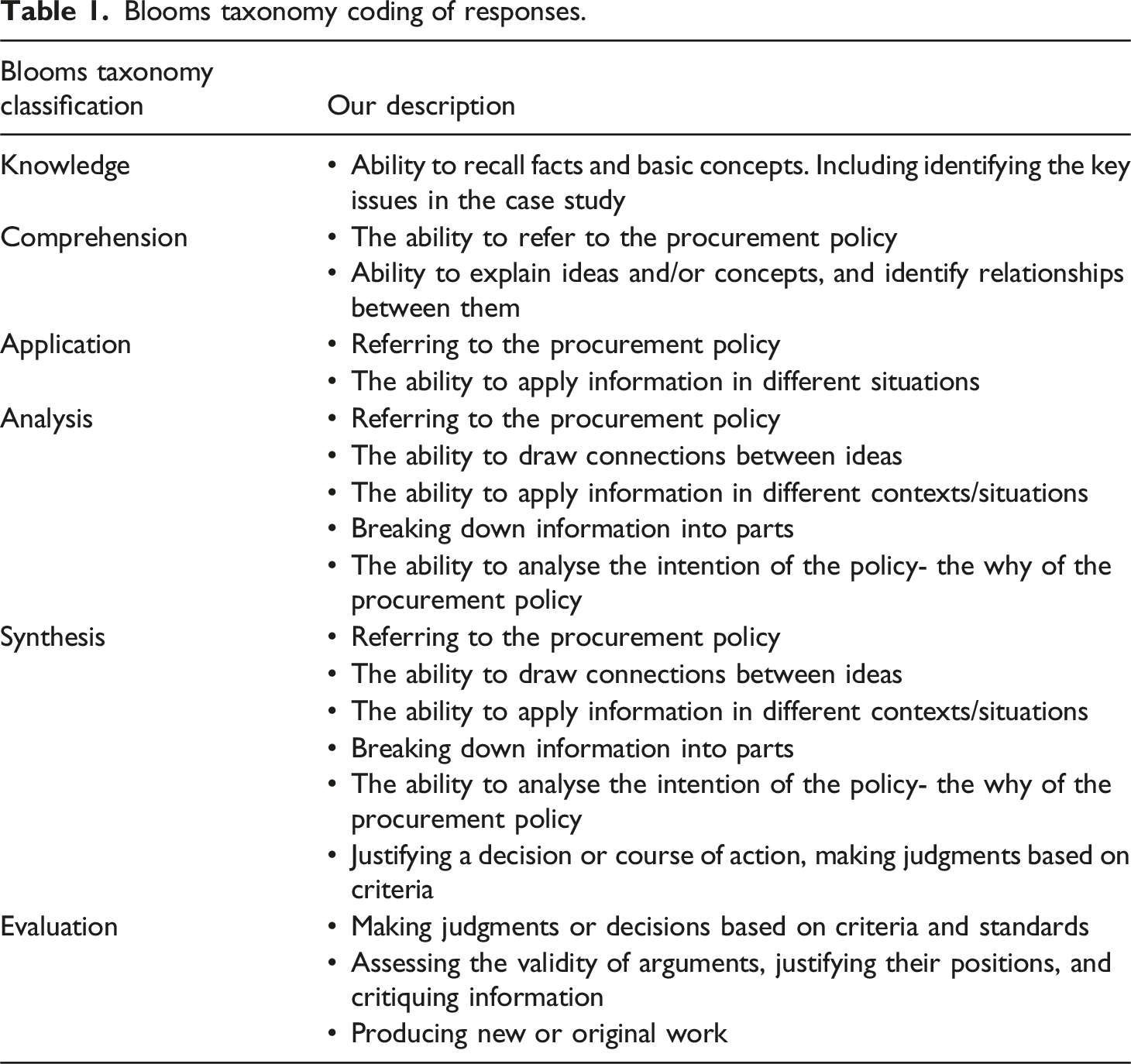
a) Knowledge: The responses ‘both of them are wrong’ and ‘we don’t know who is wrong or right’ are suggestive of students at the knowledge level demonstrating LOT skills. These responses reflect the ability to merely recall the facts. While important for building a knowledge base, it does not directly develop critical thinking skills. Learners at this level are primarily engaged in lower-order thinking.
b) Comprehension: The response “Lungelo is wrong because s/he provided two quotations” demonstrates comprehension, as it involves understanding and interpreting the procurement policy and its implications. At this level, learners demonstrate their ability to explain ideas or concepts. This involves some level of interpretation and paraphrasing, which requires a deeper engagement with the material. However, critical thinking skills like analysis and evaluation are not yet fully developed
c) Application: None of the responses showed the ability to apply knowledge. When learners can apply their knowledge to new situations or solve problems, they are engaging in a higher level of thinking. This level requires learners to transfer their understanding to novel contexts, which is an important aspect of critical thinking
d) Analysis: Some analysis is noted in one of the responses where some students agreed that both Lungelo and the boss are wrong. They identified the issues and reasoning behind their conclusions. Analysis involves breaking down information into parts, finding patterns and relationships, and drawing conclusions. This level of thinking requires learners to use critical thinking skills like comparing, contrasting, and inferring. Analyzing information is a key component of critical thinking
e) Synthesis: None of the responses demonstrate the ability to synthesize in the given context. At this level, learners generate new ideas, products, or solutions by combining elements in novel ways. Creating requires learners to engage in higher-order thinking, such as evaluating information, making judgments, and producing original work. This level is closely aligned with the development of critical thinking abilities
f) Evaluation: None of the students in the class exhibited evaluative thinking, which goes beyond analysis, and comprises making judgments and assessing the validity or effectiveness of actions or policies. A response that critically evaluates the procurement policy and its applicability to this specific situation would reach the evaluation level. The highest level of Bloom’s Taxonomy, evaluation involves making judgments or decisions based on criteria and standards. Learners must use critical thinking skills like assessing the validity of arguments, justifying their positions, and critiquing information. This level represents the pinnacle of critical thinking development
A reflective analysis of the students’ responses reveals that they cover a range of cognitive levels in Bloom’s Taxonomy, with some demonstrating basic knowledge and understanding, while others exhibit no application, and fewer exhibiting analytical skills. In order to enhance educational learning and critical thinking, it is important to encourage students to progress from lower-level skills to higher-order thinking, such as analysis, synthesis, and evaluation, in their problem-solving. In using the original taxonomy, we focused on the essence of reflection without being burdened by the complex details of a discipline-specific adaptation. This allowed us to engage in a more intuitive exploration of our reflection, making it a suitable choice for this paper. Ultimately, the original Bloom’s Taxonomy serves as a versatile tool for fostering critical thinking, making it well-suited for the reflective purposes of this paper.
The student responses demonstrated the anticipated gap in policy understanding. They did not demonstrate an understanding of the logic or argument behind the procurement policy requiring three quotations. The students’ responses appeared to centre around finding fault in one of the parties. A critical thinking approach to Public Policy education is to ensure that students learn about the entire policy process, which includes policy formulation, implementation and evaluation. The students’ answers revealed an ability to implement policy and to evaluate the extent to which such policy has been adhered to. The gap is highlighted in the area of policy formulation, which partly addresses the ‘why’ of policy.
Understanding the ‘why’ behind a policy offers a distinct sense of its intended aims and objectives. Clarity on this issue ensures that all stakeholders in the public administration space, from policymakers to those responsible for implementation, have a common understanding of what the policy is meant to achieve. Without this clarity, dissimilar interpretations will lead to varied applications which can lead to frustration, disjointed efforts and ineffective implementation. Another aspect critical thinking addresses, is the conceptualisation that there are always reasons behind policy formulation; which often include addressing specific issues or challenges. Understanding these reasons, allows for the successful design of the implementation approach, ensuring its suitability to the context while addressing the root problems. The challenge presented in the case study exemplifies the one-size-fits-all approach, which often leads to inefficiencies and inadvertent consequences.
Furthermore, knowing the rationale behind the policy assists when allocating resources, to ensure efficiency in order to achieve the desired outcomes. Policy success can appropriately and accurately be measured when specific and measurable indicators are identified and understood. Without which, application and evaluations will lack consistency. In addition, the ‘why’ of policy formulation is of paramount importance when auditing its effectiveness (Bridwell-Mitchell and Sherer, 2017). This understanding enables policymakers and implementers make informed changes. This evaluation is essential as it curbs against unchecked policy failure, leading to persistence in ineffective policies. Therefore, understanding the reasons behind policy formulation is critical for ensuring effective and uniform implementation and evaluation. Without this understanding, policies may lack direction, fail to achieve their goals, and be challenging to assess or adjust.
The ‘why’ of the policy
The procurement policy is designed to address three major issues in the procurement process. This is the part that the students failed to identify and articulate. Failure to do so led to the group suggesting more costly ways to deliver the service. This wasted time, frustrated ‘Lungelo’ (case study) as S/he could not justify the submission of two substantive quotes when three is the requirement, stressed the line manager because S/he did not understand the ‘why’ of the policy. Understanding the three objectives of the policy would have addressed the challenge. The policy is designed to:
According to World Bank, Procurement Policy and Guidelines (2014) competition ensures that buyers receive the best possible value for money. Therefore, obtaining quotations from several suppliers, Prices can be compared and the supplier offering the best value for money can be chosen. This approach is further supported by the International Organization for Standardisation (ISO), ISO 9001:2015 Quality Management Systems (2015) who propose that organisations should establish and keep a documented procedure to ensure that it selects suppliers based on objective criteria. Competition is promoted to ensure that the purchase decision maker gets the best possible price. This way the supplier providing the best value for money is identified and given priority.
The second reason for the policy is to reduce the risk of favouritism or corruption. The United Nations Office on Drugs and Crime (UNODC, 2013), Procurement Integrity Assessment Guide (2012) stipulates that obtaining quotations from multiple suppliers is an effective risk reduction strategy, addressing favouritism or corruption, as it makes it more difficult for a particular supplier to receive preferential treatment. Transparency International, Corruption in Procurement (2019) posit the need for competition as a preventative measure against corruption in procurement. Their contention is that when a single supplier submits a quotation, the buyer has less bargaining power, making them more vulnerable to corruption. When the buyer only obtains quotations from one or two service providers, there is a greater risk that the buyer will choose the service provider that they have a relationship with or the one who has offered them a bribe. The rationale behind three quotations from three or more service providers, is that the buyer will be more likely to choose the service provider that is best qualified for the job.
The third ‘why’ of the policy is the need to ensure that the buyer has a good understanding of all or most of the players in the market and the prices that are being charged. Multiple quotations from several service providers, gives a better understanding of the market and the prices that are being charged. This information can be used to negotiate a better price with the chosen service provider. The World Bank, Procurement Policy and Guidelines (2011) suggests that obtaining quotations from multiple suppliers will assist buyer understanding of the market. The information can be used to negotiate a better price with the chosen supplier. This notion is additionally supported by the Chartered Institute of Procurement and Supply (CIPS), CIPS Procurement Professional Guide (2019) who have indicated that it is important for buyers to have a good understanding of the market and the prices, in order to obtain value for money. Obtaining quotations from multiple suppliers will ensure that buyers also achieve this.
Implications on service quality and service delivery
This reflection is written in the context of service quality and service delivery in South Africa. Much of the literature in South Africa, in public administration and governance centres around policy application and evaluation (Santeramo and Phali, 2023). Several significant consequences can result when public servants do not understand the motivation behind policy formulation. This impacts the organisation and its stakeholders in various ways. Without a clear understanding of policy motivations, public servants may misinterpret its intended purpose, leading to a flawed implementation process and resulting in practices that deviate from policy objectives. The lack of understanding will additionally lead to actions that are unaligned to organisational mission and objectives. Inefficient and incorrect policy implementation will result in wasted resources, such as money, time and effort. When policy is correctly understood and applied, these resources are better utilised for productive purposes. When leaders and supervisors fail to understand and uphold the ethos of policies, it can erode trust among employees, stakeholders, and the public.
Conclusions
Research indicates that critical thinking is integral to developing robust decision-making skills, with repeated practice in making choices serving as a foundation for these cognitive abilities (Taylor et al., 1997). Studies on nursing students have shown that exposure to decision-making tasks improves both critical thinking and clinical decision-making skills, which suggests a significant relationship between cognitive practice and skill enhancement (Brooks and Shepherd, 1990; Paryad et al., 2011). Additionally, exposure to real-life decision-making scenarios allows students to approach problems more reflectively, which helps them understand the role of experience and knowledge in shaping decisions, even when outcomes vary (Milner and Wolfer, 2014; Smith, 2003).
Furthermore, consistent practice with decision-making has been shown to build resilience in students by enhancing their ability to learn from mistakes. Through this iterative process, students are likely to gain confidence in their analytical capabilities and their ability to reflect on outcomes critically. The reflective nature of learning from mistakes is instrumental in cognitive development, which undergirds the value of encouraging decision-making experiences within educational settings (Girot, 2000; Holmes et al., 2015).
Training in critical thinking encourages students to question, analyse, and critically evaluate each stage of the policy process, from formulation to implementation and evaluation. Doing this, ensures that students are equipped with the skills necessary to make informed, well-reasoned decisions. It is essential that students learn to evaluate policy options, and consider their ethical, legal, and practical implications. Students will be better equipped to critically evaluate existing policies, identify areas for improvement, and develop strategies for successful implementation. Incorporating Bloom’s taxonomy into pedagogy design and instructional practices will allow educators to promote the development of critical thinking skills and encourage students to engage in HOT processes. This approach is invaluable when public servants need to make decisions that align with the public interest, while adhering to ethical and legal standards. Critical thinking enables students to draw from a broad knowledge base when addressing societal challenges. Public policy issues are often complex and multifaceted, requiring an interdisciplinary approach. This analytical approach is fundamental for effective policy formulation, implementation and evaluation.
This reflective paper outlines gaps in teaching effectiveness at a South African university. The assessment of teaching effectiveness, particularly in the context of public policy and public service delivery education. This is a critical research gap, because understanding how teaching methods impact student learning outcomes is essential for educational improvement. The application of policy theory in a practical setting is explored by focusing on how students apply this theory in real-world scenarios. This addresses the gap in understanding the practical implications of policy studies. The paper has additionally demonstrated the importance of encouraging critical thinking and problem-solving skills among students through more effective teaching approaches. This is significant as it addresses the research gap relating to the evaluation and development of these skills in the context of Public Administration and policy education.
Understanding how policy context affects decision-making processes continues to be a research gap in the field of public administration and policy research. The paper has shown the need for internalisation of the ethos behind policy creation; making the focus on the ethical and moral dimensions of policy development and implementation a relevant research gap in the teaching and learning practice. This further highlights a research gap related to the evaluation of pedagogical approaches to teaching public policy, and their impact on student learning outcomes in the field of Public Administration in South Africa. Central to this reflection is the desire to enhance teaching and learning effectiveness in higher education institutions in South Africa. To do so, gaps in pedagogical approaches and student learning outcomes, need to be further explored, with the aim of improving education in South Africa. Overall, this reflective paper identifies gaps in understanding teaching effectiveness, policy application, critical thinking development, and the practical implications of teaching methods in the context of public administration education in South Africa.
Footnotes
Author contributions
Conceptualization: Sibongile R Nhari; The design, material preparation, data collection and analysis were performed by Sibongile R Nhari; Methodology: Sibongile R Nhari; Formal analysis and investigation: Sibongile R Nhari; Writing – original draft preparation: Sibongile R Nhari; Writing – review and editing: Sibongile R Nhari; Resources: Sibongile R Nhari and Thokozani I Nzimakwe; Supervision: Thokozani I Nzimakwe. All authors read and approved the final manuscript.
Declaration of conflicting interests
The author(s) declared no potential conflicts of interest with respect to the research, authorship, and/or publication of this article.
Funding
The author(s) received no financial support for the research, authorship, and/or publication of this article.
