




Abstract
This article presents a first synthesis of the ability to codify challenges that constrain project learning codification and, in turn, limit the sharing of learnings between projects at scale. An improved understanding of these challenges supports the externalized sharing of project learnings, between communities of practice, that can scale beyond the temporal, geographical, and organizational barriers that constrain personalized sharing. Through an integrative cross-domain literature review, a learning codification gauntlet of seven key ability to codify challenges is reconceptualized, and significant new research gaps are identified for further investigation, including: the operation of identified challenges in practice, challenge interrelationships, and challenge-cumulative effects on project-to-project learning outcomes.
Keywords
Introduction
Project-to-project learning is essential to prevent the reinvention of the wheel. Such learning can span a myriad of potential sharing interactions across individual, project, and parent organization levels (Prencipe & Tell, 2001; Bakker et al., 2011), and can support improved decision-making (Williams, 2008), common challenge identification and resolution (Boh, 2007; Yap et al., 2017), the avoidance of redundant work and repeated mistakes (Carrillo, 2005; Schindler & Eppler, 2003; Wiewiora et al., 2014), capability development (Schindler & Eppler, 2003; Moehler et al., 2018), harmonized methods (Hanisch et al., 2009), and accelerated product development (Sadeghi Dastaki, et al., 2022). Although the benefits of project learning are compelling, learning lessons is complex in practice (Fuller et al., 2010), with project temporality resulting in a “learning paradox” (Bakker et al., 2011, p. 494) whereby valuable knowledge, including learnings (also referred to as lessons learned within this article), are subject to knowledge fragmentation and “project amnesia” (Schindler & Eppler, 2003, p.p 219–220). The impacts of the learning paradox are severe: learning from projects rarely happens, consigning project organizations to keep on repeating the same mistakes (Flyvbjerg, 2021). Even where the sharing of learnings occurs, these received learnings often fail to deliver the intended results (Duffield & Whitty, 2016).
Where project-to-project knowledge that relates to project learnings is shared between projects, either personalized or externalized sharing approaches may be applied with a trade-off between the richness of personalized sharing and the reach of externalized sharing (Boh, 2007). This study focuses on an exploration of externalized knowledge sharing, noting that externalized approaches have the potential to enable project-to-project sharing of learnings at scale (Akkerman & Bakker, 2011) by spanning temporal, geographical, and organizational barriers (Boh, 2007; Hargadon & Sutton, 1997), however these outcomes require knowledge to be converted and codified (Kogut & Zander, 1992; Prencipe & Tell, 2001). Both personalized and externalized knowledge-sharing approaches involve knowledge crossing boundaries between distinct communities of practice (Abraham et al., 2015) that are differentiated by their histories, repertoire, communication approach, and capabilities (Wenger, 2000; Julian, 2008).
The codification of project learnings is impacted by an array of influencing considerations relating to both the intent to codify and the ability to codify. A project practitioner’s intent to codify is informed by a plethora of contextual factors (Bakker et al., 2011) including organizational culture and trust considerations (Agarwal & Anantatmula, 2022; Sense, 2007; Mueller, 2012a; Wiewiora, 2014; Liu et al., 2021), considerations of agency (Terhost et al., 2018; Aaltonen et al., 2020; Wiewiora et al., 2020; Nisula et al., 2022), and considerations of reliability and trustworthiness (Argyris, 1995; Eskerod & Skriver, 2007; Choo, 2007; Julian, 2008; Rajak, 2014; McGuirk et al., 2015; Pitsis et al., 2018). While resolving intent to codify is highly challenging on its own, to achieve learning codification that affords project-to-project knowledge sharing requires more than intent alone; project practitioners must also have the ability to codify. Considerations relating to the ability to codify, which form the focus of this article, include the characteristics of tacit and explicit knowledge (Nonaka et al., 1996; Nonaka, Toyama, & Konno, 2000; Nonaka, Toyama, & Nagata, 2000; Nonaka & von Krogh, 2009; von Krogh et al., 2000), the knowledge continuum (Nonaka, 1991, 1994; Nonaka & von Krogh, 2009), the limitations of the unarticulated background (Tsoukas, 1996), the role of practice (Carlile, 2002), knowledge sensemaking (Papadimitriou & Pellegrin, 2007), knowledge rationalization and prioritization (Tsoukas, 1996; Yap et al., 2017), codification effort (Zollo & Winter, 2002), the codification debate (Ancori et al., 2000), “reach and richness” trade-offs (Boh, 2007, p. 53), and boundary object capacity (Carlile, 2002, 2004; Carlile & Rebentisch, 2003; Abraham et al., 2015; Maaninen-Olsson & Müllern, 2009; Whyte & Nussbaum, 2020).
This study has applied an integrative literature review method as a syncretism of three decades of scholarship across the domains of knowledge, knowledge codification, knowledge sharing, project learning, and boundary objects. The novel contribution of this study arises from the reconceptualization of key concepts from the literature in response to an identified research gap: while scholars have widely explored the challenges associated with codification in general, and project learning codification in particular, these studies have not differentiated or syncretized an integrated view of ability to codify challenges from the perspective of project practitioners. Recognizing the importance of codification in scaling the sharing of project learnings between communities of practice beyond the constraints of personalized knowledge transfer, this article seeks to contribute to the resolution of this research gap by examining the following research question: How does ability to codify constrain the codification of project learnings?
Throughout this review, a series of learning codification challenges are identified as key concepts are examined. Within our discussion, we propose a learning codification gauntlet, as a metaphor for the public trial/hurdle run of practice, as a reconceptualization of the seven identified challenges impacting and constraining the ability to codify for the purpose of sharing project learnings between communities of practice. We conclude that several important opportunities for further research are evident, with future studies recommended to consider the unique context and mechanisms associated with specific project classes and individual project case studies.
Research Method
The focus of this study on codified knowledge implies, from the outset, the positivist assumption that knowledge can indeed be codified, stored, and transmitted (Vo, 2012; Vera & Crossan, 2003). Drawing on Svejvig’s examination of theory building in project management research (Svejvig, 2021), the focus of the positivist philosophical orientation on explanation, prediction, and testing can be understood as contrasting with the alternative orientations of interpretivism, which examines lived experiences through meaning, values, interpretations, and rules, and pragmatism, where knowing and doing are understood as the same process and value is measured by concrete consequences for practice (Svejvig, 2021). The impact of philosophical orientation in the knowledge domain is manifested in the codification debate (Ancori et al., 2000), where the possibility and value of codifying knowledge are strongly contended (see, for example, Tsoukas, 1996; Hislop, 2005; Bradley et al., 2006). Throughout this article we have endeavored to present a balanced perspective, drawing on the approach of Nonaka and von Krogh (2009), which acknowledges the key roles of both explicit and tacit knowledge forms across the knowledge continuum and within articulation, conversion, and codification processes.
Our literature review process is consistent with the integrative method of Klein and Müller (2020). The integrative review process commenced with identifying and selecting relevant articles across the domains of knowledge, knowledge codification, knowledge sharing, project learning, and boundary objects. The body of literature examined has been identified through Science Direct, Scopus, Monash University internal library e-collection, and Google Scholar with searches on keywords including project management, knowledge, knowledge codification, knowledge sharing, lessons learned, and boundary objects. After scanning the search results, studies were organized from the general to the particular before thematic analysis. The research question served as an initial main theme and the thematic analysis led to additional themes addressed in the subsections of the article. The supporting notes of Torraco (2005) have also guided this review process.
Seminal papers that guided this study have explored the interfaces between these interconnected domains over the last three decades, including the works of Nonaka et al. (1996), Nonaka, Toyama, and Konno (2000), Nonaka, Toyama, and Nagata (2000), von Krogh et al. (2000), and Nonaka and von Krogh (2009), exploring the nature of tacit and explicit knowledge and knowledge conversion; Tsoukas’s review of the knowledge management literature and foundational concepts (Tsoukas, 1996); Boh’s study of “reach and richness” trade-offs (Boh, 2007, p. 53); Agarwal and Anantatmula’s paper (2022) considering criteria for knowledge management success; a study (2020) by Aaltonen et al. of sensemaking in the context of megaproject innovation; Akkerman and Bakker’s review (2011) of boundaries and boundary objects; and the exploration (2011) by Bakker et al. of the project learning paradox.
Within key themes, perspectives have been compared across multiple authors to identify common and divergent perspectives across the period in which these domains have received significant focus in the literature. In line with the recommendations of Klein and Müller (2020), our intention has been to summarize and syncretize the existing literature, and through this syncretism provide insight on our research focus area and identify testable propositions for further research. We believe this intent has been fulfilled through the examination of a key research question and the reconceptualization of these distinct literature domains into theoretically grounded prepositions for further investigation in project practices.
Importantly, we note this article has focused on codified knowledge sharing between communities of practice in sender and receiver projects and has remained agnostic regarding learning context, project-to-project sharing approach, or project characteristics. In placing our primary emphasis on the systematic transfer of explicit and codified knowledge across projects, we posit that explicit knowledge offers actionable pathways for consistent project-to-project learning, acknowledging the inherent challenges posed by the “stickiness” of tacit knowledge (Szulanski et al., 2016), and that codified knowledge is a tool, not a definitive guide, with differing project characteristics impacting prior knowledge applicability. Furthermore, in limiting our scope to a generalized perspective, we have not accounted for the important impact of characteristics, such as project size and complexity, which may, for example, influence the required level of structure, responsiveness, iteration, and adaption within knowledge and learning processes. We note also the multifaceted nature of project “complexity” (Bakhshi et al., 2016; Dao et al., 2017), where the various manifestations of complexity impact how knowledge is curated and transferred across project environments (Hartono et al., 2019). While our scope reductions have been strategic, using an instrumental approach to develop foundational principles for management models and tools, future studies will need to consider how the research opportunities identified relate to the specific circumstances of individual project case studies.
Literature Review and Thematic Analysis
How Does Ability to Codify Constrain the Codification of Project Learnings?
We have reviewed the cross-domain literature to examine ability to codify challenges, focusing on the codification of knowledge relating to project learnings. Beginning with a review of the connection between the domains of project learning and knowledge management, we address the complex nature of project knowledge, the role of tacit and explicit knowledge, the knowledge continuum, knowledge conversion limitations, knowledge and practice, knowledge and sensemaking, learning rationalization and prioritization, codification processes, the codification debate, reach and richness tradeoffs, and the role of boundary objects. Across these key concepts and theories, a range of key ability to codify challenges are identified.
The Connection Between Project Learning and Knowledge Management
The scholarly fields of project learning and knowledge management operate in parallel as intertwined, iterative, and mutually reinforcing processes (Scarbrough et al., 2004). Project learning encompasses the actions that project teams use to create and share knowledge within and across projects (Kotnour, 2000) such that future performance can be improved (Project Management Institute [PMI], 2013), while knowledge management is the process of creating, sharing, using, and managing the knowledge of an organization (Girard & Girard, 2015). Both project learning and knowledge management domains are of relevance to this study of project-to-project learning, on the basis that we consider the codification of learning-related explicit knowledge or information assets within boundary objects for the purpose of enabling externalized knowledge sharing and project-to-project learning processes and outcomes. To adequately respond to the significant generation of knowledge stimulated by projects, organizations require a combination of project learning and knowledge management processes (Wiewiora et al., 2014). In considering these parallel fields, establishing clear boundaries is complex and not fully resolved; Hazlett et al. (2005, p. 37) consider knowledge management an “organic paradigm,” whereas Paver and Duffield (2019, p. 106) view knowledge management as a combination of disciplines that operates without “an agreed theoretical basis.”
Bosch-Sijtsema and Henriksson (2014) have examined the mechanisms of knowledge management and embedded knowledge in project organization contexts. After knowledge has been accumulated from past project experiences, knowledge processes enable the knowledge to be embedded in tasks, activities, routines, or objects, including artifacts, enabling knowledge retrieval and use at a later point in time. Project organizations create artifacts that embed knowledge across the life cycle of the project and these are passed to other participants in the project, whereas knowledge sharing also occurs between participants across projects. Project products of these sorts act as shared knowledge that enables further knowledge development as they are shared and used. Accordingly, future projects can benefit from, and continue to develop, shared products from both parallel and past projects, facilitating the processes of knowledge sharing and knowledge development. For the purposes of this article, we conceptualize the importance and relevance of both project learning and knowledge management while focusing on the challenges that constrain learning codification during the discovery and creation and documentation and storage knowledge management phases, utilizing the knowledge management nomenclature of Navidi et al. (2017).
The Complex Nature of Project Knowledge
Knowledge is central to value creation for society as a whole (Vie, 2012), drawing on the inexhaustible emergence of novel practices through the inherent creativity of human action (Tsoukas, 1996), with knowledge intensity continuing to grow as a result of dematerialization across economic value chains (Hanisch et al., 2009). Knowledge is one of the most important and valuable resources associated with organizations (Navidi et al., 2017), shaping the core activities and boundaries of firms (Prencipe & Tell, 2001). Knowledge underpins the ability of humans to define, prepare, shape, and learn to solve tasks and problems (von Krogh et al., 2000).
In the field of project management, knowledge is one of the few characteristics that all projects have in common (Sankarasubramanian, 2009), with knowledge comprising a key source of project value (Project Management Association of Japan [PMAJ], 2005). For projects, knowledge can be generated across the life cycle and address questions such as What worked? What didn’t work? and What has been learned? often taking the forms of delivery approaches, technical solutions, identified risks, and issue resolutions. The ambiguity, confusion, and controversy that accompany many projects are challenging but provide a rich environment for the creation of new knowledge (Fernie et al., 2003) and collaboration and knowledge transfer arising from problem-solving (Moehler et al., 2018).
Knowledge can be defined as the set of skills, experiences, information, and capabilities that individuals use to solve problems (Bakker et al., 2011; Hanisch et al., 2009). A distinction is drawn between knowledge and the information that supports knowledge. Dosi et al. (1996, p. 276) viewed information as “well stated and codified propositions,” as opposed to knowledge, which includes cognitive categories, codes of interpretations, tacit skills, and search and problem-solving heuristics. Prencipe and Tell (2001, p. 1375) considered information as a symbol or code without meaning, whereas “knowledge is meaning, meaning that can only be given by an observing system.” Capturing project knowledge relies on the “organizational memory” learning mechanisms of “learning by building organizational memory” and “learning from existing organizational memory” (Iftikhar & Wiewiora, 2020, p. 7).
Tacit and Explicit Knowledge
A key concept in the knowledge literature is the distinction between tacit and explicit knowledge, first introduced by Polanyi (1962). Nonaka and Takeuchi (1995) consider tacit knowledge to be subjective, experiential, and created in the moment. Nonaka et al. (1996), Nonaka, Toyama, and Konno (2000), Nonaka, Toyama, and Nagata (2000), and Nonaka and von Krogh (2009) explain that tacit knowledge is tied to the senses, tactile experiences, movement, skills, intuition, unarticulated mental models, or implicit rules, where these forms of knowledge are rooted in action, procedures, routines, commitment, ideals, values, and emotions. Sternberg et al. (1995) argue that tacit knowledge is acquired with limited direct instruction, procedural, and practically useful. Adenfelt and Lagerstrom (2006) view tacit knowledge as residing within individuals, whereas Bradley et al. (2006) suggest that actors are usually unaware of tacit knowledge—that is, it is consciously inaccessible—and that this form of knowledge is difficult to articulate and encode. Complex tacit knowledge is recognized as being of great value to project organizations, with Disterer (2002) viewing tacit knowledge as a primary source of project management competency and Flanagan et al. (2007) recognizing the unique value of process, product, and organizational “overview” tacit knowledge in design projects. Similarly, van der Hoorn and Whitty (2019) identify practical wisdom and stakeholder engagement soft skills as examples of project management knowledge that is largely tacit, context based, intuition reliant, and hard to communicate in an explicit manner.
In contrast, von Krogh et al. (2000) view explicit knowledge as that which can be put on paper, formulated in sentences, or captured in drawings. Bradley et al. (2006) consider explicit knowledge to be easily captured, expressed, and codified, comprising knowledge that actors are aware of and can articulate and discuss. Nonaka and von Krogh (2009) suggest that explicit knowledge has a universal character that supports use across contexts and is accessible through consciousness. Explicit knowledge has a direct applicability to project learning, including the use of explicit knowledge artifacts as candidate boundary objects for externalized knowledge sharing and project-to-project learning, noting that the knowledge literature uses a range of terms to describe artifacts and commonly substitutes objects as a synonymous category (Mariano & Awazu, 2016). With a focus on project learning codification, this study has been undertaken recognizing the important role of project knowledge artifacts in learning processes, for example post-project appraisals, after-action reviews, micro-articles, learning histories, and learning databases (Schindler & Eppler, 2003). In addition to artifacts, a further important conceptualization to note is paradigms (Kuhn, 1997), which shape both tacit routines, like Plan, Do, Check, Act, and structure-explicit repositories, such as designs, highlighting the dual role of shared cognitive frameworks in knowledge dynamics.
The Codification Debate
The knowledge concepts and processes described in this article must be acknowledged as being the subject of an ongoing and unresolved codification debate in the knowledge management literature. As described by Ancori et al. (2000), this is a debate between an absolutist position on tacit knowledge (suggesting all codified knowledge requires tacit knowledge to be useful) versus an absolutist position on codification (suggesting all knowledge can be explicitly codified). Further, in addition to these absolutist positions, the debate also encompasses a wide range of nuanced perspectives such as Cook and Brown’s knowledge conversation argument (Cook & Brown, 1999, p. 385) that forms of knowledge can be used to help acquire knowledge but that “tacit… cannot be turned into explicit” knowledge.
On the tacit side of the debate, early scholars including Polanyi (1962, 1964, 1966, 1975) have claimed that tacit knowledge holds primacy over, and is the foundation of, explicit knowledge and that it is the source of all knowledge and knowing. Tsoukas (1996) has argued that tacit and explicit knowledge are mutually constituted and inseparably related. Hislop (2005) considers that knowledge sharing necessarily involves two people who are actively inferring and constructing meaning. Bradley et al. (2006) note that many believe that explicit knowledge without tacit knowledge is incomplete and results in suboptimal solutions for problem-solving.
On the explicit side of the debate, Nonaka and von Krogh (2009) have reviewed the empirical results of explicit knowledge methods across the literature, including studies by Nonaka (1994) across 105 Japanese managers, Becerra-Fernandez and Sabherwal (2001) across 159 Kennedy Space Center stakeholders, and Chou and He (2004) across 204 organizations. Nonaka and von Krogh (2009) conclude that the ability to create explicit knowledge from tacit knowledge is supported by knowledge conversion, with examples of converted explicit knowledge identified across the study organizations. Similarly, Bradley et al. (2006) conclude that tacit knowledge does have the potential to be accurately elicited and codified, noting the importance of validation measures.
For the avoidance of doubt, the examination of knowledge continuum, articulation, and conversion considerations put forward in this article assumes that knowledge exists on a continuum and knowledge conversion is possible (with a range of limitations to be considered). This stance has been adopted in line with the recommendations of Nonaka and von Krogh (2009) who, having weighed the literature and evidence, suggest a balanced perspective: while tacit knowledge may not be accessible through consciousness at the extreme end of the continuum, tacit knowledge that leans toward the explicit side of the continuum can be accessible through consciousness, creating the possibility of knowledge conversion and codification. These concepts of conversion, accessibility, and codification are further explored in the next section.
The Knowledge Continuum, Articulation, and Conversion
One of the seminal contributions to knowledge theory has been Nonaka’s socialization–externalization–combination–internalization (SECI) model (Nonaka, 1994), whereby tacit and explicit knowledge elements do not exist in discrete isolation but are instead complementary knowledge forms that exist along a common knowledge continuum (Nonaka, 1991; Nonaka, 1994; Nonaka & von Krogh, 2009). This knowledge continuum is differentiated by levels of “articulation” (Boh, 2007; Cabrera & Cabrera, 2002) as knowledge undergoes a process of conversion (Lindner & Wald, 2011). At the extreme “tacit” end of the continuum, knowledge is entirely “embodied”—it is automatic, non-directed, and non-intentional, hardwired into our cognition and biological functioning, tied to our physiology, sensory and motor functioning, and individual history of physical movement in the world, with no possibility of explicit representation (Nonaka & von Krogh, 2009; Maturana & Varela, 1987; Varela et al., 1991; Varela, 1992). As we move beyond this extreme position, the continuum concept implies that articulation increases, and the resultant knowledge comprises a progressively greater “explicit” element. Articulation begins with “reflective practitioners” (Schon, 1983), involves an inherently creative act using metaphors, analogies, and images (Nonaka, 1991), and results in knowledge with a sufficiently explicit component that it can be “articulated”—it can be uttered, formulated in sentences, adopt a universal character, and be accessed through consciousness (Nonaka & von Krogh, 2009). Prencipe and Tell (2001), drawing upon Foray and Steinmueller (2001), suggest that knowledge conversion achieves symbolic inscription, enabling knowledge storage and transfer across time and space, as well as knowledge structure change from the transposition to literate representative forms. Movement along the knowledge continuum is fluid (Nonaka & von Krogh, 2009), with tacit and explicit knowledge forms “oscillating” so that each mutually enhances the other rather than existing in competition (Jha, 2002). Importantly, the conversion, and subsequent codification, of knowledge does not terminate the role of tacit knowledge: when codified knowledge is shared and acted upon by knowledge recipients, it is then internalized by individuals who are applying their own continuum of tacit and explicit knowledge; at the early stages of internalization the explicit knowledge facilitates slow and consciously modifiable cognition; however, with repetition, the tacit knowledge component increases and becomes automated over time, enabling increased stimuli complexity (Nonaka & von Krogh, 2009; Pothos, 2007; Koch, 2004; Nonaka, 1994).
Limitations of Knowledge Conversion as a Result of an Unarticulated Background
Turning to the limitations of tacit knowledge conversion, early views beginning with Polanyi (1964, 1966, 1975) explored the connection between conscious awareness and articulation through the concept of subsidiary awareness that “can exist at any level of consciousness, ranging from the subliminal to the fully conscious” (Polanyi, 1975, p. 39), such that “we acquire knowledge that we cannot tell” (Polanyi (1966, p. 5). Tsoukas (1996) provides an explanation of the key concepts relevant to exploring these limitations, drawing upon Polanyi (1962, 1975) and Taylor (1993): All articulated knowledge is based on an unarticulated background; articulated knowledge represents a tacit integration of particular details by individuals based on the particulars of the background they are subsidiarily aware of; rule-following is grounded in the unarticulated background; the unarticulated background is known to us through socialization processes leading to both cognitive and embodied understanding; and through this mechanism individuals are socialized into a practice. It follows that an individual’s attempt to articulate limited particulars for an unarticulated background that is partly embodied will necessarily deliver an incomplete and imperfect rendering of that background (Tsoukas, 1996). Taylor (1993, p. 50) described such incomplete and imperfect representations as “islands in the sea of our unformulated practical grasp on the world,” and Tsoukas (1996) notes that there is always a level of asymmetry between rules as represented and rules as guides in practice. Indeed, the embodied nature of much of an individual’s understanding of an unarticulated background (Maturana & Varela, 1987) impedes tacit knowledge articulation, as this knowledge is intuitive, tied to the senses, and escapes formal analysis through introspection (Nonaka & von Krogh, 2009). It has been suggested that many of the minutiae of individual skills are actually quite inaccessible through consciousness (Nonaka & von Krogh, 2009).
The Relationship Between an Unarticulated Background and Practice
Through our exploration of knowledge conversion above, the key role of unarticulated background knowledge has been introduced, with individuals experiencing an unarticulated background connected to their socialization within a practice. We will now further consider this central relationship between knowledge and practice. Carlile (2002), drawing on Cook and Brown (1999), notes that knowledge cannot be separated from an individual’s engagement in their practice. Tsoukas (1996) argues that actor understanding is primarily informed by practices and practice-based activity as a matter of necessity, given that defined rules alone are inherently insufficient; he notes that the application of rules cannot be achieved through rules (Gadamer, 1980) and that defined rules can never be fully self-contained or complete (Garfinkel, 1984). The importance of practice knowledge to organizations is further reinforced by a study by Javernick-Will and Scott (2011) and analyzed by Biesenthal et al. (2018), who found that professional practice knowledge that is improvised in use was regarded by respondents as the most important knowledge type for firms to acquire.
Three key characteristics of knowledge in practice are proposed by Carlile (2002): knowledge is localized in practice, knowledge is embedded in practice, and knowledge is invested in practice. Regarding localization, Carlile (2002) draws on Wenger (1998) to argue that knowledge is inherently local in character, even in response to large-scale problems. Regarding embeddedness, Carlile (2002) suggests practice knowledge is embedded in accumulated experiences, know-how, technology, methods, and rules of thumb, and that embedded knowledge becomes more difficult to communicate as the differences among individuals’ practices expand. Regarding investment, Carlile (2002) explains that knowledge that proves successful becomes more valuable and is more likely to be reused in the future. Carlile (2002) concludes that these characteristics of knowledge in practice combine to result in specialization effects, which increase knowledge utility within a practice while also promoting knowledge sharing between practices.
An important aspect of knowledge embeddedness are the social systems, or social practices, that create, evolve, and utilize knowledge in practice. Winograd and Flores (1987) considered social practices to be the foundation of intelligibility, even more important than the specific subject of an interaction between actors. Social practice knowledge exists in a dispersed form; dispersed across multiple minds within a community but also dispersed by the uncertainty of what knowledge will be called upon in a particular circumstance (Hayek, 1982). Accordingly, to discuss social practices, it is necessary to also recognize the limitations imposed by their elusive nature and the effective impossibility of comprehensively describing a social practice in action (Tsoukas, 1996).
Mouzelis (1995) suggests that social practices have three dimensions: social position or role, dispositional, and interactive–situational. Social position or role refers to the expectations of a specific role held by an actor within a social practice. The dispositional dimension refers to the way an individual’s habits of thinking have been formed over time through past participation in historical practices (Tsoukas, 1996); Bourdieu (1990) described this disposition of an actor as the “habitus.” Finally, the interactive–situational dimension addresses the specific context and expectations tied to a particular social activity. Taking these dimensions together, we can see that social practices are informed by an individual’s role, their habitus, and the context of the activity at hand, where the combination of these dimensions calls upon “quasi-automatic” actor behaviors (Mouzelis, 1995) and drives both consistency and diversity in the behaviors that are demonstrated (Orr, 1990).
A key type of social practice, with particular focus on the social position or role dimension of Mouzelis’s model (1995), are discursive practices. Discursive practices are defined by Harre and Gillet (1994) as the use of a sign system associated with norms and focuses. Discursive practices have been the basis for practice analysis across a range of professions and industries, with Tsoukas (1996) summarizing a body of literature spanning roles such as stock controller, production scheduler, photocopier repairer, blacksmith, forest ranger, ship navigator, and physician. At an industry level, Spender (1996) suggests the concept of an “industry recipe” discursive practice as a means of understanding discourses within a specific industry environment and the communication and decision-making that those discourses enable. Biesenthal et al. (2018) utilize the concept of discursive practices to contextualize text-based knowledge as the object of discourse produced in and through languages and semiotic systems including images, drawings, models, and words.
An informative actor-focused example of knowledge in practice is the tacit knowledge in practice commonly held by individuals regarded as experts within a subject matter discipline. Bradley et al. (2006) view the expert as being able to sift diverse data to find key problem-solving information, tacitly knowing the relevant objects and relationships and traversing effectively between symptoms and solutions. The expert draws upon tacit knowledge associated with their practice to construct mental networks and maps that support reasoning processes (Kinchin et al., 2000). This knowledge in practice is of great value but challenging to articulate or elicit; it can be affected by expert-induced bias and commonly requires indirect elicitation techniques to achieve a level of articulation (Bradley et al., 2006).
Within a specific practice, the group of individuals that form the membership of the practice are collectively referred to as a “community of practice,” defined as “self-organized groups of practitioners, who collaboratively engage with each other in their work practices, learn from each other, and solve their practical problems” (Schulte, 2021, p. 2). Project teams typically consist of members who belong to, and identify with, a range of communities of practice in addition to their shared project practice (Sense & Antoni, 2003). Communities of practice are an essential construct to understand learning, as many of the knowledge-sharing processes that occur in organizations are informal, social, and interpersonal processes (Williams, 2008). In addition to these informal processes, communities of practice may be uniquely positioned to enable knowledge codification as a result of their enhanced capability to combine tacit and explicit knowledge elements (Wenger et al., 2002).
The Role of Sensemaking for Articulated Knowledge
Knowledge and the meaning that it imparts appear to be significantly influenced by subjective factors. Clegg (1989) argued that subjectivity stemmed from the discursive practices of talk, text, writing, cognition, argumentation, and representation. Vie (2012) suggests that the construction of meaning is necessary, as elements of knowledge are lost through transfer and translation, obliging the receiver to recreate the lost knowledge within their own context. Biesenthal et al. (2018, p. 50), viewing projects as projections, consider them as a “complex web of semiotics” and “semiotic systems” defined by their social construction, including those who sponsor, fund, make, contest, and use them. Pitsis et al. (2018) suggest that each project actor who brings competencies to a project also brings specific rationalities, across contractor, subcontractor, client, sponsor, and stakeholder groupings. Aaltonen et al. (2020, p. 523) argue that project actors “inevitably perceive and interpret the project in their own ways,” drawing on their study findings that individual actors assign different meanings to key process steps, reflecting their roles, responsibilities, experiences and backgrounds, and these meanings guide their behavior and decision-making. Prencipe and Tell (2001) noted that organizations and organizational members exhibit systematic biases in knowledge interpretation, often influenced by recent and salient events, which include being insensitive to sample size, overly focused on intentionality, and applying simple and linear algorithms.
One approach that project learning and knowledge management scholars apply, to consider the subjectivity of knowledge, is the lens of sensemaking. Applying a sensemaking focus, the act of organizing is an experience of “being thrown into an ongoing, unknowable, unpredictable streaming of experience in search of answers” (Weick et al., 2005, p. 410). Sensemaking is a process that encompasses: “enaction,” whereby the lack of clear and legitimate collective sense is defined; “selection,” whereby options to resolve the lack of sense are identified and a new collective paradigm is built; and “retention,” whereby the newly acquired sense is integrated within a set of rules and action (Papadimitriou & Pellegrin, 2007). Sensemaking is a broader concept than interpretation, taking into account an individual’s innovativeness and the breadth of conception they are able to bring to bear in constructing social and physical worlds (Weick, 1995). Stories, verbal descriptions, and other communications shared and negotiated between organizational actors are believed to play a crucial role in the sensemaking process (Aaltonen et al., 2020).
Project management and sensemaking are closely entwined. Ivory et al. (2004) suggest that projects are often more focused on sensemaking objectives than executing fully formed plans, while Papadimitriou and Pellegrin (2007) argue that it is the variety and the dynamics of sensemaking activities that define the nature of a project. Alderman et al. (2005) developed a framework to understand the sensemaking nature of projects, drawing on the supporting concepts of boundary objects, trajectories, social worlds, seeding, negotiation, and accomplishment.
Sensemaking has a range of project-related impacts, with regard to both project characteristics and the management of knowledge. Sensemaking is influenced by project characteristics and in turn influences a project’s points of differentiation. Sensemaking within a project is shaped by the unique characteristics of that project; however, surface-level complexity and scale measures are insufficient to understand a project’s true nature; a project’s ambiguity, uncertainty, and complexity characteristics are best understood with reference to the experience, knowledge, and intellectual and social skills of project stakeholders (Engwal, 2003). Conversely, the characteristics that differentiate a project as unique from its peers include the specific sensemaking activities that project actors have applied in responding to project situations, thus creating new collective frames for understanding, thinking, and action (Weick, 1995). Considering sensemaking and knowledge management, Hewitt and Walz (2005) view knowledge sharing as being directly linked to the development of project actor sensemaking. Aaltonen et al. (2020) go further to argue that the way project actors make sense of innovations determines whether and how those innovations are understood, accepted, and applied, noting that innovation adoption cannot be controlled by any single actor and is the result of differing interpretations across groups. Aaltonen et al. (2020, p. 535) additionally view these differing interpretations as establishing “islands of understanding” that can co-exist at certain project stages as sensemaking between individuals diverges and converges over time.
The scholarship of Boland and Tenkasi (1995) further refines the sensemaking process to differentiate perspective making, through knowledge creation, from perspective taking, through knowledge interpretation. Perspective taking, also described as “sensetaking” (Birollo & Rouleau, 2018), applies individuals’ interpretative schemes (Dougherty, 1992) to inferential and judgmental processes that access the “unique thought-worlds of different communities of knowing” (Boland & Tenkasi, 1995, p. 359). With reference to the codification process, we can understand the acts of codifying knowledge and interpreting this codified knowledge as interruptions in the sensemaking process (Rom & Eyal, 2019; Helms Mills et al., 2010), where the interpretation of codified knowledge involves sensetaking that evaluates the sensemaking of others (Huemer, 2012).
The Reconciliation and Prioritization of Articulated Learnings for Codification
Once tacit knowledge relating to learnings has been converted and sensemaking for the articulated knowledge has occurred, project teams must consider which learnings to codify. We consider two aspects of this learning selection process: first, in the preceding section we considered the contextual factors that inform whether learnings are selected for codification; second, in the next section, we examine the challenges resolving knowledge contradictions and prioritizing knowledge value.
Across the project life cycle, Tsoukas (1996), drawing on Hayek (1945), argues that the character of the modern rational economic order means that the knowledge that organizations require never exists in an integrated form, but rather as dispersed, incomplete, and contradictory knowledge held by individuals. Tsoukas (1996) suggests that tensions between stakeholder social practices mean knowledge is never possessed by a single agent or that it is complete, and that aspects of knowledge origination remain outside a firm’s control. In this way, project knowledge may be created relating to, for example, process, product, overview, or soft-skills learnings (Flanagan et al., 2007; van der Hoorn & Whitty, 2019); however, this knowledge may only exist in a fragmented state between multiple project role holders, each of whom may interpret the project learning in a different, and potentially inconsistent, way.
At key project milestones and project close, the selection of knowledge, including learnings, for codification is further complicated by the inherent discontinuity of project working constellations and team compositions that results in knowledge fragmentation and disintegration (Prencipe & Tell, 2001; Disterer, 2002; Kasvi et al., 2003; Lindner & Wald, 2011). The interplay of these factors is influenced by unique project circumstances, noting the organizational landscape context, methodology linkages, parallel projects, expert knowledge inputs, and permanent firm goal alignment at hand (Lindner & Wald, 2011). This context amplifies the radical level of knowledge uncertainty faced by all firms: “they do not, they cannot, know what they need to know” (Tsoukas, 1996, p. 22). Given the knowledge richness of many projects, the imperfect mechanisms available to identify key value-adding knowledge, including learnings for codification, represents a significant challenge for project organizations (Yap et al., 2017).
The Codification Process
The conversion and codification of knowledge within projects can have profound implications for organization-wide learning (Prencipe & Tell, 2001). Codification can transform knowledge into a commodity that can be exchanged or traded (Prencipe & Tell, 2001), enabling organizations to acquire knowledge from others through knowledge exploitation as opposed to reliance upon knowledge exploration (March, 1991; Brady & Davies, 2004; Eriksson, 2013). Knowledge that can be codified and commodified lends itself to greater ease of knowledge transfer and lower knowledge transfer costs (Cowan & Foray, 1997). Transfer cost efficiency can result from high initial fixed costs being offset by very low marginal costs as reproduction volumes increase through knowledge diffusion (Prencipe & Tell, 2001). Codification establishes the possibility of cross-organization knowledge sharing, increasing an organization’s combinative capability (Kogut & Zander, 1992) and enabling the instruction of machines for automation and the creation of memory external to individuals, reducing vulnerability to the loss of tacit knowledge residing in individuals (Prencipe & Tell, 2001), which is a key challenge for temporal projects (Navidi et al., 2017).
Zollo and Winter (2002) take the view that the creation of codified knowledge involves both creative elements and internal selection processes and requires significant learning investment. In the context of time- and resource-constrained projects, this investment necessitates a level of triage, with multiple potential impacts on knowledge capture: where high-value tacit knowledge is not converted to an explicit form, the ease of acquiring that knowledge is more difficult to assess during triage decision-making; also, where learning potential has been identified, it is likely that all learnings cannot be captured on investment triage grounds, and accordingly learning prioritization decisions will be made. As Mueller (2012b, p. 441) has found, time is “the most important resource for knowledge sharing between project teams.”
Ghasemi et al. (2012) suggest that to effectively codify experiences through documentation both planning and implementation processes are warranted: planning may include studying the organization’s status, identifying knowledge areas, mapping managerial experiences, and selecting the format of documents; implementation may involve identification of experiences, categorization of experience content, assessment of elicited experiences, and structured distribution of experiences. For complex knowledge conversion cases, such as capturing expert knowledge, a range of tools have been developed, including protocol analysis, neural networks, causal mapping, cognitive mapping, observations, post-completion analysis, and memory content elicitation (Bradley et al., 2006).
The Reach and Richness Trade-Off Between Knowledge-Sharing Approaches
Once tacit knowledge has been converted to explicit knowledge through articulation and conversion, this knowledge may be utilized either through “personalization,” whereby the knowledge is closely tied to the person who developed it and is shared primarily through person-to-person contact or through “externalization,” utilizing codified knowledge within artifacts applying linguistic and symbolic representations (Prencipe & Tell, 2001). The “reach and richness” trade-off (Boh, 2007, p. 53), reflecting the “codification debate,” captures the tension organizations face in choosing between a personalized approach (typically richer in contextualized knowledge with enhanced tacit elements) and an externalized approach (typically enabling greater reach across many individuals and organizational boundaries). Reinforcing the enhanced richness of personalized knowledge sharing, a study (2005) by Antoni et al. found “people-centered” learning approaches were more significant than codification strategies to achieve project-to-project knowledge transfer. Similarly, Hartmann and Dorée (2015, p. 342) found that “sender/receiver” approaches existing independently of context can represent “major limitations” for project learning, and Prencipe and Tell (2001) have described the risks of over reliance on codified knowledge, which may result in rigidity, stifle the development of new knowledge, and inflict inertia on systems. Balancing these perspectives, while remaining consistent with the “reach and richness” trade-off, Akkerman and Bakker (2011) have argued that externalized codified knowledge can be shared at greater scale as a direct result of reduced reliance upon personalized interactions.
Knowledge Sharing and the Role of Boundary Objects
Both personalized and externalized knowledge sharing, and indeed knowledge sharing of any type, involves crossing boundaries between communities of practice (Abraham et al., 2015), including the communities of practice within “sender” and “receiver” projects. These boundaries arise from the characteristics that differentiate communities of practice from one another, including their histories, their repertoire, and their communication approach and capabilities, and they may be either declared or unspoken (Wenger, 2000). When the sharing of learnings between projects is viewed as sharing between communities of practice, an elevated frame of reference is adopted in which a myriad of specific interorganizational interactions are possible (see, for example, Prencipe & Tell, 2001; Bakker et al., 2011). The spanning of community of practice boundaries is enabled by three complementary mechanisms: boundary objects, boundary interactions, and boundary brokers (Wenger, 2000). Of these, it is boundary objects that establish a shared context across heterogeneous practices (Star, 1989), provide a “nexus of perspectives” (Wenger, 1998, p. 107), “embody and represent essential knowledge that can be shared across domains” (Choo, 2007, p. 13), and act as facilitators of knowledge management (Wohlrab, 2020). Importantly, boundary objects may be intangible entities, such as meetings, interactions, or conversations, or they may take concrete forms such as documents, files, or prototypes (Star & Griesemer, 1989; Mueller, 2015; Buhl et al., 2019; Wlazlak & Pour, 2022). When an individual reads a document that is a concrete boundary object, the knowledge relationship formed is not only between the individual and the document, but also between the individual and two or more communities of practice (Julian, 2008; Wenger, 1998). Four key boundary types identified in the literature, representing increasing boundary complexity, are “syntactic,” “semantic,” “pragmatic,” and “temporal” boundaries (Carlile, 2002, 2004; Carlile & Rebentisch, 2003; Abraham et al., 2015; Maaninen-Olsson & Müllern, 2009; Whyte & Nussbaum, 2020). The extent to which codified boundary objects afford complex boundary spanning across increasingly complex boundaries hinges on inherent object capacity, underpinned by object structure and characteristics (Rosenkranz et al., 2014), with Ferres and Moehler (2023) proposing a schema of 30 discrete characteristics associated with boundary spanning capacity for project-to-project learning.
Discussion
Our examination of project-to-project learning codification has considered a wide range of knowledge mechanisms that operate in parallel across the knowledge continuum and spectrum of knowledge-sharing approaches. We reconceptualize the interaction of these mechanisms in Figure 1, demonstrating the alignment of codified project learnings with the explicit end of the knowledge continuum, where externalized sharing of codified knowledge creates the potential for greater knowledge sharing reach across complex boundaries between communities of practice. Importantly, while the scope of this study is focused on externalized knowledge sharing with codified knowledge, Figure 1 also illustrates the pivotal role of tacit knowledge within the knowledge continuum, and personalized knowledge sharing as an alternative and, typically, richer sharing alternative.
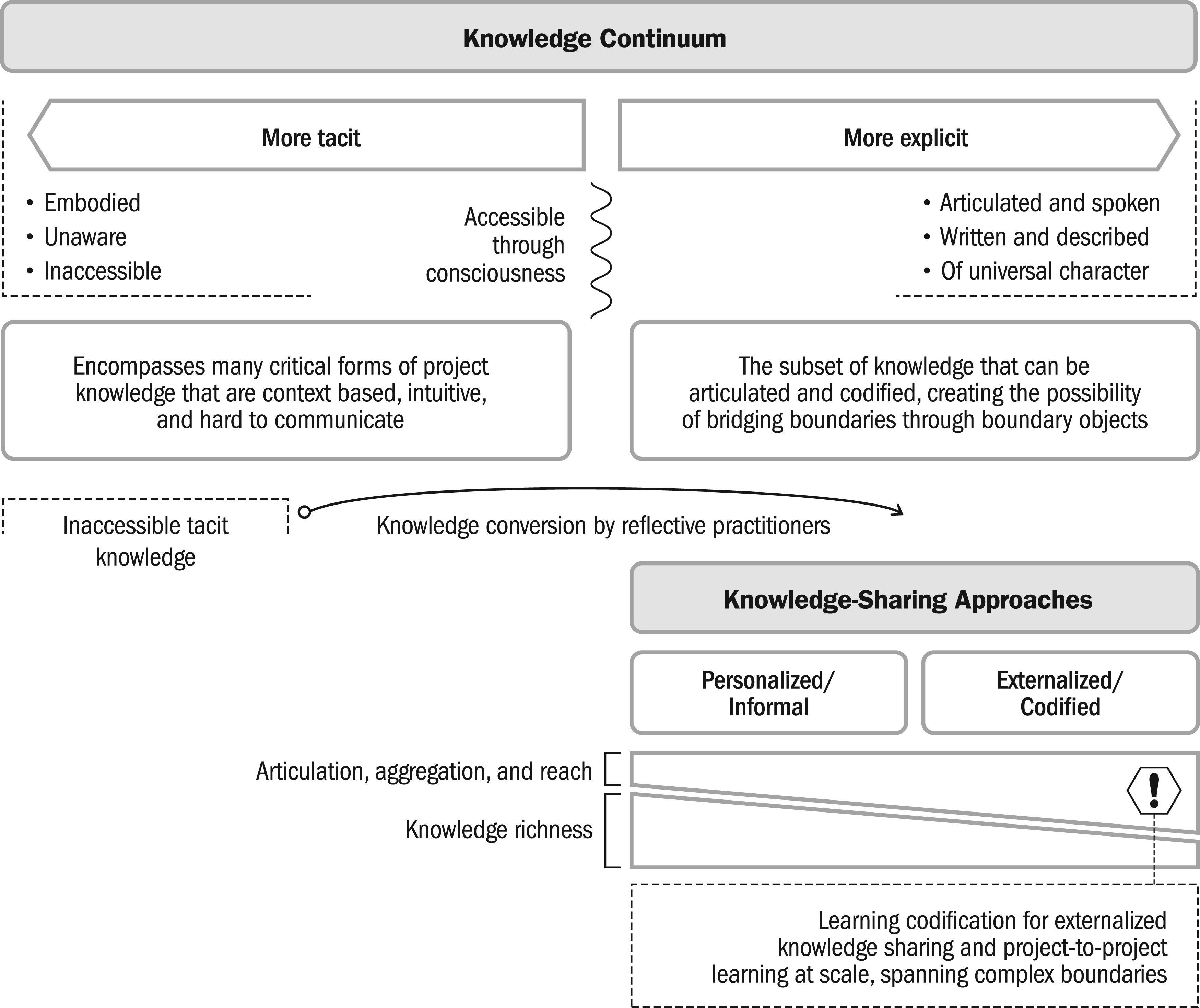
Reconceptualization of knowledge conversion, codification, and sharing mechanisms.
Our review of these mechanisms of project learning codification has also revealed a range of challenges with the potential to significantly constrain project practitioners’ ability to codify project learnings. We identify seven key challenges to project learning codification as follows:
We suggest that these challenges can be usefully reconceptualized as running the learning codification “gauntlet” that constrains project practitioners’ ability to codify project learnings. This learning codification “gauntlet” of challenges must be navigated for every tacit project learning that emerges from project practice if it is to be codified for externalized sharing at scale between communities of practice, independently of specific project-to-project interaction types. We set out the run of the learning codification “gauntlet” in Figure 2.
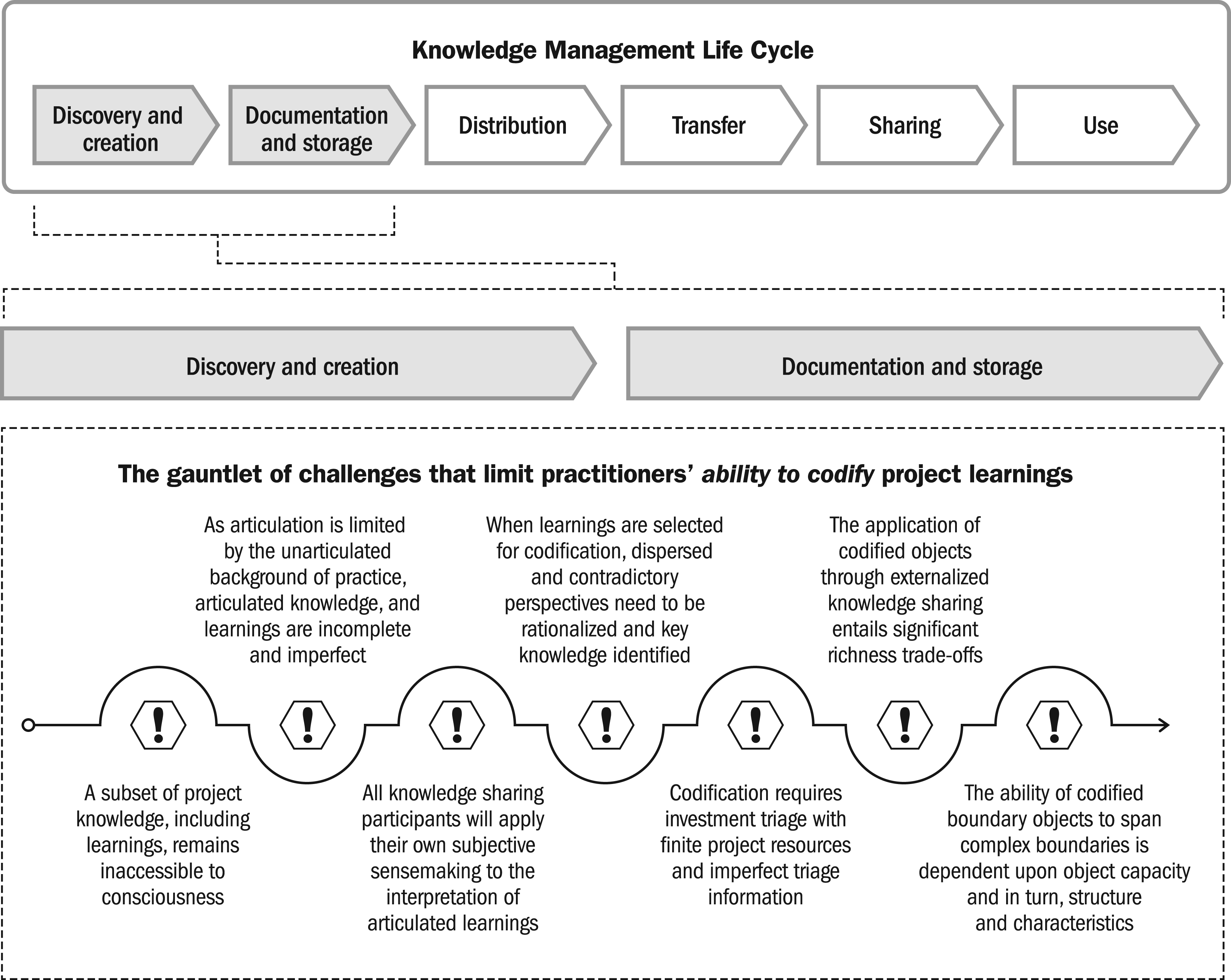
The “gauntlet” of challenges that limit project practitioners’ “ability to codify” project learnings.
The concept of the “gauntlet” will require further investigation, including to confirm the end-to-end series of constraints that impact codification from the point of accessibility to consciousness through to knowledge sharing, as well as to better understand the cumulative impact of these constraints. We feel further study is warranted as the “gauntlet” is directly relevant to the ability of projects to codify key learnings and upscale project-to-project sharing beyond the constraints of personalized knowledge transfer.
Conclusion
This integrative literature review has reconceptualized the domains of knowledge, knowledge codification, knowledge sharing, project learning, and boundary objects to address a single research question: How does “ability to codify” constrain the codification of project learnings? We believe our syncretism of the literature advances this important field of research, directly relevant to the sharing of learnings at scale and across barriers and identifies significant new research gaps.
Our examination has identified seven key challenges affecting project practitioners’ “ability to codify” project learnings. These challenges reinforce the difficulty of sharing learnings between projects; not only are project practitioners encumbered with the project learning paradox and the multiple contextual factors that constrain “intent to codify,” they must also overcome the “ability to codify” challenges we have identified. In our attempt to capture the pressing reality of these challenges for project practitioners, we have reconceptualized the identified “ability to codify” challenges as a “gauntlet” that must be “run” for every tacit project learning that emerges from project practice if it is to be codified for externalized sharing at scale between communities of practice. We consider the “gauntlet” to include the following seven challenges (see also Figure 2):
A subset of project knowledge, including learnings, remains inaccessible to consciousness and cannot be articulated. As articulation is limited by the unarticulated background of an individual’s practice, articulated knowledge and learnings are incomplete and imperfect. All knowledge-sharing participants will apply their own subjective sensemaking and sensetaking to the interpretation of articulated learnings. When learnings are selected for codification, dispersed and contradictory perspectives may need to be reconciled and key knowledge identified. Codification requires investment triage with finite project resources and imperfect triage information. The application of codified objects through externalized knowledge sharing entails significant richness trade-offs. The ability of codified boundary objects to span complex boundaries is dependent upon object capacity and, in turn, structure and characteristics. The operation of each of these challenges in practice within project-to-project learning environments, for which limited studies have been undertaken; The interrelationships between these challenges, which have not yet been studied in any context; The cumulative effect of these challenges on project-to-project learning outcomes, which has not yet been studied in any context; and The interrelationships between these challenges and parallel “intent to codify” considerations, which have not yet been studied in any context.
Having identified and considered the project learning “ability to codify” challenges, we also note that further investigation will be required to understand:
As further research in this field progresses, we note that it will be necessary to go beyond the “project agnostic” approach applied to this study and consider the unique context and mechanisms associated with specific project classes and individual project case studies. We put forward these identified research gaps as important future research opportunities to improve how project practitioners codify key learnings, upscale project-to-project sharing beyond the constraints of personalized knowledge and, ultimately, avoid the “reinvention of the wheel.” To link the framework to comprehensive knowledge integration, future research should aim to expand it to encompass tacit knowledge capture and transfer, thus deepening the theoretical and practical aspects of knowledge transfer in project management.
Footnotes
Declaration of Conflicting Interests
The author(s) declared no potential conflicts of interest with respect to the research, authorship, and/or publication of this article.
Funding
The author(s) received no financial support for the research, authorship, and/or publication of this article.
