




Abstract
There is a growing face-value acceptance of optimism bias as the primary cause of transport cost overruns. This article provides a timely review of literature on optimism bias and transport infrastructure project cost overruns. The article identifies significant gaps and unanswered questions about the relationship between optimism bias in project cost appraisal and cases of transport infrastructure cost overruns. The presence and nature of optimism bias in the complex institutional environment of project cost appraisal are largely understudied and not well understood. Consequently, this has significant implications for the development of effective mitigation strategies for improving transport project cost performance.
Keywords
Introduction
The early cost estimates for major transport infrastructure projects are infested with risks and uncertainties (Love et al., 2021; Miller & Szimba, 2015). Many of these risks arise from the time-consuming and complex organizing, planning, and implementing processes of major transport projects (Cavalieri et al., 2019). The risks and uncertainties derived from the lengthy and complex nature of transport infrastructure projects have led to frequent budget overruns worldwide. Drawing from the records of 258 completed rail, bridge, tunnel, and road projects in 20 nations across five continents, Flyvbjerg et al. (2002) found that 86% of the projects experienced cost overruns. The average scale of cost escalations is 25.7% for transport projects in Europe (n = 181) and 23.6% for projects in North America (n = 61). More recently, Terrill et al. (2020) reported that AU$34 billion more was spent on transport infrastructure projects in Australia between 2001 and 2020 due to cost overruns. In the United Kingdom, the Edinburgh Tram Project in Scotland suffered a £400 million cost increase compared to its initial budget (Love & Ahiaga-Dagbui, 2018). The London Crossrail Project was commissioned three and a half years late and cost £18.8 billion, over £4 billion more than the approved estimate in 2010 (Crossrail Ltd., 2022; Sandle, 2022).
Transport infrastructure projects have accounted for a large proportion of the public funding allocated to infrastructure and substantially impacted a region’s economy over the last two decades. Allport (2007) records that in Singapore, the Philippines, and Colombia the budgets for intercity rail projects before any cost spike account for as much as the annual budgets for multiple central government departments. Countries such as Australia and the United States encouraged increased public spending on transport infrastructure provisions and accelerated project schedules to relieve the national economic stress caused by the COVID-19 pandemic. Projected spending on transport projects outweighed any other types of infrastructure provisions between 2022 and 2026 in the United States’ newly enacted Bipartisan Infrastructure Law (BIL) 1 (Goldwyn et al., 2020). A recent Australian infrastructure market capacity report showed that 80% of the national infrastructure expenditure between 2021 and 2026 was allocated to the transport sector (Infrastructure Australia, 2021b). The emphasis on major transport project investments, in turn, increases the risks of project cost overrun and benefit shortfall. This is because rushing into an expensive transport provision commitment without a robust feasibility study stating a clear scope definition and a reliable preliminary cost estimation often heightens the risk of cost and schedule overruns (Love et al., 2014). It is imperative to facilitate the conceptual analysis of the causality of transport infrastructure cost underestimation and align the short-term fiscal stimulus plan with the long-term strategy of promoting the cost performance of public infrastructure provisions (Crudgington, 2020).
Extensive research has gone into unraveling the causes of transport project cost underestimation. The phenomenon has been explained by project-specific causes such as changes in the project scope (Love et al., 2014), political-economic causes such as leadership foul play (Wachs, 1989), and psychological causes such as optimism bias, the illusion of control, and escalation of commitment to a failing course of action (Kutsch et al., 2011). As a recently popularized explanation in infrastructure project cost management, optimism bias is considered a cognitive bias that “overestimates the likelihood of positive events and underestimates the likelihood of negative events” (Sharot, 2011, p. 941). Optimism bias is found in individuals’ overly optimistic judgments about the chances of experiencing future adverse events such as divorce and a heart attack (Weinstein, 1980), the length of time for new curriculum developments (Kahneman, 2013), the short-term future returns of the U.S. stock market (Ben-David et al., 2013), and the effectiveness of newly discovered cancer treatments (Chalmers & Matthews, 2006). Transport project planners are perceived to suffer from the same bias when they underestimate the total cost and overestimate the financial and social benefits of a project under consideration (Buehler et al., 1994; Du et al., 2019a; Flyvbjerg, 2008; Kutsch et al., 2011).
A preliminary review of the literature on behavioral decision-making in infrastructure projects indicates that the research on optimism bias in transport project cost underestimation has gained popularity in the past decade (e.g., Kutsch et al., 2011; Love et al., 2021). There appears to be prima facie evidence to support optimism bias as a significant cause of the problem. In-depth reviews of the evidence and assertions revealed in the existing literature are needed to interpret the occurrence, nature, and impact of optimism bias in the appraisal of transport infrastructure projects and identify potential research gaps to rationalize this causal relationship further. To date, however, there is a lack of review in the extant literature that critically examines the current body of knowledge about the nature and impacts of optimism bias in the context of transport infrastructure project cost appraisal. For example, Stingl and Geraldi (2017) review the theoretical foundations and the negative impacts of a wide range of cognitive biases on general project decision-making. Cavalieri et al. (2019) summarize the determinants of cost overruns in delivering transport infrastructures. Neither of these reviews pays specific attention to the role of optimism bias in transport project cost estimation.
A lack of unanimity on the reference point used to report the extent of the overruns is also noticed in the preliminary review. Three reference points were used across the existing research (Love et al., 2019a). The first reference point is at the time when a project’s sponsor makes the decision to proceed with a chosen design and allocates funds among competing options (Ahiaga-Dagbui & Smith, 2014). Notably, the estimates made at the decision-to-build stage are significantly influenced by uncertainty, lack of information, strategic misrepresentation, and optimism bias (Flyvbjerg et al., 2018). The second reference point is at the time when the detailed design of the chosen project option is completed, and a final cost estimate is established. The estimated figure is built upon the finalized design documents of the project deliverables and is incorporated into the client’s detailed business case in preparation for tendering (Berechman, 2018). The third point of reference used by researchers to measure transport project cost overrun is the contract award (e.g., Ganuza, 2007; Hinze et al., 1992; Love et al., 2013). The cost figure at this point represents the sum of the project work packages agreed between the client and the successful tenderer (Love et al., 2015a). The cost data displayed in the literature has demonstrated that, in general, the differences between the actual project cost at completion and the cost estimate at contract award are the lowest compared to the forecast made at the first two reference points.
Against this backdrop, this study offers a timely review of what is collectively known about the causal relationship between optimism bias and transport infrastructure project cost overruns in the appraisal processes. The review examines whether the well-documented nature and impacts of optimism bias at an individual level can be directly applied to explain cost overrun on transport infrastructure projects. By reviewing and synthesizing the current body of knowledge, this study aims to identify important missing links pertinent to the causality and dissect the underlying factors and conditions embedded in the organizational and political contexts in which the bias is manifested. The in-depth review can provide researchers and government agencies with recommendations on further optimizing infrastructure project cost overrun mitigation mechanisms, project stakeholder engagement strategies, and value for money safeguarding policies for capital works. To achieve this aim, the study adopts a semistructured review methodology to systematically select, scope, and analyze a wide range of literature pertinent to the causal relationships between optimism bias and transport infrastructure project cost overrun. The selected articles are synthesized and assessed for their theoretical underpinnings, research designs, and findings. The review provides a platform for integration, parallel consideration, and evaluation of the assumptions, methodologies, and conclusions regarding optimism bias in the existing transport project early cost management knowledge (Tranfield et al., 2003), and “foster cross-fertilization, new ideas, and the overall development of the field” (Stingl & Geraldi, 2017, p. 122). The next sections of the article are structured as follows: a description of the literature review method used by this study to select the pertinent literature and identify the key information for integration and evaluation is presented below. Then, findings and implications of the body of knowledge extracted from the chosen articles are presented, and areas of weakness are discussed. A future research agenda is proposed in the conclusion.
Method
The introduction of the political and psychological causal explanations of transport project cost overrun offers fresh opportunities and challenges for multidisciplinary researchers to explore the underlying factors and conditions of this perennial issue. What are some of these opportunities and challenges? Have they been adequately addressed in the existing transport project cost overrun research? This study organizes a semistructured review to answer these questions (Baumeister & Leary, 1997). The responses are summarized in the conclusion.
According to Klein and Müller (2020), a semistructured review probes into “a broad range of literature with equally broad research questions and a purpose that focuses on the understanding of complex areas” (p. 240). It combines the structure of a scoping view and the searching strategy of a systematic review and has been adopted for identifying critical concepts, assumptions, and gaps on a specific topic of inquiry.
The chosen method is supported by a systematic literature identification and selection process and a scoping review-styled analysis. Using a systematic literature search and selection strategy ensures that the quality and content of the literature pertinent to the research questions are thoroughly evaluated and analyzed using “a transparent process and clearly identified inclusion/exclusion criteria” (Klein & Müller, 2020, p. 241). In presenting a synthesis of the findings and implications of the selected literature, the scoping review opens the opportunity for the authors to cross-reference several informative government publications and transport engineering reports (Levac et al., 2010). The incorporation of gray literature allows the study to consider the interpretations of optimism bias among transport infrastructure project experts and practitioners and critically evaluate how the theory is translated into the current policy designs for transport project appraisal. This enriches the discussion on the current body of knowledge and substantiates a future research agenda.
The Review Framework
The review was conducted in accordance with the standards and methodology framework established by Arksey and O’Malley (2005) and Levac et al. (2010). The systematic literature search and selection process was designed by consulting the Preferred Reporting Items for Systematic Reviews and Meta-Analyses (PRISMA) guidelines (Moher et al., 2009), Cavalieri et al. (2019) and Denicol et al. (2020). The systematic review process was completed on the online workflow platform Covidence.
Literature Search Strategy
Peer-reviewed articles were searched in three major academic online databases: Scopus, Web of Science, and ScienceDirect, published from 2002 to October 2022, in English. Based on this article’s areas of interest, the keywords for the systematic literature search were summarized in three categories: transport infrastructure project synonyms, cost appraisal synonyms, and optimism bias synonyms. The synonyms of the three keywords formed the search terms. Boolean operators linked these terms to generate search strings on the databases, as summarized in Table 1. The search terms were determined by considering keywords documented in recent transport infrastructure literature, brainstorming sessions among the authors, and consulting case studies of transport projects published by government agencies and industry bodies. Due to a limit of Boolean operators placed on the ScienceDirect database search (maximum eight per field), a smaller range of search terms was used.
Search Terms Derived from the Three Categories of Keywords
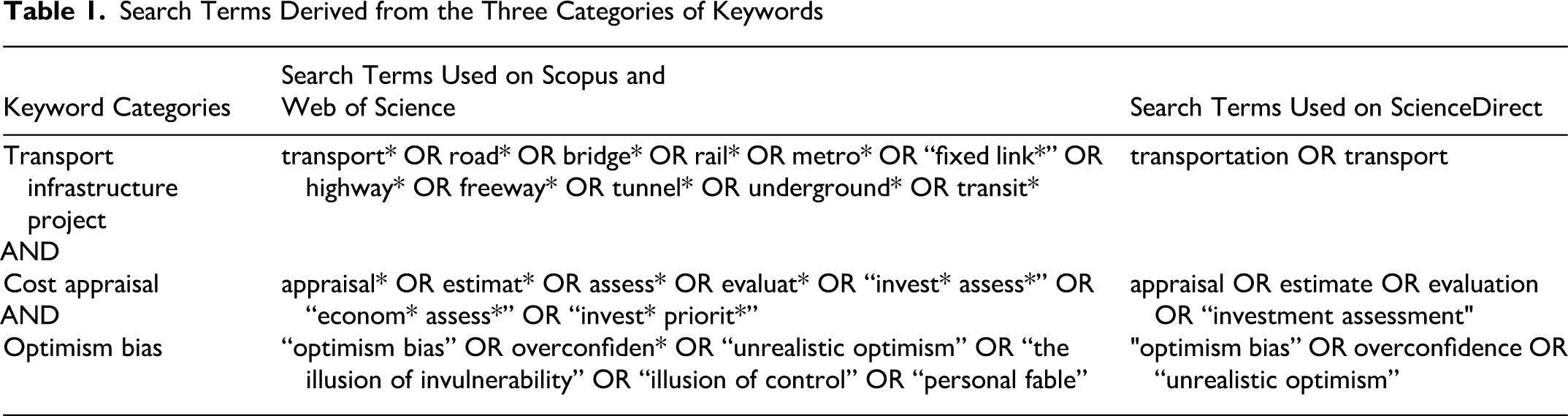
The search strings returned 1,786 articles on Scopus, 38 on Web of Science, and 1,725 on ScienceDirect. On Scopus, the results were then limited to the subject areas of business, management and accounting; decision sciences; engineering; multidisciplinary; social sciences, reducing the number of articles to 416. On Web of Science, the results were restricted to the subject areas of transportation, returning 13 articles. Six hundred forty-four articles returned on ScienceDirect after the search results were limited to social sciences; business; management and accounting; engineering; decision sciences.
Screening
A total of 1,093 articles were imported into Covidence for the systematic literature selection tests. After 65 articles were removed by duplication, the titles and abstracts of the remaining entries were assessed by a set of inclusion and exclusion criteria. In addition to the publication time and language restrictions, the assessment criteria consist of the following requirements: (1) the full texts were available, (2) the type of project examined in the article is transport-related (e.g., roads, rail, and bridges), (3) psychological or behavioral biases were examined in the article, and (4) the articles concerned the issue of transport project cost overrun. As a result, 87 entries met the criteria for the title and abstract screening (941 articles were deemed irrelevant) and were assigned to full-text reviews. The full-text review removed an additional 50 articles. Among them, 31 articles examine optimism bias in settings other than transport infrastructure project cost appraisal, 14 articles focus on transport project cost overrun causes other than optimism bias, and five articles concentrate on the statistical characteristics of transport demand shortfalls. In the end, 37 articles were considered relevant for data extractions. The complete article selection process is visualized in Figure 1.
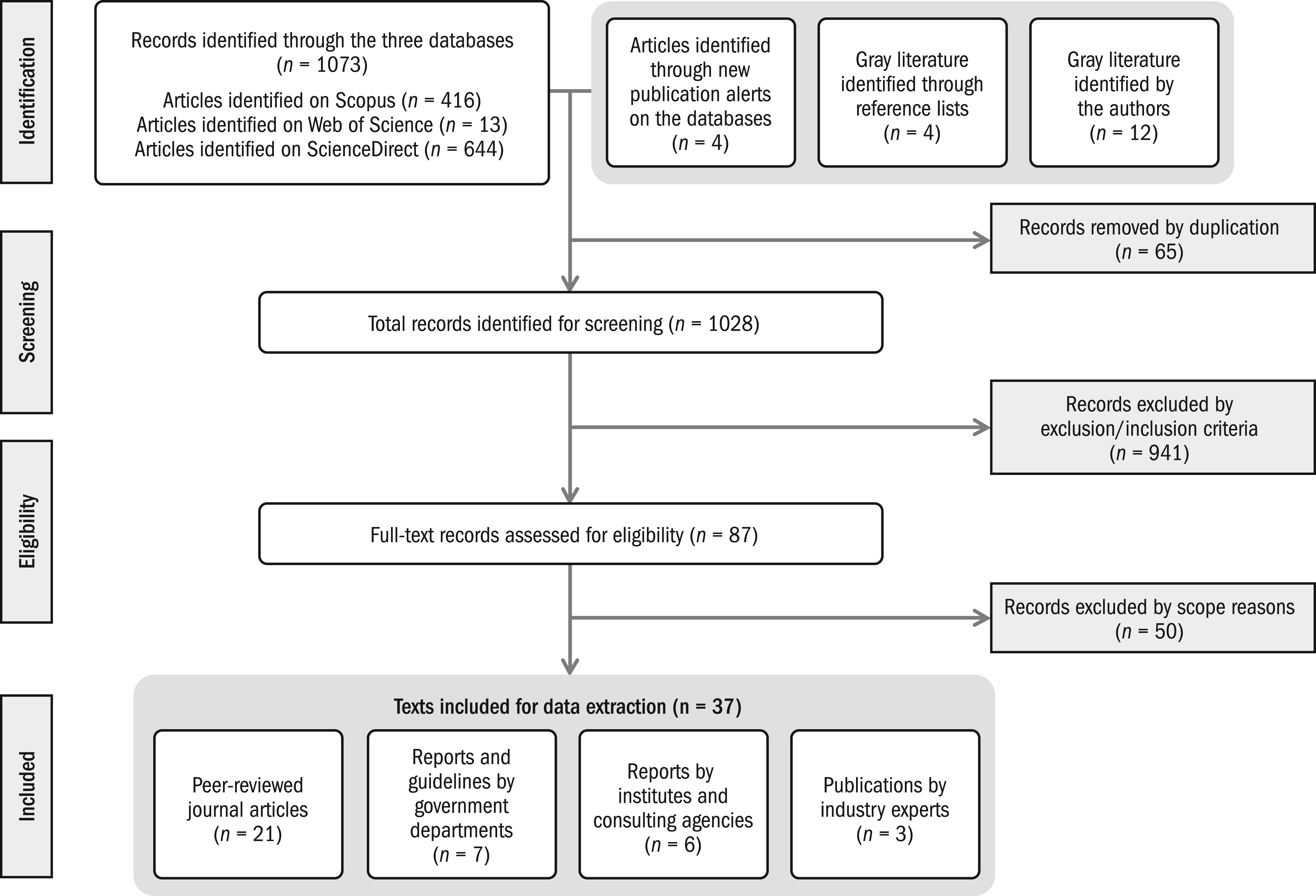
Literature selection process flow diagram.
Data Extraction and Synthesis
The full-text review process finalized the selection of articles for data extraction. Adapting from the Cochrane Data Extraction and Assessment Template (Lasserson et al., 2019), the information about the purposes of the research, study designs, transport projects concerned, and interventions of cost overrun (if applicable) was extracted by the authors. In keeping with the contexts discussed in the preliminary literature review, the data were synthesized in terms of the points of reference used for measuring cost overrun, the approaches adopted for dissecting optimism bias in the early cost forecasts, the strategies recommended for improving transport project cost performance, and the theoretical underpinnings or assumptions embedded in the scholarly discussions.
Findings and Discussion
Characteristics of the Included Literature
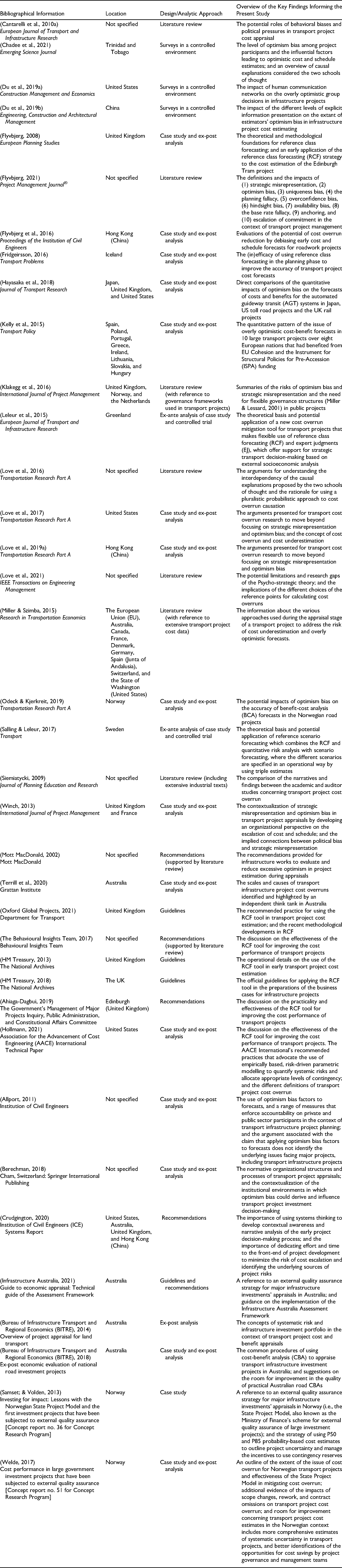
All the selected literature concerned the sources of unreliable cost estimation in relation to the cost performance of transport infrastructure project appraisals. The cost performance of a transport project refers to the state of the project’s capital expenditures at a certain stage in its development and is compared to the project’s approved total budget estimate. It affects the cost-benefit ratio in the project appraisal and informs discussions about investment options for the project (Love et al., 2017). Among the literature reviewed, 13 texts quantified the scales of cost overrun on completed transport projects, presented ex-post analyses of their cost performances, and evaluated the causes of the overruns, including the impacts of optimism bias. Three articles investigated the underlying factors and impacts of optimism bias in controlled settings comparable to the decision-making processes of transport project planning and delivery. Two articles explored and evaluated the effectiveness of cost overrun mitigation tools developed upon Reference Class Forecasting. In addition, 12 of the selected texts set out best-practice guidelines and recommendations for mitigating overly optimistic cost (and benefit) forecasts in transport project appraisals. Seven articles speculated on the roles of behavioral biases and political pressures in the risk management and decision-making processes by reviewing extensive case study reports from the perspective of transport project governance. A summary of the bibliographical information and the characteristic of the selected literature is shown in the Appendix at the end of the article. The Appendix also contains the key findings of each reviewed literature, facilitating the following discussion.
Optimism Bias in the Causal Explanations of Transport Cost Overrun
Traditionally, research on the causality of transport project cost overrun tended to focus on identifying and analyzing project-specific causes for the problem. For example, Love et al. (2016) suggested that “overruns result from changes in scope and definition between the inception stage and eventual project completion” (p. 185). Depending on a transport project’s quality of design, location, managerial structure, and procurement method, scope change can be attributed to design errors (Love et al., 2005), subsoil conditions in excavations (Terrill et al., 2020), price escalation (Chadee et al., 2021), and design changes following ad hoc negotiations between project promoters and local interest groups (Gil & Fu, 2022). These causal explanations have been widely illustrated in the engineering-managerial literature, and researchers supporting the explanations are regarded as the Evolutionists (Love et al., 2018). This school of thought maintains that a transport project is constantly exposed to the possibility of scope and schedule changes as it evolves through the planning and delivery stages. When such changes occur, the overall cost of the project rises (Ahiaga-Dagbui et al., 2017; Cavalieri et al., 2019).
However, identifying project-specific causes alone is not adequate for the development of effective managerial strategies to tackle transport project cost overrun. A considerable number of publications on project-specific cost overrun factors were criticized for their superficial and replicative research methods and subsequent conclusions. According to Ahiaga-Dagbui et al. (2017), these articles often began with the identification of numerous potential cost overrun factors and asked project participants (e.g., clients, consultants or contractors) to “rank these factors on a five-point Likert scale, ranging from ‘not significant’ to ‘extremely significant’” (p. 90). Using a basic scale survey and the conventional net-effect correlational analysis is ineffective in producing demonstrable causality. Factors such as improper planning, unreliable project cost estimation, and expensive labor and material costs were repeatedly reported regardless of the varying project contexts (Cavalieri et al., 2019).
To advance from the superficial and replicative findings, a wave of multidisciplinary research purported that infrastructure project cost overruns should be interpreted from political and psychological points of view. Wachs (1989) argued that cost overrun is closely related to project planners’ conscious decision to favor one design option over others in the analysis of project options when preparing the business case or to convince the project sponsors of the economic feasibility of a chosen option (Love et al., 2017; Siemiatycki, 2009). Such deliberate underestimation of cost and impact of risk have been termed “strategic misrepresentation” (Flyvbjerg et al., 2002, p. 290). Nonetheless, researchers concerned with strategic misrepresentation have acknowledged that empirically verifying the deceptions as intentional from those involved in the estimations is tricky, because the inquiry may involve asking project sponsors and estimators to admit lying (Flyvbjerg et al., 2002; Love et al., 2016).
Built on the influential behavioral economics research findings of Daniel Kahneman, Amos Tversky, and Dan Lovallo (Kahneman, 2013; Kahneman & Tversky, 1979; Lovallo & Kahneman, 2003), recent research also suggested that transport project cost overrun can be explained by optimism bias (i.e., self-delusion) (Flyvbjerg, 2008; Kutsch et al., 2011). This view is inferred from the assumption that optimism bias is inherent in the nature of the sponsors and planners of a proposed transportation project. They are likely to inadvertently underestimate costs, time, and risks and overestimate benefits in the preparation of the overall pre-construction forecast (Chadee et al., 2021; Love & Ahiaga-Dagbui, 2018). The causal explanations that attribute the primary sources of cost overruns to the behavioral decision-making concepts of strategic misrepresentation and optimism bias are summarized as the Psycho-strategic school of thought (Ahiaga-Dagbui & Smith, 2014; Love et al., 2015b).
The debate on the validity and practicality of the two schools of thought is linked to the debate over the standard measurement of cost overruns for transport infrastructure projects. For example, Flyvbjerg et al. (2002) measured the cost escalation profiles of 258 global transport infrastructure projects by comparing the cost estimate at the decision-to-build. Love and Ahiaga-Dagbui (2018) argued that since cost estimate at decision-to-build is not supported by reliable scope definition and detailed design schemes, using the decision-to-build estimate as a point of reference is likely to produce exaggerated sizes of cost overrun. Major transport infrastructure projects often undergo an extensive definition period after the decision-to-build juncture. For instance, the London Crossrail was conceptualized as an inner-city rail line, connecting the existing underground networks in the initial business case, which was approved to be delivered as it bore a high cost-benefit ratio (approximately 3.2 to 3.8) (Gil & Fu, 2022). The business case for the project continued to develop over the next three years, and an agreement was reached between the project control groups on a scope encompassing 118 kilometers of commuter trains. This design change resulted in a significant cost increase and almost halved the initial cost-benefit ratio (Gil & Fu, 2022). Love et al. (2015a) opposed using the final cost estimate from the detailed design stage of a transport project as the point of reference. It was asserted that the choice “is not indicative of changes in market rates” and “the procurement system adopted may also influence the estimate due to the allocation of risk, particularly if it is a public partnership method for delivering the project” (Love et al., 2015a, p. 2). Future research examining optimism bias in transportation project cost estimation needs to note the nuances embedded in the researchers’ choice of reference points and their theoretical underpinnings about the causal relationships that contribute to the underestimation of transportation costs.
Resonating with the popularization of the Psycho-strategic theory is the growing trend for media to highlight a few eye-catching causal factors and portray infrastructure decision-making as a world in which cost-benefit assessments are tenuous, political influence and pressure are high, and cost underestimation to gain project approval is the norm (Taleb, 2007; Terrill et al., 2020). The public sponsors of major infrastructure projects in the United Kingdom, Australia, Canada, Denmark, Norway, and Hong Kong identified optimism bias as the leading cause of budget overruns (Flyvbjerg et al., 2018; Flyvbjerg et al., 2016; Infrastructure Australia, 2021a; Salling & Leleur, 2017). A novel forecasting tool called Reference Class Forecasting (RCF) was recommended by government bodies to mitigate the risk of unrealistically optimistic project plans and forecasts. The RCF approach uses total project cost forecast uplifts built on the cost at-completion data of similar past projects to counter cost underestimation (Allport, 2011; Flyvbjerg, 2008). For example, the UK Treasury’s Green Book for assessing government investment recommended that “appraisals should make explicit adjustment for optimism bias” by “applying overall percentage adjustments at the outset of an appraisal” (HM Treasury, 2018, p. 30). Nevertheless, the debate about the root causes of the cost overrun phenomenon and the associated cost overrun mitigation strategies continues to emerge in the literature (Flyvbjerg, 2021; Flyvbjerg et al., 2018; Love & Ahiaga-Dagbui, 2018; Love et al., 2021).
Optimism Bias in the Organizational Setting of Transport Project Cost Appraisal
It is unclear whether the findings of overly optimistic judgments about future events at an individual level are valid in the setting of transport project planning appraisal. The current review indicates that optimism bias is well-studied at an individual level (Ben-David et al., 2013; Chalmers & Matthews, 2006; Kahneman, 2013; Seaward & Kemp, 2000; Weinstein, 1980). However, evidence of its presence and impacts are less known in an organizational setting where predictions are usually made collectively and may be subject to the impacts of known biases at the group level such as groupthink and polarization (Du et al., 2019a; Ika et al., 2022; Kahneman et al., 2021). How optimism bias manifests in the transport project cost appraisal setting, where project cost and schedule estimates and contingencies are set, is even less documented in the literature (Du et al., 2019a; Ika et al., 2022; Love et al., 2021).
On the one hand, the organizational setting of a major project may offer greater opportunities for prudent opinions to be circulated and considered than in an individual decision-making scenario. The opinions may come from project sponsors, external consultants, professional engineers, and estimators. The cost appraisal of a major transport project usually involves a project control group (which consists of internal project planners and external consultants) to estimate and verify budget forecasts and a project governance team to decide upon design options and funding strategies (Berechman, 2018; Du et al., 2019a; Love et al., 2021; Siemiatycki, 2009). Publications from Australia, the United Kingdom, the United States, Norway, and Hong Kong reported that during the planning phases of transport projects, strategies were implemented in the organizational setting to ensure that sound investment decisions could be made. These strategies include brainstorming in risk identification workshops, project stakeholder consultations, and business case reviews with project governance teams and third-party advisors to check the quality of cost estimates (Berechman, 2018; Bureau of Infrastructure Transport and Regional Economics [BITRE], 2018; Crudgington, 2020; Samset & Volden, 2013; Goldwyn et al., 2020; Flyvbjerg et al., 2016). Hence, some researchers indicated that the organizational setting of major infrastructure projects could ameliorate the effects of optimism bias on cost estimates (Farooq et al., 2018; Ika et al., 2022; Welde, 2017).
On the other hand, this article underscores the nuances of the manifestations of optimism bias in a transport project’s organizational setting. This is because while this review confirms that optimism bias has been widely cited as an important cause of transport project cost underestimation, the presence of optimism bias in transport project cost appraisals is not well backed by empirical evidence (Du et al., 2019a; Love et al., 2016, 2021). For instance, although various stakeholders may contribute to the cost appraisal of a transport project, is it oftentimes up to individuals (i.e., estimators) to make the relevant estimates? To what extent would they consider the opinions of other group members when they are making the estimates? Would some project stakeholders’ opinions weigh more than others? And, if yes, are the more influential opinions experienced enough to understand risks and project delivery in uncertain environments? Empirical evidence is needed to uncover these nuances in the organizational setting of a major transport project. Moreover, according to Kahneman et al. (2021), group decision-making gives a sense of good decision. Still, it can easily lead to worse decisions because of the combined impacts of peer pressure, initial popularity 2 , and informational cascades 3 in the forms of self-reinforcing popular opinions and reduced independent judgments. Empirical evidence is also required to assist in-depth analyses of the levels of independence, critical thinking, and pressures perceived when presenting unpopular in transport project appraisals.
Optimism Bias and Other Cognitive Biases in the Appraisal Process
Among the reviewed articles, Love et al. (2021), Flyvbjerg (2021), Winch (2013), and Leleur et al. (2015) explicitly acknowledged the potential impacts of other cognitive biases alongside optimism bias that contribute to unrealistically optimistic prognoses about future project outcomes. Table 2 provides a brief overview of the other types of human biases in decision-making considered in the reviewed publications. References known for articulating these biases are also listed for further exploration. Love et al. (2021, p. 6) highlighted that the influence of other cognitive biases on transport project “cost contingency (and estimate)” is not well studied. One such bias underlined by Flyvbjerg (2021) and Winch (2013) is the escalation of commitment. This bias concerns the tendency for project sponsors to “justify increased investment in a decision, based on the cumulative prior investment, despite new evidence suggesting the decision may be wrong” (Flyvbjerg 2021, p. 532). Winch (2013) demonstrated through a case study of the Channel fixed link between France and the United Kingdom that committed escalation was a significant factor in the project’s budget and schedule overruns. The operation of escalation of commitment is similar to the concept of path dependency (Cantarelli et al., 2022). They are viewed as two complementary explanations for the lock-in phenomenon in project front-end planning. According to Cantarelli et al. (2022, p. 704), “escalation of commitment focuses on what caused the escalation, while path dependence focuses on how, overtime, the project development process results in lock-in.” The lock-in phenomenon concerns the persistence in pursuing a project development option even before a formal decision-to-build is made (Cantarelli et al., 2010b). This persistence not only eliminates other opportunities to change directions, where other design options may potentially demonstrate better value for money, but also significantly increases the risk of cost escalation because the estimated costs are typically unreliable before the formal decision-to-build, as the project scopes are not fully defined.
An Overview of Other Common Cognitive Biases
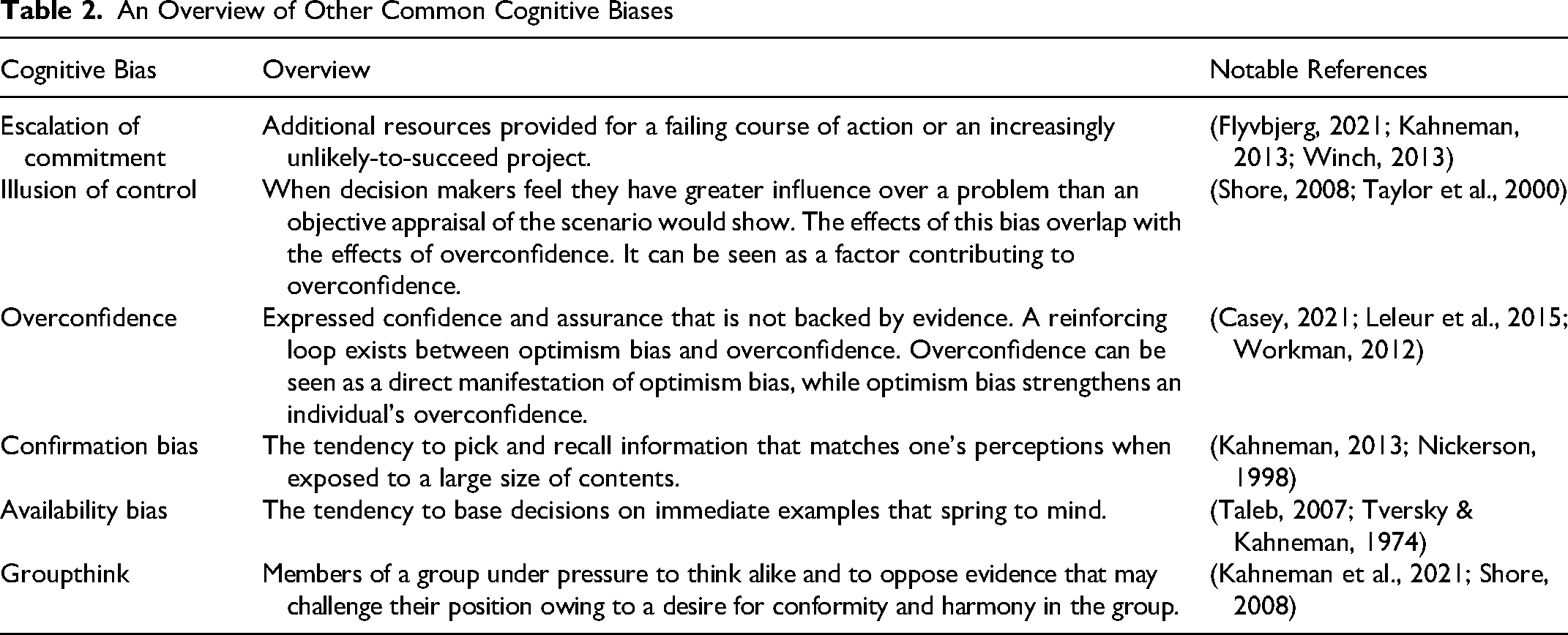
While the escalation of commitment and optimism bias indicate different human tendencies in project management, both suggest incentives to underestimate project costs. Various combinations of cognitive biases could cause a very similar phenomenon. For example, Leleur et al. (2015) introduced overconfidence bias (attributes outlined in Table 2) to the inquiry of overly optimistic cost estimates in transport infrastructure investments. They suggested that “people in general (including experts) are unaware of their lack of capability to indicate a complete range of variation” (Leleur et al., 2015, pp. 368–369). The difficulties in pinpointing “which specific behavioral bias is causing outcomes in a given situation” (Thaler, 2014, as cited in Flyvbjerg, 2021, p. 543), and establishing a clear distinction between cognitive biases were also observed in the wider behavioral decision-making literature (Shore, 2008). A key lesson derived from the findings presented in this section is that it is difficult to pinpoint which bias is at play when decisions are being made in the appraisal of a major infrastructure project. Cognitive biases can be viewed as an integrated part of the systemic risks 4 that drive cost overrun in transport projects (Cantarelli et al., 2010a; BITRE, 2018; Flyvbjerg, 2021; Hollmann, 2021). Future research should pay more attention to the dynamic interplays between optimism bias and other cognitive biases and their synergetic impacts on the cost appraisal of transport infrastructure projects.
Understanding Overly Optimistic Estimation in a Politicized Organizational Environment
In addition to the influences of other cognitive biases, special attention should also be given to considering the impacts of strategic misrepresentation on overly optimistic transport project cost forecasts. Based on the definition described in the review of the causal landscape, Flyvbjerg (2021) considered strategic misrepresentation a political bias. The relationship between strategic misrepresentation and optimism bias has been portrayed as a “complement” (Flyvbjerg 2008, p. 6). This was built on the arguments that both explanations contribute to project cost underestimation and that strategic misrepresentation is more impactful when the political and organizational pressures in project appraisal are higher (Cantarelli et al., 2010a; Flyvbjerg, 2008, Love & Ahiaga-Dagbui, 2018).
Nonetheless, a review of the pertinent literature revealed that the relationship between strategic misrepresentation and optimism bias is potentially more nuanced than the arguments suggest. Assisted by interviews with key players in the Channel fixed link project, Winch (2013) noted that the sustained mutual suspicion between the project’s financiers and construction contractors and the strong persuasions by politicians for continued investment by the financiers were the two factors facilitating “escalation of commitment in the context of strategic misrepresentation of the original business case” (p. 730). In other words, optimism bias may be understood as political bias in the context of large publicly funded infrastructure projects. Arising from the power relations in the development of major capital works, Flyvbjerg (2021) argued that political bias is “the most significant behavioral bias…for big, consequential decisions and projects, which are often subject to high political-organizational pressures” (p. 532). This argument shows that the manifestations of political bias can be described as strategic misrepresentation in a hierarchical organizational environment and that its impact on decision-making is pervasive (Flyvbjerg, 2021).
The above finding implies that scrutinizing the chain of events that leads to project cost underestimation in a complex organizational environment is more effective for ascertaining the presence and nature of a cognitive bias than using deductive methods, such as simple questionnaires, to collect segmented and superficial responses and establish plausible evidence. An inductive inquiry that utilizes contextual sensemaking and narrative analysis can be a more effective approach to appreciating the impact and interaction of optimism bias and strategic misrepresentation. A further review of the research design of the chosen articles found that similar in-depth investigations were adopted by Odeck and Kjerkreit (2019), Hayasaka et al. (2018), and Love et al. (2017). However, the review also observed that Chadee et al. (2021) and Du et al. (2019a) used Likert scale questionnaires to extrapolate the exhibition of optimism bias in project planners. Whereas current researchers in transport cost management are experiencing a shift from technical and engineering-managerial causal explanations to psychological and political explanations, they should priortize a methodological change in the field to elicit more systemic and insightful conclusions.
Mitigations of Cost Underestimation
The selected literature documented several mitigation strategies to address unrealistic optimism in transport project cost estimation. These strategies include disciplined phase gate systems (Hollmann, 2021), expert judgment (Leleur et al., 2015; Love et al., 2016), independent third-party quality assurance review (Klakegg et al., 2016; Miller & Szimba, 2015), and empirical probabilistic estimating tools (mainly used for contingency estimations) that incorporate historical costing data (Flyvbjerg et al., 2016; Fridgeirsson, 2016; Klakegg et al., 2016). One such empirical approach is reference class forecasting (RCF). The RCF’s role of “debiasing forecasts” (Flyvbjerg, 2008, p. 7) is grounded on the assumption that optimism bias is a measure of the extent to which actual project costs and duration exceed those estimated (Mott MacDonald, 2002 5 ; HM Treasury, 2013). Ika et al. (2022) identified that the strategy behind RCF is simplifying complexity, a cost overrun mitigation methodology supported by the Psycho-strategists. This oversimplification of the causality may overlook the conjoint possibilities, the uncertainty in complex project systems, and the highly dynamic interrelationships between the different causal factors (Love et al., 2019a).
From a theoretical perspective, simply applying optimism bias factors to future project cost forecasts may impede advances in project risk management and cost overrun causation theory research. The attribution of cost overruns to a single source (i.e., optimism bias) ignores the evidence that overruns often stem from multiple sources (Cavalieri et al., 2019; Denicol et al., 2020; Love & Ahiaga-Dagbui, 2018; Love et al., 2016). It neglects the complex interaction and nested risks among factors such as scope changes, unforeseen ground conditions, delays, policy changes, or stakeholder resistance (Ahiaga-Dagbui et al., 2017; Denicol et al., 2020; Hollmann, 2021; Gil & Fu, 2021). More importantly, the application of RCF “masks” critical investigations into the cost planning processes that give rise to optimism bias (Love et al., 2012, p. 570). Cost predictability may well be increased with the use of RCF. Still, the underlying conditions, such as personal experiences, organizational structures, and task time frames in a project appraisal team that could lead to over-optimistic predictions, remain unknown (Love et al., 2012; Stingl & Geraldi, 2017).
From a practical perspective, using a linear debiasing strategy reinforces the presumption among project appraisal teams that overall cost predictability at completion triumphs over risk breakdown analysis and contingency management dedicated to efficient cost allocation planning. For instance, the Green Book accepted optimism bias adjustments based on generic values when “an organization’s evidence base for historic levels of optimism bias” in cost estimating is absent (HM Treasury, 2018, p. 30). Such practice leaves little room for cost planning optimizations. As Ahiaga-Dagbui (2019) asserted: The current track record of delivering projects to agreed budgets is rather abysmal. If future estimates are then to be based on distributional information derived from poor practices and estimates from the past, public funds will be wasted through non-competitive and overblown budgets. (p. 4)
Apart from the implications for the suboptimal use of taxpayer money and decreasing accountability for transport project cost estimation and public fund allocation, the notion of pursuing cost predictability over competitiveness and cost-effectiveness and the statistical uplift method introduced by the RCF run the risk of being undermined by project sponsors and estimators’ deliberate decisions in cost planning. As the discussion of political bias has shown, the sponsors and estimators of a project proposal could deliberately lie about the cost estimates to pursue particular agendas or to ease pressure from their organization in the politicized context of a hierarchical project governance team. What is likely to happen is that they will soon learn to reduce the basis for uplift before decisions are made, and the problem the RCF is designed to mitigate will continue or become even worse.
An empirical study of the factors underlying optimistic forecasts is essential for a greater understanding of the causal relationship between optimism bias and transport project cost overrun and for a nuanced appreciation of the systemic nature of overrun causations against a reductionist debiasing methodology (Love et al., 2021; Stingl & Geraldi, 2017). The Behavioural Insights Team (2017) in the United Kingdom argued that the RCF tool is “a ‘fudge factor,’ aiming to correct the budgets but not tackling the root causes of optimism bias or planning fallacy” (p. 14). The goal of cost overrun mitigation in major infrastructure development is cost-effectiveness and value for money, not simply predictability of the outcome. According to Fridgeirsson (2016): There is no urgent need for Icelandic Road Administration (ICERA) to adopt reference class forecasting as its current methodology that is based on time series data seems to work well enough. Projects completed over a five-year period record an average overrun of 6%, which could be considered a moderate indicator of success. The ideal position is to have an average overrun as close to zero as possible. To reach this position, ICERA could add a 5% uplift for optimism bias to all its primary cost plans for road projects, but it is questionable if the effort is worthwhile for such a small reward. (p. 114)
The Behavioural Insights Team (2017) observed that RCF “may result in large contingency reserves being set unnecessarily”, as the tool “does not identify and remove the underlying causes of bias which may exist in some projects but not others” (p. 15). Indeed, the Team (2017) concluded that “it is plausible that any money allocated to the project will be spent, since there is no longer an incentive to remain within the original unadjusted budget. Overall departmental efficiency and value for money may therefore suffer.” (p. 15). The Concept Research Program funded by the Norwegian Ministry of Finance documented in its concept reports that the adoption of a steering frame 6 by transport project sponsors in accordance with the ministry’s scheme for external quality assurance of large investment projects helps to counteract the incentive to spend a project’s contingency reserves and increase the potential for cost savings at completion (Samset & Volden, 2013).
The validation of the nature and impact of optimism bias in transportation infrastructure project evaluation provides a basis for developing an RCF 2.0. It can be achieved by appreciating the possibility that some factors’ effects may depend on others’ presence or absence (Ragin, 2008). In current RCF practice, this may mean supplementing information on the distribution of comparable items in the past with qualitative data on causal parameters.
Conclusions and Future Research
A semistructured review of peer-reviewed journal articles, books, government documents, and industry reports pertinent to optimism bias and transport infrastructure project cost overrun is undertaken in this article. This study critically reviews the extant body of knowledge about optimism bias in the cost appraisal of transport projects and identifies the areas of weakness and future research opportunities. The review shows that the presence and nature of optimism bias in the organizational setting of transport project cost appraisal are largely understudied. The interactions between optimism bias and other cognitive biases and their synergetic impacts on transport project appraisal require further investigation. Further, the effect of optimism bias in the presence of other well-known technical and project factors is also not fully understood. At this stage, it also appears that the relationship between political pressure and optimism bias in the complex institutional environment of the cost appraisal phase of transport projects would benefit from a closer examination. Importantly, a considerable number of studies relied on the comparison of cost at the time of decision-to-build and cost at completion as a proxy to postulate the impacts of optimism bias on transport project cost overrun without delving into the factors and conditions that give effect to the bias in decision-making (e.g., Chadee et al., 2021; Hayasaka et al., 2018; Kutsch et al., 2011). This proxy considerably limits readers’ ability to fully understand the project-specific, as well as the systemic, cost overrun causes and how much optimism bias can be implicated in the causal analysis.
Considering the implications found in relation to the causal relationships between optimism bias and transport infrastructure project cost overrun, it is necessary to pay extra attention to and address the systemic and multiple root causes of cost overrun commonly seen in major infrastructure project deliveries. As an early study to undertake a thorough and systematic review of optimism bias in the context of transport infrastructure appraisal and cost overrun causation, this review observes that the theory of optimism bias as a predominant cause of overrun has continued to gain momentum and is increasingly being incorporated into key infrastructure appraisal policy instruments, but the causal relationship between the two has been taken at face value. Policies safeguarding the cost and social performance of publicly funded infrastructure projects must follow sound and accountable empirical evidence. However, if there are a series of questions and unknowns about a particular phenomenon, great caution must be taken in the absence of empirical evidence.
The study contributes to the ongoing debate that a system view is necessary to make meaningful gains in the continuous improvement of major infrastructure projects’ cost overrun mitigating strategies and the development of more realistic prognoses about project outcomes. Future research agendas grounded on optimism bias and infrastructure project cost underestimation could include the following questions:
Firstly: How should we examine and verify the presence, nature, and impact of optimism bias in the organizational setting of transport project cost appraisals? This question is an extension of the questions raised in the discussion about the nuances of the presence, nature, and impact of optimism bias in a complex organizational setting. It goes to the heart of the challenge of choosing a research design sufficient to gather compelling evidence of group-level optimism bias in projects. An extension to the first question could be: What innovative methods could be used to identify the factors and conditions underlying optimism bias in project cost appraisals? This literature review has highlighted the need to consider inductive research methods in lieu of traditional deductive methods, such as standard surveys, to contextualize the complex chain of events in the project cost estimating decision process.
Secondly: What are the deep-level connections between political influence, optimism bias, and other cognitive biases in project governance? The indication that optimism bias may be understood as political bias in publicly funded major infrastructure projects requires empirical verification by future research. Reconstructing a transport project’s appraisal process using empirical data to trace the potential political influences that trigger decision makers to produce unrealistically optimistic prognoses about project cost, duration, and user benefits may help to uncover the deep-level connections.
Furthermore: How can the causal study of infrastructure project cost overruns be enhanced beyond the ongoing debate between the two schools of thought? This question essentially dissects the assumptions made to assert the root causes of the problem. Assumptions about the underlying theoretical basis that guides the research design and the reference points for cost performance measurements and ex-post analysis will need to be clarified in investigating the question. Future research may facilitate a systemic integration of the two schools of thought to strengthen the understanding of the complex and multifaceted nature of decision-making in infrastructure project estimation.
Accordingly, a final question in the research agenda is: How can we develop a new conceptual framework that adequately addresses behavioral biases in project decision-making and maps the systemic and multiple root causes of the cost overrun issue? The frameworks should consider the theoretical and practical critiques surrounding the current use of the reference class forecasting tool and lay the foundation for exploring more reliable cost assessment tools that incorporate the outside view.
Footnotes
Declaration of Conflicting Interests
The author(s) declared no potential conflicts of interest with respect to the research, authorship, and/or publication of this article.
Funding
The author(s) received no financial support for the research, authorship, and/or publication of this article.

Notes
Author Biographies
An Overview of the Bibliographical Information and Key Findings of the Selected Literature
| Bibliographical Information | Location | Design/Analytic Approach | Overview of the Key Findings Informing the Present Study |
|---|---|---|---|
| (Cantarelli et al., 2010a) European Journal of Transport and Infrastructure Research |
Not specified | Literature review |
The potential roles of behavioral biases and political pressures in transport project cost appraisal |
| (Chadee et al., 2021) Emerging Science Journal |
Trinidad and Tobago | Surveys in a controlled environment | The level of optimism bias among project participants and the influential factors leading to optimistic cost and schedule estimates; and an overview of causal explanations considered the two schools of thought |
| (Du et al., 2019a) Construction Management and Economics |
United States | Surveys in a controlled environment | The impact of human communication networks on the overly optimistic group decisions in infrastructure projects |
| (Du et al., 2019b) Engineering, Construction and Architectural Management |
China | Surveys in a controlled environment | The impact of the different levels of explicit information presentation on the extant of estimators’ optimism bias in infrastructure project cost estimating |
| (Flyvbjerg, 2008) European Planning Studies |
United Kingdom | Case study and ex-post analysis | The theoretical and methodological foundations for reference class forecasting; and an early application of the reference class forecasting (RCF) strategy to the cost estimation of the Edinburgh Tram project |
| (Flyvbjerg, 2021) Project Management Journal® |
Not specified | Literature review | The definitions and the impacts of (1) strategic misrepresentation, (2) optimism bias, (3) uniqueness bias, (4) the planning fallacy, (5) overconfidence bias, (6) hindsight bias, (7) availability bias, (8) the base rate fallacy, (9) anchoring, and (10) escalation of commitment in the context of transport project management |
| (Flyvbjerg et al., 2016) Proceedings of the Institution of Civil Engineers |
Hong Kong (China) |
Case study and ex-post analysis | Evaluations of the potential of cost overrun reduction by debiasing early cost and schedule forecasts for roadwork projects |
| (Fridgeirsson, 2016) Transport Problems |
Iceland | Case study and ex-post analysis | The (in)efficacy of using reference class forecasting in the planning phase to improve the accuracy of transport project cost forecasts |
| (Hayasaka et al., 2018) Journal of Transport Research |
Japan, United Kingdom, and United States |
Case study and ex-post analysis | Direct comparisons of the quantitative impacts of optimism bias on the forecasts of costs and benefits for the automated guideway transit (AGT) systems in Japan, US toll road projects and the UK rail projects |
| (Kelly et al., 2015) Transport Policy |
Spain, Poland, Portugal, Greece, Ireland, Lithuania, Slovakia, and Hungary |
Case study and ex-post analysis | The quantitative pattern of the issue of overly optimistic cost-benefit forecasts in 10 large transport projects over eight European nations that had benefited from EU Cohesion and the Instrument for Structural Policies for Pre-Accession (ISPA) funding |
| (Klakegg et al., 2016) International Journal of Project Management |
United Kingdom, Norway, and the Netherlands |
Literature review (with reference to governance frameworks used in transport projects) |
Summaries of the risks of optimism bias and strategic misrepresentation and the need for flexible governance structures (Miller & Lessard, 2001) in public projects |
| (Leleur et al., 2015) European Journal of Transport and Infrastructure Research |
Greenland | Ex-ante analysis of case study and controlled trial | The theoretical basis and potential application of a new cost overrun mitigation tool for transport projects that makes flexible use of reference class forecasting (RCF) and expert judgments (EJ), which offer support for strategic transport decision-making based on external socioeconomic analysis |
| (Love et al., 2016) Transportation Research Part A |
Not specified | Literature review | The arguments for understanding the interdependency of the causal explanations proposed by the two schools of thought and the rationale for using a pluralistic probabilistic approach to cost overrun causation |
| (Love et al., 2017) Transportation Research Part A |
United States | Case study and ex-post analysis | The arguments presented for transport cost overrun research to move beyond focusing on strategic misrepresentation and optimism bias; and the concept of cost overrun and cost underestimation |
| (Love et al., 2019a) Transportation Research Part A |
Hong Kong (China) |
Case study and ex-post analysis | The arguments presented for transport cost overrun research to move beyond focusing on strategic misrepresentation and optimism bias |
| (Love et al., 2021) IEEE Transactions on Engineering Management |
Not specified | Literature review | The potential limitations and research gaps of the Psycho-strategic theory; and the implications of the different choices of the reference points for calculating cost overruns |
| (Miller & Szimba, 2015) Research in Transportation Economics |
The European Union (EU), Australia, Canada, France, Denmark, Germany, Spain (Junta of Andalusia), Switzerland, and the State of Washington (United States) |
Literature review (with reference to extensive transport project cost data) |
The information about the various approaches used during the appraisal stage of a transport project to address the risk of cost underestimation and overly optimistic forecasts. |
| (Odeck & Kjerkreit, 2019) Transportation Research Part A |
Norway | Case study and ex-post analysis | The potential impacts of optimism bias on the accuracy of benefit-cost analysis (BCA) forecasts in the Norwegian road projects |
| (Salling & Leleur, 2017) Transport |
Sweden | Ex-ante analysis of case study and controlled trial | The theoretical basis and potential application of reference scenario forecasting which combines the RCF and quantitative risk analysis with scenario forecasting, where the different scenarios are specified in an operational way by using triple estimates |
| (Siemiatycki, 2009) Journal of Planning Education and Research |
Not specified | Literature review (including extensive industrial texts) | The comparison of the narratives and findings between the academic and auditor studies concerning transport project cost overrun |
| (Winch, 2013) International Journal of Project Management |
United Kingdom and France |
Case study and ex-post analysis | The contextualization of strategic misrepresentation and optimism bias in transport project appraisals by developing an organizational perspective on the escalation of cost and schedule; and the implied connections between political bias and strategic misrepresentation |
| (Mott MacDonald, 2002) Mott MacDonald |
Not specified | Recommendations (supported by literature review) | The recommendations provided for infrastructure works to evaluate and reduce excessive optimism in project estimation during appraisals |
| (Terrill et al., 2020) Grattan Institute |
Australia | Case study and ex-post analysis | The scales and causes of transport infrastructure project cost overruns identified and highlighted by an independent think tank in Australia |
| (Oxford Global Projects, 2021) Department for Transport |
United Kingdom | Guidelines | The recommended practice for using the RCF tool in transport project cost estimation; and the recent methodological developments in RCF |
| (The Behavioural Insights Team, 2017) Behavioural Insights Team |
Not specified | Recommendations (supported by literature review) | The discussion on the effectiveness of the RCF tool for improving the cost performance of transport projects |
| (HM Treasury, 2013) The National Archives |
United Kingdom | Guidelines | The operational details on the use of the RCF tool in early transport project cost estimation |
| (HM Treasury, 2018) The National Archives |
The UK | Guidelines | The official guidelines for applying the RCF tool in the preparations of the business cases for infrastructure projects |
| (Ahiaga-Dagbui, 2019) The Government’s Management of Major Projects Inquiry, Public Administration, and Constitutional Affairs Committee |
Edinburgh (United Kingdom) |
Recommendations | The discussion on the practicality and effectiveness of the RCF tool for improving the cost performance of transport projects |
| (Hollmann, 2021) Association for the Advancement of Cost Engineering (AACE) International Technical Paper |
United States | Case study and ex-post analysis | The discussion on the effectiveness of the RCF tool for improving the cost performance of transport projects. The AACE International’s recommended practices that advocate the use of empirically based, risk-driven parametric modelling to quantify systemic risks and allocate appropriate levels of contingency; and the different definitions of transport project cost overrun |
| (Allport, 2011) Institution of Civil Engineers |
Not specified | Case study and ex-post analysis | The use of optimism bias factors to forecasts, and a range of measures that enforce accountability on private and public sector participants in the context of transport infrastructure project planning; and the argument associated with the claim that applying optimism bias factors to forecasts does not identify the underlying issues facing major projects, including transport infrastructure projects |
| (Berechman, 2018) Cham, Switzerland: Springer International Publishing |
Not specified | Case study and ex-post analysis | The normative organizational structures and processes of transport project appraisals; and the contextualization of the institutional environments in which optimism bias could derive and influence transport project investment decision-making |
| (Crudgington, 2020) Institution of Civil Engineers (ICE) Systems Report |
United States, Australia, United Kingdom, and Hong Kong (China) |
Recommendations | The importance of using systems thinking to develop contextual awareness and narrative analysis of the early project decision-making process; and the importance of dedicating effort and time to the front-end of project development to minimize the risk of cost escalation and identifying the underlying sources of project risks |
| (Infrastructure Australia, 2021) Guide to economic appraisal: Technical guide of the Assessment Framework |
Australia | Guidelines and recommendations | A reference to an external quality assurance strategy for major infrastructure investments’ appraisals in Australia; and guidance on the implementation of the Infrastructure Australia Assessment Framework |
| (Bureau of Infrastructure Transport and Regional Economics (BITRE), 2014) Overview of project appraisal for land transport |
Australia | Ex-post analysis | The concepts of systematic risk and infrastructure investment portfolio in the context of transport project cost and benefit appraisals |
| (Bureau of Infrastructure Transport and Regional Economics (BITRE), 2018) Ex-post economic evaluation of national road investment projects |
Australia | Case study and ex-post analysis | The common procedures of using cost-benefit analysis (CBA) to appraise transport infrastructure investment projects in Australia; and suggestions on the room for improvement in the quality of practical Australian road CBAs |
| (Samset; & Volden, 2013) Investing for impact: Lessons with the Norwegian State Project Model and the first investment projects that have been subjected to external quality assurance [Concept report no. 36 for Concept Research Program] |
Norway | Case study | A reference to an external quality assurance strategy for major infrastructure investments’ appraisals in Norway (i.e., the State Project Model, also known as the Ministry of Finance’s scheme for external quality assurance of large investment projects); and the strategy of using P50 and P85 probability-based cost estimates to outline project uncertainty and manage the incentives to use contingency reserves |
| (Welde, 2017) Cost performance in large government investment projects that have been subjected to external quality assurance [Concept report no. 51 for Concept Research Program] |
Norway | Case study and ex-post analysis | An outline of the extent of the issue of cost overrun for Norwegian transport projects and effectiveness of the State Project Model in mitigating cost overrun; additional evidence of the impacts of scope changes, rework, and contract omissions on transport project cost overrun; and room for improvement concerning transport project cost estimates in the Norwegian context includes more comprehensive estimates of systematic uncertainty in transport projects, and better identifications of the opportunities for cost savings by project governance and management teams |