




Abstract
The concept of “Agile Project Management” has gained significant traction in various sectors, beyond its origins in software development. However, a coherent, universally accepted definition remains elusive, prompting this study to embark on a systematic exploration of agile practices and their implications in broader contexts. Employing a systematic literature review across three major academic databases on business and management studies in the past two decades, this research scrutinizes a final selection of 80 high-quality academic papers. The principal contribution of our research is the articulation of a nuanced definition of Agile Project Management, which demarcates it from traditional project management frameworks and those agile practices specific to software development. This study not only sheds light on the prevailing ambiguities in the understanding of Agile Project Management but also sets the stage for future research into the emerging organizational dynamics engendered by the adoption of agile practices.
Introduction
Background: From Agile Software Development to Agile Project Management
“The last two decades have seen the rise of agile approaches to projects” (PMI, 2022, p. 1), which has “introduced radical changes” (Bianchi et al., 2022b). Both the project management academic and professional communities have become interested in the application of agile (Baxter, 2021; Bergmann & Karwowski, 2018; Ceylan, 2020; Cram & Newell, 2016; Dong et al., 2022; Noteboom et al., 2021). Since 2009, agile has been the preferred approach in software development (Cañete-Valdeón, 2013; Schwaber, 2010; Smith, 2008). The rise in the popularity of agile in project management can be attributed to the widespread adoption of the values and principles for managing software development set out in the Agile Manifesto (Drury-Grogan et al., 2017; Leybourne, 2009; Stacey et al., 2008), alongside the increasing utilization of digital technologies in the modern workplace (Appio et al., 2021; Bianchi, et al., 2022b; Lanzolla et al., 2020).
The propagation of agile practices has been institutionalized through mandates by the U.K. government and recommendations by the U.S. government, signifying a paradigm shift in project management approaches (Agile Delivery Community, 2016; U.S. Government Accountability Office, 2020) and widely adopted in both public and private sectors beyond software contexts (Baxter et al., 2023a; Dong et al., 2022). This includes construction (Arefazar et al., 2019), manufacturing (Edwards et al., 2019; Denning, 2020), banking and financial services (Hoffmann et al., 2020; Thomas, 2020), accounting (Volodymyr, et al., 2020), energy (Terrani, 2020), education (Rush & Connolly, 2020), and governments (Baxter et al., 2023a; Greve et al., 2020; Mergel et al., 2020). Agile projects are increasingly employed for new product development (Baxter & Turner, 2021; Kettunen & Lejeune, 2020; Salvato & Laplume, 2020; Zuzek et al., 2020) and portfolio management (Cooper & Sommer, 2020; Stettina & Horz, 2015). The application of agile in project management has been linked to a range of benefits, including improved teamwork, enhanced customer collaboration, increased efficiency (Bhat & Nagappan, 2006; Tarhan & Yilmaz, 2014), and heightened stakeholder satisfaction in projects beyond the realm of software development (Conforto et al., 2014; Lill et al., 2020; Serrador & Pinto 2015; Zavyalova et al., 2020).
For a definition of what agile is, software teams can refer to the values and principles of the Agile Manifesto (Beck et al., 2001). While that may be fine for one team, it does not present a complete solution for large organizations or for large projects and/or different project types. Some of the responses to this problem (agile at scale) include the Scaled Agile Framework (SAFe®, see https://scaledagileframework.com/). However, SAFe® does not fully cover “projects” (team, program, and portfolio), and it is apparently (given terms like “release train”) also optimized for software development. Additionally, software development can be managed using continuous delivery, and hence the arrival of DevOps (see https://devops.com/the-origins-of-devops-whats-in-a-name/), as a more formal way not only to manage continuous delivery at scale, but also to integrate development and operations. However, this cannot quite apply to hardware product development. Research has identified that agile projects are four times more likely to achieve success and one-third less likely to incur failure than projects following traditional waterfall approaches (Serrador & Pinto, 2015; Standish Group, 2015, as cited in Mergel et al., 2020). However, there remains ambiguity around what agile is in the project management profession and research (Dong et al., 2022). There is a pressing need to clearly define “Agile Project Management,” which is currently without a suitable theoretical foundation, as a response to the increasing use of agile practices in software development, but more specifically beyond software project contexts. Agile practices are open, people centered, and process light.
Rationale and Research Objectives
Agile is principally circumscribed within the domain of software development, outlining four values that underscore the significance of individuals and interactions, the delivery of functional software, customer collaboration, and a broader commitment to adaptability in the face of change (Beck et al., 2001). While agile practices have achieved widespread endorsement in numerous sectors (Rigby et al., 2016), the scholarly landscape reveals a substantial body of research accentuating the beneficial outcomes of applying agile practices (Augner & Schermuly, 2023). Despite this, a consensus on a definitive interpretation of Agile Project Management remains elusive, with research predominantly confined to the realm of software development (Karlström & Runeson, 2006; Petersen & Wohlin, 2009). The current literature predominantly adopts an empirical perspective, concentrating on the pragmatic ramifications of agile implementation. This has resulted in a paucity of theoretical exploration or a clear, universally accepted description of Agile Project Management (Baxter, 2021; Baxter et al., 2023a; Hron & Obwegeser, 2022). Although the application of agile practices is advocated in various project domains beyond software development (e.g., Smith, 2008), there persists a discernible gap and ongoing challenges in comprehensively understanding and interpreting agile within the broader context of project management. The wider need to incorporate the agile approach in (larger) projects, especially beyond software development contexts, highlights the necessity of understanding what Agile Project Management is or could be.
Recent research points out the pressing need to further review agile from the perspectives of project management organization and wider institutional contexts to address potential challenges and realize its benefits (Baxter et al., 2023a; Hansen & Svejvig, 2023; Mergel, 2023). According to the Project Management Institute (PMI, 2023), “A project is a series of structured tasks, activities, and deliverables that are carefully executed to achieve a desired outcome,” and “Each aspect of a project must go through the phases of the project life cycle before reaching an end goal. This life cycle allows project managers to execute each phase of their project effectively. It enables them to plan each task and activity meticulously, ensuring the highest chances of a project’s success.” Therefore, Agile Project Management requires “a systematic approach” to apply its flexibility (Augner & Schermuly, 2023) and productivity (Hofman et al., 2023). The misalignment between project management and the Agile Manifesto now coexists with the widespread adoption of agile in project management (Dong et al., 2022). The fragmented body of literature and confusion in practice call for further investigation and examination.
In this article, we employ a systematic literature review in the business and management domain in an attempt to resolve the current tension between project management as a discipline (emphasizing processes, tools, and planning), and the values and principles set out in the Agile Manifesto (emphasizing customer satisfaction and collaboration). As Lechler and Yang (2017) point out, there is a lack of theoretical foundation in the current literature. We posit that Agile Project Management extends beyond being merely a software development method (Baxter, 2021). While agile practices are applicable to software development, the Agile Manifesto is not readily suitable for Agile Project Management; this requires a more detailed definition and theoretical foundation. Our aim is to provide the project management community with a comprehensive definition of Agile Project Management to enable future research and practice. The core research question: “What is Agile Project Management?” is answered with the following objectives: (1) Examine the empirical context of agile in project management, including methods and tools, effects, and organizational challenges. (2) Systematically examine current definitions of Agile Project Management. (3) Highlight the most crucial avenues for future research.
In pursuit of these objectives, our article adds a distinctive dimension to the ongoing discourse. It provides a comprehensive and context-specific definition that sets Agile Project Management apart, not only from traditional project management approaches, but also from agile software development. This differentiation is achieved through a detailed analysis of 80 selected academic journal publications. Additionally, we develop a research agenda tailored for researchers and practitioners navigating the application of agile projects in diverse industries, with a specific emphasis on intricate, large-scale projects extending beyond the confines of software development.
Review Method
Phase 1: Mapping Review
The systematic literature review approach is widely accepted as a robust method within the management domain for generating reliable and balanced research synthesis (Baxter et al., 2023b; Denyer & Tranfield, 2006; Taroun, 2014; Tranfield et al., 2004). This approach initially gained credence in observational sciences, such as medical science, to analyze and compare statistical data, but has since evolved to encompass a wider range of disciplines, including project management (Geraldi et al., 2011; Maylor & Turner, 2017). It provides a more rigorous and transparent process, reducing the risk of author bias compared to alternative methods such as narrative review methods (Tranfield et al., 2003), and has been increasingly adopted by Project Management Journal® (PMJ) to build on current knowledge and enlighten future research (Alzoubi, et al., 2023; Chbaly & Brunet, 2023; Hansen et al., 2023; Wang et al., 2022). We follow the six-phase approach (Jesson et al., 2012; Wang et al., 2022), as illustrated in Figure 1.

Systematic literature review process (adapted from Wang et al., 2022).
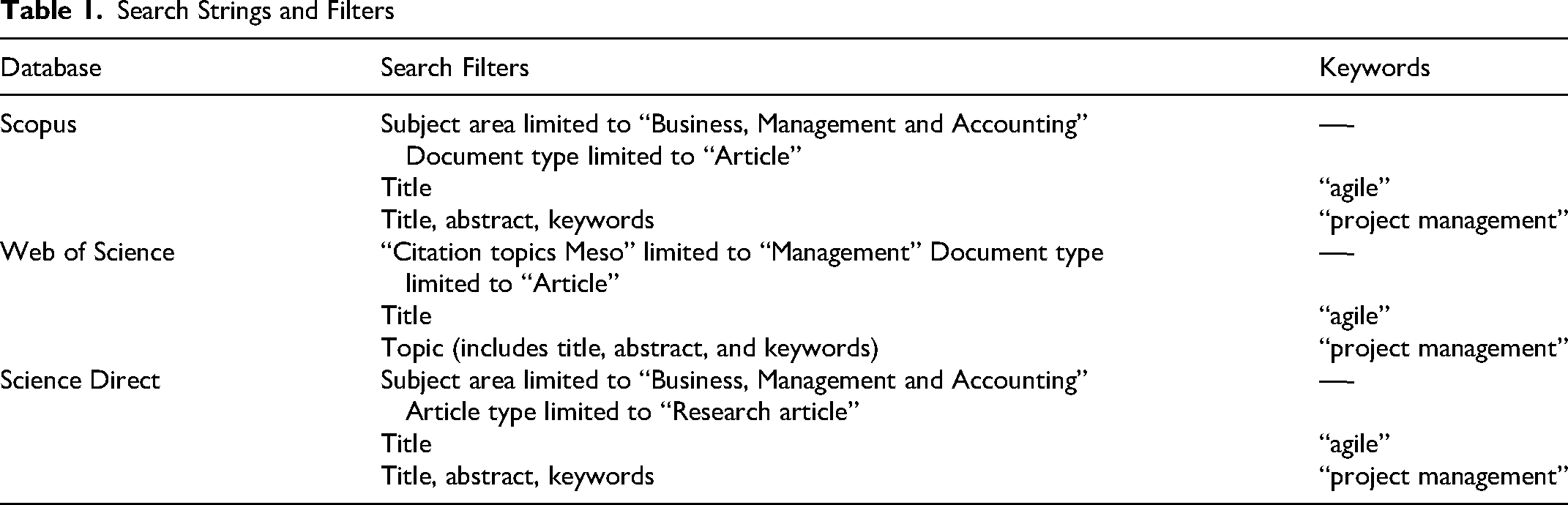
In Phase 1, a scoping literature review was conducted following the traditional literature review approach. This maps out the background of the study and provides an initial understanding of Agile Project Management and major current debates around the topic to steer this systematic literature review. Keywords and filters were developed in this phase. The search string are displayed in Table 1.
Search Strings and Filters
Phase 2: A Comprehensive Search
The methodology of this search process was informed by previous systematic reviews of agile (Campanelli & Parreiras, 2015; Dyba & Dingsøyr, 2008; Hoda et al., 2017; Hron & Obwegeser, 2022; Lappi et al., 2018). The systematic literature review was carried out in September 2022, following a process designed to identify academic literature pertaining to Agile Project Management. To ensure the widest possible inclusion of relevant academic articles, three major databases were included: Scopus (www.scopus.com, whose database archives publications from 1966 onwards; see also Burnham, 2006), Web of Science (www.webofknowledge.com), and Science Direct (www.sciencedirect.com). Specialty journals including Project Management Journal®, International Journal of Managing Projects in Business, and International Journal of Project Management are all indexed in the “management” category of the Social Sciences Citation index (https://jcr.clarivate.com/jcr/browse-journals), and so, in order to select content developed within the project management discipline we applied “management” as a topic filter. The search also adopted a start date of 2001 onward, the year in which the Agile Manifesto was published. The search terms were defined as follows: the term “agile” must appear in the title, and “project management” must appear in the title, keywords, or abstract of the article. Upon eliminating duplicates, 426 unique articles were identified across the three databases.
Phases 3 and 4: Quality Assessment and Data Extraction
These two phases were conducted with iterations. In order to screen out low-quality or less-relevant content, we required the journal to be included in the Chartered ABS (CABS) Journal Guide’s AJG list 2018 (Wang et al., 2022). The subsequent step entailed a preliminary examination of the titles and abstracts, employing a defined set of criteria for inclusion and exclusion. These criteria underwent continuous refinement throughout the course of the review. The final iteration of these criteria, along with the number of articles that remained after each iteration, is presented in Figure 2. A thorough cross-referencing of the articles was conducted to affirm their relevance and quality to the research topic. Through the analysis of titles and abstracts (Okoli, 2015), articles that were explicitly centered on computer science (e.g., those discussing software programming and algorithms) were eliminated, while articles with a more managerial focus within software contexts were retained for further evaluation.
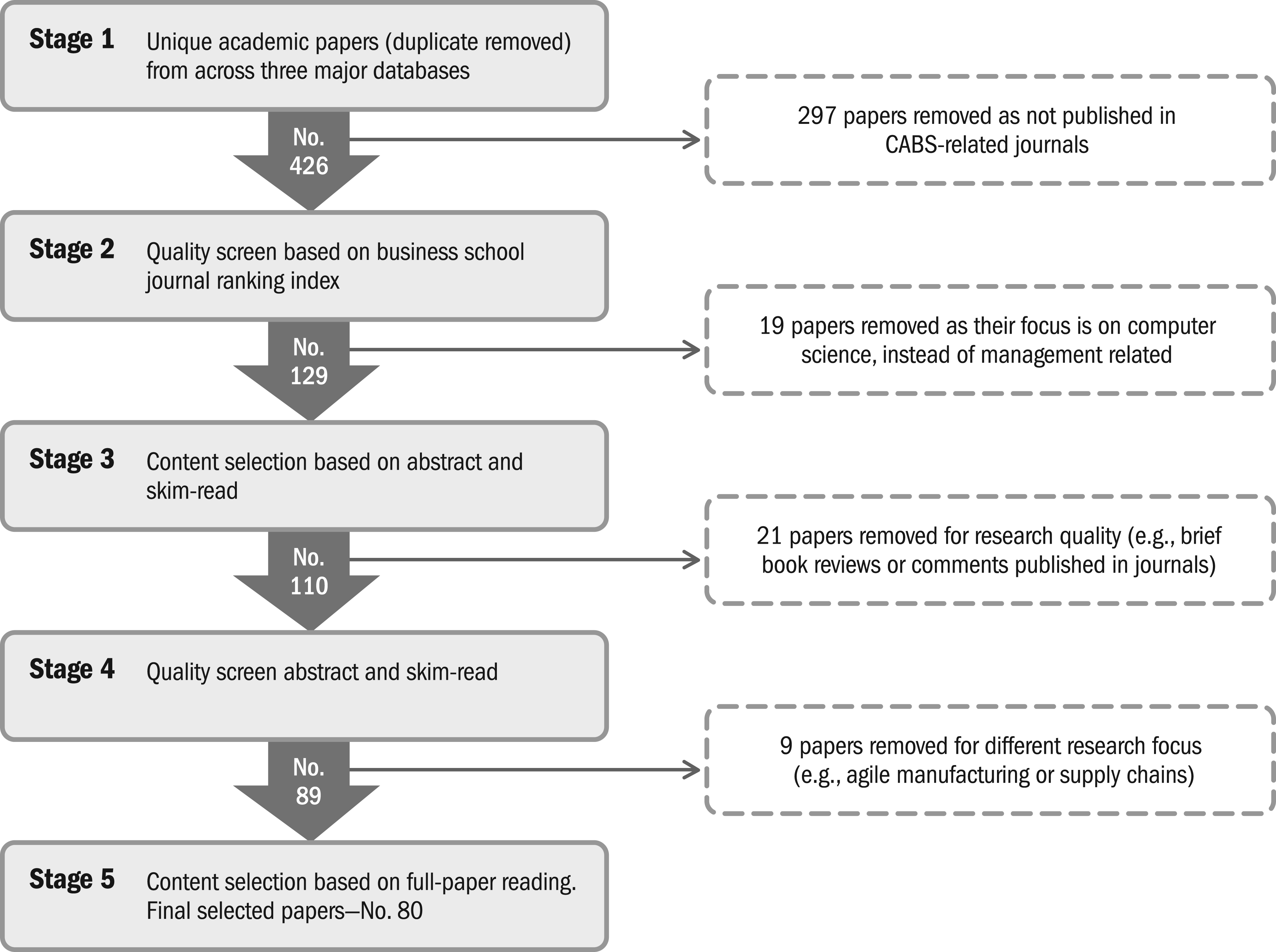
Article selection process.
Phases 5 and 6: Data Synthesis and Write-Up
This paper takes a qualitative approach due to the nature of our research aim. 1 We undertook a rigorous evaluation of the full texts of the final 80 articles, adhering to the research objectives. The review was executed in three stages, each serving a specific purpose. During the first stage, a preliminary examination was conducted to synthesize concise summaries for each article and extract essential information, including the methodologies employed and the contextual sector/industry. This comprehensive mapping of the literature enabled the authors to attain a high-level perspective. The second stage entailed a more in-depth examination, where the literature went through thematic analysis. Themes that emerged were subject to a critical review and gaps were identified. These included existing definitions, descriptions, and impacts around the adoption of agile in project management (including both benefits and potential challenges).
In the third stage, we synthesized and developed insights, which were structured and presented as thematic findings and discussions (Tuckett, 2014; Williams & Moser, 2019). Engaging with the ongoing discourse on Agile Project Management, we also considered additional literature, as well as current and emergent practitioner reports, to increase the validity and practical relevance of the research. To enhance the strength and reliability of the findings, we convened a consultation panel of renowned project experts from industry with rich expertise in both agile practices and project management. The panel participated in synchronous discussions of the initial results of the systematic literature review, working out the practical meaning of the literature. All participating experts in the consultation panel were anonymized for the purpose of this article. The results of the final phase, write-up and diffusion resides in this paper.
Thematic Findings
Agile Practices
The Agile Manifesto lists a set of principles, but they do not include methods, knowledge, skills, or tools (see Beck et al., 2001). However, our systematic review reveals a large collection of agile practices and tools being devised and adopted, primarily in software projects. These span a wide range of tools, techniques, and approaches, and are often referred to as strategies, frameworks, or standards (Fernandez & Fernandez, 2008; Aldave et al., 2019). Among the various agile practices documented in the extant literature, Scrum is the most widely discussed, followed by other software development approaches such as Extreme Programming (XP) and Crystal. The examination of the existing literature also highlights the scarcity of comprehensive efforts to establish a taxonomy of agile practices in the domain of project management. While some introductory references to the terminologies are offered across several articles, the methods are primarily contextualized as the subject of the studies. Despite this, there are a few attempts to methodically categorize agile practices. For example, Fernandez and Fernandez (2008) contrast linear management strategies with agile strategies, which are characterized as incremental, iterative, adaptive, and extreme. They posit that the latter type of strategy has the advantage of being responsive and adaptable, thereby enabling more effective management of complex and uncertain circumstances (Rane et al., 2020; Zavyalova et al., 2020). Vidoni et al. (2021) suggest that the size of project teams and projects could be a useful categorization criterion for agile practices with some methods, such as XP and Crystal, being more appropriate for smaller projects and project teams (i.e., “code-focused”). Other methods, such as Scrum, are more suitable for mid- to large-sized projects (i.e., “project-focused”) where planning and operation at the organizational or global level are required.
There has also been a proliferation of “hybrid” approaches that blend traditional and agile practices (Bianchi et al., 2020; Brock et al., 2020; Conforto & Amaral, 2016; Cooper, 2017; Lappi et al., 2018; Leybourne, 2009; Niederma et al., 2018; Zuzek et al., 2020). In many cases, these hybrid approaches encompass a broad range of industries beyond software development. The hybrid models are perceived as a means of balancing the benefits of flexibility, adaptability, and responsiveness with the more structured decision-making processes of traditional methods (Conforto & Amaral, 2016; Cooper, 2017; Lappi et al., 2018). However, research on the effects of hybrid models is limited, with one empirical study suggesting that their impact may vary depending on how they are combined (Bianchi et al., 2020). Hybrid models may serve as an initial step by supporting the use of team-level agile practices within established project management frameworks.
The Empirical Context: Project Types Where Agile Is Used
For many, agile is commonly associated with software contexts, and this is further emphasized by its presence in recent academic studies and practitioner reports, which largely focus on software development (Conforto et al., 2014; Lappi et al., 2018). The majority of research output is associated with the notion that agile predominantly acts as a “lightweight process underpinned by short iterative cycles” (Patanakul & Rufo-McCarron, 2018, p. 181). In this systematic literature review, we excluded publications purely concerning software techniques or technologies during the screening stage. Notwithstanding, approximately three-quarters of the remaining documents still address software-related projects. This is unsurprising, as the Agile Manifesto has its foundations in software engineering. Google Trends (https://trends.google.com/trends/explore?date = all&q = agile,%2Fm%2F02zhbn,scrum,extreme%20programming,kanban) also supports this assessment with a clear link between the search term “agile” and the topic “agile software development.”
Nevertheless we highlighted that agile practices gained broader acceptance in project management, extending beyond a singular emphasis on software techniques and technologies, as previously mentioned. The increasing uptake is evident in the academic literature in sectors such as government and public administration (Greve et al., 2020; Mergel et al., 2020), construction (Arefazar et al., 2019), research and education (Anderson & Lewis, 2019; Macheridis, 2018; Vidoni et al., 2020), manufacturing and retail (Edwards et al., 2019), aerospace (Alam & Toppur, 2019), and other industries—such as healthcare, entertainment, and telecommunications—as an important approach (Fernandez & Fernandez, 2008; Hansson et al., 2006; McDowell & Drechsler, 2018; Rola et al., 2016; Serrador & Pinto, 2015). The application of agile principles has also been observed in small- and medium-sized enterprises, public sector entities, and nonprofit organizations (Baham et al., 2017; Ju et al., 2019; Lappi & Aaltonen, 2017; Wen et al., 2020). Additionally, Baham et al. (2017) posit that agile practices have the potential to aid in disaster recovery, particularly in the aftermath of significant disruptions such as those experienced during the COVID-19 pandemic in 2021 and 2022. Despite this increasing trend in practical adoption, the corresponding academic literature appears to lag in its consideration of Agile Project Management as a topic. However, an emergent interest in this domain can be deduced from an analysis of Google Trends data, which demonstrates that by 2011, the term “Agile Project Management” received more searches than “agile software development” (Hoda et al., 2016; Stettina & Horz, 2015), further indicating a growing interest in the wider application of agile principles beyond software development.
The Effects of Agile on Project Outcomes
The adoption of agile can be traced back to various factors (Conforto et al., 2014; Tripp & Armstrong, 2018). For example, benefits gained by using agile practices in software projects include improvements in software quality, reduction in the delivery times of working software, enhanced collaboration with customers, and a more responsive approach to defects (Aldave et al., 2019; Azanha et al., 2017; Maruping et al., 2009; Maruping & Matook, 2020; Stettina & Horz, 2015; Thorgren & Caiman, 2019). Some studies on agile software development have also revealed significantly improved project success rates, including the achievement of project deliverables within established time and cost constraints (Tam et al., 2020; Chow & Cao, 2008). In the broader project management sphere, the adoption of agile has also been found to result in a multitude of benefits, including improved feedback and learning, increased team trust and cooperation, empowerment of individuals, improved customer collaboration and communication, innovative leadership, increased resilience, heightened delivery quality, and cost reduction (Conforto et al., 2014; Maruping et al., 2009; Mchugh et al., 2011; Mergel et al., 2020; Recker et al., 2017; Serrador & Pinto 2015; Shrivastava & Rathod, 2019; Tam et al., 2020; Wen et al., 2020).
Agile Project Management has also been shown to result in significant changes in the control mechanisms and responsibilities of project teams (Mahadevan et al., 2015; Maruping et al., 2009; Taylor, 2016), although some research suggests that teamwork quality and performance are only slightly superior to those of traditional projects (Lindsjorn et al., 2016). These agile practices have been linked to improved motivation and staff satisfaction (Azanha et al., 2017; McHugh et al., 2011), as well as improved effective decision-making (Drury et al., 2012; Drury-Grogan et al., 2017), coordination (Azanha et al., 2017; Thorgren & Caiman, 2019), and formal and informal communication (González-Cruz et al., 2020; Thorgren & Caiman, 2019). This was brought to light, especially, during the widespread adoption of remote work brought about by the COVID-19 pandemic and enabled by recent advancements in communication technologies (Brynjolfsson et al., 2020; Savic, 2020; Watson et al., 2021).
Leybourne (2009) posits that agile practices can enhance creativity, adaptability, innovation, and learning, while Ju et al. (2019) and Lill et al. (2020) found that Agile Project Management has a positive correlation with innovation project outcomes and innovation capabilities. The agile approach can also improve employee empowerment and autonomy, thereby elevating project success (Kaufmann et al., 2020). Lee and Xia (2010) also suggest that the efficacy of agile project teams can be attributed to their autonomy and diversity. Vidoni et al. (2021) highlight that the underlying principles of agile can accommodate the demands of complex projects, with the ability to adapt to change and establish shorter delivery deadlines, potentially resulting in more expedient investment returns.
In the context of global software development, Akbar et al. (2020) and McAvoy and Butler (2009) have accentuated the pivotal role played by the capability of project managers in the success of agile projects. It is suggested that project managers need to function as a medium between their team members and their broader organizations, as well as with stakeholders, to ensure that agile principles and practices are widely understood (Arefazar et al., 2019; Hobbs & Petit, 2017; Nkukwana & Terblanche, 2017; Taylor, 2016). In a systematic review, Lappi et al. (2018, p. 54) conclude that “the performance and the success of agile projects are best supported by practices that give project teams the freedom, authority, and capability to produce tangible value to and with the customer.” In other words, Agile Project Management must be market oriented (Kurniawan et al., 2020). Managers’ allocation of authority and responsibility to agile team members becomes more pronounced when the latter are more self-organized and invested in active project engagement and idea generation (Lies, 2020; Thorgren & Caiman, 2019). Conforto and Amaral (2016) suggest that a project team’s proactive involvement in the management decision-making process is essential.
The implementation of agile projects requires an active approach to manage divergent goals (Hoffmann et al., 2020; Zasa et al., 2021). The complexity of interaction within an agile project among project individuals, teams, and tasks, poses further challenges as noted by Hoda and Murugesan (2016) and Zasa et al. (2021). These challenges can lead to negative outcomes. Thorgren and Caiman (2019) also caution that in cases where there are incongruities between workplace cultures and agile values and principles, the adoption of agile practices may entail an increased workload and time investment. Additionally, despite the heightened project success rate in comparison to traditional project management approaches, the application of agile practices does not guarantee the realization of project success or improvement, and indeed there are a variety of project outcomes (positive, negative, or null) in previous studies (Chow & Cao, 2008; Nurdiani et al., 2016). Some studies have shown that the impact is contingent upon the particular combination of agile techniques employed (Bianchi et al., 2020). Other studies have suggested that managers advocating for agile may exhibit bias when claiming benefits, such as mistaking the perception of pace for actual time savings (Fink & Pinchovski, 2020). Overall, while agile can offer a wide range of benefits, these benefits are highly contingent on management effort and active team coordination. The organizational complexity of agile adoption is further discussed in the next section.
Agile Introduces Changes to Projects and Organizations
The implementation of agile is highly complex, and when taken on beyond the level of a single team it requires a great deal of stakeholder engagement to create a context conducive to meeting the necessary preconditions, such as flexibility, temporal availability, and resource allocation, to ensure success (Aldave et al., 2019). The fidelity of implementation (e.g., Dearing, 2009) is a critical component of any new methodology or intervention, and a rigorous implementation of agile demands substantial modifications to the organizational structure of projects. This is a complex organizational challenge, as the principles of agile transcend the confines of individual projects and instead pertain to the domain of project governance, organizational strategy, and business process design. Despite the potential for numerous benefits, the integration of agile into an established organization can present a formidable challenge and entails a substantial degree of risk (Dingsøyr el al., 2018; Ghobadi, & Mathiassen, 2017; Patanakul & Rufo-McCarron, 2018).
Studies suggest that the successful adoption of agile requires a series of changes, including a shift in the mindset of personnel, a transformation of existing team member and manager roles through renewed responsibilities, the provision of appropriate agile training, and its integration with established business processes and tools (Mergel et al., 2020; Patanakul & Rufo-McCarron, 2018; Rola et al., 2016). For example, Mergel et al. (2020) view agile as a mindset that drives cultural change in bureaucratic, command-and-control organizations. They posit that the key features of agile include an appreciation for the fluidity of situations and change over time, a preference for adaptive structures over hierarchies and silos, an emphasis on responsible individual discretion over bureaucratic procedures, and the promotion of continuous self-referential learning processes and knowledge acquisition regarding processes, procedures, and requirements.
Existing Definitions of Agile
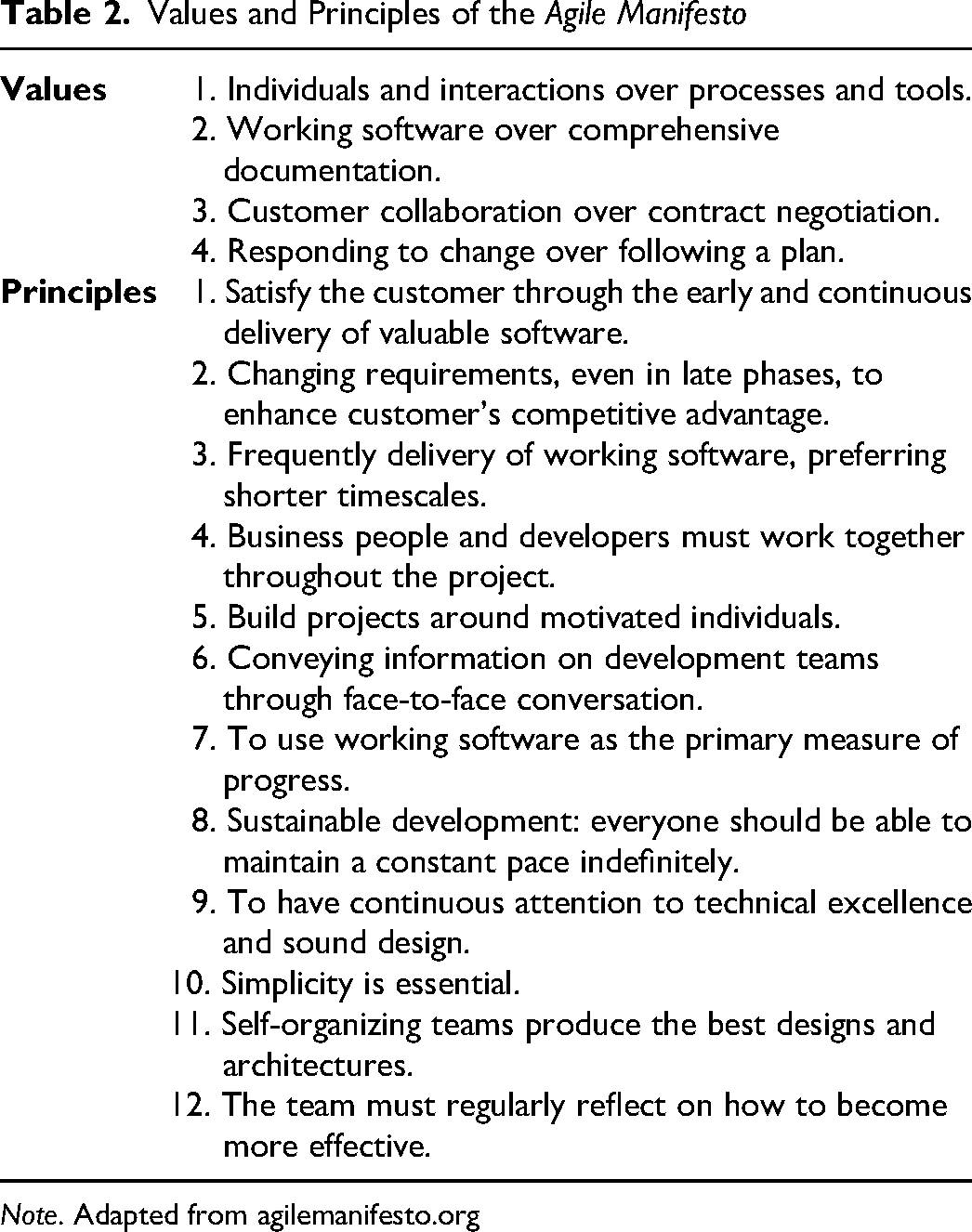
The emergence of research on agile practices can be traced back to the late 1990s, primarily within the evolving software industry (Drury-Grogan et al., 2017; Luong et al., 2019). In response to the predominant documentation-centric and formal approach, the Agile Manifesto was devised in 2001 to foster an environment conducive to software developers and to align software development activities with customer requirements (Beck et al., 2001). A depiction of the four values and 12 principles of the Agile Manifesto is presented in Table 2. Agile software development has subsequently gained substantial attention and recognition (Chow & Cao, 2008; Hansson et al., 2006; Leybourne, 2009) as a more effective approach for addressing complex or unpredictable requirements and adapting to rapidly evolving technological and business landscapes (Drury-Grogan et al., 2017; Lee & Xia, 2010; Reker et al., 2017).
Values and Principles of the Agile Manifesto
Note. Adapted from agilemanifesto.org
The adoption of agile principles has since been recognized as a valuable approach to project management beyond software development to mitigate the effects of change through adaptive flexibility. The need to manage varying conditions, conflicting stakeholder values, and complex information has been widely acknowledged (Conforto et al., 2014). As stated by Stettina and Horz (2015, p. 151), adopting agile software development principles “evolves into agility in project management.”
In recent years, there have been a limited number of systematic literature reviews pertaining to the broader domain of agile (e.g., Akbar et al., 2020). However, these studies are primarily focused on agile software development, not fully reflecting the expanding application of agile in various project management contexts. This discrepancy has resulted in scant attention toward broader applications of agile principles (Sweetman & Conboy, 2018; Stettina & Horz, 2015). Specifically, Hobbs and Petit (2017) highlighted the absence of a clear and comprehensive definition of Agile Project Management that transcends software-centric perspectives. The Agile Manifesto is explicitly restricted to software development, as shown by the second value of agile practices that refers to “working software” and the first principle to “valuable software” (see Table 2).
The extant literature presents numerous definitions of agile, as depicted in Table 3, and illustrates a lack of consensus. Since the origins of agile are in software development, it is not unexpected that early academic research predominantly recognizes and accentuates the ideas and techniques intrinsic to that domain. During this period, the term agile was commonly employed as an alternative to conventional software development methodologies, with a focus on iterative work processes and incremental delivery (Patanakul & Rufo-McCarron, 2018). However, with the proliferation of agile beyond the software industry, the definitions have become increasingly applicable to the broader domain of project management.
Definitions of Agile in the Extant Literature
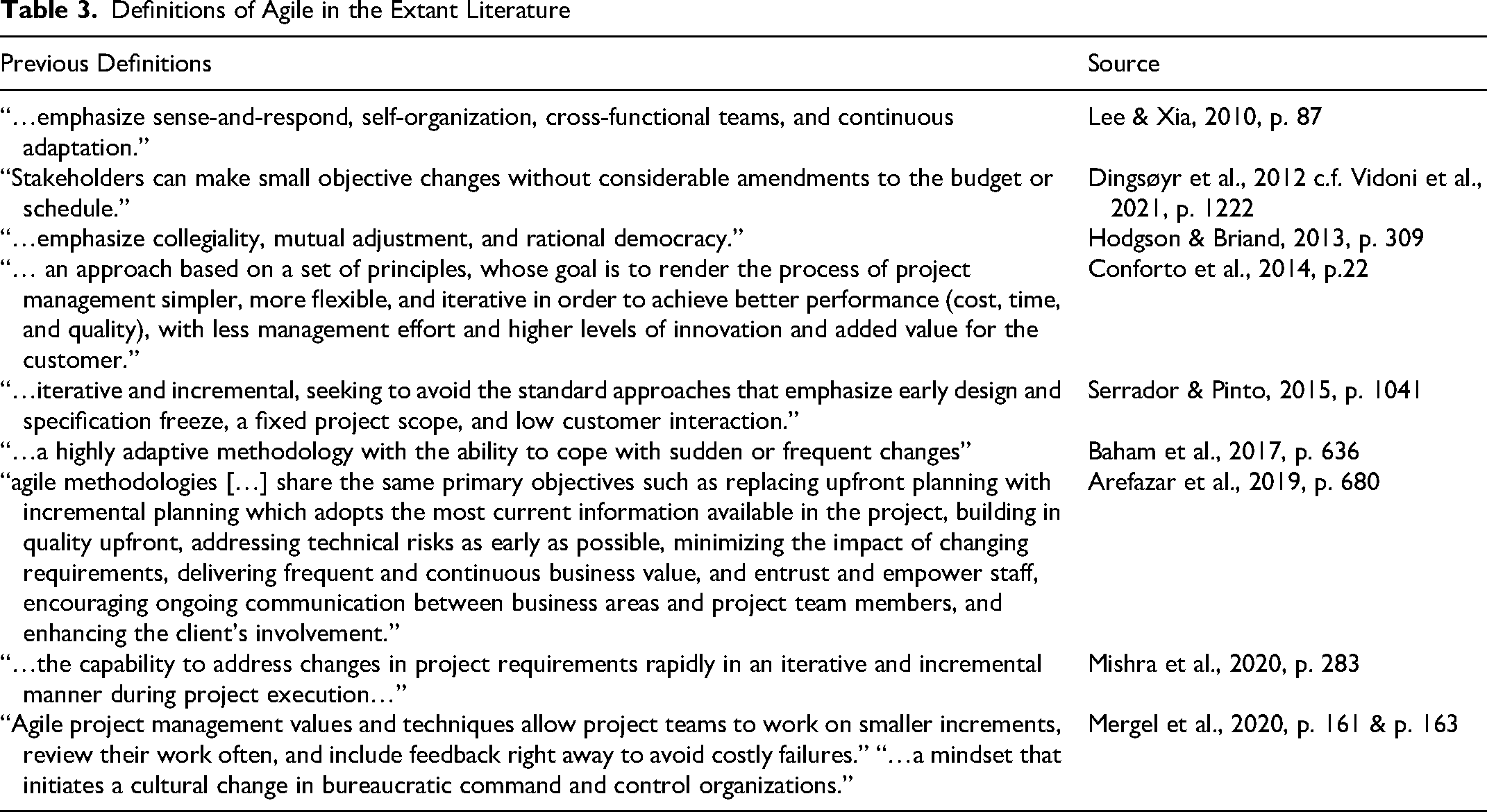
Some of these definitions can be applied to project management. Several are written for a particular context, such as projects based on technology (Arefazar et al., 2019), but others are much more generally applicable, intended for projects with a customer (Conforto et al., 2014; Serrador & Pinto, 2015) or client (Arefazar et al., 2019). None of the provided definitions serves as a comprehensive definition of Agile Project Management. We therefore address this gap in further detail in the discussion section.
Discussion
This study examined the academic literature on Agile Project Management, including methods and tools, project outcomes and organizational effects, and existing definitions of agile. In this section, we enhance the theoretical understanding of Agile Project Management through the formulation of a novel definition, which is synthesized based on the systematic literature review in addition to selected practitioner publications, such as: The 14th Annual State of Agile Report, Result Report: Status Quo (Scaled) Agile 2019/20: Fourth International Survey Benefits and Challenges of (Scaled) Agile Approaches, and State of Agile Culture 2020 Report. Furthermore, this section develops specific directions for future theoretical and empirical research.
Defining Agile Project Management
Agile has been widely adopted and modified in various project contexts beyond software development (Hron & Obwegeser, 2022) and can present a deviation to the heritage plan-execution logic. Projects, according to Project Management Institute (PMI) (2023) are “temporary efforts to create value through unique products, services, and processes.” However, the prevailing definitions of Agile Project Management include changes in user requirements (Baham et al., 2017) and project requirements (Mishra et al., 2020), which appear to be at odds with the traditional definition of projects that sets out to meet known and specific project objectives (see Maylor et al., 2023). To reconcile this dichotomy, PMI’s guidance on Agile Project Management (see https://www.pmi.org/about/learn-about-pmi/what-is-agile-project-management and PMI’s Agile Practice Guide, 2017) focuses more on flexibility over predetermined objectives. Nevertheless, this definition does not address the fundamental incompatibility between Agile Project Management’s evolving process of discovery toward a high-level vision and the systematic application of tools toward delivering a well-defined aim that is traditional project management.
Mergel et al. (2020) posit that agile should be regarded as a complementary approach to traditional organizational methods, rather than a replacement. However, the concept of “embracing agile as a mindset” does not sufficiently encapsulate the intricate relationship between agile practices and project management. Agile Project Management extends beyond the mere adoption of scalable project components or a suite of software development techniques. It involves a deeper integration of agile values and principles into the management ethos. Indeed, Drury-Grogan et al. (2017) suggest concentrating on agile principles and values instead of specific techniques. Nonetheless, since agile is explicitly a software development approach, many of the values and principles from the Agile Manifesto cannot be directly applied to non-software projects.
Several academic studies have attempted to distill the core values of Agile Project Management by extracting its principal philosophy, extending beyond the confines of software development. In alignment with the values conveyed in the Agile Manifesto, Lappi et al. (2018) advocate prioritizing individuals and their interactions over processes and tools. This sentiment is echoed by Aldave et al. (2019) and Mergel et al. (2020), which emphasize the significance of customer involvement and the need for greater adaptability and flexibility to accommodate changing customer needs and demands. The agile approach also necessitates a responsive attitude to changing requirements (and hence allocation of responsibilities, see Agren et al., 2022), which is deemed essential for delivering value to both the organization and its stakeholders (Becks et al., 2001; Highsmith & Cockburn, 2001; Mergel et al., 2020; Thorgren & Caiman, 2019). Table 4 presents a recent effort by Saltz and Heckman (2020) that interpreted the 12 principles into a more general dialect suitable for a wider range of project contexts.
Translating Agile Principles
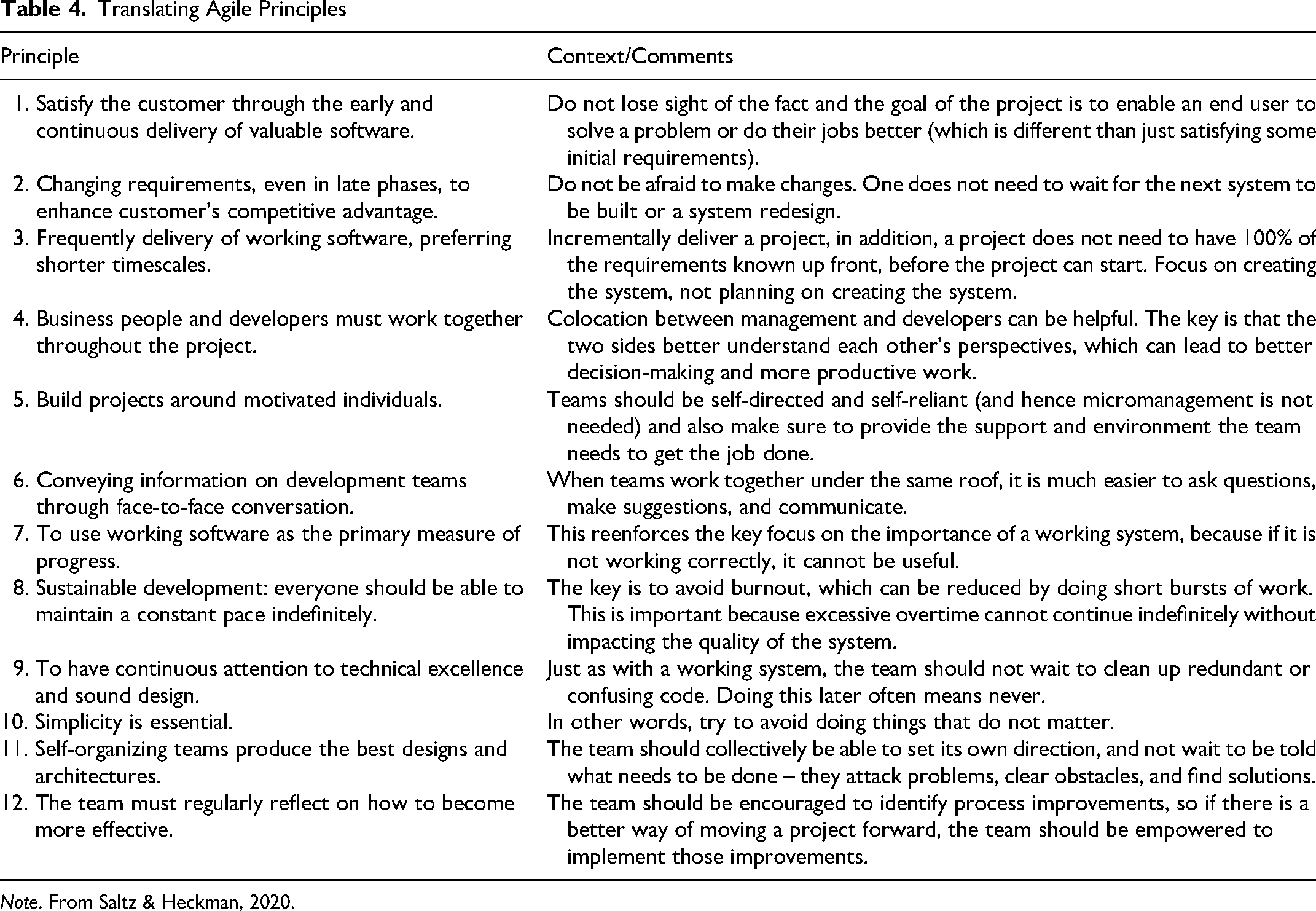
Note. From Saltz & Heckman, 2020.
The implementation of Agile Project Management can be problematic for practitioners, since it reconceptualizes projects and their governance, through the prism of transformed intraorganizational structures and boundaries. The same challenge is present for academics, since Agile Project Management also traverses disciplinary boundaries. As Conforto et al. (2016, p. 660) acknowledge, the understanding of Agile Project Management domain is “inconsistent, incomplete, and lack[s] clarity.” Our systematic review detects the lack of a consensus on the definition of Agile Project Management. We posit that one key conundrum to solve is the level of analysis. Our definition portrays Agile Project Management not as a subdivision of project management but as a distinct form of project management. This hierarchy is not always apparent since some definitions of agile are quite granular and only depict explicit features of project organization, such as self-organization and cross-functional teams (Lee & Xia, 2010; Van Wessel et al., 2021).
Nerur et al. (2005) provided a succinct comparison between traditional and agile software development (see Table 5) nearly two decades ago, and this comparison remains prevalent in contemporary agile literature. It is referred to in numerous academic studies such as those of Dyba and Dingsøyr (2008), Hoda et al. (2016), and Zavyalova et al. (2020). The contrast highlights the imperative for versatile and evolutionary project frameworks and approaches, drawing attention to the significance of agile in the realm of software development. However, the notion of agile as a departure from traditional, linear project management practices is further espoused by several scholars, including Mergel et al. (2020), who recently outline that Agile Project Management represents an egress from the conventional, deterministic approach to project planning. Similar to this viewpoint, Leybourne (2009) asserts that the central tenet of agile is to move away from the rigid adherence to a preconceived plan and instead adopt a more flexible and adaptive approach, which allows for the accommodation of changing conditions, including adjustments to project requirements (Augustine et al., 2005). This adaptability aims to improve the ability to deal with new developments and changes in circumstances (Anderson & Lewis, 2019; Arefazar et al., 2019; Wen et al., 2020), and represents a significant divergence from the established project management paradigm.
A Detailed Description of Agile Project Management
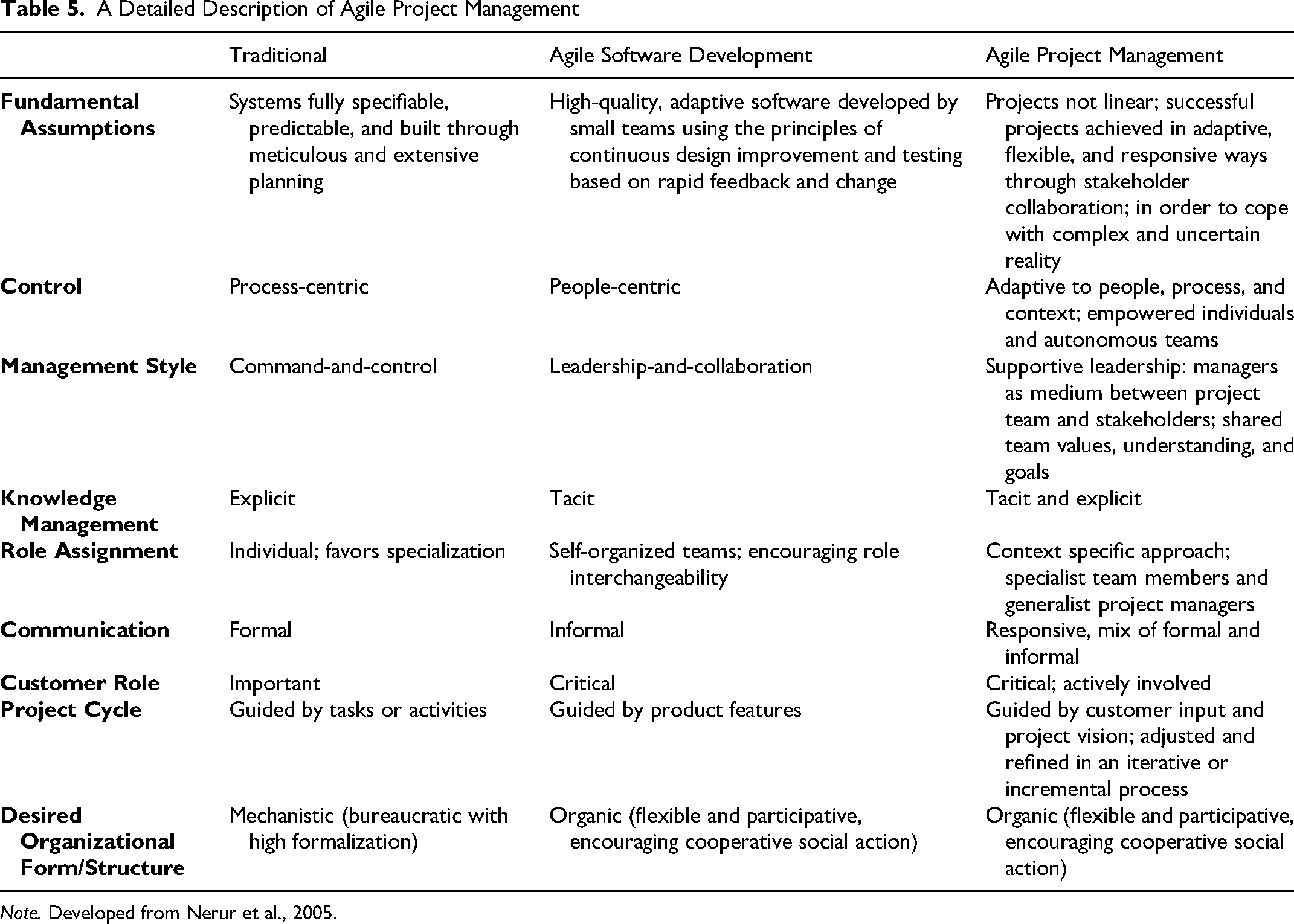
Note. Developed from Nerur et al., 2005.
Following its values, Agile Project Management would also adapt to the particular project and organizational contexts (Bianchi et al., 2022a; Van Wessel et al., 2021). In accordance, Tripp and Armstrong (2018, p. 174) advocate for the adaptive and flexible application of agile, coining the term “tailored agile.” This is further echoed by the notion of agile being a “context-oriented” approach (Macheridis, 2018, p. 129). As such, Agile Project Management has the potential to revolutionize an organization and its projects in numerous ways. Drawing on the previous works of Nerur et al. (2005) and Tripp and Armstrong (2018), we provide a comprehensive, updated definition of Agile Project Management in conjunction with traditional and agile software development methodologies. We argue that Agile Project Management is a flexible approach that includes discovering the aim and delivering the project. It embodies the organizational capability to adapt to changes as they arise.
This proposed definition, along with the detailed description presented in Table 5, highlights the importance of considering the context specificity of the adoption of Agile Project Management and its need for continual adaptation to align with the nature of specific organizations and projects (Bianchi et al., 2020).
Future Research Directions
Our review did not identify any specific tools or measures for assessing the level of agile within project teams or organizations. We also noticed that there are few large-scale and in-depth empirical studies investigating whether Agile Project Management improves project outcomes. Many argue that Agile Project Management is a better alternative for a wide range of projects, but the extant literature reviewed demonstrates a lack of research breadth and depth to make confident claims about a specific project or organizational setting, in this regard.
We propose the following directions for future research:
What are the antecedents of success in agile projects? Considering Agile Project Management as a deviation from the traditional approach, this needs to include defining success in a different way than meeting the originally stated objectives. The literature lacks clear and consistent guidelines for addressing the challenges posed by varying organizational characteristics (Conforto et al., 2016), including cultural and human factors (Luong et al., 2019; Thorgren & Caiman, 2019). Development of a pre-implementation framework to examine organizations’ institutional readiness for adopting Agile Project Management including their existing approaches to project contracts and governance (Armstrong & Manitsky, 2022; Baxter et al., 2023a). Development of a post-implementation maturity evaluation model to investigate the fidelity of Agile Project Management within organizations (Mergel et al., 2020; Patanakul & Rufo-McCarron, 2018). Exploration of the institutional costs and “tensions” (Baxter et al., 2023a) associated with agile-compatible organizational design, through a “microfoundations” perspective (Foss, 2011), particularly in the context of business innovations (Appio et al., 2021; Ghezzi & Cavallo, 2020; Patrucco et al., 2022). Examining the effects of Agile Project Management on stakeholder welfare (Augner & Schermuly, 2023; Mergel, 2023). A comparative analysis of major organization-wide Agile Project Management practices, such as those adopted by SAAB, Bosch, and 3M (Rigby et al., 2016), and the U.K. Ministry of Defence (Baxter et al., 2023a). Some organizations adopt agile values but do not use the label Agile Project Management, such as Intel’s OKRs, Toyota’s development system, or Tesla updates.
Conclusion
Summary of Contribution
Our findings illustrate a marked surge in research into Agile Project Management, especially since 2015, with key discussions and publications appearing in a variety of academic journals across different disciplines. This systematic review of the existing literature on Agile Project Management aggregates, consolidates, and extends the existing theoretical understanding of the topic. Our findings encompass discussions surrounding agile practices (adoption, empirical context, and effects on projects), organizational changes brought by agile, defining Agile Project Management, and future research agenda. Through these, we expand the understanding of agile beyond software development and recognize the broad adoption and adaptation of agile practices across various project contexts, emphasizing its prevalence in diverse industries.
We present Agile Project Management as a distinct approach, that asserts a new level of analysis. It is not a subject of project management, but a new and distinct type. We also describe Agile Project Management at a number of levels, including its fundamental assumptions, control and management styles, and desired organizational form.
Practitioners are provided insights into challenges associated with the implementation of Agile Project Management, offering a nuanced understanding of both external and internal organizational dynamics. Organizations contemplating the adoption of Agile Project Management are alerted to potential transformations required in their structures, strategies, and cultures. We also advocate for a tailored and adaptive application of agile principles, encouraging a context-oriented approach. Our definition resolves the discrepancy between the original Agile Manifesto as a software-specific approach, enabling Agile Project Management to be understood and applied in a wide range of project types.
Limitations
Despite our extensive review, several limitations should be acknowledged. The scope of our review was restricted to published articles focusing on agile practices in the management domain and excluded studies solely concentrating on software development due to the scope of our study. The keywords “Agile Project Management” potentially exclude alternative terms that might be relevant. While our findings illustrate the increasing adoption of Agile Project Management beyond the software industry, the majority of empirical evidence is based on software projects. Thus, there may be a potential disparity between existing literature and emerging industry practices. Future research might benefit from including additional practitioner reports and grey literature (see Adams et al., 2017) to provide a more comprehensive and updated overview of the application of Agile Project Management across various industry sectors.
Footnotes
Acknowledgment
This article forms part of the Understanding Agile Project Management research series funded by the Association for Project Management (APM).

Notes
Author Biographies
Appendix A. Descriptive Findings
As illustrated in Figure A1, research into agile project management has experienced a marked surge in recent years, with 64 of the 80 qualifying articles published since 2015.
The key journals publishing research on agile project management are identified in Table A1. The five key journals hosted a total of 34 out of the 80 surveyed articles. Overall, the topic is widely dispersed, and our results include articles published in 43 different journals. Most of these articles adopted an empirical approach, relying on survey instruments or case study methodologies.
List of the Final 80 Articles Identified Through the Systematic Search
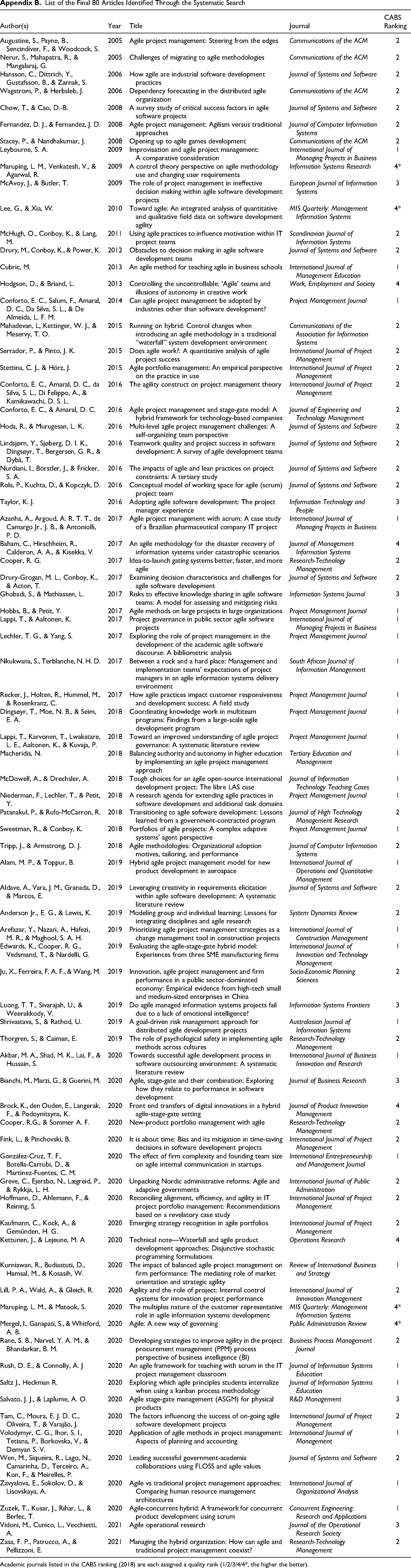
| Author(s) | Year | Title | Journal | CABS Ranking |
|---|---|---|---|---|
| Augustine, S., Payne, B., Sencindiver, F., & Woodcock, S. | 2005 | Agile project management: Steering from the edges | Communications of the ACM | 2 |
| Nerur, S., Mahapatra, R., & Mangalaraj, G. | 2005 | Challenges of migrating to agile methodologies | Communications of the ACM | 2 |
| Hansson, C., Dittrich, Y., Gustafsson, B., & Zarnak, S. | 2006 | How agile are industrial software development practices | Journal of Systems and Software | 2 |
| Wagstrom, P., & Herbsleb, J. | 2006 | Dependency forecasting in the distributed agile organization | Communications of the ACM | 2 |
| Chow, T., & Cao, D.-B. | 2008 | A survey study of critical success factors in agile software projects | Journal of Systems and Software | 2 |
| Fernandez, D. J., & Fernandez, J. D. | 2008 | Agile project management: Agilism versus traditional approaches | Journal of Computer Information Systems | 2 |
| Stacey, P., & Nandhakumar, J. | 2008 | Opening up to agile games development | Communications of the ACM | 2 |
| Leybourne, S. A. | 2009 | Improvisation and agile project management: A comparative consideration | International Journal of Managing Projects in Business | 1 |
| Maruping, L. M., Venkatesh, V., & Agarwal, R. | 2009 | A control theory perspective on agile methodology use and changing user requirements | Information Systems Research | 4* |
| McAvoy, J., & Butler, T. | 2009 | The role of project management in ineffective decision making within agile software development projects | European Journal of Information Systems | 3 |
| Lee, G., & Xia, W. | 2010 | Toward agile: An integrated analysis of quantitative and qualitative field data on software development agility | MIS Quarterly: Management Information Systems | 4* |
| McHugh, O., Conboy, K., & Lang, M. | 2011 | Using agile practices to influence motivation within IT project teams | Scandinavian Journal of Information Systems | 2 |
| Drury, M., Conboy, K., & Power, K. | 2012 | Obstacles to decision making in agile software development teams | Journal of Systems and Software | 2 |
| Cubric, M. | 2013 | An agile method for teaching agile in business schools | International Journal of Management Education | 1 |
| Hodgson, D., & Briand, L. | 2013 | Controlling the uncontrollable: ‘Agile’ teams and illusions of autonomy in creative work | Work, Employment and Society | 4 |
| Conforto, E. C., Salum, F., Amaral, D. C., Da Silva, S. L., & De Almeida, L. F. M. | 2014 | Can agile project management be adopted by industries other than software development? | Project Management Journal | 1 |
| Mahadevan, L, Kettinger, W. J., & Meservy, T. O. | 2015 | Running on hybrid: Control changes when introducing an agile methodology in a traditional “waterfall” system development environment | Communications of the Association for Information Systems | 2 |
| Serrador, P., & Pinto, J. K. | 2015 | Does agile work?: A quantitative analysis of agile project success | International Journal of Project Management | 2 |
| Stettina, C. J., & Hörz, J. | 2015 | Agile portfolio management: An empirical perspective on the practice in use | International Journal of Project Management | 2 |
| Conforto, E. C., Amaral, D. C., da Silva, S. L., Di Felippo, A., & Kamikawachi, D. S. L. | 2016 | The agility construct on project management theory | International Journal of Project Management | 2 |
| Conforto, E. C., & Amaral, D. C. | 2016 | Agile project management and stage-gate model: A hybrid framework for technology-based companies | Journal of Engineering and Technology Management | 2 |
| Hoda, R., & Murugesan, L. K. | 2016 | Multi-level agile project management challenges: A self-organizing team perspective | Journal of Systems and Software | 2 |
| Lindsjørn, Y., Sjøberg, D. I. K., Dingsøyr, T., Bergersen, G. R., & Dybå, T. | 2016 | Teamwork quality and project success in software development: A survey of agile development teams | Journal of Systems and Software | 2 |
| Nurdiani, I., Börstler, J., & Fricker, S. A. | 2016 | The impacts of agile and lean practices on project constraints: A tertiary study | Journal of Systems and Software | 2 |
| Rola, P., Kuchta, D., & Kopczyk, D. | 2016 | Conceptual model of working space for agile (scrum) project team | Journal of Systems and Software | 2 |
| Taylor, K. J. | 2016 | Adopting agile software development: The project manager experience | Information Technology and People | 3 |
| Azanha, A., Argoud, A. R. T. T., de Camargo Jr., J. B., & Antoniolli, P. D. | 2017 | Agile project management with acrum: A case study of a Brazilian pharmaceutical company IT project | International Journal of Managing Projects in Business | 1 |
| Baham, C., Hirschheim, R., Calderon, A. A., & Kisekka, V. | 2017 | An agile methodology for the disaster recovery of information systems under catastrophic scenarios | Journal of Management Information Systems | 4 |
| Cooper, R. G. | 2017 | Idea-to-launch gating systems better, faster, and more agile | Research-Technology Management | 2 |
| Drury-Grogan, M. L., Conboy, K., & Acton, T. | 2017 | Examining decision characteristics and challenges for agile software development | Journal of Systems and Software | 2 |
| Ghobadi, S., & Mathiassen, L. | 2017 | Risks to effective knowledge sharing in agile software teams: A model for assessing and mitigating risks | Information Systems Journal | 3 |
| Hobbs, B., & Petit, Y. | 2017 | Agile methods on large projects in large organizations | Project Management Journal | 1 |
| Lappi, T., & Aaltonen, K. | 2017 | Project governance in public sector agile software projects | International Journal of Managing Projects in Business | 1 |
| Lechler, T. G., & Yang, S. | 2017 | Exploring the role of project management in the development of the academic agile software discourse: A bibliometric analysis | Project Management Journal | 1 |
| Nkukwana, S., Terblanche, N. H. D. | 2017 | Between a rock and a hard place: Management and implementation teams’ expectations of project managers in an agile information systems delivery environment | South African Journal of Information Management | 1 |
| Recker, J., Holten, R., Hummel, M., & Rosenkranz, C. | 2017 | How agile practices impact customer responsiveness and development success: A field study | Project Management Journal | 1 |
| Dingsøyr, T., Moe, N. B., & Seim, E. A. | 2018 | Coordinating knowledge work in multiteam programs: Findings from a large-scale agile development program | Project Management Journal | 1 |
| Lappi, T., Karvonen, T., Lwakatare, L. E., Aaltonen, K., & Kuvaja, P. | 2018 | Toward an improved understanding of agile project governance: A systematic literature review | Project Management Journal | 1 |
| Macheridis, N. | 2018 | Balancing authority and autonomy in higher education by implementing an agile project management approach | Tertiary Education and Management | 1 |
| McDowell, A., & Drechsler, A. | 2018 | Tough choices for an agile open-source international development project: The libre LAS case | Journal of Information Technology Teaching Cases | 1 |
| Niederman, F., Lechler, T., & Petit, Y. | 2018 | A research agenda for extending agile practices in software development and additional task domains | Project Management Journal | 1 |
| Patanakul, P., & Rufo-McCarron, R. | 2018 | Transitioning to agile software development: Lessons learned from a government-contracted program | Journal of High Technology Management Research | 2 |
| Sweetman, R., & Conboy, K. | 2018 | Portfolios of agile projects: A complex adaptive systems’ agent perspective | Project Management Journal | 1 |
| Tripp, J., & Armstrong, D. J. | 2018 | Agile methodologies: Organizational adoption motives, tailoring, and performance | Journal of Computer Information Systems | 2 |
| Alam, M. P., & Toppur, B. | 2019 | Hybrid agile project management model for new product development in aerospace | International Journal of Operations and Quantitative Management | 1 |
| Aldave, A., Vara, J. M., Granada, D., & Marcos, E. | 2019 | Leveraging creativity in requirements elicitation within agile software development: A systematic literature review | Journal of Systems and Software | 2 |
| Anderson Jr., E. G., & Lewis, K. | 2019 | Modeling group and individual learning: Lessons for integrating disciplines and agile research | System Dynamics Review | 2 |
| Arefazar, Y., Nazari, A., Hafezi, M. R., & Maghool, S. A. H. | 2019 | Prioritizing agile project management strategies as a change management tool in construction projects | International Journal of Construction Management | 1 |
| Edwards, K., Cooper, R. G., Vedsmand, T., & Nardelli, G. | 2019 | Evaluating the agile-stage-gate hybrid model: Experiences from three SME manufacturing firms | International Journal of Innovation and Technology Management | 1 |
| Ju, X., Ferreira, F. A. F., & Wang, M. | 2019 | Innovation, agile project management and firm performance in a public sector-dominated economy: Empirical evidence from high-tech small and medium-sized enterprises in China | Socio-Economic Planning Sciences | 2 |
| Luong, T. T., Sivarajah, U., & Weerakkody, V. | 2019 | Do agile managed information systems projects fail due to a lack of emotional intelligence? | Information Systems Frontiers | 3 |
| Shrivastava, S., & Rathod, U. | 2019 | A goal-driven risk management approach for distributed agile development projects | Australasian Journal of Information Systems | 1 |
| Thorgren, S., & Caiman, E. | 2019 | The role of psychological safety in implementing agile methods across cultures | Research-Technology Management | 2 |
| Akbar, M. A., Shad, M. K., Lai, F., & Hussain, S. | 2020 | Towards successful agile development process in software outsourcing environment: A systematic literature review | International Journal of Business Innovation and Research | 1 |
| Bianchi, M., Marzi, G., & Guerini, M. | 2020 | Agile, stage-gate and their combination: Exploring how they relate to performance in software development | Journal of Business Research | 3 |
| Brock, K., den Ouden, E., Langerak, F., & Podoynitsyna, K. | 2020 | Front end transfers of digital innovations in a hybrid agile-stage-gate setting | Journal of Product Innovation Management | 4 |
| Cooper, R.G., & Sommer A. F. | 2020 | New-product portfolio management with agile | Research-Technology Management | 2 |
| Fink, L., & Pinchovski, B. | 2020 | It is about time: Bias and its mitigation in time-saving decisions in software development projects | International Journal of Project Management | 2 |
| González-Cruz, T. F., Botella-Carrubi, D., & Martinez-Fuentes, C. M. | 2020 | The effect of firm complexity and founding team size on agile internal communication in startups. | International Entrepreneurship and Management Journal | 1 |
| Greve, C., Ejersbo, N., Lægreid, P., & Rykkja, L. H. | 2020 | Unpacking Nordic administrative reforms: Agile and adaptive governments | International Journal of Public Administration | 2 |
| Hoffmann, D., Ahlemann, F., & Reining, S. | 2020 | Reconciling alignment, efficiency, and agility in IT project portfolio management: Recommendations based on a revelatory case study | International Journal of Project Management | 2 |
| Kaufmann, C., Kock, A., & Gemünden, H. G. | 2020 | Emerging strategy recognition in agile portfolios | International Journal of Project Management | 2 |
| Kettunen, J., & Lejeune, M. A | 2020 | Technical note—Waterfall and agile product development approaches: Disjunctive stochastic programming formulations | Operations Research | 4 |
| Kurniawan, R., Budiastuti, D., Hamsal, M., & Kosasih, W. | 2020 | The impact of balanced agile project management on firm performance: The mediating role of market orientation and strategic agility | Review of International Business and Strategy | 1 |
| Lill, P. A., Wald, A., & Gleich, R. | 2020 | Agility and the role of project: Internal control systems for innovation project performance | International Journal of Innovation Management | 2 |
| Maruping, L. M., & Matook, S. | 2020 | The multiples nature of the customer representative role in agile information systems development | MIS Quarterly: Management Information Systems | 4* |
| Mergel, I., Ganapati, S., & Whitford, A. B. | 2020 | Agile: A new way of governing | Public Administration Review | 4* |
| Rane, S. B., Narvel, Y. A. M., & Bhandarkar, B. M. | 2020 | Developing strategies to improve agility in the project procurement management (PPM) process perspective of business intelligence (BI) | Business Process Management Journal | 2 |
| Rush, D. E., & Connolly, A. J | 2020 | An agile framework for teaching with scrum in the IT project management classroom | Journal of Information Systems Education | 1 |
| Saltz J., Heckman R. | 2020 | Exploring which agile principles students internalize when using a kanban process methodology | Journal of Information Systems Education | 1 |
| Salvato, J. J., & Laplume, A. O. | 2020 | Agile stage-gate management (ASGM) for physical products | R&D Management | 3 |
| Tam, C., Moura, E. J. D. C., Oliveira, T., & Varajão, J. | 2020 | The factors influencing the success of on-going agile software development projects | International Journal of Project Management | 2 |
| Volodymyr, C. G., Ihor, S. I., Tetiana, P., Borkovska, V., & Demyan S. V. | 2020 | Application of agile methods in project management: Aspects of planning and accounting | International Journal of Management | 1 |
| Wen, M., Siqueira, R., Lago, N., Camarinha, D., Terceiro, A., Kon, F., & Meirelles, P. | 2020 | Leading successful government-academia collaborations using FLOSS and agile values | Journal of Systems and Software | 2 |
| Zavyalova, E., Sokolov, D., & Lisovskaya, A. | 2020 | Agile vs traditional project management approaches: Comparing human resource management architectures | International Journal of Organizational Analysis | 1 |
| Zuzek, T., Kusar, J., Rihar, L., & Berlec, T. | 2020 | Agile-concurrent hybrid: A framework for concurrent product development using scrum | Concurrent Engineering: Research and Applications | 1 |
| Vidoni, M., Cunico, L., Vecchietti, A. | 2021 | Agile operational research | Journal of the Operational Research Society | 3 |
| Zasa, F. P., Patrucco, A., & Pellizzoni, E. | 2021 | Managing the hybrid organization: How can agile and traditional project management coexist? | Research-Technology Management | 2 |
Academic journals listed in the CABS ranking (2018) are each assigned a quality rank (1/2/3/4/4*, the higher the better).