




Abstract
Complex project networks confront project actors, with value pluralism originating from a plethora of competing organizational and institutional systems related to the project environment. Using a single urban redevelopment case study, we present a dynamic understanding of the emergence and nature of conflicts in different conflict arenas of collaborative project networks. We identify seven coping patterns to reduce and engage with this complexity in the process of delivering value throughout projects. The coping patterns enable a more dynamic and flexible approach toward conflict management in project networks with a high degree of conflicting project interests.
Keywords
Introduction
Solving contemporary problems, such as climate change and social inequity, requires the involvement of an increasing number of public, private, and civil society stakeholders and their constituencies. As a result, intense collaborations among public clients, private contractors, and citizens in achieving public goals lead to complex project environments (Kuitert et al., 2019; van der Steen et al., 2013). According to Lundin et al. (2015), project networks are transitional and interdependent systems that relate to collaborative activities performed by a number of organizations over a period of time. The complexity of these networks stems from the interdependence of multiple actors, bringing into play individual objectives, interests, and systems (Alford & Head, 2017). Rokeach (1973, p. 5) defines a value system as “an enduring organization of beliefs concerning preferable modes of conduct or end-states of existence along a continuum of relative importance.” In complex project networks, citizens and local entrepreneurs are often placed at the center of the project network, and cocreation is emphasized (Coule & Patmore, 2013; Casey, 2014; van der Steen et al., 2013). Yet, all stakeholders involved bring their own value system—from public institutions under procurement law and public and private organizations in their sociotechnical environment, to individuals in their professional and societal contexts (Dille & Söderlund, 2011; Greenwood et al., 2011). Hence, project networks need to be amorphous in order to be governed and coordinated by the different stakeholders involved (DeFillippi & Sydow, 2016).
The multiplicity of value systems can result in conflicts at different intersections of the project network, also referred to as intragroup and intergroup relations (Jehn, 1995). Current project management practices tend to simplify toward rational–technical decision-making, rather than approaching project network management in a way that does justice to the dynamic interests of the entire network and contributes to the larger system (Joosse & Teisman, 2020). In complex project networks, however, project actors increasingly have to navigate through conflicting value systems when managing such projects (Smets et al., 2015; Van der Wal et al., 2011). When conflicts are not managed correctly, disputes and other disruptions may arise. Hence, effective and timely conflict management is essential to assure the creation and maintenance of long-term sustainable value for all organizations and their stakeholders involved (Too & Weaver, 2014).
To increase our understanding on how to manage complex projects in a way appropriate to their network complexity, we draw on a single-case study of an urban redevelopment project with an innovative participatory process of delivering a new municipal park. To grasp the dynamic and social aspects of this type of collaborative arrangement, we applied a process-related research method (Lundin et al., 2015).
Our contribution is twofold. First, we answer the call for studies on new inclusive and integrative perspectives of complex projects and their governance, thus increasing our understanding of the embedding of projects in organizational, interorganizational, or even broader institutional contexts (Adami & Verschoore, 2018; Dille et al., 2018; Geraldi & Soderlund, 2018; Lundin et al., 2015). In doing so, we are following the trend to look at project governance from an interinstitutional project perspective (Dille & Söderlund, 2011). The interorganizational focus views project governance as internal to a specific project, in which tailored governance arrangements may define shared practices for safeguarding, coordinating, and adapting exchanges taking place among various actors in the project (Ahola et al., 2015). Hence, we first draw from complexity theory in organizational science (e.g., Greenwood et al., 2011; Pache & Santos, 2013) to not only take notice of the effect of a project on its environment, but to also study the influence of the organizational and institutional environments on project management (Geraldi & Söderlund, 2018; Matinheikki et al., 2019). Our findings include the identification of four conflict arenas that occur due to the dominance of organizational and institutional relationships in the process of delivering value through complex projects: (1) the political arena, (2) the temporary project arena, (3) the participation arena, and (4) the system value arena.
Second, we answer the call for a dynamic theorization of projects (Dille & Söderlund, 2011). Research into value creation in projects still has a strong focus on what is achieved in terms of efficiency, effectiveness, and other more performance-based values and provides multiple quantitative ways to deal with different kinds of value conflict (Martinsuo et al., 2019). Recent bodies of literature on coping behavior as a strategy to dealing with complexity and value conflicts (Thacher & Rein, 2004) offer a search for more functional responses to value conflicts rather than typical cost-benefit and multicriteria approaches (Mardani et al., 2015; Pache & Santos, 2013). This led to the identification of seven coping patterns that enable dynamic and flexible value-based conflict management in project networks: (1) deferral, (2) prolongation, (3) anticipation, (4) prevalence, (5) relegation, (6) aggravation, and (7) coincidence.
In this article, we will first introduce the theoretical background on the origin of value conflict arenas and differentiate various ways to deal with value conflict in project networks. After this, we introduce our research approach to the single case study and report on the findings in several sections. We then describe the limitations, contributions, and practical implications of our work, and offer suggestions for further research.
Theoretical Background
Value Conflict Arenas in Projects
The multiplicity of value systems that project actors bring to projects leads to organizational and institutional complexity. Conflicts that originate from differing interests in or perceptions of the values and roles in relationships, can lead to the creation of conflict arenas at various intersections of the project network, either intragroup relations within or intergroup relations between organizational and institutional units, domains, and levels (Jehn, 1995). Previous studies have found that with regard to intergroup conflict arenas, especially in construction projects, the relationships between public and private parties traditionally have been quite adversarial and limited to the individual project (e.g., Adami & Verschoore, 2018; Dubois & Gadde, 2002). Parties are therefore likely to have only partly overlapping interests and goals, as well as incompatible systems and routines (Bygballe & Swärd, 2019). In public construction projects, such as city parks, infrastructure, or governmental buildings, the context is often political; the political responsibility of public clients raises the possibility of political interventions that affect the balance among the values of the parties involved (Leijten et al., 2010). Public project managers are therefore confronted with intraorganizational institutional complexity arising from the social and political contexts (Matinheikki et al., 2019). Private organizations operating in public projects, on the other hand, can be characterized by their profit-oriented and competition-driven nature (Benítez-Ávila et al., 2019). Especially in public procurement systems designed to offer public and private organizations a context in which to work toward collaboration, actors are confronted with competing demands and dilemmas resulting from conflicts of interest and moral hazard (McCue et al., 2015).
What is more, the project-based nature of construction activities in general leads to interorganizational conflict arenas evoked by the temporality of projects. One of the problems for public clients is that they are involved in achieving the competing and often incompatible demands of the permanent public commissioning organization and the situational requirements of the temporary project-related network of public and private parties (Stoltzfus et al., 2011). As a result, public clients continually have to manage the recurring value conflicts originating from the exploration–exploitation paradox. The short-term focus on efficiency, based on exploitation of existing knowledge and technologies, comes into conflict with the long-term focus on innovation and strategic development, which is based on the exploration of new knowledge and technologies (Eriksson, 2013; Kuitert et al., 2019).
In public projects, conflicts also arise at the level of intraorganizational relations (Ellis & Baiden, 2008; Fossestøl et al., 2015; Thacher & Rein, 2004). In cases where project participants are seconded from different parts of the organization, each participant will bring in ideas and values belonging to a different organizational culture and will, in turn, find themselves confronted with the distinct viewpoints and approaches of other participants (Ellis & Baiden, 2008). Value pluralism often exists within public clients due to the differentiation of governance mechanisms among departments, domains, and/or levels (Matinheikki et al., 2019; Pache & Santos, 2013). Consequently, these internally complex organizations exhibit a good deal of ambiguity in their approach to management. In this context, Kraatz and Block (2008) argue that because the pluralistic organization is a composite of multiple institutional systems, its internal functioning thus reflects the contradictions among the larger systems themselves. The implementation of new ideas therefore is context-specific and, as such, various management ideas have to be reinterpreted in order to be aligned with the individual circumstances of the organization. The sheer number of different organizational entities involved in projects often leads to levels of organizational structure complexity, which are so high that they need to be managed within the organization (Matinheikki et al., 2019).
These inter- and intragroup relations are dynamic in nature. Hence, the value systems that interact will change over time, and conflict arenas may appear in different activities of the process of delivering value throughout all phases of the project: the value identification, the value creation, and the value capturing during and after the project (Laursen & Svejvig, 2016; Lepak et al., 2007). During the implementation of new collaborative approaches, there will inevitably be times when participants are confronted with contrasting organizational and institutional value systems from departments and layers that normally appear in other phases. Technical entrepreneurs, for example, can help in defining innovative assignments but also add complexity to the project network because of their different value system. Moreover, the groups operating on behalf of the public and private participants within a project, such as resident associations and social support offices, are heterogeneous; they change in line with the various phases of the project’s life cycle as different professional and organizational skill sets are needed in the various phases (Bresnen et al., 2004). The political embeddedness of public construction projects means that values of a public party can change over successive administrative terms, and conflicts at the system level can arise or worsen as a result of such changes (Kuitert et al., 2019). Public clients’ value systems are therefore also subject to time-related changes.
Managing Conflicts in Delivering Values
Value creation is a complex and multifaceted concept that is central to management and organizational literature (Caputo et al., 2018). However, apart from the recognition of negotiation theory, mediation, and conflict management styles (Caputo et al., 2018), project management literature on value creation has largely focused on optimizing benefits and costs in projects, rather than recognizing the complexity and managerial challenges on an organizational level (Laursen & Svejvig, 2016). Many of these project management studies relate to well-defined problems and rational analysis, such as multicriteria decision-making, in which value hierarchies provide structure to a decision-making process to help select a design solution by assigning weights to attributes (Mardani et al., 2015). Hence, conflict management in project management practices primarily provides quantitative ways to handle different kinds of conflict by recognizing disputes in a rational, balanced, and effective way.
Value management today, however, should be seen as an “interpretive activity grounded in the social processes of projects” appropriate to a context with increasing complexity of managing project networks (Martinsuo & Killen, 2014, p. 56). In this context, Martinsua and Killen (2014) argue that a shift needs to be made from project management success measures (e.g., the iron triangle) to project outcomes and benefits such as environmental impact. This study therefore builds on an organizational value conflict perspective, which considers conflict management as a process of limiting the negative aspects of conflicts while increasing the positive aspects of conflict (Stepanova et al., 2020). From an organizational science perspective on value pluralism, a distinction can be made between reducing complexity and engaging with complexity (Jarzabkowski, Lê, et al., 2013; Smith & Lewis, 2011; Thacher & Rein, 2004), which will be explicated in the following sections.
Views on Value Pluralism
Most of the views on the ability to make value considerations in a situation of value pluralism relate to how decision makers view the commensurability of values. In this context, commensurability refers to whether or not there is a single currency or scale in which conflicting values can be measured and, thus, whether or not a rational assessment can be made (de Graaf & Paanakker, 2014). Reducing complexity—supporting a process whereby a single value system becomes dominant in an either/or perspective—is only possible when one believes that values can be commensurable (Fossestøl et al., 2015; Thacher & Rein, 2004; Tjosvold, 2008). This more classical economic view adopts the classical value chain described by Porter and is dominated by rational–technical approaches to reduce complexity: when values are assessed as commensurable, they can be traded off (Ward & Daniel, 2012). To justify their trade-offs, actors first identify the relative importance of each value to this ultimate standard, for example, social welfare, and then make a decision that maximizes that master value (Thacher & Rein, 2004).
However, in discussing the delivery of public values, the classical economic theory generally falls short in accounting for intangible aspects of value choices (Miller, 2016). Public organizations also tend to address value much more broadly, viewing it as incommensurable and both tangible and intangible (Kuitert et al., 2019; Moore, 2000). To adopt a social value theory view to engage with complexity, process elements and non-financial effects are included (Riis et al., 2019). In this context, Parsons and Smelser (2005) argue that the relation between maximization of production and the complexity of various institutionalized and societal value systems is relevant in economics. This view indicates that public actors may consider trade-offs to be inevitable and—given the intrinsic nature of values—impossible at the same time (Steenhuisen, 2009). This means that one should embrace the conflicting nature of value, adopt a paradoxical view, and aim to optimize the balance among conflicting values (Steenhuisen, 2009).
To adopt the incommensurable perspective on value pluralism actively, embracing conflict is necessary. This means accepting the coexistence of competing extremes by means of confrontation, transcendence, and adopting a both/and perspective rather than an either/or perspective (Jarzabkowski, Lê, et al., 2013; Smith & Lewis, 2011). According to Smith et al. (2010) and Tetlock (2000), avoiding comparisons in rational–technical approaches—consistently making hard choices in support of one strategy while ignoring the other—is a relatively defensive way of dealing with complexity. Both the either/or and the both/and perspectives on conflict management offer viable solutions in specific situations by applying different ways of dealing with conflicts, as will be discussed in the next section.
Dealing With Value Conflicts
Previous research in the field of dealing with value pluralism suggests that when faced with competing institutional interests, organizations are likely to respond using a separation strategy in order to reduce complexity (e.g., Pache & Santos, 2013). Organizations resort to different management techniques (Pache & Santos, 2013): Decoupling refers to organizations symbolically endorsing practices prescribed by one value system while actually implementing practices promoted by another value system, often one that is more aligned with their organizational goals; compromise is the attempt by organizations to enact institutional prescriptions in a slightly altered form by crafting minimum standards, adopting new behavior, or by bargaining. This bargaining option is also a recognized subcategory of negation theory (Caputo et al., 2018).
Various authors mention a range of decoupling coping mechanisms related to time, topic, environment, and organizational unit. Decoupling is separating contradictory elements either temporally—by dealing with one, then the other (Bruijn & Dicke, 2006; Poole & Van de Ven, 1989)—or spatially—by compartmentalizing elements into different areas (Eriksson, 2013; Poole & Van de Ven, 1989). For example, spatial separation takes place when the physical domain tasks of a client’s organization are spread across separate policy-related pillars within the municipal organization such as education, culture, sports, or urban planning. Separation is also referred to as splitting, projection, regression, or ambivalence (Jarzabkowski, Lê, et al., 2013). Thacher and Rein (2004) mention other coping mechanisms, such as firewall (structural separation), bias (favor through dominant discourse), casuistry (taking a case-based approach), or cycling (sequential separation); whereas Schillemans and van Twist (2016) talk about anchoring strategies, meaning that public actors resort to procedural means instead of resolving value conflicts.
In contrast to the previous separation response strategy, Greenwood et al. (2011) suggest borrowing from the literature on ambidexterity to provide new insights into the integration of competing value systems. From an ambidexterity perspective, institutional complexity is not a problem to be resolved, rather a naturally occurring condition to be engaged in (Jarzabkowski, Smets, et al., 2013; Kraatz & Block, 2008). Contextual ambidexterity refers to a behavioral capability to pursue exploration and exploitation simultaneously and synchronously within a business unit or work group (Eriksson, 2013; Gibson & Birkinshaw, 2004). This is not done through structural, task-related, or temporal separation but by building a business unit context that encourages individuals to make their own judgments on how to strike the best balance between the conflicting demands of alignment and adaptability (Gibson & Birkinshaw, 2004).
This type of strategic response is referred to as synthesis by Poole and Van de Ven (1989) and may also be called adjusting: a response to tension that recognizes the importance and interdependency of both poles of the paradox, thereby acknowledging the need to accommodate both (Jarzabkowski, Lê, et al., 2013). The synthesis strategy hints at management techniques involving value system combinations by engaging and encouraging conflict through synthesis (Greenwood et al., 2011; Pache & Santos, 2013; Smith et al., 2010), allowing more flexibility in decision-making (Smith et al., 2010). In this response, the coping mechanism called hybridization—in other words, better off together—is a result of the ability to manage the complexity of the various value systems (Thacher & Rein, 2004). In this setting, tensions may be confronted using the iterative responses of splitting and integration or using acceptance and embracing conflicts as part of a strategy of working through (Smith & Lewis, 2011).
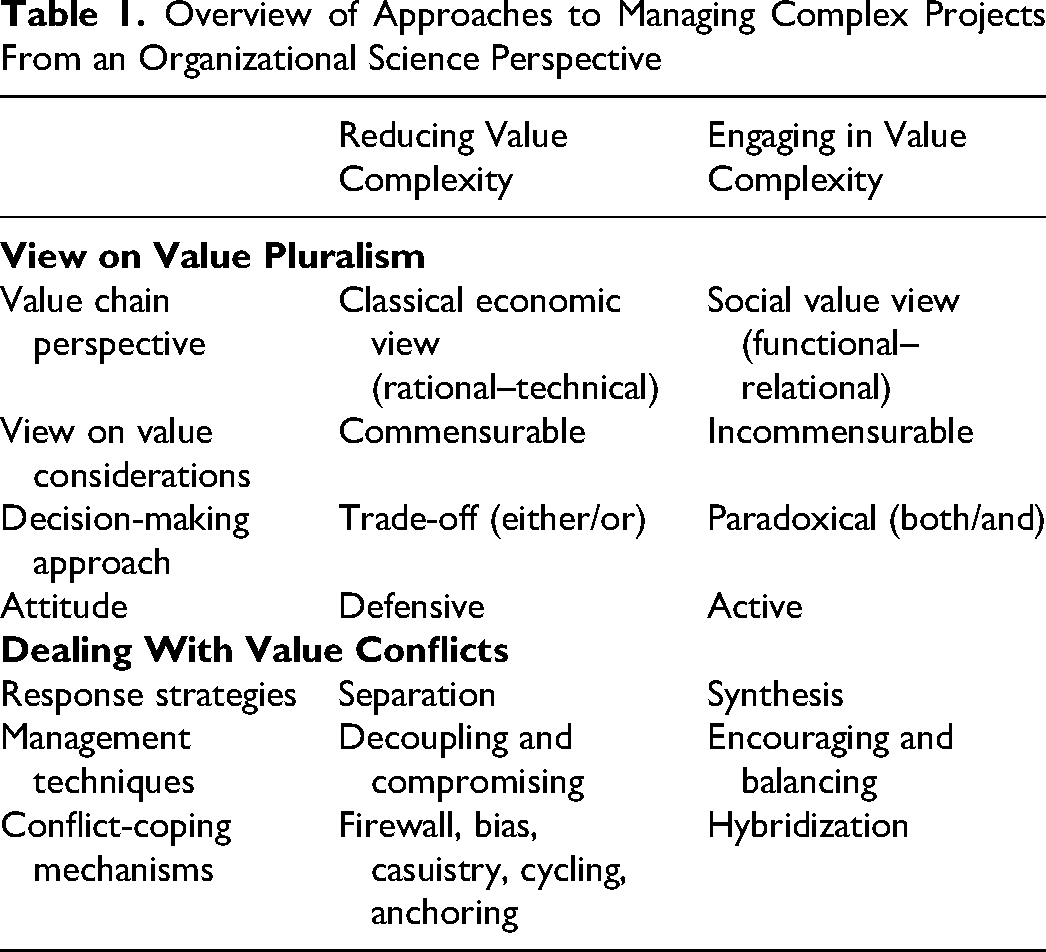
This leads us to the following overview of the two perspectives on dealing with complexity in delivering value in complex project environments: (1) reducing complexity and (2) engaging with complexity (Table 1). The two perspectives differ in their views of value pluralism and approaches to dealing with value conflicts. These perspectives are not mutually exclusive and can be combined, providing a framework for developing appropriate strategies for managing complex projects.
Overview of Approaches to Managing Complex Projects From an Organizational Science Perspective
Research Approach
Single-Case Qualitative Process Study
This research draws on a single qualitative case study of the redevelopment of a local city square into a signature municipal park. Although case studies, and especially single case studies, are limited to specific sets of circumstances, scholars have argued that any study can provide a useful basis for theoretical generalization and development (Dubois & Gadde, 2002; Yin, 1994). According to Vaara and Whittington (2012), a process orientation helps researchers provide important, context-sensitive insights into how practitioners are enabled and constrained in their strategic actions and decisions by wider organizational and/or social practices. Hence, for our aim of studying how to manage value conflicts in project networks, we chose a case that is process oriented in nature, in real time, and contextual (Pettigrew, 1997).
This redevelopment case has been chosen for two reasons. First, particularly in urban area development, an increase in the use of participatory processes in order to enhance the many different interests involved in these complex and socially challenging projects can be seen (Miozzo & Dewick, 2004; Van der Steen et al., 2014). This makes the case a critical case (Flyvbjerg, 2006), well suited for studying the multilevel challenge of dealing with complexity in a project network. Second, the multilevel network corresponds with the call of researchers, such as Hartley et al. (2017), to involve a wider range of stakeholders than simply managers in public value research. In this study, we set out to generalize to theory within our domain, rather than to populations outside (Eisenhardt & Graebner, 2007). As such, we consider the sampling appropriate for this goal.
Case Description
Our urban redevelopment case concerns the ambition of one of the Netherlands’ biggest municipalities to turn a regular public square with a playground and a simple petting zoo in a rather problematic neighborhood, into a true municipal park with wide appeal that would boost the reputation and urban living quality of the whole area. Because of a new municipal policy, this project became a pilot project for an innovative participatory approach, with the local stakeholders aiming to improve social return. The initial idea for the project originated with one of the city aldermen responsible for this district of the city. Hence, a district manager became the official project sponsor, and an external general project manager was appointed to manage the whole project.
A group of local small and medium-sized enterprises signed up to participate in a tender pool—hoping to eventually be awarded one of the contracts for the design and/or execution of the project. A resident panel was set up to represent a variety of resident groups during the design and procurement process. Two assistant project managers were appointed by the municipality to act as intermediaries for these two groups. The three project managers formed the core of the project team, complemented with representatives of a municipal procurement consultant, a communication agent, a representative from the municipal urban management department, and the landscape architect and their communications office, who became involved after an earlier design tender.
Due to the strong involvement of several municipal organizational units, the residents, and local businesses, a network type of governance needed to be adopted in the project structure. Connecting public and private actors in a project network like this, various public and private actor groups at different levels of the organizational and institutional systems can be identified as the network in which the project operates. To a large degree, the complexity in this case was caused by the ambidexterity of the participatory process between the municipality and the tender pool of businesses and the resident panel. A municipal client organization is generally driven by public and political interests. Hence, innovative forms of citizen participation and social return were very relevant public values in this case. The resident panel and the tender pool, however, wanted to express their individual, private interests such as a safe living environment and financial feasibility.
We followed the case through various project phases of public value delivery through the participatory process: planning, design, and commissioning. The actual construction and operation phases were not part of the study due to time limitations of the researchers. During the planning phase, an architect had already been commissioned to translate the project values as set out in the project plan into a conceptual design, to be elaborated upon during the design phase using the residents’ participation. In the commissioning phase, the execution of various subprojects was procured to local businesses to stimulate the local economy. The main part of the actual construction of the park was procured as an integrated design and construct contract, with specific award criteria related to the social values of social return and participation. Furthermore, an overall process was set out to prepare for the management phase in pursuit of ownership of the new park.
Data Collection
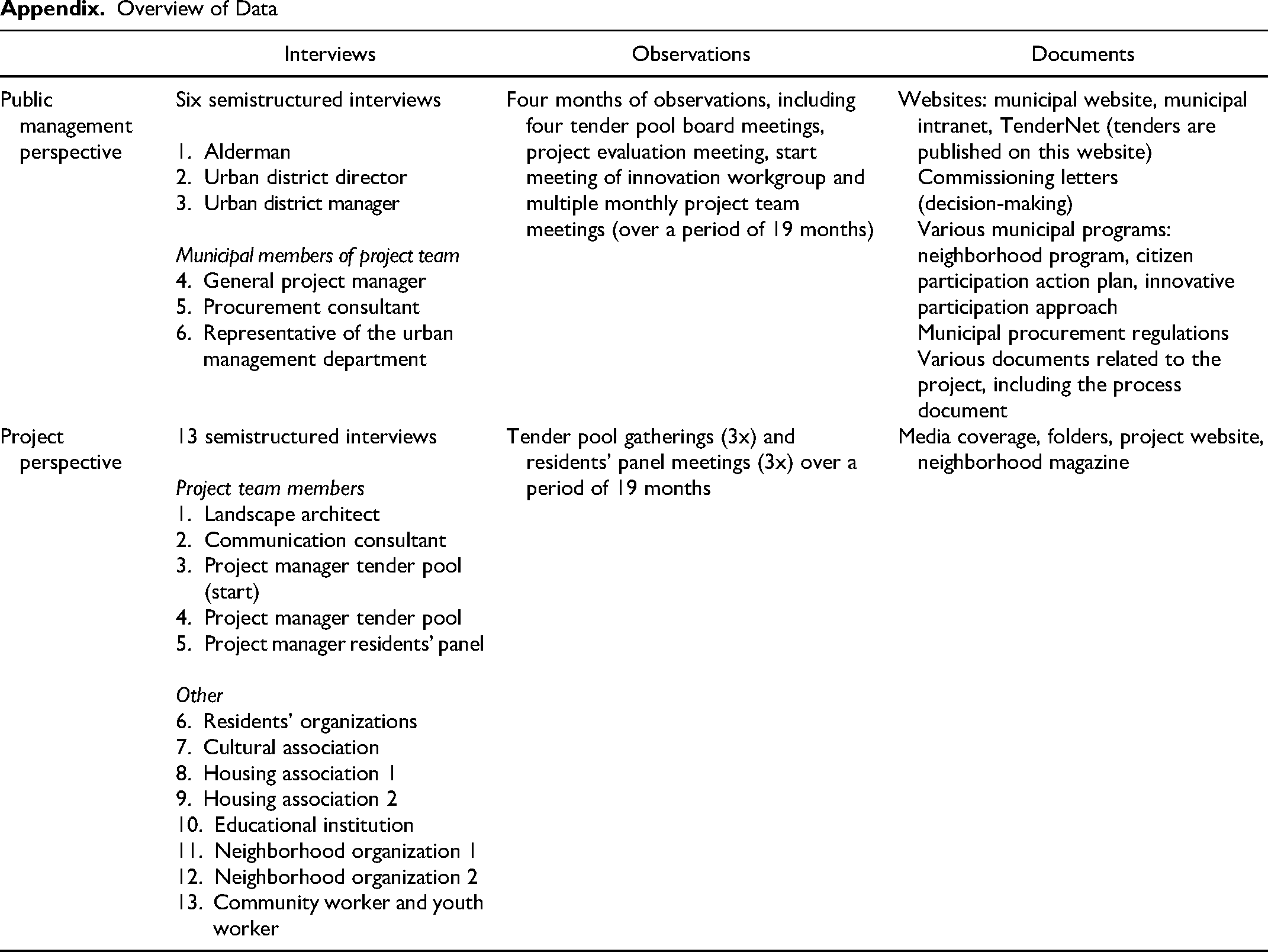
The data collected in the study include both current and retrospective data on multiple network levels and phases spanning a two-year period (see overview in the Appendix at the end of the article). The data were collected between June 2017 and May 2019 by three researchers, including the first and second authors. We collected data from a variety of sources: interviews, documents, and participant and nonparticipant observations. It is broadly recognized that the use of multiple data sources helps to ensure the quality and credibility of a study (Eisenhardt & Graebner, 2007; Yin, 1994). The researchers acted as observant participants in the project management team meetings, the tender pool gatherings, and residents’ panel meetings for a period of 19 months. Furthermore, the first author conducted four months of observations in the urban management department of the municipal organization. Throughout this process, notes were taken to detail all observations and interpretations in this same period, and these were then included in our analysis.
In selecting interviewees, it was important to ensure good representation of the different levels of the project network and its environment and to allow different perspectives to emerge (Hennink & Hutter, 2011) to explore where frictions among value systems occurred and how the network actors dealt with those conflicts. A total of 19 semistructured interviews were held, of which six were from a public management perspective with actors from the public client organization and public members of the project management team, and a further 13 with intermediaries and various external public and private institutions representing the project perspective. A first round of interviews took place from October 2017 to December 2017, with a second round in May 2018. The interviews were between 30 and 90 minutes in duration and included questions about experiences and perceptions of the ways in which the project objective had been chosen, the implementation and outcome of the participation approach, and the role of the public client. Audio recordings were made of the interviews, which were then transcribed verbatim.
Furthermore, numerous documents were collected from the municipality’s private intranet and public websites by using a purposeful sampling technique in order to find policies, communications, and other relevant case information. This also included the documents that were mentioned in the interviews and during observations. The data set was supplemented by email correspondence in relation to the meetings and attached documents.
Data Analysis
We adopted a three-step iterative process to theory development. The first step involved the inductive thematic coding of all data by moving back-and-forth between engaging with the data and extant literature (Locke et al., 2022). We coded the actual timing of critical events—for example, event–design phase—to construct the public service delivery process. We specifically coded the interactions among the various actors during the various phases of the process to identify where frictions between value systems emerged—for example, public-private–conflicting value systems. We applied a visual mapping strategy (Langley, 2007) to identify the different practices of actors that are consciously or unconsciously deployed to make value trade-offs in networks of internal and external institutions. Based on the foundations of Moore’s value chain (Moore, 2000), we looked into (project) governance processes around values, aiming to connect objectives set for the project at the public management level with project management practices. We focused in particular on the value process of social return and aspirational values derived from participatory elements such as sustainability. In order to produce the value maps, we coded key players, processes, procedures, activities, and specific goals—for example, interaction–municipality/tender pool. In addition, the value process elements were coded as types of approaches to value conflicts such as conflict approach–avoid/trade-off or conflict approach–engage/paradox. The preliminary conclusions and emerging coding were discussed between the first two authors and validated with the third author.
The second step involved a joint comparison and discussion of the code reports and the findings extracted, resulting in a list of shared conflicts, their origin relationships, and the accompanying coping strategies marked by their characteristics—reduce or engage. In the third and final step of data analysis, we theorized across exemplary conflicts and their accompanying coping strategies (Eisenhardt & Graebner, 2007). Looking for similarities and differences, we found that these two axes in particular play a role in understanding what took place in this dynamic and complex environment: (1) the temporal axis, representing the various phases in the construction project life cycle dealing with value identification, value creation, and value capturing; and (2) the spatial axis, represented by the network levels among the different project actors.
This analytical step was key in highlighting the importance of looking within and across the network levels and the project phases to identify the four different conflict arenas and seven patterns that are described in the following sections. A conflict arena originates from conflicts of interests or perceptions of the values and roles in relationships. In our case study, we found two major conflict arenas that occurred within various network levels of the redevelopment project—the political arena and the temporary project arena. We also found two major conflict arenas among the actors across the project network levels—the participation arena and the system value arena. We have been able to identify three coping patterns in relation to the temporal dimension of projects: (1) deferral, (2) prolongation, and (3) anticipation (see also Table 2). Four coping patterns were found by displacing project coping activities within and across network levels in the spatial dimension in order to deal with value conflicts that occurred in the project: (1) prevalence, (2) relegation, (3) aggravation, and (4) coincidence (Table 3). The dynamic understanding of conflict emergence explained how project actors are affected by the dominance of relationships during the process of delivering value through projects (Figure 1).
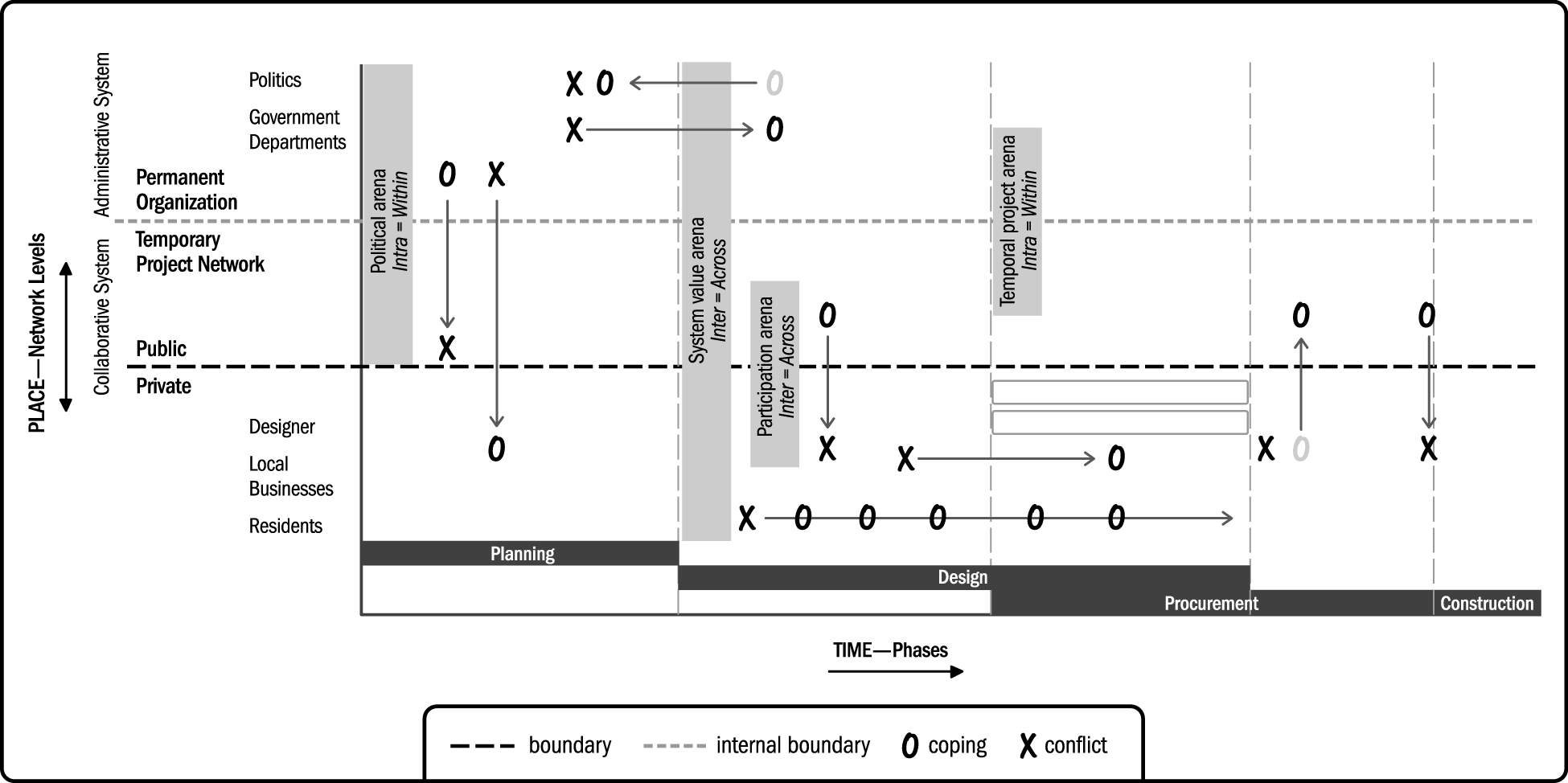
Conflict arenas and coping patterns in the case.
Coping Patterns on the Temporal Axis
Coping Patterns on the Spatial Axis
Findings
Conflict Arenas in Complex Project Network Environments
Spatial Conflict Arenas Within Project Network Levels
One of the conflict arenas within the public realm—the political arena—is associated with various issues related to the political environment in which the internal client is embedded. We found that the municipality was mainly driven by political interest, as expressed by the communication agent who worked with the architect: “The whole reason for this project was that the alderman wanted it. That was the first question I asked at the first meeting: ‘Who wants a new park?’ It was the alderman.” (Interview 2, project perspective) “The alderman said: ‘We’re getting a park,’ and that was that. […] Of course, I'm very happy with it, but it came out of the blue. I’ve never heard any of the residents say they wanted a park with appeal.” (Interview 7, project perspective)
The decision to redevelop the simple square into an attractive park was therefore a hierarchical one, which proved to be a complicating factor as regards the support for the project decision within the client organization and within the neighborhood itself. This also implied that the level of commitment for participation was compromised. A further complication was the fact that projects of this scale are generally initiated by local parts of the municipality representing local values that may conflict with the general interest of the city, with a municipal project portfolio held at a higher level. Hence, to avoid value conflict, it is very important to align the general interests of the citizens, the collective values of the city, and the political interests of the project from the start. The municipal procurement consultant stated: “In principle, the park as an entity is of course a unified whole. And what the alderman is pursuing is a number of goals, namely civic participation and a higher goal within the district that, among other things, will give not only the park but also the district a considerable boost… The entire layout of the park is not an end in itself, but a means of achieving a higher plan for the entire subarea.” (Interview 5, public management perspective)
Another conflict arena within the public realm—the temporal project arena—relates to the interface within the public client organization between the permanent municipal organization and the temporary project network. We observed that efforts to produce clarity and order in the project generated complex issues for the line organization. For example, the decision to create a number of subprojects may have been beneficial for the project organization and the collaboration with the actors in the tender pool, but this complicated matters for the line organization, especially for the procurement department, which needed to find a way to integrate this approach into its regular tender practices.
Spatial Conflict Arenas Across Project Network Levels
The participation arena involves conflicts across relationships between public and private entities. This conflict arena represents conflicts that follow from the participatory nature of the project, as illustrated by how the municipality framed the collaboration with actors in the tender pool and the residents’ panel. The political interest of the client was, for example, expressed as a neighborhood park with appeal to be achieved through innovative forms of participation and a high rate of social return. Underlying documents showed that this new general participation-oriented policy was to be translated into local project aims such as fostering local employment, encouraging a local sustainable economy, and generating national recognition for the participatory approach. Hence, such a local participatory approach calls for a network type of governance in which the public sponsor creates a certain distance in order to enable local partners to reach compromises and agreements with their consultative partners on how to achieve the project’s aims, which was not the case in this situation.
Another issue originated from the municipality not only asking local businesses to participate in the tender process for the subprojects—representing a significant investment of time and money from these businesses—but also asking them to contribute to municipal ambitions in terms of social return. While local businesses were intrinsically motivated to contribute to the neighborhood, they were also concerned with obtaining work and safeguarding financial feasibility, concerns that may in some instances run counter to the shared value. Moreover, they appeared to be unfamiliar with the framework of the municipality and its formalized tendering procedures, which meant that their organizational processes did not match the public governance system in which the project was embedded. The general project manager explained: “That’s a difficult point, of course. First of all, we wanted to involve companies that knew nothing at all about the municipal context and its tendering process. So they were at a considerable disadvantage to start with. And on top of that, we were asking them to provide something that, while it might be in line with their intrinsic motivations, they’d had no experience of providing.” (Interview 4, project perspective) “Cocreate in the field of knowledge sharing, exchange views on points of difficulty, but also collaborate to ensure that projects are multidisciplinary.” (Interview 5, project perspective)
However, in the end, the participatory process turned into a rather top-down approach in which the residents’ pool provided mainly legitimacy to the public aim of participation.
Another conflict arena across project network levels was the system value arena. This arena related to conflicts involving relationships across system levels between the administrative system of the parent organization adhering to a traditional value system of accountability and, what we call, the collaborative system of the project organization sharing network values such as participation and innovation. On several occasions, we found that the objective of a far-reaching form of participation in a local redevelopment project conflicted with responsibilities in the public system such as those in the field of public accountability. The innovative participatory process, for example, conflicted with the standards set by municipal advisory bodies, specifically relevant in the procurement phase. These bodies had to be consulted on matters such as traffic, the Public Space Manual, and general welfare. From a project management perspective, they were considered obstacles that either needed to be bypassed or creatively integrated into the project strategies.
Another approach was to move away from the system. According to the general project manager, the municipality created its own project network dynamics by mainly hiring external parties for this project, based on the stated aims of “getting away from system thinking” (Interview 4, project perspective) and ensuring the innovative character of the project. One example of a conflict in social value perception was an implicit performance measurement that considered the number of stakeholders who participated as an indicator of success. In one of the interviews, the architect stated that the focus on numbers in stakeholder participation was not clear from the start, which aroused their indignation as to how the value of participation should be perceived. They felt that the municipality was not clear in what they expected. As a communications expert explained: “People were only focused on the number of people who took part, not on what came out of it. So, it wasn’t about the results of the design workshop at all, which went well despite the low turnout. Instead, the sole concern was ‘how can we reach more residents?’” (Interview 2, project perspective)
Temporal Dominance of Conflict Arenas
Our findings also showed the dominance of particular conflict arenas in network relationships at different phases of the project life cycle relating to the different stages of the public value process. In this context, we found that the political conflict arena overshadowed all phases of the project. It shows that a municipal organization has to ensure support for the ambitions of an alderman, as expressed in the following quote from the municipal procurement consultant: “Of course, political will always plays a role. […..]The more a project is a visible element of the city, the more natural it is for political will to play a more explicit role in the entire process. As an organization, you try to ensure that an alderman is protected, that we don’t undertake things here and now that won’t be marketable in future.” (Interview 5, public management perspective)
The temporal project arena was the conflict arena where most conflicts took place in the procurement phase. During this phase it became clear that certain design decisions on subprojects, intended to attract the participation of creative design companies, conflicted with processes in the municipal parent organization geared toward the assessment of official tender documents. While the splitting of decisions reduced complexity for the project network, it appeared to make matters even more complex for the parent organization.
The participation conflict arena appeared to be mainly dominant in the planning and design phases. When two additional project managers were brought in to manage the interfaces between the public (project sponsor) and private entities (tender pool and residents’ panel), the balance shifted toward private values. The system value arena appeared to be dominant in the design and the commissioning phases of the project. The design phase formed the core of the dominant relationships of the participatory system, which connected to the central position of the triumvirate of project managers that underpinned the value system. Hence, in this phase, we saw various attempts to look for flexibility in rules, exploiting room for maneuvering in the regulations set by the municipal administrative system.
In the commissioning phase, we noticed that the administrative systems became increasingly dominant. Consciously or unconsciously, the municipal organization reverted to its traditional patterns in the interests of its internal control mechanisms, even though the initial intention in the project had been to clear the way for new ways of working that were born of network collaboration. For example, although a conscious choice was made to select an independent architect, the design was then handed over to the municipality’s engineering department to exercise control over the details during the construction phase. In particular, the relatively strict public tendering regulations during the construction phase of the park seemed to require a high level of creativity from the project team in order to deal with the municipal governance system in ways that delivered on the public value as initially envisioned. Overall, the relationship between the administrative system and the participatory system appeared to be more dominant in the conflict arenas than the intersection between the public and the private parties.
Coping Patterns in Complex Project Network Environments
The dynamic understanding of conflict emergence explains how project actors are affected by the dominance of relationships in the process of delivering value through projects. In light of this insight, we proceeded to unravel the link between conflict emergence and coping.
Coping Patterns on the Temporal Axis
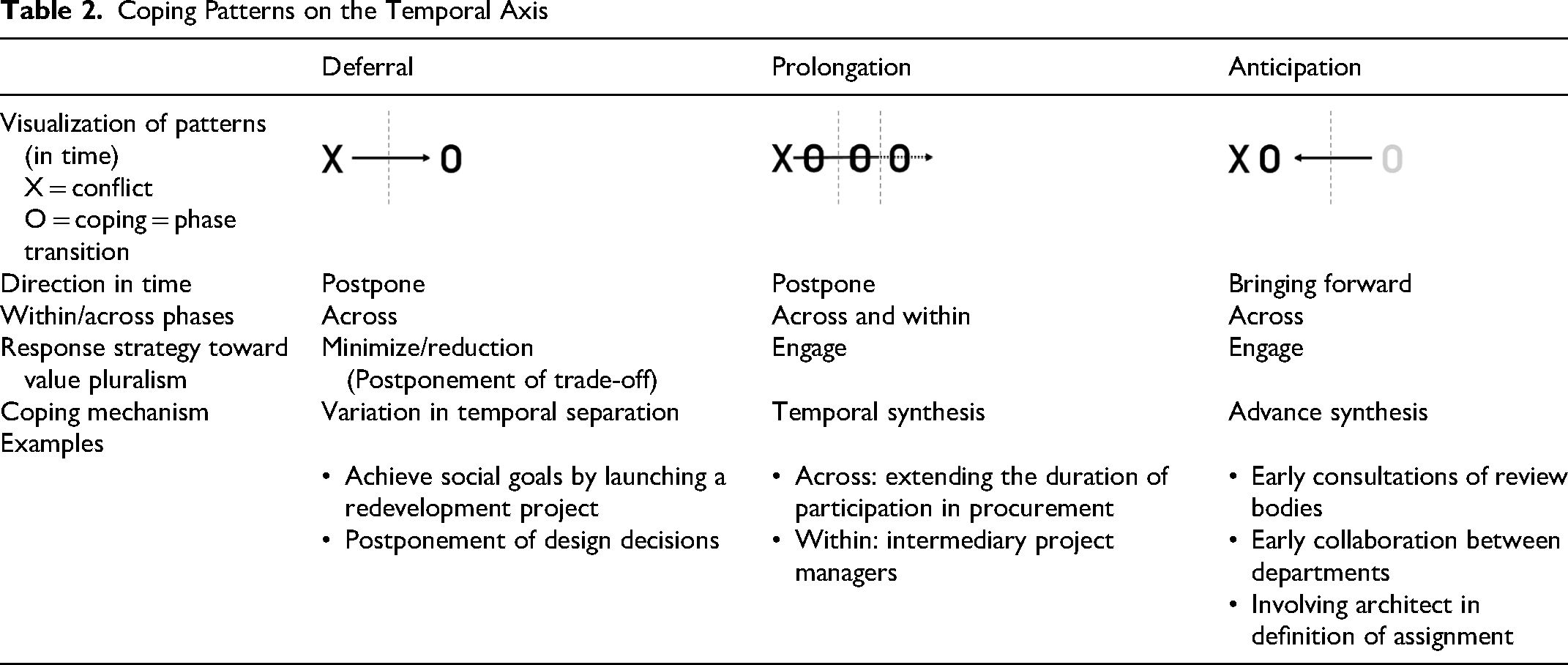
Based on our data, we have been able to identify three coping patterns in relation to the temporal dimension of projects. The following three patterns emerged in dealing with conflicts as they arose in the various conflict arenas: (1) deferral, (2) prolongation, and (3) anticipation. These patterns are summarized in Table 2 and illustrated in the following sections.
The first coping pattern, deferral, refers to situations where coping with conflicts is deferred and takes place at a later time and in another project phase than the one in which the conflict occurs, allowing other value systems to come into play. Deferral across phases enables the decoupling of certain value systems, as the composition of the groups of actors involved develops as the project proceeds. In the construction industry, decoupling is often accomplished by introducing a project, ensuring a case-based approach by way of coping. In our case, this coping pattern made specific use of the various subgroups in the project network. Choosing a project from the engineering domain to achieve societal goals allowed other backgrounds and areas of expertise to provide legitimacy for certain choices in terms of allocating budgets. In this case, many decisions on the layout of the park were made in the design phase, which is experienced as more flexible than the more strategic planning phase in which, for example, social return procurement rules are determined. The ambition to procure and develop the architectural design in a socially responsible way changed the dominant logic of the redevelopment project from efficiency and accountability to innovation and participation. Another example includes the postponement of design decisions. The initial design was the work of the architect, but certain decisions were made with the participation of residents. One such decision related to the shape of the routing: Should it be straight or curved? There was also scope for design decisions in the preparation of tenders by the local businesses. The postponement of coping brings rewards in terms of the possible trade-off options and therefore defers the conflict. Moving the coping further along the time line allows for the possibility of a change in the value interests at hand, which is why we understand this pattern as a variation in terms of temporal separation. Instead of choosing to favor a dominant logic at a specific time, this pattern defers the process to count on the value systems of actors that may be involved in a later phase of the value process.
The second coping pattern, prolongation, refers to situations where the coping takes place multiple times, spread over a longer period after the moment of the conflict, either within or across phases. Other than in the deferral pattern, in which a new trade-off situation foresees the participation of new stakeholders in a particular later phase, the prolongation pattern enables new values to slowly become embedded in the process by diminishing—but not dismissing—the influence of other value systems. Prolonging the time in which certain processes occur enables postponement of certain decisions—just like deferral—but, unlike the decoupling part of deferral, also allows for engagement with different value systems. This increases the chance of finding a value system that matches the pursued goal during different project phases. An example from our case study was the decision to extend the period of participation in the procurement phase, which was unique and enabled dissociation from certain tender procedures. Due to the fact that responsibilities are different in participatory relationships than in traditional client–contractor relationships, participation necessitates greater dependence, a point emphasized by the project manager of the tender pool: “There’s a pilot for participation with residents in the design phase and so on, but there is also local participation with the neighborhood and then you have to do something unique because otherwise you’d fall under the standard procurement policy.” (Interview 4, project perspective)
Looking at examples of this coping pattern, dealing with conflict may be more difficult because of the large number of trade-offs that need to take place at the same time, as there is no decoupling and actors are confronted with multiple value systems in a single phase, and because dominant relationships remain consistent in a phase and only actors may change their value systems. In a network environment, we see actors with multiple roles switch between value systems all the time, for example, as intermediaries. The project manager of the tender pool was contracted by the municipality and also had the task of representing local businesses and adopting their value system. This seemed to be merely a process of complex trial and error, which can be considered as temporal synthesis.
Lastly, the anticipation pattern refers to situations in which the coping takes place at the moment of conflict itself. Although the coping process or action applied would normally occur at a later phase, in this approach it is brought forward immediately. A particularly interesting aspect of this pattern is that specific roles or professions—along with their attendant tools and processes, which would normally not become involved until later phases of the project—can make a contribution toward dealing with the conflict because they are free of other obligations and can look for optimal solutions. For example, the Advisory Board on Public Space (ACOR), one of the internal municipal advisory boards required to approve the quality of the design, was consulted at a very early phase in the case study project. This created the potential for pushing boundaries in search of a solution and guided the project manager in the design and construction process of the park. Although the administrative restrictions as assessed by ACOR remained the same, taking this informal approach to qualitative assessment as a coping pattern in an earlier phase of the project allowed the integration of the various value systems. As explained by the urban district manager: “Hopefully, it also has to do with the fact that we approached and engaged ACOR [advisory board on public space] during the early stages, even before we got started. We asked them to tell us about the general lines that we had to consider.” (Interview 3, public management perspective)
Other examples of anticipation include involving the architect in the value definition phase, during the drafting of the process document when the participatory process was further elaborated, and in the early cooperation between the public affairs domain and the urban management department to align goals before internal commissioning. We saw that anticipation as a coping pattern allows engagement with other value systems by crossing project phases. By involving actors and entities from other phases and bringing them forward across the different project phases, value systems are already integrated in decision-making. Hence, we understand this pattern as advance synthesis.
Coping Patterns on the Spatial Axis
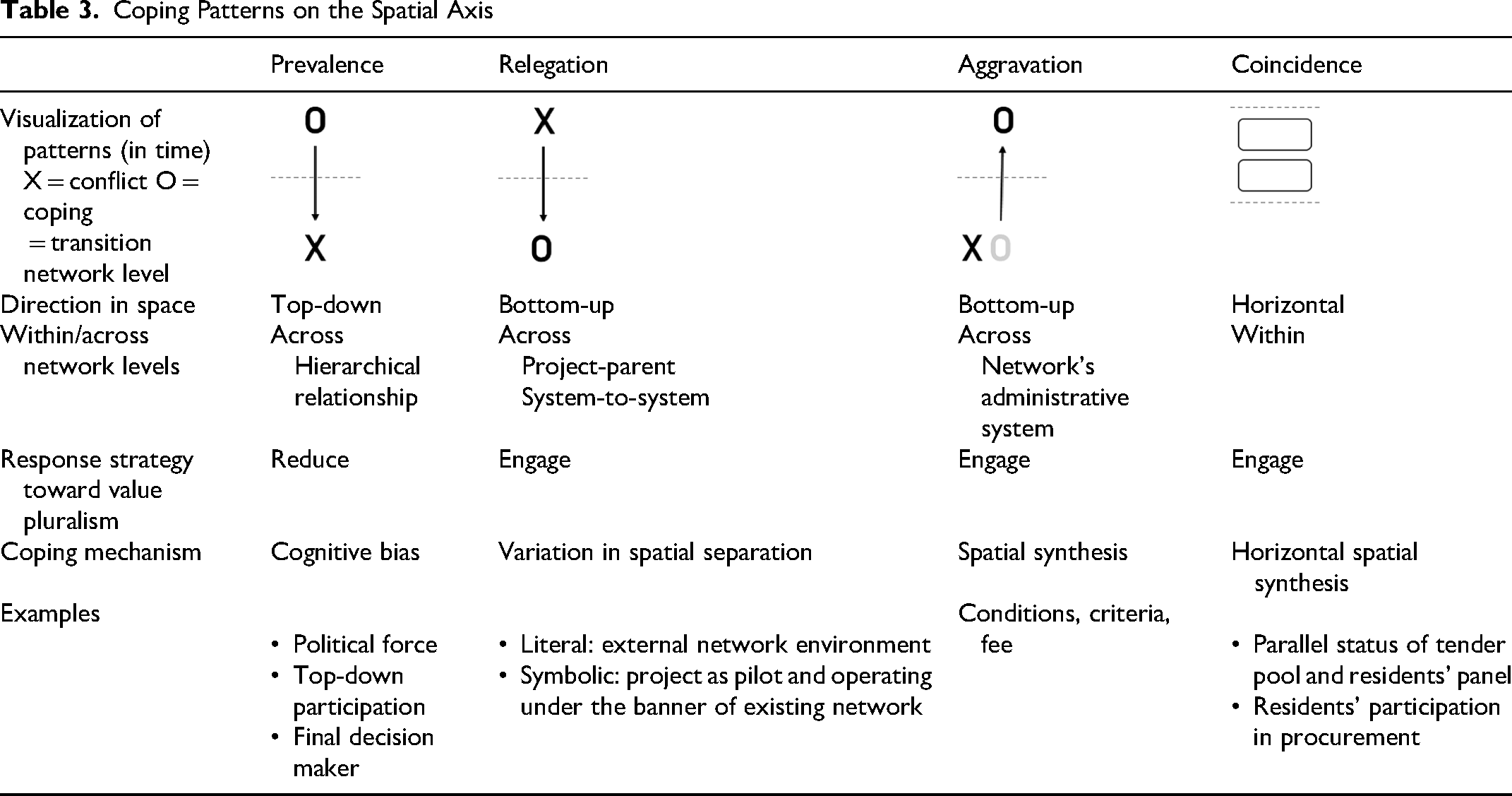
Four coping patterns were found by displacing project coping activities within and across network levels in the spatial dimension in order to deal with value conflicts that occurred in the project: (1) prevalence, (2) relegation, (3) aggravation, and (4) coincidence. These four patterns are summarized in Table 3 and illustrated in the following sections.
Prevalence, the first pattern in the spatial network dimension, refers to situations in which the coping takes place at a higher level than the one where the conflict has occurred. This implies a top-down approach in dealing with complexity, crossing the network levels by using existing power relationships and positions, for example, the top-down nature of the participatory process. Especially in situations where final decisions needed to be made in the participatory design process with residents and in the transition toward the tender phase, it was often emphasized—in both formal and informal communication—that the final decision lies with the municipality. The public client was also found to have utilized a multitude of other unnecessary minor formalizations in order to remain in control.
The aim of this pattern is to favor certain value systems over other systems, adopting bias as a way of coping. Prevalence utilizes what is usually the relatively large hierarchical distance between conflict and coping. It therefore implies focusing on one dominant logic that emanates from a hierarchical power relationship, dismissing other value systems and imposing particular value trade-offs. Although using power settings is often surrounded by negative associations, this prevalence does allow the decoupling of decisions.
The second coping pattern, relegation, refers to situations where the coping takes place at a lower level relative to where the conflict occurs. This implies a bottom-up approach in dealing with conflicts across network levels and can take the form of a symbolic or a literal displacement. For example, at one of the project meetings, ways of expanding the legal playing field of the tender pool were discussed and documented, including the symbolic act of allowing the project team to work under the banner of an existing partnership within the neighborhood. Another symbolic result of relegation would be to label the project as a pilot. An example of literal displacement is the municipality’s creation of an external network environment in the shape of the project team, allowing public actors to act outside the bureaucratic and political environments. The intersection that is being crossed is intentionally created and can therefore be understood as a variation on spatial separation, either between the parent organization and project organization or between two systems: the administrative system and the system of participation. The focus of the coping mechanism is moving away from more formal administrative and accountability value systems, either in real time, for example, by creating an external network, or symbolically, for example, by framing units or activities differently.
The third pattern of coping on the spatial axis, aggravation, refers to situations in which the coping occurs at the locus of the conflict while utilizing the value systems of higher network levels. In doing so, it crosses levels but always maintains the distinction between the values of the project network and the administrative value system of the parent organization, which means that it engages with parts of the existing value systems. For example, although the tender process was restricted by public procurement law, we observed a clear focus on adopting new types of values and relationships in the design of the process. As transparency is considered to be one of the most important values in public procurement, a process document was drawn up to explain the full process of partner selection, including the assessment criteria and decision-making procedures. In itself, this document can be seen as a defensive reaction but it accounted for some of the more creative interpretations of procurement law, interpretations which potentially reduced the accountability of the tender decision. This led, for example, to the inclusion of the percentage of social return as one of the award criteria, which is typically not permitted. In other words, while the selection process itself fulfilled the criteria of a system-based approach, it also provided at least some legal and practical leeway to look for compromises in decision-making. The municipal procurement consultant explained this as follows: “But then you are already operating in something of a gray area because, strictly speaking, that should not be used as an award criterion. Even so, that's what we did to encourage the market to deliver the highest possible percentage of social return.” (Interview 5, public management perspective)
The fourth spatial coping pattern, coincidence, refers to the situation in which two groups of network actors work in parallel at the same network level to cope with value conflicts, regardless of where the conflict occurs. It is noticeable that the tender pool and residents’ panel were set up alongside each other in the design and execution phases of the project in order to prevent conflicts of interests between the entrepreneurs and the residents. The tender process document contained a comprehensive description of how the tender pool and the residents’ panels should function in relation to each other. Yet, despite the good intentions, this resulted in a number of paragraphs so complex that even project managers had to read them several times in order to understand what was being said.
Another example of coincidence can be found in the parallel design and procurement phases, which allowed the residents’ panel to be involved in decision-making with regard to the local business tender. For example, during an information-sharing meeting for the residents’ panel organized by a commissioned business from the tender pool in December 2018, residents expressed concerns about the design of benches. This was then considered in the final plan. Coincidence at a single level of the project network creates a specific relationship among actors, who might otherwise operate on different levels of the network. Hence, the result of this pattern is horizontal spatial synthesis.
Discussion
Project networks as forms of collaborative project delivery approaches are becoming increasingly important in dealing with today’s societal challenges. In our case study on the redevelopment of a municipal park, hierarchical top-down and participatory bottom-up activities are combined in the development of the project network. This case study, therefore, provides an interesting example of a complex project network environment (Flyvbjerg, 2006). Although limited to one specific set of circumstances, our process-oriented case study provides a useful basis for theoretical generalization and development (Yin, 1994).
Firstly, the practice-based process perspective on a complex project network development enabled us to study the contextual and institutional embeddedness of project practices, embracing a broader organizational perspective on project governance (Brunet et al., 2021; Geraldi & Söderlund, 2018). We join the stream of researchers who focus on how the dynamic and social aspects of new forms of collaboration shape and are shaped by the interactions of project partners (Lundin et al., 2015; Riis et al., 2019). This research contributes to the development of knowledge on how to develop shared practices for safeguarding, coordinating, and adapting exchanges among various actors in the project (Ahola et al., 2015). Identifying several conflict arenas on the temporal and spatial axes and corresponding coping patterns (see Figure 1) offers a theoretical understanding of identifying conflict emergence and strategizing for dynamic coping patterns in project environments.
Secondly, our findings show the importance of looking beyond coping itself to address the complexity of today’s value frames (Kraatz & Block, 2008) by looking at the coping mechanism relative to where the conflict emerges in the phase and the institutional and organizational levels of a project. Looking at the coping relative to the conflict emergence elaborates on the temporal and spatial separation of current decoupling management techniques toward value pluralism (Bruijn & Dicke, 2006; Poole & Van de Ven, 1989) and shows that thinking in patterns can also benefit the flexibility of projects. Next, the patterns show that employing a coping strategy from one view (e.g., reduction) can produce an outcome that belongs to the opposite view (e.g., engagement), using its relative position to the conflict. In our case the extension of the duration of the stakeholder participation in the procurement phase led, for example, to new opportunities to include residents’ value systems in small design tasks by local entrepreneurs. Thus far, conflict management in the project management field has been mainly focused on rational–technical approaches associated with decision-making systems, such as cost-benefit and multicriteria approaches, and considers a nondirect action (like deferral) as risky (Fossestøl et al., 2015; Thacher & Rein, 2004; Tjosvold, 2008). Adding the social theory perspective from organizational science shows that the inclusion of coping patterns that engage with complexity and are associated with synthesis provide greater flexibility in the management of complex projects (Jarzabkowski, Smets, et al., 2013; Smith & Lewis, 2011).
Conclusion
Today, the complex project networks required to deliver public value confront project actors with value pluralism, originating from a plethora of competing organizational and institutional systems related to the project environment. Our case study of a participatory redevelopment process of a municipal park offers a theoretical understanding of strategizing for flexible project network governance within public–client organizations, helping them to move toward actual collaboration in complex public–private networks. We distinguished four conflict arenas and seven coping patterns along two axes of time and place to reduce and engage with complexity.
This understanding facilitates managing complex projects at the level of societal values rather than project performance alone. In current project management practices, the explanation of conflicts is still mainly sought in risk allocation related to values such as functionality, quality, impact, time, money, and quality. Our conflict arenas approach shows that there are many more reasons for conflicts and places where conflicts arise. We therefore emphasize the importance of looking at the individual and their specific context to determine the values that come into play in the pursuit of a specific ambition instead of equating the individual with their organization or position, for example, when talking about the municipality or the alderman. This insight broadens practices of stakeholder analysis.
Broadening the repertoire of actions related to coping patterns enhances the project manager’s task maturity, facilitating the appropriate risk approach in both existing and new contract forms, particularly when joint risk sharing is relevant. It also provides opportunities for steering project portfolios in the context of asset management. A better understanding of the emergence of conflict helps to better understand relational uncertainties in advance. The dynamic mechanism behind the coping patterns then also provides the opportunity to make strategic value choices for policy implementation through various projects.
Developing new network-based collaborative routines as, for example, addressed by Bresnen et al. (2004) and Bygballe and Sward (2019), could enhance the shift toward a more network-based project governance. Hence, it would be worthwhile to apply our theoretical framework and research approach to similar cases to gain insights into the development of these routines in other complex project environments. Further research could also focus on the balance between public accountability and responsibility and the impact of role changes in collaborative approaches. On the one hand, public clients have to ensure that public values, such as participation and social return, are strived for by adopting a convener or facilitating role in the project network. On the other hand, public clients must ensure that the project runs along the path of legitimacy by adopting a more traditional principal role to remain in control. Ambidexterity literature (e.g., Turkulainen & Ruuska, 2022) could support such line of inquiry and strengthen the field of project management.
Overview of Data
Footnotes
Acknowledgments
The authors would like to acknowledge Drs. ing. Gerard A. van Bortel for his involvement in the interviews. Our sincere gratitude goes to the municipality for opening up their organization. Earlier versions of part of the theoretical framework and findings have appeared in conference papers and are parts of the dissertation of the first author.
Declaration of Conflicting Interests
The author(s) declared no potential conflicts of interest with respect to the research, authorship, and/or publication of this article.
Funding
The research was supported by Dutch Construction Client Forum. The author(s) received no financial support for the authorship and/or publication of this article.
