




Abstract
The purpose of this article is to explore how different actors can operate within a project management ecosystem to sustain a pool of project management personnel with the knowledge, skills, and abilities of the standards required to support successful project delivery into the future. A new conceptual model is presented offering a set of six propositions whereby professional associations mediate the relationship between project management personnel and employers. The article advances understanding of career ecosystems theory and the new psychological contract via application to a new domain of project management. Practical implications and future research opportunities are also discussed.
Keywords
Introduction
Organizations are increasingly reliant on project performance to achieve their goals and compete in a dynamic environment (Hermano & Martín-Cruz, 2020). Projects account for around 30% of all economic activities in western economies based on empirical findings from Germany, Norway, and Iceland (Schoper et al., 2018). Moreover, “projects have become omnipresent not only in the economy but also in our society and our lives” (Jensen et al., 2016, p. 21). Predictions suggest that employers will need 87.7 million people working in project-oriented roles by 2027 and, due to a talent gap shortage, around US$207.9 billion in GDP could be lost over the decade between 2017 and 2027 (Project Management Institute [PMI], 2017). Organizations thus need to look for new ways to adapt when operating within volatile contemporary labor markets (Akkermans et al., 2020a). One opportunity is to incorporate contract project management personnel into the workforce ecosystem to offer agility and flexibility via a decentralized workforce.
Iansiti and Levien (2004, p. 5) introduced ecosystems to the field of business management, defining an ecosystem as a “system that contains a large number of loosely coupled (interconnected) actors who depend on each other to ensure the overall effectiveness of the system.” The notion of ecosystems advances Lewin’s (1951) field theory, which stated that behavior is the result of the interaction between an individual and the environment representing the totality of coexisting and interdependent forces. Subsequently, Baruch (2013) established career ecosystem theory (CET) to capture the interconnectedness, interdependencies, and interactions among different actors operating within an ecosystem. The CET has subsequently been integrated into a framework with the new psychological contract (NPC) in acknowledgment of the uncertainty of contemporary labor markets (Baruch & Rousseau, 2019). The NPC was introduced by Rousseau (1995) to capture the unspoken and unwritten rules that form an agreement between two parties that acts as an extension to the spoken and written rules of a traditional contract. However, within an ecosystem, there can be multiple NPCs in play, reflecting an increased number of actors. The framework of CET and NPC is established within the vocational behavior literature and has been applied to graduate employability by highlighting the need for sustainable careers for the benefit of all actors (Donald et al., 2020). The framework has also been applied to performance management (Gribling & Duberley, 2021). However, it has not yet been widely applied to specific professions such as project management.
This article advances previous project management literature, which has predominantly focused on the interactions between individuals and organizations (e.g., Floris et al., 2020; Havermans et al., 2019; Huemann et al., 2019; Madter et al., 2012; Savelsbergh et al., 2016). Emphasis has also been placed on career paths (Alkhudary & Gardiner, 2021; El-Sabaa, 2001), models (Bredin & Söderlund, 2013), competencies (Chen et al., 2019; do Vale et al., 2018; Li et al., 2020), and identities (McKevitt et al., 2017) from an individual agency perspective. The purpose of this article is to explore how different actors can operate within a project management ecosystem (PME) to sustain a pool of project management personnel with the knowledge, skills, and abilities of the standards required to support successful project delivery into the future.
The actors under study are project management personnel, employers, and professional associations. Project management personnel are defined by the Project Management Institute (PMI) (2021, p. 1) as any individual who is responsible for “the application of knowledge, skills, tools, and techniques to project activities to meet the project requirements.” Employers represent organizations that rely on the delivery of multiple projects sequentially and/or concurrently (Schoper et al., 2018). Professional associations exist nationally and internationally for project management and, although their approaches may vary, their overarching objectives are similar. Professional associations take responsibility for accreditation, training, and affiliation of project management personnel, while working with project management personnel and employers to develop conducts and standards for project management as a profession (Morris et al., 2006). Professional associations also offer networking opportunities and a focus on the continued professional development of project management personnel. The aim is to facilitate the delivery of projects by equipping project management personnel with the means to navigate complexity within project environments (Arnold et al., 2021; Jaafari, 2003).
The PME refers to the loosely coupled and interdependent nature of the actors to ensure the sustainability of the project management profession. Project management offers a new domain for the application of CET and NPC and is of particular interest due to the temporary nature of projects and the fact that the demand from employers exceeds the supply of personnel. Organizations need to adapt and evolve to support project management personnel to develop sustainable careers as part of a talent pipeline (Akkermans et al., 2020a). Understanding how project management personnel sustain their careers offers an antecedent for project performance and the associated benefits to employers (Ekrot et al., 2016; Hölzle, 2010).
The topic of sustainable careers is well established in the vocational behavior literature (e.g., De Vos & Van der Heijden, 2017; De Vos et al., 2020; Dixon-Fowler et al., 2020; Donald et al., 2020; Van der Heijden et al., 2020; Ybema et al., 2020). Sustainable careers have also recently been introduced to the field of project management (e.g., Akkermans et al., 2020b; Armenia et al., 2019; Geraldi & Söderlund, 2018; Lo Presti & Elia, 2020), but have yet to be contextualized within a PME incorporating NPCs. The concept of psychological contracts has, however, been applied independently in the project management literature (Kaulio, 2018). The three dimensions of sustainable careers are person, context, and time (De Vos et al., 2020). The project management personnel (person) are either employed by or contracted by employers (context). The type of relationship between an individual and an organization can change throughout their career (time). The actors operate within a PME, and NPCs exist among each of the combinations of actors (e.g., project management personnel–employers, project management personnel–professional associations, and professional associations–employers). The PME acknowledges the view of Keegan et al. (2018) that sustainability requires looking beyond the dyadic individual–organization relationship. Thus, project management personnel, employers, and professional associations can benefit from acknowledging their interdependencies and striving to ensure a sustainable pool of project talent is accessible over time.
The application of CET and NPC theories from the vocational behavior literature offers an opportunity for new insights into the field of project management and builds on initial literature that has begun to integrate the two fields (e.g., Akkermans et al., 2020b; Geraldi & Söderlund, 2018; Keegan et al., 2018). The desire is to ensure the sustainability of all actors within the PME, rather than prioritizing the needs of one actor at the expense of another actor. For example, there is an observed tendency for contract-based project management personnel to be more committed to project management than to any organization, industry, or sector within which they might carry out a project role (Bredin & Söderlund, 2011). These individuals are often dependent on professional associations for developing networks, locating future roles, and for their ongoing development since they do not have a continuing relationship with a specific employer. This highlights the crucial role that professional associations can play by acting as an intermediary between project management personnel and employers to establish, maintain, and evolve the aspects of training, accreditation, conduct, and standards.
Our focus now shifts to the development of a set of propositions and a conceptual model, before discussing the implications and opportunities for future work.
Conceptual Model Development
The Relationship Between Project Management Personnel and Employers
The relationship between project management personnel and employers has been investigated extensively in isolation within the project management literature (e.g., Floris et al., 2020; Havermans et al., 2019; Huemann et al., 2019; Madter et al., 2012; Savelsbergh et al., 2016). One area of interest is the distinction between the science and the art of project management (Newton, 2012).
The science of project management captures the structured processes and metrics of a project that can be quantified and subsequently reported. At the project management personnel level, this includes theoretical knowledge (e.g., university degree, specialist masters, professional accreditation), the technical experience of the process of delivering previous projects, and aspects of the project that can be quantified to measure performance (Ashleigh et al., 2012; Ojiako et al., 2014). The science of project management translates to the employer level through success criteria, requirements, test cases, budgets, risk management, and metrics for tracking and reporting (Chipulu et al., 2019; González et al., 2013).
The art of project management captures the aspects that are often unwritten and difficult to quantify yet play a crucial role in the determinant of project outcomes. At the project management personnel level, this includes communication, problem-solving, leadership, networking, conflict management, expectation management, and managing uncertainty (Li et al., 2020; Manata et al., 2021; Ojiako et al., 2015). The art of project management translates to the employer level through the temporary and complex nature of projects, globally dispersed and multicultural teams, responding to issues as they arise, and the role that organizational culture plays in the delivery of the project (Gibbs et al., 2017; Madsen, 2019; Wu et al., 2017). Synergy effects from a combination of the science and art of project management are particularly beneficial to project management personnel and to employers via the management of successful projects (Newton, 2012).
Furthermore, project management personnel work on a series of projects either sequentially and/or simultaneously that are temporary in nature (PMI, 2021). Project management personnel can either be employed by an organization and manage different projects over time for the specific organization or they can be contracted by an organization on a temporary basis. The decision to undertake contract-based project work instead of employee-based project work reflects a trade-off of increased career flexibility, pay, and career ownership in exchange for reduced job security and lack of additional benefits such as holiday pay (Lloyd-Walker et al., 2016). One of the interesting aspects of the careers of contract project management personnel is the paradox that completing a project increases one’s employability while ending an income stream.
To address this paradox, boundaryless and protean career theory metaphors have been adopted by the project management literature (e.g., Crawford et al., 2013; Crawford et al., 2015; Lo Presti & Elia, 2020; Lo Presti et al., 2018). These metaphors reflect the need for mobility and career ownership via a boundaryless career orientation (Arthur & Rousseau, 1996; DeFillippi & Arthur, 1994) and a protean career orientation (Hall, 1976; 2004) in response to the landscape of contemporary careers. Project management personnel thus rely on antecedents of employability and career orientation via a growth mindset and a commitment to lifelong learning for sustainable career outcomes (De Vos & Van der Heijden, 2017; Donald et al., 2018; 2019). However, those individuals in contract roles have a greater reliance on these aspects than those in employed roles due to the increased frequency of having to secure new income streams from different employers.
The choice of opting for employee-based or contract-based project roles also raises some considerations for employers. Making the right choices is crucial since organizations rely on productivity, competitive advantage, and profitability as indicators of sustainability (Donald et al., 2020; Lo Presti & Elia, 2020). The sustainability of organizations is also directly linked to the sustainability of national economies, particularly in western contexts (Schoper et al., 2018). Employee-based project roles can secure project management personnel and enable them to gain familiarity with the culture of the organization across multiple projects. This can also help in overcoming the talent gap shortages of project management personnel predicted to occur by 2027 (PMI, 2017). However, project management personnel with higher levels of employability and experience in managing similar projects in different environments are likely to enhance the chances of successful project delivery (Hall et al., 2018). Increased levels of maturity and experience in project management personnel have been shown to reduce overall project costs and enhance the probability of project success (Spalek, 2014). Contract-based roles can therefore have the potential to offer greater flexibility to the organization with increased daily pay rates offset by project cost savings and avoiding responsibility for additional employee-related benefits. Furthermore, transient experiences enable project management personnel to understand the values that give meaning to their lives and seek out projects that align with such values (Nimmi et al., 2022). Employers are likely to seek a blend of employee-based and contract-based talent and these two groups of project management personnel are likely to require different NPCs. Therefore, the construction of the PME begins with two propositions capturing the relationship between project management personnel and employers.
The Relationship Between Project Management Personnel and Professional Associations
Project management personnel have the opportunity to be affiliated with professional associations although this is not compulsory. Professional associations emphasize standards for affiliated project management personnel to adhere to (Morris et al., 2006). These standards inform best practice guidance and act as the benchmark against which certification is issued (Morris, 2001). Qualified status is often determined through a combination of an academic component and an assessed practice component (Lester, 2009). The standards and best practice guidance evolve over time (PMI, 2021) in response to the needs of actors operating within the context of a dynamic and complex PME. By experiencing affiliation through voluntary certification to a professional association, project management personnel improve their competence, signal their capabilities to employers, and develop a sense of worth driven by self-determination theory (Blomquist et al., 2018).
Professional associations may also offer networking opportunities, career development opportunities, and access to contract or permanent project roles (PMI, 2021). For example, a professional association may mandate self-reflection practices as part of the continued professional development requirements for its members (Arnold et al., 2021). Taking the time to reflect on experiential learning, including instances where a project has failed, can help the individual to identify areas for personal improvement and decrease the likelihood of repeating the same mistakes on future projects (Cicmil & Gaggiotti, 2018). The benefits offered by professional associations may be of particular interest to contract-based project management personnel or individuals transitioning from employee-based to contract-based roles during their careers. This is because contract-based personnel have to take greater responsibility for their employability and have to secure income streams from different employers more often than employee-based project management personnel (Hall et al., 2018).
Professional associations may wish to partner with project management personnel to determine how they can best support the ongoing development of these individuals. This will ensure that project management personnel have the opportunity to update their knowledge, skills, and abilities to keep abreast of the evolving nature of projects to increase the likelihood of career sustainability and retention of talent (Keegan et al., 2018). This takes on increased significance, since the gap between the demand from employers and the supply of talent is likely to grow over the next decade (PMI, 2017). The interconnected and interdependent interactions between the project management personnel and professional associations reflect the underpinnings of CET and the NPC (Baruch, 2013; Baruch & Rousseau, 2019; Donald et al., 2020; Rousseau et al., 2018). It also highlights the need for increased dialogue among the actors operating with the context of a PME. The feedback can facilitate professional associations to advocate on behalf of their members and, where appropriate, seek to address such concerns.
The process of project management personnel providing feedback to professional associations is thus a crucial element for ensuring that the needs of each actor within the PME are understood. This is particularly significant since the relationship between certification and performance remains tentative (Farashah et al., 2019). Furthermore, feedback can also provide learning opportunities whereby professional associations can disseminate knowledge through the development of communities of practice for their members. This approach has been shown to enhance innovation and performance (Choi et al., 2019). However, the extent to which professional associations currently listen to feedback from their membership and take action to support their members remains unclear. Consequently, does the NPC among these actors need to be strengthened for the PME to function more effectively?
The Relationship Between Professional Associations and Employers
Professional associations also determine the conduct and standards for employers to adhere to when conducting project-based work (Morris et al., 2006). This is a crucial role since stakeholder engagement, resource management, and policies and practices are considered essential for organizational sustainability (Larsson & Larsson, 2020). Moreover, the COVID-19 pandemic highlights the need for professional associations to help organizations navigate through complex and dynamic chance events (Arnold et al., 2021).
Employers also play a key role by helping professional associations understand the evolving needs of organizations (Arnold et al., 2021). This involves providing feedback to determine what is required to support the ongoing development of the pool of project management personnel to ensure these individuals have the opportunities to update their skills, knowledge, and abilities to meet current and future employer demands. The process enables professional associations to understand the context in which current and future project management personnel will operate capturing the three sustainable career dimensions of person, context, and time (De Vos et al., 2020). Professional associations can subsequently ensure that the continued professional development activities required of their members are appropriate and relevant (PMI, 2020). Undertaking continued professional development activities can also enable project management personnel to evidence their motivation for lifelong learning and a commitment to the project management profession (Beqiri & Mazreku, 2020). Maintaining high levels of commitment to the profession is essential, since low commitment levels to a project have been shown to negatively impact the wider project team and the likelihood of a successful project outcome (Manata et al., 2021; Tekleab et al., 2020).
Furthermore, the process of providing feedback requires employers to reflect and learn from past experiences and engage with other actors, which is indicative of the behavior of a sustainable organization (Larsson & Larsson, 2020). The evidence collected during the feedback process can also help professional associations to look at innovative approaches to address the tentative links between professional certification and project performance (Farashah et al., 2019). This can aid employers by providing a pipeline of talent and helps to ensure the sustainability of all actors within the PME.
The Mediation Role of Professional Associations
The temporary nature of projects requires employee-based project management personnel to embrace high levels of interorganizational mobility, whereas contract-based project management personnel embrace high levels of intraorganizational mobility (Crawford et al., 2013; Crawford et al., 2015; Lo Presti & Elia, 2020; Lo Presti et al., 2018). This captures a transactional approach between project management personnel and employers as discussed in P1a and P1b (Hall et al., 2018; Schoper et al., 2018). However, these actors often have different priorities regarding the notion of sustainable outcomes (Dixon-Fowler et al., 2020). From the perspective of project management personnel, sustainable outcomes might include well-being, career success, and wealth (Brown & Bowman, 2020; Burke et al., 2015; Guan et al., 2019; Lo Presti & Elia, 2020; Lo Presti et al., 2018). From the employer’s perspective, organizations may consider productivity, competitive advantage, and profitability as sustainable outcomes (Chipulu et al., 2019; De Vos et al., 2020; Dixon-Fowler et al., 2020; Donald et al., 2020).
Professional associations can encourage project management personnel and employers to find mutually beneficial ground whereby a win-win scenario is feasible, rather than purely framing each transaction as short-term wins or losses (Baruch & Vardi, 2016). This approach is essential for the sustainability of the PME by retaining existing talent and attracting future talent to the project management profession to meet the demands of organizations for such personnel (PMI, 2017; Schoper et al., 2018). The temporary nature of projects can therefore be framed as transient experiences leading to health and happiness (Fisher, 2010), rather than as being detrimental to the individual (Kidd, 2008). For example, project management personnel can construct a network of contacts. Professional networks are particularly valuable in the field of project management, because people determine project success more often than processes or systems do (do Vale et al., 2018). These networks also provide project management personnel with increased opportunities to negotiate flexible working arrangements, which can boost well-being through work-life balance (Burke et al., 2015). Increased levels of health and happiness are also linked to reduced levels of presentism and absenteeism (Baptista et al., 2019), leading to increased commitment to the profession and increased likelihood of successful project outcomes for organizations (Tekleab et al., 2020).
The opportunity for NPCs between project management personnel and professional associations and between professional associations and employers have been established through the development of P2, P3, P4, and P5, respectively. However, the opportunity also exists for professional associations to mediate the relationship between project management personnel and employers, leading to sustainable outcomes for all actors within the PME. The professional association needs to collate feedback from project management personnel and employers as discussed in the development of P3 and P5 to become aware of existing concerns, preempt future concerns, and manage conflicts of interest. Yet, this relies on feedback from individuals being valued to the same extent as feedback from employers so that all voices within the PME are suitably represented. This approach can help to align expectations among the actors during the temporary periods when they rely on one another to achieve their respective goals for career and organizational sustainability (Geraldi & Söderlund, 2018; Kaulio, 2018). The professional associations acting as mediators can draw together the beliefs and assumptions from the other actors to increase the likelihood of adherence to agreed standards for the project management profession (Morris et al., 2006). The agreed standards should develop over time to reflect the dynamic and evolving nature of the PME. Furthermore, agreed standards for the project management profession can subsequently be complemented by unwritten and unspoken agreements (Rousseau, 1995). These NPCs can subsequently help actors to develop their relationships organically to identify opportunities for optimization of the PME. Therefore, the final proposition of the conceptual model is:
Conceptual Model
Figure 1 maps the six propositions to offer a conceptualization of a PME.
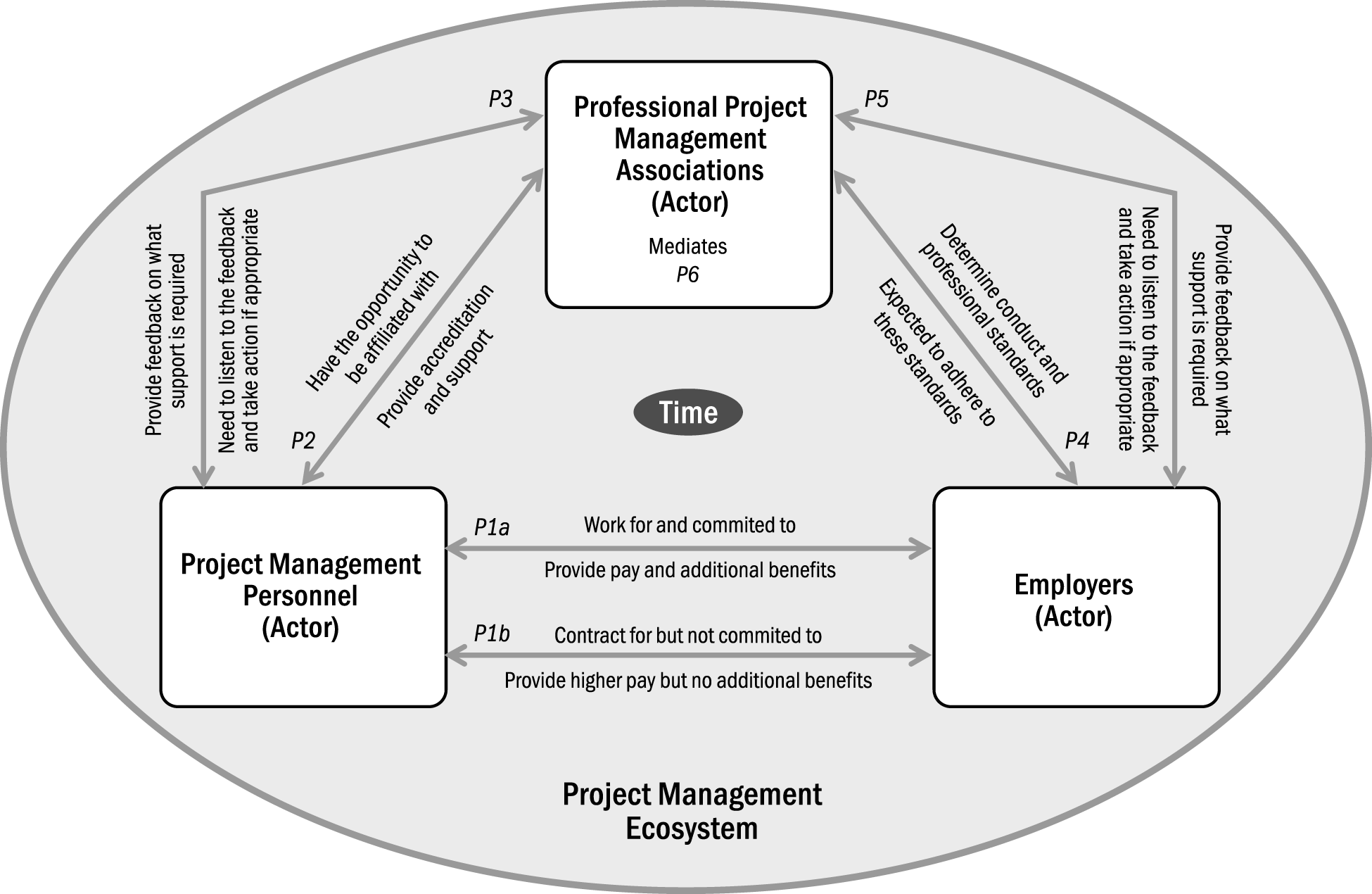
Conceptualization of a project management ecosystem (PME).
Implications
Theoretical Implications
The purpose of this article was to explore how different actors can operate within a PME to sustain a pool of project management personnel with the knowledge, skills, and abilities of the standards required to support successful project delivery into the future. The actors included within the PME were project management personnel, employers, and professional associations. The PME refers to the loosely coupled and interdependent nature of the actors to ensure the sustainability of the project management profession. A set of six propositions were developed offering a new conceptual model (see Figure 1). The PME highlights the need for project management personnel, employers, and professional associations to work collaboratively and recognize their interconnectedness, interdependencies, and interactions to achieve sustainable outcomes for all actors and project management as a profession. Understanding how project management personnel sustain their careers offers an antecedent for project performance and the associated benefits to employers (Ekrot et al., 2016; Hölzle, 2010). Furthermore, organizations need to adapt and evolve to support project management personnel to develop sustainable careers as part of a talent pipeline (PMI, 2020).
The theoretical framework of CET and the NPC has to date predominantly been developed and applied by scholars in the field of vocational behavior (e.g., Baruch, 2013; Baruch & Rousseau, 2019; Donald et al., 2020; Gribling & Duberley, 2021; Rousseau, 1995; Rousseau et al., 2018). This article advances our understanding of CET and the NPC via application to a new domain of project management and builds on initial literature that has begun to integrate the two fields (e.g., Akkermans et al., 2020b; Geraldi & Söderlund, 2018; Keegan et al., 2018). The application of CET and NPC to the field of project management is timely, since the demand from employers for project management personnel is predicted to significantly outstrip supply by 2027 (PMI, 2017). Moreover, this is a global issue, with 75% of the demand for project management personnel driven by China and India (PMI, 2017). The versatility of the conceptual model in this article, underpinned by a sound theoretical framework, offers a strong foundation on which to build and develop further. The conceptual model can thus serve as an initial point of departure to look for nuances across different settings and subsequently as a point of return to share findings, challenges, solutions, and best practices.
Furthermore, since Aareseth et al. (2017) called for scholars to address the emergent and fragmented state of sustainability in the field of project management, the topic has achieved significant attention. For example, a search of the term “project management sustainability” with a publication date of 2018–2021 in Google Scholar returns approximately 300 peer-reviewed papers. Yet, this term means different things depending on the context in which it is used (Armenia et al., 2019). Development of the PME in this article builds on the views of Keegan et al. (2018) that sustainability cannot be localized to the individual–organizational dyad. The introduction of a professional association as a mediator to the relationship between project management personnel and employers advances project management discourse from predominantly focusing on career paths (Alkhudary & Gardiner, 2021; El-Sabaa, 2001), models (Bredin & Söderlund, 2013), competencies (Chen et al., 2019; do Vale et al., 2018; Li et al., 2020), and identities (McKevitt et al., 2017) from an individual agency perspective. Moreover, this article continues to draw together aspects of sustainability from vocational behavior literature (e.g., De Vos & Van der Heijden, 2017; De Vos et al., 2020; Dixon-Fowler et al., 2020; Donald et al., 2020; Van der Heijden et al., 2020; Ybema et al., 2020) and the project management literature (e.g., Akkermans et al., 2020b; Armenia et al., 2019; Geraldi & Söderlund, 2018; Keegan et al., 2018; Lo Presti & Elia, 2020).
The theoretical contribution thus comes from drawing together the recent literature on CET, NPCs, and sustainability from the vocational behavior literature and the project management literature to offer a conceptualization of a new model. The PME is also reflective of the need for a new model that adequately captures the evolving nature of contemporary labor markets in the field of project management. The need for a blend of written contracts and psychological contracts can provide structure to the PME while allowing the flexibility to innovate and organically develop relationships among the actors.
Practical Implications
Practical implications come from understanding the interconnectedness, interdependencies, and interactions among the loosely coupled actors operating within the PME. Specifically, what do each of the actors need, and what can each of the actors provide to ensure sustainability of the PME?
Project management personnel need support from either employers or professional associations to ensure that their skill set remains relevant to an evolving labor market. Contract-based personnel are more likely to rely on professional associations, whereas employee-based personnel may place greater emphasis on employers for this support. However, project management personnel are likely to move between contract-based and employee-based roles during their careers, perhaps based on their experience, age, and other external factors (O’Neill & Adya, 2007). This further highlights the loosely coupled and interconnected nature of the actors operating within an ecosystem (Baruch, 2013), suggesting the need for employers and professional associations to work together to ensure a sustainable pipeline of talent to meet the future demands of the project management profession.
Partnering with a professional association and securing accreditation can help to signal to employers one’s ability to carry out project-based work (Blomquist et al., 2018). Project management personnel need to play a role in helping professional associations to establish and maintain a relationship between accreditation and performance (Farashah et al., 2019). Professional associations need to listen to this feedback in acknowledgment of their role as a mediator in the PME and establish new norms and standards that apply to individuals and employers (Morris et al., 2006; PMI, 2021). This also reflects the evolving nature of the PME over time.
Project management personnel should commit to lifelong learning to develop the science and art aspects of project management to realize the synergy effects and develop competence and confidence in managing projects (Chen et al., 2019; do Vale et al., 2018; Li et al., 2020; Newton, 2012). This acknowledges that a focus on enhancing employability and adopting a boundaryless and protean career orientation can act as antecedents to career sustainability at an individual agency level (Baruch & Rousseau, 2019; Donald et al., 2019; 2020; Hall et al., 2018). Furthermore, continued professional development and reflection activities can benefit the individual via a growth mindset (Lester, 2009). The benefits to project management personnel of sustainable careers include well-being, career success, and wealth (Brown & Bowman, 2020; Burke et al., 2015; Guan et al., 2019; Lo Presti & Elia, 2020; Lo Presti et al., 2018). These benefits subsequently transcend to employers via increased productivity, competitive advantage, and profitability (Donald et al., 2020; Lo Presti & Elia, 2020).
Employers need a sustainable supply of project management talent to meet the needs of their organizations. However, there is predicted to be a significant shortfall in the availability of such talent by 2027 (PMI, 2017). Organizations should consider if the acquisition and retention of employee-based project management personnel are more beneficial than contract-based project management personnel. Perhaps employers could operate a central pool of project management employees who move among projects within the same organization (intraorganizational mobility) rather than among organizations (interorganizational mobility). Such strategic decisions are likely to be determined on a case-by-case basis considering factors such as the size of the organization, the volume of project-based work, and cost. A blend of both options may be considered the optimal approach to gain the benefits of experience from individuals who have worked on multiple projects for multiple organizations and are likely committed to the project management profession, with individuals who have a knowledge of the employer and are likely committed to the organization (Bredin & Söderlund, 2011). Employers, therefore, need to consider how to attract and retain employee-based project management personnel while simultaneously strengthening their bonds with professional associations to source the contract-based talent they need on an ad hoc basis. The opportunity may also exist to offer permanent employment to personnel who perform well on initial projects in contract-based roles. This could also offer opportunities for project management personnel to transition from contract-based to employee-based work. Equally, employers need to consider how best to deconstruct jobs to offer organizational agility in response to evolving work arrangements (Jesuthasan & Boudreau, 2021).
Employers also need to communicate clearly with professional associations to articulate their current and future needs (PMI, 2021). Professional associations can then position formal training and development to provide project management personnel with a sense of identity and the competencies to manage projects now and in the future (Chen et al., 2019; do Vale et al., 2018; Li et al., 2020; McKevitt et al., 2017). The investment in training and development opportunities can also offer employers a means for talent retention.
Professional associations need to listen to their members and employers and tackle key issues head-on in acknowledgment of their mediation role with the PME. Professional associations need to make decisions that are in the best interests of all actors and clearly articulate their motivations to increase buy-in from their members and employers. If the perspectives of project management personnel are not represented or listened to then professional associations cannot become aware of their views and pass these on to employers. This risks professional associations and employers working on approaches they think will be valuable while potentially failing to address the issues that matter to the pool of talent. Through initiating open and honest dialogue, professional associations can help to identify what is needed and where areas of conflict exist. Written contracts or policies can then be established and periodically updated to reduce the ambiguity among actors and provide a solid foundation on which to build. These written contracts can then be supplemented by NPCs to facilitate the organic growth of the PME for the benefit and sustainability of all actors. This approach can help to attract and retain project management personnel, which takes on increased importance given the predicted shortfall in the supply of these individuals to meet the demands of employers by 2027 (PMI, 2017).
Benefits to professional associations include increased membership and playing an active role in the sustainability of the PME by positioning themselves as the focal point for training, accreditation, and standards (Blomquist et al., 2018; Morris et al., 2006). The dissemination of knowledge through the development of communities of practice also has the potential to enhance innovation and performance (Choi et al., 2019). This knowledge sharing can take place among members of the professional associations or among members and employers, reflecting the mediation role of professional associations within the PME.
Limitations
The conceptual nature of this article means the propositions have not been empirically tested. Opportunities for empirical testing of the model are discussed in the directions for the future research section of this article. Additionally, multiple professional associations exist at national or international levels. Understanding how these associations can collaborate while maintaining their separate statuses lies outside the scope of this article.
Directions for Future Research
The conceptual model and six propositions developed in this article could be tested through empirical research to continue to connect and advance the fields of careers and project management. Qualitative research would be particularly useful to capture the dynamic and evolving nature of the PME. Insights from the actors within the ecosystem can help to inform the future of work landscape and continue to strive for sustainable outcomes for all actors. The themes from qualitative findings could subsequently be validated via quantitative research to provide an evidence-informed approach to strategic decision-making, training, and policy.
An opportunity also exists to build on existing literature examining the university-to-work transition and how the science and the art of project management can be taught and learned. For example, can professional associations support higher education institutions in aligning course pedagogy with employability congruence to acknowledge the role of employability as an antecedent to a sustainable project management career (Ashleigh et al., 2012; Ojiako et al., 2014)? This could also incorporate insights into the impact of national government decisions to pursue a neoliberal approach to higher education.
Longitudinal research could aid in understanding the impacts of the COVID-19 pandemic as a global chance event on project-based work across different sectors of the economy. For example, how has flexible and remote working helped or hindered project management personnel and organizations? Have project management personnel left the profession and exacerbated a preexisting gap between demand and supply? If so, what factors have contributed to their departure, and what actions can be taken by professional associations and employers to mitigate these risks? The views and career paths of project management personnel who have left the profession are underrepresented in the literature compared with project management personnel who remain active in the profession or have retired. This is likely due to the difficulty in accessing these specific participants. Consequently, can professional associations conduct and support research via informed consent based on comparing current and previous membership lists?
Finally, an understanding of the challenges that employers expect to face over the next decade would facilitate forward planning rather than adopting a reactionary approach. Specifically, acknowledging that more than 75% of the demand for 87.7 million project-orientated roles by 2027 will be from India and China (PMI, 2017). This would facilitate the development of a pipeline of future project management personnel with the necessary competencies and abilities to deliver the projects that will define the future sustainability of employers and the wider ecosystem.
Conclusion
This article explored how different actors can operate within a project management ecosystem to sustain a pool of project management personnel with the knowledge, skills, and abilities of the standards required to support successful project delivery into the future. The fields of vocational behavior and project management were connected and advanced via the development of a new conceptual model (see Figure 1) offering a set of six propositions, whereby professional associations mediate the relationship between project management personnel and employers. This article also advanced understanding of CET and the NPC via application to a new domain of project management. The model and propositions offer an opportunity for interdisciplinary and transdisciplinary research between vocational behavior and project management scholars to conduct empirical studies to test the propositions from this conceptual model and to quantify and qualify the dimensions of a PME.
Footnotes
Author Biography
 He can also be contacted at w.e.donald@soton.ac.uk