




Abstract
Professions are undergoing a significant change in how they integrate environmental and social objectives into their core values. This article examines the situation in which those working in the project management profession are expected to work under contradictory sustainability constraints. In this article, we investigate the tensions project managers experience when addressing sustainable objectives. Results show that when tensions arise over sustainable objectives (temporality of objectives, organizational barriers, and lack of control), they are addressed only when anchored to an economic one in the form of a business case for sustainability. We also find that when matching traditional project objectives with sustainable ones is not possible, practitioners enact a set of reactions characterized as greenwashing, it can’t be one person, no space for sustainability in my job, other actors involved, or pushing back, depending on the specific project context. Adopting the paradox theory lens, we provide an alternative approach to the business case for sustainability. The practical contribution of this article lies in suggesting the need to find strategies to embrace paradoxical situations and we provide some suggestions to illustrate this.
Keywords
Introduction
Countless academic studies have coupled the concepts of sustainability and project management (Aarseth et al., 2017; Huemann & Silvius, 2017; Marcelino-Sádaba et al., 2015; Sabini et al., 2017; Silvius & Schipper, 2014), so much so that these concepts have become recognized as a new school of thought within the project management stream (Silvius, 2017) often referred to as sustainable project management (SPM; Sabini et al., 2019; Silvius & Schipper, 2014). In parallel with academia, the professional world is also experiencing a transformation of traditional project management (Code of Ethics and Professional Conduct, International Project Management Association [IPMA], 2015; Project Management Institute [PMI], 2010, 2016), where professional boundaries and duties have widened to include social and environmental aspects in the development of the project (Huemann & Silvius, 2017; Sabini, 2016; Sabini et al., 2017).
Whether those sustainable objectives are developed in accordance with Elkington’s original triple bottom line (social, environmental, and economic; see Elkington, 1997) or using the 17 United Nations Sustainable Development Goals (SDGs; sustainabledevelopment.un.org), these transformations in project management create a complicated balance of different conflicting objectives. Indeed, the 17 SDGs indicators interact with each other, creating synergies and trade-offs (Pradhan et al., 2017) and frequently the “progress in one indicator has been connected in the past and the present with an obstacle in fulfillment of another and vice versa” (Pradhan et al., 2017, p. 1171). Indeed, the SDG7 indicator 7.1.1—“proportion of population with access to electricity”—has been met in some developing countries by expanding non-renewable energy sources (Wamukonya, 2003).
As shown, these conflicts emerge when translating high-level sustainability goals into lower-level practical indicators. In the same way, the broad concept of sustainable development as defined by the Brundtland (1987) 1 contrasts with the complexity engendered when this concept is considered practical, in day-to-day project decisions. Any decision made regarding a sustainable objective (e.g., implementing indoor sensors to constantly monitor air quality) could be an impairment to another sustainable objective (e.g., cutting electricity consumption).
Indeed, it is extremely difficult while implementing a project to establish a series of objectives that fulfill the abstract definition of sustainability in its entirety (meeting simultaneously environmental, social, and economic criteria). An example of a trade-off comes by looking at stakeholder management, which advocates for simultaneous consideration of all legitimate interests, even if they are conflicting (Donaldson & Preston, 1995). In this sense, “sustainability confronts managers with situations in which they need to simultaneously address multiple desirable but conflicting economic, environmental, and social outcomes at firm and societal levels that operate in different time frames and follow different logics” (Hahn et al., 2014, p. 466) and this is particularly true for project managers.
The introduction of sustainability concepts in the project management profession has radically changed the overall approach to the management of the project (Sánchez, 2015). Indeed, different sets of institutional actors push in different directions, exacerbating existing paradoxes or creating new contradictions, rather than resolving them (Sabini & Muzio, 2017; Sabini et al., 2017; Sabini & Paton, 2021). Very often a win-win solution is proposed (Carvalho & Rabechini, 2017; Gareis et al., 2011; Martens & Carvalho, 2016; Yuan, 2017) that privileges the economic aspect and emphasizes the business case. In this burgeoning literature, there are some growing considerations on how decision makers (i.e., project managers) approach sustainability issues (Silvius & Schipper, 2020; Silvius et al., 2017); however, very few reflections address the nature of the tensions decision makers face.
In this article, we seek to address this gap with a more critical perspective to analyze how sustainability is understood and the obstacles to achieving sustainability within projects. Indeed, a critical outlook for the consideration of sustainability within project management will move beyond the traditional business case for sustainability, which emphasizes the adoption of a given sustainable objective only when an economic one is also achieved, described as a win-win paradigm by Hahn et al. (2010). A more critical consideration of these trade-offs could help project managers to deal with paradoxical situations and develop new creative solutions to what are highly complex problems. Using the paradox theory lens, we argue that to achieve sustainable objectives, project managers need to concede that some trade-offs are not solvable, and therefore need to focus on managing rather than solving the arising projects’ paradoxes.
Therefore, the research questions are: What tensions do project managers experience when facing trade-off decisions on sustainability-related objectives? And how do they react to these tensions? The answers to these research questions contribute to the sustainable project management literature on three points. First, by providing empirical evidence of the tensions project managers experience when facing trade-off decisions about sustainability. Second, by providing a critical perspective on the consideration of trade-off decisions about sustainable issues often overlooked in the literature. And, third, by suggesting possible strategies to enable project managers to deal with unsolvable paradoxical situations emerging in project contexts.
In the next section, we review current project management literature dealing with sustainability and the arguments for a more sustainable form of project management, suggesting that this view is predominantly focused on the business case perspective. We then provide some methodological details of the research that generated evidence of practitioner responses to this issue and analyze these responses in terms of the broad themes that emerge in the form of the tensions arising from the need for trade-offs and the reactions expressed by practitioners. We then suggest some strategies to embrace paradoxical situations and discuss conclusions and directions for future research.
Literature Review
Sustainable Project Management—Base Definition
Although the concept of sustainable development is broadly used in different contexts with different meanings (Gregersen et al., 1994), its definition has been set since the report of the Brundtland Commission (Brundtland, 1987). However, the concept of sustainable project management has traditionally lacked a clear definition that effectively encompasses all the different “dimensions of sustainability” (Silvius & Schipper, 2014, p. 71). For our purposes, we use the Silvius and Schipper (2014) definition, which derived from a systematic review, embedding the broad meaning and different dimensions of sustainable project management as follows:
Sustainable Project Management is the planning, monitoring and controlling of project delivery and support processes, with consideration of the environmental, economical and social aspects of the life-cycle of the project’s resources, processes, deliverables and effects, aimed at realising benefits for stakeholders, and performed in a transparent, fair and ethical way that includes proactive stakeholder participation (Silvius & Schipper, 2014, p. 79).
The comprehensive nature of this definition is at the same time an advantage and a limitation to its use. The construct that Silvius and Schipper (2014) define relies on the development of project management activities “with consideration of the environmental, economic and social aspects.” Therefore, studying sustainable project management is studying any project that delivers a product or a service in a sustainable way. The biggest misunderstanding (or misinterpretation) over this topic resides in studies of projects that develop a sustainable product or service (e.g., wind turbine, solar power plant, energy efficiency buildings, waste reduction systems), rather than a project that also considers sustainability in its processes. The literature has clarified this misunderstanding by explaining that sustainable project management refers both to (1) projects that deliver a sustainable good or service—“sustainability by the project” and (2) projects delivered following sustainable processes—“sustainability of the project” (Huemann & Silvius, 2017, p. 1066).
Sustainable Project Management—The Business Case for Sustainability
The project management literature identifies several reasons for adopting sustainable business practices into a project, including in particular: the moral imperative (Silvius et al., 2013), organizational resilience (Perrini & Tencati, 2006), the organization’s economic prosperity (Gareis et al., 2011), long-term performance (Russell & Shiang, 2013), and improving technological performance (Brent et al., 2007). However, one of the most popular bases to justify the adoption of sustainable business practice is the economic one. The consideration of sustainable objectives in relation to a positive economic effect is a common denominator in both general management (Schaltegger et al., 2019; Whelan & Fink, 2016) and project management studies (Brook & Pagnanelli, 2014; Carvalho & Rabechini, 2017; Dalcher, 2012; Gareis et al., 2011; Herazo et al., 2012; Martens & Carvalho, 2016; Russell & Shiang, 2013; Yuan, 2017). The argument for this resides in the classical economic motive, whereby those who consider sustainability while implementing projects obtain a better economic performance. With this argument, researchers aim to persuade even the most skeptical managers of the importance of sustainability beyond the moral imperative or basic ethical considerations (Silvius et al., 2013). Adopting an even more pragmatic rationale, Ebbesen and Hope (2013) demonstrate that in everyday projects, even if the connection between sustainability and success is not completely clear, it is important, especially in specific industries, to consider it in order to stay in business.
Thus, sustainability concepts work as a facilitator, influencing simultaneously both strategic and operational levels (Aarseth et al., 2017), making it easier for an organization to reach its objectives. Herazo et al. (2012) demonstrate how, in construction projects, if sustainability is taken as a guiding principle for every project, it facilitates project approval by aligning different organizational levels (from tactical to strategic) and different stakeholders (internal and external). By working as a catalyst in this alignment, sustainability becomes a very important factor in fulfilling organizational performance goals. A similar perspective is apparent in infrastructure projects, such as in the railway sector (Yuan, 2017), where overall project success is undermined by disparities among stakeholders’ perceptions regarding the achievement of project sustainability. In particular, government agencies focus on economic sustainability (facing the challenge of driving the local economy in the long term), while environmental protection organizations pay more attention to environmental criteria (ensuring the project is implemented in an environmentally friendly manner). The reconciliation of these disparities and the consequent achievement of sustainable criteria for all different stakeholders are essential to achieving project success.
Looking at improvements that sustainable project management could lead to, Gareis et al. (2011) (also Dalcher, 2012) note that the benefits of SPM are better exploited when change happens at the level of the core processes of an organization. Specifically, this refers to the project management processes: at the start of the project, through continuous coordination, in project control, and in project close. Gareis et al. and Dalcher argue that consideration of sustainability principles enables organizations to “better cope with the complexity and dynamics of projects” through a “reduction of project crisis situations, project cancelations and interruptions, and fluctuation of project personnel” (Gareis et al., 2011, p. 64). Therefore, the focus on sustainable aspects of a project (or having a sustainable perspective), by pushing project managers to consider negative social and environmental impacts, improves overall project success (Carvalho & Rabechini, 2017).
In describing the contribution of sustainability to project success, Martens and Carvalho (2016) distinguish between success in project management and success in projects. In this sense, they consider sustainability to be not necessarily contributing to project management success (that is the direct action of the project manager in technically planning and managing project activities), but certainly contributing to the overall project success (meeting the initial objective and other benefits planned for the organization as a whole). Striving for sustainable objectives, which are about the perpetuation of the economic, environmental, and social benefits of the projects will, they suggest, inevitably lead to overall project success (Martens & Carvalho, 2016). Moreover, in looking at the personal choices of project managers regarding sustainable objectives, Silvius et al. (2017) found that triple-constraint criteria (time, cost, and quality) tend to dominate project managers’ decision-making processes and “only a limited number of sustainability criteria were taken into consideration by the project managers when making their decisions” (Silvius et al., 2017, p. 1146).
The Role of the Project Manager
It is clear from the project management literature that project managers face trade-off decisions when trying to reconcile sustainability-related objectives with conventional triple-constraint criteria; to date, there has been no effective exploration of the tensions that arise as a result. Most recently, research exploring the role of the project manager has identified the central and influential position project managers hold regarding decisions over sustainability matters (Marnewick et al., 2019; Poon & Silvius, 2019; Silvius & de Graaf, 2019; Silvius & Schipper, 2020). Indeed, as discussed above, the project manager’s central position in the project offers the opportunity to steer the project toward multiple objectives. Factors inducing project managers to include sustainable objectives arise from many different influences. Silvius and Schipper (2020) argue that understanding the human behavior of the project manager can benefit the SPM literature by providing an individual perspective.
The main contribution of this recent stream of literature is that project managers, when considering or embedding sustainability in their projects are influenced by different factors: intrinsic motivation, compliance (task driven), and pragmatism (Silvius & Schipper, 2020). The first factor refers to the will to address sustainability that comes from the personal principles of the practitioner. Second, task-driven practitioners are instead driven to comply with the “project’s assignment and the opinion of others” (Poon & Silvius, 2019, p. 93). Third, the pragmatic project managers are “not strongly self-motivated for sustainability, but will address it when they see a good application for sustainability” (Silvius & Schipper, 2020, p. 361).
This analysis suggests that only the intrinsic motivation to address sustainability will effectively stimulate serious considerations on the matter. However, if intrinsic values drive decisions on sustainability, a practitioner endowed by strong sustainability values will be experiencing an increase in the tensions and trade-offs that competing sustainability objectives generate. Conversely, the other two factors (task driven and pragmatic) are more likely to reinforce the concept of the business case for sustainability or the win-win paradigm as the determining influence.
Sustainability Tensions and Paradox Theory
When looking at sustainability-related trade-offs, the literature typically categorizes them as long-term (sustainability-oriented) versus short-term (project-oriented) objectives (Carollo & Guerci, 2018; Etzion et al., 2017), contradictions that emerge when dealing with opposing stakeholder interests (Cuganesan & Floris, 2020), or competition over scarce resources (Iivonen, 2018). When these trade-offs appear, the traditional logic driving decision-making is the business case; in other words, sustainable objectives are pursued only when an economic element is achieved at the same time (Aarseth et al., 2017). Challenging this vision, can unleash the full potential of innovations coming from the adoption of sustainable objectives (Hall & Vredenburg, 2003). In the traditional vision, sustainability issues are considered pragmatically (and often marginally) only in conjunction with positive economic benefits for the organization.
However, decoupling the pursuit of sustainable objectives from economic objectives leaves decision makers (i.e., project managers) with a “persistent contradiction between interdependent elements” (Schad et al., 2016, p. 10) and it is “usually more complex (because there is typically a wider range of stakeholders) and more ambiguous (as many of the parties have contradictory demands)” (Hall & Vredenburg, 2003, p. 61). The topic is not new; as Smith and Lewis (2011) noted, scholars have investigated several types of organizational tensions: collaboration-control (Sundaramurthy & Lewis, 2003), individual-collective (Murnighan & Conlon, 1991), flexibility-efficiency (Adler et al., 1999), exploration-exploitation (Smith & Tushman, 2005), and profit-social responsibility (Margolis & Walsh, 2003).
Therefore, since “paradox theory provides multiple approaches to managing persistent contradictions among conflicting elements” (Pinto, 2019, p. 186), we frame our work borrowing from the related field of corporate sustainability strategies to deal with paradoxical situations (Hahn et al., 2010, 2014; Maletič et al., 2014; Van der Byl & Slawinski, 2015; Winn et al., 2012). In particular, we draw on Hahn et al. (2014), who distinguished between two contrasting cognitive frames used in this process: the business case and the paradoxical frame. The first frame leads the manager to focus only on the environmental and social aspects aligned with economic objectives (i.e., sustainability issues are considered pragmatically in conjunction with positive economic benefits for the organization). The second frame leads managers to develop a dual interpretation of sustainability issues, accepting the fact that addressing various “desirable but interdependent outcomes simultaneously leads to a risk of unintended consequences” (Hahn et al., 2014, p. 465).
To handle this dual interpretation of sustainability issues, Hahn et al. (2015) propose an integrative view, which allows (project) managers to pursue different aspects of sustainability even if they are contradictory. Therefore, contrary to the dominant instrumental (or business case) logics that base decisions on a hierarchy of expected outcomes, in the integrative view “sustainable performance measurement[s] needs to be undertaken without an a priori predominance of any of these dimensions” (Hahn et al., 2015, p. 299, citing Hahn & Figge, 2011).
According to the integrative view, (project) managers have to carefully choose strategies to manage these paradoxes, because with a traditional business case logic, it is clear that a solution to one issue could be detrimental to that of another. Research on paradoxes has suggested that they can be dealt with more easily using either acceptance strategies, in other words, opposition or resolution strategies, in other words, separation and synthesis (Poole & Van de Ven, 1989; Smith & Lewis, 2011). With acceptance strategies, the different sources of the tension are dealt with at the same time, leaving the paradox open (opposition). With resolution strategies, the decision maker can either deal with sources of the tension in a different time or space (separation) or develop a completely different perspective that eliminates the sources of the tension (synthesis).
This literature review identifies that project managers are central to sustainability-related decision-making in projects. As such, they face inevitable trade-offs stemming from contradictions that arise when trying to reconcile sustainability objectives with economic business objectives and the conflicting requirements of multiple stakeholders. What the literature has little to say about, however, is how these contradictions manifest themselves and the specific form of tensions that project managers face in the project setting. We also know little about the reactions of project managers to these sustainability paradoxes and contradictions. We therefore apply a paradox theory lens and the framework of Hahn et al. to identify and investigate the tensions project managers face when introducing sustainability considerations into the project context, characterize their reactions to such tensions, and suggest strategies that might help them deal with these tensions.
Methodology
To investigate the tensions project managers experience when facing trade-off decisions on sustainable related objectives and their respective reactions, we adopted a qualitative methodology based on semistructured interviews with key people in the professional project management associations. This approach is consistent with an exploration of what is still an emerging phenomenon (Yin, 2009) and allowed an in-depth exploration of the knowledge and experience held by individuals on this topic (Bryman & Bell, 2011).
Data Collection
The data used for this research have been collected as part of a larger European Union (EU) funded project on sustainability in project management (Marie Sklodowska-Curie action, H2020-MSCA-IF-2014, project 655265). The selection of possible respondents exploited background research into the professional project management associations, along with personal contacts with members of those associations. To draw out the process of practitioner sensemaking with regard to sustainability issues, we used qualitative semistructured interviews. These in-depth interviews were conducted between May 2015 and September 2016, with 14 respondents holding key positions within six different professional project management associations and communities of practice (Table 1). The sampled practitioners in combination have extensive experience in a wide range of industries (as evidenced by their varied career backgrounds) and represent a repository of key issues in the project management profession (as holders of key positions in their respective professional associations). The outline of the interview schedule is shown in the Appendix at the end of the article.
Respondent Description
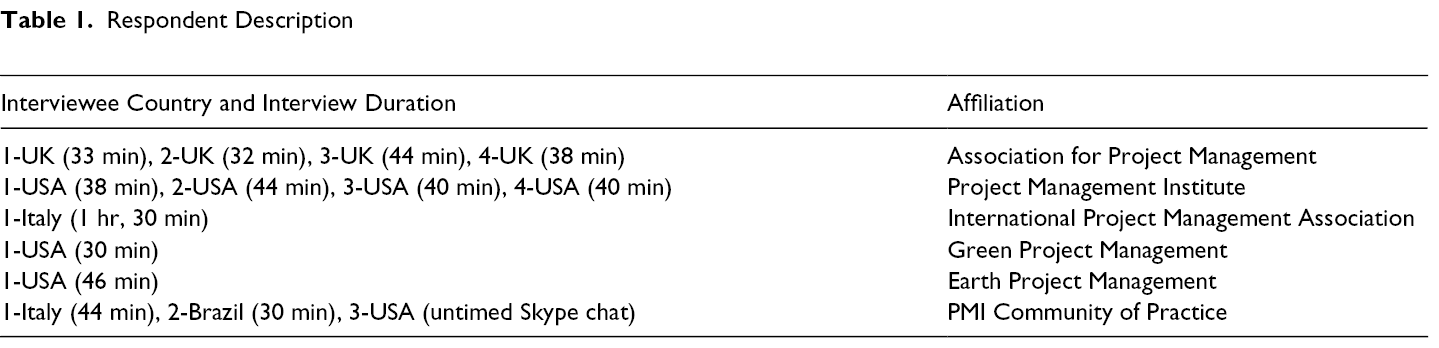
The interviews followed a standard protocol; lasted between 30 and 90 minutes; and were recorded, transcribed, anonymized, and entered into NVivo11 for subsequent analysis. Interview questions were designed to elicit respondents’ views on sustainability, the strategic decisions they had been faced with in the context of sustainability, and the issues and obstacles faced with regard to achieving sustainability.
Data Analysis
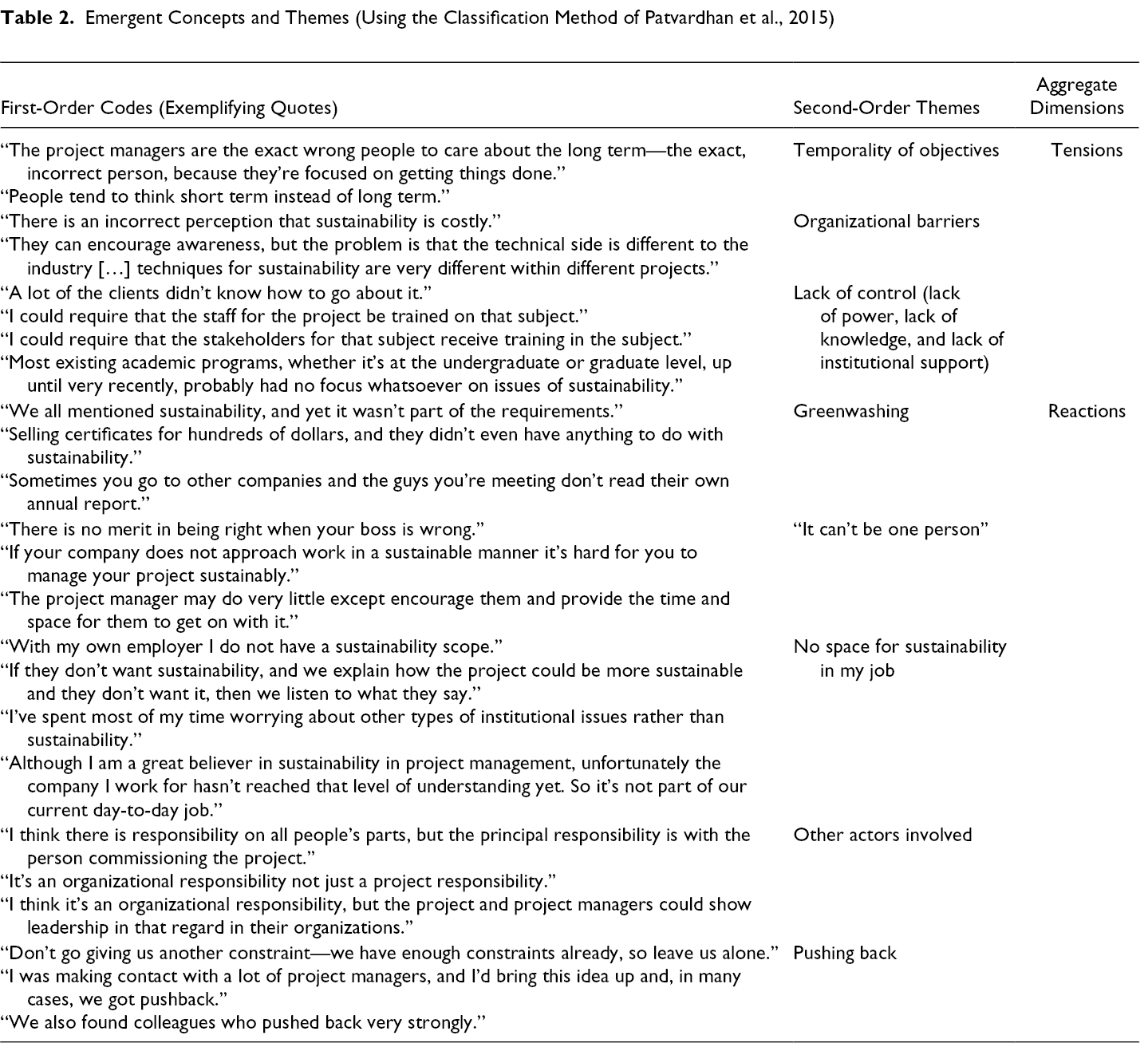
The coding of the semistructured interviews followed a grounded style approach (Gioia et al., 2013; Strauss & Corbin, 1998). With the overarching research question in mind, interview transcripts were coded, allowing first-order concepts to emerge from the text of individual responses, an approach that “tries to adhere faithfully to informant terms” (Gioia et al., 2013, p. 20). We grouped the second-order themes from the first-order codes derived from the narrative of the interviews. The second-order themes are further grouped into two aggregate dimensions: tensions and reactions. This second order embraces “themes, dimensions, and the larger narrative” (Gioia et al., 2013, p. 20); in this case, centered on the tensions experienced by the respondents and their reactions to those tensions. Hence, the coded data led us to isolate different views on sustainability, which we grouped into ten recurring first-order concepts and two second-order themes, following Gioia et al. (2013).
We organized the findings in the next two sections in accordance with the two aggregate dimensions of tensions and reactions (Table 2). In particular, we framed the reactions as responses to the arising tensions, acknowledging that the interviews were not focused on specific projects in a way that would clearly identify the causal links between specific tensions and specific reactions.
Emergent Concepts and Themes (Using the Classification Method of Patvardhan et al., 2015)
Findings
Tensions
The set of tensions that emerged from our data sample are associated with (1) the diverse temporal dimension of sustainable objectives; (2) the presence of organizational barriers; and (3) the lack of control over the process, including a lack of knowledge on best practices and a lack of institutional support.
Temporality of Objectives
A mounting tension emerging strongly from practitioners’ discourse reflects the inherent contradiction between the short-term nature of projects and the long-term focus of sustainability. How can objectives in a long-time horizon be met while implementing a short-term oriented project? Long-term oriented concepts collide with the traditional short-term ones in project management: “The project managers are the exact wrong people to care about the long term; the exact, incorrect person, because they’re focused on getting things done” (interview 13). In the view of another practitioner, the origin of this tension stems more simply from “the fact that people tend to think short term instead of long term” (interview 11). In part, this reflects the fact that most senior managers have been trained in a world in which project management has focused only on “two or three techniques. The project manager was glued to his charts and was just looking after the numbers” (interview 14) and this implies they are not equipped to deal with sustainability issues.
Organizational Barriers
Organizational barriers are also a source of tension. Practitioners interviewed reflected on the contradictions emerging in their everyday practices, often viewing this as a barrier to SPM implementation and evident in their discourse when reflecting on attempts to implement SPM in their everyday tasks. The security of the project manager and their career appears at odds with the pursuit of sustainability through SPM. “I’ve had people tell me that they’re afraid they’ll lose their job if they manage their project sustainably” (interview 12). This consideration was also reflected in the difficulty respondents reported in demonstrating benefits and convincing others of the value of pursuing sustainability in their projects; much of this could be attributed to the unpredictability of outcomes:
It’s not an easy decision, and you’ve got to think about it before you do it. When you’re trying to adopt some of the novel activities, such as using the structure as a heat sink, then it’s difficult to predict exactly what’s going to happen. There may well have been tests in laboratories, there may well have been a prototype or been done on a smaller scale, but not quite in this specific situation, so you’re not sure that you’re going to get the return (interview 2).
From these anticipated complexities, very often practitioners are bounded by the financial constraints on the organization, since “there is an incorrect perception that sustainability is costly” (interview 11). This is very often the result of considering the expected benefits only in the short term and overlooking the benefits that the consideration of sustainability can bring in the medium to long term. Practitioners trying to introduce these considerations into their projects often become discouraged, for example “if I can say that you’ll save £30,000 over 50 years, but if prices go up, you’ll save £50,000, [or] if the building lasts 60 years, it’ll save even more. But we don’t know” (interview 2). The need for organizational buy-in was also referred to: “If your company does not approach work in a sustainable manner, it’s hard for you to manage your project sustainably” (interview 12) and “it’s an organizational responsibility not just a project responsibility” (interview 6).
Lack of Control (In Terms of Power, Knowledge, and Institutional Support)
In addition to organizational constraints a sense of lack of control was also evident, which was sometimes connected to the lack of comprehensive knowledge on sustainability among the various project partners (not just on the part of the project manager). Very often, “a lot of the clients didn’t know how to go about it” (interview 2). Indeed, considering how to approach sustainability in their projects, some respondents suggested the importance of training before embarking on attempts to achieve sustainable outcomes: “I could require that the staff for the project be trained in that subject…” and “…I could require that the stakeholders for that subject receive training in the subject” (interview 7). For these reasons, it is of primary importance for practitioners to acquire a good understanding of sustainability. Unfortunately, some practitioners report a lack of education because of shortages of courses and modules at the university level: “Most existing academic programs, whether it’s at the undergraduate or graduate level, up until very recently probably had no focus whatsoever on issues of sustainability” (interview 6). However, according to an experienced practitioner, there is a glimmer of hope since young project managers now “have a much greater awareness of the impact of their work on the environment” (interview 1).
Lack of power is also an emerging source of tension. This seems to arise from a conflict of power over decisions regarding SPM: “There was an example given to me of a factory that sent boiling water out to the river. The project manager wanted to put a system on the pipe to cool the water before it went out to the river. Who is responsible if his leadership says no?” (interview 12). This can suggest that perhaps the project manager is the wrong person to take on the responsibility for sustainability matters. However, more critical practitioners recognize that some responsibility may have to rest on the shoulders of the project manager, otherwise they are:
not recognizing that there’s anything to do but to get their project done at all costs, because their stakeholders and their sponsors want it done, and that means they’re leaving out things like social responsibility; they’re leaving out things like environmental concerns, and they’re leaving out any long-term concern (interview 13).
One can see how the conventional rationalistic frame of project management might lead project managers to view the solution in rationalistic terms, such as requirements capture: “[the tension] has also to do with how requirements are captured. If you are capturing requirements only in terms of functionality, costs, and time, et cetera; or if you are actually considering requirements in terms of sustainability as well” (interview 11).
The last source of tension that emerged from our data links to the level of institutional support project managers receive. Often institutions have their own long-term goals, and coupling project objectives with organizational ones can provide practitioners with the institutional support they are lacking: “It does make sense to use the more expensive material, if I change my timeframe, if I latch onto the company’s proper objectives, […] the ones they’re telling the world they believe” (interview 13).
Summary
The introduction of sustainability considerations introduces tensions into projects that reflect different temporal dimensions of sustainable objectives, obstacles within the organizational/project context, and lack of control experienced by project managers resulting from deficiencies in knowledge and institutional support. These tensions lead practitioners to adopt defensive mechanisms that we label as reactions. The next section describes and discusses these reactions.
Reactions
From the interview data, five different types of reactions emerged through the NVivo analysis as second-order themes: (1) greenwashing; (2) “it can’t be one person”; (3) “no space for sustainability in my job”; (4) other actors involved; and (5) “pushing back.” These themes are described in the following subsections.
Greenwashing
The concept of greenwashing reflects the perception that SPM is often treated more as a tool to support a claim to be green than to actually implement SPM practices. Being compliant with sustainability requirements is a good thing for an organization; therefore, the practice of greenwashing is a very common shortcut taken to improve organizational reputation:
… they wanted for it to look good when they had visitors. Like you say, it looks good, it feels like…they wanted that sort of feel, and they wanted features in it that made sense … we all mentioned sustainability, and yet it wasn’t part of the [formal] requirements (interview 2).
Nonetheless, practitioners’ reflections also pointed to another kind of greenwashing. They condemn SPM when it becomes a lucrative activity with no real references to true sustainability topics:
“They literally said, send us a résumé, or CV, give us an example of a green project management you’ve worked on, include U$300, and here’s your certificate” (interview 13).
“It’s very American and it’s very… If you listen to him, he’s solved everything, and I don’t believe that’s true” (interview 14).
“The clients, the customers, and possibly their backers or funders were interested and intrigued by whether they could be and ‘appear’ more sustainable” (interview 2).
“It Can’t Be One Person”
This reaction reflects the need for sustainability to be a collective endeavor, whereas the traditional view of the project manager as heroic leader steering the project toward completion and success contradicts this shared perspective. “There is no merit in being right when your boss is wrong” (interview 12); this implies sustainability within a project cannot be driven by just one person. One respondent summed it up thus: “It’s impossible to do anything on a project despite people. The best projects—you do it with them” (interview 2).
Operating through solo actions is risky for the project manager, as previously mentioned:
Project managers have to deliver an outcome. Not just deliverables, but there has to be an outcome from it, and so it’s getting these ideas straight in your head, and then you think of the person who’s paying for it and what do you say? ‘Excuse me, Mr. Client, but I think that your idea for this building is awful because we’re not going to be able to maintain it, we’re not going to be able to keep it going?’ ‘Well, if you don’t like it, I’ll find another project manager.’ So the push has to come from everybody (interview 14).
Citing the responsibility of other actors was a frequent response:
I think there is responsibility on all people’s parts, but the principal responsibility is with the person commissioning the project [and] responsibility for the sustainability aspects of any project lies with the client, because you can only do what the client allows you to do (interview 1).
The view seemed widely shared that although project managers cannot act alone in implementing SPM they are still regarded as having a role as catalyst: “Most of the people I’m dealing with are people from industries that would instinctively believe they don’t have much to contribute to sustainability” (interview 1). In this way, project managers motivate and educate other actors to implement SPM.
“No Space for Sustainability in My Job”
Pragmatics and the realities of project life tend to take precedence in terms of practical actions taken by project managers, revealing a contradiction between espoused sustainability principles and achieved practice. The vision of SPM is not so easy to implement:
“I’ve spent most of my time worrying about other types of institutional issues rather than sustainability” (interview 1).
“…not in my current practice, no. Currently I work as a project manager for information technology in general. Basically, I will put mobile applications and a portfolio of a program of those mobile applications, and we do not have that sustainability value” (interview 7).
The demands or requirements of clients also appears as a reason or excuse for not pursuing sustainability, despite claims of engagement in SPM: “I don’t think we’ve ever refused anything, […] I think we would have found that out before… If they don’t want sustainability, and we explain how the project could be more sustainable and they don’t want it, then we listen to what they say” (interview 2). Similarly, the project manager’s company could be deemed the obstacle in that it was not sufficiently aware or advanced in its understanding to enable sustainability considerations to be addressed: “Although I am a great believer of sustainability in project management, unfortunately the company I work for hasn’t reached that level of understanding yet. So it’s away from our current day-to-day job” (interview 3).
If the job description of the project manager did not explicitly refer to sustainability issues, then it could be considered out of scope: “With my own employer I do not have a sustainability scope” (interview 4).
Other Actors Involved
The consideration that responsibility relies on the organization and not just on the project manager emerges quite often from practitioners’ discourse: “It’s an organizational responsibility not just a project responsibility” (interview 6). Or, in the view of another practitioner, it is the responsibility of the sponsor: “When we talk about sustainability and projects, we always refer to the role of the project manager but not that often to the role of the project sponsor, which I believe is of much importance” (interview 11).
From others’ perspectives, the client is identified as the main actor: “I think there is responsibility on all people’s parts, but the principal responsibility is with the person commissioning the project… Responsibility for the sustainability aspects of any project lies with the client, because you can only do what the client allows you to do” (interview 1). Some expressed a more inclusive view: “I think every individual involved in projects, not just project managers but anyone who’s involved in the project, needs to think: what are we going to leave behind?” (interview 14), and “I think it’s an organizational responsibility, but the project and project managers could show leadership in that regard in their organizations” (interview 6).
Pushing Back
The final type of response to sustainability contradictions is a straightforward refusal or a pushback, particularly when project managers feel the pressures of implementing SPM, but without a clear mandate for action. SPM can be interpreted as yet another responsibility that adds unnecessary complexity to the project: “Don’t go giving us another constraint; we have enough constraints already, so leave us alone” (interview 13). This respondent alluded to the paradox that sustainability considerations required project managers to think beyond the bounds of the project and to consider future operations. They would say things such as: “Leave us alone, what are you guys doing, our field is project management, we turn over a project, period, leave us alone. You are making us think about operations, and that’s not our field” (interview 13).
Discussion
Our analysis shows that project management practitioners experience a number of different tensions when confronted with the prospect of including vague, sustainability objectives in their practices (i.e., temporality of objectives, organizational barriers, and lack of power, knowledge, and institutional support). The results also show that, in the presence of these tensions, contextual reactions occur (i.e., greenwashing, “it can’t be one person, “no space for sustainability in my job,” “other actors involved,” and “pushing back”). Although no direct causal link can be established between specific tensions and specific reactions through the qualitative analysis, the interview narratives indicate that, in the presence of one or more of these tensions, one or more of the identified reactions are likely to arise, depending on the specific project context. Moreover, in situations where issues are addressed with greenwashing or transfers of responsibility to other professionals (“it can’t be one person” “no space for sustainability in my job,” “other actors involved”) or simply denial (”pushing back”), it is anticipated that no significant sustainability objectives will be pursued successfully.
The SPM literature proposes solutions to these tensions, stressing the potential for considerable short- and long-term project benefits (e.g., considering the whole-life cost of project outputs versus the cost of the project). Unfortunately, this perspective is often analyzed in light of the financial benefits or the value that sustainability brings to project management. However, when sustainable objectives cannot be reconciled under the economic imperative they are often disregarded. The data from our respondents are full of these tensions, for example, “stringent project deadlines drive decisions” (“the project manager was glued to his charts and was just looking after the numbers”), or “lack of knowledge for innovative sustainable activities” (“when you’re trying to adopt some of the novel activities, […] it’s difficult to predict exactly what’s going to happen”). In the logic of traditional management practices where only what is measured matters, practitioners failing or unable, to measure the possible economic advantage (i.e., demonstrating the business case) of pursuing sustainable objectives will, in all likelihood, not achieve these objectives or simply not pursue them in the first place. Examples of façade reactions, just to appear sustainable, emerged frequently from the respondents’ narratives, for example, “… they wanted for it to look good when they had visitors […] … however, we all mentioned sustainability, and yet it wasn’t part of the [formal] requirements.”
What the data suggest are, that notwithstanding the important role for project managers identified in the previous research in relation to sustainability (e.g., Silvius & Schipper, 2020) and the personal drivers they have identified, good intentions on the part of responsible project managers run up against the paradoxes of contradictory objectives, which create tensions that stymie and obstruct the project manager and lead to outcomes reflecting the kinds of reactions that our analysis highlighted. In other words, when desired sustainability outcomes are at variance with the business case, alternative strategies are required to circumvent the problem.
Suggested Strategies to Embrace Paradoxes in Projects
In this exploratory study, we contribute to the practitioner literature by suggesting an alternative approach to the business case for sustainability using the paradox theory lens. Indeed, to manage tensions arising from paradoxes in project contexts, we suggest a number of strategies that project organizations or project managers could employ. Therefore, from a managerial perspective, embracing paradoxical situations requires acknowledgment of the tensions that initiate such paradoxes; once tensions are recognized, detailed strategies can be developed.
In this context, Hahn et al. (2015) recommend two types of strategies to embrace paradoxical situations: acceptance and resolution. In the first strategy, there is no attempt to resolve or mitigate the tension, thus the paradox remains even if it is not an efficient situation. Managers handle the paradox by simultaneously pursuing the opposing options. By contrast, resolution strategies involve attempting to address contradictory demands simultaneously and these are subdivided into synthesis and separation strategies. Synthesis strategies focus on developing a new perspective that will either solve the paradoxical situation or eliminate the tension (and its sources). A separation strategy involves separating the sources of tension—either in space or in time—with the result that sources of tension occur in different moments or different places and therefore do not clash and can be handled simultaneously (Hahn et al., 2015). In Table 3, starting from the sources of tension identified in the first part of our study, we propose examples of possible strategies using the model of Hahn et al. (2015).
Characteristics of the Sustainability Tensions in Projects and Suggested Strategies (Adapted From Hahn et al., 2015)
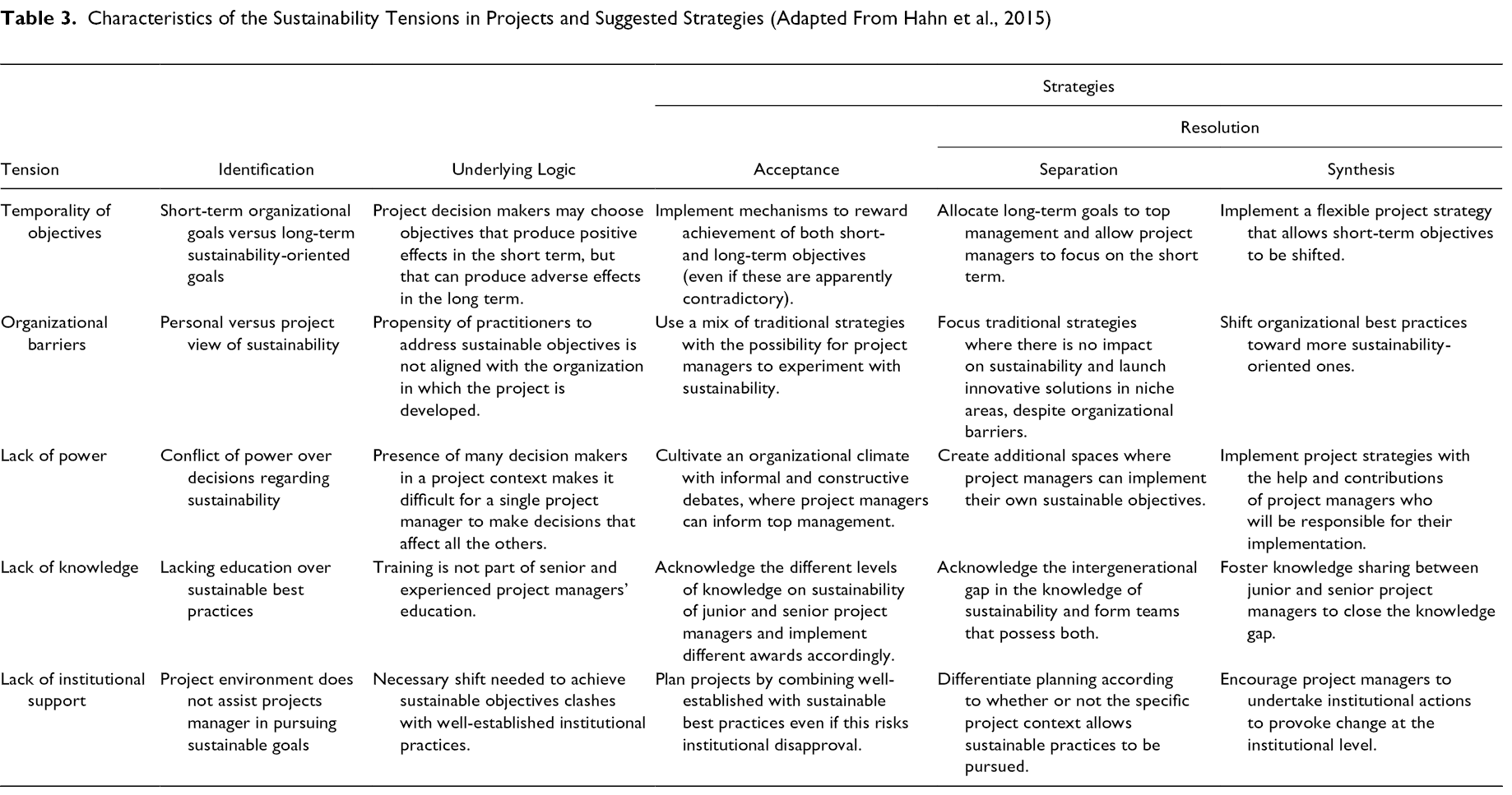
In the temporality of objectives, the tension project managers experience lies in the short-term organizational goals versus the long-term sustainability-oriented goals. The logic underlying this source of tension is that project managers favoring the economic aspect may choose objectives that produce positive (financial) effects in the short term, but that can produce an adverse effect in the long term. A possible acceptance strategy is to implement mechanisms to reward achievement of both short- and long-term objectives (even if these are apparently contradictory). The separation strategy could be to allocate long-term goals to top management and allow project managers to focus on the short term; a synthesis strategy can be to implement a flexible project strategy that allows short-term objectives to be shifted.
In organizational barriers, the tension comes from the personal versus project view of sustainability. The logic underlying this source of tension is the propensity of practitioners to address sustainable objectives not aligned with the organization in which the project is developed. A possible acceptance strategy is to use a mix of traditional strategies with the possibility for project managers to experiment with sustainability. The separation strategy could be to focus traditional strategies where there is no impact on sustainability and launch innovative solutions in niche areas, despite organizational barriers; a synthesis strategy might be to shift organizational best practices toward more sustainability-oriented ones.
In lack of power, the tension originates from conflicts of power over decisions regarding sustainability. The logic underlying this source of tension is the presence of many decision makers in a project context, which makes it difficult for a single project manager to make decisions that affect all the others. A possible acceptance strategy is to cultivate an organizational climate with informal and constructive debate where project managers can inform top management. The separation strategy could be to create additional spaces where project managers can implement their own sustainable objectives; a synthesis strategy could be to implement project strategies with the help and contributions of project managers who will be responsible for their implementation.
In lack of knowledge, the tension comes from the lack of education over sustainable best practices. The logic underlying this source of tension is that training is not part of senior and experienced project managers’ education. A possible acceptance strategy is to acknowledge the different levels of knowledge on sustainability of junior and senior project managers and award results accordingly. The separation strategy could be to acknowledge the intergenerational gap in the knowledge of sustainability and form teams that possess both; a synthesis strategy can be to foster knowledge sharing between junior and senior project managers to close the knowledge gap.
In the lack of institutional support, the tension emerges when the project environment does not assist the project manager in pursuing sustainability goals. The logic underlying this source of tension is that the necessary shift needed to achieve sustainable objectives clashes with well-established institutional practices. A possible acceptance strategy is to plan projects by combining well-established with sustainable best practices even if this risks institutional disapproval. The separation strategy could be to differentiate planning according to whether or not the specific project context allows sustainable practices to be pursued; a synthesis strategy can be to encourage project managers to undertake institutional actions to provoke change at the institutional level.
In summary, by accepting that some of the tensions arising from the implementation of sustainable objectives in projects create paradoxical situations, there is a potential pathway to address sustainability in project management. The examples provided in Table 3 offer initial suggestions for new ways to deal with sustainability paradoxes in projects. This is in contraposition to the business case, where only those sustainability challenges naturally aligned with traditional business and financial objectives are addressed. Moreover, Pinto suggests that “a workforce that has internalized a paradox mindset would be able harness creativity and innovation to develop superior (rather than myopic and suboptimal) ways of dealing with performing paradoxes” (Pinto, 2019, p. 189).
Conclusion
The growing recognition that many contemporary environmental challenges require urgent solutions has brought the concept of sustainability into sharp relief. Societal and institutional pressures are forcing individuals, organizations, and nations to consider sustainability and sustainable objectives. However, how to pursue these objectives or how to be sustainable is rarely a clear thing; the understanding of what it entails in practice requires experimentation and innovation in the traditional ways of doing things. Responsibility for finding solutions rests with everyone, but professional bodies are seen to have a particular responsibility coincident with notions of professional ethics and behavior. The project management profession is no exception and, indeed, could be argued to be on the front line of action, given the obvious impacts of major projects on social, environmental, and economic well-being.
Analysis of the data has identified that when practitioners try to comply with sustainability (i.e., include sustainable objectives in their projects) tensions arise. We heard frequent references to the needs of the client, the limits to what any one individual could do alone and the difficulties, if not impossibility, of undertaking actions consistent with sustainability objectives in projects subject to strong client demands, corporate business needs, and pressures to deliver to conventional project metrics. More significantly, perhaps, this seems to explain why sustainability in project management has been identified in the literature as following a primarily economic (rationalist) logic. The dominant cognitive frame used by practitioners appears to be consistent with the business case frame posited by Hahn et al. (2014). In this research, we explored the nature of the tensions project managers experience when trade-offs among different sustainability objectives appear: (1) the temporality of objectives; (2) organizational barriers; and (3) lack of power, knowledge, and institutional support. The responses reflected that when a win-win solution cannot be achieved, practitioners experiencing the inability to address multiple competing objectives (i.e., facing a paradoxical situation) react in a variety of ways. These reactions may reflect concerns over career success and job security, along with a strong sense of isolation within a much more complex network of actors concerned with sustainability. Reactions to these tensions have been grouped into five categories: (1) “greenwashing”; (2) “it can’t be one person”; (3) “no space for sustainability in my job”; (4) “other actors involved”; and (5) “pushing back.”
Project managers seem to be emphasizing alignment with the needs and demands of other actors where actions can be demonstrated to be of economic and therefore business value, whether for the project manager’s own organization, for the client, or for other stakeholders. These results highlight an alignment with the business case framing noted by Hahn et al. (2014). In practice, therefore, addressing sustainability is a balancing act between the priorities and concerns of different stakeholders. This consideration seems largely absent both from academic and practitioner debates within the project management field, and this lack of clarity precludes further development in this area.
We believe that, although aiming for a non-compromising approach to sustainability is not possible (the very meaning of trade-offs or paradoxes underlines this), the pursuit of sustainable objectives remains desirable; however, this requires a degree of adjustment in the traditional ways activities are carried out. We argue that the acknowledgment of tensions over trade-offs is the first step in properly addressing all competing sustainable objectives. However since, by definition, a solution to a paradoxical situation does not exist, we suggest that strategies to manage these situations could help address the competing sustainable objectives. Furthermore, we speculated about possible strategies (articulated in Table 3) to manage paradoxical situations—strategies intended to help project managers to pursue different sustainability objectives even if they are contradictory.
These suggestions are at best speculative and their development and application require considerable further research, both theoretical and empirical. Our study was exploratory and there is a need to investigate these paradoxes in specific empirical project contexts and in greater depth. This may help clarify whether and how specific tensions experienced by project managers prompt particular reactions; this should help to identify what organizations and project managers can do in practical terms to address sustainability paradoxes in specific project situations.
We would suggest that a shift in thinking is required to break free of the constraints of a purely economic, rationalist view of project management. A more critical perspective is needed to make assumptions explicit and challenge conventional practice (Cicmil & Hodgson, 2006; Cicmil et al., 2006; Hodgson & Cicmil, 2016). This perspective reflects a distinction between a rationalist view of projects as fixed, immutable entities (projects as being) and a view that sees projects as emergent (projects as becoming; Linehan & Kavanagh, 2006). A way of thinking that enables paradoxes to be accommodated, worked around, or managed, challenges conventional thinking based on prescriptive methodologies, best practices, and other propositions that have not “creatively contributed either to constructive debate in the field or to the resolution of difficulties encountered in practice” (Cicmil & Hodgson, 2006, p. 112).
In practice, this issue needs to be tackled collectively and simultaneously at the project, organization, and institutional levels. Organizations, professional bodies, and regulators all have to acknowledge the inherent tensions that the concept of sustainability injects into the project context and the implications for the project management profession. We suggest that a recognition of the paradoxical frame might enable alternative approaches and solutions to be explored, in line with Schad et al. (2016), underlining how research tends to “pay less attention to relationships within paradoxes” (Schad et al., 2016, p. 6). We believe this approach opens up an important avenue for future research that will identify how sustainability contradictions unfold in a project management context and how practitioners, professional bodies, and regulators make sense of these contradictions and deal with paradoxes in their everyday practices.
Footnotes
Appendix. Outline Interview Schedule
Acknowledgments
For their comments on earlier drafts of this article, we thank the two anonymous reviewers and the editor whose kind support and constructive criticism helped in improving this article.
Declaration of Conflicting Interests
The author(s) declared no potential conflicts of interest with respect to the research, authorship, and/or publication of this article.
Funding
The author(s) received no financial support for the research, authorship, and/or publication of this article.
Note
Author Biographies