




Abstract
This exploratory research examines who supports what aspects of career development on projects. Our main finding is that, although project professionals receive support from formal and informal sources, a compensatory mechanism is at play. When support does not come from direct line managers, project professionals are compelled to initiate informal practices, including mentoring, buddy systems, and communities of practice. Practical implications arise for organizations regarding how to ensure sufficient mechanisms are in place to compensate for lack of line management career support and to allow project professionals to access the development opportunities they need by supporting their self-initiated efforts.
Introduction
Project-based careers have increased in significance with the proliferation of project-based organizations (hereafter, PBOs) (Gemünden, Lehner, & Kock, 2018; Keegan & Turner, 2002; Miterev, Mancini, & Turner, 2017) and the projectification of organizations and societies (Schoper, Wald, Ingason, & Fridgeirsson, 2018). As more and more professionals base their careers on projects, these developments offer opportunities for the study of careers on projects as an emerging area of study. A person’s career is defined as “the unfolding sequence of his or her work experiences over time” (Arthur, Hall, & Lawrence, 1989, p. 8). Careers can be enabled or constrained based on the amount and type of support people receive from organizations (Kraimer & Wayne, 2004; Rhoades & Eisenberger, 2002). However, because little is known about this specific topic, we carried out a study to explore careers in projects in greater detail. Our research question is: Who supports what aspects of career development in projects? Research combining a focus on both careers and projects is valuable, given that we have little knowledge of who provides support and what types of support, in what appears to be an increasingly important sector. In this article, we explore how careers in projects evolve and ways of supporting these careers. Consistent with the nascent state of the literature, we adopt a qualitative, exploratory approach (Schwandt, 1994), which has the potential to yield valuable new insights. Given the trends in projectification, it is also of increasing interest to researchers and practitioners interested in both project organizing and careers (Akkermans, Keegan, Huemann, & Ringhofer, in press).
Thus, in this article, we explore how careers in projects evolve and ways of supporting these careers. Since the literature on project careers is still emerging, we adopt an explorative approach, which sets the boundary conditions for our conclusions.
The article is structured as follows. First, we provide insights on career theory as well as on careers on projects and present our research question and what motivates a focus on this specific issue. We then discuss our three-step data-gathering process and how we analyzed the data. After this, we present our results from the data analysis and discuss our findings. We conclude with some practical recommendations regarding support of project managers’ careers.
Developments in Career Theory
In recent years, concepts such as boundaryless and protean careers have displaced the notions of traditional organizationally managed careers (Inkson, Gunz, Ganesh, & Roper, 2012; Van Buren, 2003). The idea that careers are the property of and should be controlled by their owners (individuals), not by organizations, aligns well with mainstream psychology-focused career literature. For example, Inkson (2008, p. 551) argues the organizational career–boundaryless career contrast, although it may be critical to organizations and their managers, is largely irrelevant or incidental to mainstream career theory and practice, whose proponents would argue that all careers are, and should be, managed by the individual, and that the individual normally has points of reference outside the current organization and normally crosses boundaries during his or her career.
In Arthur and Rousseau’s (1996) formulation of the boundaryless career, careers develop independently of any single employer across multiple projects. The boundaryless career concept has become accepted by many as the mainstream career model, with other terms carrying the same connotations, including the protean career with “individually defined goals…. [driven] by the person, not the organization” (Briscoe & Hall, 2006, p. 6).
These assumptions are challenged by a growing number of career scholars who view careers and changes to careers from a broader organizational and societal perspective (Van Buren, 2003). These scholars emphasize the duality of individual/organizational responsibilities and the interdependency between individuals and organizations in careers where individuals influence organizations and vice versa (Fleisher, Khapova, & Jansen, 2014). Employability theorists, for example, eschew a focus on only the individual or the organization in their examination of careers (Bozionelos et al., 2015). Van Buren (2003, p. 132) argues “that employers have obligations to help employees maintain their employability… satisfying employability obligations partially resolves the ethical problems posed by boundaryless careers.” As employability refers to the continuous fulfilling, acquiring, or creating of work through use of competences and adaptability of such competences to changes in internal and external labor markets (De Vos, De Hauw, & Van der Heijden, 2011; Van Der Heijde & Van Der Heijden, 2006), a focus on how individuals and organizations achieve this and their interdependencies in achieving this (Fleisher et al., 2014) is important.
An employability focus on how careers on projects also addresses concerns associated with careers involving mobility and flexibility across different kinds of boundaries, which leads to concerns expressed, for example, in the work of Tempest and Starkey (2004, p. 509) that …while new ways of organizing might well challenge the old boundaries of industrial society and work organization, they also have limits, particularly in terms of the locus of and the responsibility for the learning that makes the acquisition of key competencies possible.
Underpinning this explicit emphasis on interactions between individual and organizational actions is a focus on balance as it relates to both employee/employer interests as well as interests between the employee in terms of his or her employment and his or her broader responsibilities, including family and nonwork–related obligations (Dany, 2014). There is a need to recognize the dual role of employability-oriented practices to enable both individual-level career success and organizational advantages (Van Der Heijde & Van Der Heijden, 2006) and that also demand actions and investments from individuals and organizations.
Project Careers
Projects play a key role in many contemporary careers (Crawford, French, & Lloyd-Walker, 2013) and they are often associated with boundaryless careers (Arthur & Rousseau, 1996; DeFillippi & Arthur, 1998). Projects can enable and constrain people in developing their careers as a journey unfolding across a sequence of work-related experiences (Arthur et al., 1989). Understanding the role of projects in careers commends a focus on projects as temporary organizations, as well as the broader context within which such projects are undertaken. While DeFillippi and Arthur (1998) focused on the hopping from project to project within the film industry, a perspective on careers within organizations and how these project careers unfold adds to our understanding. Project careers involve movement across inter- and intraorganizational boundaries as people undertake projects with different clients and in different constellations of project expertise. The proliferation of PBOs (Gemünden et al., 2018; Keegan & Turner, 2002; Miterev et al., 2017; Sydow, Lindkvist, & DeFillippi, 2004) and the general projectification of organizations and societies (Schoper et al., 2018) produce consequences for project work (Lundin et al., 2015) in terms of the numbers and types of boundaries that people are expected to cross to contribute to organizational development and as a basis for growth and development of (project based) expertise and capabilities on an individual level. As organizations become more project oriented, and less oriented to stable, functional organizations, individual work and careers emerge and unfold in projects involving interdisciplinary work teams, often in an international context. There is, therefore, an opportunity for the study of projects and their roles in careers (Keegan, Ringhofer, & Huemann, 2018) and to untangle the mechanisms regarding how project careers unfold. Previous attempts to model the careers on projects or in project-based organizational settings, include the work of Keegan and Turner (2003) who suggested spiral staircase careers as an appropriate metaphor to reflect the idea that people will move through a series of varied and wide-ranging jobs while working on projects. While the project career might become more common—and involve development based on wider and broader skill development by crossing project boundaries, also internationally—little detailed research to date has explored these development issues and how they are supported. With our explorative study, we aim to answer the following research question: Who supports what aspects of careers on projects? Seeking an answer to this highlights the need to focus on both the individual project professional and the project-organizational context and their mutual interactions.
Method
The exploratory and interpretivist nature (Schwandt, 1994) of this research guided our design of the study. We combined three steps to gather data on project professionals’ perceptions of project careers and the support they did, or did not, experience. We drew together insights from three sources: (1) in-depth interviews carried out using a systemic constellation; (2) interviews based on systemic constellations combined with additional free text questionnaire responses; and (3) three focus groups. These sources of data allow us to triangulate insights on the support for careers described by project professionals in each step of the research process (Yin, 2015).
Step 1
In Step 1, we conducted 20 semistructured interviews with project professionals. These included project managers, heads of project management expert pools, program managers, project management office (hereafter PMO) managers, and PMO members. We used a snowball sampling strategy (Bell, Bryman, & Harley, 2018; Tracy, 2012). After each interview we asked participants to recommend colleagues who may be interested in participating, provided they had at least 10 years of project-related career experience. An overview of participants by their roles held when we interviewed them is provided in Appendix A at the end of the article. In this sample, we focused on project professionals in Austria consistent with our snowball approach. This step entailed a broad exploration of project professionals’ careers, the importance of projects on careers, and the support project professionals receive for career development. We designed a specific type of in-depth interview using systemic constellations (for details see Huemann, Eskerod, & Ringhofer, 2016) to allow interview participants to visualize and then design their careers using visual aids (see Appendix B at the end of the article). The interviews accompanying the constellations were digitally recorded, fully transcribed, and analyzed to determine the role of projects in careers, and how project professionals make their careers on projects as well as the types of support they receive throughout their careers. We coded the transcripts for insights on both types of support and also who provides support (Miles & Huberman, 1994). The core themes that emerged from this stage included the types of support project professionals experience throughout their careers.
Step 2
To explore this further, we carried out two additional steps, focusing more specifically on the topic of support for careers. In Step 2, we narrowed the lens by asking a smaller group of project professionals (9) to carry out the constellation exercise (as in Step 1) and, additionally, to complete a short questionnaire using free text responses on career support. These questionnaires were coded and analyzed for themes on support and especially who provides it, what they provide, and when. In this step, the focus was more explicitly on the career support.
Step 3
In Step 3, we wanted to gain richer insights into the meaning of the data on support practices and experiences. To achieve this, we carried out three focus group workshops with a cross section and varying numbers of project professionals (21, 15, 7, respectively) to examine in-depth the support project professionals received throughout their careers. This allowed us to explore in-depth the stories regarding line management support, general support, and support practices and roles.
Data Preparation, Transcription, and Analysis
We recorded and transcribed all interviews in Step 1. Most interviews were held and first transcribed in German. We then translated the transcriptions into English. One member of the research team member, a native English speaker, checked the transcriptions and clarified the meaning of translations, where these were unclear, by working with the German researchers. The last step included a recheck of the translations by the German language researchers, considering the comments from the native English speaker and comparing the relevant sections with the original transcripts or recordings from Step 1. We attended a workshop to clarify all final issues. These processes achieved high-quality translations of all the interview transcripts.
Based on the research question and literature, we developed a series of start codes to analyze the interviews (Miles & Huberman, 1994). Using NVivo 11—a software package for analyzing qualitative data—we coded all interviews using our preliminary start codes (Saunders, Lewis, & Thornhill, 2012). As the interview analysis proceeded, we refined our list of codes based on emerging findings and updated these to reflect the emergent patterns regarding support.
Our key finding from Step 1 is that different types of support are available to project professionals. We wanted to probe this finding more closely. We therefore carried out Steps 2 and 3 of the study. In Step 2, we asked nine project professionals to carry out the constellation exercise and to reflect on three key projects. We then asked them to write free text responses to the following questions:
In terms of this project and your career:
Did you get any support? If yes: Who supported you on this project? If yes: How were you supported? If yes: What was the outcome?
In a final step to gain clearer and also richer and broader insights on career support, we carried out three focus group workshops addressing the same questions of support for careers on projects.
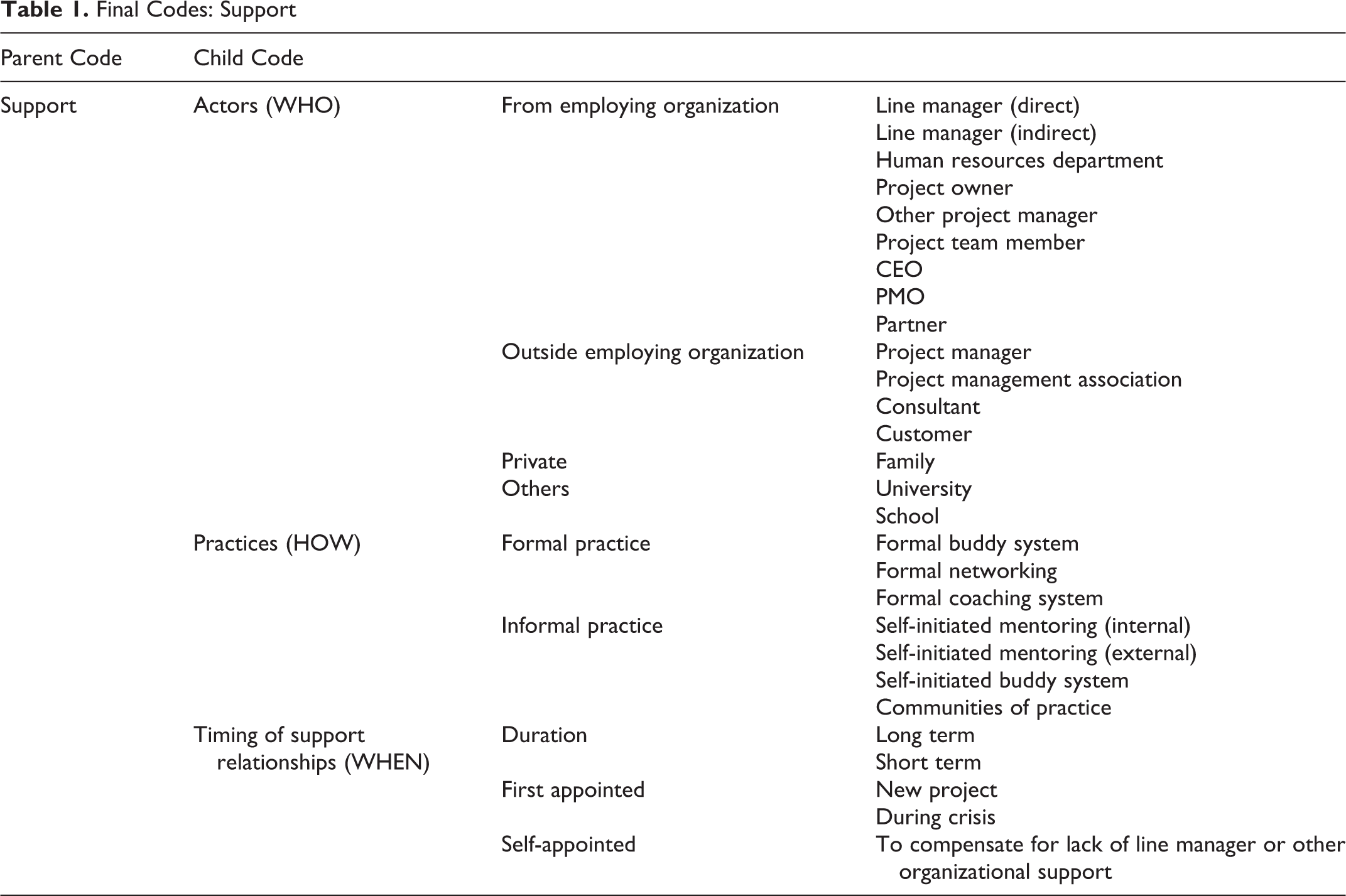
Our analysis resulted in three core narratives pertaining to support for careers on projects. We present these as follows and are our main results in this article. These narratives are composed of a holistic and recursive analysis of the data from the constellation-based interviews in Step 1, interviews plus free text responses in Step 2, and the focus groups in Step 3 because these pertain to mentoring. Our final coding table (see Table 1) shows the results of the analysis of the data on support across all three steps, with each step providing more depth or detail, and clarifying puzzles or differences, on the issues regarding support. In the next section we present our findings.
Final Codes: Support
Findings
The basis of the narratives is the WHO, HOW, and WHEN of support for project careers. First we discuss the WHO—who provides support. Second, we illustrate HOW support is provided by presenting practices described by project professionals. Finally, we discuss the data that emerged on the timing of career support, including specific relationships such as mentoring and when these are likely to be formed.
Narrative 1: WHO Provides Support?
Our first narrative focuses on the question: “Who provides support to project managers in terms of their careers?” Our questions in the interviews and focus groups were posed openly as to the actors who might provide support. We did not focus on internal and external company actors and were interested in who the professionals themselves identify as providing support.
Early on in the analysis we identified that some project professionals feel unsupported in their careers and development both generally and on specific projects. Therefore, prior to presenting the data on who provides support, we first present data indicating that many project professionals feel alone, and not at all supported in their careers while working on projects. They do not feel that their line manager or project manager supports them and feel they do not have anyone to turn to.
This was my very first project. The only support I got was an overview of the project by my then project manager (name of project manager) during the first day of the project…Then I was left alone with the customer for three months. One day a week, my project manager came back for a mid-term review of my work, changed a couple of things in the way I was working, and left me there for another three months. Then we made a final presentation, reviewed by another experienced consultant, and well-received by the customer. I learned three very important lessons here: (1) Once you’re in the water, you better start swimming; (2) Your very first customer, most of the time, is your boss, and that doesn’t make that much sense; and (3) Sometimes you don’t have skills to do what you’re asked, nor the power to change that. And you still have to deliver. (Step 2 [S2], free text response [FTR], original)
There was neither mentoring nor coaching. (S2 [Step 2], FTR [free text response], original)
I stand alone in the rain. (S3, focus group workshop, translated to English)
It was my wish to get support. But we had no resources. (S3, focus group workshop, translated to English)
There was very little support. I got an external project management education but there was no other support. (S3, focus group workshop, translated to English)
The support was to have a set of internal project management standards in the company. (S3, focus group workshop, translated to English)
The Line Manager Is the Main Provider of Career Support on Projects
With the exception of the data coded no support as above, we coded most data for who supports career development on projects to the line manager. Furthermore, the support of the direct line manager was often not limited to one specific project but seen in the context of a long-term mentoring or coaching relationship over many years. The data suggest line managers can support careers on projects by pointing project professionals to training opportunities or giving them career-related advice based on their own experience in the organization or industry.
My direct line manager supported me for 17 years. (S1, Interview 8, translated to English)
It was my direct line manager who supported me. On the one hand, he gave me the opportunity to participate in trainings but, on the other hand, he shared his personal experience with me. He was educated in a different area [lawyer] than me and this was very productive, as I realized that different knowledge from different areas is important for projects. (S1, Interview 18, translated to English)
Yes, I had as one of the few people there—a good connection with my direct boss…so we were able to, I don’t know, connect with each other…He was always in the background as a source of support. (S1, Interview 5, original)
It developed unofficially because we [the line manager and the project manager] like each other. He [the line manager] was my mentor. His door was always open and it was possible to reach him every time if I had a question. He shared his experience with me and always supported my decisions. (S1, Interview 10, translated to English)
He [the line manager] was just there, being available. (S1, Interview 1, original)
I had discussions with my colleagues and line manager. (S3, focus group workshop, translated to English)
My direct line manager was an experienced project manager. He supported me. (S3, focus group workshop, translated to English)
Of course, my direct supervisor in the line was also the program manager of this program. Of course this is very convenient, because then you have a contact person for both topics. The one is fundamentally the career development or the further development on the line and the second is the project completion or the project success. (S1, Interview 20, translated to English)
Other Project Managers Can Compensate When Support Is Low or Absent
Next, we coded most data on the SUPPORT-WHO to other project managers. In the absence of clear support from line managers and in order to not be alone, project professionals organize themselves into small or large networks, informal buddy systems, or communities of practice, in order to share experiences, support each other, and discuss problems or crisis situations. They reach out to other project managers—either peers or those with more experience—and accept support from project managers inside and outside their organizations. Opportunities for sharing experiences and gaining advice from people in the same situation seems to be an important source of support for project managers.
Then when I moved on to the corporate project management team, we were just a few people—I think it was a handful of project managers—and we established a buddy system so that we had a deputy available and to help each other, and do some [knowledge] exchange, and see how we can improve and how to do it better. (S1, Interview 1, original)
There have been some role models. For example, several project managers from whom I have learned a lot and an Austrian project manager from [an Austrian university], who were very much involved in this funding project. Furthermore, there was a project manager from Canada and one from Luxembourg in this project. (S1, Interview 14, translated to English)
I got informal support from colleagues. (S3, focus group workshop, translated to English)
I had a project-buddy who supported me. (S3, focus group workshop, translated to English)
Participants expressed that other project professionals, project managers, colleagues, and teams or project managers from other organizations, often become their primary sources of support.
The most important support came from the project team. (S2, FTR, original)
I have learned a lot from my mistakes and the actions of others. There was a lot of exchange with other project managers. (S3, focus group workshop, translated to English)
I got support from an experienced project manager. (S3, focus group workshop, translated to English)
Knowledge exchange with other project managers. (S3, focus group workshop, translated to English)
Other Internal Roles and Career Support
We coded data to other actors in specific roles who may provide support, such as project owners, human resource (HR) specialists, and PMO members. However, with few exceptions, provided as follows, these actors did not provide support to project professionals in terms of their careers.
In terms of project owners, one observation emerged that if the direct line manager is also the project owner, career support is performed by this person acting from his or her role as a line manager. This finding is consistent with the general observation that it is mainly line managers who are identified as providing career support.
Career support was not expected from project owners in that role. Neither the HR department nor the PMO was seen as providing any kind of career support. One exception to this, which we noted regarding the PMO, is that PMO members felt responsible for providing career-related support if they had, themselves, experienced support as junior project professionals. The data suggest that this finding related more to personal tendencies to offer time for supporting others’ careers than to the role in the PMO.
It is my personal interest to support young project managers. For a company it is essential to share knowledge and experiences with junior professionals. […] People have a formal education when they start working in a company, but they have none or little experience, and how this works in practice. Sharing personal experience and how different things work in practice, is a very important process. (S1; Interview 18, translated to English)
The HR department only became actively involved in career support if this responsibility was formally allocated to them, which was not always the case. In general, members of the HR department are completely absent from the narratives of project professionals regarding sources of support for careers on projects.
External Roles and Career Support
Finally, we coded a very small amount of data to career support provided by external people.
It was one guy from [name of company]. [It] was one of the companies in my project. And he was a kind of a mentor, I would say. He also had a department at [name of company] running projects there and he had a lot of employees in the same age range as I was at that point in time. So that's why maybe he saw that I could be one of his team members and that’s why he coached me a little bit. But I did not ask to be coached either. He did it and he supported me very well so that was perfect. (S1, Interview 6, translated to English)
I got some support from [project management association]. I have a network there, and within this network I got support. (S3, focus group workshop, translated to English)
I got some support from the CEO of [company name]. He was my client. Furthermore, there was [name] from [company name]. He was the general manager of the company. The third person [who supported me] was [name] from [company name]. All of them were senior professionals at this time and had a lot of experience. (S1, Interview 18, translated to English)
I got support from an external consultant. There was no support from internal colleagues. (S3, focus group workshop, translated to English)
Narrative 2: Career Support Practices
To untangle how project careers unfold, we focused on the practices provided to support project careers and identified several core practices. These are differentiated into formal and informal practices and summarized in Table 2.
Career Support Practices
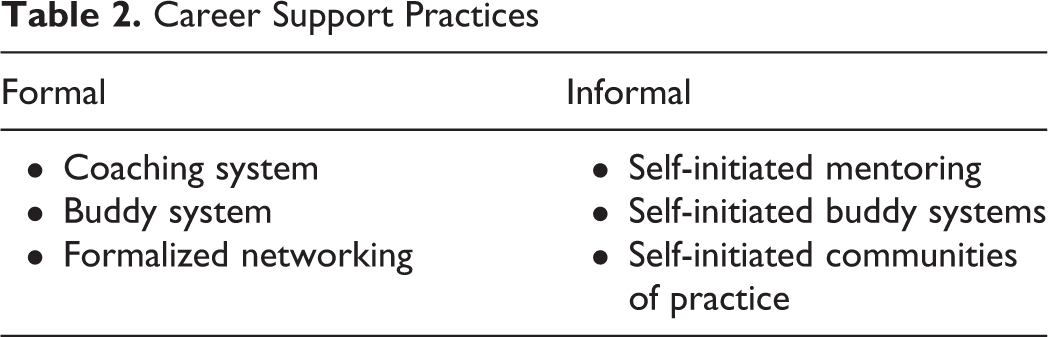
Formal practices included organizationally mandated coaching systems, buddy systems, and formalized networking practices. For example, we found company support for mentoring came in the form of companies providing formal structures such as a project management breakfast for knowledge exchange and mentoring for a group of project managers. In addition, companies nominated experienced project managers to perform mentoring in informal ways. Furthermore, companies support mentoring in a general way and provide infrastructure such as rooms or schedule time to perform mentoring. However, in many cases, aside from providing space and time, the company was not involved in how the mentoring was performed. This means companies also have no systems for evaluating the effective delivery of mentoring support or ways to pick up on gaps in the delivery.
We found formal coaching practices in place where experienced project managers are specifically nominated to support one inexperienced project manager. Active support by formally appointed coaches appears to be linked with whether these project professionals, or other professionals, see the value of such initiatives. Active support works only if the coach is willing to be actively involved and also if the company wants and supports coaching or career support on projects in an active manner. Not all those involved are enthusiastic and doing it by choice.
I’m a project coach. […] The company forced me to do this. (S1, Interview 15, translated to English)
I provided support to younger project managers. The result was that I had more competitors [in the company]. (S3, focus group workshop, translated to English)
Formal practices, such as networks, bring people together and can be the starting point for mentoring activities to grow more organically.
One part of the PMO task is the organization of networking events. We organize a project management breakfast a few times per year and invite all project managers. We define key topics and nominate experienced project managers to talk about these topics. Furthermore, we perform smaller internal meetings for knowledge exchange in each department. (S1, Interview 18, translated to English)
In our company, we have a regulatory peer review with some line managers. (S3, focus group workshop, translated to English)
We have a project-buddy system in our company. (S3, focus group workshop, translated to English)
We have regular sounding boards, where they can place their entries [presentation] or new ideas for knowledge exchange. One of them was an extremely interesting HR project manager. But they came up with this idea that he wanted to make workshops about benefits. Perfect, do it! Then you are the expert for HR projects and you now start leading workshops and educational programs in order to find out what an HR project manager means for [company name]. (S1, Interview 6, original)
Then when I moved on to the corporate project management team, we were just a few people, I think it was a handful of project managers and we established a buddy system so that we have a deputy available and to help each other and do some exchange, how we can improve and how to do it better. (S1, Interview 1, original)
Other examples of formal practices include formal buddy systems where an experienced buddy is responsible for an inexperienced employee. In contrast to formal coaching for a specific project, the buddy system is not limited to a specific task or time frame. It is more open and includes advice on internal company processes and support regarding company culture or working styles for those working on projects.
We also coded data on career support practices to the category informal practices, which included informal mentoring, informal advice, ad hoc communities of practice, and so forth.
At this point in time, coaching or mentoring was not established. We gave them [the young unexperienced project manager] more tasks if we realized that they are willing to learn. (S1, Interview 15, translated to English).
There were some certified project managers in-house [the company]. They organized sessions for knowledge exchange. (S1, Interview 7, translated to English)
Narrative 3: Timing
Finally, we coded results in this narrative that suggest that explicit career support often happens in the first project. For example, project professionals are more likely to be assigned mentors in a first project than on subsequent projects.
I did not receive any mentoring or coaching support since it was not my first project. (S2, FTR, original)
On subsequent projects, project professionals are less systematically given support, and some express that they less systematically need support.
Freedom is very important to me. I don’t need anyone to tell me what to do. […] I don’t need mentors anymore. They were important in the beginning. At this time, my direct line manager was also the program manager. This worked well. (Interview 20, translated to English)
Mentoring and advice are particularly important for inexperienced project managers, especially when handling their first project in a new context. The balance between knowledge, gained in school or university, and the way things work in practice is important to master, though difficult for newcomers.
It is my personal interest to support young project managers. For a company it is essential to share knowledge and experiences with junior professionals. […] People have a formal education when they start working in a company, but they have no or little experience or how this works in practice. Sharing personal experience, how different things work in practice, is a very important process. (S1, Interview 18, translated to English)
I was the first one who used the official [project management standard]. I was some kind of prototype. I received some training and coaching. The benefit for the company was, that I tested the standard in an ongoing project and they [the company] saw what happened. Furthermore, I was coached by some external [consultant/expert]. (S1, Interview 11, translated to English)
Discussion
Based on our findings, we conclude that career support on projects is nascent. In the following section, we develop propositions emergent from our exploratory research approach.
Proposition: The application of a compensatory lens sheds light on who takes a role in career support on projects, if line managers cannot, will not, or are not mandated to fulfill this role.
While organizations may have formal career paths and structures, support for careers in projects is still largely hit or miss. Project professionals may receive support from their line managers, supporting the call by Bredin and Söderlund (2013) to reframe line managers as career advisors and coaches. However, we do not advocate that line managers are the only actors seen as providing support for careers on projects, because this would ignore the many project professionals for whom line managers are not available, too busy, or with whom contact is too sporadic. Our view is that, given the vast contextual differences in careers on projects, and taking into consideration the often shifting and volatile relationships project professionals have with multiple project and line managers (Keegan & Den Hartog, 2018), adopting an explicit compensatory lens when conceptualizing careers on projects is valuable.
This compensatory lens both acknowledges and welcomes the roles line managers can and often do play in supporting careers on projects, and also sensitizes organizations, project managers, and researchers to the need to consider the other less official sources of support that can and must be activated when line management coaching, mentoring, and support do not materialize, as is unfortunately often the case. Our compensatory logic recognizes the interactive effects of both official line manager support and informal support. While individual responsibility for career development is impressed upon us by boundaryless career theory, employability theorists urge us to acknowledge that though responsible for their own careers, project professionals must also have access to support and use the supports around them, including those available on projects. Organizations in turn must make sure that career support is available. This will take different forms depending on the context within which projects are undertaken and the relative roles played by line managers and project managers in career-related tasks.
Proposition: HR departments are not visible to project professionals from the perspective of career support.
In our study, the HR department as a source of career support was not mentioned or considered by our respondents. Indirectly, HR departments are represented in the findings, if we look at formal practices, because they are often designed by HRM specialists. HR departments or specialists are not explicitly presented as an actor providing support; rather, they are only indirectly present via the formal practices they contribute to or design. For example, the formal buddy and mentoring systems that organizations offer are linked to the presence of HRM specialists. This observation is in line with other studies that describe HRM specialists as operating on a more strategic level and quite removed from project professionals (Huemann, 2015; Keegan, Huemann, & Turner, 2012).
Proposition: Co-creation of career support by project professionals.
Based on the findings, project professionals need to be able to access support from different actors, depending on the mix of projects and links to the line as well as the effectiveness of line manager support. One somewhat optimistic finding from this study is the opportunities presented by the co-creation of career support by project professionals who miss line manager support. These types of practices, which compensate for line manager lack of support, should be studied more systematically and explicitly. They should also be both acknowledged and mobilized by organizations and individuals for supporting careers on projects. This also gives project management associations a vital role they can more explicitly play in the career support of project professionals.
Proposition: If people have been supported during their own career, they are more likely to also provide career support to young professionals.
Experience with having received advice or mentoring emerged from our study as an important indicator of whether project professionals are willing to support others with advice and mentoring activities. Many seem to want to give back, and they reciprocate by offering the kinds of support they received early in their careers. Our study revealed that career support was provided especially on first projects and in project crisis situations. These interventions suggest that career support is salient mainly at moments when it is required in order to avoid damage to the project manager’s career. If the senior project professional has this experience, he or she is ready to mentor young project professionals. In contrast, if senior project professionals perceived that they had not received support in their own project careers, they are less likely to provide support to others. From a practical point of view, this suggests a relatively straightforward mechanism for building compensatory career support capabilities by making everyone a mentor at least once as part of their project career development journey.
Conclusions, Limitations, and Future Research
This study contributes insights on the compensatory roles emerging in support of project careers, a nascent area of research in need of more systematic attention from career and project management scholars. There are several limitations to be considered when evaluating the results of this research, limitations that create boundary conditions for applying the findings of our study. First, our study is based on 20 interviews, which is a small though adequate sample best on best practice in qualitative research (Guest, Bunce, & Johnson, 2006). Our data are thus limited and do not cover all of the potentially relevant industries or project types that could provide valuable insights into careers on projects and support. A further limitation, linked with our strategy of snowball sampling, is that all of the interviews were performed with project professionals from Austria. Although most companies work internationally, the results present a limited view on this topic. For further research, it would be valuable to perform interviews in different industries, incorporating more diverse project types, and also internationally operating organizations. Second, the interviews focused on the whole career, of which career development support was only one aspect. As interviewees told the whole story regarding their careers, and in a short amount of time, it is possible that we missed more and/or different types of career support methods. To overcome this problem, we performed Steps 2 and 3 in the data preparation and collection. In the future, research regarding different aspects of career models for project professionals—such as incentive systems or formalized career development—could improve our insights into these important career-related themes. Finally, we have highlighted the compensatory roles of line and project managers in supporting career development. We have not, thus far, identified the antecedent factors for project professionals to self-initiate support, and the relative importance of personal or organizational issues, which underpin the patterns we observed in this study. For example, if organizations provide a strong mandate to line managers to support career development, it is less likely these compensatory dynamics will prevail than when organizations fail to, or choose not to, devolve such responsibilities to line managers. Identifying organizations with and without such a mandate, and comprising career support in terms of who provides and what is provided, can provide deeper and more precise insights into these issues. Future research can be valuable in revealing these factors and providing practical guidance to organizations and individuals regarding support for careers on projects.
Footnotes
Appendix A. Interview Sampling
We purposefully selected the interviewees based on their experience as project professionals. We used snowball sampling to build up on our initial pool of potential interviewees gained through personal or professional contacts as well as project management associations (Table A1).
Appendix B
To explicate and visualize the careers of project professionals we used a form of a Systemic Constellation (Huemann et al., 2016) (see Figure B1).
We asked the interviewees to make their career paths, including important projects, visible. We prepared a set of cards in different colors and formats. The interviewees could select the cards they wanted to select and it was possible for them to express a special meaning through the use of different cards (e.g., big red circles as crisis projects, etc.). All interviewees prepared their career path by putting the cards on the floor (see Figure B2). In the next step, the interviewees explained their career path to the researcher. The researcher followed a rough interview guide, which included the following questions: Did you get support within this project or these projects for your career? How did you get this support? Who supported you? When did you get this support? Were there any obstacles in this project regarding your career development?
In addition, we asked the interviewees to make the resources for career development on projects visible to us. On average, the interviews lasted 1 hour and 30 minutes, including the time spent by the participant preparing to present his or her career path using the cards.
Acknowledgments
We are grateful to Project Management Institute, who partly sponsored the research project Beyond Boundaryless Careers, as well as to all interview partners and focus group participants.
Declaration of Conflicting Interests
The author(s) declared no potential conflicts of interest with respect to the research, authorship, and/or publication of this article.
Funding
The author(s) received financial support for the research, authorship, and/or publication of this article: This research was partly sponsored by the PMI Research Grant.