




Abstract
The shortage of teachers is amplified in rural areas where educators work with students with low-incidence disabilities (LID; visual or hearing impairment; significant cognitive impairment; any impairment for which a small number of personnel with highly specialized skills and knowledge are needed for children to receive early intervention services). This scarcity is closely linked to the lack of accessible knowledge for these teachers. Both a high attrition rate and lack of expertise negatively affect the educational outcomes of students with LID. We propose school–university partnerships (SUPs) to alleviate these challenges. This position paper presents the critical elements of a comprehensive SUP by synthesizing programs reported in the literature, including the following elements (a) instructional, assessment, and online resources; (b) mentorship; and (c) professional development. We specifically identify how these elements can improve outcomes of students with LID and alleviate the rural special education teacher shortage. Finally, we discuss the implications of this proposed SUP and implications for practices, policy, and research.
Keywords
For decades, the body of relevant literature has designated the severe teacher shortage as a top concern for rural special education (Billingsley & Bettini, 2019; Ludlow et al., 2005; Purcell et al., 2005). In particular, the subgroup experiencing the most severe shortage is personnel qualified to teach students with low-incidence disabilities (LID), also defined as students with multiple or severe disabilities (Howley et al., 2017; Howley & Howley, 2021; Ludlow et al., 2005). The literature pinpoints one of the major factors to be a high attrition rate among this group (Jackson, 2008; Sutcher et al., 2019). Research also emphasizes that this teacher shortage contributes to an inadequate education for rural students with LID (Garcia et al., 2022; Rude, 2005). In this position paper, we argue that school–university partnerships (SUPs) can increase rural special education teacher retention (decreasing the shortage) and improve outcomes for students with LID.
In this paper, we define SUP and how our proposed SUP differs from traditional SUPs that are used by many teacher education programs in the United States (See Table 1). We define rural schools broadly to mean schools located in geographically isolated areas (Hawley et al., 2017). Furthermore, we expand Hawley’s definition of LID using Section 1462(c) of the Individuals with Disabilities Education Act (IDEA, 2004) (a) a visual or hearing impairment, or simultaneous visual and hearing impairments; (b) a significant cognitive impairment; or (c) any impairment for which a small number of personnel with highly specialized skills and knowledge are needed for children with that impairment to receive early intervention services or a free appropriate public education.
Differences Between the Proposed School–University Partnership (SUP) and Traditional Teacher Preparation Programs.
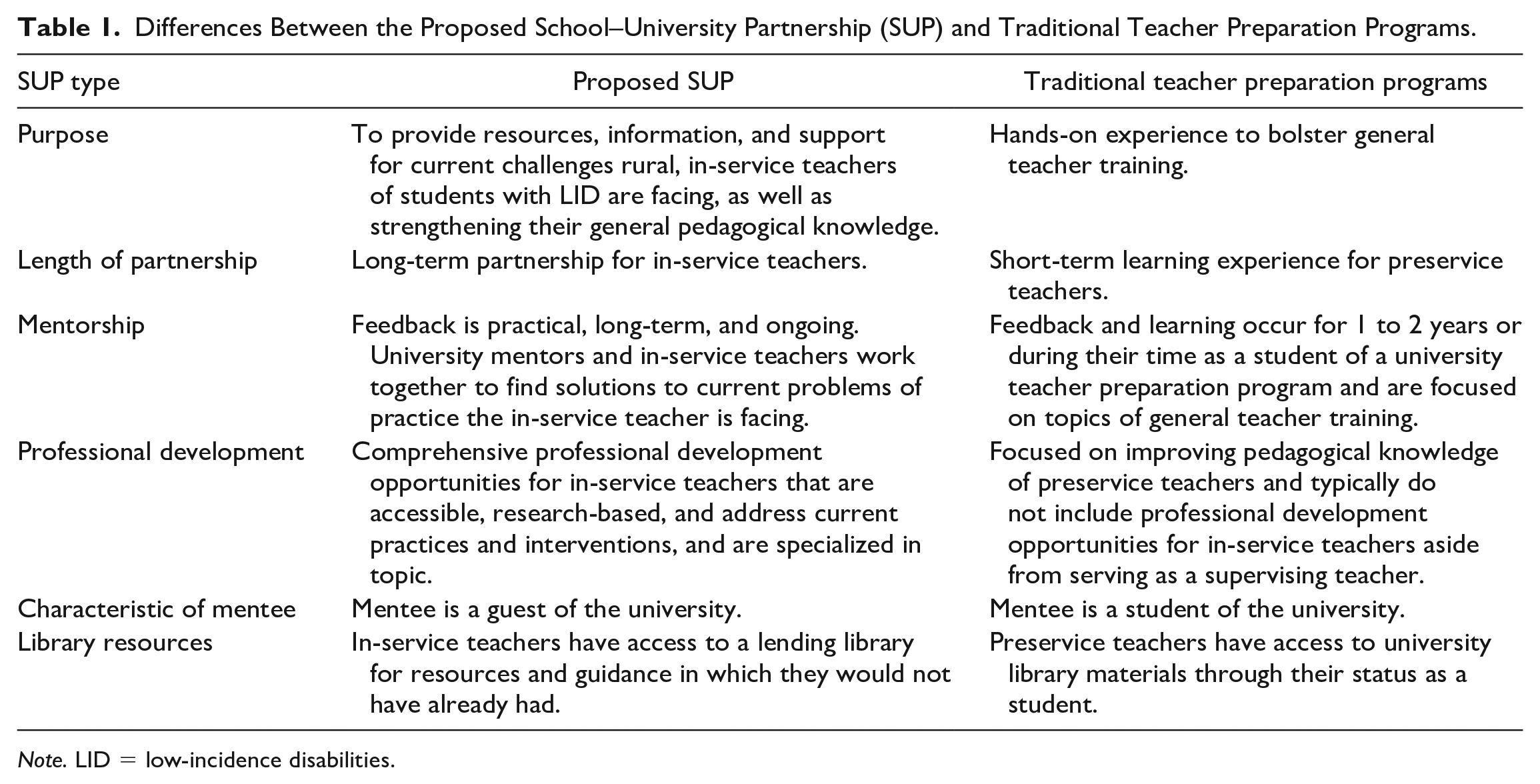
Note. LID = low-incidence disabilities.
Rural special education teachers have faced high attrition rates, partly because they feel unprepared to educate students with LID (O’Neill, 2018). Research confirms their lack of readiness, which leads to poor educational outcomes for these learners (Berry et al., 2011; Cavitt & Kovach, 2022; Collins, 2007; Ludlow et al., 2005).
A growing body of special education research discusses establishing SUPs to address rural special education challenges (Hoppey, 2016; Magiera & Geraci, 2014; Maheady et al., 2016; Rude, 2005). That being said, limited research puts SUPs at the center of addressing the rural teacher shortage and the poor educational outcomes of students with LID in these areas.
Therefore, in this position paper, SUP is used to address the specific needs of in-service teachers who are teaching students with LID in rural areas. More specifically, our conceptualization of SUPs extends beyond schools hosting practicum and internship students as part of their teacher education programs, which typically only last for a year or two during their teacher training. We aim to promote SUPs as multi-faceted, long-term partnerships designed for in-service teachers to build deeper connections and community, improve their pedagogical skills, and gain access to research, online resources, and instructional materials. See Table 1 for the differences between traditional teacher preparation programs and our proposed SUP..
Existing studies have shown that university collaborations with schools can raise the caliber of teachers in underperforming institutions (Burroughs et al., 2020; Hora & Millar, 2011; Levine, 2006; National Commission on Teaching and America’s Future, 1996; Rosenberg et al., 2009). SUPs can support robust teacher preparation programs, fostering the professional growth of working educators and university professors, and promoting student learning (Badiali et al., 2000; Birrell et al., 1998; Buczynski & Hansen, 2010). Others argue that, in comparison with traditional teacher education programs, which typically have a residency component for preservice teachers (Dorel et al., 2016; Greenberg et al., 2011; Hobson et al., 2012), general SUPs (not focused on rural teachers of students with LID) offered more long-term structured teaching experiences for both pre- and in-service teachers, increased and ongoing feedback for teacher candidates, and more opportunities to gather student performance data (Beck & Kosnik, 2002; Brown et al., 2003; Conaway & Mitchell, 2004; Price, 2005).
Even though previous work has not used SUPs to specifically target the rural special education teacher shortage and the outcomes of students with LID in rural areas, SUPs could potentially be the key to eliminating these challenges. This stems from the collaboration of university and school resources, enabling rural schools to broaden and enhance their knowledge and skills (Maheady et al., 2016).
Furthermore, researchers have separately called attention to rural special education (Berry, 2012; Berry et al., 2011; Cavitt & Kovach, 2022; Rude, 2005): (a) high attrition rates which affect the educational outcomes of students with LID (Billingsley & Bettini, 2019), (b) educational outcomes of students with LID (Capper, 1990; Collins & Ludlow, 2018; Ludlow et al., 2005; Rude, 2005), (c) the rural teacher shortage (Brownell et al., 2004; Oyen & Schweinle, 2020), and (d) the benefits of SUPs (Hoppey, 2016; Magiera & Geraci, 2014; Maheady et al., 2016; McCray et al., 2011; Mollenkopf, 2009; Price, 2005). However, researchers have not combined these areas of study.
Our review of the literature puts SUPs at the center of addressing two specific challenges associated with rural special education: (a) the high rate of teacher attrition and (b) the poor outcomes seen for students with LID. It is essential to explore how SUPs can address these issues because SUPs can possibly provide an excellent intervention for addressing both concerns (Berry et al., 2011; Sutcher et al., 2019).
We organize this position paper by first introducing our method of conducting our literature review; second, we propose a SUP that will improve two specific challenges of rural special education by asking: What can the literature tell us about how SUPs can address two challenges associated with rural special education (a) the teacher shortage and (b) the performance of students with LID? From the literature, we then propose a partnership with the following essential elements (a) instructional, assessment, and online resources; (b) mentorship; and (c) professional development. We conclude by discussing the implications of this proposed SUP.
Review of Literature
We initially used ERIC, Google Scholar, Education Complete, and Scopus to identify publications in which writers framed their research using terms related to “special education,” “teacher shortage,” “low-incidence disabilities,” “school university partnerships/university school partnerships/SUP,” “professional development,” and “rural education” in various possible combinations to find articles for our position paper. We searched for articles with these keywords separately or in combinations in either the article’s title, abstract, or body.
We limited our review to studies from the United States because the U.S. educational system has unique challenges, laws, and funding and, therefore, unique solutions for special education issues. We did not create a narrow time period because we did not want to limit our search.
In our initial review of the literature, we gained a broad understanding of the issue (i.e., rural special education is facing significant challenges) and general themes (i.e., areas in need of reform include the teacher shortage, poor teacher training programs, inadequate classroom resources, and poor professional development) and then narrowed our search to find common themes, including professional development, mentorship, and instructional and educational resources. First, to achieve a comprehensive understanding of the issues, we began by reading secondary sources—reviews, conceptual articles, program reviews and evaluations, and position papers (e.g., Collins, 2007; Rude & Miller, 2018). These papers helped shape our initial idea of SUPs as an effective intervention for alleviating the teacher shortage and supporting students with LIDs, particularly in rural settings.
Next, we allowed theoretical and empirical papers to shape our findings because they both offer valuable lenses. Theoretical papers offered a variety of perspectives to understand SUPs, the problems associated with the rural special education teacher shortage, including a high teacher attrition rate, and the current issues affecting students with LID. These theoretical papers allowed us to understand one or more areas of our scope (e.g., SUPs targeting special education, but not considering students with LID directly, or LID students without thinking about SUPs). The papers aided us in piecing together the complex puzzle in order to form a more comprehensive proposal that utilizes their perspectives in order to build a proposed SUP that addresses our foci, the rural teacher shortage, and the needs of students with LID. The empirical papers also provided the necessary data to support our proposed partnership.
Then, using the themes we found in our first search, we used EBSCO (PsychoInfo, Education Complete, and ERIC) and Google Scholar to conduct keyword searches in various possible combinations consisting of at least two of the following terms: special education, low-incidence disabilities, teacher shortage, professional development, school-university partnerships, and rural education.
We found 23 articles from EBSCO and 16 from Google Scholar. Additionally, we searched the tables of contents of peer-reviewed journals from 2002 to 2022: Exceptional Children, Rural Special Education Quarterly, and Teacher Education and Special Education. These three journals were explored because their scopes’ and publications aligned with our topics, including the rural special education and the teacher shortage. We found 23 articles from Rural Special Education Quarterly, six articles from Exceptional Children, and four articles from Teacher Education and Special Education. We also searched the references of the papers we found to dive deeper into certain themes including professional development, mentorship, and instructional and educational resources. We found seven additional articles in the references of relevant articles. Through these searches, we identified 79 articles. Author 1 excluded 18 overlapping articles. Within the remaining 61 articles, there were articles irrelevant to our foci (i.e., SUP, teacher shortage, and LID). We further excluded 42 articles because 12 were outside our scope and 30 were not relevant to our foci or topic. After that, we were left with 19 articles that shaped our findings for a proposed SUP. See Figure 1 for a flow chart of our methodology and Table 2 for details for each of the 19 articles included in this paper.
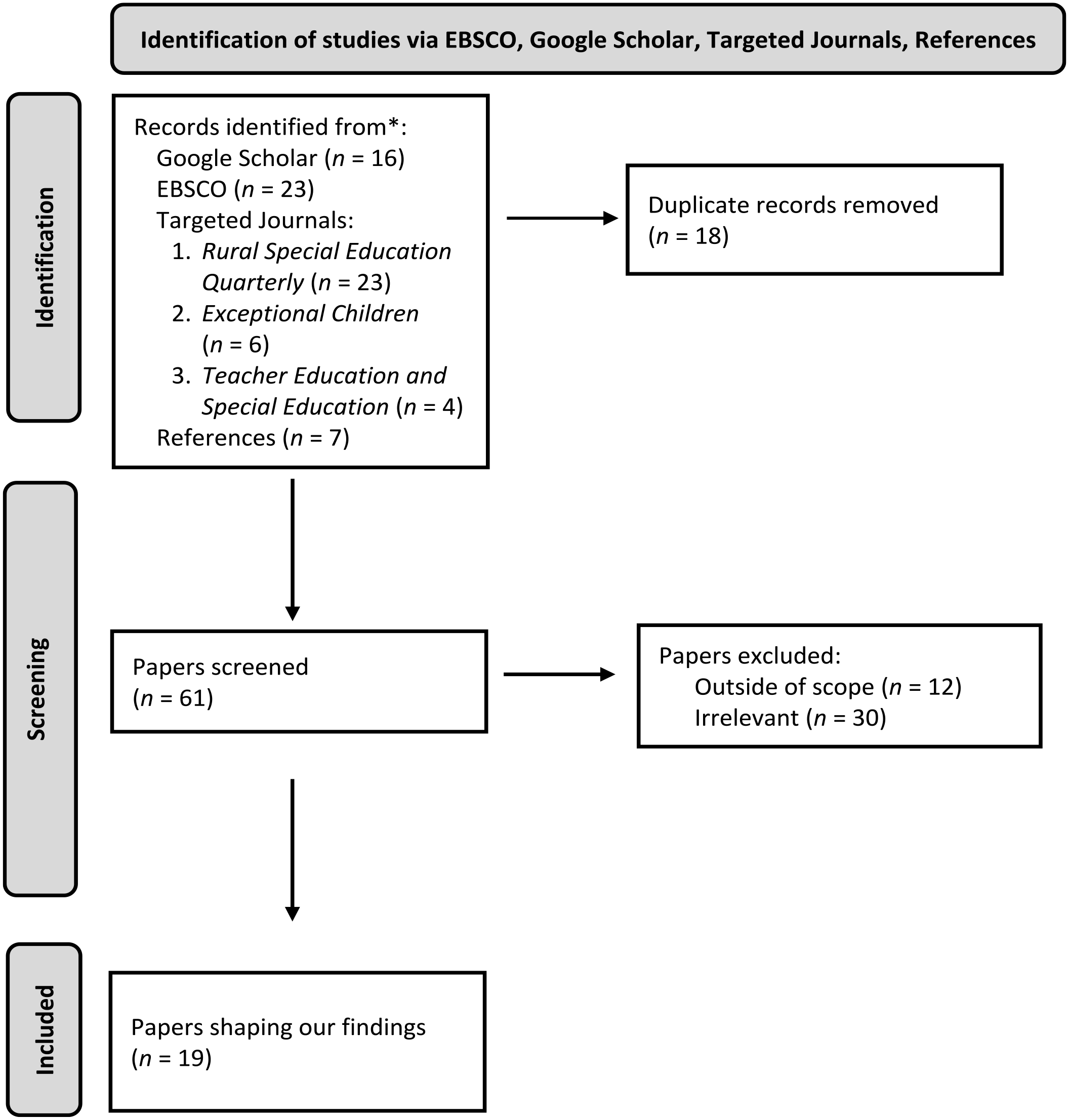
Studies Selection Flow Diagram.
Theoretical and Empirical Papers Reviewed.
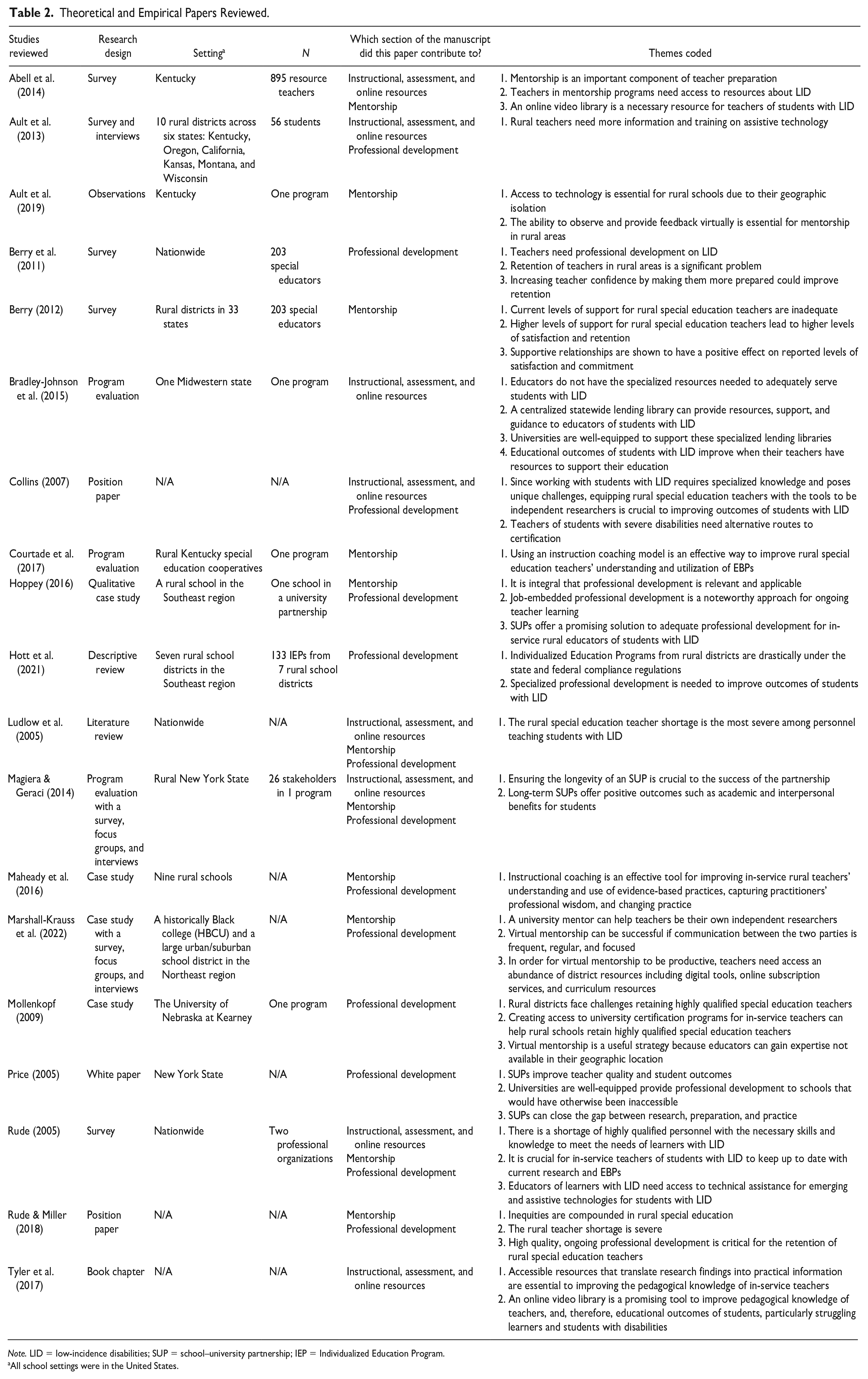
Note. LID = low-incidence disabilities; SUP = school–university partnership; IEP = Individualized Education Program.
All school settings were in the United States.
To analyze studies we found, at least one author read each article; then we met virtually once per week to discuss themes. Each author took primary responsibility for preparing a written summary of three to five articles per week. We developed a template to analyze and summarize the studies. It included categories typically used for literature reviews (e.g., author and year published, research method, keywords, research questions, sample, methods/analysis, key findings, and practical suggestions). We used these categories to familiarize ourselves with each study and to analyze common themes. We tracked the evidentiary trail from these studies by noting their topic, subject, method, findings, and discussion/implications, which assisted us in reviewing concepts for each relevant section as we discussed essential elements of a SUP to alleviate the rural special education teacher shortage in the United State and improve the outcomes of students with LID in rural areas.
It is worth noting that the papers included are specific to rural special education. However, some general education research that offers implications for urban and suburban education but could apply to rural special education was included (e.g., Billingsley & Bettini, 2019; Price, 2005). Themes were developed from the saturated and repeated major findings from these 19 studies including the need for and use of mentorship in SUPs, the need for and use of effective and targeted professional development in SUPs, and the need for and use of resources in SUPs (see Table 2 for details). We found there were gaps in the literature regarding SUPs; for example, putting SUPs at the center of solving teacher shortages but not improving outcomes for students with LID. Major themes emerged to support a comprehensive SUP including mentorship, resources, and professional development.
Key Findings and Discussion
The essential elements of our proposed SUP include (a) instructional, assessment, and online resources; (b) mentorship, and (c) professional development. All three of these elements offer teachers increased accessibility to resources about the education of students with LID which will increase teacher retention by increasing preparedness to teach this population and improve outcomes for learners with LID. The elements are not exclusive to each other; however, by addressing them individually, we can highlight the importance and unique benefits they bring when included in a comprehensive SUP.
Instructional, Assessment, and Online Resources
In this section, we call attention to the available university resources, such as instructional and assessment materials and online resources, to decrease the rural special education teacher shortage and support students with LID via SUPs. For example, we suggest building a university-run lending library.
In our review, a group of scholars discussed rural schools and their shortages in instructional materials and technology, which contributed to teacher attrition and the low performances of students with LID (Ault et al., 2013; Oakes & Saunders, 2004; Sundeen & Sundeen, 2013; Tieken & Montgomery, 2021). For instance, a primary area of research in special education is assistive technology (AT). A study by Ault and colleagues (2013) reveals that students in rural areas had access to AT across functional areas., including communication, body support, protection and positioning, and education and transition. However, compared with all students around the United States, rural students had significantly fewer devices per student. The authors speculate that this could be due to a lack of awareness about AT in rural districts and a lack of funding. Similarly, Sundeen and Sundeeen (2013) indicate that rural schools have limited access to instructional technology due to insufficient funding and budgetary constraints. They note that rural districts may have to utilize alternate funding sources, such as federal and private grants. Furthermore, Walters et al. (2014) list resources available to Grades 3 to 8 teachers in rural Northeast region schools, including 38% who had access to textbooks and other Common Core State Standards in Mathematics (CCSSM) aligned resource materials, and only 23% had access to assessment resources to monitor student progress. Resource deficits are compounded in special education, especially those serving students with LID, because many additional support tools are needed to educate students with high support needs. One key solution our proposed SUP offers is building a university-run lending library that can provide these specialized resources to teachers. An additional benefit of a lending library is that, with these resources, teachers will feel better prepared to teach students with LID and, therefore, less likely to leave their jobs. Researchers have found that improving the retention of current teachers could have a larger positive impact on the teacher shortage than any other intervention (Sutcher et al., 2019).
It is important to note that librarians are crucial in making these resources accessible to teachers. Librarians from both the higher education and rural schools must communicate about the needs of special education teachers and stay current about targeted materials for the rural LID population. A few examples of established university resources that provide teachers with assessment, instructional, or online resources are the lending library program at Texas A&M University (https://files.eric.ed.gov/fulltext/ED260262.pdf), the IRIS Center (n.d.; https://iris.peabody.vanderbilt.edu/), and Central Assessment Lending Library (n.d.; https://www.cmich.edu/academics/colleges/liberal-arts-social-sciences/departments/psychology/psychology-centers-clinics-research-labs/central-assessment-lending-library).
Kok (1984) describes a lending library that was part of the Vocational Special Needs program at Texas A&M University. This program provided special education teachers with materials pertaining to the education of students with high support needs, including resource lists and assessment materials. While lending libraries have existed for decades, these programs must evolve with current research and technology. One way to do this would be to establish an online video library for teachers of students with moderate to severe disabilities (Abell et al., 2014) that showcases exceptional instructional practices and provides examples of instructional strategies.
Another helpful model is the IRIS Center. The IRIS Center is hosted by Vanderbilt University’s Peabody College and is supported by the U.S. Department of Education’s Office of Special Education Programs (OSEP). The Center emphasizes evidence-based instructional and intervention practices, including Evidence-Based Practice Summaries and user-friendly modules that allow users to explore topics discussed in research. The Center’s STAR (Software Technology for Action and Reflection) Legacy Modules provide in-depth information for teachers, including how to write high-quality Individualized Education Programs (IEPs), how to implement evidence-based practices with fidelity, and how to include students with significant cognitive disabilities in the general education classroom (IRIS Center, n.d.; Tyler et al., 2017). The modules are focused on translating research findings into practical information that is easy for preservice and in-service teachers to digest (Tyler et al., 2017).
The last example is the Central Assessment Lending Library (CALL), which provides information, consultation, and resources to teachers teaching students with LID. CALL is staffed by faculty members and a student in the psychology doctoral program (Bradley-Johnson et al., 2015; Central Assessment Lending Library, n.d.; https://www.cmich.edu/academics/colleges/liberal-arts-social-sciences/departments/psychology/psychology-centers-clinics-research-labs/central-assessment-lending-library). School officials can use the library to rent assessments and instructional materials pertaining to students with LID that may have otherwise been inaccessible (Bradley-Johnson et al., 2015). For instance, teachers can borrow materials such as Braille flashcards and the Early Literacy Skills Builder. To give an idea of the content of materials offered, the Early Literacy Skills Builder is a unique reading program for children with moderate to severe intellectual disability (Browder et al., 2008). The CALL is a thoughtful way to connect teachers with the resources they need to help their students succeed, especially in rural areas. Even if the CALL is located in a metropolitan area, it is set up to work with educators virtually, and nearly all of its resources are shipped to those who rented them, making this resource accessible to rural schools (Bradley-Johnson et al., 2015). The CALL can be a tool to increase support for teachers, thus reducing attrition, decreasing the number of students with LID who are isolated in separate settings, and equipping teachers with the resources they need to help students with LID succeed.
An ideal lending library would incorporate elements from IRIS (Tyler et al., 2017) and CALL (Bradley-Johnson et al., 2015) because these programs can provide practical, effective, and accessible training, an online resource center, and instructional and psychoeducational assessment materials. An optimal SUP should also include elements of instructional coaching such as practices described by Courtade and colleagues’ (2017) study as well as evidence-based practices (Singer et al., 2017), and professional development programs run by the university (Zenkov et al., 2013). Combining elements from existing university-affiliated lending libraries and creating new, innovative solutions to inequities in materials can create an even more effective library.
In agreement with Maheady and colleagues (2016), we acknowledge that these programs (Borthwick et al., 2020; Chu, 2022) may only be sustainable with financial support from state and federal funding intended to create and maintain comprehensive SUPs. Resources for rural teachers of students with LID should be a top priority for support and allocation of resources because learners with LID, compounded with rural inequalities, are at the highest risk of receiving an inadequate education. It is important to note that these programs are meant to bolster already existing district resources and supports.
Future directions include allowing research opportunities for teachers themselves to consume research, conduct action research, and be reflective educators using evidence-based practices focusing on LID students (Collins, 2007; Gesel et al., 2022; Rude, 2005).
Overall, a lending library, as a part of a comprehensive SUP, could strengthen the connection between action research and teachers to create better educational outcomes for students with LID and increase teachers’ preparation to teach these students. When teachers feel adequately prepared to educate students with high support needs, they are more likely to stay in their position, decreasing special education teacher attrition rates.
Mentorship by University Faculty
School–university partnerships allow for mentorship by university faculty. Mentorship refers to collaborative relationships among teacher educators and P-12 professionals (i.e., teachers and school leaders) to improve service delivery to students with disabilities (Maheady et al., 2016). Mentorship of in-service teachers by university faculty is a critical element of a successful SUP. Connections to university staff give in-service teachers positive service examples, allow for collaboration and knowledge sharing, and help teachers develop their instructional skills (Capper, 1990; Courtade et al., 2017; Hoppey, 2016). Mentorships between university faculty and in-service teachers are essential to retaining rural educators teaching students with LID and improving outcomes for students with LID. As Jackson (2008) notes, the high attrition rates, which are majorly contributing to the teacher shortage, are impacted by a perceived lack of preparedness on the part of teachers teaching students with LID. That being said, mentorship by university faculty can allow in-service teachers to feel more qualified to address the needs of their students with the feedback and suggestions of their university mentors who have expertise in the field.
One type of mentorship SUPs can coordinate is between clinical, community, and field experience faculty (i.e., from part of a teacher education program or part of a state-funded grant) who are observing preservice or supporting in-service special education teachers. This way, rural special education teachers can feel more supported and prepared to teach students with LID, increasing teacher retention and reducing the teacher shortage.
However, mentorship is an area that needs serious improvement to alleviate the special education teacher shortage, especially for teachers of students with LID (Hagaman & Casey, 2018). Billingsley et al. (2004) state that 61% of 370 special educators reported having access to a formal mentorship program in the first few years of teaching. While this is more than the majority, 61% still leaves room for improvement, and there needs to be more current research on the availability of formal mentorship for special educators. One avenue for these support networks is mentorship by university faculty, which has been shown to improve student outcomes, build teachers’ confidence, positively affect retention, and improve the research-to-practice gap (Berry, 2012; Courtade et al., 2017; Maheady et al., 2016). Mentorship can be incorporated into university faculty’s service component by being a part of a cohort that provides mentorship. That being said, if this cohort became too large of a workload, adding mentorship as a course could be considered if funding allows. Additionally, it is important to note that faculty should be matched carefully with teachers so, to the extent possible, the university mentor’s experience and expertise match the mentee’s current position (Jackson, 2008).
Furthermore, instructional coaching has a tight tie to research in mentorship. University mentors can work with teachers to bridge the research-to-practice gap. For example, Maheady and colleagues (2016) describe programs in nine rural schools where graduate students coached P-12 teachers in an “I do, we do, you do” (p. 38) coaching style (which is also called guided practice, see Gersten & Kelly, 1992) to conduct research projects looking at substantial instructional difficulties, including active student participation, increasing academic productivity, and decreasing disruptive behaviors. Topics focused on in mentorship can be shaped by paying particular attention to immediate problems of practice that in-service teachers are experiencing, which is one feature of job-embedded professional development that has been shown to enhance student and teacher learning (Croft et al., 2010; Hoppey, 2016).
It is important to note the possible challenges in SUP-organized mentorship programs; we offer two considerations. First, a historical theme was that university mentors had to allow for flexibility in meeting locations due to geographic isolation (Mollenkopf, 2009). However, virtual mentorship has become possible due to the advancement and availability of technology. The available research, partly due to the COVID-19 pandemic, offers valuable insights and strategies for conducting effective virtual mentorship (Ault et al., 2019; Marshall-Krauss et al., 2022). For instance, Marshall-Krauss and colleagues (2022) conducted an action research study on virtual mentoring programs. They found that maintaining connections in partnership during times of sudden change is possible as long as virtual mentorship continues to be frequent, regular, and focused. This is an example of the versatility and flexibility of SUP-provided mentorship. Additionally, Ault and colleagues (2019) reflect on alternative ways for mentors to observe rural educators and give feedback during the COVID-19 pandemic. They state that classroom cameras can adequately provide educators and mentors with a way to connect.
While there has been a change in the role technology plays in schools since COVID-19 (Ferdig et al., 2020), researchers indicate access to technology is still a challenge for many schools (Running Bear et al., 2021; Srinivasan et al., 2021). The literature emphasizes rural students’ lack of access to technology and Wi-Fi (Carpenter & Dunn, 2022) but does not explore educators’ access to these resources. Our earlier proposal of creating a SUP with a strong lending library base can solve part of this problem so rural educators have access to technology to participate in a mentorship program fully.
Second, careful attention must be paid to the caseload of university staff mentoring rural educators (Courtade et al., 2017). Too heavy a caseload on one mentor may limit how much time they can dedicate to mentoring each teacher, negatively impacting the partnership’s success (Courtade et al., 2017). These were limitations found in the SPLASH program, a Kentucky Department of Education professional development program that used a coaching model to help rural educators increase the academic performance of students with LID (Courtade et al., 2017).
Overall, a more significant support network for special educators will improve student outcomes and increase teacher satisfaction and commitment to their jobs (Berry, 2012; Edinger & Edinger, 2018; Glover et al., 2016; Rivera et al., 2023). Special education teachers can benefit from working with administration and university mentors to adopt a balanced and realistic approach, allowing them to be more apt to face challenges associated with teaching and less likely to leave the profession (Carver-Thomas & Darling-Hammond, 2019; Hagaman & Casey, 2018).
Professional Development
In this section, we argue that SUPs can provide the professional development needed to retain rural special education teachers and improve outcomes for students with LID. Professional development programs in this paper refer to formats such as seminar days, summer training institutions, and job-embedded professional development (Croft et al., 2010; Hoppey, 2016).
A university-provided professional development program can help begin to repair the rural teacher shortage by providing the necessary knowledge to teach students with disabilities. Rural educators often leave the field because they do not have the specialized knowledge required to teach this population of students (Eppley, 2009; Hobbs & Törner, 2019) for instance an understanding of IEPs (Hott et al., 2021) and AT, including alternative and augmentative communication (Alexandra Da Fonte, 2022; Ault et al., 2013). Students with LID only receive a quality education when their teachers are adequately equipped to teach them (Carver-Thomas & Darling-Hammond, 2019; Rude, 2005).
Furthermore, it is important to consider the key professional development topics that should be improved on to keep rural special education teachers in the field, including (a) supporting students with LID (Berry et al., 2011; Bradley-Johnson et al., 2015); (b) improving teachers’ skills in collaboration and inclusive practices (Berry et al., 2011; Hoppey, 2016); (c) offering resource support for curriculum content (Berry et al., 2011; Bradley-Johnson et al., 2015); and (d) providing access to special education and LID-specific certification programs (Ault et al., 2019; Collins, 2007; Mollenkopf, 2009). For example, Mollenkopf (2009) elaborates on how the University of Nebraska at Kearney uses university resources to improve the rural teacher shortage and create highly qualified teachers. The program focuses on accessible certification programs for rural educators, which can be considered another form of professional development.
Additionally, scholars call for the following information to be provided to teachers in an evidence-based way: strategies that promote the inclusion and interaction of students with LID and their non-disabled peers (Berry et al., 2011; Rude, 2005), facilitation of literacy and language development among learners with LID (Rude, 2005), and the provision of assistive and emerging technologies that enhance the instructional effectiveness for students with LID (Alexandra Da Fonte, 2022; Alsolami, 2022; Michaels et al., 2017; Rude, 2005).
Professional development provided by universities through a SUP allows for the full utilization of university resources and faculty expertise (Darling-Hammond et al., 2017; Hora & Millar, 2011; Levine, 2006; Mollenkopf, 2009; National Commission on Teaching and America’s Future, 1996; Rosenberg et al., 2009). Additionally, it offers practicing educators a specific way to remain current in the field of LID, which is often absent (Rude et al., 2005; Shurr et al., 2014), given that many educational resources and professional development opportunities emphasize general education supports (e.g., the general teacher preparation program when those educators were becoming teachers). Furthermore, through SUP-provided professional development, special education teachers would have access to resources that improve their understanding of these concepts and, therefore, enhance the education of students with LID in their classrooms. After all, students with LID only receive a quality education when their teachers are adequately equipped to teach them (Rude, 2005).
Conclusion
The challenges facing rural students with LID have been documented for decades and warrant serious attention. The severe rural special education teacher shortage and poor outcomes for students with LID must be addressed effectively and comprehensively. Our envisioned SUP is an innovative way to work beyond SUPs as programs that solely provide traditional teacher preparation and create a practical, specialized, real-life-based, comprehensive, solution-centered approach. This SUP is meant to aid in-service, rural special education teachers, a population shown to be unprepared for meeting the educational needs of students with LID and who have a high attrition rate. Because of their status as in-service teachers, they are likely not a part of a teacher education program or students of a higher education institution. Hence, unlike preservice teachers, they may not have an existing connection to university resources.
Even though many of these in-service teachers received initial teacher training from a university, their former training alone is inadequate. Teachers serving students with LID would benefit from university support to lean on during their in-service teaching years. Additionally, in traditional teacher education programs, students take the role of a student teacher. Thus, they do not have complete responsibility for the education of students in their classroom and would typically refer to their cooperative teacher to address the complex needs of students with LID.
On the contrary, in-service teachers take full responsibility for educating students with LID and are often left without adequate support to do so. We argue that comprehensive SUPs can help to alleviate the teacher shortage and might be the key to revolutionizing the education of students with LID because of the opportunities the partnership can provide in regard to supporting teachers via university mentorship, equipping them with current EBPs, and providing necessary resources directly to teachers and schools.
However, none of this would be possible without the support of key stakeholders who play critical roles in supporting a longer-term SUP in which we are proposing. These roles include (a) university faculty who can engage in practical and community outreach work to transfer research findings into practical actions (Borthwick et al., 2020); (b) university and school librarians should keep a dialogue with teachers about the lending library’s (Bradley-Johnson et al., 2015; Kok, 1984) valuable resources to ensure educators are aware of the available resources and therefore ensure the accessibility and effectiveness of the lending library; (c) clinical and field faculty who are working with preservice and in-service teachers can seek opportunities for communicating the emerging issues regarding the causes of the teacher shortage and the needs of students with LID to keep both university and school faculty informed about current issues (Chu, 2022); and (d) school and district administrators should provide sufficient support to allow teachers and schools to try new ideas in supporting students with LID. Additionally, using the resources SUPs (Borthwick et al., 2020) can provide, school and district administrators must organize professional development opportunities for special education teachers to hone their skills using EBPs while also implementing professional development topics that address teachers’ top concerns. Special education teachers can seek opportunities to stay informed about data-driven and effective interventions and EBPs, support their students, and find support for their own needs as well.
In conclusion, we consider the foundational elements needed to make SUP an effective intervention tool for the retention of teachers and the educational outcomes of students with LID. These partnerships are vital for the progress of the rural special education field and to provide an equitable education to students with LID in rural areas across the United States. With proper education, rural students with LID will be equipped with skills and experiences that will prepare them for any future opportunities they wish to pursue.
Footnotes
Authors’ Note
The authors confirm that this work is original and has not been published elsewhere, nor is it currently under consideration for publication elsewhere.
Availability of Data and Material
There is no existing data set for this position paper.
Declaration of Conflicting Interests
The author(s) declared no potential conflicts of interest with respect to the research, authorship, and/or publication of this article.
Funding
The author(s) received no financial support for the research, authorship, and/or publication of this article.
