




Abstract
Effective use of classroom management practices is critical to creating positive classroom climates supporting students’ academic and behavioral outcomes, and teachers in rural areas have a strong need for training in classroom management. One classroom management practice with significant support is behavior-specific praise (BSP). Research shows teachers need training to use BSP at high frequencies. Multicomponent training packages with sustained coaching have demonstrated increases in teacher use of BSP, but more flexible training approaches are needed to meet the needs of rural teachers. We used a multiple baseline design to first evaluate the effects of an online module on rural teachers’ use of BSP. Then, we evaluated the additive effects of asynchronous, virtual peer coaching on BSP. Results tentatively suggest the presence of a functional relation between virtual peer coaching and BSP following the online module and suggest the absence of a functional relation between the online module alone and BSP.
Many teachers feel inadequately prepared to effectively manage student behavior and report classroom management skills as one of their greatest professional development needs (Rollin et al., 2008). Students in poorly managed classrooms experience less time engaged in academics than other students (Shinn et al., 1987) and are at risk for developing persistent or severe behavior problems (Greer-Chase et al., 2002). Student problem behavior also negatively impacts teachers; it is associated with increased burnout (Aloe et al., 2014; Reinke et al., 2013) and lower teaching self-efficacy (Reinke et al., 2013). Teachers in rural areas are more prone to experiencing stress and burnout than teachers in other geographic settings and have a demonstrated need for professional development (PD) in classroom management (Berry et al., 2011; Garwood et al., 2018). Rural special educators are more likely to provide services outside of their training areas than teachers in urban and suburban areas (Berry et al., 2011) and receive less PD than teachers in other types of areas (Glover et al., 2016).
Effective classroom management aims to maximize academic engagement and achievement and apply proactive behavior management practices (Simonsen et al., 2008; Sugai & Horner, 2002). One classroom management practice with significant scientific support to decrease inappropriate behaviors and increase engagement is the use of behavior-specific praise (BSP; Royer et al., 2019). Behavior-specific praise is a praise statement that clearly indicates the student and behavior being praised (Brophy, 1981; Sutherland et al., 2000). It is a particularly useful intervention to target during teacher training because of its positive effects on student behavior and because it is simple to deliver, non-intrusive, and requires little time to implement (Sutherland et al., 2000). Despite strong evidence for the use of BSP across grade levels, educational settings, and student populations (Conroy et al., 2009; Royer et al., 2019; Sutherland & Wehby, 2001), observational studies show it is used at low and inconsistent rates ranging from 1.8 to 8.8 statements per hour (Burnett & Mandel, 2010; Floress et al., 2018; Reinke et al., 2013), as opposed to recommended rates of at least three to five BSP per 10-min (Floress et al., 2018; Floress & Jenkins, 2015) and as high as four or more per minute (Kranak et al., 2017). Systematic reviews summarizing teacher training on BSP have shown multicomponent training packages increase teachers’ use of the strategy (Ennis et al., 2020; Floress et al., 2017; Zoder-Martell et al., 2019). Common components in these packages are didactic instruction (e.g., Dufrene et al., 2014; Thompson et al., 2012), performance feedback (Duchaine et al., 2011; Myers et al., 2011; Sutherland et al., 2000), goal setting (Allday et al., 2012; Sutherland et al., 2000), self-monitoring (e.g., Gage et al., 2017; Simonsen et al., 2017), and teacher incentives (e.g., Myers et al., 2011). However, more research is needed evaluating PD approaches on classroom management strategies feasible for use with rural teachers who face additional barriers to accessing PD relative to other teachers. Rural school districts have particular difficulty providing PD due to challenges including geographic isolation, a lack of PD resources, and a lack of available staff to support PD efforts (Glover et al., 2016).
Efficient Instructional Methods for Teaching Classroom Management Practices Online
Online PD is a well-suited modality for training rural teachers who have more limited access to in-person training resources and peers in the same content area. Online PD enables teachers to connect virtually with higher education institutions and peer teachers in other rural areas (Erickson et al., 2012). Sustained, online professional learning communities have been shown to decrease teachers’ feelings of isolation (Herrington et al., 2006) and improve instruction and student achievement (McConnell et al., 2013). With the increasing use of online teacher PD (King & James, 2022; Lay et al., 2020), there is a need to further evaluate online instructional methods for improving teacher practice in critical areas, such as classroom management. Evaluating the effects of asynchronous online instruction may be of particular importance because of the lack of opportunity for in-the-moment practice and feedback, which research shows is often necessary to change classroom management practices (Dufrene et al., 2014; Gage et al., 2017; Myers et al., 2011; Simonsen et al., 2014; Stormont et al., 2007). Components of high-quality didactic instruction on classroom management that can be delivered in an asynchronous format are providing (a) an overview of the practice, (b) examples and non-examples of how to use the practice, (c) plans for incorporating the practice into instruction, and (d) written feedback. Following asynchronous online instruction, some teachers may be able to increase their use of practice without additional feedback, while others may require coaching with more frequent feedback (Torelli et al., 2023).
One way to provide coaching online is via peer coaching. During peer coaching, teacher partners observe each other’s teaching and provide structured feedback. Peer coaching is a promising approach to efficiently provide feedback because the instructor trains teachers to serve as the coaches, lessening the supervisory resources necessary for coaching and providing opportunities for connection and learning between teachers. Previous studies have shown in-person peer coaching is effective in a variety of educational settings. Research supports in-person peer coaching for in-service teachers, showing it increases the use of social-emotional learning practices in early childhood classrooms (Golden et al., 2021), high-leverage practices in inclusive elementary school classrooms (Ackerman et al., 2023), and instructional practices in elementary school classrooms (Kohler et al., 1997, 1999). However, few studies have evaluated the effects of peer coaching on classroom management practices, and only one has used virtual peer coaching (Torelli et al., 2023). The small body of research on in-person peer coaching for classroom management with in-service teachers provides promising initial evidence. Teachers have increased the use of specific classroom management practices with peer coaching, including opportunities to respond, BSP, rule reminders, choice opportunities, and positive descriptive feedback (Ackerman et al., 2023; Golden et al., 2021; Stichter et al., 2006), suggesting further research evaluating the effects of virtual peer coaching on use of classroom management practices is warranted.
Another important area of extension for research on peer coaching is the timing and modality of peers observing and providing feedback. In previous peer coaching studies, teachers observed each other in person and provided written feedback either immediately following an observation (Golden et al., 2021; Stichter et al., 2006) or by the end of the day (Ackerman et al., 2023). In some studies, teachers also held conferences to discuss feedback following observations (Ackerman et al., 2023; Stichter et al., 2006), which may make peer coaching less practical for teachers to implement because they need to find time in the school day to observe and additional time to discuss the observation. In addition to conducting peer coaching virtually rather than in-person, procedural adaptations, we evaluated to improve the feasibility of peer coaching included (a) using video recordings of instruction, rather than live observations, (b) using a longer, more flexible feedback window for peers to provide feedback (i.e., within 24 hours of uploading a lesson recording), and (c) providing written feedback without live conferences.
The purpose of this study was to evaluate the effects of online instruction and asynchronous, virtual peer coaching on rural teachers’ use of BSP when embedded in an online graduate course in classroom management.
The research questions we addressed were:
Method
Participants and Setting
After obtaining Institutional Review Board (IRB) approval, we recruited participants from a graduate-level online course in classroom management. Nine students in the course consented to participate in a larger study evaluating the effects of peer coaching on various classroom management strategies (i.e., BSP, precorrection, opportunities to respond, and choice). Four of the nine participants targeted BSP, and this study reports the results of these four participants. Participants had not received graduate course instruction on BSP before consenting to participate in the study.
All four participants were certified to teach in at least one area and taught in different schools. All schools were Title 1 public schools located in rural districts in the southeast United States with approximately 600 students or fewer. We used the National Center for Education Statistics (NCES) locale classifications to define school districts as rural (National Center for Education Statistics [NCES], 2021). We defined school districts as rural if they were labeled as rural, distant town, or remote town. Teachers implemented the strategies in their classrooms, and we collected data via video recordings. The research team coded and analyzed weekly or bi-weekly video recordings of a targeted instructional activity submitted by participants. The submissions were stored in a secure cloud storage system. Camilla had 5 years of experience, was certified in elementary education and special education for learning and behavioral disorders, and was a special education math teacher. She recorded small group math instruction for grades 5–6 during the study. Tori had 5 years of experience, was certified in interdisciplinary early childhood education, and was a prekindergarten teacher. She recorded large group story time. Delaney was a first-year teacher, emergency certified in special education for learning and behavioral disorders, and was a first-grade special education teacher. She recorded lessons during small group math and reading instruction. Lauren was a first-year teacher, certified in elementary education, and taught third grade. She recorded lessons during Tier 2 math and reading instruction. All four participants were Caucasian.
Materials
Participants submitted videos to a folder on a secure cloud storage service. Only the participants, their peer coach, and the research team had access to their videos. We collected data using electronic data forms in word processing software. During the peer coaching phase, participants submitted electronic peer coaching forms to their partner’s folder (see Figure 1 for the form, adapted from Golden et al., 2021). We told each participant to review their feedback, initial, date, and move the document to a “reviewed” folder to indicate they had read the feedback. Participants also had access to a graph showing their frequency of BSP by session during peer coaching.
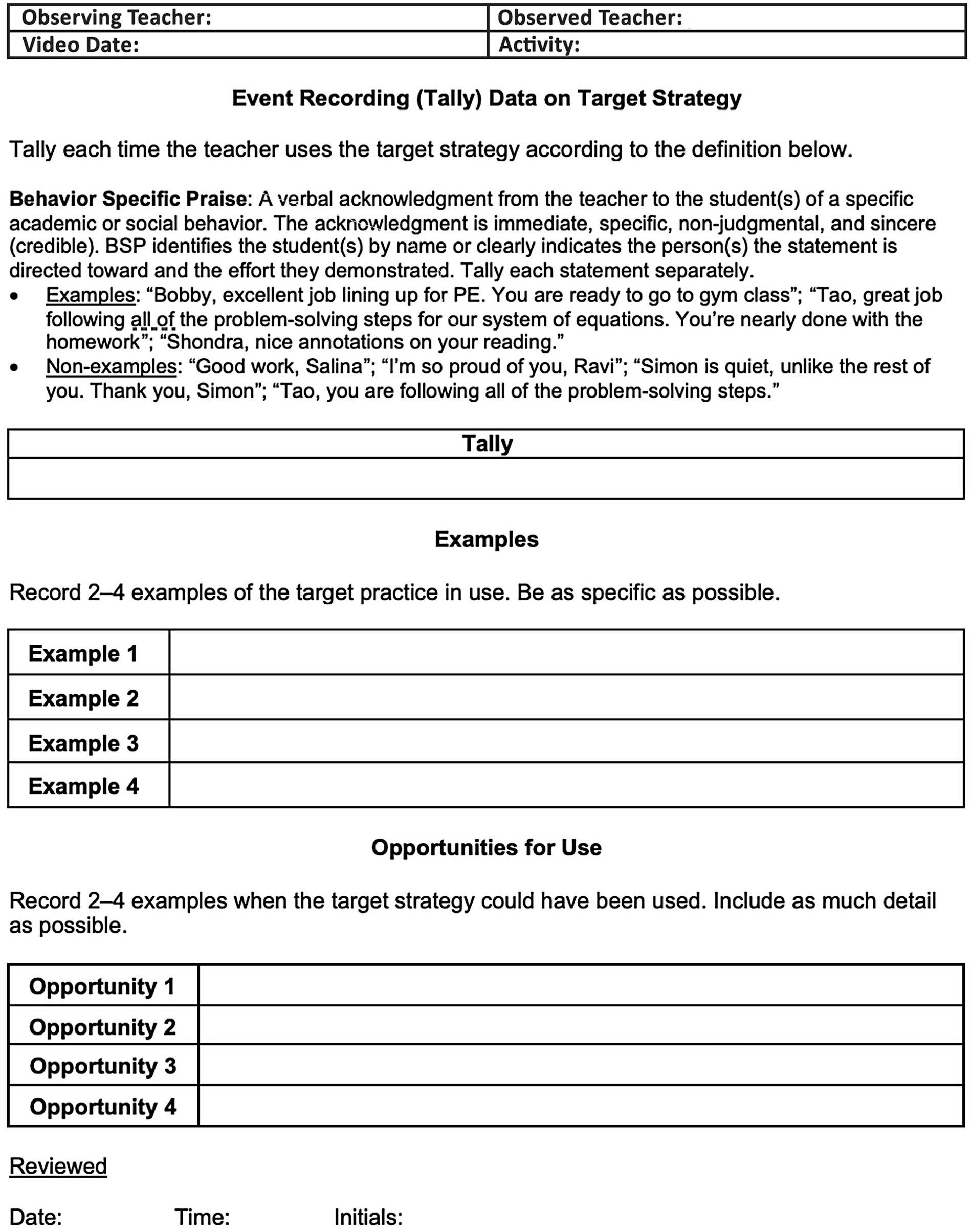
Peer Coaching Form.
Research Design
We evaluated the effects of peer coaching on BSP using a concurrent multiple baseline across participants design with three experimental phases (Gast et al., 2018). The first phase was a baseline phase in which participants submitted videos of their targeted instructional activity without any additional instructions. Following the baseline, we assigned participants a target practice (i.e., BSP for all participants in this study) to which we applied the independent variables. In the next phase, participants completed an asynchronous online module on the target practice. Following the module phase, participants implemented peer coaching for the target practice. We staggered the introduction of peer coaching across the first three tiers of the multiple baseline design. Due to practical constraints of embedding the study into a semester-long course and because peer coaching was the primary independent variable of interest, we did not stagger the introduction of online instruction in the same order as peer coaching (see Figure 2). We conceptualized the online module phase as an enhanced baseline condition and expected most participants to require additional support to increase BSP.
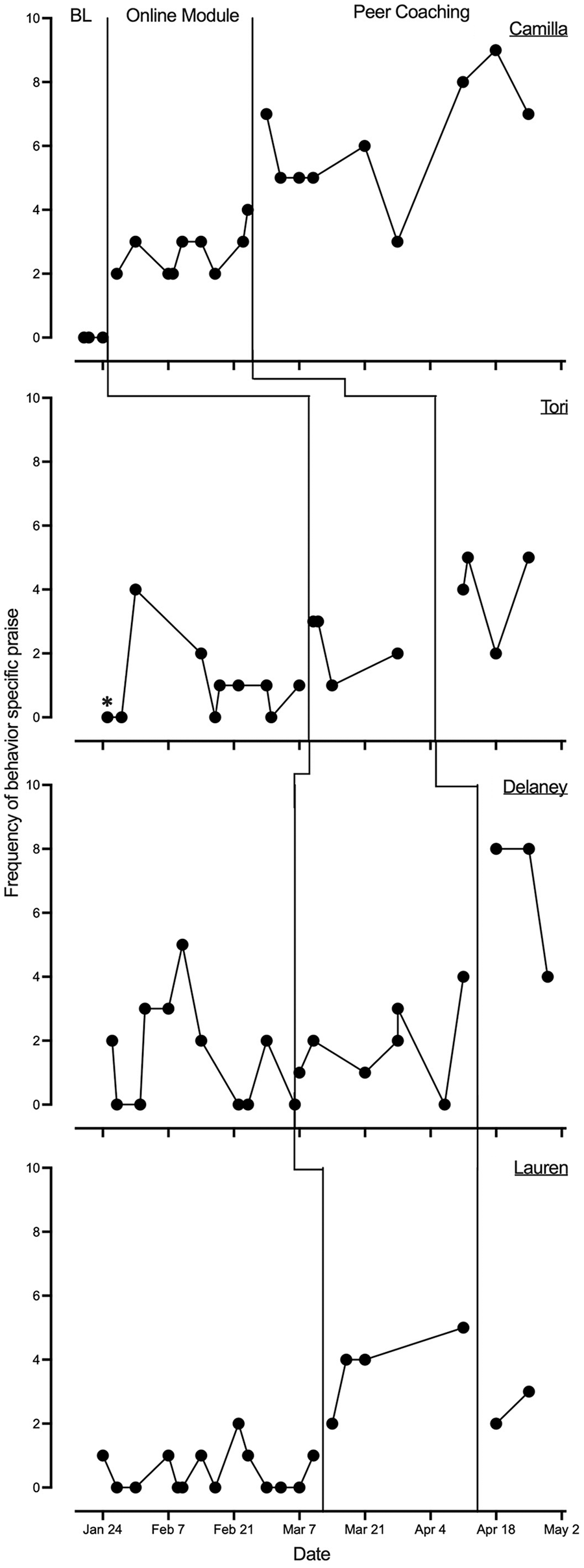
Treatment Evaluation Results for Teachers’ Use of Behavior-Specific Praise.
We determined when to make phase changes using visual analysis within and across tiers, observing for stable levels or a countertherapeutic trend in BSP with a minimum of three data points per condition before changing conditions (Gast et al., 2018). We determined which participant would receive intervention first using visual analysis, observing for stable or countertherapeutic trends in BSP (Gast et al., 2018). Camilla received the online module first (first tier), then Delaney (third tier), followed by Tori (second tier), and finally Lauren (fourth tier). We staggered the introduction of peer coaching across the first three tiers after observing a change in the level of BSP in the intervened tier and stability in non-intervened tiers for at least two sessions before introducing peer coaching in the subsequent tier(s). After observing stable levels of BSP during the online module phase in the third and fourth tiers, we introduced peer coaching in both tiers simultaneously due to the upcoming end of the semester.
To control for threats to internal validity given the limitations in how we staggered conditions across phases, we included four participants and collected at least four data points in baseline and online module phases (Ledford & Zimmerman, 2022). To infer the presence or absence of functional relations between the independent variables and BSP, we used visual analysis within and across tiers. We inferred the presence of a functional relation if we observed an immediate increase in BSP following the introduction of an independent variable (online instruction or peer coaching) that maintained or showed an increasing trend within the phase for at least three tiers while observing stable levels of BSP in non-intervened tiers.
Response Measurement
Behavior-specific praise
Trained observers collected data using an electronic form in which they tallied the frequency of BSP during 10-min video recordings of the participant’s targeted instructional activity. We coded BSP as each time a participant provided a verbal acknowledgment to the student(s) of a specific behavior (Royer et al., 2019). The statement had to include a sincere (i.e., not sarcastic), positive statement describing the behavior and clearly indicate the student(s) referenced. Examples were, “Nice work entering the problem into your calculator, Juan,” and “Thank you for moving to the carpet quickly and quietly, table 1.” We excluded sarcastic statements and statements without a clear reference to a student or specific behavior. Non-examples were, “Elle is doing a great job of sitting quietly, unlike certain other people,” and “Excellent work.”
Interobserver agreement
Trained observers collected data independently and simultaneously on at least 25% of randomly selected sessions across participants and conditions to assess interobserver agreement (IOA). During baseline, we collected IOA on 33%, 27%, 30%, and 35% of sessions for Camilla, Delaney, Tori, and Lauren, respectively. During the online module, we collected IOA on 33%, 43%, 25%, and 75% of sessions for Camilla, Delaney, Tori, and Lauren, respectively. During peer coaching, we collected IOA on 56%, 100%, 50%, and 50% of sessions for Camilla, Delaney, Tori, and Lauren, respectively. We calculated IOA using the gross method of agreement by dividing the smaller BSP frequency by the larger BSP frequency and multiplying by 100%. We used the gross method of agreement because our data collection method prevented point-by-point agreement. The form was designed as a practical measurement tool that other course instructors would be able to use with minimal training and resources. Mean agreement across participants and conditions was 96.3% (range, 80%–100%). For Camilla, mean agreement was 95.1%, 100%, and 100% for baseline, online module, and peer coaching phases, respectively. For Delaney, mean agreement was 100%, 100%, and 91.7% for baseline, online module, and peer coaching phases, respectively. For Tori, mean agreement was 100%, 100%, and 90% for baseline, online module, and peer coaching phases, respectively. For Lauren, mean agreement was 100% for all phases. Interobserver agreement varied by phase and participant due to a relatively low frequency of BSP in some sessions, providing few opportunities for agreement.
Procedures
General procedures
We conducted the study over the course of an academic semester. All study activities were embedded into the classroom management course and completed online and in participants’ P-12 classrooms. We collected study data by coding the participants’ recorded lessons during a targeted instructional activity (e.g., whole-class math instruction). The course instructor (first author) told participants to select an instructional activity when they (a) provided teacher-directed instruction to a group of students and (b) had difficulty managing student behavior. She instructed students to keep the instructional context and students they were teaching similar across videos. Videos were 10 min in duration, except session 1 for Tori, which was 7 min, 58 sec (noted in Figure 2). In the first 8 weeks, participants submitted videos twice per week. In the last 6 weeks, participants submitted videos once per week. The exact number of videos varied slightly across participants due to scheduling variations (range, 18–21). Outside of the study, as part of the associated course, participants completed online modules on classroom management practices unrelated to BSP (e.g., setting classroom expectations, developing routines, pre-correction, opportunities to respond, and choice).
Baseline
The participants submitted videos of their target instructional activity twice weekly during baseline. Following the third baseline video submission, the research team selected a target practice for each participant by visually analyzing the baseline frequency data of selected practices taught in the course (i.e., opportunities to respond, choice, pre-correction, BSP). We selected BSP for participants in this study due to low baseline frequencies relative to other potential target practices and using professional judgment about the appropriateness of BSP for the classroom context.
Online module
After observing stable responding or a countertherapeutic trend in BSP during baseline, we staggered the introduction of online instruction across participants. In this phase, participants completed an asynchronous online module on BSP. The module included a recorded lecture and a quiz we developed. The lecture was 17 min long and defined BSP, provided examples and non-examples, described how to use BSP, and provided prompts for planning to incorporate BSP into instruction. It also included a short video clip of a teacher using BSP during instruction. The quiz assessed participants’ understanding of BSP and required them to share their plan for incorporating BSP into instruction. Participants received instructor feedback on quiz responses and were required to earn at least 80% on the quiz to submit their next video (all participants earned at least 80% on the first attempt). During this phase, participants were told to try to increase their use of BSP. They were not given a specific goal.
Virtual peer coaching
After observing stable responding or a countertherapeutic trend in BSP during the online module phase, we staggered the introduction of peer coaching across participants. During peer coaching, participants were assigned a partner in the class with whom they implemented reciprocal peer coaching. Participants were paired with another person in the course who taught in a similar setting and grade level. None of the participants in this study were paired with each other. Participants completed a short online module (approximately 20 min) on how to implement peer coaching. The module described the rationale for peer coaching, peer coaching procedures, how to provide appropriate feedback with examples and non-examples, and how to use the peer coaching form. Participants completed a quiz assessing their understanding of how to implement peer coaching and were required to earn an 80% or higher to begin peer coaching (all participants earned at least an 80% on the first attempt). Participants submitted videos once per week during peer coaching and completed peer coaching on each video submitted. Each week, participants watched their partner’s video, completed a peer coaching form (see Figure 1), and uploaded the form to their partner’s cloud folder within 24 hours after a video was submitted. We did not program interactions between teachers beyond completing the written peer coaching forms, though we encouraged teachers to exchange phone numbers with their partners to tell them when they uploaded videos and forms. After receiving a peer coaching form, the teacher reviewed the feedback, initialed, dated, and moved the form to a “reviewed” folder in their cloud storage folder within 24 hr of receiving it and prior to submitting their next video. The course instructor informally reviewed teacher videos and peer coaching forms weekly and emailed participants when videos or forms were missing or not completed correctly.
Treatment integrity
We formally evaluated treatment integrity of BSP and peer coaching modules using data available from the learning management system. These data indicated all participants watched the recorded lectures in full, completed the associated quizzes, and received instructor feedback and a grade of at least 80% on the quizzes.
We evaluated treatment integrity on peer coaching using permanent product data from the peer coaching forms that participants completed while watching their partner’s videos. We randomly selected between 33% and 50% of peer coaching sessions across participants to evaluate treatment integrity. We assessed the extent to which peer coaching forms were completed as planned by coding (a) submission of the form, (b) on-time feedback, (c) tally data provided, (d) examples of BSP provided, and (e) opportunities to use BSP provided. When coding treatment integrity on BSP examples and opportunities for use, we only coded the component as correct if the peer provided BSP statements that met our operational definition for BSP (see Response Measurement section). We calculated the percentage of correct components by dividing the number of correct components by the total number of components and multiplying by 100. Average treatment integrity was 77% (range, 0%–100%). The average treatment integrity percentage was somewhat low because one form was missing, which was scored as 0% integrity. By component, including the missing form at 0%, average integrity was 85.7% for submission of the form, 71.4% for on-time feedback, 85.7% for tally data provided, 85.7% for examples of BSP provided, and 57.1% for opportunities to use BSP provided. For the same randomly selected sample, we separately assessed treatment integrity of reviewing peer coaching forms by summing the number of forms the participant reviewed by the number of forms they received and multiplying by 100%. Participants reviewed 83.3% of the forms they received (the missing form was not included as an opportunity in calculating this percentage).
Results
The research questions we addressed in this study were: (1) Does an asynchronous online module increase rural teachers’ use of BSP relative to baseline? and (2) Does asynchronous virtual peer coaching following online instruction increase rural teachers’ use of BSP relative to completion of the online module alone? We graphed data following each session and used visual analysis (i.e., analyzed level, trend, variability, consistency, immediacy, and overlap) within and across tiers following study completion to infer functional relations between peer coaching and BSP. Figure 1 shows the results for the four participants.
During baseline, Camilla did not use BSP (M = 0). Following completion of the online module, Camilla showed an immediate increase in the level of BSP with frequencies between two and four per session (M = 2.7). Following the introduction of peer coaching, Camilla showed an immediate further increase in level from the online module phase with frequencies between three and nine per session (M = 6.1). She maintained high frequencies of BSP during peer coaching. The percentage of non-overlapping data (PND) during the online module relative to baseline was 100%, and PND during peer coaching relative to the online module was 88.9%.
Tori used low frequencies of BSP during baseline between zero and four per session (M = 1.1). Following completion of the online module, Tori showed a slight increase in her use of BSP during the first session before BSP returned to baseline levels (M = 1.5, PND = 0%). When she began peer coaching, Tori showed an immediate increase in BSP and maintained frequencies between two and five per session (M = 4, PND = 75%).
Delaney used variable frequencies of BSP during baseline between zero and four per session (M = 1.6). Her frequency of BSP showed little change from baseline during the online module phase (M = 1.9, PND = 0%). Delaney showed an immediate increase and change in level in BSP when she began peer coaching with frequencies between four and nine (M = 6.7). The level of BSP during peer coaching remained higher than in the online module phase but with a decrease in the final data point and a PND of 66.7%.
Lauren used low, somewhat variable frequencies of BSP during baseline between zero and four per session (M = 0.5). Her frequency of BSP increased following the online module with frequencies between two and five (M = 3.8, PND = 100%). After introducing peer coaching, the frequency of BSP decreased to two and three per session (M = 2.5, PND = 0%). We were only able to collect two data points for Lauren during the peer coaching phase due to the end of the semester. Thus, while the data suggest peer coaching may not have increased Lauren’s BSP, more data are needed to draw conclusions regarding the effects of peer coaching on her BSP.
Across tiers, two of four participants showed an increase in BSP during the online module phase (Camilla and Lauren). The remaining two participants did not show a change in the level of BSP during the online module phase (Tori and Delaney). These results suggest there was not a functional relation between the online module and BSP. These data should be interpreted with caution due to the limited lag in the introduction of the online module across tiers.
For peer coaching, two of four participants (Camilla and Tori) showed an immediate increase in BSP with peer coaching that was maintained throughout peer coaching. One participant (Delaney) showed an immediate increase in BSP that decreased during the final session, overlapping with baseline and online module frequencies. The fourth participant (Lauren) had insufficient data suggestive of a non-response to peer coaching. The combined results tentatively suggest there was a functional relation between peer coaching and the frequency of BSP relative to the online module with additional data needed to confirm a functional relation.
Discussion
The purpose of this study was to evaluate the effects of (a) an asynchronous online module and (b) asynchronous virtual peer coaching following online instruction on rural teachers’ use of BSP. We found two of four teachers increased their use of BSP with the online module alone and three of four teachers increased their use of BSP during peer coaching following the online module phase, though results did not maintain for one of the teachers who initially responded to peer coaching. Results tentatively suggested the presence of a functional relation between BSP and peer coaching relative to online instruction alone.
Our results extended the literature on PD for rural teachers in classroom management in three ways. First, results replicated previous studies showing increases in teachers’ use of classroom management practices with peer coaching (e.g., Ackerman et al., 2023; Golden et al., 2021) and extended these results to rural teachers. In previous in-person peer coaching studies targeting classroom management practices with in-service teachers, teachers increased their use of BSP, opportunities to respond, choices, rule reminders, and feedback. Results of these studies suggested peer coaching may be a useful approach for increasing a range of classroom management practices (Ackerman et al., 2023; Golden et al., 2021; Stichter et al., 2006) and provided initial support for use in rural settings where fewer staff may be available to provide supervisory coaching.
Second, results provided initial support for peer coaching adaptations to enhance its utility and feasibility for use in rural settings by implementing it virtually and asynchronously using video recordings of instruction and written feedback without conferences. Our results showed most teachers increased BSP during peer coaching, even when teachers received slightly delayed feedback following the targeted lesson and without meeting to discuss the observation. These adaptations increase peer coaching’s utility for use in rural settings by implementing it online, decreasing the time required to implement it, and enhancing the intervention’s flexibility. Asynchronous, virtual implementation of peer coaching is a benefit for rural teachers who may not have colleagues in close physical proximity who teach the same subject area or grade level (Howley & Howley, 2004), while also overcoming physical distance and scheduling as barriers to use. Further, results provide a viable method for incorporating frequent feedback into online teacher preparation courses without increasing staffing resources, which are also particularly limited in rural areas (Glover et al., 2016).
Third, results inform the extent to which didactic instruction alone is responsible for changes in teachers’ use of BSP and add to the literature showing didactic online instruction may be insufficient to change some teachers’ use of classroom management practices. Studies evaluating the effects of training on teachers’ use of BSP have shown positive effects using a variety of training approaches. Almost all of these studies have used multicomponent packages to train teachers (Floress et al., 2017; Zoder-Martell et al., 2019). While didactic instruction is the most common component in these packages, we cannot isolate its effects when it is evaluated in combination with other strategies (Zoder-Martell et al., 2019). Our results replicate previous studies showing at least some teachers require additional support to didactic instruction to increase the use of BSP (Dufrene et al., 2014; Gage et al., 2017; Myers et al., 2011; Stormont et al., 2007; Torelli et al., 2023) and suggest peer coaching may meet some of these teachers’ training needs.
Implications for Research and Practice
The results of this study, combined with previous studies, have several implications for practice and research for rural teachers. Related to practice, the absence of a functional relation between the online module and the use of BSP strengthens existing evidence that many teachers will require additional support beyond didactic instruction to change their use of classroom management practices. PD providers for rural teachers, including higher education faculty and school-based coaches, should embed opportunities for practice and feedback to help teachers increase their use of classroom management practices. These results are aligned with recommendations that PD includes active learning, implementation of skills in daily routines, and follow-up support (Desimone, 2009). Asynchronous, virtual peer coaching provides a feasible modality for rural school districts to embed active learning, practice, and regular feedback into PD. Results also suggest peer coaching is a promising resource-efficient method for providing teachers with increased feedback. Peer coaching may provide added benefit over other coaching methods for rural teachers because the peer observation component may act as a model for how to implement target practices, which may be particularly beneficial for rural teachers who tend to have fewer experienced colleagues than other teachers (Rude & Miller, 2018). Further, the reciprocal nature of peer coaching may decrease feelings of isolation, a common experience for rural teachers (Garwood et al., 2018), and encourage further collaboration (Donegan et al., 2000). Relatedly, results suggest some teachers may not need additional support beyond didactic instruction to apply target practices. In practice, PD providers may consider regularly assessing teachers’ implementation of target practices to determine who needs additional support. More resource-intensive supports (e.g., peer coaching, supervisory coaching) can then be applied only to teachers with a demonstrated need for them.
Implications for research include a need to better understand the specific components of PD packages that produce changes in teacher behavior and to understand who might require additional support. Future studies should further evaluate PD components in isolation to inform the development of more resource-efficient packages that can be used to train rural teachers. Component analyses of PD packages would also allow researchers to identify predictors of response and non-response to individual training components, and to understand how rural teachers respond to PD relative to other teachers. A better understanding of for whom and under what conditions teachers respond to training would help PD providers tailor training for teachers based on contextual factors (e.g., school, teacher, and classroom characteristics). Finally, results point to a need to develop additional methods for efficiently providing teachers with feedback, whether online or in person. As PD providers balance limited resources with teachers’ need for sustained feedback, having a range of approaches to choose from may help PD providers be more effective.
Limitations
The results should be interpreted considering the following limitations. First, while data were collected as concurrently as possible across tiers, there were some inconsistencies in the exact days in which teachers submitted videos due to differing academic calendars and teaching schedules. Camilla began baseline three days prior to other participants and began peer coaching while the remaining participants were still in baseline. Further, while decisions to change phases were response-guided (i.e., by observing for stability or countertherapeutic trends in baseline and online module phases), they were also limited by the academic semester schedule. As a result, some phase changes were introduced with limited staggering across tiers, and we were unable to collect sufficient peer coaching data for Delaney and Lauren to confidently infer functional relations. These limitations increase the difficulty of visually analyzing data across tiers to infer functional relations and limit confidence about controlling for historical threats. To help mitigate these limitations, we followed reporting guidelines for multiple baseline designs, including graphing data by date to clearly show instances of non-concurrence and time between sessions (Ledford & Zimmerman, 2022). Second, we were unable to collect maintenance or generalization data due to resource constraints and the academic semester schedule. Thus, we do not know if participants increased their BSP at other times during the school day or if they maintained higher frequencies of BSP when peer coaching was removed. This is an important area for future studies to evaluate, considering previous research showing mixed results related to generalization and maintenance for classroom management strategies following peer coaching (Ackerman et al., 2023; Golden et al., 2021).
Conclusion
Previous research has demonstrated the promise of peer coaching for improving teaching practices. This study extended the peer coaching literature by evaluating the effects of asynchronous, virtual peer coaching following the completion of an asynchronous online module to increase rural teachers’ use of BSP. Three of four teachers increased their use of BSP with peer coaching, though results did not maintain for one teacher, tentatively suggesting the presence of a functional relation between BSP and peer coaching following the online module. Only two of four teachers increased the use of BSP with the online module alone. Results cautiously provided initial support for a more feasible application of peer coaching for use in rural school districts by implementing it virtually and asynchronously.
Footnotes
Acknowledgements
We thank Mallory Glowatz, Alyson Parker, Madelyn Richman, Cora Spiller, and Haylee Hood for their assistance with data collection.
Declaration of Conflicting Interests
The author(s) declared no potential conflicts of interest with respect to the research, authorship, and/or publication of this article.
Funding
The author(s) received no financial support for the research, authorship, and/or publication of this article.
