




Abstract
As the world tackled the COVID-19 pandemic, nearly all research institutions underwent significant change, shifting from an in-person to an online landscape, resulting in several benefits and drawbacks to their research laboratories. The pandemic shut down most research efforts, and methods such as online Zoom meetings were required to keep most elements of the research and training going. In the post-COVID period, anxieties about health and safety resulted in difficulty in recruiting participants for clinical studies, and the emphasis on following health standards and guidelines (e.g., social distancing, personal protective equipment) required flexibility in research training processes. This symposium incorporates satisfaction rates and anecdotal evidence from individuals experiencing in-person and virtual research training throughout the pandemic to examine the changes and effects COVID-19 had on laboratory research. Nine traits of a high-quality research training environment (RTE), proposed in a study by Gelso et al, provide context for the subjective claims made and assist in categorizing certain traits. Both modes of research training carry benefits and drawbacks. The increase in collaboration and communication in an online space promoted several of the nine traits of an RTE. However, qualitative feedback from students suggests that the lack of training incorporating the direct operation of equipment, holding a transducer, and direct interaction was detrimental to new laboratory members and their research training. Flexibility and a combination of in-person and online training are likely necessary for an effective research environment in a post-COVID world.
The global COVID-19 pandemic introduced unprecedented challenges to the educational and research spheres. The forced closure of physical laboratories and the subsequent shift to virtual environments disrupted the research training process significantly. Here, we aim to dissect these changes by identifying the essentials of a high-quality research training environment (RTE), exploring the disruptive impact of the pandemic, and elucidating the indispensable need for in-person training while recognizing the added value of virtual training components. Provided personal anecdotes illuminate the real-world impact of these changes on researchers’ experiences.
Factors That Contribute to a High-Quality Research Training Environment
A high-quality RTE serves as the bedrock for the creation and nurturing of tomorrow’s researchers. An intricate web of elements is essential for fostering such an environment. In their work, Gelso et al 1 offered a framework for understanding the nuances of a high-quality RTE, proposing nine traits:
Faculty modeling appropriate scientific behavior (FM);
Positive reinforcement of scholarly activities (PR);
Early, minimally threatening research involvement (RI);
Teaching statistics and the logic of design (Stat);
Teaching to look inward for research ideas (IR);
Science as a partly social experience (SS);
Emphasizing that all studies are flawed (F);
Focusing on various investigative styles (IS);
Uniting science to clinical practice (CP).
In a survey of 165 psychology students, these traits of high-quality RTEs contributed significantly to research self-efficacy (RSE) and a willingness to participate in future projects in both undergraduate and graduate students, reinforcing the validity of Gelso’s framework.
2
Within a scientific laboratory, the principal investigator (PI) is a keystone for facilitating these high-quality RTE traits, which goes well beyond faculty modeling. They set the laboratory’s direction, prioritize tasks, and align laboratory activities with students’ goals and objectives. To appreciate the significance of RTE characteristics facilitated by a PI, let’s consider the aspirations of a first-year research student named Robert. His narrative helps to contextualize Gelso’s nine traits of a high-quality RTE:
As I begin my research journey, I am excited to be in person for both academic and social reasons ( As an aspiring medical student, I want to learn about the meaningful nature behind my research towards medical advancement (
Disruptions in Research Training: Lessons From the COVID-19 Pandemic
The onset of the pandemic had profound implications on research training in 2020. In total, 58% of scholars and trainees were unable to conclude their research as initially planned, 57% experienced a dip in productivity, 54% faced escalating competing demands for their time, and 48% had reduced access to vital resources. 3 These disruptions presented significant hurdles for the successful development and sustenance of RTEs. The impact of the pandemic on RTEs also posed downstream effects with individual student trainee’s RSE, or the level of confidence students feel in working within the RTE. 4 This added trait is a crucial life skill that the RTE should instill, preparing students for future challenges, whether they pursue advanced research or apply their skills in other professional or personal contexts.
Despite negative impacts, these challenging times underscore the need for resilience and adaptability within RTEs, which is critical for ensuring sustained high-quality training for the next generation of researchers. Achieving seamless cooperation to maintain team science in a high-quality RTE while adhering to institutional and state-wide safety guidelines during a global pandemic presented a unique set of challenges. This section delves into the experiences and adjustments made by our laboratory during the COVID-19 outbreak.
Resilience and Adaptation to the Immediate Aftermath of the Pandemic Onset
On March 17, 2020, the mandate arrived: our laboratory was to be closed. Our Institutional Review Board (IRB)-approved community-based projects were abruptly put on hold and reassessed for potential continuation. In the wake of the pandemic, an all-encompassing suspension was placed on almost all non-COVID-19-related researches. The closure of laboratories and the redeployment of clinician-researchers to front-line duties echoed this sentiment starkly. 5 Our team, comprising Isaiah (a second-year undergraduate), Nicole (a third-year PhD student), Jade (a second-year MPH student), Austin (a second-year MS student), and myself, Kevin (the laboratory PI), faced the daunting task of carrying on with our research studies.
One project involved screening 40- to 60-year-old patients for atherosclerotic disease using novel metrics that needed to be collected in person. Through brainstorming and persistence, we devised a COVID-19 safe protocol to continue our research without increasing patient or provider risk of viral exposure. Collaboration with Randell Wexler, MD, Chief of Family Medicine, was crucial in navigating hospital and clinic migration strategies while continuing patient consultations (see Figure 1). Unfortunately, it was not possible to rework a second research project. Specifically, a third year of data collection for a USDA pediatric study involving school-age participants and their parents had to be canceled.
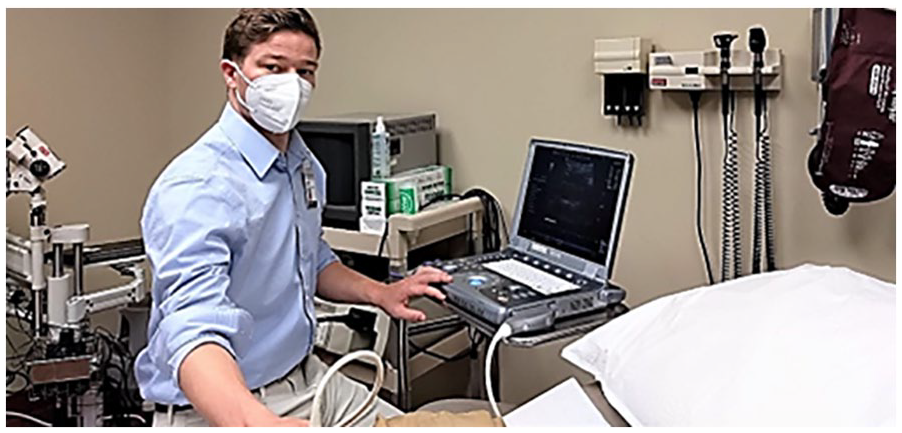
This is a picture taken of Isaiah preparing our new imaging protocol, cleaning procedure, and social distancing from the faculty mentor, based on Dr Wexler and university guidance. This change to the funded study was needed to continue taking data in the OSUMC outpatient clinic (circa April 2020).
While unable to collect new data, we focused on resuming laboratory operations to process the collected data from the previous year. We repurposed our office space and submitted a laboratory reopening form that would allow us to resume image and data analysis. Our institutionally approved laboratory reopening plan (see Supplemental Appendix) made this crucial training and image review possible and allowed the project to overcome total stagnation (see Figure 2). Innovative solutions, such as virtual image access, came to the rescue. Samad et al. 6 shared their experiences and described best practices for maintaining effective undergraduate learning through virtual mediums during the pandemic, showing that virtual RTEs can fill in gaps, planned or unexpected, that are present with in-person RTEs.
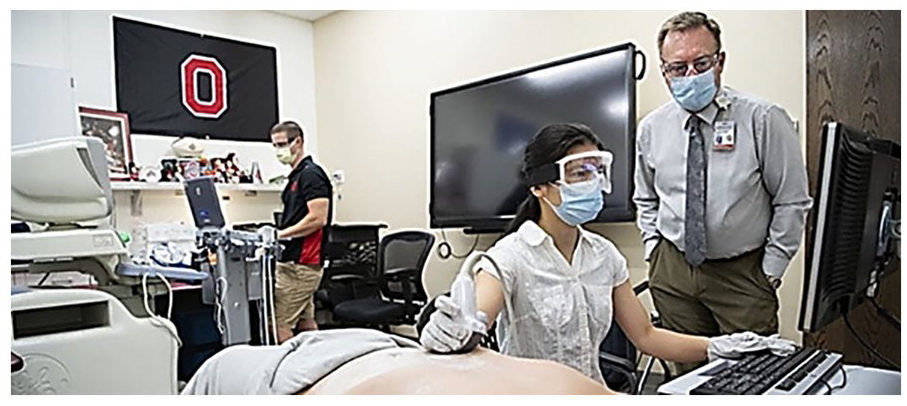
Pandemic reopening on our research laboratory allowed for continued training of our graduate students. The faculty mentor is directly working with Jade Yang, MPH candidate, on the simulator. Austin Brady, MS candidate, is reviewing images and assessing quality, taken by Isaiah, at the OSU outpatient clinic. Goggles, masks, and social distancing were part of our reconfiguration (circa May 2020).
Maintaining Laboratory Progress and Student Engagement
During these times, the need for consistent communication and meetings, both on Zoom and outdoors, became paramount for our staff and students. Our laboratory trainees faced many concerns in navigating this new and complex environment. They needed reassurance and guidance on maintaining their laboratory experiences and handling personal challenges during the pandemic. An illustration of such an experience can be seen through Sydney’s perspective below:
I would have meetings (Zoom and outside) with Dr. Evans on our lab progress; this provided me with the chance to share updates on the project and express my own wishes and concerns (
Regular meetings with Dr Evans allowed Sydney to share project updates and express her concerns and aspirations. These exchanges fostered a deeper connection and allowed for the organic progression of mentorship, making the experience more rewarding. This reaffirms the importance of fostering a supportive and adaptive RTE, particularly in times of crisis.
The Post-pandemic New Normal: Adapting Scientific Training Approaches
As the world began navigating the exit from the pandemic, the scientific community was required to adapt and establish new ways of scientific training:
As with the rest of “normal” life, the research landscape has been significantly and detrimentally altered by COVID-19. The changes having come into effect over the past several months are unlikely to revert to the old status quo soon and so a “new normal” may have to be reached.
7
In a survey conducted by Speer et al., 8 a majority of 38 mentees across six science-based departments managed to meet their goals through virtual mentorship; however, some students expressed dissatisfaction with their inability to meet their intended goals. This makes clear the need for the new normal to bring back the rigor of the in-person RTE but also carry forward the lessons in resiliency, adaptability, and virtual mentoring gleaned from the pandemic.
Reviving the USDA Pediatric Study: New Protocols and Adjusted Expectations
Finding our new normal, our team returned to the USDA pediatric study involving school-age participants and their parents. Attempting to recruit participation from the public school system, we encountered the inevitable need for reassurances and procedural adjustments; parents and children often required additional encouragement before participating due to lingering anxieties associated with the pandemic. Accordingly, our data collection protocol and expectations were adjusted to accommodate this new dynamic (see Figure 3).
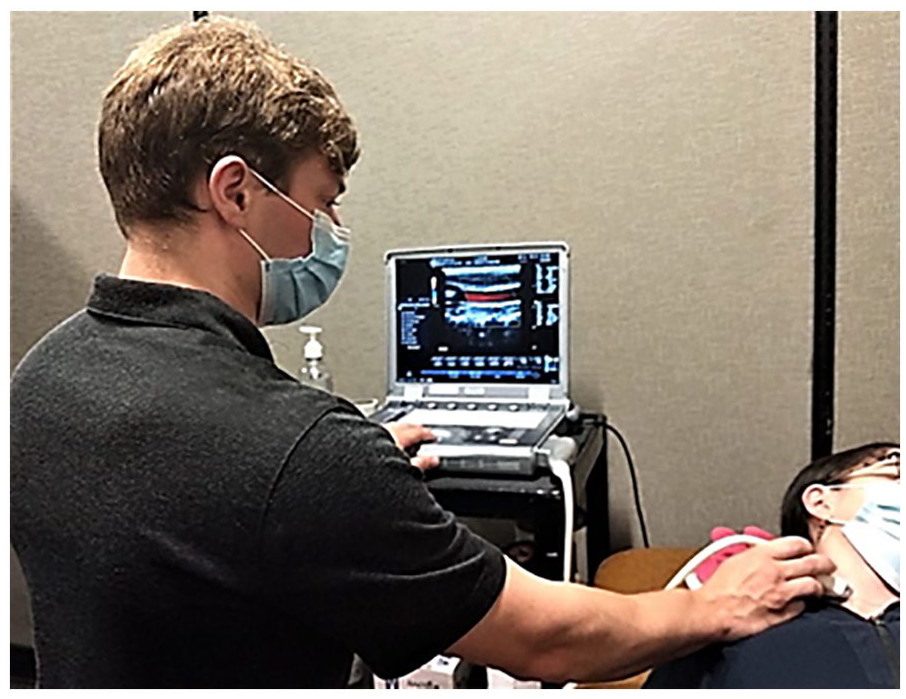
This is a picture of Isaiah demonstrating how he worked with a pediatric participant in the third cohort (year 4). After a year delay, we were able to resume our data collection for the United States Department of Agriculture’s funded study. This examination cubicle was redesigned such that Isaiah could work with indirect supervision from the faculty mentor (Note: gloves were worn with actual participants) (circa June 2021).
Although this cohort of participants was half the size of the two cohorts recruited before the pandemic, we felt very lucky to be able to complete the study. Our team used the Wexler clinic protocol to complete data collection safely and effectively. Isaiah, now a fourth-year undergraduate, and Nicole, a fourth-year PhD candidate, took participants on alternate days. Working alone with a pediatric participant allowed for easier adherence to social distancing and all COVID mitigation measures, while creating more appointment options due to increased research team availability.
Reinventing Laboratory Meetings and Beyond: Hybrid Approach
In response to the “new normal,” we adopted a hybrid approach for our laboratory meetings. We continued to hold Zoom meetings on alternate Fridays for our full laboratory sessions, supplementing these with in-person meetings in a large conference room that allowed for social distancing. This new meeting structure eliminated the necessity for “parking lot” discussions and ensured an environment conducive to collaborative discussion while maintaining safety protocols. This adjustment exemplifies how we have evolved our practices to suit the post-pandemic research landscape. The focus on maintaining a high-quality RTE remained at the forefront, demonstrating our resilience and ability to adapt to new challenges. The following narrative by Isaiah provides an insightful perspective on the application of pandemic research skills to post-pandemic data collection:
As we navigated through the turmoil and challenges of the pandemic, one thing became abundantly clear—the invaluable role of in-person mentoring in shaping undergraduate experiences ( However, to dismiss virtual platforms completely would be a mistake. The pandemic-induced necessity of Zoom and similar platforms illuminated their tangible value in complementing traditional, in-person mentoring (
The Future of Providing High-Quality Scientific Training
As we live and pursue science in the post-pandemic world, the lessons learned during the crisis offer a unique opportunity to enhance the quality of scientific training. Our collective experience has underlined the significance of flexibility in RTEs, allowing us to identify and harness the strengths of both in-person and virtual models. In a pre-pandemic world, the richness of in-person interactions was an integral part of scientific training. However, the pandemic’s upheaval demonstrated the value of remote learning and collaboration tools, showing us that they can not only supplement but, in some circumstances, replace traditional methodologies.
In the post-pandemic era, we have the chance to integrate these valuable insights and create a hybrid research training model that combines the benefits of in-person and virtual environments. This fusion of methodologies promises to enhance the quality of training, increase efficiency, and create a more flexible and adaptable scientific community. Huriah’s experience best illustrates our vision for the future of scientific training:
Throughout my academic journey at OSU, I have had the opportunity to engage in a hybrid mentoring approach that blended virtual training and mentoring with in-person experiences (
Huriah’s experience encapsulates the immense potential of a hybrid training model. Throughout her academic journey at OSU, she balanced her research commitments with personal challenges, utilizing the flexibility afforded by a hybrid research training approach. As we forge ahead, Huriah’s narrative serves as a testament to the value of maintaining a balanced, hybrid model in our RTEs, a testament that promises a vibrant and resilient future for scientific training.
Conclusion
The issues surrounding a shift from in-person to online research, in both training and execution, are complex and interweaving. A variety of anecdotal experiences from the collective effects of a post-COVID research environment were dissected and assessed relative to the nine traits of an effective RTE facilitated by a research PI. The COVID-19 pandemic led most research institutions to shut down nearly all research, resulting in massive delays to ongoing projects, and impacting RTEs. The desire of researchers to continue their work resulted in creative solutions, such as repurposed office space or the development of virtual RTEs. Anecdotal evidence would suggest that virtual RTE, such as via Zoom, can support several of the nine traits of a high-quality RTE, particularly allowing for a greater emphasis on communication and collaboration. Moreover, integrating virtual technology into research was shown by our students and staff to have many benefits in the wake of the pandemic, as having easy access to online conferences can help streamline meetings and alleviate the burdens of chronological or geographical conflicts. Simultaneously, the advantages of direct, hands-on collaboration (e.g., being able to directly hold a transducer) were made clear and were noted to be sorely missing in virtual research. Although many mentors and mentees met their research goals during the pandemic, they often expressed dissatisfaction. The transition of research throughout the phases of pre- and post-COVID life has demonstrated the benefits and drawbacks of both online and in-person research training and has highlighted the importance of flexibility. Going forward, supplementing hands-on research with easily accessible communication using virtual platforms will undoubtedly yield more in-depth and efficient research practices and promote high-quality RTEs.
Supplemental Material
sj-docx-1-jdm-10.1177_87564793231215768 – Supplemental material for Hybrid Methodologies: The Evolution and Future of Scientific Training in a Post-Pandemic World
Supplemental material, sj-docx-1-jdm-10.1177_87564793231215768 for Hybrid Methodologies: The Evolution and Future of Scientific Training in a Post-Pandemic World by Kevin D. Evans, Peter Bradbury and Isaiah W. Bloom in Journal of Diagnostic Medical Sonography
Footnotes
Acknowledgements
The authors would like to thank all our laboratory students and staff for their commitment to completing funded projects over the last 4 years.
Declaration of Conflicting Interests
The authors declared no potential conflicts of interest with respect to the research, authorship, and/or publication of this article.
Funding
The authors received no financial support for the research, authorship, and/or publication of this article.
Peer Reviewer Guarantee Statement
The Editor of JDMS is an author of this article; therefore, the peer review process was managed by alternative members of the Board and the submitting Editor had no involvement in the decision-making process.

References
Supplementary Material
Please find the following supplemental material available below.
For Open Access articles published under a Creative Commons License, all supplemental material carries the same license as the article it is associated with.
For non-Open Access articles published, all supplemental material carries a non-exclusive license, and permission requests for re-use of supplemental material or any part of supplemental material shall be sent directly to the copyright owner as specified in the copyright notice associated with the article.
