




Abstract
Objective:
The practice of mindfulness has many reported benefits. The purpose of this mixed-methods study was to investigate the effect of a three-minute, instructor-led Mindful Pause Practice (MPP) in the sonography classroom over a two-semester period.
Methods:
Participants were students enrolled in programs accredited by the Commission on Accreditation of Allied Health Education Programs from four universities. Instructors provided MPP, and then students completed the Mindful Attention Awareness Scale.
Results:
A statistically significant increase in mindfulness as was seen from pre- to poststudy (3.3 vs. 3.9, P < .001). The majority of students described the MPP as a positive experience (>70%) and reported improved classroom attention and awareness (>78%). Qualitative themes of stress reduction/relaxation, improved focus/attention, and self-care were noted each semester. Self-directed MPP outside the classroom was low but did improve over time.
Conclusion:
The addition of a short MPP to sonography classes has positive benefits and improves student mindfulness. These findings support current literature on classroom mindfulness and add information specific to sonography education.
Mindfulness can be defined as the awareness that emerges through paying attention on purpose, in the present moment, and nonjudgmentally to the unfolding of experience moment by moment. 1 Historically a Buddhist practice, mindfulness allows one to focus inwardly on self-compassion and to remain in the present moment, with the idea that suffering caused from excess worry and stress can be eliminated. 1 From moment to moment, all people are mindful to some degree. Concentration is one type of mindfulness practice in which an individual attempts to maintain focus for a period of time by repeating a mantra, focusing on a word, or by counting breaths. 2 Concentration allows one to become aware of thoughts and sensations within their body and to recognize outside stimuli without attaching a thought or personal judgment to it. The expected benefits of the practice include increased awareness and focus on the present while reducing rumination on past events. This technique can be beneficial in reducing stress, anxiety, depression, mood disturbance, and inattentiveness.2,3
Applying mindfulness techniques in the health care setting can promote not only the well-being of health care workers but has also been shown to improve patient care and healing.1 –8 Jon Kabat-Zinn, a pioneer in mindfulness research, conducted one of the first studies on the use of mindfulness in patients diagnosed with chronic pain. The study investigated the use of mindfulness techniques such as a body scan, mindful breathing, yoga to reduce pain, and stress. At the end of a 10-week stress reduction and relaxation program, participants completed a questionnaire to assess program outcomes. A significant reduction in pain and fewer medical symptoms were noted in a majority of the study participants. 2
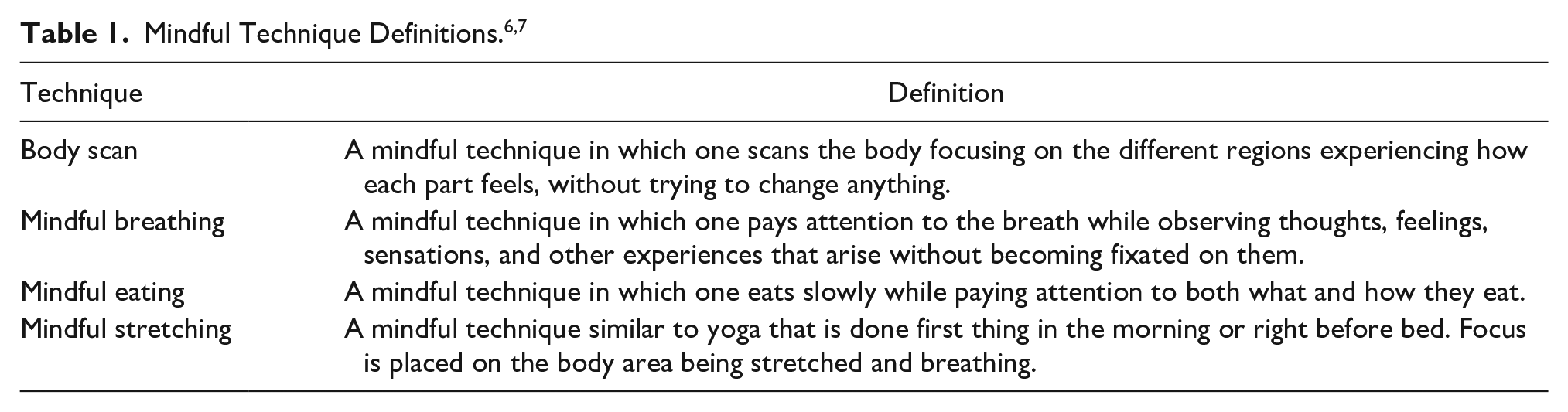
Since Kabat-Zinn’s original research on mindfulness, its application for reducing health care provider stress and improving awareness has been well documented among a variety of health care professions.4 –7 Kemper and Khirallah 4 investigated the use of online mindfulness training in physicians, nurses, social workers, psychologists, and dietitians. The study found significant improvements in mindfulness and empathy alongside a significant reduction of acute stress. Mackenzie et al. 5 demonstrated techniques such as mindful breathing, body scanning, mindful stretching, and mindful eating that can improve levels of emotional exhaustion, life satisfaction, and depersonalization in health care providers. See Table 1 for a list of mindful technique definitions.6,7 Gauthier et al. 8 found the use of mindfulness interventions among pediatric intensive care unit nurses led to significant reductions in stress that were maintained one month following the intervention. Reingold 9 investigated the use of a six-week, self-administered mindfulness-based stress reduction program for radiologic technologists. Study participants experienced improvement in their perceived stress levels after participating in the program. Methods used to implement mindfulness in the health care setting range from online modules or courses to guided practices with regular meeting times in the workplace setting.4 –11 Mindfulness programs often include an initial one-time training session prior to the implementation of a mindfulness practice. Some practices described in the research include at-work guided sessions with additional at-home mindfulness sessions. Research studies with at-home components have demonstrated success in reducing stress and anxiety, although adherence to the at-home practice has not been adequately studied or evaluated.4,11
Increased interest in the use of mindfulness has been demonstrated by educators in primary, secondary, and higher education to improve student performance, as well as reduce stress. The techniques applied in education include the use of smartphones/mobile apps, in-class meditation practices, classroom-based practices such as pause practice and journaling, and biofeedback techniques.12 –15 Smartphone applications such as Calm and Headspace have been shown to improve perceived mindfulness and reduce stress in medical residents and college students.12,13 Quick mindfulness interventions at the beginning of a class also showed favorable results.14,15 Specifically, a mindfulness minute helped prepare nursing students for class with improved focus, calmness, and sense of community. 14 Miller et al. 15 implemented a three-minute mindful breathing exercise at the beginning of a third-year-level college course. Students reported less mind-wandering in class and improved mental wellness, and more than half of the students reported continuing the practice outside of class.
Health professions educators are exploring mindfulness as a tool to help reduce stress, improve classroom attentiveness, and maintain focus on the present moment.16 –18 Van der Riet et al. 16 provided a weekly, 60-minute face-to-face mindfulness session to undergraduate nursing and midwifery students. At study conclusion, qualitative assessment demonstrated students improved their self-awareness of stress, reduced their stress levels, and improved their ability to focus and to remain present. Sanko et al. 17 used live and prerecorded mindfulness sessions that varied from 20 to 60 minutes during an eight-week mindfulness intervention for prelicensure and postgraduate nursing students. The intent was to improve ethical decision making. The researchers found significant improvements in self-reported stress, mindfulness, attention, and concentration but did not see improvements in ethical decision making. Shapiro et al. 18 implemented the Mindfulness-Based Stress Reduction program for mental health therapy students. The study found significant declines in student stress levels, negative affect, rumination, and negativity at program completion.
There is limited research on the duration of a mindfulness practice as an independent variable of a hypothesis. Studies show that mindfulness practices for both long and short durations can be successful. Gauthier et al. 8 used a daily five-minute mindfulness practice at shift start for nurses in a pediatric intensive care unit. The brief intervention resulted in positive outcomes, including a significant change in stress from baseline to postintervention. Kemper 10 demonstrated that online training with a completion time of 5 to 20 minutes noted statistically significant improvements in mindfulness scores using the Mindful Attention Awareness Scale (MAAS) among health care professionals and trainees. Van Kuiken et al. 14 started nursing class with one minute of mindfulness; the results demonstrated improvements in stress reduction and focus in class.
Factors to consider when implementing a mindfulness program in education include time and duration of the study/program. Time is hypothesized as a reason why individuals either do not engage in or fail to complete mindfulness studies.12 –17 Long sessions or sessions over the lunch hour can be difficult to work into already busy student schedules. Students reported dissatisfaction with long sessions and noted scheduling conflicts when asked to attend training and/or practice sessions.12 –17 Academic calendars and allied health curricula may not be conducive for long trainings prior to practice, and practice sessions scheduled in addition to or outside regular class time may not be well attended.13 –17 Lack of classroom time may be a deterrent to adopting an in-class mindfulness practice. Online modules have shown to be successful, but determining compliance with the online practice may not be feasible. While there are a variety of ways that mindfulness can be implemented, the literature demonstrates that short interventions in the classroom can be successful, which may be ideal for allied health training programs.13 –17
Multiple tools are available to measure mindfulness. The MAAS is one of the most commonly used tools. 3 The MAAS is part of the public domain and has been validated in college, community, and cancer patient populations. 3 The 15-item Likert scale questionnaire takes approximately five minutes to complete and assesses core characteristics of mindfulness, mainly attention and awareness to what is taking place in the present. The average score is 3.85 for undergraduate college students and 4.22 for the general population. 3
The purpose of this pilot study was twofold: first, to explore changes in the MAAS scores among sonography students who participated in a weekly or biweekly Mindful Pause Practice (MPP) at the beginning of class over two semesters and, second, to answer the question, “What are the perceptions and experiences of sonography students on the use of MPP within sonography courses?”
Methods
This mixed-methods study investigated the impact of introducing a MPP at four Midwestern universities with baccalaureate degree sonography programs accredited by the Commission on Accreditation of Allied Health Education Programs (CAAHEP). Each program had institutional review board (IRB) approval. All participating faculty have over 10 years of experience teaching didactic sonography, are American Registry for Diagnostic Medical Sonography (ARDMS) credentialed, and have a minimum of a master’s degree. Prior to the study, all faculty completed a six-week online Mindfulness Fundamentals course through the Mindful Schools of Emeryville, California. Faculty then attended a one-hour live workshop taught by an educational psychologist and licensed mental health practitioner specializing in mindfulness, resiliency, and burnout for health care professionals. The workshop was designed to train faculty in the MPP technique and to standardize the practice across the programs. Each faculty selected an autumn and spring semester course for the MPP. The selected courses met in person or synchronously via videoconferencing at least one time per week.
During campus orientation, all potential subjects received an oral explanation of the study and attended a one-hour online presentation on the benefits of mindfulness and instructions on the MPP. This presentation was delivered online to ensure consistency of information and to avoid conflicts based on each university’s mandatory orientation schedule. The following day, all potential participants were emailed an electronic survey that included prestudy demographic data and the MAAS. The survey was administered through the REDCap survey software. Demographic data gathered included program site, sex, age, and current mindful practice techniques used, if applicable. The consent to participate was a voluntary action of completing the survey.
At the beginning of every class in the autumn and spring semesters, the instructor read the three-minute MPP instructions and participated in the intervention (Figure 1). A chime was used to begin and end the MPP. Students not participating in the study were asked to sit quietly. At the end of the autumn and spring semesters, students again completed the MAAS along with questions on perceptions and experiences with the MPP. The spring semester began with all sonography students completing a one-hour refresher seminar on the benefits of mindfulness.
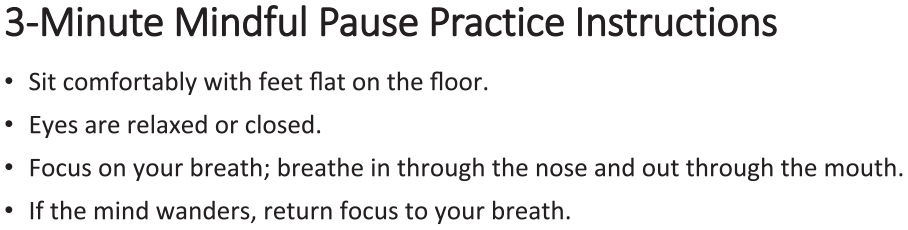
Instructions read by faculty when leading the Mindful Pause Practice at the beginning of the sonography class.
Statistical Analysis
Survey results were described using frequencies and percentages. Open-ended responses were analyzed by classifying the responses into common categories and reporting the frequencies and percentages of the categories. A repeated-measures analysis of variance model was used to test for differences in the MAAS mean values across survey time points with a Greenhouse-Geisser correction factor used to account for correlation between measures from the same subjects. Pairwise comparisons between pairs of time points were adjusted for multiple comparisons using Scheffe’s method. Mean scores at each time point by practice frequency and indication of initial MPP were initially compared using t tests. A second analysis of variance (ANOVA) model that included time point (prestudy, end of autumn semester, end of spring semester), practice frequency, and initial MPP plus all two-way interactions was used to confirm the significance of noted differences.
Results
Nearly half (n = 46/94) of invited students completed the initial presurvey. Ninety-six percent (n = 44) were female and 83% (n = 38) were between the ages of 18 and 23 years. Participation was distributed across all four universities: university 1 (n = 17, 37%), university 2 (n = 13, 28%), university 3 (n = 9, 20%), and university 4 (n = 7, 15%). Almost half of the participants (n = 20) reported current engagement in a mindful practice. The two most common practices were prayer (n = 17, 85%) and yoga (n = 5, 25%).
Student mindfulness as measured by the MAAS found a prestudy mean (SD) score of 3.3 (0.7). Students who identified engagement in a mindful practice at the start of the study had significantly higher mean MAAS scores (3.7 vs. 3.1, P = .004) compared to those who did not practice. Prior to the study intervention, students in the once-a-week MPP group had a higher MAAS than those in the twice-a-week MPP group (3.6 vs. 3.2, P = .108). Students were surveyed two additional times with 41 and 34 students completing the fall and spring semester survey, respectively. Data analysis included students who completed the presurvey and at least one additional survey. All universities were represented at each data collection time point.
At the end of Fall semester, the mean (SD) MAAS score of 3.6 (0.9) did increase but did not quite reach statistical significance (P = .058). At this time point, the MAAS scores were even (3.6 for both, P = .944) between the group new to mindful practice versus the group with a prior practice in place. Students practicing once a week and those practicing twice a week both demonstrated an increase in the MAAS, and the gap had closed slightly (3.8 vs. 3.6, P = .489) between the groups. Mean (SD) spring MAAS scores rose to 3.9 (0.7; P < .001), a statistically significant increase from the presurvey mean. MAAS scores for those initially not practicing mindfulness were no longer significantly different from those who entered the study with a practice (3.9 vs. 3.8, P = .707), and both practice groups, once a week and twice a week, were now even (3.9 vs. 3.9, P = .982), with twice-a-week practice experiencing an overall larger mean gain (Table 2). A second ANOVA model was run to assess differences in MAAS score means and trends by practice frequency (once vs. twice per week) and whether the students had a practice in place at the beginning of the study. Significant differences in scores were noted across time (P < .001), and there was a significant interaction between time and whether the students had an initial practice, with students who did not have an initial practice experiencing sharper gains over time.
Data Showing Repeated-Measures Analysis of Variance for MAAS Mean Scores by Survey Time Point and Practice. a
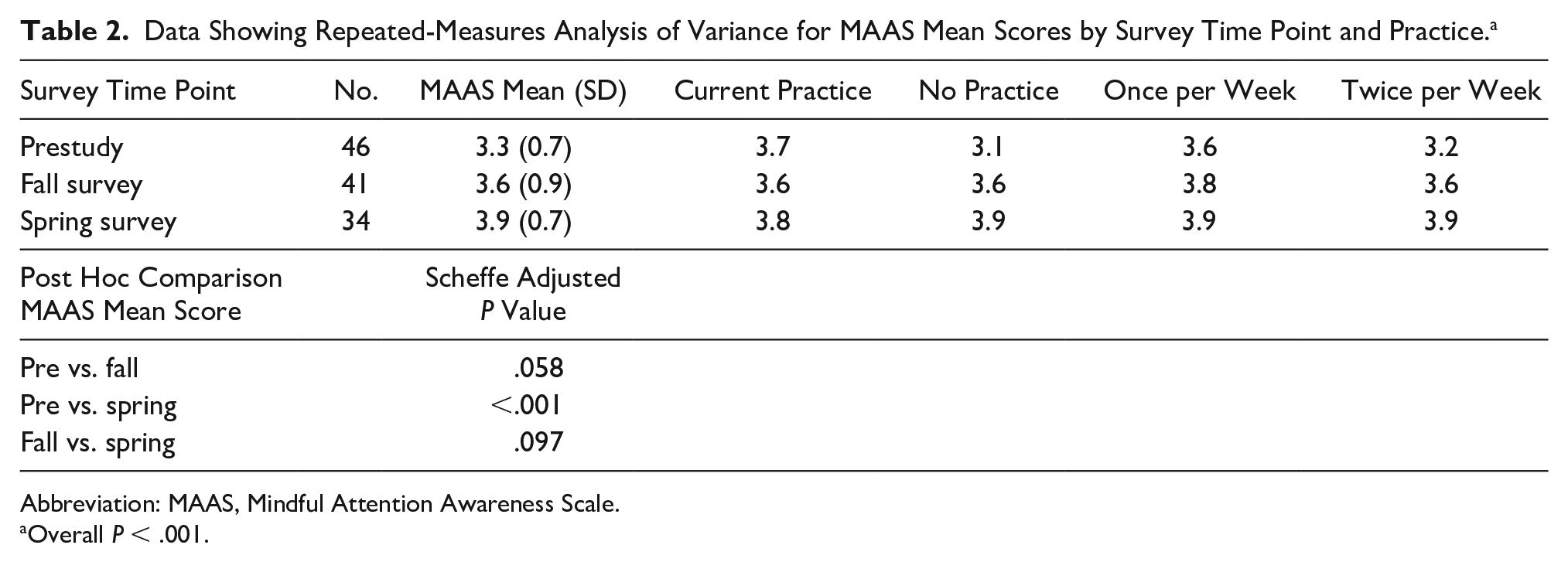
Abbreviation: MAAS, Mindful Attention Awareness Scale.
Overall P < .001.
In both semesters, the majority of the students (autumn: 73%, n = 29/40; spring: 77%, n = 23/30) described the MPP experience as positive and believed it helped bring their full awareness and attention to class (autumn: 78%, n = 32/41; spring: 81%, n = 25/31). Three themes emerged from the positive responses over the two semesters: stress reduction/relaxation, improved focus/attention, and self-care (Figure 2). Over half of the students in the autumn (55%, n = 16/29) and 40% in the spring (n = 9/23) reported the practice at the beginning of class helped them reduce their stress level. It allowed them to relax and regain a sense of calm either coming from a stressful situation, such as a commute, or coming into a stressful situation, such as an examination. Improved attention and focus were cited in almost one-third of autumn (28%, n = 8/29) and spring (26%, n = 6/23) students with improved concentration and a better frame of mind for the upcoming class, lecture, or examination noted. Self-care was a theme in both autumn (55%, n = 16/29) and spring (39%, n = 9/23) semesters. Students described the MPP as a three-minute opportunity for silence, no worry: a time to slow down.
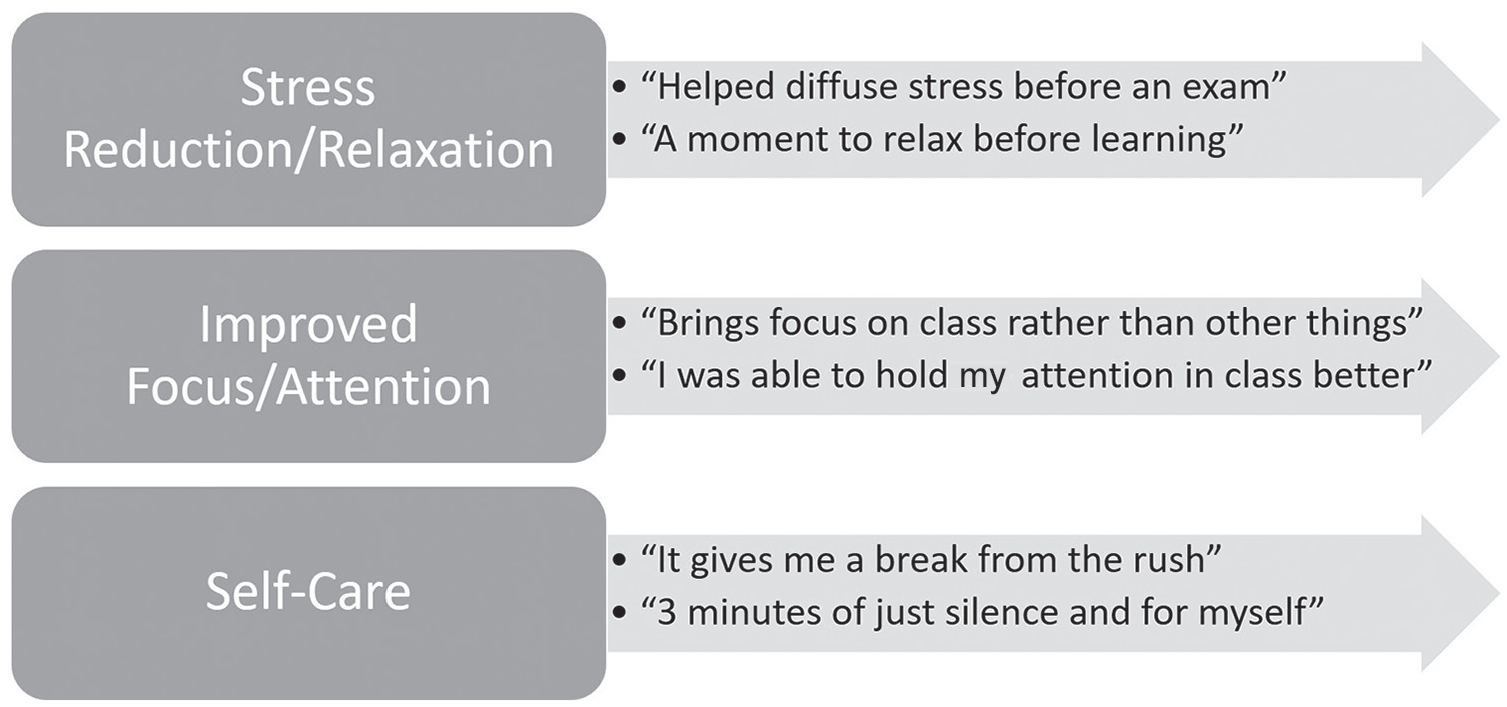
Qualitative themes related to the Mindful Pause Practice.
A few students each semester (<10%) described the practice as a negative experience, autumn (n = 4/40) and spring (n = 1/30). Comments noted the practice made them sleepy or increased their stress. Approximately 20% of the participants each semester were neutral (fall, n = 7/40; spring, n = 6/30) and did not see the experience as positive or negative, citing trouble focusing during the practice or inconsistent practice for their response.
For most students, the practice did not naturally transition outside of the classroom, but use outside the classroom did increase over time. More students began to use the MPP (spring 34% vs. autumn 24%) while studying either to help relieve frustration or to refocus during a long study session. MPP in the clinical setting also increased (spring 13% vs. autumn 7%) with use either before or after new or difficult examinations. Moving forward, the majority of students reported they would continue with the mindfulness practice. Only 16% (n = 5/32) of the respondents said they would probably not continue with the MPP in their personal or professional life, and 19% would not seek out other mindful practices. Of the students who were new to the practice and completed the final survey, 89% (n = 16/18) reported they would likely continue with the MPP.
Discussion
Over the past few years, sonography faculty at four Midwestern universities noticed students came into class or the laboratory rushed, stressed, and distracted. In an attempt to improve the learning environment and to help prepare students for success in a fast-paced curriculum, faculty added a short, mindful practice to select courses. Mindfulness in its simplest form is being present in the moment, paying attention on purpose. 1 In addition to improving attention and awareness, the addition of a mindful practice has been shown to improve mental, physical, and emotional well-being.1–22 These positive changes have been noted in many populations, including health professions students and health care professionals.5,8 –18 Currently, there is little information in the literature on mindfulness in imaging science education, specifically sonography education. This multi-institutional study is one of the first to investigate the impact of adding a 3-minute Mindful Pause Practice to the beginning of sonography classes over a two-semester time period.
Prestudy data found that sonography students had a lower self-reported mindfulness, as measured by the MAAS, when compared to normative scores in the college population, 3.3 versus 3.85. 3 Sonography students who currently engaged in a mindful practice more closely aligned to the college MAAS with a score of 3.7. While students in this study are in the college-age range, there is not a reported normative MAAS score for health professions students for comparison in the literature. The lower initial overall mean MAAS score may be related to the small, homogeneous sample size or it may signify health professions students in general have lower self-reported mindfulness as measured by the MAAS when compared to traditional college students. Lower MAAS scores were also noted preintervention in a small study of senior-level nursing students by Schwarze and Gerler. 20 Additional research and normative MAAS scores for health professions students would be helpful for future mindfulness studies.
The results of this study demonstrate the addition of a short MPP at the beginning of class can increase student mindfulness as measured by the MAAS. Mean MAAS scores rose each semester, showed a statistically significant increase at the spring survey when compared to the preintervention survey, and surpassed the average MAAS score for college students by the end of the study. This improved mindfulness was further supported by almost 80% of the participating sonography students each semester responding positively when asked if the MPP helped bring their full attention and awareness to the classroom. Miller et al. 15 incorporated a Three-Minute Breathing Space practice at the beginning of a child psychopathology course. At the end of the semester, the intervention group showed no significant improvement in mean MAAS scores but reported fewer episodes of mind-wandering with this short practice. A qualitative study by Van Kuiken et al. 14 also found that starting class with a brief mindful practice resulted in themes of “focusing and centering” and “setting aside distractions.” A similar theme of “improved focus and attention” was reported by almost one-third of the sonography students each semester. Almost all (autumn, n = 17/18; spring, n = 12/12) students who responded felt the practice had a positive impact on their academic performance due to improved attention in class or while studying. These results support published findings that even a short, mindful practice at the beginning of a class can improve mindfulness in the majority of students and improve attention and awareness in the classroom.10,15
Consistency of practice over time played a factor in improvement of MAAS scores and reported mindfulness. An overall increase in mean MAAS scores was seen in both semesters, but the increase did not reach statistical significance until the end of spring semester with approximately nine months of practice. Mean MAAS scores improved for both the one MPP per week and the twice MPP per week groups, although the group that performed two practices per week experienced a larger gain in score. The mean MAAS score for those engaged in a mindful practice prior to the study was significantly higher than those new to mindfulness. Both groups showed improved scores over time, and those new to mindfulness were equal with the experienced group by the end of the study. Individual scores also followed this upward trend with 60% of students increasing their MAAS score in the fall semester and almost 80% in the spring semester when compared to the presurvey. This study supports findings that a mindful practice in the educational setting improves mindfulness over time.12–18,20
In the educational setting, mindful practices that do not increase students’ workload and fit easily into their schedule were viewed with favorable feedback.14,15 This was taken into account in the MPP study design. For sonography students, the MPP was performed during the first few minutes of class; no additional work was needed outside of the classroom. Survey feedback was favorable with nearly 75% of students each semester reporting the experience to be positive. Study completion rates were also high, which promotes this method of mindfulness integration into the curriculum. Only one student in the spring semester reported the practice in a negative light. The student stated the practice was “just another thing to do.” In contrast, self-initiated MPP outside the classroom during studying or clinicals was low. This finding was similar to other study findings where participation was lower when it was self-directed.10,11,14 All students who used mindfulness outside the classroom reported it was valuable, and the percentage of students adding the MPP outside the classroom did increase over time. For studying, this increase may have occurred as the practice became more of a habitual way to approach the learning process or as students associated academic success or reduced stress related to the practice. Students may have found it more difficult to use the MPP in the clinical setting. This could possibly be attributed to lack of time or privacy in the busy clinical setting or lack of support from clinical instructors. These factors were not assessed in this study and warrant future investigation.
This study also found two additional themes linked to the practice of mindfulness: “stress reduction and relaxation” and “self-care.” Kinsella et al. 21 did a scoping review of studies that looked at the effect of mindfulness on students’ perceived stress. All articles exploring mindful practice on student stress reported a reduction in student stress. This benefit was also experienced with the MPP. The theme of reduced stress and relaxation was overarching and noted by students in the classroom, study sessions, examinations, and the clinical setting. Stress reduction is linked to mindful practice, and this was not an unexpected finding in this study. Self-care has many definitions, but in the most basic sense, it is taking time to care for oneself. 22 The MPP provided this time for the sonography students; many reported enjoyment from the opportunity for quiet and no worry. The theme of self-care is not as commonly reported but was noted by both Kinsella et al. 21 and Van Kuiken et al. 14 Both researchers cited it as a benefit to transitioning mindfulness into professional practice.
Not all sonography students enjoyed the MPP. A few students reported the MPP made them sleepy for the upcoming class, which investigators coded as a negative. These comments were seen again in spring semester, which may indicate the students found other positives of the MPP that outweighed the negatives, such as sleepiness, and continued with the study. In autumn, two students specifically noted increased anxiety and stress levels. The comments did not reappear in spring, most likely through participant attrition. For some, the practice of mindfulness can be a negative experience and cause increased stress and anxiety. This factor should be disclosed as a risk of a mindfulness intervention.
There were limitations to this study. Although it was multi-institutional, it was specific to one cohort of health care education students. This sample size was also small. This may limit generalization of findings to other populations. Future studies should include other health care professions students to address these two limitations. This study used only one form of mindfulness. While this did help with standardization across the institutions, some students may have benefited from a different method of practice. The survey instrument is validated, but it is a self-reported tool; therefore, a student’s MAAS score may have been influenced by other circumstances specific to that day. Future areas of research may want to explore different methods of mindfulness and survey tools. Last, the second ANOVA model was limited to persons with complete data for frequency of practice, so we are assuming that persons from whom we were unable to collect frequency of practice information are similar to those for whom we did have information.
Conclusion
Mindfulness in sonography students can be improved with the addition of a three-minute MPP at the beginning of class as measured by the MAAS. Consistent and more frequent practice has a greater effect on the development of mindfulness. Improved mindfulness is linked to reduced anxiety and stress and to improved focus and attention in the classroom. The majority of students found the MPP to be a positive experience with related themes of stress reduction and relaxation, improved focus and attention, and a time for self-care. Introducing activities that support the development of mindfulness among sonography students may help students develop methods to cope with the high cognitive load of a professional program.
Footnotes
Acknowledgements
The authors thank the Society of Diagnostic Medical Sonography and the Anderson Distinguished Professorship of Imaging Sciences for their generous support of educational research.
Declaration of Conflicting Interests
The authors declared no potential conflicts of interest with respect to the research, authorship, and/or publication of this article.
Funding
The authors disclosed receipt of the following financial support for the research, authorship, and/or publication of this article: This study was funded by the Society of Diagnostic Medical Sonography (SDMS) Foundation’s Research Grant Programand the Joseph C. Anderson, MD, and Darlene Anderson Distinguished Professorship of Imaging Sciences.
