




Abstract
Mobile learning or m-learning is used on a daily basis, on every continent, in a plethora of ways. Yet, its awareness and implementation in the field of sonography education are lacking. Whether as a tool of formal education or a form of professional development, mobile learning has much to offer this diagnostic medical imaging field. This article defines the differences between electronic learning (e-learning) and m-learning, illustrates a few of the many opportunities this application holds to offer its stakeholders, and challenges sonography educators to begin using its value as an educational tool in their established curriculums.
As the business of digital communications continues to expand, the opportunities to harness this valuable technology as an educational tool continue to unfold. With more than 5.3 billion cell phone users in the world today, 1 many use high-end data packages with computing powers that rival those of the mid-1990s. 2 Today’s technological advancements in the form of mobile devices include mobile phones, smartphones, e-readers, personal digital assistants (PDAs), and electronic notebooks/netbooks/smartbooks.
With mobile learning or m-learning, educational formats are no longer bound by traditional locations or Internet connections; learning can take place when the learner is ready, which is almost everywhere and at any time. Many institutions of higher learning are implementing mobile computing across a variety of disciplines and educational environments. An undergraduate history course at the University of Texas–Dallas regularly used Twitter to discuss course topics during class. The ability to display tweets on a large screen for everyone to visualize encouraged group communications and discussions. A Houston community college conducted a pilot study in which they compared the study habits of students enrolled in an anatomy course. One group was given mobile devices and the ability to access course content on these devices; the other group only used desktop computers. The mobile device group found themselves interacting with class content much more, including during spare times such as waiting for appointments. 3 The University of Utah is using a series of mobile applications (apps) that allow its users to study human anatomy, evaluate medical problems, visualize large sets of 3D images, and manipulate these images to better understand their anatomical relationships. 4 Institutional libraries are adapting mobile Web portals to allow their users to connect with certain capacities via mobile devices.
Many studies have been conducted regarding distance education—in particular, harnessing the Internet as an instructional instrument.5–10 Internet-based education offers key opportunities not traditionally realized with classroom-based bibliographic instruction, including tailoring instruction to individual learner’s needs and allowing for learning to occur when it is convenient and where it is most optimal to each individual learner. Given these advantages, Internet-based learning continues to grow and has become a well-proven and popular approach to health education.11,12 With this continually emerging and dynamic technology, the adoption of new instructional ideologies for both educators and learners alike also continues to advance. The boundaries that have already been crossed include learning communities, 13 adaptation to multimedia elements,14,15 changing dynamics including interactions and feedback,16,17 and grasping new terminologies.
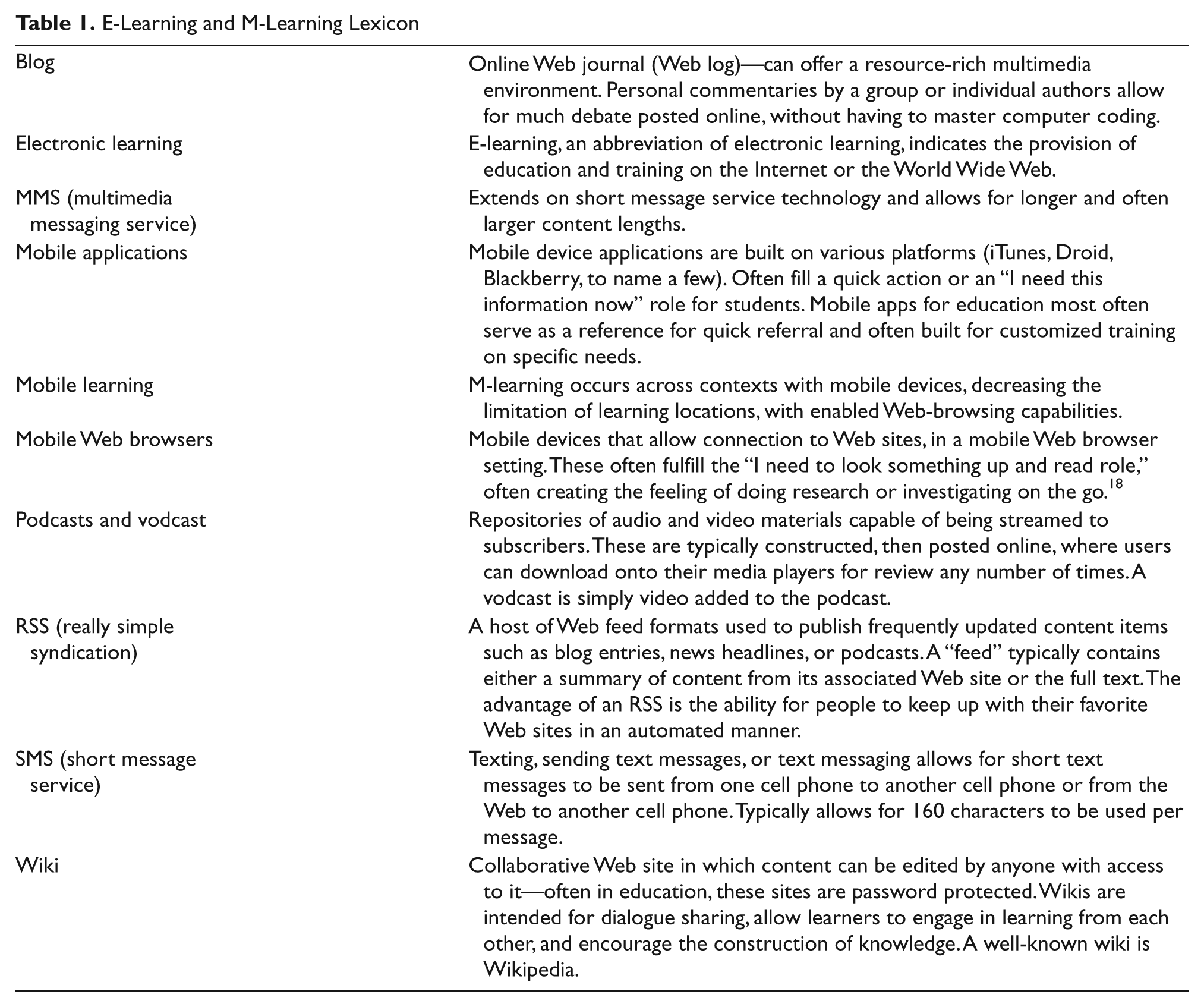
This article discusses a variety of m-learning applications pertinent to sonography and provides an overview of various possibilities sonography educators can adopt in a structured curriculum. In providing a pathway to meaningful and contextual educational environments, students’ expectations and technological advancements may begin to be recognized. Prior to beginning the discussion of mobile learning and how it has become applicable to sonography education, it may be of value to review some commonly used terminology associated with electronic and mobile learning (Table 1).
E-Learning and M-Learning Lexicon
The high percentage of college-age students using cell phones today allows for little if any learning curve or cost for utilization. For learners and educators alike, streaming technology to a mobile device has become routine, often pushing expectancy. Most major news networks (CNBC, CBS, NBC, ABC, ESPN, Fox, etc.) offer video blogs, making instant streaming of stories and other ideas constantly and continuously possible. 19 Information technologies designed for other purposes besides education are frequently applied to learning, with mobile devices having created a readily inexpensive pathway for mass distribution. Individuals can choose to prepare for learning by finding a notebook/textbook, powering up a computer, connecting to the Internet, or dialing in on a landline telephone. Or they can take advantage of mobile learning by having the knowledge required available immediately on their mobile device, in the proper context and without any special preparation, making just about any situation a possible learning situation conducive to making information transfer more effective. 20
The capabilities m-learning has stimulated include short messaging services (SMS or texting), virtual graphics, user-controlled operating systems, access to Web browsers and mobile applications, camera functions (still and video), and geopositioning, to name a few. Sonography educators can stream podcasts or text message assignments, encourage presentations on subjects coming up, or bring a greater awareness to complex topics that will be discussed in the next face-to-face meeting. An enhancement of communication pathways between instructors and their students, as well as between students themselves, is often found to flourish when learning is contextual. This communication tool can encourage and allow for spontaneous student research with experts in the field at their clinical sites when they are off campus. As this type of learning prospers, ownership of the learning situation occurs and a sharing of knowledge abounds, often leading to and encouraging student-centered learning environments.
With high-graphic displays and high-resolution screens, cell phones are a good medium for interesting case studies to be sent to students while in their learning context. Mobile apps such as the iTunes Sono Quiz 21 series allows students to practice sonographic image recognition based on specific specialties while under pressure from a timer. Another iTunes mobile application is the Sonography Cheat Sheet series, which serves as a reference for sonographers to immediately access current measurements and values from one place—their mobile device. Many companies offer animations and presentations on subjects such as anatomy and physiology, sonography, and medicine complete with pictures, sound, and video components, encouraging access to learning tools and greater ownership of the learning process. 22
Assessment ideas or learning unit summaries can be posted to blogs, class chat rooms, wikis, or discussion boards with really simple syndication (RSS)–capable updates going out to all course members throughout the day. Mobile app sonography examination protocols can be mandated by instructors, downloaded by students, and accessed on the fly prior to performing sonographic examinations as they present themselves on the student’s clinical schedule. This feature also allows diagnostic medical sonography programs to standardize their students’ expected sonography examination protocols throughout their clinical sites, as all clinical preceptors and students alike can download each program’s expected protocols.
Many of today’s mobile devices and cell phones have memory cards allowing sizable media to be downloaded, making podcasting or vodcasting lectures, helpful tips, messages, subject reviews, and many other learning content packages deserving dissemination accessible to enrolled students. Also available are private or public “clouds” that provide off-site computing or software-driven computations to occur outside the mobile device with the final product being delivered to the device. Cloud computing allows for any size data or application to be processed through a browser so users can access it from anywhere an Internet connection is available (including mobile devices). Students are able to access many educational tools and teaching programs that were previously only available on personal computers with special software or that needed to be downloaded so a program could run the application. The amount of computing “horsepower” needed to run these programs has been decreased by cloud computing.
M-learning has made possible the support for contiguous inquiry learning, as educators strive to provide authentic learning environments with meaningful or impressionable learning situations that are often absent in many classroom settings. Zanussi et al 23 argued that listening to podcasts is typically a solitary activity, and the transfer of learning is only enhanced when the learning and retrieval environments are similar. So to enhance learning, why not make readily available the multimedia presentation of a sonographic fetal cardiac anatomy lesson while the student is immersed in a perinatology or pediatric cardiology sonography setting? What better learning environment can be constructed than that which is based on patient care, high-impact ethical situations, cardiac anomalies, and complex medical implications that present in real time and can be referenced to immediately by the touch of a few buttons? This is the advantage of m-learning, of balancing the technologies in our teaching portfolio with those that learners desire. With immediate reference capabilities while in an authentic learning environment, students can learn and transfer this knowledge to long-term memory while being actively engaged with the very medium educators wish to portray. 24
As higher education continues to invest substantial resources into distance education, many educators are now becoming familiar and more comfortable with the numerous advantages the Internet has to offer.25,26 Virtual learning environments (VLEs) or course management systems (CMSs) such as BlackBoard, Moodle, and Angel are now common practice among formal learning institutions. 27 A study by Borreson-Caruso and Kvavik 28 reported most students preferred a moderate amount of technology in their courses. This study also found those students who used a CMS had a 75% positive (or very positive) experience. As recent technological advancements, including CMS systems, continue to make a historically unique imprint on higher education, their migration to mobile applications and mobile Web portals is now encouraging learners to use device-specific features related to their course work via their mobile device. In a 2011 study by Clay, 29 midwives enrolled in a newborn infant physical examination (NIPE) course at Coventry University completed an investigation of how and if mobile devices could be used in pedagogically effective ways. Course content was streamed within a VLE and posted on mobile learning devices used within the student’s clinical area. Research concentrated on evaluating student use of mobile devices in relation to their technical aptitude, educational application, and compatibility of personal learning styles. Seventy-five percent of the participants found mobile learning to address the need for just-in-time knowledge, and 80% reported the mobile device was easy to use. Results demonstrated mobile learning to afford flexibility in time and place of learning, with immediate access to the teaching and learning materials enhancing the mobility of learners and motility of learning. Participants found it useful to access their mobile device in the clinical area, on a train, or a bus—wherever they happened to be at a time when it was convenient to them. All participants in the study reported the feeling of empowerment to learn and that the flexibility of where the learning could take place enhanced their acquisition of the performance skills required for a complete neonatal examination. By providing continuous access to curricular information, educational flexibility ensues and learners are able to feel more ownership. By incorporating dynamic multimedia learning opportunities in context-specific situations, a learner’s knowledge base can continue to advance and allow for greater transfer to occur.
The need to share information and data is valuable and even more keenly felt in the medical field from the perspectives of teaching, learning, and scientific inquiry. The ability to implement ease of circulation of digital images (abnormal and normal), examination protocols, image critiques, and scientific data will continue to advance this profession and its contributors. 30 As many educators continue to move from perceiving mobile phones as implements of disruption and distraction in the classroom, they may begin to realize the many potentials m-learning holds as a tool for curriculum development and authentic learning situations. A well-rounded reality lies with students using both platforms of mobile learning and electronic learning in their sonography educative endeavors. Mobile learning quickly drives heuristic access to information, which in turn creates an environment for student lead learning specific to each user’s desire and need for particular knowledge.
Educators have been presented with a tool that provides a participatory media that, once harnessed and directed, holds the significant potential to transfer learning and thinking. Although the Internet still clearly holds its leadership position as an educational tool for research, discovery, and passive learning, m-learning has transposed digital learning to a new level. The decision for educators or educational institutions to experiment with new technologies, experiment with their broad capabilities, and then finally make the decision to integrate their use into the daily workflow and personal experience of its users is a complicated and often anxiety-producing process. 31 The resistance to adoption of m-learning technologies might be attributed to any number of factors: lack of awareness of the possibilities, technology phobias, lack of time for instructors to explore the potential of these technologies, and the aversion to the risks inherent in the act of experimentation. However, it has fallen on educators’ shoulders to harness these new technologies and create transformative learning situations that younger students often find in other avenues of their lives. Instructional designers are realizing the importance of weaving mobile learning into the fabric of formal learning, especially as the integration of didactic concepts into clinical actions becomes more of an expectation.
A paradigm shift that facilitates student-led learning in context, a scaffolding of situational examples being built with m-learning and e-learning opportunities that break away from traditional teacher-directed experiences, may have arrived. Educators should be encouraged to share, discuss, learn, and teach effective digital learning skills, as they themselves continue to find success with these technologies. The educative process does not necessarily need to be centered on what has always been traditional and therefore acceptable in terms of presentation. Its continued success may depend on the realization and utilization of many recent potentials and possibilities that await educators as the field of sonography education continues to develop, and praxis is reached with more commonality and more swiftly.
Footnotes
Declaration of Conflicting Interests
The authors declared no potential conflicts of interest with respect to the research, authorship, and/or publication of this article.
Funding
The authors received no financial support for the research, authorship, and/or publication of this article.