




Abstract
The need for US Geological Survey (USGS) National Seismic Hazard Models (NSHMs) to report estimates of epistemic uncertainties in the hazard (e.g. fractile hazard curves) in all forthcoming releases is increasing. With fractile hazard curves as potential new outputs from the USGS 2023 NSHM, a simultaneous need is to help end-users better understand these epistemic uncertainties and clarify their potential uses. In this article, we address the latter need by (1) characterizing epistemic uncertainties in two updates of the USGS NSHM (2014 for California and 2021 for Hawaii), (2) illustrating a variety of downstream applications of fractile hazard curves in both hazard and risk contexts, and (3) discussing implications from the various types of uncertainties. We found that the epistemic uncertainty in hazard is generally larger for Hawaii than for California, the epistemic uncertainty in hazard can be reasonably approximated with a lognormal distribution for most of the cases considered, and the correlation between epistemic uncertainty in hazard at two different intensity measure levels generally varies with both location and type of intensity measure. Furthermore, we developed models for readily generating approximate fractile hazard curves in California and Hawaii. Finally, given the complexities involved in the hazard modeling process, we developed an open-source interactive tool to enable a broad range of users to independently examine and potentially start using such epistemic uncertainties for their respective applications.
Introduction
The US Geological Survey (USGS) National Seismic Hazard Models (NSHMs) have traditionally reported mean hazard curves but not “fractile” hazard curves 1 (Petersen et al., 2008, 2015, 2020). In essence, a single hazard curve at a given location quantifies the “aleatory variability” in ground shaking, whereas different hazard curves at the same location represent the “epistemic uncertainty” in the hazard (Abrahamson and Bommer, 2005; Ang and Tang, 2007; Musson, 2012). While the distinction between the two terms is not always obvious, the distinction is still useful in some contexts 2 (Der Kiureghian and Ditlevsen, 2009; McGuire et al., 2005). Epistemic uncertainty exists in the hazard because of limited data and knowledge in defining the (1) seismic source model (SSM) and (2) ground motion model (GMM) (Anderson, 2018; Budnitz et al., 1997; Cao et al., 2005; Cramer, 2001; McGuire, 1977; National Research Council (NRC), 1988). For example, several alternative models might be available to characterize earthquake occurrences in time, spatial geometry of earthquake sources, and exceedances of ground motion levels for different earthquake ruptures (Bradley, 2009; Working Group on California Earthquake Probabilities, 2003). One way to capture such alternatives and their scientific credibility is through explicit documentation using logic trees (Baker et al., 2021; Bommer et al., 2005; Kulkarni et al., 1984; McGuire, 2004).
As the USGS continues to update the NSHM, the need to report estimates of epistemic uncertainties in the hazard is increasing (e.g. National Academies of Sciences, Engineering, and Medicine (NASEM), 2019; NSHM Steering Committee, 2020). For example, “more complete calculation of uncertainties (fractiles) in the hazard models” was planned at the conclusion of the 2018 update (Petersen et al., 2020). For the first time, fractile-based uniform hazard ground motions (UHGMs) were recently reported for the 2021 update of the NSHM for Hawaii (Petersen et al., 2022). Reporting estimates of epistemic uncertainties in the hazard is important because a probabilistic seismic hazard analysis should (1) “account for uncertainties in a complete and transparent way,” and (2) “adopt decision methods that are insensitive to alternative valid interpretations” (McGuire et al., 2005).
At the same time, helping end-users of the NSHM better understand such epistemic uncertainties and their uses is important. For example, although logic trees have traditionally been already used to capture epistemic uncertainties when deriving mean hazard, past NSHMs have reported only the mean hazard (Altekruse and Powers, 2021; Frankel et al., 1996, 2002; Shumway et al., 2021). Consequently, misinterpretation and confusion are possible if epistemic uncertainties in the hazard were also to be reported in every forthcoming update (e.g. via fractile hazard curves at select locations), especially because the end-users of the NSHM are wide ranging (e.g. design engineers, risk modelers, and researchers). Moreover, how epistemic uncertainties in the hazard are used is highly context-specific (e.g. Hamburger et al., 2017; Lee et al., 2018).
Therefore, this article aims to help end-users of the NSHM better understand epistemic uncertainties in the hazard and their potential uses. To achieve this goal, this article focuses on various downstream applications of the epistemic uncertainties in hazard after they have already been quantified or reported. First, we use individual logic tree branch hazard curves from two updates of the USGS NSHM (2014 for California and 2021 for Hawaii) to explicitly illustrate fractile hazard curves and clarify key ideas. Then, we characterize the nature of such epistemic uncertainties in the hazard, resulting in models for readily generating approximate fractile hazard curves in California and Hawaii. Next, we provide specific example uses of fractile hazard curves, for both hazard and risk contexts. Finally, we develop an open-source interactive tool to enable users to independently examine and potentially start using such epistemic uncertainties for their respective applications.
Epistemic uncertainties in USGS NSHMs
2014 NSHM for California
Epistemic uncertainties in the USGS 2014 NSHM for California were recently examined by researchers from the perspective of prioritizing scientific efforts (Field et al., 2020). For this goal, the study used statewide average annual loss of buildings in California to quantify the value of removing logic tree branches to reduce epistemic uncertainties in the hazard. Using a total of 172,800 logic tree branches (see Figure 3 therein), the study found that the most influential source of epistemic uncertainty was the node corresponding to “GMM Added Uncertainty” (Rezaeian et al., 2014). This node documents additional epistemic uncertainty (i.e. beyond use of multiple GMMs) to account for close interaction between developers of GMMs and lack of knowledge from earthquakes that are poorly represented in the NGA-West2 database; details for this additional epistemic uncertainty are described elsewhere (Petersen et al., 2008).
In this article, we use a subset of the full 172,800 logic tree branches to study epistemic uncertainty in hazard more comparably across two updates of the USGS NSHM. Specifically, we assume earthquake occurrences follow a Poisson probability model because USGS NSHMs provide long-term forecasts of earthquake hazard. Furthermore, we assume site effects are given by the model due to Allen and Wald (2009) because hazard curves from USGS NSHMs are reported for fixed values of time-averaged shear-wave velocity in the upper 30 m of subsurface conditions,
Logic tree used herein for illustrating fractile hazard curves in California; each row shows the branches of one node and the branch weights follow colons. Please see Figure 1 by Field et al. (2020) for definitions of abbreviations
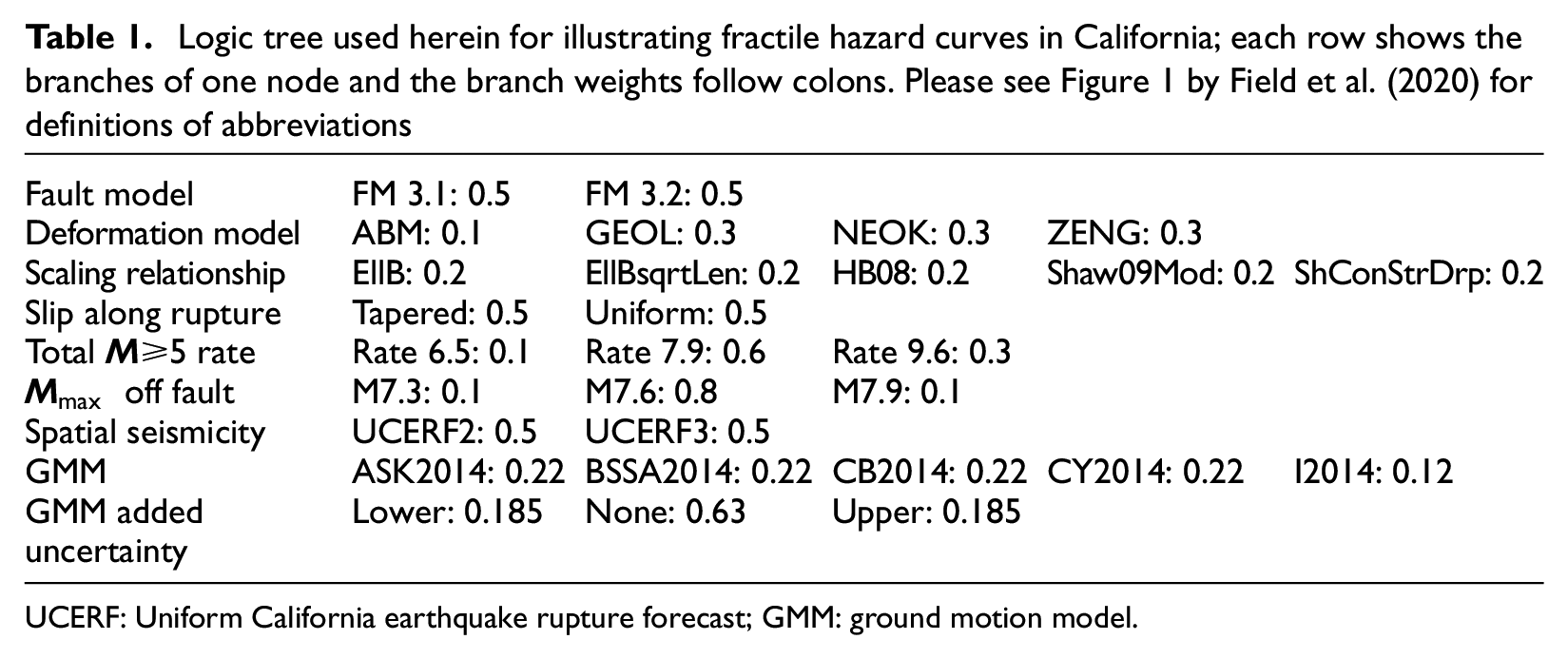
UCERF: Uniform California earthquake rupture forecast; GMM: ground motion model.
Similar to the study by Field et al. (2020), we assume the same logic tree applies to any location within California. Furthermore, we consider two types of intensity measures (0.2- and 1-s spectral accelerations, denoted respectively by SA(0.2) and SA(1.0)) and eight locations within California: (1) Los Angeles (34.1, −118.3), (2) Long Beach (33.8, −118.2), (3) Ventura (34.3, −119.3), (4) San Francisco (37.8, −122.4), (5) San Jose (37.4, −121.9), (6) Vallejo (38.1, −122.3), (7) Stockton (37.9, −121.25), and (8) Sacramento (38.52, −121.5). These intensity measure types were chosen to facilitate direct comparison with hazard from Hawaii and are important for the development of design spectra in building codes. Further, the selected locations include those considered in past USGS NSHMs (e.g. Petersen et al., 2020) as well as those considered in the study by Bradley (2009).
Unlike the study by Bradley (2009), however, we focus on annual frequencies of exceedance (AFEs) instead of 30-year probabilities of exceedance to discuss epistemic uncertainty in hazard more generally. Specifically, AFEs can be converted to probabilities using models of earthquake occurrence other than a Poisson model (e.g. Anagnos and Kiremidjian, 1988; Boyd, 2012). More precisely, we discuss AFEs in the context where earthquake occurrences and successive events are assumed to follow a homogeneous Poisson process with random selections 3 (Baker et al., 2021; Der Kiureghian, 2005).
Figure 1 presents fractile hazard curves for Los Angeles and San Francisco for SA(0.2) and SA(1.0). For a given location and type of intensity measure, the shaded region illustrates the range of the individual

where im denotes a fixed level of the intensity measure,

where

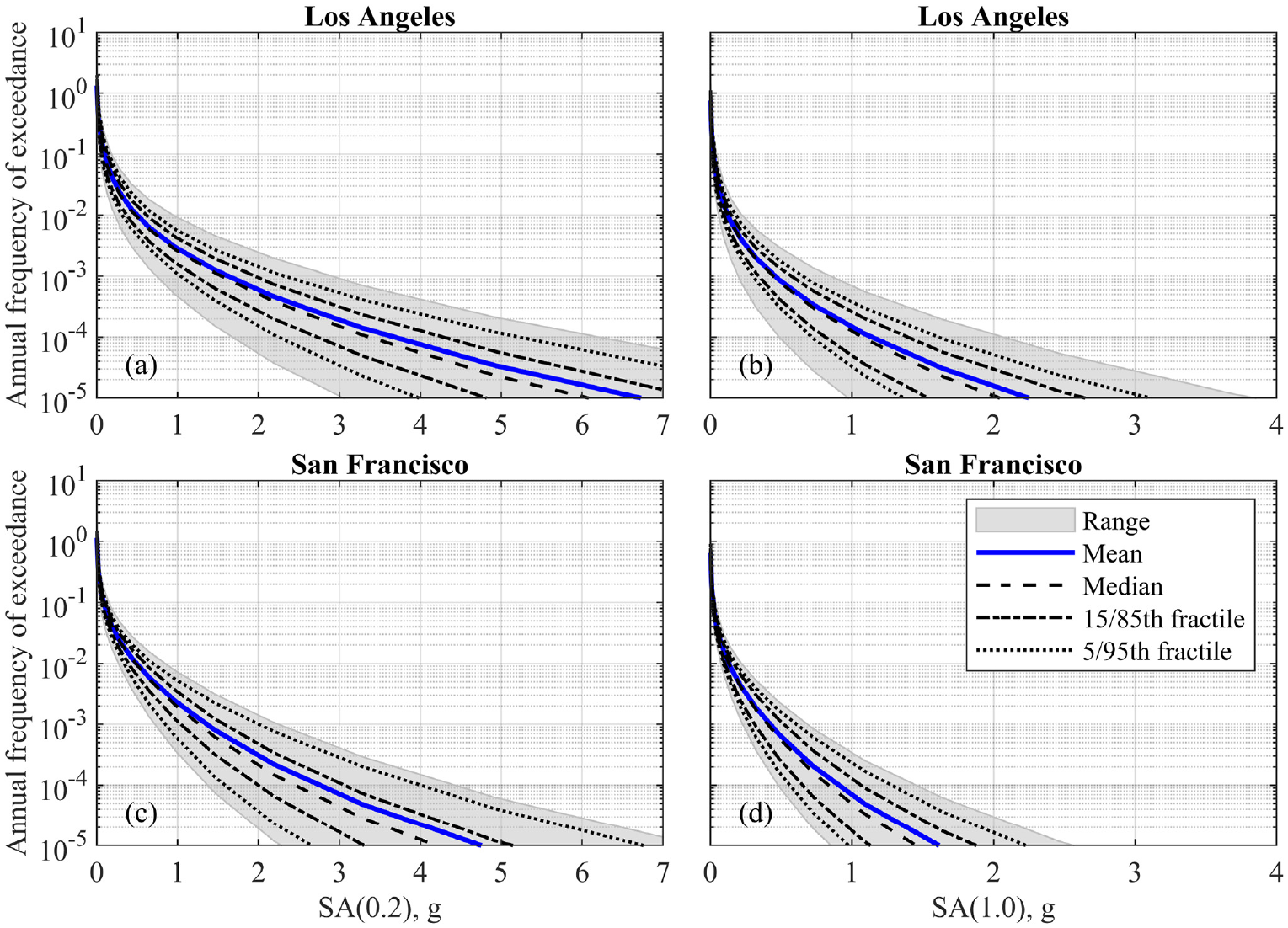
Mean and fractile hazard curves from USGS 2014 NSHM for example locations in California (21,600 branches): (a) SA(0.2) in Los Angeles, (b) SA(1.0) in Los Angeles, (c) SA(0.2) in San Francisco, and (d) SA(1.0) in San Francisco.
A few comments can be made from the results that were used to create Figure 1. First, the fractile hazard curves, which include the median hazard curve, are computed using the logic tree branch weights instead of determining quantiles from the individual 21,600 hazard curves. Therefore, none of the fractiles corresponds to a physically plausible hazard curve from a single logic tree branch.
4
Second, the mean exceeds the median, which indicates
2021 NSHM for Hawaii
Epistemic uncertainties in the USGS 2021 NSHM for Hawaii were also recently examined by researchers, but from the perspective of understanding which input logic tree branches are most influential to the mean hazard (Petersen et al., 2022). In general, eight distinct earthquake source types contribute to the hazard for any location within Hawaii (i.e. hazard from each source type is summed without applying any logic tree branch weights): 5
Shallow-gridded seismicity (summit).
Shallow-gridded seismicity (non-summit, north).
Shallow-gridded seismicity (non-summit, south).
Deep-gridded seismicity (summit).
Deep-gridded seismicity (non-summit).
Caldera collapse.
South flank.
West flank.
In addition, these eight earthquake source types can be further grouped into five source groups: (1) shallow-gridded seismicity, (2) deep-gridded seismicity, (3) caldera collapse, (4) south flank faults, and (5) west flank faults.
The logic tree for each of these five source groups is given by Figures 4a, 4b, 5, 7a and 7b in the study by Petersen et al. (2022), respectively, leading to a total of 90, 54, 3, 15, and 30 possible branches per source group. In general, the decision for one source group can be independent of that for another source group (i.e. uncorrelated logic tree branches). For example, when adding hazard from both shallow-gridded seismicity and deep-gridded seismicity, the logic tree branch for the declustering algorithm for the former source group can differ from that for the latter source group. Alternatively, the same decision for the declustering algorithm could apply to both source groups (i.e. correlated logic tree branches). Therefore, assuming independent choices across source groups, the total number of possible hazard curves for any location within Hawaii is about 2.9 trillion hazard curves (903· 542· 3 · 15 · 30 = 2.87 × 10¹²). Although this number of hazard curves at a given location is very large, the range of hazard spanned by these different curves could potentially be even larger because several simplifying decisions were made in the 2021 NSHM (e.g. proceeding with the adaptive smoothing algorithm instead of creating separate branches for other smoothing algorithms). Therefore, all fractile hazard curves shown herein (from either correlated or uncorrelated branches) should be interpreted as lower bounds to the “true” epistemic uncertainty in hazard (Abrahamson, 2006).
Unlike California, direct determination of fractile hazard curves from all enumerated branches in the full logic tree for Hawaii is too onerous. One way to simplify the full logic tree at a given location is to identify a subset of the most important earthquake source types from disaggregation, which was done by Petersen et al. (2022). For example, disaggregation of the SA(0.2) hazard for Honolulu, at an exceedance probability of 2% in 50 years (AFE of 4.04 × 10⁻⁴ or return period of 2475 years), shows that 99% of the total hazard can be approximated by adding hazard from only two source types: (1) shallow-gridded seismicity (non-summit, north) and (2) deep-gridded seismicity (non-summit). With this subset of source types, the total number of logic tree branches becomes 4,860 (90 · 54 = 4,860). An additional simplification is to assume that the decisions about SSM for one source type also apply to the other source type (e.g. choice of declustering algorithm). Moreover, in the version of the nshmp-haz software that was used for the 2021 NSHM, individual hazard curves corresponding to different branches of
Declustering algorithm for all gridded seismicity sources (2 branches).
Time period for subcatalog for all gridded seismicity sources (3 branches).
Earthquake smoothing algorithm for all gridded seismicity sources (1 branch).
Parameters for earthquake smoothing algorithm for all gridded seismicity sources (1 branch).
Maximum magnitude, Mmax, for all gridded seismicity sources (1 branch).
GMMs for shallow-gridded seismicity (non-summit, north) sources (5 branches).
GMMs for deep-gridded seismicity (non-summit) sources (3 branches).
Although disaggregation could be conducted at each location in Hawaii to determine its own logic tree, results from disaggregation depend on the choices for both (1) type of intensity measure and (2) specified AFE (or return period). As an alternative to location-specific logic trees, we consider the same master logic tree for all locations in Hawaii by including hazard from the same eight source types for each location. Specifically, Table 2 summarizes this master logic tree, after the branches for
Logic trees for different earthquake source groups used herein for illustrating fractile hazard curves in Hawaii; each row shows the branches of one node and the branch weights follow colons. Please see Figures 4, 5, and 7 by Petersen et al. (2022) for definitions of abbreviations
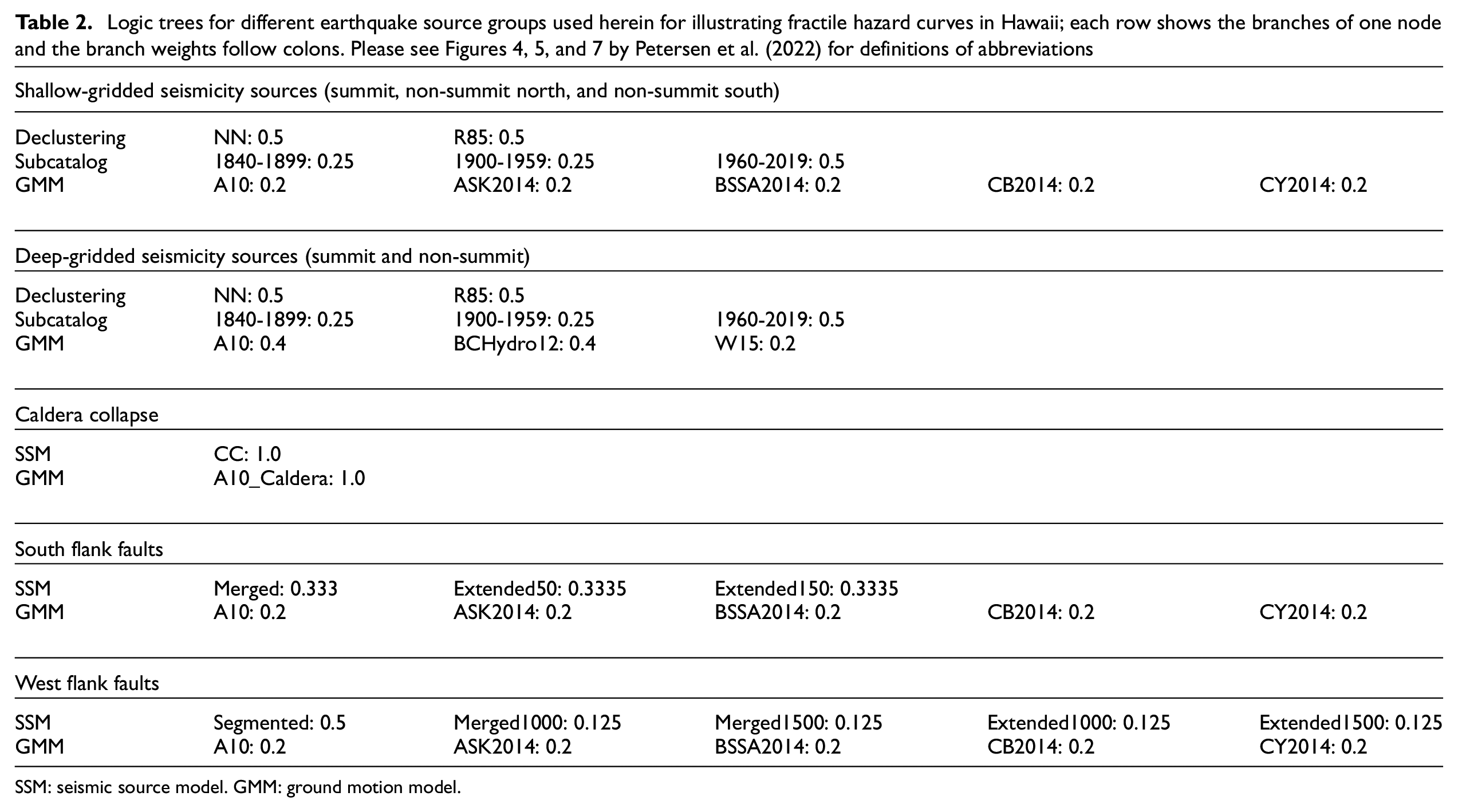
SSM: seismic source model. GMM: ground motion model.
To overcome such computational challenges when determining fractile hazard curves, we used Monte Carlo simulation instead. Specifically, we used the logic tree branch weights shown in Table 2 to independently simulate one realization of hazard curve from each of the eight source types. Then, the eight simulated hazard curves are added together to produce one corresponding realization of the total hazard curve. Repeating this process for a total of
We explored different choices for
Figure 2 presents fractile hazard curves for Hilo and Honolulu and for SA(0.2) and SA(1.0). In total, we considered the same five locations in Hawaii that were studied by Petersen et al. (2022): (1) Hilo (19.7, −155.06), (2) Honolulu (21.3, −157.86), (3) Kahului (20.9, −156.5), (4) Kailua Kona (19.66, −156.0), and (5) Līhu‘e (21.96, −159.36). For a given location and type of intensity measure, the shaded region illustrates the range of the individual 50,000 simulated hazard curves.
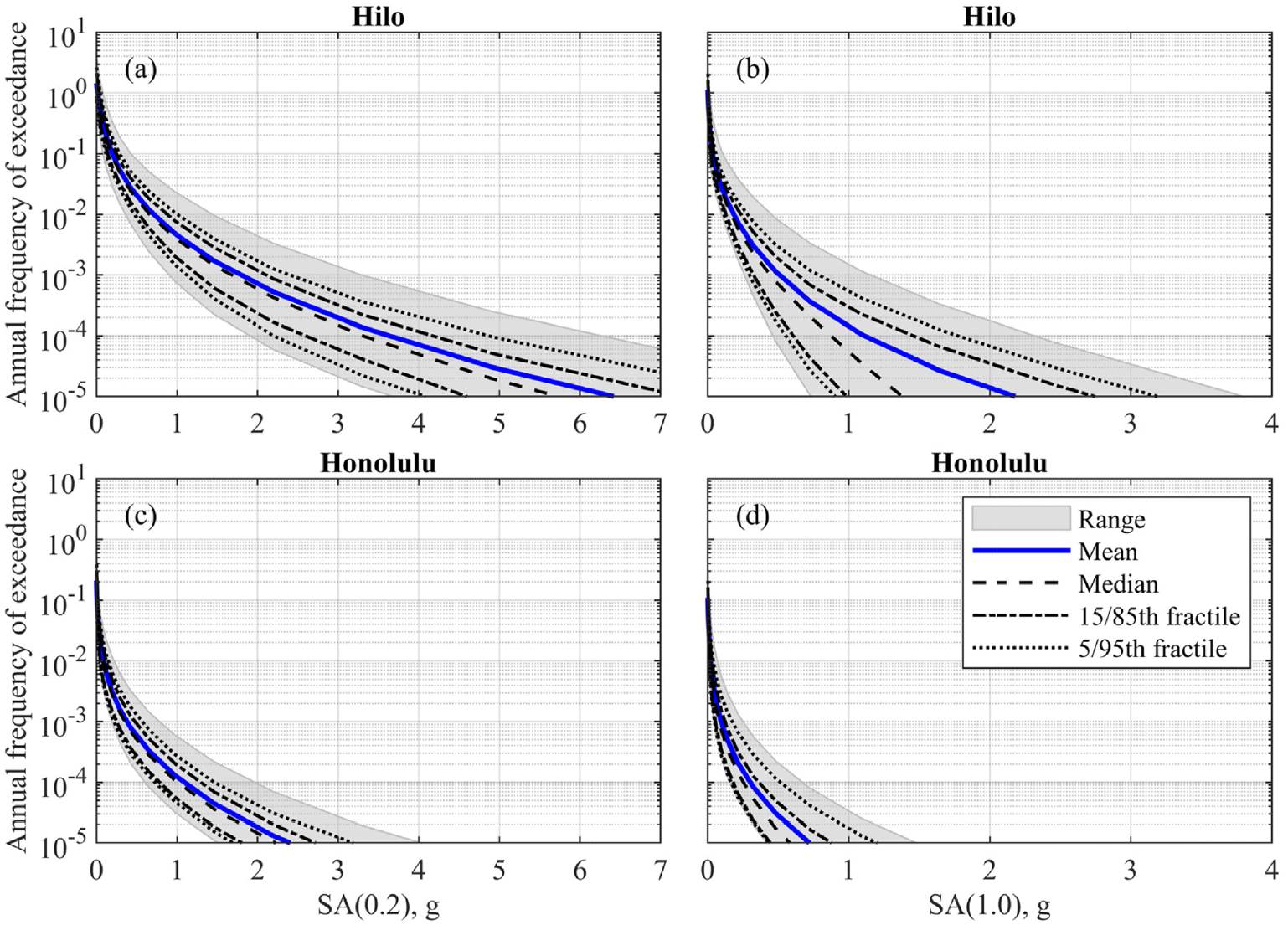
Mean and fractile hazard curves from USGS 2021 NSHM for example locations in Hawaii: (a) SA(0.2) in Hilo, (b) SA(1.0) in Hilo, (c) SA(0.2) in Honolulu, and (d) SA(1.0) in Honolulu.
A few comments can be made from the results that were used to create Figure 2. First, the fractile hazard curves, which include the median hazard curve, are determined by calculating the quantiles from the individual
Characterizing epistemic uncertainty in the hazard
The previous section illustrated two approaches for estimating fractile hazard curves; those in California were determined from Equations 1–3, whereas those in Hawaii were determined from Monte Carlo simulation. For each state, the same master logic tree was used for all locations within the state (i.e. Table 1 for California and Table 2 for Hawaii). Because estimation of fractile hazard curves for one location required analyzing a relatively large number of individual branch hazard curves, reporting fractile hazard curves is fraught with computational challenges such as runtimes and memory storage. These observations indicate that it may be useful to develop a way to readily generate approximate fractile hazard curves.
Although the epistemic CDF of AFE at a fixed intensity measure level,
Figure 3 compares such epistemic logarithmic standard deviations against the corresponding mean AFEs,
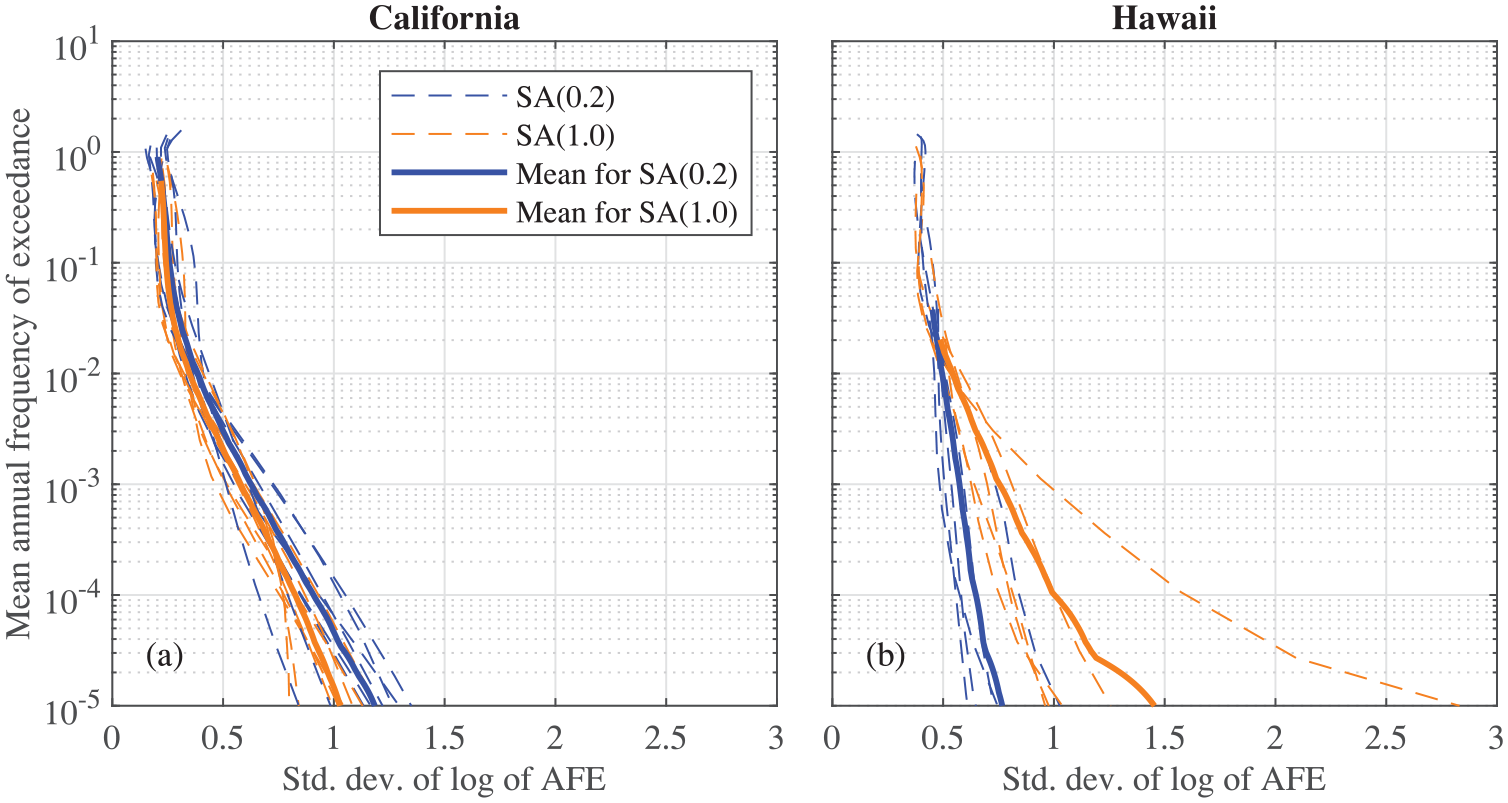
Mean annual frequency of exceedance (AFE) versus epistemic standard deviations of logarithm of AFE: (a) all eight sites in California and (b) all five sites in Hawaii.
A few observations can be made from the results shown in Figure 3. First, we observe that
To better understand the trends, we directly compared the mean curves from each state against each other as shown in Figure 4. For SA(0.2), the epistemic uncertainty in AFE is larger for Hawaii than for California at mean AFEs larger than 2 × 10⁻³ (return periods shorter than 500 years) but then the trend reverses at smaller mean AFEs (Figure 4a). By contrast, for SA(1.0), the epistemic uncertainty in AFE is larger for Hawaii than for California across all mean AFEs (Figure 4b). The fact that the epistemic uncertainty in AFE is generally larger for Hawaii than for California at mean AFEs greater than 1 × 10⁻¹ makes sense because (1) this range of mean AFEs essentially corresponds to annual frequency of earthquake occurrence (e.g. Baker et al., 2021: 265) and (2) occurrence of earthquakes are less well studied in Hawaii than in California.
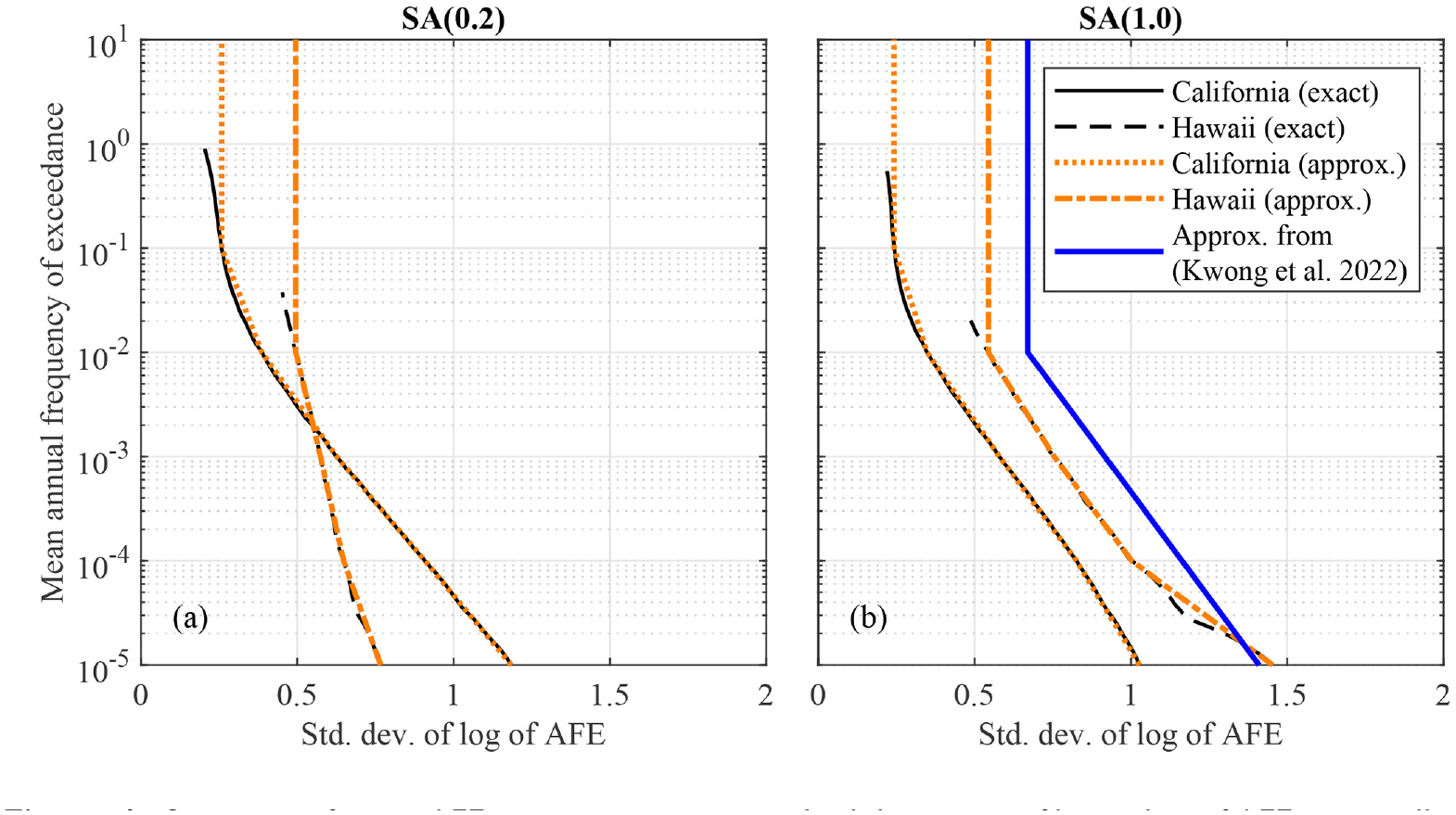
Summary of mean AFE versus epistemic standard deviations of logarithm of AFE across all sites: (a) SA(0.2) and (b) SA(1.0).
Based on the mean curves shown in Figure 4, we developed models for generating approximate fractile hazard curves. Such approximate fractile hazard curves are not a substitute for exact fractile hazard curves but would be useful for locations in which the latter are unavailable. First, we provide the numerical estimates of
Epistemic logarithmic standard deviations of AFE for generating approximate fractile hazard curves; for mean AFEs greater than 1 × 10⁻¹, the constant value at 1 × 10⁻¹ is used whereas for mean AFEs less than 1 × 10⁻⁵, linear interpolation in semi-log space is used (log of mean AFE versus standard deviation)
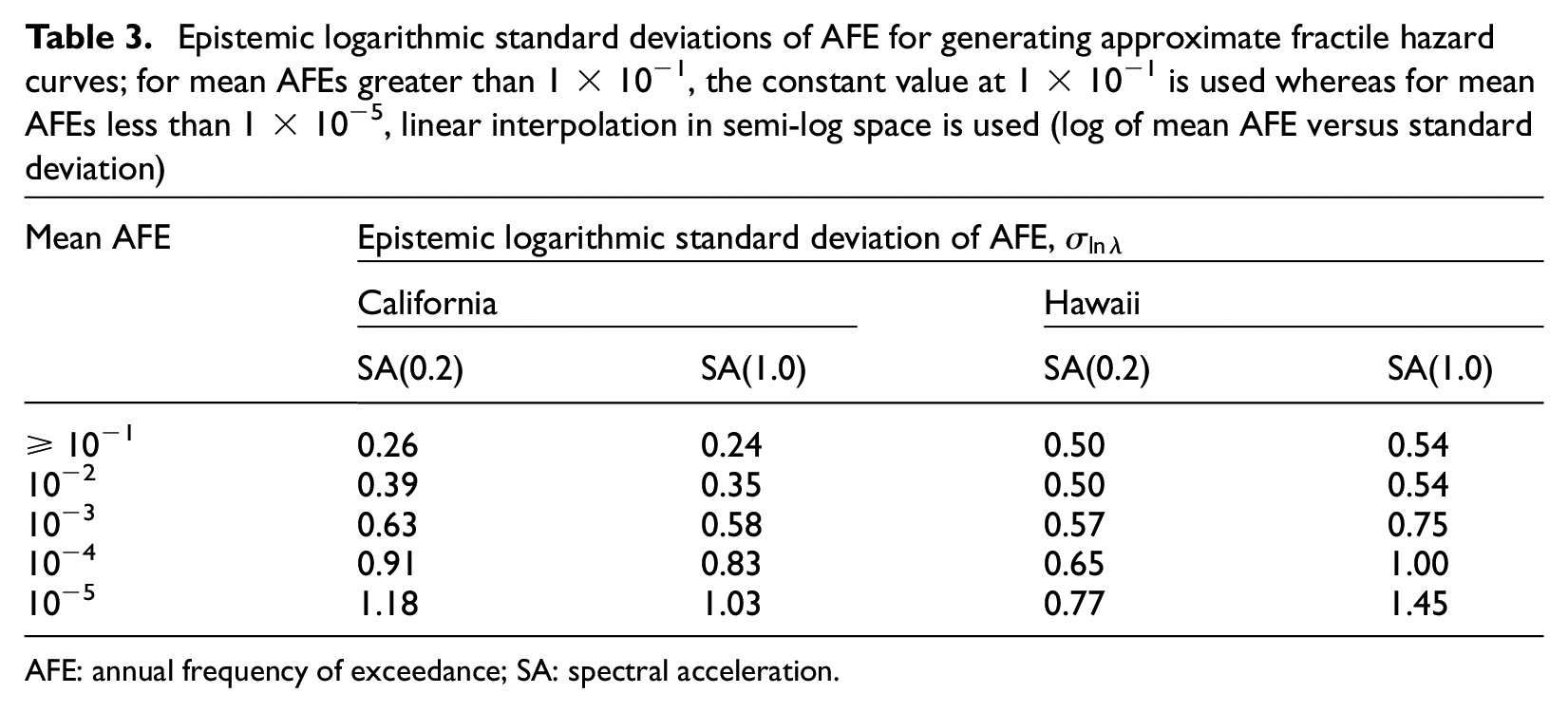
AFE: annual frequency of exceedance; SA: spectral acceleration.
In the study by Kwong et al. (2022), a relatively crude model for generating approximate fractile hazard curves was developed to understand the influence of various sources of uncertainty within a nationwide seismic risk assessment of gas transmission pipelines. Although that study had a different goal than this study, comparison of the approximate models in Figure 4b yields several observations. First, the trend of increasing
We propose to generate approximate fractile hazard curves using the simple approach from Kwong et al. (2022), but with estimates of standard deviations from Table 3 instead of those described therein. First,

where
Figure 5 compares the approximate fractile hazard curves against the more exact fractile hazard curves for SA(1.0) at four locations. The agreement is excellent for a large range of AFEs, but the agreement can become poor at very small AFEs (e.g. smaller than 4.04 × 10⁻⁴ for SA(1.0) in Hilo). Such occasional poor agreement is due to
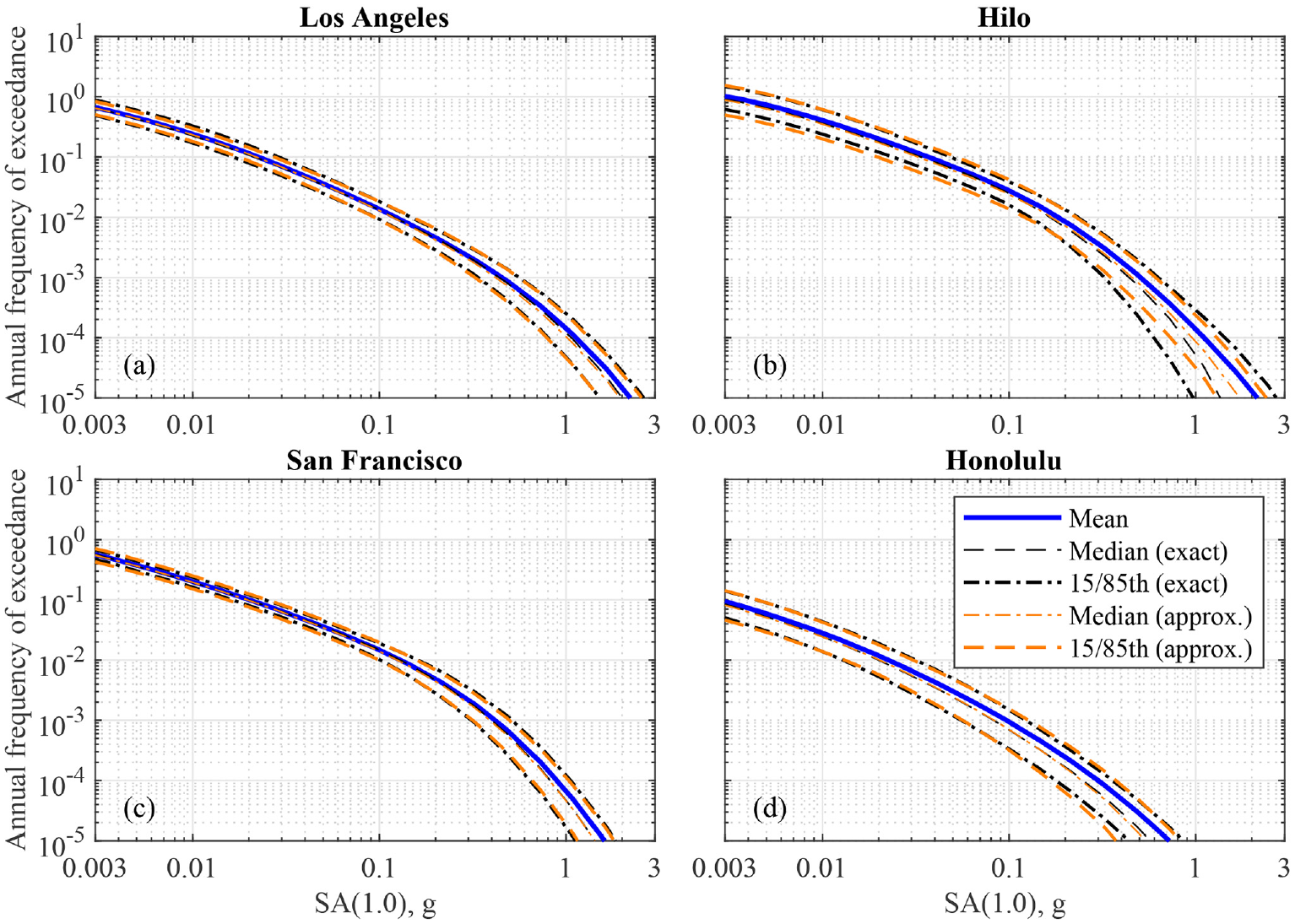
Approximate versus more exact fractile hazard curves for SA(1.0) at: (a) Los Angeles, (b) Hilo, (c) San Francisco, and (d) Honolulu.
To further characterize the epistemic uncertainty in hazard, we examine the correlation between the logarithm of AFE at two different intensity measure levels. We denote the two different intensity measure levels using
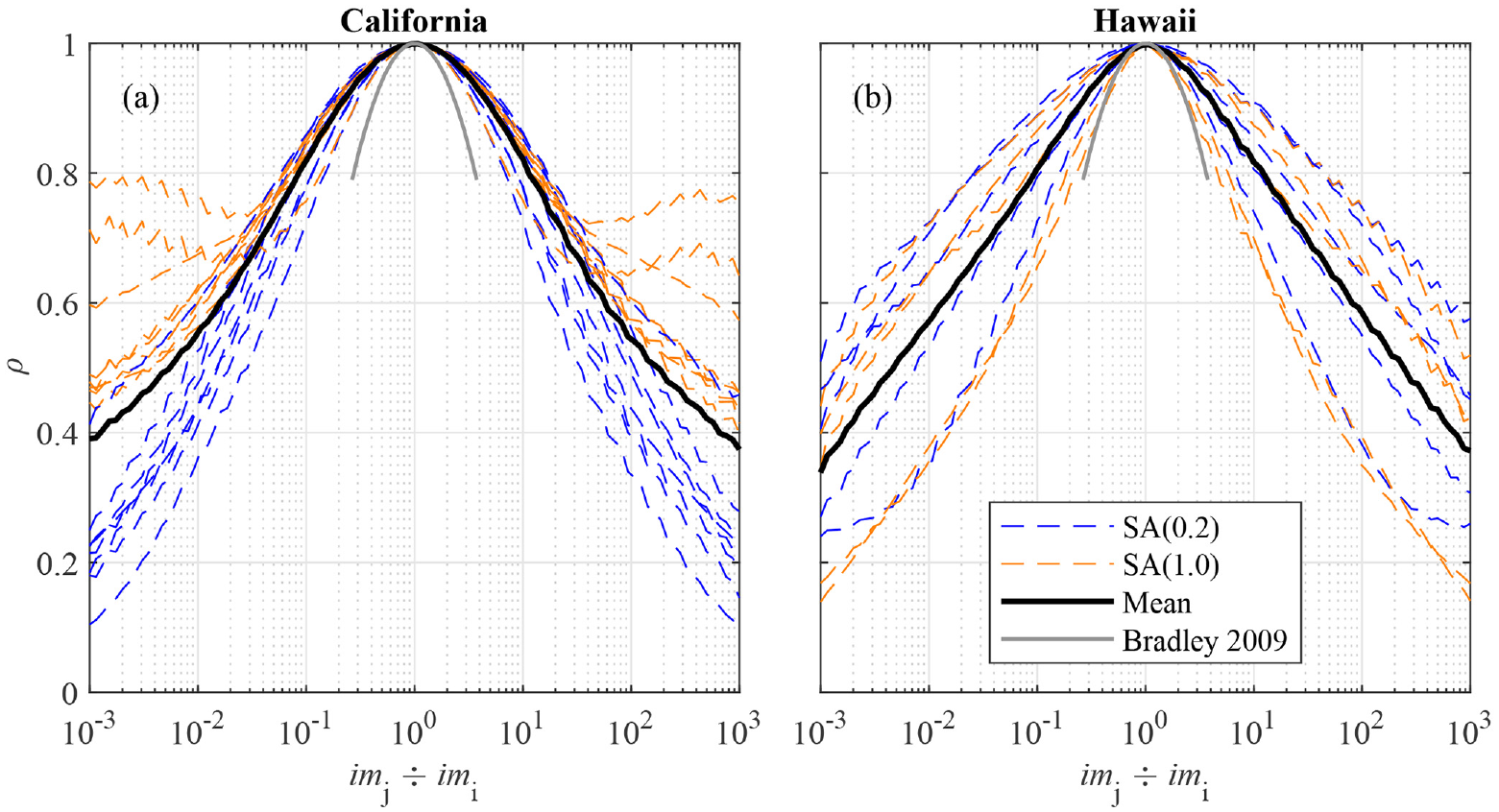
Correlation between logarithms of AFE at two different intensity measure levels as a function of the ratio between the two levels: (a) California and (b) Hawaii.
Figure 6a shows that in California, the correlation relation is relatively insensitive to both location and type of intensity measure when the two intensity measure levels are close to each other. For instance, when the two intensity measure levels are identical to each other, the correlation equals unity. By contrast, when the two intensity measure levels are very far apart from each other (e.g. ratio of 1 × 10³), the correlation relation depends strongly on the type of intensity measure and location; specifically, the correlation is stronger for SA(1.0) than SA(0.2).
Figure 6b shows that unlike California, the correlation relation for Hawaii differs in two major ways. First, when the two intensity measure levels are close to each other, the correlation relation is more sensitive to location in the case of Hawaii than in the case of California. Second, the correlation relation is relatively insensitive to the type of intensity measure, regardless of the ratio between the two intensity measure levels. 6
Although the correlation relation generally varies with both location and type of intensity measure, it may still be useful to approximate such correlations for estimating the epistemic joint distribution (e.g. epistemic bivariate distribution of log of AFE at two different intensity measure levels) in the context of uncertainty propagation (Bradley, 2009; McGuire et al., 2005). For example, the correlation model by Bradley (2009) was used in the semiparametric Monte Carlo approach to propagate epistemic uncertainty when estimating the probability of collapse for a hypothetical structure. Although Figure 6 shows that this correlation model underestimates the actual correlations for nearly all the cases considered herein, it should be noted that the model was developed using older data (UCERF2) and for a smaller geographical region (San Francisco Bay Area); nevertheless, the new data herein do confirm that the correlations are indeed closer to unity than to zero (see Figure 7 in Bradley, 2009). Considering correlation relations from all locations and both types of intensity measures, we developed the following model to approximate the correlation between the logarithm of AFE at two different intensity levels:

where
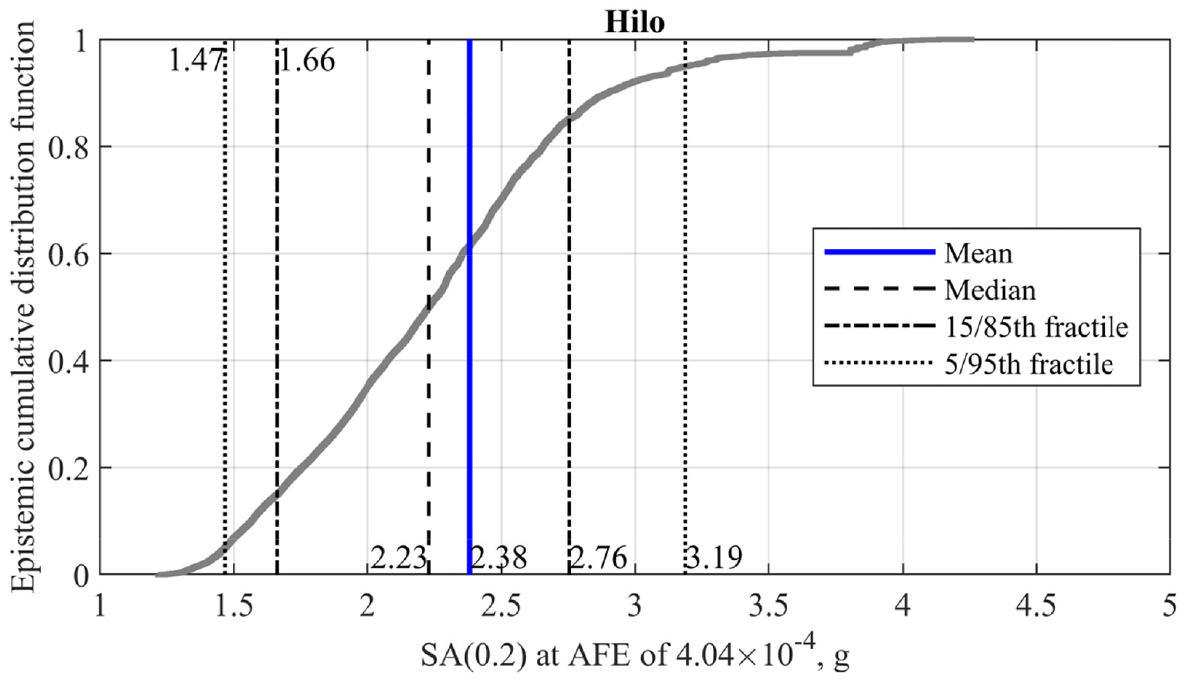
Example use of fractile hazard curves: determining confidence in UHGM for SA(0.2) in Hilo, at a specified AFE of
Uses of fractile hazard curves
In this section, we used both approximate and more exact fractile hazard curves to illustrate a variety of potential downstream applications from reported epistemic uncertainties in the hazard. We intentionally kept the examples brief to showcase breadth rather than depth. To help readers more easily navigate this section, Table 4 summarizes the six examples.
Summary of examples for illustrating potential uses of fractile hazard curves
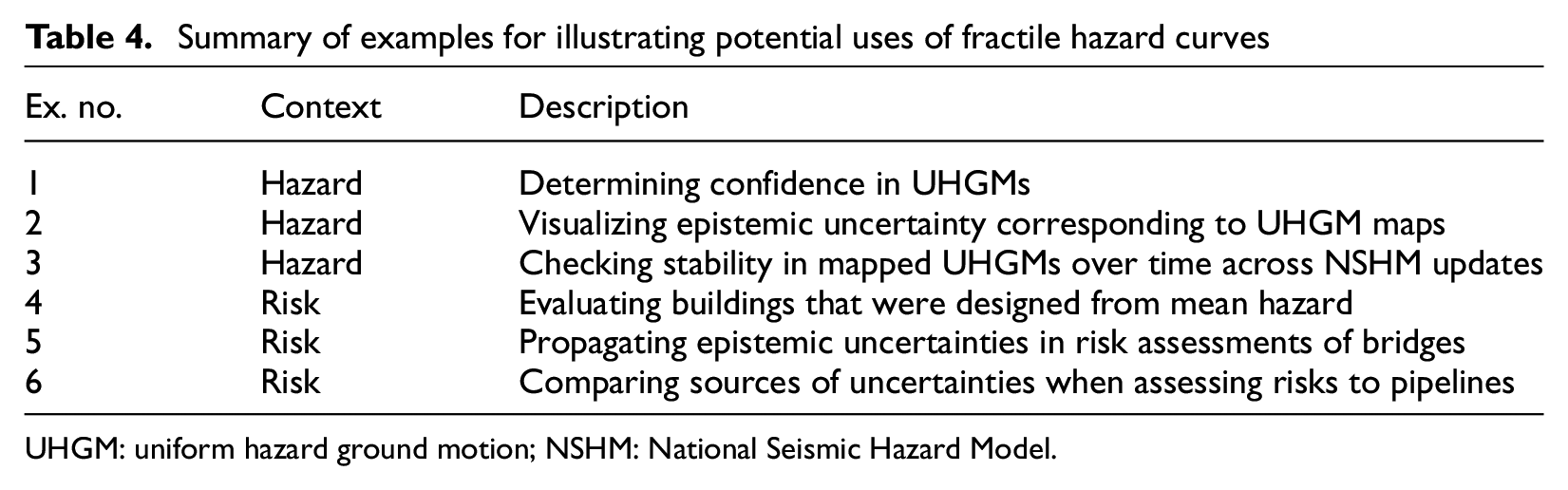
UHGM: uniform hazard ground motion; NSHM: National Seismic Hazard Model.
Hazard example 1
One use of fractile hazard curves is for determining confidence in the probabilistic ground motion or uniform hazard ground motion (UHGM) that was derived from mean hazard. For example, the blue vertical line in Figure 7 illustrates the UHGM for SA(0.2) in Hilo, at a specified AFE of 4.04 × 10⁻⁴ (return period of 2475 years). Put differently, this UHGM was determined from the mean hazard curve in Figure 2a, using an input AFE of 4.04 × 10⁻⁴ (i.e. the uniform hazard).
Although the choice of AFE or return period quantifies the desired “safety level” (i.e. vertical direction in Figure 2a), the choice of fractile quantifies the desired “confidence level” (i.e. horizontal direction in Figure 2a) (Abrahamson and Bommer, 2005). At an AFE of 4.04 × 10⁻⁴ (return period of 2475 years), the UHGMs corresponding to five fractiles are also illustrated in Figure 7 using different line styles in black color. Furthermore, the empirical CDF from all 5 × 10⁴ values of the UHGM is shown in solid gray; this quantifies the epistemic uncertainty in UHGM, not the epistemic uncertainty in hazard,
Hazard example 2
A second use of fractile hazard curves is for visualizing epistemic uncertainties that are inherent in maps of UHGMs. For example, Figure 8 illustrates the UGHM map for SA(1.0) in Hawaii, at a specified AFE of 4.04 × 10⁻⁴ (return period of 2475 years or 2% Poisson exceedance probability in 50 years). For each location in the map, the corresponding mean hazard curve was used to determine the resulting UHGM value; however, fractile hazard curves could also be used at each location.
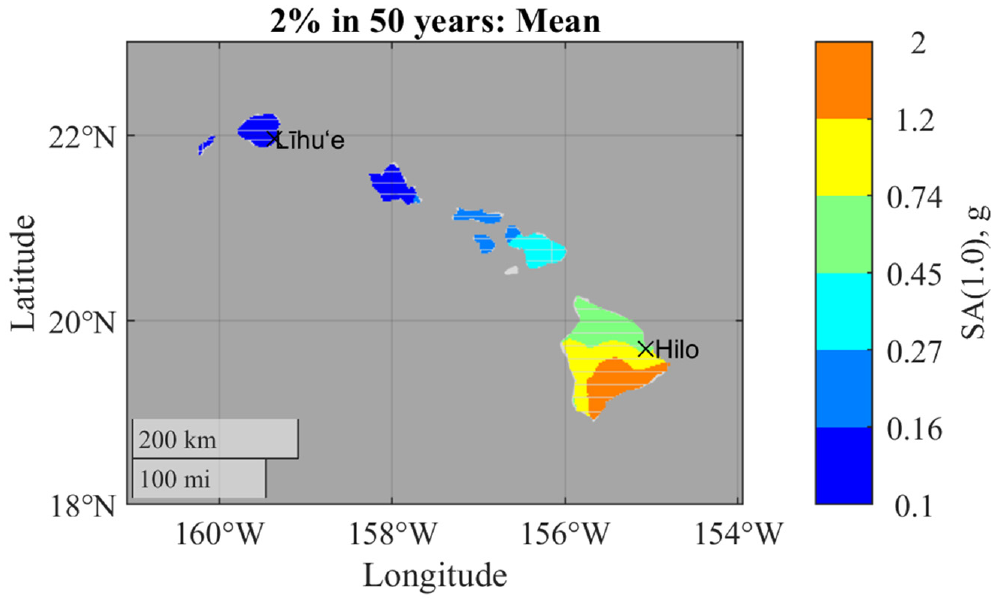
Mean-based UHGM map for 1.0-s spectral acceleration in Hawaii, at a specified AFE of 4.04 × 10⁻⁴ (return period of 2475 years).
Researchers have examined various ways to visualize uncertainties in a map (e.g. Schneider et al., 2022). For instance, one way is to plot the central estimates (e.g. means) directly adjacent to estimates of uncertainty (e.g. standard deviations). A second way is to illustrate the uncertainty through color transparency. In this alternative, the mean-based map is again shown, but regions with a color that is more transparent has larger epistemic uncertainty or less confidence (e.g. Retchless and Brewer, 2016).
A third way is to plot the lower bounds of a confidence interval directly adjacent to the upper bounds, using the same color scheme across the two plots (e.g. Nadav-Greenberg et al., 2008). For example, using the approximate fractile hazard curves that were described earlier, Figure 9a shows the map derived from the 15th fractile hazard curves at each location (i.e. lower bound), whereas Figure 9b shows the map derived from the 85th fractile hazard curves (i.e. upper bound). In this approach, similar colors across the two plots at a particular location indicate low epistemic uncertainty (e.g. high confidence of low hazard at Līhu‘e). By contrast, differing colors at a particular location indicate high epistemic uncertainty (e.g. lower confidence in the hazard at Hilo because of green color in Figure 9a versus yellow color in Figure 9b). In the context of aftershock forecast maps, Schneider et al. (2022) found that showing the lower/upper bounds was more effective than the other two approaches at communicating “potential surprise” locations (i.e. locations where high uncertainty could lead to worse outcomes than predicted). Like the mean-based UHGM map in Figure 8, the fractile-based UHGM maps in Figure 9 are not physically realizable because the ground motion value at one location is determined independently from that at another location. Therefore, although Figure 9 helps distinguish different degrees of confidence in the mapped values from Figure 8, all three maps should not be used in loss or risk assessments that require spatial correlation of ground motions (e.g. regional risk assessment of spatially distributed infrastructure).
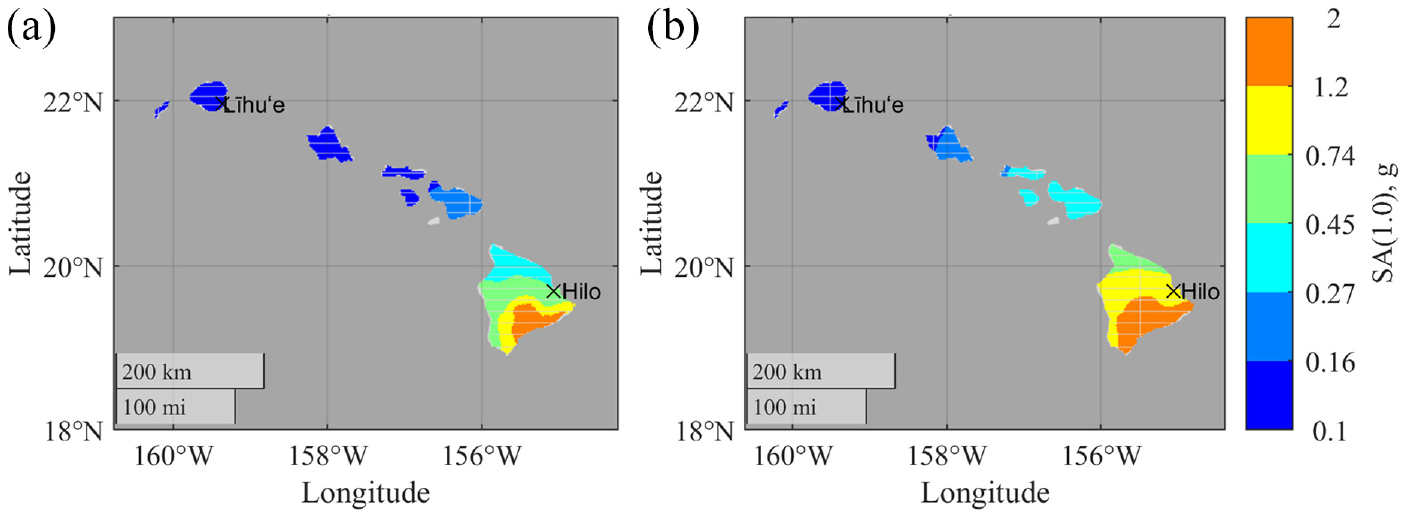
Example use of fractile hazard curves: visualizing epistemic uncertainty in UHGM map for SA(1.0) in Hawaii, at a specified AFE of 4.04 × 10⁻⁴ (return period of 2475 years): (a) 15th fractile and (b) 85th fractile.
Hazard example 3
A third use of fractile hazard curves is for checking stability in mapped UHGMs over time across NSHM updates. For example, the blue circles in Figure 10a illustrate UHGMs for SA(1.0) in Los Angeles from the three most recent updates of the USGS NSHM, at a specified AFE of 4.04 × 10⁻⁴ (return period of 2475 years). Similarly, the blue circles in Figure 10b illustrate UHGMs for SA(1.0) in Hilo from the two most recent updates of the USGS NSHM. These fluctuations over time could potentially convey a lack of stability in the mapped values (Hamburger et al., 2017); however, how “big” or “small” are such fluctuations?
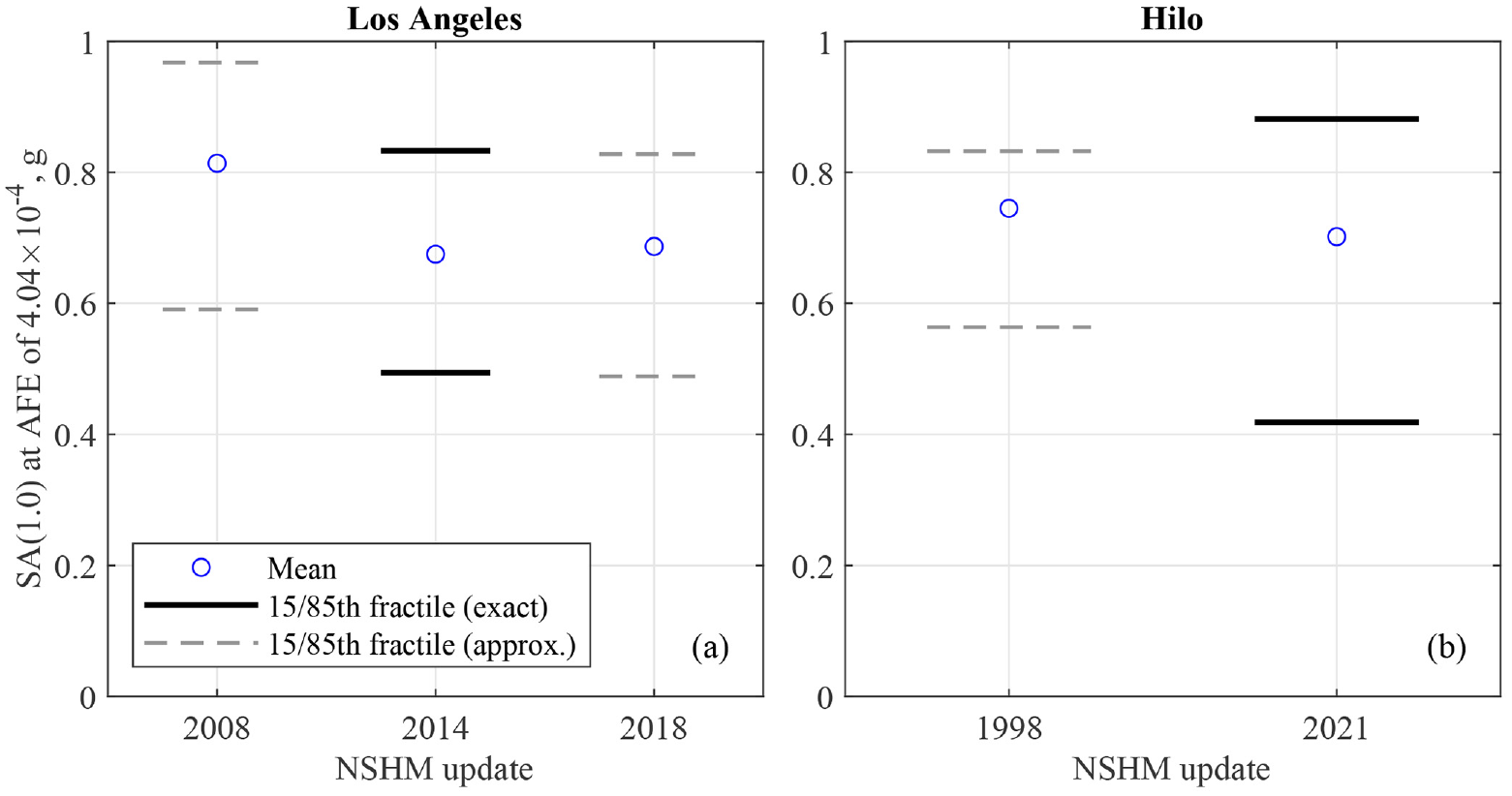
Example use of fractile hazard curves: checking stability in mapped UHGMs over time across USGS NSHM updates; SA(1.0) at a specified AFE of 4.04 × 10⁻⁴ (return period of 2475 years) in (a) Los Angeles and (b) Hilo.
The fractile hazard curves could be used to gain insight to this question. For example, the 15th and 85th fractile-based UHGMs that correspond to each mean value are also shown in Figure 10. For the 2014 and 2021 updates, the fractile-based UHGMs are illustrated using solid black lines, whereas those for the other updates are illustrated using dashed gray lines; this was done to convey that the latter were estimated from approximate fractile hazard curves (Equation 4). In contrast, the 2014 values for Los Angeles correspond to those shown in Figure 1b, while the 2021 values for Hilo correspond to those shown in Figure 2b.
Comparison of the confidence intervals between the 2018 and 2014 updates for Los Angeles indicates that the mapped values across the two updates appear to be stable, even though the latest mapped value increased by about 2%. This makes sense because the only major change for this location between these two updates was the addition of a basin model (Petersen et al., 2020). Similarly, comparison of the confidence intervals between the 2021 and 1998 updates for Hilo indicates that the mapped values across the two updates also appear to be stable, even though the latest mapped value decreased by about 6%. In contrast, the noticeable decrease in confidence interval for Los Angeles from the 2008 update to the 2014 update is consistent with the approximate 20% decrease in the mapped value, which may prompt investigation of the reasons behind such discrepancies. Further investigation reveals that a major difference for this location between these two updates was a major change in the hazard modeling process, from UCERF2 to UCERF3 (Field et al., 2014; Petersen et al., 2015). Finally, the confidence interval for each update could potentially be used as a basis for averaging mapped values from several updates in an effort to stabilize ground motion values for engineering design 7 (Hamburger et al., 2017).
Risk example 1
In the context of risk, one example use of fractile hazard curves is for evaluating buildings that were designed from mean hazard. For example, Figure 11 illustrates the determination of risk-targeted ground motions (RTGMs) for designing a hypothetical building in Los Angeles (Luco et al., 2007). The solid black curve in Figure 11a shows the mean hazard curve for SA(1.0) in Los Angeles and a UHGM value of 0.68g, at a specified AFE of 4.04 × 10⁻⁴ (return period of 2475 years). On the contrary, the solid black curve in Figure 11b shows the corresponding risk-targeted fragility curve that was derived (see Appendix 1) from risk targets of (1) 1% probability of collapse in 50 years (i.e. AFE of 2.01 × 10⁻⁴ or return period of 4975 years) and (2) 10% conditional probability of collapse given the RTGM value (Haselton et al., 2017). Corresponding to the 15th, mean, and 85th fractile hazard curves, Figure 11a also shows the UHGMs and Figure 11b also shows the RTGMs. Unlike the UHGM value of 0.68g, the RTGM value of 0.61g incorporates the fragility of a building (i.e. consequences beyond hazard) and, hence, enables designs based on uniform risk rather than uniform hazard. However, the RTGM is about 10% smaller than the UHGM. Because both values of GM were derived from the mean hazard curve, they both contain epistemic uncertainty. Therefore, it may be cost-effective to intentionally design to a level higher than what is required by regulations to account for potential retrofit mandates caused by future revisions of seismic hazard estimates (e.g. revision of logic tree branches for new GMMs) (McGuire et al., 2005).
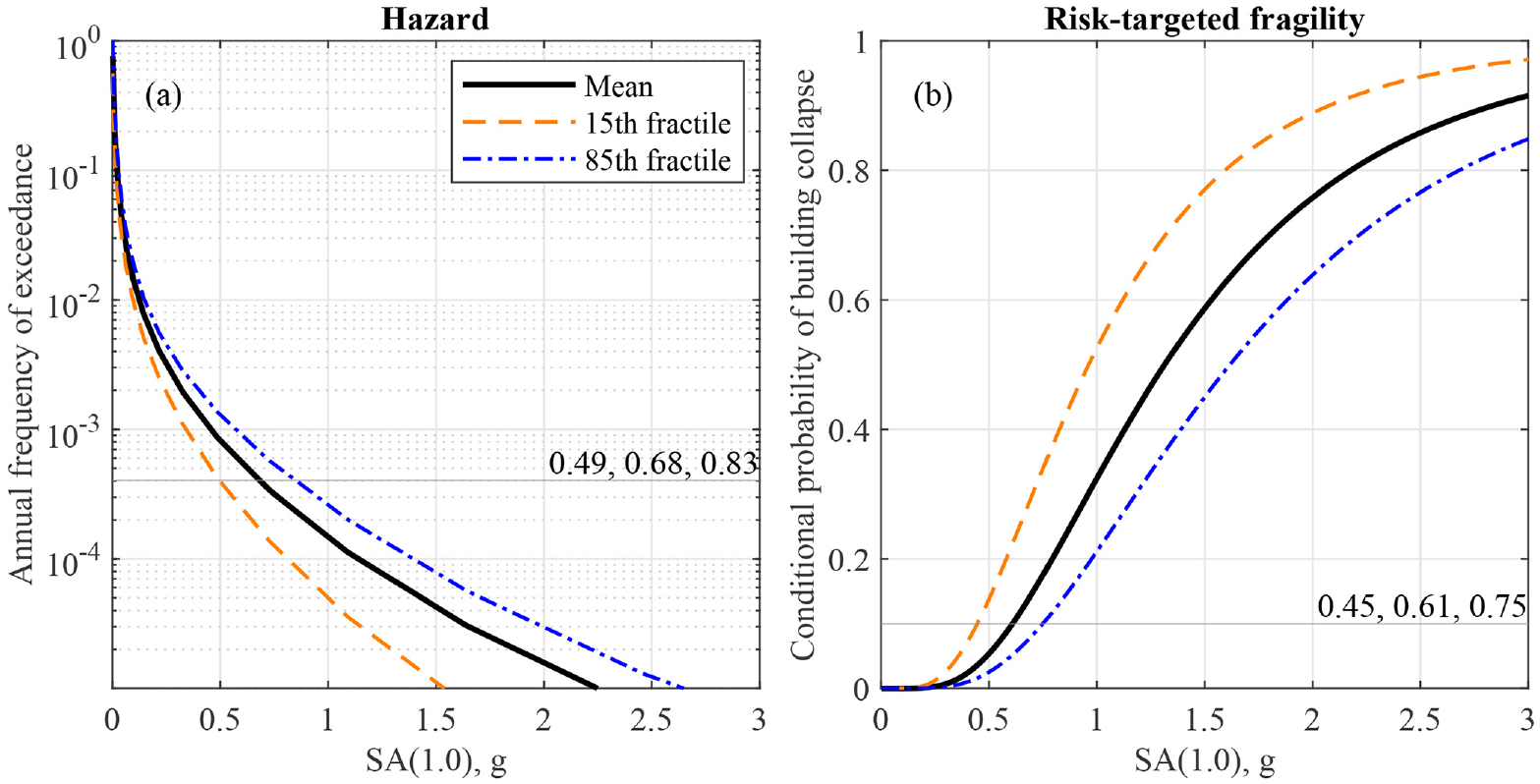
Example use of fractile hazard curves: evaluating a hypothetical building in Los Angeles that was designed from mean hazard: (a) hazard curves (with UHGMs shown) and (b) corresponding risk-targeted fragility curves (with RTGMs shown) from assuming an aleatory logarithmic standard deviation of
One potential way to develop confidence in a mean-based design is to evaluate the design using a UHGM that was derived from a high fractile hazard curve. For example, the blue chained curve in Figure 11a shows the 85th fractile, with a corresponding UHGM value of 0.83g. The UHGM value of 0.83g might be used instead of the mean value of 0.68g to conduct disaggregation, perform nonlinear response history analyses, and check design acceptance criteria (Zimmerman et al., 2017). If the mean-based design remains satisfactory even under a more intense ground motion, one can be more confident that the design (1) achieves the objectives that were originally intended and (2) offers better functional performance (e.g. “immediate occupancy” instead of “life safety”; Moehle and Deierlein, 2004) than a design that is barely satisfactory at the mean hazard.
Another potential way to develop confidence in a mean-based design is to evaluate it using an RTGM that was derived from a high fractile hazard curve. For example, the blue chained curve in Figure 11b shows the risk-targeted fragility resulting from use of the 85th fractile hazard curve instead of the mean hazard curve (see Appendix 1). Although the risk targets remain the same as before, the resulting risk-targeted fragility median is now increased because the input hazard is now higher. Consequently, the 85th fractile-based RTGM value of 0.75g exceeds the mean-based RTGM value of 0.61g. As before, this higher RTGM value might be used to initiate evaluation of a mean-based design.
Although Figure 11 illustrates the potential of evaluating a design with a “high” fractile hazard curve, what constitutes as “high” depends on the specific problem under consideration. For example, designing nuclear facilities may require consideration of very low AFEs (e.g. 1 × 10⁻⁷ or lower), and hence, the mean might exceed the 85th fractile (Abrahamson and Bommer, 2005). However, we note that (1) it is not surprising for the mean to exceed a given fractile (e.g. the mean exceeded the median in earlier examples), and (2) a higher fractile that exceeds the mean can always be considered (e.g. 95th fractile).
Risk example 2
Fractile hazard curves can also be used for propagating epistemic uncertainties in site-specific seismic risk assessments. As an example, suppose that one is interested in estimating the annual frequency of exceeding slight damage,
Multiple approaches are available to propagate epistemic hazard uncertainties in site-specific risk assessments (e.g. Bradley, 2009), and we consider three approaches herein. In the first approach (“Full logic tree”), the risk calculation is repeated for each of the individual 21,600 hazard curves that correspond to the full logic tree, leading to an epistemic empirical CDF of
Assuming no epistemic uncertainty in the fragility, Figure 12a compares the empirical CDF of
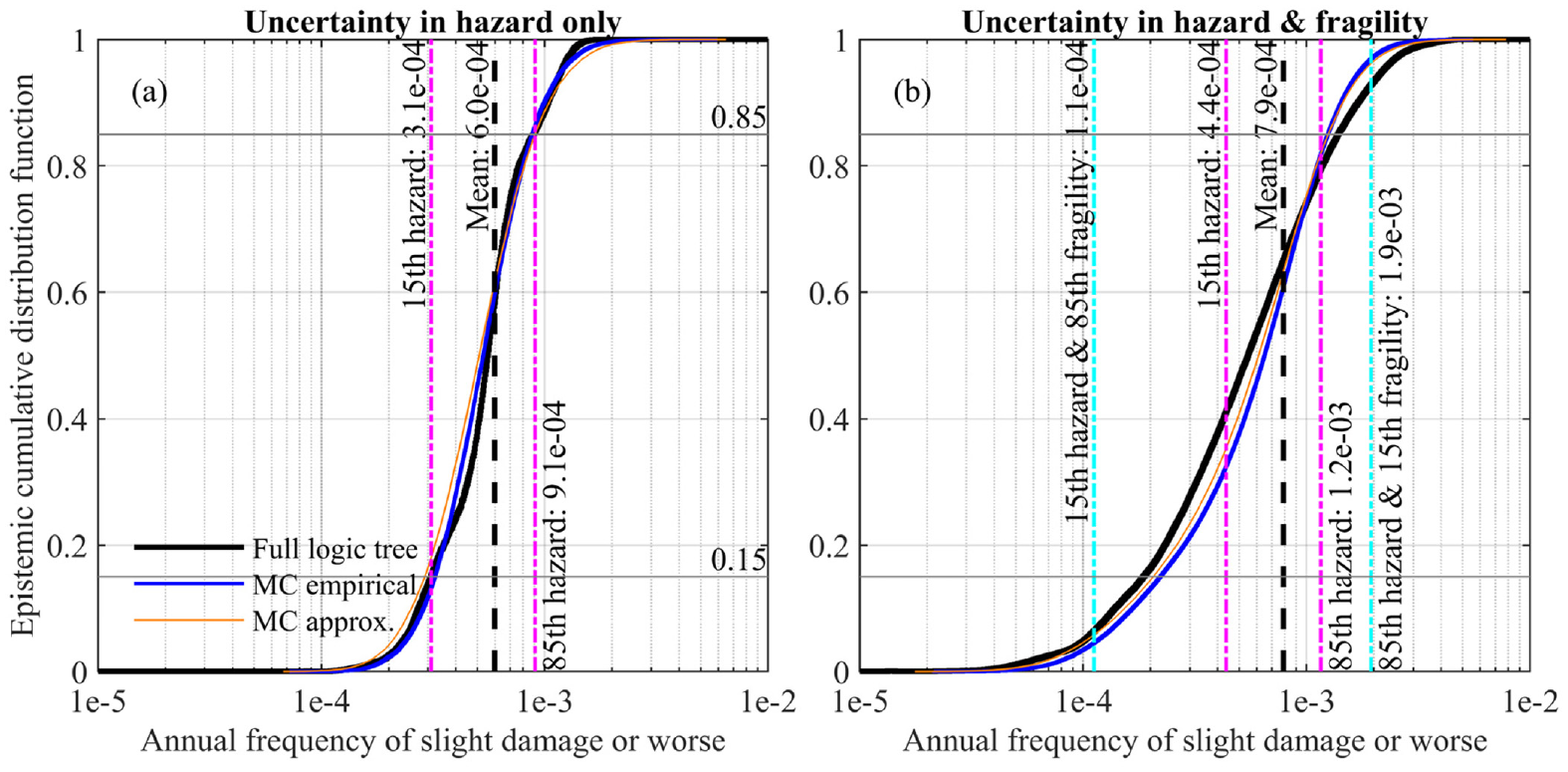
Example use of fractile hazard curves: propagation of epistemic uncertainties in a site-specific seismic risk assessment of an unclassified highway bridge in Los Angeles: (a) no epistemic uncertainty in fragility and (b) fragility median assumed to follow a lognormal distribution with an epistemic logarithmic standard deviation of
The agreement between the “MC empirical” and “Full logic tree” approaches is excellent, confirming the earlier assertion that the epistemic uncertainty in hazard can be reasonably approximated by a lognormal distribution for most of the cases considered. The “MC approx.” approach is simpler to implement than the “MC empirical” approach because the former requires only the mean hazard curve and standard deviations from Table 3, whereas the latter requires all 21,600 hazard curves from the full logic tree.
All three approaches yield roughly similar estimates of the 15th and 85th epistemic percentiles of
Figure 12b also illustrates several more effects from including epistemic uncertainty in the fragility. First, the epistemic uncertainty in risk increases (i.e. range increases from roughly [9 × 10⁻⁵, 2 × 10⁻³] in Figure 12a to roughly [1 × 10⁻⁵, 4 × 10⁻³] in Figure 12b). Second, the mean estimate also increases from about 6 × 10⁻⁴ to 8 × 10⁻⁴. Third, the mean from combining the mean hazard with mean fragility is the same as the mean from the “Full logic tree” approach, whereas the means from the Monte Carlo approaches are slightly smaller. Fourth, the new mean estimates of
Risk example 3
A final illustrative use of fractile hazard curves is for comparing epistemic uncertainties in hazard against other types of uncertainties within a seismic risk assessment. For example, a recent study on seismic risk of gas transmission pipelines in the CONUS integrated four key models when estimating average annual loss: (1) hazard (USGS 2018 NSHM), (2) exposure (locations and attributes of pipelines), (3) vulnerability (relation between rate of pipeline leaks or breaks and intensity measure), and (4) consequence (costs required to physically repair leaks or breaks) (Kwong et al., 2022). Besides epistemic uncertainties in the hazard, uncertainties also existed for the other three models. Based on the uncertainties approximated therein, the study found that the vulnerability model was the most influential source of uncertainty in the seismic risk assessment, whereas the hazard model was the third most influential source. However, this conclusion was based on fractile hazard curves that were crudely approximated using published information from Stepp et al. (2001). Therefore, different input epistemic uncertainties in the hazard could potentially change the rankings in the tornado diagrams.
Figure 13 presents results from repeating the sensitivity analyses that were described by Kwong et al. (2022) but with different input fractile hazard curves. Specifically, Figure 13a presents the tornado diagram resulting from replacing the input fractile hazard curves with those generated from standard deviations for California shown in Table 3. By contrast, Figure 13b presents the tornado diagram resulting from application of the standard deviations for Hawaii shown in Table 3 instead. In both cases, the vulnerability model remained the most influential source of uncertainty when estimating AAL within the CONUS. However, the hazard model was the least influential source of uncertainty in Figure 13a, whereas it is the third-most influential source of uncertainty in Figure 13b. Therefore, implications from a given downstream application of hazard information could strongly depend on the input fractile hazard curves, and hence, epistemic uncertainties in the hazard should be carefully estimated.
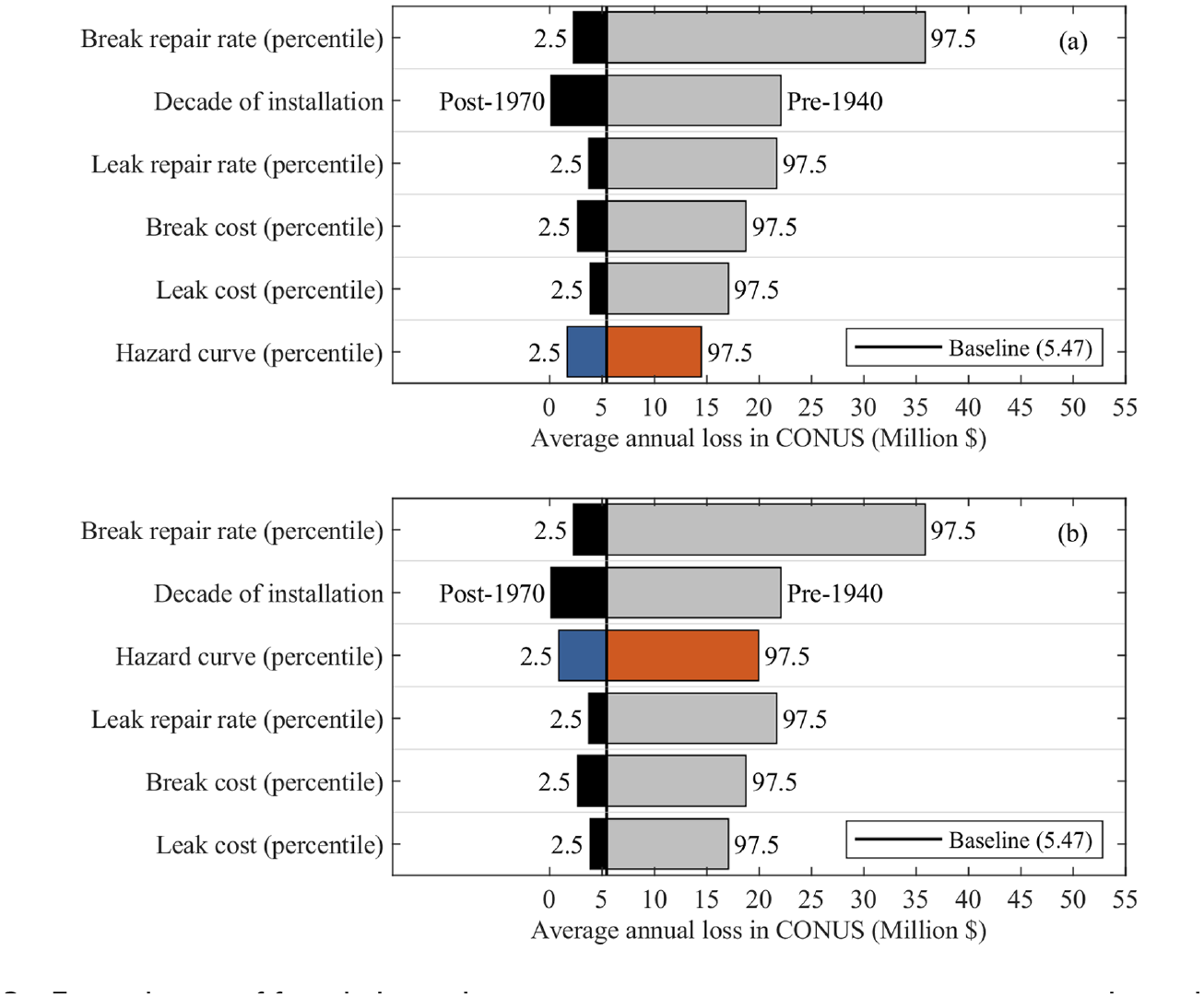
Example use of fractile hazard curves: comparing epistemic uncertainties in hazard against other types of uncertainties in a seismic risk assessment; tornado diagram for average annual loss of gas transmission pipelines in CONUS using (a) standard deviations for California from Table 3 and (b) standard deviations for Hawaii from Table 3.
Other potential uses of epistemic uncertainty in the hazard
The preceding six examples are intended to portray a variety of possible uses of fractile hazard curves and provide inspiration for other potential applications. Consequently, the uses are neither exhaustive nor comprehensive. For instance, Figure 7 illustrated the use of fractile hazard curves for determining confidence in the UHGM for SA(0.2) in Hilo, at a specified AFE of 4.04 × 10⁻⁴ (return period of 2475 years). However, yet another potential use of the epistemic uncertainties shown in Figure 7 is to quantify the epistemic uncertainty in the mean estimate of the UHGM. In this case, the mean estimate from Equation 1 would be viewed as a random variable with its own epistemic uncertainty. However, such quantification would require knowledge of not only the epistemic uncertainty in the AFE for a given logic tree branch (i.e. the variance of
In the context of risk, Figure 13 illustrated the use of fractile hazard curves for understanding the size of epistemic uncertainties in the hazard, relative to other sources of uncertainty. However, yet another potential use of such fractile hazard curves is to calibrate a set of earthquake rupture scenarios in the region so that spatial correlations of ground motions can be properly accounted for in regional seismic risk assessments of buildings and critical infrastructure systems (e.g. Lee et al., 2022; Miller and Baker, 2015; Soleimani et al., 2021). Furthermore, by more completely connecting all hazard uncertainties to various risk metrics, scientific efforts can be better prioritized with respect to reducing epistemic uncertainties (Field et al., 2020).
Given the wide variety of potential uses of epistemic uncertainties in hazard, we aimed to enable a broad range of users of USGS NSHMs to independently examine and potentially start using such epistemic uncertainties for their respective applications. To facilitate sensitivity analyses and encourage user engagement, we developed an open-source interactive tool that extends the second risk example described in this article, which can be accessed using Kwong and Jaiswal (2023). Specifically, we developed an accompanying Python-based Jupyter notebook that enables readers to try different input hazard curves when conducting a site-specific seismic risk assessment of a given hypothetical highway bridge (https://code.usgs.gov/ghsc/erp/bridge_risk_interactive_tool).
Figure 14 shows a screenshot of this tool, which is built upon the open-source HoloViews Python library (Stevens et al., 2015). For a given input hazard curve from a comma-separated value (CSV) file, the user can specify other inputs of the seismic risk assessment through widgets on the left (e.g. fractile, Hazus highway bridge class, damage state, epistemic logarithmic standard deviation of the fragility median). Examples of input hazard curves include, but are not limited to the following: (1) hazard curve for another location or for a different update cycle of the NSHM (Shumway et al., 2021), (2) hazard curve for a different estimate of
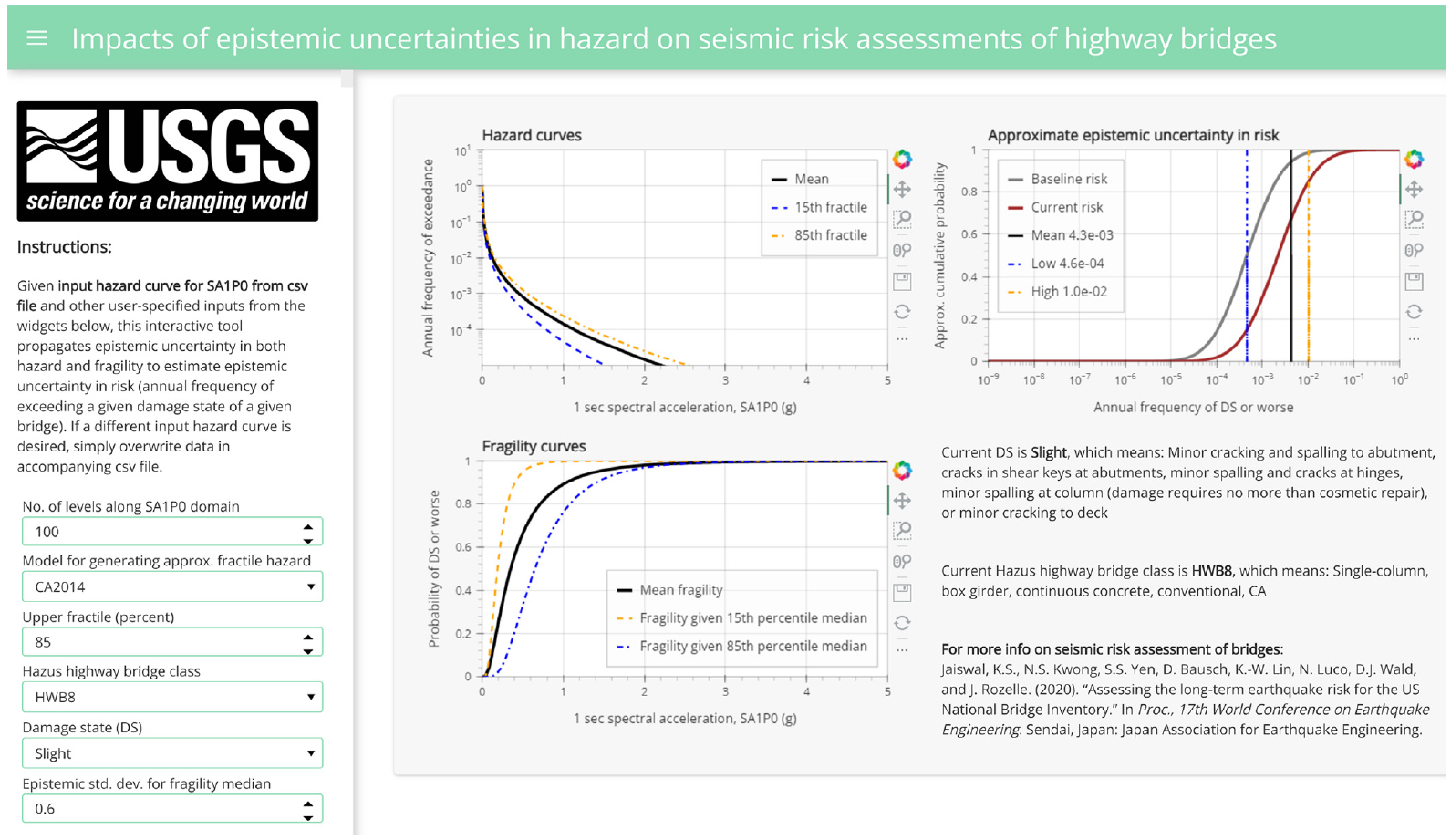
Screenshot of open-source interactive tool for better understanding impacts from epistemic uncertainties in hazard when assessing seismic risks to highway bridges (Kwong and Jaiswal, 2023).
Conclusion
This article aims to help end-users of USGS NSHMs better understand epistemic uncertainties associated with the forecasted earthquake hazard at any given location and shed some light on how such information can potentially be used for hazard and risk applications. Consequently, this article focused on various downstream applications of the epistemic uncertainties in hazard after they have already been quantified or reported. First, we used individual logic tree branch hazard curves from two updates of the USGS NSHM (2014 for California and 2021 for Hawaii) to explicitly illustrate fractile hazard curves and clarify key ideas. Then, we characterized the nature of such epistemic uncertainties in the hazard, resulting in models for readily generating approximate fractile hazard curves in California and Hawaii. Next, we provided specific example uses of fractile hazard curves, for both hazard and risk contexts. Finally, we developed an open-source interactive tool to enable a broad range of users to independently examine and potentially start using epistemic uncertainties for their respective applications.
This investigation led to the following conclusions:
The epistemic uncertainty in hazard is generally larger for Hawaii than for California, except for 0.2-s spectral accelerations at very small AFEs (very long return periods).
The epistemic uncertainty in hazard can be reasonably approximated with a lognormal distribution in most of the cases considered, with the approximation sometimes less reasonable for very small AFEs (very long return periods).
In general, the epistemic uncertainty in hazard is approximately constant at very small intensity levels and increases with increasing intensity level, but the precise relation varies with both location and type of intensity measure.
Approximate fractile hazard curves from the newly developed models agree reasonably well with the more exact fractile hazard curves for most of the cases considered, with poorer agreement for smaller AFEs.
In general, the correlation between epistemic uncertainty in hazard at two different intensity measure levels varies with both location and type of intensity measure.
Example uses of fractile hazard curves include but are not limited to the following:
(a) Determining confidence in UHGMs.
(b) Visualizing epistemic uncertainty in UHGM maps.
(c) Checking stability in mapped UHGMs over time across NSHM updates.
(d) Evaluating buildings that were designed from mean hazard.
(e) Propagating epistemic uncertainties in site-specific seismic risk assessments of bridges.
(f) Comparing epistemic uncertainties in hazard against other types of uncertainties in regional seismic risk assessments of pipelines.
Footnotes
Appendix 1
To make the risk-related examples in this article self-contained and maximally accessible to a variety of end-users of the USGS NSHMs, we summarize salient risk-related concepts in this Appendix 1.
The annual frequency of exceeding a given damage state (e.g. collapse of a building, slight damage of a bridge, leak of a pipeline),
where
where the second line is readily derived from integration by parts,
By specifying
Like the hazard curve,
where
Acknowledgements
The authors thank Kevin Milner for providing the individual branch hazard curves from OpenSHA that formed the basis of the fractile hazard curves in California. They thank Allison Shumway for providing the individual branch hazard curves from nshmp-haz that formed the basis of the fractile hazard curves in Hawaii. This research has benefited from guidance from members of the NSHM steering committee as well as discussions with the NSHM Project Team. They thank two anonymous reviewers, the journal Editor, Max Schneider, Brian Shiro, and Janet Carter for providing helpful comments that improved the manuscript. Finally, they also thank Heather Hunsinger and Jason Altekruse for providing feedback that improved the accompanying software release. Any use of trade, firm, or product names is for descriptive purposes only and does not imply endorsement by the US Government.
Declaration of conflicting interests
The author(s) declared no potential conflicts of interest with respect to the research, authorship, and/or publication of this article.
Funding
The author(s) received no financial support for the research, authorship, and/or publication of this article.
