




Abstract
Earthquake early warning (EEW) entails detection of initial earthquake shaking and rapid estimation and notification to users prior to imminent, stronger shaking. EEW (ShakeAlert Phase 1, version 2.0) went operational in California in October 2019 and is coming to the rest of the U.S. West Coast. But what are the technical and social challenges to delivering actionable information on earthquake shaking before it arrives? Although there will be tangible benefits, there are also limitations. Basic seismological principles, alert communication challenges, and potential response actions, as well as substantial lessons learned from the use of EEW in Japan, point to more limited opportunities to warn and protect than perhaps many expect. This is in part because potential warning times vary by region and are influenced by tectonic environment, hypocentral depth, and the fault’s proximity to the alert user. For the U.S. West Coast, particularly for crustal earthquakes, warning times are shorter—and possible mitigation actions are likely to be less effective—than often maintained. Nevertheless, EEW is an additional arrow in the quiver of earthquake information tools available in the service of earthquake risk reduction. What is called for, then, is transparency and balance in the EEW discussion: along with its potential, the acknowledgment of EEW’s inherent and practical limitations is needed. Recognizing these limitations could, in fact, make EEW implementation more successful as part of a holistic earthquake mitigation strategy, where its role among other earthquake information tools is quite natural.
Introduction
“The […] reason that technology so often disappoints and betrays us is that it promises to make easy things that, by their intrinsic nature, have to be hard” (Stephens, 2018). The goal of earthquake early warning (EEW) is to provide timely alerts that are sufficiently rapid to allow warnings 1 that may reduce harm or impacts of earthquakes (e.g. Allen and Melgar, 2019). In that sense, EEW is both a scientific and a societal challenge. It would be wonderful to see EEW save many lives and reduce societal losses in future earthquakes. But are such expectations realistic? Is it that straightforward to reduce the impact of earthquakes with EEW, above and beyond other efforts to do so?
The challenge is to rapidly determine not only whether to send out an alert, but also how, to whom, and with what warning for users to heed. These highly visible, critically important, publicly distributed decisions are serious technical challenges in their own right. But widely communicating actionable warnings turns out to be even more difficult. It is also well known from other natural hazards that providing rapid, actionable warnings, although beneficial, is challenging, 2 and EEW alerts come with much shorter lead times than warnings for other perils. What is more, exactly what actions should be taken is imprecisely known (e.g. Johnson et al., 2017). Realistically, even if the EEW system correctly estimates shaking in a timely fashion for warning purposes, they may not be sufficient to significantly alter an earthquake’s impact in many cases. To date, there are few examples of how reducing losses with EEW can be accomplished.
There are two key points discussed herein that raise concerns about EEW in the U.S. West: (1) effective warning times—especially when accounting for delivery and response—are less impressive than purported, effectively increasing the area of the blind zone where no warning is possible, and (2) possible mitigating actions are more challenging than anticipated and are thus less likely to be effective than often claimed. Indeed, shorter-than-expected warning times fundamentally limit the range of opportunities for risk reduction. Consequently, overall expectations for EEW alert timing and consequent societal benefits may not be met. Therein lies the need for full transparency, and for better clarity about the realistic benefits and the limitations of EEW.
The purpose of this note, then, is to provide an additional perspective 3 that amplifies the need for complete transparency and balance in the overall EEW conversation, commensurate with such an important, publicly delivered emergency earthquake information system. It is important to properly consider which specific aspects of risk reduction could be achieved with EEW, and to do so by not only being realistic about potential warning times, but also recognizing the importance of other earthquake information products and more mundane (albeit more expensive) mitigation strategies. After reviewing the current scientific literature and engaging with EEW practitioners, other scientists, and potential users, I offer observations and conclusions toward this end.
Background
The process underlying EEW entails assessing P-waves at the closest seismic station(s) to the epicenter and rapidly estimating shaking due to later-arriving, larger S-waves. 4 If the projected S-wave shaking is likely to be strong at any location, a warning can be sent ahead of the S-wave arrivals, at least under some conditions, and certainly at more distant locations where weaker shaking is expected. Recent advances on many of the technoscientific components of EEW have indeed been impressive; up-to-date overviews of EEW’s potential and limitations have been provided by Allen and Melgar (2019) and Ogweno et al. (2019).
Early on, Nakamura and Tucker (1988) articulated opportunities along with several concerns about transporting EEW from Japan to California; their apprehensions included differences in tectonics, challenges in mitigating applications beyond primarily slowing trains, and even concerns about litigation. They also noted the challenges of serving a range of different users in California and the inherent need for a more complex system as a result, and further contended that the cost-benefit of implementing an EEW system would need to be documented given the competing needs for tax dollars and the lower level of concern over earthquake hazards in California versus Japan. Perhaps, the earliest concerns from the seismic network manager’s perspective were from Malone (2008); he also emphasized that “the science and technology parts of such systems seem to be way ahead of their effective application” (p. 608).
From a strictly seismological standpoint, Meier (2017) implored that EEW performance be evaluated in terms of the accuracy and timeliness of ground motion estimates from the EEW system (vs magnitude and location error). Based on recorded ground motions, Meier et al. (2017) also demonstrated that small and large earthquakes are indistinguishable in their beginnings, implying that EEW can only determine earthquake size after an event either ends or takes time to get larger; that is, larger events will take longer to evaluate for EEW purposes.
More challenging, Minson et al. (2018) made the case that—based on the assumption that the size of an earthquake is not encoded in its start—EEW systems provide only minimal warning times for very strong shaking. To paraphrase Minson et al.’s conclusions: from basic principles, areas with damaging shaking levels are very likely to receive little to no warning; moderately shaken areas will likely receive a short, <10 s, warning; and light shaking areas will most likely receive a significant warning, 10 s or more.
Moreover, Minson et al. (2019) concluded that—due to the inherent large variabilities of ground motions—accurate EEW shaking threshold alerts are unlikely to be the outcome, even when earthquake source information is accurately determined. Fortunately, false alert–tolerant users—those willing to accommodate alerts at much lower thresholds than really necessary—would be less likely to miss an alert for damaging shaking levels.
Yet, despite the known challenges, the EEW literature 5 and coverage by the media are replete with statements implying that you will receive “up to a minute of warning.” In fact, of the thousands of papers, abstracts, and meeting special session presentations on EEW over the past decade, 6 very few describe EEW’s practical limitations along with its potential. Even social science studies focused on potential benefits of EEW often begin with the assumption of a warning of 10–50 s (e.g. TriNet, 2001) or 10–60 s (e.g. Wood, 2018) as an organizing principle.
How might EEW practitioners better communicate the area and effect of the blind (no-warning) zone with respect to strongly shaken and affected areas? In essence, for most areas of strong shaking, warning times are very short or non-existent, especially if one accounts for warning dissemination, receipt, and response times. Illuminating figures can be found for both recent and historical earthquakes. By looking to Japan’s experience with EEW for insight, several confounding challenges confront EEW in the western United States (the “ShakeAlert” system). With an understanding of the limited warning times, and the challenges ShakeAlert faces, this study examines the potential and limitations to taking mitigating actions with EEW in the western United States.
Finally, I discuss how such constrained opportunities to mitigate losses require a more nuanced approach to the way we analyze benefits and costs, and how we communicate and present EEW to our communities. In the process, I also recognize some of the potential benefits of EEW and provide some options for moving forward: by candidly acknowledging EEW’s limitations up-front, we can focus on EEW’s real benefits in the context of a continuum of other appropriate mitigation strategies.
Understanding and communicating warning times
A fundamental element to understanding the potential and limitations of EEW lies in communicating the meaning and extent of potential warning times. ShakeAlert warning latency is typically discussed in terms of alert time—the time the system takes to notice and recognize the seismic signal and estimate the shaking elsewhere. So, the alert time is the elapsed time between when an earthquake begins and when the alert is issued (Minson et al., 2018). In common-use literature, the warning time (sometimes called lead time 7 ) is the number of seconds from issuance of that alert to the theoretical S-wave arrival at any given location (Kamigaichi et al., 2009). Simply put, warning time is the number of seconds after the alert is issued before the S-wave arrives at a particular location; it is the time available for potentially actionable information at a user’s location. Warning time is spatially variable and can also be negative in the blind zone (or no-alert zone), where the S-wave arrives first. Unfortunately, the closer one is to the causative fault, the more compact and pulse-like the S-wave tends to be; thus, in close—where the strongest and most damaging shaking occurs—the S-wave arrival time is what matters most and is representative of the time before which action is needed. Moreover, a fact rarely noted in the literature is that the P-wave will often be very strongly felt ahead of the S-wave warning time in areas of potentially damaging S-wave shaking levels—a point to which I return later.
For accurate portrayal of projected (for scenarios) or actual warning times for earthquakes, the calculus must deliberately consider both the delay inherent for magnitude determination 8 sufficient for shaking projections—which is considerably longer for larger earthquakes (see Minson et al., 2018)—and communication latencies, which further reduce the warning. In addition, for human responses, one must also consider the time it takes to recognize, interpret, and respond to the warning message. 9 In this regard, some of the key latency times could be better explained and presented in everyday EEW discussions. Recommended actions, such as duck, cover, and hold on (DCHO), and other anticipated reactions take precious seconds. If one only considers electronically automated uses, the warning time (assuming zero communication latency) is a reasonable interval to consider, depending on the time to activate and engage such automatic systems. Whereas some automatic systems can be protected nearly instantaneously (e.g. disengaging hard drives), many mechanical systems take several to many seconds to activate (e.g. moving elevators to the next floor and opening doors, opening garage doors, slowing trains).
Most EEW projections presume activation and response times to be instantaneous or ignore them altogether. Although empirical evidence for many of these latency or reaction times has not been well established, some are knowable, or can be estimated. For example:
Alert times (both Japan Meteorological Agency (JMA) and ShakeAlert). We can optimistically assume 5 s, though the ShakeAlert system has not yet achieved that consistently for small to moderate earthquakes (Chung et al., 2019). Empirical evidence from JMA and from Minson et al. (2018) suggests that it would be more proper to assume significantly longer delays as a function of increasing magnitude to alert the proper area. Note that alert times depend on earthquake location, network configuration, and station density and could be longer. 10
Communication latency. In Japan, best-case alerting through public channels takes about 2–3 s (K Doi, oral communication, October, 2018; Patchett, 2017). ShakeAlert will not likely be faster than that; in the short term, it may be slower (e.g. Given et al., 2018). In the United States, warnings are expected to be delayed due to technical limitations of our communication systems. Wireless emergency alert (WEA) testing in Oakland, CA—one of the main proposed ShakeAlert public notification methods—indicated greater than 5 s of communication latency for 85% of users. The communication (delivery) latency for the ShakeAlertLA phone app, released in 2019, has not been publicly specified.
Reaction times. Bay Area Rapid Transit (BART) reports that it takes about 10 s to decelerate trains from 70 miles/h down to 40 miles/h (Gregory, 2018). Actually, stopping a train takes longer, although any time available to reduce train speeds clearly may lessen the consequences of a derailment. In human terms, Porter and Jones (2018) substantiate that DCHO reaction times can be approximated with a lognormal distribution with an 8.8 s median and a 0.4 s standard deviation; that is, only a small percentage of responses were able to DCHO in less than 5 s.
In order to better communicate EEW latency challenges, just adding the shaking intensity to the alert time maps used for explaining EEW (as JMA does for their post-earthquake summaries) is an effective first step. Yet, it is even more appropriate to indicate representative warning and reaction times (commensurate with specific locations and anticipated actions), not just the alert times. For recent and historical events, where the damage, injuries, and fatalities are known, we can use this information to evaluate how EEW would have performed. This can be taken a step further and used to communicate where and how EEW did or did not work, and for future earthquake scenarios, what we might realistically expect. For Japanese events, where EEW has been in place since 2006, the affected region and the actual EEW performance can be directly compared. In the western United States, similar maps can be made for any recent, historical, or even scenario earthquake with informed assessments of EEW system latency, communication delays, and response times.
In the section that follows, Japan’s experiences for three fundamentally different tectonic settings are considered along with how their EEW system performed in each of these settings. The relevance of these results to similar tectonic environments in California, Oregon, and Washington is then discussed.
Lessons from Japan
The JMA has the most established EEW system in the world. 11 It has been regularly tried, tested, and adjusted for events small and large, and it has been alerting publicly since 2006 (Doi, 2011). Lessons can be learned from the numerous deadly earthquakes, year-in and year-out, and EEW advancements at JMA—for example, their alternative to estimating shaking without magnitude and location—are continuously and rapidly deployed operationally (e.g. the propagation of local undamped motion (PLUM) method; Kodera et al., 2018).
Japan has invested very heavily in earthquake monitoring, mitigation, and preparedness. Both the Japanese support for their seismic networks and national imperative for EEW show that JMA has achieved very dense station coverage and operates a highly sophisticated EEW system with government-mandated low latency (approximately 2–3 s) for public alerts that are widely communicated to the public via the airwaves and free and commercial apps (Doi, 2011; K Doi, October, 2018, oral communication). In fact, all cell phones purchased in Japan come preconfigured with EEW alerts set to “on” by default (e.g. Patchett, 2017).
Despite all this, the success of EEW in Japan has been mixed, with results being dependent on tectonic source zones. Japan is subject to three fundamentally different types of earthquakes: (1) distant, offshore megathrust earthquakes from Japan’s bordering subduction zones; (2) deep, intraplate events reflecting tensional earthquakes within the bending subducting plates; and (3) shallow crustal earthquakes from faults much closer to people and infrastructure. Of these, the subduction zone earthquakes provide for the greatest amount of warning time and have therefore been the most successful, while the crustal earthquakes provide the least amount of warning time, typically with the affected area being fully encompassed within the no-alert (e.g. “blind”) zone.
A noteworthy success occurred in 2011 in response to the great Tohoki-Oki quake; although the magnitude was significantly underestimated, the JMA EEW system provided sufficient, actionable warning times (up to 15 s) to many residents in the damaged areas (Fujinawa and Noda, 2013; Hoshiba and Ozaki, 2014). It is not fully clear that losses were mitigated significantly, but the advanced warning was provided and appreciated, and Shinkansen trains were systematically slowed (only one derailed). Because the magnitude was significantly underestimated, the EEW system in 2011 did not provide warnings to more distant areas such as Tokyo. However, this shortcoming is being addressed with the inclusion of better offshore monitoring and rapid finite fault capabilities as the system evolves.
Two deep intraplate (inslab) earthquakes with loss of life have occurred since publicly available EEW has been in place in Japan. The 2008 M6.8 eastern Honshu (deep, yet inland) earthquake afforded little warning in the strongest shaken areas (JMA, 2008) However, warning times of 10–15 s were provided for the 2011 M7.1 Tokachi-oki (deep, yet offshore) earthquake, demonstrating the potential timeliness EEW could give for inslab Japanese subduction events.
Warnings for inland earthquakes in Japan, especially those tied to shallow crustal faults, have been less successful. Small to moderate crustal earthquakes (e.g. M5.5–6.0), for which damage is restricted to the irreducible blind zone even for optimal EEW systems, can be consequential. The 2018 M5.5 Osaka, Japan earthquake, for example, killed five people and injured over 400 in the epicentral area. JMA routinely provides maps of available warning time (Figure 2 in Appendix 1; concentric circles; the alert time minus S-wave arrival time). I have supplemented JMA’s map, which shows the blind zone, by adding a 2 s communication latency (dash-dotted circle) and an additional 5 s human response latency (dashed circle). Defined this way, all of the impacts of the Osaka earthquake were well within the EEW blind zone. 12 Losses in such events—with damage limited to the immediate epicentral area—are not likely to be mitigated with EEW.
Since 2006, there have been 14 additional fatal inland (e.g. crustal) events in Japan during which JMA’s EEW system was fully functional and had been incrementally improved. Those losses were not mitigated by EEW, nor is there any published evidence to suggest that other losses were prevented. Figures 2 to 4 in Appendix 1 show how the best EEW system in the world cannot provide adequate warning where it is needed the most—the blind zone. For these crustal earthquakes, the blind zone encompasses much or all of the impacted area. For this reason, Japan Railway (JR) has heavily invested in complementary strategies to help avoid high-speed derailments. 13
Recognizing the inherent differences in the effectiveness of the JMA system in these contrasting tectonic environments, Japanese researchers as well as the public distinguish inland from offshore (-oki) earthquakes, and they are painfully aware that fewer benefits are proffered by EEW for inland events. Inland earthquakes are underfoot, allowing only minimal warning times, while offshore events provide the opportunity for longer warning times. Despite the mixed results in Japan, the Japanese population wants and likes EEW (e.g. Doi, 2011; Patchett, 2017), 14 a point returned to later in the discussion.
Although the focus of this discussion is on Japan, it is worth noting the similar situation and experience in Mexico. In Mexico City, offshore events can afford relatively long warning times in the city due to the unique situation: shaking is greatly amplified in the lakebed basin sediments of the city, yet it is distant from large offshore quakes. For this reason, Mexico developed a warning system following the deadly 1985 Mexico City earthquake. This system was tested twice in 2017 with two different intraplate events. First, an M8.2 earthquake occurred on 7 September 2017, off the southern coast of Mexico. This quake did, in fact, trigger a warning for Mexico City, although this particular quake did not result in any damage. In contrast, nearly 500 lives were lost in Mexico City on 19 September of 2017 from a 50-km-deep M7.1 intraplate event located well inland. This second earthquake was the deadliest event since EEW was implemented there. The SASMEX EEW audio alert was preceded by very noticeable strong shaking, so it did not alter this deadly outcome (Allen et al., 2018). The fact that neither earthquake matched the “design” megathrust earthquake is not a condemnation of the system, but the challenge for providing effective warnings for non-megathrust earthquakes is clear.
The disparity in the potential benefits for EEW between offshore and inland quakes must be taken into consideration; whereas this is potentially good news for Oregon and Washington residents, it does not bode as well for Californians.
The Cascadia subduction zone
The Cascadia subduction zone (CSZ) is a 1000-km-long dipping fault that stretches from northern Vancouver Island, Canada, to Cape Mendocino, California. The CSZ has produced earthquakes of magnitude 9.0 or greater in the past and undoubtedly will in the future. The last known megathrust earthquake in the Northwest was in January 1700, just more than 300 years ago. A large megathrust earthquake on the CSZ poses a significant threat to the southern Pacific Coast of Canada and the Pacific Northwest (PNW) coast of the United States.
Of particular concern with great subduction zone earthquakes is the potential for amplification of strong ground motion due to sedimentary basins. Nasser et al. (2017) note that the long-duration subduction earthquakes and the effects of basins combine to increase the risk of collapse, particularly for tall buildings and other structures affected by long-period shaking. So even though the source of the earthquake is more distant (a factor that would—all else being equal—result in decreased shaking), the basin setting of Vancouver, Seattle, and Portland results in increased hazard for these regions.
Fortunately, an offshore CSZ earthquake would likely be analogous to the 2011 Tohoku-oki M9.0 earthquake in Japan in that it offers the opportunity to realize a substantial warning to these metropolitan areas. The Tohoku earthquake example shows the potential for tens of seconds of warning over large regions in the PNW that could benefit from EEW. Patchett (2017) documented EEW benefits from that event in Japan, and the lessons they hold for a PNW EEW system. But, currently in the United States, warning times would likely be less due to the lack of offshore sensors. Precious seconds are lost waiting for the seismic signals to reach the sensors along the coast. Japan has already addressed this limitation with offshore seismic and geodetic sensors, while research is underway in the United States to explore ways to instrument the seafloor. To fully maximize warning time, significant investments will be required to operate and maintain an offshore component to the U.S. EEW monitoring system.
Intraplate earthquakes in the PNW
Along the Cascadia coast, intraplate earthquakes are also observed. In Washington State, we expect about a dozen moderate-sized inslab (intraplate) earthquakes for every major subduction interface event based on recent periods. Historically, these earthquakes are of moderate size (∼M7), although much larger intraplate earthquakes (∼M8) have been observed recently in such places as Sumatra, South America, Mexico, and Alaska. Past events in Washington have shown that these events can be deadly and quite damaging (e.g. 1949, 1965, 2001), yet the warning times for these are (though longer than shallow crustal events) considerably less than those for great offshore events. In the case of the 2001 M6.8 Nisqually, WA earthquake (Figure 12 in Appendix 1), EEW times would have been very limited, particularly if you consider the added time for human response. In the epicentral areas (Olympia, WA) where the damage was greatest, warning time would have been effectively zero, while in more distant areas such as Tacoma and Seattle 3–10 s of warning time would have been possible.
Most recently, the 2018 M7.1 Anchorage, AK earthquake provided a similar event for the city of Anchorage (Figure 13 in Appendix 1). There, too, areas damaged would have received very little warning time (0–5 s). Note, also, that the gain in warning time over crustal events is a result of the larger depth of intraplate events, meaning also that the ground shaking is inherently lighter than that for crustal events.
Crustal earthquakes: with a focus on California
Like Japan, the West Coast of the United States is characterized by numerous crustal faults capable of generating large, damaging earthquakes (e.g. M6–8). The focus of this section is on the challenges of providing an early warning to California from these crustal earthquakes, recognizing that Oregon and Washington are also subject to these same types of events. What is unique about California, however, is that it does not have Japan’s (or the PNW’s) mix of offshore and inland earthquakes: nearly all deadly California (South of the Mendocino Triple Junction) earthquakes have been inland. Earthquake risk in California is dominated by a combination of more frequent moderate-sized inland earthquakes that affect populated areas, and less frequent larger inland events that shake greater regions. Losses from moderate-sized (M < 7) earthquakes have significantly dominated losses in the past century. In California, such events include the 1971 M6.7 San Fernando, 1989 M6.9 Loma Prieta, 1994 M6.7 Northridge, 1987 M5.9 Whittier Narrows earthquakes (see Figures 9 and 11 in Appendix 1).
As in Japan, significant warning times are not expected in the most strongly shaken areas for moderately sized crustal earthquakes. For example, Figure 1 shows areas most strongly shaken by the 1994 M6.7 Northridge, CA quake that killed dozens and injured thousands (Shoaf et al, 1998). Concentric circles show the approximate 15 warning times that could be achieved with the current configuration of the ShakeAlert system, with an optimistic 2-s assumption about communication latency (since that challenge has not yet been solved). Notably, the P-wave shaking—which was strongly felt in areas just beyond the blind zone—would have arrived sooner than any warning (Figure 1). The knowledge that stronger shaking can follow any perceived shaking can be employed as a naturally occurring self-defense strategy 16 in conjunction with or independently of EEW.
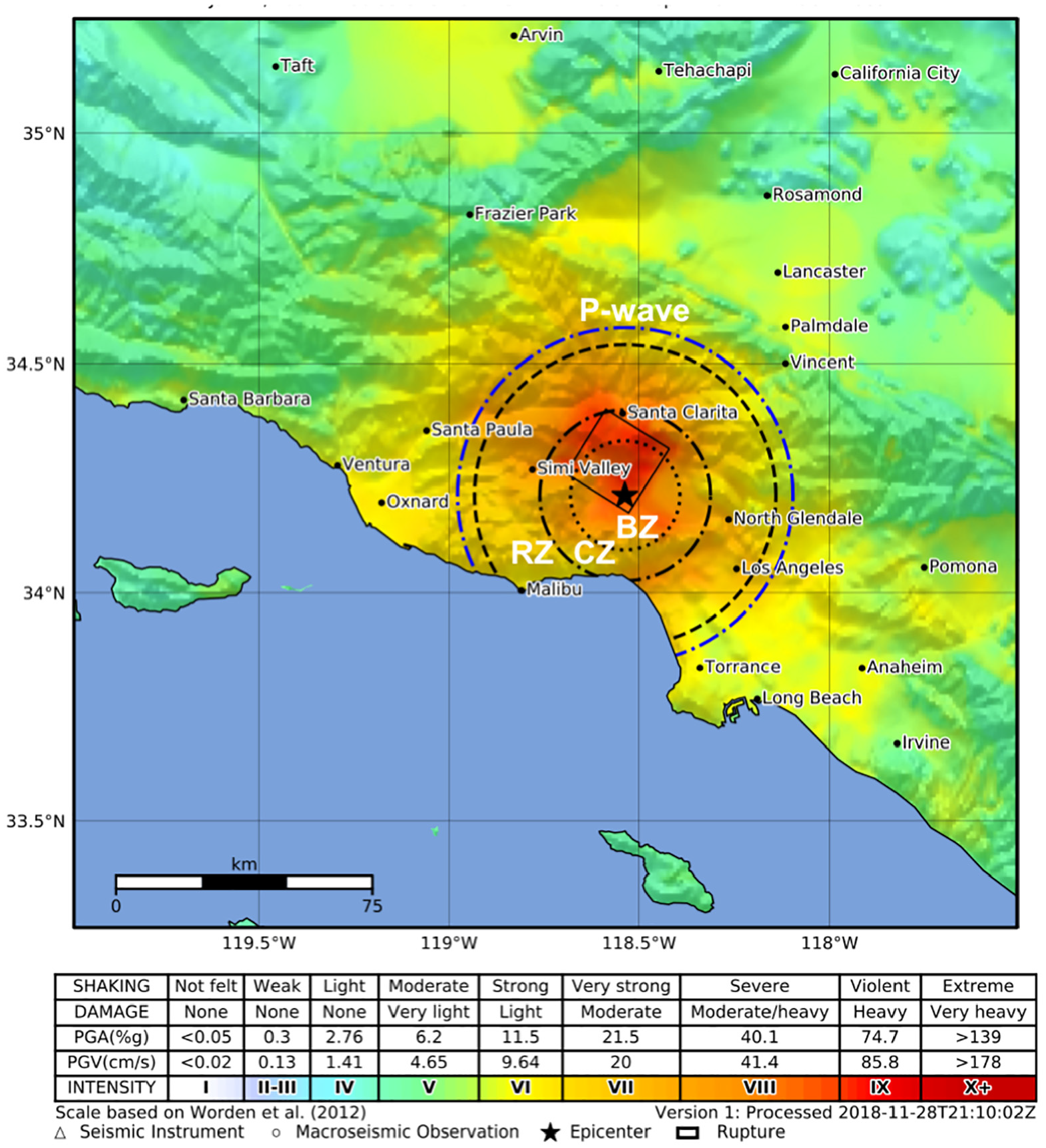
1994 M6.7 Northridge, CA earthquake ShakeMap. The epicenter is depicted with a star; the fault is shown as a rectangle angled northward from the epicenter. Concentric circles denote the alert time (dotted, 7.0 s after origin time), the warning time (dash-dotted, 2 s communication latency added), and the response time (dashed, a 5 s reaction time added). Blue dot-dashed circle is the location of the P-wave at the warning time. White text abbreviations refer to the blind zone (BZ), 2 s communication latency–added blind zone (CZ), and the response zone (RZ) where users have between 0 and 5 s to respond. The legend indicates color mapping from intensity to ground motion based on Worden et al. (2012). Most of the fatalities occurred very near the epicenter at the Northridge Meadows Apartment complex.
So, when alert, warning, and response time regions are shown along with ShakeMap shaking intensities, it is more clear which areas—and which shaking levels—could receive warnings. For the Northridge quake case, areas where shaking and thus damage were severe—and thus where the fatalities and most injuries occurred—would receive no warnings or very late ones. EEW recipients closer to the epicenter than the 5 s “response” radius would have proportionately less time to act. It is fundamental to communicate these limitations—that substantive warning times occur primarily at relatively low shaking levels—particularly when promoting EEW through the media.
Yet, media reporting on EEW for California often further plays into the optimism for recent events for which EEW was in test operations: A prototype system has proved successful in many recent minor and moderate California quakes, notably the 2014 magnitude 6 temblor that hit Napa, giving San Francisco eight seconds of warning. Earlier that year, scientists in Pasadena got six seconds of warning when a magnitude 5.1 earthquake hit La Habra. (Lin, 2018)
Notably, for the aforementioned Napa event, San Francisco shook at the modified Mercalli intensity (MMI) III–IV level (weak to light shaking; Figure 8 in Appendix 1); for the M5.1 2014 La Habra event, Pasadena received the same low-level shaking (MMI III–IV). Of course, whereas it is quite possible to provide a short warning to distant (low-intensity shaking) areas, for both events, the only damage occurred in areas within the no-alert (blind) zones. This inconvenient reality is fundamental, yet is not routinely portrayed in the media’s coverage of EEW.
The most significant California earthquake sequence to test the newly operational ShakeAlert system occurred near Ridgecrest, CA, in July 2019. The first alert for the 4th July M6.4 event was 7 s after the origin time and had an initial EEW M5.7 estimate; the final EEW M6.2 was only reached after 20 s (A Chung, ShakeAlert Performance Report). The initial alert for the 5th July M7.1 event was 8 s after the origin at M5.5 with a final EEW M6.3 also at about 20 s. Station density is relatively low in the epicentral region, so the initial alerts were slower than average, but the magnitude underestimates were of more concern. Nonetheless, most of the reporting for these events focused not on the EEW magnitude underestimates which resulted in lower-than-actual estimates of shaking intensity in Los Angeles, but on the lack of alerting due to the perception that alerts should have been received. As a result, the alerting threshold for ShakeAlertLA (the cell phone app available to residents in the city of Los Angeles) has been since lowered from light shaking (intensity IV) to weak shaking (intensity III), this despite actual shaking throughout the city being well below damaging levels, being felt by some but not nearly all in the city. So, whereas those in Ridgecrest—the epicentral residential area most heavily damaged—were within the blind zone for both events (and had no potential for a warning), media attention was focused not on the EEW system as a whole, but on populated areas where a warning of light shaking might have been available. Yet, such reporting is evidence that many would choose to receive early warnings even if they are unlikely to experience strong (damaging) levels of shaking.
Challenges for California’s larger earthquakes
One advantage that California has compared to Japan is that large earthquakes along very lengthy ruptures, such as those along the San Andreas Fault (SAF), have the potential to allow for longer warning times (away from the unavoidable blind zone). However, EEW alerting for larger earthquakes is further complicated by the emerging nature of warnings: for larger events, the EEW system is continuously issuing warnings before the event is done. As the rupture extent expands, the magnitude updates follow, but not in time to get ahead of the expanding blind zone. So, unless you are far away and willing to get warned about what is initially estimated to be small shaking (e.g. Minson et al., 2018), you are subject to the same limitations as for small, nearby crustal events—the warning time is minimal.
And herein lies another challenge: the notion of a larger fault providing longer warning times has been overstated for the northern (e.g. Allen, 2006) and southern SAF (e.g. Burkett et al., 2014), suggesting over a minute of warning for San Francisco and Los Angeles, respectively. Such warning times cannot be substantiated theoretically or empirically. Earlier hopes that earthquakes are deterministic (e.g. Allen, 2006) have not panned out (e.g. Meier, 2017): the early stages of an earthquake are not fully diagnostic of its ultimate size, so it takes time for an event to grow to the size in which a regional warning is warranted. Thus, the reality is less favorable; the warning time gained by being farther away is mostly negated by the added time required to evaluate the size of the earthquake. 17
EEW’s role in risk reduction
EEW’s potentially realizable benefits for reducing risks come in several forms: reduction in casualties, reduced losses, and a sense of wellbeing from the rapid flow of information about an evolving hazard at a time of distress. Let us examine these components further.
Human (life safety)
Allen and Melgar (2019) emphasized, perhaps the most important category of users is the public, broadly defined as a group of individuals who want personal alerts and will take personal protective actions. The impact of public alerts and responses is perhaps the clearest case of the cost-benefit of EEW. (p. 363)
If personal alerts and actions constitute the most important user category, one must consider how long alerts take to reach such users and how long it takes for them to respond appropriately.
Some direct potential life safety benefits from ShakeAlert are obvious and quite achievable. DCHO and other protective actions are undoubtedly worthwhile. Yet, these actions can and should be done with or without a warning. A warning can expedite and clarify the immediate need for such actions if it arrives in time. But very little effort has been made to acknowledge (or quantify) the fact that adequately rehearsed behavior in response to shaking would not be significantly facilitated by EEW. After all, nature’s built-in EEW system—the P-wave—provides the opportunity to act independently of an EEW system. For nearly any S-wave shaking level that warrants a warning, the P-wave should be readily felt.18,19
Porter and Jones (2018) estimated the potential for reducing injuries from DCHO for a hypothetical M7.1 earthquake on the Hayward Fault, the “HayWired” earthquake scenario. They assumed a 5 s warning time; in other words, they assumed that the warning time for the M7.1 event would be as rapid as warnings for smaller quakes. They further assumed zero communication latency and an extreme upper bound 89% injury reduction 20 (in addition to an excessive US$28,000 cost per injury 21 ) to compute US$300M in potential savings from DCHO for that scenario. Based on earlier work on the Northridge earthquake (Porter et al., 2006), Strauss and Allen (2016) suggested over US$1–2B in savings from DCHO alone for that event. Of course, the Northridge earthquake occurred at 4:30 a.m. local time, so DCHO was thus not a logical option for nearly the entire (sleeping) population.
In fact, for the Northridge earthquake, around 2.0% of questionnaire respondents in the areas with MMI of VI or less were injured, similar to that percentage found in both the Whittier Narrows and Loma Prieta earthquakes; in higher-intensity areas, 20%–25% of respondents reported being injured (Shoaf et al., 1998). Shoaf et al. concluded that injuries generally occur in earthquakes that result in MMIs of VII or higher. This is, for the most part, the same case for the HayWired scenario if proper warning time assumptions are made.
Strauss and Allen (2016) suggested that EEW could “reduce the number of injuries in earthquakes by more than 50%” (p. 365); therefore, it would easily “pay for itself.” However, nearly all of the injuries (and all fatalities) occurred in areas that would not receive a warning (e.g. Meier, 2017; Minson et al., 2018), let alone have sufficient time to react. Nor is there any epidemiological evidence that DCHO would have been as successful in reducing injuries as assumed by Strauss and Allen (2016) and Porter and Jones (2018).
Systematic injury data indicate that roughly half of all injuries in earthquakes were due to primary (during-shaking) and secondary (post-shaking) actions rather than from shaking or its effects. Primary actions led to about half of the 2011 M6.3 Christchurch, New Zealand earthquake injuries, and an additional quarter of injuries were attributed to secondary actions (Johnston et al., 2014). Following the 2018 M7.1 Anchorage earthquake questionnaire, as many respondents reported that they were injured during the quake (223) as those after the quake (252), for instance, when cleaning up (Porter and Tiffany, 2019). Thus, injuries should be considered avoidable not solely in the context of EEW, but also through public education about personal protective actions and equipment (primarily foot protection), which could be part of a comprehensive EEW communications, education, and outreach (CEO) strategy facilitated by a large EEW outreach effort.
Hence, although Porter and Jones (2018) reported that DCHO could reduce injuries and fatalities in idealized cases, those injuries that occur in the heavily damaged areas are the most likely to receive little to no warning, and only in small part due to current limitations of alerting technologies. For all these reasons, the Porter and Jones (2018) result was an overly optimistic estimate of reduced injuries due to EEW; a more proper estimate would consider EEW as it advances response time or improves mitigating actions above and beyond the default behavior (of course, in either case conditioned on further education and outreach efforts to enhance the public’s reactions).
Although not intuitively obvious, reducing fatalities is all the more difficult to achieve in California than elsewhere because severe shaking causes many fewer fatalities per capita than in other hard-hit regions; this a function of the high quality of building codes and compliance as well as the recency of the building inventory. Consider that the fatality rate due to severe to violent shaking in California is approximately 50 times lower than it is in Japan 22 and nearly 350 times lower than that in Italy (Jaiswal and Wald, 2010). Likewise, most serious injuries and fatalities due to earthquake shaking occur under circumstances (like catastrophic structural collapses) that cannot be greatly mitigated through human reactions to very short warnings; instead, they must be reduced through more tried-and-true, long-term mitigation strategies addressing the built environment: building codes and their enforcement, structural and non-structural retrofit programs, and earthquake engineering.
Sheltering in place (including DCHO) and evacuation are end-member actions that are warranted under certain conditions; the latter is only recommended in areas of low, highly vulnerable structures where egress is likely to be more advantageous (e.g. Geohazards International (GHI), 2018). A rather significant dilemma remains in advising populations on what EEW actions to take in regions where DCHO may not be, or is likely not, the advisable strategy (GHI, 2018). Johnson et al. (2017) suggest that “a range of appropriate warning responses (e.g. more than DCHO) is needed given the variety of situationally specific human activities that people may be engaged in when an earthquake occurs” (p. xiv). Johnson et al. (2017) go on to say that investigations are needed to cover an array of socio-demographic, organizational, temporal, and functional situations, including for example, hazardous industrial and occupational scenarios, what individuals of different backgrounds and abilities might do in various private or public settings, and human-object interactions and the different warning response times ranging from only a few to many seconds.
While Johnson et al.’s recommendations are appropriate, the truth remains that the range of response opportunities that can reduce harm is limited given the short times and the high-quality nature of the building stock in California (in particular) and the western United States (in general); the good fortune of inhabiting safe buildings affords one fewer opportunities to benefit from EEW.
Many social science studies also follow the media’s lead and assume “EEW can give a few sec to minutes” (Dunn et al., 2016) or “10–60 s” warning (Wood, 2018) as the initial conditions for their analyses, rather than the much more likely 0–10 s for damaging or injurious shaking levels (e.g. Minson et al., 2018). In order to draw beneficial conclusions, social science, communication, and preparedness efforts need to be based on realistic expectations of ShakeAlert’s anticipated capabilities and performance, not on optimal scenarios.
Infrastructure, industrial, and financial impacts
In a review article published in 2016, Strauss and Allen showcased a variety of potential uses for EEW in Mexico, Japan, Turkey, Taiwan, China, Romania, and the United States, noting that EEW could be used in hospitals, schools, elevators, manufacturing, and transportation systems, and to support emergency responders. However, few documented mitigation examples were presented; most were either anecdotal or pointed to potential uses and savings.
Johnson et al. (2017) also delineate many possible avenues for organizational use of EEW, yet they point out, “however, to date, these uses are mostly hypothetical” (p. xii). This is to be expected for a nascent U.S. EEW system, where warning times are only now being documented and where communication paths and the content of warning messages are all still being determined. Nevertheless, the ShakeAlert system boasts a large number of pilot users from a range of different industries and commercial sectors, suggesting that interest is high in leveraging the EEW messages for machine-to-machine (electronic) applications that can occur automatically in a range of industrial, commercial, and public settings.
Yet, automatic actions taken in response to an EEW alert have not been the norm in Japan. Patchett (2017) translated a number of important documents in Japanese and summarized JMA’s survey of business operators—who for over a decade have had access to Japan’s advanced-user EEW feeds. Patchett noted that “initially, an automatic halting of machine operation for production lines were expected to be high; however, the number of controlling operation of machines, production lines or halting of elevators are small, and automation of such processes are also low” (p. 38). Noteworthy, documented, real-world applications in the utility sector exist, including an integrated EEW/rapid response system in Istanbul for the Natural Gas Network (IGDAS). Upon EEW triggering, district regulators can interrupt the gas flow if any exceedance is detected (Zulfikar et al., 2016). Such documented examples are encouraging but rare.
One of those early adopters of ShakeAlert is the BART. BART’s goal in employing ShakeAlert is simple: by slowing down or ideally stopping trains before strong shaking arrives, BART hopes to reduce train derailments, thereby avoiding injuries and potential casualties. This application is a no-brainer: the cost is low (false alarms causing trains to slow are relatively harmless) and the potential benefit is high. Yet here, too, let us consider the practical experience. It takes BART about 10 s to decelerate from 70 to 40 miles/h (Gregory, 2018), so stopping a train given the expectation of <10 s of warning time in areas that are strongly shaken is unlikely. Nevertheless, train derailment is a complex function of shaking intensity, train speed, and track curvature (or damage), and reducing train speeds prior to the arrival of shaking has the potential to reduce losses, thereby changing the risk profile for a network of moving trains distributed across a large metropolitan region.
Beyond infrastructure, the fact of the matter is that accounting for earthquake losses (and thus calculating future risk) in California is partly done not just in human terms, but by considering economic losses. The 1994 Northridge earthquake is estimated to have cost US$40B (e.g. Eguchi et al., 1998). Most of the Northridge earthquake losses resulted from damage to residences and businesses that can only be mitigated by alternative (long-term, and granted, much more expensive) means. As summarized by Goltz and Flores (1997), It is extremely unlikely, however, that [EEW] can be justified solely as a means of avoiding financial losses in a commercial and industrial setting or of providing industry with large financial savings derived from mitigative actions undertaken within a few sec. (p. 732)
Personal (and emotional) comfort
Although less quantifiable from a cost–benefit perspective, there is clear documentation of the sociopsychological benefits of EEW. JMA surveys show that the Japanese populations want and like EEW (e.g. Doi, 2011; Patchett, 2017) despite its mixed success. Similar survey results were reported following the 2017 Mexico earthquakes, where warnings were either late or irrelevant (Allen et al., 2018). In California, the demand in Los Angeles for lower alerting thresholds following the 2019 Ridgecrest earthquake sequence confirms the desire to use EEW for informational benefit and emotional support.
In a recent study, Nakayachi et al. (2019) noted that “despite significant evidence of the utility of EEW for technical applications, there is limited information on the actual (not potential) effectiveness of EEW for personal protection” (p. 2) and that “how effective it actually is in practice is not yet clear.”Nakayachi et al. (2019) concluded that primary reactions were passive in nature, and that the overwhelming majority of survey respondents stated that EEW enabled them to mentally prepare for shaking rather than to take action. Their study supports the notion that EEW can provide important emotional preparedness prior to shaking. While this might best be categorized as “nice-to-know” rather than quantifiable loss reduction, the benefits are real. 23
In addition, a common refrain from the EEW community is that EEW can contribute to a “culture of prevention” (Allen, 2017; Goltz and Flores, 1997), thereby inculcating a population to be better aware of—and thus desire and support—better monitoring, EEW, and other earthquake mitigation efforts. Surveys of potential users suggested that EEW would help in “raising the level of personal and organizational awareness and preparedness for earthquakes, and reducing anxiety given the sudden onset of earthquakes” (Johnson et al., 2017: xii). Similarly, earthquake practice drills (“ShakeOuts”) provide important awareness and training on an annual basis. There certainly would be great value to a robust EEW system in delivering timely, accurate information about all shaking levels via customizable alert thresholds. The awareness of what shaking is expected in the chaotic seconds of strong shaking would likewise be highly welcomed by users, as we have seen in Japan.
In all of the above risk mitigation goals, the most fundamental approach is widely known to be good design, construction, and retrofitting of the Nation’s infrastructure (e.g. United Nations (UN), 2015). Such earthquake engineering and construction must include structural as well as non-structural elements that could potentially cause fatalities and injuries. These are not either–or propositions: EEW is much less expensive than most systematic structural or even non-structural retrofit strategies.
Communication, education, and outreach
When is an early warning system suitable or ready for public consumption? The United Nations International Office of Disaster Risk Reduction (UNISDR, 2006) has developed a set of best practices that relate to early warning; these have little to do with scientific knowledge and technical tools. Instead, they are focused on risk communication. Experts in this field have long documented the importance and complexity of appropriate communication for emergency alerts (Mileti and Sorensen, 1990; Sorensen, 2000; Tierney, 2004). Best practices in risk communication are by no means simple to achieve, and mistakes can lead to messages failing to reach vulnerable populations—or being ignored when they do. These insights have informed contemporary U.S. Geological Survey (USGS) risk communications recommendations, which include heavy stakeholder involvement at all stages of risk (Ludwig et al., 2018).
A central tenet to EEW education and outreach, therefore, is to ensure realistic expectations in terms of what EEW warning times will actually be. To this end, messaging needs to be tailored to the tectonic setting, meaning that CEO education and outreach efforts in the PNW, where subduction zone and intraplate earthquakes dominate and offer tens of seconds to perhaps a few seconds of warning, respectively, will inherently differ from those in California, where crustal earthquakes will likely result in no warning to areas exposed to damaging ground shaking. And the likelihood of not receiving a warning prior to shaking must also be presented as a high probability in all regions, depending on the location of the earthquake and other limitations in the technology of delivering warnings. If that likelihood of not receiving messages until after the strong shaking starts (and potentially even after it stops given long latencies with WEA-based public alerting) is more fully acknowledged, messaging could more properly reflect the range of users’ experiences and thus better inform their actions.
The “last mile” of the ShakeAlert strategy––near-instantaneous delivery of the warnings to the public––was not fully vetted or verified in the first decade of its development, nor was the content of the messages to be delivered. Initial promotion of ShakeAlert considered an alert capable of providing both an estimate of the users’ expected shaking intensity and a countdown to the arrival of strong shaking (e.g. Given et al., 2014; Figure 7 in Appendix 1). However, neither of these can be realized for the general public with the current available notification technologies (Given et al., 2018). Whereas solving the communication latency challenges is not in the purview of ShakeAlert operators, the system is incomplete without timely warnings, and education and outreach efforts are hindered by the lack of existence of simple, actionable, and timely messages.
While it remains to be seen how much risk reduction can be achieved from automated responses such as arresting moving systems, securing dangerous chemicals, shutting valves, and securing machinery and equipment, it has always been clear that EEW alone will not fundamentally eliminate earthquake losses. To the contrary, it is likely that the amount of risk reduction achieved by EEW will pale in comparison to (much more expensive) highly successful risk reduction accomplishments achieved through retrofits, earthquake provisions in building codes, and improved structural design. For this reason, EEW messaging should not compete with long-term earthquake mitigation efforts; it should augment them. In fact, a less-touted benefit of EEW has already been achieved: helping the USGS improve its basic seismic monitoring operation, which in turn provides the data that researchers and engineers need to better understand hazards and risk, prioritize retrofits, and continue to design more earthquake-resistant buildings.
As with all new technologies, the potential for unforeseen benefits is profound. But adoptions of new technologies—the diffusion of innovations—also follow rather predictable trends (e.g. Rogers, 2003). Early adopters are key to communicating an innovation’s benefits, and they evaluate an innovation on its relative advantages. Transparency concerning limitations and delivering on expectations is thus essential in EEW’s ultimate adoption as a technology. Will the early adopters stick with the program? It is too early to tell, but with ShakeAlert, the stakes are not just scientific reputations or proper governance, but potentially lives.
From a communications viewpoint, the following talking points could be considered as part of any comprehensive strategy to articulate EEW possibilities and limitations:
Depict communications and response latency to expected alert times to yield a practical warning time—and publish specific scenarios as examples (e.g. the 1994 M6.7 Northridge earthquake). Current seismic network and communication limitations result in about a 25-km (15-mi)-radius zone centered on the epicenter for which alerts are not possible. The size of this no-alert zone does not include the additional time required for people to comprehend and respond to an alert message; so, practically speaking, the “no-response” zone is substantially larger than a 15 mi radius. It should be shown for specific use/action scenarios.
Distinguish between subduction zone environments, intraplate quakes, and crustal quakes in setting warning time expectations. This requires geographically specific communication strategies and materials.
Educate users that if they feel shaking, they should take appropriate action (or appropriate inaction). They may or may not get confirmation from EEW in time to act.
Communicate that EEW is not the only—nor even the best—strategy for reducing earthquake losses. Preparedness, training to take proper actions, and more standard mitigation efforts (building and non-structural retrofits, better infrastructure) are all needed.
Acknowledge that early users need to be fault tolerant since (a) the EEW system will evolve and improve with time, (b) it is going to issue false alerts and miss some events, and (c) offshore earthquakes may challenge accurate and timely detection until there are sufficient offshore sensors.
Promote EEW as part of the full suite of USGS earthquake information products. The societal effects of earthquakes just begin at the moment of severe shaking; the economic losses, social disruptions, and many of the injuries and deaths occur in the hours, days, and more following the mainshock. While EEW can be the initial “heads-up,” it is rapidly supplemented by actionable maps of shaking intensity (ShakeMap), loss projections (PAGER), citizen science opportunities (Did You Feel It?), aftershock projections, and other advisories the USGS and its partners provide.
Keep EEW front and center, but also promote it in the broader context of the available earthquake hazard and risk information products that meet a broad range of planning, mitigation, and response purposes.
Conclusion
The numerous significant technical refinements and scientific advancements aimed at EEW challenges in recent years have been impressive. Yet, providing effective EEW within seconds of an earthquake is more challenging than anticipated or readily acknowledged. Moreover, serious practical and technical EEW limitations reduce the range of possible actions that would significantly mitigate earthquake losses. Neither the practical limitations of EEW nor the narrow range of mitigation options have been widely articulated.
As the technology and infrastructure improve, and as costs are reduced, EEW is logically going to become a standard operating procedure, if the current communications challenges can be addressed. There are a number of straightforward benefits that EEW can provide, as well as future opportunities (including rail and other transportation sectors). It is likely that automated actions not yet envisioned will also become routine and contribute to reducing losses. Likewise, comprehensive communication, education, and outreach efforts developed under the ShakeAlert program may speed up and enhance personal and institutional responses to earthquakes. There is also room for optimism even for large inland earthquakes as more ideal (denser) seismic networks, refined EEW algorithms, and the next-generation communication technologies take hold. Evolving algorithms such as the rapid finite fault analyses developed by Böse et al. (2017) suggest that it may be possible to alert some fraction of the strongly shaken populace for even large inland earthquakes, and research by Melgar and Hayes (2019) offers hope that a weak magnitude determinism will be informative for faster magnitude characterization. We can also count on significant improvements to warning timeliness for PNW offshore subduction events as offshore networks are supported and deployed (e.g. Patchett, 2017).
Yet, it is due to these enticing prospects that EEW science is essentially part of the public sphere. This study aims for more nuanced EEW discussions that will facilitate efforts to adequately articulate EEW limitations while we explore its potential benefits; this needs to be done from an impartial, non-advocacy perspective. It is not unusual that proponents of new technologies are known to put words in the mouths of potential users. As recognized long ago by Plato, “the parent or inventor of an art is not always the best judge of the utility or inutility of his own inventions to the users of them” (ca. 370BC). EEW system developers and scientists can play an important role in promoting their work for the betterment of society, but their advocacy role should be balanced and limited. When the experts in a technology are not their own critics, the scientific community surrounding them must be. The scientific process, and the public, warrant nothing less.
The USGS through the National Earthquake Hazards Reduction Program has prioritized seismic hazard assessment and research as a means to promote long-term risk reduction. Its National Seismic Hazard Model serves as the basis for earthquake-resistant code provisions that are adopted into building codes and other code standards directed at bridges, railways, and other infrastructure. Complementing these longer-term products are shorter-term USGS tools aimed at providing situational awareness following earthquakes and supporting pre-earthquake planning and mitigation activities. Examples include the ShakeMap, ShakeCast, and PAGER products, and newer products that forecast aftershock activity and predict ground failure and earthquake-triggered landslides following a mainshock.
In this context, the EEW ShakeAlert product is but one in a series of USGS products aimed at addressing the continuum of informational needs from decades prior to an earthquake to minutes and days following an earthquake. No single USGS product meets all the needs of the customer base—effectiveness comes from the continuum of products that seek to share information and inform users across the earthquake cycle. Engaging customers and addressing their needs from the perspective of the full USGS product line is thus recommended to not only maximize risk reduction but also minimize the potential for reliance on ShakeAlert alone for life safety and economic resiliency.
Supplemental Material
Wald_1.04.2020_EEW.Earthquake.Spectra.clean – Supplemental material for Practical limitations of earthquake early warning
Supplemental material, Wald_1.04.2020_EEW.Earthquake.Spectra.clean for Practical limitations of earthquake early warning by David J Wald in Earthquake Spectra
Footnotes
Appendix 1
Appendix 2
Appendix 3
Acknowledgements
Conversations with many ShakeAlert members (particularly D Given, S Minson, and E Cochran) have been essential. Likewise, colleagues in Japan (T Iwata, J Goltz) and particularly at JMA (M Hoshiba, K Doi) provided valuable insight on Japan’s EEW system, as did members of the EEW External Working Group, notably D Johnston and W Ellsworth. Thanks, also, to one of my earliest mentors, Tom Heaton, for his insights over the years, particularly for convincing me to ask the tough societal risk–related questions. J McGuire, W Ellsworth, D Johnston, E Cochran, M Blanpied, S Hickman, and E Wald provided valuable comments and edits. J McCarthy provided several rounds of valuable edits; the author appreciates her time and commitment to see this paper on its way. Any use of trade, firm, or product names is for descriptive purposes only and does not imply endorsement by the U.S. Government.
Declaration of conflicting interests
The author(s) declared no potential conflicts of interest with respect to the research, authorship, and/or publication of this article.
Funding
The author(s) received no financial support for the research, authorship, and/or publication of this article.

Notes
References
Supplementary Material
Please find the following supplemental material available below.
For Open Access articles published under a Creative Commons License, all supplemental material carries the same license as the article it is associated with.
For non-Open Access articles published, all supplemental material carries a non-exclusive license, and permission requests for re-use of supplemental material or any part of supplemental material shall be sent directly to the copyright owner as specified in the copyright notice associated with the article.
