




Abstract
In this article, I interrogate how music educators understand the importance of social justice education. Data was generated through interviews with 10 currently practicing Grade 7–12 music educators from Manitoba, Canada, and reflexively analyzed through poststructural and anti-colonial theoretical perspectives. Findings reveal that participants’ perceptions regarding the importance of social justice education are both constructed within and constrained by the dominant discourses of the Western classical ensemble paradigm. Specifically, because study participants are regulated by the expectation and normalized understanding that to be a music educator is to focus primarily on technical skill development in pursuit of performance excellence, the importance of social justice in relation to their roles as music educators is diminished and devalued. This article is significant in coming to know how the dominance of the performance paradigm potentially limits music educators’ willingness and ability to pursue social justice.
Keywords
Music education for social justice affords students unique opportunities to critically connect with and respond to the world by engaging musically with issues of (in)equity and (in)justice (Hess, 2017). However, despite the transformative potential of justice-oriented music education pedagogies and practices, there is little research on how music educators understand the importance of social justice education (SJE) in relation to their roles as music educators. This matters because their understandings shape both how and to what extent they enact SJE within a North American music education context dominated by the Western classical ensemble paradigm (Williams, 2019). In the spirit of conscientization (Freire, 1968/2000)—the process of coming to know the social conditions in which we live for the purpose of transforming these conditions—the purpose of this article is to interrogate how music educators understand the importance of SJE in the pursuit of more inclusive, equitable, and just ways of engaging in music education.
Background and Context
This research study is set within Manitoba, a centrally located prairie province in Canada. Manitoba has a rich, but not unproblematic, history of music education largely focused on “musical excellence” (Bowman, 2012). Although band and choir programs dominate the provincial music education landscape, Manitoba enjoys significant student participation in a diverse variety of music education programs, including strings and guitar (Bolden, 2012). Importantly as it concerns this study, music education is structured similarly within Manitoba secondary schools through the enactment of the Western classical ensemble paradigm. In this paradigm, class time is typically structured as a rehearsal which features a large director-led ensemble focused on learning Western art music via Western notation. In addition, this paradigm is fundamentally concerned with developing students’ technical music skills and abilities in pursuit of performance excellence (Bartel, 2004; Hess, 2019). It also embodies a plethora of Eurocentric musical values, perspectives, and discourses that inevitably shape how music education is both understood and enacted.
Social Justice and Music Education
Recognizing the value in a multifaceted understanding of social justice that incorporates both distributive and recognition justice frameworks (Fraser, 2005; Jorgensen, 2015), social justice includes eliminating inequality and injustice, abolishing all forms of oppression, and eradicating human suffering, thereby resulting in the equitable and ecologically sustainable distribution of resources alongside the full and equitable participation of all individuals within a democratic society (Adams et al., 2023). From this intentionally broad definition which allows for a multiplicity of social justices contingent on sociocultural context, I position social justice not as a noun, but as a verb; social justice is something that we do. Therefore, social justice is the ongoing and continual pursuit of more inclusive, equitable, and just ways of engaging in and through the world (Vaugeois, 2009).
Social justice in music education can be generally understood as the pedagogical work of challenging the systems, structures, and discourses that oppress, exploit, and exclude (Bell, 2023; Salvador & Kelly-McHale, 2017). This work occurs by fostering justice-oriented learning environments through both intentional pedagogical practices and curriculum content (Adams et al., 2023). In other words, reflexively attending to both the how and what of teaching while simultaneously embracing the inherently political act of teaching for and about social justice offers students unique opportunities to critically connect with and respond to the world (Bialystok, 2014; Picower, 2012). Enacting SJE through music education affords students the opportunity to challenge, critique, and transform the various systems of oppression, sociohistoric relations of power, and material conditions that shape their lives and communities.
Notably, the ongoing dominance of the Western classical ensemble paradigm has marginalized both the potential for and the pursuit of social justice (Hess, 2014). This paradigm can (a) marginalize students’ diverse musics through its privileging of Western art music typically composed by White men; (b) eschew students’ power and agency through hierarchical director-centered models of instruction; (c) negate students’ diverse ways of learning music through an emphasis on Western notation; and (d) position music, as an object to be studied and appreciated aesthetically, as more important than students themselves. As such, oppression, discrimination, exclusion, and other forms of injustice within this paradigm are not only often left unchallenged, but the unexamined classroom itself becomes a potential site of harm.
Research Design
Researcher Positionality
Recognizing that a variety of social, cultural, political, and historical forces influence how I approach this study, I begin by reflexively analyzing my positionality to ensure transparency and trustworthiness (Goundar, 2025). I am a White, cis-gender, able-bodied, straight, settler male which affords me immense privilege. In addition to my role as a graduate student and researcher, I am a music educator teaching Grade 7–12 guitar in the popular music tradition. My teaching within this tradition does not represent the dominant music education traditions of Manitoba. Rather, it is characterized by informal and student-centered pedagogies, an emphasis on process over product, and culturally relevant pedagogy (Green, 2002; Hess, 2019; Powell, 2021). Moreover, my teaching is fundamentally concerned with critiquing sociohistoric relations of power and working toward social change by developing students’ critical consciousness and willingness to engage in transformative action (Freire, 1968/2000; hooks, 1994). In this way, it is my goal to foster students as creative and critical citizens who can contribute to a substantive democracy in our shared pursuit of equity and justice. I reject the notions of “objectivity” and “neutrality” and instead acknowledge that I bring a specific agenda to this study—social change—while simultaneously recognizing that my positionality and privilege embody the potential to counter this aim (Stark, 2023; Vaugeois, 2007).
Methodology
This qualitative interview study is grounded in a multi-perspectival bricolage approach to methodology (Denzin & Lincoln, 2018). The metaphor of the bricolage derives from a French expression which refers to artisans who creatively and imaginatively use left-over materials from other projects to construct something new (Lévi-Strauss, 1962/1966). In qualitative research, the metaphor of the bricolage represents an approach that examines phenomena from multiple theoretical perspectives (Rogers, 2012). Specifically, I approach this study as a theoretical bricoleur (White & Cooper, 2022) by employing an anti-colonial theoretical lens within a poststructural perspective to respond to the following research question:
How do Grade 7–12 Manitoba music educators understand the importance of social justice education in relation to their roles as music educators?
Theoretical Framework
This study is influenced by poststructural theories which posit that knowledge and understanding are constructed through our contextual engagement with the world and are therefore fundamentally subjective, partial, and contingent (Janzen & Heringer, 2023). From this poststructural perspective, the Foucauldian concept of discourse and its inherent interplay with power relations plays a key analytical role within this study (Foucault, 1976/1978). A discourse is a way of speaking, writing, or communicating that structures and gives meaning to the way that people think, act, and behave (Paechter, 2001). Language is particularly important to the poststructural concept of discourse because language has the power to define, explain, and potentially contest both subjectivity and how society is organized (Davies, 1999). Language also helps construct certain discourses as natural and self-evident, thereby resulting in these discourses becoming normalized and dominant. In this way, discourse generates and transmits power; “discourses establish the status quo by framing some ideas as legitimate or central while framing other ideas as marginal” (Vaugeois, 2009, p. 4). Because the ways that study participants think and speak about social justice and music education are regulated by discourse, interrogating how these discourses construct the status quo is essential to the work of social justice.
I also employ an anti-colonial theoretical lens within my poststructural framework. Anti-colonialism is defined as “an approach to theorizing colonial and re-colonial relations and the implications of imperial structures on the processes of knowledge production and validation, the understanding of indigeneity, and the pursuit of agency, resistance and subjective politics” (Dei, 2006, p. 2). Anti-colonialism represents an active stance of resistance as evidenced through the emphasis on “anti” (Angod, 2006; Fanon, 1961/1963). I employ this “anti” stance to directly address and challenge the Eurocentric and colonial underpinnings of music education in the Manitoba context. As Hess (2013) posits, “given that the Eurocentric nature of the dominant paradigms in music education and the imposition of Western classical music and Western musical epistemologies on systems around the world is a direct effect of colonialism, an anti-colonial approach is crucial” (p. 15). Therefore, an anti-colonial lens affords me the opportunity to interrogate the dominant Eurocentric and colonial discourses that are often manifest in music education (Sánchez-Gatt et al., 2025; Vaugeois, 2007).
Procedures
This study employs semi-structured interviews as the sole data generating method. Because they are centered on dialogue, semi-structured interviews afford flexibility in attending to topics of interest to both the participant and researcher while simultaneously affording participants the opportunity to narratively construct their perspectives, experiences, and perceptions (Galletta, 2013). After obtaining ethics approval from the University of Manitoba, the Manitoba Music Educators’ Association agreed to facilitate this study by distributing an email invitation to participate to its membership in Fall 2023. Adopting a convenience sampling approach, 10 currently practicing Grade 7–12 Manitoba music educators who expressed interest in participating and submitted a signed letter of informed consent were then selected on a first-come, first-served basis to participate in an individual, virtual 45- to 75-minute interview (Stratton, 2021).
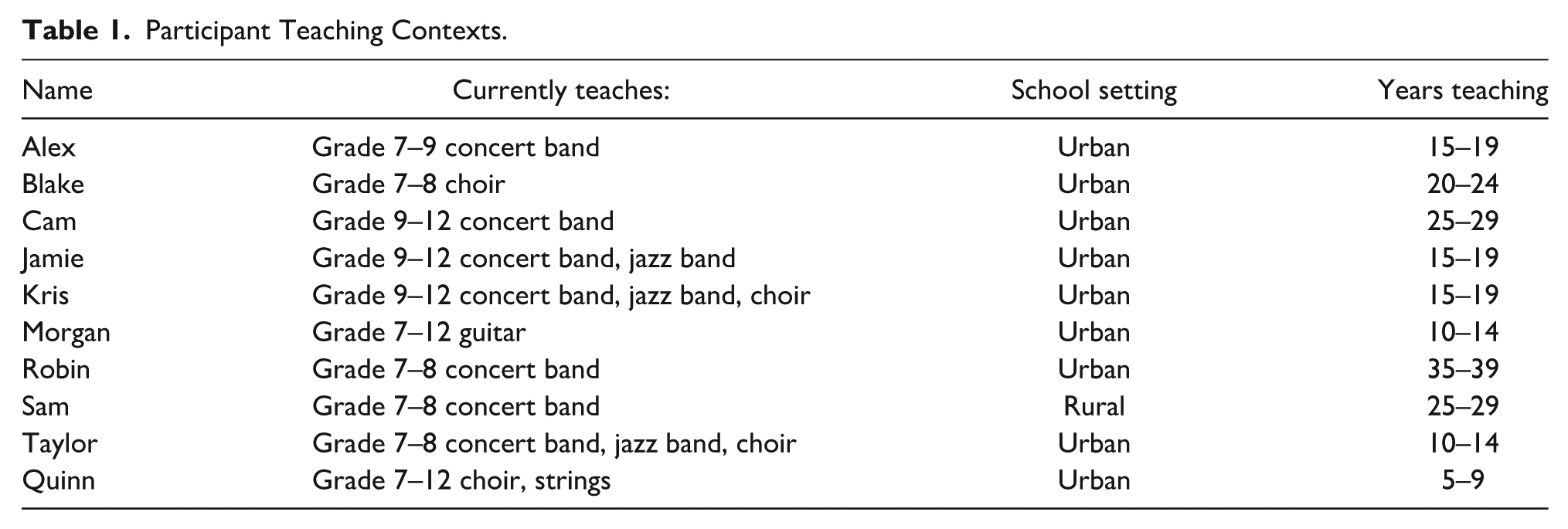
Interview questions pertained to how music educators conceptualize SJE; why they are interested in social justice; how they understand the importance of SJE in relation to their roles as music educators; how they understand the connection(s) between social justice and the Manitoba music curriculum framework; how comfortable they are enacting SJE; and what barriers or challenges they might experience when attempting to enact SJE. I did not define SJE during the interviews so as to afford participants space to construct their own understandings, conceptualizations, and perceptions. As shown in Table 1, although most participants teach in some type of band or choir setting, there was also representation from guitar and string teachers. Interviews were audio-recorded and manually transcribed. Gender-neutral pseudonyms were assigned to all research participants and singular they/them pronouns are used throughout this article to protect participant confidentiality.
Participant Teaching Contexts.
Data Analysis
I employed Braun and Clarke’s (2021, 2023) reflexive thematic analysis process to critically engage with the interview data. In general, thematic analysis is a method of identifying, analyzing, and reporting recurring themes within data. These identified themes “capture something important about the data in relation to the research question, and represents some level of patterned response or meaning within the data set” (Braun & Clarke, 2006, p. 82). What makes reflexive thematic analysis unique from other forms of thematic analysis is that it positions researcher subjectivity and their reflexive engagement with theory and data as an analytical resource rather than a limitation or threat to the credibility of the study.
My use of reflexive thematic analysis is underpinned by the philosophical assumption that there is no such thing as a single “Truth” nor is reality universal, objective, or fully knowable (Janzen & Heringer, 2023). I understand reality and truth as relative and multiple because reality cannot be distinguished from the subjective experience of it (Levers, 2013). All knowledge is thus subjective because it is constructed and filtered through unique lenses and ever-changing contexts (Rogers, 2012). Consequently, I reject the positivist ontological claim that there exists an objective reality that can be fully and accurately understood through my data analysis (Maul, 2018). Likewise, reflexive thematic analysis is “premised on the researcher always shaping their research; it will always be infused with their subjectivity, and they are never a neutral conduit, simply conveying a directly-accessed truth of participants’ experience” (Braun & Clarke, 2023, p. 4). Therefore, as Braun and Clarke (2021) argue, “the avoidance of ‘bias’ is illogical, incoherent and ultimately meaningless in a qualitative paradigm and in reflexive [thematic analysis], because meaning and knowledge are understood as situated and contextual, and research subjectivity is conceptualized as a resource for knowledge production” (pp. 334–335). My role as a reflexive researcher is not to pursue “objectivity” and eliminate “bias” but rather to account for and make transparent how my positionality and subjectivity invariably influence my data analysis (Braun & Clarke, 2023). Notably, because I was also a practicing Grade 7–12 music educator in Manitoba while conducting this study, I embrace how my subjectivity and “insider” experiences inevitably shape my analysis (Hillier & Milne, 2016). This intentionally subjective stance affords me the opportunity to critically examine music educators’ perceptions within the Manitoba music education context, recognizing that my analysis is inherently partial and provisional because of my positionality.
Practically, reflexive thematic analysis is a recursive six phase process wherein the six phases necessarily overlap and flow into and from one another (Braun & Clarke, 2021). For phase one, I familiarized myself with the interview data by manually transcribing the audio recordings verbatim and checking the transcripts back against the recordings to ensure accuracy. Phase two included manually generating initial codes based on the textual data. Assuming a broader focus, I generated initial themes based on the constructed codes in phase three. Phase four included reviewing and refining the themes followed by defining and naming the themes in phase five. Phase six included writing the final report. I employed the strategy of persistent observation throughout my reflexive analysis to “identify those characteristics and elements in the situation that are most relevant to the problem or issue being pursued and focusing on them in detail” (Lincoln & Guba, 1985, p. 304). Finally, in line with my multi-perspectival theoretical framework, my use of reflexive thematic analysis is inherently critical as it tends to the interconnectedness of colonial power relations, discourse, and the various systems and structures of oppression (Lawless & Chen, 2019).
Analysis and Findings
SJE is conceptualized in three main ways by participants: (a) diversifying repertoire, (b) ensuring instrument access, and (c) engaging in critical discussions with students about social justice issues and topics. Including diverse repertoire that represents all students is an important aspect of engaging in modes of music education that sustain students’ cultural practices and identities (McKoy & Lind, 2023). As Jamie shared, “If we aren’t working toward that equity then we’re just going to perpetuate 99% of everything we play being by a White male.” This student-centered and culturally relevant pedagogical practice empowers students through the inclusion of their lived experiences, prior knowledge, interests, and preferences (Hamilton, 2021). Instrument access is also an important component of what it means to construct an inclusive music learning environment because if students do not have access, they will be unable to fully participate in music learning experiences. As Robin clearly articulated, “[SJE] definitely comes up with the actual providing of musical instruments.” Finally, critical dialogue with students about social justice issues and topics affords students the opportunity to come to know the social conditions in which they live for the purpose of transforming those conditions (Freire, 1968/2000). Kris argued that “You can’t talk about the history or evolution of the blues or jazz or the recording industry in North America without talking about colonization and racism.”
However, despite participants conceptualizing SJE in these three meaningful ways, all participants’ responses demonstrate that their perceptions regarding the importance of SJE are governed by the dominant discourses of the Western classical ensemble paradigm. These discourses, including the primacy of skill development and the pursuit of performance excellence, marginalize participants’ willingness and ability to enact SJE.
Primacy of Skill Development
Skill development refers to the fostering of students’ technical skills and abilities with their instrument or singing voice and is a fundamental aspect of music education. Because of the normalized expectation that music educators are focused primarily on skill development, the importance of social justice is discursively constructed outside the bounds of what constitutes a “normal” music education experience. For example, Sam stated,
We’re so performance-based sometimes, especially when you have, in a few weeks we have a holiday concert so it’s just drilling the skills for that performance. And I’m finding in the year, like in the school year, sometimes there’s not a whole lot of time to touch on other things. . . . When we do have these performance dates, that kind of takes precedence. . . . It’s just kind of part of our job.
Sam made explicit not only the centrality of skill development within their music education program but also emphasized how “drilling the skills” takes precedence over “other things.” Although Sam acknowledged the potential for this paradigm to marginalize social justice, they normalize it when they state, “It’s just kind of part of our job.” When discussing how they perceive a “normal” class, Quinn shared,
When I think about your normal choir class, you’re just coming and you’re warming up and you’re rehearsing different, the difficult moments in your music and then working on the larger, the verse and the refrain, and we’re going to, we’re just piecing the piece together. Not necessarily talking too much about the themes.
Quinn conceptualized SJE as critical dialogue with students but acknowledged that these discussions do not necessarily happen in a typical rehearsal. Similarly, in a significant critique of community and institutional expectations, Jamie opined, “I think people would be very happy for me to just teach traditional band here. . . . In my first 15 years, I feel like I could’ve completely ignored social justice education and no one would notice.” Finally, keenly aware of the paradigmatic assumptions that guide their work, Kris asked, “There’s certainly room for [SJE], but from a current state of affairs, what does a regular music program look like and regular school around urban areas or rural areas in Manitoba?”
Although participants generally recognize how the primacy of skill development can marginalize SJE, some participants also tend to construct SJE outside of what they understand their roles to be. For example, Morgan stated,
[Social justice] kind of just became background white noise in the teaching experience then because for years you suddenly got put into a classroom. Okay, now I gotta teach. Now I gotta get these students [playing]. . . . That’s generally where my priorities land, is for the most part, is on that skill level.
In this case, “Okay, now I gotta teach” reduces “teaching music” solely to developing students’ technical music skills and abilities. Although social justice can and should be enacted through the practice of skill development, this understanding of music education potentially excludes social justice from what it means to “teach music.” Similarly, Jamie stated,
You know the challenges of teaching music and teaching foundation and technique and performance and literacy. . . . I think just giving ourselves permission to say once in a while, it’s okay if those kids, if our students, what we don’t work on is the wrong note and rhythm. Because we’re going to be doing that 90% of the time. We’re still going to be working on that. But once in a while, it’s okay for something else to be a priority.
During their interview, Jamie expressed a desire to engage more fully in critical dialogue with their students. However, like Morgan, they construct “teaching music” as focusing on technique via correcting wrong notes and rhythms, thereby constructing social justice beyond what it means to be a music educator. Even though Jamie agreed that decentering skill development would allow them to more fully engage in SJE, they still quantify skill development as “90%” of what they would do as if to justify not working on skill development 100% of the time.
Ensuring “High Standards”
The primacy of skill development also reveals the pervasive discourse of “high standards” that participants feel they must uphold. These “high standards” potentially reinforce the dominance of White male composers. For example, when discussing diversifying repertoire as a form of SJE, Blake shared,
I was going to try and get away from doing choral pieces that are arranged by the same five White guys from the mid-west. . . . [But] it’s something I’m actually really struggling with right now. . . . They do the best arranging for that age group.
Blake positioned the “five White guys from the mid-west” as the standard to which all other composers and arrangers are measured. But if non-White male composers are unable to compose or arrange choral pieces to the (colonial) standard that Blake deems acceptable, then diverse repertoire is excluded. In this way, Blake potentially reinscribes the dominance of White men at the expense of more inclusive repertoire that better represents their diverse students. Similarly, Morgan stated,
[Guitar repertoire was composed by] a bunch of White guys. Like there weren’t a lot, not a lot of women represented there, definitely not a lot of People of Color represented. . . . Now in their defense, they wrote some really great, memorable stuff. So that’s the music that got carried forward and so that’s the music that I’m now presenting. . . . I don’t always find it easy getting out of [the dominance of White male composers], because like I said, they wrote great stuff, they wrote some very memorable stuff, so what am I going to replace it with is where I’m coming up a little bit empty now.
Like Blake, Morgan positioned the repertoire of White men as the standard to which all other musics must be evaluated and measured. Centering colonial musical standards and values in this way demonstrates how research participants struggle to meaningfully engage in enacting SJE despite the stated importance of doing so.
Pursuit of Performance Excellence
Stemming from the primacy of skill development, the pressure to perform looms large for participants. For example, Sam shared that “it’s the expectation in the community that the teacher does put on the holiday concert and then the spring band concert and we do, we have a whole festival of the arts in the spring.” Taylor said, “in Canada, it’s very, basically here’s the room, here’s the keys, just put on a winter concert and maybe a spring concert.”
More specifically, participants discussed how they feel pressured to pursue excellence in their performances. For example, Alex stated, “There’s a lot of pressure on product instead of process. . . . You want to set them up for success for that performance, right? You feel like it has to be at a certain level.” Similarly, Quinn shared that their ensembles have a “ton of performance pressure, so even though we see them so often, I would say that my time does get hijacked by performances a little bit because we get trotted out to do a lot of different things.” Cam also discussed the difficulty of working toward performance excellence within the current Manitoba music education context:
It’s tough because you’re trying to be excellent and you’re trying to represent the best education these kids can have and teach them what process and product is, and how refinement towards a goal is important. And so in that process, we go to festival, right? And then festival has a list you have to pick pieces from. And you’ve got all these adjudicators that have this basically, all the same background that are going to evaluate and then how well you do definitely has an impact on recruitment, retention, budgeting, staffing, all those things, right? So it’s a dance.
As a result of these expectations of performance excellence, some participants uphold the director-led discourse naturalized within the performance paradigm. For example, Blake argued,
I don’t want to change the way choir functions, right? I still think choir needs to function with a director. . . . If you’re going to have choir the way that our school systems are expecting it to be, we can’t really change that part of the structure. . . . Choir is still a little bit of a dictatorship. It kind of has to be.
Notably, Blake discussed how they would like to decolonize their music teaching earlier in their interview. Yet despite recognizing that “school systems are expecting” choir to function in a particular way, Blake made explicit their preference for choir being a “dictatorship” because “it kind of has to be.”
Time Constraints
This pursuit of performance excellence is often manifest in time constraints as it concerns enacting SJE. For example, Jamie stated, “It is so easy to just be like ‘concert, concert, concert’ that you don’t have time. Yup. 100%. That is a huge thing.” Similarly, Morgan shared that “Conversations that even scratch the surface of social justice just don’t happen when you have a very limited amount of contact time.” Taylor opined, “That’s where people stop, honestly, is that time piece. . . . It’s like you run out of time [because] I need to put together this concert program.” Finally, Sam was direct in their assessment of the challenges to enacting SJE: “The barriers or challenges is time.” These excerpts reveal how participants feel constrained by time because of the expectation that they are constantly developing students’ technical skills and abilities to an acceptable performance standard.
It is crucial to note that several participants discussed enacting SJE in substantive ways during the COVID-19 pandemic, a time when Manitoba music programs were prohibited from playing wind instruments or singing indoors because of the potential for these activities to transmit the virus at increased rates. As a result, there were no concerts, and music educators were forced to enact alternative music education pedagogies and practices outside of the Western classical ensemble paradigm. For example, Sam shared that “When we weren’t performing [due to restrictions during the COVID-19 pandemic], that’s when we touched on different things that we’ve never maybe even thought of before.” Jamie stated, “The year I did the most of this stuff was two years ago [during the COVID-19 pandemic] when there were no concerts because we had so much more time.” After restrictions were lifted on playing wind instruments and singing, Jamie was explicit when asked if they continue to engage in justice-oriented music education practices with their students: “No, I would say I am not.”
Discussion and Implications
Because study participants are regulated by the expectation and normalized understanding that to be a music educator is to focus primarily on skill development and performance excellence, the importance of social justice education in relation to their roles as music educators is diminished and devalued. In other words, social justice is positioned as marginal to participants’ perceived primary roles and responsibilities as music educators within the Western classical ensemble paradigm. This is not to argue that the performance paradigm and its concomitant discourses have no value. It is an efficient method of music instruction that can foster teamwork, perseverance, belonging, and the ability to work toward a common goal. Moreover, because ensuring students have access to instruments—one of the three main ways that participants conceptualize SJE—aligns with the values of the performance paradigm, participants are largely able to enact this conceptualization of SJE within their music teaching contexts. However, participants are explicit that they are not able to enact other conceptualizations of SJE to the extent they deem meaningful because of the pressure and expectation that they are focused primarily on skill development for the purpose of excellence in performance.
This study has two broad implications for music educators and the pursuit of social justice in music education. The first includes the importance of critically reflecting on our values as music educators, especially as these values give shape to our daily teaching practices, pedagogies, and repertoire choices. The second is being more intentional about our time with students in pursuit of social justice.
Reflecting on Our Values
Just because the performance paradigm is the dominant mode of music education does not mean that it is not subject to challenge and change. Therefore, music educators must be willing to both recognize and challenge the myriad ways in which this paradigm shapes how they understand their roles and responsibilities. Music educators might begin by asking themselves the following questions as they critically reflect on their values:
What does a “normal” music education experience look like in my teaching context? Why is this the case? Whom does this mode of music education include or privilege? Whom does it exclude or oppress?
How do I understand the importance of social justice in relation to my role as a music educator? Would my students agree or disagree with my answer to that question?
Do I feel pressure from administrators, community members, colleagues, myself, or others to regularly put on “high-quality” performances? If so, how do these expectations influence my day-to-day teaching?
What is the purpose of music education? Do my daily teaching practices, strategies, and pedagogies help work toward that end? Or are they contrary to those goals?
By critically reflecting on these questions, music educators can come to know the ways in which taken-for-granted music pedagogies and practices potentially work against the pursuit of social justice. For example, challenging the performance paradigm might mean letting go of firmly entrenched notions about what constitutes performance excellence. This does not necessarily mean lowering expectations and standards, but it almost certainly means broadening how we understand our roles as music educators and shifting our priorities. This broadening and shifting might mean that in addition to fostering students as technically proficient musicians, an increased focus is placed on developing critical and creative citizens who share in our collective pursuit of social justice.
Concerning values and repertoire, the Western classical ensemble paradigm does not typically attend to musics outside the Western canon which consequently denies students the opportunity to engage with musics that represent and reflect their cultural identities (Sánchez-Gatt et al., 2025). Participants highlight the notion of diversifying repertoire as a meaningful enactment of SJE yet admittedly struggle to do so because of the expectation that they are upholding “high standards.” Therefore, the Western classical ensemble paradigm functions as imposition and domination—core traits of colonialism (Dei, 2006)—by privileging Western art music at the expense of students’ diverse musics. Critically reflective music educators must then be willing to recognize the ways in which their values and assumptions about repertoire are potentially rooted in colonial understandings of music.
Drawing on culturally relevant pedagogy, music educators can instead empower students by embracing repertoire and ways of learning music that are representative and reflective of students’ diverse cultural identities and backgrounds (McKoy & Lind, 2023). This requires a rich understanding of the students in the room and their cultures, lived experiences, and interests (Au et al., 2007; Gaztambide-Fernández & Rose, 2015). Based on participant responses, it also possibly requires more effort to curate diverse repertoire. But including music that more fully represents students—while being careful not to do so in extractivist, tokenistic, and additive ways (Stark, 2023)—challenges how music education in North America has traditionally silenced and erased particular musical-cultural identities (Good-Perkins, 2022). This practice affirms, celebrates, and sustains students’ diverse identities and backgrounds which is key in working toward social justice (Alim & Paris, 2017). Practically, music educators are encouraged to select music composed and arranged by individuals who embody a diverse range of positionalities, especially as it relates to race, gender, class, sexual orientation, ability, language, and other identity characteristics. In this way, students can both see and hear themselves represented in the music they learn which functions as an empowering experience (Hamilton, 2021). Moreover, rather than making assumptions about students’ cultural identities, inviting students to research and select music that represents themselves affords students power and agency, a necessary aspect of constructing a more justice-oriented music education environment (Hess, 2019).
Being Intentional with Our Time
Efficiency in instruction is integral to the performance paradigm. It is therefore likely that social justice will be marginalized when students are expected to perform at a high level in multiple concerts and festivals a year. As such, the pursuit of performance excellence consequently restricts how participants engage pedagogically with their students.
Music educators must not merely find time to engage in SJE but must make time. Although the COVID-19 pandemic was an incredibly challenging time for music educators, it offered the field a glimpse of an alternative music education paradigm (Salvador & Harry, 2025). Participants discussed how—freed from the constraints of the performance paradigm—they were afforded the opportunity to engage in critical and creative music pedagogies beyond the status quo during the pandemic; they were afforded the necessary time to engage in critical dialogue with students, to examine issues of (in)equity and (in)justice with students through music, and to develop caring relationships through shared musical experiences.
We prioritize what we value. If we value social justice in music education, we will make time for it. Music educators might ask themselves the following questions as they critically reflect on the notion of time:
What do I spend most of my time on during class? What is gained from this pedagogical emphasis? What is lost?
How would I structure my music classes if I was not allowed to do concerts?
How would my music teaching change if I had unlimited time with students?
How much time do I spend focusing on social justice with students?
Spending more time on explicitly justice-oriented music education pedagogies and practices necessarily means spending less time on “drilling the skills.” It also might mean reducing the number of performances in the school year. But it simultaneously opens up potentially transformative learning opportunities wherein students are encouraged to think and act critically about a range of social justice issues that inevitably impact them, their communities, and the world.
Participants identify critical dialogue with students about social justice issues as a meaningful way to engage in SJE. Developing this idea further in practice, music educators could make time for critical dialogue with students by analyzing, critiquing, and deconstructing song lyrics about (in)equity and (in)justice (Levy & Byrd, 2011). This could mean listening to, learning, and engaging with songs about racism, sexism, homophobia, transphobia, climate justice, colonialism, wealth inequality, and other important topics. Music educators could also critically engage students in classroom discussions about who is typically represented in the repertoire learned and performers studied. This helps students come to know whose voices and perspectives have been privileged in music and whose have been excluded (Ladson-Billings, 2015). This process could also include fostering students’ critical understandings of the historical, cultural, and social contexts of various songs, composers, genres, and music traditions. Music is not created in a vacuum, nor should it be studied in one.
Because music is also an emotional experience, critical discussions should focus not only on what students think, but also on how they feel (Wright, 2013). As Levy and Byrd (2011) contend, “listening to music is an emotional and educational experience that potentially shapes a person’s values, actions, and worldview” (p. 64). Music educators could make time during class to actively listen to various songs associated with social justice themes or topics and then reflect both individually and collectively on how those songs make students feel (Silverman, 2013). Although songs with lyrics may offer the most accessible way for students to connect emotionally, instrumental songs also offer students the opportunity to critically feel. As Wright (2013) states, “since music reflects thought and emotion, it is as empowering as it is powerful, and as such, music provides the tools of language whereby emotion can be expressed in non-verbal ways” (p. 35). Further, music educators might introduce students to several different arrangements, covers, or versions of the same song and invite student reflection on how the different musical interpretations make them feel and why. In addition, students could be encouraged to share justice-oriented songs that are emotionally meaningful to them with the class. This opens up space for students to share how music intersects with their lived experiences in unique and powerful ways and also allows students to come to know the injustices and inequities that potentially impact others in their community. Ultimately, engaging students’ emotions and feelings with music has the potential to develop empathy and compassion, two characteristics essential to the fostering of students as socially responsible citizens.
In addition, oftentimes absent from the performance paradigm and its focus on musical reproduction are opportunities for creativity. Music and activism have a long shared history and this should be encouraged in the classroom. Justice-oriented music educators should make time for students to compose and create songs specifically about social justice issues. Depending on the context, this could include individual, small group, or large group songwriting sessions wherein students identify and research a relevant social justice issue followed by composing, writing, arranging, sampling, remixing, or otherwise creating a musical reply to that issue (Elliott, 2007). Rooted in the lived experiences of students, this practice ensures that student agency and (musical) voice are central to the music learning experience. It also allows students to express themselves musically and speak truth to power regarding issues of inequity and injustice.
Finally, recognizing that the performance paradigm does not necessarily have to be at odds with SJE, music educators are encouraged to engage in performances that work toward social justice by “help[ing] audiences hear and feel the sounds of pervasive oppression” (Elliott, 2007, p. 87). For example, music educators could begin by incorporating explicitly justice-oriented repertoire within concert programs. The inclusion of these songs can be accompanied by introductory comments or program liner notes to provide both information and context. Taking this a step further, music educators might design an entire concert program around a single social justice issue that is relevant to the community, ensuring that students and community members are actively involved in the design and implementation. In this way, not only are students afforded the opportunity to engage both cognitively and affectively with social justice through music, but audiences are also invited into this dynamic process.
Beyond traditional school concert settings, music educators might accompany their ensembles to perform at rallies and protests such as Pride parades, climate justice rallies, and racial justice marches. Performing and participating in these types of events potentially develops students’ individual and collective activist identities as they learn to contest the status quo as well as how and what it means to act in solidarity with others (Curnow et al., 2019). School hallways, coffeehouses, street corners, and other more intimate venues and spaces offer students yet another empowering opportunity to perform justice-oriented music. Notably, performing in these various ways allows music educators to combine both SJE and the development of students’ students’ technical music skills and abilities. As Elliott (2007) argues, “becoming a musician for social justice requires all the understandings that make up musicianship, but it also requires that we harness and encourage students’ dispositions for musical-social activism” (p. 87).
Ultimately, raising students’ critical consciousness about the political, social, cultural, and economic conditions of their lives, as well as allowing them to respond with and through music, is foundational to the work of social justice (Spruce, 2017). As Hess (2017) argues, “In employing a social justice pedagogy for music education, we can help [students] challenge, critique, and shape both their world and their music in ways that help them express their ideas and tell their stories” (p. 73). This inevitably requires being intentional, explicit, and making time for social justice in music education.
Conclusion
This article is significant in coming to know how the dominance of the Western classical ensemble paradigm potentially limits music educators’ willingness and ability to pursue social justice. Put differently, the naturalized expectation that music educators focus primarily on skill development and performance excellence marginalizes the importance of social justice in relation to their roles as music educators.
A key characteristic of my bricolage approach to methodology is to conduct “research in such a way as to challenge the audience to see the phenomenon under study in new and unexpected ways” (White & Cooper, 2022, p. 446). Thus, it is my hope that the findings of this study can help illuminate the ways in which the taken-for-granted nature of the performance paradigm potentially constructs social justice outside the bounds of what is “normal” in music education. If music educators are to engage in music education for social justice, they must “transgress” against the dominance of the Western classical ensemble paradigm (hooks, 1994). This transgression will require immense courage because it necessarily means confronting and challenging both the implicit and explicit colonial expectations placed upon music educators. Only then will we be able to enact curricular and pedagogical possibilities necessary for working toward a more inclusive, equitable, and just future both in and through music education.
Footnotes
Acknowledgements
Thank you to the members of my thesis committee, including Beryl Peters, Shannon Moore, and Joe Curnow, for their mentorship and guidance throughout this research project.
Author Note
Justin D. Fraser is now at The University of British Columbia, Vancouver, Canada. This article is based in part on his master’s thesis, “Musicking for Social Change: Music Educators’ Perceptions of Social Justice Education,” completed at the University of Manitoba in 2024.
Declaration of Conflicting Interests
The author declared no potential conflicts of interest with respect to the research, authorship, and/or publication of this article.
Funding
The author received no financial support for the research, authorship, and/or publication of this article.
Ethical Considerations
This research has been approved by the Research Ethics Board at the University of Manitoba, Fort Garry campus (Protocol # HE2023-0198).
