



Abstract
The purpose of this qualitative case study was to explore the experiences of one music teacher (the researcher) and two intact classrooms of 3- to 6-year-old children who engaged in world music lessons as a pathway to developing empathy. Participants in each of the two classes engaged in a 30-minute world music lesson once per week for 8 weeks, and each lesson included a different musical culture. Data sources for this study included semi-structured interviews with early childhood center directors and teachers. Further data included transcripts and video recordings of class sessions, researcher field notes, childcare center curriculum documents, and planning documents. Findings indicated that this world music-based approach was successful in generating curiosity about the world, making empathetic connections with others, navigating new and different sounds and experiences with respect, and inviting children into the role of expressing empathy.
As our teaching contexts become more diverse and globally oriented, it is critical to develop a robust sense of empathy throughout all ages and stages of life. Our global engagements with music offer a point of departure for connection, empathy-building, and deeper understandings of self and others (Campbell, 2004). Despite varying meanings and manifestations, music is a common human endeavor that spans time, geography, and culture. World music encounters may present a concrete way to bring these multifaceted musical cultures into the consciousness of children and youth, starting from their youngest days in early learning centers (Watts, 2018). As populations in early childhood learning centers continue to represent a wide diversity of cultural traditions and origins, it is essential to implement curriculum and support systems that celebrate this diversity and to explore basic concepts of empathy and connecting to others (Donnelly, 2018).
Empathy is a concept that is receiving attention in a variety of contexts in education, music education, and in other caring professions such as nursing. Music education practitioners have been thinking more about the social and emotional well-being of children and youth as well as issues of empathy, compassion, care, and humanity (Edgar, 2017; Hendricks, 2018; Laird, 2015; Watts et al., 2020; Yob & Jorgensen, 2020). As we continue to navigate changes in the world and resultant shifts in human experience, it becomes more compelling to deeply explore issues of empathy and how we might overtly develop empathy skills at all ages and stages. The global focus of world music pedagogy may be a meaningful point of departure for discovering and developing empathetic skill sets.
Review of Literature
Although there are various meanings and layers to this term, “the essence of empathy is the ability to stand in another’s shoes, to feel what it’s like there and to care about making it better if it hurts” (Szalavitz & Perry, 2010, p. 12). Hendricks (2018) highlighted the importance of perspective-taking, envisioning what it might be like to view the world through another’s lens. Levine (2005) asserted that demonstrating empathy requires the development of skills and strategies, not just feelings or emotions. Levine continued,
. . . one of the most empathic questions to ask a group of students is, “Can you imagine what that person(s) must have been feeling?” This is asked not as an accusation but rather as a discovery tool for understanding. (p. 36)
Levine’s thoughts regarding empathy as a skill set are well-taken as we consider how to help young children develop these skills through our work in the field of music education. Skills require practice to improve, a known fact that can extend beyond scales and etudes in the practice room. Care scholar Nel Noddings (2005) addressed the concept of practice in her framework for moral education, stating, “If we want people to approach moral life prepared to care, we need to provide opportunities for them to gain skills in caregiving” (p. 24). Szalavitz and Perry (2010) further noted that while we are hardwired with the impulse to be empathetic, we still need to hone these empathy skills across the lifespan.
Many early childhood learning centers intentionally build curriculum around the issue of empathy and other social/emotional learning objectives through family visits, stories, art projects, and games. How then might we take the next step and integrate the learning of empathy skills in the early childhood years? World music encounters in the early childhood setting may be a key component of building empathy in young children as they wrestle with egocentricity and begin to understand the experiences and viewpoints of other people. Watts (2018) noted that the early childhood years are a crucial time of learning social skills and aspects of self-regulation:
Exposing young children to the world’s musical cultures brings them into the cultural conversation, allowing them to learn about self and others in an artistically meaningful and engaging way. Prior to the development of social biases and cultural preferences that all too easily devolve into prejudices, the opportunity to know people through song, dance, and instrument play is a gift to all who work for the well-balanced development of young children into the responsible citizens they will one day become. (p. 2)
Teachers may approach the exploration of global music cultures in various capacities ranging from a more general approach to implementation of the World Music Pedagogy (WMP) framework developed by Patricia Shehan Campbell. This framework allows teachers and students to use thoroughly researched musical encounters featuring different levels of listening engagement (Attentive Listening, Engaged Listening, and Enactive Listening) as well as strategies for integrating world music into multiple topic areas and creating new music (Campbell, 2004, 2016; Watts, 2018). According to Campbell (2004), “the teaching and learning of the world’s musics can happen in courses and curricular programs from preschool through post-graduate studies. Even the youngest learners can sing, play, move, create, and listen in focused ways” (p. 13), suggesting that world music learning in early childhood is a worthwhile pursuit. Young (2018) highlighted the importance of incorporating global music into early learning encounters to minimize Western-centric repertoire and approaches and diversify the aural soundscapes of young children. As there is little in the way of extant research overtly connecting early childhood world music experiences with empathy-building, the current study seeks to contribute to this gap in the literature. Campbell (2016) echoed,
. . . there is in fact scant research on the multifaceted nature and outcomes of teaching world music despite decades of activity in developing greater diversity in music programs suggests that WMP-associated activity can be examined and adjusted to suit the needs of teachers and students. (p. 106)
Purpose and Research Questions
The purpose of this qualitative case study was to explore the experiences of one music teacher (the researcher) and two intact classrooms of 3- to 6-year-old children who engaged in world music lessons as a point of departure in developing empathy. The following guiding questions provided direction to the current study:
Method
Site and Context
This study took place in two classrooms situated in university-affiliated early learning centers at a large university in the Eastern United States. 1 The first classroom housed a group of 15 preschool children, aged 3 through 5. The preschool group featured a lead teacher and two assistant teachers who participated in all music activities along with the children. The second classroom was a Kindergarten group composed of 19 children aged 4 to 6. The Kindergarteners were under the supervision of two co-lead teachers who primarily observed the music activities from the periphery of the classroom. Three center directors were also involved at the inception of the project but did not regularly attend the music class sessions. All teachers and directors were interviewed prior to the beginning of the study. Their input helped to shape the empathy-building themes and musical activities featured in the classes.
I learned early on that the preschool and Kindergarten children in these university early learning centers were being set up for success in terms of appreciation of global diversity and empathy development simply by being enrolled in these settings. Director 1 emphasized the “importance of relationships. We definitely consider ourselves an extension of the family. . .” Both centers featured a wide diversity of families from all over the globe, as one might expect at a large research university. Director 2 noted that “we want to be welcoming to all families, all children [and bring in] as much about that family, their culture, and their values into the classroom itself.” Director 1 explained that the centers are continually attempting to make children and families feel welcomed and included:
When a child and family walk through our doors, can they see themselves here? Is there a piece of them here? It could be a family photo album; it could be the child’s image on their cubby on the first day that they’re here . . . those are just small ways to do that.
Music has been integral in the exploration of world cultures, especially those represented in these early learning centers. Director 1 remarked that “we’ve had families that have brought in books, brought in music in their home languages. They’ve showed us different dances. They’ve brought in fabrics that they may use as part of their dress when they’re utilizing those musical skills.” The directors further emphasized “our antibias curriculum and social emotional development are. . . foundational pieces of everything that we do.”
The current study employed a case study approach, or “an in-depth description and analysis of a bounded system” (Merriam & Tisdell, 2016, p. 37). More specifically, an instrumental case study design was implemented, and I attempted to understand the phenomenon of empathy-building without being attached to a particular classroom or teacher or set of children (Stake, 1995). Various data collection approaches appropriate for case study research were implemented including participant-observation, observation, interviews, reflective field notes, and examination of documents and material culture (Barrett, 2014; Yin, 2018).
Participant-observation was key in the current case study as I was the facilitator of the music sessions for the children. Yin (2018) explained that participant-observation may involve taking on multiple roles within the research process, not only observing from afar but also directly engaging in the phenomenon under study and that in some cases, participant-observation may be the single pathway to examining a particular topic. As there were no early childhood world music/empathy-building focused lessons occurring within my community, I needed to create and facilitate them myself, leading to the necessity of my participant-observation.
Participant-observation may possess some inherent problems, however. The task of facilitating the lessons may have skewed the balance of my engagement more toward “participant” than “observer.” To remedy the potential pitfalls of this situation, I kept reflective notes following each lesson. Additionally, each lesson was audio and video recorded, allowing me to conduct an observation of each lesson from a distance. Although there was a bit of flexibility in the methods to accommodate my facilitation of the music lessons, it was not outside the realm of possibility in the case study. Schwand and Gates (2018) noted case studies are not uncomplicated endeavors, and a measure of flexibility in designing and implementing these studies is acceptable.
Procedures
After receiving Institutional Review Board approval for this study, I sought written informed consent from a parent or guardian of each child. The informed consent process occurred in person at the center sites so that I could be available to field any questions or concerns regarding the study procedures. Parents and guardians were informed that their child’s participation was voluntary. All children in both the preschool and the Kindergarten classes elected to participate in the music classes. As I have been a regular presence in these early learning centers for several years, participation in my music classes was not a departure from ordinary class operations.
Semi-structured interviews were conducted with the three early childhood center directors as well as the three preschool teachers and one of the Kindergarten teachers prior to the beginning of the classes. The three preschool teachers were interviewed as a group and two of the directors were interviewed as a pair. I was able to conduct a follow-up interview with the Kindergarten teacher after the lessons. A total of 90 minutes of interviews were recorded which did not include additional informal exchanges throughout the time of the study. These interviews featured questions related to center philosophies regarding empathy, engagements with world cultures in center classrooms, empathy-building activities already occurring in classrooms, and impacts of the world music lessons. All interviews were transcribed for analysis purposes. Although the primary data source for the study was the time spent in music class, the director and teacher interviews helped to shape and customize some of the music class content and empathy-building activities. These interviews were essential in better understanding the contexts for the study, how and why the centers operate the way they do, and how to best implement study procedures within these settings (Yin, 2018). For example, the Kindergarten teacher noted that “[the children] are dying to get into instruments, so that might be something to know.” That piece of information guided my inclusion of various instruments for the children’s exploration throughout the lessons.
Participants in each of the two early childhood classes engaged in a 30-minute world music lesson once per week for 8 weeks, facilitated by me. I visited each classroom to carry out each music lesson. Sixteen lessons occurred overall, for a total of 480 minutes of instructional time. This time did not include informal greetings and exchanges before and after class. I observed each lesson by viewing a video recording and reviewing a written transcript of each class. Each lesson featured activities focused on a different musical culture, including traditional Hawaiian music, folk traditions of the Andes mountains, East African drumming, Israeli folk songs, Chinese folk songs, South African choral music, Trinidadian steel pan, and Western orchestral music. All lessons followed a basic format of a greeting song, a warm-up activity, locating the area of study on a large felt map, viewing photographs of people and places from the areas under study, selected musical activities, empathy-building discussions, and a goodbye song. See Figure 1 for an overview of each lesson’s culture focus, empathy-building area, and sample discussion questions.
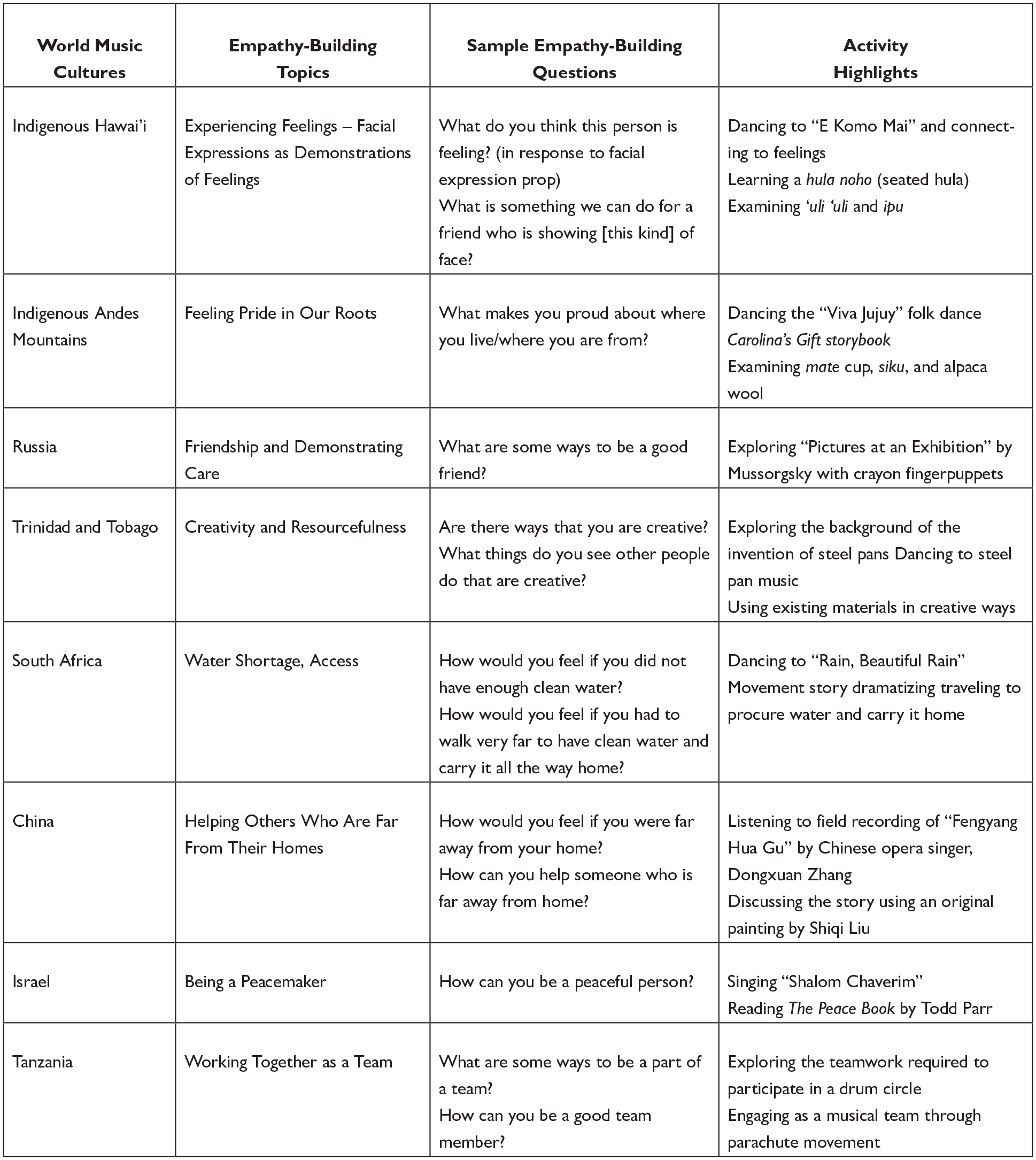
World Music Lesson Culture and Empathy-Building Topics.
I thoroughly researched each culture presented, even having completed fieldwork within some of the cultures featured. Children and teachers engaged with these musical cultures through songs, folk dances, stories, playing instruments, listening, examining cultural artifacts, and child-friendly discussion. Each musical culture served as a point of departure for exploring age-appropriate empathy-related issues, such as feelings, friendship, kindness, peacemaking, dealing with scarcity of basic life necessities, and understanding the needs of others. Active musical experiences would then pivot into thinking and sharing through child-friendly questions and discussion points. Empathy-related topics were drawn from relevant literature, center curriculum documents, and consultation with the teachers and directors. Watts (2018) noted,
Through exposure to many different sounds and contexts accompanied by careful questioning to help little ones put themselves into the “shoes” of others, understanding lifeways, values, traditions, and customs of others across the globe, [can lead] to the development of dispositions of acceptance, tolerance, respect, friendship, and love. (p. 143)
As these engagements occurred on-site in the center classrooms, I was somewhat limited in terms of audio-visual resources that could be incorporated into each lesson. Therefore, audio recordings and print images were key to bringing the children closer to each musical culture. Within the context of the World Music Pedagogy framework, the activities presented to the children fell within the realms of Attentive Listening, Engaged Listening, and Integrating (Campbell, 2004, 2016; Watts, 2018). Attentive Listening offers directed listening encounters focusing on facets of the music, whereas Engaged Listening facilitates some type of participation which might include singing or moving. Integrating invites children to connect the music, its meanings, and the people who make it in intersectional and interdisciplinary ways. The children also received a map coloring page at the end of each lesson, featuring a QR code to facilitate home listening to the musical cultures we explored.
Although the lessons for the preschool students and Kindergartners followed the same basic outline, I made adjustments along the way to better suit each age group and their developmental needs. As I became better acquainted with each group, I learned that I could spend more time on empathy-building discussions with the Kindergarten students than I could with the preschool children. The discussions still took place with the preschoolers, but in a way that was succinct and age-appropriate for 3- to 5-year-old children. Despite variations in developmental characteristics, both classes had many students who participated in all activities and some who engaged through observation, both of which were completely acceptable in this context.
I sensed a readiness for these lessons when the Kindergarten teacher remarked, “we live global diversity here.” Her words indicated to me that the children were learning in an environment that was congruent with what I hoped to accomplish throughout our world music lessons—appreciation of the wider world and how people live and make music and how we can use music as a point of departure to understand the experiences of others. Once the children understood the routine of what would be occurring during my visits, they would chime in with “where are we going?” as soon as I stepped into their classrooms. They frequently guessed where in the world we would be studying that day, offering suggestions that were close to their own experiences, both real and imaginary, such as Pittsburgh, California, and even “why can’t we go to the North Pole?”
Analysis
To facilitate data analysis, all interviews and class sessions were transcribed. Data were analyzed through open and focused coding, seeking patterns and emergent themes and determining the social and musical outcomes of these encounters with world music (Emerson et al., 2011; Merriam & Tisdell, 2016). Emergent themes were connected back to the original research questions (Merriam & Tisdell, 2016). Relevant document analysis included examination of childcare center handbooks and documents, anti-bias curriculum documents implemented by the centers, and planning documents.
The lesson transcripts and videos were both analyzed individually and compared with one another. As I rewatched the videos and read through lesson transcripts, I was aiming to uncover the ways in which children were participating in the musical activities, their follow-up responses to empathy-building prompts, and implications for future teaching endeavors. Similarly, interview transcripts were considered both individually and within the context of the other interviews, exploring the ways in which the adults involved in these settings were contributing to empathy-building and the readiness of the children to do so.
Various strategies were implemented to ensure the trustworthiness of the findings (Creswell & Poth, 2018). I communicated and collaborated with directors and teachers to design an appropriate series of lessons. All relevant lesson and interview transcripts, as well as researcher field notes and reflections, were considered as a whole to achieve triangulation of findings. Additionally, I was teaching within settings where I have been present and involved for several academic years. I also examined my own positionality and biases related to the study topic and procedures.
Findings
Throughout the open and focused coding process, the following overarching themes emerged: building empathetic connections, navigating new connections, and children as facilitators of empathy. Synthesis of lesson videos and transcripts, interview transcripts, and researcher reflections contributed to the uncovering of these emergent themes. Children had the opportunity to find commonalities between themselves and children from other cultures around the world, learned how to use respectful language when discussing the music and culture of others, and joyfully engaged with songs, games, and dances from around the world. The following presentation of findings is accompanied by examples and illustrations from the encounters with the children.
Building Empathetic Connections
In connecting to the research questions, there is much for teachers to glean from children’s engagement in this series of world music and empathy-building lessons and the ways in which world music may offer an accessible pathway to developing empathy. One such outcome is related to the ways in which children were making connections with others around the world, seeing themselves in the experiences and emotions of the concrete, visible others in the classroom as well as the experiences of abstract others across the globe. Finding commonalities with others, navigating relationships, seeing wider global impacts of behaviors, and interpreting body language as an empathetic tool all came to the forefront in this overarching theme.
Commonalities
Throughout the series of world music lessons, many moments of empathetic connections emerged. Part of each lesson included viewing color photographs of various aspects of the day’s culture focus, including photographs of children their own ages from these cultures. Seeing the children in the photos sparked many questions and ideas about their ages, their names, and their relationships with the other children, likely reflective of their own blossoming awareness of their own identities and family units.
They were also apt to find commonalities with the children in the photos. We viewed a photo of children living in a traditional Andean village in which they were wearing bright, colorful woven hats. One 3-year-old joyfully exclaimed, “I have a hat!” She was jubilant to find something in common with the children in a faraway place, something as simple as wearing a hat. It was enlightening to see that her first reaction was one of “what do we have in common?” In addition, this child’s response made sense in terms of empathetic skills being developed regularly in the classroom. The lead preschool teacher noted that “Circle Time for us is really about getting children to come together and self-regulate and to understand their role as part of a group.” She further noted that
We talk a lot about friendship skills and feelings, being helpful. . .we are also working on the color brown, so we’re trying to integrate a conversation about skin tones and how skin tones are really the colors of the earth, that kind of thing. We try to incorporate different topics related to people around the world in all of the curriculum threads, so even if it’s something like houses and building, we try to show children that there isn’t just one way of doing that.
She further explained that “we have a child in our classroom whose ancestors are from Peru,” which may have added to the excitement and connection during this activity.
“That’s Your Dad”
It was interesting to observe the children trying to contextualize me as their teacher and fellow human. At one point in the lessons, I displayed a photo of myself (American teacher of European descent) and an Inner Mongolian Culture Bearer dressed in traditional blue and gold vestments. A preschooler pointed to the photo and explained, “that’s you and that’s your dad.” It made perfect sense to this child that this Inner Mongolian man could be my father, despite our differences in ethnicity and cultural origins—the child was correct that he was of an appropriate age to be my father. This gave me pause to think about the caring and connected ways that children are already seeing the world. They were learning that families come in all different kinds of manifestations, a lesson they applied to their viewing of this photo. The lead preschool teacher shared that “we’re just kind of at the point where we’re introducing the idea of skin tones and recognizing and appreciating the differences in others and getting comfortable talking about that,” which may have played a role in this discussion with the children.
This issue arose again during our visit to Russia. We explored some aspects of “Pictures at an Exhibition” by Modest Mussorgsky as well as the gesture of friendship contained within its origins, having been composed for Mussorgsky’s friend, Viktor Hartmann. Upon viewing a painting of Mussorgsky, another child questioned, “Is that your dad?” In their daily lives in these early learning centers, children are dropped off and picked up by parents and caregivers, and so these little ones come to visualize their friends as part of family units—I suppose they wanted to do the same for me.
Venus Flytraps
In our visit to South Africa, we highlighted this region as one place in the world that has struggled with a shortage of water. The Kindergarten children, in particular, have encountered this issue in their curriculum as an empathy-building point. Director 3 remarked that the children are starting to think about:
How does it apply to me? How does it apply to my small community? Who has access to it and why or why not? Can we all turn our faucet on, have access to potable water? I do. You probably do. But doesn’t everybody in the world? [We are] trying to thread some of these global views into the curriculum.
The Kindergarten teacher additionally shared that
We’ve talked about water because we had somebody who just kept leaving the water on when they were brushing their teeth. We went into that conversation of, think about the person who can’t do that, who has to walk somewhere to gather water that might not be clean . . .
We explored the connection of rain and water access through movement to Ladysmith Black Mambazo’s “Rain, Beautiful, Rain.” The following conversation ensued in the Kindergarten class as I posited various questions to the children.
Why is rain important?
‘Cause it makes water, ‘cause it makes pools and lakes
If you don’t have water, you might get unhydrated [sic]
It helps flowers grow
If there is no water then the fish can’t be alive, and they’ll die
Another child had an interesting perspective on the issue of lack of water:
[Lack of water] can make Venus flytraps die and Venus flytraps are good. They eat flies and flies drink our blood. They eat flies and flies are bad to us.
In his own unique way, he made empathetic connections, feeling for the experiences of the Venus flytraps, and by extension, the experiences of the people they help.
Feelings and Faces
One of our world music lessons focused on music of Hawai’i and began with the vibrant and upbeat tune “E Komo Mai” by Willie K. Children were invited to move and dance freely, bouncing and giggling. At the conclusion of the song, we talked about the Hawaiian language term, e komo mai, and how it translates to “welcome.” This term began our conversation about feelings—what does it feel like to feel welcome? Our conversation was further extended by viewing a series of emotion faces, drawn with markers on round felt board props, representing happiness, sadness, anger, worry, and others. An excerpt of the Kindergarten conversation then unfolded:
When we were dancing, what kind of face did you make?
Happy!
Did you make a face that looks like this face? (shows smiling face prop)
Yeah!
Maybe we’ve made this face before and maybe you’ve seen other friends who have made this face before, too (shows sad face prop). What kind of feelings are they having if they are showing this kind of face?
Sad
What were some of the clues?
‘Cause water’s coming out of his eyes
I have an important question for you. If you see a friend making a sad face, what’s the next thing you could do for that friend?
Give a hug
You can say “it’s ok”
I’m sorry
If you have a friend who has a scared face, what is a thing you can do to help that friend?
You could say “it’s ok, maybe when you think it’s a monster and you say it’s just not a monster”
One of the preschoolers offered a different perspective:
Music friends, I have an important question for you. When you were dancing, what feelings did you have?
I had a mean face.
Why did you have a mean face, do you think?
Because I fell down.
Children in both groups were making associations among their own feelings, interpreting the facial expressions of others, how they might empathize with those various emotions, and actions they can take to show compassion and connection. The lead preschool teacher noted that she encourages the children to be proactive in demonstrating compassion. She shared that
I try to get them to ask the other person, “what can I do to help you feel better?” Because I think that’s at least an action step. We talk about making sure you stop and check on the other person so that they know you care about them.
Navigating New Connections
Various pathways to developing age-appropriate empathy emerged as children were invited to step away from their familiar worlds into something new. Part of the mission of developing these world music and empathy-building lessons was to help young children navigate what is new to them—faces, spaces, sounds, customs, beliefs, etc. There was much to be gleaned by teachers in this regard in terms of investigating the biases children bring with them to a world music pedagogy experience, and how those biases might color their perceptions of various places in the world. The illumination of some of these biases gave rise to empathy-building pathways within the lessons.
“Russia Is Bad”
As was to be expected, some of the children experienced some surprises and challenges when offered opportunities to engage with something new. However, these moments were ripe with possibilities for facilitating child-friendly discussion about being an empathetic person. Upon learning we would be exploring music of Russia, 2 one preschooler remarked, “Russia is bad.” I followed up with her, asking why she made that observation. She replied, “I don’t know.” This was a short but compelling example of the many ways in which young children may be picking up on the biases of those with whom they interact and the media they consume. There were varying reactions to different places in the world as in the case of a Kindergarten child who exclaimed, “I’ve never been there, but I love Russia!” Her teacher explained “my only thought about that is that they were in Alaska and knowing there’s that closeness, I’m sure there was a conversation.”
“That’s Weird”
One of the lessons took us to the Andes Mountains region of Peru. Both classes engaged with a story book entitled Carolina’s Gift by Katacha Díaz which portrays the home and community life of a young girl in Pisac, Peru. During the reading/singing of the book in the Kindergarten group, the children were invited to look at the main character’s traditional Andean home and share their observations. One child remarked how “the whole thing is different!” Others were curious about Carolina’s pet guinea pigs as they had not seen this animal before. One inquired, “where does she sleep?” as Carolina’s sleeping quarters were not pictured. They were curious and thoughtful about a different kind of home to which they were accustomed in the eastern United States.
The conversation took an interesting turn when a Kindergartner shouted, “That’s weird!” when viewing the building materials and layout that was different from his own home. Before I could respond, the fellow Kindergartners leapt into empathetic action, telling their friend that his words could hurt Carolina’s feelings. This outburst opened up an opportunity to discuss how we can be respectful to others with our words and prompted other children to offer suggestions for more respectful language, understanding that just because something is new or different does not mean it is weird. The Kindergarten teacher noted that this child who made this exclamation is an only child and that “being egocentric is just how their world is right now. It’s just them and mom and dad at home. [Only children are] typically the ones that we feel have the hardest time [demonstrating empathy.]” She further noted that their center employs anti-bias curriculum materials to aid children in coming to these discussions with an openness to diversity.
“Fengyang Hua Gu”
Our musical journeys also took us to China. The children interacted with a recording of a traditional Chinese folk song from the Anhui Province entitled, “Fengyang Hua Gu.” The recording featured Chinese opera singer and teacher, Dongxuan Zhang, in a performance from 2019 (Zhang & Watts, 2021). There were two very different responses in each of the two classes. While engaging with “Fengyang Hua Gu,” we discussed the story of the little girl in the song, singing on the sidewalk for money to pay for a return trip home to her family and how we can help people who are far from their homes. After having discussed feelings and facial expressions, we gave some thought to how the song might sound happy, but the story behind it is actually sad. The Kindergarten was populated by many children who had either immigrated from China themselves or who had parents who were born in China and had heard “Fengyang Hua Gu” in their homes. Their faces brightened as they told the other children in the class that this was a Chinese song they knew. It was a moment where they could shine and share their insider knowledge with others. The leaders of these children helped the whole group to engage with the story. One child responded that if she was far from home, “I would probably cry.” Another child wanted to clarify whether this story was real or imaginary, perhaps to mitigate his sensitivity to the feelings the story invoked.
The preschool class heard this song, sung in Mandarin, and promptly burst into giggles. Laughing at something new and different is not an entirely unexpected human response, especially for young children. This reaction provided an opportunity to build empathy by discussing respectful ways to listen to music from other places and that laughing at someone else’s music might hurt their feelings. We were able to recall the Culture Bearer featured on the recording and wonder whether his feelings would be hurt if we laughed at his song, connecting with an actual human rather than an amorphous conglomeration of nameless people. The lead preschool teacher remarked that “a lot of the group that we have now seem to be very egocentric and they have a hard time understanding that another person might have needs and wants that are different from their own,” indicating that these children were at a developmental stage where it might be difficult to take on the perspective of another person.
Children as Facilitators of Empathy
In our best efforts as teachers to reach our students, to share and connect, the children often teach us just as much as we hope to teach them. At various points throughout the study, the children taught me about being a more empathetic teacher and human. Unplanned opportunities for children to facilitate empathetic encounters arose naturally throughout the series of music classes, reminding me of the openness inherent in this responsive way of teaching. This suggests that sometimes the pathways to developing empathy do not need to be facilitated by the teacher—children can synthesize their own experiences to come forward as empathetic humans.
In each lesson we engaged with languages featured in the various cultures under study. As we were practicing our Mandarin greeting of ni hao (hello), a Kindergarten girl informed me that “I can say ni hao better than you because I’m Chinese and you’re not.” And she was correct! She was noticing our cultural differences and reminded me that she was a cultural insider and had the knowledge to share. Although I do try to approach all of my world music teaching encounters with research, humility, and responsiveness, this child reminded me to continually find ways to acknowledge and celebrate what the children are bringing to the table.
In a lesson about the Andes Mountain region, the preschoolers and I were petting a lifelike alpaca puppet to connect with the aforementioned storybook, Carolina’s Gift. I asked the children to put their hand out to show that they would like a turn to pet the alpaca, knowing that not all children enjoy puppets or may feel overwhelmed in a sensory capacity. I passed by a preschooler who did not have her hand out. She immediately started crying and I backtracked with the alpaca friend. She gave me pause to think about the ways in which my directions might not work for every child and to take a moment to check when sharing something interesting for individual engagement.
In a class session conducted while I was recovering from an illness, the children stepped up to collaborate with me and treat me with the same empathy they were beginning to show their peers. At the outset of class, I asked the Kindergarten children if they could help me with my singing voice, which they kindly obliged by putting forth extra effort in their participation. I did my best in the moment, but upon viewing the video for analysis purposes, noticed my shortcomings in this class. I did not feel well enough to stay present with the children. They were asking questions and expressing their curiosities and I did not follow up on the rich teaching opportunities they were presenting. I learned a lesson in bringing not just a well-researched plan, but a prepared mind and body to the table in my teaching encounters.
Discussion
The purpose of this qualitative case study was to explore the experiences of one music teacher (the researcher) and two intact classrooms of 3- to 6-year-old children who engaged in world music lessons as a point of departure in developing empathy. I wanted to explore what teachers can learn from this way of approaching world music and empathy-building lessons as well as the ways in which world music may uniquely cultivate these empathy-focused teaching moments. Findings suggest that this world music-based approach presented various pathways to explore empathy-building with these two classes of 3- to 6-year-old children. They demonstrated curiosity about the cultures we explored and a general excitement to both learn new things and connect to what they already knew, better understanding the emotional and musical links among humans. In support of facilitating these musical connections, Campbell (2016) wrote that
In the practice of music education at every level, the onus is evident for those who teach that they must configure learning in equitable ways that create an awareness of music as a cross-cultural universal and a pan-human practice. Students deserve to know music with a capital “M”—Music—as it sounds and functions in varied communities. (p. 109)
Children found commonalities between themselves and children from cultures different from their own around the world, explored the use of respectful language when discussing world cultures, and joyfully engaged with songs, games, stories, artifacts, and dances from around the world. They demonstrated egocentricities and already-forming biases but also made remarkable strides toward considering the feelings and experiences of others and having the courage to speak up when others are not using empathetic language.
There were moments of giggles, laughter, and exclamations as the children navigated new sonic and social worlds through our musical explorations, as was to be expected. There were moments where I, as the facilitator, addressed ways to be more empathetic in our words and actions, but even more moments where the children led each other in coming to a more empathetic place in their interactions. The lead preschool teacher spoke to the types of engagements that lead to more empathetic understandings: “Sometimes our classroom has had really in-depth conversations about different areas of diversity and fairness, recognizing inequity and then taking action steps to bring about change.” Although these conversations are not always comfortable, they must occur regularly to be normalized in children’s lives. Hendricks (2018) commented: “We can encourage cognitive empathy now and in the future by taking the time to talk through differences of opinion in positive and productive ways, and helping students understand how they can better relate to others” (p. 70). Perry and Winfrey (2021) noted,
. . . the capacity to demonstrate empathy is a function of key neural networks in the brain, and these networks are organized on a use-dependent basis. In other words, just as language fluency requires exposure to lots of conversation and verbal stimulation, “empathic fluency” requires sufficient repetition with caring relational interaction. And our modern world is not providing these opportunities for our children. (p. 259)
As music educators, we are poised to supplement these opportunities, to help fill these gaps, cultivating both musical enrichment and empathetic skills in students of all ages.
While we continually strive as music educators to teach “music for music’s sake,” we cannot overlook the ways in which humanity develops in connection with the arts, particularly in diversity-focused arts settings. Young (2018) wrote
. . . in spite of the growing musical diversity of the children we teach, early childhood music education practice, broadly speaking, remains persistently monocultural, rather than multicultural or intercultural . . . through the study of music from various cultures, particularly of music belonging to immigrant communities, children can build a better understanding of their own identity and of the different people who make up our society. Music thus becomes a tool for achieving other non-musical, social, and political aims such as tolerance towards others, equality, and democracy. (p. 131)
To echo Young’s words, the Kindergarten teacher shared that music was an effective empathy-building approach: “It’s about making a connection to something, to make it meaningful to them, so music is like a world language . . . an easy way to connect to everybody.” It was both a joy and a challenge for me to step away from my music silo and reconceptualize my facilitation of early childhood music learning encounters to celebrate this intersection of the arts and children’s humanity.
As in any research endeavor, there were limitations that may have impacted the current study. My own biased lens may have played a role in various ways including the structuring of the lessons, selection of repertoire and materials, and synthesis of teacher input in the crafting of empathy-building activities. My role in facilitating the music classes presents another limitation, considering the impacts of participant-observation on the findings of this study. The conception, implementation, and analysis of study content all filtered through my own lens. In addition, one might consider the underlying philosophies of the early learning centers to be a limitation—they were open to these empathy-building music classes as their centers operated on anti-bias, compassion-centered curricula. Conducting the study in a different context may have led to different findings.
Implications, Recommendations, and Conclusion
There are various lessons to be gleaned from this study integrating world music and empathy-building encounters for young children. Music educators may feel hesitant to take on the facilitation of lessons revolving around unfamiliar cultures. The WMP framework and the natural openness of young children can be catalysts for teachers to feel empowered to implement well-researched world music learning encounters. As in this current case, employing a multimedia approach was effective in making world cultures more accessible and relatable. Photographs, field recordings, commercial recordings, instruments, puppets, artifacts, maps, storybooks, and other manipulatives can come together to create a memorable, tangible experience.
A final lesson derived from the current study is the extent to which young children are capable of engaging in empathy-focused discussions, given age-appropriate prompts. It is possible to have meaningful empathy-building conversations and musical experiences with young children when careful thought is given to their cognitive and social development. Carving out space for these important conversations required me to reflect upon my own planning and pacing, coming to terms with the fact that making time for these interactions is important in children’s overall development as connected and empathetic humans—teaching the whole child, not just children experiencing a compartmentalized music time. Collaboration with early learning center directors and teachers can make these experiences even more fruitful; collaboration with the children through the incorporation of their interests and curiosities is a further consideration. Although this research focused on young children, teachers and scholars may consider the possibilities of applications to other age groups and music teaching settings. The musical threads that run through all cultures can be fruitful and engaging starting points for allowing these conversations to unfold.
Footnotes
Declaration of Conflicting Interests
The author(s) declared no potential conflicts of interest with respect to the research, authorship, and/or publication of this article.
Funding
The author(s) received no financial support for the research, authorship, and/or publication of this article.
