




Abstract
Evidence-based practice in education is the implementation of research-supported teaching tools to enhance students’ learning. Retrieval practice is among the top performing learning techniques in scientific literature, with decades of research supporting its incorporation in educational contexts. Testing enhances posterior performance of the studied material, compared with restudying for an equivalent amount of time. Its benefits extend beyond long-term retention: it diminishes anxiety, fosters learning transfer, and reduces the negative consequences of acute stress on memory retrieval, among other desirable outcomes. Its implementation is inexpensive as it requires only minimal supplies. Despite research indicating the potential of retrieval practice to significantly improve student learning, this technique is rarely implemented in music education contexts. The main objective of this work is to propose the incorporation of retrieval practice in jazz performance education. The article outlines a description of retrieval practice, characterizes optimal conditions for its application, and provides step-by-step examples of its use in the classroom.
Keywords
The way I teach is
Retrieval practice is an empirically tested learning technique in which students deliberately recall or remember information instead of rereading or rehearing (Bjork et al., 2013; Karpicke & Roediger, 2008; Roediger & Butler, 2011). In simple words, retrieval practice is the same as taking a test. Decades of research indicate that the act of retrieving enhances posterior performance of the studied material, compared with restudying for an equivalent amount of time (Roediger & Butler, 2011). This phenomenon was first reported more than a hundred years ago (Abbott, 1909; Gates, 1917; Thorndike, 1914) and is called testing effect (Roediger & Karpicke, 2006). Nowadays, retrieval practice is considered among the learning techniques with the most impact on long-term retention and transfer (Adesope et al., 2017; Carpenter et al., 2022; Dunlosky et al., 2013).
Historically, teachers and students have viewed tests as devices to specifically assess learning, and not necessarily to foster or enhance it. One could argue that most teachers and students perceive testing to be an undesirable requirement in educational systems. These narratives obscure the fact that testing not only boosts learning, but also decreases anxiety (Agarwal et al., 2014), improves long-term retention (Carpenter et al., 2022; Dunlosky et al., 2013; Roediger & Butler, 2011), and enhances understanding (Roediger & Butler, 2011). Some studies suggest that repeated testing is up to three times more effective than restudying (Carpenter et al., 2022; Karpicke & Roediger, 2008). Despite its benefits, retrieval practice is rarely implemented not only in music education contexts, but also in most pedagogical settings (Dunlosky et al., 2013; Neelen & Kirschner, 2020; Newton et al., 2020; Roediger & Pyc, 2012).
One of the key benefits of performing regular tests is the transfer of learning (Carpenter, 2012; Pan & Rickard, 2018). Transfer is the process by which the learner applies what was studied in one context to a new situation, using their knowledge in a novel circumstance (Geringer & Madsen, 1987; Macaulay & Cree, 1999; McKeough et al., 2013). In other words, it is the application of prior knowledge to new conditions (Pan & Rickard, 2018). For instance, learning a new phrase and practicing it over a ii—V—I cadence facilitates improvisation over standards with similar chord changes; or learning a chord progression like a iii—V7/ii—ii—V—I prepares students to both memorize and improvise over standard harmonic structures in jazz like “Rhythm Changes.” Transfer is a crucial process in learning and education because most formal instruction aims for knowledge to be applied in real-life settings (Macaulay & Cree, 1999; Madsen & Madsen, 2020; McKeough et al., 2013). In jazz performance settings, improvising over a new piece demands transfer of learning. Consequently, transfer is a critical target outcome of jazz performance education because it lies at the nucleus of a frequently performed action within the profession.
Since the early 2000s, retrieval practice has been extensively tested using a wide variety of materials and subjects, including foreign vocabulary, science, history, psychology, physics, math, definition of vocabulary words, text of various lengths and topics, scientific journal articles, and even neuroanatomy (Dunlosky et al., 2013). Research on retrieval practice and music is less extensive than in other fields; however, the studies that exist yield promising results (Cash et al., 2014; Chaffin, 2007; Duke & Davis, 2006; Segalowitz et al., 2001; Telesco et al., 2021; Williamon & Valentine, 2002). As the testing effect is grounded in how memory systems interact (e.g., working memory and long-term memory) and how a memory is processed (e.g., encoding, storage, consolidation, retrieval, and reconsolidation), all current evidence indicates that applying it to music learning should render the same benefits (Dudai, 2002; Dunlosky et al., 2013; Endres & Renkl, 2015; Inda et al., 2011; Neely & Cho, 2014; Sara, 2000; Ye et al., 2020). The main objective of this work is to propose the implementation of retrieval practice in jazz performance education. To achieve this, the article outlines a basic definition of retrieval practice, characterizes optimal conditions for its application, and provides two step-by-step examples of its use in the classroom.
Ideal Retrieval Conditions to Maximize Long-term Retention and Transfer
Use Low- to No-Stakes Tests
There is a widely studied relationship between acute stress and long-term retention: the more stressful the retrieval conditions (e.g., high-stakes test or exam), the lesser the benefits on long-term retention (Hinze & Rapp, 2014; Kenney & Bailey, 2021; Nichols, 2007; Wenzel & Reinhard, 2021). More simply put, low- to no-stakes quizzing is the type of retrieval that enhances learning (Hinze & Rapp, 2014). High-stakes tests or exams are stressful conditions that could harm long-term retention. For this reason, high-stakes exams should not be considered or included as a part of a retrieval schedule when designing classes or lessons.
Minimize Retrieval Cues
Retrieval cues are prompts or hints that help with the process of memory recall (Moult, 2011). In cued recall, students are presented with material (e.g., the starting section of a piece of music, the first two bars in a specific section) that is related to the information being tested (Moult, 2011; Segalowitz et al., 2001). In contrast, when performing free recall, students are encouraged to retrieve all information they remember, without giving them any specific questions or cues. The more challenging the retrieval conditions (e.g., free recall or retrieval without cues), the better the long-term retention. This phenomenon is called retrieval-effort effect (Pyc & Rawson, 2009). Consequently, cues that facilitate retrieval should be avoided or minimized. Nonetheless, cues could be introduced as a form of scaffolding when students fail to retrieve (Fiechter & Benjamin, 2018; Finley et al., 2011).
Use Free Recall
Retrieval could be elicited by a variety of testing tools: multiple-choice questions, essay questions, cued recall, and flashcards, among many other strategies. Nonetheless, the most researched setting for retrieval practice is free recall in which students attempt to remember previously studied material in any order, without using prompts, cues, or questions (Arnold & McDermott, 2013; Karpicke & Roediger, 2008). The benefits of free recall for long-term retention, transfer, and other desirable learning outcomes are well established (Arnold & McDermott, 2013; Carpenter et al., 2022; Roediger & Butler, 2011). Free recall is inexpensive, easy to implement, and requires only minimal school supplies.
Use Repeated Testing
The number of retrieval opportunities is another variable that strongly affects long-term retention and transfer. Evidence suggests that retrieval practice is most effective when performed as repeated testing (Karpicke & Roediger, 2007). Long-term retention and transfer are consistently and significatively increased when four or more retrieval opportunities are given (see Figure 1; Butler, 2010; Karpicke & Roediger, 2007, 2008; Roediger & Butler, 2011; Vaughn & Rawson, 2011; Wiklund-Hörnqvist et al., 2014).
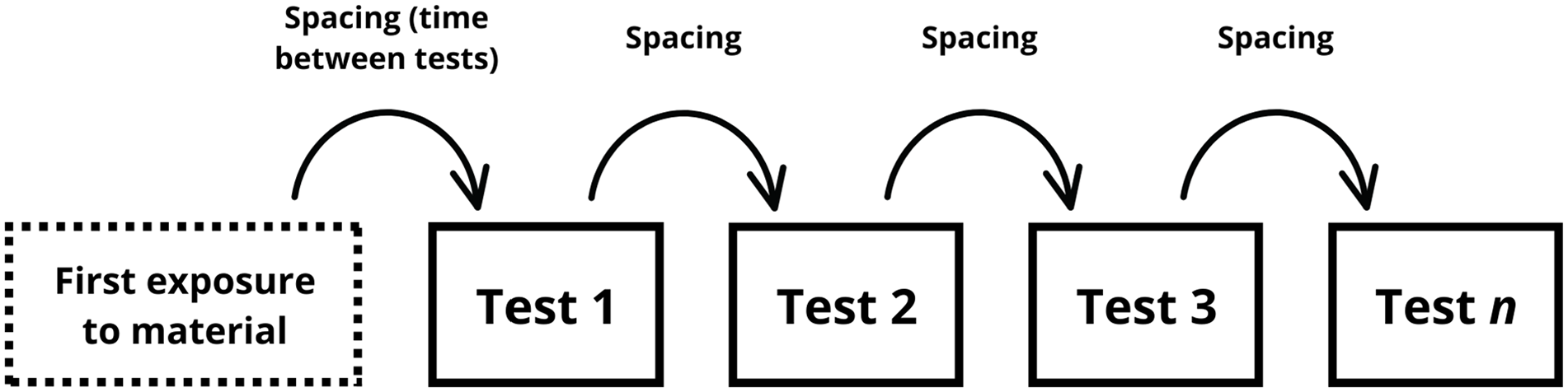
Depiction of a Repeated Testing Schedule.
Timing and Spacing
In characterizing beneficial retrieval schedules for repeated testing, the most prevalent finding is “the longer, the better” (Carter & Grahn, 2016; Karpicke & Bauernschmidt, 2011; Pyc & Rawson, 2007, 2009; Roediger & Butler, 2011). Very short intervals between tests (e.g., 1 min) have almost no positive impact on long-term retention (Pyc & Rawson, 2009; Roediger & Butler, 2011). Six minutes is the shortest interval between tests that has rendered positive results on long-term retention (Pyc & Rawson, 2009). Nonetheless, intervals of 24 to 72 hr result in far superior learning outcomes (Pyc & Rawson, 2007; Rawson & Dunlosky, 2011; Roediger & Butler, 2011). Considering that most subject matter in music education settings is visited a maximum of once a day, the minimum space between retrieval opportunities would be 24 hr, rendering an effective retrieval schedule. Low-stake tests of previously studied material should be performed at the beginning of the lesson to take advantage of the space between classes and also to avoid cues that could reduce the effect of the test (Latimier et al., 2019; Roelle et al., 2022).
Feedback
Feedback is defined by Hattie and Timperley (2007) as “information provided by an agent (e.g., teacher, peer, book, parent, self, experience) regarding aspects of one’s performance or understanding” (p. 81). Within the context of retrieval practice, it has been demonstrated that providing the correct answers after a test increases its memory benefits (Bangert-Drowns et al., 1991; Roediger & Butler, 2011; Wisniewski et al., 2020), ensuring that future retrieval attempts will be successful (Butler et al., 2008). Moreover, supplementing retrieval practice with feedback can increase motivation to continue learning (Abel & Bäuml, 2020). Feedback is even more critical when students complete recognition tests (e.g., true or false questions, multiple choice) because they are exposed to incorrect answers. As retrieval produces learning, completing a recognition test poses the risk of memorizing wrong information (Marsh et al., 2007, 2012). Nonetheless, evidence strongly suggests that providing students with feedback after a recognition test dramatically reduces or even nullifies its potential negative effects (Butler & Roediger, 2008; Marsh et al., 2012). Some key guidelines to provide effective feedback include the following: (a) engage in a two-way conversation with students in which they can communicate their doubts, questions, and their own musical and nonmusical ideas; (b) focus on how to improve on mistakes, interpretation, and technique instead of on the errors themselves; (c) be specific about what needs to be practiced to achieve the desired outcome; (d) inquire students about how they feel and what they think, so as to orient them in the most informed fashion; and (e) ask students to explain the instructor’s feedback to check whether it is understood (for a more detailed review, see McPherson et al., 2022; Wisniewski et al., 2020)
Examples of Retrieval Practice Application
There is a growing interest in assessing the impact of retrieval practice and repeated testing outside the laboratory, in naturalistic settings (e.g., lessons, rehearsals, and classrooms). Current research indicates that retrieval practice has a positive and powerful impact on student learning in the classroom (Agarwal et al., 2014, 2021; Carpenter et al., 2022; Gurung & Burns, 2019). The examples provided in the following sections are a general guide that could help teachers and professors incorporate retrieval practice into their day-to-day practice.
Retrieving the Chord Changes of “Tune Up.”
“Tune Up” is a composition by Eddie Vinson, popularized by Miles Davis (Nisenson, 2000). It is frequently used as a vehicle for improvisation in jam sessions and is considered a part of the standard repertoire. Its harmonic progression is characterized by a sequence of modulations that descend in whole steps (e.g., when played in D major, it goes through C major and Bb major). In each key, these modulations are accomplished through long ii—V—I cadences with a harmonic rhythm of one chord per bar. As ii—V—I cadences are the most prevalent chord progressions in the jazz repertoire (Coker et al., 1997; Terefenko, 2014), “Tune Up” lends itself as an important learning tool for advanced beginner to intermediate students (Coker et al., 1997; Murphy, 2009). The following steps are a guide for retrieving the chord changes of “Tune Up” and provide a template for recalling harmonic progressions within classroom settings.
Private Lessons: Retrieving Wynton Kelly’s Solo on “Freddie Freeloader”
As private lessons happen in a one-on-one format, implementing retrieval practice is simpler. Testing could be applied to transcriptions, harmonic analysis, melodies, phrases, scales, or almost any topic. The following steps are a guide for retrieving Kelly’s solo on “Freddie Freeloader” and provide a template for the application of free recall to transcriptions within private lessons.
Conclusion
The benefits of retrieval practice extend beyond long-term retention. Low- to no-stakes testing facilitates transfer (Butler, 2010; Carpenter, 2012; Pan & Rickard, 2018), diminishes test anxiety (Agarwal et al., 2014), leads to long-lasting knowledge (Carpenter et al., 2022; Dunlosky et al., 2013; Roediger & Butler, 2011), and increases motivation (Abel & Bäuml, 2020), among other positive learning outcomes. Testing also decreases the negative effects of acute stress on memory retrieval (Smith et al., 2016). The value of this potential outcome is underscored when one considers the stress that live performances induce in some students (Smith et al., 2016; Smith & Thomas, 2018; Vogel & Schwabe, 2016). Finally, retrieval practice is beneficial to all students regardless of background (Bertilsson et al., 2021; Dunlosky et al., 2013), making it a universally applicable, highly impactful learning strategy.
Footnotes
Acknowledgements
The authors would like to thank Dr. Rebecca Torres for her critical comments, helpful discussions, and suggestions.
Authors’ Note
Both authors reviewed the literature, created the examples, and wrote the manuscript.
Declaration of Conflicting Interests
The author(s) declared no potential conflicts of interest with respect to the research, authorship, and/or publication of this article.
Funding
The author(s) received no financial support for the research, authorship, and/or publication of this article.
