




Abstract
Belief Change explores methods to handle potential changes in the beliefs of an agent. The Alchourrón, Gärdenfors, and Makinson model describes three change operations, expansion, revision, and contraction, which serve as the foundation for revision models. On the other hand, Ontology Repair searches for methods to change an ontology so that it does not have unwanted consequences. Recent works established connections between the two fields of Belief Change and Ontology Repair.
In this paper, we analyze specific methods for building optimal repairs and compare them to a specific belief change operator, namely, partial meet pseudo-contraction. In addition, we present an implementation that makes pseudo-contraction closer to optimal repairs.
Introduction
Knowledge Representation (KR) is a field of artificial intelligence that aims to represent knowledge about the world, allowing reasoners to infer more information from it (Brachman & Levesque, 2004). Knowledge is dynamic, and even a small change can significantly impact an entire knowledge base (KB) (Peppas, 2008). Belief Change explores methods to handle these changes.
In their seminal paper, Alchourrón et al. (1985), proposed a paradigm for Belief Change, where the beliefs of an agent are represented as belief sets, sets of formulas in propositional logic. This paradigm, which became known as Alchourrón, Gärdenfors, and Makinson (AGM), describes the principles that characterize the operations of expansion, revision, and contraction of belief sets. The AGM paradigm was generalized in several ways, including the use of other logics, such as description logics (DLs) (Baader et al., 2017). Hansson (1993b) proposed a generalization of belief sets known as belief bases together with a new construction of contractions based on the notions of kernels and incision functions (Hansson, 1994).
Ontology Engineering studies how to model an ontology representing a domain in terms of concepts and roles. In the construction of an ontology, the need for repair has proven to be critical to maintain consistency. Ontology Repair (Kalyanpur, 2006; Keet, 2018), then, explores different methods to repair an ontology. Classical approaches significantly impact the KB, leading to unnecessary loss of information while repairing an ontology. Baader et al. (2018) present a strategy to make repairs more gentle. Although this method proved efficient at alleviating the impact of a repair, it remained highly dependent on the syntax of the axioms. In Baader et al. (2020), a method is introduced to remove unwanted assertions by using an extension of ABoxes called quantified ABoxes (qABoxes). In Baader et al. (2021), the authors presented an approach to finding optimal repairs that focuses on assertions within the ontology while keeping the terminological part static.
Several studies have sought to map similarities between Belief Change and Ontology Repair. Following the generalizations presented in Hansson (1993a), Santos et al. (2018) examined the properties of partial meet pseudo-contractions, defining a new construction of this operation that used a different consequence relation. Matos et al. (2019) extended the work of Santos et al. (2018) to the notions of kernel contractions and related the constructions of pseudo-contraction operations to gentle repair approaches. However, their work did not yet consider constructions of optimal repairs, which were introduced only later in Baader et al. (2020), Baader et al. (2021). Baader (2023) explored how functional approaches to construct optimal repairs align with pseudo-contraction operations under certain conditions.
The aim of this work is to explore the differences between optimal repairs and the outcomes of pseudo-contraction operations, a comparison that contributes to the integration, initiated in Matos et al. (2019), of the fields of Belief Change and Ontology Repair, which address similar problems but have traditionally developed independently. In this sense, our work expands (Matos et al., 2019) by incorporating the study of optimal repair constructions into this comparison. We also introduce a method for saturating the KB, which allows us to bring the results of these two approaches closer together. Additionally, we provide a comprehensive synthesis of existing work on optimal ABox repairs, supporting future research in this field. This clarification helps to make explicit the relationship between belief change operators and ontology repair techniques.
Preliminaries
We first introduce the foundations of DLs, focusing on the DL
Description Logic
DLs are a family of KR languages that can be used to represent knowledge of an application domain in a structured and well-understood way (Baader et al., 2017). The signature

In DL, concept names are unary predicates of first-order logic and role names are binary predicates of first-order logic. Concepts are constructed from concept names using concept constructors and correspond to first-order formulas with one free variable. In contrast, roles are formulas with two free variables, built from role names, that express the relationship between individuals.
A KB is a set of axioms categorized into terminological and assertional axioms. Terminological axioms (TBox) restrict the interpretation of concepts and roles, representing the knowledge about the domain in the form of concept inclusions

A DL is characterized in terms of first-order interpretations. An interpretation
An interpretation
A variety of axioms may be part of TBoxes, depending on the language used. We will emphasize the general concept inclusion for the terminological part and concept and role assertions for the assertional part. The syntax and semantics of these axioms are defined in Table 1.
Terminological and Assertional Axioms Baader et al. (2017).

Terminological and Assertional Axioms Baader et al. (2017).
In DLs, reasoning tasks are fundamental decision and inference problems that determine the logical consequences of a KB (Baader et al., 2017). Among the main reasoning tasks, query answering generalizes instance checking by retrieving all individuals or tuples of individuals that satisfy a given query with respect to the KB. It focuses on computing the certain answers to a query—those that hold in every model of the TBox and ABox. The most common query language is that of conjunctive queries (CQs), which are existentially quantified conjunctions of concept and role assertions, such as
The Description Logic
There is a range of DLs and their extensions. They start from a basic logic and are incrementally extended with extensions to enhance expressivity. Extensions introduce new constructors for complex concepts by adding new types of formulas. Like other DLs, a KB in
An
An 
An
Finally, an
From the definitions above, an
Quantified ABoxes
qABoxes were first introduced in the work of Baader et al. (2020) as an extension of usual ABoxes, replacing the set of individuals
Formally, a qABox
The set of individuals in a qABox is denoted by the set of objects 
Every ABox
In the same work, the authors characterized a qABox as a first-order formula by taking the conjunction of the assertions in 
As a result, they brought more expressivity to the KBs, allowing the creation of assertional axioms that were not possible with conventional ABoxes.
Belief Change
Belief Change is a field of KR that aims to understand the dynamics of epistemic states of an agent. An epistemic state of an agent represents all of their beliefs in a given moment (Ribeiro, 2010). In other words, Belief Change seeks to comprehend the agent’s behavior when faced with changes in its beliefs (Matos, 2021; Ribeiro, 2010).
The seminal contribution to Belief Change was made by Alchourrón et al. (1985), who proposed a method to represent the agent’s epistemic state alongside a set of operations to manage the changes in its beliefs when receiving new information. The guiding principle behind this method is the principle of minimal change, which suggests that a rational agent should adjust its beliefs as little as possible in order to accommodate the new information (Peppas, 2008). Due to the authors’ names, this model became known as the AGM framework.
In the AGM model, beliefs are represented by formulas of a propositional language, while the epistemic state of an agent is represented by a logically closed set of propositions, known as belief sets (Alchourrón et al., 1985). This model defines three fundamental operations on belief sets: Expansion, contraction and revision.
An expansion operation is responsible for adding new beliefs to the belief set. For a given belief set 
A contraction is responsible for removing unwanted beliefs. In simple terms, a contraction operation consists of giving up as many beliefs as needed to ensure that the new belief set no longer implies the unwanted information. Unlike expansion, contraction is not defined by a single formula but by postulates that capture the underlying intuition behind the operation (Alchourrón et al., 1985). These postulates include properties such as closure, ensuring that the result of a contraction
Finally, a revision operation comprises of adding new beliefs to the set of beliefs while ensuring that the final belief set remains consistent. Revision is equivalent to expansion if adding a belief does not introduce inconsistencies. However, if the expansion results in an inconsistency, other beliefs of the initial belief set may need to be removed to achieve consistency. Like a contraction, the revision operation
Partial Meet Contraction
The postulates do not determine a unique contraction or revision operation for a belief set but rather characterize such operations. In the work of Alchourrón et al. (1985), the authors introduce a construction for contraction functions based on the idea of selecting maximal subsets that do not entail the belief being contracted. This operation is known as partial meet contraction.
In partial meet contraction, the remainders of a belief set 
This construction satisfies the six basic postulates of contraction in the AGM model, while aiming to minimize the loss of information from the belief set during the contraction. The limiting case, when for all beliefs
Belief Bases
The AGM paradigm treated all beliefs in a belief set equally, making no distinction between basic beliefs and those inferred from the basic ones. Hansson (1991) proposed a significant generalization by introducing belief bases. A belief base is a set of beliefs that is not closed under logical consequence. Its elements represent beliefs held independently of any other belief or set of beliefs (Hansson, 1991). This way, models utilizing belief bases enhance expressiveness compared to the belief set presented in Alchourrón et al. (1985).
Hansson further generalized partial meet contraction to apply to belief bases. It is important to note that while partial meet contraction relies on selecting maximal subsets that do not imply the contracted belief, it is not sufficient for these subsets that they do not contain the contracted sentence. Hansson then characterizes partial meet base contraction in terms of the following postulates:
Hansson (1994) introduced another construction for obtaining contraction operations, based on the notions of kernels and incision functions. Unlike partial meet contractions that aim for maximal subsets that do not imply the undesired belief, a kernel contraction targets the minimal belief sets that do imply the unwanted sentence.
As explained in (Wassermann, 2000), the idea behind kernel contraction is that by removing at least one element from each minimal subset that implies the unwanted belief, we obtain a belief base that no longer implies this belief. To perform these removals, we use an incision function.
In Kernel contraction, a kernel set of a belief base 
Broadly speaking, kernel contractions are more general than partial meet contractions. However, if the kernel contraction is induced by a minimal incision function, then it becomes a maxichoice contraction.
Pseudo-contraction
A downside of the contraction notions introduced in the AGM framework (Alchourrón et al., 1985), when applied to belief bases, is their syntax dependency, in the sense that they can only use sentences explicitly present in the belief base. For example, consider a belief base
In Hansson (1989), a weakening of the inclusion postulate was introduced, termed logical inclusion. In logical inclusion, the consequences of a contraction are contained in the consequences of the belief base:

By replacing the inclusion postulate, Hansson allowed beliefs in the contraction’s consequences to be added to the resulting belief base during the contraction. Some years later, Hansson proposed to call an operation that satisfies success and logical inclusion a pseudo-contraction (Hansson, 1993a).
Partial Meet Pseudo-contraction
Following the results from Hansson (1993a), Santos proposed a pseudo-contraction operation that depended on the formulas allowed to be added when contracting the belief base called 
As detailed in Santos et al. (2018),
Kernel Pseudo-contraction
Analogously to 
Two-place Pseudo-contraction
Matos presented another kind of Cn
Two-place 
As in
Ontology Repair
In ontology engineering, we might need to repair a KB either when modeling errors are detected or when it is necessary to remove an undesired formula (Baader, 2023). The central question in ontology repair studies is then how to repair a KB, removing the unwanted information while ensuring that:
no new information is introduced; the ontology remains as close as possible to the original.
Classical repair approaches define a repair as a maximal subset of the KB that does not imply unwanted sentences (Baader et al., 2021). These approaches ensure that no new axioms are added during the repair process, maintaining the ontology as close as possible to its original by adhering to the maximality condition (Baader, 2023). Classical methods are based on axiom pinpointing (Schlobach & Cornet, 2003), which provides methods to understand why a particular consequence holds by computing its justifications. A justification is defined as a minimal subset of the KB that entails the consequence in question.
From its justifications, classical repairs are computed ensuring that no justification holds in the computed subsets of the KB. Formally, a repair of a KB
A classical repair of a KB
While these classical approaches preserve as many sentences as possible, the obtained results may not preserve a maximal amount of consequences and are syntax-dependent. For instance, suppose we have the sentence
However, as shown in Baader et al. (2018), this approach still need not produce optimal repairs, that is, ones that preserve a maximal set of consequences, and they are also dependent on the syntactic form of the axioms.
Classical Repair Approaches and Pseudo-contractions
Although the studies of contractions in Belief Change and the repairs in Ontology Engineering aim to solve the same issue, they approach the problem in different ways. Belief Change focuses on the characteristics of what a contraction is, while Ontology Repair concentrates on finding ways to compute an optimal repair. For example, in Belief Change, there is no restriction on a belief base being a finite set, whereas KBs in ontology engineering are usually assumed to be finite.
In Matos et al. (2019); Santos et al. (2018), the authors explored the similarities between contractions and repairs. Matos et al. (2019) demonstrated the equivalence between kernels and justifications. They also established a correspondence between classical repairs and remainders in partial meet base contractions and gentle repairs and pseudo-contractions.
Baader (2023) also studied in the similarities of these areas. As the notions of optimal classical repairs and remainders coincide, he showed that a maxichoice partial meet contraction operation is an optimal classical repair whenever the unwanted sentence is not a tautology and, if it is, the operation does not change the base.
Functional Approaches
Functional approaches to produce ontology repairs were developed to create a method of repair where the syntactic structure of the axioms in the ontology was supposed to be irrelevant. These approaches shift the focus from the axioms to their consequences, interpreting the repair conditions as:
no new consequences are introduced; a maximal set of consequences is preserved rather than a maximal set of axioms.
In Baader et al. (2021), the authors proposed methods to compute optimal repairs, considering the use of qABoxes in scenarios where the initial qABox might contain errors while assuming the TBox to be static.
In these terms, an optimal repair is defined as an ontology that does not have unwanted consequences, is entailed by the original ontology, and preserves the maximal amount of implications in the sense that there is no repair that strictly entails it (Baader et al. (2021)). In the same work, the authors also demonstrated that, in general, optimal repairs need not exist, even if there are repairs. Moreover, unlike classical repair approaches, even if optimal repairs exist, they need not cover all repairs in the sense that every repair is contained in an optimal repair.
The intuition behind canonical repairs originates from generating variations of the initial qABox while maintaining entailment relationships between them, until it no longer entails any unwanted consequences (Baader et al., 2023). Although this process, known as blind search, works for computing optimal repairs, it is very inefficient.
Canonical repair arises then, as a construction where copies of individuals and their assertions are created while removing unwanted consequences. Each copy replicates the original individual, preserving information that would otherwise be lost when removing certain consequences. For example, given the assertions:

If we aim to remove the assertion that Francesca is a journalist, we would also lose the consequence that there is an Italian who is a journalist. However, by creating a copy of Francesca as a free variable 
The unwanted sentence Journalist(Francesca) was removed, but the consequence “There is an Italian who is a journalist” was retained. Inevitably, creating copies extends the initial ABox to a qABox, where the added variables serve as copies of the original objects.
Canonical repair is restricted to
Rather than comparing ontologies based on their models, the process of computing optimal repairs described in Baader et al. (2021), Baader (2023), suggests comparing them based on the answers to the queries they entail. For a given query language QL, we say that a qABox
In what follows, the construction of repairs is explained using the notion of repair requests. A repair request is defined as a finite set of
The process for computing a canonical repair
The remainder of this section describes each of these steps in detail.
For CQs, the CQ-saturation rules are defined as follows:
While the third rule adds new concept assertions implied by the ABox and the TBox, the other two rules break down complex concept assertions into atomic parts. The In Baader et al. (2021), the authors demonstrated that applying these rules may not always terminate, but for cycle-restricted TBoxes, CQ-saturation always terminates. For instance queries, the IQ-saturation rules are slightly different:
As shown in Baader et al. (2021), the IQ-saturation always terminates without imposing any restriction on the TBox. The key difference lies in the fact that IQ-saturation rules are more parsimonious when introducing new objects, ensuring that added variables are linked to existing concepts. For instance, when applying the Regardless of the chosen query language, saturation is the process of exhaustively applying the respective rules to break down complex concepts and add consequences of the TBox into the ABox. This process results in a qABox formed by atomic concepts, making it suitable for repair since the TBox information is included within the resulting qABox.
If The first condition ensures that
These conditions ensure that the assertions added to
If Given the repair seed
While canonical repairs compute optimal repairs, it also introduces more copies than necessary to achieve an optimal repair (Baader et al., 2021). In contrast, the optimized repair approach presented in Baader et al. (2021) constructs an optimal repair using only the essential copies, ensuring that the resulting repair is equivalent to the canonical one.
All the processes of repair, such as saturation, copying, repairing, and selection, are identical to those described in the canonical approach. The key difference in the optimized approach is the addition of the pruning step. Instead of utilizing all the generated variables in the repairing, this step filters out redundant copies by selecting those associated with minimal cover repair types.
Before explaining the process of pruning, it is first necessary to define the concept of coverage. Given two sets of concept descriptions
In Baader et al. (2021), the authors rephrase it in terms of coverage: An assertion The rules proposed in Baader et al. (2021) for constructing optimized repairs are dependent on the chosen query language. For the IQ-case, the construction starts with
The saturated ABox contains the role assertion For the CQ-case,
The saturated ABox contains the role assertion The repair type The intuition behind the pruning step is to select only the variables reachable from the initial individuals that have a repair type that minimally affects the KB.

Consider an example in which Francesca loves an individual who is both Italian and a chef. This relationship could be represented by the following KB:

Now, let’s say we want to get rid of this assertion. In this case, the repair request containing the unwanted consequence is defined as:

The remainder of this section illustrates each step in building a canonical repair and also an optimized repair, as described in the previous section.
Starting with the initial ABox
According to the The copying process creates copies of the objects in The possible repair types are given by the power set of the existing atoms:
For each object in By following these steps, we have computed Following the creation of new copies, the selection process will select, for each individual in Given that The repairing process then, will create the assertions for each copy based on the original object and the associated repair type. The generated assertions take into account the conditions described in the repairing definition:
The



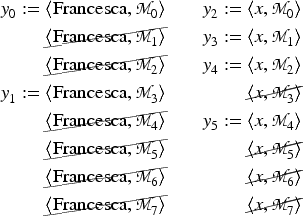


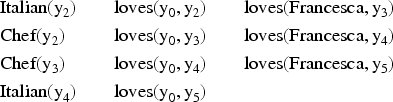

For the optimized approach, we add the pruning step prior to the repairing process:
The copying process created variables with valid repair types. In this step, unnecessary variables are pruned. For the IQ-repair, the construction begins with an empty set of variables and only one individual:
Recall that Francesca is represented by the variable Since the rule cannot be reapplied, the final set of variables is used in the repair is:
The repairing step, then, will create the assertions for the remaining copies. The process is the same as the canonical repair but now running over the results of the pruning step:
The






It is intuitive to see the similarities between contractions and ontology repair approaches. Previous studies, such as Matos et al. (2019), have identified equivalences between pseudo-contraction operations and ontology repair methods. Baader (2023) explored the connection between optimal repairs and pseudo-contractions. By defining a consequence operator, he showed that, under certain conditions, optimal repairs could be obtained from pseudo-contractions.
Given the KB 
In the same work, it is proved that this function can effectively be computed since, as presented in Baader et al. (2022), optimal repairs can be computed by first computing the optimal qABox repairs, which results in a finite and computable set. Building on this, Baader proved that when the ABox is restricted to being acyclic and the TBox to being cycle-restricted, the existence of an optimal repair implies that there exists a remainder of
As a consequence, it was shown that a maxichoice
From this point forward, we focus on the results of contractions and repairs, aiming to better understand their differences. We begin by comparing their results.
Comparing Optimal Repairs and Pseudo-contractions
Any of the approaches presented in Baader et al. (2021) to find an optimal ontology repair, whether through canonical or optimized repairs, use qABoxes to increase the number of consequences preserved during the repair. However, as shown in Baader et al. (2022), Baader (2023), optimal ABox repairs are limited to the non-existence of cycles in the base. Consider, as an example, the following ontology and repair request:
In this example, the GCI 
The resulting qABox has no equivalent optimal ABox repair as the cycle
The main question is that KBs represent a potentially infinite set of consequences. Once we look at this set and try to find a maximal subset that does not imply a particular formula, a finite representation of this maximal subset may not exist.
In contrast, the same KB and repair request in a partial meet pseudo-contraction operation that uses the consequence operator of ELK
2
(Kazakov et al., 2012), 


This difference can be explained by the fact that, in Belief Revision, contractions consider the entire KB as refutable, whereas constructing optimal repairs in the presented approaches assumes that terminological axioms cannot change.
In AGM theory (Alchourrón et al., 1985), beliefs are represented by belief sets, which are closed under logical consequence. Thus, a remainder is a maximal subset of the belief set that does not imply a specific formula, but, at the same time, because the sets are closed, it is also a maximal set with respect to preserving consequences, such as in optimal repairs.
In belief bases, remainders are maximal subsets of the base, that is, of the finite representation, regardless of how they behave concerning the consequences. By using the classical consequence operator, a contraction could keep the maximum number of consequences since it includes all the existing consequences. However, it turns out that this is not a computable set. Reasoners only compute a closure of the consequences based on the tasks they can perform, such as classification, instance checking, or satisfiability checking. Otherwise, the number of inferences could become infinite, and the reasoner would never stop.
The limitation of reasoners in computing consequences also produces differences when comparing the results of pseudo-contractions and optimal repairs, even though both aim to find the maximal set of consequences. For instance, consider a scenario with an empty TBox:
The optimal repair computed by an optimized IQ-repair construction achieves one of the following qABox:


These results are dependent on the chosen repair seed and can be expressed by equivalent ABoxes:


This example results in non-equivalent remainders when running the partial meet pseudo-contraction under consequences computed by the ELK reasoner:



ELK did not compute any consequences for this base, which implies the lack of existential restrictions in its assertions, such as
Optimal repairs offer the possibility of having more consequences in an extended version of the language while restricting the existence of cycles. On the other hand, pseudo-contractions are not concerned with cycles but depend on the closure of consequences computed by the reasoner. We fall between the absence of cycles or the dependency of reasoners. Let’s explore one more example:
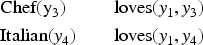
This example illustrates the scenario where the TBox contributes to the justification of the unwanted sentence, and therefore, it needs to be considered during the repair process. The generation of variables provides a small set of copies for 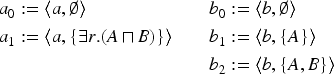
Note that only 


The first two repairs are optimal repairs for the given base and repair request. The third one is entailed by
Now, let’s compare the optimized IQ-repair construction results with the remainders obtained from a partial meet pseudo-contraction operation using the same KB and unwanted sentence. To do so, we will use the set of consequences computed by ELK:

From the inferred base, the remainders are as follows:



When comparing the remainders with the computed optimal repairs, they yield similar results. It is easy to see that
The following section proposes an algorithm to extend the closure of consequences computed by the reasoner with a set of axioms entailed by the base.
Reasoners can only infer consequences based on their reasoning methods. To extend this set of consequences, we propose a new method to compute a specific family of consequences. Consider the following assertions:


The first assertion says that Francesca loves Gabriele, while the second says that Gabriele is a chef. Together, they imply that “Francesca loves a chef”. The following axiom can represent this:

In other words, there exists a relationship loves between Francesca and an individual who is an instance of the concept Chef. We can also use the same construction to entail a chain of individual relations. For example, by adding the axioms:



Axioms in a KB can express the connections between individuals, and this form of axiom describes the chain of relations that connect a pair of individuals. If we imagine each individual in the base as a node and each axiom of the form

Graph of the relations generated from the specified axioms.
By traversing the graph from a node to all reachable nodes, we can generate the existing chains of relations starting from the chosen node. Repeating this process for each node in the graph allows us to infer all the existing chains in the KB. Using the depth-first search (DFS) algorithm, Algorithms 1 and 2 describe the changes to compute the saturated KB.
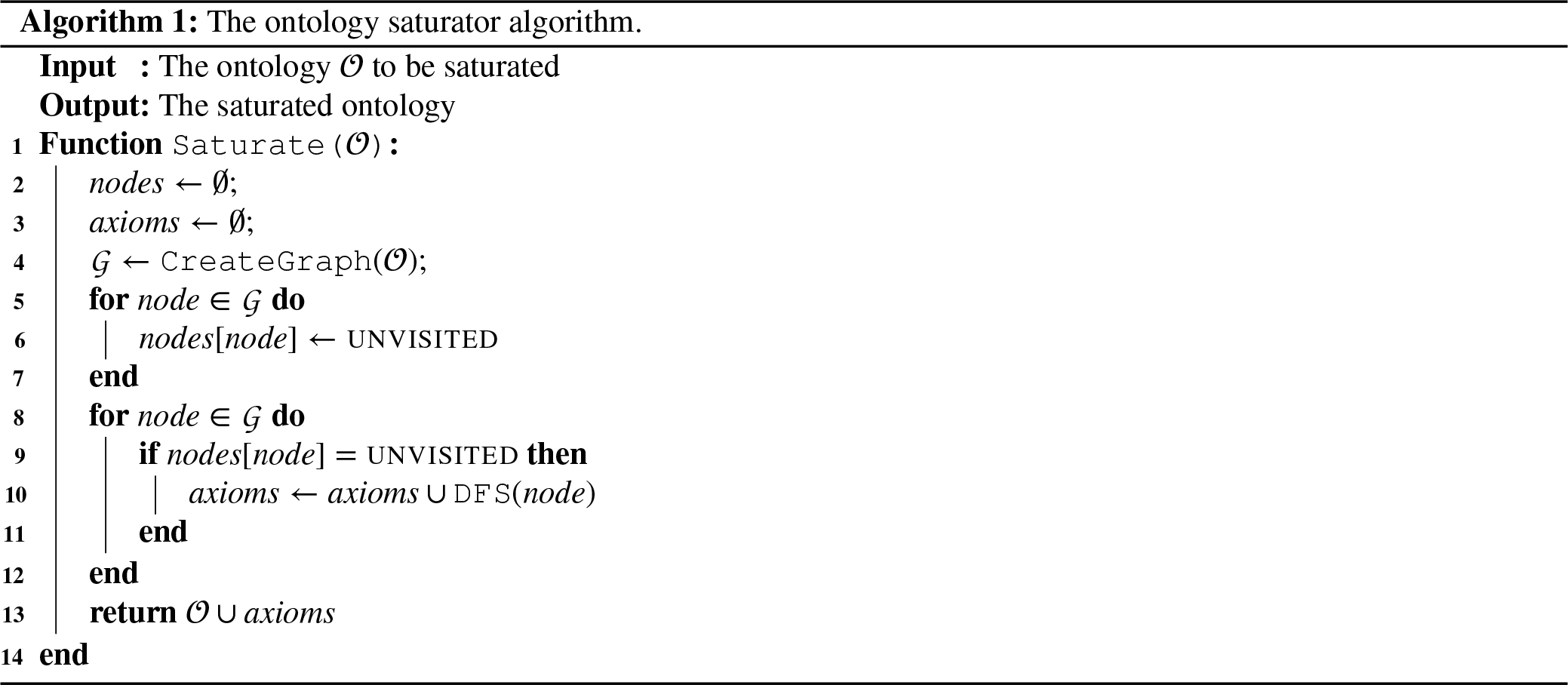
Algorithm 2 starts with graph
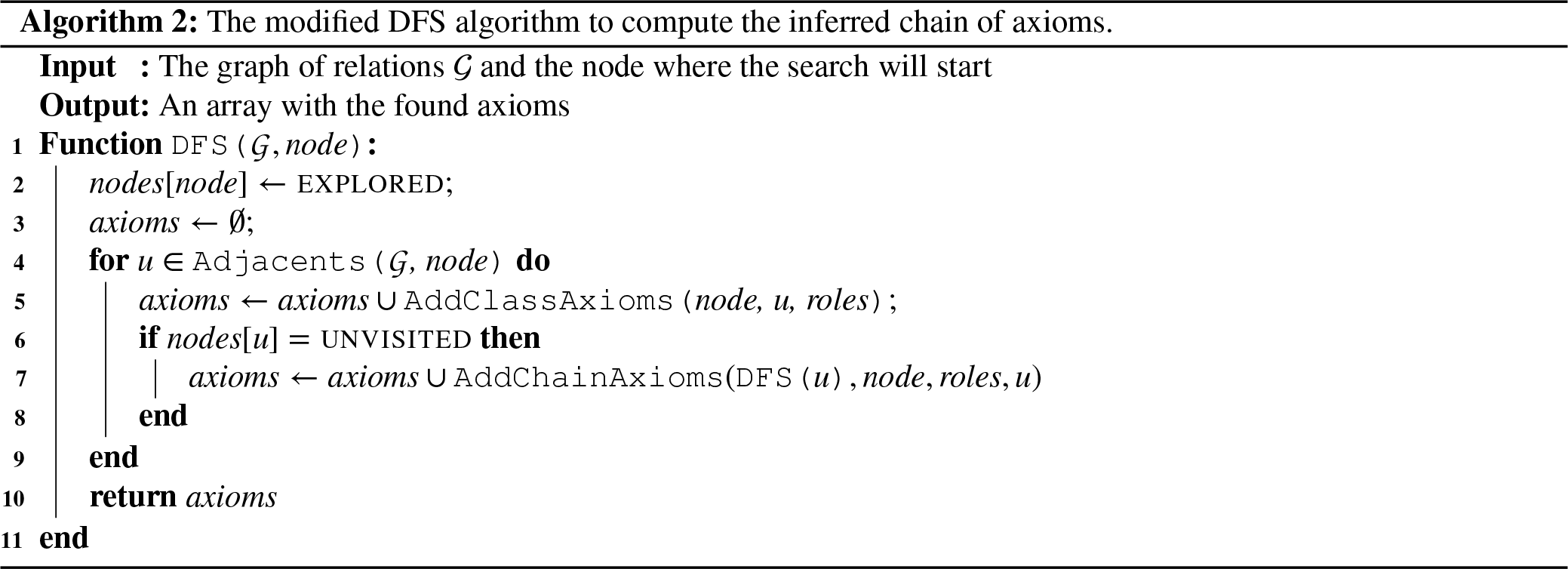
Algorithm 3 presents the modified DFS algorithm. Iterating over all adjacent nodes of the current node, the algorithm runs a routine to generate the axioms related to these adjacent nodes (Algorithm 3). Additionally, it also executes a routine to associate the generated chains of axioms from the recursive DFS calls with the current individual concerning the roles that connect them (Algorithm 3).
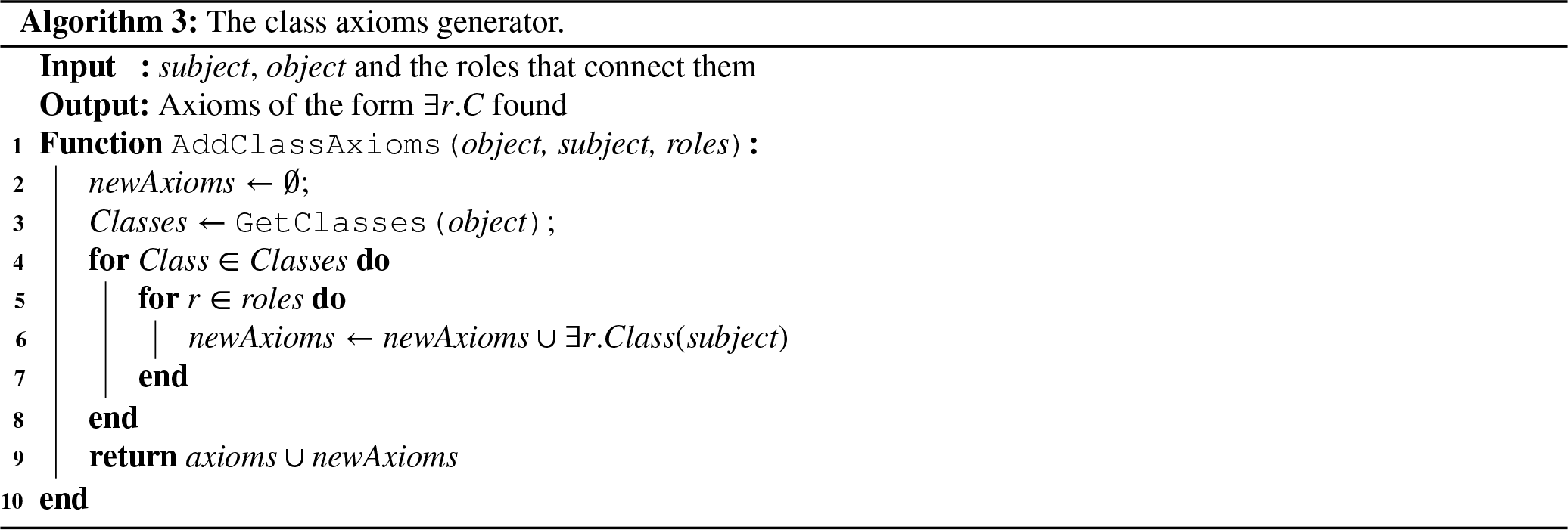
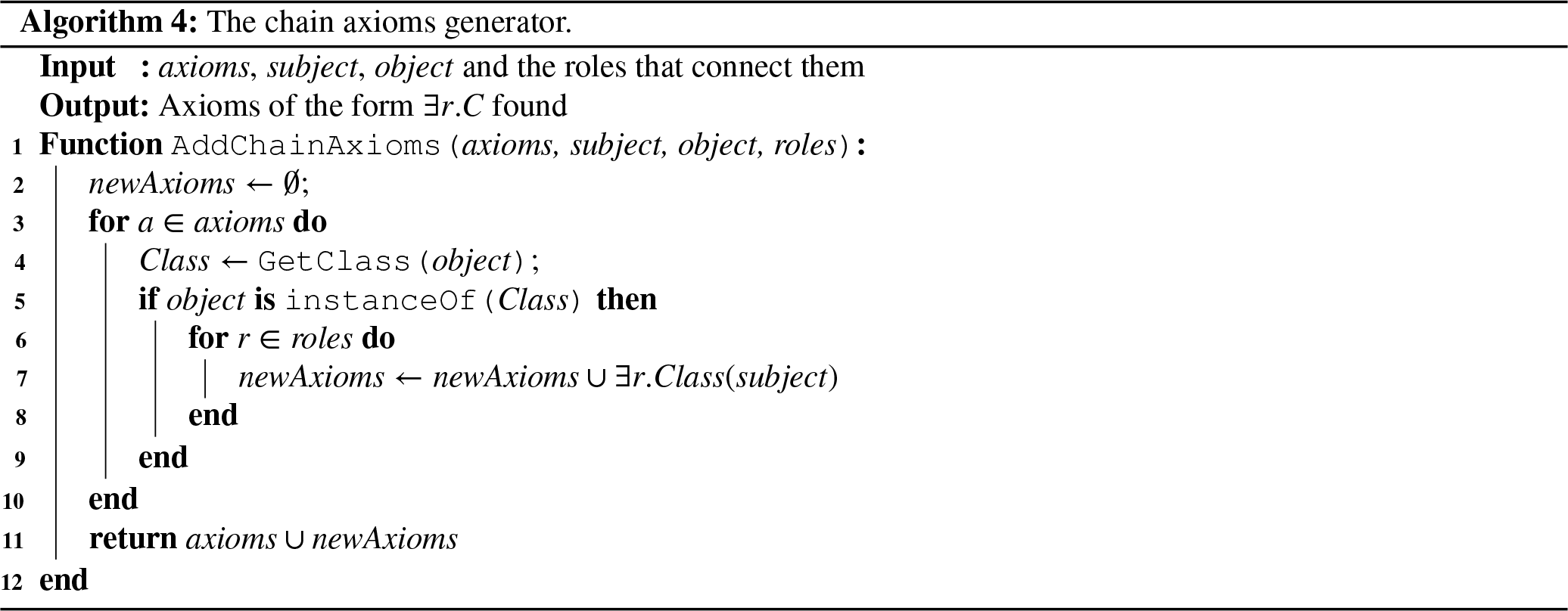
Algorithm 3 constructs new axioms based on the roles between the subject and the object individuals, also taking into account the concepts in which the object is an instance. Finally, Algorithm 4 processes a set of axioms to generate new chain axioms based on the roles and the relationships between the individuals subject and object.
It is important to note that infinite chains could occur depending on the existence of cycles in the graph. For instance, the addition of friendOf(Francesca, Giulia) to the previous example would result in the graph of Figure 2.
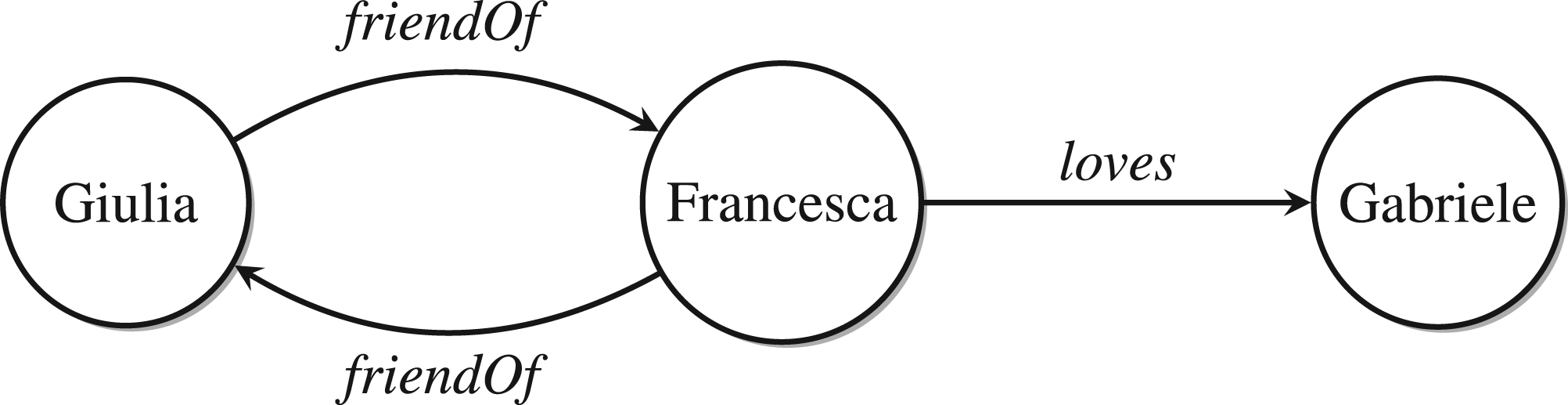
Graph of relations generated after adding a cycle to the ontology.
This cycle generates the infinite chain 
Going back to the previous example, given the following ontology and repair request:
Consider using ELK to compute the consequences and then applying the saturation over the inferred ontology:


The partial meet pseudo-contraction, now, results in the following remainders:
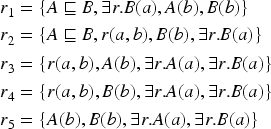
Comparing the remainders to the results obtained by repairs, note that
Again, the TBox contributes to the justification of the unwanted sentence and therefore is considered to generate the copies:
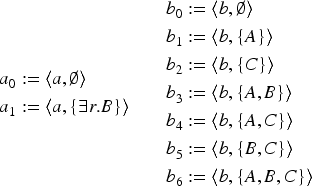
As the number of atoms increases, the number of variables generated and, consequently, the number of repairs will also increase. The only option of a repair seed for 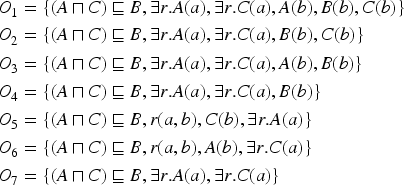
From the computed repairs, only 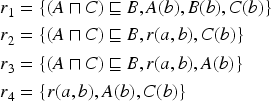
In this example, no remainder is equivalent to an optimal repair. Although remainders and repairs are very similar, the remainders lack the consequences that the reasoner could not compute. By computing the consequences on ELK and then saturating the inferred ontology, the contraction operation will increase the number of consequences on the remainders:


The remainders then, computed by a partial meet pseudo-contraction, are:
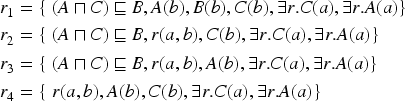
With the help of the reasoner, the saturator increased the closure of computed consequences so that the contraction achieved equivalence with the optimal repairs. The first three remainders are equivalent to the optimal repairs, while the last one has no equivalence, as it results from a contraction that changes the TBox.
The source code of the saturator developed for extending the ontology described in this section is available on GitHub 3 .
To find out whether the saturator introduced in this chapter effectively expands the closure of computed consequences, we conducted experiments comparing the size of the consequence sets computed by ELK reasoner before and after the saturation process.
As corpus for our evaluation, we selected the ontologies used in the 2015 OWL Reasoner Competition for the track OWL EL Realisation (Parsia et al., 2017), which are also the same employed in the evaluation of optimal repair approaches in Baader et al. (2021). Out of the 80 ontologies filtered in Baader et al. (2021), we selected 74 non-trivial ontologies with diverse characteristics for this study.
With the use of the saturator, the number of axioms increased in 55% of the ontologies. Excluding outliers, the average growth in the number of axioms among these ontologies was 9%. This variation in growth reflects the structure of each ontology. Ontologies with few or no assertional axioms showed little to no increase in the number of axioms, as did those lacking role assertions or already containing the computed chains. In contrast, ontologies with a significant number of role assertions experienced substantial growth in the number of axioms in the ontology.
This shows that the algorithm introduced in this paper has a highly positive impact, increasing the chances of achieving a contraction equivalent to an optimal repair.
Discussion
In this work, we undertook a detailed study of approaches to construct optimal repairs in Ontology Engineering and how they relate to contractions in Belief Revision. This comparison is valuable as it highlights potential overlaps and similarities between these two areas, helping us to understand how approaches from each field may complement and enhance one another. Previous work examined classical repair approaches, which provided methods for constructing repairs by computing justifications. Santos et al. (2018) and Matos et al. (2019) explored the similarities between classical repairs and pseudo-contractions. Starting from Baader et al. (2020), the authors introduced a series of works to propose functional approaches of repairs that were not dependent on the syntactic structure of the axioms. These approaches focused on repairing the ABoxes while assuming that TBoxes did not change. In Baader (2023), the author compared optimal repairs resulting from functional constructions with pseudo-contractions, proving that in certain specific cases, optimal repairs were equivalent to the remainders of a partial meet pseudo-contraction. In this study, we have aimed to understand the scenarios in which the results of optimal repairs diverge from the remainders in contractions, enriching the understanding of how these approaches resemble each other.
Our work also synthesizes existing research on optimal repairs, enriching this synthesis with examples that can improve the understanding of each approach. By organizing these studies, we aim to support further exploration in the field of optimal repairs.
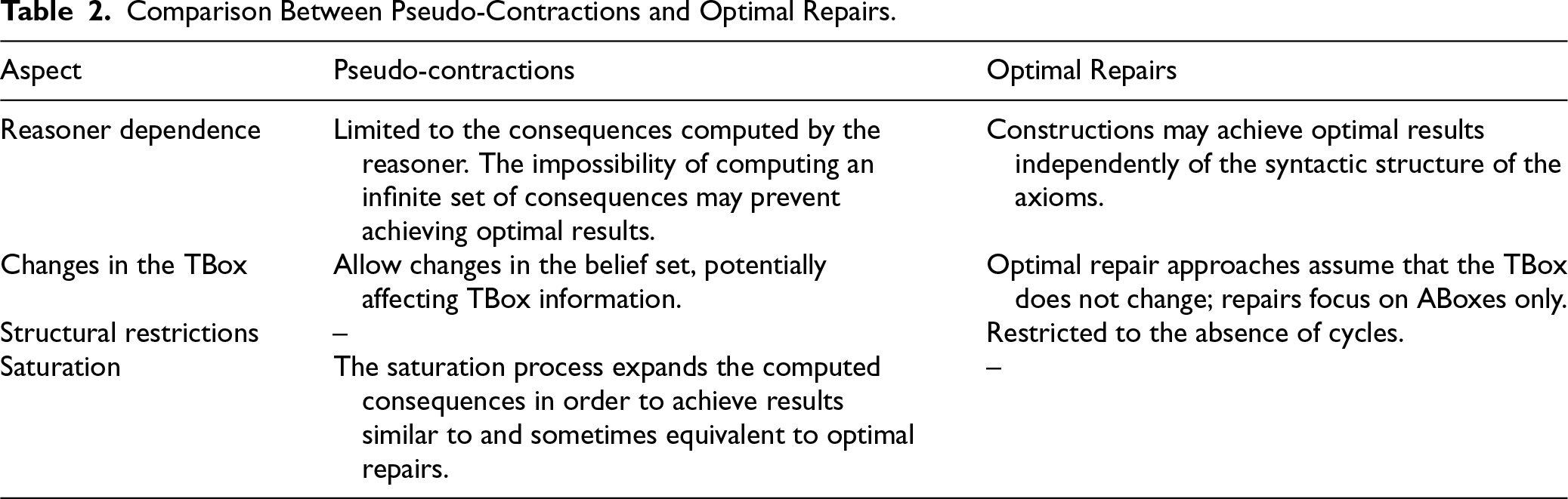
Compared to contractions, while the constructions of repairs presented in Baader et al. (2021) could achieve optimal results, the restriction to cycles and the fact that a repair does not affect the TBox can be seen as a pain point depending on the ontology that we need to repair. On the other hand, while functional approaches could find optimal repairs, the impossibility of a reasoner to compute an infinite set of consequences prevented the pseudo-contractions from achieving optimal results in some specific scenarios.
To summarize and clarify these differences, Table 2 presents a structured comparison between pseudo-contractions and optimal repairs, highlighting the main distinctions discussed above.
Comparison Between Pseudo-Contractions and Optimal Repairs.
Comparison Between Pseudo-Contractions and Optimal Repairs.
To bridge this gap between optimal repairs and pseudo-contractions, we proposed a method to saturate a KB, expanding the closure of computed consequences. This approach helped achieve optimal repairs in bases where pseudo-contractions could not compute optimal results using only the reasoner’s consequences.
There are still some open questions that this paper did not address, but they would provide interesting directions for future work. For example, it is unclear whether the consequences introduced through saturation are sufficient to ensure that pseudo-contractions consistently achieve optimal repairs. Also, it would be interesting to understand how functional approaches handle DLs other than
Another aspect that was not considered in this work is the computational cost of the proposed algorithms. Since computational cost is a central concern in Ontology Repair, a deeper analysis of the cost of saturation would be an important direction for future research.
Footnotes

Funding
The authors received no financial support for the research, authorship, and/or publication of this article.
Declaration of Conflicting Interests
The authors declared no potential conflicts of interest with respect to the research, authorship, and/or publication of this article.