Conditional syntax splitting for inductive inference from conditional belief bases has been proposed as a generalization of syntax splitting, which also covers cases where the conditionals in the subbases may share some atoms. While p-entailment and system Z fail to satisfy conditional syntax splitting, two other inductive inference operators, lexicographic inference and system W, have been shown to satisfy this property for reasoning from strongly consistent belief bases. In this article, we introduce the concept of conditional semantic splitting of a belief base. For both syntax splitting and semantic splitting, we take not only strongly consistent belief bases into account, but also belief bases that are only weakly consistent, enforcing some worlds to be fully infeasible. We show that c-representations satisfy a core postulate relating conditional splittings on the syntax and the semantic level. Based on these findings, we investigate conditional syntax splitting for nonmonotonic inference with c-representations. Regarding single c-representations, we utilize the concept of selection strategies and show that a straightforward property of the selection strategy leads to inference operators satisfying conditional syntax splittings. Furthermore, we show that c-inference, taking all c-representations of a belief base into account fully complies with conditional syntax splitting, and we prove that credulous and weakly skeptical inference based on c-representations also satisfies conditional syntax splitting. In particular, we show that these syntax splitting properties hold for strongly consistent belief bases and also in the case of only weakly consistent belief bases.
In both human and formal reasoning it is often essential not to take into account the full amount of knowledge that is available to an intelligent agent, but to split the available knowledge into independent parts so that local reasoning on a part of the knowledge can be done. Toward this goal, the concept of syntax splitting was developed by Parikh (1999) for belief sets in order to formulate postulates for belief revision, and was later transferred to other structures and applications (e.g., Kern-Isberner & Brewka, 2017; Peppas et al., 2015), a related concept was introduced by Weydert (1998) as minimum irrelevance. Syntax splitting for nonmonotonic reasoning from conditional belief bases (Kern-Isberner et al., 2020) is a combination of the postulates relevance and independence, stating that only conditionals from the considered part of the syntax splitting of a belief base are relevant for corresponding inferences, and that inferences using only atoms from one part of the syntax splitting should be independent of additional information on the other parts. Furthermore, the concept of semantic splitting has been introduced with a focus on the models of a belief base (Beierle et al., 2021b).
From a theoretical point of view, these splittings are interesting because they implement a notion of (ir)relevance in inferences. But splitting techniques have also consequences for applications: they allow for breaking down conditional reasoning to the subbases relevant for a query, hence usually reducing the relevant subsignature significantly. From a cognitive point of view, splitting techniques bring in the concept of local reasoning, which accounts for the limited resources of humans. Moreover, local reasoning is also fundamental to all works on probabilistic networks (Pearl, 1988).
Full splittings in the sense of Kern-Isberner et al. (2020), however, are quite rare in real-world applications. The concept of conditional syntax splitting for inference from conditional belief bases (Heyninck et al., 2023) is a generalization of syntax splitting which also allows the subbases to overlap syntactically, providing much more realistic application scenarios. The relevance of conditional syntax splitting is further underpinned by the fact that the so called drowning-effect (Benferhat et al., 1993; Pearl, 1990) was formalized as a violation of conditional syntax splitting (Heyninck et al., 2023). The drowning effect is a phenomenon where, for some inductive inference relations, special subclasses will not properly inherit properties of their superclass. For example, given the knowledge that birds usually fly, penguins are usually birds, penguins usually do not fly, and birds usually have wings, an inductive inference operator suffering from the drowning effect would not be able to conclude that penguins usually have wings. This means that if an inference operator satisfies conditional syntax splitting, it is also guaranteed to avoid the drowning effect in general, and not just for the canonical example. p-Entailment, characterized by the axioms of system P (Adams, 1965; Kraus et al., 1990), and system Z (Goldszmidt & Pearl, 1996) are known to suffer from the drowning problem, and in the paper introducing the concept of conditional syntax splitting (Heyninck et al., 2023), it is demonstrated that p-entailment and system Z do not satisfy this property, while it is shown that the two inductive inference operators lexicographic inference (Lehmann, 1995) and system W (Komo & Beierle, 2020, 2022) fully comply with conditional syntax splitting.
In this article, we extend the study of conditional splittings of belief bases in several directions, in particular by introducing conditional semantic splittings, by extending the application of conditional syntax splitting also to belief bases exhibiting only a weak notion of consistency. As a basis for our investigations, we use ranking functions (ordinal conditional functions [OCFs]; Spohn, 1988) as a well-established and popular semantics for conditional belief bases. Besides their popularity, another reason for using OCFs is that the work on conditional syntax splitting is inspired by probabilistic techniques. Since OCFs can be understood as qualitative abstractions of logarithmic probabilities, they provide a perfect mediating framework to realize such probabilistic ideas for qualitative nonmonotonic reasoning. We answer the question to what extent c-representations (Kern-Isberner, 2001), which are a specific subset of ranking models of a belief base, and inference with them satisfy conditional semantic splitting and conditional syntax splitting by investigating skeptical, weakly skeptical, and credulous reasoning with c-representations over three different subsets of models.
It should be noted that so far the notions of conditional syntax and conditional semantic splittings mentioned above have only been investigated in the context of belief bases that are consistent in the sense of the well-known consistency test by Goldszmidt and Pearl (1996). This notion of consistency, called strong consistency in the following, requires models where every possible world is at least somewhat plausible. In contrast, a weakly consistent belief base may only have models where some worlds are fully infeasible and thus completely implausible (Haldimann et al., 2023). With a focus on taking also weakly consistent belief bases into account, this article provides the following main contributions:
We introduce the concept of conditional semantic splitting for semantics based on Spohn’s ranking functions (Spohn, 1988), and a postulate (CSemSplit) relating conditional splittings on the syntax and on the semantic level, covering both strongly and weakly consistent belief bases.
We show that c-representations, which are special ranking functions obtained by summing up impacts assigned to falsified conditionals (Kern-Isberner, 2001, 2004), satisfy conditional semantic splitting. This also holds for extended c-representations (Haldimann et al., 2024) for weakly consistent belief bases.
We study the relationship between conservative c-representations, which minimize the number of implausible worlds, and relaxations thereof, leading to a postulate ensuring classic preservation (Casini et al., 2019).
Regarding reasoning with respect to a single c-representation or a single extended c-representation, we utilize the concept of selection strategies (Beierle & Kern-Isberner, 2021; Kern-Isberner et al., 2020) and show that the property of preserving the impacts chosen for certain subbases for inferences on the full belief base leads to inference operators satisfying conditional syntax splitting.
Without any requirement regarding a selection strategy, we prove that c-inference, extended c-inference, and also conservative extended c-inference, which are the skeptical inference relations taking all c-representations, extended c-representations, or conservative extended c-representations, respectively, of a belief base into account (Beierle et al., 2018, 2021a; Haldimann et al., 2024) fully comply with conditional syntax splitting.
We show that also credulous and weakly skeptical inference with c-representations, extended c-representations, or conservative extended c-representations (Beierle et al., 2021a; Haldimann et al., 2025) satisfy conditional syntax splitting.
This article is a revised and largely extended version of our conference paper presented at the 21st International Conference on Principles of Knowledge Representation and Reasoning (KR 2024; Beierle et al., 2024b). The additions include, in particular, all aspects related to weakly consistent belief bases. We apply the notions of conditional syntax splitting and conditional semantic splitting accordingly. While c-representations extended to weakly consistent belief bases and the correspondingly extended c-inference operator have been introduced only recently (Haldimann et al., 2024), we show here that extended c-representations satisfy conditional semantic splitting and that extended c-inference and also inference with respect to extended c-representations obtained via an appropriate selection strategy satisfy conditional syntax splitting. We study relaxations of conservative c-representations for weakly consistent belief bases and formulate a postulate ensuring classic preservation for induced inductive inference operators based on them. Furthermore, we broaden our investigations of splitting properties of c-representation-based inference systems by addressing also credulous and weakly skeptical c-inference.
The rest of this article is organized as follows. In Section 2, we present the basics of conditional logic needed here, and in Section 3, we recall the concept of conditional syntax splitting. In Section 4, we introduce the notion of conditional semantic splitting, show that it is satisfied by c-representations and by extended c-representations, and we study the relationship between conservative c-representations and relaxations thereof. In Section 5, we present postulates for selection strategies and prove that these postulates ensure that the corresponding inference operators for single c-representations and for extended c-representations satisfy classic preservation and conditional syntax splitting, respectively. In Section 6, we show that c-inference taking all c-representations of strongly consistent belief bases, and also extended c-inference taking all extended c-representations, or all conservative extended c-representations, respectively, of weakly consistent belief bases into account, fully comply with conditional syntax splitting, without reference to any selection strategies. In Section 7, we expand these results to credulous and weakly skeptical c-inference, and in Section 8, we conclude and point out further work.
Formal Basics
Let be the propositional language over a finite signature with atoms , with the usual connectives (not), (and), (or), and (material implication), and with formulas For conciseness of notation, we may omit the logical and-connector, writing instead of , and overlining formulas will indicate negation, that is, means . Let denote the set of possible worlds over ; will be taken here simply as the set of all propositional interpretations over . means that the propositional formula holds in the possible world ; then is called a model of , and the set of all models of is denoted by . For propositions , holds iff , as usual. By slight abuse of notation, we will use both for the model and the corresponding conjunction of all positive or negated atoms. This will allow us to use both as an interpretation and a proposition, which will ease notation a lot. Since means the same for both readings of , no confusion will arise.
For subsets of , let or short denote the propositional language defined by , with an associated set of interpretations or short . Note that while each sentence of can also be considered as a sentence of , the interpretations are not elements of if . But each interpretation can be written uniquely in the form with concatenated and , where is the complement of in . Note that the syntactical reading of interpretations as conjunctions makes perfect sense here. According to this reading, is a conjunction of and (with omitted symbol). is called the reduct of to (Delgrande, 2017). If is a subset of models, then restricts to a subset of . In the following, we will often consider the case that are disjoint subsignatures of , then we write instead of for the reducts to ease notation.
By making use of a conditional operator , we introduce the language of conditionals over :
A conditional expresses a plausible, defeasible rule “If then plausibly (usually, possibly, probably, typically) ” and is a trivalent logical entity with the evaluation (with for unknown or indeterminate; de Finetti, 1937):
A conditional is called self-fulfilling if , that is, there is no world that can falsify it.
A popular semantic framework that is often used for interpreting conditionals is provided by OCFs. OCFs with , also called ranking functions, were introduced (in a more general form) first by Spohn (1988). They express degrees of belief of propositional formulas by specifying degrees of disbeliefs of their negations . More formally, we have , so that . A proposition is believed if (which implies ). The uniform OCF is defined by for all , representing an epistemic state of complete ignorance.
Degrees of plausibility can also be assigned to conditionals by setting . A conditional is accepted in the epistemic state represented by , written as , iff or , that is, iff is more plausible than or is deemed infeasible. Conditional belief bases (over ) consist of finitely many conditionals from . An OCF accepts , denoted by , if for all . Consistency of a conditional belief base can be defined in terms of OCFs (Pearl, 1990). According to the well-known consistency test by Goldszmidt and Pearl (1996), is consistent iff there is an OCF such that and . In the following, we will call this notion strong consistency because it requires models that view every possible world to be at least somewhat plausible. A more liberal notion of consistency used in other approaches (e.g., Casini et al., 2019; Giordano et al., 2015; Haldimann et al., 2023), allows for models where some worlds may be fully infeasible. A belief base is weakly consistent iff there is an OCF such that (Haldimann et al., 2023), thus, such a represents that all worlds in are fully infeasible.
The nonmonotonic inference relation induced by an OCF is given by Spohn (1988)
The marginal of on, denoted by , is defined by for any . Note that this marginalization is a special case of the general forgetful functor from -models to -models (Beierle & Kern-Isberner, 2012) where is the inclusion from to .
To formalize inductive inference from conditional belief bases, the notion of inductive inference operators has been introduced (Kern-Isberner et al., 2020). An inductive inference operator (on ) is a mapping that assigns to each conditional belief base an inference relation on , that is,
such that the following properties hold:
Direct Inference (DI) if then , and
Trivial Vacuity (TV) implies .
An inductive inference operator for OCFs maps each belief base to an OCF over accepting ; the inference relation assigned to a belief base is then the inference relation induced by according to equation (2).
An example for an inductive inference operator capable of handling also weakly consistent belief bases is extended system Z, based on the notion of tolerance and the extended Z-partition of a conditional belief base (Goldszmidt & Pearl, 1996).
A conditional is tolerated by if there is a world such that verifies and does not falsify any conditional in , that is, and .
The (extended) Z-partition of a belief base is the ordered partition of constructed by letting be the inclusion-maximal subset of that is tolerated by until . The set is the remaining set of conditionals .
The (extended) Z-ranking function is defined as follows: For , if a conditional in is applicable to define . If not, let be the last partition in that contains a conditional falsified by , and define . If does not falsify any conditional in , then let .
Because the sets are chosen inclusion-maximal, the Z-partition and thus the ranking function is unique (Pearl, 1990). System Z yields the inductive inference operator
which maps belief bases to the OCF , yielding the inference relation induced by via equation (2).
Conditional Syntax Splitting
Syntax splittings describe that a belief base contains completely independent information about different parts of the signature. Let us first recall the notion of syntax splitting as introduced in Kern-Isberner et al. (2020). A conditional belief base splits into subbases if there are disjoint subsignatures such that , for , , and . This is denoted as
Syntax splittings were generalized in Heyninck et al. (2023) to conditional syntax splittings, which allow subbases to share the atoms in a given subsignature .
We say a conditional belief base can be split into subbases , conditional on a subsignature , if there are such that for , the signatures , , and are pairwise disjoint, and . This is denoted as
However, conditional syntax splittings in general do not ensure complete independence of and in the sense that inferences involving only symbols from one of the subbases can safely be done taking into account just that subbase because they are independent of the other subbase, as it is the case in (unconditional) syntax splitting. To fix this, safe conditional syntax splittings were introduced.
A conditional belief base with can be safely split into subbases , conditional on a subsignature , writing:
if the following safety property holds :
Safe conditional syntax splittings guarantee (conditional) independence of conditionals in and . In essence, the safety property ensures that any complete conjunction over may not require the falsification of a conditional in or . For a more detailed explanation on why this is necessary, see Heyninck et al. (2023).
Note that, unlike syntax splitting, conditional syntax splitting does not require the subbases and to be disjoint. For the remainder of this paper, we will use the notation introduced in the following straightforward proposition.
If then
where, , and are pairwise disjoint and are given by:
Note that , more precisely , and for . Furthermore, for and we have that
We illustrate the notion of safe conditional syntax splitting with an example.
()
Consider representing (b)irds, (p)enguins, (f)lying entities, and (w)inged entities. Let be a belief base describing the well-known penguin triangle together with the expression that birds usually have wings. Then
is a conditional syntax splitting with , and . According to the notation in Proposition 4, we have , , and .
We can extend any by any with without falsifying a conditional in . Similarly we can extend any by any with without falsifying a conditional in . Thus, the splitting is safe.
The following is an example for a weakly consistent belief base with a safe conditional syntax splitting.
()
We extend from Example 5 with an additional conditional , modeling the constraint that we only consider worlds with winged entities to be feasible. In this way, we obtain the weakly consistent belief base . Then
is a safe conditional syntax splitting of .
Every syntax splitting is also a safe conditional syntax splitting (Haldimann, 2024). In fact, syntax splittings coincide with conditional syntax splittings conditional on in a straightforward manner. Note also that every conditional syntax splitting with is trivially safe, leading to the following observation.
Let be a consistent belief base. Then we have
The postulates conditional relevance (CRel) and conditional independence (CInd) for inference from belief bases with conditional syntax splitting (Heyninck et al., 2023) are inspired by the postulates (Rel) and (Ind) (Kern-Isberner et al., 2020). (CRel) and (CInd) describe that inference over and should be independent if we have full information, that is, a full conjunction, on the “conditional pivot” . While for the original definition of (CRel) and (CInd) it was implicitly assumed that is strongly consistent (Heyninck et al., 2023), here we specifically also consider weakly consistent belief bases.
(CRel) (Heyninck et al., 2023). An inductive inference operator satisfies (CRel) if for , for , , and a complete conjunction we have that
Thus, an inductive inference operator satisfies conditional relevance if, for every safe conditional syntax splitting, inference in the language of depends only on the conditionals in , that is, only on those conditionals in that same language.
(CInd) (Heyninck et al., 2023). An inductive inference operator satisfies (CInd) if for , for , for any , , and a complete conjunction such that we have
The requirement that was added here. Otherwise, (CInd) would require for every formula . Conditional independence requires that, given complete knowledge of , inferences in the language of are independent of every formula over the language of .
The postulate (CSynSplit) is the combination of (CRel) and (CInd):
(CSynSplit) (Heyninck et al., 2023). An inductive inference operator satisfies (CSynSplit) if it satisfies (CRel) and (CInd).
While the conditional syntax splitting postulates can be applied to all belief bases, they are trivially satisfied for belief bases that are not weakly consistent. This is because belief bases that are not weakly consistent cannot have a safe conditional syntax splitting, as the following proposition states.
Let be a belief base that is not weakly consistent. Then there is no .
First, note that weak consistency of a belief base can be characterized by the existence of a world falsifying no conditional in . Let be a belief base that is not weakly consistent and let . We show that cannot be safe. We discern two cases.
Either or is not weakly consistent or both: Let be the subbase that is not weakly consistent. Then there is no world such that no conditional in is falsified. Thus, the safety condition cannot be satisfied.
Both and are weakly consistent: Then there is some that falsifies no conditionals in . With (10) this means that falsifies no conditional in . Toward a contradiction, assume that . Then the safety property would demand that there is such that falsifies no conditional in . But then falsifies no conditional in as a whole and therefore would be weakly consistent, contradiction.
For the rest of this article, we will therefore focus on the case of weakly consistent belief bases when investigating compliance with conditional syntax splitting postulates. Conditional syntax splitting is closely related to the notion of conditional -independence for OCFs.
Let where and are pairwise disjoint and let be an OCF. are conditionally -independent given , in symbols , if for all , and with , it holds that .
Note that in the expression the are treated not as worlds but as formulas over . The following lemma provides a useful alternative characterization of conditional -independence.
Let where and are pairwise disjoint and let be an OCF. are conditionally -independent given iff for all and all complete conjunctions with it holds that
Note that the equation from Definition 9 is equivalent to
by applying the definition of ranks of conditionals (cf. Section 2). Note that while is built over , the are treated here as conjunctions over their respective signatures. We show both directions of the “iff” separately.
Direction : Let be conditionally -independent given . Then (11) holds for all , , and . Now let be the world with minimal rank in the models of . Assume the same for and . Note that since is a complete conjunction over , must be a world with minimal rank in the models of . Thus we can rewrite (11) to
Clearly . We now show that also has minimal rank with this property. Toward a contradiction assume did not have minimal rank with this property. Then there is some with and . Since and are disjoint, can be split into , , . Thus, it must hold that
Since it must hold that or or . The first inequality cannot hold, as , but as per our assumption is minimal with this property. Analogously the second inequality cannot hold. The third inequality does not hold either, as is a full conjunction and therefore . Thus cannot hold and must have minimal rank with . Then we can rewrite (12) to
Because , the right-hand side of (14) is always well-defined, completing the proof for this direction.
Direction : For the other direction, assume (14) holds for all , and all complete conjunctions with . Let , and . As we have stated previously, all worlds can be represented by a complete conjunction of all literals of their signature. Let be such a conjunction for , for and for . Then (14) is equivalent to (11), completing the proof.
Conditional independence for OCFs expresses that information on is redundant for if full information on is available and used. We can now state the following result regarding (CRel) for OCFs as follows:
An inductive inference operator for OCFs satisfies (CRel) if for any , we have for .
Originally, the other direction of Proposition 11 was stated to also hold (Heyninck et al., 2023, Proposition 7). We show now that this is not the case.
There is an inductive inference operator for OCFs that satisfies (CRel) but there is a safe conditional syntax splitting such that for does not hold.
Let with . Consider the OCFs given in Figure 1, and let be the inductive inference operator defined by:
Clearly is OCF-based. The ranking function obtained via from and its marginalization are shown in Figure 1(a). The ranking function obtained via from is shown in Figure 1(b). As can be seen, (CRel) is satisfied, but . Note, however, that and are inferentially equivalent (Beierle & Kutsch, 2019) because they induce the same inference relation, that is, .
Ranking functions for the proof of Proposition 12. (a) Ranking function and its marginalization to . (b) Ranking function .
However, this does not influence any of the other results in Heyninck et al. (2023), as this direction is never used. Next we also state a result connecting (CInd) to -independence for OCFs.
An inductive inference operator for OCFs satisfies (CInd) if for any we have .
Proposition 13 lets us use conditional -independence to derive (CInd), while Proposition 11 allows us to derive (CRel) via marginalization of OCFs, both of which are useful for showing that an inference operator for OCFs satisfies (CInd) or (CRel), respectively.
Conditional Semantic Splitting
For the rest of this article, we focus on inference with OCF-based semantics. While syntax splitting notions aim at splitting a belief base based on its syntactical representation, a splitting notion at the semantical level was introduced in the form of semantic splitting (Beierle et al., 2021b). In analogy to syntax splitting, these semantic splittings split a belief base into disjoint subbases. We now extend this notion by introducing the new concept of conditional semantic splitting, allowing for the subbases to share conditionals as in the case of conditional syntax splitting. We show that extended c-representations and conservative c-representations (Haldimann et al., 2024) satisfy conditional semantic splitting.
Model Combinations and Semantic Splittings
First, we introduce the notion of model combinations for ranking models.
(Model combination)
Let be sets of OCFs over . Model combinations of and , denoted by and by , respectively, are given by:
Note that in general, or may contain functions that are not ranking functions because, for example, no is mapped to . We consider different subclasses of ranking models for conditional belief bases in this paper, for example, system Z ranking functions or c-representations. The following definition provides a joint formal concept for focusing on such subclasses.
An (OCF-based) semantics for conditional belief bases is a function mapping a belief base over to a set of models where .
A conditional semantic splitting of builds on the combination of models given by an OCF-based semantics Sem and generalizes the notion of semantic splitting (Beierle et al., 2021b). Semantic splittings and conditional semantic splittings apply the notion of splittings to the model level, yielding a desirable splitting property to evaluate OCF-based semantics.
(Conditional semantic splitting)
is a conditional semantic splitting of for a semantic if
Intuitively, if a belief base has a conditional semantic splitting, then the models of the subbases and can be computed independently and then combined to obtain models of . Because it might be the case that , the conditionals in are counted twice and thus their influence must be subtracted again to obtain models of . This yields the base for the following postulate.
(CSemSplit). An OCF-based semantic satisfies (CSemSplit) if every safe splitting is also a conditional semantic splitting of .
We first give two examples of popular inference operators that do not satisfy conditional semantic splitting.
System P is an axiom system stating desirable properties for nonmonotonic reasoning with conditionals (Adams, 1965; Kraus et al., 1990). It also characterizes a semantic that maps a belief base to all its models, that is, . This semantics does not satisfy (CSemSplit) which can be illustrated with and and . Obviously, is a syntax splitting and thus a safe conditional syntax splitting of (Proposition 7). Furthermore,
but is not even a ranking function and would also not model if it was normalized by reducing all ranks by 1.
(Extended) system Z (cf. Definition 1) yields a model semantics given by . This semantics also does not satisfy (CSemSplit). Consider and the conditional syntax splitting in Example 5. We have , and . Then we get . Thus (CSemSplit) is not satisfied.
While system P and system Z do not satisfy conditional semantic splitting we will consider semantics satisfying this property in the next section.
Extended c-Representations and Relaxations of Extended c-Representations
Among the OCF models of , c-representations are special ranking models obtained by assigning individual integer impacts to the conditionals in and generating the world ranks as the sum of impacts of falsified conditionals.
Let . The constraint satisfaction problem for c-representations of, denoted by , is given by the conjunction of the constraints, for all :
Note that (16) expresses that falsification of conditionals should make worlds not more plausible, and (17) ensures that as specified by (15) accepts . A solution of is a vector of natural numbers. denotes the set of all solutions of . For and as in equation (15), is the OCF induced by and is denoted by . is sound and complete (Beierle et al., 2018; Kern-Isberner, 2001): for every , is a c-representation with , and for every c-representation with , there is such that . Thus, c-representations yield an OCF-based model semantics
For an impact vector , we will simply write and for the corresponding projections and , and for their composition. Similarly, we will write for the composition of a vector with a singular natural number . We illustrate c-representations and with an example.
( continued)
Consider the belief base from Example 5.
contains for and the following constraints:
Figure 2(a) shows some solutions for as well as their corresponding induced c-representations. For example, , and .
(a) Verification (v) and falsification (f) on worlds, impact vectors for and their induced c-representations . (b) Verification and falsification of the additional conditional , impact vectors for and their induced extended c-representations . (c) The system Z ranking functions and . These tables are used in Examples 21, 24, and 30.
Recently, c-representations have been generalized to also cover weakly consistent belief bases, yielding extended c-representations.
An extended c-representation of a belief base over is a ranking function constructed from impacts with assigned to each conditional such that accepts and is given by:
We will denote the set of all extended c-representations of by .
Every c-representation is also an extended c-representation (Haldimann et al., 2024). Just like c-representations, extended c-representations can also be specified using a constraint satisfaction problem, based on the constraint satisfaction problem for c-representations.
Let be a belief base over . The constraint satisfaction problem for extended c-representations of , denoted by , on the constraint variables ranging over is given by the conjunction of the constraints, for all :
The constraint system is sound and complete (Haldimann et al., 2024), thus extended c-representations yield an OCF-based model semantics
We illustrate the notion of extended c-representations and their constraint system with an example.
( continued)
Let , as in Examples 5, 6, and 21. The constraint for in is given by:
Every possible solution of this constraint requires choosing , yielding, for example, the impact vector or as possible solutions of .
The corresponding extended c-representations can be seen in Figure 2(b).
Among the extended c-representations, special attention should be given to the so-called conservative c-representations, assigning to a world only if it is strictly necessary for accepting all conditionals in .
Let be a belief base. Then is the set of conservative c-representations of such that for all worlds , we have only if for every OCF , implies .
Note that every conservative c-representation is also an extended c-representation (Haldimann et al., 2024). Because is the unique minimal ranking function accepting a belief base in the sense that for every and every OCF accepting (Goldszmidt & Pearl, 1990), we immediately obtain the following lemma.
Let be a weakly consistent belief base and let be a conservative c-representation of . Then iff.
The set of conservative c-representations has been shown to admit exactly the same inferences as the set of extended c-representations if all ranking functions are taken into account.
Conservative c-representations can be specified using a simplified constraint satisfaction problem, taking into account only those conditionals whose impacts are not assigned .
Let be a belief base over with the extended Z-partition . Let
The simplified constraint satisfaction problem for extended c-inference of , denoted by , on the constraint variables ranging over is given by the constraints , for all :
By assigning the value to all constraint variables not mentioned in , we obtain the set of impact vectors characterizing conservative c-representations.
Let be a belief base, , and let be defined as above. For let be the impact vector with
Then .
The set of impact vectors is sound and complete, that is, it characterizes exactly the set of conservative c-representations (Haldimann et al., 2024), yielding an OCF-based model semantics
We illustrate the differences between conservative c-representations and extended c-representations by giving an example.
( continued)
Let as in Example 6. This belief base is weakly consistent with . Let and be as in Example 24 with and . Then is a conservative c-representation, that is, but is not conservative, as , but . The ranking functions and can be seen in Figure 2(b). The system Z ranking functions and can be seen in Figure 2(c).
Consider the inference relations and derived from and , respectively. First, we have that if for all . However, additionally allows for further, potentially unintended inferences to be drawn. For example, we have both, and , admitting the inferences that flying penguins are usually birds and not birds at the same time, due to the fact that , that is, according to , flying penguins are deemed infeasible. On the other hand, regarding , we have and , that is, according to , flying penguins are usually birds, which seems more intuitive.
We now look at the differences between conservative and extended c-representations more formally. For this, we introduce the notion of relaxation of a conservative ranking function and of an impact vector.
(Relaxation of conservative c-representations)
Let be a conservative c-representation and let be an extended c-representation. Then is a relaxation of , if or . Similarly, is a relaxation of if, for , or . We call a relaxation proper if additionally or , respectively.
The intuition here is that every conservative c-representation, induced by an impact vector , has a corresponding set of extended c-representations, whose impact vectors share the same values as , except that they may unnecessarily assign the value to some constraint variable(s). For example, in Example 24, the impact vector is a relaxation of , and furthermore is a relaxation of . We now show that the inferences of a conservative c-representation and its relaxations are, in general, incomparable.
There is a belief base such that there are a conservative c-representation of and a relaxation of such that both and hold.
Let . Let and . Let and . Clearly is a relaxation of . The ranking functions can be seen in Figure 3. then and , because but , and but .
Ranking functions for the proof of Proposition 32.
While we have studied the differences between conservative and extended c-representations in this section, in the next section, we will show that both semantics satisfy conditional semantic splitting.
Extended and Conservative c-Representations Satisfy Semantic Splitting
A fundamental property of c-representations is that for any syntax splitting the composition of any impact vectors for the subbases yields an impact vector for , and vice versa (Kern-Isberner et al., 2020). Before proving a generalization of this observation to conditional syntax splitting, we state two useful lemmata.
Let be a conditional belief base, , and a self-fulfilling conditional, where . Then for any , and accordingly for all .
Since for all worlds , the impact assigned to only has to satisfy , and it does not appear in the sum-expression (15) defining an extended c-representation.
Let . Then all conditionals in are self-fulfilling.
Let where and .
Toward a contradiction, assume there was some with . Then for it must also hold that . Due to the safety property (5), must have extensions and such that no conditional in , respectively, is falsified. Since and thus and , we get , contradicting our assumption.
Note that in our example base , is empty while is not. The crucial (conditional) link between and is given semantically by .
The following proposition provides the key for showing that c-representations satisfy conditional semantic splitting.
For any , where , we have , i.e.,
We will first consider the case that . Then, we have that .
Let and . Let , , , thus . Then, for , we have iff . We start with the following assumption:
(S1) ,
Let us denote the constraint variables in with and in with . Hence, we can write the constraints in as:
Due to the safety property (5), does not mention any constraint variable from and vice versa, thus (S1) is equivalent to:
(S2) , .
We will now consider the two constraints (20a) and (20b) separately. First, we consider (20b). We can write the constraints of form (20b) in as:
For , let and be:
Note that both and only involve impacts corresponding to falsified conditionals from the subbase the conditional does not belong to.
Due to the safety property (5), any world that minimizes the sum in , falsifies no conditionals in . Analogously, this holds for and therefore we have .
Thus, adding to the right-hand side of (23) yields the following constraint having the same set of solutions as (23):
Because of the safety property, for every world minimizing (or , respectively) there must also be a world minimizing both and (or and , respectively), thus the -minimizations and the -minimizations in (26) can be combined without changing the set of solutions. Together with the fact that and , this yields the constraint:
Notice that the constraints (23), (26), and (27) all have the same set of solutions. In the case of non-extended c-representations specified by the constraint system , this constraint system only contains constraints of the form (20b). Then, we can replace each constraint (23) in by constraint (27), and, using as constraint variables expressing , we have that (S2) and thus (S1) is equivalent to the condition and we are done.
Next we consider the case of the inequality (20a). We can write the constraints of form (20a) in as:
Due to the safety property (5) there is an extension of such that no conditional in is falsified. Since we are looking for a world that minimizes the sum expression, such a world will not falsify any conditionals in . Thus, we can rewrite (28) to
where (28) and (29) have the same set of solutions.
Because the constraints (23), (26), and (27) all have the same set of solutions, and the same holds for the constraints (28) and (29), we have that (22) has the same set of solutions as:
Therefore, (S2) and thus also (S1) is equivalent to:
(S3) , where is obtained from by replacing each constraint (22) by (30).
Using as constraint variables for expressing , we observe that .
Next, we consider the case that . Due to Lemmas 34 and 33, the impact assigned to in has no influence on or on , and, furthermore, , completing the proof.
Next we will work toward showing an analogous result for conservative c-representations.
We first state the following result, stating that arbitrarily shrinking the belief bases and of a safe conditional syntax splitting yields again a safe conditional syntax splitting.
Let . Then for all , , .
Let and let . Let , , . Then clearly . Toward a contradiction assume that the splitting is not safe. Then there is a world such that there is no extension such that for some . However, because , we have leading to a contradiction.
Conservative c-representations are linked to the system Z ranking function , cf. Definition 25. The following proposition relates the notion of tolerance underlying the definition of to conditional syntax splitting.
Let and, for , . Then is tolerated by iff is tolerated by .
Regarding the Z-partition, we adapt a lemma for strongly consistent belief bases (Haldimann, 2024) and extend it to weakly consistent belief bases by adding statement (4) in the following lemma.
With the exception of , the tolerance partitions for weakly consistent belief bases are constructed in the same way as for strongly consistent belief bases. Therefore, the proofs of the first three statements are the same way as in Haldimann (2024). For proving statement (4), we show both directions of the subset relationships expressed by the equation in that statement. First, let . Then there is such that . Toward a contradiction, assume . Then, there is some such that . With (3) this implies , contradicting our assumption.
For the other direction, let . Again, toward a contradiction assume . Then there is such that . With (3) this implies , contradicting our assumption.
We can now show a result analogous to Proposition 35 for conservative c-representations.
For any , where , we have , that is,
Again, we first consider the case where . Let be the extended Z-partition of , and let be the extended Z-partitions of for . Let such that and let . We consider two cases:
Case : Then either (a) or (b) there is no with . In the case of (a) we have that iff due to Lemma 38 and thus iff . In the case of (b), due to the safety property, has an extension such that iff and therefore iff .
Case : Then , thus the constraint system applies to and, utilizing Lemma 36, we can apply the same arguments that we used for inequality (20b) in the case of in the proof of Proposition 35, yielding that is equivalent to . Together with the first case, we obtain that is equivalent to . This can then be extended to the case where , analogous to the proof of Proposition 35.
Propositions 35 and 39 show that, just like for syntax splittings, for safe conditional syntax splittings, the impact vectors for the subbases can be determined independently, yielding an impact vector for through composition. We illustrate this with an example.
( continued)
Recall and its safe conditional syntax splitting from Example 6. Because we have that and . According to Proposition 35, in order to obtain a solution for it suffices to determine solutions for and separately, where consists of the first three constraints from Example 21 and consists of the fourth one and the constraint from Example 24. Thus, we have that, for example, can be obtained by composing and , see also Figure 2, that is, for the projections of we have , and . We can also compose and to obtain .
With Proposition 35 we can now show that extended c-representations satisfy conditional semantic splitting.
Extended c-representations satisfy (CSemSplit).
Let be an extended c-representation for a belief base and let , where . First, in lieu of Lemma 34, it is clear that must be strongly consistent. We have to show that this is also a conditional semantic splitting, that is, that
holds. With Proposition 35 we have that every can be split into such that , , and . Vice versa, for every , , and we have . Therefore, we have that
With Lemmas 34 and 33, we have that , and , where is the uniform OCF mapping every world to 0 (cf. Section 2). Thus, (32) is equivalent to (31), finishing the proof.
Analogously, we can use Proposition 39 to show that also conservative c-representations satisfy conditional semantic splitting.
Analogous to the proof of Proposition 41 utilizing Proposition 39.
Because conservative c-representations coincide with (nonextended) c-representations for strongly consistent belief bases, Proposition 42 also applies to c-representations for strongly consistent belief bases. The splitting properties of c-representations on the semantic level and on the level of impact vectors provide an important base for showing conditional syntax splitting properties with respect to inference with c-representations.
Conditional Syntax Splitting and Inference with Respect to Single c-Representations
Choosing a c-representation for any given belief base and assigning to , thereby extending the beliefs in , yields an inductive inference operator . Principally, for every , the c-representation may be chosen arbitrarily. The concept of selection strategies for c-representations (Beierle & Kern-Isberner, 2021) can govern the choice of via appropriate postulates. Selection strategies have been used successfully for investigating and proving properties, for example, for inference with c-representations and (unconditional) syntax splitting for strongly consistent belief bases (Kern-Isberner et al., 2020), or for a kinematics principle in iterated revision (Sezgin et al., 2021). The adaptation of selection strategies to weakly consistent belief bases and extended c-representations is straightforward.
An inductive inference operator for extended c-representations with selection strategy is a function
where is a selection strategy and, as before, is obtained via equation (2) from .
Because each satisfies both (DI) and (TV), is an inductive inference operator for every selection strategy . A recent example for a specific selection strategy are minimal core c-representations (Wilhelm et al., 2024).
Without any further restriction, a selection strategy may assign any impact vector to a belief base . For instance, may always choose the impact vector , thus assigning the impact to each conditional, because (Haldimann et al., 2024). This choice maximizes the set , deeming as many worlds as possible to be considered infeasible, and it maximizes the set of formulas with , rendering many conclusions trivial and unhelpful, and leading to an inductive inference operator that coincides with classical deduction with respect to the material counterparts of all involved conditionals.
(infinity selection strategy yields material counterpart inference )
For any belief base , let be the material counterpart of . For formulas , we call a material counterpart inference from in the context of , denoted by , if:
Let be the infinity selection strategy assigning to each weakly consistent belief base the impact vector . Then for all weakly consistent belief bases , we have , that is, for all formulas , the following holds:
First, observe the following two facts. (a) The models of are exactly those worlds that do not falsify any conditional in , and (b) for every world either or . We show both directions of the iff in (33) separately.
Direction “”: Assume . Then either or . We make a case distinction. In the first case , which implies that all worlds with must falsify some conditional in . Together with (1) this implies and thus . In the second case implies with (b) . Then and thus .
Direction “”: Assume , that is, . We discern two cases: and . In the case that we have and thus with (a) and (b) that and therefore . In the case that we have and thus . We also have due to and thus with (a) also . Since we have and thus . Altogether, we have , implying and , meaning .
Thus, while adding more inferences to an inference relation may be desirable, there should be a restriction for inferences leading to a contradiction, that is, inferences of the form . Such an inference expresses that considers to be inconsistent, thereby preventing the entailment of any other informative beliefs from . A corresponding restriction is obtained by the (Classic Preservation) postulate (Casini et al., 2019), stating that should only hold if entails according to system P, that is, if where is the system P inductive inference operator (Adams, 1965; Kraus et al., 1990; cf. Example 17).
(Classic Preservation) adapted from Casini et al. (2019) . An inductive inference operator satisfies (Classic Preservation) if for all belief bases and it holds that iff .
Because system Z satisfies (Classic Preservation), this postulate can also be characterized using system Z as stated by the following lemma.
For a weakly consistent belief base and a formula we have iff .
As illustrated above, there are selection strategies such that does not satisfy (Classic Preservation), for example, due to selecting , thereby assigning worlds rank while this may be not enforced by the conditionals in . Toward avoiding this phenomenon, the following postulate restricts selection strategies to only yield conservative c-representations.
(CI) A selection strategy satisfies conservative impact if, for every belief base , .
For selection strategies satisfying (CI) we show that (Classic Preservation) is satisfied.
Let be a selection strategy. If satisfies (CI) then satisfies (Classic Preservation).
Let be a belief base and be a selection strategy satisfying (CI). Then is a conservative c-representation. With Lemma 46 we need to show that iff . Because satisfies (CI), according to Lemma 26, we have for all that iff , or, equivalently, iff . Thus, , completing the proof.
For a belief base and a selection strategy satisfying (CI), no proper relaxation of satisfies (Classic Preservation). This is because for any relaxation of with , there must be some world such that . According to Definition 31, this means and . According to Definition 25, because , we have , leading to a violation of (Classic Preservation) by according to Lemma 46.
In principle, for every , a selection strategy may choose some impact vector independently from the choices for all other belief bases. The following postulate characterizes selection strategies that preserve the impacts chosen for subbases that are part of a safe conditional syntax splitting of .
(IP-CSP) A selection strategy is impact preserving w.r.t. conditional belief base splitting if, for , we have for every safe conditional syntax splitting .
We illustrate (IP-CSP) with an example.
( continued)
Recall Example 21. Let be a selection strategy with . Then (IP-CSP) requires that and .
An algorithm for generating selection strategies satisfying a corresponding impact preserving postulate for (unconditional) syntax splittings (Kern-Isberner et al., 2020) is introduced in Beierle and Kern-Isberner (2021), providing a basis for an algorithm for generating selection strategies satisfying (IP-CSP).
As a first proposition with respect to (IP-CSP), we show that inference with extended c-representations based on an impact preserving selection strategy satisfies (CRel).
Let be a selection strategy satisfying (IP-CSP). Then satisfies (CRel).
Let . Note that here both and are defined on worlds in . According to the marginalization of ranking functions (cf. Section 2) we have:
Due to the safety property (5), there is an extension of such that falsifies no conditional in . Therefore, we can simplify (34) by only considering as follows:
Note that we no longer need to consider a minimum over worlds, since and is a full conjunction; thus, every world that is minimal with respect to and that is a model of falsifies the same conditionals in as . Because satisfies (IP-CSP) we have and thus (35) is equivalent to
which is the definition of . This holds for all . Accordingly which, together with Proposition 11, implies (CRel).
Before addressing (CInd) for inference with single extended c-representations, we first relate extended c-representations to conditional independence via Proposition 13 by stating the following proposition.
Let , and let be an extended c-representation with . Then .
Let and let such that . Recall the definition of c-representations (15). We can rewrite (15) to:
Note that, due to Lemma 34, the sums over the conditionals of cannot evaluate to . By simply adding and subtracting the last sum of (37) we obtain the following equation:
Then we can combine the sums for and with the sum for to obtain sums for and , respectively.
Since is in , is in , and is in , we can use (10) to simplify (39):
Due to the safety property, cannot falsify any conditional in for . Thus (40) can be rewritten to:
By applying the definition of c-representations again, we obtain
which is equivalent to . The proof is completed by the fact that due to Lemma 34.
Proposition 50 yields a straightforward way to prove that inference with respect to single extended c-representations satisfies (CInd).
Let be a selection strategy. Then satisfies (CInd).
Let and let be a selection strategy. Let with . Let be the impact of . Due to Proposition 50, we know that holds. Thus, with Proposition 13, satisfies (CInd).
Note that Proposition 51 holds for every selection strategy ; in particular, it is not necessary for to satisfy (IP-CSP). By combining Propositions 49 and 51, we reach the following result.
Let be a selection strategy satisfying (IP-CSP). Then satisfies (CSynSplit).
Follows directly from the satisfaction of (CRel) and (CInd) according to Propositions 49 and 51.
Thus inference with single extended c-representations satisfies (CSynSplit) if the underlying selection strategy satisfies (IP-CSP). Note that (IP-CSP) is required only for (CRel) because (CInd) holds for inference with single extended c-representations in general.
With the help of Proposition 52, we can easily derive that deductive inference with respect to the material counterpart of a belief base satisfies conditional syntax splitting.
Material counterpart inference satisfies (CSynSplit).
Because the infinity selection strategy satisfies (IP-CSP) and material counterpart inference coincides with according to Proposition 45, the claim follows due to Proposition 52.
The results in this section also apply to (non-extended) c-representations for strongly consistent belief bases, because they are a subset of extended c-representations in the context of strongly consistent belief bases.
c-Inference and Extended c-Inference Satisfy Conditional Syntax Splitting
The inductive inference operator c-inference is the skeptical inference operator obtained by taking all c-representations of a belief base into account (Beierle et al., 2016a, 2018), that is, holds iff for all c-representations of . Correspondingly, extended c-inference is defined with respect to all extended c-representations.
Let be a belief base and let . Then is an extended c-inference from in the context of , denoted by , iff holds for all extended c-representations of , yielding the inductive inference operator
For strongly consistent belief bases c-inference and extended c-inference coincide (Haldimann et al., 2024). Before proving that extended c-inference and thus also c-inference satisfy conditional syntax splitting, we show a proposition stating the following observations.
Consider a safe conditional syntax splitting of into and , and an extended c-representation determined by a solution vector together with its projections and to and , respectively. Then the rank of any consistent formula over the language of under the projection coincides with the rank of the formula rank determined by , while its rank under the other projection evaluates to zero.
For any , for all and with , , we have and .
Let . We show first. Consider some world with . Then due to the safety property (5) there is some such that does not falsify any conditional in . Then we have and thus .
Next we show . We have:
Let then . Furthermore, and falsify the same conditionals in , since . Due to the safety property (5) there is some extension such that does not falsify any conditional in . Clearly is a minimal world in the sense of (43) if is a minimal world in the sense of (43). Since does not falsify any conditional in we can omit from (43) in the following way:
Thus, we have .
The next proposition shows that extended c-inference satisfies conditional syntax splitting. Note that since in general the inference relation cannot be represented by an OCF, no corresponding characterization of syntax splitting based on OCFs is applicable to it. Thus, the techniques used in the proofs of the propositions for here are different from those used in previous proofs referring to OCF-based characterizations of syntax splittings.
Extended c-inference satisfies (CSynSplit).
Let . W.l.o.g. assume and assume is a complete conjunction with .
To prove that satisfies (CRel) we need to show that iff . By applying the definition of we obtain:
For the direction of (45) observe that with Proposition 35, every can be split into where, with Lemma 33, .
For the other direction of (45), with Proposition 35 and Lemma 33, we have that every with and has an extension such that . Therefore, to show (45) it suffices to show that
for all with . With Proposition 55 this follows directly because since , and .
Next, we prove that satisfies (CInd). We need to show iff . Again, due to Proposition 35 it suffices to show that
for all . First we consider the case that and . Since Proposition 50 states that and are conditionally -independent given and due to we have with Lemma 10 that and therefore (47) holds. In the case that and/or , again, with Proposition 50 and Lemma 10 we have that . Because , we have and . Thus iff .
c-Inference satisfies (CSynSplit).
Because extended c-inference limited to strongly consistent belief bases coincides with c-inference , the claim follows from Proposition 56.
We give an example illustrating Propositions 55, 56, and 57.
( continued)
Recall Example 21. According to Proposition 55, for , we get and from without having to compute or . This also works in the other direction, where we do not have to compute if we have knowledge about .
Next, consider again the safe conditional syntax splitting given in Example 5. Taking the constraints in Example 21 into account, it follows that holds. With Proposition 57 we know that satisfies (CRel) and (CInd). From (CRel) we conclude . Furthermore, according to (CInd), we know that and .
A skeptical inference relation based on extended c-representations is obtained by taking all conservative extended c-representations of into account. The resulting inference relation, called conservative extended c-inference, coincides with extended c-inference (cf. Proposition 27) and thus also satisfies (CSynSplit).
We have shown that c-inference, extended c-inference, and conservative extended c-inference for weakly and strongly consistent belief bases, respectively, fully comply with conditional syntax splitting. Note that just as the proof that c-inference satisfies (unconditional) syntax splitting (Kern-Isberner et al., 2020), also proving satisfaction of (CSynSplit) by and by does not require the use of selection strategies.
Credulous and Weakly Skeptical c-Inference and Their Extended Versions Satisfy Conditional Syntax Splitting
Besides reasoning with respect to all models of a belief base, two other modes of reasoning have been investigated and instantiated for c-representations (Beierle et al., 2016b): credulous and weakly skeptical reasoning.
Let be a strongly consistent belief base and let , be formulas.
is a credulous c-inference from in the context of , denoted by , iff there is a c-representation of with .
is a weakly skeptical c-inference from in the context of , denoted by , iff or there is a c-representation of with and there is no c-representation of with .
These inference modes have been adapted to belief bases that are not strongly consistent by taking extended and conservative extended c-representations, respectively, into account.
((Conservative) extended credulous/weakly skeptical c-inference, (Haldimann et al., 2025))
Let be a belief base and let , be formulas.
is an extended credulous c-inference from in the context of , denoted by , iff (i) is not weakly consistent or (ii) there is an extended c-representation of with .
is a conservative extended credulous c-inference from in the context of , denoted by , iff (i) is not weakly consistent or (ii) there is a conservative extended c-representation of with .
is an extended weakly skeptical c-inference from in the context of , denoted by , iff (i) is not weakly consistent, (ii) there is an extended c-representation of with , or (iii) there is an extended c-representation of with and there is no extended c-representation of with .
is a conservative extended weakly skeptical c-inference from in the context of , denoted by , iff (i) is not weakly consistent, (ii) there is a conservative extended c-representation of with , or (iii) there is a conservative extended c-representation of with and there is no conservative extended c-representation of with .
The inference methods given in Definitions 60 and 61 all satisfy (DI) and (TV) and are thus inductive inference operators. However, so far, none of them has been investigated with respect to their syntax splitting properties. In the following, we will show that all six operators fully comply with conditional syntax splitting and thus also with (unconditional) syntax splitting. We start with the inference operators defined with respect to all extended c-representations.
Extended credulous c-inference and extended weakly skeptical c-inference satisfy (CSynSplit).
Both extended credulous c-inference and extended weakly skeptical c-inference have been shown to coincide with material counterpart inference (Haldimann et al., 2025, Proposition 64 and 74). Thus, the claim follows due to Proposition 53.
In the following two propositions, we show that also the inference operators defined with respect to all conservative extended c-representations satisfy conditional syntax splitting.
Let and let . We show (CRel) and (CInd) separately.
(CRel): Let and let be a full conjunction over . We need to show iff , which is equivalent to showing that there is a conservative extended c-representation of with iff there is a conservative extended c-representation of with . Let be an impact vector such that is a conservative extended c-representation of with . With Proposition 39 there is an impact vector such that is a conservative extended c-representation of and . Vice versa, every conservative extended c-representation of is based on an impact vector that can be extended to an impact vector such that is a conservative extended c-representation of and . With Proposition 55, we get for all , implying iff and thus iff .
(CInd): Let , let , and let be a full conjunction over with . We need to show iff . Assume . Further, there is a conservative extended c-representation such that . Then there is a selection strategy such that the inductive inference operator maps to , that is, . According to Proposition 51, the inference operator satisfies (CInd). Thus implies and thus . The other direction is analogous.
Let and let . We show (CRel) and (CInd) separately.
(CRel): Let and let be a full conjunction over . We need to show iff . In the proof of Proposition 63, we have already shown that (1) there is a conservative extended c-representation of with iff there is a conservative extended c-representation of with . In particular, this proof also implies that iff , covering case (ii) from Definition 61. We now show that (2) there is no conservative extended c-representation of with iff there is no conservative extended c-representation of with . We show this via contraposition. Assume there were some conservative extended c-representation with . Then, utilizing the same arguments as in the proof of Proposition 63, we obtain that there must also be a conservative extended c-representation with . The other direction is analogous. With (1) and (2), we get iff .
(CInd): Let , let , and let be a full conjunction over with . We need to show iff . In the proof of Proposition 63, we have already shown that (1) there is a conservative extended c-representation of with and . In particular, this covers (ii) from Definition 61. We now show that (2) there is no conservative extended c-representation of with iff there is no conservative extended c-representation with . We show this via contraposition. Assume there were some conservative extended c-representation with . Then, utilizing the same arguments as in the proof of Proposition 63, we obtain that . The other direction is analogous. With (1) and (2), we obtain iff .
Finally, we show that conditional syntax splitting is also satisfied by the two inference operators defined only for strongly consistent belief bases.
Credulous c-inference and weakly skeptical c-inference satisfy (CSynSplit).
For all strongly consistent belief bases, conservative extended credulous c-inference coincides with credulous c-inference (Haldimann et al., 2025, Lemma 68), and conservative extended weakly skeptical c-inference coincides with weakly skeptical c-inference (Haldimann et al., 2025, Lemma 78). Thus, the claim follows due to Propositions 63 and 64.
Thus, all inference operators obtained by reasoning with c-representations across three different reasoning modes—credulous, weakly skeptical, and skeptical—and with respect to three different sets of models—c-representations, extended c-representations, and conservative extended c-representations—fully comply with syntax splitting and conditional syntax splitting.
Conclusions and Future Work
For inductive reasoning from conditional belief bases, the concept of conditional syntax splitting has been introduced in the literature as a generalization of syntax splitting. It is applicable also to cases where the conditionals in the subbases share some atoms, and it leads to a formalization of the drowning effect which had been described previously only by means of examples. However, previous work on splitting often implicitly or explicitly assumes that the considered belief bases are (strongly) consistent in the sense of the well-known consistency test by Goldszmidt and Pearl (1996).
In this article, we extended the study of conditional splitting. by taking also weakly consistent belief bases into account and thus allowing for some worlds to be completely infeasible. We introduced the concept of conditional semantic splitting for OCF-based semantics of conditional belief bases. We showed that c-representations, which exhibit notable properties desirable for nonmonotonic reasoning, satisfy the conditional semantic splitting postulate (CSemSplit). For inference based on single c-representations, we showed that the concept of selection strategies leads to inductive inference operators satisfying the conditional syntax splitting postulate (CSynSplit). Furthermore, we proved that c-inference, which is obtained by taking all c-representations of a belief base into account, also satisfies (CSynSplit) and thus fully complies with conditional syntax splitting, and we have shown that also credulous and weakly skeptical reasoning with c-representations satisfies conditional syntax splitting. All results regarding c-representations and inference based on them are shown for strongly consistent belief bases and also for their extended and conservative extended versions covering weakly consistent belief bases. This results in different inference operators based on c-representations that all fully comply with conditional syntax splitting, showing that c-representations behave very well with respect to splitting properties. We also elaborated on the relationship between conservative extended c-representations and relaxations thereof, leading to a postulate for selection strategies ensuring classic preservation.
Our current and future work includes exploiting the benefits of conditional splitting in implementations of inductive inference, for example, in the reasoning platform InfOCF and its underlying library (Beierle et al., 2017, 2024a, 2025; Kutsch & Beierle, 2021), and to extend the study of splitting to also cover case splitting and the kinematics principle (Kern-Isberner et al., 2023).
Footnotes
ORCID iDs
Christoph Beierle
Lars-Phillip Spiegel
Jonas Haldimann
Marco Wilhelm
Jesse Heyninck
Gabriele Kern-Isberner
Acknowledgments
We would like to thank all reviewers for their valuable comments and hints, which helped us to improve this article.
Funding
The authors disclosed receipt of the following financial support for the research, authorship, and/or publication of this article: This work was supported by the Deutsche Forschungsgemeinschaft (DFG, German Research Foundation)—512363537, grant BE 1700/12-1 awarded to Christoph Beierle. Lars-Phillip Spiegel was supported by this grant.
Declaration of Conflicting Interests
The authors declared no potential conflicts of interest with respect to the research, authorship, and/or publication of this article.
References
1.
AdamsE. (1965). The logic of conditionals. Inquiry, 8(1–4), 166–197.
2.
BeierleC.EichhornC.Kern-IsbernerG. (2016a). Skeptical inference based on c-representations and its characterization as a constraint satisfaction problem. In M. Gyssens, & G. Simari (Eds.), Foundations of information and knowledge systems—9th international symposium, FoIKS 2016, Linz, Austria, March 7–11, 2016. Proceedings, LNCS (Vol. 9616, pp. 65–82). Springer. https://doi.org/10.1007/978-3-319-30024-5_4.
3.
BeierleC.EichhornC.Kern-IsbernerG.KutschS. (2016b). Skeptical, weakly skeptical, and credulous inference based on preferred ranking functions. In G. A. Kaminka, M. Fox, P. Bouquet, E. Hüllermeier, V. Dignum, F. Dignum, & F. van Harmelen (Eds.), Proceedings 22nd European conference on artificial intelligence, ECAI-2016, frontiers in artificial intelligence and applications (Vol. 285, pp. 1149–1157). IOS Press. https://doi.org/10.3233/978-1-61499-672-9-1149.
4.
BeierleC.EichhornC.Kern-IsbernerG.KutschS. (2018). Properties of skeptical c-inference for conditional knowledge bases and its realization as a constraint satisfaction problem. Annals of Mathematics and Artificial Intelligence, 83(3-4), 247–275. https://doi.org/10.1007/s10472-017-9571-9
5.
BeierleC.EichhornC.Kern-IsbernerG.KutschS. (2021a). Properties and interrelationships of skeptical, weakly skeptical, and credulous inference induced by classes of minimal models. Artificial Intelligence, 297, 103489. https://doi.org/10.1016/j.artint.2021.103489
6.
BeierleC.EichhornC.KutschS. (2017). A practical comparison of qualitative inferences with preferred ranking models. KI—Künstliche Intelligenz, 31(1), 41–52. https://doi.org/10.1007/s13218-016-0453-9
7.
BeierleC.HaldimannJ.Kern-IsbernerG. (2021b). Semantic splitting of conditional belief bases. In A. Raschke, E. Riccobene, & K. Schewe (Eds.), Logic, computation and rigorous methods—essays dedicated to Egon Börger on the occasion of his 75th birthday, LNCS (Vol. 12750, pp. 82–95). Springer. https://doi.org/10.1007/978-3-030-76020-5_5
8.
BeierleC.HaldimannJ.SaninA.SchwarzerL.SpangA.SpiegelL.von BergM. (2024a). Scaling up reasoning from conditional belief bases. In S. Destercke, M. V. Martinez, & G. Sanfilippo (Eds.), Scalable uncertainty management—16th international conference, SUM 2024, Palermo, Italy, November 27–29, 2024, proceedings, LNCS (Vol. 15350, pp. 29–44). Springer. https://doi.org/10.1007/978-3-031-76235-2_3
9.
BeierleC.HaldimannJ.SaninA.SpangA.SpiegelL.von BergM. (2025). The InfOCF library for reasoning with conditional belief bases. In G. Casini, B. Dundua, & T. Kutsia (Eds.), Logics in Artificial Intelligence, 19th European conference (JELIA 2026), proceedings, part II, LNAI (Vol. 16094, pp. 19–27). Springer. https://doi.org/10.1007/978-3-032-04590-4_2
10.
BeierleC.Kern-IsbernerG. (2012). Semantical investigations into nonmonotonic and probabilistic logics. Annals of Mathematics and Artificial Intelligence, 65(2–3), 123–158. https://doi.org/10.1007/S10472-012-9310-1
11.
BeierleC.Kern-IsbernerG. (2021). Selection strategies for inductive reasoning from conditional belief bases and for belief change respecting the principle of conditional preservation. In E. Bell & F. Keshtkar (Eds.), Proceedings of the 34th international Florida Artificial Intelligence Research Society Conference (FLAIRS-34) (pp. 1–6). Florida Online Journals. https://doi.org/10.32473/flairs.v34i1.128459
12.
BeierleC.KutschS. (2019). Computation and comparison of nonmonotonic skeptical inference relations induced by sets of ranking models for the realization of intelligent agents. Applied Intelligence, 49(1), 28–43. https://doi.org/10.1007/s10489-018-1203-5
13.
BeierleC.SpiegelL. P.HaldimannJ.WilhelmM.HeyninckJ.Kern-IsbernerG. (2024b). Conditional splittings of belief bases and nonmonotonic inference with c-representations. In P. Marquis, M. Ortiz, & M. Pagnucco (Eds.), Principles of knowledge representation and reasoning: Proceedings of the 21st international conference, KR 2024 (pp. 106–116). IJCAI Organization https://doi.org/10.24963/kr.2024/10.
14.
BenferhatS.DuboisD.PradeH. (1993). Argumentative inference in uncertain and inconsistent knowledge bases. In D. Heckerman & E. H. Mamdani (Eds.), Proceedings ninth annual conference on uncertainty in artificial intelligence, UAI-93 (pp. 411–419). Morgan Kaufmann.
15.
CasiniG.MeyerT.VarzinczakI. (2019). Taking defeasible entailment beyond rational closure. In F. Calimeri, N. Leone, & M. Manna (Eds.), Logics in artificial intelligence—16th European conference, JELIA 2019, Rende, Italy, May 7–11, 2019, proceedings, LNCS (Vol. 11468, pp. 182–197). Springer.
16.
de FinettiB. (1937). La prévision, ses lois logiques et ses sources subjectives. Annales de l’Institut Henri Poincaré, 7(1), 1–68. English translation in Kyburg, H., & Smokler, H. E. (Eds.) (1974) Studies in subjective probability (pp. 93–158). Wiley & Sons.
17.
DelgrandeJ. P. (2017). A knowledge level account of forgetting. The Journal of Artificial Intelligence Research, 60, 1165–1213. https://doi.org/10.1613/jair.5530
18.
GiordanoL.GliozziV.OlivettiN.PozzatoG. L. (2015). Semantic characterization of rational closure: From propositional logic to description logics. Artificial Intelligence, 226, 1–33.
19.
GoldszmidtM.PearlJ. (1990). On the relation between rational closure and system-z. In Proceedings of the third international workshop on nonmonotonic reasoning, May 31–June 3, 1990 (pp. 130–140). UCLA Cognitive Systems Laboratory. Technical Report CSD-910043.
20.
GoldszmidtM.PearlJ. (1996). Qualitative probabilities for default reasoning, belief revision, and causal modeling. Artificial Intelligence, 84, 57–112.
21.
HaldimannJ.BeierleC.Kern-IsbernerG. (2024). Syntax splitting and reasoning from weakly consistent conditional belief bases with c-inference. In A. Meier & M. Ortiz (Eds.), Foundations of information and knowledge systems—13th international symposium, FoIKS 2024, LNCS (Vol. 14589, pp. 85–103). Springer. https://doi.org/10.1007/978-3-031-56940-1_5
22.
HaldimannJ.BeierleC.Kern-IsbernerG. (2025). Inductive inference from weakly consistent belief bases. The Knowledge Engineering Review, 40(e8), 1–32. https://doi.org/10.1017/S0269888925100088.
23.
HaldimannJ.BeierleC.Kern-IsbernerG.MeyerT. (2023). Conditionals, infeasible worlds, and reasoning with system W. In S. A. Chun & M. Franklin (Eds.), Proceedings of the thirty-sixth international Florida Artificial Intelligence Research Society conference (pp. 1–7). Florida Online Journals. https://doi.org/10.32473/flairs.36.133268
24.
HaldimannJ. P. (2024). Nonmonotonic reasoning with defeasible rules on feasible and infeasible worlds: Exploring a landscape of inductive inference operators, dissertations in artificial intelligence (Vol. 355, pp. XV+185). IOS Press. https://doi.org/10.3233/DAI355
25.
HeyninckJ.Kern-IsbernerG.MeyerT.HaldimannJ. P.BeierleC. (2023). Conditional syntax splitting for non-monotonic inference operators. In B. Williams, Y. Chen, & J. Neville (Eds.), Proceedings of the 37th AAAI conference on artificial intelligence (Vol. 37, pp. 6416–6424). AAAI. https://doi.org/10.1609/aaai.v37i5.25789
26.
Kern-IsbernerG. (2001). Conditionals in nonmonotonic reasoning and belief revision—considering conditionals as agents (Lecture notes in computer science, vol. 2087). Springer Science + Business Media.
27.
Kern-IsbernerG. (2004). A thorough axiomatization of a principle of conditional preservation in belief revision. Annals of Mathematics and Artificial Intelligence, 40(1–2), 127–164.
28.
Kern-IsbernerG.BeierleC.BrewkaG. (2020). Syntax splitting relevance + independence: New postulates for nonmonotonic reasoning from conditional belief bases. In D. Calvanese, E. Erdem, & M. Thielscher (Eds.), Principles of knowledge representation and reasoning: Proceedings of the 17th international conference, KR 2020 (pp. 560–571). IJCAI Organization. https://doi.org/10.24963/kr.2020/56
29.
Kern-IsbernerG.BrewkaG. (2017). Strong syntax splitting for iterated belief revision. In Proceedings of the twenty-sixth international joint conference on artificial intelligence, IJCAI 2017, Melbourne, Australia, August 19–25, 2017 (pp. 1131–1137). IJCAI.
KomoC.BeierleC. (2020). Nonmonotonic inferences with qualitative conditionals based on preferred structures on worlds. In U. Schmid, F. Klügl, & D. Wolter (Eds.), KI 2020: Advances in artificial intelligence—43rd German conference on AI, Bamberg, Germany, September 21–25, 2020, proceedings, LNCS (Vol. 12325, pp. 102–115). Springer. https://doi.org/10.1007/978-3-030-58285-2_8
32.
KomoC.BeierleC. (2022). Nonmonotonic reasoning from conditional knowledge bases with system W. Annals of Mathematics and Artificial Intelligence, 90(1), 107–144. https://doi.org/10.1007/s10472-021-09777-9
KutschS.BeierleC. (2021). InfOCF-Web: An online tool for nonmonotonic reasoning with conditionals and ranking functions. In Z. Zhou (Ed.), Proceedings of the thirtieth international joint conference on artificial intelligence, IJCAI 2021 (pp. 4996–4999). ijcai.org. https://doi.org/10.24963/ijcai.2021/711
35.
LehmannD. (1995). Another perspective on default reasoning. Annals of Mathematics and Artificial Intelligence, 15(1), 61–82. https://doi.org/10.1007/BF01535841
36.
ParikhR. (1999). Beliefs, belief revision, and splitting languages. Logic, Language, and Computation, 2, 266–278.
37.
PearlJ. (1988). Probabilistic reasoning in intelligent systems: Networks of plausible inference. Morgan Kaufmann.
38.
PearlJ. (1990). System Z: A natural ordering of defaults with tractable applications to nonmonotonic reasoning. In Proceedings of the 3rd conference on theoretical aspects of reasoning about knowledge (TARK’1990) (pp. 121–135). Morgan Kaufmann.
39.
PeppasP.WilliamsM. A.ChopraS.FooN. Y. (2015). Relevance in belief revision. Artificial Intelligence, 229(1–2), 126–138.
40.
SezginM.Kern-IsbernerG.BeierleC. (2021). Ranking kinematics for revising by contextual information. Annals of Mathematics and Artificial Intelligence, 89(10–11), 1101–1131. https://doi.org/10.1007/s10472-021-09746-2
41.
SpohnW. (1988). Ordinal conditional functions: A dynamic theory of epistemic states. In W. Harper & B. Skyrms (Eds.), Causation in decision, belief change, and statistics, II (pp. 105–134). Kluwer Academic Publishers.
42.
SpohnW. (2012). The laws of belief: Ranking theory and its philosophical applications. Oxford University Press.
43.
WeydertE. (1998). System JZ—how to build a canonical ranking model of a default knowledge base. In A. Cohn, L. Schubert, & S. Shapiro (Eds.), Proceedings of the sixth international conference on principles of knowledge representation and reasoning (KR’98) (pp. 190–201). Morgan Kaufmann.
44.
WilhelmM.Kern-IsbernerG.BeierleC. (2024). Core c-representations and c-core closure for conditional belief bases. In A. Meier & M. Ortiz (Eds.), Foundations of information and knowledge systems—13th international symposium, FoIKS 2024, Sheffield, UK, April 8–11, 2024, proceedings, LNCS (Vol. 14589, pp. 104–122). Springer. https://doi.org/10.1007/978-3-031-56940-1_6






 induced by an OCF
 on
on 
 , and
, and implies
  assigned to a belief base
  induced by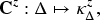
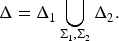











 satisfies
 satisfies
  we have

 was added here. Otherwise, (CInd) would require
  for every formula




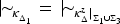 .
.
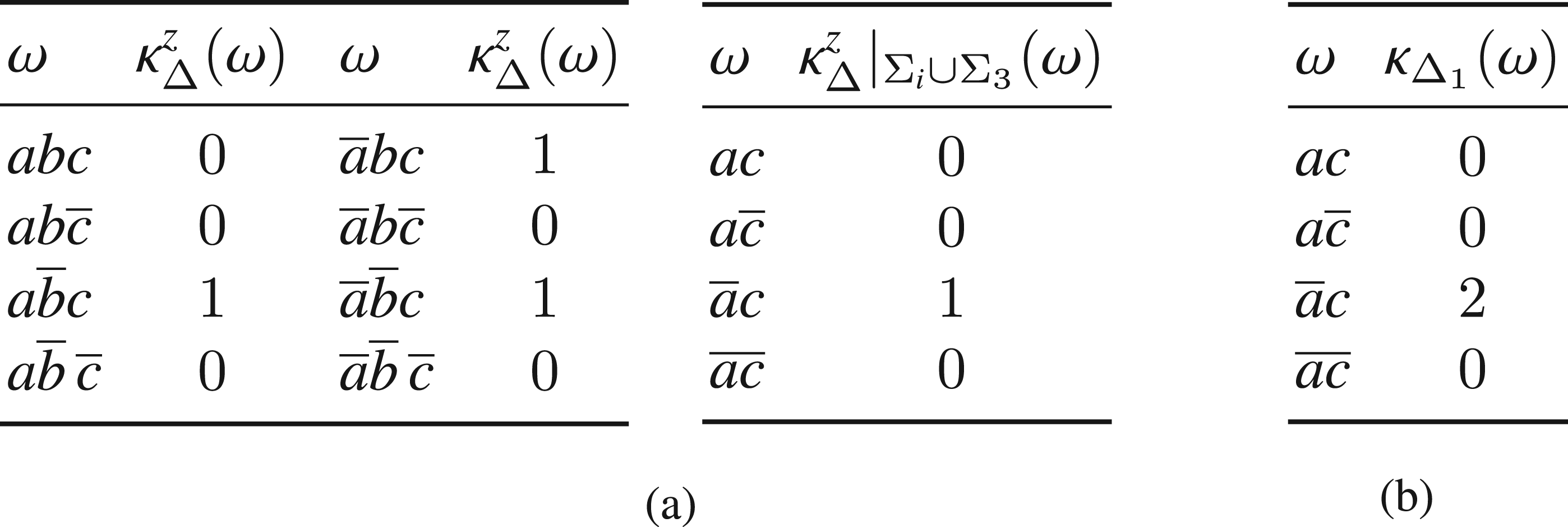
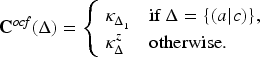







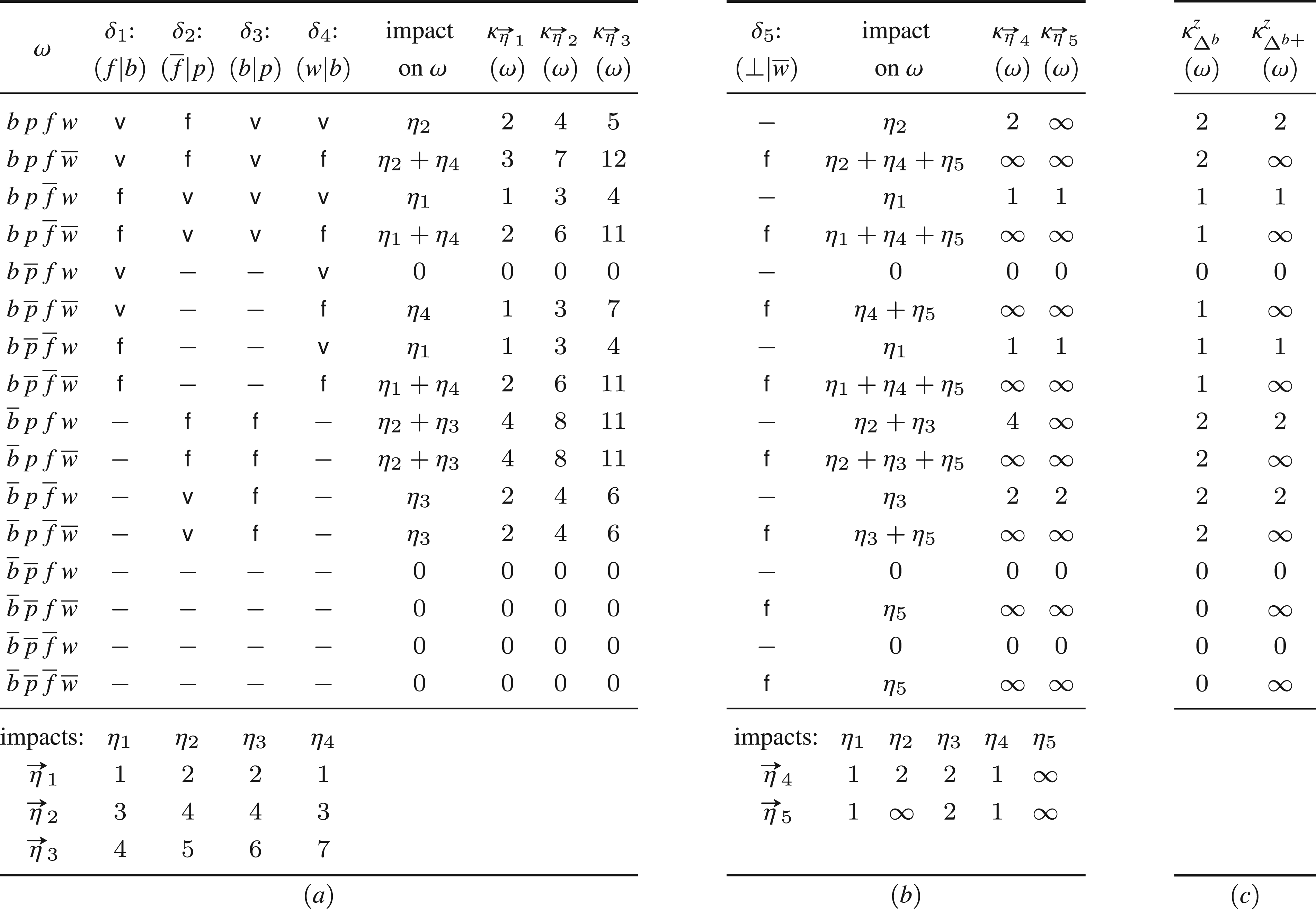
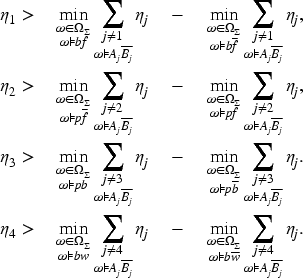

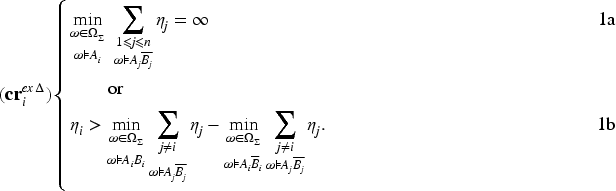






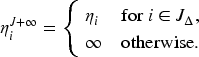

 and
and  derived from
  if
if  for all
  . However, additionally
  allows for further, potentially unintended inferences to be drawn. For example, we have both,
  and
and  , admitting the inferences that flying penguins are usually birds and not birds at the same time, due to the fact that
  and
and  , that is, according to
  and
and  hold.
hold. and
and  , because
 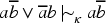 but
but 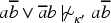 , and
, and  but
but  .
.
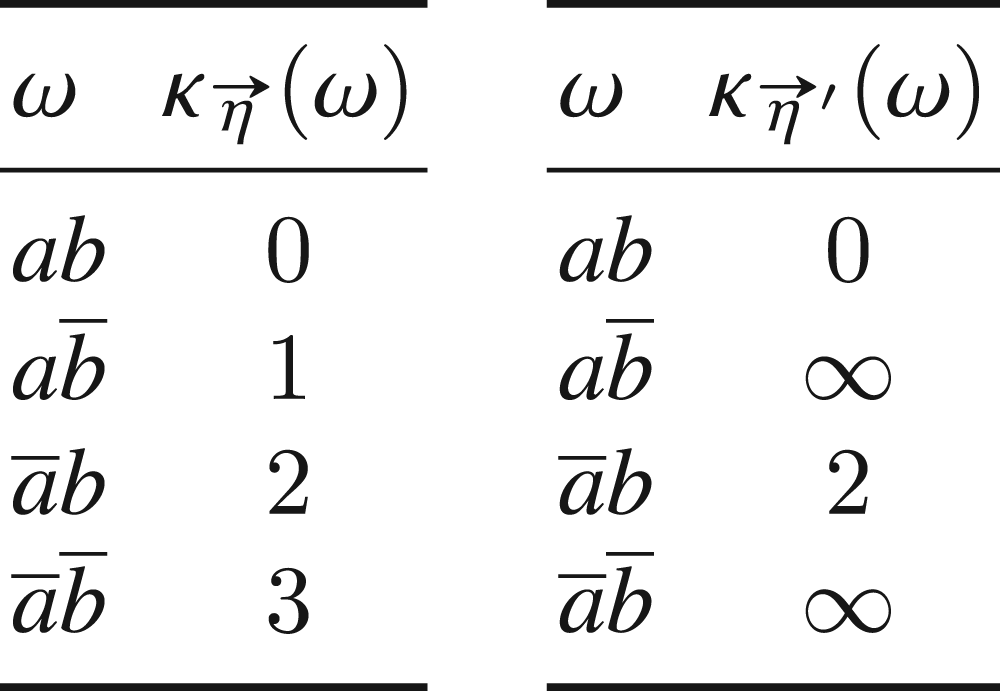













 to
to  . Principally, for every
 is obtained via equation (2) from
 satisfies both (DI) and (TV),
  , rendering many conclusions trivial and unhelpful, and leading to an inductive inference operator that coincides with classical deduction with respect to the material counterparts of all involved conditionals.
 )
) , if:
, if:

 , that is, for all formulas
 . Then either
  . In the case that
  .
. . Such an inference expresses that
  considers
  should only hold if
  where
where 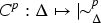 is the system P inductive inference operator (Adams, 1965; Kraus et al., 1990; cf. Example 17).
 satisfies (Classic Preservation) if for all belief bases
  iff
iff  .
. .
. iff
iff 








 is the skeptical inference operator obtained by taking all c-representations of a belief base
  holds iff
  for all c-representations
  , (Beierle et al., 2016a; Haldimann et al., 2024))
 , iff
, iff  holds for all extended c-representations
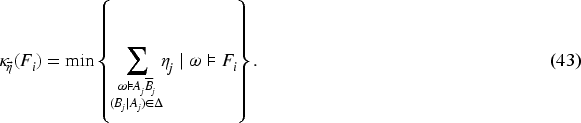
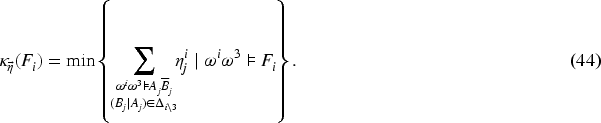
 cannot be represented by an OCF, no corresponding characterization of syntax splitting based on OCFs is applicable to it. Thus, the techniques used in the proofs of the propositions for
  here are different from those used in previous proofs referring to OCF-based characterizations of syntax splittings.
 .
. iff
iff  . By applying the definition of
  we obtain:


 iff
iff  . Again, due to Proposition 35 it suffices to show that
 we have with Lemma 10 that
  , we have
 holds. With Proposition 57 we know that
  . Furthermore, according to (CInd), we know that
  and
and  .
. , iff there is a c-representation
  .
. , iff
, iff  and there is no c-representation
  .
. , iff (i)
  .
. , iff (i)
  .
. , iff (i)
  and there is no extended c-representation
  .
. , iff (i)
  and there is no conservative extended c-representation
  .
. iff
iff  , which is equivalent to showing that there is a conservative extended c-representation
  iff
iff  .
. . We need to show
  iff
iff  . Assume
  . Further, there is a conservative extended c-representation
  . Then there is a selection strategy
  implies
  and thus
  . The other direction is analogous.
 iff
iff  . In the proof of Proposition 63, we have already shown that (1) there is a conservative extended c-representation
  iff
iff  .
. . We need to show
  iff
iff  . In the proof of Proposition 63, we have already shown that (1) there is a conservative extended c-representation
  iff
iff  .
.