




Abstract
Crowdsourcing services and cloud-based design and manufacturing platforms have been combined into an emerging network service model. Due to the diversity and differences of crowdsourcing members in the platform, member optimized selection process is uncertain and discrete, and it is difficult to find the most satisfying solution. In view of this, this article proposed an optimized selection strategy of crowdsourcing members to help users select reasonable crowdsourcing members to form the cooperative team with the most satisfaction. The research steps in this article are as follows. The first step is to analyze the characteristics of crowdsourcing services and crowdsourcing members in the cloud-based design and manufacturing platform. In the second step, according to the characteristics of crowdsourcing members, the evaluation index and target variables of members in the optimized process are proposed, the optimized selection system is established, and the calculation based on each target variable is given. In the third step, the decision-making model is established based on the optimized selection index system. The model decomposes the task-oriented global optimized selection indexes for crowdsourcing members into subtask-oriented local optimized selection indexes, and the gray relational analysis method is used to solve the model. Finally, the effectiveness of the proposed method is verified by taking the crowdsourcing member optimized selection process in the medical product research and development task as an example.
Keywords
Introduction
As an emerging network product development and application service provider (ASP) platform, 1 cloud-based design and manufacturing (CBDM) platform integrates technologies such as virtualization, cloud computing, and cloud services to virtually integrate the development resources of the product life cycle into the resource pool of the platform. All resources are intelligently managed and operated by the platform. 2 It transforms the traditional business model for product design and manufacturing into a service-oriented innovation model. 3 As an innovative collaboration mode of collective online participation, crowdsourcing has been closely integrated with the cloud design and manufacturing platform and widely used in product innovation, education, communication, and medical fields.4,5 CBDM platform provides an open network environment for crowdsourcing service and supports the networked application of crowdsourcing mode through relevant technologies. 6 Meanwhile, crowdsourcing has become an effective operation mode of CBDM. By making full use of idle crowdsourcing resources, it not only provides users with ready-to-access, on-demand, high-quality, and low-cost services in the product development process 7 but also provides innovative development ideas beyond existing knowledge system. 8
In CBDM platform, a large number of crowdsourcing members are virtualized and packaged into crowdsourcing services. The members who provide crowdsourcing services are not limited to companies, institutions, and companies, but more individuals, teams, and studios also become crowdsourcing members. 9 When a user releases product development task in the platform, the platform selects from a large number of crowdsourcing members according to the task requirements, and the selected crowdsourcing members will form a crowdsourcing team to participate in the task. After the task is completed, the crowdsourcing team is disbanded. 6 Therefore, the crowdsourcing model provides collaborative services for users in the way of “on-demand aggregation and dispersion.” Crowdsourcing members provide flexible product development services for users and get corresponding remuneration by sharing knowledge, experience, complementary advantages, and professional skills. However, due to the large number of crowdsourcing members in CBDM platform, there are differences and diversity among these crowdsourcing members. 10 These characteristics make the platform produce many different options in the process of selecting crowdsourcing members, which increases the difficulty of member selection. In addition, users usually want to get satisfactory crowdsourcing services at a lower cost, but crowdsourcing members want to get higher rewards through services. This contradiction between supply and demand makes it difficult for users and crowdsourcing members to reach a consensus in the selection scheme, which hinders the application of crowdsourcing mode in the platform. Therefore, how to select reasonable crowdsourcing members has become a big challenge.
In response to this, this article takes the selection and decision-making process of crowdsourcing members as the research object and proposes an optimized selection strategy to help the platform to optimize the selection of crowdsourcing members. Based on the analysis of the characteristics of members and selection process, the optimized selection index system of crowdsourcing members is established, which includes time, cost, ability, and other indexes. Through the indexes, standards (constraints) are established for the selection process of crowdsourcing members. After generating more member selection schemes, the optimized decision-making model is established according to the index system, and the calculation method is designed to solve the model. In this way, the member selection scheme (crowdsourcing team) with the highest satisfaction of users and crowdsourcing members can be obtained. At the same time, the expectation of both parties can be quantitatively analyzed according to the indexes, and more reasonable crowdsourcing members can be selected under the contradiction between supply and demand. Finally, it realizes the efficient use of crowdsourcing members in the platform and improves the service level and quality of crowdsourcing members.
Related works
In the field of computer-aided product development, CBDM has received great attention in academia and industry. 1 It is a networked innovation model oriented to product development services and an extension of technologies such as cloud computing in product development. 11 As an effective operation mode of CBDM platform, crowdsourcing completes product development tasks by crowdsourcing members of cross-regional, multi-disciplinary, and multi-agent. 12 Due to the diversity, differences and socialization of crowdsourcing members, 10 member selection not only plays an important role in the implementation and development of crowdsourcing mode in CBDM platform but also improves the utilization efficiency of crowdsourcing members in the platform.
At present, some scholars have been working on related issues. Wang et al. 13 completed the selection process of crowdsourcing members through multi-constraint conditions and used multi-linear weight optimization and multi-objective particle swarm optimization (PSO) algorithm to find the optimal solution of Pareto in the selection scheme. In the work of Ardagna et al., 14 in the research of network member optimized selection study, each member is selected from the candidate member set corresponding to the subtask, and finally, all members satisfying the respective subtask constraints are obtained. Xin and Fan 15 took the selection process as the research object, fully considered the influence of different members on collaboration, and proposed a member selection model of compatibility mode which is used to select members who meet the cooperative conditions. Zeng et al. 16 proposed a middleware platform, which takes user satisfaction as the goal to select members and takes quality of service (QoS) as the objective function to meet user’s requirements for crowdsourcing services. Wang et al. 17 designed a distributed crowdsourcing member selection mechanism based on negotiation. Each member was given a tag, which collected the comprehensive information of the member and realized the member selection through the link graph. Tao et al. 18 took time, cost, and quality as constraints for member selection and adopted PSO method to obtain crowdsourcing members meeting user needs. Liu et al. 19 proposed an optimized selection model based on the individual abilities and collaboration capabilities of team members and used the Pareto algorithm to solve the optimized selection model. Qian 20 adapted Web service technology to realize the optimized selection of members in cloud service by analyzing the problem of resource management and sharing in virtual collaborative design environment. Yin et al. 21 established the optimized selection system based on member’s comprehensive ability index and used gray relational analysis method to analyze the process of member optimization selection. Song et al. 22 used a dynamic online member selection strategy to instantly select reasonable crowdsourcing members for crowdsourcing tasks. Wang et al. 23 proposed a selection method combining structural features and attribute features to achieve cross-platform selection of crowdsourcing members and to improve the efficiency and accuracy of selection. Feng et al. 24 used Myers-Briggs-type metrics to analyze member collaboration capabilities and complete network member selection based on it; proposed a cross-functional team (CFT) member selection method based on collaborative information; and solved the member optimized selection model combining with genetic algorithm. Papakostas et al. 25 used indexes of cost, time, and quality as the criteria for selecting collaborative members to improve the efficiency of resource allocation in network manufacturing. Fan et al. 26 proposed a method of team member comprehensive ability assessment, which is based on intuitionistic fuzzy set and network analysis, and solved the problem of team member selection in the cloud-based design service platform. Yin et al. 27 proposed an optimized selection method for team members based on multi-agent, which can quickly and accurately find suitable member by combining the optimized selection index system and multi-agent technology.
In summary, some achievements have been made in the research of crowdsourcing member selection in network environment. However, due to the uncertainty and fuzziness in the selection process of crowdsourcing members in CBDM platform, the existing researches are not perfect in terms of the optimized selection index system and decision-making method of crowdsourcing members and do not adequately consider the performance of members’ comprehensive capabilities. At the same time, there are few researches on the fuzziness and correlation between the optimized selection indexes of crowdsourcing members, which cannot well reflect the complex collaborative network factors under CBDM platform. Therefore, this article proposes an optimized selection strategy, which quantifies and studies all objective variables in the optimized selection indexes by establishing the optimized selection index system of crowdsourcing members. The decision-making model and the corresponding calculation method are used to solve the most satisfying crowdsourcing members’ optimized selection scheme.
Characteristics of crowdsourcing member selection in the CBDM platform
Crowdsourcing member in the CBDM platform
The principal part of crowdsourcing members is generally an individual, but in the CBDM platform, crowdsourcing members also include studios, companies, micro-enterprises, and entrepreneurial teams. They use their free time to get a certain amount of reward on the platform by sharing their professional skills and experience. Therefore, there is a loose-coupling cooperative relationship between crowdsourcing members. 28 In the CBDM platform, the main characteristics of crowdsourcing member are as follows.9,29,30
Difference
The platform virtually centralizes crowdsourcing members scattered in different geographical locations to serve users located in different locations. However, different crowdsourcing members have large differences in cost, time, and professional competence. 9
Diversity
The product research and development process involve multi-disciplinary knowledge such as design, psychology, and mechanics. The composition of crowdsourcing also has the characteristics of interdisciplinary. At the same time, in the same field, a large number of different crowdsourcing members are often gathered. 29
Networked collaboration
Crowdsourcing services are usually in the form of online to offline (O2O). The crowdsourcing members complete the task input and output on the line and carry out specific tasks under the line. In the process of collaboration, an asynchronous collaborative working mode consists of several crowdsourcing members who differ in space and time. 30
Characteristics of crowdsourcing member selection
The selection process of crowdsourcing members in CBDM platform is as follows. First, the platform classifies all members and takes each stage of product lifecycle development as the classification criterion. At the same time, the characteristics and abilities of members are evaluated, and the evaluation data will directly affect the optimized selection results of crowdsourcing members. Second, after the user publishes the task, the platform divides the task into several subtasks. According to the requirements of subtasks, the platform searches several members to provide corresponding services for each subtask and forms a candidate member set of a subtask. Finally, one member is selected from each candidate set and a large number of selection (crowdsourcing team) sets are obtained. At the same time, due to the diversity, differences, and sociability of crowdsourcing members, there will be the following characteristics in the member selection process.10,27
Uncertainty
There are a large number of crowdsourcing members in the platform who can meet the requirements of a certain task. However, these members have great differences in cost, working time, comprehensive ability, and so on, and the service quality and level of each selection scheme (crowdsourcing team) are uneven. As a result, it is difficult to determine whether the selected member is suitable for collaborative tasks with other members. 27
Fuzziness
In the process of crowdsourcing member selection, it is necessary to establish a system of optimized selection index, with several indexes as the criteria or constraints of the member selection process. Among them, the optimized direction of each index is different, and there is a mutual promotion or restriction between the indexes. When there are multiple indexes, the mutual influence between them is more complicated and fuzzier. 10
Optimized selection index system for crowdsourcing members
Optimized selection index system
In CBDM platform, because of the contradiction between supply and demand between users and crowdsourcing members, this will affect the decision-making process of selecting crowdsourcing members. Therefore, it is necessary to establish an optimized selection index system for crowdsourcing members on the basis of user requirements and characteristics of crowdsourcing members. And several optimized selection indexes are taken as constrained conditions for member selection.
Combining the experience of member index selection in other literatures, this article first selects time (T), cost (C), and quality (Q) as the optimized selection indexes.18,25,31 In the contradiction between supply and demand, users expect short-term, low-cost, and high-quality services. Crowdsourcing members expect to receive generous rewards through professional services within a reasonable time, so these three indexes will directly affect the selection process and decision-making of crowdsourcing members. In addition, based on the previous research results, this article also finds that there are a number of qualitative indexes that will indirectly affect the selection and decision-making of crowdsourcing members.6,10 These indexes often reflect the comprehensive capabilities of crowdsourcing members and will further affect the rationality of choosing crowdsourcing members. Meanwhile, these indexes also have interactions with indexes of time, cost, and quality. Therefore, by combining the preliminary research basis with the characteristics of crowdsourcing members, credibility (Cr), collaboration (Co), stability (St), and availability (A) should also be taken as the optimized selection indexes. All optimized selection indexes also contain multiple target variables, as shown in Table 1.
The optimized selection index system.

In the selection and decision-making of crowdsourcing members, a comprehensive trade-off is required for target variables in each of the optimized selection indexes. However, these seven indexes are not completely independent; they interact with each other and have the characteristics of discreteness. In order to obtain the most satisfying solution, it is necessary to achieve maximum equilibrium and optimum of the target variables. In the optimization process, the optimization direction of optimized selection indexes and target variables is shown in Figure 1.

Optimization direction of the index.
Calculation method of optimized selection index
The data of target variables of the optimized selection indexes of crowdsourcing member are processed and stored by the platform. In the calculation of the optimized selection indexes, because of parallel and serial relationship between subtasks, the computing standards will be affected. Therefore, according to the two relationships, the calculation method of the optimized selection indexes will be given below.
In equations (1)–(11), i represents one task, m represents the total number of tasks, j represents one crowdsourcing member, and e represents the total number of crowdsourcing members. There are two ways to obtain the data of target variables. One is directly obtained from the background database of CBDM platform, such as time and cost target variables. Other target variables, such as quality, reliability, and collaboration, are scored by users, experts, and crowdsourcing members on the platform. The five-level making is adopted for marking. The value of five scale is {1, 2, 3, 4, 5}, and each value is {poor, a bit poor, general, a bit good, good}.
Time (T = Te + Tl)
T represents the total time spent by crowdsourcing members to complete subtasks; Te is the average time data of the tasks completed by crowdsourcing members; and Tl is the logistics time data obtained by the platform by calculating the geographical distance. The T can be calculated as follows


Cost (C = Cs + Cl)
C is the total cost that users need to pay. The target variables of C include the following: crowdsourcing member service fees, Cs, and logistics cost, Cl. Among them, Cs represents the cost that users need to pay to each crowdsourcing member and Cl represents the fees that need to be paid if the logistics is generated

Quality (Q = (Qp + Qe + Qs)/N)
Q is an important index of the comprehensive capabilities to measure comprehensive ability of crowdsourcing members; Qp is the average quality data of the tasks completed by crowdsourcing members; Qe is the average value of data of service satisfaction of crowdsourcing members; Qs is the average value of data of service quality of crowdsourcing members; and N is the number of times the member participates in the task. The Q index can be calculated as follows

Credibility (Cr = (Crt + Crs + Crc)/N)
Cr is an important index for judging security and reputation of crowdsourcing members; Crt is the average of reliability data of the completed tasks of crowdsourcing members; Crs is the average of the confidentiality data of the completed tasks of the index members; Crc is the average value of credit evaluation data of the completed tasks of crowdsourcing members; and N is the number of times the member participates in the task. The Cr index can be calculated as follows

Collaboration (Co = [n(Cot + Cos + Con)]/NCo)
Co is to measure the collaborative ability of crowdsourcing members in a networked environment; Cot is the communication capability evaluation data among crowdsourcing members; Cos is the ability evaluation data of crowdsourcing members in the platform to help other members solve problems through professional knowledge; Con is the number of times a crowdsourcing member has participated in a task on the platform; NCo is the number of times a crowdsourcing member is selected in the platform; and n is the number of times a crowdsourcing member is selected in a single task. The Co can be calculated as follows


Stability (St = K/NSt)
St is the stability that crowdsourcing members can provide continuous services; P is the number of times a crowdsourced member still completes a task when something unexpected happens; and NSt is the total number of accidents. The St can be calculated as follows


Availability (A = Ta/Tc)
A is the working status of crowdsourcing member for a period of time; Tc is a fixed work cycle, such as 7 or 30 days; and Ta is the time of service provided by crowdsourcing members during the work cycle. The A can be calculated as follows


In summary, the optimized selection index system of crowdsourcing member is composed of 7 optimized selection indexes and 15 target variables, that is, Opt [T, C, Q, Cr, Co, St, A]. The overall goal of the optimized selection strategy of crowdsourcing members is to look for the most satisfying member selection scheme. The specific goal is that the member selection plan should meet the seven constraint conditions: low cycle, low cost, high quality, high reliability, high collaboration, high stability and availability.
Decision-making model for crowdsourcing member optimized selection
Technical framework of decision-making model
The technical route of the decision-making model is as follows: after the task is decomposed into several subtasks, the crowdsourcing members satisfying the requirements are retrieved around the subtasks, a set of the candidate crowdsourcing member for each subtask is formed, and the appropriate crowdsourcing member is selected from the set. The technical framework of the decision-making model consists of three components: (1) task decomposition: decomposing complex tasks into several simple subtasks, 32 (2) crowdsourcing members retrieval: finding qualified candidate crowdsourcing members for each subtask,33,34 and (3) optimized selection of crowdsourcing members.
Task decomposition and crowdsourcing member retrieval are the preparatory phases for the optimized selection of crowdsourcing members. And the optimized selection of crowdsourcing members is also the focus of this article. After forming a set of the candidate crowdsourcing members, a large number of crowdsourcing member selection schemes can be obtained, and an optimized selection strategy is needed to complete the selection and decision-making of the crowdsourcing members: first, establishing an optimized selection of crowdsourcing member index system, and second, establishing decision-making model for process of optimized selection. The decision-making model decomposes the task-oriented global optimized selection indexes for crowdsourcing members into subtask-oriented local optimized selection indexes. Finally, the decision-making model is solved by gray relational degree analysis method, and the most satisfying selection scheme of crowdsourcing member is obtained.
The mathematical description of the crowdsourcing member optimized selection process for CBDM platform is as follows. After the user proposes task t, task U is decomposed into several subtasks by the platform, and the subtask set is represented as U = {ST1, ST2, …, ST
n
}, where ST
n
represents the nth subtasks of task U. The platform then searches for appropriate candidate crowdsourcing members according to the crowdsourcing member retrieval technology and forms a candidate crowdsourcing member set. The candidate crowdsourcing member set corresponding to each subtask is represented as CMS = {CMS1, CMS2, …, CMS
m
}, where CMS
m
represents the candidate crowdsourcing member set corresponding to m subtask. The crowdsourcing members in each crowdsourcing member set are represented as CM, and the corresponding members of each crowdsourcing member set are represented as CMS
m
= {
The selection and decision-making process of crowdsourcing members can be regarded as a multi-objective optimization problem consisting of five types of optimized selection indexes. The target variables can be regarded as the decision-making vector of the optimized selection indexes, and each type of optimization index is composed of several different target variables. The decision-making model is a composite of target variables in the optimized selection indexes. In summary, the decision-making model of optimized selection of crowdsourcing members for CBDM platform is shown in Figure 2.

Decision-making model for process of optimized selection.
Model solving
In the product research and development process of CBDM platform, there are serial and parallel relationships between subtasks. When there are multiple subtasks, the relationship between subtasks is more complicated, and the selection scheme of crowdsourcing members is also complicated. Therefore, in the model-solving process, the relationship between all subtasks needs to be analyzed first. By analyzing the relationship between subtasks, number of subtasks, and crowdsourcing members,
Step 1: Establish an evaluation index matrix
According to the optimized selection index system, the evaluation index matrix
Step 2: Normalize the data of the matrix
The optimized selection indexes of crowdsourcing members include both qualitative and quantitative types. According to the nature of the indexes, they can be divided into benefit-based indexes and cost-based indexes.
19
Among them, the larger the value of the benefit-based index, the closer it is to the idealized solution, and the smaller the value of the cost-based index, the closer it is to the idealized solution. Normalize elements in the
Benefit-based index (the larger the value, the better the target)
When

When

Cost-based index (the smaller the value, the better the target)
When

When

In equations (12)–(15), i = 1, 2, …, n; j = 1, 2, …, n; and
Step 3: Calculating the coefficient of gray relational analysis
The coefficient of gray relational analysis is the relationship between indexes of candidate member selection schemes and optimal indexes. According to the benefit-based index and the cost-based index, supposing that there is a crowdsourcing member i in the crowdsourcing member set CMSi and calculating the relation coefficient

where
Step 4: Determining the relative weight value of the index
The relative importance between the optimized selection indexes is different, and the weight value can be obtained by weight calculation or direct empowerment. 37 At the same time, the gray weighted relational degree of member selection scheme needs to be calculated by combining the relational coefficient with the relative weight of the index. Therefore, the relative weight of each index is calculated by a general method. The solving process of the method is as follows: first, the judgment matrix of the index is constructed, and second, the relative weight of the index is calculated according to the judgment matrix. The detailed calculation process is as follows.
The judgment matrix to construct optimized selection index is

where

Equation (18) is the calculation method of the numerical normalization process in the matrix



The relative weight of the optimized selection index
Step 5: Relative weight consistency check
Here,



In equations (22)–(24),
Step 6: Calculating the gray weighted relational degree
The gray weighted relational degree of selection scheme is calculated by the standard relational degree equation combined with the relative weight of index. It represents the degree to which all selection schemes are close to the most satisfying scheme

where
Step 7: Scheme relational degree ranking
All crowdsourcing member selection schemes are sorted by

where
Case study
This section will examine the effectiveness of the proposed method by taking the selection and decision-making process of crowdsourcing member in the medical analgesia pump development task as a case. The case study environment is prototype CBDM platform. The platform is based on ASP.NET technology system and Browser/Server mode and supported by the MySQL database and JAVA language. The platform can provide basic functions such as task decomposition, members retrieval, and index evaluation.
After the user puts forward the development requirements, the CBDM platform centrally manages and controls the user requirements, development tasks, crowdsourcing members and workflow. The selection and decision-making of crowdsourcing members is accomplished through task decomposition, crowdsourcing member retrieval, and adoption of optimized selection strategies.
Preparatory phases for optimized selection
The user submits the development task of the medical analgesia pump to CBDM platform. The development task is decomposed into 10 subtasks by analyzing user demand: sketch design, appearance design, ergonomic design, structural design, reliability analysis, prototype production, mold design, process planning, manufacturing, and product maintenance.
Through the analysis of the relationship between subtasks and the combined product life cycle development process, the relationship between the 10 subtasks and the workflow sequence are shown in Figure 3(a).
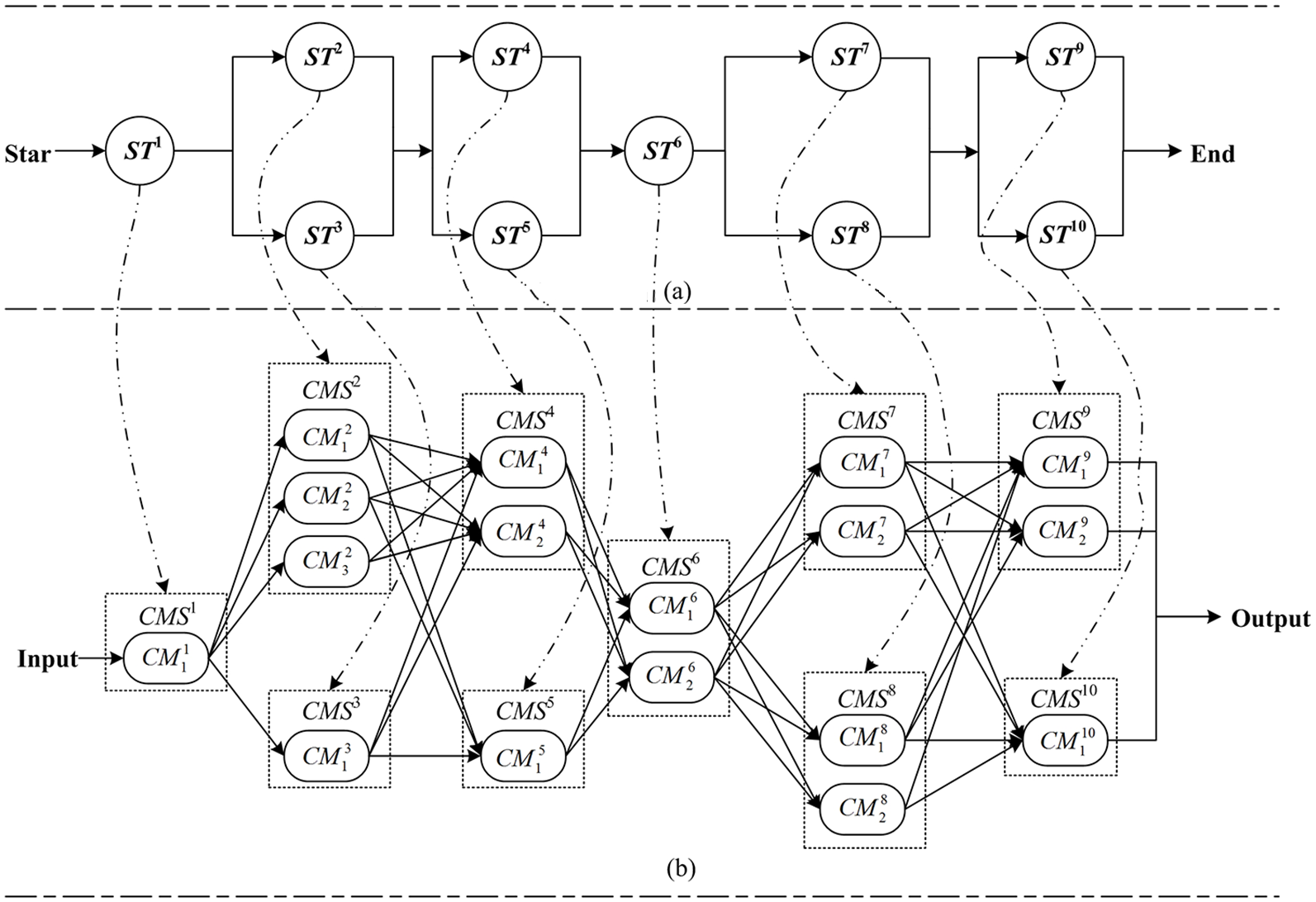
Crowdsourcing membership selection process: (a) relationship between subtasks and the workflow; (b) crowdsourcing member selection schemes.
In Figure 3(a), The subtasks ST2 and ST3, ST4 and ST5, ST7 and ST8, and ST9 and ST10 are in a parallel relationship. The directed arrows represent input and output directions of information between subtasks, and the workflow order of subtasks. In Figure 3(b), the crowdsourcing member sets corresponding to the 10 subtasks are CMS = {CMS1, CMS2, CMS3, CMS4, CMS5, CMS6, CMS7, CMS8, CMS9, CMS10}. The CBDM platform finds crowdsourcing members who meet the demands of subtasks through the retrieval function. A total of 17 crowdsourcing members are retrieved for the subtasks, as shown in Table 2. In Figure 3(b), according to
Candidate crowdsourcing members in CBDM platform.
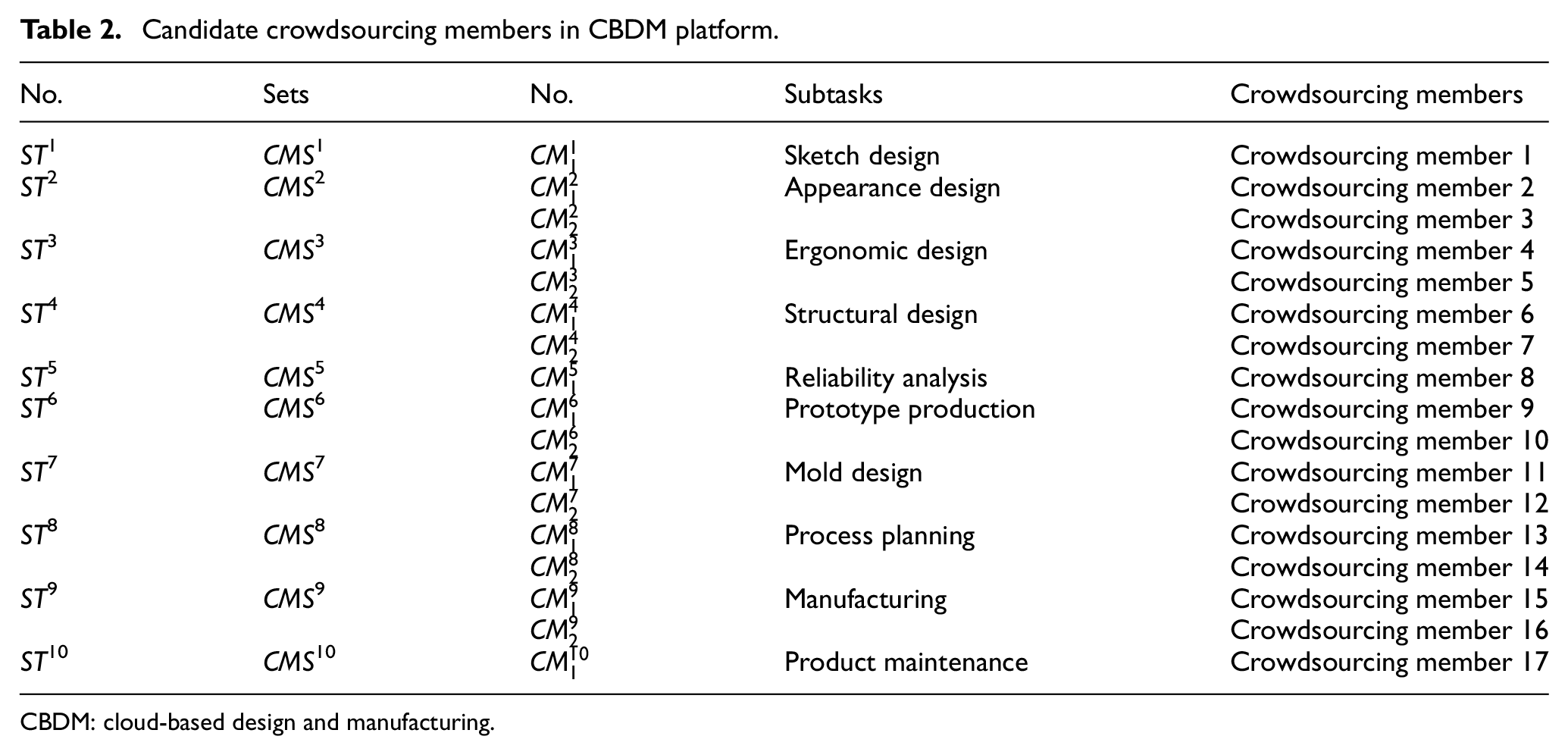
CBDM: cloud-based design and manufacturing.
Building optimized selection index system
The CBDM platform provides users with evaluation tools. The original data of each target variable are provided to the platform by users and crowdsourcing members. Among them, the original data unit of the target variable of T is h, and the unit of C is yuan. The original data of other target variables were scored using a five-level making. Since the data unit of each target variable is not uniform, the data of original target variables need to be normalized, and the processed data are beneficial for subsequent calculations.
Then, the normalized data of target variables are brought into equations (1)–(11) to calculate the crowdsourcing member optimized selection index data. And an optimized selection index system for crowdsourcing members is established, and the index parameters are shown in Table 3.
Optimized selection index parameters for crowdsourcing members.

Decision-making model and solution process
To solve the case decision-making model according to the method in section “Model solving,” a specific process is followed.
Step 1. The index parameters of crowdsourcing members in Table 3 are transformed into evaluation index matrix. The evaluation index matrix can be constructed as follows

Step 2. The original data of each index weight are obtained by expert making. Relative weight of index is calculated by equations (18)–(21). The relative weights of each index are as follows

Step 3. The evaluation index matrix is normalized by equations (12) and (14), and then the coefficient of gray relational analysis is calculated by equation (16), where
Step 4. The consistency of relative weight values is checked by equations (22)–(24). The calculated CR values are as follows

Condition CR < 0.1 has been met, so the relative weight of each index is reasonable.
Step 5. The gray weighted relational degree is calculated according to equation (25), and then the approximation values of 128 crowdsourcing member selection schemes and the most satisfying schemes are obtained, as shown in Table 4.
Gray weighted relational degree value of 128 schemes.
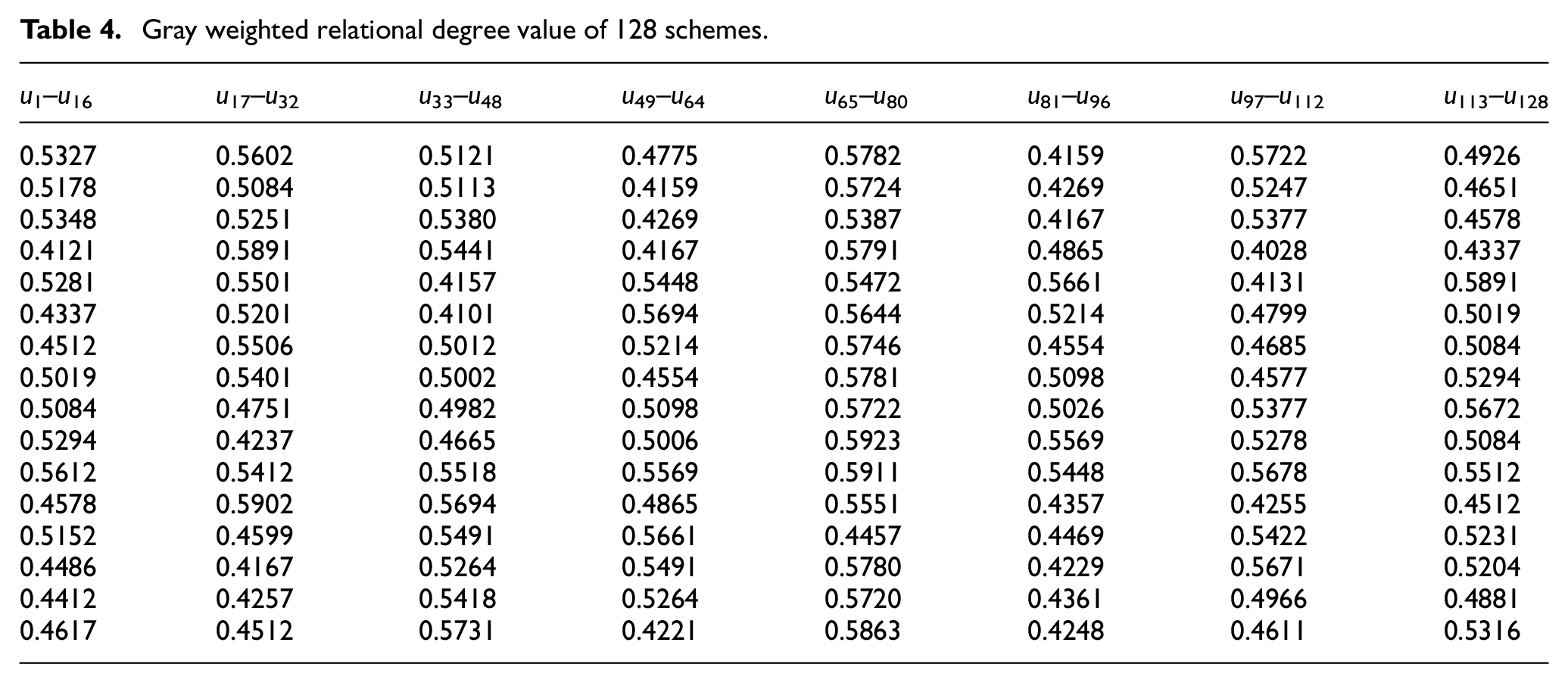
In Table 4, the crowdsourcing member selection results of scheme u1 are as follows: {crowdsourcing member 1, crowdsourcing member 2, crowdsourcing member 4, crowdsourcing member 6, crowdsourcing member 8, crowdsourcing member 9, crowdsourcing member 11, crowdsourcing member 13, crowdsourcing member 15, crowdsourcing member 17}. The crowdsourcing team consists of these 10 members, and 128 schemes are ranked by this analogy. However, ST1, ST5, and ST10 each have only one candidate crowdsourcing member. Therefore, the three crowdsourcing members (crowdsourcing member 1, crowdsourcing member 8, and crowdsourcing member 17) are included in all 128 schemes.
The relational degrees of 128 schemes were ranked according to equation (26), and the most satisfying scheme is the no. 74 scheme. The calculation results are as follows


The optimized selection strategy of crowdsourcing members of the u74 scheme is {
The CBDM platform selected 10 members to participate in tasks.

CBDM: cloud-based design and manufacturing.
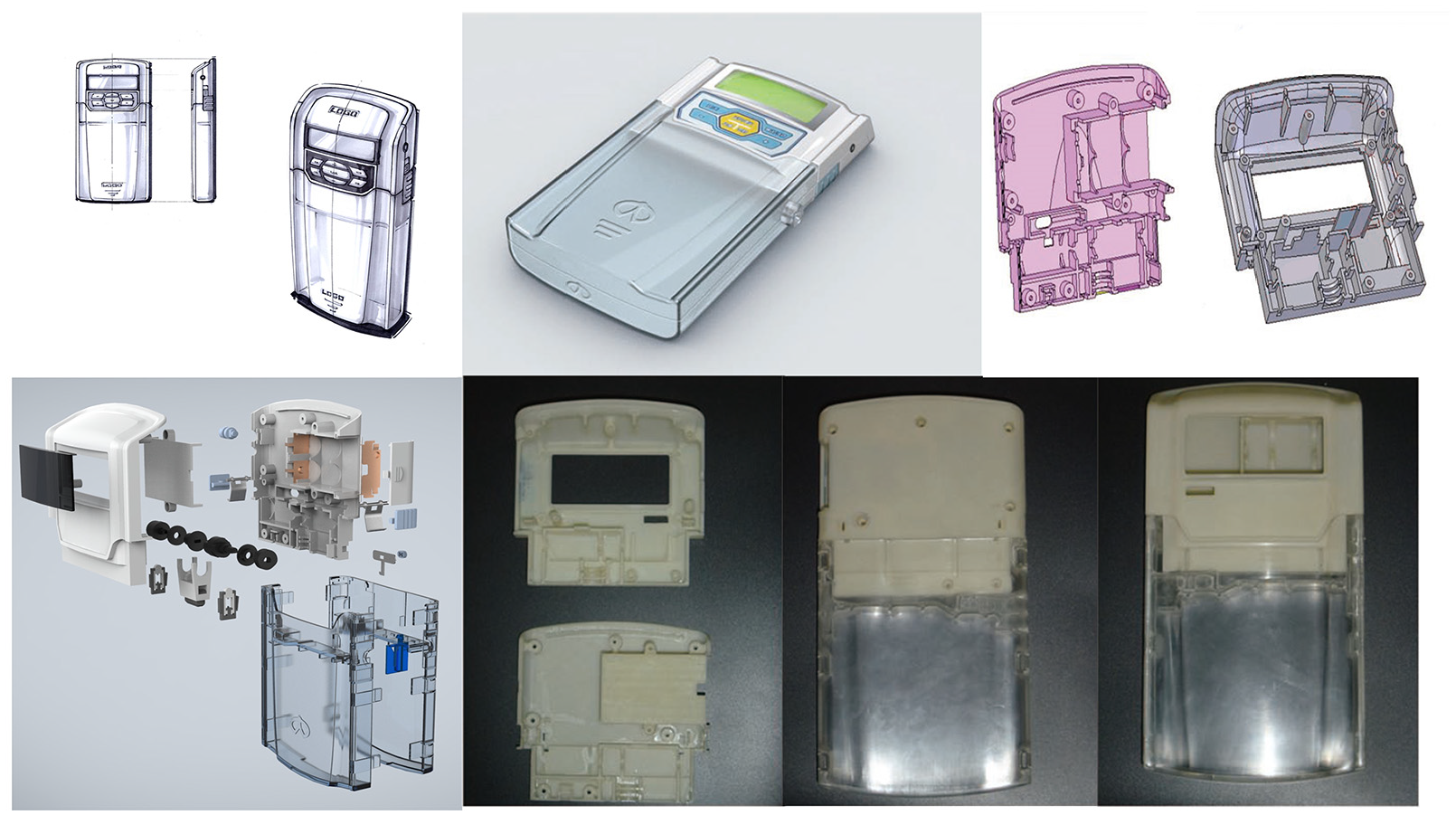
Part of the case development process.
Case analysis
According to the above method, the case task obtains the optimized crowdsourcing member selection scheme in the platform. In order to further verify the effectiveness of the proposed method, this section will compare and analyze the different selection schemes obtained by the method proposed in this article and the method in Liu et al. 19 Liu et al. 19 proposed an optimized selection model based on the individual abilities and collaboration capabilities of team members and used Pareto algorithm to solve the optimized selection model.
However, it is not easy to directly compare the advantages of the two methods because of their great differences in optimized selection index, application environment, and the types of crowdsourcing members. Therefore, the different selection schemes can be obtained in application cases according to the two methods. This section will compare and analyze different schemes from three aspects: time, cost, and QoS. The time and cost data are obtained through Table 3. The QoS is obtained by calculating the average value of five indexes such as quality, reliability, and collaboration. The original data of each index are also obtained from Table 3. In addition, the above two schemes will also be compared with the scheme with the smallest ui value.
The comparison schemes are as follows: u74 (maximum value of ui), u38 (minimum value of ui), and uother (the selection scheme obtained by the method in Liu et al. 19 ). The crowdsourcing members of each scheme are as follows:
u 74: crowdsourcing member 1, crowdsourcing member 3, crowdsourcing member 4, crowdsourcing member 6, crowdsourcing member 8, crowdsourcing member 10, crowdsourcing member 11, crowdsourcing member 13, crowdsourcing member 16, crowdsourcing member 17.
u 38: crowdsourcing member 1, crowdsourcing member 2, crowdsourcing member 5, crowdsourcing member 7, crowdsourcing member 8, crowdsourcing member 9, crowdsourcing member 12, crowdsourcing member 13, crowdsourcing member 15, crowdsourcing member 17.
u other: crowdsourcing member 1, crowdsourcing member 3, crowdsourcing member 5, crowdsourcing member 7, crowdsourcing member 8, crowdsourcing member 10, crowdsourcing member 12, crowdsourcing member 14, crowdsourcing member 16, crowdsourcing member 17.
The comparison data of time, cost, and QoS of the three schemes are shown in Table 6 and Figure 5.
Comparison of three crowdsourcing member selection scheme data (data without physical units).


Comparison of three crowdsourcing member selection scheme data.
All three schemes meet the needs of users and are feasible, but the performance of each scheme in terms of time, cost, and QoS has some differences, as shown in Figure 5. The comparative analysis of u74 and u38 is as follows: scheme u74 is superior to scheme u38 in terms of time, cost, and QoS. The comparative analysis of u74 and uother is as follows: in terms of service quality, scheme uother is slightly better than scheme u74, but the gap is small. In terms of time and cost, scheme u74 is better than scheme uother, which has a large gap in cost. Therefore, from the perspective of comprehensive comparison, the selection result of scheme u74 is better than that of scheme uother. This shows that the method proposed in this article has more advantages in the optimized selection process of crowdsourcing members.
However, there are still some limitations and uncertainties in the case study. First, the optimized selection process of crowdsourcing members is faced with a single task. In the multi-tasking complex situation, the method proposed in this article is still insufficient. Second, this research did not give full consideration to the dynamic change of crowdsourcing members. Therefore, further research is needed in these two aspects. Although there are some deficiencies about the proposed methods, the overall train of thought is feasible.
Conclusion and future work
Overall, the proposed method has solved the problem of crowdsourcing member optimized selection in the CBDM platform. By establishing an optimized selection index system and decision-making model, the optimized selection strategy problem is transformed into a multi-objective optimization problem. And the gray relational degree method is used to solve the discrete scheme set, which helps users and crowdsourcing members find the most satisfying scheme. Finally, the effectiveness of the proposed method is verified in a case study.
Compared with other methods, this method solved the contradiction between supply and demand in the process of crowdsourcing member selection. At the same time, it provides a basis for quantitative analysis of qualitative indexes in the process of crowdsourcing member optimized selection. In the future work, a large-scale case study is needed to further validate and improve the method proposed in the article.
Footnotes
Handling Editor: James Baldwin
Declaration of conflicting interests
The author(s) declared no potential conflicts of interest with respect to the research, authorship, and/or publication of this article.
Funding
The author(s) disclosed receipt of the following financial support for the research, authorship, and/or publication of this article: This work was supported in part by the National Key Research and Development Program of China (No. 2017YFB1104205) and the National 111 Project (No. B13044).
