



Abstract
Introduction:
An acute shortage of pathology and clinical laboratory workforce, worsened by the pandemic, has created ethical concerns, notably unequal access to pathology services. To date, efforts to alleviate these shortages have primarily focused on outreach and increasing the profession’s visibility. However, a crucial aspect that has received insufficient attention is the retention of the more tenured workforce, a strategy that could directly impact the availability and equitable distribution of services.
Objective:
To assess the workplace presence and loyalty of a tenured workforce to the company compared to that of early-career workforce in lab medicine.
Design:
We analyzed a cross-sectional web-based survey to compare the tenure time at the current workplace (loyalty) and unexpected sick days taken (workplace presence) between the tenured workforce (ages 51-65) and the early-to mid-career workforce (ages 21-50). Additional characteristics such as job fulfillment and physical and emotional wellness were also assessed.
Results:
The study demonstrated that more senior laboratorians showed higher loyalty with significantly longer tenure at their current workplace at 20.5 years, compared to their younger cohort, who stayed a median of 3.0 years (P < .001). Moreover, the more senior professionals also displayed significantly higher workplace presence (P < .001), with fewer unexpected sick or mental days taken (0) compared to their counterparts (2). Finally, the 2 cohorts had no significant statistical differences in self-perceived levels of job fulfillment and physical or mental wellness.
Conclusion:
Instead of focusing mainly on high school and college recruitment, the study results suggest providing additional resources and efforts to retain the existing workforce. Specifically, successfully retaining tenured and more experienced laboratory professionals concurrent with current efforts may be a better strategy for closing the current workforce shortage gap in clinical lab medicine.
Keywords
Key Points
What Is Already Known on This Topic: There is an acute shortage of pathology and clinical laboratory workforce, worsened during the pandemic.
What This Study Adds: Senior laboratorians exhibit significantly higher loyalty and workplace presence compared to their counterparts, with longer tenure and fewer unexpected sick days.
How This Study Might Affect Research, Practice, or Policy: Retaining tenured and experienced laboratory professionals is crucial for addressing workforce shortage in clinical laboratory medicine.
Introduction
How best to fill the gap between the demand for pathology laboratory services with a limited number of qualified laboratory professionals (LP) is a challenge faced by many hospitals and reference laboratories across the globe. There is an acute shortage of pathology and clinical laboratory workforce, as was evident during the most recent pandemic in 2019, which required our attention. 1 A study published by the American Society for Clinical Pathology highlighted this workforce crisis, revealing that 16 out of the 17 sub-disciplines in laboratory medicine have double-digit vacancy rates. The core laboratory department had the highest overall vacancy rate at 18.0%, while all other sub-disciplines, except cytogenetics (7.0%), also reported double digit vacancies. 1 Moreover, according to the analysis of the U.S. Bureau of Labor Statistics, the situation is projected to worsen. At the current rate, ~3 job openings will exist for every new graduate entering the profession for the next decade. 2 The potential impact of the shortage on the quality and timeliness of diagnostic services can raise ethical concerns about patient care and safety. Moreover, the unequal access to pathology services, particularly in underserved communities during the pandemic, also has important policy implications for healthcare equity. In addition, the challenges faced by the existing pathology workforce, including increased workload and burnout, also have important ethical considerations related to professional well-being.3,4 The hospital administrators, policymakers, and medical directors need to respond to this critical issue to ensure the timely and accurate diagnosis of disease conditions, which directly impacts patient care and health outcomes. While efforts to expand the pipeline of professionals through recruitment by improving the profession’s visibility at college and medical campuses have shown some progress, there has been little focus on retaining and rehiring the more experienced workforce as a way to fill the gap.1,5-8
Laboratory Service Utilization
The growing demand for clinical laboratory services has been well documented, from the improved access resulting from the Patient Protection and Affordable Care Act (PPACA) passed in 2010, to the increased visibility the laboratory workforce received during the pandemic – both of which have contributed to the rising demand for laboratory services. Additionally, many technical advancements in the next generation of molecular testing have made laboratory tests more sensitive and affordable, leading to increased demand. 9 The traditional solution and approach to overcoming the workforce shortage has been to request more funding for training programs and to improve professional visibility on college and medical campuses. 8 One study looked into incorporating more pathology training into medical schools and during clerkship rotations. 6 Another discussed removing the perceived stigma associated with pathology and lab medicine to improve recruitment. 7
Of course, these are all excellent ways to help the profession grow and meet the increasing demand. However, the approach to reducing the lab shortage needs to be multi-prone. While improving funding and recruitment efforts are important long-term solutions, we also need immediate, short-term strategies. An equally important part of the equation includes retention, specifically retaining and rehiring the more experienced laboratory professionals who may have been laid off in previous consolidation. There is a perception and stereotype that the tenured workforce is less dependable because of their health and may have higher absenteeism. However, growing evidence from general workforce literature suggests that this workforce may be more reliable and loyal to their employer than their younger counterparts. 10 This trend, which has been observed across a few industries, raises the possibility that the same dynamics may apply within the pathology and laboratory medical workforce – a gap we aim to address in this study.
Workforce Characteristics
Today, employees often work with colleagues from many different generations. At 1 end are the baby boomers (those born 1946-1963) and the Generation X (those born in 1963-1981). On the other side are the Millennials (those born in 1981-1996) and the Generation Z (those born in 1996 and beyond). 11 According to studies done by researchers from the Kellogg Business School, the millennials and Gen Z (younger cohorts or groups) are driven by work-life balance and finding meaning in a career. Many are entrepreneurial and do not fear leaving their current employers for a better-suited professional purpose and greater job satisfaction elsewhere. 11 As a cohort or group, they are more likely to job-hop and are less committed to their employer than previous generations. 12 In 1 workplace survey, 21% of millennials reported having changed jobs in the past year alone, and more than 66% are planning to leave their current company within the next 5 years. 13 According to a recent laboratory turnover survey reviewing 23 hospitals’ staffing patterns conducted by the College of American Pathologists, the median 3-year turnover is 18.2%. 14 The study concluded that the high turnover can undermine patient safety and operational efficiency for these hospitals and health systems. 14
In another analysis, the cost of employee turnover at hospitals represented 3.4% to 5.8% of the facility’s $500 million annual operating budget.14,15 The high turnover rates are costly and can create a more serious issue for the healthcare sector. Hospitals and laboratories that are not staffed adequately can incur a higher annual cost due to the need for temporary staffing, overtime pay for existing employees, and the expenses associated with recruiting and training new staff. Moreover, inadequate staffing can lead to poorer patient health outcomes, as overworked healthcare professionals may be more prone to error due to mental and physical exhaustion. 16
Contrary to common perception, studies from the general labor market have shown that the more tenured workforce is more loyal to their employers. They tend to stay with the organization and do not job-hop. Moreover, they have a strong work ethic and lower absenteeism.10,17,18 While general labor trends can offer useful context, they do not always translate directly to specialized sectors. LP operates in a highly technical, regulated, and often high-pressure environment with turn-around deadlines, which may influence retention differently than the broader labor categories. For example, in cytopathology, both cytotechnologists and pathologists are required by the Clinical Laboratory Improvement Amendments (CLIA) to pass annual slide proficiency tests in addition to fulfilling continuing education (CE) requirements. 19 These strict regulatory demands can create barriers to retention, especially for experienced professionals who may find the recurring testing burdensome or stressful. This level of scrutiny and certification is not typically present in most general labor sectors, making direct comparisons less reliable. In this study, we hypothesized that the more tenured laboratory professionals are more loyal and demonstrate stronger workplace presence than their younger counterparts. We proposed that retaining or rehiring these individuals should be part of the multi-prong approach to address the workforce shortage issue faced by clinical laboratories across the country.
Methods
Hypotheses were tested in a cross-section survey sent out to laboratory professional participants obtained from professional organizations and through a snowball sampling technique. Initially, survey invitations were disseminated to the laboratory community via email lists sourced from professional organizations and alumni networks. The list included randomly selected members from the American Society for Clinical Pathology (ASCP), the American Society for Cytopathology (ASC), and the American Society for Clinical Laboratory Science (ASCLS). Additional announcements were posted on relevant forums and listservs affiliated with these organizations. To enhance participation, recipients were encouraged to share the survey link with other laboratory professionals, which is a widely used approach known as “snowball sampling.” Snowball sampling can maximize survey participation and is effective in collecting information from pathology and laboratory participants. 4 The data collection protocols were reviewed and approved by the University’s Institutional Review Board. The inclusion criterion is being part of the clinical laboratory industry. All survey participants who failed to complete at least 50% of the survey were removed from the study sample.
Measures
The cross-sectional survey collected personal demographic data (sex, age, education, and ethnicity), workplace information (country, lab setting), and work-characteristic details (role in the lab, last title at work, years in the industry, and years at the current workplace). The data on tenure with the current employer were collected by multiple choice with a time range where the median number was used for each participant. To explore aspects of the workplace presence, participants were asked to self-report the number of days they were absent from work in the last 6 months. We selected a 6-month recall period for absenteeism based on a review or prior studies examining workforce presence, particularly among healthcare professionals such as nurses. While some studies have used a 12-month recall period, others have opted for 6 months to strike a balance between minimizing recall bias and capturing a meaningful timeframe for comparison. The 6-month period is long enough to reflect patterns of absenteeism that are not overly influenced by short-term fluctuations, yet short enough to reduce the likelihood of inaccurate self-reporting due to memory limitations. 20 Finally, self-perceived wellness indicators, including job fulfillment, physical wellness, and mental/emotional well-being, were also noted. The wellness indicator data were obtained by asking participants to rate their job fulfillment, physical wellness, and mental and emotional levels with Likert scales from 1 to 4, with 1 being not well and 4 being very well. For example, physical wellness was measured by asking “how fulfilling do you find your current career” with response options ranging from “no fulfillment” (1) to “very fulfilling” (4). These items were modified and adapted from previously published studies that have employed single-item measures to assess subjective wellness domains in healthcare and workforce populations. 21 While multiple item scales are often used to measure wellness constructs, single-item measures have been shown to be valid and reliable. 21
Data Analysis
In order to compare the loyalty and workplace presence between the early to mid-career and tenured laboratory workforce, age 50 was used as a cut-off between the 2 cohorts since this was used in other healthcare studies.22-25 Those between 21 and 50 at the time of the survey were included in the early to mid career LP cohort, called Cohort 1. Those between 51 and 65 were placed in the tenured workforce cohort, called Cohort 2. Given the small sample size and the non-normal distribution, the non-parametric of the independent sample t-test was used. The Wilcoxon rank sum or the Mann-Whitney test was performed to compare the tenure time between the 2 cohorts to determine if there is a difference in the levels of workplace loyalty (the number of years with current employer).
For workplace presence, the Wilcoxon rank sum (Mann-Whitney test), was also used to determine if there was a significant difference in the number of unexpected call-out days taken between the early to mid-career and the tenured laboratory cohorts in the past 6 months. In addition to absenteeism or workplace presence, wellness indicators, including self-perceived job fulfillment, physical wellness, and mental/emotional well-being, were also evaluated across the 2 cohorts using the same statistical test. The statistical analyses were performed using IBM SPSS statistical software, version 29.
Results
Study Sample
Two hundred and twenty-five laboratory professionals, including pathologists, technologists, technicians, and assistants, participated in the survey (Table 1). Of these, 191 were between the ages of 21 and 50 (Cohort 1) and 34 were between 51 and 65 years old (Cohort 2). Cohort 1 included both female (53.4%) and male (44.5%) participants who were highly educated, with nearly everyone having attained at least a 4-year college degree or higher. They were also predominantly minority population (64.4%), working in the United States and Canada (96.9%), and currently employed in either commercial labs (35.6%), community hospitals (21.5%), or academic facilities (36.6%). Similarly, the laboratory professionals in Cohort 2 were also well educated with at least a college degree (100%). They mostly worked in the United States and Canada (97.1%). However, the cohort consisted of a higher number of female (73.5%) and White (85.3%) participants, and LPs working in academic or teaching hospitals (64.7%).
Demographics and Sample Characteristics.

Abbreviation: LP, laboratory professionals.
P < .05.
Loyalty and Workplace Presence of Laboratory Professionals
The years the laboratory professionals stayed with their current employer were used as a proxy indicator for loyalty to the company (Figure 1). Cohort 2 showed a higher loyalty with a significantly longer tenure at their current workplace (20.5 years). In contrast, Cohort 1 stayed with the current employer for a median of 3 years (z = 6.81; P < .001).

Loyalty to current employer by career cohort.
The number of unexpected sick days taken within the last 6 months was used as a proxy indicator for an employee’s workplace presence. When compared (Figure 2), Cohort 2 also displayed stronger workplace presence with significantly fewer median sick days (0) compared to Cohort 1 (2.0) within the past 6-month period (z = 5.42; P < .001).
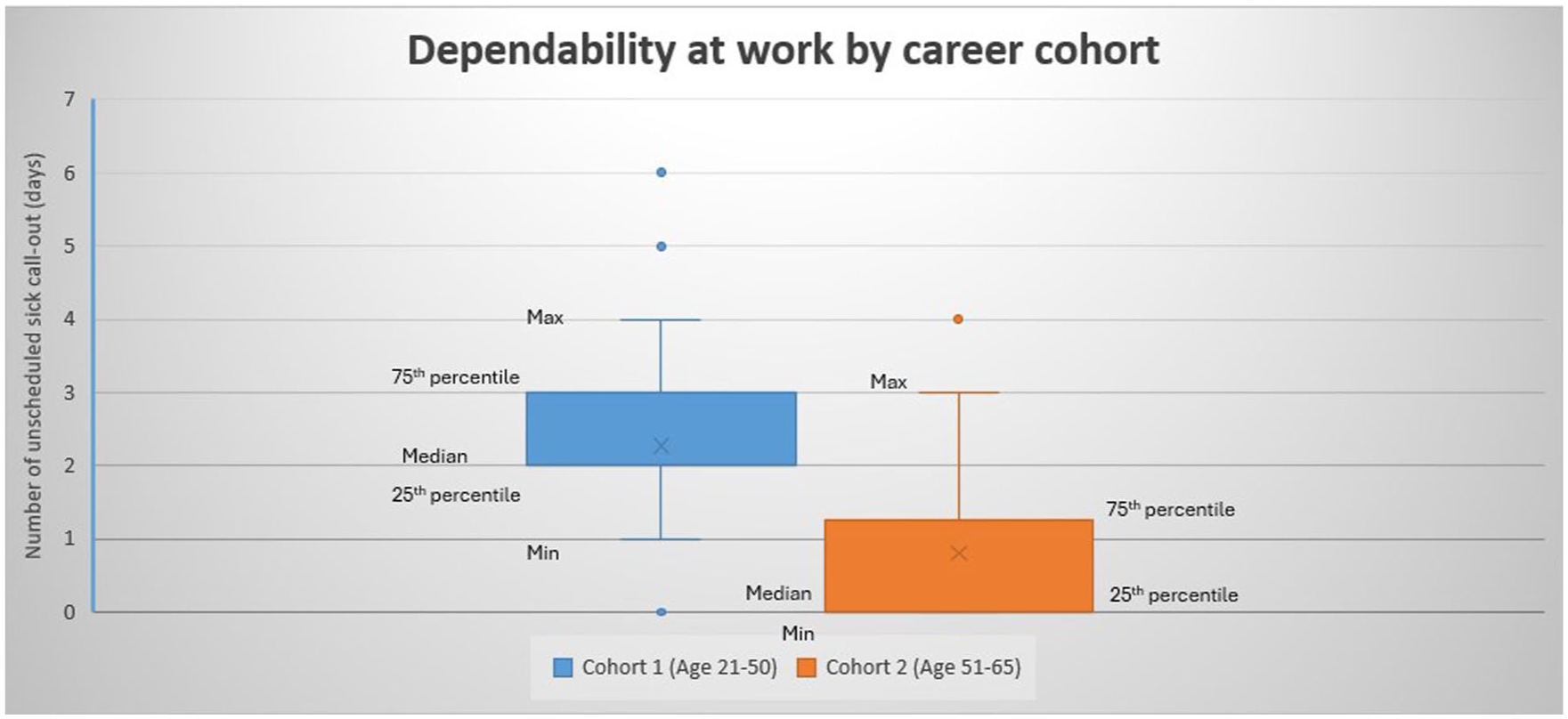
Boxplot of workplace presence by career cohort.
Other Wellness Indicators
In addressing perceptions that tenured LPs are more physically and emotionally vulnerable when compared to their counterparts, the median and average scores from the job fulfillment, physical wellness, and mental and emotional wellness domains were assessed between the 2 groups. The median scores from all 3 domains were the same for both cohorts, at 3.0 for job fulfillment, 2.0 for physical wellness, and 2.0 for mental and emotional wellness. In comparing the mean (SD) for the cohorts, they also showed very similar results (Table 2). The job fulfillment average (SD) for Cohort 1 was at 3.17 (0.98), compared to 3.10 (1.16) for Cohort 2. Similarly, the physical wellness mean (SD) for Cohort 1 was at 2.28 (0.65) versus Cohort 2 at 2.17 (0.60). Finally, the average score (SD) for the mental and emotional wellness scale was 2.27 (0.67) for Cohort 1 and 2.06 (0.64) for Cohort 2.
Job Fulfillment, Physical Wellness, and Mental and Emotional Wellness by Career Cohort.

Discussion
This study explores age-related differences in absenteeism and tenure among laboratory professionals, with a focus on the potential value of retaining older employees. The analysis confirmed the Bureau of Labor and Statistics (BLS) finding that tenured workers are a highly loyal and consistently present workforce.26,27 In addition to these retention trends, our study examined wellness indicators and found no significant differences across the 2 groups, suggesting concerns about declining physical and mental capabilities in tenured laboratory professionals may be overstated.
As expected, the Cohort 2 LPs in the survey showed strong organizational loyalty and firm commitment to their employers, which often translates into longer tenure and consistent attendance. This is consistent with studies that have been conducted over the years. The data on the U.S. workers’ tenure for 2022 showed that the older workforce, on average, stayed 9.8 years with their current employer, significantly higher than the 4.1 years for the general public.26,27 A study on the nurse workforce also found a similar trend: the older registered nurse (RN) cohort is more likely to stay with the current health system than younger RNs. 25 Nonetheless, turnover incurs additional costs to the employer for the time needed to search, interview, and train a new laboratory professional, not to mention the loss of experience and productivity. Moreover, there is an ethical implication to the potential loss of this experienced workforce, as it raises ethical concerns about maintaining institutional knowledge and ensuring continued high-quality diagnostic services.
One key finding was the workplace presence of the tenured laboratory cohort. Cohort 2 has significantly fewer call-outs, which is crucial for maintaining the timely turnaround of critical clinical and pathology tests that clinicians and patients rely on. While the difference in absenteeism may appear modest – approximately half a day per month per employee – its impact is magnified in high-volume laboratory settings. For instance, in a cytology reference lab with 30 cytologists, each screening around 100 cases/day, a half-day absence per person equates to 1500 unscreened cases/month. Given that many specimens are time-sensitive and require a 1 to 2 days turnaround, even small increases in absenteeism can lead to delays in diagnosis and increased anxiety for patients. This is especially critical in cases such as a breast fine needle aspiration biopsy, where a patient may be anxiously awaiting results to determine whether a lump is benign or malignant, or a thyroid FNA where timely diagnosis can guide urgent clinical decisions. The loss of this group can increase strain on remaining laboratorians, potentially affecting the timeliness and accuracy of results, which has direct ethical implications for patient care. Studies in the scientific literature have suggested that more experienced workers are more resilient, experience lower burnout, are more resourceful, and are more engaged at work.28,29 One reason for the higher resiliency is the extensive job-related skills and self-management resources that experienced lab professionals have built over their long careers. These include experiences with managing conflicts, juggling multiple competing priorities, and meeting the department’s turnaround and productivity expectations.22,28,29
Another interesting finding is that there were no significant statistical differences between the 2 cohorts in self-perceived levels of job fulfillment and physical or mental wellness, suggesting that age is not a primary factor in laboratory professionals’ sense of job fulfillment, physical wellness, or mental wellness.
Public Health Priority and Policy Implications for Retaining Experienced Workforce
It is a public health priority to offer policymakers recommendations that address laboratory workforce challenges. These recommendations must ensure an adequate current and future workforce ready for both routine healthcare needs and unexpected crises like the recent pandemic. One potential response to the current shortage is to incentivize experienced laboratory professionals to work until or beyond traditional retirement. It is also important to note that laboratory work can be repetitive and physically demanding, similar to the musculoskeletal strain experienced by other healthcare professionals, such as registered nurses who work directly with patients and frequently suffer neck and back injuries. In laboratories, neck injury is the most common complaint, particularly among those who work with microscopes.30,31 Our study found that the more experience cohort not only demonstrated greater loyalty and fewer absences, but also reported comparable physical and emotional wellness to their younger counterparts. This suggests that concerns about physical decline may be overstated and that, with proper support, experienced workers can continue to contribute meaningfully to the workforce. Though management must still be proactive in providing periodic ergonomic assessments and appropriate equipment to mitigate strains on the body. The repetitive nature of pathology and clinical laboratory testing can have a cumulative wear and tear effect on the body, making it especially important to provide optimal ergonomic support for those who have been in the industry for many years.
Another critical point is to reduce mandatory overtime requirements. In commercial laboratories that are short on LPs, it is not uncommon for employees to have compulsory overtime on weekends in addition to working 40-hour work week. 32 This can contribute to burnout and absenteeism across all age groups. Our study found that the more senior professionals had significantly fewer callouts and comparable physical and emotional wellness to their counterparts, suggesting that with support, this group can maintain consistent workplace presence despite the overtime on weekends. Offering flexibility and reducing mandatory overtime may help preserve this liability, allowing employees, regardless of age, to rest and regroup.
A final recommendation is to leverage the loyalty and experience of the tenured workforce through structured mentorship programs. Our data show that older laboratory professionals tend to stay longer with their organizations, making them ideal candidates to mentor early-career employees. Pairing new hires with experienced workers during their first year can facilitate better integration into the health system and organizational culture.25,33 This is especially valuable in academic hospital settings, where mentorship can support professional development, including navigating complex NIH grant applications. Given that the average age of NIH-funded scientists is now 51, the expertise of the experience professional cohort should be actively cultivated. 34
While the study is significant, there are limitations to the findings. First, the study relied on self-reported questionnaires, which may be subject to recall bias. Second, the study used snowball sampling, which may introduce selection bias. Third, there is an over-representation of Blacks or African Americans in Cohort 1 and an under-representation in Cohort 2. Fourth, the use of medians and time ranges to determine tenure with an employer is not ideal and can detract from the findings that are obtained. Lastly, the small sample size of Cohort 2 (n = 34) may introduce confounding factors (Supplemental Material).
Conclusion
The study found that more experienced laboratorians demonstrated higher workforce stability, characterized by significantly longer tenure than their counterparts. Furthermore, the more experienced professionals also exhibited greater workplace presence, as indicated by fewer unexpected sick or mental health days taken. These results reveal a significant disparity in workplace presence and loyalty between the 2 groups, highlighting the ethical implications of their potential loss for maintaining diagnostic quality and timely lab reports equitably. Therefore, our findings revealed an urgent need for policy interventions that go beyond recruitment and instead strongly suggest prioritizing targeted retention strategies for the tenured laboratory professionals as 1 potential, high-yield approach to mitigate the current workforce shortage and ensure equitable patient care.
Supplemental Material
sj-docx-1-pat-10.1177_30502098251415113 – Supplemental material for Addressing the Clinical Workforce Shortage by Retaining the Tenured Laboratory Professionals
Supplemental material, sj-docx-1-pat-10.1177_30502098251415113 for Addressing the Clinical Workforce Shortage by Retaining the Tenured Laboratory Professionals by Paul Z. Chiou and Lotte Mulder in Sage Open Pathology
Footnotes

Ethical Considerations
The study was approved by the Institutional Review Board of the University (2021002231).
Author Contributions
PZC conceptualization, survey design, sample collection, data analysis, methodology, original draft writing, review, and editing, LM resources, conceptualization, review, and editing. All authors have read and agreed to the published version manuscript. PZC accepts full responsibility for the finished work and/or the conduct of the study, has access to the data and controlled the decision to publish.
Funding
The authors received no financial support for the research, authorship, and/or publication of this article.
Declaration of Conflicting Interests
The authors declared no potential conflicts of interest with respect to the research, authorship, and/or publication of this article.
Supplemental Material
Supplemental material for this article is available online.
References
Supplementary Material
Please find the following supplemental material available below.
For Open Access articles published under a Creative Commons License, all supplemental material carries the same license as the article it is associated with.
For non-Open Access articles published, all supplemental material carries a non-exclusive license, and permission requests for re-use of supplemental material or any part of supplemental material shall be sent directly to the copyright owner as specified in the copyright notice associated with the article.
