



Abstract
As the demand for aesthetic procedures grows and techniques evolve rapidly, many aesthetic surgeons face challenges in accessing structured, up-to-date learning resources. Plastic Surgery Home (
Introduction
The field of aesthetic plastic surgery has grown by leaps and bounds over the past decade, driven by evolving patient expectations, advances in minimally invasive techniques and the global surge in demand for cosmetic procedures. As aesthetic practice becomes increasingly sophisticated and competitive, the pressure on surgeons to maintain clinical excellence and remain current with emerging trends has also increased. Continuing professional development (CPD) has become a regulatory obligation as well as a professional necessity for aesthetic surgeons around the globe. 1
Despite this growing need, access to high-quality, specialty-focused CPD remains inconsistent. Traditional modes of continuing education, such as conferences, printed journals or workshops, are often limited by cost, geography, or time constraints. Furthermore, relevant digital resources are scattered across platforms, lacking curation or clear pathways for structured learning. Aesthetic plastic surgeons, particularly those in practice, may find it difficult to consistently engage with credible, up-to-date educational content tailored to their scope of practice.
Recognising this gap, a curated, open-access online platform that serves as a centralised CPD resource; Plastic Surgery Home, was designed for plastic surgeons, with dedicated content relevant to aesthetic practice (Figure 1). This report explores the features of this platform and how such a platform can bridge the digital divide in aesthetic surgery education, support self-directed lifelong learning and complement traditional CPD pathways.
Readers Can Scan the QR Code to Access the Home Page of www.plasticsurgeryhome.in .
Educational Challenges for the Aesthetic Surgeon
While the need for ongoing education in aesthetic surgery is widely acknowledged, access to structured, specialty- specific CPD remains uneven. Specialists often navigate a fragmented educational landscape, relying on a patchwork of sources such as isolated surgical videos on YouTube, subscription-based journals and in-person conferences. For many, especially those in solo or private practice or those working in resource-limited and remote settings, these limitations present a significant barrier to continuous learning.
Barriers to access to high-quality CPD materials include:
Paywalls restricting journal access Limited awareness of upcoming aesthetic events and workshops Geographic isolation from academic institutions or teaching centres Time constraints for attending live events
Ideally, high-quality CPD in aesthetic surgery should be accessible, relevant and regularly updated to reflect evolving techniques and best practices, improving patient care overall. However, the above-mentioned barriers hinder a surgeon’s ability to stay current and engaged.
Social media platforms and private groups offer informal learning opportunities, though they lack standardisation, peer review or archiving, which are important attributes for a structured CPD. Coupled with these, the lack of a unified, curated digital space for aesthetic plastic surgery education creates inefficiencies in the learning system. This gap reflects the need for a purpose-driven, user-centred digital CPD ecosystem that aggregates relevant content and also simplifies access while encouraging ongoing engagement. It is within this context that the website ‘Plastic Surgery Home’ was conceived as a practical and scalable solution to bridge the digital divide in aesthetic surgery education.
Innovation
Plastic Surgery Home was created to function as a dynamic learning ecosystem with curated content to support lifelong learning and CPD with an additional focus on aesthetic practice.
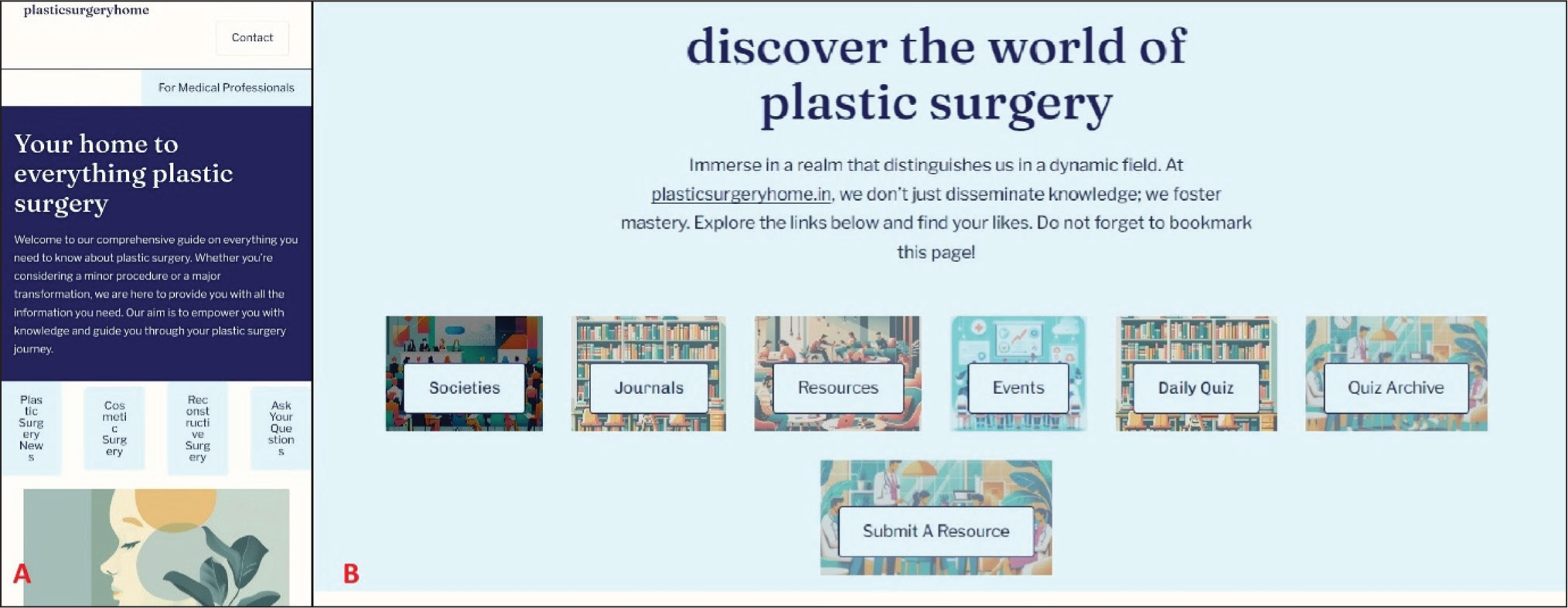
The Home landing page contains informative material on different aspects of plastic surgery, primarily geared towards non-specialists and lay people. This landing page forks into a ‘For Professionals’ section of the website, which houses multiple CPD-enabling resources directed towards specialists (Figure 2). These include:
Societies: A comprehensive directory of global plastic surgery and aesthetic surgery societies, including ISAPS, ASAPS, IPRAS, and region-specific organisations. This allows users to identify training opportunities, fellowships, and educational resources offered by professional bodies worldwide. Resources: This section aggregates open-access books, procedural videos from vetted YouTube channels, and links to websites that offer focused content on aesthetic techniques, ranging from rhinoplasty and blepharoplasty to facial rejuvenation and body contouring. These are hand-picked for quality and relevance, providing users with trusted material in one place. Journals: The platform lists both open-access and subscription-based journals in aesthetic and reconstructive surgery, facilitating quick access to recent advances, surgical pearls and expert opinions. This also encourages regular academic reading and critical appraisal habits. Events Around You: A dynamic feed of global academic events, aesthetic workshops, symposia and webinars. Updated regularly, this section ensures that users remain informed about educational opportunities. Subscribers also receive this content through an automated newsletter via mail, minimising the need to search for event details across multiple sources.
(A) Home Page of www.plasticsurgeryhome.in As Seen on a Mobile Screen. (B) Screen Capture of the Resource Page Showing Different Categories of Resources Available.
Together, these components offer a multidimensional CPD environment supporting surgeons in enhancing their skills and staying abreast of global trends. By addressing accessibility, relevance and engagement, Plastic Surgery Home fills a void in the CPD infrastructure for aesthetic plastic surgeons.
Discussion
The benefits of Plastic Surgery Home lie in its adaptability to the learning needs of aesthetic and reconstructive surgeons across different stages of their careers, ease of access and specialty relevance. This platform is intentionally designed to support a broad spectrum of users, ranging from residents in training to senior aesthetic practitioners, each with distinct CPD goals. For trainees, it complements textbook learning with high-quality surgical videos, open-access journal links and information on fellowships and virtual events. Mid-career and senior surgeons use it to stay updated on academic meetings, innovations and new publications, with newsletters and event feeds that keep them connected without extra effort. Educators also benefit by using the platform as a trusted resource hub to share with trainees, saving time and ensuring consistency in teaching materials.
Advantages Over Traditional CPD Modalities
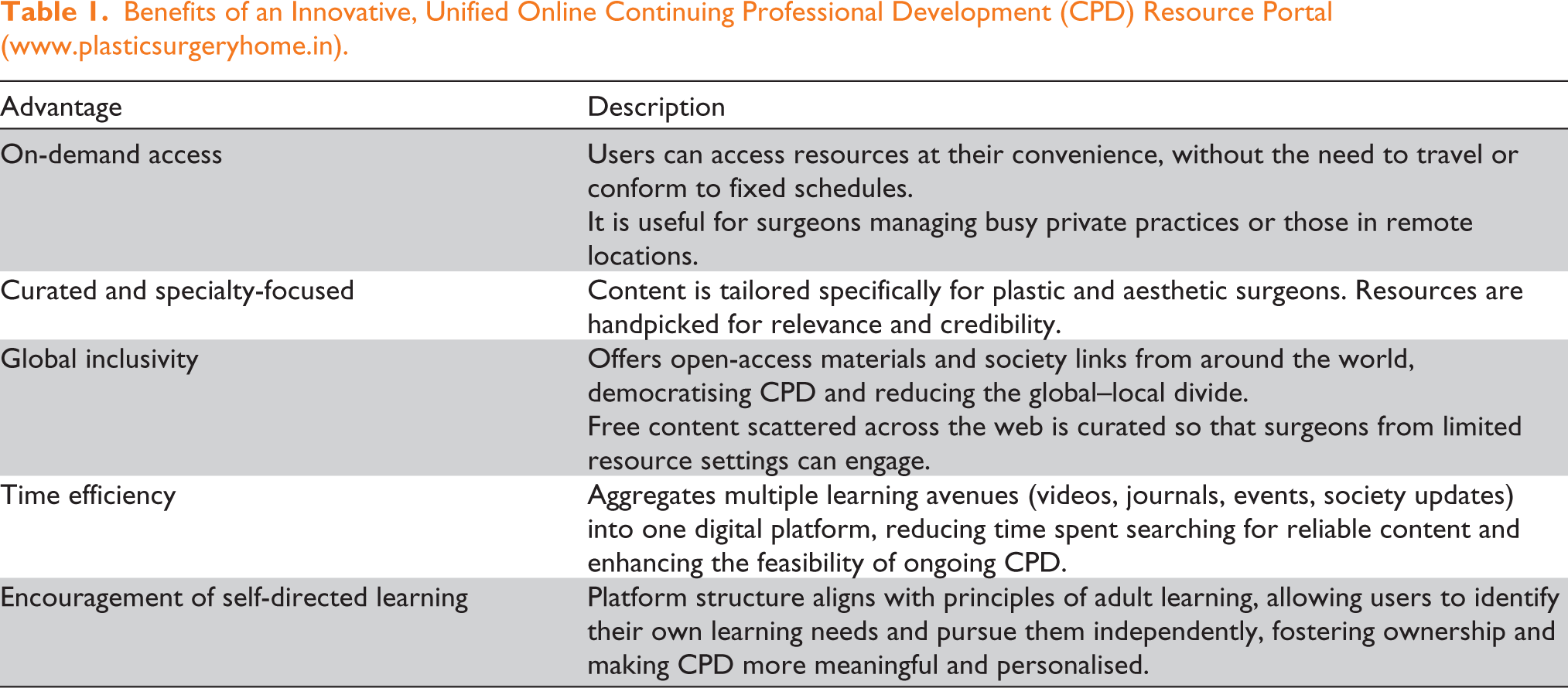
Traditional CPD modalities such as conferences, hands-on workshops, printed journals and peer discussions remain vital in aesthetic surgery education, although they are often constrained by factors such as geographic access, high costs, limited time availability and inconsistent frequency. The platform Plastic Surgery Home provides several advantages (Table 1).
Benefits of an Innovative, Unified Online Continuing Professional Development (CPD) Resource Portal (
Future Directions
The goal is to evolve the platform into a more interactive, personalised and globally integrated educational ecosystem. Key areas of future development include integrating with artificial intelligence (AI)-enabled learning assistants and creating custom GPT-based modules (trained on aesthetic surgery textbooks and literature) that could potentially enable users to query complex topics, receive concept explanations or even generate quiz-based self-assessments. 2 This will add a layer of interactivity and foster deeper conceptual understanding. Developing specialty CPD pathways, like ‘Facial Aesthetics’, ‘Body Contouring’ or ‘Non-Surgical Techniques’, with structured content progression, recommended readings and evaluation checkpoints, mirroring micro-credentialling models. Establishing collaborations with aesthetic societies and academic departments to provide accredited CPD modules, joint webinars or endorsed content. Developing discussion boards, case-of-the-month forums or mentorship matching could create a thriving virtual community to help build professional networks. Dedicated mobile app deployment to facilitate mobile-first learning and improve accessibility and user engagement, particularly for younger or on-the-go learners. 3
Conclusion
As aesthetic surgery continues to evolve in complexity, scope and global reach, the need for accessible, relevant and dynamic CPD resources becomes critical. Plastic Surgery Home addresses this need by offering a curated, open-access digital platform tailored to the educational and professional demands of aesthetic plastic surgeons across all stages of their careers.
Footnotes
Authors’ Contributions
Devi Prasad Mohapatra conceptualised the manuscript, developed the platform described, drafted the commentary, and approved the final version for submission. Nisha Kalra helped in drafting the manuscript and approved the final version for submission.
Declaration of Conflicting Interests
The authors declared no potential conflicts of interest with respect to the research, authorship and/or publication of this article.
Funding
The authors received no financial support for the research, authorship and/or publication of this article.