



Abstract
Research on design neurocognition – the cognitive and neural processes involved in designing – could radically reshape the study and practice of design. However, the field faces challenges in its nascent stages. I unpack these and explore focus areas to spotlight neurocognition topics for Designing and outline pathways towards long term impact. This reveals a rich set of topics spanning theoretical development and practical applications across the short, medium, and long term. Key areas include extending design cognition theory, establishing explanatory and predictive relationships, increasing ecological validity through methodological innovation, and exploring how research can tangibly shape current design practice. Three pathways could lead to sustainable long term impact: (1) developing mechanisms for integrated and systematic theory building; (2) engaging with neurotechnology development; and (3) strengthening the theory-practice connection. Together, these themes provide context for the design neurocognition conversation at Designing, and I invite researchers across the community to contribute.
Design neurocognition refers to the set of interacting cognitive and neural processes involved in designing, which are shaped by context and evolve over the course of the design process. Research in this area has the potential to radically reshape the way we study and practice design. It offers new ways of understanding design activities and developing methods and tools, providing deeper insights into why designers (and users) behave as they do and highlighting new leverage points for improving performance and processes. In the long term, it opens up avenues for fundamentally different ways of designing – using neurotechnologies to augment human capabilities and democratise access to designing across broader demographics. However, to realise its full potential, the field needs to address a number of significant challenges in its nascent stages.
In this Editor Perspective, I unpack these challenges and explore focus areas for design neurocognition research. My aim is two-fold: (1) to summarise the field’s current status and spotlight future neurocognition topics for Designing; and (2) to outline forward-looking pathways for sustainable long term impact. To do this, I will explore the latest advancements in the literature and community perspectives on the field’s future, building up a picture of the short, medium, and long term priorities. I hope this will give researchers working in the field a sense of how their work fits into the design neurocognition dialogue at Designing. I also hope to inform others who may be new to the field, and wondering how this research could connect with their own work.
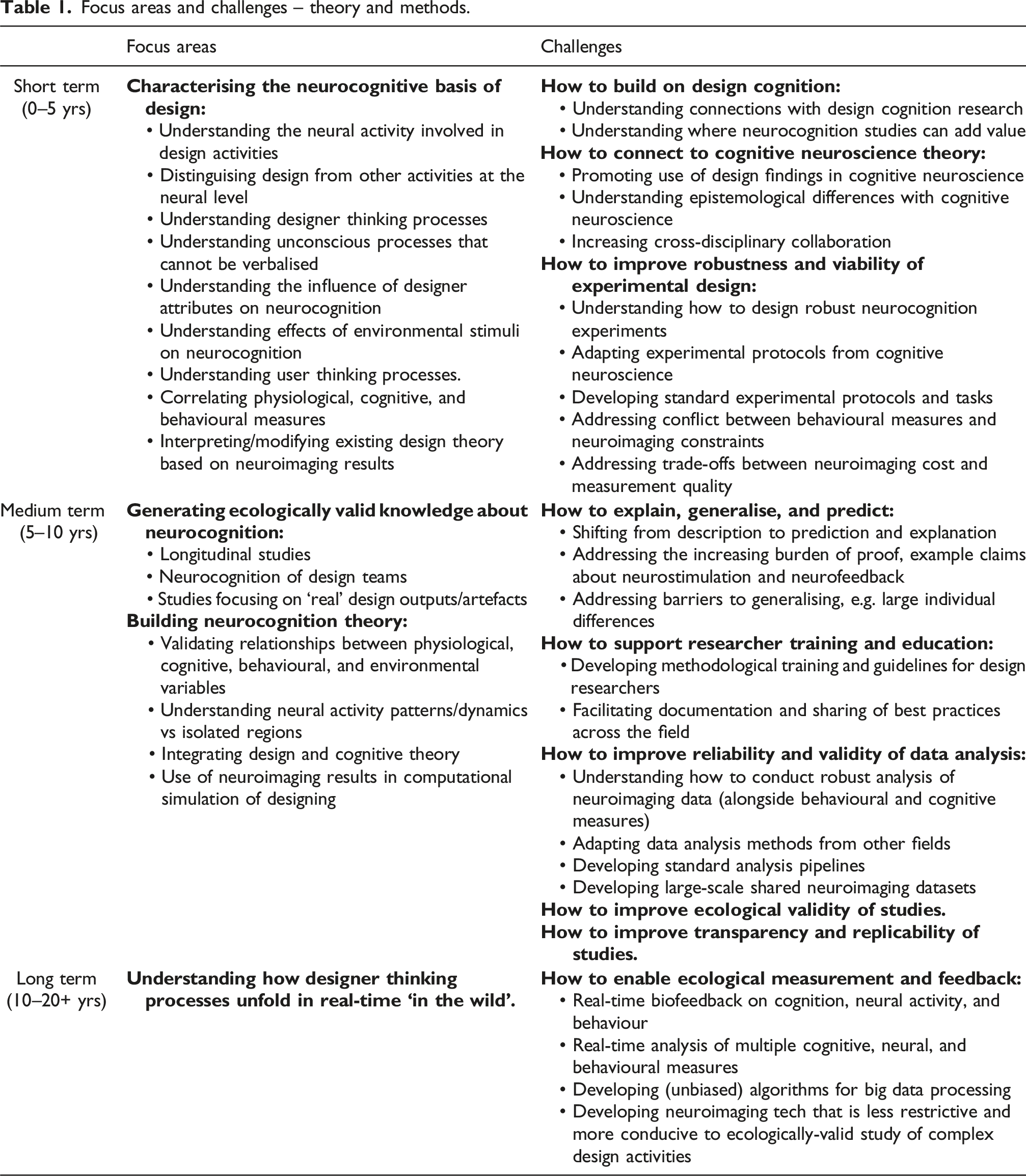
Focus areas and challenges – theory and methods.
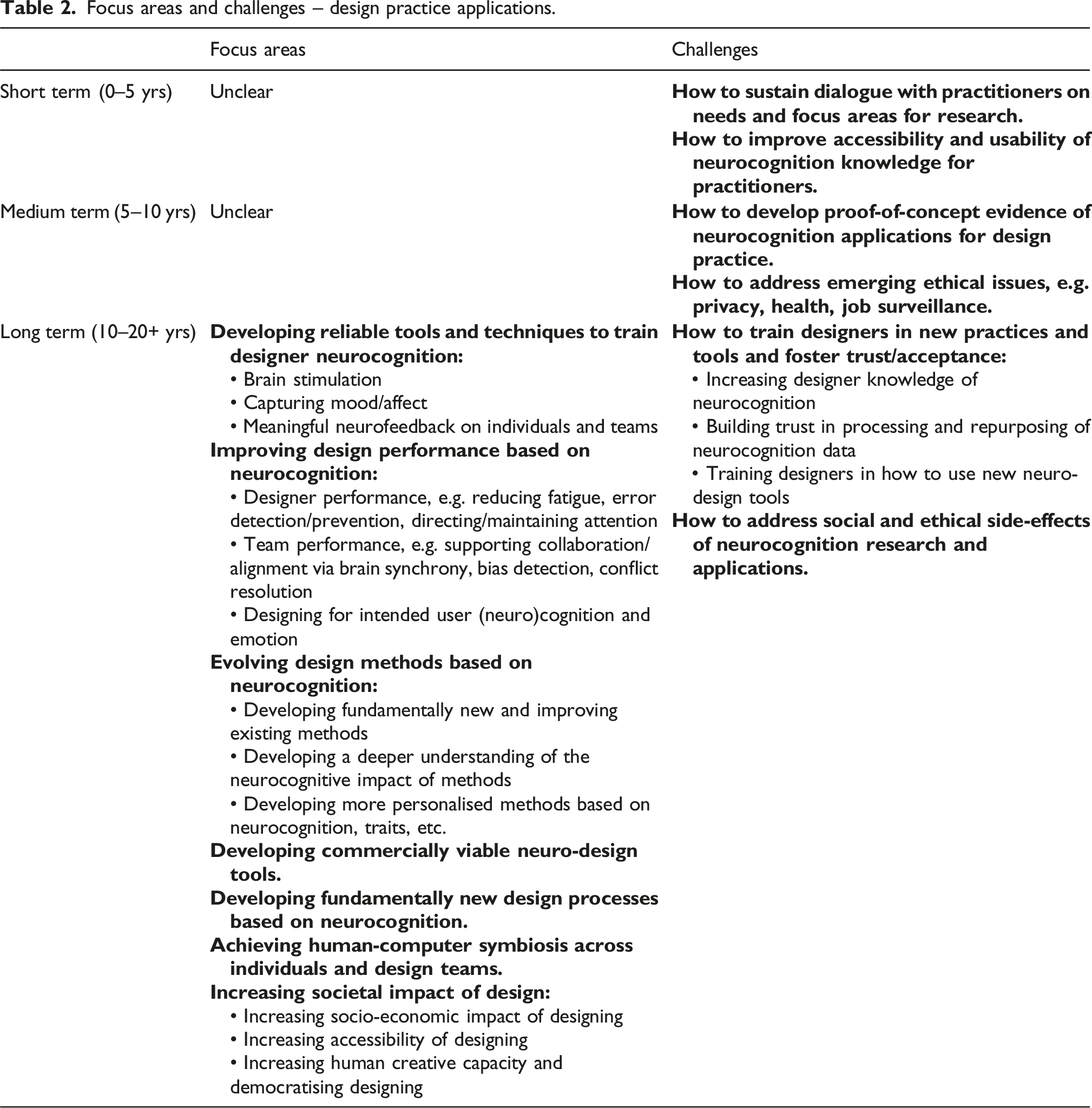
Focus areas and challenges – design practice applications.
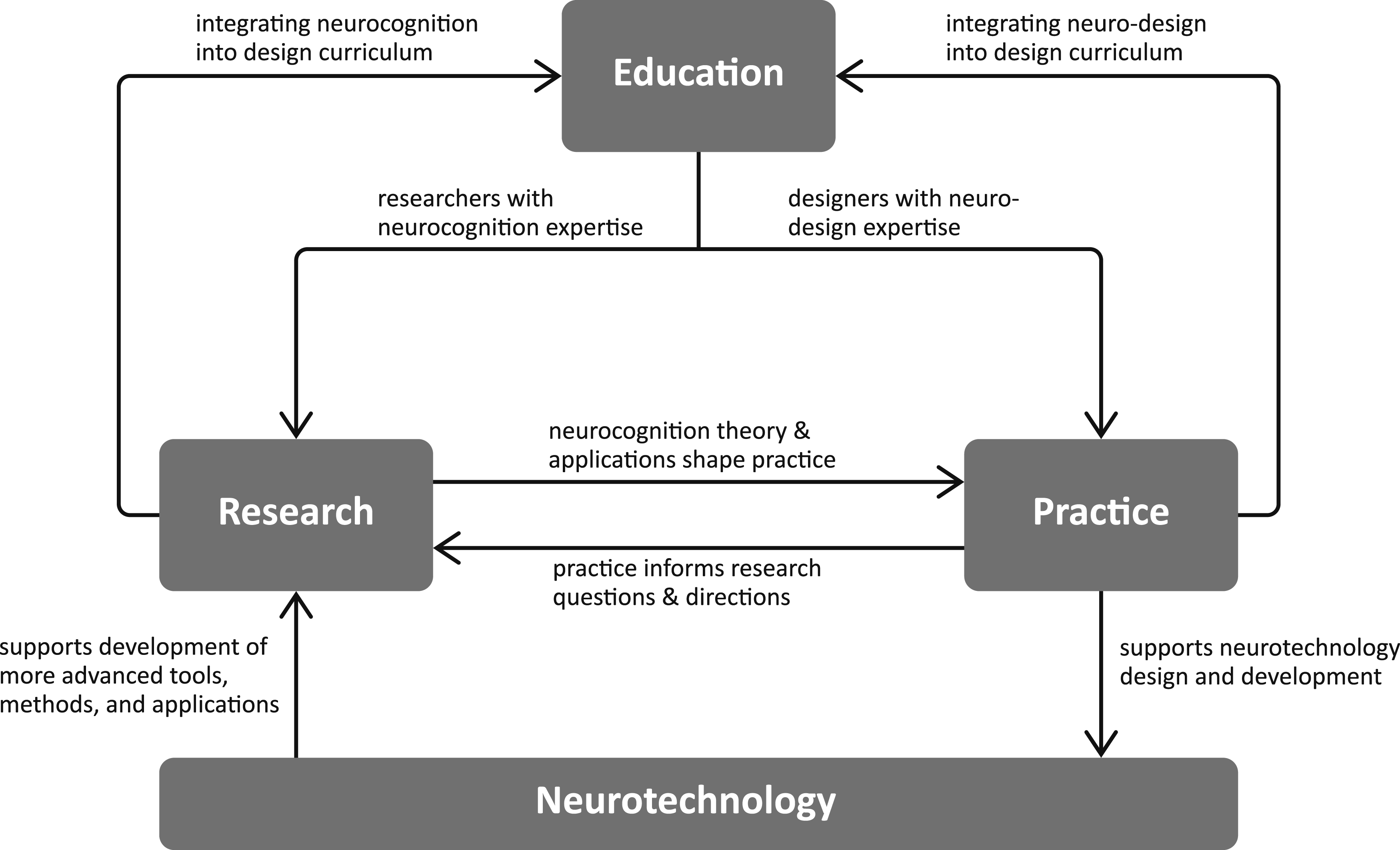
Pathways to impact for design neurocognition research.
Whilst I have taken care to present a view that is informed by the community, it should not be taken as exhaustive. Furthermore, the view is constantly evolving as theory, practice, and society advances. What this paper does provide is a starting point to guide our work and dissemination, and a framework for thinking about impactful research – and I warmly invite design researchers from across the community to contribute to this ongoing dialogue in the shared forum provided by Designing.
Approach
As noted above, to write this Editor Perspective I have consulted both the design neurocognition community and its body of literature. Community engagement involved structured workshops on future field development, run during my tenure as leader of the Design Society’s special interest group in Cognitive Design Science. Additionally, I have been privileged to have many more conversations with neurocognition researchers from across the DRS, the Design Society, and beyond – spanning all career stages, and working across Asia, Australia/New Zealand, Europe, and the USA. All of this has fed into the perspectives in this paper, with the aim of presenting a broad view and setting the tone for future inclusive dialogue in Designing. I recognise there are groups and geographic locations I have not managed to capture; I would welcome viewpoints from these researchers to begin to fill the gaps.
I have used the literature to take stock of where we are currently, spotlighting successes but also trying to learn from past challenges. My intention is not to criticise, but to embody a culture of embracing critical reflection on theory and methodology – something that is important for the field’s maturation (as discussed in later sections), and which has a home in the Research Notes articles on research quality at Designing. In addition to reflecting back, I have also tried to look forward, offering suggestions for future pathways to impact – grounded in current achievements, but thinking beyond the immediate horizon towards what a desirable future might look like.
Focus areas and challenges
My exploratory work revealed a range of focus areas and challenges for the field in the short (0–5 years), medium (5–10 years) and long term (10-20+ years), summarised in Tables 1 and 2. Two streams emerge: theory development and the research methods involved, pertaining to scientific impact; and the development of applications for achieving impact on design practice. These provide a rich set of topics for exploration in Designing; below, I unpack some of the key priorities further. Given that this is a short paper, I have only included some key illustrative references. See Balters et al. (2023) for a comprehensive review.
Theory and methods
In the field’s early stages, our major scientific focus has been discovery and exploration to outline the fundamental characteristics of design neurocognition: distinguishing design from related activities such as problem solving (Alexiou et al., 2009; Vieira et al., 2020), describing neural dynamics (Nguyen et al., 2019), and mapping the brain regions involved (Hay et al., 2019).
For the field to progress longer term, a key priority is advancing from exploration to more systematic theory building. A clear starting point is the extensive body of existing knowledge on design cognition. As shown in Table 1, a challenge currently is identifying where we can add new understanding to this theoretical base through neuroscientific work. In this vein, studies have begun describing the neural underpinnings of key cognitive constructs in design research such as analogical reasoning (Goucher-Lambert et al., 2019a; 2019b), fixation (Fu et al., 2019), and problem constraints (Vieira et al., 2022). Looking ahead, there is a need to shift focus from describing neurocognition to explaining and predicting phenomena. There is some existing work in this direction – for example, studies exploring relationships between neurocognition and variables such as external stimuli (Goucher-Lambert et al., 2019a), methods/techniques (Milovanovic et al., 2021; Shealy et al., 2020), and experience/expertise (Hu et al., 2021; Hu and Reid, 2018); work exploring functional connectivity between brain regions (Campbell et al., 2024); and studies using machine learning to predict design performance from neuroimaging data (Hu et al., 2017; Li et al., 2024; Liu and Liang, 2020). Overall, however, theory building remains fairly fragmented – in later sections, I offer suggestions for how we might channel our efforts in a more integrated way.
Three neuroimaging approaches currently dominate, each providing different information on neural activity: electroencephalography (EEG), tracking temporal dynamics; functional magnetic resonance imaging (fMRI), evaluating spatial localisation; and functional near-infrared spectroscopy (fNIRS), focussing on both temporal and spatial aspects. These often clash with the subjective, situated, and physically embodied nature of designing – imaging equipment is intrusive, physical movement is minimised, and achieving validity and reliability requires strictly controlled, repeatable time-limited tasks that do not reflect how designers work in practice. Major challenges are therefore how to conduct robust experiments and analysis whilst preserving the essence of real-world design (i.e. ecological validity). Design researchers are beginning to tackle this with innovations drawing from our tradition of methodological pluralism – for example, combining qualitative methods like protocol analysis with neuroimaging, and collaborating with neuroscientists to develop/adapt advanced approaches for more naturalistic studies (Balters et al., 2023; Gero and Milovanovic, 2020).
Finally, we have visions for how the field might develop in the far future. One central priority has been repeatedly emphasised in community discussions: understanding how designer neurocognition unfolds in real-time ‘in the wild’. This will be the culmination of extensive theory building work to explain neurocognitive mechanisms not only in individuals, but across teams, users, and AI agents. Ecological measurement will be needed to provide real-time biofeedback in naturalistic settings, supported by real-time analysis of quantitative and qualitative measures using artificial intelligence (AI). Whilst this is some way off, we are nonetheless making tentative steps forward – for example, through work on fNIRS-based neurofeedback to sustain design performance (Shealy et al., 2020; Walker et al., 2025), AI and machine learning for data processing (Hu et al., 2017; Liu and Liang, 2020), the use of hyperscanning to study design teams (Li et al., 2021; Wu et al., 2025), and frameworks for correlating neural, cognitive, and physiological measures (Gero and Milovanovic, 2020).
Applications
There is less dialogue on the practical applications of design neurocognition research in the literature. My community discussions in this area have often started with visions for the long term future (bottom of Table 2), with a focus on tools and methods to help designers design. Many revolve around the use of neurotechnologies for enhancing the human brain. For example, neurofeedback can help individuals self-regulate neurocognitive performance through real-time information on brain activity patterns (Shealy et al., 2020). Tools using this technology could help designers more effectively learn and engage complex skills and thinking patterns, such as creativity and systems thinking. Brain stimulation involves the use of electrical impulses to directly alter neural functioning (Chrysikou and Gero, 2020) – tools along these lines could rapidly improve design performance across a host of dimensions. Using technologies like these could also potentially improve collaboration and codesign – for example, by mediating optimal levels of neuro-synchrony/diversity across teams and mitigating collective biases towards particular thinking patterns. New tools could be used in conjunction with new or evolved design methods, targeting key neurocognitive processes highlighted by theory to improve outcomes and with greater personalisation to suit individual neurocognition.
There is currently high profile work underway to develop wearable – and even implantable – neurotechnologies (Neuralink, 2025; NeuroCONCISE, 2025). As such, it may eventually be possible to develop concepts like those above into commercially viable neuro-design tools, integrating new ways of thinking and working into everyday practice and fundamentally reshaping the neurocognitive processes underpinning design. In the far future, we can imagine human-computer symbiosis, with neurotechnologies bridging between the human brain and artificial systems to increase creative capacity.
These are exciting future visions – but returning to the shorter term, the path ahead is unclear. A starting point could be opening and sustaining dialogue with practitioners. What are their needs, how can neuroscience help to address these, and how should this shape our research agenda? These conversations could be supported by more proof-of-concept evidence of applications to demonstrate the possibilities and build collaborative interest and participation. A related question is how we can make neurocognition research accessible for practitioners, who may not have neuroscience training and expertise.
There are also important challenges to be addressed around the ethics of neurotechnology. These include privacy, job surveillance, and role obsoletion; support, training, and education will likely be needed to help designers (and the public) trust and navigate significant shifts in tools and practices. Another important dimension is socio-economic impact and equitability. In the context of current disparities in technology access and development, it is not a given that neurotechnology will have a positive impact. As discussed further below, the ethics of neuro-design applications will need to be a key focus going forward.
Pathways to impact
The focus areas and challenges in Tables 1 and 2 convey exciting visions for the future, and provide a broad range of avenues for exploration in Designing. However, they also highlight a lack of clarity around how we can achieve impact in a sustainable way. Our short term theoretical focus is clear, but it is less clear what longer term scientific impact might look like. It is not clear what short and medium term developments are needed to achieve ambitious future visions for practical applications. And the link between theory and practice is unclear – how does theory feed into applications, and how might practice drive future theoretical focus?
In the following sections, I address these issues and outline three pathways towards long term impact: (1) developing mechanisms to support theory building and testing; (2) engaging with neurotechnology development; and (3) strengthening relationships between scientific research and design practice. These encompass key strategic considerations for the field as a whole, centring on interactions between design research, practice, and education as shown in Figure 1.
Mechanisms for theory building/testing
Many of the focus areas and challenges in Table 1 pertain to theory building/testing and related methodological concerns around validity and reliability. For guidance on navigating these issues, we may look to Cash (2018, 2020), who discusses the importance of the five-stage theory building/testing cycle for generating scientific impact (i.e. impact on knowledge): (1) discovery and description; (2) definition of variables and domain limitation; (3) relationship building; (4) prediction, testing, and validation; and (5) extension and refinement.
There are some signs that design neurocognition research is falling into a trap that could limit higher level impact: a significant focus on discovery and description, with limited attempts so far to explain, generalise, and predict. The field is young, and it may therefore be expected that it would be in the early stages of the research cycle. However, a lack of integrating theory has long been highlighted as an issue in design cognition research (Hay et al., 2017, 2020), which extends into design neurocognition given that it should be seeking to build on cognitive theory. In these nascent phases, we have an opportunity to set the field on a better course by more consciously developing mechanisms to support coherent theory development.
Collectively defining a shared scientific model and research framework(s) could outline a clearer pathway to scientific impact. These would formalise how we approach the theory building/testing cycle as a field, coalesce and define our underpinning theoretical principles and constructs, and map methods to the theory development stages where they can add the most value (Cash, 2018). In turn, this would help researchers to (1) define questions that contribute to theory building and advance us forward from description, (2) develop robust studies using the right methods, and (3) theoretically integrate findings to extend a coherent body of knowledge. To engage with this kind of field development work, we need to develop a culture around publishing articles on methodological and theoretical issues and the critical evaluation of research quality. I am eager to see Research Notes on these kinds of topics in Designing.
We may draw from the models and frameworks adopted in psychology and cognitive neuroscience, which have undergone a similar transition from theoretical fragmentation to integration (Cash, 2018; Poldrack et al., 2011). However, these fields tend to be highly positivistic – seeking to minimise subjectivity and reduce complexity down to controllable variables that can be quantified and studied in a lab. In contrast, design research is more pluralistic – we embrace epistemological positions across the full spectrum from positivism to interpretivism and constructivism, and have a strong tradition of qualitative and mixed-methods approaches. As such, whilst neuroscience and psychology could provide inspiration, it is important to consider how our research models and frameworks might differ – for example, is there the potential for a ‘critical neuroscience’ approach, where aspects such as subjectivity and situatedness are embraced as integral facets of neurocognition in the wild rather than extraneous variables? With all the focus on neuroimaging, where do qualitative methods fit? These kinds of questions will be an important design neurocognition topic for Designing. They may also lead to contributions in cognitive neuroscience, potentially bringing new approaches better suited to the study of subjective and nuanced phenomena like creativity.
Neurotechnology development
Many of the research areas (Table 1) and design practice applications (Table 2) envisioned long term will require significant advances in neurotechnology. However, whilst we seem very aware of current limitations, design neurocognition research is not particularly engaged with neurotechnology development. As discussed in previous sections, there are ongoing efforts to implement more advanced neuroscience approaches – but whilst it is a step forward, this alone is unlikely to bring about the major shifts required to achieve long term goals. A challenge is potentially a lack of expertise – this first generation of researchers are tackling an extremely steep learning curve ‘on the job’, with little background in scientific methods and neurotechnology. Another challenge may be funding – it is difficult enough to obtain money for design research, which is often undervalued by funders. It is even harder to secure funding for the kind of risky, technically advanced studies required to drive major shifts in technology development.
We could rely on cognitive neuroscience to drive the advances – but as a field, their goals are quite different from our own. Our design expertise and interest in practical applications could bring a new angle, and help shape development in a mutually beneficial direction. Part of the solution may therefore be greater collaboration with cognitive neuroscientists, along with technologists working in the neuro domain. In addition to pooling expertise, this could increase access to major funding sources. This is something that could potentially be facilitated by community groups such as the DRS and Design Society SIGs, for example, through bridge-building, networking, and profile-raising activities.
As discussed previously, ethics is an important challenge for neurotechnology development. Table 2 lists potential concerns such as privacy, job surveillance, and role obsoletion. Something that seems to receive less consideration is the potential for neurotechnology to amplify socio-economic inequities in design research and practice. Table 2 arguably presents something of an idealistic future – where neurotechnology democratises design by increasing its accessibility, in turn expanding human creative capacity and increasing design’s socio-economic contribution. However, there are currently significant socio-economic inequities in technology access and development; is it therefore possible that a design practice dependent on neurotechnology could be less accessible to large swathes of society? If neuro-design becomes the exclusive pursuit of wealthy nations in the Global North, we are swinging the balance of power in the wrong direction. These concerns extend to the neurocognition research we do now – given the high costs involved, how do we ensure that diverse voices are able to contribute? These issues will have a critical impact on how the future envisioned in Table 2 takes shape – as such, I hope to see the ethics of neurocognition research and applications become a key focus in Designing. There is a strong community around the study of design ethics that would be well-placed to contribute.
Strengthening the theory-practice connection
Although there is some tentative research on applications, we still feel far from meaningful impact on practice. At the same time, we are very productive when it comes to scientific research output. So what needs to happen to start translating the latter into the former?
One solution, noted previously, is to open a more focused and sustained dialogue with design practitioners. Design thinking tells us that to create meaningful impact for users, we need to understand their needs – however, this does not seem to be happening to any great extent in design neurocognition research currently. How can we better engage with practice? Within the positivistic paradigm of conventional neuroscience, designers are largely viewed as experimental subjects; if design neurocognition research takes a more pluralistic approach, this may open up additional modes of participation that could give practitioners a more active, collaborative role in the research process. What can be learnt from design research areas with strong traditions in this direction, such as research through design?
Another critical link between theory and practice is education. Neurocognition is being integrated into design education at some institutions (e.g. neuro-design modules at Stanford University (Balters et al., 2023)). Scaling up these efforts would build expertise in the next generation of researchers, hopefully raising research quality and therefore increasing long term scientific impact. However, it would also strengthen links between neurocognition research and design practice by equipping future designers with knowledge and skills for neuro-design. Developing viable neuro-tools for design research and practice requires more than just theoretical knowledge and technological expertise – these tools will themselves need to be designed as products, services, and systems to meet user and market requirements. Designers who can contribute to this challenge would increase the design community’s capacity to drive neurotechnology development to meet its own needs. They would also be equipped to support the development of other neuro-products (e.g. neuroprosthetics), which will be important as neurotechnology proliferates over the coming decades. More generally, designers with an interest in neurotechnology are likely to also be interested in how it can be applied to improve their own practices, sustaining the theory-practice connection over time.
As we move through the theory building/testing cycle, strong links with practice will only become more important. We need designers to participate in our evolving experimental work. We need to explore whether our hypotheses and propositions hold in real-world settings. And importantly, we need to test our proposed applications in practice and evaluate their longer term impact. This will feed back into theory building in the form of new research questions and directions. As such, a strong connection with design practice is a critical link in the overarching research cycle and the field’s longevity.
Implications and conclusions
Design neurocognition research clearly has a thriving and productive community. The focus areas and challenges in Tables 1 and 2 provide a rich set of topics for exploration in Designing, extending across the short, medium, and long term.
I am eager to see articles bringing new neuroscientific understanding to existing design cognition theory, and working towards explanatory and predictive relationships between neural, cognitive, behavioural, physiological, and environmental variables. In particular, I see opportunities to advance understanding of the physically embodied, subjective, and situated aspects of designing that are typically less explored in cognitive neuroscience. Improving the ecological validity of neurocognition studies will be critical for achieving these advances – I envisage that methodological innovations, integrating design/neuroscience and quantitative/qualitative approaches, will form a key topic for Research Notes going forward. I am also keen to see more work exploring how neurocognitive theory and applications can tangibly shape designing. Neurotechnologies show promise – but are there other ways we can support practice in the present? For example, in research on design methods, there are knowledge gaps around how method content interacts with designer attributes such as cognition (Daalhuizen and Cash, 2021). Neuroimaging could add a new layer of understanding here.
Thinking more broadly, beyond individual topics, the focus areas and challenges also illuminate three higher level pathways to longer term impact – strategic directions for the field, centring on interactions between design research, practice, and education (Figure 1). These highlight some additional cross-cutting themes that I believe authors in Designing will be well-placed to address: (1) Developing mechanisms to support more integrated and systematic theory building and testing. A critical question is how to develop a shared scientific model that embraces the design research traditions of epistemological and methodological pluralism, versus the highly positivistic approach of neuroscience. (2) Engaging with neurotechnology development. Can we collaborate more extensively with neuroscientists and neuro-technologists to drive neurotechnology development in a direction that meets our needs? There are critical questions regarding the ethics of neurocognition research and applications; I am eager to see work with the design ethics community to explore these. (3) Strengthening the theory-practice connection. There are opportunities to explore more active, collaborative modes of practitioner participation, potentially learning from communities with strong traditions in this direction (e.g. research through design). Integrating neurocognition into design education is also key for building interest and expertise in future designers.
I hope this Editor Perspective helps design neurocognition researchers get a sense of how their work fits into the new forum provided by Designing. I also hope that it inspires fresh connections and collaborations with other areas, bringing new and diverse voices into the conversation.
Footnotes
Acknowledgements
Numerous people have contributed to the ideas discussed in this editorial. I thank the neurocognition researchers I have spoken to across the community, who are too many to name but greatly appreciated. I thank Philip Cash, who co-led the Design Society’s CDS SIG with me and played an integral role in shaping the ideas in this paper. I also thank the researchers with whom I co-chaired various community workshops (in particular, John Gero, Julie Milovanovic, and Tripp Shealy). Finally, I thank Peter Lloyd for valuable comments on an earlier version of this manuscript, and Chris McTeague, for early input into my thoughts around impact and many insightful neurocognition conversations.

Funding
The author received no financial support for the research, authorship, and/or publication of this article.
Declaration of conflicting interests
The author declared no potential conflicts of interest with respect to the research, authorship, and/or publication of this article.