



Abstract
Research through design (RTD) provides a means for researchers to investigate a problem area in a generative manner that is valuable, different, and complementary to phenomenological, experimental, and other established research approaches. RTD is special because it harnesses the ‘power’ of designing to question, speculate on, ideate, prototype, test, and critically appraise the qualities of human and other-than-human futures before they become reality. Although RTD has been practised in various forms since the 1960s, the last 25 years have seen the approach became popularly adopted and studied. To encourage high-quality submissions to Designing journal, this paper provides an express orientation for RTD, putting forward methodological considerations that may be regarded as fundamental yet open to diverse responses and positions. The considerations cover the following: what RTD is and isn’t; who does the designing; decisions on design processes; research prototypes as focal points; demands of multiple roles; and the necessity of documentation.
Research through design (RTD) is one of a triad of phrases commonly used to categorize design research, alongside research into design and research for design. These phrases are usually attributed to Sir Christopher Frayling (1993), but their provenance is more properly shared with Bruce Archer (2004, 1995). The phrases are useful as simple prompts to help plan academic design research. ‘Into’ refers to design as the subject matter of research, ‘for’ refers to research that targets design-related beneficiaries, and ‘through’ refers to a particular approach, where research is carried out ‘…through the medium of practical action’ (Archer, 1995:11). In other words, RTD uses the processes, outcomes, and interactions of design practice to help illuminate an underlying research agenda and answer research questions. Accordingly, RTD is neither a method nor a methodology. Rather, as an approach to academic inquiry, RTD is shaped by philosophical underpinnings, research practices, and methods of data collection and analysis.
RTD has been practised in various forms since the 1960s, but the last 25 years have seen the approach became popularly adopted and studied. RTD is considered special because it harnesses the ‘power’ of designing to question, speculate on, ideate, prototype, test, and critically appraise the qualities of human and other-than-human futures before they become reality. Unfortunately, as an acronym, RTD does not properly reveal what it means. A more precise expansion would be ‘research through designing’, where the gerund form of the verb emphasizes the crucial role of design action or design practice. Otherwise, one may ask ‘research through design what?’: design education, design history, design technology? Each of these may be a valid study, but it is the connection to design praxis that characterizes RTD.
Much work has been carried out within design research and human–computer interaction (HCI) communities to contribute examples, framings, and evaluations of RTD, as well as to diversify its disciplinary discussions. Notable contributions include Prochner and Godin (2022), Krogh and Koskinen (2020), Giaccardi (2019), Herriott (2019), Stappers and Giaccardi (2018), Zimmerman and Forlizzi (2014), Gaver (2012), and Koskinen et al. (2011). This short paper has been prepared to assist researchers in the planning, conduct, and dissemination of RTD. As an initial impetus for attracting RTD studies to Designing, the paper provides researchers with an express orientation for RTD, putting forward methodological considerations that may be regarded as fundamental yet open to diverse responses and positions. These considerations cover the following: what RTD is and isn’t; who does the designing; decisions on design processes; research prototypes as focal points; demands of multiple roles; and the necessity of documentation.
RTD implies planned action, utilizing design activity in a systematic and strategic manner. RTD has been a work-in-progress for a long time but is becoming refined and more deeply critiqued (Anderson et al., 2019; Kaszynska and Kimbell, 2024). It is important to stress that multiple conceptions and implementations for RTD are promoted and contested in the literature (Boon et al., 2020). Whilst prominent, the considerations and suggestions raised in this paper should not be regarded as definitive or exhaustive. The diversity of theory and practice that surrounds RTD would render such an ambition unwise. But in reviewing the points raised and consulting the references, researchers are encouraged to construct their own understanding of RTD, informed by the substantial body of prior art that now exists.
What RTD is and isn’t
At least four alternative meanings exist for the preposition ‘through’: ‘from one end or side of something to the other’; ‘from the beginning to the end of a period of time’; ‘as a result of’; and ‘by; using’ (Cambridge Online Dictionaries, 2025). Whilst all these meanings can be relevant, it is the ‘by; using’ meaning that appears to most strongly characterize RTD. It refers to research that is informed by designing; research that engages with design action; research that integrates design activity; or research that utilizes design practice. In other words, the design activity within RTD exists principally not for its own ends but instead for the purposes of knowledge creation and theory building. Accordingly, RTD is built on both research practice and design practice. Researchers adopting RTD do so because they are convinced that the processes and outcomes of designing will be beneficial for gathering insights into a problem area. Findeli (1998) uses the alternative term ‘Project-Grounded Research’ to describe research carried out through the medium of design projects, where ‘such research helps build a genuine theory of design by adopting an epistemological posture more consonant with what is specific to design: the project’ (Findeli, 1998:108). In another alternative framing, Koskinen et al. (2011) offer ‘Constructive Design Research’, emphasizing design practice directed at generating and testing new knowledge. Constructive Design Research applies principles of constructivism (meaning-making) to the creation and appraisal of design outcomes. In all these framings, the RTD researcher uses design activity to illuminate and respond to an underlying problem or opportunity that can be oriented within the academic literature.
In RTD, design practice is placed at the heart of an academic research process. When given this placement, design activity and its associated outcomes are granted unconventional agency as investigative means and tools (Savic and Huang, 2014). Rather than aiming to reach a refined design solution, the design activity in RTD is focused primarily on delivering an evidence base on which to build transferable and communicable knowledge. Such contributions to knowledge might include insights into an ill-defined problem probed through designing; advances to a particular class of product or service or other designed outcome; or, improvements to design practices through provision of new tools, methods, information, and suchlike (Pedgley and Wormald, 2007). RTD may also be carried out with the express intention to understand and develop the theory and practice of RTD. In the planning for all these examples, a decision is made that a problem area can be probed through design practice, in preference to, for example, participant observation, making an online survey, managing an ethnographic study, or running a controlled experiment (Figure 1). Swapping the designing for alternative investigative approaches is likely to substantially change the character of the research and, also likely, the findings, contributions, and impact. A basic model of RTD: in preference to alternative investigative approaches, the activity of designing is used to help transform a research agenda into research outcomes.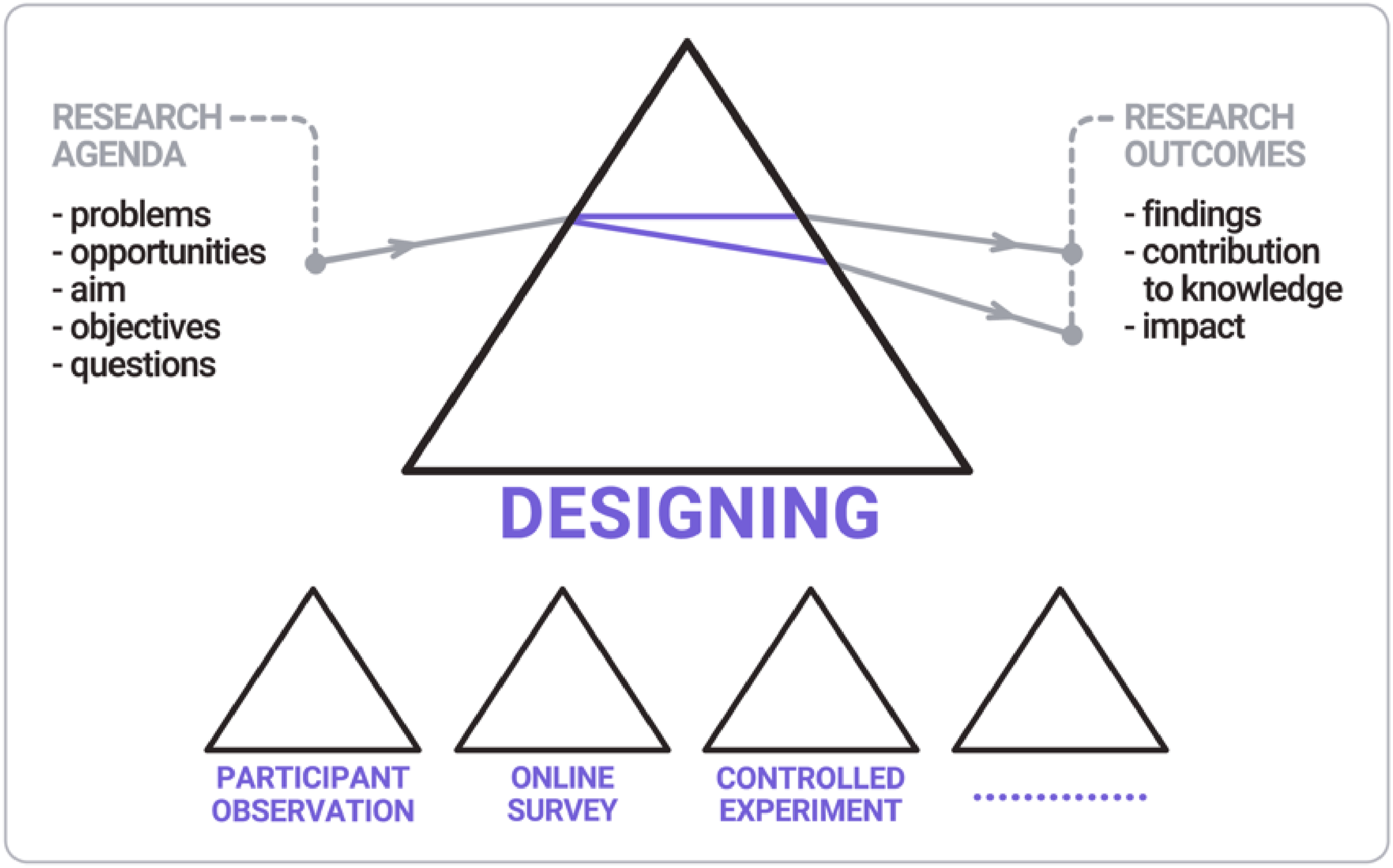
As will be appreciated, RTD is conceptually very distant from the designer’s prerogative of ‘doing a design project that requires supportive research’ (Cross, 1998; Friedman, 2008). RTD is a scholarly pursuit. The essential activities of knowledge generation and theory construction are made in addition to the act of designing. By implication, the act of designing taken on its own is insufficient for conducting RTD. RTD is neither a simple approach to plan nor an easy approach to apply. In the author’s experience, postgraduate design researchers often struggle with the effort required and the expansiveness involved. Confusions are apparent between RTD and what may be called ‘research preceding design’ (RPD), which describes a valid but different approach. RPD typically starts with a substantial investigation (e.g. observations, interviews, ethnography, and surveys) aimed at establishing new research insights linked to design recommendations and then puts those recommendations into action through designing to create a design solution. In contrast, as well as reduced importance to reach a refined solution, RTD necessitates that the designing be placed nearer the front of a research process.
Who does the designing?
RTD holds special attention for academic researchers, usually based in higher education institutions, whose training and expertise is in design practice. It offers the possibility to harnesses those researchers’ unique creative praxis (design) in the context of research inquiry. Often, the researcher and the designer are the same person, assuming multiple roles, although other structures are possible. Different configurations lead to the identification of at least two types of RTD, which may be termed ‘type A’ and ‘type B’. • Type A. The principal (or sole) researcher on a project also carries out the designing either individually, as a team member, or through participation in co-design activities. It leads to the terms ‘designer-researcher’ or ‘researcher and designer as one’. Type A is prevalent, especially when the research is carried out for the award of a higher degree. • Type B. The designing is delegated to somebody else, or multiple other people, with no design input from the researcher. In the case of participatory design sessions, the researcher may be involved only in a facilitating role. Type B is less common in published studies of RTD.
Decisions on design processes
RTD does not in principle prescribe the adoption of specific design methods, activities, representations, outcomes, attitudes, or priorities. The design focus can conceivably be products, services, environments, interiors, exhibitions, apps, graphics, typefaces, processes, policies, systems, experiences, and so on. The designing may proceed in various ways, for example, as a double-diamond activity (Design Council, 2025), an odyssey (Ford, 2023), a serendipitous adventure, an intuitive vision for the future, or a technical trial. It may be driven by various principles, such as user-centredness, technological achievement and innovation, behaviour change, social and cultural transformation, or non-anthropocentric thinking. Speculative design movements such as design fiction and critical design (Dunne and Raby, 2013) can take their place in RTD. In this regard, the kind of designing to be used in RTD is one of the researcher’s key decisions, considering the research agenda, the people who will carry out the designing, and other factors such as feasibility and credibility. It is very likely, however, that the designing will involve networks of people and external stakeholders, such as experts, users, consumers, and policymakers. It is also very likely that multiple designs will be created and developed iteratively with these networks of people, in the general spirit of learning by doing. Indeed, appraisals of research prototypes by stakeholders can be considered central to RTD (see section: ‘Research prototypes as focal points’), providing the researcher with inspiration and guidance, whilst justifying or challenging decisions (Töre Yargın and Erbuğ, 2017).
One point of complexity is when the type of design practice chosen also includes practitioner investigations (research) at various stages of the designing (e.g. up-front to set design directions and understand a problem area; downstream to evaluate design proposals). Using such design practice in RTD brings about the situation where the ‘D’ manifests as a compendium of investigative and generative activities. Adopting the four-stage double-diamond model, RTD shifts from ‘research through designing’ to ‘research through discovering + defining + developing + delivering’, with each stage potentially including practitioner research. This underlines how it can be entirely normal for RTD to concurrently contain academic research (within the R) and practitioner research (within the D). However, knowing which is which, being clear about their positioning and role, and understanding whether at any point they are two of the same, is a rather complex aspect of RTD. This is where acknowledging and understanding the different roles within RTD becomes vital (see section: ‘Demands of multiple roles').
Research prototypes as focal points
One of the defining aspects of RTD is its generation of research prototypes: various forms and iterations of model, simulation, or representation that embody or materialize key points within the research agenda. Research prototypes (sometimes referred to as research artefacts) are created with the express intention to stimulate discussion and insights. Stappers and Giaccardi (2018) provide a useful list of ways in which research prototypes can be used in RTD, which includes demonstrating a point, gathering experiences and appraisals, and confronting conventional understanding. When fulfilling a mediator role, a research prototype becomes a focal point for eliciting and negotiating complex and competing demands from people who are affected by the research or intended to benefit from it.
The level of fidelity to which a research prototype is created is dependent on the underlying research agenda. For example, where the problem area is unexplored and the form of good fitting solutions is not foreseen at the outset, low-fidelity research prototypes are appropriate. These embody conceptual ideas that are intentionally open to modification. Such conceptual incompleteness is realized through various qualities such as abstraction, partial completion, tentativeness, or ambiguous representations that encourage anyone encountering the prototype to construct their own interpretations and meanings. High-fidelity research prototypes are also relevant but under different circumstances, for example, when pursuing advances to a particular class of product, service, tool, information, or process, when there are precedents and exemplars to refer to. High-fidelity research prototypes have fixed, well-defined, detailed, and unambiguous qualities that facilitate direct comparison with existing solutions. In either case, low-fidelity or high-fidelity, research prototypes are intended to extract a plurality of views tied to a problem space. Several rounds of prototyping may be carried out over time, changing in purpose and form in a dynamic and iterative manner in response to changes in research and design directions, or in response to a need to dig deeper into certain aspects of the research agenda (Claisse et al., 2018).
Demands of multiple roles
One of the challenges in conducting RTD is to be able to fulfil diverse roles that centre on problem ownership, research practice, and design practice (Boon et al., 2020; Sleeswijk Visser, 2018). At least three roles (or ‘hats’) can be identified for type A RTD, requiring self-negotiation on how and when to switch between roles. • The Research Coordinator role. The designer-researcher says, ‘I need to find out…’. This is the primary role, setting and running the research. It demands refinement and checking of the academic agenda: making sure literature reviews are up-to-date and relevant, whilst making special checks on the efficacy of insights arriving from the designing. • The Designer role. The designer-researcher says, ‘I need to create…’. This role demands the skills and knowledge necessary to design whatever has been planned as research prototypes. • The Auto-Ethnographer role. The designer-researcher says, ‘I need to tell about…’. This role is performed on the top of the previous two roles, in response to a need to generate good documentation about the conduct of the RTD (see next section). It demands a self-reflexive attitude to write about (i) the progress and achievements from the designing (communicating the designer role) and (ii) the experiences of the ongoing researching-designing relationship (communicating the research coordinator role).
Necessity of documentation
To build a credible evidence base for RTD, it is necessary to capture the processes and outcomes of designing. Part of this evidence base can be the ‘normal’ by-products of designing, such as sketches, digital canvases, mock-ups, meeting notes, presentations, and collected resources. However, since designing is essentially a cognitive activity, with many processes not normally externalized, additional instruments can be deployed to tease out and capture design thinking and decision-making, such as self-prepared workbooks (Bardzell et al., 2016), annotated portfolios (Bowers, 2012), or concurrent or retrospective diaries (Pedgley, 1997, 2007). These instruments can be used to articulate the events of design activity in an impartial and factual manner (e.g. by capturing commentaries, explanations, accounts of events, rationale, decision-making, and information consultation). They may also provide a canvas for documenting thoughts arising from the auto-ethnographer role. For type A RTD, critical journaling (Sadokierski, 2020) can provide a form of hybrid documentation, serving as a single repository for factual narratives of designing, reflexive narratives of designing, and reflexive narratives of the researching-designing relationship.
All these documentation types, whether normal or additional to design activity, combine to deliver source material for RTD (Bardzell et al., 2016; Makela and Nimkulrat, 2011). Their presence helps transparently communicate the personal position of the designer-researcher and can be used to counter any criticisms about the authenticity or provenance of the work carried out. Parallels can be drawn to quality assurance procedures, where information usage should be traceable, and decisions should be justified. Kenneth Agnew, the designer who worked with Bruce Archer on the RCA’s renowned hospital bed project, raised this issue many years back. His reference to ‘industrial products’ can also apply to research prototypes: ‘Research into the design of industrial products is hindered by the lack of any fundamental documentation of the design process which produced them. Too often, at best, the only evidence is the object itself, and even that evidence is surprisingly ephemeral. Where a good sample of the original product can still be found, it often proves to be enigmatic’ (Agnew, 1993:121).
The auto-ethnographer role requires introspection and reflection-on-action as a stop-and-think activity (Moon, 1999; Schön, 1983; Schön and Wiggins, 1992). In this role, researchers become ‘adjunct ethnographers of their own circumstances’ (Zimmerman and Wieder, 1977:484), constructing explanations of their research practice and, in the case of type A RTD, also of their design practice. From a methodological perspective, the creation and presence of any kind of out-of-the-ordinary documentation to accompany designing (or researching) has the potential to influence and change those activities. There are perspectives that embrace this effect as a phenomenological aspect of RTD (Sadokierski, 2020), whereas other perspectives treat the effect as an interference in the pursuit of capturing ‘authentic’ designing (Pedgley, 2007). An alternative approach, termed reflection-alongside-action (Bowen et al., 2014), is proposed as minimally interruptive to the flow and attention needed for designing. It is important that the researcher communicates a position on such potential effects of auto-ethnographic documentation. In any case, none of the above documentation types are intended to substitute the writing of literature reviews, theory development, or research reports, all of which create a more formal documentation of the research and design processes.
Discussion and conclusions
Individual design researchers can do more to promote RTD as a valid approach by highlighting precisely in which ways practitioner activity (designing) added value, or was central, to their research process and its associated delivery of new knowledge and understanding. This paper has shown how RTD can be usefully expanded into a simple yet more informative linguistic structure: [academic research/research inquiry] [informed by] [design action/design practice/designing]. This expansion is useful for highlighting key points in planning, conducting, and disseminating RTD. The results and outcomes can be impressive, progressive, and wide-ranging. For example: Dorta’s work on innovative digital ideation spaces involved interconnected development and dissemination of (i) design solutions (Hyve-3D, 2021; Dorta, 2007), (ii) user experience needs and evaluations (Dorta et al., 2008), and (iii) new insights into co-design practices when using such solutions (Dorta et al., 2011). In the author’s research on materials and design, RTD culminated in the development and dissemination of (i) acoustic guitars made from alternative materials (Pedgley and Norman, 2012), (ii) improved knowledge and understanding of material-related design decision-making (Pedgley, 2009), and (iii) new tools and methods for capturing and analysing the designing embedded within RTD (Pedgley, 2007).
As an academic inquiry, RTD is bound by fundamental research questions: what to find out, why, and how to go about it. The ‘how to go about it’ acknowledges the possibility that designing, prototyping, and making something along the way might help. On completion of RTD, and in any write-up derived from the research, it is reasonable to expect the following: (i) a proper account of previous and related studies in the subject area, helping to justify the specific topic tackled, (ii) detailed accounts of the designing and how a bridge is made to the research agenda, and (iii) proper reflection and statements on the scholarly contributions made (original and significant new knowledge, understanding, theory, and impact).
RTD inherently requires designers and designing. It may be considered an approach to inquiry that designer-researchers claim uniquely as their own (Findeli, 1999). However, RTD should not be confused with research preceding design (RPD). In RPD, new knowledge is generated and subsequently applied to a design case. In RTD, new knowledge is generated in the process of working on a design case. The act of designing provides a means for researchers to investigate a topic in a generative manner that is valuable, different, and complementary to phenomenological, experimental, and other established research approaches. With all this in mind, the Editors of Designing welcome the submission of manuscripts that disseminate high-quality RTD, contributing both to the development of the research approach and its various applications.
Footnotes
Acknowledgements
This paper draws upon running conversations held with colleagues across many years. I am especially grateful to Phil Roberts, Chris Rust, Eddie Norman, and Jonathon Allen for their challenges, provocations, and ideas regarding the legitimacy of research through design(ing). Thanks also go to Dean Bates who 30 years ago, during regular ‘research student hikes’ in the English Peak District, was an invaluable soundboard on what practice-based design research might be, compensating for the lack of examples and advice available at that time.

Funding
The author received no financial support for the research, authorship, and/or publication of this article.
Declaration of conflicting interests
The author declared no potential conflicts of interest with respect to the research, authorship, and/or publication of this article.
Data Availability Statement
No dataset is available to accompany this work.