




Abstract
This article examines a debate regarding future orientations for the field of Urban Political Ecology (UPE). Anchored in two UPE discourses toward a more planetary or a more situated UPE, I argue that these discourses present two critical yet independent responses to early UPE scholarship, opening up the possibility for a more synthesising position. Building off of this debate as well as some of UPE's intellectual traditions, I then argue for a rapprochement between UPE and the field of critical logistics, using the 2022 expansion of the IJmuiden sea lock in the Netherlands as an illustrative case for demonstrating how applying the combined theoretical and methodological insights of UPE and critical logistics can turn a seemingly mundane sea lock infrastructure into a key site from which to draw out the political stakes of urban and climate futures as they play out in a city like Amsterdam. A closer engagement with critical logistics can not only extend UPE's existing themes and empirical focal points, but also attend to theoretical tensions regarding the politics of scale and place central to the debate between a more planetary and a more situated UPE. Finally, I argue that this rapprochement is not only theoretical and methodological but also political, as the wealth of work in critical logistics on articulating a counterlogistics can help UPE expand its political project in a time of climate emergency and interlocking capitalist crises.
Introduction
In this commentary I engage with a debate regarding future orientations for the field of Urban Political Ecology (hereby: UPE). Anchoring myself in two UPE discourses sketched by Tzaninis et al. (2020), I outline the respective cases for a more planetary or a more situated UPE. On the one hand, I aim to show how such a debate within UPE can be indirectly mounted if key texts are read through the lens of wider literature on planetary urbanisation. On the other hand, I argue that the fact that some of the principal proponents of planetary and situated UPE never speak directly to each other's arguments, but rather present two critical yet independent responses to early UPE scholarship, opens up the possibility for asking whether the strands are truly as mutually exclusive as they are sometimes made out to be. This explains the emerging interest in moving beyond dichotomising constructions of the field, and I outline some of the cases made for this more synthesising position. Building off of this debate as well as some of UPE's intellectual traditions, I then aim to place UPE in conversation with a different yet overlapping literature: critical logistics. My aim is to show what the fields have in common, and to suggest how an engagement with critical logistics can extend UPE's existing themes and focal points, while attending to some of the sticking points in the planetary-situated debate. After setting out the critical logistics literature and how its main lineages, arguments, and themes are connected to UPE, I illustrate empirically what a critical logistics lens can bring to UPE using the 2022 expansion of the IJmuiden sea lock, a logistical infrastructure situated at the mouth of the river IJ which allows commercial cargo vessels to navigate into the Port of Amsterdam. The empirical material for the illustrative case draws on a combination of field-based and documentary research. The field-based research was carried out during participation in the 2022 FieldARTS Transitional Waters residency organised by the Amsterdam School of Cultural Analysis. The residency brought together researchers, practitioners and artists to develop field-based methods for thinking and sensing the political ecology of estuaries and brackish environments like IJmuiden. 1 The documentary analysis draws primarily on the publicly available planning documents from Dutch ministries and public authorities regarding the expansion of the lock, as well as some secondary sources from news reports. Drawing on this illustrative case I suggest three key things that a critical logistics lens can offer UPE: site selection strategies, processual methodologies, and an expanded political project. Firstly, an engagement with critical logistics can orient UPE toward identifying key sites for studying urbanisation that are of the city without being in the city. Secondly, bringing UPE in conversation with critical logistics – which is ultimately a critical engagement with capital's science of flow – encourages almost by necessity the kind of process-based episteme toward which UPE seeks to push the study of the urban. Thirdly, an engagement with critical logistics can help expand UPE as a political project through its rich and ongoing debates on how and to what extent labour, social, and environmental movements can organise around and against the material chokepoints of capital circulation.
What is urban political ecology? Roots, evolution, and internal debates
Urban Political Ecology is a strand of critical urban theory that has emerged over the past two decades. UPE's disciplinary genesis emerged partly in response to the rural bias of political ecology (Zimmer, 2010) but also in response to a lacking engagement by critical urban scholars with ecology and ecological movements (Swyngedouw, 1996: 67). The term was coined by Swyngedouw (1996) and more explicitly outlined as a sub-discipline in an edited volume by Heynen et al. (2006). UPE scholars seek to undo ontological, methodological, and discursive constructions of nature and society as a binary of distinct entities. Instead, they argue, the two are inseparable because they are co-constituted: everything we see around us in urban environments are results of socio-ecological processes, and the same is true for what we think of as ‘nature’ or ‘natural’ environments. Thus, it is more accurate to speak of socio-nature, or hybrids, and the task UPE sets for itself is to reconceive of urban phenomena using this lens. Perhaps at the centre of this reconception is the Marxist concept of metabolism: the socio-natural process by which humans, through their labour, transform their environment (2006: 7). In this sense, though the field was partly responding to shortcomings of political ecology, its theoretical lineage lies with Marxist geography. However, UPE resists definitive boundaries and is best understood as a disciplinary rapprochement (Kaika, 2005: 21; Swyngedouw, 1996: 67) of critical social and cultural theory, political economy, urban studies and ecological thinking. As Heynen et al. (2006) put it, UPE has no ‘hermetic canon of enquiry’ (2006: 11), but central perspectives and themes of the field are nevertheless discernible (2006: 11).
Since its foundational works were published, various internal debates have emerged on what UPE scholars should write about, and how. Some of the field's earliest scholars have produced progress reports and papers surveying the field's evolution and possible future directions (see Heynen, 2014, 2016, and 2018 for three successive progress reports; and most recently Keil, 2020 and Tzaninis et al., 2020). In a field with intentionally open-ended boundaries such introspection must arguably occur by necessity. Two directions scholars have pushed the field is on the one hand, away from the city as empirical site of investigation – a more planetary UPE – and away from the so-called Global North as privileged site to theorise from – a more situated UPE. Given UPE's nesting within critical urban theory (UPE is after all critical urban theory), these debates mirror wider debates on these topics spearheaded by scholars such as Brenner (2013) and Robinson (2015).
In what follows I outline key arguments made by UPE scholars for a more planetary or a more situated UPE. For the reason mentioned above, the UPE debate on the ‘planetary-situated’ question draws on a lot of literature that concerns planetary urbanisation more broadly (Angelo and Goh, 2020; Buckley and Strauss, 2016; Loftus, 2018) in addition to papers that stake out positions explicitly using UPE framing (Angelo and Wachsmuth, 2015; Connolly, 2019; Lawhon et al., 2014). Given the impossibility of disentangling the two, in outlining the debate I weave a to and fro between arguments drawn from critical urban theory at large, and their implications for UPE in particular. What I hope to bring attention to is not so much what side of the debate an author identifies with, but rather through what arguments they arrive at this point. I therefore prioritise closer readings of fewer works over describing a larger number of works in broader strokes.
The planetary urbanisation thesis and its implications for UPE
In early articulations and reviews of UPE, a focus on the city as site of study is implicit: Swyngedouw (1996) speaks of practising a ‘political ecology of the city’ (1996: 73); Heynen et al. (2006) present their volume as interrogating ‘socio-ecological processes that occur within cities’ [emphasis added] (2006: 8); and Zimmer (2010) presents it as a field that ‘addresses urban areas’ (2010: 344). As UPE scholarship began to sprout, the Planetary Urbanisation (hereby: PU) thesis originally coined by Lefebvre (2003) was being given new scholarly impetus (Brenner and Schmid, 2014). Brenner and Schmid (2014) seek to challenge what they view as an entrenched tendency in urban studies to render equivalent the ‘urban’ category and the settlement type known as the city. Yet, they argue, there are many processes without which cities in their present-day form could not function, which occur outside the bounds of this settlement type, making them of the city without being in the city. It follows that an urban studies that makes urban and city equivalent cannot coherently theorise these processes and therefore lacks tools to properly understand the very phenomenon under investigation. Correcting this requires, in their view, reconceiving of the urban in a way that no longer posits it in contrast to the non-urban, superseding the study of urban forms by investigations of multi-scalar processes (2014: 750). Once such a view is taken, the authors argue that it becomes clear this process affects the entire world territory, not simply parts of it (2014: 751). Thus, we may think of the ‘planetary’ in PU as denoting the loss of the urban's ‘constitutive outside’ (2014: 751).
This challenge to urban studies at large was subsequently taken up in the context of UPE and questioned whether the commitment advanced by Keil (2003) and others for UPE to embody the Lefebvrian view of ‘an urban science for an urban world’ (2003: 728) was occurring in practice (Angelo and Wachsmuth, 2015). The gist of the critique is that despite attributing importance to the PU thesis, most UPE studies remain confined to the city, and the field therefore remains a political ecology of the city rather than of urbanisation, which the authors posit should be seen, akin to Brenner and Schmid (2014), as a set of processes no longer reducible to the city (Angelo and Wachsmuth, 2015: 20). Though self-admittedly provocative, it is nevertheless important to qualify their critique. Firstly, the critique is rooted in ideas about the urban that could be found in early writings of UPE scholars themselves. Secondly, the critique is geared at UPE precisely because this field, with its focus on the concept of metabolic circulation and its ‘process-based episteme’ (Swyngedouw, 1996; cited in Lawhon et al., 2014: 500) strikes the authors as particularly well-placed to take on the shift in focus from city-as-site to urbanisation-as-process (2014: 21). Thirdly, the authors acknowledge the city may sometimes be an appropriate methodological choice for UPE (2014: 22), but view it as insufficient for capturing urbanisation, which is where they see a crucial gap. Based on this critique, Angelo and Wachsmuth call for UPE to ‘fulfil its Lefebvrian promise’ (2015: 24) by more systematically capturing the planetary dimension of the urban condition. They suggest doing this firstly by decentering the city from being the ‘container’ of UPE scholarship to being one among many research objects whose socio-natural production, along with our understanding of them as particularly social or natural, and more or less urban, is to be explained (2015: 25); and secondly, by following urbanisation out of the city and tracing urban features across the planet (2015: 25). This would, according to the authors, work to rebalance a bias in the UPE literature that has aimed to establish cities as socionatural (2015: 22), but looked less at the socionatural and constitutively urban production of non-city environments.
Situated UPE and its implicit critique of the planetary urbanisation thesis
Having reviewed the case made for a more planetary UPE, in this section I relate it to a second emerging discourse: the call for a more situated UPE, grounded in the work of Lawhon et al. (2014). Lawhon et al.'s (2014) paper on situated UPE is primarily devised as a critique of and extension to earlier UPE scholarship. They argue that arguments found in UPE literature typically proceed through three steps: a historical-materialist theory of power; an artefact taken as object of analysis, usually infrastructure; and finally, a critique of capitalism (2014: 500). Processing this through a lens of African urbanism, they demonstrate its methodological inadequacy for attending to socio-environmental change in many African cities, where power structures are often more diffuse and the study of infrastructures (like water or sewage) cannot assume universal delivery (2014: 506). They call for a situated UPE that would decrease reliance on methodological and epistemological presuppositions rooted in the urban experience of the Global North.
Importantly, these authors do not explicitly frame their call in response to a more planetary UPE, so it is not explicit from the outset how the two are related, and this is a point I shall return to in the next section. Perhaps the most immediately emerging contrast with planetary UPE is that Lawhon et al. (2014), insist on the importance of everyday practice for building an understanding of the urban (2014: 506), and from the UPE perspective, for an understanding of how materials flow through cities (2014: 507). However, they implicitly place the study of such practices within the traditionally bounded city, adopting as a research frame precisely that which planetary urbanisation advocates wish to resist.
To tease out less apparent tensions between the two, Lawhon et al. (2014) can also be read through the lens of PU critiques. PU critics have argued that everyday practices is precisely what ends up getting subsumed by PU scholars in their quest to examine what Lefebvre termed ‘the urban phenomenon’ (Buckley and Strauss, 2016: 618). Reading Angelo and Wachsmuth (2015) with this critique in mind raises the question of whether a theory of urbanisation as a series of complex, multi-scalar processes will, despite its recognition of multiple scales, tend to give analytical precedence to larger scales and processes, placing it in tension with the everyday practices emphasised by Lawhon et al. (2014).
Furthermore, when proponents of a more planetary UPE propose overcoming methodological city-ism by ‘investigating urbanization processes in their totality’ (Angelo and Wachsmuth, 2015: 21), a situated UPE response, refracted through wider PU critiques, may be to ask: what does this ‘totality’ entail? In particular, Buckley and Strauss (2016) problematise the appeal PU scholars make to Lefebvre's urban phenomenon while simultaneously downplaying the everyday – for this is, they argue, a misreading of Lefebvre's own understanding of the concept and crucially, of how the concept could be known (2016: 625). The ‘totality’ of the urban phenomenon, argue Buckley and Strauss, was precisely what Lefebvre thought could never be rendered through any singular epistemological frame, but rather, would always remain a ‘partial practice’ (2016: 630). Such universalisation is also what Lawhon et al. (2014) implicitly contest in their very attempt to provincialise UPE. Appealing to Lefebvre's own writings, Buckley and Strauss (2016) point out that it should be possible to recognise that the ‘urban phenomenon’ is more than the city, without ‘laying ontological and epistemological claim’ to its entirety (2016: 630).
New approaches and sensibilities for moving beyond the planetary-situated dichotomy
One thing Angelo and Wachsmuth (2015) and Lawhon et al. (2014) have in common is that they both mount a methodological challenge to early articulations or applications of UPE, and then suggest a new way forward. In this sense, these two answers seem to have evolved relatively independently from each other in the UPE context, leaving the question of compatibility and mutual exclusion more open than it sometimes may seem. Thus, while I have attempted above to outline some tensions that emerge between planetary and situated UPE, there is also a different, more synthesising perspective on how to relate these two strands to each other. If the gist of the tension is, as Loftus (2018) puts it, that the planetary is invoked at the expense of everyday life (2018: 92), this can instead be turned into a question: must an invocation of the planetary necessarily happen at the expense of everyday lived experience? Or, as Angelo and Goh (2020) put it: is there possibly a distinction between the claim that PU has not engaged with the everyday and that it, due to some inherent incompatibility, cannot do so? (2020: 3). Asking this question has paved the way for critical urban scholars, and urban political ecologists among them, to aim at synthesis of or resistance to this binary.
Loftus (2018), an early contributor to UPE scholarship (Loftus, 2006) argues that the supposed dichotomy between ‘planetary’ and ‘grounded’ (or situated) is ‘an obstacle to the practice of genuinely inquisitive scholarship’ (2018: 88), and that what could have been a generative debate has instead become polarising and paralysing (2018: 90). More specifically, he argues that the danger of the term planetary and its associated scholarship arises when it is mobilised as a starting point for analysis, rather than a point one can only arrive at through careful critical analysis (2018: 88) grounded in the concrete. Angelo and Goh (2020) approach this question as two queer, feminist scholars highly attuned to the politics of knowledge production who nevertheless make use of planetary urbanisation frameworks (2020: 1). In line with Loftus (2018) call to keep the tension between abstract and concrete, the situated and the planetary continually present in analyses (2018: 93), Angelo and Goh (2020) demonstrate how, in their research, movement is possible (and necessary) between scales of phenomena and levels of abstraction: the small and concrete, the large and concrete, the small and abstract, and the large and abstract (2020: 10). And contrary to Loftus (2018) critique of scholarship that engages with the everyday only in service of claims about the planetary, as a ‘post hoc gesture’ (2018: 92), Angelo and Goh (2020) show how, in their research, the invocation of the planetary comes in when it is deemed necessary for explanation of apparently local phenomena (2020: 11). Bringing these synthesising concerns back to UPE, Connolly (2019) seeks to show how ‘different ways of researching urbanization can work together in determining what constitutes the urban’ (2019: 64). Taking up Angelo and Wachsmuth's (2015) call for UPE to be more ‘methodologically adventurous’ (2015: 25) as a way of overcoming its ‘city-ism’, and wanting to extend UPE beyond the city without sacrificing a focus on everyday practice and lived experience, Connolly (2019) proposes ‘the site multiple’ as a methodology and methodological sensibility (2019: 68). The site multiple, adopted from Annemarie Mol's (2002) work on the body multiple, enables an understanding of the city as a site but one that is enacted through various practices (Connolly, 2019: 68). In another co-authored paper, he defines it as ‘a way to follow practices that generate cityness and its more-than-urban geographies’ (Lepawsky et al., 2015: 186). Thus, joining up elements from more planetary and more situated understandings of UPE, the city is a site, but its enactment occurs through practices in various places and at various scales, and can never be understood as a ‘single, discernible entity’ (Connolly 2019, 68). According to this approach, the empirical phenomenon to be studied is defined, but what remains open are the actors, processes, objects – human or non-human, in the city or beyond the city – that will become relevant for understanding it (2018, 68). From such an approach begins to emerge some form of synthesis or reconciliation between the works of Lawhon et al. (2014) and Angelo and Wachsmuth (2015): on the one hand, the approach emphasises actions over objects (Connolly, 2019: 5), bridging the material and the social; grounding the research in that it requires the right sensibilities for understanding why people do what they do in the places where they are; and generating partial, situated knowledge (Lepawsky et al., 2015: 196). On the other hand, rather than confining these actions to the city-as-site, the approach encourages following actions outside the city when the research calls for it, and does not necessarily posit the city as a priori more important than the non-city for understanding the phenomenon in question, two features that at least partly resolve Angelo and Wachsmuth's (2015) city-ism critique.
The planetary and the everyday in the ‘networked matrix’: placing UPE in conversation with critical logistics
Running in parallel to these developing discourses and debates among urban political ecologists, the past decade has seen a surge of scholarly interest from the social sciences and humanities in the critical study of logistics and the infrastructures of extraction and circulation that undergird global commodity production (Aung, 2021; Cowen, 2014; Chua et al., 2018; Danyluk 2018a; Hockenberry et al., 2021). The growing interdisciplinary sub-field of critical logistics is driven by an overarching interest in shifting dominant understandings of logistics away from its association with depoliticised supply chain management science and repositioning it instead as ‘a calculative logic and spatial practice of circulation that is at the fore of the reorganization of capitalism’ (Chua et al., 2018). In the remainder of this article I argue for a rapprochement between UPE and the field of critical logistics and use the 2022 expansion of the IJmuiden sea lock in the Netherlands as an illustrative case for demonstrating what applying the combined theoretical and methodological insights of UPE and critical logistics to a seemingly mundane sea lock infrastructure can bring to bear on its situated, planetary, and more-than-urban politics.
The cross-disciplinary rise of interest in critically examining logistical infrastructure can be read, at least partly, as emerging from globalisation debates around the turn of the century. Responding to what was perceived as an all-too dematerialised enchantment with globalisation and through metaphors of connection, seamlessness, flow, networks, and the digital evaporation of distance, key figures like cultural theorist Allan Sekula were pushing for an understanding of globalisation in all its ‘crude materialism’: in his own formulation, ‘ships explode, leak, sink, collide’ (1995: 12). In a similar vein, Neilson (2012) contended that the ‘social and cultural investigations into the operative dimensions of the global’ had largely ignored its material dimensions (2012: 323). The heuristic of the supply chain, which Cowen (2014) argues is the ‘the paradigmatic space of logistics’ (2014: 8), was also popularised in response to the conceptual and methodological challenge of apprehending the simultaneously planetary yet fragmented nature of globalisation, a concern that directly echoes the planetary-situated debate within UPE. This led anthropologist Anna Tsing (2009) to propose ‘supply chain capitalism’ as a frame through which to understand ‘both the continent-crossing scale and the constitutive diversity of contemporary global capitalism’. Part of this turn to examine logistical infrastructures was thus born from identifying them as sites from which to understand the various scales on and processes through which global capitalism operates.
Some of the earliest works to engage systematically with the concept (Cowen, 2014; Neilson, 2012) opened up a research agenda that examined the role of logistics in the reorganisation of relations of production as well as logistics as a form of power. Here, the ‘origin story’ of the logistics revolution draws centrally on both Marxist and Foucaultian traditions. The logistics revolution of the 1960s marks a moment that requires a fundamental rethinking of the relationship between the production and circulation of commodities, as distribution became not just an afterthought but central to how production is organised, and itself an opportunity for profit-making. Critical logistics scholars ask how we are to understand capitalist production when, as Chua (2022) points out, ‘the world's fastest-growing retail companies barely produce commodities’ (2022: 1442). Since these shifts were profoundly spatial, the Marxist lineage of critical logistics scholarship draws heavily on its geographical categories, conceiving of the logistics industry as ‘the leading edge of capitalism's tendency to render places interchangeable’ (Danyluk, 2018a: 94), or, in Mau's (2023) more visceral formulation, as methods for ‘carving the logic of capital into the crust of the earth’ (2023: 149). As Danyluk (2018b) argues, the rise of logistics as a business science depended crucially on ‘its power to produce space in particular ways’ (2018b: 631). The ‘logistics revolution’ has also been read in a more Foucaultian light as marking the transition of logistics and its technological apparatuses from the military to the civilian realm. Critical logistics scholars have studied not just how the logistics revolution reorganised work and space along sprawling and splintering supply chains but have also sought to understand the new forms of biopolitical governance and surveillance that the logistical reorganisation of space gives rise to (Neilson, 2012; Kanngieser, 2013. Ultimately, critical logistics is, perhaps much like UPE, interchangeably conceived of as a lens and a field, and the product of years of evolving interdisciplinary (sometimes un- or anti-disciplinary) rapprochements. As Cowen argues – and certainly something similar could be said of UPE - the frictions and disagreements that arise from un-disciplinarity is precisely what lends the field its vitality (Cuppini and Cowen, 2019: 97)
So what then, can critical logistics contribute to UPE? As political geographer Martin Arboleda argues in proposing the term ‘logistical urbanism’, the reorganisation of territory through the operational integration of sectors related to extraction and transportation, all of which work in service of materially supporting contemporary forms of urbanisation, is a direct challenge to the city/non-city dichotomy (Arboleda et al., 2021). The potential of supply chains has not gone unnoticed by UPE scholars: Angelo and Wachsmuth (2015) suggest UPE apply insights from commodity-chain analysis (2015: 25) and Tzaninis et al. (2020) highlight ‘following complex supply chains’ (2020: 12) as a method for breaking urban-rural divides. Theoretically, the fields both understand the production of space and physical landscapes as best explained by the optimisation of conditions for reproducing capitalist production relations (Chua et al., 2018: 622). Methodologically, both focus on studying circulatory processes over static entities (2018: 621). Politically, they share a critique of depoliticisation of socioenvironmental issues, and re-shift focus from a struggle against material flows to one against the social forms that channel them (2018: 624). Since critical logistics has never been city-bound, their approach to studying infrastructural assemblages (Chua et al., 2018: 622) may be a fruitful source both to Tzaninis et al.'s (2020) call for a more-than-urban political ecology that begins with the ‘non-places’ (2020: 14), and offer insights to the perceived shortcoming that most UPE scholarship looks at individual or comparative case studies rather than at the ‘networked matrix itself on which urban-nature relations are made and unmade’ (Tzaninis et al., 2020: 6). This could include extending UPE's common use of water as an analytical entry point for the study of social power (Swyngedouw, 1996: 76), to oceans and maritime logistics – the eco-system turned planetary infrastructure that ensures cities need not be materially self-sufficient - as a site for understanding how power operates transnationally. Taking up this direction seems to align well with calls for a more planetary UPE. At the same time, demonstrating planetary scale without eclipsing situated ways of knowing is as a shared concern. Supply chain capitalism has been suggested as a lens that captures the ‘bigness’ of global capitalism ‘without abandoning attention to its heterogeneity’ (Tsing, 2009: 150). In a UPE sense, the supply chain is on the one hand a manifestation of metabolism and circulation gone planetary, and yet the recognition that supply chains are intentionally structured by difference (Chua et al., 2018: 622) demands attention to local context and sensibilities. In this sense, the study of locally embedded everyday practices is not antithetical to a supply chain lens but integral to it. Building on this shared theoretical, methodological, and political basis, in the following section I empirically illustrate what a critical logistics lens can bring to UPE by way of the example of the 2022 IJmuiden sea lock expansion in the Netherlands. 500 × 70 × 18: The More-than-Urban and Infrastructural Politics of the IJmuiden Sea Lock Expansion That's all caused by the reduced times of the locks at IJmuiden. (It's quite something for all passengers and the companies to adapt to all weather, covid and war changes, but we will cope as we love cruising….). - Comment posted on Cruise Critic community board, August 6th, 2022
HE HE, HO HO, CRUISE SHIPS GOT TO GO
Graffiti on IJmuiden sea lock, August 9th, 2024
I open with this vignette not because of a particular interest in the cruise industry, but because of how these two events might help frame the confluence of situated politics, shipping networks, and infrastructure standards (Carse and Lewis, 2017) around a site like the IJmuiden sea lock. The IJmuiden Sea Lock is the fifth lock to be built at IJmuiden, following the Small Lock and Southern Lock which were built in 1876 when the North Sea Canal was first dredged, the Middle Lock built in 1896, and the Northern Lock built in 1929. Sea locks act as modulating mechanisms between water bodies, in this case the brackish waters of the North Sea canal spilling out into the sea. They also determine the maximum dimensions of the vessels that are able to pass through the lock to the port. Finally, by way of the financial magnitude and material scale of the investment that this kind of infrastructure represents, sea locks are often planned with decades of use in mind (when it is retired in 2029, the Noordersluis will have been in use for a century), sedimenting particular logistical imaginaries over others. In what follows, I briefly analyse each of these functions or characteristics of sea locks in the IJmuiden context to demonstrate its intertwined urban political ecological and logistical significance, reading it simultaneously as a logistical object that forms part of a node in a network best understood at a planetary scale, but also as a locally embedded infrastructure. Through this analysis I make three interrelated claims: firstly, the lock was designed to accommodate the rhythms of just-in-time planetary supply chains, compromising local ecosystems and compounding the spatial contradictions of capital accumulation, which beget further infrastructural fixes. Secondly, the specific dimensions of the lock chamber must be understood in the context of the planetary geography, political economy, and anticipatory logics of international shipping, whose relentless pursuit of economies of scale force ports worldwide to accommodate growing vessels bearing little or no relation to actual increased throughput in the port. Finally, through devices like scenario planning, the lock was designed to accommodate a logistical future that keeps the city of Amsterdam tethered to its petroleum infrastructures.
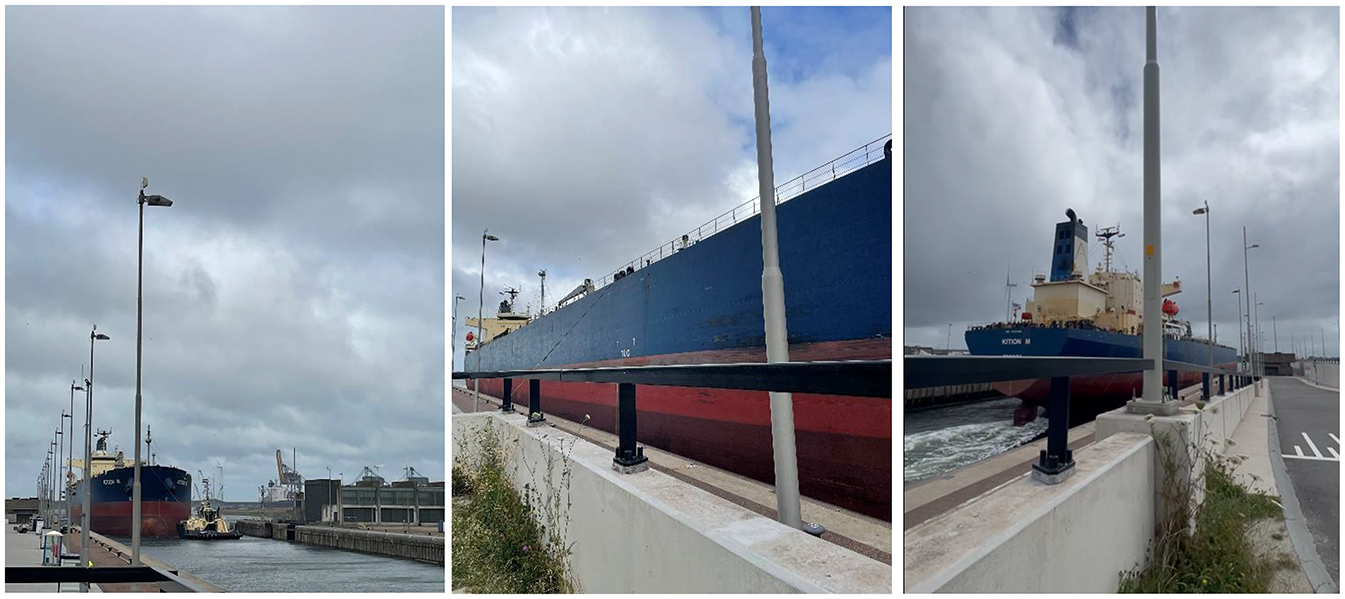 Lock Passage: oil tanker sailing into Port of Amsterdam through the lock complex at IJmuiden. Images by author.
Sea locks facilitate a ship's passage between water bodies at different levels by raising or lowering them inside their lock chambers. Prior to the expansion, the use of the existing Noordersluis for ships with a deep draft was bound to the tide, allowing passage only at certain times, a problem exacerbated by the anticipated growth in vessel size. Thus, a significant part of the infrastructural promise of the expanded sea lock was to increase its depth so as to provide tide-independent passage for ships 24/7, accommodating the just-in-time rhythms of planetary supply chains. However, sea locks are also infrastructural disturbances in delicate watery ecosystems, like the brackish ecologies of the IJ estuary. With a capacity of 630 million liters of water (Port of Amsterdam, 2025), more than double that of the lock it was designed to replace, each time the new, expanded sea lock at IJmuiden opens to allow a vessel passage it also lets in 10,000 tonnes of salt into the inland waterways (Port of Amsterdam, 2022), with compromising local effects on drinking water, wildlife, and agricultural land along the canal. Because of this risk, its opening and closing has become regulated, constantly calculated against an acceptable threshold of salinity, a risk only exacerbated by climate change. Thus, the tidal-independent 24/7 passage sought by the expansion is undermined by the expansion itself, and the local effects of an infrastructure developed in service of the just-in-time rhythms of logistics beget further investment in infrastructural fixes: in the fall of 2022, the Dutch Ministry of Water and Infrastructure started building a salt dam which will pump salt water back out into the sea by relying on for which completion is expected in 2025 (Rijkswaterstaat, 2025).
Sea locks do not just modulate water levels; their dimensions also set the physical limitations on the kinds of vessels that are able to pass through on their way to the port. The chosen dimensions of the lock chambers – 500 meters in length, 70 in width, and 18 in depth – require an understanding of the role vessel size standards play in the political economy of international shipping. In discussing the optimal dimensions of the new lock chamber, a report on the future lock published by the Dutch Government's Multi-year Programme for Infrastructure, Space, and Transport (MIRT) mentions three places in particular: Panama, Suez, and Malacca (Rijkswaterstaat, 2008: 55). These are perhaps the three most important chokepoint passages in international shipping, as they enable passage on trade routes linking the Americas, Asia, and Europe, avoiding lengthy circumnavigation around the African and South American continents. Deepwater ports like Amsterdam are sometimes defined as ports that can accommodate Panamax ships, a vessel size standard dictated by the dimensions of the lock chambers of the Panama Canal. Panamax is one of multiple vessel size standards that follow the same logic: Suezmax for the Suez canal; Malaccamax for the strait of Malacca linking the Indian and Pacific Oceans; Baltimax for passage to and from the Baltic sea; Seawaymax for the St Lawrence seaway linking the inland Great Lakes of North America with the Atlantic Ocean; Kamsarmax for the port of Kamsar in Guinea, one of the world's largest exporters of Bauxite; Q-Max for the liquefied natural gas terminals in Qatar, the list goes on. These vessel standards illustrate the way planetary standardisation sought by logistical systems remains bound by site-specificity. The 2008 report also anticipates how the IJmuiden expansion must anticipate the Panama Canal Lock Expansion, which was to be completed in 2016 (Rijkswaterstaat, 2008: 55). As a crucial passage for the container trades between Asia and the US East Coast, the Panama Canal derives a large part of its income from the containerised trade, and the decision to expand its lock dimension can in turn be seen as related to the relentless pursuit of economies of scale of the highly oligopolised liner shipping industry (Bolton and Matthiessen, 2023). Reading them relationally through the specifics of the lock dimensions, IJmuiden and the Panama Canal are in this sense geographically distant but logistically proximate sites. Every time a ship passes through Amsterdam, it is also passing through Panama, and Panama passes through Amsterdam in every 32-metre wide, 289 m long ship coming down the North Sea Canal. To think about IJmuiden through a logistical lens thus requires reconstituting space in a way that does not necessarily privilege proximity in terms of metric distance but rather in more topological ways (Muller, 2015: 35).
The costs of the sea lock ended up nearing 1 billion euros (Pieterse, 2022). When plans for the lock were being made, these astronomical costs needed to be justified on the basis of future projections of commodity flows into the port, for which scenario planning was used as an ostensibly technocratic forecasting tool, and various consulting firms were enlisted to advise on whether and how to enlarge the lock. The scenarios used as planning devices for estimating the future volumes of the port's commodity flows —a high-growth scenario named Global Economy and a low-growth scenario named Regional Communities —outlined distinct sets of economic and geopolitical futures as a basis for decision-making. 2 In the cost-benefit analysis documents, it is insisted that scenarios should not be understood as involving prediction or preference. Rather, as the Netherlands Environmental Assessment Agency (PBL), who jointly designs the scenarios together with the Netherlands Bureau for Economic Policy Analysis (CPB), puts it: ‘scenarios are not forecasts, but descriptions of conceivable futures. The four WLO scenarios together form, as it were, the corner flags of the playing field within which the future will probably take place’ (PBL, 2010: 8). However, by virtue of their narrow selection, scenarios must involve some idea of the probable, as well as an assertion of the probable over the possible. If scenario planning is not prediction, it is at the very least prefiguration, as it helps render certain futures more possible than others. While the documents steer clear of making explicit recommendations, it is clear that the investment decision for the lock is shaped by the Global Economy scenario, the highest growth scenario, given that under the lower-growth scenario it is concluded that the costs of the lock would outweigh its benefits my tens of millions of euros (Rijkswaterstaat, 2008: 64). It raises the question: which futures are being planned around the Port of Amsterdam and its oil terminals, and what kinds of futures are ideologically sedimented into mega-infrastructures like the IJmuiden sea lock? The Port of Amsterdam is one of the largest energy ports in Europe, and the largest petrol port in the world. The Global Economy scenario invoked in the 2008 report projected that the oil products stored in the Port of Amsterdam would continue growing from 26 million tonnes in 2008, to 45 million in 2020 and 48 million in 2040 (Rijkswaterstaat, 2008: 34). The report also imagined a growing container market for Amsterdam through its CERES terminal, despite the neighbouring Port of Rotterdam already serving as one of the largest container terminals in Europe, projecting a container throughput of 69 million tonnes per year by 2040, compared to 6 million for the lower-growth Regional Communities scenario. In 2023, and the actual total throughput across all cargo segments was 63 million tonnes, with container throughput at a mere 1 million tonnes (Port of Amsterdam, 2023), following the bankruptcy of Amsterdam Container Terminals (ACT) ten years prior.
While the Port of Amsterdam website describes the sea lock as ‘built for the future’ and boasts of its ability to enable the port to become a ‘sustainable and circular energy and raw materials hub’ (Port of Amsterdam, 2025), in May 2022, research by Platform Investico showed that the financial figures underlying the sea lock investment decision completely overlooked the Paris climate goals, as its projections include a significant continued throughput of coal and petroleum in 2040 (Estrada and Voogt, 2022). If you stand by the locks today, two thirds of the cargo volume passing through carries some form of coal, oil, gas, or petroleum. If the scenario which ultimately granted the sea lock investment was to play out, the same amount of fossil fuels would still be flowing in and out of the port 15 years from now. Conversely, if the port were to decarbonise and go through an energy transition, the expanded sea lock would lose much of its reason for existing in the first place. In this sense, the financial and political justification for the world's largest sea lock infrastructure tethers the port and city of Amsterdam to a fossil-fuelled future, and the scenarios that envisaged this world have also helped make it.
Conclusion
I first visited the IJmuiden sea lock complex on a rainy summer day in 2022. While cycling across each of the smaller locks, we realised our bike trip was serendipitously timed with a VLCC tanker approaching the lock gate from the sea. We hung around until it was inside the lock chambers, a long and slow process and in-situ experience that defied any default association of logistics with speed. The seafarers on board noticed us standing around, and we tried our best through the rumbling engines and emptying water to ask them where they were coming from. They were coming from Georgia and were headed to Nigeria next. Two weeks later, the Dutch government announced its preventive lock schedule to avoid saltwater intrusion into the inland waterways. The various geographies and ecologies implicated in the everyday use of the lock set in motion a number of questions for field research: how might we effectively constitute space and time when approaching a field site through a logistical lens? And how might these logistical spatio-temporalities be thought in relation to local ecological and urban politics? As outlined in the beginning of this article, the central tension between UPE orientations that tend toward more planetary or situated approaches to studying the urban resides in a potential trade-off between examining multi-scalar processes that stress the planetary dimension of urbanisation, and everyday practices that are also constitutive of the urban. However, both strands emerged as responses to early UPE rather than as explicit responses to each other, paving the way for scholars to develop new methodological sensibilities that avoid the kinds of dichotomous constructions that force a choice between one or the other. Building on these approaches, in this article I have tried to argue and illustrate how an engagement with critical logistics offers ways forward for this debate and for UPE at large in three main ways.
Firstly, if logistics is, as Bernes (2013) calls it, ‘capital's own project of cognitive mapping’, then refracting the concerns of UPE through a critical logistical lens can help identify sites from which to begin following these processes in a way that is of the city without being in the city, and letting them unfold as a site multiple that resists the dichotomy of the planetary and the everyday. The IJmuiden sea lock complex is not a place that one might at first sight characterise as particularly urban, but reading it through a combined UPE and critical logistics lens also illustrates how the ‘non-place’ can be a key site from which to draw out the political stakes of urban and climate futures as they play out in a city like Amsterdam, discursively invested in planning policies evoking a sustainable circular economy, but materially tethered to fossil fuel infrastructures whose futures are only further legitimised by mega-infrastructures like the expanded sea lock. Secondly, as I have sought to illustrate by way of the concrete example of the scheduling rhythms, dimensions, and futurities of the expanded IJmuiden sea lock, the logistical infrastructures of the shipping industry are a great example of how combining UPE and critical logistics encourages a processual episteme for following circulatory flows that pays attention to both its political economy and political ecology and their connections to and implications for urbanisation and urban politics, responding in this sense to Swyngedouw's (2023) call for the development of ‘flow-based methodologies’ for reading the uneven geographies and socio-ecological patterns of planetary urbanisation (2023: 42). If logistics is capital's science of flow, then a deeper engagement of UPE with critical logistics lends itself to the kind of processual methodologies it is theoretically committed to for understanding urbanisation.
Finally, a deepened engagement with critical logistics could also help UPE expand its political project: as Kaika et al. (2023) note in a recent volume on UPE and the climate emergency, critique must help not just propel the field forward but also orient us towards new forms of action (Kaika et al., 2023: 6). As Arboleda (2023) argues regarding the relationship between studies of extractivism and UPE, the climate emergency raises the stakes of both research agendas and therefore also the need to develop productive articulations between them (2023: 92). I believe a similar argument holds for the rapprochement between UPE and critical logistics, both regarding how the latter can theoretically and methodologically extend the former but also because of the wealth of work among critical logistics scholars and organisers on what it might look like to articulate a counterlogistics: collective attempts rooted in labour, grassroots, and indigenous movements to organise against the extractive capture of life, labour, and land by ceaseless logistical expansion through blockade tactics connected to broader forms of social struggle (Alimahomed-Wilson and Ness, 2018; Bernes, 2013; Chua and Bosworth, 2023). Over the past year, we have seen an orientation of internationalist solidarity action in logistical directions, toward economic blockades targeting complicity with Israel's genocidal war in Gaza, in the form of spontaneously organised blockades of entrances to arms factories, ports, and airports: activists and organisers often recognie the spatial form of the ‘chokepoint’ as having the potential to increase the material leverage of their political demands, as was the case with the XR activists who blocked the IJmuiden lock in the opening vignette. The spatial and political contours of these logistical vulnerabilities and the extent to which they can be used as a way for situated yet connected struggles to reverberate and build power at scale has been subject to much debate among scholars of logistics. Here too, scholars and organisers working around logistics have many lessons to offer an urban political ecology that seeks to reconcile situated and planetary visions of urban and ecological justice in the struggle for a livable planet.
Acknowledgements
I would like to thank all the participants of the 2022 FieldARTS Transitional Waters residency, especially Fred Carter and Jeff Diamanti. The thinking and writing that went into this article would not have been possible without the intellectual comradeship and support of Jacob Bolton. I am also grateful to the UvA Urban Political Ecology reading group and to Tait Mandler and Yannis Tzaninis for their encouragement.
Footnotes

Funding
The author received no financial support for the research, authorship, and/or publication of this article.
Declaration of conflicting interests
The author declared no potential conflicts of interest with respect to the research, authorship, and/or publication of this article.