




Abstract
In this paper, we analyse the heterogeneity of water supply infrastructure in Accra, Ghana, to understand the politics of water in cities where infrastructural diversity has always been the norm. We do this by extending the use of heterogeneous infrastructure configurations as a heuristic device, shifting the focus and scale of urban political ecological analyses of infrastructural diversity from users and access to water distributions at city scale. To explain the impacts of three experiments in the distribution of water across the city, we analyse how changes in the technical and operational arrangements of Accra’s bulk water filling points reflect changes in the social relations of cooperation or conflict between the diversity of actors and infrastructure supplying water across the city. We find the uneven waterscape of the city is shaped by a plurality of actors whose practices are informed by a range of motives. These motives exceed profit-making, political legitimacy, patronage and petty corruption including also solidarity, religious beliefs and pragmatic choices. We show that distributions of water, risks and responsibilities among different actors involved in operating the water filling points are constantly contested with ambiguous and unforeseen outcomes foreclosing but also opening new possibilities for progressive experimentation. Documenting how relations between actors and technologies of water provisioning are dynamic, and open to incremental improvements towards progressive (re)distributions of water, our analysis at the city scale calls for further focus on how practices and policies of solidarity can be extended across heterogeneous provisioning systems.
Introduction
Daniel lives in one of the most exclusive and well-serviced areas of Accra. Although the neighbourhood is known for its celebrity residents and upmarket villas, Daniel and his family live in a temporary structure made of wood and metal, a home for both the family and the family’s water kiosk business. Daniel buys piped water from the Ghana Water Company Limited (GWCL), the national public urban water services provider, and then resells it in bulk amounts to the water tankers serving upper class residents and construction sites in surrounding neighbourhoods. He gets water from the GWCL piped network through a registered, unmetered connection and stores it in a ground level 80 m3 concrete tank. When a tanker driver pulls up and asks for water Daniel turns on his diesel pump, the driver connects the pump to storage containers on the truck (cisterns, polytanks) and waits for them to fill. Selling water to tanker trucks supports Daniels family, and supplies water in smaller volumes to neighbours living in temporary kiosks who can neither afford nor are formally allowed, to connect to the public water supply system. Recognizing the social service he provides to his neighbours, Daniel points at the rich houses surrounding his compound and he asks, ‘do you think you can knock at their door and ask for water? They would chase you, send their dogs and think that you are a thief”.
The story of Daniel reflects the diversity of technologies, infrastructures, practices and people through which water is supplied in Accra, and many other cities where water has never been universally provided through a centralized piped network. With Accra’s piped network supplying water to barely half of the growing population, residents rely on combinations of providers (water trucks, water vendors, packaged drinking water producers), storage infrastructures (polytanks) and technologies (boreholes and pumps) (Oteng-Ababio et al., 2017). Of course, not all residents have access to the same set of providers or infrastructures. High- and middle-income households live in areas of the city where, historically, piped water supply is available and reliable, while these residents can also afford to install and fill large reservoirs with water extracted from boreholes, or bought from tankers (Yeboah, 2006).
Recent developments in the field of urban political ecology (UPE), and urban studies more broadly, call scholars to take seriously the infrastructural complexity of providing and accessing urban services, like water (Coutard and Rutherford, 2015; Jaglin, 2014; Lawhon et al., 2017; Peloso and Morinville, 2014; Silver, 2016). For urban water scholars this means situating and/or decentring explanations for why and how inequalities in water access and water related risks occur (Furlong and Kooy, 2017). This requires scholars to look beyond – or alongside – centralized piped network infrastructure when analysing how social relations metabolize or urbanize water to shape its uneven flow through urban populations, (re)producing uneven urban environments (Furlong and Kooy, 2017; Truelove, 2019). More radically, Mary Lawhon and colleagues argue the need to go beyond explaining inequalities, advocating the use of UPE to identify leverage points for fostering a more progressive politics in the city, providing insights on the ways existing inequalities could be remedied (Lawhon et al., 2014). Towards this, Lawhon et al. (2014) call for close attention to how (everyday) practices shape the circulation of material flows through the city. This, they argue, can help analyse how inequalities in the city are (re)produced in places where there is no large networked infrastructure, and can help identify those practices offering scope for incremental possibilities for progressive change (Silver, 2014).
In response to calls for both more situated, and more pragmatic, UPE analyses we set out to take the diversity of Accra’s water supply infrastructure seriously. For us, this means to understand the politics of water in Accra through the diversity of its water provisioning infrastructure. Specifically, we look at how uneven distributions of water across the city are produced through the ways actors and infrastructures interact – coming together in relations of cooperation, or conflict. Instead of seeing infrastructural diversity as a product of inequalities, to be explained by the presence or absence of the centralized piped network, we ask how the city’s inequalities are (re)produced, contested and/or change through infrastructural heterogeneity, what are the social and technical relations shaping these outcomes, and how might they provide insights for a more progressive urban water politics? Our analysis builds on understandings of urban infrastructure as heterogeneous infrastructure configurations (HICs) (Lawhon et al., 2017), and we extend the application of this heuristic device to focus on provisioning, rather than access and users. We do so in order to illustrate how changing socio-technical relations between heterogeneous water supply configurations shape uneven water flows at the city level, rather than users, or neighbourhood levels. Second, and as a part of the HIC scholarship, we seek to contribute to the larger political project of this ‘new wave’ UPE by identifying the possibilities for incremental change. For the latter, we approach this with humility, focusing on how analyses of infrastructural heterogeneity can help to identify where, by whom, under what circumstances progressive changes may be possible.
We take the water filling points (WFPs), like the one managed by Daniel, as an entry point for our analysis. Characterized by different technologies, physical materials and organizational arrangements that change over time, WFPs are among the many meso-level configurations that contribute to the circulation of pipe water beyond the reach of the networked infrastructure – ‘treated water is pumped to a local distribution centre, from which it is sold to residents’ (Schindler et al., 2019: 13). These configurations are the focus of many interventions for improving water access in underserved areas, particularly informal low-income settlements (Adams and Boateng, 2018; Schwartz et al., 2017). A rich literature analyses the technologies of WFPs including regulatory and operational challenges in terms of water quality, affordability, inclusiveness, cost-recovery for households, entire communities and water companies (Ahlers et al., 2012, 2013; Manzungu et al., 2016; Sarpong and Abrampah, 2006). Yet, they remain relatively unexplored in analyses of Accra’s uneven waterscape and – unlike for public standpipes, sachet water and water kiosks (Morinville and Harris, 2014; Stoler et al., 2012a) – they seem not to be considered significant in analyses of city-level outcomes. And yet, WFPs are significant in terms of the volume of water circulated (compared to sachet), and the percentage of residents reliant on them: WFPs provide pipe water in bulk quantities to more than 500 tanker drivers that in turn deliver to more than 17% of the city’s population (Alba et al., 2019).
We begin our analysis documenting how and why the socio-technical relations constituting WFPs and their relations with other infrastructural configurations changed in three distinct ways over the decades, from 1990s to 2017. Our specific research questions are (1) how do the different socio-technical configurations involved in the distribution of water interact materially over time; (2) how are these interactions produced by and productive of situated relations of power between actors involved in water provisioning and (3), what are the outcomes for the distribution of water and water related risks and responsibilities? For the third research question we focus on the distribution of commercial risks, and responsibilities for revenue collection, setting water prices and monitoring the quality of water sold at the WFPs. In our concluding section, we reflect on how approaching the politics of urban water through infrastructural diversity helps identify possibilities for more just distributions.
Heterogeneous water supply infrastructure
In recent years, scholars concerned with urban inequalities, and seeking to explain the production of uneven urban environments through a focus on water infrastructure, have called for more situated and decentred analyses (Coutard and Rutherford, 2015; Kooy and Bakker, 2008; Lawhon et al., 2014; McFarlane and Rutherford, 2008). Advocating the need for closer engagement with infrastructural diversity as an opportunity, rather than a failure (Jaglin, 2014), has gone alongside arguments for understanding the production of the urban waterscape through infrastructural connections – rather than the fragmentation of a centralized piped network (Furlong and Kooy, 2017). To further the analytical purchase of infrastructural heterogeneity for understanding urban inequalities, Lawhon et al. (2017) developed the term HICs, proposing this as a heuristic device for exploring relationships between urban infrastructure, environments and inequalities. Conceptualizing urban infrastructure as ‘many different technologies, relations, capacities and operations, entailing different risks and power relationships’ (Lawhon et al., 2017: 722), all of which shift over time and space, infrastructure is understood as a verb – the process of making and maintaining connections between people and things – rather than a noun (McFarlane and Silver, 2017). Employing the term configuration instead of system underlines the dynamic, incremental and open character of urban infrastructure, never fixed but always changing and transforming (Silver, 2014). The questions asked of these configurations are how they make things (e.g. resources, water, even alcohol) flow – through what arrangements, material objects and relationships – and what do the socio-technical relations shaping material flows mean for urban environments, and how might they be made less uneven?
Such a perspective brings new insights for a political ecological analysis of water infrastructure. Thinking through HICs demands a situated understanding of what constitutes water infrastructure in a certain place at a certain time, for specific individuals (McFarlane and Rutherford, 2008), and draws attention to how risks and power are (re)distributed when socio-technical arrangements for basic service provision are either ‘complement … [or]. conflict with each other’ (Lawhon et al., 2017: 731). Most significantly, these analyses are not only concerned with the production of socio-spatial inequalities, but also how they might be challenged, or substantially altered by the diversity of efforts to circulate water across the city. Such goals and perspectives align with recent proposals for a practice-based understanding of water governance (Alba et al., 2019; Cornea et al., 2017; Neves Alves, 2019; Truelove, 2019) acknowledging ‘the messiness, creativity and contingencies in water governance processes, while also allowing a better appreciation of how water decisions and actions may be as much the outcome of pragmatic or tactical choices, as of strategic, power-laden ones (Kemerink-Seyoum et al., 2019: 3). These practice-based analyses echo Lawhon et al. (2017), calling for recognition of how ‘societal orders, and the governance these assume or produce are always in-the-making and inherently performative – and therefore open to change’ (Kemerink-Seyoum et al., 2019: 2).
We also see opportunities for thinking through HICs to contribute to understanding the politics of water in Accra. Here, we build on the existing rich literature on water supply and access in the city, and draw from UPE analyses of Accra’s water, to suggest how a new explanatory framework for the city’s water woes can extend current insights. Specifically, while socio-spatial inequalities in access to water in Accra are well documented, existing UPE analyses explain this by focusing on the more structural social relations and processes responsible for presence or absence – coping – of networked infrastructure (colonialism and neoliberalism) and on residents’ unequal response to such fragmentation (Bartels et al., 2018; Peloso and Morinville, 2014; Silver, 2016; Whitfield, 2006; Yeboah, 2006). These explanations have historically interpreted infrastructural heterogeneity as a product of inequalities in networked supply, and, excluding the work of Peloso and Morinville (2014), they have therefore not taken the diversity as a starting point to understand the production of water inequalities and to identify possibilities to reverse them. And while there is a rich literature from water scholars covering the diversity of water supply infrastructure in Accra, we find few analyses (with exception of Morinville, 2017 and Peloso and Morinville, 2014) of how these infrastructural configurations interact to shape uneven geographies of water access at the city level, or of the social relations of power sustaining or changing the material relations. Scholarship on the provisioning infrastructure characterized as small-scale water providers describe the diversity of social technical configurations at the meso-level, but are primarily concerned with outcomes for individual users or neighbourhoods and rarely focus on tanker water supply (Alba et al., 2019, Amankwaa et al., 2014; Dapaah and Harris, 2017; Grönwall, 2016; Tutu and Stoler, 2016). We see space here for more relational analyses of how the set up and operation of meso-level configurations shape water distribution across the entire city.
Towards this goal, we proceed to understand the politics of water in Accra through its infrastructural diversity. We employ HICs as a heuristic device for the political ecological analysis, although with a slight adaptation to focus on providers instead of users. Taking users as the scale and focus of analysis of the socio-technical relations highlights the opportunities that smaller-scale relations (i.e. within one neighbourhood, one street) and meso-scale configurations offer for incrementally reverse (water) inequalities – i.e. water sharing arrangements between households (Smiley, 2020). But analyses at this scale have also shown the limits of local interventions for progressive change, i.e. by switching from one (water) configuration to another users deal with disruptions and mitigate risks for themselves and some of their neighbours, but not for all (Schindler et al., 2019). Schindler et al. (2019) suggest adapting meso-level configurations can reduce inequalities while maintaining a degree of intra-neighbourhood heterogeneity – i.e. residents can continue to switch between different systems or build their own systems in order to deal with (temporary) disruptions but a minimum supply of basic services is provided by the state at neighbourhood level. Picking up the suggestion of Schindler et al. (2019), and reading this back into our empirical data on WFPs, we analyse the socio-technical relations of these meso-level configurations of water provisioning, and what they mean for the urban waterscape.
Researching inequalities through water filling points
Our analysis draws on empirical data collected by the first author during August to November 2015, and from August to September 2017. Our interest in WFPs began in the summer of 2015, when the first author followed the practices of water delivery via mobile tankers (Alba et al., 2019). Journeys across the city with water tanker trucks to WFPs – to fill the trucks tanks, deliver to residential, commercial customers, construction sites – made visible the role of WFPs in the city’s water supply.
The significance of WFPs in the city’s water supply is not immediately apparent from government figures. There is no official data on the number of residents served by WFPs, although some indication of the minimum number residents relying on tankers, vendors and neighbours, and thus on WFPs can be derived by the Ghana Living Standard Survey (GLSS) (Ghana Statistical Service, 2014). According to the GLSS, in 2014, 30% of households relied on neighbours to access piped water as a main source of water supply for general uses (it is not specified if the neighbours from whom a household obtains water runs a WFPs or not), while 17.4% of households relied on tankers and vendors (the source of water delivered by tankers is not specified). These percentages are likely much lower than actual numbers as they do not include the use of tanker water/WFPs for the construction industry and for institutions (i.e. to hospitals and schools). Finally, they do not account for the role of tanker water supply as a secondary source – i.e. by those end users whose primary source is the piped network but live in areas receiving water only 1–3 days a week and thus count on tankers/WFPs during the frequent disruptions of piped water supply (Oteng-Ababio et al., 2017).
During our rounds across the city with water tanker truck drivers we observed the different material designs, sources of water, practices of bulk water vending and spatial locations of WFPs (Figure 1, Table 1). In our visits to the WFPs with the tanker drivers we documented the actors, and the social relations between actors: GWCL, private bulk water vendors, mobile tanker drivers and residents themselves, but also local politicians, national governments and district administrations and the Public Utility Regulatory Commission (PURC). Some of the WFPs we saw had overhead hydrants connected with the piped network, and were managed by the water utility. Other WFPs were operated by private residents who, legally or illegally, draw water from their household connection to the network to fill storage tanks – reselling to tanker operators and neighbours. Not all of the WFPs sold piped water; some WFPs extract, store and sell groundwater, and in one place we observed a WFP selling surface water. WFPs are very heterogeneous water infrastructures (Table 1), and as we go on to describe, they are also enrolled in and/or related to the functioning of other configurations of water infrastructure.
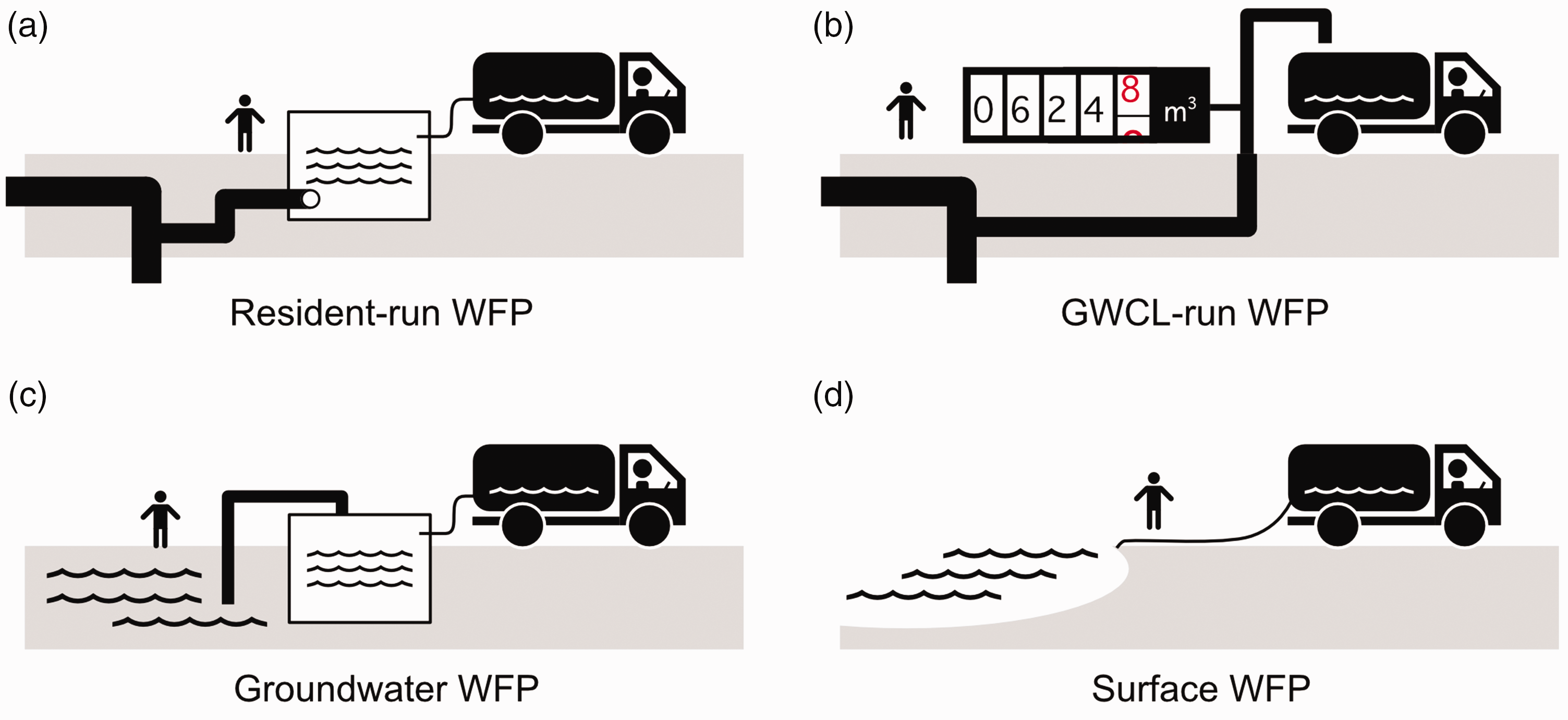
Schematic representation of WFPs (source: authors’ notes, 2015).
Typology of water filling points.
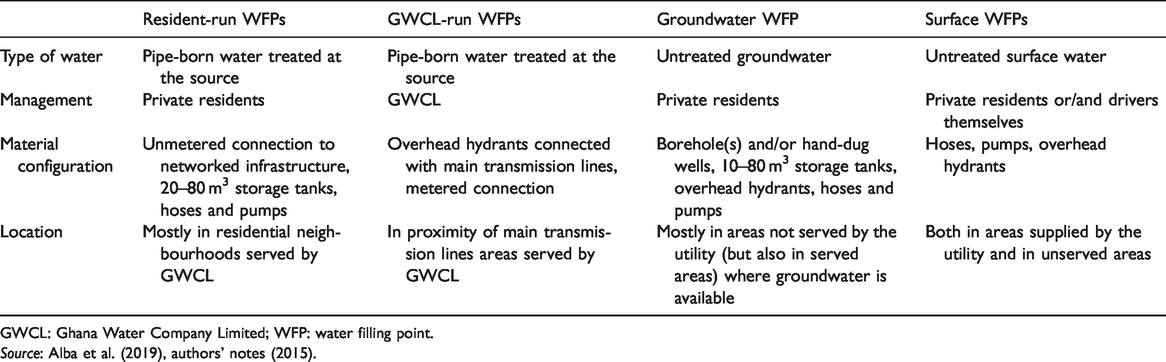
GWCL: Ghana Water Company Limited; WFP: water filling point.
Source: Alba et al. (2019), authors’ notes (2015).
Using our own mapping, and data collected from GWCL and tanker drivers, we counted 45 WFPs: 14 WFPs selling groundwater, 2 WFPs selling surface water, 29 WFPs reselling piped water. The WFPs we documented are scattered across the city, albeit many are clustered at the fringe of the water network, where tanker water demand by houses just outside the network coverage is high, as well as in areas where groundwater is accessible (higher water table) and not (too) saline. The WFPs we document are those used by four associations of tanker drivers, and one’s communicated to us by the GWCL. 1 Emphasizing how many WFPs there are in the city – beyond the ones we visited – one driver we interviewed warned us we would use all the ink in our pen if we were going to try to list them all. This statement, and the statistics suggesting the role WFPs in urban water supply, contrasts the current lack of official regulation of the price, quality and quantity of water distributed through the WFPs. Although mentioned in recent policy documents (Ministry of Water Resources, Works and Housing, 2015), WFP operators are not licensed, WFPs, are not regulated by government agencies responsible for safe water supply, and are not included in tariff setting schemes. And yet – despite their absence from frameworks of urban water governance, the location and configuration of WFPs are well known by GWCL district staff. When asked about the number of bulk water vendors present in her district, a GWCL commercial officer printed out a list of names and started going through it one by one. She knew most of the vendors by name, and when in doubt, would call the field officers in charge of the meter readings. After two or three phone calls we had a list of seven WFPs and several tables recording their monthly water consumption. In another district, helped by Kwame, a senior driver, we mapped 15 WFPs including those known by the GWCL, those operating illegally, and those recently closed.
Our mapping and interviews with GWCL, drivers and WFP operators, highlighted the dynamic character of WFPs. We saw some WFPs in operation, but others were temporarily or permanently closed and/or sought to remain hidden from GWCL (Figure 2). Using information collected from interviews, archives, newspapers, water sector reports, we document the changes in WFPs, developing a chronology of WFPs from the 1990s onwards: how and when they were built, operated and integrated – or not – in formal plans and policies for the city’s water supply (Table 1). Our analysis is informed by oral histories collected from senior tanker truck drivers involved in the tanker water supply business from its inception, senior and former staff of the water company and private residents operating WFPs for more than 10 years. These personal accounts were triangulated with articles from newspapers, policy documents, unpublished documents shared by a former spoke person for Accra’s tanker drivers (a list of WFPs, way bills of tanker driver and two petition letters) and reports about tanker water supply in Accra (Owusu Kanin, 2010; Sarpong and Abrampah, 2006). Existing literature tracing the history of urban water provision in Accra and analysing Accra’s urbanization provided useful background information (Bohman, 2010; Silver, 2016; Yeboah, 2006). While analysing the data, we identified three different periods in the experimentation with WFPs around which we organized our empirical material. These are: 1990s – mid-2000s when WFPs first emerged following the rise of tanker water supply, mid-2000s – 2010 when WFPs were shut down and 2011–2017 when WFPs were reopened. In each period, we document the changes in the socio-technical configuration of the WFPs, we analyse the social and technical relations shaping new forms of experimentation, and identify the outcomes for the (re)distribution of water. In analysing WFP configurations, we pay particular attention to how different experimentations entail different distributions of responsibilities for prices setting and water quality monitoring as well as revenues and commercial risks among the water company, the PURC, tanker drivers and WFPs’ operators.
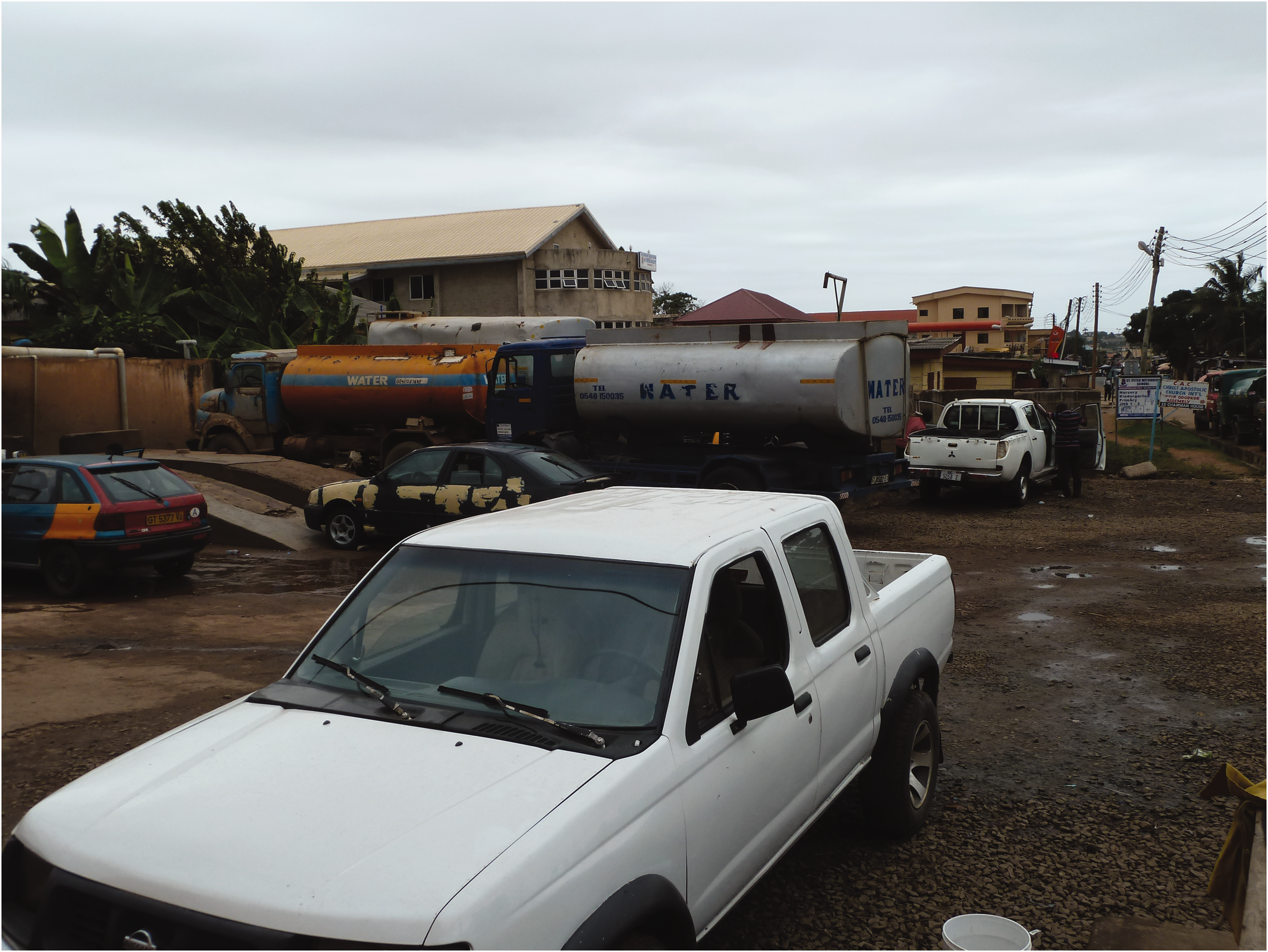
Disconnected WFP (overhead hydrant) and tanker trucks not in use (source: authors, 2015).
Reconfiguring relations through infrastructural configurations
The emergence of WFPs, 1990s–mid-2000s
The emergence of WFPs can be traced back to the late 1980s, when a growing number of privately owned tanker trucks started to distribute water across the city (Owusu Kanin, 2010). These WFPs differed from other meso-level configurations – i.e. public standpipes present in Accra since colonial times (Bohman, 2010) – as they were designed to facilitate easy access of large trucks to bulk volumes of piped water. Initially, privately operated tanker trucks accessed the piped network from a WFP they shared with tanker trucks operated by the GWCL (Tanker driver A1, 2015, interview). This first WFP was located next to the GWCL’s office in the city centre, owned and operated by the GWCL. The WFP consisted of an overhead hydrant supplying water directly from the network into the trucks. GWCL’s trucks had priority at the filling station, but privately operating trucks could access water here, if registered with GWCL – and, of course, paying for the water supplied by GWCL (Tanker driver D2, 2015, interview).
Soon enough, one WFP was not sufficient to supply the burgeoning number of private trucks circulating across the city. There were long queues and longer waiting times for drivers and for the customers they served (Tanker driver A1, 2015, interview). A senior driver we spoke with estimated there were only 24 privately operated water trucks in 1993 (Tanker driver A1, 2015, interview), but by mid-2000 this grew to more than 520 tankers (PURC, 2005; Sarpong and Abrampah, 2006). We find two configurations of WFPs emerging from the 1990s to mid-2000, to supply this demand: WFPs run as a collaboration between GWCL and associations of tanker drivers, and residents-run WFPs. These configurations had different socio-technical relations, and ambiguous impacts on improving (pipe) water access across the city.
The WFPs run as a collaboration between GWCL and associations of tanker drivers was an overhead hydrant with a metered connection to the piped network. Tanker associations – a minimum of four tanker drivers who registered their water-vending business with the Accra Metropolitan Assembly (Owusu Kanin, 2010) – and the state provider shared responsibilities and risks in the operation of the WFPs. Associations had to file a request to the GWCL for a connection to the network, pay monthly water bills (per metered unit of water consumed), create and enforce rules for its drivers on water pricing and keep records of the number of truck drivers and the amount of purchased (Tanker driver A1, 2015, interview). In opening these WFPs the GWCL sought to stop drivers from abstracting piped water from hydrants dedicated to Fire Services, a practice considered illegal (Sarpong and Abrampah, 2006). The public provider was motivated by the opportunity to increase revenues, expand coverage and gain some control over water distributed beyond the networked infrastructure, but GWCL shared responsibilities and risks in the operation of the WFPs with tanker drivers and the PURC. GWCL provided the technology connecting tankers to clean water (overhead hydrants) from the network, and monitored water quality, 2 while the associations were responsible for the quality of water at point of delivery (Owusu Kanin, 2010). Individual drivers had to disinfect their tanks every six months and association were to monitor drivers’ behaviour (PURC, 2005). If they delivered water from other sources (i.e. untreated water abstracted from rivers or hand-dug wells), the association banned them from operating for six months (Tanker driver A1, 2015, interview). Actors were also to collaborate for setting water tariffs. The water company set the tariffs for bulk water supply at the WFPs, following the tariff scheme approved by the PURC. The prices for water sold by tankers were to be agreed on by the PURC and the associations.
In 1997, a Memorandum of Understanding (MoU) between the GWCL and the first association of tanker drivers (Former GWCL staff, 2015, interview), and later the draft document of ‘Water tanker service guidelines’, hereby referred as guidelines (PURC, 2005), formalized the agreement of how roles and responsibilities were shared between actors. However, experimentation with this HIC was only supported by PURC, not by other national government institutions, and as a result the guidelines remains up until today only a draft reference document (PURC, 2015, group interview). The spirit of the guidelines resonated with the market-based principles – encouraging fair and open competition between operators – of World Bank (WB)-sponsored reforms of the water sector (Whitfield, 2006), but was apparently not seen as conducive to the public-private partnership between the state provider and Aqua Vitens Rand Ltd. (AVRL) (Fuest and Haffner, 2007). Here, we see how infrastructural experiments are shaped by the social relations between different government organizations, and how these relations are in turn influenced by international actors such as the WB (Amenga-Etego and Grusky, 2005).
The second type of configuration, a residents-run WFPs, also emerged between the 1990s and mid-2000s, and was used by tanker drivers to access water (Tanker driver B1, 2015, interview). Residents who had a connection to the piped network built large storage facilities and sold piped water in bulk to tankers, and in buckets to their neighbours (Bulk water vendor I, 2015, interview). This experimentation was similar in form and time period to sachet water production, where residents treated and resold piped water, becoming drinking water providers (Stoler et al., 2012b). Like for the early years of sachet water production, many of the resident run WFPs operated without authorization or registration with GWCL. They used ‘backdoor’ arrangements (Bulk water vendor T, 2015, interview), comprised of two-inch underground PVC pipes diverting water from metered domestic connections and into self-constructed concrete storage tanks located partly underground and in backyards. This technical design made it difficult for the GWCL field staff find the WFPs and sanction illegal practices of water abstraction (GWCL district staff, 2015, interview).
The ‘backdoor’ WFPs effected a very different distribution of responsibilities and risks than set out in the PURC’s guidelines. Residents running the WFPs took over responsibilities for water quality, decisions about prices, operating hours and distribution schedules. They also took over commercial risks and public health risks as the quality of water delivered at these WFPs depended on the regular cleaning of storage tanks and hoses by residents. Tanker drivers welcomed resident-run WFPs as an additional opportunity to access piped water. But the public provider lost revenue: water was either not paid for, or when it was, residents often paid according to the lower domestic tariffs instead of higher commercial ones (GWCL district staff, 2015, interview; Former GWCL staff, 2015, interview).
The outcomes of these WFPs – GWLC-run and resident-run – were positive in terms of increased coverage but overall can be seen as negative for redistributions. With the robust structure of tanker trucks and ability to drive on unpaved roads, it was now possible to deliver piped water to edges of city where development was booming but transport infrastructure and networked supply was mostly absent (Yeboah, 2006). WFPs and tankers provided piped water to middle and high-income residents of new housing estates on the outskirts of the city (Bartels et al., 2018). These residents, and other middle and upper-middle income households living in the inner city, could afford to buy large volumes of water – and store it, not insignificant abilities considering 5000 gallons (about 22 730 L) was 70 USD (Yeboah, 2006). In contrast, low-income households living in one-room dwellings had neither space for money to buy large volumes of water. These WFPs did not make access to clean water for poorest residents more affordable, as residents continued to buy small volumes of water from neighbours or vendors at high prices per unit (Amankwaa et al., 2014; Tutu and Stoler, 2016), but they did improve availability of piped water for residents who were unable to get individual connections (Bulk water vendor, 2015, interview; fieldnotes 2015).
Forced disconnections: Closing of water filling points, mid-2000s–2010
The city water company’s experimentation with WFPs changed significantly in the period leading up to, during and after the private sector partnership between GWCL and AVRL. The 2006 management contract for urban water supply made AVRL responsible for daily operations, while GWCL maintained ownership of assets, and responsibility for investment (Hirvi and Whitfield, 2015). Withdrawing the MoU and the ‘Tanker water service guidelines’ agreement, WFPs were disconnected. Officially sanctioned configurations were terminated, and hidden pipes of the ‘backdoor’ WFPs were the target of joint water company and police operations, demolishing storage tanks and arresting tanker drivers using these configurations (Bulk water vendor, 2015, interview, Tanker driver A1, 2015, interview). The total number of WFPs closed over this period remains unspecified by GWCL, but a list shared with us by the spokesperson of an association of tanker drivers counts the disconnection of 24 overhead hydrants operated by drivers’ associations and private individuals, while newspaper articles mention the closing of 13 hydrants (Daily Graphic, 2010) and the destruction of more than 15 underground tanks (Della Russel Ocloo, 2011). We explain the end of this experimentation with water supply infrastructure by exploring the social relations and societal processes shaping the closure of WFPs, as well as how the new distributions of water, risks and responsibilities were contested, and influenced by material arrangements.
Implementing the disconnection of WFPs, the city water company now blamed WFPs for their poor technical and financial performance (Daily Graphic, 2009). Technically, the bulk abstractions of WFPs decreased piped water supply, and reduced pressure, surrounding areas, similar to sachet water production (Morinville, 2017). Financially, WFPs were blamed for high levels of non-revenue water (NRW). Newspaper articles, and our interviews with GWCL staff, blamed WFPs for taking water without paying – making illegal connections, or bypassing meters (Daily Graphic, 2007; Doe Ablordeppey, 2002). Certainly, the water company’s NRW was not insignificant; in 2007 NRW was at 60%, of which 27% was due to physical losses (i.e. leaky pipes) and 33% due to commercial losses, that is water supplied but not paid for by customers (Adank et al., 2011). 3 The disconnection of WFPs was justified also in relation to the high cost and poor quality of water sold at the WPFs (Former GWCL staff, 2015, interview). In contrast to the actions taken against WFPs, the similar problems with sachet water production for water pressure and water quality issues were addressed by further formalizing arrangements and state regulation. 4 This could be related to the public health consequences of poor drinking water quality, but the relations with GWCL are also significant. Sachet water was not perceived as a threat by the GWCL: the total volume of water abstracted is low, in comparison with total volume of supply, and producers (mostly) register their connections and paid the special tariffs (Stoler et al., 2012b). A less direct challenge to the authority of GWLC for water supply, alongside the relations between government agencies (Ghana Standards Board, Food and Drugs Board), and the lobby group for sachet water producers led to a different outcome.
The emphasis on financial performance, and attribution of poor performance to WFPs, is also explained by a new approach to NRW resulting from the private sector management contract for water supply and the commercialization of water supply. 5 NRW was a long-standing challenge for the water company (Bohman, 2012), but the withdrawal of government subsidies, as part of structural adjustments included in the package supporting introduction of neoliberal governance frameworks, made improving revenue collection paramount for the newly privatized provider. Reducing NRW (5% per year) was one of the targets used to evaluate the performance of the management contract, and to achieve this AVRL introduced new billing systems, performance-based management practices, and a stricter attitude to the practices identified by the water company as illegal (Fauziatu, 2009; Hirvi and Whitfield, 2015): tapping water from the network without the knowledge of the utility, tampering with meters, or re-selling water at a WFP for commercial purposes whilst registered as a domestic customer. Disconnecting WFPs thus redistributed the revenues derived from the sale of pipe water from operators of WFPs, tanker drivers and the city’s residents, to an international private company.
Beyond the well-documented political economic processes shaping the liberalization of water supply in Accra (Amenga-Etego and Grusky, 2005; Whitfield, 2006; Yeboah, 2006), and the interests they brought to bear on WFPs, we also heard other explanations for why – now – the experimentation with WFPs was no longer considered desirable. Although many of the GWCL staff and government officials we spoke with refused to answer questions or make hypothesis (beyond referring to the technical, financial and public health reasons explained above), those interviewees who did speak about the closures suggest threats to the legitimacy of the state – and its subsequent authority – was also important for how the experiment ended. Complaints about limited water supply were growing across the city (Daily Graphic, 2008), and instead of water being publically provided at an affordable price, it was going to tankers and WFPs (PURC, 2015, group interview; Former GWCL staff, 2015, interview). The poor state of the city’s water infrastructure, due in part to how the decade-long privatization process limited capital investment for expansion of the network and routine maintenance, while the population and demand for water grew (Hirvi and Whitfield, 2015), meant that by 2007 less than 20% of residents connected to the piped system received water everyday (Adank et al., 2011). This meant that even residents connected to networked infrastructure relied directly or indirectly on WFPs – paying between 7 and 14 times more than GWCL’s lifeline tariff (Adank et al., 2011). Closing WFPs was identified as an easy – and politically expedient – way of addressing charges made by the general public of the state not living up to its promises and responsibilities (PURC, 2015, group interview; Former GWCL staff, 2015, interview).
Ending the experiment with WFPs was also politically expedient for addressing conflicts in party politics at the local and national scale. Tanker drivers and WFP operators, we spoke with identified local and national (party) political conflicts as more important than concerns of the GWCL/AVRL (Tanker driver A1, 2015, interview; Tanker driver D1, 2015, interview; Bulk water vendor, 2015, interview). They explained how WFPs were a source of political patronage and revenue generation by newly elected local and national politicians. One of the drivers compared the arrangements around the operation of WFPs to those around public toilets, management of which was given out citywide by politicians as political favours in the mid-1990s (Ayee and Crook, 2003). With the 2009 national elections changing the party in power at the national level the relations of patronage supporting some WFPs were disrupted. Municipal and District Assemblies (MDA) – lowest level of government in Ghana – assisted the disconnections, at times collaborating with utility staff in the WFP closures (Della Russel Ocloo, 2011). Proposals by these assemblies to then reopen the WFPs under new patronage arrangements were, however, not supported by the GWCL (Bulk water vendor, 2015, interview; GWCL district staff, 2015, interview).
The disconnection of the WFPs was publically contested – mostly by those individuals working in the domestic water supply sector. In 2010 and 2011, drivers protested the changes on public radio programs, in news articles, in letters to parliament and by participating in demonstrations (Tanker driver A1, 2015, interview). They also took collective action by forming a Coalition of Private Water Service Providers (CPWSP) in the Greater Accra Region. As part of their campaign the CPWSP compiled a list of 24 closed WFPs dotted across the city – to our knowledge this is the only list of WPFs available as the city water company will not disclose how many WFPs were in operation in this period. Their protest was unsuccessful in bringing back the social and technical configurations of earlier: WFPs operated by associations of tankers have not been reinstated.
Also visible – but less publically debated – in the closure of WFPs were the contestations over distributions of responsibilities, risks and revenues between different actors involved in different HICs. The opening and closure of WFPs reflect different answers to questions about what level of government should provide water (MDA vs. national), who among state actors should regulate water supply (PURC, MDAs or the water company), what political party and what groups in society are and should be involved in the provision of water (companies in the GWCL, or tanker businesses, or individual residents), and of course – how water supply should be financed (cost recovery or public subsidy). The shifting power relations between actors shaped the changing answers to these questions from 1990 to mid-2000s, but the material arrangements of water supply also challenged the permanence of desired arrangements of water and society. As one of the residents involved in the sale of piped water in the mid-2000s, now a local politician, explained, individuals managing WFPs ‘have also to survive and people will have to drink water; so they had to find other means to supply the water through illegal means ( … ) they will connect it [the pipe] in the night and sell it [the water] in the night by 6 am they’ve closed. They will sweep the whole place so when you come, you will not even see a trace, then they will block the line [again]’ (Assembly man, 2015, Interview).
The outcomes of this experiment and rearrangements of socio-technical relations for the distribution of water and related risks did not – perhaps unsurprisingly – match the justifications used to close WFPs. It is unclear how the closure of WFPs improved availability of supply for residents, as the rationing scheme continued. With continued demand for water, the WFPs continued to operate, but now illegally, and these risks were passed on to customers in the form of higher prices. Tankers now paid double for bulk water: before 2009 they paid 5 GHS for 2.5 m3 of piped water, and after they paid more than 10 GHS (Bulk water vendor, 2015, Interview). Water quality concerns were also not addressed, as water supplied by WFPs was no longer monitored by the government, and water tankers began to sell untreated groundwater and surface water. The disconnection of the WFPs ended up redistributing the risks related to affordability and water quality from providers and the government, onto individual consumers, particularly those unable to connect with the GWCL network due to high connection costs, complicated procedures and legal limitations.
Back again: Reopening water filling points, 2011–2017
In 2010, the GWCL changed its attitude to WFPs, opening up again for collaborative experimentation. New meso-level configurations emerged, now identified as a temporary measure for extending access to piped water in underserved areas of the city (peri-urban and low-income communities) and recognized in the Water Sector Strategic Development Plan 2012–2015 (WSSDP) (Ministry of Water Resources, Works and Housing, 2014). These configurations are diverse: overhead hydrants installed and managed directly by GWCL staff, WFPs built and managed by residents paying commercial water tariffs to GWCL, and privately built and operated WFPs supplying groundwater. These configurations show how intersections between political economic conditions, practices and technological possibilities shift from relations of conflict to cooperation between HICs.
The cooperative relations shaping the emergence of these WFPs are undoubtedly heavily influenced by the shift in social relations governing networked supply. The management contract between GWCL and AVRL was terminated in 2011, owing to, among other issues, the failure of AVRL to meet performance targets, and persistent opposition to private sector participation (Hirvi and Whitfield, 2015). With the GWCL again responsible for the management of water supply infrastructure, improving technical and financial performance remained a key objective. The goal of providing potable water to all by 2025 was set by the national government (Ministry of Water Resources, Works and Housing, 2014), and to reach these objectives a series of management reforms were introduced, supported by the WB and a Uganda-based consultancy. 6 The performance-based and commercial orientation of water supply as a business introduced during privatization remained (Yates and Harris, 2018), but this now contributed to the financial independence of the public provider, rather than a private company.
WFPs became useful for meeting performance targets related to revenue collection and increased distribution. As explained to us by one GWCL district manager, WFPs now aligned with the goals of the reforms and WSSDP. If WFPs were registered as commercial connections and paying for piped water then GWCL realized cost savings, avoiding the costs of managing WFPs directly while still collecting revenues for water distributed through higher commercial tariffs (GWCL district staff 1, 2015, interview). To discourage illegal practices meters were not installed in these WFP configurations; WFP operators pay a monthly consumption rate of 500 m3 (GWCL district staff 1, 2015, interview; Bulk water vendor, 2015, interview). While the GWCL regulates the price of water sold at WFPs, it leaves the operators of privately run WFPs some room for manoeuvre in setting different tariffs for tankers and for those buying by the bucket, or giving water away free-of-charge to some customers (Alba et al., 2019). For instance, Daniel decided to give water for free to one of his neighbours, an aged man unable to work, while young people who can work had to pay 0.10 GHS for a small bucket of water (10–15 L) or 0.40 GHS for a ‘Kufuor gallon’ (15–20 L).
New WFP configurations are also emerging as land owners invest in one or multiple boreholes or hand-dug wells, storage tanks, pumps and overhead hydrants to extract, store and sell groundwater (Bartels et al., 2018). Groundwater WFPs are primarily located at the outskirts of city – where the piped network is absent, and where the aquifer is higher and the groundwater is less saline – but we also encountered them in areas served by the GWCL. For instance, we spoke with one groundwater WFP operator located in the piped network supply zone, but wanting higher financial returns, implying groundwater is cheaper or free in comparison to piped water rates (Bulk groundwater vendor, 2015, interview). Some of the operators of groundwater WFPs we interviewed mentioned that they are asked to pay a monthly or yearly toll to the Municipal and District Assemblies, but these bodies do not play any other regulatory function. Groundwater WFPs sell water independently of the decisions and actions of GWCL and although Water Resource Commission should be notified of new boreholes this regulation is rarely enforced (Grönwall, 2016). Like for the piped water WFPs, groundwater WFPs decide themselves how to ensure water quality (or not), set prices, and what – and how – any social or ecological considerations shape their practices. For instance, a vendor moved by religious beliefs provided water for free to neighbours, while he sold it to tankers (Bulk groundwater vendor, 2015, interview). But equally with these configurations it is left to the discretion of individual drivers to disclose groundwater as the water source. This is similar to piped water WFPs who may be motivated by commercial interests to follow hygiene norms and water quality guidelines set in the national water quality framework (Ministry of Water Resources, Works and Housing, 2015), but are not regulated by the state.
These HICs reflect and enable new distributions of water and responsibilities, but have not yet fundamentally altered the distribution of related risks from previous decades. Risks in relation to water quality and affordability remains with individual consumers or WFPs operators, rather than the state. Given their still temporary status there is no official recognition – or demand – for cross-subsidies or other formal regulations for solidarity – across meso-level water supply configurations. The WFPs reselling piped water are considered only as commercial customers of the GWCL, unrecognized within formal water governance frameworks. Concerns over the quality of water from WFPs might be of secondary importance given the majority of Accra’s residents are now drinking sachet water and tanker water supply is used mostly for non-drinking uses by higher income groups, but affordability remains a critical issue. While these configurations allow for water-sharing arrangements to emerge at local level (giving water for free, or lower cost), financial risks remain with the individual vendor. Managers of WFPs have to pay monthly bills to the water company, even when demand for tanker water decreases, as it did in areas not far from Daniel’s. Some WFPs avoid the ultimate measure of disconnection from the piped network by relying on social networks – like the case of Daniel’s neighbour Ekua who borrowed from other WFP operators to pay her bill. This does not improve water access for those residents who remain dependent on WFPs for buying water in buckets, nor does it discourage what may be an unsustainable shift of WFPs to groundwater.
Summary: Thinking Accra’s waterscape through its WFPs
Experiments in the socio-technical configurations of Accra’s WFPs have had an impact on the city’s waterscape. To show this, we documented three distinct types of socio-technical arrangements of WFPs, starting in the 1990s. We have traced how and why these experiments emerged, and evolved, as a result of contestations between different actors, changing political economic circumstances and new technological possibilities. Starting out as collaborative endeavours between the GWCL, associations of tanker drivers, and PURC, the first WFP configuration ended when GWCL contested the distributions of responsibilities, risks and revenues for the water sold at WFPs. In parallel to the end of the first WFP experiment, we traced the emergence of a second WFP experiment: resident resold piped water in their backyards, operating either without the authorization of GWCL (illegally), or as commercial customers of the water company. In the third phase of WFP experimentation, GWCL is reselling bulk water directly to tanker drivers, while private residents are reselling groundwater. These different socio-technical configurations for WFPs have had different relations with other water supply configurations, and shifted the distribution of specific responsibilities and risks related to water supply.
Documenting these socio-technical experiments and their impacts on the politics of water in the city, we show how WFPs, like other meso-level configurations (Morinville 2017; Schindler et al. 2019), can contribute to tackling the historically uneven coverage of networked supply across the city of Accra. WFPs can allow residents excluded from networked infrastructure to access (piped) water: residents access water directly from the WFPs, like in the case of Daniel’s low-income neighbours, or through tanker drivers. However, the possibility of WFPs to contribute to more equitable access to water changes over time, as how WFPs work and for whom they work (or not) depends on the relations of cooperation or conflict between different water supply configurations. Conflicting relations, as exemplified by the outcomes of the disconnection of the WFPs, led to increases in the price of piped water distributed beyond the network, leave water quality monitoring at the discretion of the operators of the WFPs and incentivize tanker drivers to deliver untreated groundwater. Collaborative relations, the WFPs run together by GWCL and associations of tanker drivers and resident-run WFPs authorized by the GWCL, ensure a minimum involvement of public authorities (GWCL and/or PURC) in monitoring the quality and the prices of water sold at the WFPs. Collaborative relations also favour the distribution of piped water (instead of groundwater) by tanker drivers by making it easier (and not illegal) for tanker drivers to access piped water.
Conclusions: Situating the politics of water through HICs
In this article, we took the heterogeneity of water supply infrastructure as a starting point to contribute to the understanding of the politics of water in Accra, and other cities where water has never been universally provided through a centralized piped network. Moving beyond the characterization of heterogeneity as a symptom and indicator of urban inequalities, we sought to understand how the diversity itself (re)produces, challenges or could help change, uneven waterscapes. We explored this heterogeneity through WFPs, meso-level infrastructural configurations used in the delivery of water by various providers. We documented how and why the socio-technical relations of WFPs changed over time, and showed how shifting social relations of cooperation or conflict between the diversity of actors and efforts involved in the supplying water resulted in different outcomes for the distribution of water across the city. Collaboration between water supply configurations extended the legal distribution of piped water across the city, either by WFPs operated by associations of tanker drivers or by WFPs run by private residents. Contestations between water supply configurations halted this form of experimentation with WFPs, leading to unauthorized WFPs. While each configuration we examined improved water for some but not for all, collaborative WFPs authorized by the GWCL discouraged the circulation of untreated (ground)water, ensured a minimum monitoring of water quality and of water tariffs by state authorities and associations of tanker drivers. On the contrary, contestation between water supply configurations, materialized in the disconnection of WFPs, the persistence of unauthorized WFPs and more recently the emergence of groundwater-WFPs, contributed to a rise in the price of the piped water supplied by tanker drivers and to an increase in the circulation of untreated groundwater across the city.
Responding to calls for situated and pragmatic analyses of the politics of the urban environment to identify possibilities for progressive change (Lawhon et al., 2017), we offer here a few reflections on how this heuristic device helps identify how (and by whom) socio-spatial inequalities in the distribution of water and risks might be challenged, or substantially altered, in Accra. First, seeing water infrastructure through HICs forces a situated analysis of the politics of water. Understanding infrastructure as a socio-technical practice of establishing connections can take into account – but also goes beyond – structural processes and societal relations (re)producing urban water inequalities, i.e. neoliberalism (Lawhon et al., 2014; Parnell and Robinson, 2012). Using HICs, we see how the uneven distribution of water in the current city is shaped by colonial legacies, processes of capital accumulation, neoliberalization embedded in the governance of urban infrastructural networks (Bohman, 2010; Silver, 2016; Whitfield, 2006) but we also see how distributions are shaped by individuals within these larger processes and structures. We document the ever-shifting power relations between the many different actors – tanker drivers, GWCL, WFPs operators, residents, local administrations, PURC, land owners, financial institutions, political parties – part of WFP configurations. These actors, their practices and relations around WFPs are shaped by a variety of interests and influences. There is the usual profit making, political legitimacy, patronage and petty corruption, but we also see relations of solidarity and practices shaped by religious beliefs and a sense of responsibility for the broader public, alongside pragmatic choices of district level staff of the water company in authorizing WFPs.
Second, using HICs to approach the politics of urban water highlights the constant flux of socionatural relations; power relations and water distributions are constantly reconfigured. We see this as hopeful, in the sense of societal orders being unable to be fixed in place, and/or outcomes always open to ‘tinkering’ and reinterpretation. While the state water provider remains in a position of authority in supporting (or not) infrastructural experiments, and thus shaping urban water flows both within and beyond the infrastructure it manages, its effort in regulating urban water supply are continuously challenged. This is very visible in the volume of leakages in the piped network, the growth of sachet water production and ‘back door’ WFPs. While actors sometimes openly contest the water company’s authority as the ‘only urban water provider’ (i.e. letters to parliament), we also see this in the quiet everyday practices of illegal water connections, or in the emergence of WFPs supplied with groundwater. These practices ask the question of who and how decisions are made about the price, quantity and quality of water circulating across the city and beyond large-scale infrastructure in particular. Authority over water distributions – i.e. who and how decides about water prices, monitors the quality of water circulating across the city – are less static than GWLC or the state would have us believe. This is exemplified by how responsibilities for setting prices of water sold to the WFPs and by the WFPs continued to shift over time being with the water company, associations of tanker drivers and PURC in the case of collaborative WFPs, with WFPs’ operators in the case of ‘backdoor’ WFPs and with the GWLC and operators in the case of authorized resident-run WFPs.
This brings us to our third and final point. In thinking Accra’s waterscape through HICs at the meso-level scale we do not intend to celebrate diversity and change in and of itself, but rather we seek to foster a relational analysis attentive to connections between physical distributions. Improving access in one locality and/or for some users and providers, the WFPs and/or other configurations can exacerbate risks in another place and/or for other users and providers. Our analysis confirms local level experiments, as already noted by Schindler et al (2019), to be limited in their progressive outcomes. This points to the need for more understanding of how forms and practices of solidarity can be consolidated both within and beyond the neighbourhoods (Bhan, 2019). Insights and inspiration can be derived from literature analysing how forms of social collaboration, i.e. water sharing, are already happening at household level (Peloso and Morinville, 2014; Silver, 2014; Wutich et al., 2018), how co-production improves water access at neighbourhood scale (Adams and Boateng, 2018) or how cross-subsidies within networked supply contribute to extend water supply at city level.
The challenge for Accra, and other cities, is how forms of solidarity can be established across heterogeneous provisioning systems operating at different scales. Our analysis provides some initial suggestions for the case of Accra. First, forms of collaboration between HICs where state authorities (i.e. the public water company and PURC) take a public, visible role in steering infrastructural experimentations offers more potential for progressive redistribution of water and related risks. In this regard, the outcomes of the experiment with collaborative WFPs are positive: improved water access for final users, reducing risks for the operators of WFPs, while contributing to the financial and operational performance of the water company. In this experiment, the state responds to the demands from residents to perform a leading role in ensuring affordability and water safety (Harris, 2019).
More publically visible, and open-ended experimentation with meso-level configurations with the state in a lead role as coordinator, would – we believe – be another progressive move. This however first requires an acknowledgement of the historic, current and future limitations of the water company to provide water to all residents. Accra’s diversity of water infrastructure needs to be taken seriously by a variety of actors, including financial institutions advising and financing GWCL’s performance programs, national governments setting development goals, local authorities and politicians, water vendors, the water company itself and residents. This acknowledgement has been a long time coming, as WFPs reselling piped water have been around for 30 years but are still considered technically illegal, and GWCL remains the sole formally recognized authority responsible for supplying water to urban areas. When taken seriously as integral parts of the city’s waterscape and in addressing sociospatial inequalities WFPs and other configurations can be publically discussed, debated, monitored and adjusted. The example of sachet water, and the reopening of WFPs, signals hope for moves in this direction, if they can remain experiments – open for a public discussion as to how the provision of water should be organized, with what outcomes for the city’s residents and the urban environment.
Supplemental Material
sj-pdf-1-ene-10.1177_2514848620975342 - Supplemental material for Conflicts, cooperation and experimentation: Analysing the politics of urban water through Accra’s heterogeneous water supply infrastructure
Supplemental material, sj-pdf-1-ene-10.1177_2514848620975342 for Conflicts, cooperation and experimentation: Analysing the politics of urban water through Accra’s heterogeneous water supply infrastructure by Rossella Alba, Michelle Kooy and Antje Bruns in EPE: Nature and Space
Footnotes
Acknowledgements
We are grateful to all the research participants who generously provided their time and shared their experiences. We thank the members of the Governance and Sustainability Lab, Trier University, for the constructive criticism they provided on previous versions of this article. We thank three anonymous reviewers and the editor for very constructive comments that substantially helped us in improving the paper. All faults in the final article remain with the authors.
Declaration of conflicting interests
The author(s) declared no potential conflicts of interest with respect to the research, authorship, and/or publication of this article.
Funding
The authors disclosed receipt of the following financial support for the research, authorship, and/or publication of this article: This research was funded by the German Federal Ministry of Education and Research (Bundesministerium für Bildung und Forschung, BMBF) under the project WaterPower, Grant Number [01 LN 1316 A].

Notes
References
Supplementary Material
Please find the following supplemental material available below.
For Open Access articles published under a Creative Commons License, all supplemental material carries the same license as the article it is associated with.
For non-Open Access articles published, all supplemental material carries a non-exclusive license, and permission requests for re-use of supplemental material or any part of supplemental material shall be sent directly to the copyright owner as specified in the copyright notice associated with the article.
