



Abstract
Introduction
The 2017 periodontal disease classification categorized periodontal disease using a staging and grading system and is based on the new best evidence in practice. This standardized classification enables clinicians to diagnose periodontal disease accurately and provide the appropriate periodontal treatment. The aim of this study was to examine the level of knowledge and agreement in periodontal diagnoses among dental undergraduates and postgraduates using this new periodontal classification.
Materials and Methods
This cross-sectional pilot study included two cohorts: Dental undergraduates (n1 = 86) and dental postgraduates (n2 = 14). A validated survey instrument included five periodontal disease cases and a questionnaire containing closed- and open-ended questions. The participants were scored based on 22 items of the five cases. The Mann-Whitney U test was used to compare the level of knowledge and agreement between undergraduates and postgraduates. Spearman’s rank-order correlation was conducted to determine the relationship between familiarity with the classification and knowledge level of the periodontal diagnoses.
Results
The Mann-Whitney U test showed a significant difference in the knowledge level and agreement of new periodontal classification between dental undergraduates and postgraduates (P < .001). Compared with postgraduates, the undergraduates had better knowledge and agreement level of periodontal diagnoses. Spearman’s rank-order correlation showed a positive correlation between familiarity with the 2017 periodontal classification and knowledge level of the periodontal diagnoses which was statistically significant (rs = 0.219, P = .028).
Conclusion
The knowledge levels and agreement of periodontal diagnoses of dental undergraduates are better than those of postgraduates using the new periodontal disease classification due to the inclusion of new periodontal classification under the current undergraduates’ curriculum. Formal education on the new periodontal classification can be implemented in the postgraduate diploma curriculum to familiarize the postgraduates with the new periodontal classification, as was done for undergraduates.
Introduction
Periodontal disease is a major oral health problem affecting almost 94% of the Malaysian population. 1 Patients whose disease is left untreated will experience irreversible attachment loss, bone destruction and eventually tooth loss. 1 Hence, comprehensive periodontal treatment should be provided in a timely manner to prevent further tooth loss. An accurate periodontal diagnosis made by a dental practitioner is crucial for the patient and for guiding the clinician in subsequent treatment planning. 2 Overdiagnosis may result in the adoption of unnecessary but extensive treatment modalities with no additional benefits, such as surgical debridement or the prescription of antibiotics. However, underdiagnosis of periodontal disease may result in inadequate debridement of periodontal pockets, leading to delayed management of early periodontal lesions, which eventually results in compromised treatment outcomes. 2
The 1999 classification of periodontal disease was used by dental clinicians over the past 17 years prior to the publication of the 2017 new periodontal classification. However, considerable disagreement in periodontal diagnosis and classification has been reported among dental practitioners when using the 1999 classification.3, 4 A case study by Bailey et al. showed that those who graduated before and those who graduated after the publication of the 1999 American Academy of Periodontology (AAP) classification lacked consensus on periodontal disease diagnosis. 2
Variations in periodontal diagnoses and terminology using the 1999 Classification of Periodontal Disease have been observed among practicing dentists. 5 A study by John et al. showed that there was disagreement on periodontal diagnosis among third-year dental students and fourth-year students. 6
In 2017, a new classification of periodontal and peri-implant diseases was introduced by the AAP and the European Federation of Periodontology (EFP) based on the best new evidence in practice. The 2017 periodontal disease classification standardizes periodontal disease using a staging and grading system; consequently, periodontal disease is no longer classified as chronic or aggressive. This new periodontal classification enables clinicians to provide individualized diagnoses and tailor-made treatment plans for each patient. 7
The ability to understand and develop an accurate periodontal diagnosis based on this new classification is important for dental students and dental practitioners to achieve better treatment planning and patient management. However, to date, many practitioners with different educational backgrounds are still not familiar with this new classification.
A 2019 questionnaire-based study by Milosavljevic et al. in Sweden showed that there was considerable variation in periodontal diagnoses and periodontal assessments among periodontists and general dental practitioners using the new periodontal classification. 8 A 2021 cross-sectional observational study by Oh et al. showed a fair level of agreement in periodontal diagnosis among dental practitioners with different educational backgrounds when the new classification was used. 9 A survey by Abou-Arrai et al. on the level of agreement on diagnosis and treatment planning at various dental education levels based on the new periodontal disease classification showed that postgraduate periodontology students showed a better level of agreement in regard to accurate diagnosis and treatment planning. 10 Studies at Indiana University by Marlow et al. and Kakar et al., respectively, showed periodontology postgraduates who participated in calibration sessions were able to consistently formulate periodontal diagnosis accurately using the new periodontal classification compared to other groups who did not participate in calibration sessions.11, 12 A study by Gandhi et al. showed a fair level of agreement in the diagnoses among undergraduates from three dental schools in the United States of America. 13 Studies have suggested that additional training is needed to enhance dental students’ understanding of the new periodontal classification system.13, 14
The purpose of this study was to assess the level of knowledge and agreement of periodontal diagnoses among dental undergraduates and dental postgraduates at a private dental university with regard to the new periodontal disease classification. The findings from this study can help to address the gaps in the knowledge and accuracy of periodontal diagnosis among dental undergraduates and postgraduates.
Materials and Methods
Study Design
This was a cross-sectional pilot study involving dental undergraduates and postgraduates.
Study Sample
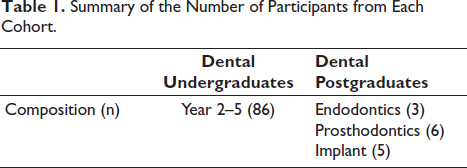
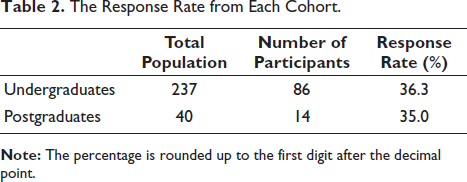
Table 1 shows the summary of consented participants from each cohort. A total of 100 participants were involved (N = 100) consisting of dental undergraduates (n1 = 86) and dental postgraduates (n2 =14). Table 2 shows the response rate from each cohort.
Summary of the Number of Participants from Each Cohort.
The Response Rate from Each Cohort.
Survey Instrument and Data Collection
The survey instrument was developed by the principal investigator (PI) and further validated by an expert. This survey instrument (Appendix A) included five cases of periodontal disease (Cases 1–5) and a questionnaire consisting of both open- and close-ended questions. All five clinical periodontal cases were selected from patient databases. Each case included medical and dental history, full-mouth periodontal charting, intraoral photographs, and radiographs without the patient’s personal identifiers.
An expert group consisting of the PI and two other periodontists reviewed the five cases and drew a consensus agreement on the periodontal diagnoses of each case.
The questionnaire used in this study was adapted from the study by Oh et al. 9 Two additional closed-ended questions about participants’ years of clinical experience and learning sources were added to the questionnaire. Content validation of the modified questionnaire was obtained and pretested. The pretest was done with 10 volunteers consisting of eight undergraduates and two postgraduates which was 10% of our planned sample size. The purpose of content validation from the expert panel and pretest was to test for any ambiguity in the questionnaire before utilizing the questionnaire in the study. 15 No ambiguity in the questionnaire was noted.
The survey instrument was distributed to the participants via Google Forms. Participants were requested to answer the questionnaire independently based on the 2017 new periodontal classification guidelines. There was no time restriction for the participants to answer the questionnaire. Only codes for the cohort were utilized, and no personal identifiers of the participants were associated with the responses. The data were collected from June 2022 to January 2023.
Statistical Analysis
The participants were scored based on the 22 items in the questionnaire. The data analysis was conducted using SPSS version 28.0 software. The Shapiro-Wilk test revealed that the data were not normally distributed (P < .05). Hence, the independent-samples Mann-Whitney U test was used to compare the level of knowledge and agreement between the undergraduates and postgraduates. The mean rank and sum of ranks were used to compare the total scores between the two cohorts.16, 17
Spearman’s rank-order correlation was used to determine the relationship between familiarity with the 2017 periodontal classification system, years of clinical experience, and learning sources and the level of knowledge of periodontal diagnoses.18, 19P ≤ .05 was considered statistically significant.
Results
Table 3 shows the distribution of participants according to their level of familiarity with the 2017 periodontal classification system. Fifty-seven percent of the total participants used the 2017 new periodontal classification for their daily clinical practices, 11% of total participants were aware of but not practicing the new classification, 28% of total participants are in the process of integrating the new classification into practice, while 4% of the total participants consisting of the postgraduates were not aware of the classification. All undergraduate participants were aware of or practicing the new periodontal classification, while 28.6% of postgraduate participants were not aware of the new periodontal classification. A total of 62.8% of the undergraduate participants were implementing the new periodontal classification in clinics, while only 21.4% of the postgraduate participants were using the new periodontal classification.
Distribution of Participants’ Level of Familiarity with the 2017 Periodontal Classification System.

In this study, 91% of participants had less than five years of clinical experience. The remaining 9%—comprising nine postgraduate students—had between 5 and 10 years of clinical experience as shown in Table 4.
Distribution of Years of Clinical Experience Among Participants.

The majority of the participants (89%) learned the 2017 periodontal classification from seminars/lectures, while 9% of participants claimed to be self-taught. Table 5 shows the learning sources of the 2017 periodontal classification among participants.
Distribution of the Learning Sources for the 2017 Periodontal Classification Among Participants.

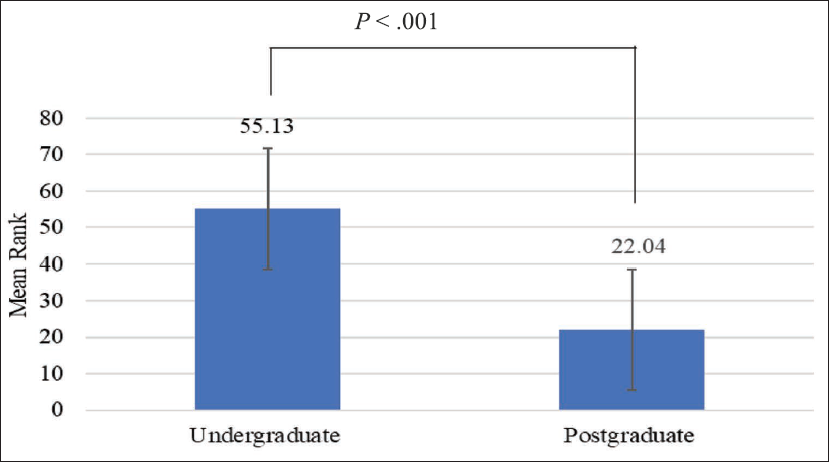
Independent-samples Mann-Whitney U tests revealed significant differences in knowledge level and agreement of new periodontal classification between dental undergraduates and postgraduates (U = 203.5, P < .001). Compared with postgraduates, who had a mean rank of 22.04, undergraduates had a higher mean rank, with a value of 55.13. The sum of the ranks for undergraduates (ΣR1 = 4741.5) was greater than the sum of the ranks for postgraduates (ΣR2 = 308.5). Therefore, the data support the hypothesis that the knowledge levels and agreement of periodontal diagnoses are better for dental undergraduates than for postgraduates when the new periodontal disease classification is used. Figure 1 outlines the mean rank and P value from the independent-samples Mann-Whitney U test.
Mean Rank of Total Score Between Undergraduates and Postgraduates: Comparisons were Analysed Using the Independent-Samples Mann–Whitney U Test, and the Significance Level Was Set at P < .05.
Spearman’s rank-order correlation showed that there was a significant positive correlation between familiarity with the 2017 periodontal classification and the level of knowledge of periodontal diagnoses which was statistically significant (rs = 0.219, P = .028). There was no significant correlation between learning source and the level of knowledge of periodontal diagnoses (rs = 0.007, P = .946). There was a negative correlation between years of clinical experience and level of knowledge of periodontal diagnoses that was statistically significant (rs = -0.298, P = .003). This is summarized in Table 6.
Correlation Analysis Between Familiarity with the 2017 Periodontal Classification, Learning Source, and Years of Clinical Experience to Level of Knowledge of Periodontal Diagnoses (Spearman’s Rank-Order Correlation).

Discussion
The new periodontal disease classification framework focuses on the staging and grading system. 7 The clinicians’ ability to interpret and subsequently integrate the collected data with their clinical knowledge and understanding of the new periodontal classification greatly influences the final decision when formulating the diagnosis. 6 Accurate diagnosis is the foundation for effective communication between practitioners involved in patient care and the improvement of overall health. 11
This pilot study shows that undergraduates have a higher mean rank of total score than postgraduates which is statistically significant (P < .001). This shows that the level of knowledge and agreement on periodontal diagnoses of undergraduates is better than that of postgraduates using the new periodontal classification. This could be due to the postgraduates involved in this study having finished their undergraduate studies prior to the introduction of the new periodontal classification in 2017. Moreover, this new classification has not been discussed in their current curriculum. Hence, some postgraduates were not aware of the new periodontal classification, and some who were aware of the new periodontal classification were not able to integrate it into practice due to a lack of familiarity. The postgraduates who were aware of the new periodontal classification mostly learned through seminars or lectures, while some were self-taught. On the other hand, dental undergraduates were taught about the new periodontal classification in their curriculum through seminars and lectures. Furthermore, since 2019, dental undergraduates have been required to implement the new periodontal classification when diagnosing cases in clinics. This further explains why undergraduates perform better than postgraduates because undergraduates are much more familiar with the new periodontal classification than postgraduates.
A cross-sectional study by Oh et al. and Abou-Arraj et al. showed that postgraduates with a periodontal background have a better level of agreement and accuracy in periodontal diagnoses than those with a non-periodontal background when using the new periodontal classification.9, 10 Postgraduates with a periodontal background received education and training on the new periodontal classification, while those with a non-periodontal background did not receive formal education.9, 10 A study by Kakar et al. showed periodontology postgraduates at Indiana University were more successful in giving accurate periodontal diagnoses using the new periodontal classification. The periodontology faculty at Indiana University holds calibration sessions every month on different days to accommodate faculty members and address the concern of schedule conflicts. 12 This further explains why the level of knowledge and agreement on periodontal diagnoses of undergraduates is better than that of postgraduates using the new periodontal classification, as the postgraduates were not of periodontal background and no calibration session was done.
Dental postgraduates ideally perform better than undergraduates in terms of dental knowledge as they have more years of clinical experience.20–23 However, our study showed otherwise that undergraduates performed better than postgraduates did. Since the introduction of the new periodontal classification in 2017, this classification has been implemented in the undergraduate curriculum at this university. However, this classification has not been discussed in the postgraduate curriculum. Hence, the postgraduates did not perform as well as the undergraduates with a periodontal background. Lanning et al. examined variation in periodontal diagnosis and treatment planning among 27 clinical instructors comprised of periodontists, general dentists, dental hygienists, and first- and second-year periodontal graduate students. Greater consistency in periodontal diagnosis was observed for the graduate student as compared to other faculty groups. This further explains why undergraduates perform better than postgraduates because undergraduates are trained to use the periodontal classification under their formal training. 3
The findings of this study show the need to reinforce awareness of the new periodontal classification among postgraduates through the means suggested above. We also recommend the School of Dentistry to implement the new periodontal classification into the postgraduate curriculum. Integrating theory into real-life practice aids in enhancing one’s knowledge and understanding of the concept. 24 Hence, dental undergraduates and postgraduates should apply the new periodontal classification in clinical practice to increase their knowledge of periodontal diagnosis.
This approach could increase awareness of the new periodontal classification among dental postgraduates. The British Society of Periodontology (BSP) assembled an implementation group to create guidance that included a decision-making flowchart to aid in the implementation of the new periodontal classification in clinical practice. 25 The BSP/Dental Defence Union (DDU) online e-learning on periodontal diagnosis and management which is free and worth using for verifiable continuing professional development (CPD), is a mode for dental clinicians and postgraduates to learn new periodontal classifications. 26 Free recordings of webinars hosted by BSP that aimed to promote new periodontal classifications can be found on the BSP website 27 and these webinars are another good learning source for dental clinicians and students. Calibration sessions are designed to reduce inconsistency among practitioners and to reach standardization. 28 Hence, calibration sessions and study clubs regarding new periodontal classification should be implemented into dental students’ curriculum.11, 12
However, this pilot study’s generalizability is limited by the relatively small sample size, which was restricted to one dental school. Enrolling postgraduates of only a few specialties and conducting the survey within a specific time point are the other shortcomings of this study. Furthermore, the number of cases included in the questionnaire was low. While the cases were intended to represent different periodontal scenarios, more variation in cases is needed to cover the aspects related to periodontal diagnosis.
Conclusion
The knowledge levels and agreement of periodontal diagnoses of dental undergraduates are better than those of postgraduates using the new periodontal disease classification due to the inclusion of new periodontal classification under the current undergraduates’ curriculum. Formal education on the new periodontal classification can be implemented in the postgraduate diploma curriculum to familiarize the postgraduates with the new periodontal classification, as was done for undergraduates.
List of Abbreviations
AAP: American Academy of Periodontology; BSP: British Society of Periodontology; CPD: Continuing professional development; DDU: Dental Defence Union; EFP: European Federation of Periodontology; PI: principal investigator.
Footnotes
Declaration of Conflicting Interests
The authors declared no potential conflicts of interest with respect to the research, authorship, and/or publication of this article.
Ethical Approval
Ethical approval was obtained from the Joint Committee on Research and Ethics [BDS I-01-2022(16)] prior to the study.
Funding
The authors received no financial support for the research, authorship, and/or publication of this article.
Informed Consent
Informed consents were obtained from each of the participants prior to the study.
