




Abstract
This qualitative study explored the driving cessation process among older adults in urban Japan using the Trajectory Equifinality Model (TEM). Semi-structured interviews were conducted with four participants (aged 75–82) who had surrendered their driver’s license within the past 3 years. Analysis revealed four phases: (1) Driving continuation, balancing risks and convenience; (2) Driving Cessation preparation, involving lifestyle adjustments; (3) Lifestyle confidence, gaining comfort with a life without driving; and (4) License surrender decision, culminating in formal license surrender. A key finding was the distinction between practical driving cessation and formal license surrender, which do not always coincide. Factors influencing this process included familiarity with public transportation, social roles, financial concerns, media information, and alternative identification options. The findings suggest that early planning and awareness of mobility alternatives can facilitate a smoother transition away from driving.
What this paper adds
This study revealed the diverse processes through which older adults in urban Japan navigate driving cessation and license surrender. It also identified a distinction between practical driving cessation and formal license surrender, showing that the two do not always coincide.
Applications of study findings
The study’s findings can inform the development of individualized intervention programs that support older adults in planning and transitioning out of driving. Recognizing the non-linear and diverse nature of the license surrender process, future policies and services should accommodate varied needs and contextual factors that influence older adults’ decisions.
Introduction
In recent years, with the global progression of aging populations, the issue of older adults driving has garnered increasing attention as a social challenge. Previous studies from some countries emphasize that automobiles are a primary and preferred mode of transportation for older adults, who rely heavily on them as they age (Donoghue et al., 2019; Gormley & O’Neill, 2019). As Japan is among the most rapidly aging societies globally, 15% of its approximately 82 million licensed drivers are aged 70 and older (Cabinet Office, Government of Japan, 2020). However, there is growing worldwide concern regarding older drivers. Research indicates that age-related declines in visual and cognitive functions elevate the risk of accidents among older drivers (Gresset & Meyer, 1994; Morgan & King, 1995), raising concerns about their ability to continue driving safely.
On the other hand, evidence suggests that many older drivers employ strategies to sustain their ability to drive, such as reducing driving frequency (Ang et al., 2019; Liddle et al., 2008). Nonetheless, a substantial number of older adults eventually need to cease driving. Considering the risk of unforeseen accidents involving older drivers and the importance of road safety, facilitating a smooth transition toward driving cessation for them is a crucial issue.
At the same time, previous research highlighted the potential health problems associated with driving cessation. Previous studies have reported that driving cessation is associated with increased risks of depression (Chihuri et al., 2016), long-term care need (Shimada et al., 2016), dementia (Shimada et al., 2018), and mortality (Edwards et al., 2009). While these findings are based primarily on observational studies and should be interpreted as statistical associations, one prospective cohort study by Edwards et al. (2009) suggested that driving cessation was a strong predictor of 3-year mortality even after adjusting for baseline health, cognitive status, and psychosocial factors. Furthermore, individuals who cease driving have fewer social networks and reduced participation in outings and leisure activities compared to those who continue driving (Donoghue et al., 2019; Pristavec, 2018). These findings suggest that driving cessation poses a risk of health deterioration. These findings suggest an association between driving cessation and reduced social participation, though causality remains unclear. The relationship with health outcomes may be bidirectional, as driving cessation might lead to health decline, while poor health can also prompt cessation. Interestingly, individuals who proactively adopt alternative transportation and lifestyle adjustments in anticipation of future driving cessation have reported higher life satisfaction and improved quality of life (Mullen et al., 2017). These findings suggest that promoting early planning for driving cessation may help support older adults’ well-being, underscoring the need to better understand this process.
Liddle et al. (2008) describe the driving cessation process as comprising three phases: (1) a pre-decision phase for balancing and achieving awareness, (2) a decision phase for making and owning the decision, and (3) a post-cessation phase for finding new ways and coming to terms with the change. Additionally, other review research suggests the existence of a transitional stage that significantly influences the process by which older drivers progress from the pre-decision phase to the post-cessation phase, shaping their journey toward either a gradual reduction or the complete cessation of driving (Ang et al., 2019). These findings indicate that while there are defined processes involved in driving cessation, various influencing factors exist. Schofield et al. (2023) investigated the factors impacting planning for driving cessation. Their review identified four factors—individual factors, interpersonal factors, environmental factors, and policy/legislation factors—that include both facilitators and barriers to planning. These reports particularly emphasize the role of transportation infrastructure. Despite being an important factor, transportation infrastructure is rarely addressed in isolation as an environmental factor related to driving cessation. Understanding the driving cessation process in urban areas can provide valuable insights, particularly when compared to rural areas where alternatives may be limited.
In Japan, driver’s license surrender is not mandatory but regulated under a voluntary system. However, drivers aged 75 and above are legally required to attend a senior driving course every 3 years, which includes cognitive and practical assessments. If cognitive concerns are identified during the screening process, the driver must submit a medical certificate from a physician. Since 2022, those aged 75 or older who commit certain traffic violations are also required to undergo a practical driving skills test. These measures are intended to promote safety while encouraging older drivers to consider license surrender. To support this, Public Safety Commissions issue a Driving History Certificate as an official form of identification for those who voluntarily surrender their licenses, and in some regions, additional benefits such as discounts on public transportation are provided.
Qualitative research methods are commonly used to elucidate the driving cessation process. Recently, a novel methodological approach developed in Japan, the Trajectory Equifinality Model (TEM), has been gaining attention. TEM analyzes the various bifurcation points and choices individuals encounter as they progress toward a specific goal (equifinality point: EFP). This model is particularly useful for understanding driving cessation as it enables visualization of decision-making processes and identification of diverse pathways (Sato et al., 2009; Yasuda, 2015a, 2015b). Thus, TEM is highly suitable as a methodological approach in this field, where the goal of older adults driving cessation is well-defined.
For these reasons, this study aims to elucidate the process by which older adults living in urban areas of Japan surrender their driver’s licenses using the TEM.
Methodology
Study Design
This study employed a qualitative approach based on the Trajectory Equifinality Model (TEM), a method designed to visualize individual developmental pathways toward a common goal (equifinality point, EFP) (Sato et al., 2009; Yasuda, 2015a, 2015b). TEM enables researchers to analyze complex processes by identifying critical decision points, including bifurcation points (BFPs), obligatory passage points (OPPs), social guidance (SG), and social direction (SD), all situated within the context of irreversible time.
In addition to actual experiences, TEM also incorporates the concept of polarized equifinality points (P-EFP), representing imagined or value-oppositional trajectories. These concepts allow for the exploration of diverse and socially influenced pathways leading to license surrender. We applied TEM-specific terminology (Table 1) to guide our analysis.
TEM (Trajectory Equifinality Model)-Specific Conceptual Lexicon in This Study.

The application of the TEM methodology necessitates that all participants attain the EFP, which we operationally defined in this research as “Surrendering the driver’s license.” Furthermore, to pinpoint participants who had realized EFP, we employed a historically structured inviting approach and conducted interviews regarding their experiences leading to license surrender. We defined key TEM-specific terms as follows: EFP represents surrendering the driver’s license; OPPs signify shared passage points in the license surrender process; BFPs indicate moments where the trajectory diverges into multiple branches. These conceptual terms were pivotal in guiding our analysis. Our findings were articulated in accordance with the Consolidated Criteria for Reporting Qualitative Research checklist (Tong et al., 2007).
Study Participants and Ethics
The creators of TEM suggested an optimal participant count contingent upon the study’s objectives, adhering to the 1, 4, 9 rule, which posits the following: one participant provides an in-depth understanding of individual experience; 4 ± 1 participants illuminate the diversity and reveal the multifaceted and convergent aspects of the experience; and 9 ± 2 participants enhance the complexity of experience diversification, thereby facilitating typification (Yasuda, 2015a, 2015b). We considered that with nine participants, the diversification of pathways could become too complex, making pathway visualization difficult. By contrast, four participants are widely regarded as the standard scale in TEM for achieving a balance between diversity and analytic clarity. This sampling rationale is well recognized within the TEM methodology and has been employed across various studies, including Saito et al. (2023). We recruited four qualified older adults based on the following criteria:
(1) Individuals who reside in Tokyo’s 23 wards, which form the densely populated and central urban area of the city.
(2) Healthy older adults aged over 65 older who have not been needed requiring nursing care in Japan’s long-term care insurance system.
(3) Individuals who received an explanation of the research objectives in advance and provided written consent to participate in the study.
Between April and December 2023, a total of 55 older adults attended three public events—including two public lectures and one dementia café (a community gathering place where people with dementia, their families, and professionals interact and share information)—focused on driver’s license surrender. At the end of each event, the study was briefly introduced, and attendees were invited to participate in the research. Of the 55 attendees, five expressed interest in participating. Among them, four provided written consent and completed the interviews, while one declined due to uncertainty about their decision to surrender the license. These participants had no prior relationship with the interviewer apart from attending the events. The participants had a level of knowledge about driver’s license surrender comparable to that of the researchers, and through the informed consent obtained in advance, they were aware that the purpose of this study was to elucidate the process leading to license surrender. All participants were briefed on the purpose of the study and the voluntary nature of their participation. Each participant provided written informed consent prior to their participation in the study. Ethical approval was granted by the Ethics Committee of the Tokyo University of Technology (No. E23HS-013) and the authors declare no conflicts of interest associated with this manuscript.
Procedure
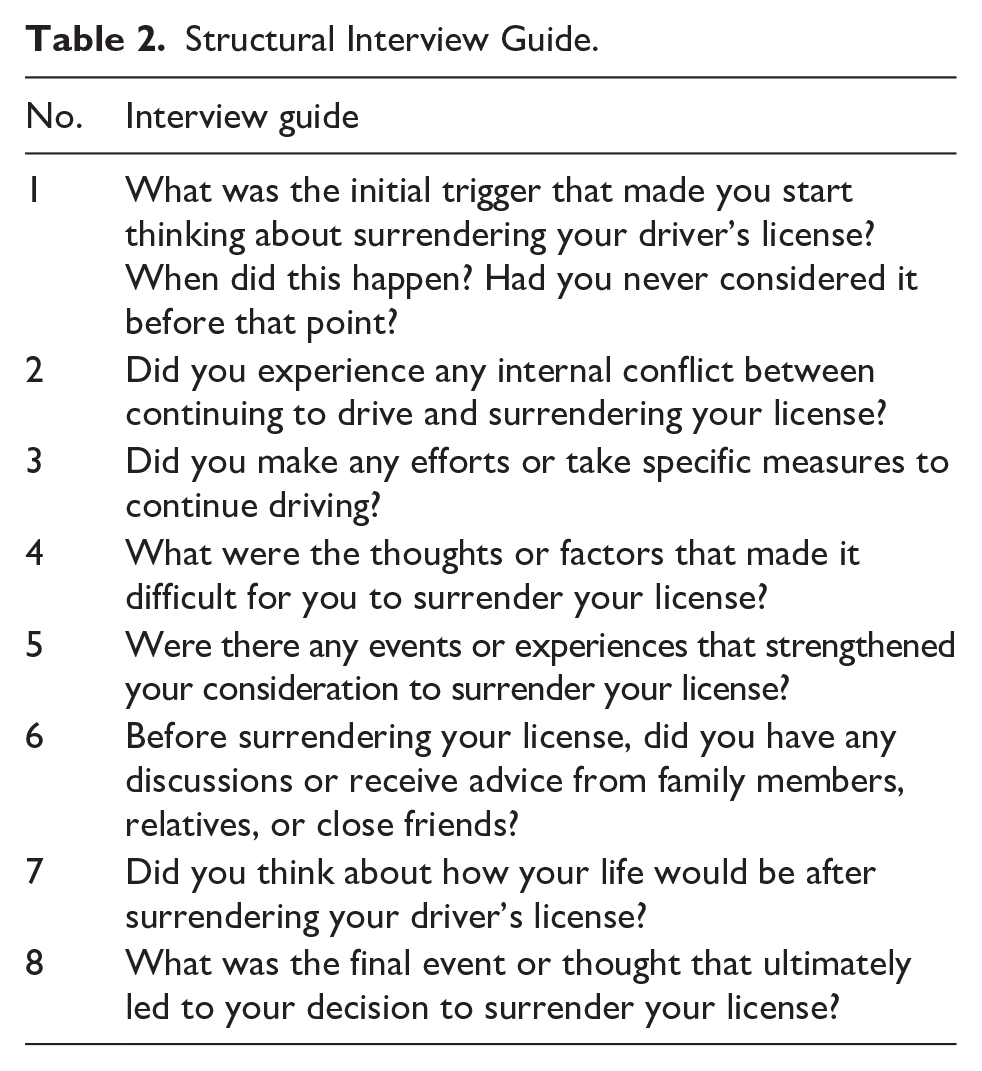
Individual interviews were executed between December 2023 and December 2024 to elucidate the participants’ viewpoints concerning surrendering driver’s license. The interviews were facilitated by the A, who possesses expertise in qualitative research as both KY (Second author) and TS (First author), with a substantial driving support background over 20 years. The interviews were conducted in a semi-structured manner, emphasizing the process leading to license surrender while using the interview guide (Table 2). This interview guide was developed with reference to previous studies on driving cessation and license surrender to ensure that key factors influencing the decision-making process were comprehensively addressed (Liddle et al., 2008). The interviews were conducted entirely face-to-face, either in a quiet space within the university’s research lab or in a secluded area of the participants’ workplaces, ensuring a direct and personal interaction for data collection. There were no observers participating. Data were captured using a digital voice recorder and subsequently transcribed verbatim.
Structural Interview Guide.
Data Analysis
The authors (TS, KY) meticulously examined the transcripts. They consulted two other expertized researchers (YS, KT) about the transcripts if required. These transcripts were categorized with an emphasis on “individuals experience in relation to EFPs.” The categorizations were organized chronologically, and a TEM diagram was constructed for each of the four participants utilizing the TEM conceptual framework. Initial versions of the TEM diagrams were presented to the participants during follow-up interviews for validation.
The EFP pathway underwent iterative revision and analysis until “transview” saturation was attained, which was subsequently verified with the participants to address any inaccuracies or omissions in the researcher’s interpretations and to identify any additional items that warranted inclusion. Transview signifies a collaborative state in which the researcher and participant synthesize each insights through multiple discussions. This process ensured mutual understanding and alignment between the researcher’s interpretations and the participants’ experiences, thereby strengthening the credibility and depth of the qualitative analysis. There existed no discrepancies between the TEM diagram formulated by the researcher and the participant’s perceptions. This process is analogous to theoretical saturation, a term commonly employed in representative qualitative inquiries.
The collective four TEM diagrams for each participant were amalgamated following the methodological approach delineated in a preceding study (Sato et al., 2009; Yasuda, 2015a, 2015b). Similar thematic content was consolidated by elevating the abstraction level of the categorizations. The experiential pathways encountered by multiple participants were collectively identified as OPP. The final integrated TEM diagram was confirmed with each participant to ensure there were no discrepancies.
Results
Demographics Data
The study group consisted of four participants: three men and one woman, with ages ranging from 75 to 82 years (mean: 77.3 ± 3.3 years). The average period since the surrender of the driver’s license was 15.0 ± 14.3 months. Additionally, each participant underwent four interviews, with a total average interview duration of 48.3 ± 16.4 min. Each interview lasted up to 35 min per participant.
Definition of Items Using TEM Diagram
Table 3 delineates the item instruments within the TEM diagram alongside their respective definitions pertinent to this research. All elements (EFP, P-EFP, BFP, OPP, SD, and SG) were designated by the authors in alignment with the objectives of this investigation. Examples of texts obtained from narratives leading to each concept are shown in Table 4. The completion of the TEM diagram was achieved after three interviews with each participant. The final integrated TEM diagram was confirmed with each participant during the fourth interview.
Demographic Data.

Example of TEM Major Concept Which Were Created From the Narrative Text.

Note. TEM = Trajectory Equifinality Model.
Classification of Time Phases (Figure 1)
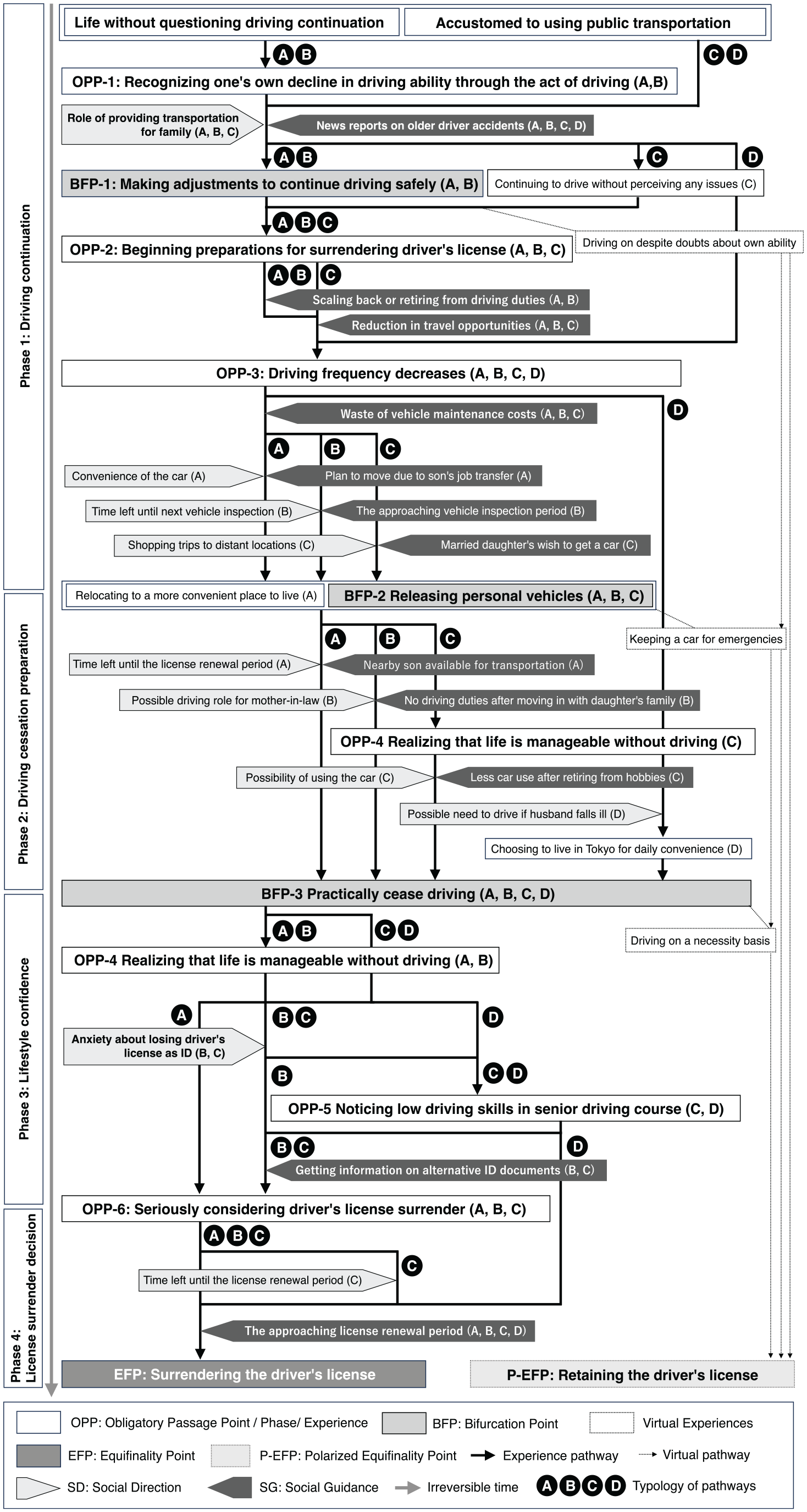
TEM diagram.
Phase 1: Driving continuation phase—balancing the risks to society and personal convenience
Phase 2: Driving cessation preparation phase—embracing the challenge of a life without driving
Phase 3: Lifestyle confidence phase—establishing a life independent of driving and licensing
Phase 4: License surrender decision phase—resolving to relinquish the driver’s license
Phase 1: Driving Continuation Phase—Balancing the Risks to Society and Personal Convenience
All participants were already accustomed to using public transportation from the beginning. Some participants experienced becoming aware of their own decline in driving ability through the act of driving (OPP-1). Three participants experienced inner conflict between their intention to surrender their driver’s license due to news report on older driver accidents (SD) and their need to continue driving to fulfill their role of providing transportation for family (SG). Those who recognized their decline in driving ability engaged in making adjustments to continue driving safely (BFP-1), whereas those who did not recognize any decline continued driving without taking any precautions. However, over time, they engaged in beginning preparations for surrendering driver’s license (OPP-2), and as their roles and daily life changed (SG), driving frequency decreases (OPP-3). One participant (D) had felt uncomfortable with driving from the beginning, leading to an early reduction in driving opportunities. Therefore, all participants experienced the essential transition of driving frequency decreases (OPP-3).
Among those who owned a car, the reduction in driving opportunities led to concerns about waste of vehicle maintenance costs (SG). Eventually, they faced personal conflicts regarding the convenience of having a car and family influence,—such as the prospect of receiving transportation support from family members in the future or transferring the vehicle to an adult child—ultimately choosing to engage in Releasing personal vehicles (BFP-2). In contrast, one participant (D) did not own a vehicle from the start, so this decision point did not emerge for them.
Phase 2: Driving cessation preparation phase—Embracing the challenge of a life without driving
During Phase 2, variations were observed depending on individual contexts (Figure 1). One participant (A) was noted to have time left until the license renewal period (SD), which later applied to others as well. Similarly, another participant (C) experienced realizing that life is manageable without driving (OPP-4), which was later observed in other participants as well.
Finally, all participants wavered between continuing to drive and surrendering their driver’s license due to life events. Some continued driving occasionally using other people’s cars, but they eventually chose to practically cease driving (BFP-3). One participant (D) had initially considered relocating to a rural area, but ultimately chose to continue living in Tokyo after reassessing the convenience of daily life without a car. This decision contributed to their practical cessation of driving, as living in an urban area made car ownership less necessary.
Phase 3: Lifestyle Confidence Phase—Establishing a Life Independent of Driving and Licensing
Following practically cease driving (BFP-3), two participants (A and B) also reached a stage where they experienced realizing that life is manageable without driving (OPP-4′), something that had already been observed in one participant (C) (OPP-4).
Three participants (A, B, and C) continued to keep their driver’s licenses due to Anxiety about losing driver’s license as ID (SD). Meanwhile, two participants (C and D) attended a senior driving course—a mandatory program in Japan for older drivers. During the course, they became aware of their own declining driving skills (OPP-5). Participants B and C obtained information about alternative ID documents (SG), which addressed their concerns about surrendering their licenses. Subsequently, participants A, B, and C began seriously considering driver’s license surrender (OPP-6).
Phase 4: License Surrender Decision Phase—Resolving to Relinquish the Driver’s License
For one participant (C), it was noted that there was still time left until the license renewal period (SD), a situation that had already been observed in another participant (A). Ultimately, the approaching license renewal period (SG) became a common factor among all participants, leading them to surrendering the driver’s license (EFP).
Discussion
Novelty of This Study
The Four Phases of License Surrender: This study identified four phases in the process of driving cessation among urban older adults: Driving continuation phase, Driving cessation preparation phase, Lifestyle confidence phase, and License surrender decision phase. Previous studies, such as Liddle et al. (2008) and C. B. A. Musselwhite and Shergold (2013), proposed a three-phase model, which includes recognizing declining driving ability, making the decision, and post-cessation adaptation. Our findings partially align with these phases.
Additionally, the concept of practical driving cessation (OPP) at the end of Phase 3 corresponds to the “driving cessation” concept used in previous studies (Savoie et al., 2024). While many studies consider driving cessation as the final stage of the process (equifinality point), our study distinguishes between practical cessation (OPP) and license surrender (EFP), which is a legal procedure (Siren & Haustein, 2015). This distinction implies that even if individuals stop driving, they retain the legal right to drive as long as they hold a valid license. Our findings reveal that even after driving cessation, participants took additional time to surrender their licenses, indicating that driving cessation and license surrender are not necessarily linked. Thus, we demonstrate that the process extends beyond practical cessation, providing a novel perspective on the license surrender process.
New Insights from Applying the TEM Framework: Previous research (Liddle et al., 2008; Schofield et al., 2023) primarily organized common themes related to license surrender but did not explore individual variations in the decision-making process. By applying TEM, our study visualized essential passage points (OPP), BFP, facilitators (SG), and barriers (SD), revealing the diverse pathways in license surrender. Stasiulis et al. (2024) emphasized the importance of individualized support instead of standardized interventions, which is further supported by our TEM-based findings.
Positive License Surrender Experiences: Previous studies suggest that driving cessation is often associated with negative emotions such as frustration and loss of autonomy (Buys et al., 2012; Dickerson et al., 2024; Liddle et al., 2008; Mullen et al., 2017). However, our study found that participants experienced minimal distress and instead gradually transitioned out of driving in a self-determined manner. This urban-specific characteristic may be attributed to the availability of alternative transportation. Furthermore, our findings support previous research indicating the importance of self-determined decision-making in a positive transition (Liddle et al., 2008; Mullen et al., 2017; C. B. A. Musselwhite & Shergold, 2013).
Key Factors Influencing the License Surrender Process
Familiarity with Public Transportation: Previous studies (Cvitkovich & Wister, 2001; Dickerson et al., 2024; O’Neill, 2015) indicate that accessibility to alternative transportation significantly impacts the ease of driving cessation. In our study, participants were already accustomed to using public transportation while they were still driving, a condition differing from older adults in rural areas. Additionally, unlike previous reports suggesting that driving cessation may lead to negative emotions such as depression or frustration (Choi et al., 2012; Fields et al., 2023), these adverse effects were not observed in our study. This suggests that having multiple transportation options in urban areas may alleviate the psychological burden of driving cessation.
Conflict Between Driving Continuation and License Surrender: Previous studies (Ang et al., 2019; Liddle et al., 2008) report that family transportation responsibilities (SG) can act as a barrier to license surrender. Our findings align with these studies, as some participants continued driving for the sake of family transportation. However, even among those who did not recognize a decline in driving ability, life events prompted them to stop driving (Supplemental Case A, B, C, D). This indicates that driving continuation is influenced not only by personal ability but also by social factors.
Decline in Driving Frequency: Research (Ang et al., 2019; Hassan et al., 2015) highlights how changes in social roles and life events (e.g., cohabitation with family, relocation) contribute to decreased driving frequency. In our study, driving frequency decline (OPP-3) was observed in all participants, functioning as a facilitator (SG) in their transition. Moreover, financial concerns regarding vehicle maintenance costs were a contributing factor, consistent with previous findings (C. Musselwhite & Haddad, 2008). However, our study also found that relinquishing a personal vehicle did not immediately lead to license surrender, indicating that the process takes time.
Influence of Media Reports: Previous studies (Hassan et al., 2015; Rudman et al., 2006) have reported that media feedback on older drivers can facilitate smoother license surrender. In our study, all participants were influenced by media coverage of older driver accidents (SD). Additionally, in Japan, media reports tend to highlight the severity of older adults driving accidents as a societal issue, reinforcing the perception that driving at an advanced age poses risks. Previous studies (Galeazzi et al., 2024) suggest that media exposure influences personal decision-making, and our findings support this notion.
Recognizing That Life Is Manageable Without Driving: Previous studies (Liddle et al., 2008; C. B. A. Musselwhite & Shergold, 2013) indicate that recognizing the ability to live without driving is a key determinant of license surrender. In our study, this realization (OPP-4) contributed to the surrender process, but the timing varied among individuals. Some participants reached this awareness before stopping driving, while others experienced it afterward. This diversity in realization timing underscores the need for personalized support rather than a one-size-fits-all approach.
Key Determinants of License Surrender: The availability of alternative identification documents has been identified as a factor facilitating license surrender (Kishimoto & Noto, 2022). Our findings show that the approaching license renewal period (SG) and securing an alternative ID (SG) were critical in prompting license surrender (EFP). While previous studies have examined health deterioration and unsafe driving experiences as triggers for driving cessation (Liddle et al., 2008), few have specifically identified the key determinant leading to formal license surrender. Our results highlight that the license renewal deadline serves as a decisive moment; however, it does not necessarily lead to a uniform process of license surrender, demonstrating the diversity of individual trajectories in this process. Based on these findings, this study elucidated not only the process of driving cessation in urban areas but also the individual diversity in the pathways leading to license surrender. Future research should explore the process of driving cessation and license surrender in depopulated areas and conduct comparative analyses.
Conclusion
This study identified four distinct phases in the license surrender process using the TEM: the Driving Continuation Phase, Driving Cessation Preparation Phase, Lifestyle Confidence Phase, and License Surrender Decision Phase. Additionally, we visualized the individual pathways leading to license surrender and demonstrated that this process is not linear but shaped by diverse influencing factors. Furthermore, our findings revealed that older adults follow varied trajectories influenced by personal circumstances, social roles, media reports, and external factors such as license renewal deadlines. This study highlights that the process of license surrender is not uniform and should be understood from a broader perspective.
The findings of this study underscore the importance of supporting older adults in gradually transitioning out of driving by recognizing the role of family dynamics, social context, and urban mobility options in shaping individualized cessation processes.
Limitation
One limitation of this study is that it did not examine in detail the variation in duration between driving cessation and license surrender, which ranged from approximately 1 month to nearly 3 years among participants. Although this difference in timing is noteworthy, our study did not focus on the time elapsed since license surrender.
To our knowledge, no previous research has investigated how the length of time since license surrender influences older adults’ reflections on or interpretations of their driving cessation experience. This perspective may offer a novel approach to understanding how older adults’ narratives, adaptation processes, and self-perception evolve over time after surrendering their license.
Supplemental Material
sj-jpeg-1-ggm-10.1177_30495334251352908 – Supplemental material for The Process of Urban Older People Surrendering Their Driver’s License: An Analysis Using a Trajectory Equifinality Model
Supplemental material, sj-jpeg-1-ggm-10.1177_30495334251352908 for The Process of Urban Older People Surrendering Their Driver’s License: An Analysis Using a Trajectory Equifinality Model by Tatsunori Sawada, Kounosuke Yamaguchi, Kounosuke Tomori, Kanta Ohno and Yuki Saito in Sage Open Aging
Supplemental Material
sj-jpeg-2-ggm-10.1177_30495334251352908 – Supplemental material for The Process of Urban Older People Surrendering Their Driver’s License: An Analysis Using a Trajectory Equifinality Model
Supplemental material, sj-jpeg-2-ggm-10.1177_30495334251352908 for The Process of Urban Older People Surrendering Their Driver’s License: An Analysis Using a Trajectory Equifinality Model by Tatsunori Sawada, Kounosuke Yamaguchi, Kounosuke Tomori, Kanta Ohno and Yuki Saito in Sage Open Aging
Supplemental Material
sj-jpeg-3-ggm-10.1177_30495334251352908 – Supplemental material for The Process of Urban Older People Surrendering Their Driver’s License: An Analysis Using a Trajectory Equifinality Model
Supplemental material, sj-jpeg-3-ggm-10.1177_30495334251352908 for The Process of Urban Older People Surrendering Their Driver’s License: An Analysis Using a Trajectory Equifinality Model by Tatsunori Sawada, Kounosuke Yamaguchi, Kounosuke Tomori, Kanta Ohno and Yuki Saito in Sage Open Aging
Supplemental Material
sj-jpeg-4-ggm-10.1177_30495334251352908 – Supplemental material for The Process of Urban Older People Surrendering Their Driver’s License: An Analysis Using a Trajectory Equifinality Model
Supplemental material, sj-jpeg-4-ggm-10.1177_30495334251352908 for The Process of Urban Older People Surrendering Their Driver’s License: An Analysis Using a Trajectory Equifinality Model by Tatsunori Sawada, Kounosuke Yamaguchi, Kounosuke Tomori, Kanta Ohno and Yuki Saito in Sage Open Aging
Footnotes

Ethical Considerations
Ethical approval was granted by Tokyo University of Technology (No. 0211).
Consent to Participate
All participants were briefed on the study’s objectives and the voluntary nature of their involvement. Each participant provided written informed consent prior to their participation in the study.
Author Contributions
Tatsunori Sawada: Conceptualization (Study design, idea development); Methodology (Design of the methodology, model development); Formal Analysis (Statistical and data analysis); Investigation (Data collection, experiments, case studies); Writing—Original Draft (Initial manuscript writing); Writing—Review & Editing (Manuscript revision, proofreading); Visualization (Figures, tables, data presentation).
Kounosuke Yamaguchi: Conceptualization (Study design, idea development); Methodology (Design of the methodology, model development); Formal Analysis (Statistical and data analysis); Investigation (Data collection, experiments, case studies); Writing—Original Draft (Initial manuscript writing); Visualization (Figures, tables, data presentation).
Kounosuke Tomori: Conceptualization (Study design, idea development); Methodology (Design of the methodology, model development); Formal Analysis (Statistical and data analysis); Writing—Review & Editing (Manuscript revision, proofreading); Visualization (Figures, tables, data presentation); Supervision (Project oversight, guidance).
Kanta Ohno: Conceptualization (Study design, idea development); Methodology (Design of the methodology, model development); Writing—Review & Editing (Manuscript revision, proofreading).
Yuki Saito: Methodology (Design of the methodology, model development); Formal Analysis (Statistical and data analysis); Writing—Review & Editing (Manuscript revision, proofreading); Visualization (Figures, tables, data presentation); Supervision (Project oversight, guidance).
Funding
The author(s) received no financial support for the research, authorship, and/or publication of this article.
Declaration of Conflicting Interests
The author(s) declared no potential conflicts of interest with respect to the research, authorship, and/or publication of this article.
Data Availability Statement
The raw data for this study is not available due to the Personal Data Protection Act; however, a TEM diagram for each individual is available upon request.
Supplemental Material
Supplemental material for this article is available online.
References
Supplementary Material
Please find the following supplemental material available below.
For Open Access articles published under a Creative Commons License, all supplemental material carries the same license as the article it is associated with.
For non-Open Access articles published, all supplemental material carries a non-exclusive license, and permission requests for re-use of supplemental material or any part of supplemental material shall be sent directly to the copyright owner as specified in the copyright notice associated with the article.


