




Abstract
This study examined the relationship between marital status and cognitive performance in middle-aged and older adults, focusing on episodic and semantic memory. Using data from 155 participants aged 50 to 94 in the Southcoast Cognitive Aging Study (SCAS), we assessed cognitive performance through delayed recall and vocabulary tasks. Regression analyses controlling for age, gender, education, and race revealed that married individuals performed significantly better on episodic memory tasks compared to their unmarried counterparts. Exploratory analyses showed that widowed and divorced/separated individuals had significantly lower scores on semantic memory compared to married participants. These findings may be explained by several mechanisms, including cognitive reserve, the emotional support and regulation provided by marriage, and increased opportunities for linguistic engagement within close relationships, all of which may contribute to better memory performance. The results highlight the importance of social relationships in promoting cognitive resilience and underscore the need for targeted interventions to mitigate cognitive risks among unmarried older adults.
Introduction
In the United States, the population of individuals aged 65 and older is projected to grow from 58 million in 2022 to 82 million by 2050 (U.S. Census Bureau, 2023). As the U.S. and global population ages, understanding the factors that influence cognitive health in later life becomes increasingly important. Cognitive aging, the gradual decline in cognitive function that is part of normal aging (Deary et al., 2009), affects individuals differently (e.g., Wilson et al., 2002; Wu et al., 2020). While some people maintain cognitive resilience despite age-related changes, others experience significant cognitive decline. This variability has profound implications for both individual well-being and public health, particularly as societies confront the challenges of an aging demographic. Cognitive decline is often associated with heightened risks of dementia, disability, and a reduced quality of life (e.g., Jekel et al., 2015; Lyketsos et al., 2002; Tabert et al., 2002). Therefore, it is crucial to identify modifiable factors that can promote cognitive resilience and mitigate cognitive decline.
One such factor is marital status, with research indicating that married individuals tend to have a lower risk of cognitive impairment and mortality compared to their unmarried counterparts (e.g., Bulanda et al., 2016; Gomez et al., 2016). However, while much of the current research has concentrated on broader cognitive functioning or dementia risk, fewer studies have examined how marital status specifically influences different memory systems, such as episodic and semantic memory. Episodic memory is particularly vulnerable to age-related decline and is significantly affected in Alzheimer’s disease, often being the first memory system to show changes in both typical and atypical aging processes (e.g., Luo & Craik, 2008; Tromp et al., 2015). In contrast, semantic memory tends to be more resilient to cognitive aging and may even improve over time (e.g., Kennedy et al., 2015; Nyberg et al., 1996; Spaniol et al., 2006). Despite these differences, the potential impact of marital status on both memory systems remains underexplored. Building on this initial work, the current study aims to address the gap in the literature by examining how marital status influences episodic and semantic memory in middle-aged and older adults.
Mechanisms Linking Marital Status and Memory
Several theoretical models offer potential explanations for the relationship between marital status and memory. One explanation is the cognitive reserve hypothesis (Stern, 2002; Stern et al., 2020), which posits that the brain can compensate for age-related or pathological changes by utilizing alternative cognitive strategies or neural networks (Stern, 2002; Stern et al., 2020; Stern, 2009). According to the cognitive reserve hypothesis, individuals with higher cognitive reserve may experience a slower rate of cognitive decline despite the natural aging process or the presence of pathology (Stern et al., 2020). One key factor contributing to cognitive reserve is social relationships, such as marriage (Bennett et al., 2006; Fratiglioni et al., 2000). Married individuals may benefit from the cognitive stimulation and emotional support provided by their spouse, which may encourage engagement in cognitively enriching activities, such as social interaction, intellectual pursuits, and physical exercise, all of which contribute to cognitive reserve (Clare et al., 2017; Evans et al., 2018; Håkansson et al., 2009; Richards & Deary, 2005). In contrast, individuals in less supportive relationships may have fewer opportunities for such enriching activities, potentially leading to poorer memory outcomes (Haghighi et al., 2024; Min & Song, 2023).
While the cognitive reserve hypothesis offers a useful framework for understanding the relationship between marital status and memory, other explanatory models may also be relevant. Emotional regulation within marital relationships may affect cognitive outcomes, particularly in later life. For instance, managing one’s emotional responses in interactions with a spouse often requires ongoing self-regulation (Smith et al., 2011). The Dyadic Biobehavioral Stress Model (Shrout, 2021) suggests that romantic partners, especially in older adulthood, are interconnected in ways that influence each other’s stress responses, health behaviors, and emotional well-being. Marital relationships can serve as both sources of support and stress, and these dynamics may have long-term implications for cognitive health (Haghighi et al., 2024). For example, individuals in high-quality marriages may experience greater emotional stability, which in turn may lower the risk of affective disorders such as depression and anxiety, both of which are independently linked to poorer cognitive outcomes (Barnes et al., 2012; Dotson et al., 2010). In contrast, strained or unsupportive relationships may contribute to chronic stress and emotional dysregulation, potentially exacerbating cognitive decline (Rothman & Mattson, 2010).
Another possible explanation involves linguistic interaction. Exposure to a broader range of language use, such as that which occurs in close interpersonal relationships, may support semantic memory by improving individuals’ ability to interpret language in diverse contexts (Lev-Ari, 2016). Marital partners often serve as frequent conversational partners, and this regular verbal engagement may contribute to maintaining or enhancing semantic memory abilities over time. Together, these perspectives provide a more comprehensive conceptualization of how marriage may influence memory.
Marital Status and Cognitive Function
The protective effects of marriage have been well-documented in older adult populations, with studies showing that married individuals tend to perform better on cognitive tests and have a lower risk of developing dementia or experiencing cognitive decline (Fan et al., 2015; Sundström et al., 2016). This is especially true for those living without a partner, whether single, divorced, or widowed, who are at an increased risk for cognitive impairments, with widowed individuals showing the highest risks (Håkansson et al., 2009; Sundström et al., 2014, 2016). Furthermore, married individuals generally exhibit better cognitive outcomes compared to their unmarried counterparts, including superior performance on tasks assessing episodic and semantic memory (K.-M. Chen et al., 2013; Feng et al., 2015; Gow & Mortensen, 2016).
However, the specific impact of marital status on episodic and semantic memory has received relatively less attention in the literature, with most research focusing on general cognitive functioning or dementia risk. A limited number of studies have examined the relationship between marital status and memory, highlighting the need for further investigation (Aartsen et al., 2005; Liu et al., 2019; Malatyali et al., 2020; Mousavi-Nasab et al., 2012). Mousavi-Nasab et al. (2012) were among the first to explore this connection, finding that married individuals exhibited significantly better episodic memory than singles, even after controlling for age, education, and health, though no marital effect was found for semantic memory after covariate adjustment. Similarly, Malatyali et al. (2020) found that divorced and widowed older Americans had significantly lower episodic memory scores than married individuals. Marital transitions, such as widowhood and divorce, were found to be associated with accelerated episodic memory decline (Aartsen et al., 2005; Liu et al., 2019). Harris et al. (2022) showed that married couples often support each other’s memory through collaborative remembering and external aids, implying that spousal communication may scaffold memory performance, indirectly supporting semantic memory retention.
Factors that influence cognitive reserve over the life course have been explained and tested (e.g., Richards & Deary, 2005) to include early social and educational environments, level of education, occupational complexity, health behaviors, and lifestyle factors. These lifestyle factors could include supportive relationships, such as marriage. Previous research suggests that functional social support from a spouse or partner is positively linked with episodic memory (Haghighi & Oremus, 2023). A supportive spouse may facilitate participation in cognitively enriching activities such as social interaction, physical exercise, and intellectual pursuits, all of which contribute to cognitive reserve (Amanollahi et al., 2021; Oosterhuis et al., 2023). Conversely, individuals in less supportive or aversive relationships may experience reduced opportunities for such activities, potentially leading to poorer cognitive outcomes (Haghighi et al., 2024; Min & Song, 2023). Additionally, sex differences in episodic memory performance have been consistently observed: women tend to outperform men on such tasks in midlife, though this advantage narrows after menopause (Rentz et al., 2017). Because sex, along with age, education, and race, are known to influence cognitive function (e.g., R. Chen et al., 2022; Sundström et al., 2016; Vonk et al., 2020), these variables are included as covariates in this study’s analyses to better isolate the relationship between marital status and memory outcomes.
The Current Study
The current study investigates the association between marital status and cognitive performance in middle-aged and older adults, specifically focusing on episodic memory, measured through delayed recall tasks, and semantic memory, assessed via vocabulary definition tasks. We hypothesize that married individuals will display better cognitive performance on both episodic and semantic memory tasks compared to those who are unmarried (single, divorced, or widowed). Furthermore, we expect that divorced and widowed individuals will show poorer cognitive performance compared to their married counterparts.
Method
Participants
Participants in this study included 155 middle-aged and older adults, ranging in age from 50 to 94 (m = 71.4, SD = 8.8) at the time of data collection. Data for 122 participants were obtained from the Southcoast Cognitive Aging Study (SCAS; SCAS; Revell, 2015; Revell et al., 2016) in 2012 (IRB # 13.077), while data for the remaining 33 participants were collected as part of a master’s thesis study in 2015 (IRB # 15.001). Participants were recruited through convenience sampling and had to meet specific criteria: they were required to be 50 years or older and able to travel to the University of Massachusetts Dartmouth campus for the neuropsychological assessments. All participants gave written informed consent prior to participating. Reanalysis of this dataset was approved by the institutional review board at the University of Massachusetts Dartmouth on March 24, 2023 (IRB # 23.024).
Procedure
The procedure for both studies was identical. At the start of each testing session, information about the study, including any risks or benefits, was explained to the participants, who then signed the informed consent document. Demographic questionnaires, health measures, and a neuropsychological battery were administered to participants during a 2-hr testing session. Testing sessions were held individually. Participants were tested individually. Those who arrived with a spouse were interviewed separately.
Measures
Marital Status
Marital status was assessed through a self-reported questionnaire in which participants indicated their current relationship status. Response options included married, divorced, separated, widowed, and single (never married). For analyses, marital status was treated as a categorical variable, with married individuals serving as the reference group in comparative analyses.
Cognitive Tests
Mini-Mental State Examination (MMSE; Folstein et al., 1975). This is a common mental status exam to screen for impairment in cognitive function in clinical and research settings. It was not for diagnostic purposes but was administered solely as a screening instrument for cognitive ability. It evaluates an individual’s cognition, including awareness of time and location, memory, language, attention, and visuospatial ability. Scores range from 0 to 30, with a higher score indicating better cognitive performance.
Wechsler Memory Scale—Revised (WMS-R; Cahn et al., 1995; Wechsler, 1987) was included in the neuropsychology battery, but only the subtests of Logical Memory Tests I and II were included for the purposes of this study. Logical Memory subtests measure immediate and delayed verbal recall of story passages that were read aloud. The delayed recall of stories A and B from this measure was used to assess episodic memory. Scores for each story range from 0 to 25, with higher scores indicating better performance. For the analyses, the combined score for stories A and B was used, with scores ranging from 0 to 50.
Vocabulary
This Wechsler Adult Intelligence Scale-Revised (WAIS-R; Wechsler, 1981) subtest measures verbal functions in clinical practice and research. The participants were asked to define vocabulary words. The maximum possible score was 70 points, with higher scores indicating more accurate and thorough word definitions. This measure was used to assess semantic memory.
Covariates
Several covariates were included in the analyses: age, gender, race, and education. Age was measured in years. Gender was assessed as a binary variable (male or female). Race was dichotomized into White and Non-White. Education was reported in total years of education but was dichotomized for analysis as high school or less and some college or more.
Statistical Analyses
Data was analyzed using SAS Studio. Descriptive statistics were assessed for the total sample, including means, standard deviations, minimum, and maximum values for continuous variables, and frequency distributions for categorical variables. Group differences between married and non-married participants were examined using chi-square tests for categorical variables and independent samples t-tests for continuous variables. Next, regression analyses were conducted to examine differences in cognitive variables between married and non-married groups, while controlling for covariate (age, education, race, and gender). Separate regression analyses were conducted for each cognitive variable. Lastly, exploratory analyses were conducted to assess differences in cognitive outcomes among all marital status groups using ANOVA. Post hoc pairwise comparisons were performed using a least squares means approach to identify specific differences between the marital status groups.
Results
Table 1 displays the sample characteristics and cognitive performance measures by marital status. The sample was primarily non-Hispanic white (79.4%), female (76.1%), and most completed high school or additional education (m = 14.4, SD = 3.4). At the time of the study, 43.2% (n = 67) of the participants were married, 23.9% (n = 37) were widowed, 25.8% (n = 40) were divorced/separated, and 7.1% (n = 11) were single/never married. There were no significant differences between married and unmarried participants in age, gender, race, or education. However, significant differences were observed between the groups in several cognitive measures. Significant group differences were found in cognitive performance, with married participants scoring higher on the WAIS-R Vocabulary Total (semantic memory), as well as on the delayed recall tasks (Story B and the combined A + B score), which assessed episodic memory. These differences were statistically significant with p-values less than .05.
Sample Characteristics.
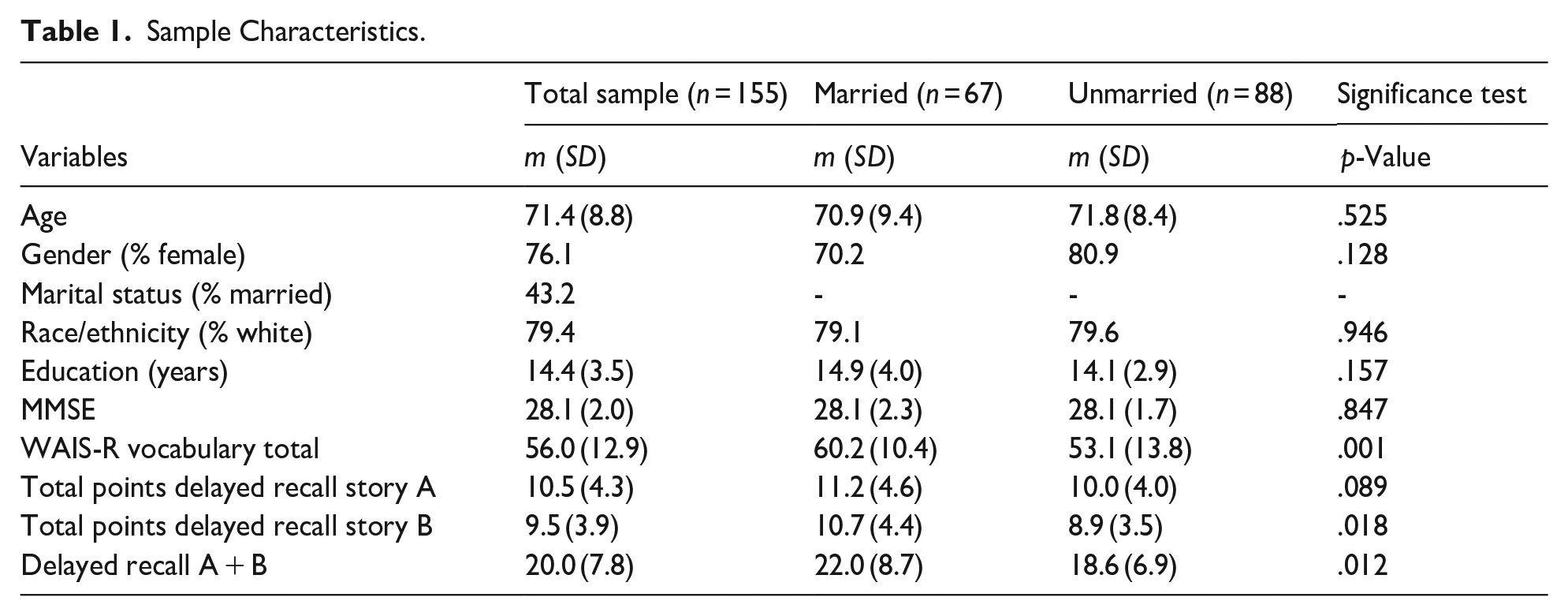
Table 2 displays the results of regression analyses examining cognitive performance by marital status, controlling for age, gender, education, and race. When controlling for age, gender, education, and race, significant differences in cognitive performance by marital status were still observed for delayed recall Story B (episodic memory; p = .015) and the combined delayed recall score (A + B; episodic memory; p = .023). Specifically, married individuals performed better on these tasks compared to their unmarried counterparts. In addition to marital status, age, education, race, and gender were also significant predictors of cognitive performance. The Cohen’s d values for delayed recall Story B (d = 0.41) and the combined delayed recall score (A + B; d = 0.43) suggest a moderate effect size, indicating that marital status accounted for a meaningful portion of the variance in episodic memory.
Regression Analysis of Cognitive Performance by Marital Status in Community-Dwelling Older Adults (n = 156).

Note. p Values less than .050 are considered statistically significant. The values for each model reflect the unstandardized coefficients (B), standard errors (SE), t-statistics (t), and p-values. R2 represents the proportion of variance explained by the model.
Table 3 presents the exploratory descriptive statistics for cognitive performance measures across the four marital status groups. Significant differences were observed between the groups in the WAIS-R Vocabulary Total score (semantic memory) and delayed recall for Story B (episodic memory). Specifically, divorced/separated and widowed individuals scored lower on the WAIS-R Vocabulary Total (p = .047 and p = .005, respectively) compared to the married group. Cohen’s d values for these comparisons were 0.63 for divorced/separated and 0.71 for widowed, indicating moderate to large effect sizes. Additionally, the delayed recall score for Story B was significantly lower for divorced/separated individuals (p = .037), with a Cohen’s d value of 0.64, suggesting a moderate effect size. While the combined delayed recall (A + B) approached marginal significance (p = .052) for the divorced/separated group, no other significant differences were observed.
Descriptives for One-Way ANOVA.

Marginal significance p = .052 compared to married group.
p < .05 compared to married group.
p < .01 compared to married group.
Discussion
This study contributes to the growing body of literature exploring the association between marital status and memory function in middle-aged and older adults. Our findings suggest that married individuals tend to perform better on episodic memory tasks compared to their unmarried counterparts, supporting our initial hypotheses. However, the relationship between marital status and semantic memory performance was less clear. While marital status initially appeared to influence semantic memory, this effect was largely explained by key covariates such as education and race. These findings align with previous research suggesting that marriage may serve as a protective factor for cognitive health (Bulanda et al., 2016; Mousavi-Nasab et al., 2012).
Marital Status and Episodic Memory
The observed differences in episodic memory performance between married and unmarried individuals are consistent with prior studies indicating that episodic memory is particularly vulnerable to aging-related decline (Luo & Craik, 2008; Tromp et al., 2015). Specifically, our findings are in line with those of Aartsen et al. (2005) and Mousavi-Nasab et al. (2012), which reported that married individuals experience less cognitive decline in episodic memory compared to their widowed and single counterparts. Married individuals in our sample performed significantly better on delayed recall tasks (e.g., Story B test) than divorced and widowed individuals, further supporting the idea that marriage may offer a protective effect on episodic memory.
The protective effect of marriage on episodic memory may be attributed to the cognitive stimulation and emotional support provided by a spouse, which could enhance memory retention and retrieval processes. This aligns with the cognitive reserve hypothesis, which posits that engaging in cognitively stimulating activities, such as social interaction with a spouse, can help mitigate cognitive decline (Richards & Deary, 2005). Given that episodic memory is often one of the earliest cognitive systems to show age-related deterioration, future research should explore the specific mechanisms through which marital status influences episodic memory, such as social engagement, emotional support, and lifestyle factors.
Marital Status and Semantic Memory
Our finding that the initial association between marital status and semantic memory disappeared after adjusting for covariates aligns with Mousavi-Nasab et al. (2012), who reported a similar lack of independent effect. This suggests that demographic factors like education and race may confound the observed relationship between marital status and semantic memory. Education, in particular, has been repeatedly shown to play a critical role in cognitive reserve and semantic memory performance (Bäckman & Nilsson, 1996; Vonk et al., 2020), and racial differences further highlight the importance of sociocultural influences on cognitive outcomes (R. Chen et al., 2022). Given that marriage often provides social support and cognitive stimulation that theoretically could benefit semantic memory (Haghighi & Oremus, 2023; Lev-Ari, 2016), the lack of a significant marital status effect in our study may be due, in part, to insufficient statistical power arising from a relatively small sample size and the inclusion of multiple covariates. Moreover, because social network size has been identified as a strong correlate of semantic memory (Evans et al., 2018), it is plausible that marriage’s impact on semantic memory might be equal to or overshadowed by broader social engagement factors not fully captured here. Future studies with larger samples and more comprehensive measures of social support and network size could clarify the nuanced role marital status plays in semantic memory maintenance.
Limitations and Future Directions
Despite the valuable insights gained from this study, several limitations should be acknowledged. First, the cross-sectional nature of the data precludes causal inferences about the relationship between marital status and cognitive function. Longitudinal studies are needed to examine how changes in marital status over time influence cognitive trajectories. Second, our sample was predominantly non-Hispanic white and female, limiting the generalizability of the findings to more diverse populations. Future research should aim to include more representative samples to better understand how marital status interacts with cultural, racial, and gender differences in cognitive aging. Third, while we controlled for several covariates, other unmeasured factors, such as social support quality, marital satisfaction, and lifestyle behaviors, may have influenced the results. Although the current study was primarily guided by the cognitive reserve hypothesis, we acknowledge that other mechanisms, including emotional regulation and linguistic interaction, may also underlie associations between marital status and memory. These alternative explanations were not directly tested in the present analysis but should be explored further in future research.
Conclusion
Our study provides further evidence that marital status is associated with cognitive function in middle-aged and older adults, particularly in the domain of episodic memory. However, the relationship between marital status and semantic memory appears to be influenced by education and race rather than marriage itself. These findings underscore the potential cognitive benefits of marriage while highlighting the importance of structural and educational factors in cognitive resilience. Future research should continue to explore the underlying mechanisms driving these associations and consider how social and behavioral interventions can support cognitive health in aging populations, regardless of marital status.
Footnotes

Ethical Considerations
The research for this study was approved by the institutional review board at the University of Massachusetts Dartmouth (IRB # 15.001; IRB # 13.077). The IRB at the University of Massachusetts Dartmouth approved the reanalysis of the dataset described here on March 24, 2023 (IRB # 23.024). All participants provided written informed consent prior to participating in the study.
Declaration of Conflicting Interests
The author(s) declared no potential conflicts of interest with respect to the research, authorship, and/or publication of this article.
Funding
The author(s) disclosed receipt of the following financial support for the research, authorship, and/or publication of this article: This study was supported by the Multidisciplinary Seed Funding (MSF) Program through the Office of the Provost at the University of Massachusetts Dartmouth (awarded to Andrew Revell, Principal Investigator).