




Abstract
Although many scales measure children’s image of older adults, none measure the image that older adults hold of children. This study creates a new scale with reference to previous studies. Using a preliminary survey, we examined whether the Child Image Scale originally designed for teachers could be applied to older adults; however, we found that it was insufficiently reliable. In our primary survey, we administered a questionnaire to individuals aged 65 years and older using newly created scale items. A factor analysis was conducted based on these data. Using exploratory and confirmatory factor analyses, we finally created the “Child Image Assessment Scale for Older Adults” (CIAO), which evaluates older adults’ image of children from three perspectives: purity, self-centeredness, and independence. The scale’s reliability and validity were confirmed using a primary and secondary survey and different samples. The results contribute to the effective evaluation of intergenerational exchange programs in the future.
● A three-factor, 12-item scale named the “Child Image Assessment Scale for Older Adults” (CIAO) was developed to investigate the image that older adults hold of children. ● CIAO was found to have sufficient reliability and validity through preliminary, first, and second surveys.
● CIAO can be used to measure the multi-faceted effects of intergenerational interaction on older adults’ image of children. ● CIAO can also be used to obtain data on the changes in the image older adults hold of children that are initiated by intergenerational interactions.
Introduction
Significance and Effects of Intergenerational Exchange Activities
The current global aging trend is anticipated to advance, and older adults are expected to become “drivers of community activities” through their active participation in society. Particularly, initiatives that address high community needs—such as childcare support, school education volunteering, and creating spaces for community engagement—often include elements of intergenerational exchange (e.g., Experience Corps® in the United States [Fried et al., 2004] and REPRINTS@ in Japan [Tokyo Metropolitan Geriatric Medical Center]). In these activities, older adults, who have more leisure time than younger and middle-aged individuals (U.S. Bureau of Labor Statistics, 2024), are expected to demonstrate generativity and promote community activities involving intergenerational exchanges.
In recent years, the creation of diverse, intergenerational exchanges in the community has been promoted as a response to the shrinking of local communities. Consequently, many positive impacts of intergenerational exchanges have been reported based on various practices (Giraudeau & Bailly, 2019; Murayama et al., 2015; Yasunaga et al., 2016). According to previous studies, the reasons for implementing intergenerational exchange programs include preventing dementia among older adults, promoting physical and mental health, providing children’s emotional education, fostering close relationships among participants, and enhancing social capital through a mutual understanding between generations.
According to the engagement hypothesis (Stine-Morrow et al., 2008), older adults are expected to benefit from increased social and intellectual activities; this, in turn, improves their health and cognitive function. The positive effects of volunteer activities on the health of older adults have been reported globally (Smith et al., 2016). For instance, improvements in physical health (Lum & Lightfoot, 2005; Shmotkin et al., 2003), extended lifespan (Gruenewald et al., 2007; Okun et al., 2013), enhanced quality of life (Taghian et al., 2019) and reduced mortality rates (E. S. Kim et al., 2020) have been documented. Moreover, older adults have been shown to benefit more from volunteer activities than other age groups (J. Kim & Pai, 2010; Musick & Wilson, 2003). Therefore, volunteer activities can be considered highly beneficial for older adults (Peters et al., 2021; Ronzi et al., 2018).
Volunteer and community activities involving intergenerational exchanges are also expected to positively affect the mental well-being of older adults. For example, Erikson (1950/1963) states that an interest in nurturing the next generation and creating something that will endure, referred to as “generativity,” is important for psychosocial adaptation in old age. Additionally, Cheng (2009) demonstrates that older adults can enhance their psychological well-being by inspiring respect among younger generations through supportive actions (generative acts). Intergenerational exchange programs, therefore, benefit both older adults and young people. According to Webster et al.’s (2023) systematic review, intergenerational exchange activities allow older and younger participants to share positive outcomes, bridge generational gaps, and strengthen their sense of solidarity.
Background of the Child Image Assessment Scale for Older Adults
One of the evaluation criteria for assessing the significance of intergenerational exchange programs is the change in participants’ image of their exchange partners before and after the program, as well as the direction of this change (i.e., positive or negative). For instance, when considering the interactions between children and older adults in a community, it is important to examine whether “children’s images of older adults have become richer and more positive” or whether “the older individuals’ images of children have become richer and more positive.” Such favorable changes can promote mutual understanding between generations and contribute to the continuity and development of community exchange activities, as well as foster children’s respect for older adults and the generativity of older adults. From a developmental psychology perspective, it is important for older adults to demonstrate generativity, as it plays a key role in addressing their developmental tasks and promoting successful aging.
Additionally, when examining the characteristics of older individuals who experience high satisfaction with community intergenerational activities and who actively and continuously participate, compared to those who feel a powerful sense of burden and withdraw early and those who are impartial about community activities, several factors must be considered. Specifically, demographic factors such as gender and age, indicators of physical and mental health, social factors such as trust in the community; psychological factors, such as generativity and self-efficacy; and perceptions of exchange partners should be included in a multivariate analysis to gain a more detailed understanding of these characteristics. To measure the perceptions of exchange partners or assess the changes in these perceptions before and after the interaction, surveys must be conducted before and after the exchange, and the results must be compared, utilizing scales designed to capture participants’ perceptions. In this context, it is advisable to ask about various aspects of perception rather than focus on a single dimension.
Many scales have been developed to measure images of specific generations or attributes by employing methods such as the Likert and semantic differential scales. For example, scales to measure children’s image of older adults (Baba et al., 1993; Flamion et al., 2020) or educational trainees’ image of children (Mishima, 2007) have been used to examine these concepts from multiple perspectives. However, our literature review did not reveal any scales designed to measure older individuals’ images of children.
Therefore, this study proposes the “Child Image Assessment Scale for Older Adults” (CIAO) as a new measure to examine changes in older adults’ image of children resulting from intergenerational interactions, including the presence or direction of such changes, as well as the relationship between child image and demographic and psychosocial variables. Additionally, the study investigates the reliability (internal consistency) and content validity of the scale. Specifically, (1) we investigated whether Mishima’s (2007) scale, designed for measuring educational trainees’ images of children, can be used as an alternative scale for measuring older individuals’ images of children. In cases where the alternative scale did not work well, we collected free-form descriptions of older individuals’ perceptions of children and created additional items based on category classification (preliminary survey). (2) We used the draft scale items developed using the preliminary survey to create the CIAO and tested its reliability and validity (primary survey). Finally, (3) we used the CIAO to conduct surveys on different samples to reassess the scale (secondary survey).
Preliminary Survey
Purpose
The preliminary survey was aimed at determining whether Mishima’s (2007) scale could serve as an alternative measure for assessing older adults’ images of children. Additionally, to prepare for situations in which an alternative may be difficult, the survey aimed to collect free-form descriptions of older adults’ images of children and to create new scale items based on category classification. The goal of developing these scale items was to enhance content validity by comprehensively extracting specific components of children’s images from the descriptions provided by older adults living in the community.
Method
The participants in this study were 86 individuals aged 65 and older (mean age 70.7 [±4.9] years, 95.3% female; 28 from Ward A and 58 from Ward B) who participated in a health promotion program aimed at dementia prevention conducted in Tokyo’s Wards A and B, Japan, from March 2013 to September 2014. The survey items included demographic variables such as gender and age, as well as the Child Image Scale by Mishima (2007). The scale consists of 21 items across six factors; each item was rated on a five-point scale, with higher scores indicating a stronger image. Additionally, participants from Ward A were asked to provide up to five free-form responses regarding their images of children. This survey was conducted before the commencement of the health promotion program.
As previously mentioned, the Child Image Scale (Mishima, 2007) was originally designed to measure the images that trainee teachers hold regarding children and was not intended to be used as a measure of older individuals’ images of children. However, because the scale items were not exclusively focused on educational activities and consisted of six factors with 21 items, they were deemed suitable for capturing a multi-faceted understanding of children’s images. After discussions among the authors, we considered its potential as a substitute measure for assessing child image in older adults. Ethical approval for the study was obtained from the Ethics Review Board of Tokyo Metropolitan Geriatric Medical Center, which is part of the Tokyo Metropolitan Institute for Geriatrics and Gerontology. (approval date: 19/Dec/2013, 5/Sep/2019, 1/June/2020, approval number: 25 kenshi No. 1743, 79, Yuankenshi No. 1924, No.30, 2 kenshi, 748th No.13).
Data Analysis
Ultimately, 7 participants with missing responses on the Child Image Scale were excluded from the analysis, leaving 79 individuals in the final dataset. Reliability (internal consistency) was assessed by calculating Cronbach’s α coefficients for each subscale of the Child Image Scale. Additionally, a qualitative analysis of the free-form responses was conducted using Berelson’s content analysis (1952). IBM SPSS Statistics 29 Standard was used to calculate Cronbach’s α coefficients, while IBM SPSS AMOS 29 was used for the confirmatory factor analysis.
Results
Examination of the Alternative Use of the Child Image Scale
Using the responses from 79 participants who answered all items in the Child Image Scale, we calculated Cronbach’s α coefficients for each of the six subscales. The coefficients ranged from .31 to .78, with several factors falling below the threshold of .70, which is the standard for internal consistency in scales, as specified by Hair et al. (2010; Table 1). In addition, the results of the confirmatory factor analysis showed that the model fit was χ2(df = 174) = 349.8, p < .001, goodness of fit index (GFI) =0.707, adjusted GFI (AGFI) = 0.611, and root mean square error of approximation (RMSEA) = 0.114. The GFI, AGFI, and RMSEA were all below the thresholds generally considered indicative of good model fit (GFI ≥ 0.9; Kline, 2016; AGFI ≥ 0.80, RMSEA ≤ 0.1; Hu & Bentler, 1999).
Cronbach’s α for Each Subscale of the Child Image Scale (Mishima, 2007).

Content Analysis of the Free-Form Responses
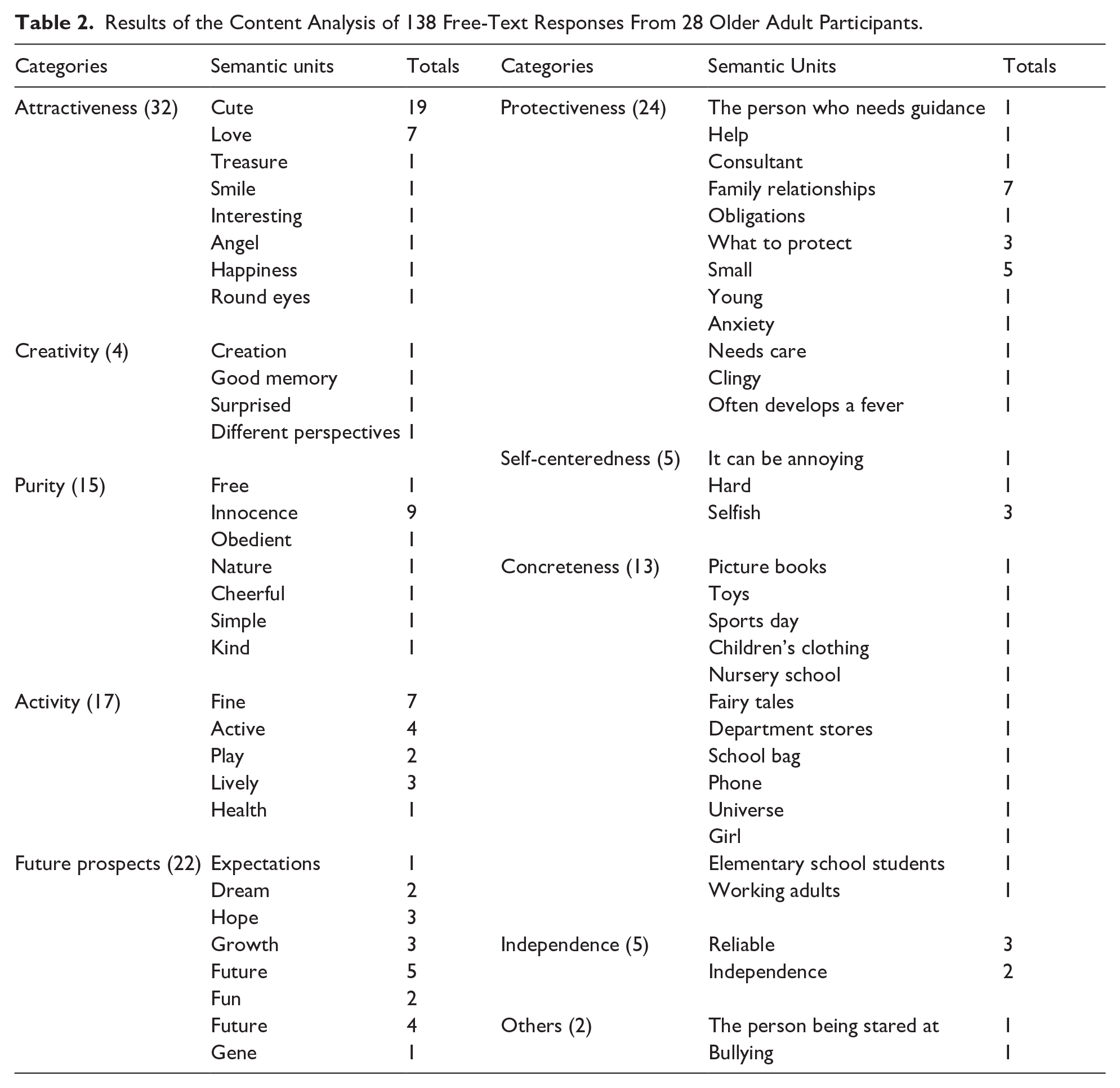
Using all 138 free-form responses obtained from the 28 participants in Ward A, we calculated meaningful units and generated categories based on Berelson’s content analysis. Consequently, nine categories were generated, including purity (innocent, naïve, etc.) and independence (reliable, self-sufficient, etc.; Table 2). The content validity of the generated categories was confirmed by the lead author and co-authors.
Results of the Content Analysis of 138 Free-Text Responses From 28 Older Adult Participants.
Discussion
The results of the factor analysis suggested reliability issues in the subscales of the Child Image Scale if applied directly to older adults. In addition to self-centeredness and creativity—which are also included in the Child Image Scale—other subcategories, such as independence and purity, were extracted from the results of the content analysis of free-form descriptions. These results suggest that there are elements that cannot be captured by substituting existing child image scales when measuring the child image of older adults; they also indicate the academic significance of creating a new scale that includes these elements.
Primary Survey
Purpose
The results of the preliminary survey indicated that Mishima’s (2007) Child Image Scale was not appropriate for measuring the child image of older adults. Therefore, based on older adults’ free-text descriptions of their child images gathered in the preliminary survey, we developed CIAO and verified its reliability and validity.
Method
The images that older individuals had of children, as derived from the preliminary survey, were classified into nine categories. However, one category—the one related to “concreteness,” which does not directly pertain to the children themselves—was excluded. For the remaining eight categories, new scales were developed and assigned to factors. The meaning units within each category were condensed into three items after validation by the co-authors with expertise in psychology and gerontology, resulting in a scale comprising eight factors and 24 items (five-point Likert scale; Table 3).
A proposed CIAO Scale Comprising Eight Factors and 24 Items.

Note. CIAO = Child Image Assessment Scale for Older Adults.
The survey targeted 346 participants aged 65 years and older who participated in a program aimed at dementia prevention and social participation using picture books. The survey was conducted in 11 municipalities in Tokyo, Japan, from August 2019 to November 2021. Of the participants, 332 individuals (mean age 72.8 [±5.3] years, 92.2% female) who responded to all newly developed scale items were included in the analysis. A survey was conducted before the start of the program. This study was approved by the Tokyo Metropolitan Geriatric Medical Center, which is part of the Tokyo Metropolitan Institute for Geriatrics and Gerontology. (approval date: 19/Dec/2013, 5/Sep/2019, 1/June/2020, approval number: 25 kenshi No. 1743, 79, Yuankenshi No. 1924, No.30, 2 kenshi, 748th No.13).
Data Analysis
The data were analyzed to identify items showing ceiling or floor effects, assess the reliability (internal consistency) and validity of the scale using exploratory factor analysis (maximum likelihood method with Promax rotation), and examine the model through confirmatory factor analysis to finalize the scale items. Additionally, for the completed scale, the presence of survey bias was tested using Harman’s single-factor test (Podsakoff & Organ, 1986). IBM SPSS Statistics 29 Standard was used for the exploratory factor and reliability analyses and Harman’s single-factor test, while IBM SPSS AMOS 29 was used for the confirmatory factor analysis.
Results
Exploratory Factor Analysis
Among the 24 items in the newly developed scale, eight (cute, creative, energetic, having a future, wanting to protect, lovable, like a treasure, possessing the ability to grow) exhibited ceiling effects. Specifically, the value obtained by adding the standard deviation to the mean of these items exceeded the maximum score (5.00). Therefore, these eight items were excluded from subsequent analyses. Next, an exploratory factor analysis using the remaining 16 items was conducted (maximum likelihood method with Promax rotation), which revealed that two items had a factor loading of 0.3 or higher across multiple factors (having a novel perspective, small). These two items were removed, and a second exploratory factor analysis was performed using the remaining 14 items. As a result, a scale was created that comprises three factors: purity (seven items), self-centeredness (four items), and independence (three items). The Cronbach’s α coefficients were .85 for purity, .79 for self-centeredness, and .70 for independence, indicating sufficient reliability for all factors.
Confirmatory Factor Analysis
As previously mentioned, the CIAO, which consists of three factors and 14 items, was developed through exploratory factor analysis and demonstrated sufficient reliability for each subscale. However, the results of the confirmatory factor analysis showed that the model fit was χ2(df = 74) = 284.9, p < .001, goodness of fit index (GFI) = 0.894, adjusted GFI (AGFI) = 0.849, and root mean square error of approximation (RMSEA) =0.093; the GFI was below the threshold of 0.9, which is considered to indicate good fit (Kline, 2016).
To improve the model, we sequentially removed the items with the lowest standardized factor loadings from each latent factor. This process led to the exclusion of two items (reliable, factor loading: 0.52; high originality, factor loading: 0.55) from the original model, resulting in a revised model with three factors and 12 items (purity: six items, self-centeredness: four items, independence: two items; Figure 1). The fit indices for this model were χ2(df = 51) = 214.1, p < .001, GFI = 0.905, AGFI = 0.855, and RMSEA = 0.098, indicating a significant improvement in both GFI and AGFI, as well as overall model fit (Δχ2 = 70.8, df = 23, p < .001).

Confirmatory factor analysis for the CIAO. Fit Index: GFI = 0.905, AGFI = 0.855, RMSEA = 0.098. Error variables were omitted.
In this model, the GFI exceeded the 0.9 threshold for a good fit, while the RMSEA met the criterion of being below 0.1, as suggested by Hu and Bentler (1999). Furthermore, removing any additional items resulted in an RMSEA exceeding 0.1. Therefore, we adopted this three-factor, 12-item model as the final model. The Cronbach’s α coefficients for the final model were 0.84 for purity, 0.79 for self-centeredness, and 0.71 for independence, confirming sufficient reliability for all factors (Table 4).
Exploratory Factor and Reliability Analyses for CIAO.

Note. Cumulative contribution rate: 52.4%.
Harman’s Single-Factor Test
Since this study relies on self-reported data, there were concerns about the potential influence of common method bias, which could overemphasize the relationships between variables. To examine the impact of common method bias, we conducted Harman’s single-factor test. Using the 12 items that constitute the scale, an exploratory factor analysis (maximum likelihood method with no rotation) was performed, applying an extraction criterion of eigenvalues greater than 1.00. As a result, three factors were extracted, accounting for 64.0% of the total variance in the observed variables. Furthermore, the first factor, which had the largest eigenvalue, explained 33.0% of the total variance. Based on these results, we concluded that the potential impact of common method bias in this sample was low.
Discussion
Based on the exploratory and confirmatory factor analyses, the CIAO, consisting of three factors and 12 items, was developed. This scale was created based on older adults’ free-text descriptions of their images of children. The lead author and co-authors, all of whom possess expertise in gerontology, performed a content validity assessment. The scale was shown to possess sufficient validity for evaluating the images of children held by older adults and has also been confirmed to meet high standards in terms of model fit and reliability. Compared to Mishima’s Child Image Scale, the CIAO consists of three factors, which can be interpreted as a developmental integration of the factors identified by Mishima. Additionally, its ability to capture a multi-faceted image of children using fewer items than Mishima’s scale is another strength of the CIAO, particularly in terms of reducing respondent burden.
Secondary Survey
Purpose
The results of the primary survey confirmed that the CIAO had sufficient reliability and validity. A secondary survey was conducted using a different sample to re-examine the internal consistency of the subscales and the model fit. In this second survey, we compared the scores of the attributes of the CIAO subscales using t-tests. We also performed a multiple regression analysis with the dependent variables of activity satisfaction, activity burden, and intention to continue reading picture books to children while using demographic variables and various physical, psychological, and social variables—including those from the CIAO—as independent variables. This analysis aimed to investigate the factors related to these dependent variables.
Method
From November 2021 to January 2022, a postal survey was conducted involving 323 individuals aged 65 years and older who belonged to the Picture Book Reading Volunteer Organization (Tokyo Metropolitan Geriatric Medical Center) in Japan. The analysis included 291 of these participants—those who provided complete responses to all analytical items, including the CIAO (average age 74.2 [±5.4 years, 90.7% female). This survey was approved by the Ethics Review Board of the Tokyo Metropolitan Geriatric Medical Center, which is part of the Tokyo Metropolitan Institute for Geriatrics and Gerontology. (approval date: 19/Dec/2013, 5/Sep/2019, 1/June/2020, approval number: 25 kenshi No. 1743, 79, Yuankenshi No. 1924, No.30, 2 kenshi, 748th No.13).
Data Analysis
The reliability (internal consistency) of the CIAO was re-evaluated using exploratory factor analysis (maximum likelihood method with Promax rotation) and confirmatory factor analysis. Additionally, t-tests were conducted to compare CIAO subscale scores across demographic variables. To examine related factors, multiple regression analysis was performed with activity satisfaction, activity burden, and willingness to continue activities as dependent variables, and demographic variables (gender and age), physical and mental health (subjective health, WHO-5, TMIG-13), the generativity scale, and CIAO subscales as independent variables. The presence of survey bias was also tested using Harman’s single-factor test. IBM SPSS Statistics 29 Standard was used for the exploratory factor and reliability analyses, t-tests, and Harman’s single-factor test, while IBM SPSS AMOS 29 was used for the confirmatory factor analysis.
Results
Exploratory and Confirmatory Factor Analyses
The exploratory factor analysis conducted on the 12 CIAO items resulted in the convergence of three factors comprising the same item groups as those in the initial survey. The Cronbach’s α coefficients for each factor were .85 for naivety, .79, and for self-centeredness .69 for autonomy, indicating adequate reliability for all factors. Further, the confirmatory factor analysis yielded χ2 (df = 51) = 189.0, p < .001, GFI = 0.905, AGFI = 0.855, and RMSEA = 0.094, confirming a good model fit, similar to the initial survey.
Harman’s Single-Factor Test
Since this study, like the Primary Survey, raises concerns about the potential influence of common method bias, we conducted Harman’s single-factor test. Using the 12 items that comprise the scale, an exploratory factor analysis (maximum likelihood method with no rotation) was performed, applying an extraction criterion of eigenvalues greater than 1.00. As a result, three factors were extracted, accounting for 64.2% of the total variance in the observed variables. Furthermore, the first factor, which had the largest eigenvalue, explained 32.0% of the total variance. Based on these results, we concluded that the potential influence of common method bias in this sample was low.
Comparison of the CIAO Subscale Scores
We compared the scores of the CIAO subscales based on gender (male and female) and age groups (65–75 years old and above) using independent t-tests. The results indicated that women scored significantly higher than men on the naivety subscale. In contrast, no significant differences were observed across age groups for any of the other subscales.
Additionally, a multiple regression analysis revealed the following related factors: (1) higher activity satisfaction was associated with being male, having better mental health, and a stronger image of independence regarding children; (2) stronger feelings of activity burden were associated with poorer mental health, less interest in generational transmission, and a weaker image of independence regarding children; and (3) a stronger intention to continue activities was associated with being younger, having a higher level of subjective health, better mental health, and greater interest in generational transmission (Table 5).
Results of the Multiple Regression Analysis for Satisfaction With/Perceived Burden of/Willingness to Continue Volunteer Activities.

p < .01.*p < .05.
Comprehensive Discussion
This study developed the CIAO, a scale comprising 12 items across three factors: simplicity, self-centeredness, and independence. The results of the confirmatory factor analysis indicated that the model fit indices for the scale met a consistent level for both the primary and secondary surveys; this confirms that the scale allows for a multi-faceted understanding of older adults’ image of children, with relatively few items. Furthermore, the reliability of each factor was confirmed to be sufficient, based on Cronbach’s α from both surveys. Additionally, by extracting the scale components from the free-form descriptions provided by older adults, we confirmed that the scale possesses adequate validity as a measure of older adults’ images of children.
Next, we discuss each factor in detail. First, the simplicity factor is associated with the image of children’s innocence and purity and primarily comprises positive word groups. If older adults’ images of children change positively through intergenerational interactions, an increase in these scores can be expected after the interactions. However, if older adults feel a gap between their imagined representation of children and reality, there may be a subsequent decrease in their scores.
Next, self-centeredness relates to the typical selfishness and assertiveness that children exhibit at their younger age and is mainly composed of negative word groups. Similar to the scores for the simplicity factor, it was anticipated that the scores would change through intergenerational interactions. If the image becomes favorable, a score decrease is expected. Conversely, if older adults’ focus is solely on children’s selfishness and assertiveness, scores may increase.
Finally, independence is connected to self-reliance and the identity acquisition of children as they grow up. It is expected that short-term or single interactions may not lead to significant changes in scores compared with the simplicity and self-centeredness factors. However, among older adult volunteers who have a long history of activities and can take a mid-to-long-term perspective on the growth of children, it is possible that scores for the independence factor will increase over time.
The results of the multiple regression analysis of the secondary survey showed a significant relationship between the independence image scores of older adults participating in picture book reading volunteer activities and their satisfaction with the activities, as well as their perceived burden. This results in having regular opportunities to witness children enhancing their independence as they grow, which can lead to a heightened image of independence among older adults involved in volunteer activities; this, in turn, contributes to a greater sense of satisfaction and a lower perceived burden. However, the strength of their willingness to continue volunteering was associated with their interest in generational continuity, and no correlation was observed with the child’s image. This indicates that, when nurturing older adult volunteers who are active in the community in the long term, initiatives that promote their generativity may be more effective than those aimed at transforming their images of children.
Future challenges include addressing the limitation that the participants in this study were restricted to older individuals in urban areas, with a high proportion of women participating in health promotion programs and volunteer reading activities; this may have introduced sampling bias into the formed images. It is, therefore, necessary to confirm the validity and reliability of the CIAO among older adults in more diverse regions and with samples with less gender bias. Moreover, examining the characteristics of older adults with high scores on each subscale of CIAO, as well as investigating the conditions of intergenerational exchange programs that have a significant effect on positively transforming older adults’ images of children, could further extend the scale’s validity by applying it in various contexts. Additionally, although this study did not examine the relationship with potential negative outcomes—such as stereotypes or a lack of understanding toward children held by the participants—future research should explore these connections.
Conclusions
Based on the preliminary, primary, and secondary surveys, we developed the new CIAO, which comprises 12 items across three factors. As it contains few questions and its reliability and validity have been confirmed, it is expected to serve not only as a scale for assessing older adults’ images of children but also as a tool for obtaining evidence regarding changes in older adults’ images of children initiated by intergenerational interactions. Additionally, it may be used as an indicator of social capital richness in local communities. Various studies have demonstrated the significance of intergenerational interactions in promoting mutual understanding among participants (Webster et al., 2023). However, it is desirable for future research to use the newly developed CIAO in this study to provide more multi-faceted evidence on the effectiveness of intergenerational exchange.
Footnotes

Ethical Considerations and Consent to Participate
This study was conducted in compliance with the Code of Ethics of the World Medical Association (Declaration of Helsinki), and the participants provided written informed consent. This study was conducted with the approval of the Ethical Review Committee of the Tokyo Metropolitan Geriatric Medical Center, which is part of the Tokyo Metropolitan Institute for Geriatrics and Gerontology. (approval date: 19/Dec/2013, 5/Sep/2019, 1/June/2020, approval number: 25 kenshi No. 1743, 79, Yuankenshi No. 1924, No.30, 2 kenshi, 748th No.13).
Author Contributions
Tomoya Takahashi: Conceptualization, Data curation, Formal analysis, Funding acquisition, Investigation, Methodology, Project administration, Resources, Software, Validation, Visualization, Writing – original draft, Writing – review & editing.
Susumu Ogawa: Data curation, Investigation.
Daichi Yamashiro: Data curation, Investigation.
Kenichiro Sato: Data curation, Investigation.
Li Yan: Investigation.
Tomoki Furuya: Investigation.
Kyoko Fujihira: Data curation, Investigation.
Yoshifumi Takahashi: Data curation, Investigation.
Tomoya Sagara: Data curation, Investigation
Koji Fujita: Data curation, Investigation.
Hiroko Matsunaga: Data curation, Investigation.
Mari Yamashita: Data curation, Investigation.
Kiyo Kawakubo: Data curation.
Yoshinori Fujiwara: Supervision.
Hiroyuki Suzuki: Funding acquisition, Project administration, Resource, Supervision.
Funding
The author(s) disclosed receipt of the following financial support for the research, authorship, and/or publication of this article: This work was supported by JSPS KAKENHI [grant number 21K18470], Ota Ward, Toshima Ward, Itabashi Ward, Bunkyo Ward, Nerima Ward, Meguro Ward, Chiyoda Ward, Tachikawa City, Hachioji City, Komae City, Inagi City, Fuchu City, Tokyo, Japan. However, they do not play any role in the study design; in the collection, analysis, and interpretation of data; in the writing of the report; and in the decision to submit the article for publication.
Declaration of Conflicting Interests
The author(s) declared no potential conflicts of interest with respect to the research, authorship, and/or publication of this article.
Data Availability Statement
The data used in this study are not publicly available in an online repository, to maintain data use priority. However, data can be provided upon reasonable request after confirming the intended use by the requester.