



Abstract
Increasing the representation of Black and Hispanic people into science, technology, engineering, and mathematics (STEM) research careers is a national priority. Despite clear links between self-esteem and motivation, prior research has not empirically examined how self-esteem relates to STEM student integration into the scientific research community. Thus, this preregistered study examined whether aspects of scientific community integration were distal, longitudinal outcomes of self-esteem among 1,247 Black (55.57%) and Hispanic (44.43%) undergraduate STEM students. Specifically, we used structural equation modeling to examine how self-esteem prior to senior year was longitudinally associated with later intentions to pursue a scientific research career, whether they applied to STEM graduate programs, and whether they attained a STEM-related occupation after graduation. Results indicated that self-esteem was associated with stronger intentions, application to STEM graduate programs, and attainment of a STEM-related career after graduation among Black and Hispanic students. Neither ethnicity, gender, nor enrollment in a minority science training program moderated the results. Taken together, self-esteem may be an important yet overlooked factor influencing the integration of Black and Hispanic STEM students into the scientific research community and may account for ethnic disparities in STEM research careers.
Introduction
The demand for science, technology, engineering, and mathematics (STEM) professionals has been and will continue to increase in the coming decades (Rifandi & Rahmi, 2019). Yet, fulfilling this workforce demand is hindered by persistent inequities in STEM education and careers, given that these fields are often perceived as less inclusive among historically underrepresented groups such as women, first-generation students, and Black and Hispanic individuals (Estrada et al., 2016; National Academies, 2023). The National Center for Science and Engineering Statistics (2023) reported a significant increase in the proportion of Black and Hispanic individuals working in STEM fields, from 18% in 2011 to 24% in 2021. However, these two ethnic groups remained underrepresented relative to their share of the total U.S. population aged 18–74 (30%) and compared to White and Asian individuals, who collectively constitute 74% of the research workforce despite representing only 67% of the U.S. adult population.
These ethnic disparities underscore the urgency of better understanding the underlying mechanisms that contribute to the underrepresentation of Black and Hispanic STEM professionals. Addressing this issue is not merely a matter of inclusion and equity but also has significant implications for national innovation and competitiveness. A diverse scientific workforce has been shown to enhance creativity, foster problem-solving, and improve adaptability in the face of uncertainty and crisis (Bell et al., 2019; Hong & Page, 2004; Hsieh et al., 2019). Despite increasing awareness and discussion of ethnic disparities in STEM careers over the past two decades, significant gaps remain. Moreover, recent research has emphasized promoting the design and implementation of effective interventions, given their positive outcomes in enhancing the representation of underrepresented minority students (Ghazzawi et al., 2021; Oyelaran, 2023). However, beyond examining environmental and extrinsic factors such as minority science training programs, the present study aimed to address several research gaps by investigating longitudinal associations between self-esteem and scientific community integration among Black and Hispanic undergraduate STEM students.
A central question that motivates the present study is:
According to sociometer theory, self-esteem is a “sociometer”—an ongoing, dynamic, and internal gauge that reflects the extent to which individuals perceive themselves as accepted and valued by others within interpersonal contexts (Leary & Baumeister, 2000). Given that belongingness is defined as an individual's subjective feeling of being an integral and important part of a social system (Allen et al., 2021; Anant, 1966; Hagerty et al., 1992), the experience of feeling accepted and valued by others and therefore, self-esteem shares substantial, overlapping variance with belongingness, leading us to conceptualize self-esteem as a crucial facet of belongingness. As such, self-esteem serves as a strong proxy for belongingness, as it fluctuates in accordance with one's perceived belongingness. Consequently, when individuals experience rejection or devaluation in certain environments, their self-esteem and perceived belongingness decline, and associated negative emotions are elicited to motivate them to reestablish their relational value and sense of belonging. Furthermore, if feelings of devaluation or exclusion persist, individuals may disengage or withdraw from these environments (Cohen & Garcia, 2008). Empirical studies have showed that students with high self-esteem tend to perform better academically and persist longer in school, whereas those with low self-esteem are more vulnerable to academic disengagement and dropout (Cortes et al., 2014; Dancot et al., 2021; Lan & Lanthier, 2003; Svansdottir et al., 2015). These dynamics appear to be particularly salient in STEM education, where rigorous demands and the underrepresentation of ethnic groups can intensify feelings of marginalization and exclusion. For example, Wilkins-Yel et al. (2022) interviewed seven Black and Hispanic STEM graduate students and found that each student had, at some point, considered dropping out due to mental health and self-esteem challenges associated with their underrepresented status in the predominantly White STEM environments. Notably, three students ultimately dropped out. Similarly, Lee et al. (2020) reported that racial microaggressions, such as feeling highly visible yet ignored, often embedded in STEM academic cultures, can undermine well-being and persistence in STEM education among students of color, particularly Black students. These findings suggest that self-esteem may play a critical role in shaping how underrepresented students, especially Black and Hispanic students, feel integrated into scientific academic environments and ultimately, affect whether they continue in STEM education and pursue scientific research careers. Some initial empirical evidence supports this proposed association. Specifically, Young et al. (2025) observed a small, positive cross-sectional correlation (r = .13) between self-esteem and intentions to pursue a scientific research career during the senior year among Black and Hispanic undergraduate students.
Although there is theoretical and, more recently, preliminary empirical support for the motivational implications of self-esteem among Black and Hispanic STEM students, there remains a notable scarcity of empirical research examining how self-esteem influences subsequent intentions to pursue STEM degrees and actual behavioral outcomes associated with scientific research career obtainment. To investigate internal drivers of STEM persistence, this study examined how self-esteem, as a strong proxy for belongingness, influenced learning motivation and integration into the scientific community. Given the additional structural and interpersonal obstacles encountered by Black and Hispanic students, understanding whether self-esteem can positively influence persistence and engagement in scientific pathways is crucial. Furthermore, other important individual-level factors may affect this relationship. Therefore, this study also examined whether the associations between self-esteem and distal scientific community integration outcomes were moderated by ethnicity (Black vs. Hispanic), gender, or enrollment in minority science training programs (MSTPs), which have been previously identified as important moderators of STEM-related career outcomes.
Specifically, some research suggests that Hispanic, but not Black, STEM students are more vulnerable to perceptions of negative stereotypes (Woodcock et al., 2012). However, these ethnic differences might be explained by the fact that 85% of the Black students were enrolled in predominantly Black institutions, where such homogenous ethnic environments may have already buffered their scientist identities. Still, given that our sample was a subset of the sample used in Woodcock et al. (2012), empirically examining ethnicity as a moderator of self-esteem associations was critical. Research has also documented gender inequities in STEM fields (Nosek et al., 2009) insofar as women face additional challenges related to a reduced sense of belonging, limited access to mentorship, and work-life balance concerns (Kachchaf et al., 2015). Finally, minority science training programs (MSTPs) aim to enhance research engagement, provide support and mentorship, and cultivate inclusive scientific communities. For instance, it has been found that MSTPs increase student retention in STEM fields and promote scientific community integration (Estrada et al., 2019, 2021; Matsui, 2018). Schultz et al. (2011) also reported that MSTP enrollment among predominantly Black and Hispanic students positively affected students' intentions to pursue scientific research careers over time, relative to a matched control group.
The Present Study
To address ethnic disparities in STEM and to better understand the relationship between self-esteem and scientific community integration among Black and Hispanic students, the present preregistered study examined longitudinal associations between self-esteem and three distal indicators of integration: (1) intentions to pursue a scientific research career (a motivational indicator), (2) submission of STEM graduate school applications (a behavioral indicator of academic engagement and aspiration), and (3) attainment of a STEM-related occupation (a behavioral indicator of career attainment). Specifically, using a large sample of Black and Hispanic undergraduate STEM students (N = 1,247), we examined whether self-esteem prior to their senior year related to their later intentions to pursue a scientific research career during their senior year and immediately after graduation, whether students submitted applications to STEM graduate programs, and whether students attained a STEM-related occupation after graduation (Research Question 1; RQ1). We also examined whether these associations were moderated by ethnicity, gender, and MSTP enrollment (RQ2).
The three integration indicators were selected to represent a comprehensive developmental trajectory, spanning academic motivation, decision-making across undergraduate and graduate education, and, ultimately, entry into the STEM workforce. By measuring both intrapersonal (i.e., intentions) and objective behavioral outcomes (i.e., graduate applications and occupational attainment), this study provides a systematic and holistic investigation of whether and how self-esteem influences student integration into the scientific community, particularly among Black and Hispanic students. Results of this study identify potential psychological mechanisms that may support long-term engagement in scientific research careers and offer guidance for developing effective interventions to promote the success of Black and Hispanic students in STEM fields. Our preregistered analytical plan, the dataset, annotated R code used to conduct the primary analyses, and a codebook of all assessed variables are available online (https://osf.io/jtaez/files).
Methods
Participants and Procedure
Participants included 1,247 Black (55.57%) and Hispanic (44.43%) undergraduate STEM students who were part of TheScienceStudy, a longitudinal panel of 1,420 STEM students from 50 U.S. universities who intended to pursue a scientific research career at the time of enrollment. An online survey was administered each spring and fall semester for 12 consecutive years beginning in 2005, and participants received $25 for each completed survey. Participants were 73.22% female, and 34.24% of participants had been enrolled in MSTPs at some point during their undergraduate studies.
Measures
Self-Esteem
Self-esteem was assessed using the Rosenberg Self-Esteem Scale (RSE; Rosenberg, 1965). Participants indicated the extent to which they agreed with five positively-keyed items (e.g., “On the whole, I am satisfied with myself) and five negatively-keyed items that were reverse scored (e.g., “At times I think I am no good at all”). Items were averaged so that higher scores reflected higher self-esteem. Self-esteem measured during the spring semester of the sophomore year and the fall and spring semesters of the junior year was used 1 . See 3.4.1 for more details.
Scientific Community Integration
Intentions to Pursue a Scientific Research Career. Intentions to pursue a scientific research career were assessed by asking participants, “To what extent do you intend to pursue a science-related research career?” (0 = Definitely Will Not, 10 = Definitely Will; Estrada et al., 2011). This item was included at each wave of data collection, with higher scores reflecting stronger intentions to pursue a scientific research career. Intentions measured during the fall and spring semesters of the senior year and the first semester after graduation were used.
Submission of STEM Graduate School Applications. Submission of STEM graduate school applications was assessed using two questions included at each wave of data collection. Specifically, participants were asked, “In the last six months, have you applied to any graduate schools?” If they answered “Yes,” they were then asked, “How many were science-related graduate programs?” If participants applied to at least one science-related graduate program at any time during or after the fall semester of their senior year, this variable was coded as 1 (all other responses were coded as 0).
Science-related Occupation. Attaining a science-related occupation after college was assessed by asking participants at each wave of data collection, “Which best describes your current primary occupation?” If, among various response options, either “science-related: research position”, “science-related: teaching position”, or “science-related other (please specify)” was selected at any point after graduation, this variable was coded as 1 (all other responses were coded as 0).
Covariates and Moderators
Gender (0 = Female, 1 = Male), ethnicity (0 = Black, 1 = Hispanic), and MSTP were used as covariates and examined as moderators of the association between self-esteem and scientific community integration. MSTP enrollment was assessed with a single item: “Are you currently enrolled in a minority science training program at your college or university?” This variable was coded as 1 if “Yes” was indicated at any point during undergraduate study (all other responses were coded as 0).
Data-Analytic Plan
Data Structure
Given that the data of TheScienceStudy were collected linearly (e.g., Spring 2005, Fall 2005, Spring 2006), we restructured the data so that it was organized according to students' class standing and semester in college (i.e., junior Fall/Spring, senior Fall/Spring, first semester after graduation, etc.) to reflect the natural progression through college and into the post-graduation period.
Missing Data and Outliers
Varying degrees of missing data were observed due to attrition and because self-esteem was measured only during specific waves of data collection (see Table 1). We therefore used Little's missing completely at random (MCAR) test (Little, 1988) to examine whether the missing data were MCAR (i.e., data were not systematically missing; Enders, 2010, 2011). Results indicated that the data were not MCAR (p < .05; i.e., the data were missing systematically). Following Estrada et al. (2018) who restructured TheScienceStudy as we did here, we identified background and demographic characteristics and academic motivation variables at the time of enrollment that were associated with the missing data. Six variables were uniquely associated with the missing data in one or more study variables: studying natural sciences as a major (e.g., physics, earth sciences), currently (vs. not currently) living with family/parents, currently (vs. not currently) living with spouse/partner with no children, currently (vs. not currently) living with spouse/partner with child or children, being recruited in the first wave, and class standing. These variables were therefore included as auxiliary variables in all models to control for missing data bias (Collins et al., 2001).
Descriptive Statistics and Zero-Order Correlations among the Observed Study Measures.

Pairwise averaging was used to calculate the means of each two pairs of data collected in the three time points.
Note. α is not available for intentions to pursue a scientific within each semester research career because this was measured with a single item. * p < .05, ** p < .01, *** p < .001.
No outliers were detected based on studentized deleted residuals and Cook's D (Judd et al., 2009).
Statistical Model
Structural equation modeling was used to examine the research questions via the “lavaan” package in R version 4.3.1 (Rosseel, 2012). Configural and metric, or partial metric (in one case), measurement invariance was established for each assessment of self-esteem across each of the three moderator variables (i.e., ethnicity, gender, MSTP; see the online supplemental materials for the methods and results of these analyses). This indicated that we could interpret group-level differences in the associations between self-esteem and scientific community integration across levels of the moderators if differences were observed (Hirschfeld & von Brachel, 2014). Measurement invariance was not examined for our three outcomes because they were single items (i.e., observed variables).
A single SEM model (depicted in Figure 1) examined RQ1 (How does self-esteem relate to scientific community integration among Black and Hispanic STEM students?). Specifically, self-esteem and intentions to pursue a scientific research career were modeled as random-intercept latent autoregressive (RI-LAR) variables (see the online supplemental materials for specific model specifications). By modeling self-esteem and intentions as RI-LAR variables, the between-subject variance for each was modeled separately (via the random intercept) from the within-subject variance (via autoregressive paths). STEM graduate school applications and attainment of STEM-related occupations were modeled as observed variables. We then regressed the intentions random intercept, STEM graduate school applications, and attainment of STEM-related occupation on the self-esteem random intercept. This specifically examined how the between-subjects variance in self-esteem predicted scientific community integration and, with respect to intentions, its between-subjects variance. Full information maximum likelihood estimation (FIML) 2 was used, and model fit was generally consistent with the recommendations of Hu and Bentler (1999) (CFI=.93, RMSEA=.03, SRMR=.09).

Analytic model and results for research question 1: longitudinal associations between self-esteem and scientific community integration Among Black and Hispanic STEM students.
Multiple-group SEM analyses were used to examine RQ2 (Does gender, ethnicity, or enrollment in a minority science training program moderate the associations between self-esteem and scientific community integration among Black and Hispanic STEM students?). Specifically, using separate models for each moderator and the Δχ2 test, we compared a model in which the association between the self-esteem random intercept and each outcome (the random intercept of intentions) was freely estimated to a model in which each of these three associations was constrained to be equal across the levels of the moderator being examined. If a significant Δχ2 was observed (i.e., moderation was observed), we constrained the associations between the self-esteem random intercept and each outcome one at a time and compared each of these models to the freely estimated model. If a significant Δχ2 in any of these separate models was observed, we examined the association at each level of the moderator (i.e., simple slopes).
Results
Descriptive statistics for model variables and their zero-order correlations for the full sample are reported in Table 1. Descriptive statistics across ethnicity, gender, and MSTP are reported in Table 2. References to effect sizes are based on Funder and Ozer (2019). RQ1: How does self-esteem relate to scientific community integration among Black and Hispanic STEM students?
Descriptive Statistics of the Study Variables across Each Sociodemographic Factor at Three Different Time Points.
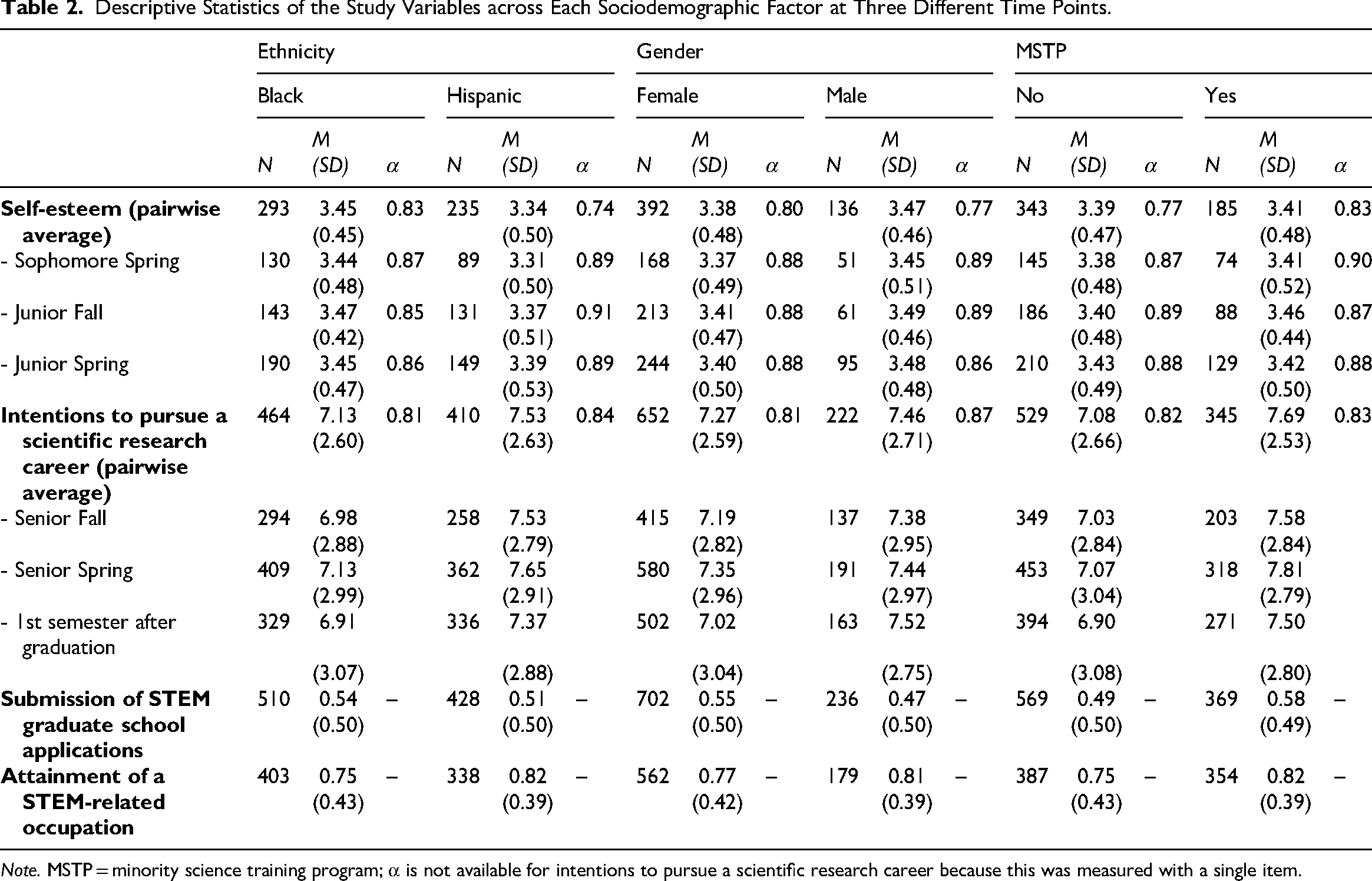
Note. MSTP = minority science training program; α is not available for intentions to pursue a scientific research career because this was measured with a single item.
As indicated in Figure 1, higher self-esteem had small and positive unique associations with intentions to pursue a scientific research career (p = .005), submitting STEM graduate school applications (p = .018), and attaining a STEM-related occupation (p = .009). These results indicated that students’ earlier self-esteem related to later intentions to pursue a scientific research career, whether they later applied to a STEM graduate school program, and whether they attained a STEM-related occupation after graduation. RQ2: Does gender, ethnicity, or enrollment in a minority science training program moderate the associations between self-esteem and scientific community integration among Black and Hispanic STEM students?
As indicated in Table 3, each Δχ2 test for RQ1 by ethnicity (Black vs. Hispanic), gender (female vs. male), and MSTP enrollment (yes vs. no) was not significant. These results indicated that the association between students’ earlier self-esteem and later scientific community integration was not moderated by ethnicity, gender, or MSTP enrollment.
Research Question 2: Results of the Nested Model Comparisons Examining Whether the Association Between Self-Esteem and Scientific Community Integration was Moderated by Ethnicity, Gender, and Minority Science Training Program Enrollment.

Note. MSTP = minority science training program.
Discussion
The persistent underrepresentation of Black and Hispanic students in STEM fields is a critical challenge for advancing equity and scientific innovation and competitiveness in the United States. Despite extensive research documenting conventional, stereotype-based barriers to ethnic minority STEM engagement, relatively little attention has been directed to self-esteem, particularly regarding its motivational implications for student engagement and persistence in STEM learning. To address this gap, the present study examined longitudinal associations between self-esteem and three key indicators of scientific community integration: intentions to pursue a scientific research career (motivational), submission of STEM graduate applications (behavioral), and attainment of a STEM-related occupation (behavioral).
Results indicated that self-esteem prior to the senior year was longitudinally and positively associated with later intending to pursue a scientific research career, submitting STEM graduate school applications, attaining a STEM-related job after graduation. Our findings provide novel insights into how self-esteem might shape student integration into the scientific community. This is consistent with the sociometer theory, which conceptualizes self-esteem as an internal monitor of social inclusion and belonging (Leary & Baumeister, 2000), and with prior research suggesting that self-esteem can serve as a motivational resource to foster students’ future-oriented thinking and goal-directed behaviors towards pursuit of science-related goals and scientific community integration (Miller & Brickman, 2004).
It is worth mentioning that the fact that self-esteem was measured as a trait, and that it was related to critical markers of scientific community integration up to 12 years later (with data collected across 12 years), underscore the potential robustness of the role of self-esteem. In other words, the magnitude of our correlations may be conservative compared to the results we might have observed if we had measured self-esteem as a state specifically related to student experiences in STEM programs. Still, self-esteem derived from student's STEM program was likely very salient and, therefore, likely a critical consideration, when they completed the self-esteem measures, given that these students were recruited on the basis of intending to pursue a scientific research career. Nevertheless, our results highlight the crucial importance of continuing to understand how and why self-esteem may have enduring influences for educational pursuit and career development in STEM pathways.
Notably, we did not find evidence that the associations between self-esteem and scientific integration outcomes differed by gender, ethnicity, or MSTP enrollment, suggesting that the positive influence of self-esteem on student integration might generalize across diverse subgroups, rather than being related to specific individual or socio-contextual experiences. This potential universality is consistent with Baumeister and Leary (2017), who proposed that belongingness and attachments are fundamental human needs and that self-esteem is a monitor reflecting parts of these needs. However, this absence of moderation effects should not be interpreted as evidence that social identities and prior science training are irrelevant to student engagement and persistence in STEM. Rather, it may reflect that self-esteem operates as a protective factor that helps buffer against the negative effects stemming from being perceived as belonging to vulnerable groups associated with gender, ethnicity, and science training background.
Why might self-esteem be such an influential factor in scientific community integration? As posited by the sociometer theory, self-esteem reflects both momentary perception of social worth (as a “state”) and lasting feelings of self-value (as a “trait”; Leary & Baumeister, 2000). In this study, self-esteem was assessed as a trait, an inherent psychological characteristic reflecting the extent to which a person generally feels that they are valued and accepted by others within interpersonal contexts, which represents a crucial component of belongingness needs (Leary & Baumeister, 2000). Since feeling valued and accepted fulfills fundamental human needs, STEM students with high self-esteem may be especially motivated to remain part of the scientific community so that they can continue to satisfy these psychological needs. This motivation can also manifest in their openness to accept influence from the scientific community by adopting scientist behaviors, internalizing values of the scientific community, and developing scientist identities (Estrada et al., 2011; Kelman, 2006). Through these social influence processes (i.e., scientific behaviors, values, and identities), which have been found to be strong predictors of motivation and actual integration into the scientific community (Estrada et al., 2011; Hernandez et al., 2018, 2020), students may increasingly view themselves as real scientists and strive to sustain this identity by pursuing graduate study in STEM and, subsequently, attaining a STEM-related research career.
The influence of self-esteem on integration into the scientific community might also be explained by self-esteem being an important, resilience-based psychological resource that helps enhance persistence in challenging academic and professional environments such as STEM fields (Pester et al., 2023; Villalobos et al., 2019). As a key component of mental health, self-esteem affects how students interpret their academic experiences and commit themselves to STEM fields through graduate application and job attainment (Acosta-Gonzaga, 2023; Young et al., 2025). Students with higher self-esteem are more likely to view academic challenges as conquerable and as opportunities to demonstrate their capabilities (Camel, 2020). By persisting through obstacles, they can develop a stronger self-perception of themselves as competent, qualified, and dedicated scientists, which reinforces their long-term aspirations in STEM. Conversely, those with lower self-esteem might perceive challenges as impasses, thus experiencing negative emotions (e.g., boredom and anxiety) and exhibiting adverse behaviors (e.g., distraction; Acosta-Gonzaga, 2023). These students could disproportionately internalize academic failures as reflections of themselves, which can lead to their disengagement from STEM pathways. Thus, self-esteem may represent a promising target for interventions aimed at enhancing resilience and promoting persistence in STEM among Black and Hispanic students.
Study Limitations and Future Directions
This study has several limitations. First, we did not test the mediating mechanisms underlying the link between self-esteem and scientific community integration. Although the present findings demonstrated associations between these constructs, the psychological processes explaining how self-esteem is translated into motivation and persistence in STEM remain unclear. Future research might consider scientific self-efficacy, scientific identity, and scientific values as mediating factors (Estrada et al., 2011). Second, although ethnicity, gender, or MSTP enrollment did not moderate the association between self-esteem and scientific community integration, it is unclear whether this lack of moderation could be generalized to other historically underrepresented groups, such as first-generation students or students from historically overrepresented ethnic groups, such as White and Asian students. Although belongingness is a universal human need (Baumeister & Leary, 2017) and the beneficial effects of self-esteem may generalize across different student populations, some prior research reported that the sense of belonging among students, and what it means for different individuals in school, varied across cultural groups due to a series of socioeconomic and family characteristics, such as teacher-student relationships and socio-economic status (Chiu et al., 2016). Thus, further investigation into the longitudinal relationship between self-esteem and scientific community integration across various cultural groups is warranted to provide a more nuanced understanding of the effects of self-esteem. Third, our data for this study were collected over 12 years from 2005 to 2017, during which pedagogy, classroom settings, and STEM teaching modalities may have changed compared to current times. However, although the way in which students develop or enhance their self-esteem may have been affected by these shifting dynamics, the role of self-esteem in scientific community integration is most likely to remain stable and this is an important relationship that has been overlooked. For example, belongingness has remained a strong predictor of student persistence and motivation across decades of higher-education research, despite ongoing changes in these contexts. Further, because challenges associated with underrepresentation have persisted since our data were collected, Black and Hispanic STEM students continue to face similar barriers today. Therefore, our study still provides important, initial insights into how self-esteem longitudinally influences scientific community integration among Black and Hispanic students.
Each of these limitations serves as important future empirical directions. Additionally, as an important initial study to understand self-esteem in scientific community integration among Black and Hispanic students, this study examined global self-esteem (Marsh, 1996) rather than distinguishing and comparing the positive (i.e., self-confidence) and negative (i.e., self-deprecation) dimensions of self-esteem (Owens, 1993) in the associations in order to provide critical insight into how self-esteem influences learning motivation and scientific community integration. Further study is warranted to examine how the positive versus negative dimensions of self-esteem differentially predict STEM persistence. Furthermore, the current study offers direction for researchers, educators, and institutions to reflect on the role of students’ self-esteem in shaping their preferences and decisions to pursue and persist in STEM fields. Future research could explore potential interventions to boost students’ self-esteem and examine whether and how these intervention strategies could contribute to increasing STEM persistence among Black and Hispanic students, as well as other ethnic student groups. Additionally, understanding why self-esteem is linked to STEM persistence and integration is also crucial for future research.
Conclusion
Our results suggest that self-esteem may be a crucial, overlooked variable that accounts for ethnic disparities in STEM fields. It is, therefore, important to continue to investigate the implications of self-esteem not only for historically underrepresented students’ integration into STEM and academic communities, but also for all students.
Supplemental Material
sj-docx-1-bel-10.1177_30290805261444410 - Supplemental material for Does Self-Esteem Influence Scientific Community Integration? A Preregistered, Longitudinal Investigation Among Black and Hispanic STEM Students
Supplemental material, sj-docx-1-bel-10.1177_30290805261444410 for Does Self-Esteem Influence Scientific Community Integration? A Preregistered, Longitudinal Investigation Among Black and Hispanic STEM Students by Xiaoxiang Zheng, Gerald Young, Anna Woodcock, Mica Estrada, P. Wesley Schultz and Paul R. Hernandez in Belonging
Footnotes

Author Contribution(s)
Funding
The authors disclosed receipt of the following financial support for the research, authorship, and/or publication of this article: The work was supported by the National Institutes of Health [R01-GM075316].
Declaration of Conflicting Interest
The authors declared no potential conflicts of interest with respect to the research, authorship, and/or publication of this article.
Data Availability Statement
Supplemental Material
Supplemental material for this paper is available online.
Notes
References
Supplementary Material
Please find the following supplemental material available below.
For Open Access articles published under a Creative Commons License, all supplemental material carries the same license as the article it is associated with.
For non-Open Access articles published, all supplemental material carries a non-exclusive license, and permission requests for re-use of supplemental material or any part of supplemental material shall be sent directly to the copyright owner as specified in the copyright notice associated with the article.
