



Abstract
Historically, the Union of Soviet Socialist Republics (USSR)—and later Russia—maintained limited and often distant relations with Pakistan, shaped by Cold War alignments and the strategic contours of the post-Cold War era. In the context of a shifting multipolar world order and evolving regional alignments, this study asks: How have Russia–Pakistan relations evolved from 2018 to the present? What challenges and opportunities do Russia and Pakistan encounter in pursuing commercial, technological, and energy cooperation? Methodologically, the study adopts a qualitative approach, employing semi-structured interviews with key stakeholders. Grounded in a geo-economic analytical framework, the article contends that contemporary Russia–Pakistan ties are increasingly conducted around pragmatic, interest-driven engagements, particularly in the energy sector, against broader geopolitical turbulence such as the Russia–Ukraine war. The findings indicate that while Russia—constrained by Western sanctions and recalibrating its strategic outreach—is cautiously expanding its economic footprint in South Asia, Pakistan is strategically reconfiguring its foreign policy to reduce overdependence on traditional partners such as the United States and Saudi Arabia. This diversification is most evident in Islamabad’s energy diplomacy. Nonetheless, despite an uptick in geo-economic engagement, the bilateral relationship remains inhibited by historical mistrust, entrenched strategic alignments, and bureaucratic inertia. The study concludes by suggesting that Pakistan’s foreign policy elite could benefit from India’s dual-alignment strategy—balancing relations with both Washington and Moscow— thereby enhancing its capacity to navigate a complex and competitive regional order while maximizing economic gains from multiple poles of power.
Introduction
Pakistan—strategically situated at the intersection of South Asia, Central Asia, and the Middle East—occupies a critical position in both regional politics and the global geo-economic order (Zaki, 2014). Traditionally, its foreign policy orientation has been shaped by deep-rooted ties with the United States and, to a lesser extent, the European Union (EU). In recent years, however, a discernible recalibration has taken place, marked by increased diplomatic and economic engagement with non-Western powers, particularly China and the Russian Federation (Fozia et al., 2019). This emerging trajectory reflects broader shifts in the international system toward multipolarity as well as Pakistan’s strategic imperative to diversify its foreign partnerships in light of evolving geopolitical and economic constraints (Zaidi & Saud, 2021).
Against this backdrop, the present study seeks to investigate the evolving contours of Russia–Pakistan relations. Specifically, we pose two core questions: How have Russia–Pakistan relations evolved from 2018 to the present? What challenges and opportunities shape the pursuit of commercial, technological, and energy cooperation between the two countries? We will address these questions through a theory-guided empirical analysis situated within a geo-economic framework that foregrounds material interests, institutional dynamics, and strategic behavior in the realm of international economic relations.
Survey of Key Studies
The literature on the Union of Soviet Socialist Republics (USSR) and Pakistan relations during the Cold War period, their bilateral economic interaction post–Cold War, and recent energy cooperation provides a rich and varied backdrop for understanding the historical context and current level of ties between the two countries. The relationship between the USSR and Pakistan can be traced back to the early years of the Cold War, as the two sides formally established diplomatic relations on May 1, 1948 (Syed, 1974).
Pakistan’s early leadership—many of whom were educated in the West—possessed strong cultural and ideological affinities with the United States and the United Kingdom. This orientation played a significant role in Pakistan joining military alliances such as the Southeast Asia Treaty Organization and the Central Treaty Organization, which further strained its relations with the USSR (Ali, 1956; Hasan, 1968; Qureshi, 1965). The USSR, in contrast, forged strategic ties with India, particularly after the Indo-Soviet Treaty of Peace, Friendship, and Cooperation in 1971.
Paradoxically, despite the broader tensions, the USSR and Pakistan contextually cooperated during the Cold War period. For instance, the USSR provided crucial technical and financial assistance for the establishment of the Pakistan Steel Mills in the late 1960s, which was a flagship industrial project symbolizing Soviet developmental outreach (Hasan, 1968). Later, both Moscow and Islamabad also took part in the 1988 Geneva Accords aimed at ending the Soviet intervention in Afghanistan (Rubin, 2002).
The end of the Cold War in 1991 and the shift to a unipolar international order opened new opportunities for cooperation between Russia and Pakistan (Rahman, 2007). The former detailed Pakistan’s evolving relations with China, Russia, and Central Asia, emphasizing regional connectivity and economic diplomacy, particularly in energy cooperation. In addition, Khan (2019) contended that while the two countries had a strained relationship during the Cold War, the post-Cold War era has seen a gradual improvement in bilateral ties, driven by converging strategic interests and economic cooperation.
While problematizing the so-called New Cold War, Faiza Bashir and Noreen Naseer (2018) analyzed the evolving relationship between the two sides with a focus on geopolitical transformation in South Asia. They argued that the changing dynamics of international politics are leading states to form new alliances, and Pakistan’s collaboration with Russia is a result of shifting political and economic developments in West Asia. Russia, as a former superpower, is seeking to revive its regional role and forge partnerships with countries that share common interests in addressing security issues.
From an Indian perspective, Kaura (2018) analyzed the implications of Russia’s shifting policy in South Asia, especially its engagement with Pakistan and the Afghan Taliban. He highlighted Russia’s growing cooperation with Pakistan and Afghanistan, causing strategic concerns in India, which is consolidating ties with the United States. This shifting alignment has opened space for Russia and China to not only strengthen their bilateral relations but also build new partnerships with Pakistan. Similarly, Biswas (2021) examined the dynamics of Russia’s engagement with China and Pakistan. Against the backdrop of Russia’s estrangement from the West, Pakistan’s dissatisfaction with the United States, and India’s deepening strategic ties with Washington, she posited the potential emergence of a strategic “counter-alliance” among Russia, China, and Pakistan. However, she contended that the crisis in Afghanistan will remain a critical variable in shaping this triangular engagement.
From the Russian perspective, Awan (2024) examined joint combat training exercises between Russia, India, and Pakistan, focused primarily on counterterrorism operations. These drills promote military cooperation, tactical knowledge exchange, and regional stability. However, their strategic value remains contingent on regional developments, such as India–US defense collaboration and the China–Pakistan strategic partnership.
Regarding economic cooperation between Russia and Pakistan in the contemporary context, the literature remains limited but insightful. Naqvi and Masood (2017) explored the prospects of cooperation in the energy sector, identifying key areas such as joint ventures, technology transfer, and investment. They argued that such collaboration could alleviate Pakistan’s energy crisis, enhance energy security, and foster regional connectivity. The authors also noted persistent challenges, such as Pakistan’s traditional economic dependence on Western actors such as the United States and EU, which complicates deeper ties with Moscow.
Similarly, A. Serenko (2020) examined the broader potential for economic cooperation, suggesting that despite mutual distrust and diverging geopolitical interests, sectors such as energy, agriculture, and infrastructure development hold untapped potential. They emphasized the necessity of strong political will to overcome bureaucratic inertia and realize deeper economic ties.
On the other hand, Khan (2021) emphasized the gradual shift toward broader cooperation between the two countries, while also underscoring Pakistan’s geostrategic significance and expanding relationship with China under the Belt and Road Initiative—a vision Russia supports through the Eurasian Economic Union (EAEU). Khan argued that despite historical limitations, efforts to resolve financial disputes and enhance trade show promise. However, lasting cooperation would require trust-building initiatives to overcome the historical baggage of Cold War rivalry (Khan, 2021).
While analyzing regional economic cooperation in South Asia, Chaliha (2021) explored the rationale behind Russia’s growing interaction with Pakistan, suggesting that a trilateral arrangement involving China could become an important regional framework. Still, such geo-economic realignments could also draw interest from other actors, particularly India and the United States.
Importantly, energy cooperation has emerged as a central pillar in Russia–Pakistan relations (Naqvi & Masood, 2017). Several studies have explored the potential for collaboration in oil and gas exploration, electricity generation, and energy infrastructure development. For instance, Khan and Khan (2019) examined joint ventures in the energy sector and contended that such initiatives could address Pakistan’s chronic power shortages while enhancing bilateral trust. They also underscored the geopolitical implications of energy cooperation, particularly in linking markets across South Asia, Central Asia, and the Middle East.
A major initiative in this regard is the development of the Pakistan Stream Gas Pipeline (PSGP) (formerly the North–South Gas Pipeline), which aims to transport natural gas from Karachi to Lahore. This project signifies Russia’s growing strategic interest in Pakistan’s energy market and illustrates the potential for infrastructure and technological collaboration (Khatoon et al., 2023).
Last but not least, Chia and Zheng (2021) analyzed Russia–Pakistan energy cooperation vis-à-vis China. They emphasized the strategic value of the pipeline agreement and noted that both countries aim to diversify economic partnerships: Russia by expanding its presence in Asia, and Pakistan by reducing overdependence on China while attracting foreign investment.
Nonetheless, despite its empirical contributions, much of the literature has underemphasized the implications of ongoing geopolitical shifts, particularly the Ukraine war, for energy cooperation between Russia and Pakistan. In view of the above, the present study adopts a geo-economic lens, detailed in the following section, to analyze evolving bilateral ties amid emerging regional realignments.
Theoretical Framework
To understand the dynamics of Russia–Pakistan relations and their economic cooperation particularly in the energy sector, this study takes a theory-guided approach of the empirical data that is analyzed in the following section. While the mainstream IR theories emphasized the centrality of the “rational” states in managing geopolitics (Waltz, 1979), the nonrationalist theories such as social constructivism tends to view power relations from the lenses of ideas and identities, as well as socially constructed discourses that shape the worldview of an actor, be that a state or a corporation (Wendt, 1999). Since the aforesaid theories have been utilized by the existing studies as reflected in the literature review, the present study employs the concept of geo-economics in order to analyze Russia–Pakistan economic cooperation in the current context.
As defined by Edward Luttwak (1990), geo-economics is the application of economic instruments, strategies, and principles to achieve geopolitical objectives or to influence the behavior of other states in the international arena. It involves the strategic manipulation and use of economic power, such as trade, investment, sanctions, tariffs, and other economic tools, to pursue and secure geopolitical interests and advantage. Put differently, the geo-economics perspective is a lens to observe that states are not solely military entities but complex economic actors driven by the pursuit of economic advantages, technological innovation, and the welfare of their populations. While this shift does not render military power obsolete, it underscores the increasing importance of economic tools in state behavior and the conduct of international relations post-World War II.
In another study, Gyula Csurgai (2017) provides a comprehensive overview of the evolving role of geo-economics in shaping global power dynamics, emphasizing the increasing significance of economic factors beyond market forces. He discusses how nonmarket elements, such as intelligence sharing, economic diplomacy, and the coordination between state agencies and private businesses, influence state behavior and strategies. Similarly, Antto Vihma’s work has examined the concept of geo-economics in international relations while highlighting its resurgence as a key factor in the interplay between commerce and strategy (Vihma, 2017). Vihma offers a more nuanced interpretation of Edward Luttwak’s original argument, emphasizing the growing role of economic means in international relations and the influence of domestic politics and ideologies on countries’ geo-economic behavior. The literature also critiques constructivist interpretations and underscores the evolving nature of international relations scholarship, which has moved away from rigid paradigm debates to mid-level theories.
Moreover, Sören Scholvin and Mikael Wigell (2018) also delve into the concept of geo-economics with reference to foreign policy. The authors proposed that geo-economics can be seen as both a foreign policy strategy and an analytical framework. Last but not least, Karel Svoboda (2022) has analyzed Russia’s lending policies in Africa and Latin America as part of the country’s economic statecraft, offering insights into the geo-economic dimension of Russia’s global engagement. Svoboda’s analysis illustrates the interplay between politics and economics in Russia’s geo-economic strategy. Thus, in the post-Cold War period, Russia is leveraging its economic interests to deepen political ties with countries in, for example, the Middle East.
In view of the foregoing, we posit that the geo-economic perspective provides a valuable framework for analyzing the use of various economic instruments in achieving economic and strategic goals amidst the complexities of modern international relations. Indeed, Pakistan’s first ever National Security Policy of Pakistan (2022–2026) represents a significant shift toward a citizen-centric security framework, prioritizing economic security. The policy seeks to enhance both traditional and nontraditional security dimensions such as health, education, and climate resilience. In addition, it is focused on national cohesion, economic resilience, territorial integrity through a proactive foreign policy (National Security Division, 2022). The latter relates to Russia–Pakistan relations that are shaped by the bilateral desire to pursue commercial and energy cooperation, especially in the current context. As explained in the following sections, the geo-economic perspective carries, in our view, the explanatory potential to theoretically analyze the empirical facts of bilateral economic cooperation in terms of trade, energy projects, and potential investment. The latter thus are economic instruments that both Russia and Pakistan are employing to pursue market connectivity in a shifting geopolitical environment, particularly in South Asia where Pakistan’s economic vulnerability is worsening post-US withdrawal from Afghanistan, depriving them of much-needed economic and military assistance.
Russia–Pakistan Economic Cooperation
As discussed in the literature review section, USSR–Pakistan relations remained bitter during the Cold War period due to divergent choices with minor exceptions of bilateral exchange. For instance, in January 1969:
Pakistan Steel concluded an agreement with V/O Tia Proexport of the then-USSR for the preparation of a feasibility report into the establishment of a steel mill at Karachi. Subsequently in January, 1971, Pakistan and the USSR signed an agreement under which the latter agreed to provide techno-financial assistance for the construction of a coastal based integrated steel mill at Karachi. (Pak Steel, 2019)
Moscow maintained limited engagement with Pakistan despite Islamabad’s role in the US–China rapprochement, recognizing its geostrategic relevance. In addition, amid Sino-Soviet border clashes in the late 1960s, the USSR sought to counter the American influence in the region as well as assert its presence near China’s western periphery (Kanet, 2007).
During the 1970s, despite Prime Minister Zulfikar Ali Bhutto’s visit to Moscow and cooperation on projects such as the Pakistan Steel Mills, relations between the USSR and Pakistan deteriorated. This was primarily due to Pakistan’s strategic alignment with the United States in opposing the Soviet intervention in Afghanistan, which overshadowed earlier economic cooperation and deepened the geopolitical divide (Khan, 2006; Rashid, 2000). Interestingly, though Pakistan took side of the USA against the USSR in the Afghan War of the 1980s, bilateral trade between Russia and Pakistan continued at a small scale. Pakistan’s total trade with the USSR increased from US$95 million in 1980 to US$138 million in 1990. “However, the percentage of trade with the USSR remained extremely insignificant in Pakistan’s total foreign trade that stood at 1.3 percent in 1980 and 1.2 per cent in 1990” (Kamenev, 2010). Moreover, largely due to political and economic instability in Russia in the post-Soviet era, bilateral trade went down from US$98 million in 1992 to US$83.45 million in 2001–2002 (Sarfraz, 2004). During this period, Pakistan faced political uncertainty under Musharraf’s military rule, while South Asia witnessed post-Kargil tensions and strained India–Pakistan ties after the 2001–2002 standoff (Human Rights Watch, 2003; Sarfraz, 2004).
In the following subsections, we investigate the pattern and trajectory of current economic cooperation between Russia and Pakistan. While applying the geo-economic framework—that emphasizes the role of economic interests and tools in shaping the relationship between countries and companies—current developments in trade, energy projects, and investments are theoretically analyzed in terms of assuming bilateral trade, energy projects, technology transfer, and investments as geo-economic tools to maximize national interests.
Trade
Russia–Pakistan relations became relatively warm after General Pervez Musharraf’s Moscow visit in February 2003. This was the first by a Pakistani head of state in over three decades, thus, signaling a renewed diplomatic push. This thaw was reciprocated when the former Russian Prime Minister Mikhail Fradkov visited Islamabad in 2007—the first such visit in 38 years—underscoring a mutual interest in revitalizing bilateral ties, particularly in energy, defense, and trade sectors (Dawn, 2007; Khan, 2004).
Various business and trade commitments were made. Consequently, bilateral trade volume took a positive turn to the tune of ca. 200 million US$ by mid-2006 and surpassed 400 million US$ in 2009 (Dawn, 2007; Khan, 2004). However, trade balance favored Russia onward as depicted in Figure 1.
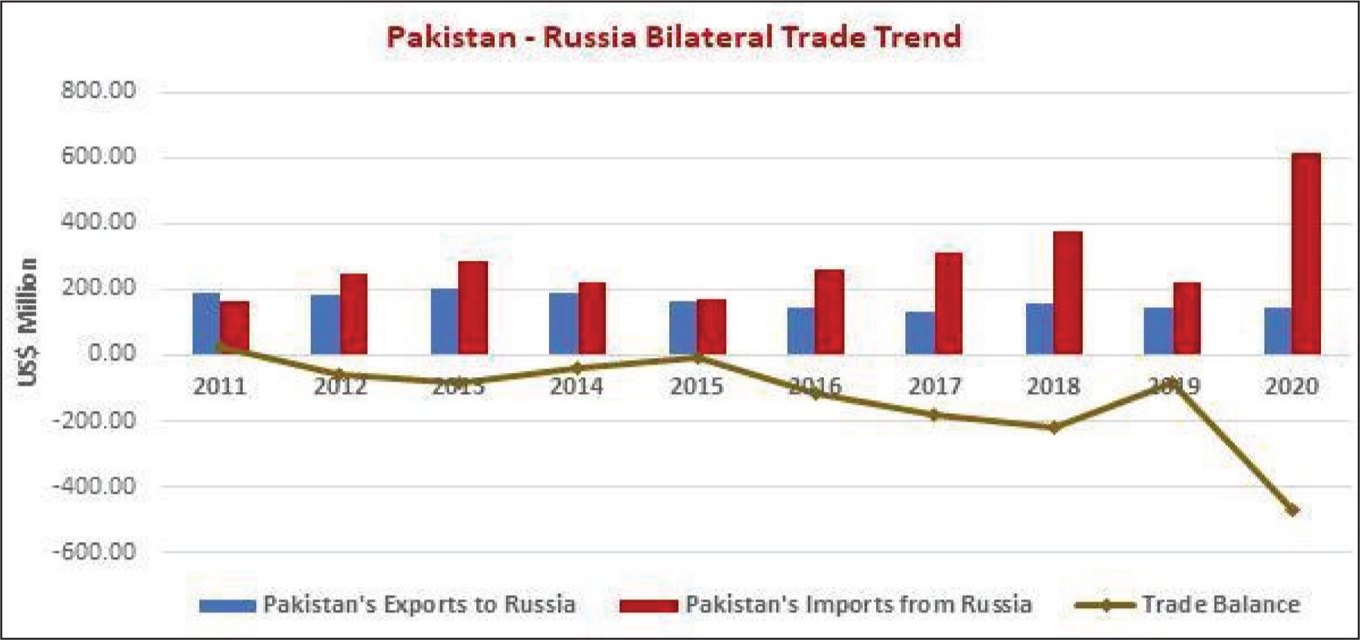
As reflects in Figure 1, though Pakistan’s total trade with Russia increased by 108% during 2011–2020, its exports decreased by 24%, whereas its imports increased by 270% in the said period. Noticeably, Pakistan observed the highest trade deficit of around 469 million US$ in 2020. Trade deficit persisted in the following years, too. In the fiscal year 2022–23, “the total trade between Pakistan and Russia amounted to $920 million. Pakistan’s exports to Russia during this period totaled $74 million, while imports from Russia reached $846 million” (The Nation, 2023a, 2023b). At Russia Day celebration on June 12, 2024, Moscow’s ambassador to Pakistan, Albert Pavlovich Khorev, announced that the trade turnover between Moscow and Islamabad exceeded US$1 billion in 2023 (TASS, 2024).
This particular figure had been reiterated by Deputy Prime Minister and Foreign Minister Ishaq Dar and visiting Russian Deputy Prime Minister Alexei Overchuk in September 2024 (Hussain, 2024). The private sector of Pakistan imported 3.536 million tonnes of grain from Russia and Ukraine costing over US$1 billion from September 2023 to April 2024 (Khan, 2024) and Russia has been the main supplier of wheat to Pakistan. Additionally, Mr Overchuk expressed a willingness to collaborate with the EAEU, a collective consisting of Russia, Armenia, Belarus, Kazakhstan, and Kyrgyzstan. He noted ongoing discussions with the Pakistani delegation about a potential free trade agreement with the EAEU, expressing openness to further detailed discussions for a tangible outcome (Hussain, 2024). In our view, such developments are best understood through a geo-economic lens, which prioritizes the role of state-directed economic instruments—like trade, investment, and connectivity—as tools of geopolitical strategy.
Moreover, in March 2024, Pakistan achieved a regional trade milestone by transporting fruit to Russia via land. Sixteen trucks from Pakistan’s National Logistics Corporation, carrying oranges, entered the Russian cities of Derbent and Grozny after a nearly 6,000-kilometer journey (Arab News, 2024a, 2024b). Pakistan and the Russian Federation in June 2023 also signed a memorandum of understanding (MoU) for cooperation between Pakistan Customs and Russia’s Federal Customs Service on Exchange of Statistical Data on Mutual Trade (The Express Tribune, 2023a, 2023b). Given economic nonperformance for years, Pakistan faces a trade deficit with all major economies, let alone Russia. Importantly, being energy-deficient and capital-dependent, successive Pakistani governments have pursued sustained economic ties with Russia with the underlying aim to accrue energy resources at affordable prices as well as decrease the country’s energy dependence on Saudi Arabia.
With regard to bilateral relations, in the recent 23rd Shanghai Cooperation Organization (SCO) Summit held on 16 October, 2024 in Islamabad, an increased dialogue between Russia and Pakistan was seen. The two Prime Ministers, Shehbaz Sharif and Mikhail Mishustin, agreed on increasing bilateral connectivity through trade, science, technology, energy, and education, following the signing of an MoU between Ishaq Dar and Alexei Overchuk in September 2024. The agreement built the foundation for productive cooperation between the two states, particularly in the sectors of trade and defense (Dawn, 2024). With Russia’s ongoing conflict with Ukraine, Pakistan’s support proves to be a meaningful asset for Moscow in tow with the SCO members. Importantly, Mikhail became the first Russian prime minister to visit Pakistan since 2007 (The Express Tribune, 2024).
Energy Projects
Besides bilateral trade, one of the most significant joint ventures between Russia and Pakistan is the PSGP, a project aimed at transporting natural gas from Pakistan’s southern port city of Karachi to Lahore, in the east. The pipeline, which is expected to have a capacity of 12.4 billion cubic meters per year, is considered a milestone in Russia–Pakistan relations and a testament to their growing cooperation in the energy sector (Government of Pakistan, 2024). Currently, the pipeline remains in the preconstruction phase. While technical parameters have been finalized and regulatory approvals secured, construction has yet to commence. Importantly, the project has faced multiple structural revisions, including changes in equity distribution and operational models, leading to delays. In addition, Pakistan’s financial constraints and security concerns along the proposed route have impeded advancement besides geopolitical tensions; particularly, US sanctions on Russian entities involved have further complicated progress. However, despite these challenges, both Pakistan and Russia continue to express commitment to the project’s realization (Inter State Gas Systems, 2025).
The joint venture between Russia’s Gazprom and Pakistan’s Oil and Gas Development Company Limited for offshore gas exploration is another promising area of cooperation (Bhutta, 2017a, 2017b). The project, signed in 2017, aims to explore potential hydrocarbon reserves in Pakistan’s Exclusive Economic Zone in the Arabian Sea, with Russia providing technical expertise and investment. Furthermore, both countries have, for geo-economic purposes, shown interest in collaborating on renewable energy projects, such as hydropower and others. Russia has expressed interest in collaborating with Pakistan on significant hydropower projects, including the 2,160 MW Dasu and the 4,500 MW Diamer-Bhasha Dam projects. A Russian company named Power Machines offered to supply electromechanical material for these developments. This partnership reflects a growing cooperation in renewable energy between the two nations, focusing on large-scale hydroelectric power generation (Atri, 2023). Russia’s experience in developing renewable energy technologies could be instrumental in helping Pakistan diversify its energy sources and reduce its dependence on fossil fuels.
Moreover, Russia and Pakistan, while marking geo-economic incentives, have taken significant steps toward strengthening bilateral trade cooperation. For example, in January 2023, both the countries successfully resolved technical issues pertaining to insurance, transportation, and payment mechanisms during the eighth session of the Russia–Pakistan Inter-Governmental Commission (IGC) on Trade, Economic, Scientific, and Technical Cooperation. They reached a consensus on the technical specifications for oil and gas transactions, addressing critical issues such as transportation, insurance, and payment mechanisms. The agreed-upon framework stipulated that payments for energy imports from Russia would be conducted in the currencies of friendly countries, thus facilitating smoother financial transactions between the two countries.
Importantly, they also signed three agreements for cooperation in the customs and aviation sector. The session, co-chaired by Pakistan’s then Minister for Economic Affairs, Sardar Ayaz Sadiq, and Russian Energy Minister, Nikolay Shulginov, emphasized enhancing energy trade and broadening energy infrastructure investment on strategic and favorable commercial terms (Radio Pakistan, 2023, 2024). Noticeably, Moscow expressed flexibility in accepting payment for oil in the currencies of any friendly country, that is, Chinese RMB, thus opening up possibilities for diverse transaction options. These developments paved the way for the signing of an agreement for the supply of Russian oil and petroleum products to Pakistan at discounted rates. The joint efforts between Russia and Pakistan underscore a geo-economic strategy that leverages mutual economic interests to foster bilateral trade, particularly in the energy sector (The News International, 2024). By resolving key logistical issues, such as payment mechanisms and transportation, both sides aim to strengthen regional integration in terms of Eurasian connectivity. However, geopolitical tensions, that is, the Ukraine–Russia war, financial limitations, and security concerns such as current India–Pakistan tensions could hinder the long-term effectiveness of these initiatives.
In addition, to lessen its economic vulnerabilities and neutralize dependence on the Saudi oil, Pakistan placed, in April 2023, its first order for discounted Russian crude oil, aiming to import 100,000 barrels per day. The deal focused on crude oil (Business Recorder, 2023); Pakistan’s Refinery Limited vowed to handle the refining process (Dawn, 2023b, 2023c). In mid-June 2023, Pakistan received its first shipment of Russian crude oil. The cargo, consisting of 45,000 metric tonnes of crude oil, arrived in Karachi (Hussain, 2023). Another oil tanker carrying 56,000 tonnes of Russian crude oil arrived at Karachi’s port in June 2023, completing the first shipment of 100,000 tonnes of Ural oil to Pakistan (Nikkei Asia, 2023). As of May 2025, Pakistan has received at least three shipments of Russian crude oil and plans to import up to 3.6 million tonnes annually, subject to refinery compatibility, port capacity, and currency mechanisms (The News, 2023).
The said cases of energy cooperation reflect geographic and economic significance of the Pakistani—for that matter South Asian market—with regard to Russian energy products.
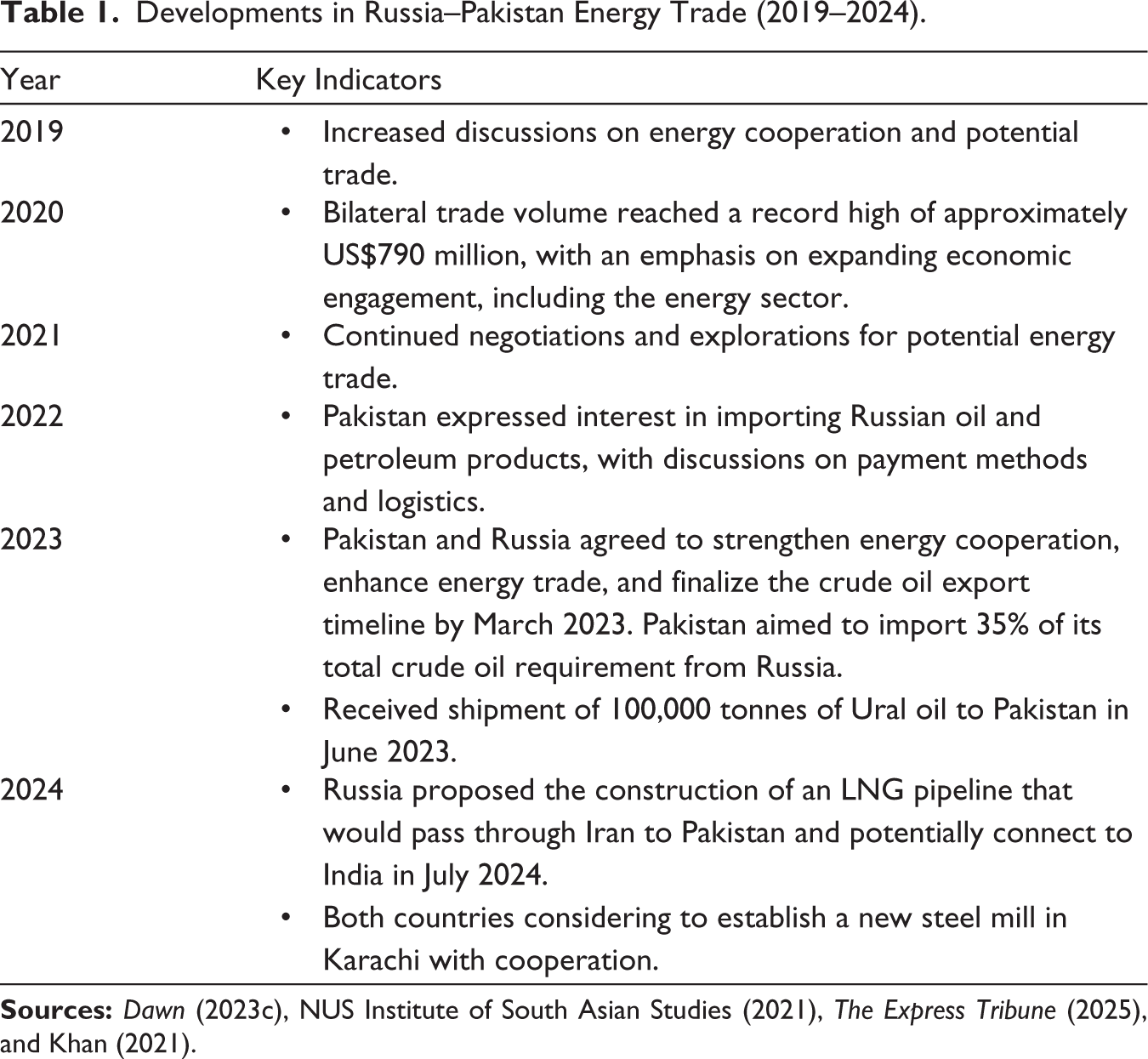
In light of our geo-economic framework, it is posited that such energy cooperation is mutually beneficial for both the countries and would arguably encourage positive interaction in other areas, that is, artificial intelligence. An American foreign policy expert, Michael Kugelman, also viewed cargo shipment as the Global South’s efforts to balance relations with both Moscow and the West (Kugelman, 2023a, 2023b). Furthermore, according to various reports, the energy trade between Russia and Pakistan has witnessed significant developments from 2019 to 2023, with a marked increase in discussions and agreements aimed at enhancing bilateral energy cooperation (see Table 1).
Developments in Russia–Pakistan Energy Trade (2019–2024).
Investments
In developments of 2024 aimed at enhancing bilateral cooperation and investments, Khalid Jamali, Pakistan’s Ambassador to Russia, announced that Pakistan has commenced the process of joining the North–South International Transport Corridor following an invitation from Russian President Vladimir Putin. Referring to President Putin’s State of the Union address from the previous year, where the invitation was extended (State Investment Facilitation Committee, 2024). At the 27th St. Petersburg International Economic Forum (SPIEF) on June 7, 2024, Pakistan and Russia signed an MoU for cooperation in the railway sector. The MoU aims to explore opportunities for railway upgrades and other projects, foster collaboration between relevant companies, and promote international cargo transport (Government of Pakistan, n.d.).
Investments in the energy sector are crucial for the overall economic development of Pakistan. As part of their growing economic cooperation amidst shifting geopolitical alignments in West Asia, Russia has already committed to investing US$14 billion in various energy projects in Pakistan, including the PSGP and offshore gas exploration. This investment, outlined in 2019, is part of a broader initiative to bolster Pakistan’s energy sector. Importantly, Gazprom, the Russian gas giant, plans to allocate significant funds toward these projects, with approximately US$10 billion directed toward an offshore gas pipeline project, US$2.5 billion for the PSGP project, and the remaining US$1.5 billion for building underground storage facilities (ISAS NUS, 2021; The Express Tribune 2019; Warsaw Institute, 2018). In April 2025, Pakistan and Russia reaffirmed their commitment to advance agreed plans in trade, energy, and security in the coming years, thus, emphasizing long-term cooperation during high-level diplomatic talks held in Islamabad (Dawn, 2025). In addition to these large-scale projects, Russia plans to invest in Pakistan’s renewable energy sector, which has immense potential but remains largely untapped due to limited resources and technological constraints. From a geo-economic perspective, Russian investments in solar, wind, and hydroelectric power projects could help Pakistan diversify its energy mix, enhance its energy security, and contribute to regional peace and stability particularly in Afghanistan in terms of offering trade and investment opportunities, Russia plays a crucial role for Central Asian countries, Afghanistan, and its South Asian neighbors (Embassy of the Russian Federation in Pakistan, 2025). As the geo-economic perspective posits, bilateral trade, joint energy projects, and investments empirically standout as key geo-economic tools available to Russia and Pakistan.
The aforementioned demonstrates that there are significant opportunities to enhance bilateral economic cooperation in the trade, investments, and above all, the energy sector. As the geo-economic perspective posits, bilateral trade, joint energy projects, and investments empirically standout as key geo-economic tools available to Russia and Pakistan. The former offers Russia strategic access to its market, along with incentives to expand into other South Asian markets like Bangladesh. In addition, Pakistan provides opportunities for cooperation in textiles, sports goods, surgical instruments, and minerals, including rare earths, crucial for Russia’s industrial and technological sectors (The Express Tribune, 2025).
Moreover, the growing cooperation in the energy sector is not only beneficial for the economic development and energy security of both the countries but also carries incentives to promote trans-regional stability, peace, and economic growth, particularly in South Asia. By engaging in these collaborative endeavors, we argue that Russia and Pakistan can effectively navigate the complexities of the international system and pursue their geo-economic interests as underscored by the geo-economic theory (Sparke, 2024). Nonetheless, despite the gradual rise in economic cooperation between Russia and Pakistan, the bilateral commercial, investment, and above all, energy cooperation is not without its challenges, which are analyzed in the following section.
Challenges
One of the major challenges in Pakistan’s growing engagement with Russia has been its economic dependence on the Unites States and the EU. Historically, Pakistan has relied on the United States and the EU for economic assistance, market access, and trade (Clary, 2022; S. Serenko, 2020). The United States has consistently remained Pakistan’s largest trading partner and a leading source of foreign direct investment, thus reflecting its importance in Pakistan’s economic landscape. The US–Pakistan bilateral trade surpassed US$12 billion in 2023 (Dawn, 2023a). Similarly, the EU has been a significant trade partner for Pakistan. Between 2014 and 2022, Pakistan’s exports to the EU surged by 108%, while imports from the EU rose by 65%. The total trade volume escalated from EUR 8.3 billion in 2013 to EUR 14.85 billion in 2022, demonstrating the pivotal role of the Generalized System of Preferences (GSP+) in enhancing EU–Pakistan trade relations (European External Action Service, 2023). In our view, this underscores the assumption of geo-economic theory that economic interdependence—while offering benefits—can also serve as a constraint on strategic autonomy.
Consequently, Pakistan’s economic ties with the United States and the EU create constraints in its bilateral engagement with Russia, as it must carefully navigate these relationships to avoid any negative fallout amid shifting geo-economic fault lines. Hence, the structure of geo-economic ties with the United States, particularly, would arguably make it difficult for Pakistan to completely shift its focus toward Russia, as doing so could jeopardize Pakistan’s relationship with the United States and the EU, potentially resulting in economic repercussions, that is, sanctions. A former Pakistani ambassador, Shafkat Saeed, argued:
Russia and its predecessor the USSR have had a long and turbulent relationship with Pakistan dating back to the Cold War period. It has therefore taken time to bring some degree of normalcy in the [bilateral] relationship. The situation now is probably better for a stable government in Pakistan to try and base relations more on economic than strategic considerations. What is fundamental for Pakistan is to keep out of the US–Russia tangle and try what the Indians [policymakers] have been doing, which is to base their relationship on their own strategic interests vis-à-vis both powers. (S. Saeed, personal communication, 2024, February 18)
We interpret this as an endorsement of the geo-economic assumption that states can increase strategic space by diversifying economic partnerships and decoupling from purely geopolitical alignments. As the above highlights, Pakistan would have to balance its relations with the United States and the EU, on the one hand, and Russia, on the other hand, in order to reap benefits based on geo-economic considerations for being energy-deficit and capital-constraint. Therefore, it would be quite challenging for Pakistan to rely on a sole source for meeting its energy needs and accessing markets. Moreover, Pakistan’s growing ties with Russia are threatened by US influence in the International Monetary Fund (IMF) as Pakistan owes US$ 8.4 billion to the latter where the United States is the largest influencer (Gul, 2024). This allows the United States to potentially leverage the IMF as a political tool, posing a challenge to the budding Russia–Pakistan relationship. From a geo-economic standpoint, this suggests that multilateral financial institutions are not merely economic platforms but instruments of strategic leverage.
In addition, the conventional rivalry between India and Pakistan also plays a negative role in terms of constraining Russia–Pakistan economic engagement. Moscow has consistently maintained strong ties with New Delhi even amid the Russia–Ukraine war. On the other hand, Russia’s relations with Pakistan have often been viewed through the lens of Russia’s engagement with India by some elements of Pakistani military (Chaliha, 2021). Russia’s concerns about maintaining access to the Indian defense market also restrict deepening defense sales to Pakistan, leading to only modest increases in arms deals (Clary, 2022). In our view, this reveals the competitive dimension of geo-economics, where economic and defense partnerships are shaped not in isolation but in relation to rival actors in a shared strategic arena.
Therefore, Pakistani policymakers in particular need to invoke the geo-economic, not geopolitical, logic for strengthening commercial and energy ties that mutually benefit both Moscow and Islamabad. Indeed, the way India has engaged both Washington and Moscow, particularly amid Russia–Ukraine war, offers policy insights for countries such as Pakistan that face policy dilemmas in terms of balancing its foreign policy vis-à-vis Russia, China, and the United States.
Finally, constrained by the Ukraine war, Russia currently seeks new markets for its energy and technological products. Being energy-deficient and carrying an underlying aim to diversify its commercial and energy enhancers, Pakistan offers itself as a viable economic and energy partner for Russia. Expanding the scale of ties with Pakistan would also suit Russia in terms of enhancing its geo-economic role in South Asia. We argue that this development illustrates one of the core assumptions of geo-economics: that market reorientation can serve as a means to mitigate the effects of strategic isolation.
Conclusion
This article has analyzed the evolving character of Russia–Pakistan relations from 2018 to the present through a geo-economic lens. It has argued that bilateral ties are increasingly shaped by shared economic interests, particularly in the energy sector, amid shifting regional and global geopolitical dynamics. The study finds that Pakistan’s growing need for affordable energy─given its economic constraints─and Russia’s strategic pivot toward alternative energy markets have created new avenues for bilateral cooperation. The delivery of Russian crude oil to Pakistan in 2023, for instance, marks a significant milestone in this emerging energy partnership. In our analysis, this case affirms a key geo-economic insight: energy trade not only meets developmental needs but also functions as a conduit for broader strategic alignment.
Yet, these opportunities are not without constraints. Pakistan’s enduring strategic and commercial ties with Western powers, coupled with transregional geopolitical conflicts such as the Russia─Ukraine war and the crisis in Gaza, pose considerable risks to the deepening of Russia─Pakistan economic relations. Furthermore, the conventional India–Pakistan rivalry remains a structural impediment, particularly as Russia continues to maintain strong defense and diplomatic ties with India.
Nevertheless, the study posits that geo-economics offers a pathway to mitigate these geopolitical constraints. Through sustained economic cooperation, particularly in energy, trade, and infrastructure, both Russia and Pakistan can not only enhance bilateral relations but also contribute to broader regional connectivity and stability. Multilateral frameworks and strategic partnerships─such as energy corridors or cooperative infrastructure development─can serve as instruments to reduce transactional risks and promote peace through economic interdependence. We posit that applying geo-economic logic offers both analytical clarity and practical guidance for Pakistan’s foreign policy—particularly as it seeks to navigate competing pressures from great powers while advancing national economic interests.
In doing so, this study makes an original contribution to the literature by employing geo-economic analysis to understand Russia–Pakistan relations in the contemporary context. It demonstrates that geo-economics is not only a useful analytical framework but also a viable policy tool for enhancing bilateral and regional cooperation. Future research should apply this framework to other South Asian cases to generate comparative insights into how states can leverage economic instruments to navigate a complex and contested geopolitical environment.
Footnotes
Declaration of Conflicting Interests
The authors declared no potential conflicts of interest with respect to the research, authorship, and/or publication of this article.
Funding
The authors received no financial support for the research, authorship, and/or publication of this article.