



Abstract
The literature on current policy scenarios has become increasingly robust in recent years, with a growing consensus that the central estimate of 21st century warming is now likely below 3 °C. This reflects progress on both clean energy technologies and climate policies that has reduced the plausibility of high-emissions pathways, as well as a recognition that the higher end of emissions scenarios was never intended to represent the most likely no policy baseline outcome. However, it is difficult to fully preclude warming of 4 °C or more under a current policy world if there are continued positive emissions after 2100 or if carbon cycle feedbacks and climate sensitivity are on the high end of current estimates in the literature. Current policy scenarios are a useful benchmark for assessing climate impacts and the effects of further mitigation, but should not be seen as either a ceiling or a floor on future warming outcomes.
A convergence of current policy projections
Over the past decade, the climate science community has taken important steps in reducing the envelope of uncertainty in future warming projections (Gillett, 2024; Lehner et al., 2023). This has primarily occurred through two means: a reduction in the likely range of climate sensitivity through the synthesis of multiple lines of evidence (Sherwood et al., 2020), and a reassessment of plausible future emissions scenarios in light of falling clean energy cost and strengthening climate policies (Hausfather and Peters, 2020).
There has been a particular push to better understand “current policy” scenarios: what levels of emissions and warming are implied by policies in place today and future technological developments in the absence of additional climate policy. Current policy scenarios provide a useful counterfactual peg for a world where no additional action is taken, and are envisioned to play a major role in the upcoming emissions scenarios underlying the CMIP7 modeling cycle and the IPCC 7th Assessment Report (Meinshausen et al., 2024; ScenarioMIP, 2024).
Defining current policy is decidedly challenging, as it requires both an assessment of the impacts of frozen policy for the remainder of the century and is subject to large uncertainties in future changes in cost and availability of different energy resources. Despite this, there has been a proliferation of estimates in the literature in recent years showing broadly consistent results. Figure 1 shows a review of the range of current policy scenarios published over the past 5 years—along with similar scenarios for the achievement of 2030 NDCs, national net-zero commitments, and other constrained estimates of future emissions.
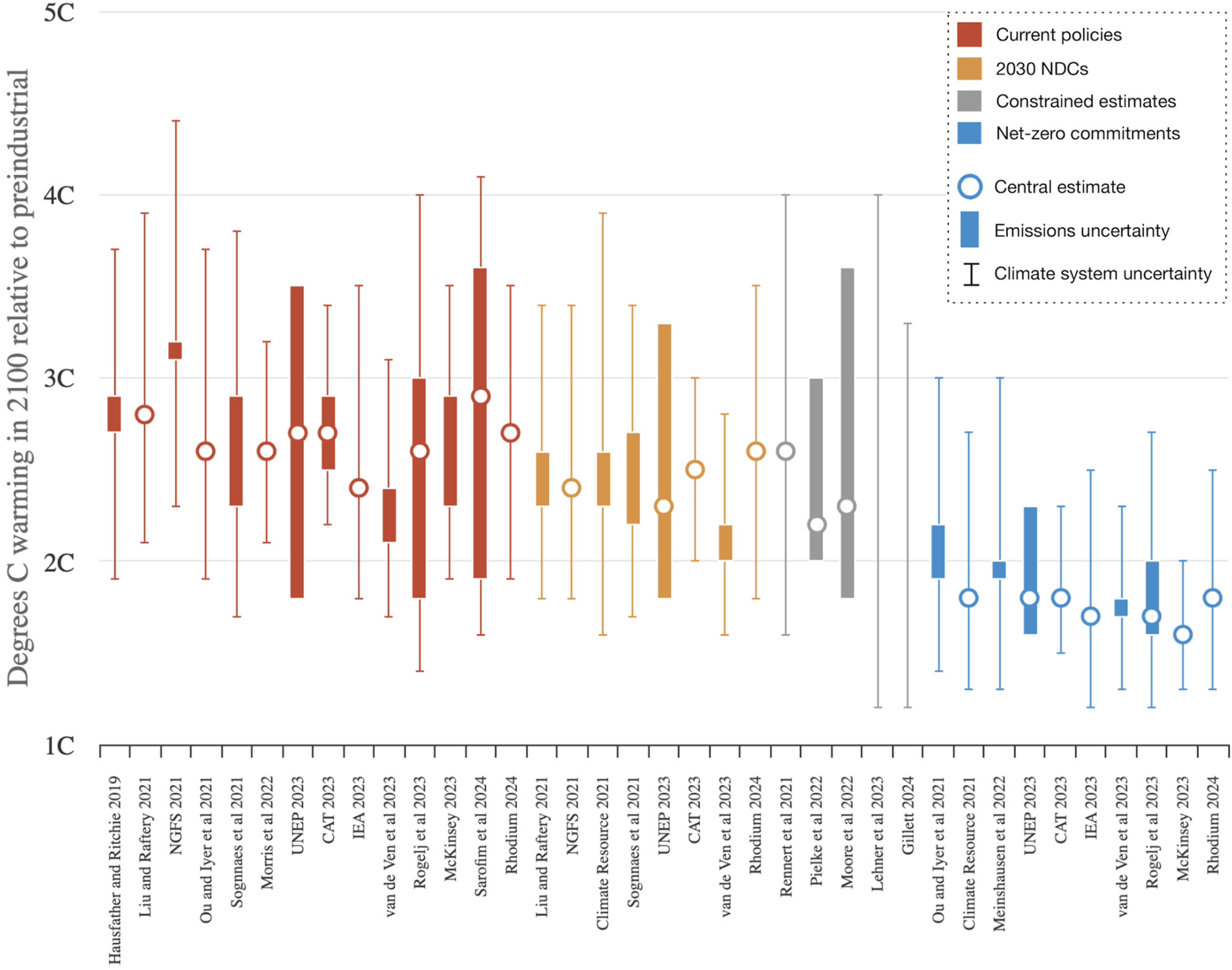
Recent estimates of 2100 warming outcomes for current policy (red, left), 2030 NDC (orange, middle), and net-zero commitments (blue, right) relative to a 1850–1900 preindustrial baseline period. Central estimates, emissions pathway uncertainties (when available), and climate system uncertainties are all shown. Constrained estimates that apply some constraint (political, economic, energy system, etc.) to future emissions but do not clearly fall into the other categories are shown in gray.
These suggest a median estimate of future warming under current policies of 2.7 °C in 2100 (with a 5th-95th percentile range of central estimates spanning 2.3 °C to 3 °C). Adding in emissions uncertainties and climate system uncertainties gives a much wider range of 1.9 °C (5th-95th percentile range of lower bound estimates from 1.5 °C to 2.2 °C) at the low end to 3.7 °C (3.2 °C to 4.4 °C) at the high end. Current policies represent something of a moving target, which complicates the interpretation of a review of recent literature; those studies from 2021 may lag behind the policy and technology environment of 2024, for example.
The push to examine the range of outcomes consistent with current policy (and a rapidly growing literature on the topic) allows us to better constrain the upper bound of plausible scenarios today. In particular, the range of current policy scenarios in the literature largely preclude emissions pathways in high-end scenarios like RCP8.5 (Riahi et al., 2011), SSP3–7.0, or SSP5–8.5 (Riahi et al., 2017) in the absence of an active reversal of current policy and current technology trends.
The median range of warming outcomes across current policy scenarios and commitments summarized in Figure 1 (e.g., 2030 NDCs and net-zero commitments) is approximately half that of the full range of assessed warming in the recent IPCC AR6 (Gillett, 2024; Hausfather and Moore, 2022), as shown in Figure 2. The reduction in warming range is particularly pronounced on the high end, though there is also some reduction on the low end reflecting the fact that even ambitious net-zero commitments result in emissions well above SSP1–1.9 scenarios that limit warming to 1.5 °C with low overshoot (Meinshausen et al., 2022; Rogelj et al., 2018).
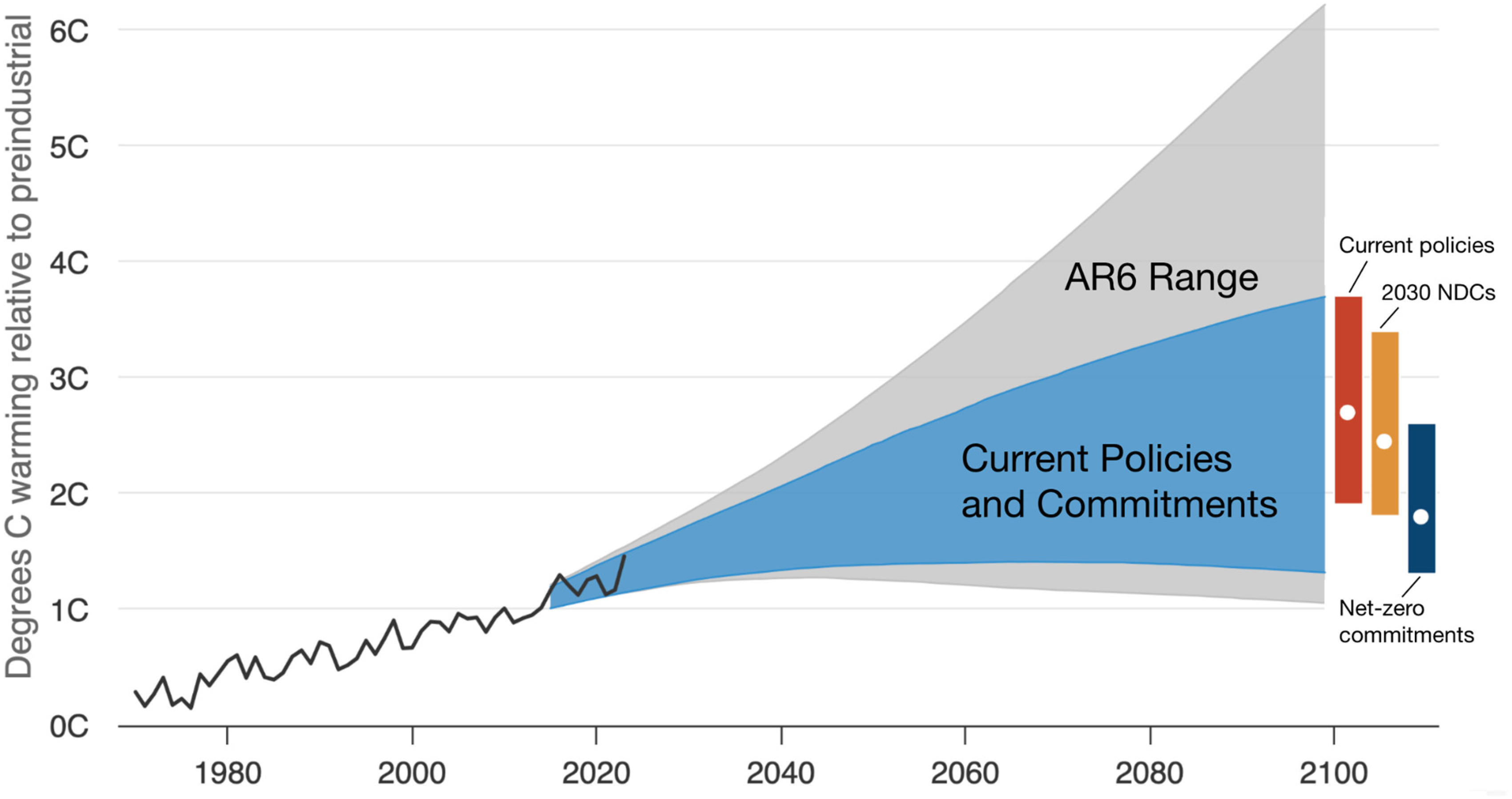
Comparison of the full range of assessed warming projections in the recent IPCC 6th Assessment Report (5th percentile of SSP1–1.9 to 95th percentile of SSP5–8.5) to a range defined by the median of the upper, central, and lower estimates of current policy and commitments outcomes in the literature reviewed in Figure 1. Observed annual global mean surface temperatures from WMO 2023 are shown in black. Adapted from Figure 1 in Hausfather and Moore (2022).
Estimates of future emissions under current policies tend to most closely match or fall slightly below those of the middle-of-the-road SSP2–4.5 scenario (Srikrishnan et al., 2022; Venmans and Carr, 2024). Figure 3 shows a range emissions across current policy scenarios compared to the SSPs featured in the AR6.
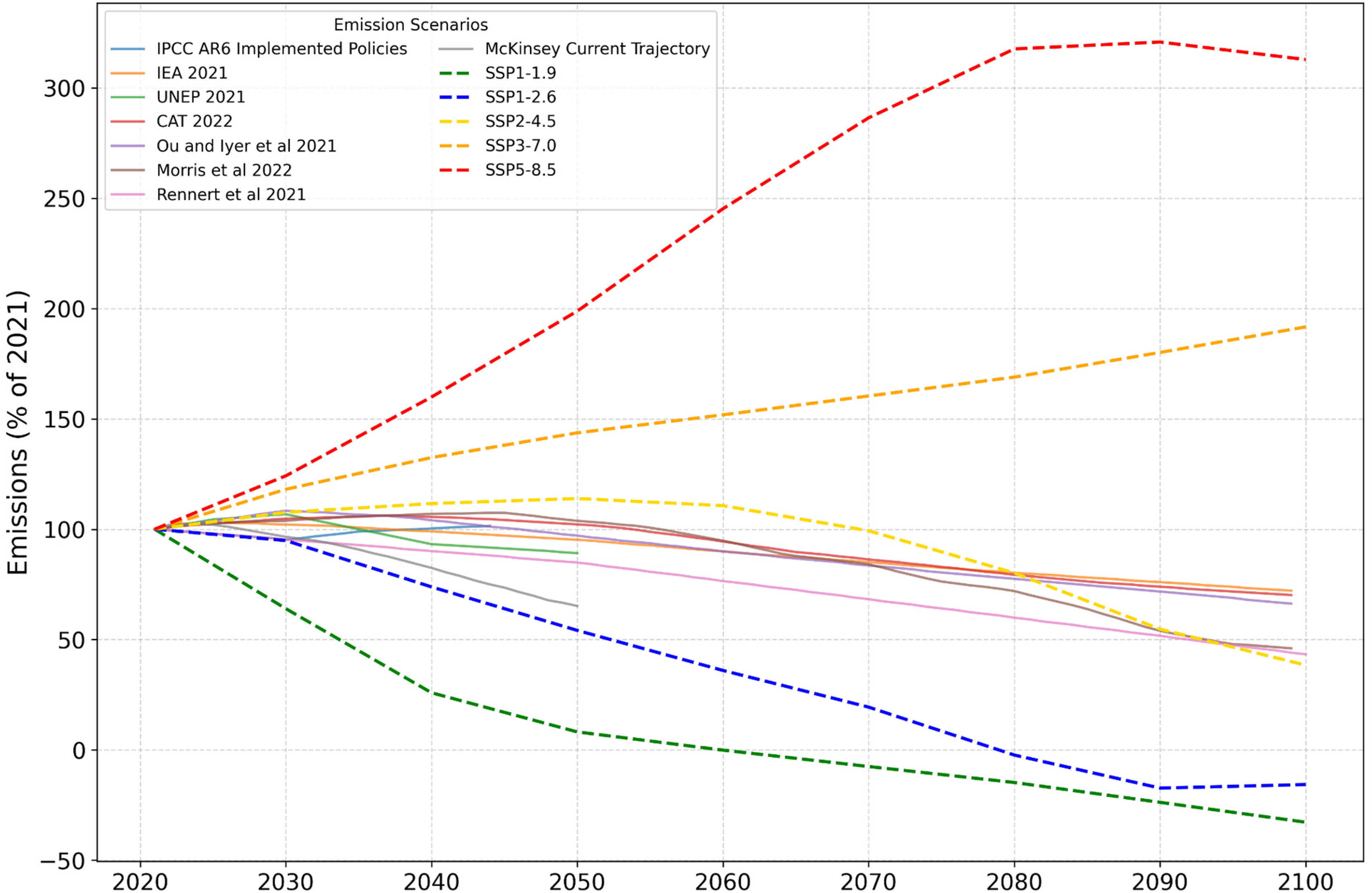
Annual CO2 emission projections relative to 2021 levels in current policy scenarios (Venmans and Carr, 2024) and SSPs highlighted in the IPCC AR6 (Riahi et al., 2017). Adapted from Figure 1 in Venmans and Carr (2024).
A move away from high-end emissions scenarios
This move away from high-end emissions scenarios in the literature reflects a broader recognition that the world is undergoing an energy transition away from a future of continuing fossil fuel expansion (IEA, 2023). Fifteen years ago many researchers argued that “business as usual” would likely lead to a world 4 °C or 5 °C above pre-industrial levels by 2100 (Sokolov et al., 2009). Today the world is in a very different place; growth in CO2 emissions slowed notably over the past decade (Friedlingstein et al., 2023), and emissions are projected to plateau in coming years under current policies and commitments (IEA, 2023). Global investments in clean energy topped 1.8 trillion in 2023, nearly double the level of global investments in fossil fuels (IEA, 2023).
High emissions scenarios assume a 21st century dominated by coal; however, global coal usage has been relatively flat since 2013, and is forecast to decline over the remainder of the century (IEA, 2023). There are also likely fundamental resource limits to the degree of coal expansion seen in RCP8.5 and SSP5–8.5 (Ritchie and Dowlatabadi, 2017), as well as overly optimistic assumptions of future economic growth (Burgess et al., 2023).
The reduced plausibility of high-end emissions scenarios has been widely recognized in recent years. The recent IPCC AR6 WG3 report (Riahi et al., 2022) noted that “high-end scenarios have become considerably less likely since AR5 but cannot be ruled out.” They also clarified that these do not represent current policy scenarios, but rather a world that actively reverses past progress, pointing out that “RCP8.5 and SSP5–8.5 do not represent a typical ‘business-as-usual’ projection but are only useful as high end, high-risk scenarios.”
The reassessment of probable emissions outcomes in recent years has sparked a debate about the extent to which this was driven by climate policy and technological development. There is a tendency to assume in hindsight that past high emissions scenarios were clearly unrealistic at the time. However, there was a commonly held view in the late 2000s and early 2010s that the world was heading to around 4 °C warming by 2100 under current policy scenarios (Sokolov et al., 2009). Research at the time criticized assumptions of “spontaneous” decarbonization in baseline emissions scenarios as “optimistic at best and unachievable at worst” (Pielke et al., 2008).
At the same time, it is clear that the highest end of emissions scenarios found in the literature (e.g., RCP8.5 and SSP5–8.5) were misinterpreted by much of the community as “business-as-usual” when they were never intended to reflect the median no-policy baseline scenario (Hausfather and Peters, 2020). For example, RCP8.5 was designed to reflect the 90th percentile of baseline scenarios in the literature (van Vuuren et al., 2011), with outcomes consistent with RCP6.0 deemed approximately equally likely in the absence of climate policy interventions. The median baseline scenario at the time resulted in closer to 7 W/m2 forcing (and ∼4 °C median warming) rather than the ∼4.5 °C warming found in RCP8.5 and 4.7 °C warming in SSP5–8.5. Prior to the 2015 Paris Agreement, more modest baseline warming estimates were published by both the IEA (3.5 °C) and Climate Action Tracker (3.6 °C) (CAT, 2023; IEA, 2023).
Ultimately, the degree to which the improvement in probable 21st century emissions outcomes was due to progress in driving down the costs of clean energy and climate policy interventions vs. implausible assumptions of high future emissions is to a large degree unknowable given its dependence on counterfactual assumptions. It is hard to rule out the possibility that the 21st century could have ended up dominated by coal—as seemed much more plausible from the vantage point of the mid-2000s—even if it is clearly quite unlikely today.
Challenges remain in constraining high-end warming outcomes
While the community has narrowed the range of plausible future emissions scenarios, constraining the range of future climate outcomes has proven more challenging. Despite a narrowing of the range of climate sensitivity in recent years (Sherwood et al., 2020), it remains difficult to fully rule out warming of 4 °C or above under current policy emissions scenarios (Riahi et al., 2022; van de Ven et al., 2023). Carbon cycle feedback uncertainties also play a role here, making it possible to have higher forcings under lower emissions scenarios (Hausfather and Betts, 2020). For example, under the high end of carbon cycle feedback estimates in the literature, RCP4.5 emissions count result in atmospheric CO2 concentrations consistent with RCP6.0 (Hausfather and Betts, 2020).
Current policy scenarios through 2100 are also not a complete constraint on the level of future emissions and atmospheric concentrations. The world does not end in 2100, even though our model runs generally do, and continued emissions at a current policy level post-2100 would result in higher forcing levels in the following century (Sarofim et al., 2024). Similarly, it is possible to imagine a SSP3-style world of regional conflicts and isolationism that prioritizes and subsidizes domestic fossil fuel resources and rolls back some of the climate policies that we have in place today (Hausfather and Richie, 2019; Riahi et al., 2017).
However, it is important to note that the past two decades have seen a continued strengthening of climate policy and more rapid than expected technological advances (IEA, 2023). These make future emissions scenarios below current policies a considerably likelier outcome than frozen policies for the remainder of the 21st century, even if a strengthening of current policies remains far from assured. That being said, there is considerable skepticism among IPCC authors that even the central estimate of current policy outcomes will be achieved, with 58% of those recently surveyed expecting at least a 50% chance of reaching or exceeding 3 °C by or before 2100 (Wynes et al., 2024).
There remains a huge amount of work to do to achieve the Paris Agreement Goal of limiting warming to well-below 2 °C this century. While the move away from high-end emissions scenarios is promising, the longer the world delays in transitioning from current policies toward deep emissions mitigation, the greater the risks become of overshooting our temperature goals and locking in the impacts of a much warmer world or having to rely on an ever-increasing amount of costly negative emissions to bring global temperatures back down.
Footnotes
Data availability

Declaration of conflicting interests
The author declared no potential conflicts of interest with respect to the research, authorship, and/or publication of this article.
Funding
The author received no financial support for the research, authorship, and/or publication of this article.